“When we run from our suffering we are actually running toward it.” Ajahn Chah
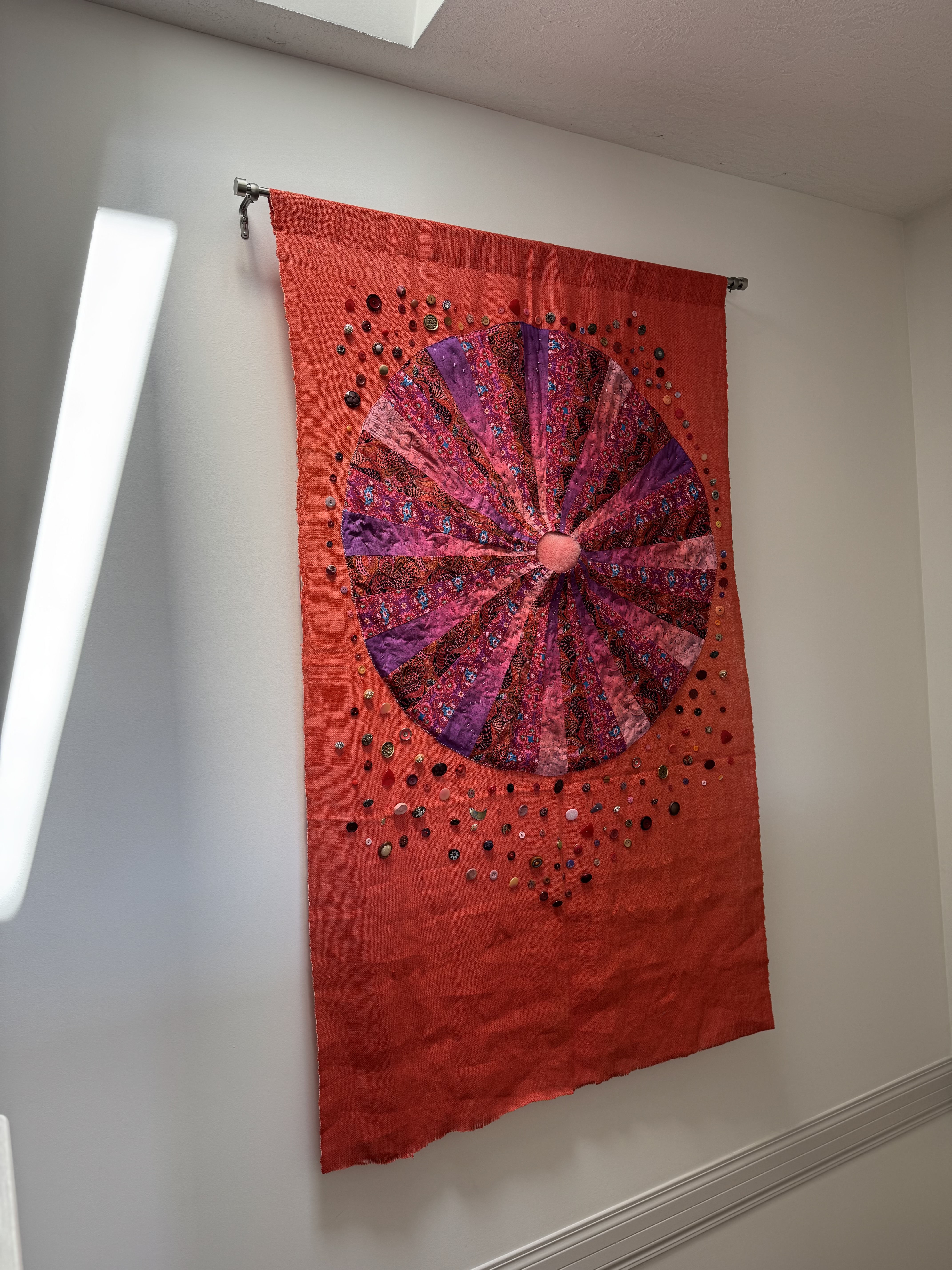
I’ve been basking in two messages from my unconscious this week. In one dream, a person wearing a bright tie-dyed shirt holds a hand lettered sign, “You are not alone.” In another dream, a young man, bearded, hugs me and whispers in my ear, “Thank you for your patience.” The messages are hackneyed, and yet they were delivered to me fresh, warm, colourful,by stately messengers. It doesn’t matter if they—the messages and the messengers—aren’t “real”; they are just as real as the people and events, the words, ideas, and things I encounter in my dream-like conscious life. And more to the point: They provide great comfort, having bathed me all week in an orange glow, a glow like that emanating from the 10,000 joys wall hanging, now installed in our stairwell.
The wall hanging seems to collect the sunlight falling in through the skylight and send back a peachy radiance. Several times now I’ve gone to flick the hall light off, thinking the switch is on when it shouldn’t be. No, the light is off, but 10,000 joys shed their own uncanny light.
When I made the piece, I kept telling myself, you don’t have to make its counterpart, 10,000 sorrows. It’s okay to just focus on joy right now. But of course, you cannot have 10,000 joys without 10,000 sorrows. I wish we taught this truth to children in kindergarten. You don’t experience joy without experiencing sorrow. And it’s okay. When you cling to joy and try to avoid sorrow, you just prolong it. I wish I’d gone to a Buddhist kindergarten, where these truths would be taught elegantly and logically, instead of being told by adults that “life isn’t fair,” which seems tawdry and cruel in comparison to the dharma.
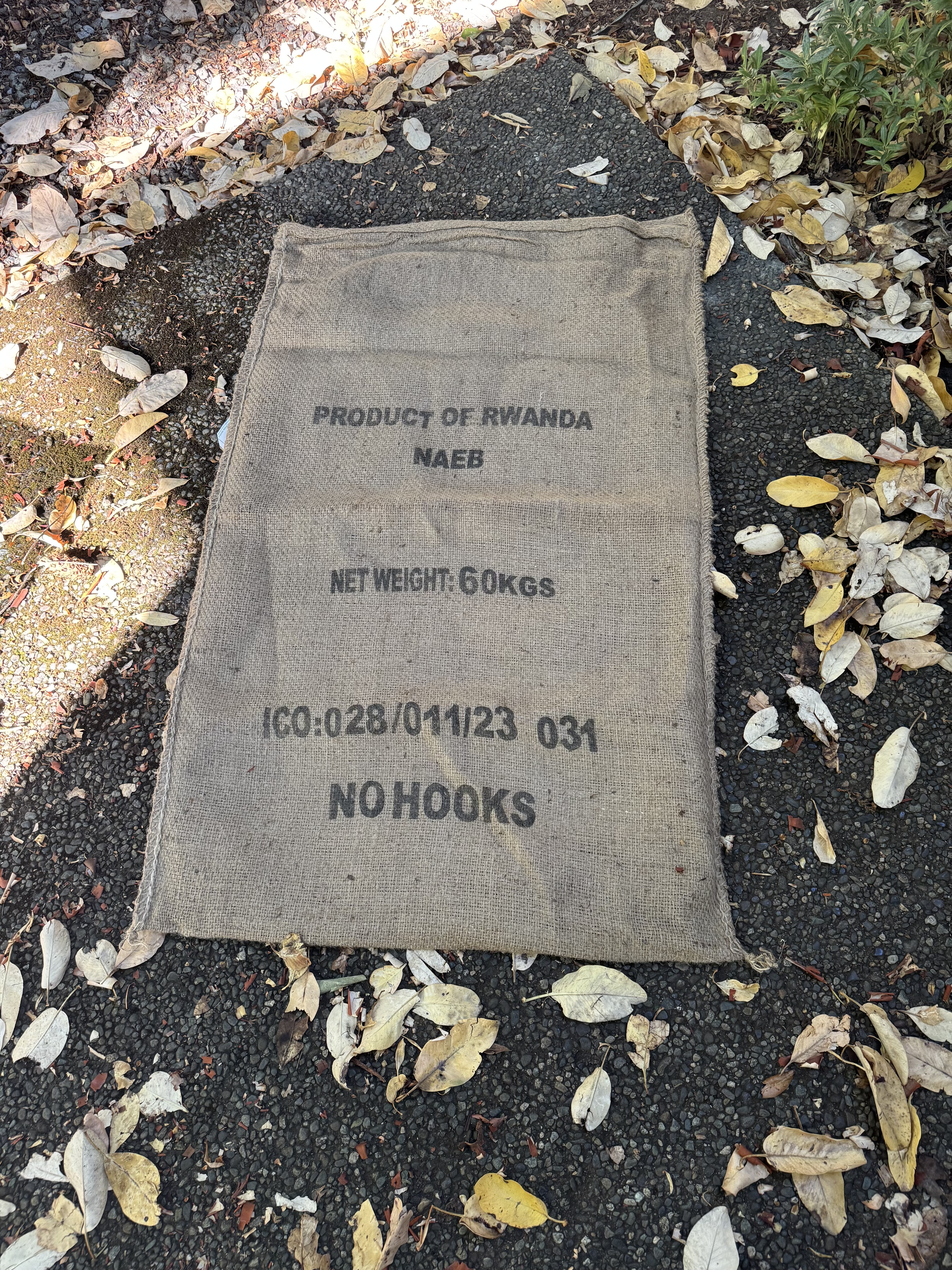
Inevitably, I am called upon to make joy’s counterpart. I had coffee with a friend yesterday at Esquimalt Roasting Company. As I waited at the counter for our lattés, I noticed a large burlap bag draped over a plastic bucket. I picked it up and showed it to the barista. Can I buy this? I asked. In my imagination, I was already picking its seams and spreading it out, a wide brown canvas for thousands of sorrows. It’s free! she responded. So now I have the backdrop for the wall hanging. I had originally thought it should be black, but brown is less dramatic than black, more subdued and complex, as sorrows often are, especially as we digest them.
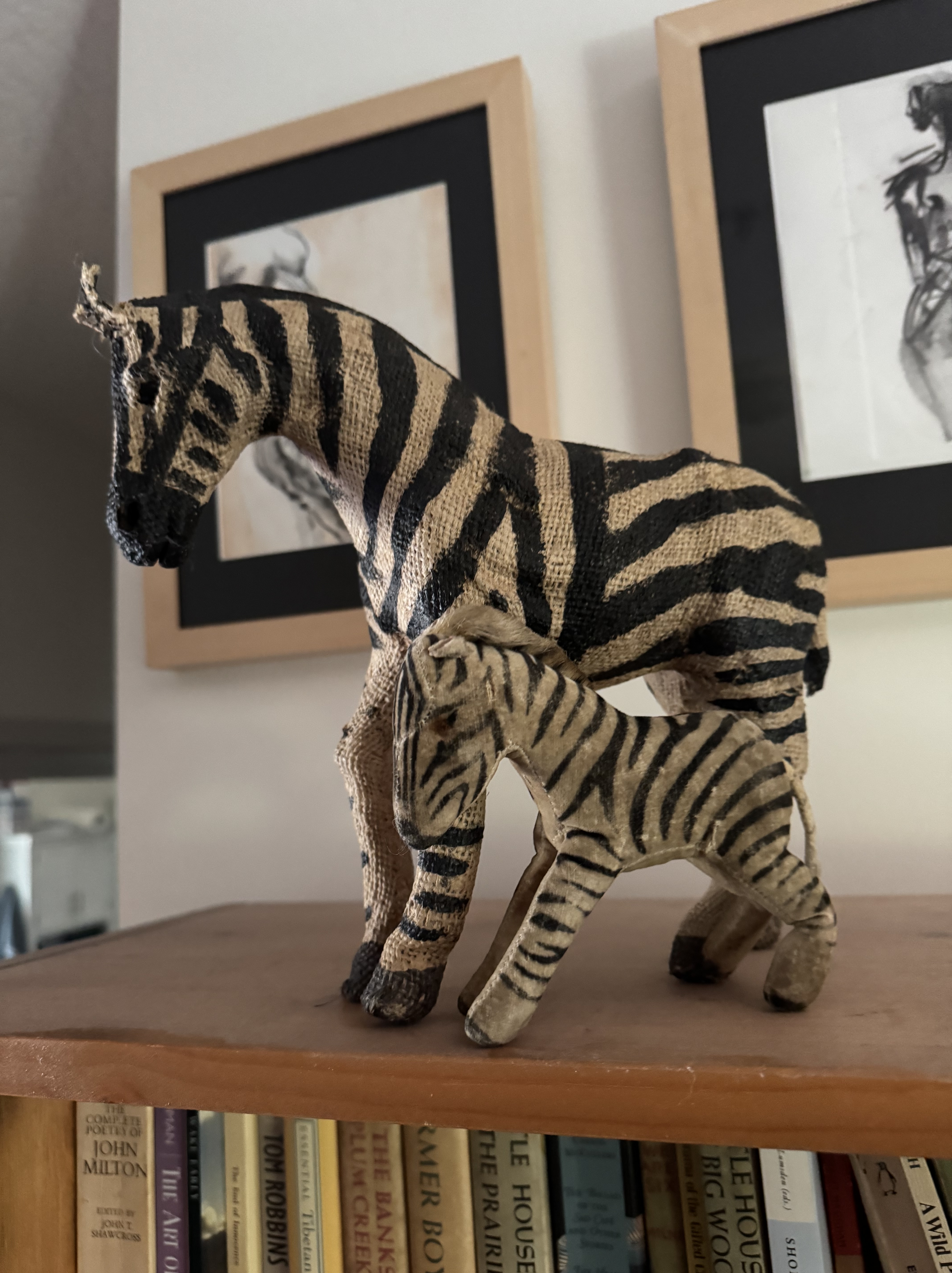
The burlap bag was pure serendipity. Another magical find was a zebra at the ReStore in Langford. Purchased for 70 cents ($1.00 but there was a 30% off sale). This zebra is majestic, dignified, kind, warm. She stands about 10 inches high. Her stripes are unrealistic, but otherwise she is a convincing animal. I dug out a stuffed toy zebra I’d kept from childhood in a box under the stairs. It’s remarkable this sixty-year old stuffed animal still stands! They now live together, mother and child, atop a bookshelf in our bedroom. I like to gaze at them from bed. Something about them feels calming, comforting. I loved my zebra striped one-piece bathing suit when I was eight years old. When I wore it, my reward was a zebra tan that was pure magic.
How to find comfort
Face fear, face grief, crunch on them like buttered toast, let them nourish you. Small striped body in the mirror, some kind of childhood magic. Let dreams bathe you in orange light. Sweet’s after tastes bitter, crying sparks a belly laugh. Joy and sorrow are so intertwined, you can’t tease them apart, please don’t waste time trying. Practice the butterfly hug: Hands cross collarbones, thumbs meet, fingers tap lightly, lightly. A comforting rhythm will come. It will come.
I am in Toronto for a few days. This city was my home from 1965 to 1989.
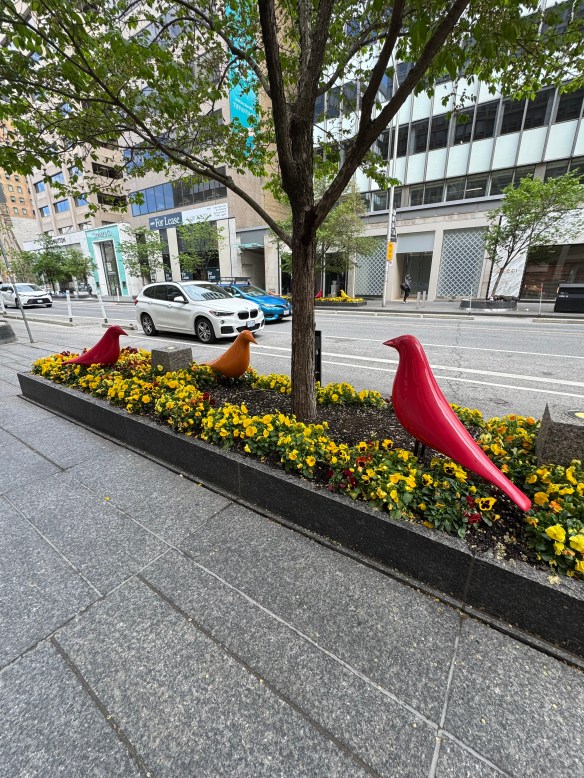
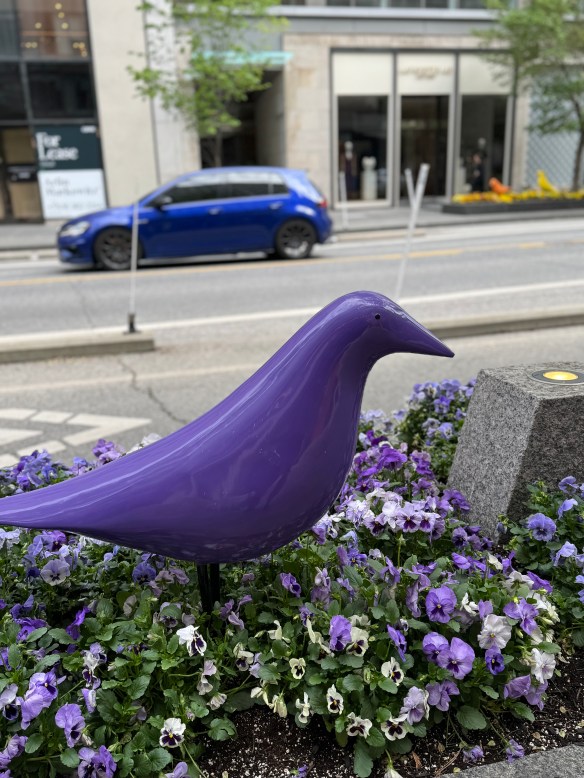
I have been walking Bloor Street West. First, the Mink Mile, that stretch between Yonge and Avenue Road lined with the tall glass storefronts: Zara, Birks, Lululemon, Holt Renfrew. Rich people shop here. Very few birds fly above these tall, inhospitable stores. Instead, big bird shapes in bright shiny colours line the sidewalks, ghosts of extinct species.
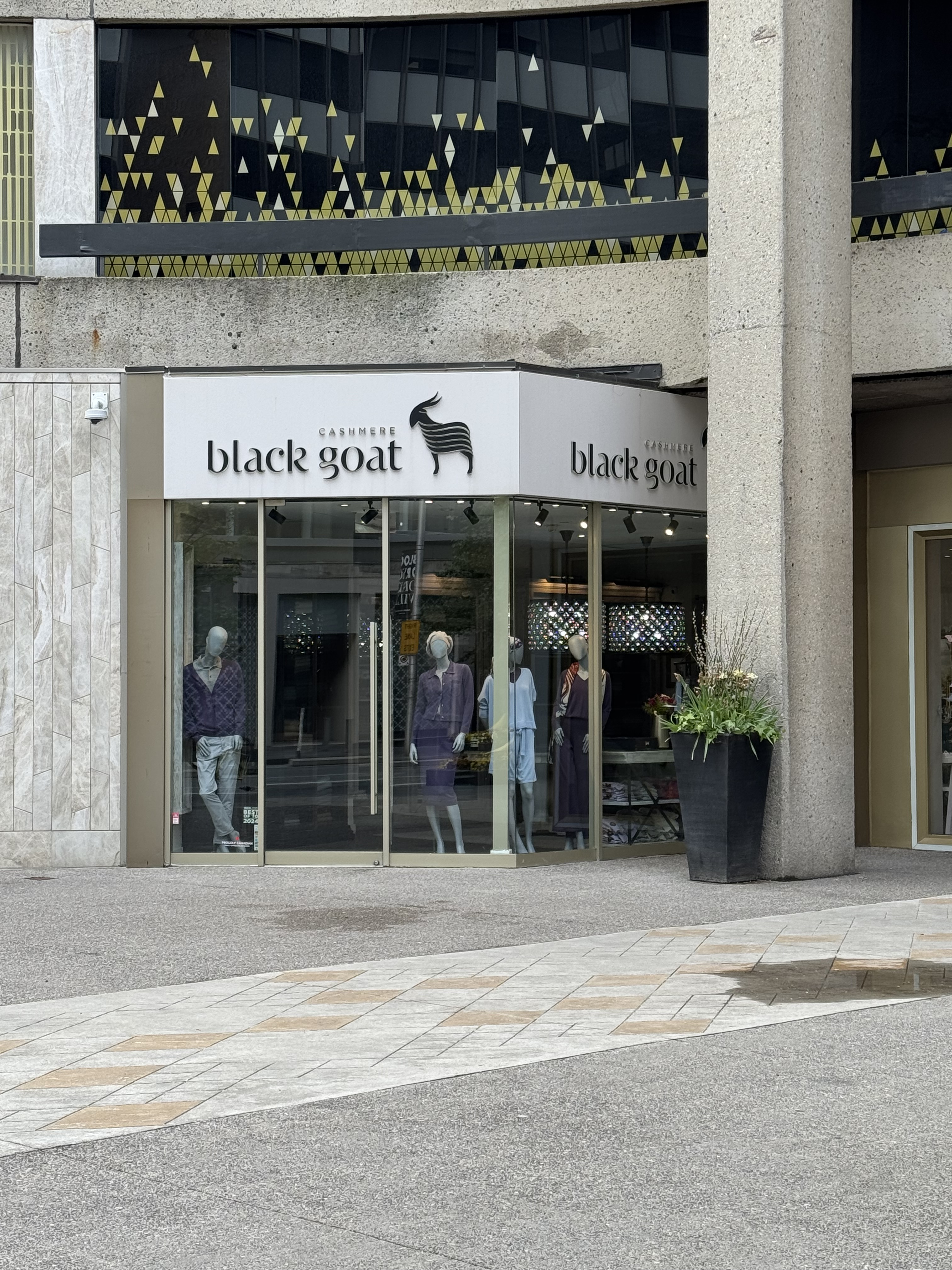
It’s cold in Toronto for late May. I wear a toque, jacket, leather gloves. But now I wish I’d brought a scarf. I admire the scarves in the window of Black Goat Cashmere, next to Ashley’s in what used to be called the Colonnade. This mall was one of my mother’s favourite places; after window shopping Bloor Street arm in arm, we’d drink coffee and eat pastries at the Coffee Mill at the back of the Colonnade.
I enter the store. Two saleswomen are upon me immediately. I ask about the small scarves, lifting one of them up out of the wooden box where they are displayed like confectionary, soft cashmere in artful designs, wool watercolours. “How much are these little ones?” “Oh,” says one of the women, advancing, “the Carre scarves are $385.” I laugh, folding the luxury item back into its box. “Perhaps in another lifetime.”
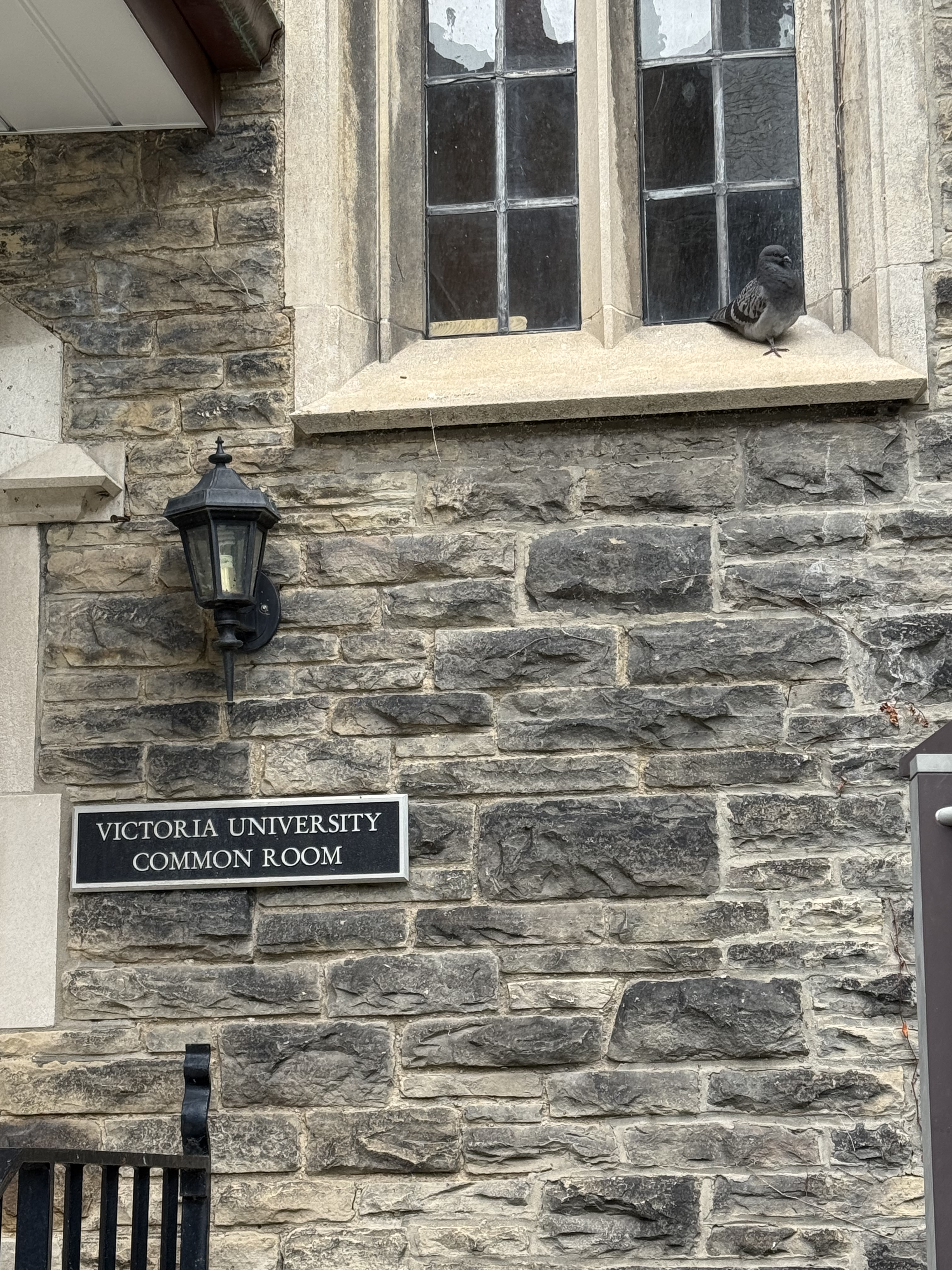
Pulling my zipper up to my chin and walking into a fierce wind, I take a detour to wander around the grounds of my alma mater, Victoria College. I feel nothing as I gaze over the green lawns, watching two young men kick a soccer ball. Alma mater means “nourishing mother,” but this place was not that for me. Those four years as an undergrad in English Literature are a blur. One thing stuck: a Shakespeare lecture by Northrop Frye when he—already extremely old—told us in his quavery voice that Bach’s Mass in B Minor was the voice of God speaking. All of us bent over our notebooks and wrote that down. It sounded profound.
I was a lonely young woman. Barry Lopez writes that “It is not possible for human beings to outgrow loneliness,” and that seems true to me. Though I’m not as lonely as I was. I admire a pigeon perched in the recessed window of the Victoria University Common Room.
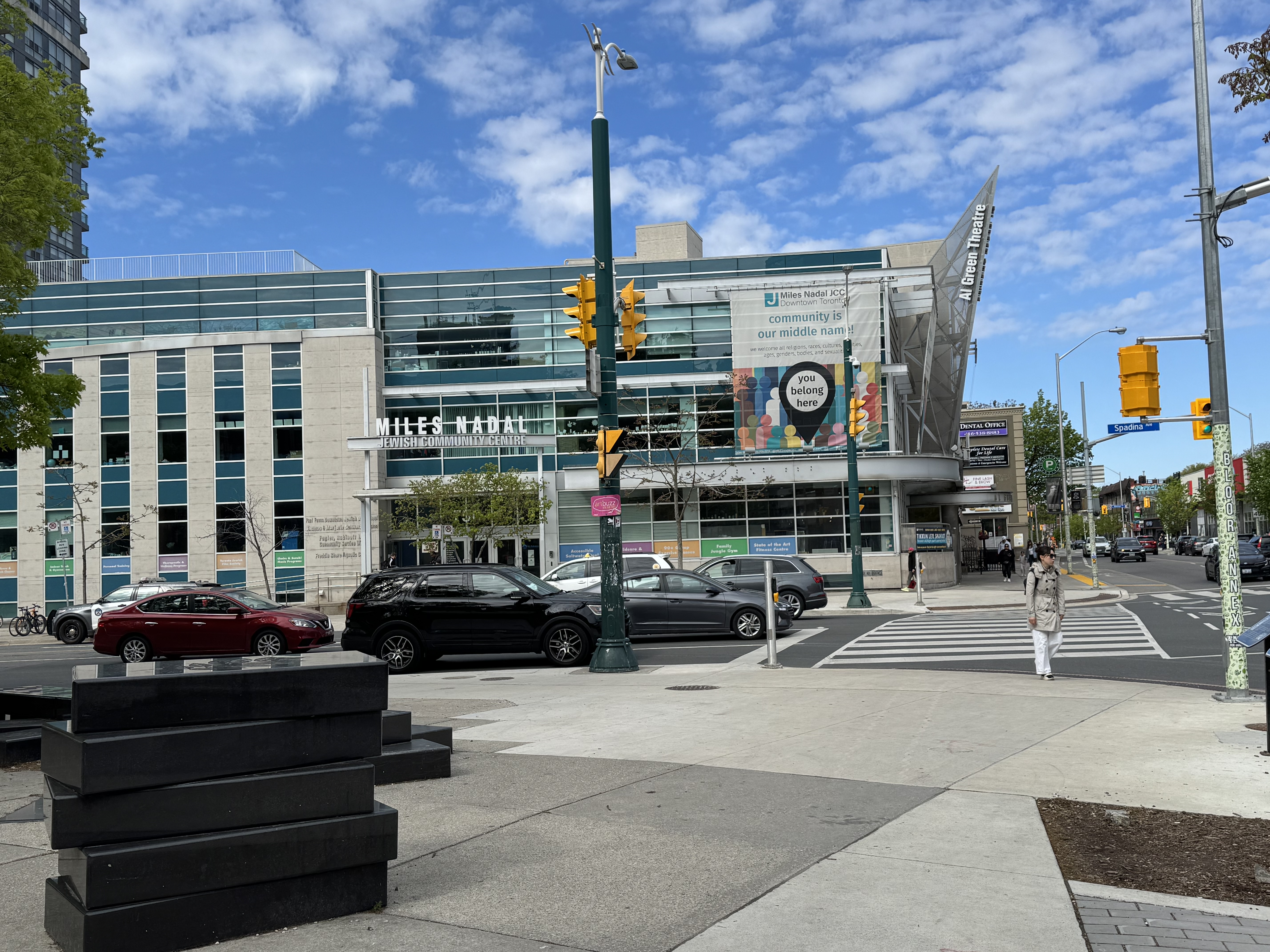
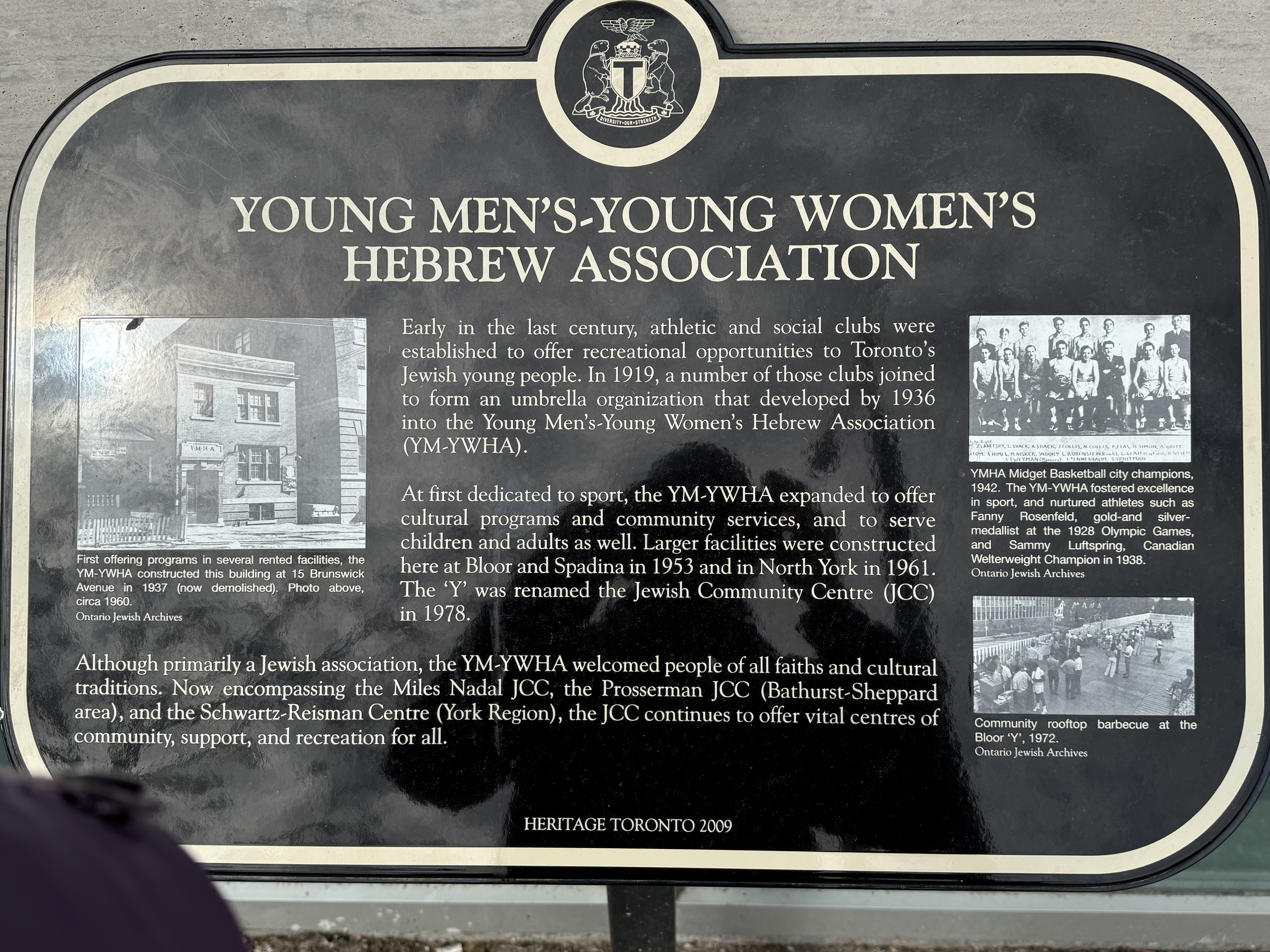
On the way up University back to Bloor Street, I check out the Gardiner Ceramic Museum, where I hope to see the work of contemporary ceramic artists, only to find that the main galleries are closed for renovation. I continue back along Bloor. It’s time for a coffee and I remember a Second Cup in the block before Spadina Avenue. And if that is no longer around, there’s a coffee shop in the old Jewish Community Centre (JCC), where my mother did aquafit for the last decade of her life. Back in the seventies, when it was the Young Men’s Hebrew Association, it was home to SEED, the alternative school my sisters and I went to as wild teens.
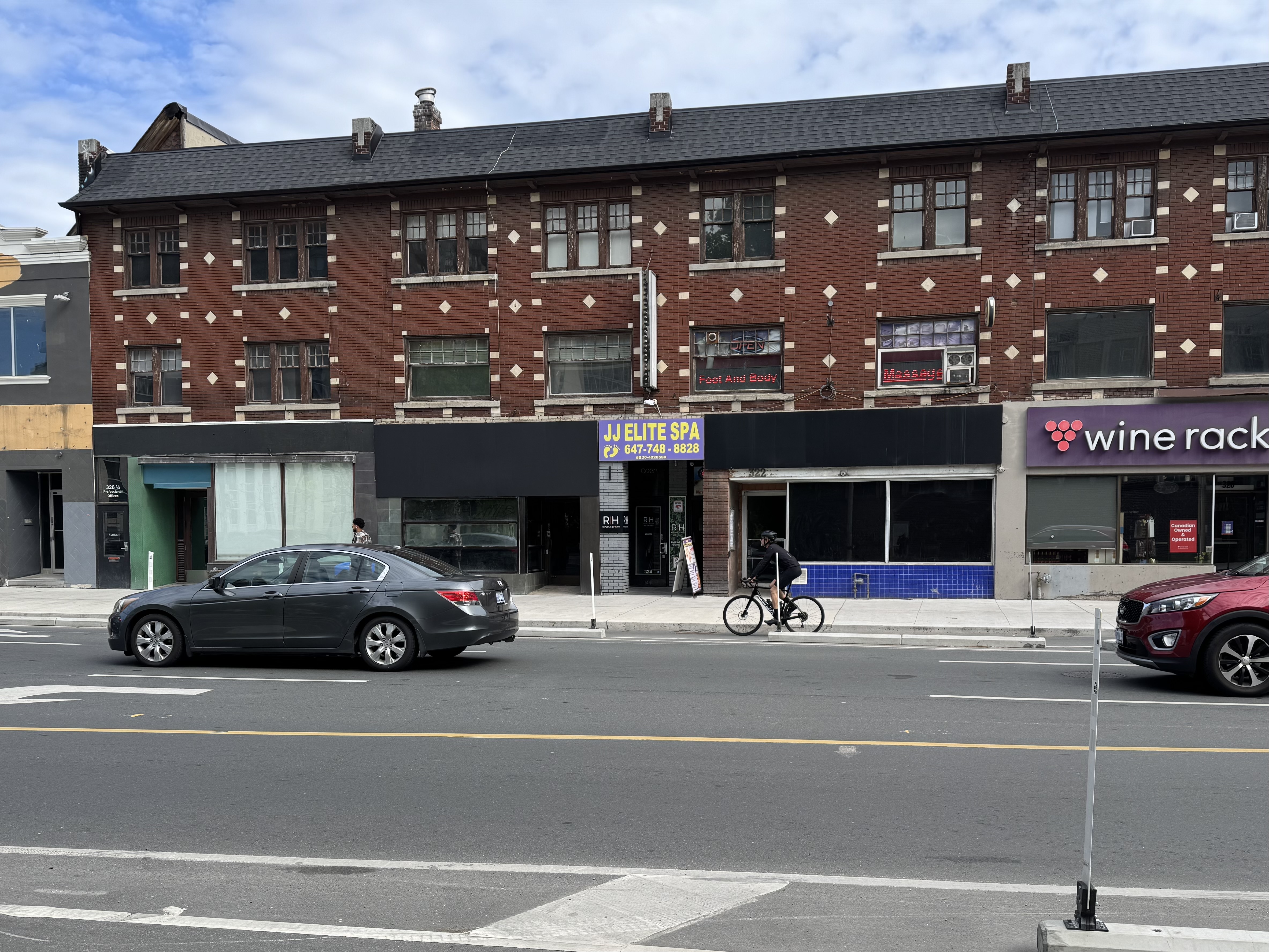
Second Cup is gone, and so are many of the other businesses on that block. Everything in life is impermanent, so I am not surprised Second Cup and Noah’s Health Foods have disappeared, and the spaces are vacant. Once upon a time there was a greasy spoon in this block where we drank coffee in thick cups, smoked cigarettes, and ate French fries. We walked over from “school” and stuffed our electric bodies into the vinyl booths, laughing, talking, flirting, mystified and excited by life. Once, for a time, my sister lived above the restaurant with her boyfriend, an apartment with burlap on the walls and plants everywhere. There’s history here.
The wine store remains. This is where we bought bottles for the meal marking my mother‘s death in February 2019. Her house is only a few blocks from this corner, and she died at home. We carried the clanking bottles through the snow. My sister made bouillabaisse and we sat around the teak table, drinking, eating, and telling our Virginia stories, stories filled with love, regret, sadness, and confusion.
I cross the street twice to the southwest corner and pull on the doors of the Jewish Community Centre, but my pull meets resistance. A security guard opens the door from the other side, just a few inches, and peers at me. “I am trying to get into the coffee shop,” I say. “No more coffee shop. Coffee shop no more,” a sort of palindrome of endings. And he closes the door in my face.
I keep walking. Surely, there is a sweet, cool, interesting café somewhere along Bloor. I am Ahab stalking the great flat white, but she’s nowhere to be found. I pass more than one Tim Hortons among the restaurants and bars still closed this cold morning, but no, I won’t go there. Cigarette butts decorate the grey pavement, evidence of parties spilling onto the street last night. Pigeons strut their stuff. I keep walking. Yes, I know Futures Bakery might be considered an interesting coffee shop, but I hold out for something else, some uncertain thing, something new, something not in the algorithm.
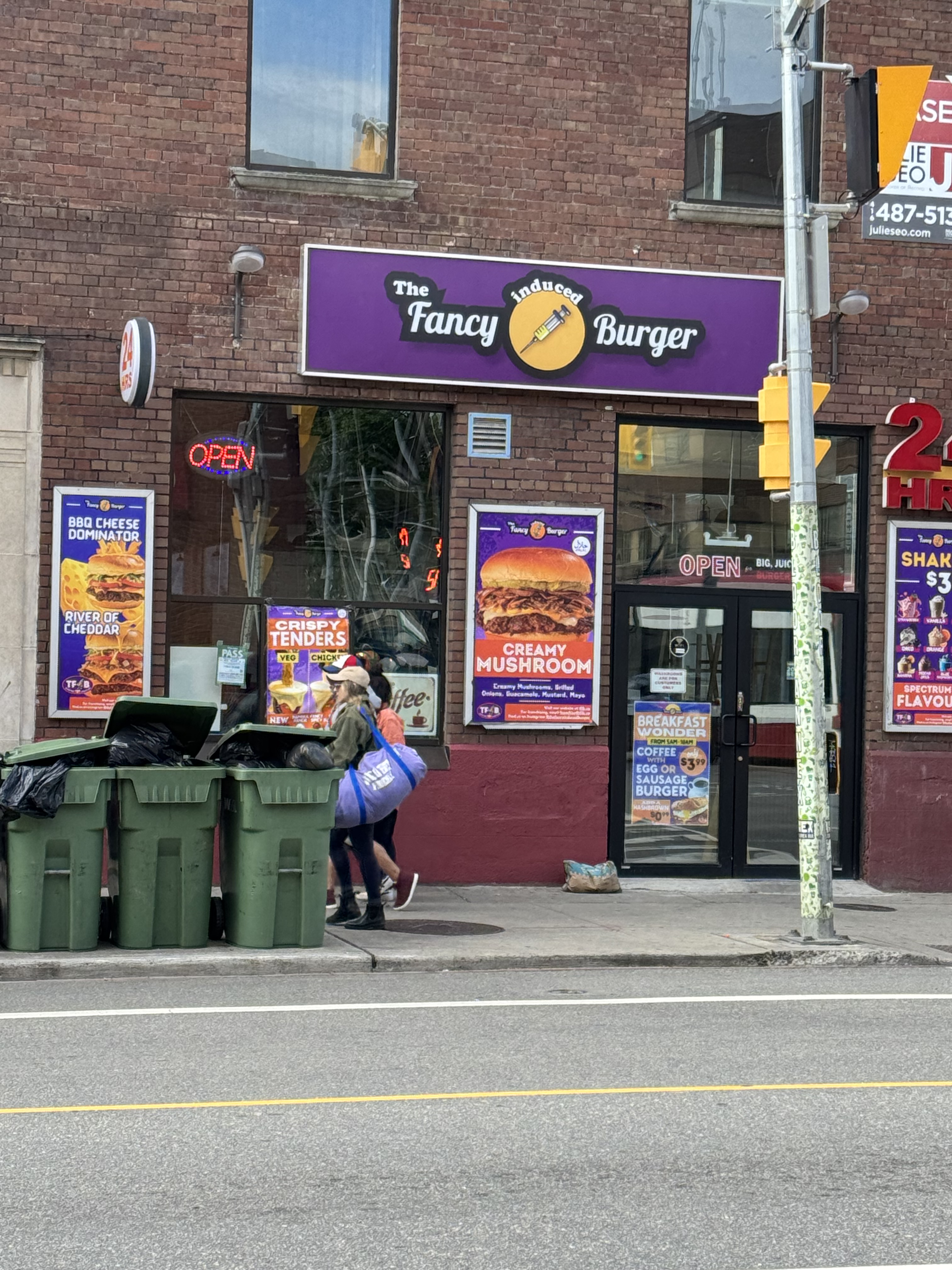
I keep walking. The Hungarian restaurant where we ordered dumplings and gravy and goulash soup: gone. The delicatessen and the cheese shop with a cow in the window: both gone. The café that once took up that southeast corner of Bloor and Bathurst: gone. Now there’s a Fancy Burger outlet, where you can add a syringe cheese shot to your beef patty for $1.49. This part of Bloor continues to metamorphize. Ethnic restaurants and record stores turn into cannabis shops and bubble tea counters. Used bookstores become pet pampering salons and tattoo parlours.
I am happy to see Midoco, the office supply shop, a place where you can lose yourself among the art supplies and fountain pens, is still in business. Ditto the Home Hardware.
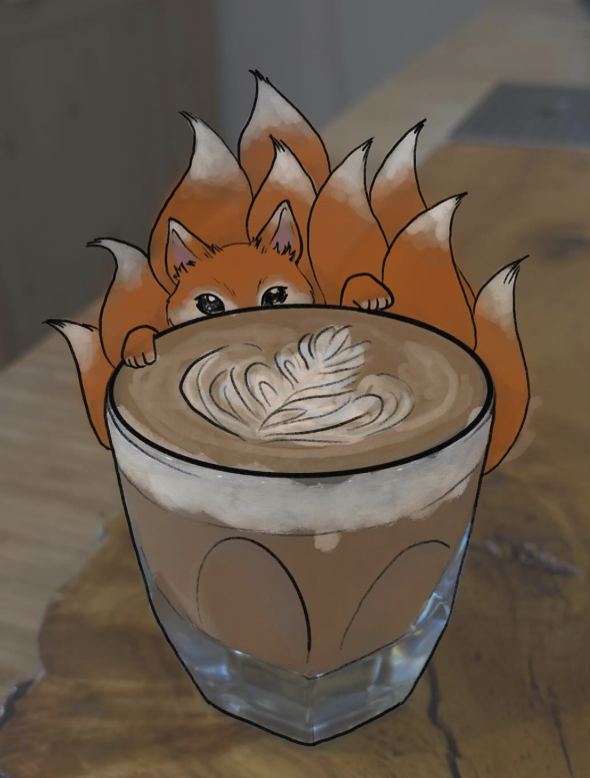
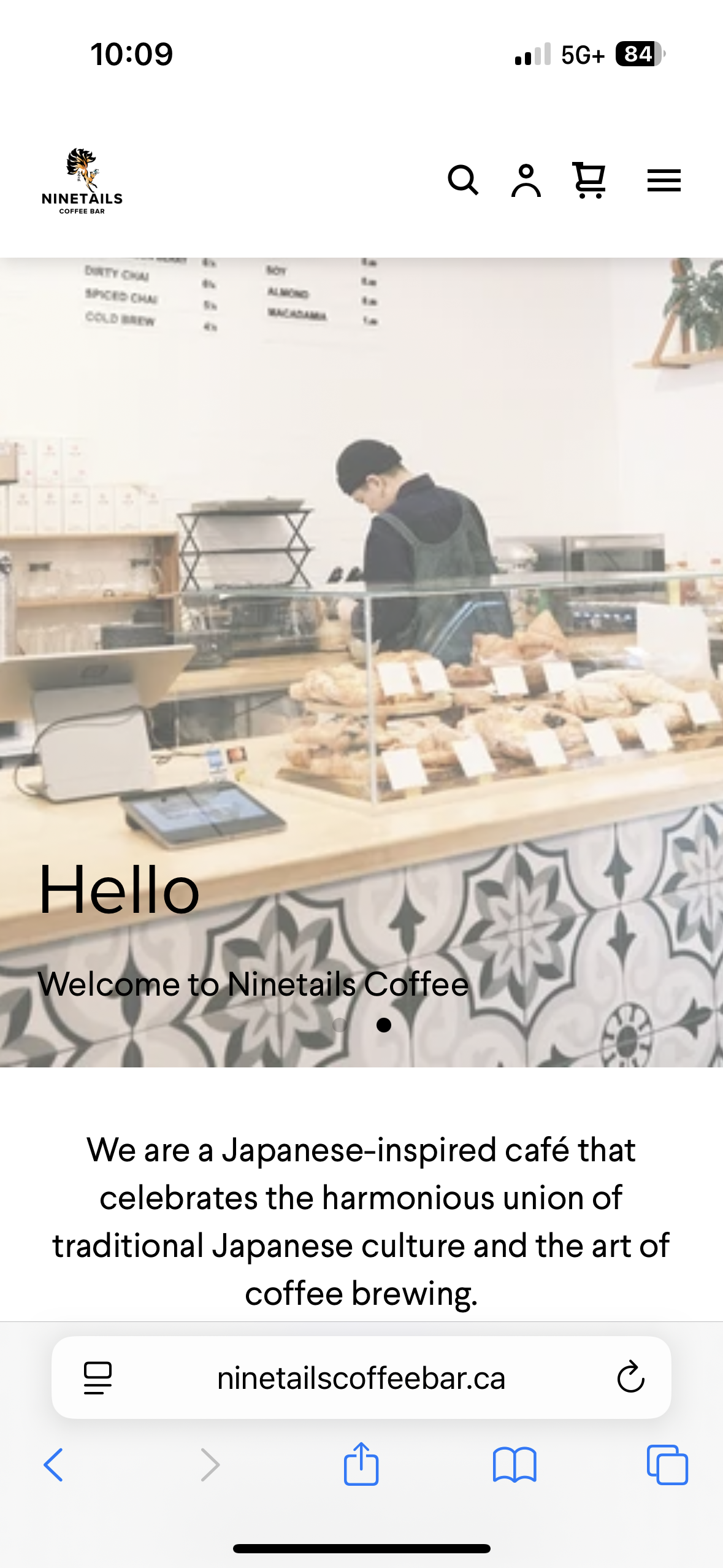
I keep walking, knowing that somewhere soon, I will come upon something interesting. I pass the small corner grocers, happy to see they still sell bargain produce and hanging pots of flowers. I pass Euclid, cross to the south side, and then, suddenly, there is an A-Frame sandwich board picturing a fox with many tails. I walk into Ninetails Coffee Bar, where two young Japanese women bustle behind a honey-coloured wood counter. White walls, a few small round tables graced by simple folding chairs. A coffee bar decorated with ceramic tiles patterned in grey, blue, and white. A full pastry case. Smiling faces welcome me.
My flat white, delivered in a short glass with a foamy fern on top, is delicious—strong and hot. While I drink my coffee I read about the coffee bar’s philosophy.
In Japanese folklore, Kitsune are foxes with mystical powers that can grow nine tails.
“we embrace the Japanese philosophy of ‘ichi-go ichi-e,’ which translates to ‘one opportunity, one encounter.’ This concept underscores the importance of cherishing every moment and every connection we make with our guests, as each encounter is unique and irreplaceable. Our goal is to provide you with a little window to Japan & Japanese culture within each visit.”
I gaze across Bloor to the north side and see, to my delight, a used bookstore that I’ll visit after I drink this coffee. It’s too easy to get lost in the past during this trip. Wandering through old neighbourhoods, remembering past experiences, feeling traces of old sadness and joy. But Toronto, like Freud’s Rome, is a metaphor for the mind. There is no denying that my personal history, etched through the decades, permeates my experience of Bloor West. I feel these vestiges of the past in my body.
But there is also the present: every moment is unique and irreplaceable.
The sun finally emerges from behind grey clouds on this cold day and streams through the glass over my table. I will never experience this moment again, as I drink this coffee, as I gaze at the people around me, the heavily inked man, the woman with green hair, as I examine the fox on the sandwich board outside, waving her many tails. She reminds me there is only one opportunity, one encounter. This is it.
In mid-December, I bought a green glass jug in a second-hand store, half price. My aspiration was to make a beautiful winter bouquet for my friend, Lillian. I bought a bunch of silver dollar eucalyptus and two dozen white carnations. I envisioned white wintry bursts among the silvery green, but the more I trimmed and mixed the carnations with the stems of eucalyptus, the sillier and more incoherent it looked. I took basic Ikebana but still haven’t a clue how to make flowers and plants look good.
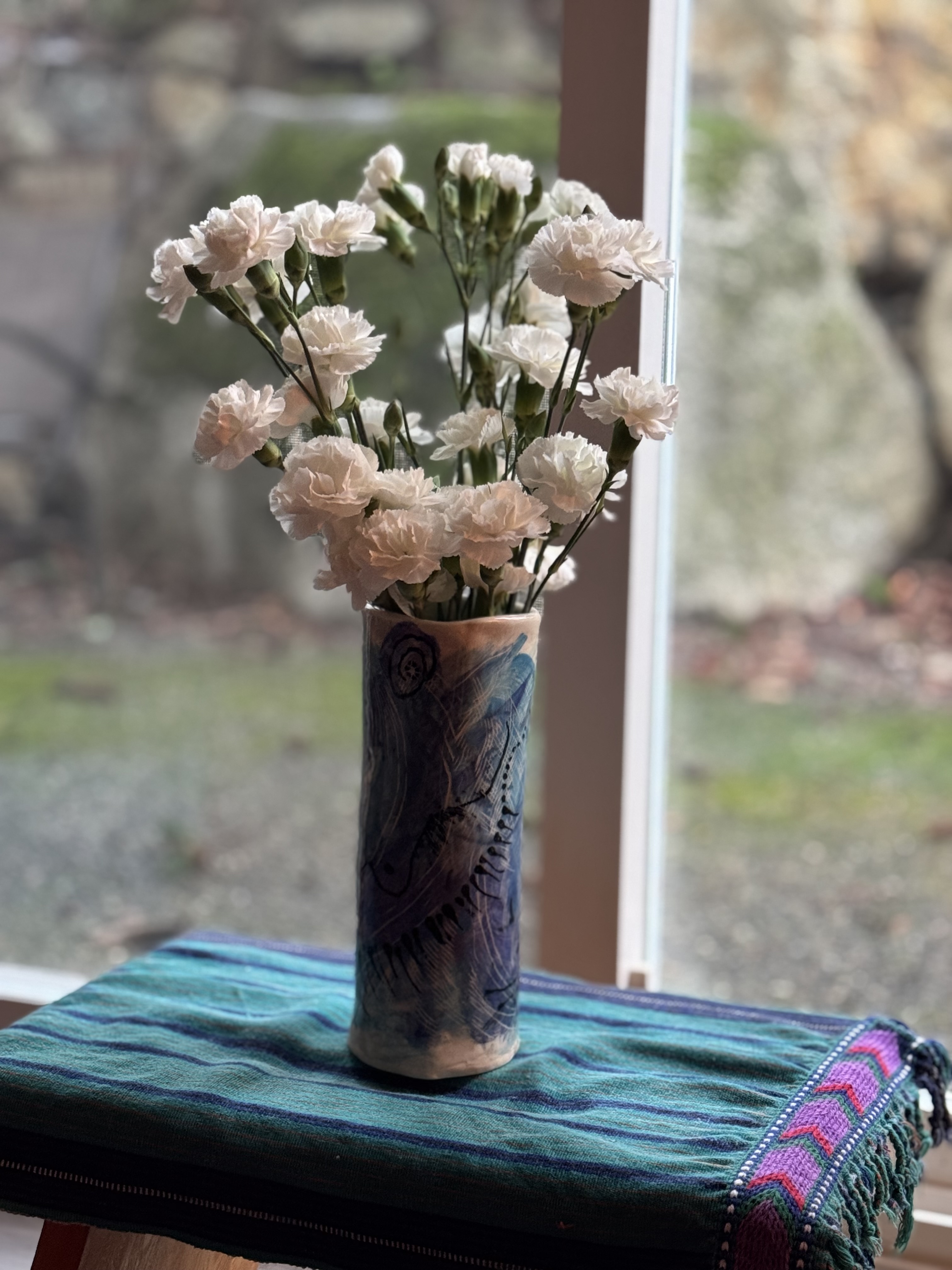
Finally, I used only the eucalyptus, splayed out in a free-fall arrangement. I attached a few small, red shiny balls to the stems, and the effect, I hope, was Christmassy and charming, if a bit messy. Lillian said she loved it. (But what could she say, really?) I was going to throw out the unused carnations, but it seemed such a waste, so I put them in a white and blue vase and placed it in my study on a low stool covered with a blue-green cloth.
I don’t like carnations, or I didn’t think that I did. I’ve seen too many sad, slender bunches wrapped in cellophane at the mini-mart next to the hospital. They make me think of last-minute purchases for the death bed, cheap flowers that outlive the person you visited. They seem so tight, orthodox, banal. Whorls of perfect, serrated petals, every bloom the same.
But they’ve grown on me. As I spend hours in their presence, they’ve become real. You could say I’ve become intimate with them. I sit here now, the last day of the year, gazing at their fresh ordinariness. The carnation is the sturdy, faithful flower that will see you through. Perhaps they are flower of the year: commonplace as canned milk. Carnations are one-foot-in-front-of-the-other flowers. Quotidian flowers. Bread-and-butter blooms. See you through the hardest times. Last for weeks. Nothing special.
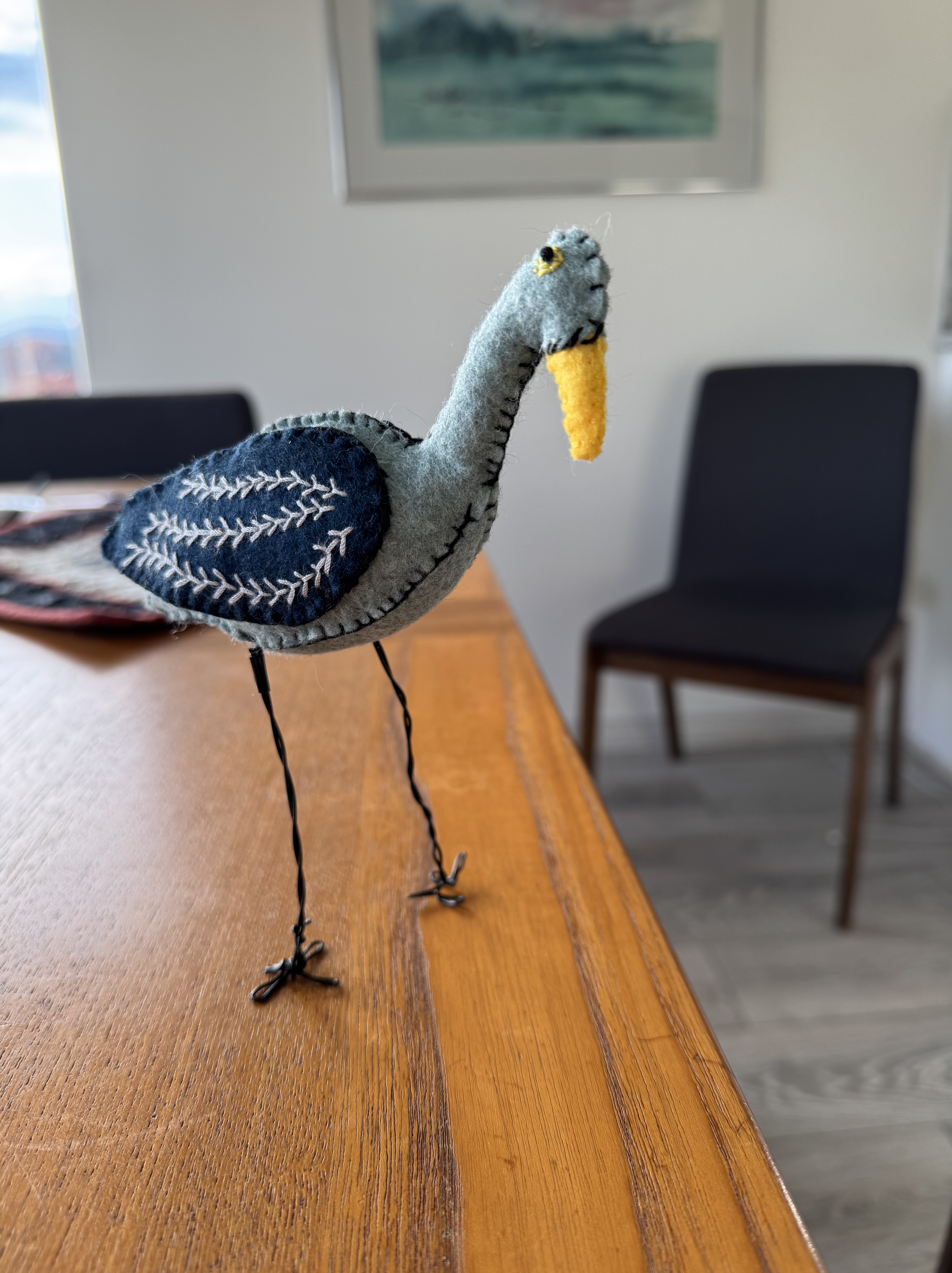
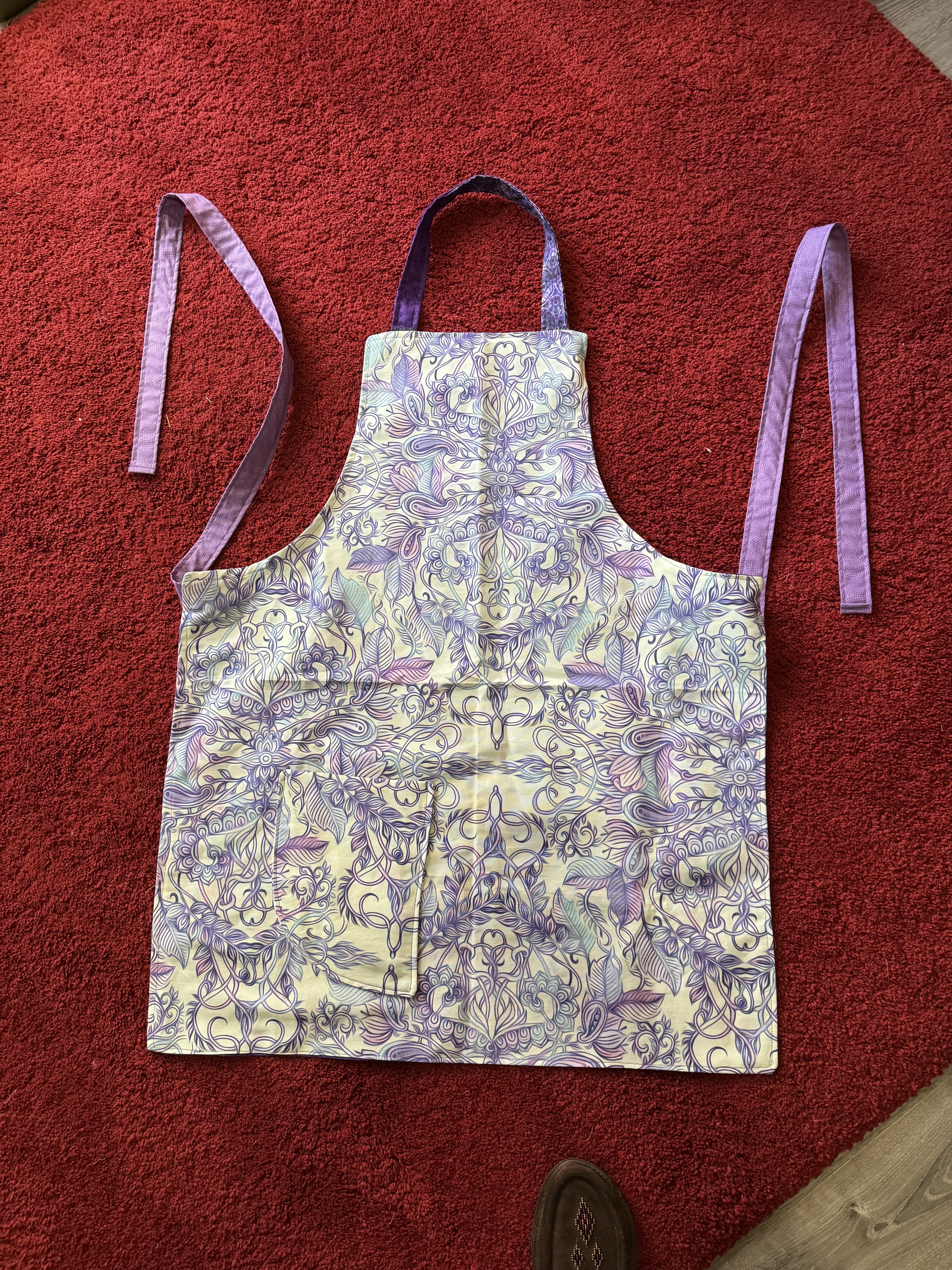
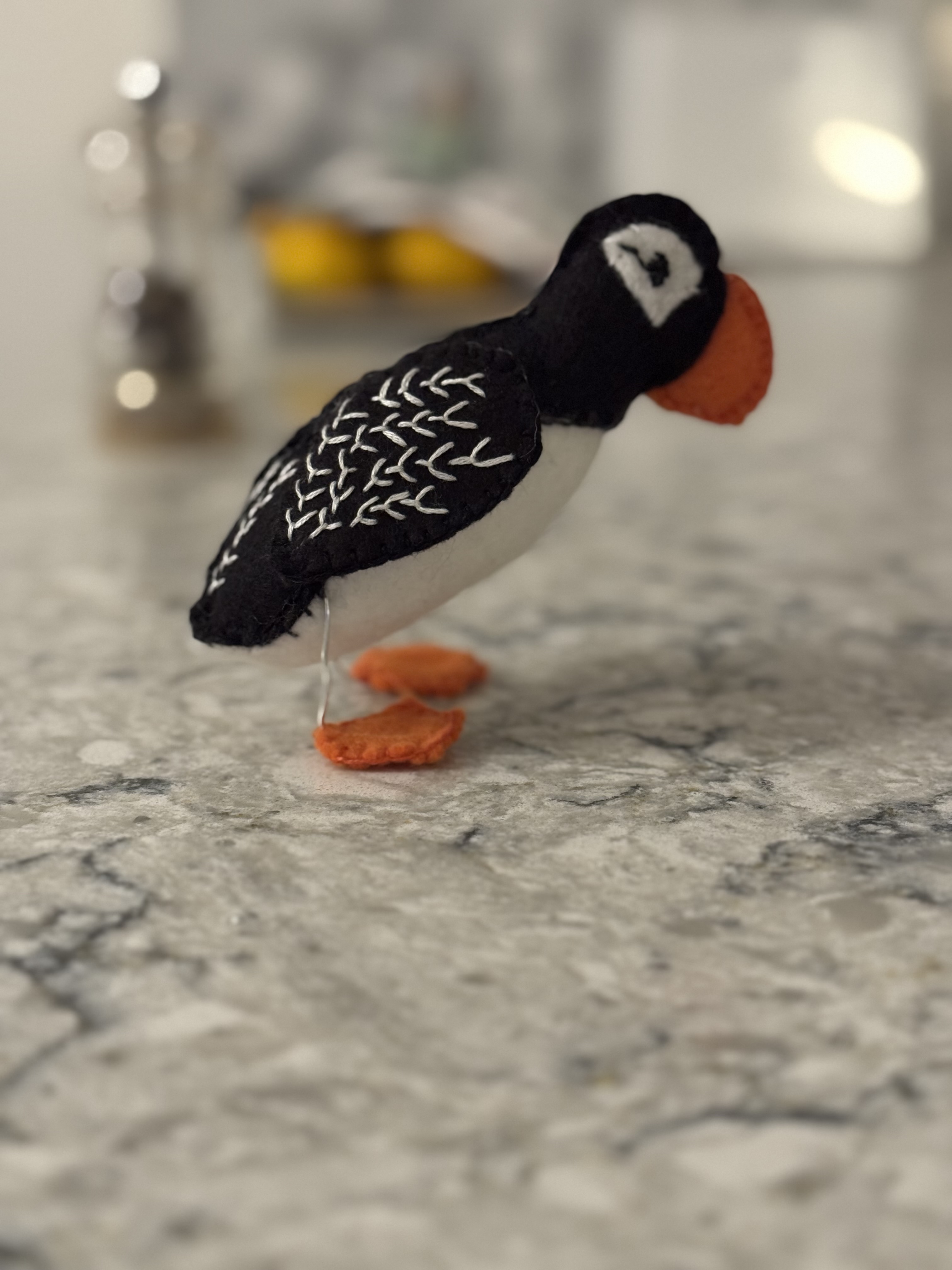
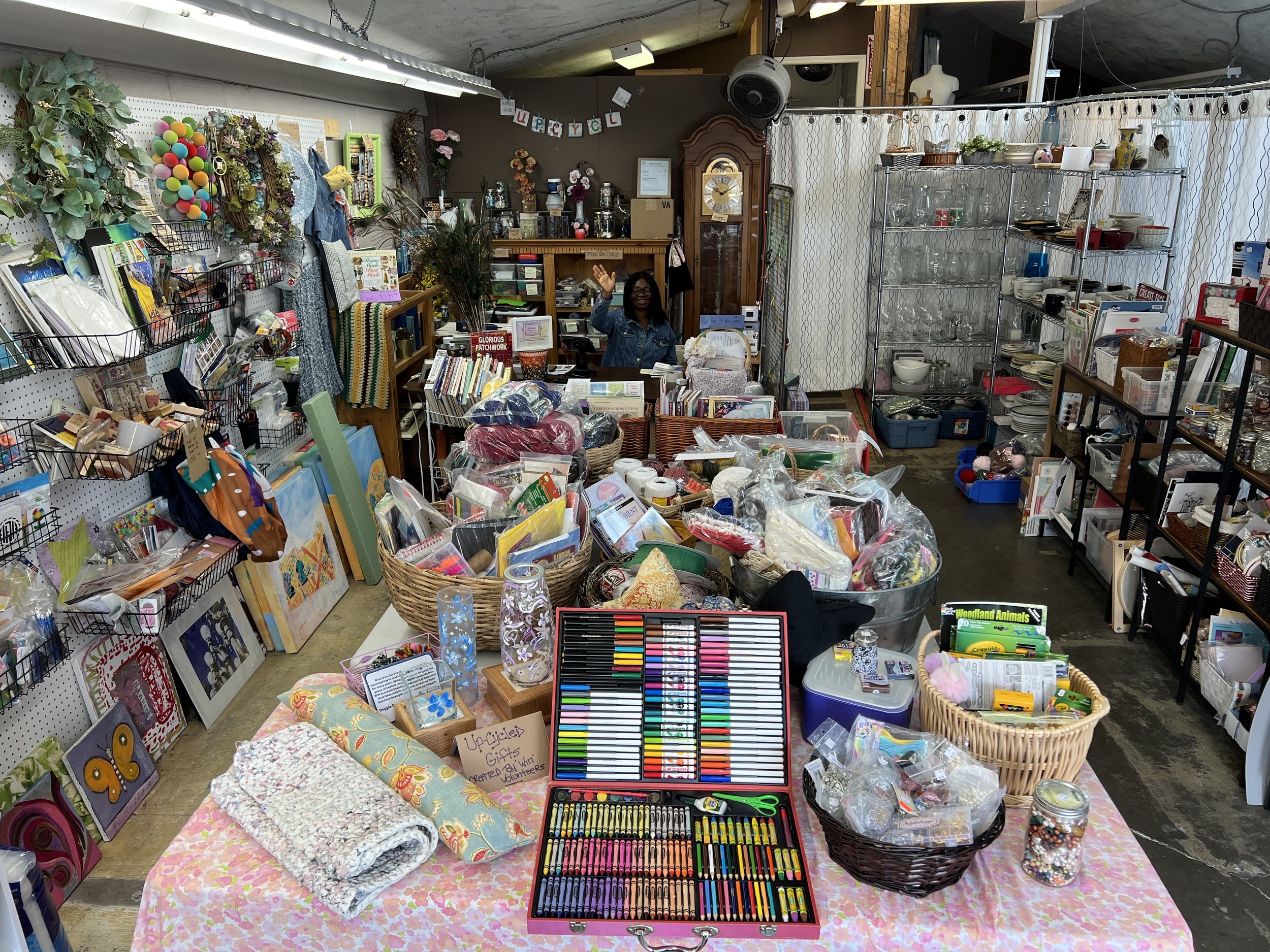
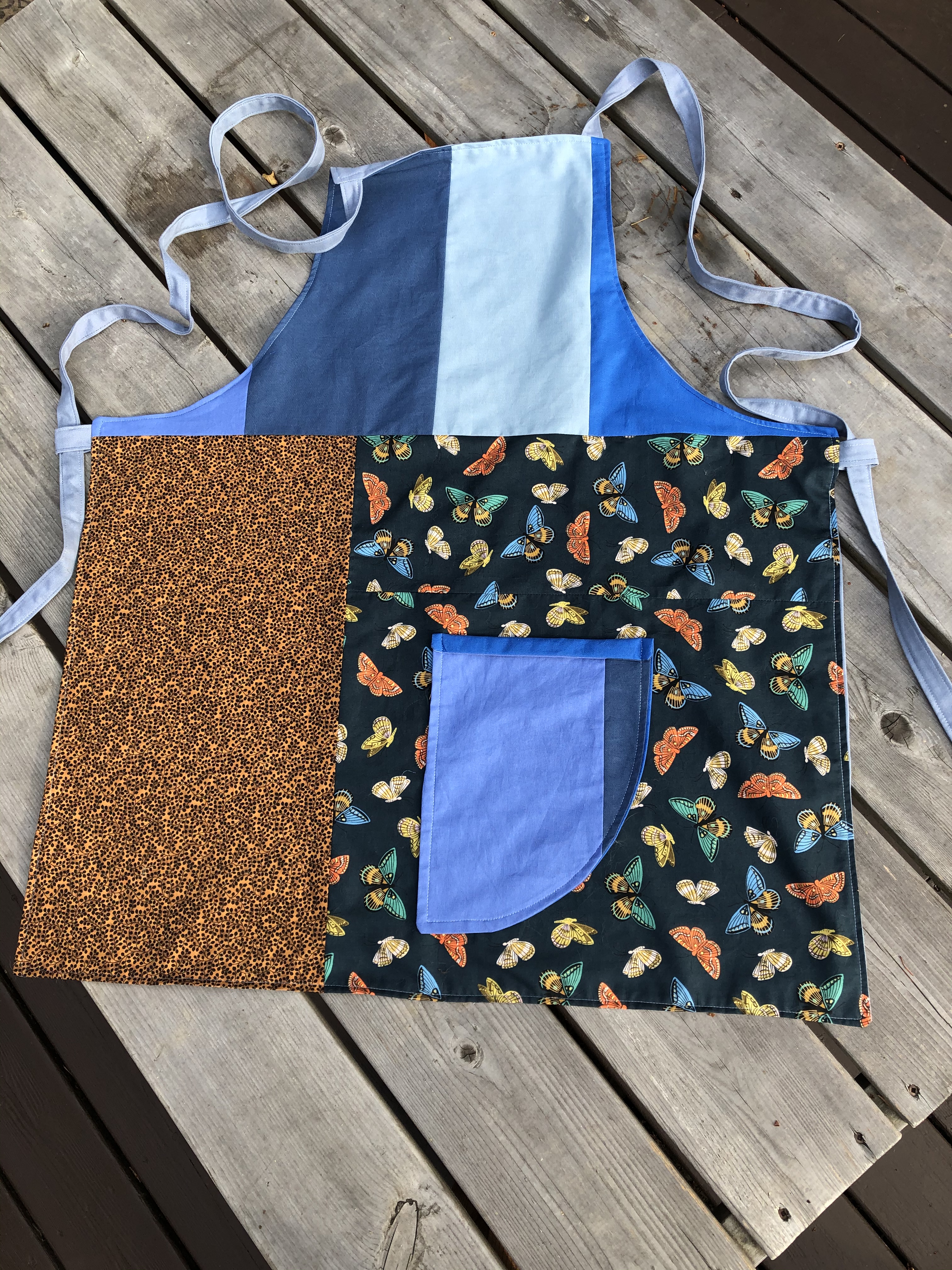
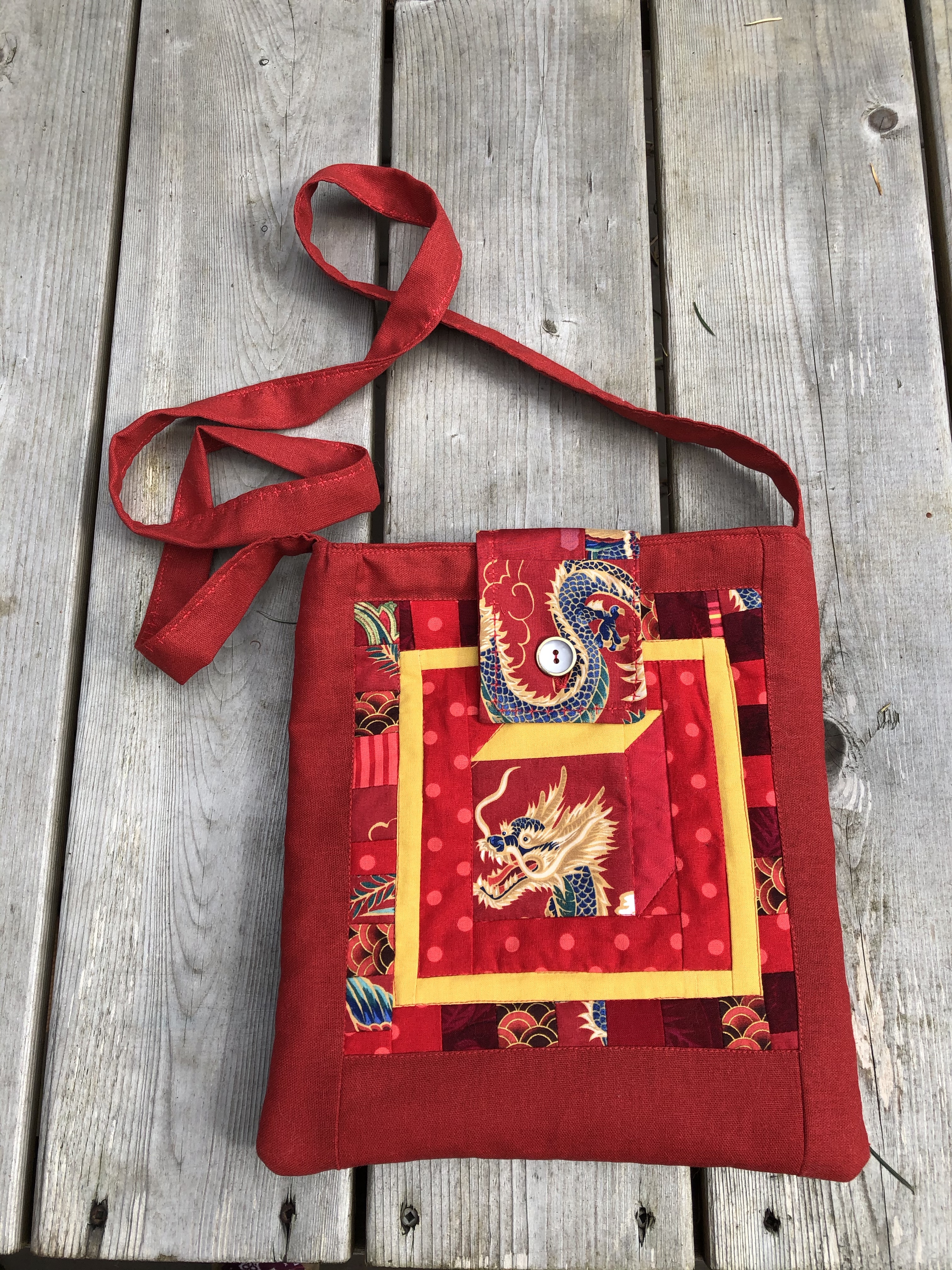
Although 2024 was my first year of so-called retirement, and thus I was given twenty additional hours each week, I wrote less, and I sewed less. (A few felt birds for family and other little felt creations, an apron, a crib quilt start, a fur-lined bag.) I did finish an editing certificate I started in 2020, which is a relief. And I made a lovely new friend and deepened existing friendships. I started a volunteer gig at a non-profit arts and crafts shop in August that has led to meeting many interesting people. Bonus: I get to surround myself with a messy profusion of materials that inspire me.
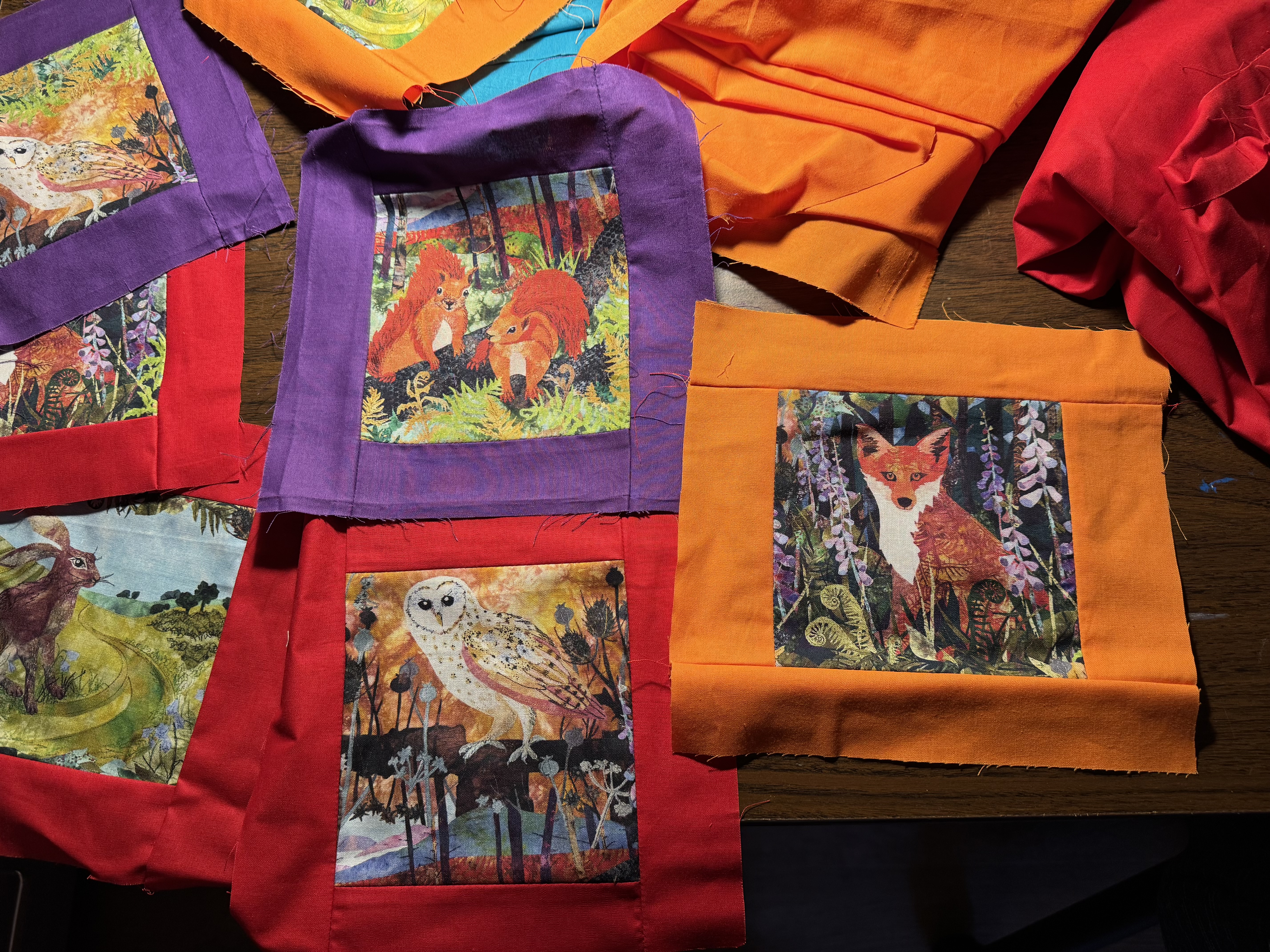
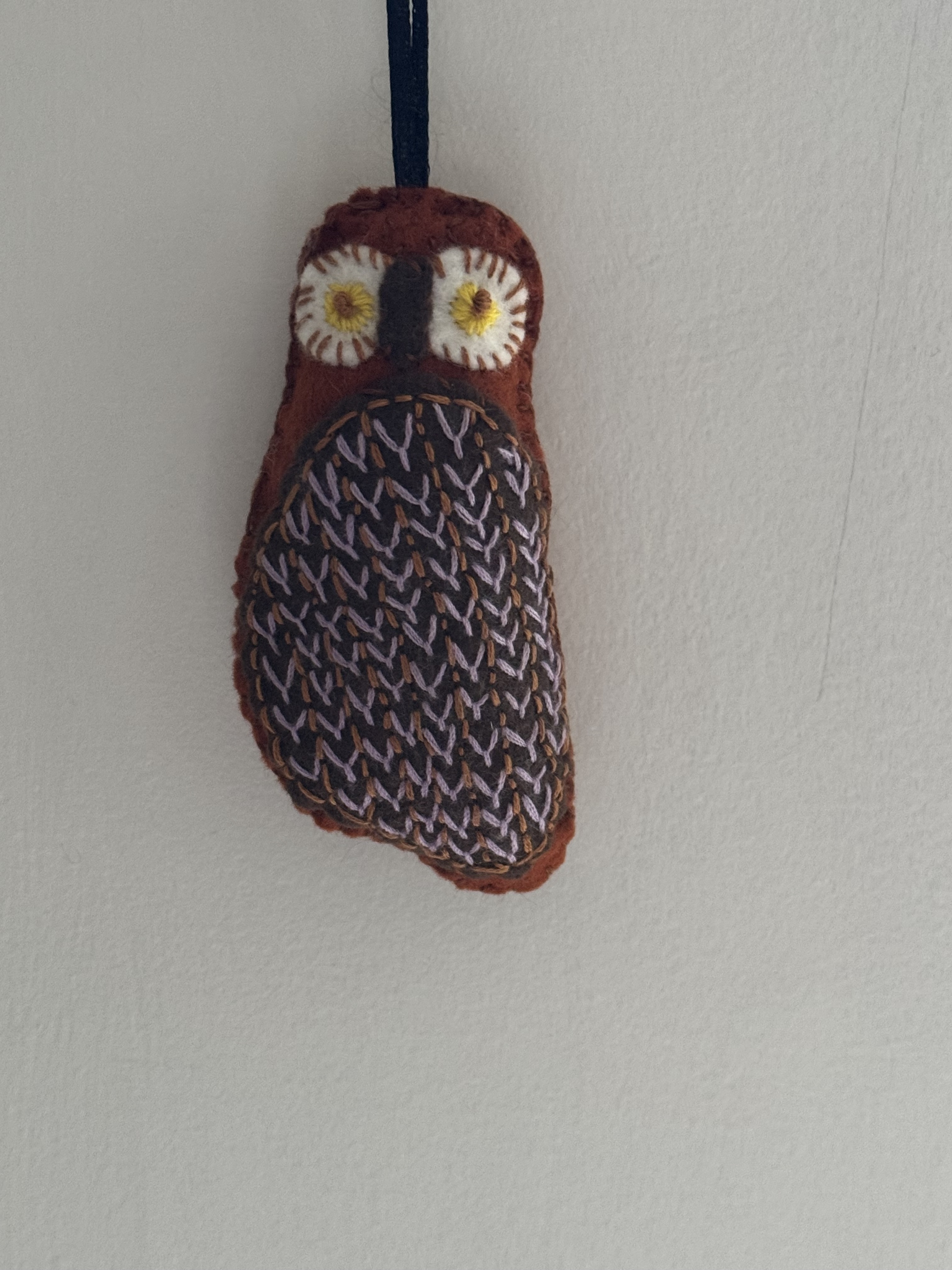
Kathryn’s robinAllison’s pigeonEvan’s heronNancy’s reversible purple apronNancy’s reversible purple apronSarah’s swanI made felt hearts for friends at Christmas.Nat’s puffinNat’s puffinI started a quilt for Lillian’s great grandson, FoxWilson the owl, a gift for Michael Magic bag lined with fake fur for Nat’s 30th birthdayWomen in Need’s Upcycle and Craft store on North Park Avenue. I work there on Thursday afternoons.
This year, I listened to probably one hundred dharma talks on Dharma Seed, with a broad aspiration of becoming more intimate with life—accepting whatever’s happening in my heart, whatever’s happening in the world. Making friends with wild mind. Accepting the truth of the way things are.
I read so many books this year. A couple that stick with me are Rebecca Solnit’s memoir, Recollections of My Nonexistence and The Age of Loneliness, a book of essays about life during the sixth extinction by Laura Marris.
Solnit writes a lot about being a woman. That’s what her title gestures toward—the peculiar “nonexistence” of being female in a patriarchy (remember mansplaining? She is behind that neologism[i]). She draws on John Berger’s 1972 Ways of Seeing, which I’ve known about for years and now am determined to read. She quotes words from him that jibe with my experience: “To be born a woman has been to be born, within an allotted and confined space, into the keeping of men. The social presence of women has developed as a result of their ingenuity in living under such tutelage with such a limited space. But this has been at the cost of a woman’s self being split into two.”
Perhaps that sounds dramatic in the Global North in 2024, but that has been my experience. Perhaps it’s different for lesbians. Perhaps it is different for women of subsequent generations, but Solnit and I were born three years apart (1961/1958), so we grew up at roughly the same time. Berger goes on,
“A woman must continually watch herself. … She has to survey everything she is and everything she does because how she appears to others, and ultimately how she appears to men, is of crucial importance for what is normally thought of as the success of her life. Her own sense of being in herself is supplanted by a sense of being appreciated as yourself by another.”
Solnit calls Berger brilliant and generous, to be able to imagine a woman’s experience, and I agree. What he writes here feels just as real as the carnations in front of me. Reading the passage and feeling its truth is freeing. No action needed, just awareness.
Similarly, truth pinged through me when I read Laura Marris writing about the age of loneliness. We become lonelier as we bear witness to the drastic reduction, or “great thinning,” of ordinary animals. Marris draws on the work of naturalist, Michael McCarthy, who writes of our baby boomer age group, “As we come to the end of our time, a different way of categorising us is beginning to manifest itself: we were the generation who, over the long course of our lives, saw the shadow fall across the face of the earth.”
Reading this series of essays, elegies to Earth as the shadow descends and animals disappear, I was gripped by a grief so deep I sat for a time and just cried. Again, the truth is freeing. Let’s not deny that this is happening. It’s really happening. We can still enjoy the beauty that is here.
In keeping with my mood of asceticism, I recently deleted my Facebook and Instagram accounts. Unlike the birds who used to sing outside my window, FB and IG will not be mourned. I feel light as I step through life with a new red pedometer safety-pinned to my leggings (the pedometer frees me from carrying a “smart” phone to count steps). Michael, Marvin, and I amble down to the beach at Thetis Cove to watch the sky change. Rippled water reflects a bank of pink clouds.
Thank you for reading. In the coming year, may you experience moments of lightness in a shadowy world.
Berger, John. 1972. Ways of Seeing. Penguin. Marris, Laura. 2024. The Age of Loneliness: Essays. Greywolf Press. McCarthy, Michael. 2015. The Moth Snowstorm: Nature and Joy. New York Review Books. Solnit, Rebecca. 2020. Recollections of My Nonexistence. Viking.
[i] From Wikipedia: The term mansplaining was inspired by an essay, “Men Explain Things to Me: Facts Didn’t Get in Their Way”, written by author Rebecca Solnit and published on TomDispatch.com on 13 April 2008. In the essay, Solnit told an anecdote about a man at a party who said he had heard she had written some books. She began to talk about her most recent, on Eadweard Muybridge, whereupon the man cut her off and asked if she had “heard about the very important Muybridge book that came out this year”—not considering that it might be (as, in fact, it was) Solnit’s book. Solnit did not use the word mansplaining in the essay, but she described the phenomenon as “something every woman knows”.
After my third accident, I decided throttles are my nemesis. First time was on my scooter, second and third times on my e-bike. Originally, my Marin Fairfax bike was not electric–just human powered. Last year, I had a Bafang motor installed to make commuting easier. But I didn’t expect to get a throttle with the install—it just “came with,” and I didn’t question it. After riding the bike for a while and experimenting with the throttle, I thought, this is too much and I don’t really need it. Five levels of assist are more than enough. Nonetheless, I started to depend on the throttle. It was like touching a magic wand to create delicious bursts of power that eased me into motion after a stop, pulled me up the steep hills, glided me along without pedalling.
On the day of the Pride Parade, I set out early for Douglas Street to capture a good spot to watch. Riding up and over the bridge, I slowed down to observe a great cloud of bright balloons approaching from the other side. After a few moments, I pressed my throttle to get a move on. What happened next was so fast and unexpected, I hardly know how to describe it. I hadn’t noticed that one of my handlebars had gotten tucked under a bridge railing. When I throttled, the bike jumped with a life of its own, and the seat swivelled, hitting me hard in the upper thigh. Suddenly, I was on the ground, the bike on top of me, with blood flowing from cuts on my hands. My thigh pulsed with pain. A couple stopped to help me up and righted my bike. Somehow, I got to the parade and watched for a while, but then realized I was in shock. Nothing an extra hot latté at Habit Coffee couldn’t cure.
But seriously, the eggplant and banana bruise on my thigh was ugly and tender, and I limped for a few days. It took some time for the bruises to go away, the cuts to heal, and for my thinking to coalesce around throttles and what they mean.
CHEK’s Tess van Straaten co-hosted the Pride Parade broadcast with local drag queen Gouda Gabor
In 2012, I bought a 50 cc scooter. So cute and fun! I loved it. But again, the throttle. I was on my way home from work in backed up traffic, daydreaming. Suddenly, I realized the car ahead of me had started moving a few moments before, and to catch up, I hit the throttle. But my wheel was turned, and the machine jumped. I was thrown to the ground, the scooter on top of me. I stopped traffic that day, ended up at the hospital, and received a sling and advice to keep my fractured arm quiet for several weeks. Shaken by the accident, I sold my scooter soon after that.
My beautiful scooter and me
Then there was the other e-bike incident when I throttled my bike on a gravel path. Big mistake. Again, I ended up flat out on the ground, bruised and shaky, with the bike on top of me.
Throttle is a noun signifying the device controlling the flow of power to an engine. Also, it’s a verb: you throttle the throttle or (second meaning) you choke or strangle somebody. I started to think of how I might be using the throttle too much on my bike and in my life. I throttle to get the extra boost I think I need. Usually, I throttle without thinking, and then I run into trouble. But if I were to insert a pause, I might realize I don’t need the throttle. Throttling chokes my life. Increasingly, to throttle (act precipitously, riding a burst of power) leads me into discordant situations that I regret getting into. Doing the unnecessary thing, saying the wrong words.
Perhaps I’d be better off if my e-bike didn’t have a throttle at all. But still, I’d be throttling my life. I reflected on ways to stop doing this. Perhaps one of these will resonate with you:
Don’t respond immediately to email or texts. Stop and think. What’s my responsibility here? Is what I am writing useful, timely, kind, necessary?
Don’t jump from one activity to another. You might like to pause for a moment and ask, “How do I feel now? What do I need?”
Stop manufacturing energy you don’t have. Don’t do that “one extra thing.” Just don’t.
Doing stuff is overrated. What about doing nothing? There is plummy goodness in sitting and observing life, engaging all senses.
And related to the last point, think about Rick Hanson’s “Taking in the Good” program in Hardwiring Happiness. (I recommend this book!) HEAL is an acronym for four steps: Have a positive experience. Enrich it by exploring all its crevices and beauties. Absorb it fully into your body and mind. Link it with negative experiences so when they arise, you rewire your negatives with positives.
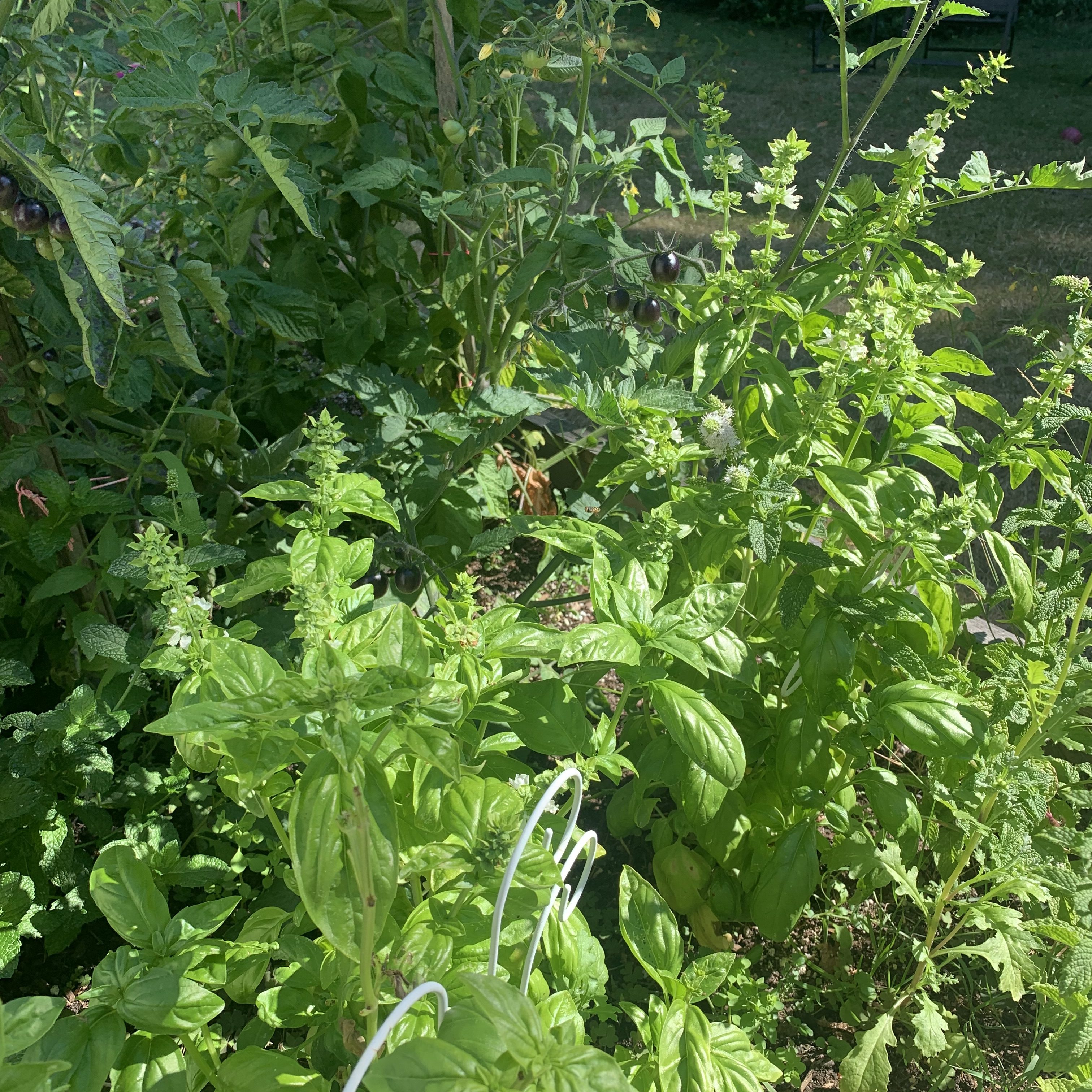
This afternoon, I sat in the sun reading a wonderful book I got out of the library, Country of the Blind: A Memoir at the End of Sight, by Andrew Leland. He writes with candour about his experience of slowly going blind from Retinitus Pigmentosa. I am learning so much about blindness and disability in general. Marvin, our dog, lay near me on the browning grass, contentedly chewing a stick. I sipped from a glass of sparkling water, a lemon sliver among the bubbles. Leland’s prose struck me as honest and evocative; I absorbed his words with delight, laughing occasionally at the stories he told about his two-week experience at the Colorado Center for the Blind. The sun felt restorative. Sounds of the neighbourhood on a summer weekday floated over the yard. The occasional yelp from a dog, somebody’s car radio—the cheesy song “In the Summertime” by Mungo Jerry coming in and out of aural focus—the guy who lives behind us directing somebody in a high, bossy voice about how to find something. “It’s in the back of the cupboard—you really have to search for it.” I could smell the mint and basil in the garden box at my elbow, filling my head with spicy green. My whole body flushed with well-being and pleasure. Throttle down.
Everything becomes something else. For example, my husband, Michael, has become a man who likes Christmas. He wasn’t a big fan of December 25, but he’s supported my love for celebrations surrounding the holiday: the tree, gifts, music, cards, and baking. This year, something shifted for him. He decided to see what it feels like to open to positive Christmas energy.
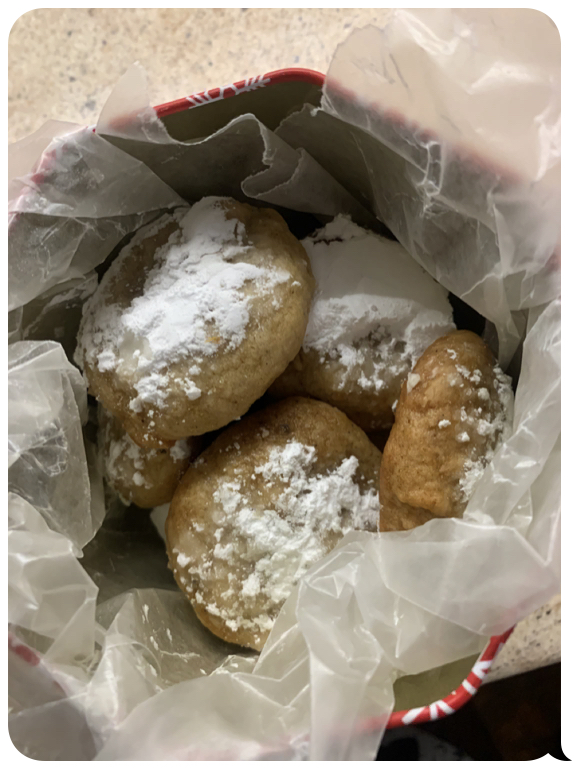
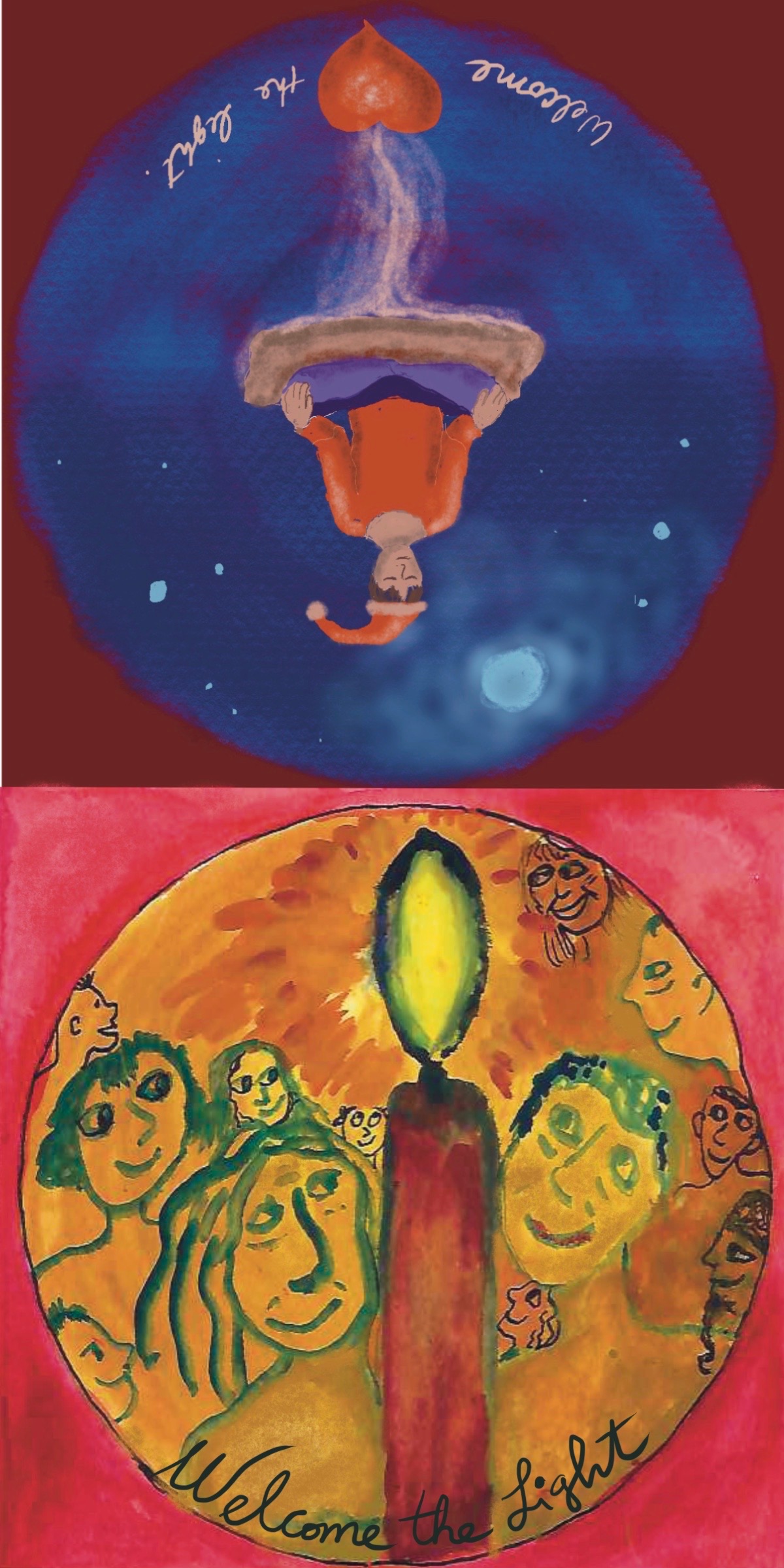
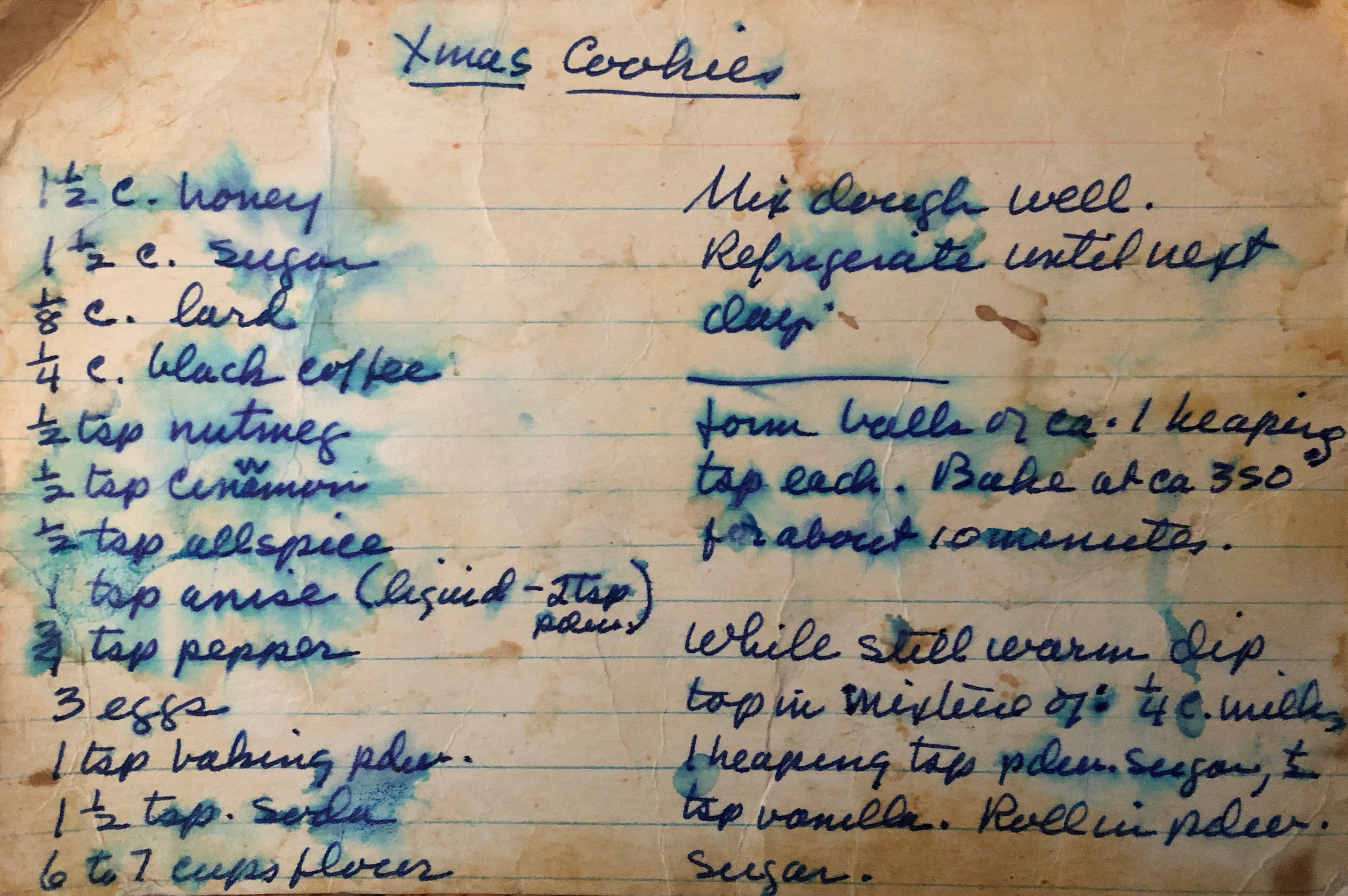
He enjoyed the pferffernüsse I baked, German Christmas cookies from my mother’s recipe. He bought some gifts and wrapped them. He admired the fat little tree I bought and helped me get it into the stand. When I suggested we join forces and design solstice cards then send them to friends and family, he was game. And when I had a yearning for the angel chimes from my childhood, we went together to buy them at a charming little shop at Mattick’s Farm. But best of all, he asked me if he could buy tickets to the sing-along Messiah for us. I lit up. Yes! We’ve gone to hear the Messiah before, and Michael—a good sport—had suffered through the fifty-three separate movements because he knows of my deep love for this piece of music.
But this was our first sing-along. We crowded into the pews at Alix Goolden Performance Hall, sitting in the soprano section in deference to my voice, and Michael went to the side table to borrow a score. I thought that I knew the soprano section so well, having heard it a million times before. I expected to keep up with just a printout of the lyrics. I was wrong.
The cold church filled with people in their various sections, many dressed in Christmas finery. Two sisters sitting next to me joked with us and rolled their eyes at the difficulty of some of those soprano runs—I mean, really? We faked it valiantly and giggled during the pauses. When at one point, I dropped my papers under the pew in front of us, the sister closest to me used her long strong leg and athletic foot to rescue them, pulling the damp papers back to me. We grinned at each other as I mouthed my thanks.
When Michael or close sister got lost in the score, one would notice the fluster of the other, and they would lean in front of me to whisper the page number. When it was time to sing our parts, we all stood, and it felt glorious to belt out the lines, “For unto us a child is born.” We cheered the amazing trumpet player during “The trumpet shall sound,” near the end of the concert. His cheeks ballooned red as pomegranates from the effort. Michael pounded his feet in high praise, earning a scowl from the sour woman in front of us and laughs from the sisters. Later, he said he had a wonderful time, even though he doesn’t sing soprano. He appreciated the experience of following the score all the way through.
Everything becomes something else. A resistance to Christmas becomes an embrace of the holiday. And then the storms hit, and we cancelled family Christmas. When I pulled the three of cups on the morning of the 22nd, I felt sure the tarot card augured well for me and my two sisters (and niece and son and husband) celebrating together the next day. But alas, the treacherous weather made travelling impossible, and instead of being together in person, we had a beautiful three-way telephone conversation filled with warmth, encouragement, and love. So that was what the tarot was telling me—find a way to celebrate, even if it’s not what you imagine it will be. Everything becomes something else, if you can just see it.
I craved Christmas this year. The year felt difficult, and Christmas seemed like a salve, a hygge solution to my discomfort. So, in my hunger for the lights, sights, and smells, I rushed to the Boy Scouts tree stand on December 1st—too early—and picked the chubbiest one I could find. Every morning I plugged in the coloured lights and enjoyed the sight of the branches decked with many home-made ornaments from over the decades. I especially treasure those old stars my children made in pre-school with their sweet faces in the middle of gold macaroni-studded frames.
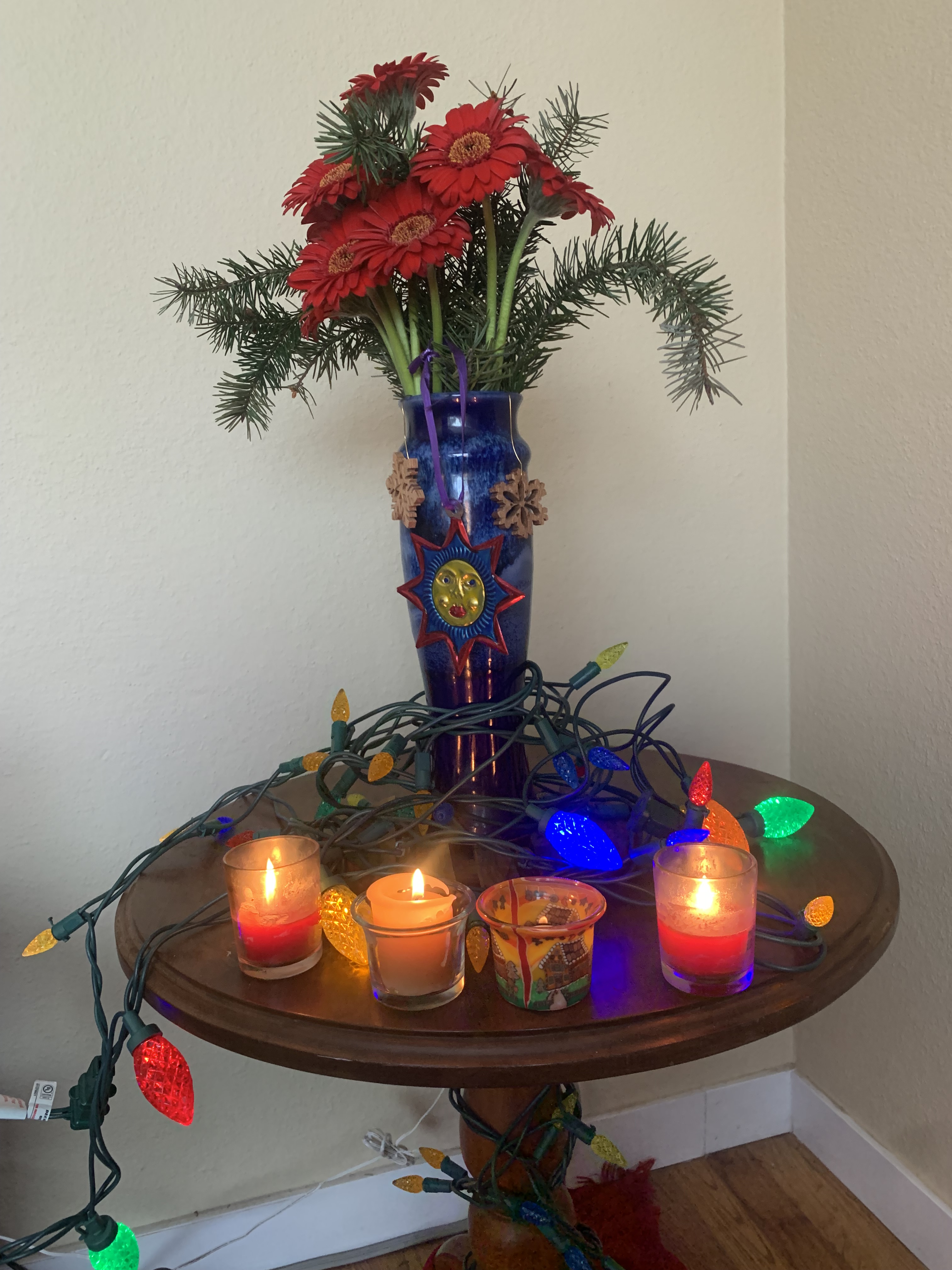
But then a few days ago, Michael said, “is that tree turning colour?” “Yes,” I had to admit. It was dry and yellowish green. So, on the solstice, we undecked the tree, unwound the lights, and tossed it at the side of the house to go into the chipper come January. Where the tree used to be, I placed a small round table holding a tall blue vase of red gerbera daisies—a gift from a friend. I mixed in some evergreen boughs and hung a few ornaments from the lip of the vase. I circled the coloured lights around the table’s base and the vase. Voila! Everything becomes something else: A Christmas tree becomes a festive bouquet.
Free yourself from fixed mind and you will see this—all things are in the process of continuously becoming something else. Witness the impermanence, get up close to it, get curious about it. It happens anyway, so allow it to happen with a loving, joyous, open heart. That’s the trick. And a micro dose of psilocybin doesn’t hurt, either.
I wish love, warmth, and all good things to you this season.
I’m not a gambler. I’ve never been one to buy scratch & win or lottery tickets, with the exception of raffle tickets for a good cause. But I have a weakness for the random—for letting books fall open, for reaching into my closet with my eyes closed. I wrote about random acts of reading in one of my early posts.
Lately, my hunger for the random has become ravenous. Perhaps it helps me cope with the relentlessness of karma, of knowing that everything arises as a result of a complex web of causes and conditions. If I just grab something, I cheat the chain of causality for one moment. An illusion of course, but it briefly satisfies something in me.
When I was at Women in Need thrift store a week ago, I bought a $5 jewelry “grab bag” and felt the thrill of not knowing what I would find inside. And then, at the Juan de Fuca 55+ Activity Centre Craft Fair last weekend, I picked up three “toonie bags,” again feeling excitement at the potential. I know the chances of getting things I neither want nor need are extremely high. But a pesky “what if?” tugs at me. What if there’s magic inside those bags?
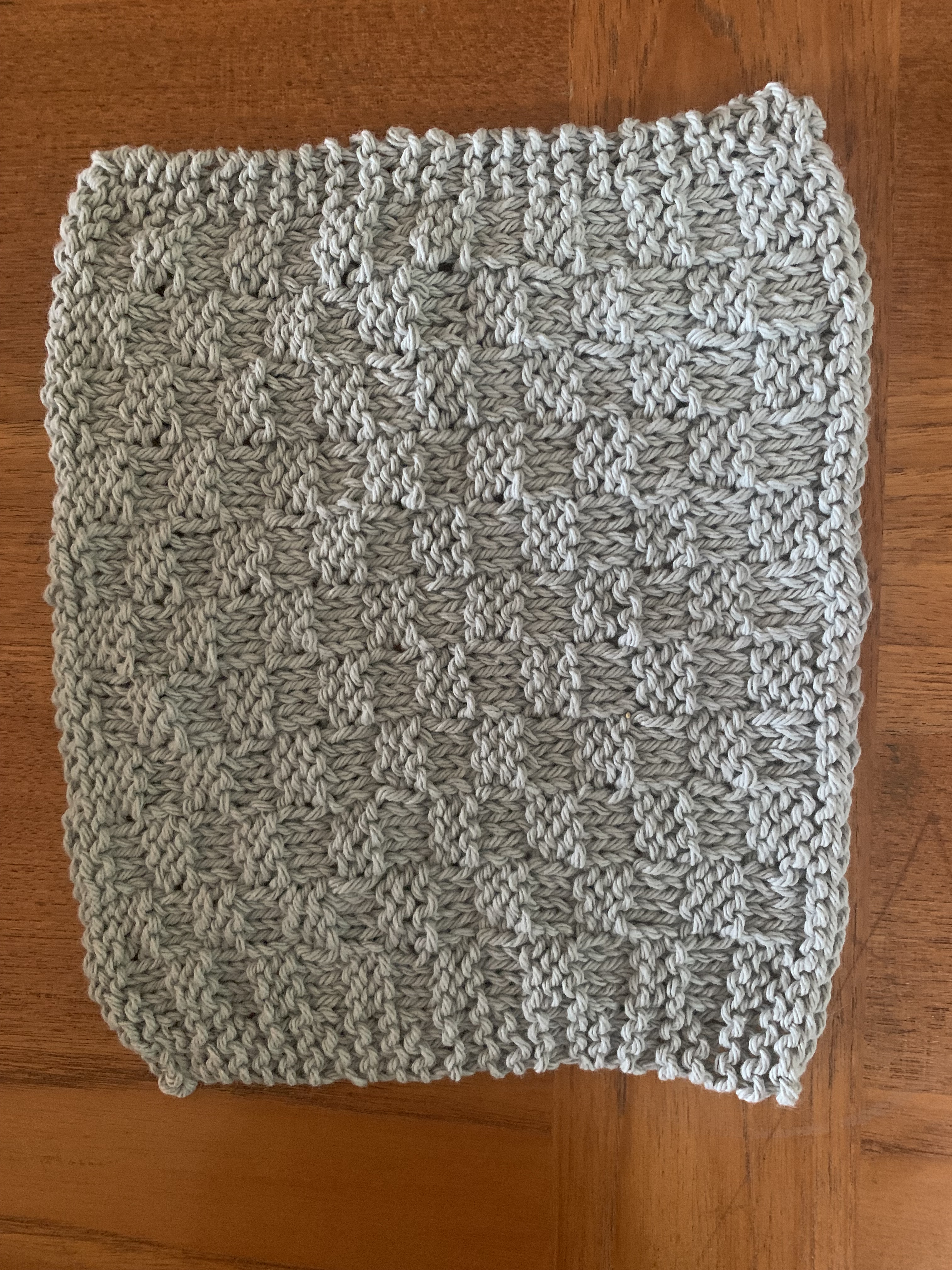
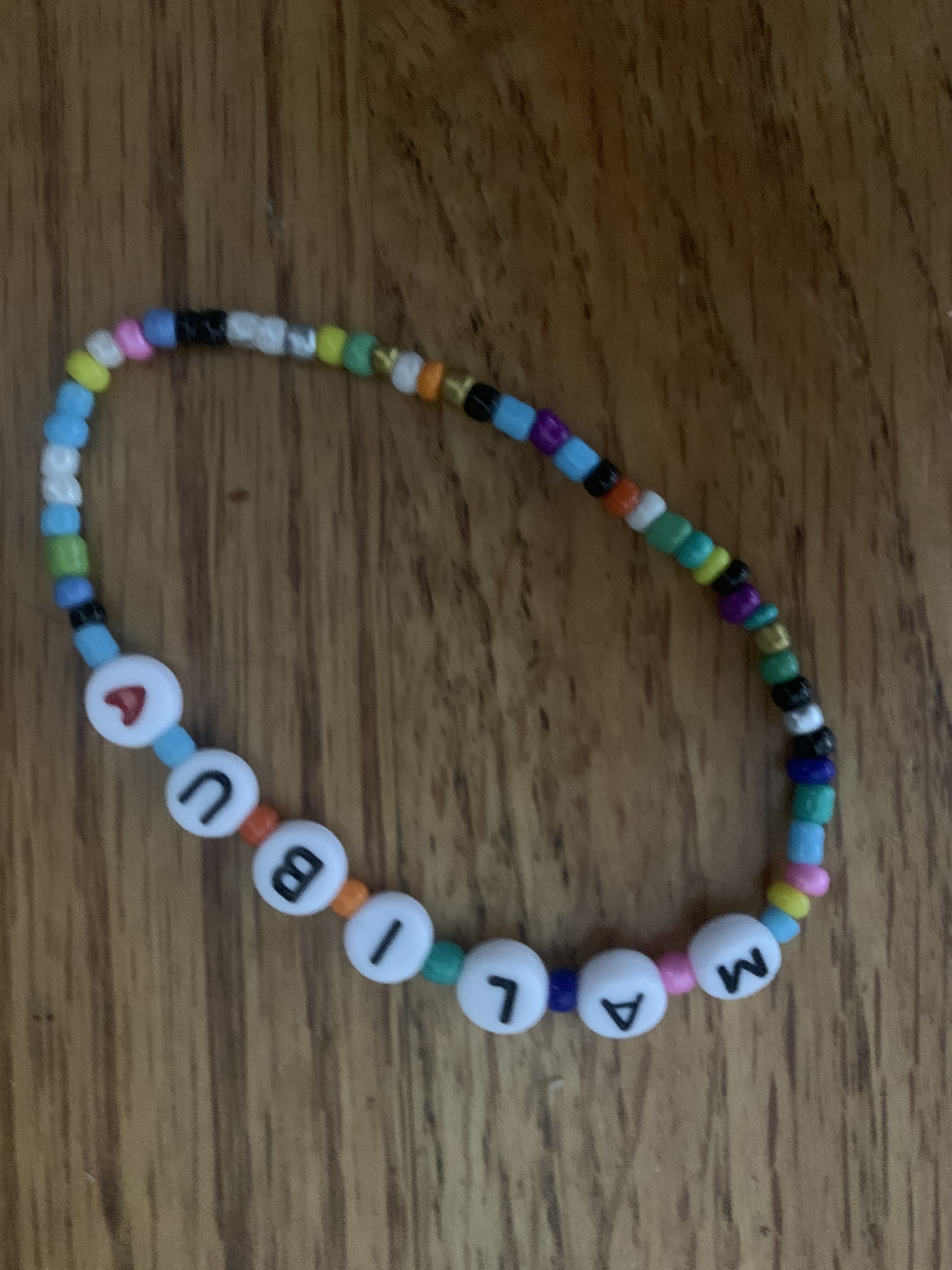
I tell myself it’s not such an expensive gambling habit: $11.00 spent over the past ten days. As you have probably already predicted, the $11.00 yielded mostly junk. Costume jewelry I would never wear. Small glass bowls, silver candles, a MALIBU beaded bracelet: all of these go right into the Goodwill donation bag. But there were a couple of things I liked. A cheesy “love” ring that nestles nicely next to my wedding ring for the time being. Three hand-crocheted dish rags in a shade of grey-green that I love and will use daily. And the priceless frisson of possibility … If I do this too often though—spend too much money on “grab bags”—I get disgusted with myself, like a gambler must feel about their addiction.
The thrill of grab bags
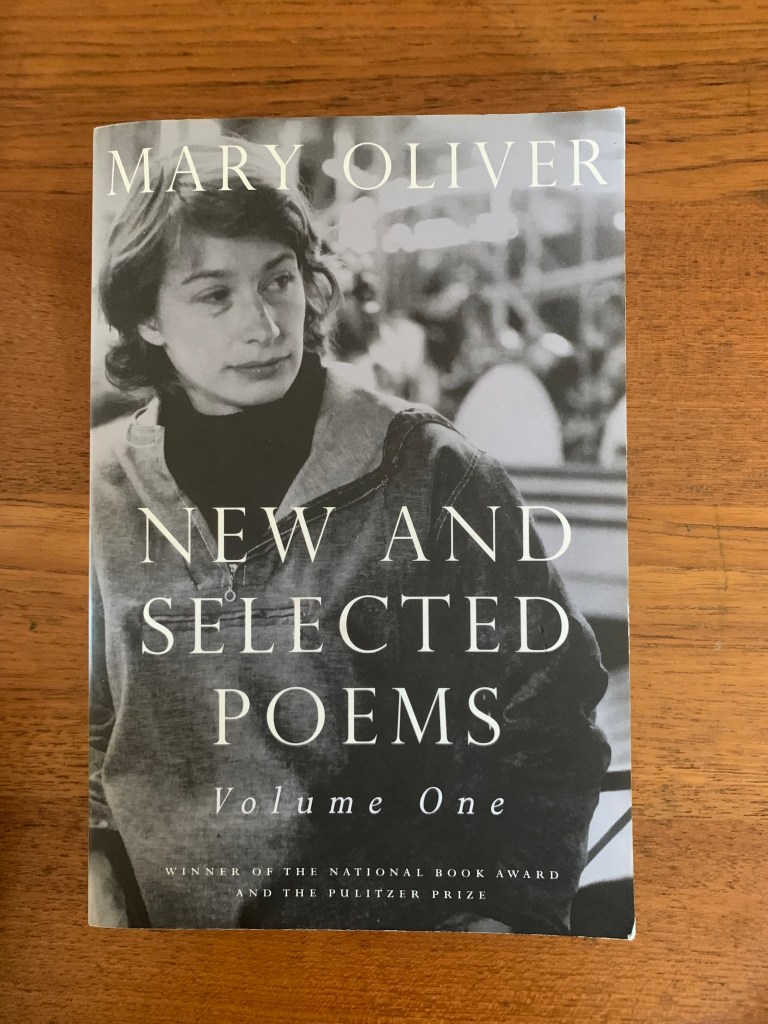
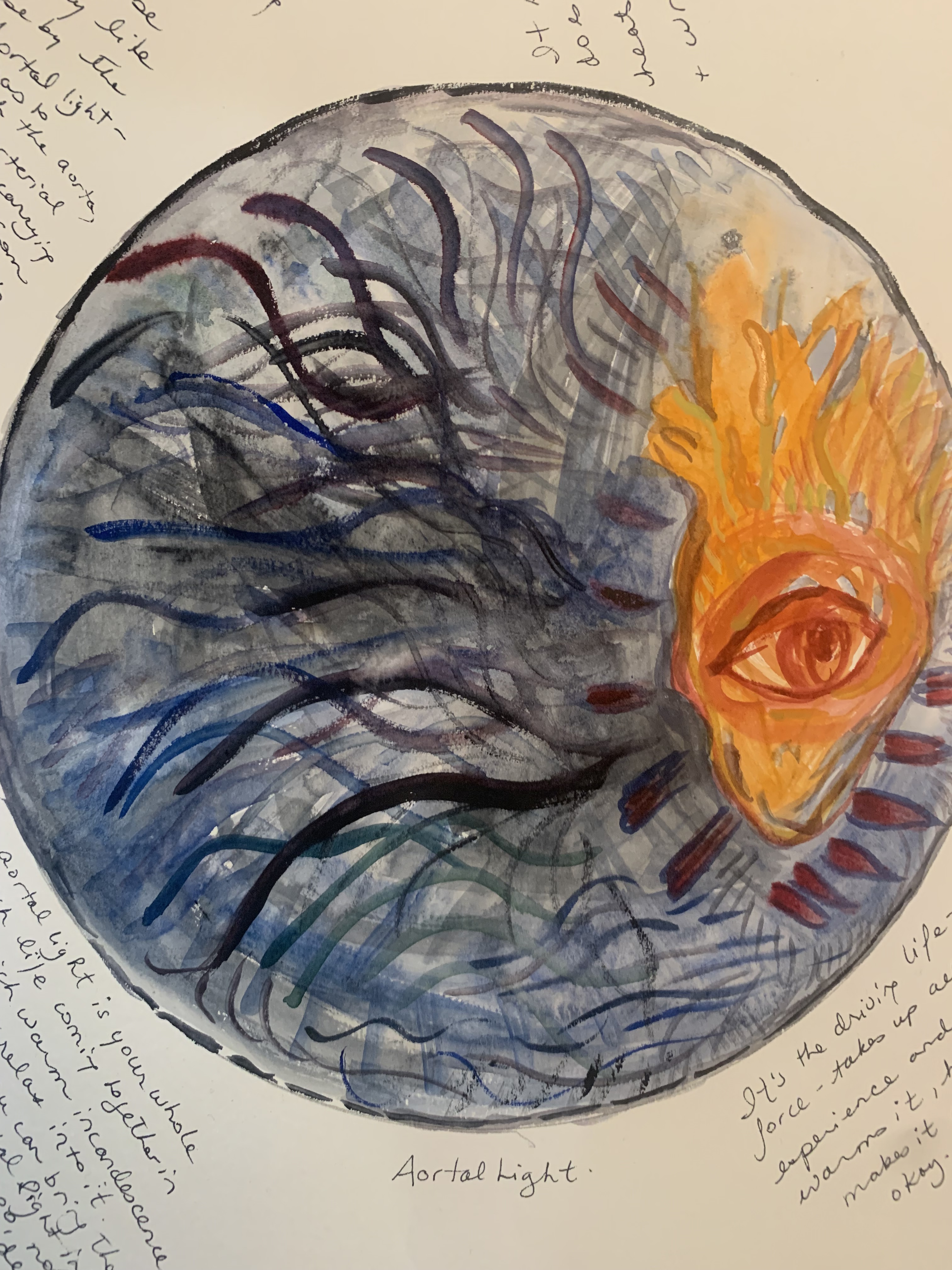
Today, Mandala Monday, I asked Michael to continue with the buffet of randomness. Last time, we each chose a tarot card to inspire us. This time for our mandala-making prompt, I suggested that I would take a book of poems by Mary Oliver and open it anywhere, read the poem, and we would create mandalas in response. Being game to participate in most of my creative ideas, he agreed. I opened to the poem, “White Owl Flies Into and Out of the Field.” Do you know this poem? The huge white owl, wingspan five feet, picks up a rodent from the snowy field and flies off to the frozen marshes to devour it. Oliver imagines the animal’s death in the jaws of the owl as something incandescent, perhaps even pleasurable. Death, she muses, may be entirely unlike the darkness we tend to imagine:
maybe death isn’t darkness, after all, but so much light wrapping itself around us — as soft as feathers —
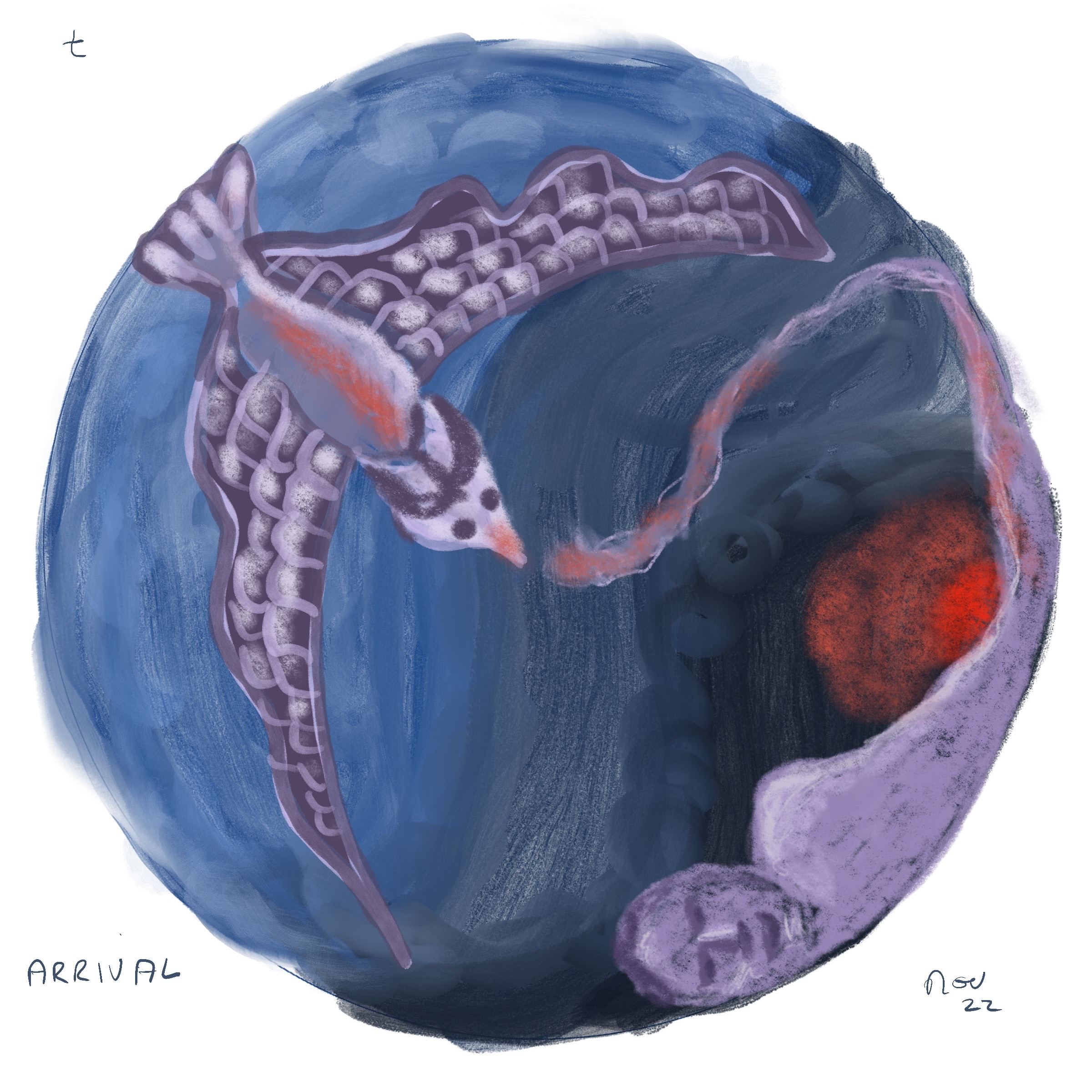
Michael and I sat across from each other at the dining room table, he with his IPad and I with old watercolours and a piece of heavy paper I’d traced a plate on. The songs from Leonard Cohen’s Old Ideas album surrounded us. We worked for a time. I sloshed paint and Michael used his magic wand. I persist in thinking of making digital art on an iPad as something otherworldly, technology out of my reach, which isn’t at all true. However, more and more, I recognize the ways I deceive myself, all of the little lies I tell to keep my life comfortable.
I like to mop up watery colour with an old rag, feel the wet paper under my palm, scrape at the bottom of the indigo blue with my brush, feel that I am using up every last bit of paint. The embodied experience of artmaking.
I got stuck on a phrase near the end of the poem, “aortal light.” Adjective + noun. Aortal – from aorta, the great arterial trunk that carries blood from the heart to be distributed by branch arteries through the body. I imagined aortal light as a lantern that pulses like a heart, sees all with a glowing eye. Warmth and insight at the end of life.
I fell in love with Michael’s “Arrival.” After creating hundreds of mandalas, he has developed a quick entry into the thriving, visceral archive of his subconscious. His images are evocative, and today both the image and the act of creation visibly disturbed him. I was riveted by the words he read to me after we’ve finished painting and writing. His honest expression of troubled feelings about the mandala—his fear of death—they scalded me. Would that I could be so honest! I like to think I won’t be scared when I am dying. I may be deceiving myself again.
Oliver writes, we “let ourselves be carried, as through the translucence of mica, to the river that is without the least dapple or shadow — that is nothing but light — scalding, aortal light — in which we are washed and washed out of our bones.”
Choosing the random means taking a chance. Please, big “S” Self, let me take more chances in this life. Not just by grabbing toonie bags and reading random poems—please let me take a chance in being honest, vulnerable.
My dad, 1927-2021, looking over his land soon after they bought the farm.
We walked slowly Thursday morning because overnight, recycling boxes and bags heaped with cans, bottles, cardboard, and newspaper had appeared at the curb. Blue splashes up and down the street that Marvin had to investigate, and so our walk slowed to a shuffle. He snuffled like a pig rooting for truffles, straining at the leash to lick the pizza box, to reach the Friskies can with a smidgen of catfood left on the rim. The night before, during his last walk of the day, he’d let out a volley of piercing barks at a pile of recycling across the street. Perhaps to his eyes, in the dark, the mound of stuff piled high above the blue box was a threatening mammal.
Early September’s morning chill, high scudding clouds above, and a Northern Flicker playing hide and seek in a hawthorn tree, his red head popping in and out of sight. The street is quiet—just the distant thunder of the McKenzie interchange as a blur of cars crosses into town. I am grateful to work at home, no need to commute. Instead, I love these 7 a.m. walks. Something in a recycling box caught my eye. Neatly folded on top of a pile of newspapers was a section of Saturday’s Globe and Mail, folded to the crossword puzzle. Every clue solved; every box filled with a neatly penciled block letter. Perfection. Did my puzzle-solving compatriot struggle over it as much as I had?
I felt connected to that person—their careful block letters different from my scribbled slanty ones, but we both finished the thing. Did they do it quickly, or did they stretch out the experience into Sunday or even farther down the week, relishing it? Did they approach the task methodically or fill in random clues? Did they ask for help or go it alone? Dictionary or no dictionary? Google or purely old school?
Marvin ate half of my pencil.
Think of all of us across the nation who turn to the crossword first thing on Saturday. Sharp number 2 pencil. Or maybe a mechanical one. Do some confident people use pens? Fresh white eraser by Mars. Or a pink Dixon, perhaps? We sit in armchairs, on couches, sprawled on deck chairs, scrunched on buses and subways, drinking lattes in coffee shops. All of us, together in the challenge.
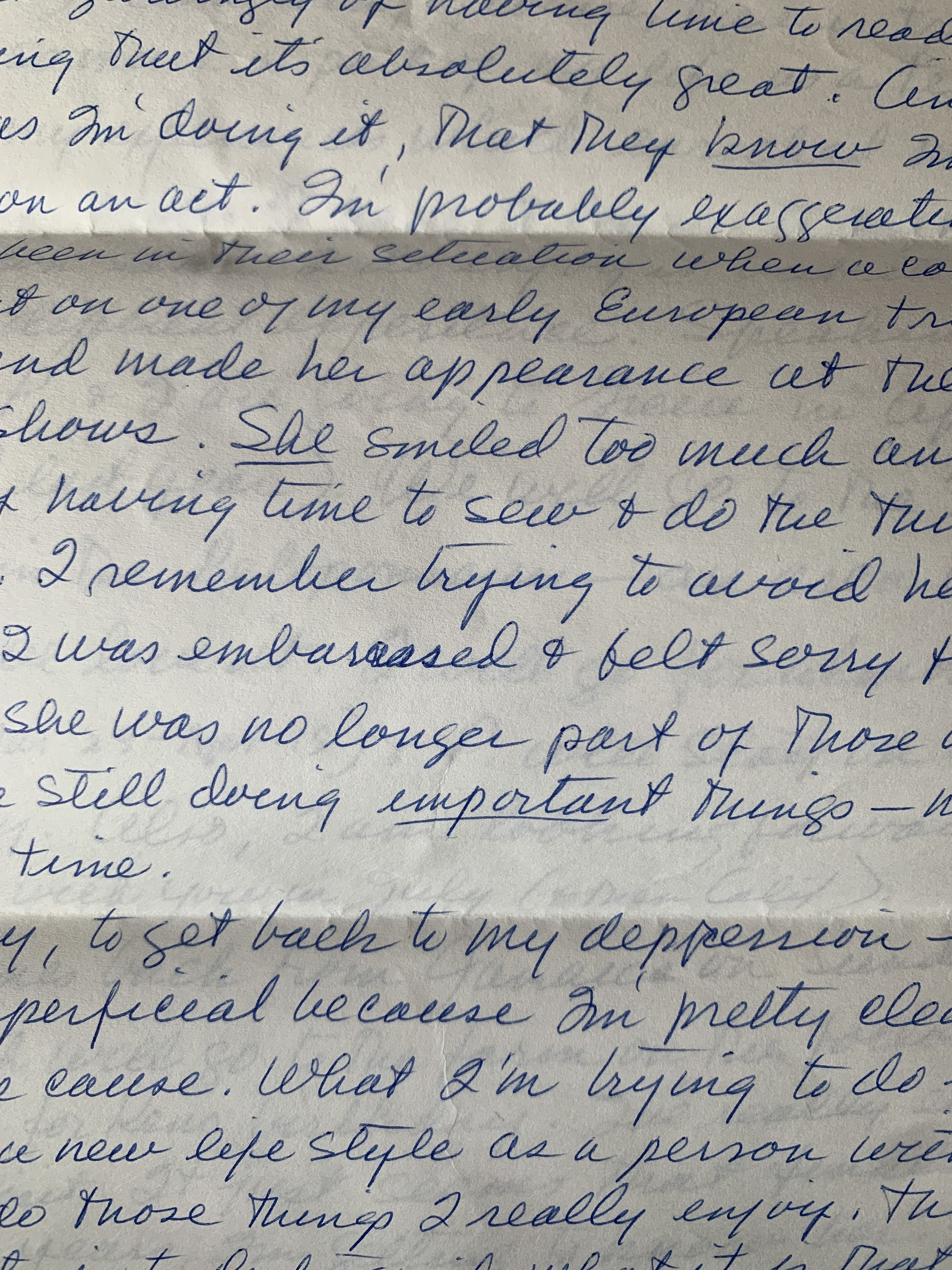
My mother did crosswords daily for the last 22 years of her life. They helped fill blocks of morning time after her mandatory retirement from her job as a lecturer in art history at Ryerson Polytechnic in Toronto. I found a letter from her dated February 1997. She had just received a package I’d sent intended to cheer her up:
“I didn’t realize my depression was so obvious. It isn’t a deep depression. It is simply that I no longer have an audience and no longer get paid for doing something I enjoy. The awful thing is that as soon as a person retires, he/she loses status. I notice it when I talk to people at Ryerson . . . They seem extra kind and sort of smile at me and ask me what I’m doing, etc. I smile back and try to talk glowingly of having time to read, etc. pretending that it’s absolutely great. And I know, as I’m doing it, that they know I’m putting on an act. . . So, I’m trying to develop a new lifestyle as a person with time to do those things I really enjoy. The difficulty is to distinguish what it is that I enjoy doing! Meanwhile, I do crossword puzzles, which is new for me and I’m getting pretty good at it (usually at breakfast), and it’s very nice to have the leisure not to have to rush.”
I started doing the Saturday crossword soon after my mother died in 2019. I thought they were too hard at first, and so I’d abandon them quickly. I have a healthy vocabulary, and I love language, but the crosswords seemed like something else. They’re filled with puns and tricks, and it seemed you had to be part of the in-crowd to get them: both hip to idiomatic English across the decades and savvy about current cultural trends. I’m just too literal, I thought, and what I know fills such a narrow groove. But then the challenge started to intrigue me. Now I look forward to the Saturday paper. After reading the headlines and the obituaries, I find the crossword, fold it into a nice rectangle, and begin.
All of this is a preface to say, I’ve had no will to write. Nothing seems worth writing about, these days. Life has a flat, fallow quality. Nothing’s important enough. Although there’s plenty of big bad news—pandemic, systemic racism, climate change—I don’t feel equipped to talk about any of it.
So, I push myself to finish this rather silly piece, a blog post about something as quotidian as the crossword puzzle. I stop and pause often to ask, “Why bother?” Why bother indeed. But it’s just that writing something, anything, seems as if it might be the antidote to the flat way I feel.
My thoughts return to my mother, sitting on the loveseat in her high-ceilinged living room, wrapped in a thick robe, blinds down, doing the crossword. Filling the hours. Her sleek black cat, Cicero, is curled up beside her. She is deep into it, puzzle dictionary next to her on the small rococo marble-topped table, Schubert’s Trout Quintet playing softly on the CD player. Missing the old nicotine rush, the sweet suck of smoke into her lungs, she holds the pencil like a cigarette for a moment. I miss her. In that old letter from ’97, she wrote,
“I’m probably exaggerating, but I have been in their situation [those Ryerson people who acted extra kind toward her] when a colleague retired and made her appearance at the annual fashion show. She smiled too much and talked of having time to sew and do the things she enjoyed. I remember trying to avoid her because I think I was embarrassed and felt sorry for her because she was no longer part of those of us who were still doing important things—not just passing time.”
Mama and me, back in the day.
Doing important things v. Just passing time. . . I flinch at my mother’s binary of “important” paid work and “just passing time.” But something in what she wrote resonates with me. I work part time as a self-employed editor, but lately, I often feel as if I’m just “passing time.”
Maybe this is just the flatness of grief. Flat-footed grief walks over me. After many losses, I am a fallow field—nothing growing here.
I have been reading memoirs about aging parents. . . Elizabeth Berg writes in hers, “I think as long as a parent is alive, it’s easier to feel young.” After my father died at the end of June, I’ve felt old, flat, fat, tired, sad. Nothing feels important. Especially not the weekly crossword. And yet, musing over the word problems gets my brain churning slowly, raking over clues like a pitchfork turning organic matter in the compost heap. I feel connected to crossword puzzlers across Canada. I imagine, for example, an old guy in Mahone Bay—let’s say he’s 82, goes by Ernest Nickerson and sits in the kitchen nook with morning coffee, chewing the end of the pencil as he tries to remember what a 10-sided shape is (79 across, 7 letters).
From our 2012 honeymoon in NYC
Remember geometry class in tenth grade? That’s where Ernest first noticed the girl who would be his wife, in geometry class at Mahone Bay School. As he digs deep for the name of a ten-sided shape, another thought is unearthed from that compost heap: Darlene’s thick red hair, held back with tortoiseshell barrettes. He couldn’t take his eyes off those red wings in front of him during class, couldn’t stop imagine pulling his fingers through that rough, dark crimson hair. He unclicks the delicate barrettes to let those wings loose to fly. If Darlene were alive now, Ernest thinks, she’d lean into my ear, her coarse grey hair tickling my nose, skinny shank up against mine, and whisper, “Decagon, Ernest. You knew that, honey.”
I write to get momentum, to feel connected to people, to create worlds. To feel connected to you, and Ernest, and Darlene. So, if you are a maker, a creative person, (we all are, each in our own way) remember: The work wants to be made, and it wants to be made by you. Even if it doesn’t seem important. Believe me, it’s important. It connects you to life. The fallow field regenerates.
Memoirs about aging and dying parents that I recommend:
Roz Chast, Can’t We Talk About Something More Pleasant?
Philip Roth, Patrimony: A True Story
Elizabeth Hay, All Things Consoled: A Daughter’s Memoir
Elizabeth Berg, I’ll Be Seeing You.
From a later trip to NYC, March 2019, after my mother died. Sugar skulls in a restaurant display.
In the last few weeks of my father’s life, my stepsister Sandra held the phone near his ear when one of us called. He lay in a bed set up in the living room, slipping in and out of consciousness. We’d given up on FaceTime; he could no longer see us. But perhaps he could hear my voice. You never know.
That day, perhaps two weeks before he died—I don’t remember—I felt desperate. I was frenzied in my wish to connect, to penetrate the veil, to make him hear me. But I had nothing to say other than I love you, you were a good father. He’d heard it all before.
So I sang. First, Summertime, from Porgy and Bess, my voice catching and scratching like an old record. Then, I pushed on with the next song that entered my head: Mac the Knife. I scrambled around the world wide web until I found the lyrics. Oh, the shark, babe, has such teeth, dear / And it shows them pearly white. Somehow, I thought he’d remember that song, but I don’t really know the melody beyond the first two lines. I faked it, trying too hard, straining, improvising, hoping. Hoping for what? For his sweet voice to say, “Madeline, that was wonderful”? Nothing.
So, then, a poem. I’ll read a poem. Robert Frost is a good safe bet.
I wanted to find Nothing Gold can Stay, a poem about impermanence. But my memory failed me. I couldn’t recall the title, so I accepted instead the first poem that popped up when I searched for Frost: Stopping by Woods on a Snowy Evening. I pressed on, putting as much feeling into my voice as I could, wishing I’d chosen a more dramatic poem, a poem I could really emote. Instead, just the simplicity of an Alex Colville painting. A man and his horse on the darkest evening of the year, stopping.
The woods are lovely, dark and deep, But I have promises to keep, And miles to go before I sleep, And miles to go before I sleep.
When I finished the last lines, my stepsister’s voice entered. She’d been there all along, holding the phone. She said kindly that she could listen to me all day, my voice was lovely. But Dad was asleep; he’d been asleep the whole time. She thought perhaps he could still hear me. Did he move an eyebrow?
But really, I know she didn’t have the heart to interrupt me. We said good-bye. A week later, I used the voice memo app on my iPhone to record myself singing “Blackbird” by the Beatles, Dad’s favourite song, and I texted it to Sandra, with a note, can I talk to Dad on Wednesday? But Tuesday was his last day here.
A frantic energy inhabited me during those final one-sided calls. Helpless, I worked overtime to get through, to make a mark. Hey you, this is your daughter. Papa! You there? Remember me? Your youngest daughter? Remember how you and I used to joke about you being King Lear, and I was your Cordelia? Sir, do you know me? Surely you do. Just give me a sign.
Father

In this wine-dark place
a tiny voice
a whisper:
hush, little baby, don’t you cry

From long ago
from far away
a thread
of red travels along
my bloodline

when that shark bites with his teeth,
babe
scarlet billows start to spread

and meets a tributary.
I know your voice.
You are mine.

I want you close
daughter,
but this trip
is made alone.

The woods in here
are dark and deep

I want to sleep,
dear, but
a worry burns:

Tell me, do I have
promises still to keep?

No, I hear you say,
no more promises to keep.

Spread your wings,
I hear you whisper

Take to the sky papa,
Take to the
red-blood sky.
I know it was a horrible year, and yet it was somehow a good year for creativity. The work wanted to be made.
Writing
I finished the first draft of my first novel—as yet untitled. I have been living my own dictum. You only learn to write by writing, I tell the students I teach and tutor in academic writing. The more you write, the more you experiment, the more you learn how to write.
James Hillman said that “truth is revealed. It cannot ever be told. It has to appear inside the telling or through the telling.” Never have I found this more resonant than in writing fiction. I started out with a vague idea for a story, but it has only been inside the telling that truth has been revealed, an exciting and serendipitous—perhaps even magical—process.
I was privileged to have the first six months of the year off work and the second half working at home. This flexibility allowed me to establish a regular writing time in the mornings, so most days I wrote at least a paragraph and sometimes several pages. The novel is about 300 pages long. I will leave it to rest for a few weeks before I go back with an eye to editing. My small but loyal writing group helped me stay motivated, and I am grateful to them. I loved hearing other writers in the group read their work.
I published 18 blogposts in 2020. Long ago Michael helped me to be content with “3 plus me” (it’s written with a wineglass writer on my mirror). That just means if I like it and three other people like it (Michael is inevitably one of the three), then I am happy.
One of the posts this year was a beautiful guest blog by my sister. And we collaborated on a second one. I love collaborating on blog posts and I welcome any of you to get in touch with me if you want to write together.
Editing
This year I was accepted into Simon Fraser University’s Editing Certificate program and I have completed 3 of the 12 courses. I aim to finish in 2021, and intend to start my own freelance editing and writing coach business. I have done this kind of work as a side gig for years, but now I am ready to formalize my training and freelance in a serious way. Editing is a profoundly creative act. All of those decisions to be made about word choices and paragraphs, sytnax, architecture, punctuation. . . .
In my reading about editing, I came across Susan Bell’s, The artful edit, an interesting book about how to edit your own prose and hone your understanding of other people’s. I loved the way she takes the reader through the masterful editing of The Great Gatsby by Fitzgerald and his editor, Maxwell Perkins. She has provided me with so many ideas both in editing my own work and as I apply my skills to my clients’ writing.
Sewing
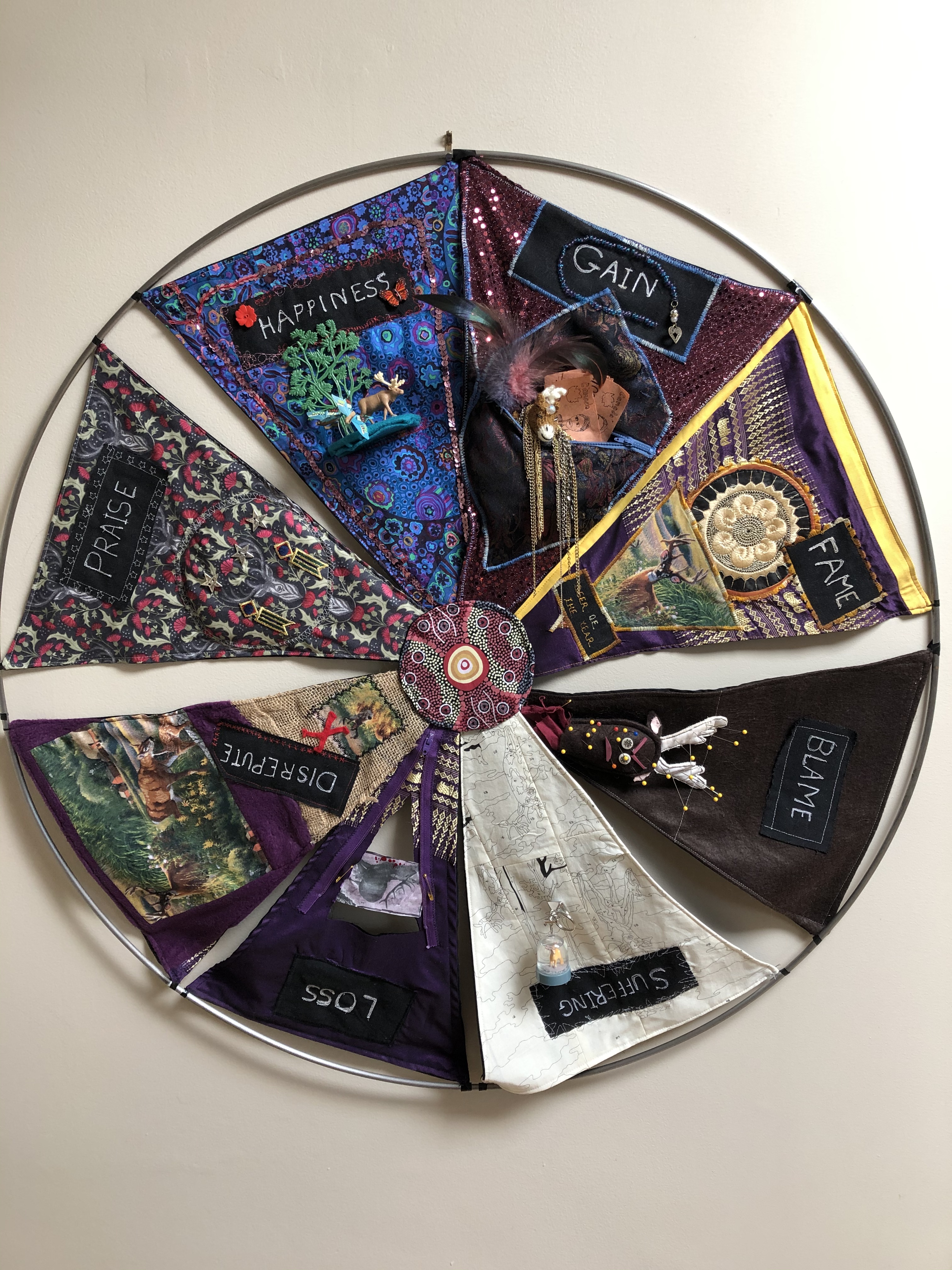
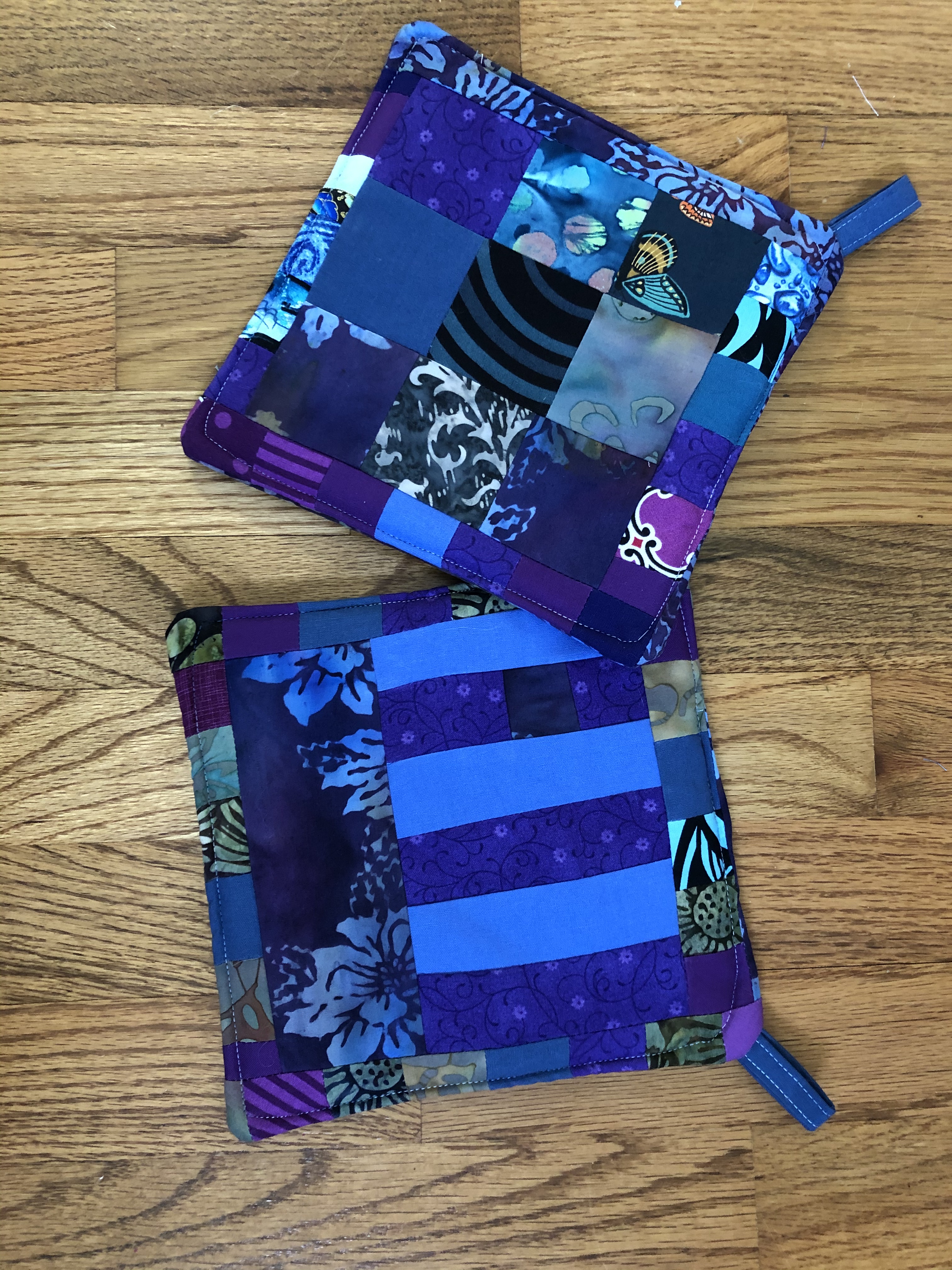
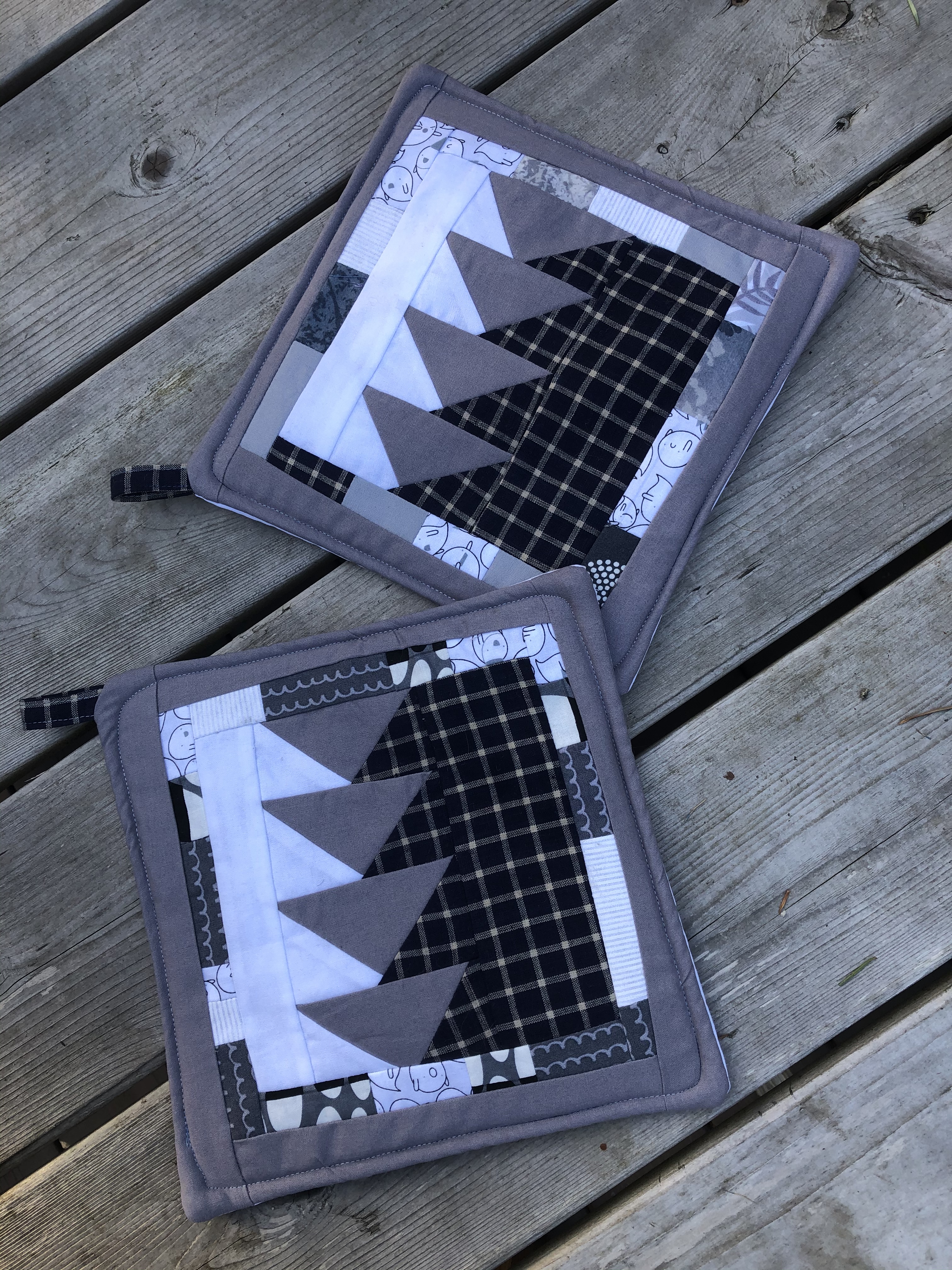
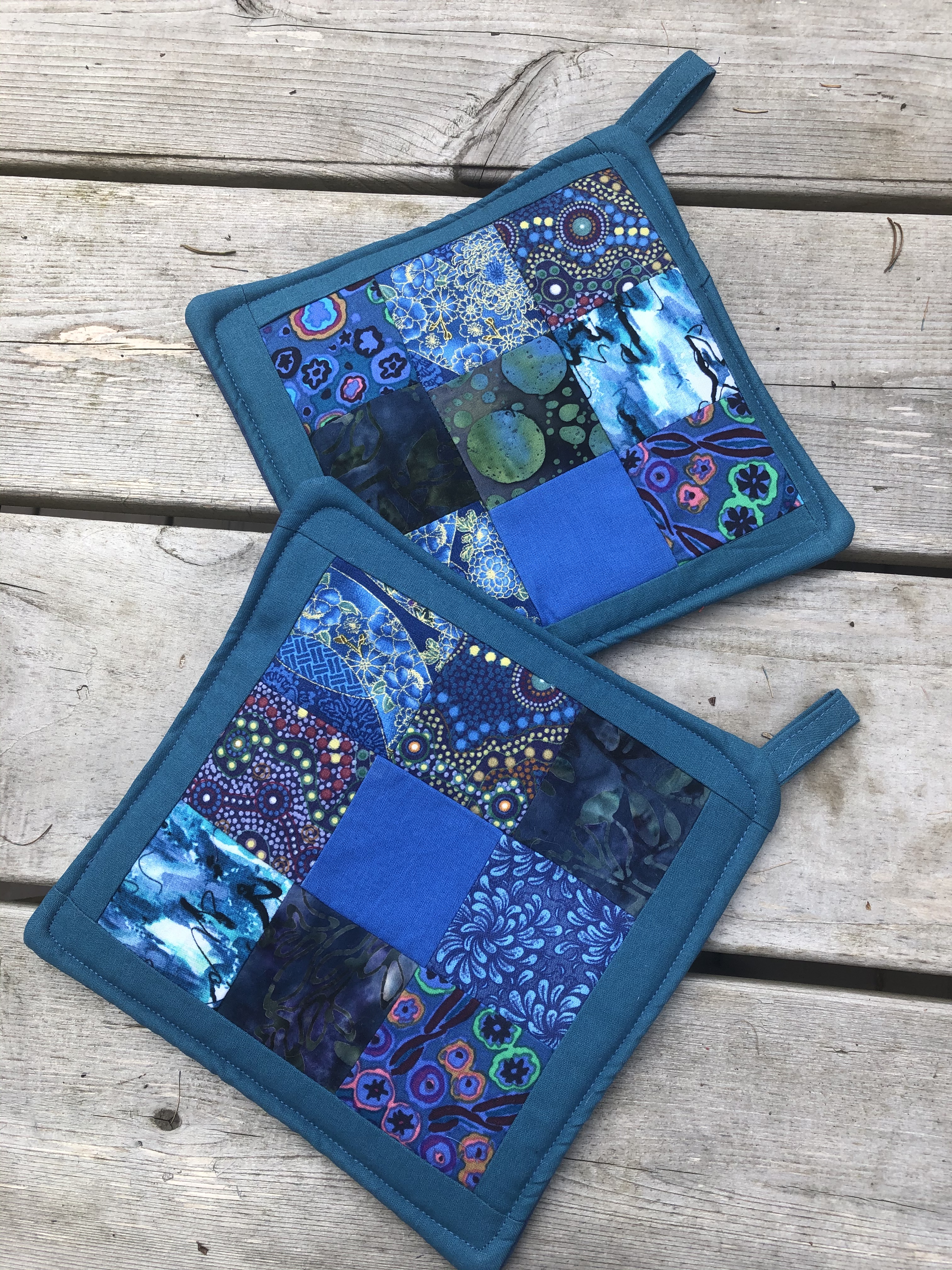
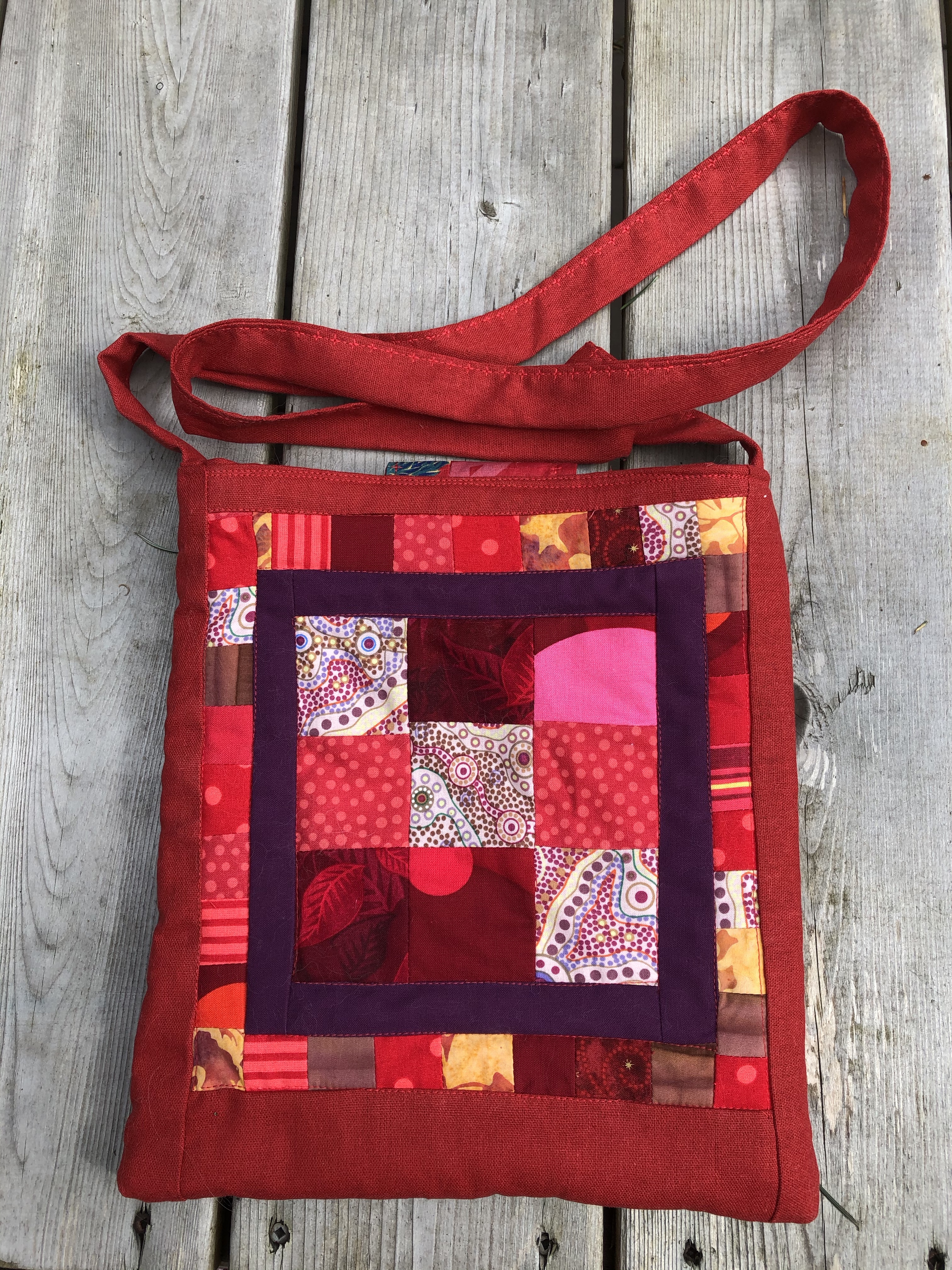
I sewed in fits and starts this year, but as I look back I realize I was productive, though it often didn’t feel that way. I finished the textile art piece Eight Worldy Winds early in the year. The piece now hangs on my office wall to remind me of the transitoriness of feelings, fortunes, and life itself. Then the pandemic shifted me into giving mode—I wanted to make small gifts for people. So I started with potholders I had promised to friends a long time ago, then I delved deep in my scrap supply to make one-of-a-kind bags for other friends. After that, I sewed masks. I have to admit, that was a duty more than a joy. Then I started making aprons for people I love. By the final apron, I felt I’d perfected the pattern. I almost forgot about the blue cape I made (my courage cape) out of an old wool blanket. So much fun!
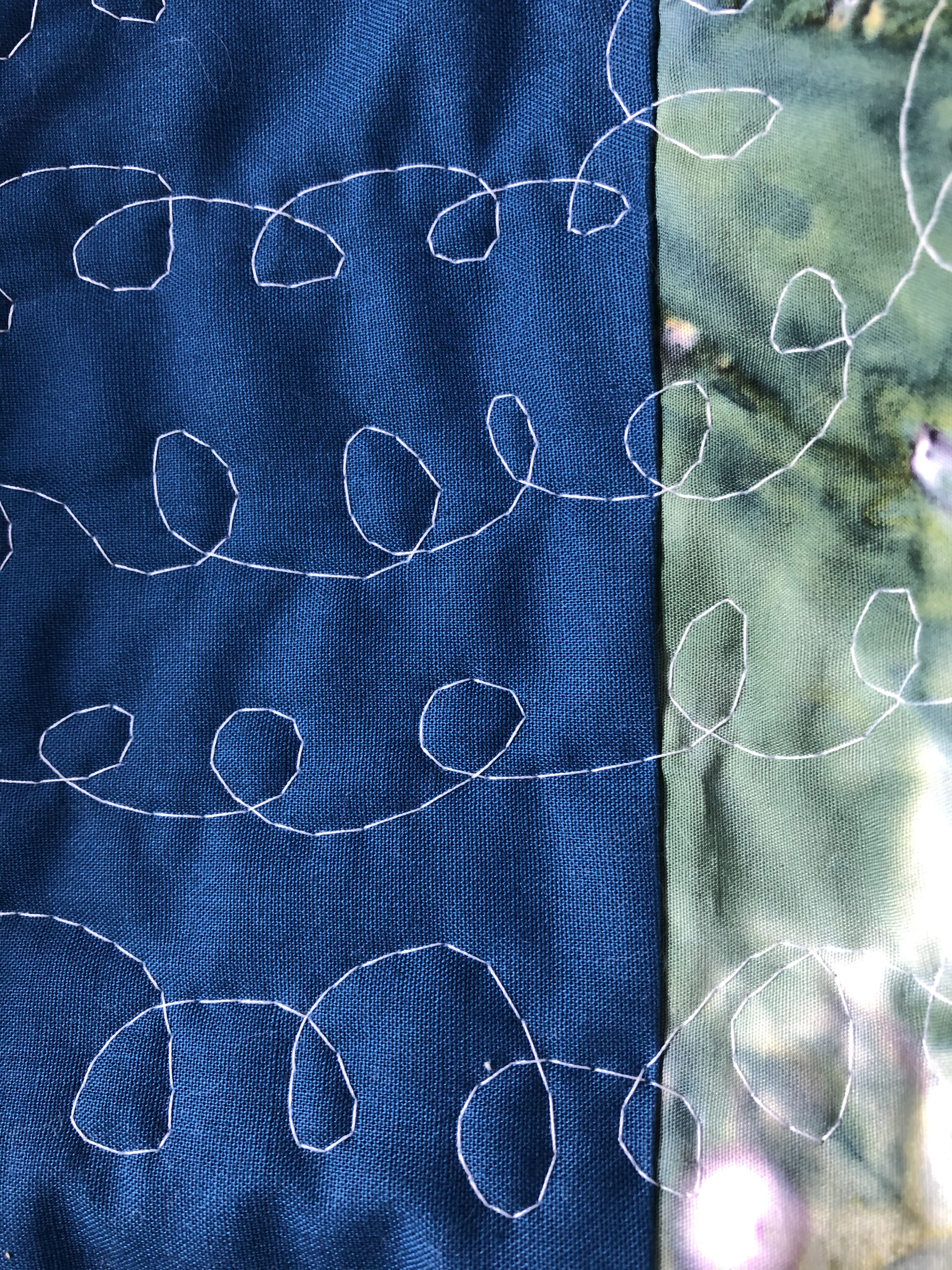
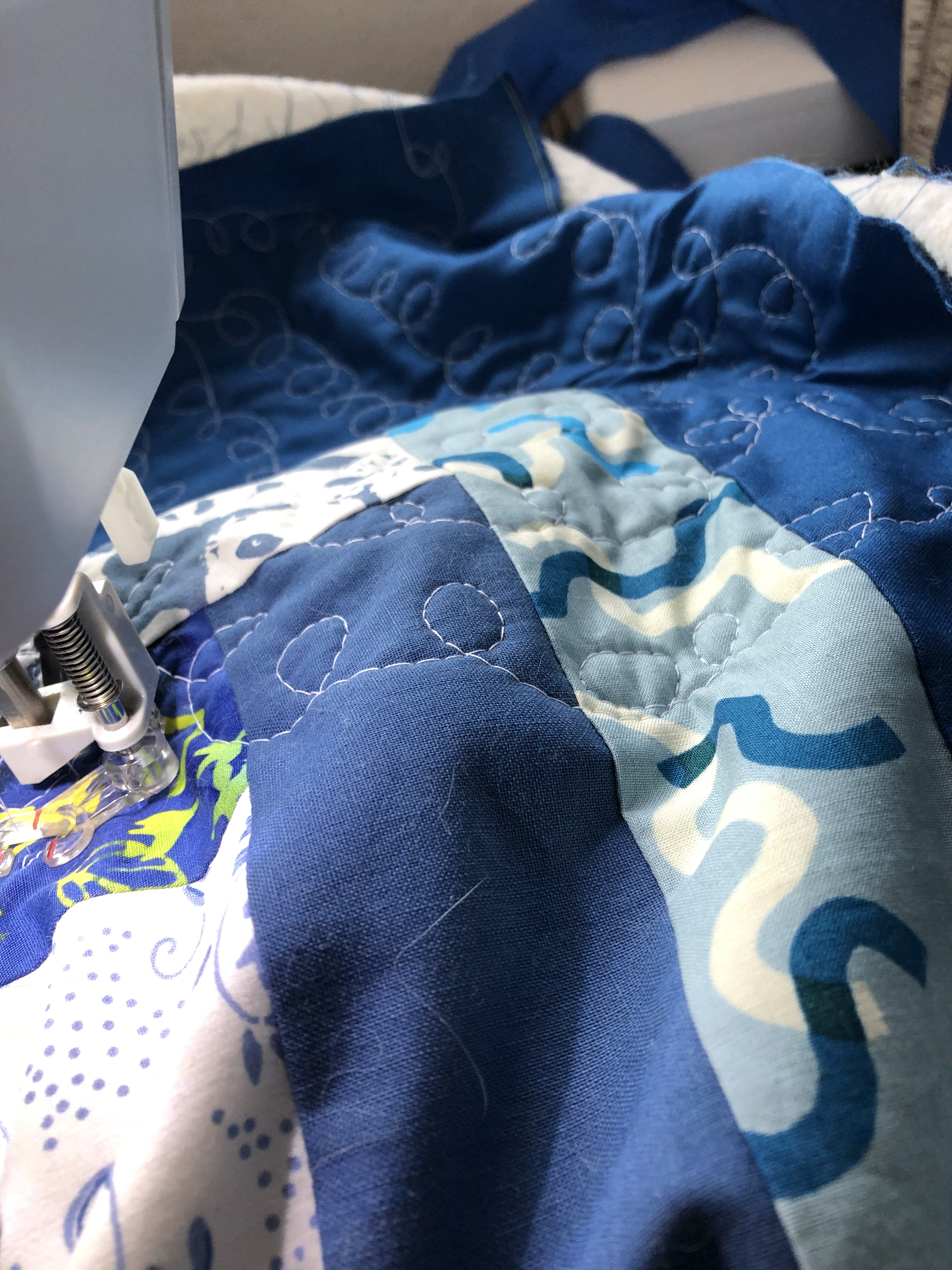
I went back to a bigger project with the Rhapsody in Blue quilt. It’s one of those weird quilts that actually look awful close up, with the mishmash of colours and patterns. But the total effect is pleasing. I started machine quilting of the top today, after pinning the whole quilt with safety pins. It’s the first time I’ve tried using curved safety pins to sandwich a quilt, and I like it. In the past, I’ve used the spray adhesive between layers, but I find it is not secure over time, and sometimes it takes me a while to finish a quilt top (now, especially, with a puppy).
There is something incredibly liberating in free motion quilting. And it’s a physical act; my whole torso sways and moves as I push the material under the needle, forming loop de loops.
Puppy raising
Raising a puppy is a creative act. Just as raising children calls for creativity every day, so does having a puppy in the house. I used to make up games and stories, craft activities, and innovative ways to distract and delight my children. Now I am doing the same kind of thing with Marvin.
Going forward
I put sewing and writing on hold during our first few weeks with Marvin because it was an immersive experience—all of my energy was need to do my paid job and engage with and train the puppy. Those few weeks taught me an important lesson. I felt drained and bereft without my creative outlets. It is not just a luxury to take time to write and sew. Creativity is my lifeblood; creativity gives me momentum to keep on going; creativity feeds me. Especially in this year of the pandemic, I have leaned heavily on creativity, and I am so grateful to have the time to pursue my creative acts.
This year I let go of some things—drawing and my aspiration to learn to play the ukulele to accompany my singing. I just can’t do everything. So I focused on writing and sewing. I’m not sure what I’ll focus on in 2021. Some contemplation is in order.
Remember, creativity is your birthright. It’s not granted to just some people—we are all born with innate creativity. As children it seems more accessible and we rarely question it, but then its force seems to fade for some people. I encourage you to spark your creativity if it’s dormant. Write a poem, cook something new, learn a song, write a song, draw a comic, sew something. Make a birthday card for a friend. You never know. . . .
In the basement of my mother and stepfather’s house, I look through the closet where Mama’s coats hang. These are her extra coats, at least twenty of them. A black suede jacket by Anne Klein, a gold rain cape by Pierre Carden, an army-style blazer by Eileen Fisher. Size 12, size 14, large, large, large. I wish they fit me, but I swim in them. Except the cape.
It’s raining, and I didn’t bring a raincoat. I came to Toronto to see my father in hospital, where he lies with a fractured pelvis. I left Victoria in a hurry and packed lightly—just a small overnight bag with a few clothes and a box of KN95 masks. I try on Mama’s rain cape and my hands go to the pockets. Change, Kleenex, a shopping list, a Stim-U-Dent, “the most recommended piece of wood in dental history.”
I inherited my mother’s gum disease and her love of pockets. The best jackets and coats, dresses, and pants have pockets. Places to stash the things we might need. Mad money, my mother told me, was the money you took on a date in case the guy was a jerk and you needed the bus fare home. Pockets are secret places to slip your hands into when your fingers are cold or restless. Places to finger a hidden thing.
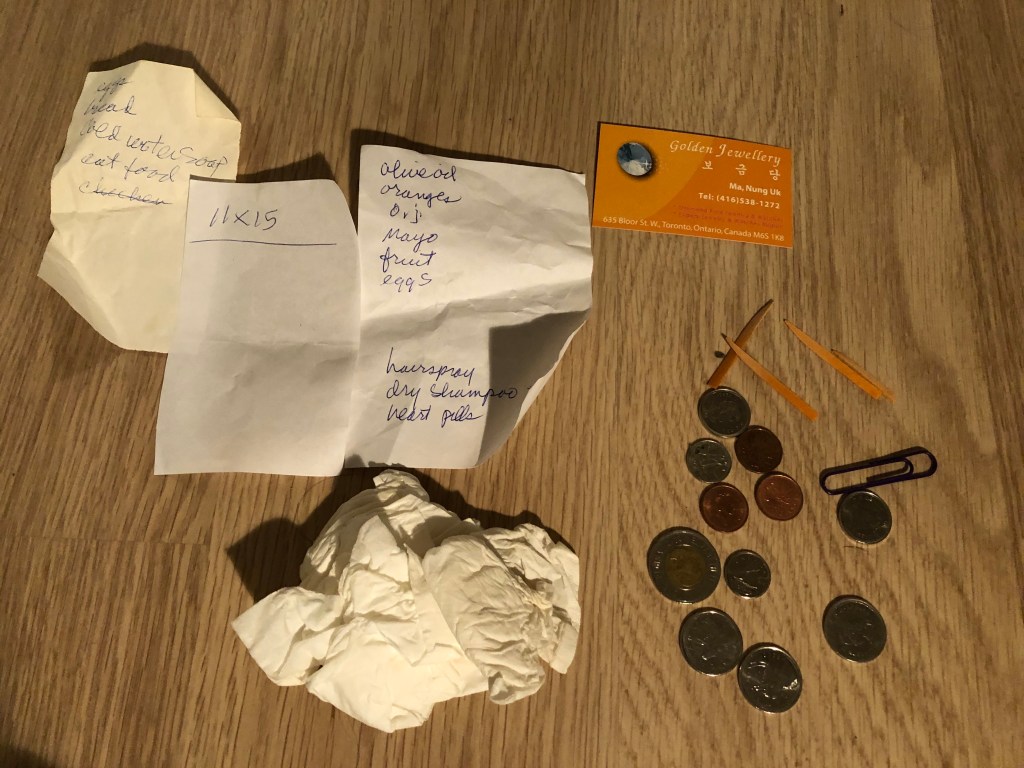
Wearing the long gold cape, light as tissue paper, I start to rifle through pockets of the other coats. The treasures I find, I pile on the floor. I take just a few sample items and make an arrangement: a toonie, quarters, dimes, nickels, and pennies. Clean Kleenex, wads of it. Stim-U-Dents. A paper clip. The business card of a jeweller up on Bloor Street. Some scraps of paper with her handwriting.
Handwriting that opens a valve spreading warmth through me. Hey, Mama, it’s you! I’ve opened hundreds of envelopes and packages addressed in that warm energetic cursive. For years, there were frequent letters filling me in, encouraging me, describing events and ideas, asking me how are you? how are the boys? Handwritten cheques, recipe cards, Christmas and birthday packages and “just because” packages.
And lists—lists that summon an image of Mama getting ready to go out to do her daily errands.
She would tell me during our weekly calls, “I’m just like a European housewife, now. I shop every day.” I can see her in her sunglasses, her dark smooth hair in a classic bob. Pink lipstick. She is dressed all in black, and she tucks the list into her jacket pocket, slings a shopping bag over her arm. She calls for the cat Cicero, making sure he’s inside before she locks up and gets into her black Echo, buzzing up to Fiesta for the good Ace brand ciabatta. For the green net bag of bright oranges to halve and squeeze for juice every morning, using the old-fashioned cut-glass juicer. Mayo—a large jar of Hellman’s to be slathered on the sliced ciabatta and then layered with Asiago cheese and slices of the best-quality salami. A stop at the drug store for heart pills, for “dry shampoo.” I can see the funny little purple and white cannister of “Nuvola Dry Shampoo” on her vanity—that powder she sprinkled on her oily scalp to assuage some anguish she had about her hair.
Pocket collage
I take off the rain cape—too dramatic. I worry it would draw attention to me as I walk along the street; I want to go by unnoticed. But I ask Petros if I can have her summer robe from the upstairs closet. It’s been 19 months now, but her clothes are all still here. I reach to the back of the closet and pull out the robe, still smelling of her.
Hey, Mama What is 11 by 15? Is it the size of a photograph you wanted to frame?
Did you ask Ma, Nung Uk at Golden Jewellery to make your ring smaller so as to fit your dwindled finger?
I hope you don’t mind that I took your robe. The Calvin Klein black jersey one you wore in your final days.
I was careless: forgot to check the pockets and when I pulled it from the washer, a fine white confetti decorated the dark folds.
The day before I left I asked him, Could you ever love another woman?
No, he said. I would always compare her to Virginia.





































 Madeline Ruth Walker