“In a time of destruction, create something.” Maxine Hong Kingston
I have been trying to write poems this year. If you love poetry, I recommend listening to The New Yorker poetry podcast. Poetry editor Kevin Young interviews poets who read a poem from the New Yorker archive plus one of their own poems. Also inspiring, if you are interested in haiku, is Natalie Goldberg’s book, Three Simple Lines. She writes about her pilgrimage to Japan, about haiku, about the first Japanese masters, Basho, Buson, Shiki.
I have started to write my own version of Haibun, a Japanese form that combines concise prose with a haiku. I loosely interpret this form, writing a daily observation in a few sentences plus a “sort of” haiku. No more 17 syllables, just three simple lines. Maybe these aren’t haibuns or haikus at all…. maybe they are just what they are.
I Womb
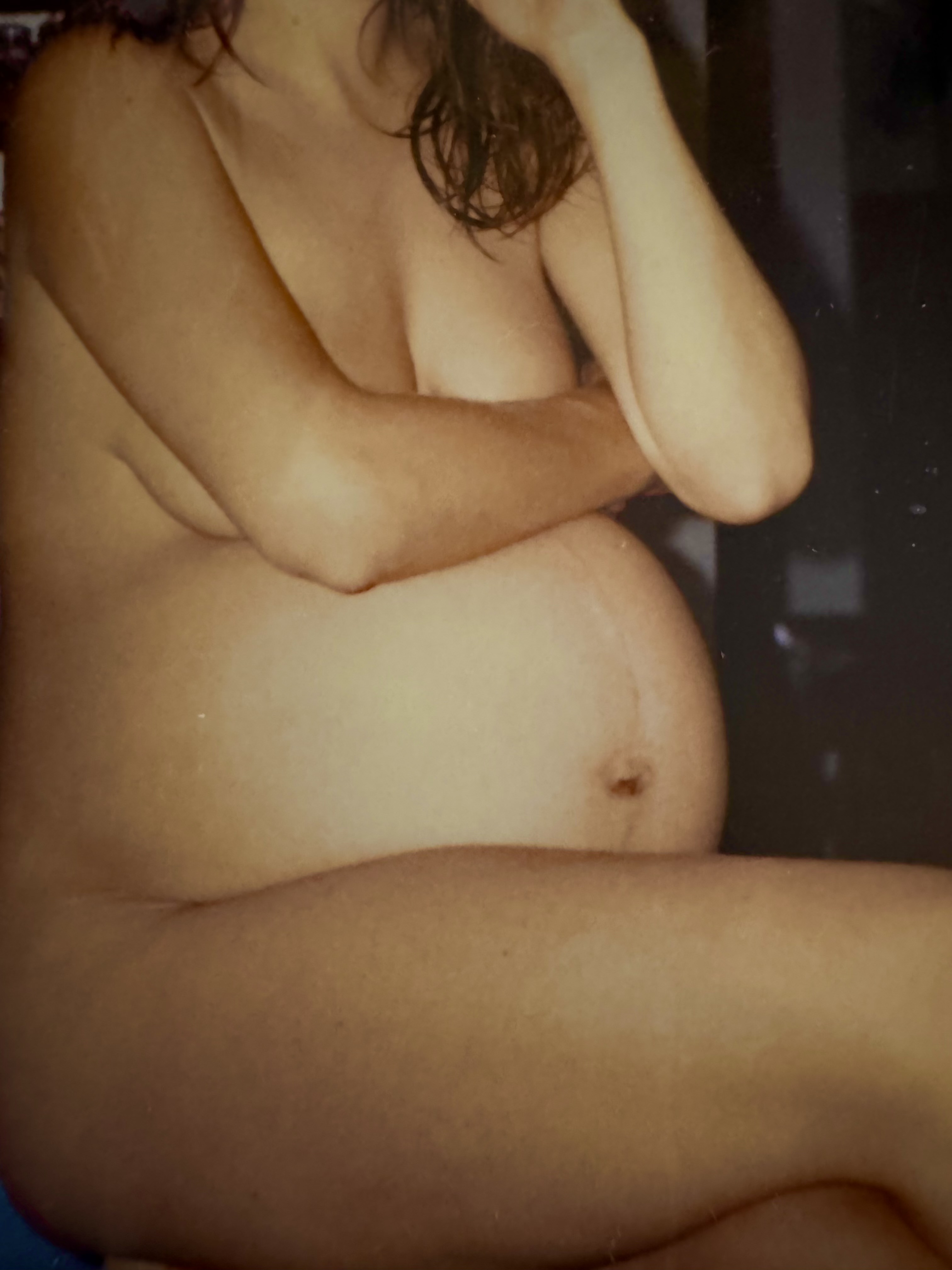
Morning crossword, four letter word, first site of eviction. “Womb,” I say aloud with certainty. But no, the answer is “Eden.”
Every human’s first home, the blood red womb
II Orange
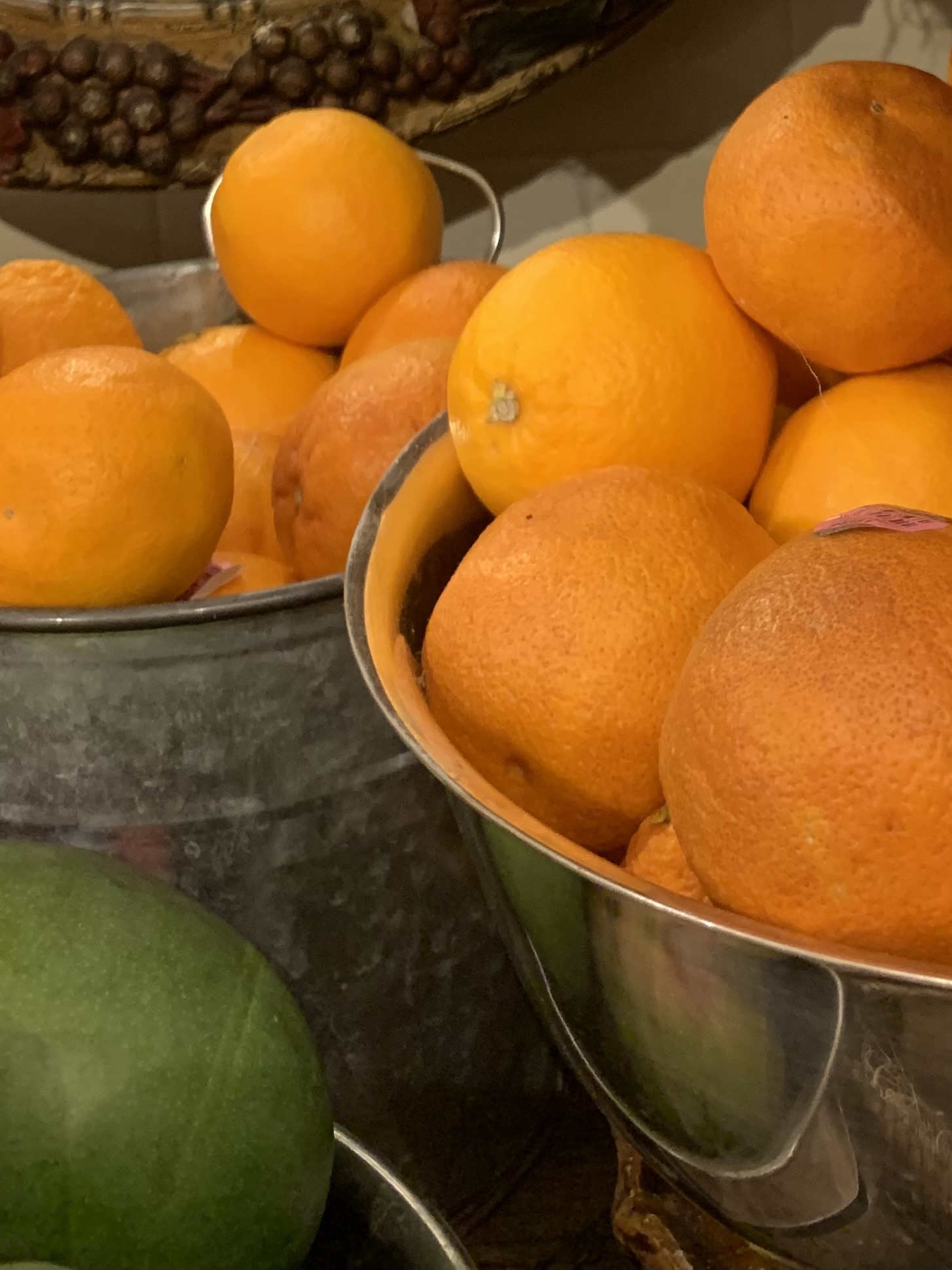
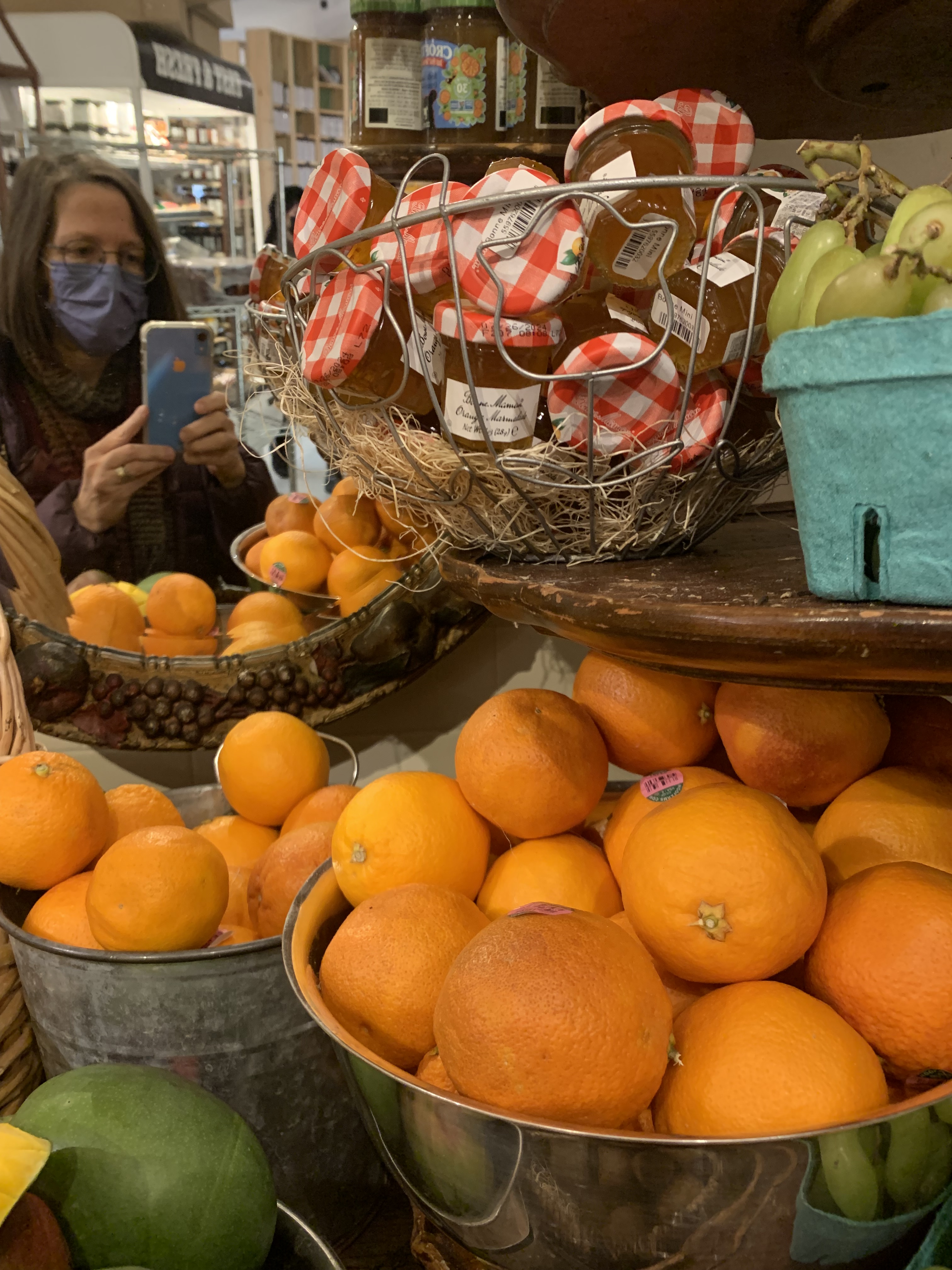
I go to the store to buy blood oranges for the cake and discover they have been rebranded raspberry oranges. the word “blood” is off-putting to consumers. I feel angry.
Remote, bloodless pale body of moon his face, forgotten
III Knife
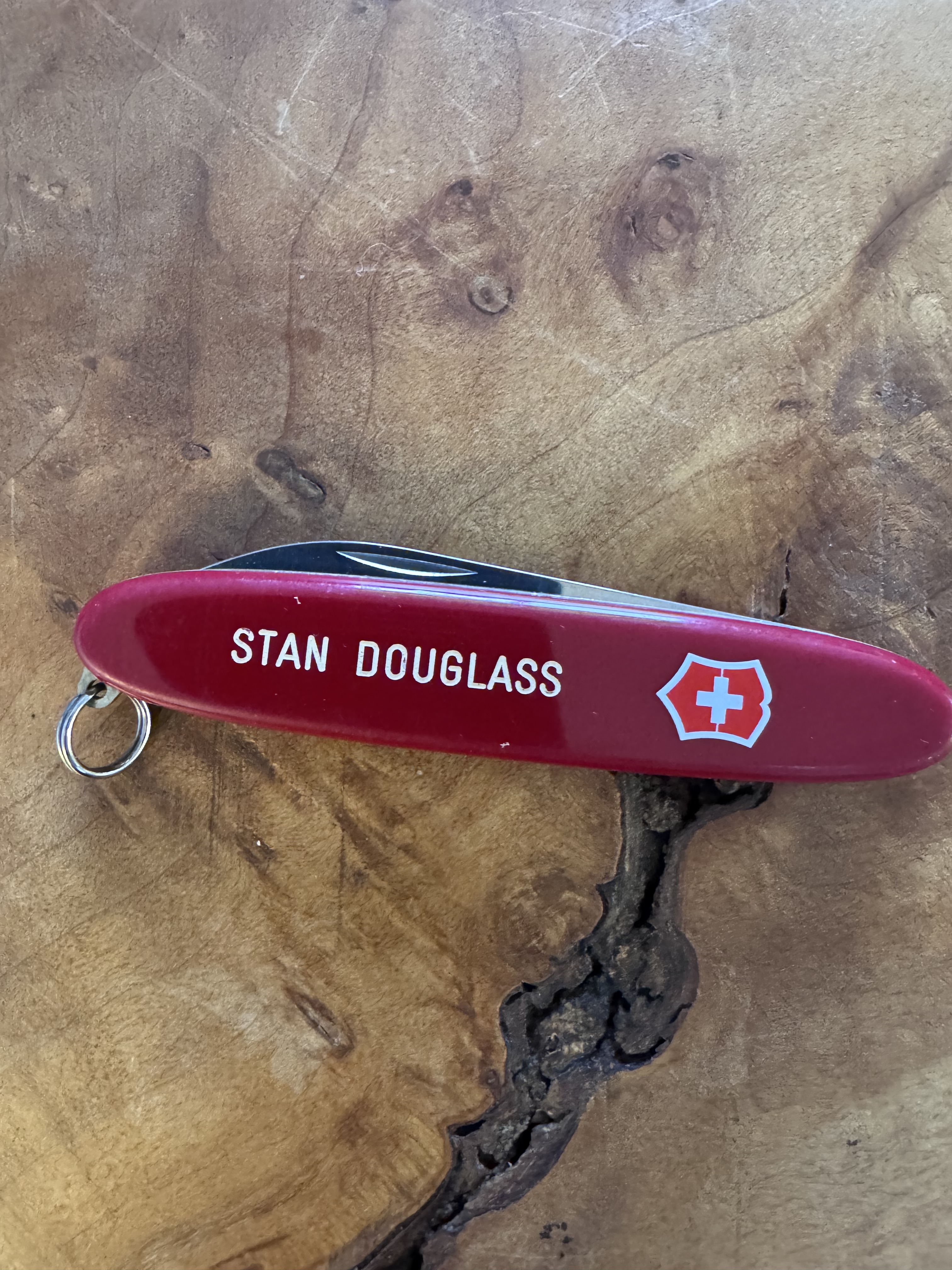
I go to an estate sale and buy a box of assorted junk for two dollars. At the bottom, I find a small Swiss army knife tucked into a black sleeve. The knife is marked with white letters: Stan Douglass. I look up Stan’s obituary.
When fifteen, only a lad, Stanley made a vow to serve the Lord
IV Ruth
My son and I walk along the street, heading to Value Village. He’s shouldering an old chair he took from a free pile, then regretted. I’m following. Suddenly a telephone pole is in front of me with
R U T H
painted in big red letters. Just a day ago, my friend and I compared middle names. Her middle name is Mazal meaning good luck. Mine is Ruth, I texted, and she texted back that “the biblical Ruth is a very special woman, and her name is synonymous with unwavering loyalty and kindness.”
Is it a sign? Four red letters tell my fortune
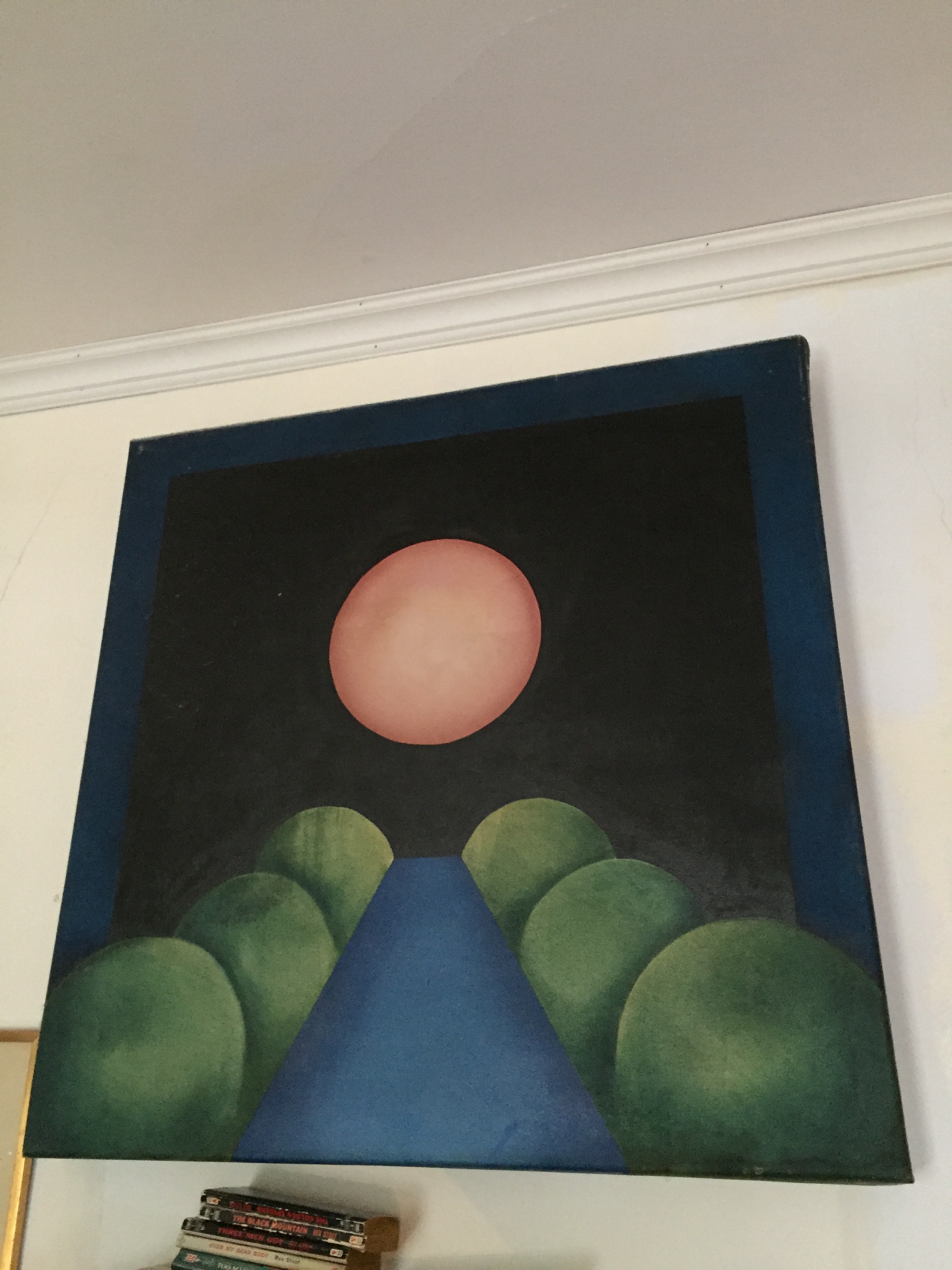
The moon painting is by Bob Sabatini. Other creations are mine.
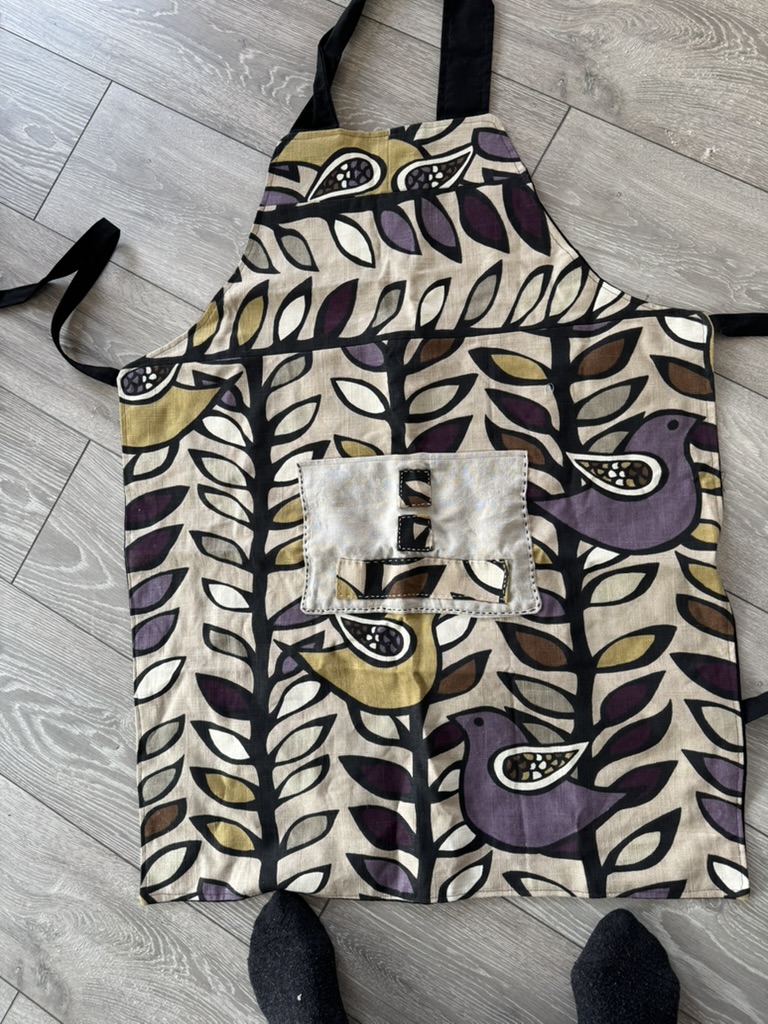
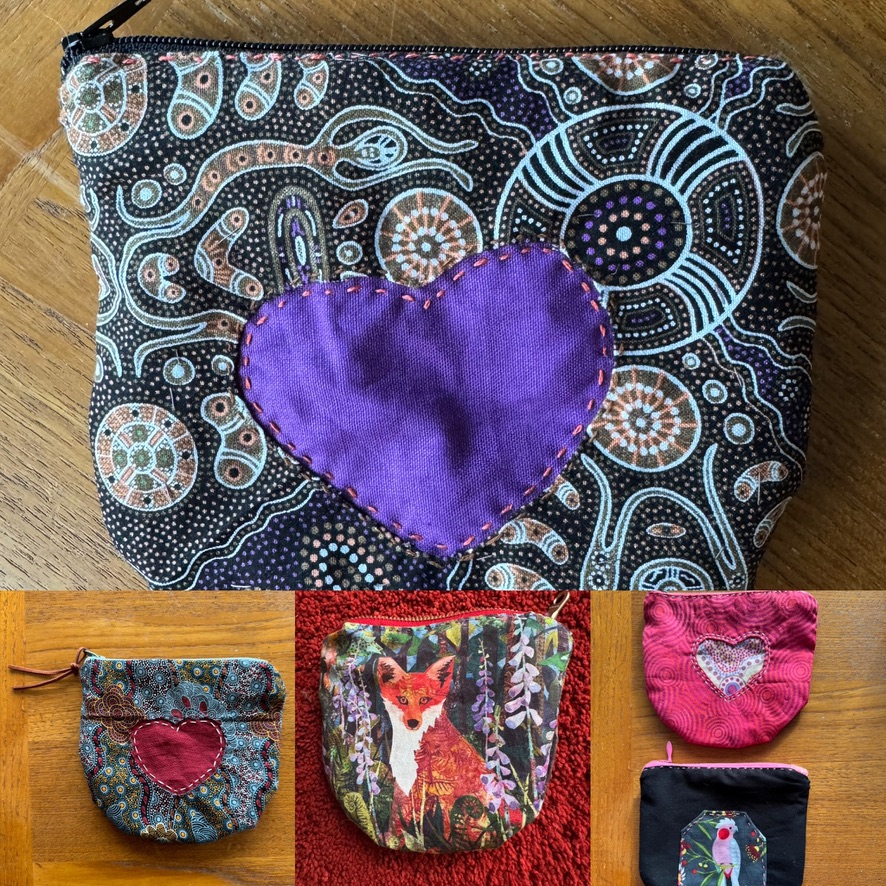
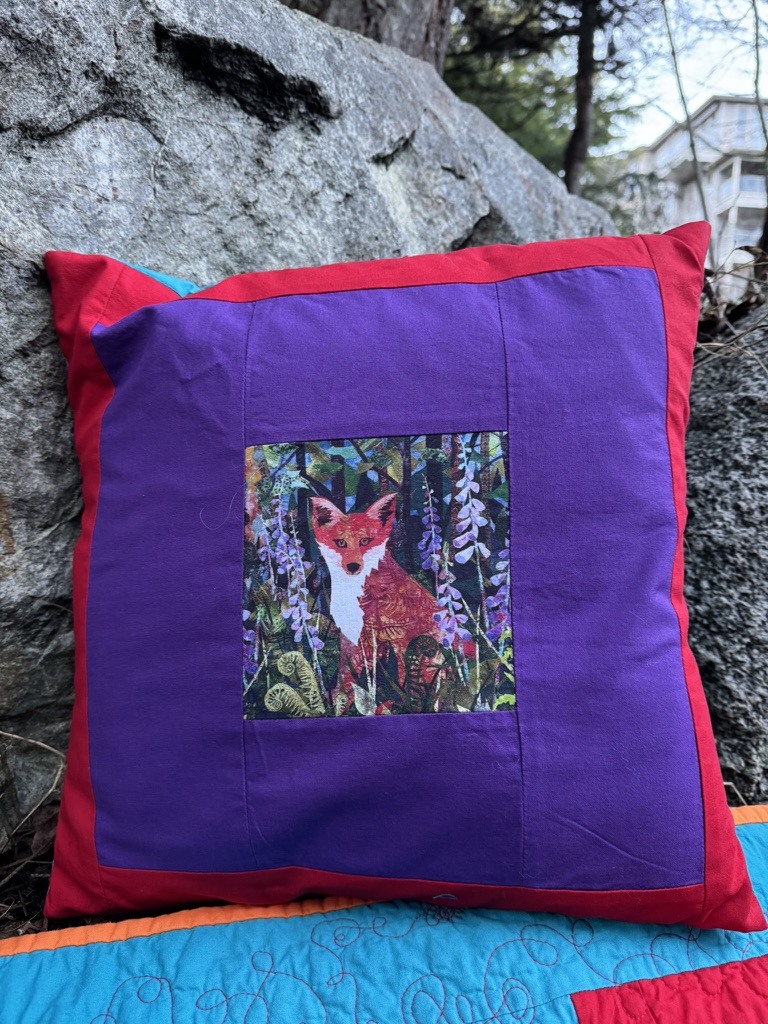
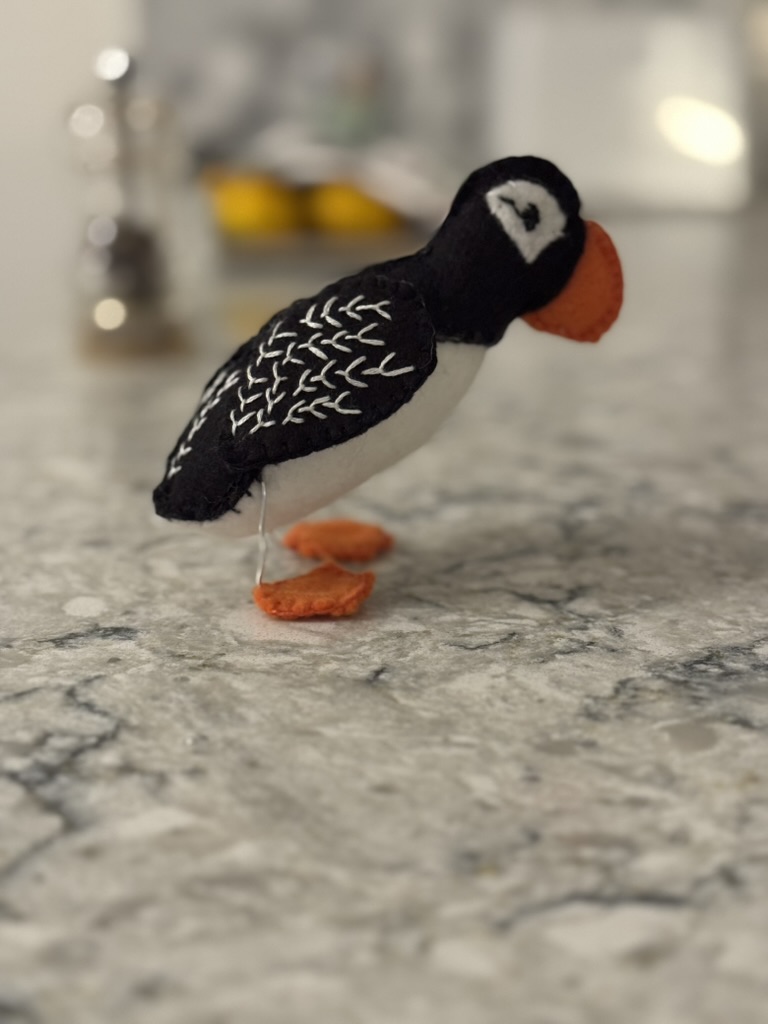
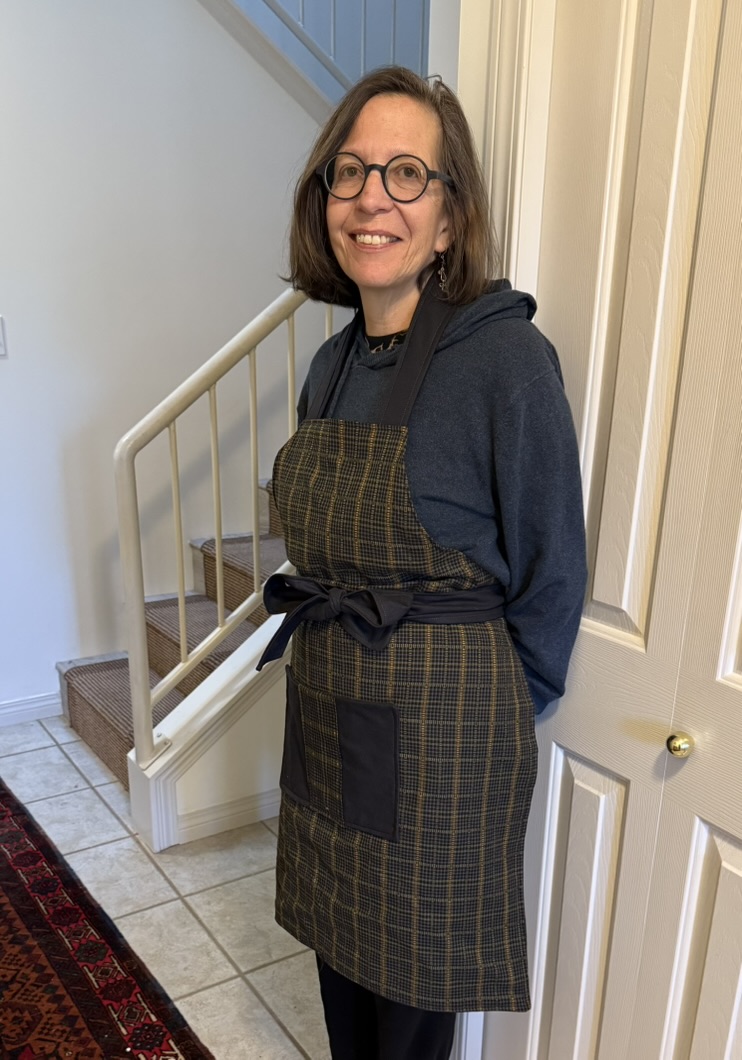
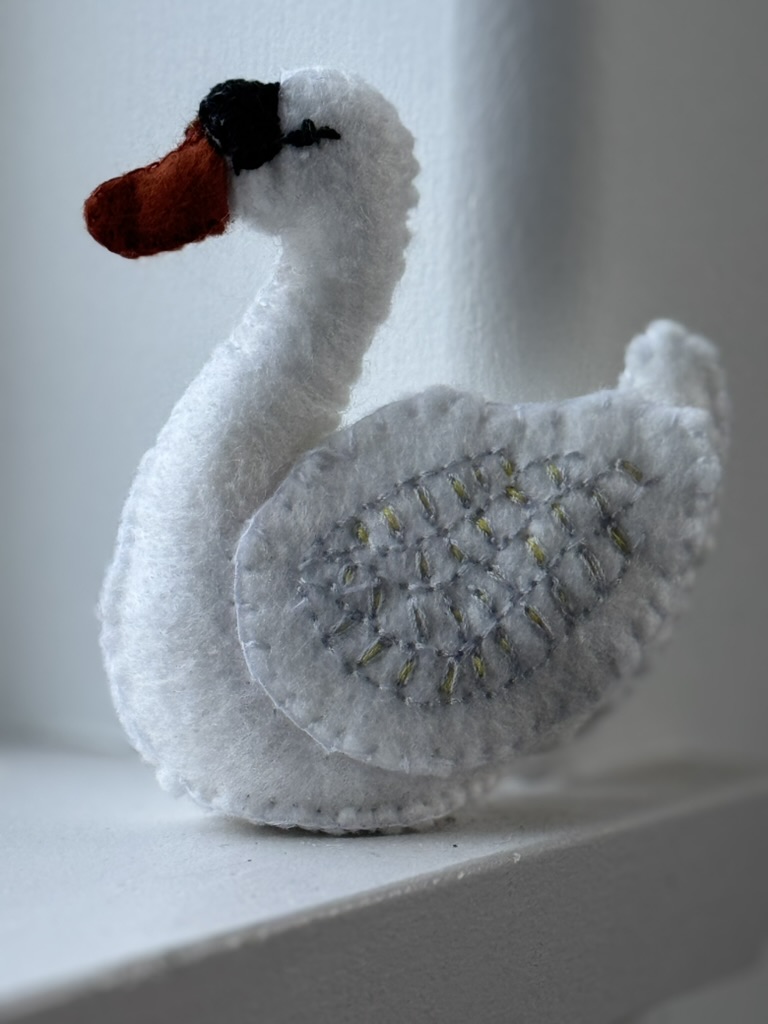
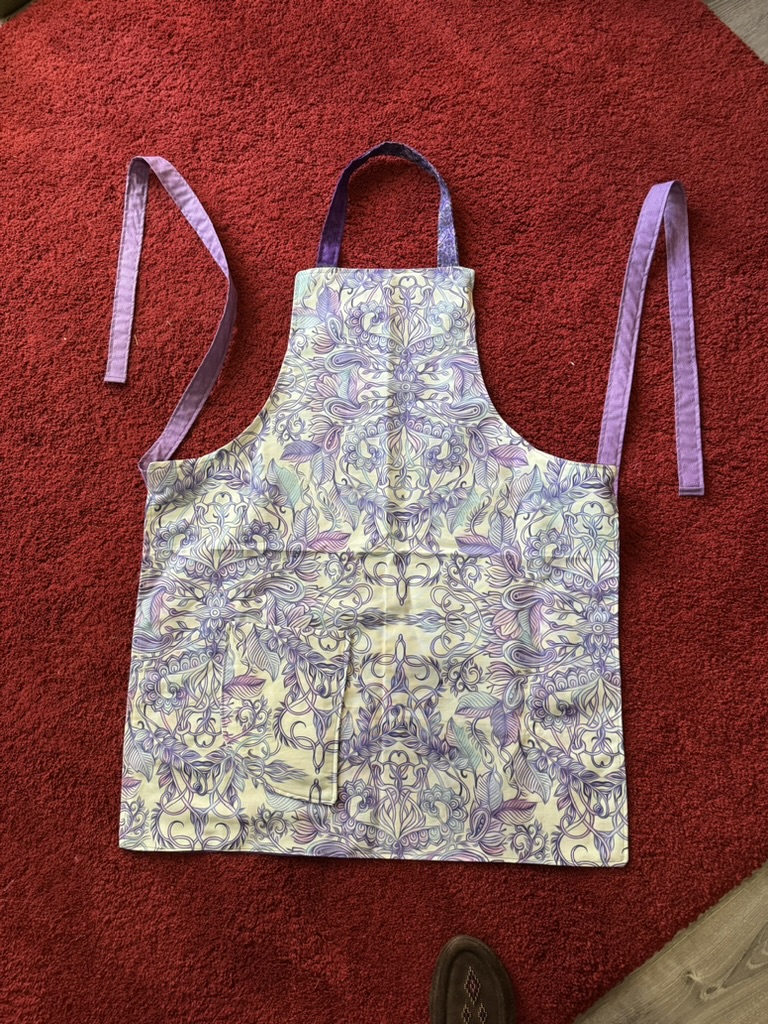
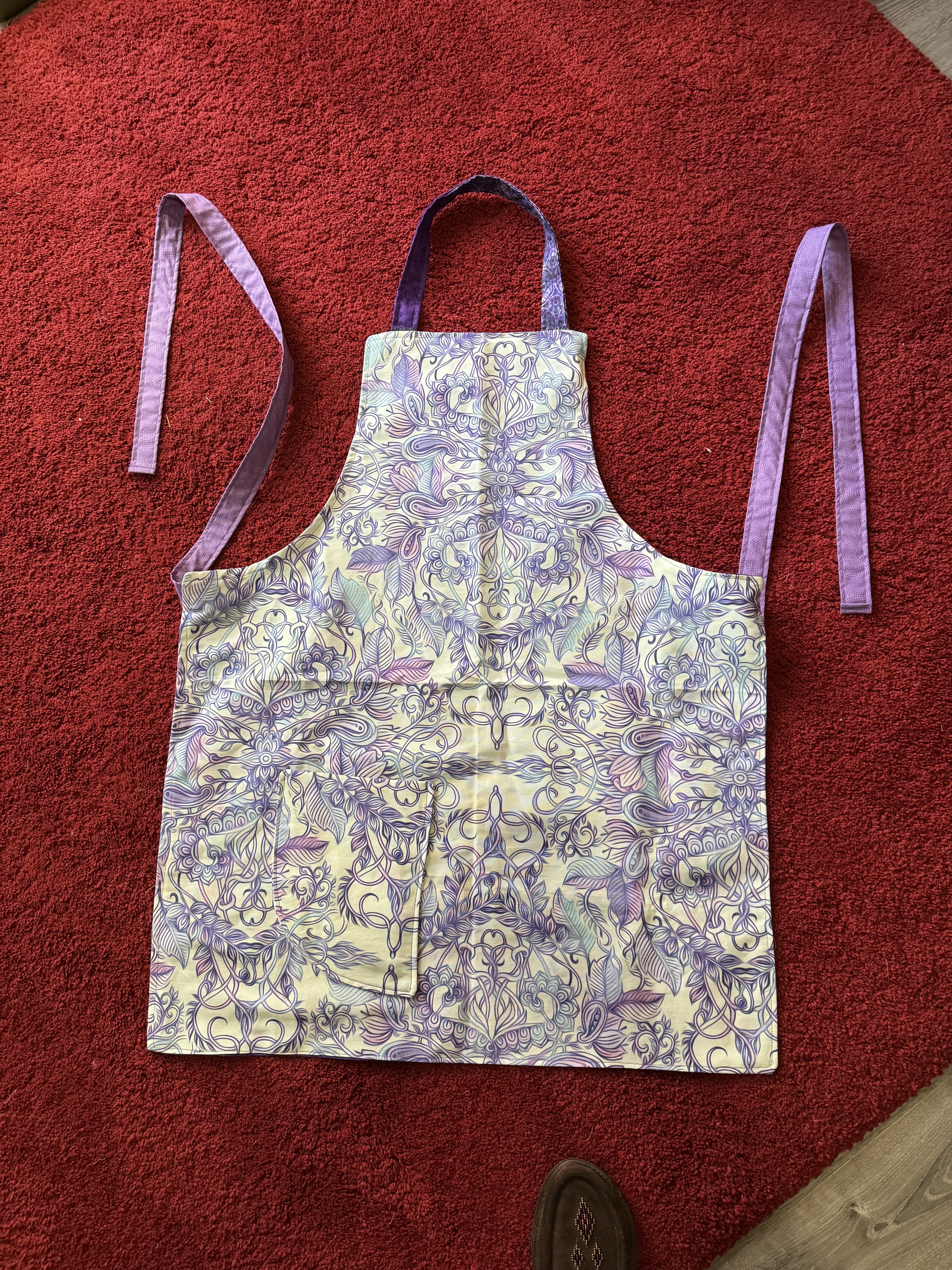
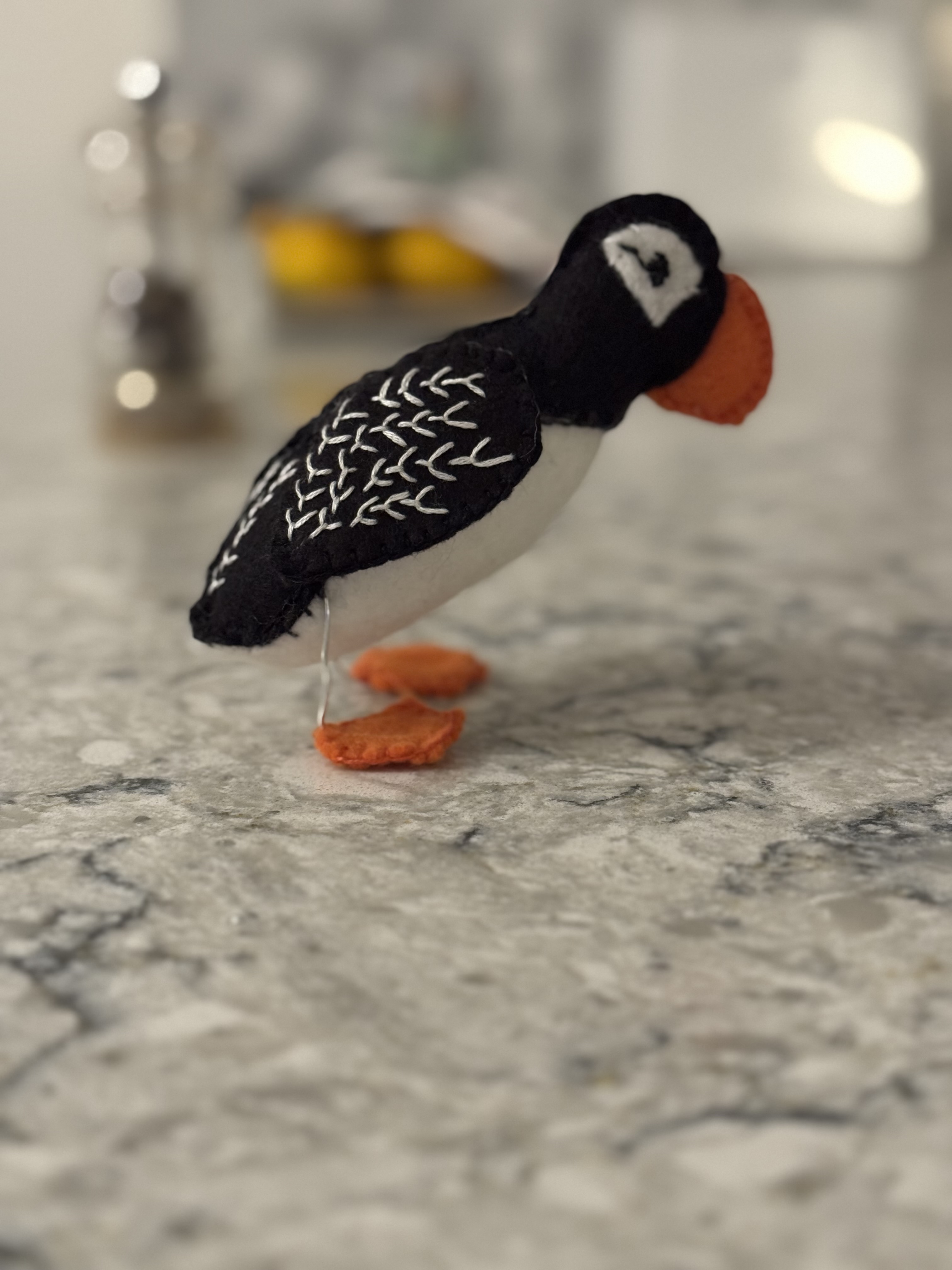
It’s my 67th birthday today, a good day to review the year in creation. What did I make this year? Eleven blog posts (this is the twelfth); a few stories, poems, and essays; felt birds for family members and felt Christmas decorations; three aprons (one for Nancy, one for Meytal, one for me); a baby quilt and matching pillow for the great grandson of my friend, Lillian; embroidered pillows for my niece; a patchwork pillow for my friend Janis; little zippered bags for everyone; “One Thousand Joys,” a wall hanging for our stairwell; a lunch bag for me; some drawings and comics; a sling bag for Nancy; some collages (thank you Kathryn for the inspiration); and cakes and more cakes for friends and family.
Living a creative life feels as important as ever.
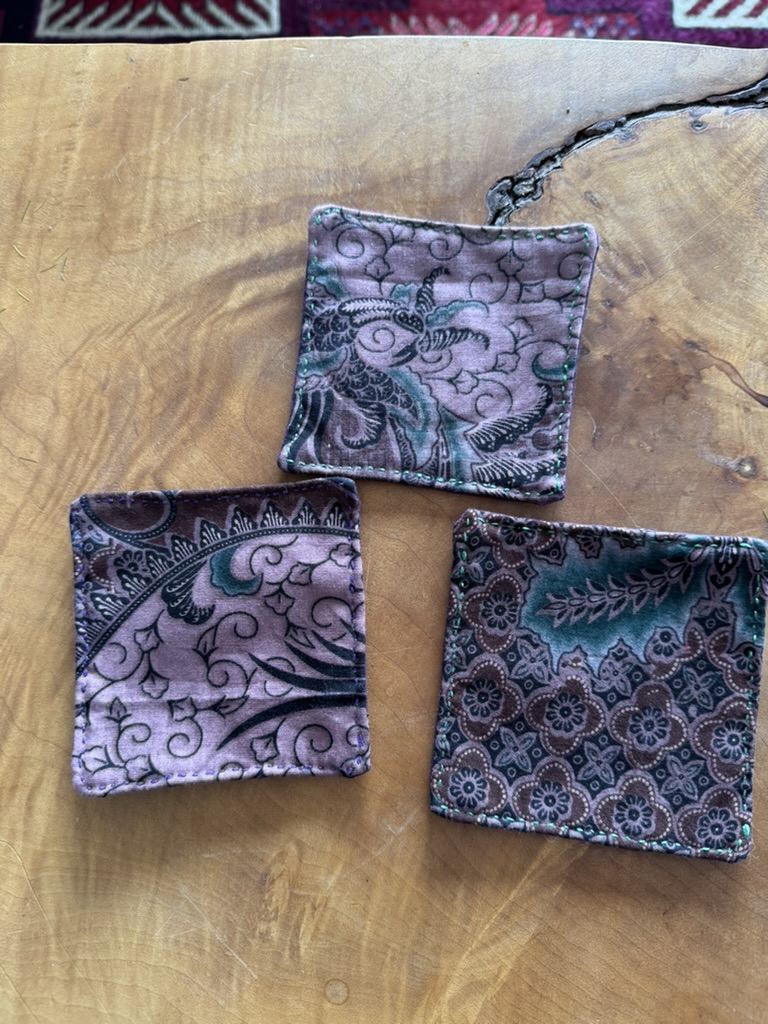
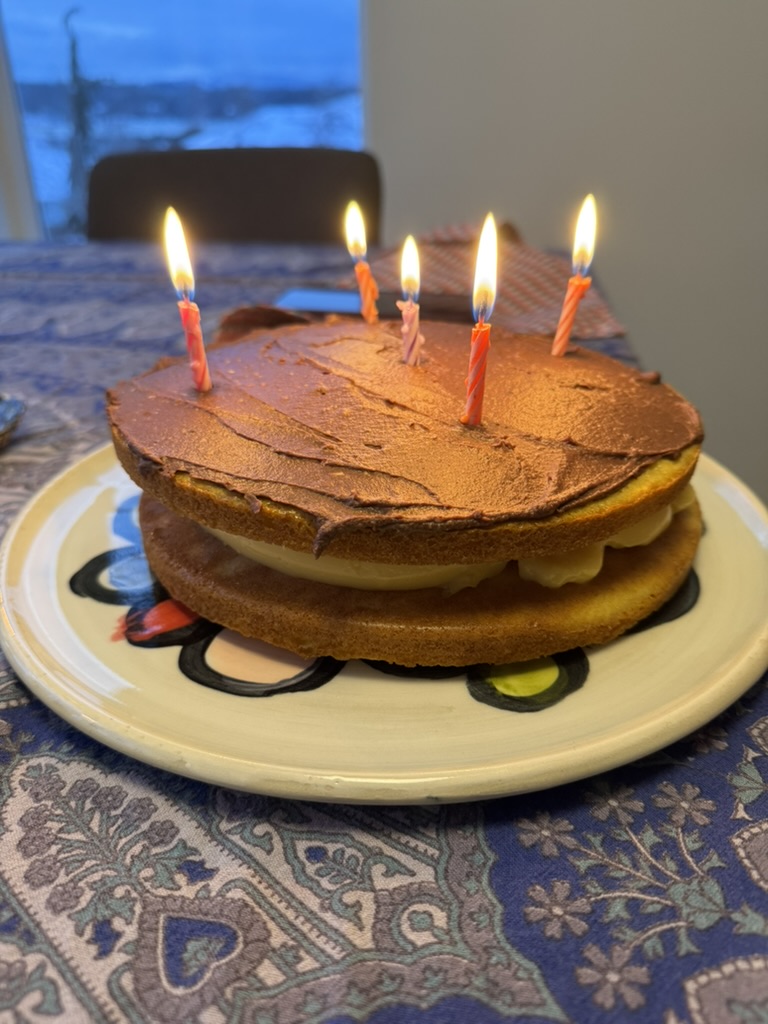
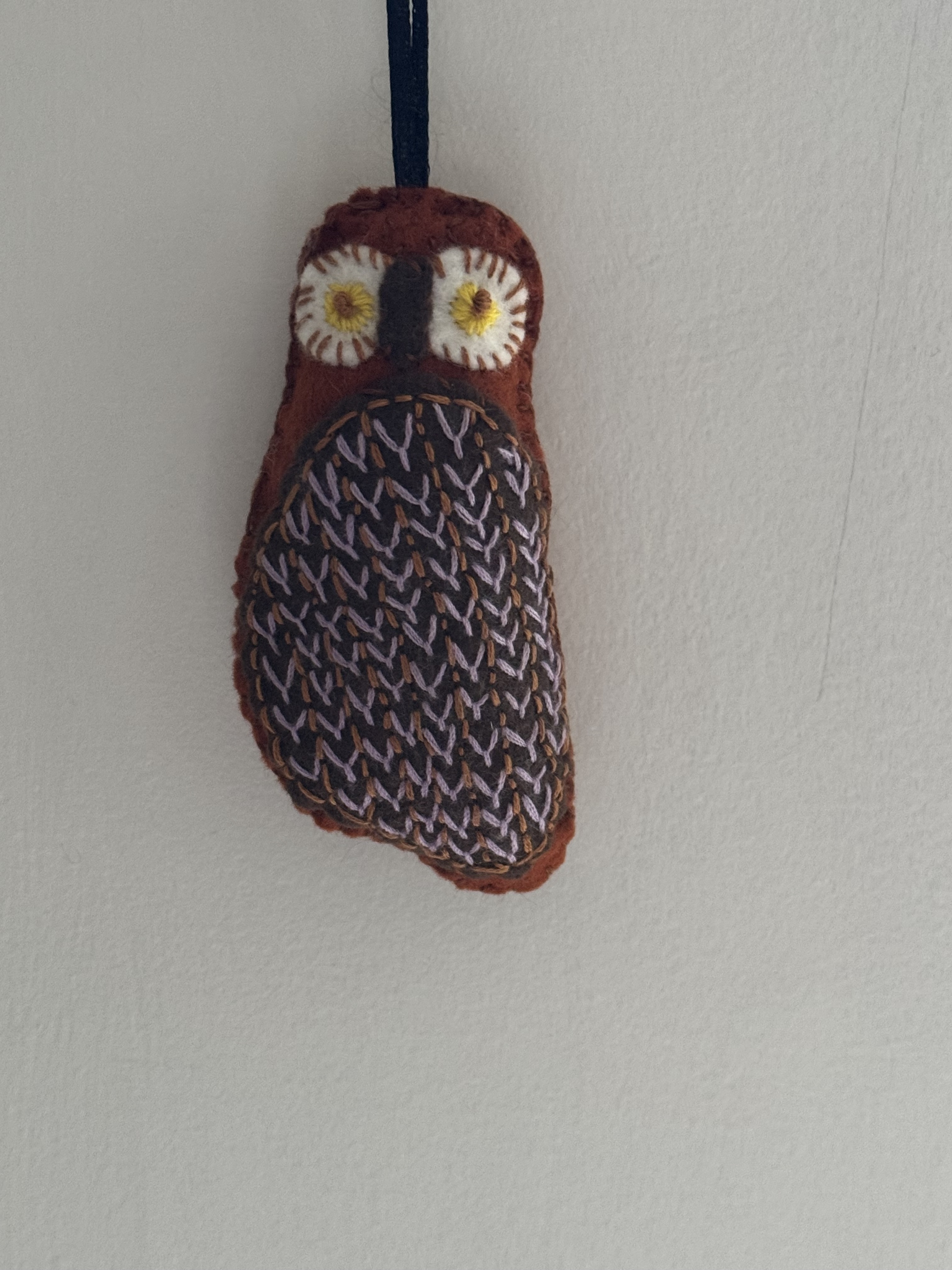
Coasters made from a shirt I bought at a yard sale10,000 JoysMe and Nancy – her birthday apronKathryn’s vegan chocolate cakea pillow for Janis’s birthdayMeytal’s birthday apronSling bag for NancyMichael wanted a Boston Cream Pie and I deliveredA lunch bag for meTwo pillows for my niece’s birthdayA quilt and pillow for a little baby I’ll never meetMichael named the owl I made him “Winston”Nat’s puffinI wanted an autumn apron, so I made thisFelt tree ornaments for my dear writing group membersSarah’s swanEvan’s heronCollage: Pieces of Me
Show and Tell

In old age,
let us
return to kindergarten
rituals.

Show something,
then tell about it
during circle time
with our friends.

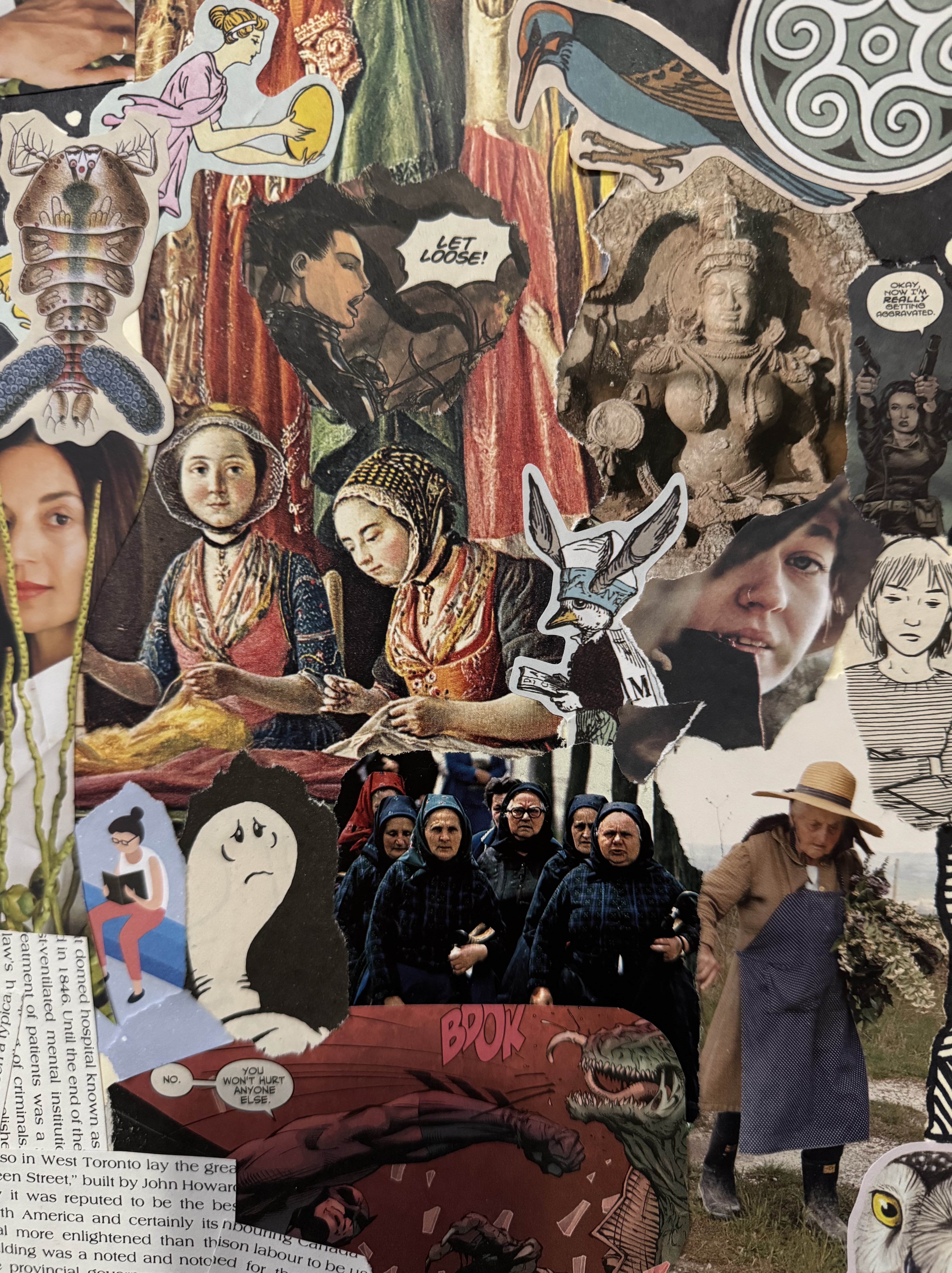
I went to collage club
at the library
Women of all ages were
cutting up old magazines.
Glue sticks and colourful scissors
lay across white tables like
sacred instruments.

As we cut, some of us
spoke; others
remained silent.

I made a collage
about the pieces of me.

Cool and aloof,
wise owl
serious as I sew buttons.
Sometimes a poor silly worm,
my blind eyes sensing light.

In past lives I was
fertility goddess,
discus thrower
seamstress
parasitic crustacean.

Inside of me, Batman blocks a monster:
“No, you won’t hurt anyone else.”

Inside of me, a bitch brandishes her guns:
“Now, I’m really getting aggravated,” she says, her voice rising on the smoke.
If women let loose their anger, the world would burn.

One spring day in Toronto,
forty years ago,
I rode the Queen West streetcar to work.
As we clattered past the mental
institution, number 999,
a statuesque woman, her
proud head shorn,
strode the sidewalk, naked.
Her brown thighs shimmered in
the light, her high breasts bounced lightly,
nipples hardened in the coolness
of that morning.
Everyone around me was,
for a moment, silent, awed
by this strange beauty.

Crustacean, crone, bird,
woman, warrior, gatherer of words,
seamstress of memories
Can you see all the pieces of me?
About a week ago, on our morning dog walk, we stood waiting for the traffic light to change and a young girl, perhaps nine, long dark hair, hooded coat and wearing a backpack, approached and stood near us. She looked over at us a couple of times. When the light turned green, she walked in front of us a few metres, but she kept turning back, peering around her big hood to look at me. And at one point, as we crossed the bridge over the Gorge, I decided to say something. “Do you like dogs?” I thought perhaps she was looking at us because of Marvin, our goldendoodle, who trundled along beside us, at the end of his purple leash. Lots of times kids want to pet him, but they’re too shy to ask.
“Yes, I like all animals,” she said. And then she spoke, in the most serious way, a line I will not soon forget: “I’m a big fan of nature.” I moved ahead of Michael and she and I walked together for a minute, discussing how we were both big fans of nature. Then we were at the school crosswalk where we parted ways.
We laughed affectionately about what she’d said—what a great line! “I’m a big fan of nature,” we kept saying to each other throughout the day, and then “I’m a big fan of ____” and we filled in the blank with whatever…fizzy water, sunsets, Marvin, taking out the garbage.
I’ve thought about that delightful exchange many times this week. The girl’s innocent enthusiasm for nature. A simple trust in the goodness of the natural world and people. Her approach wasn’t naïve; rather, it seemed wise. We spoke so briefly, but what she said made me want to adopt her attitude of fandom.
I am a big fan of hand sewing
When we went to NYC in December, I heard about Tatter, a Brooklyn-based textile organization that is “committed to preserving skills of the hand.” They promise a lot:
“We work with makers, archivists, and anthropologists to develop extended courses that use textiles as a portal to reclaim history, cultural encounter, indigenous practices, a harmonious relation to the natural world, and making as a tactic of collective liberation.”
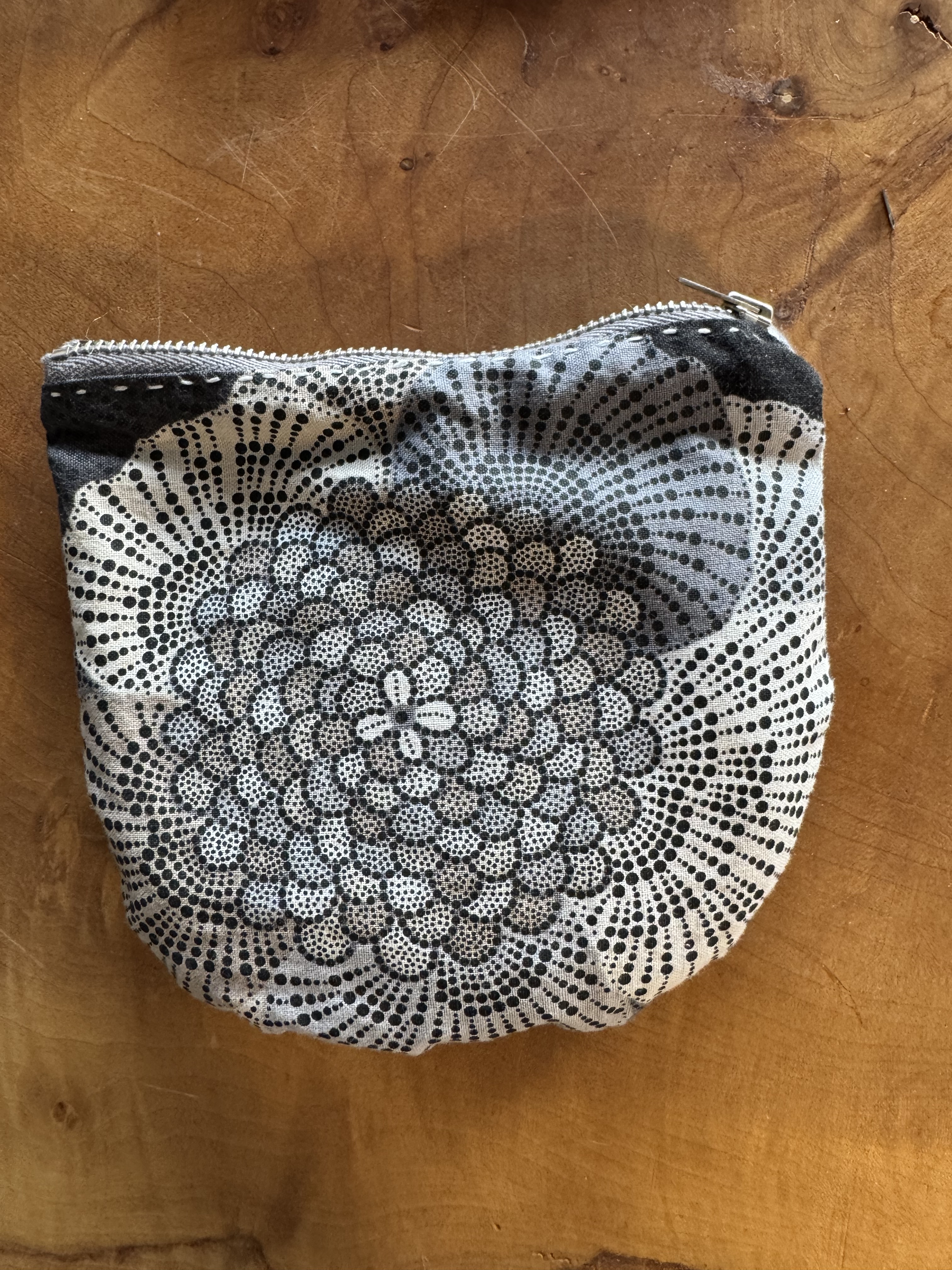
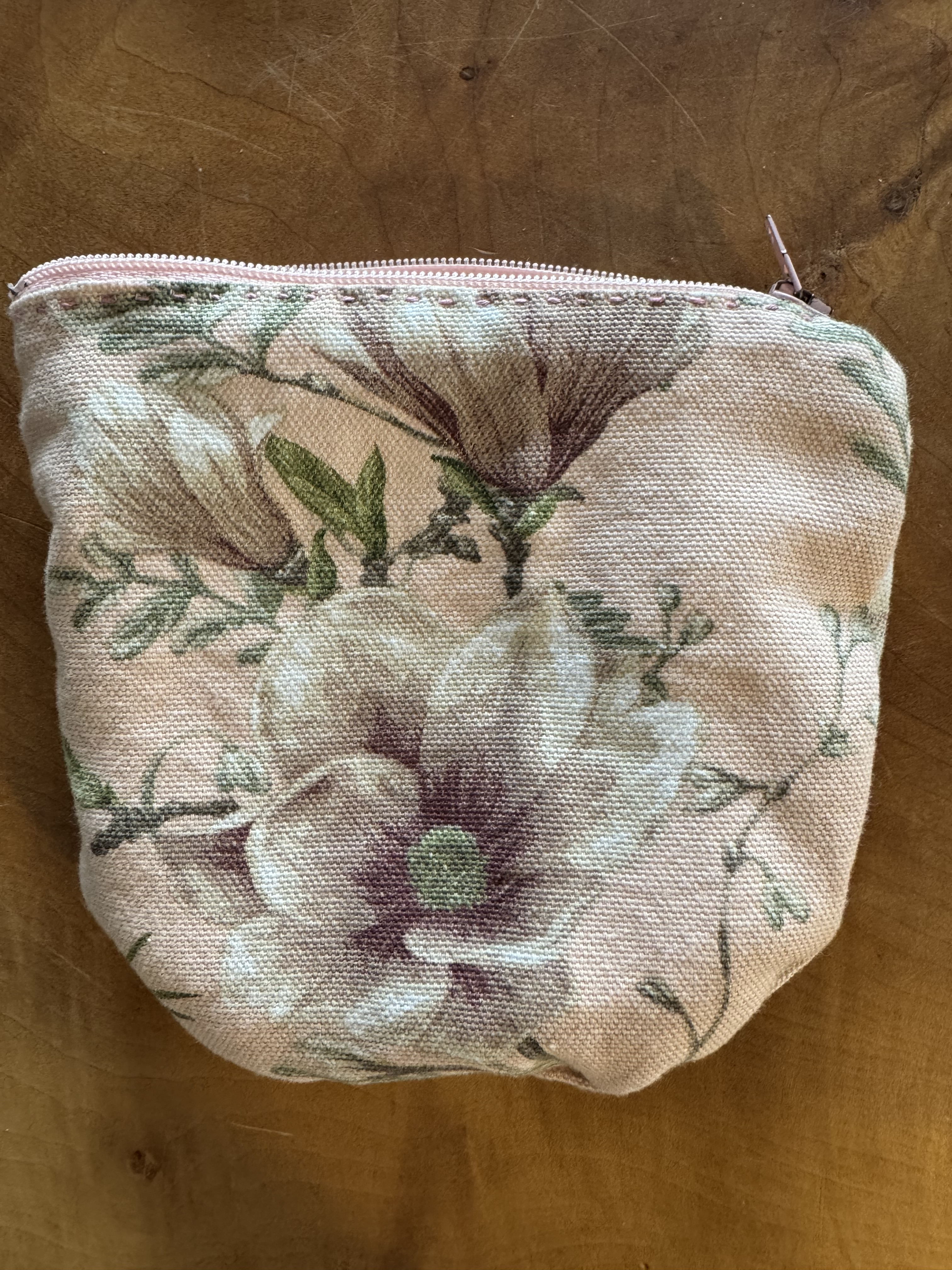
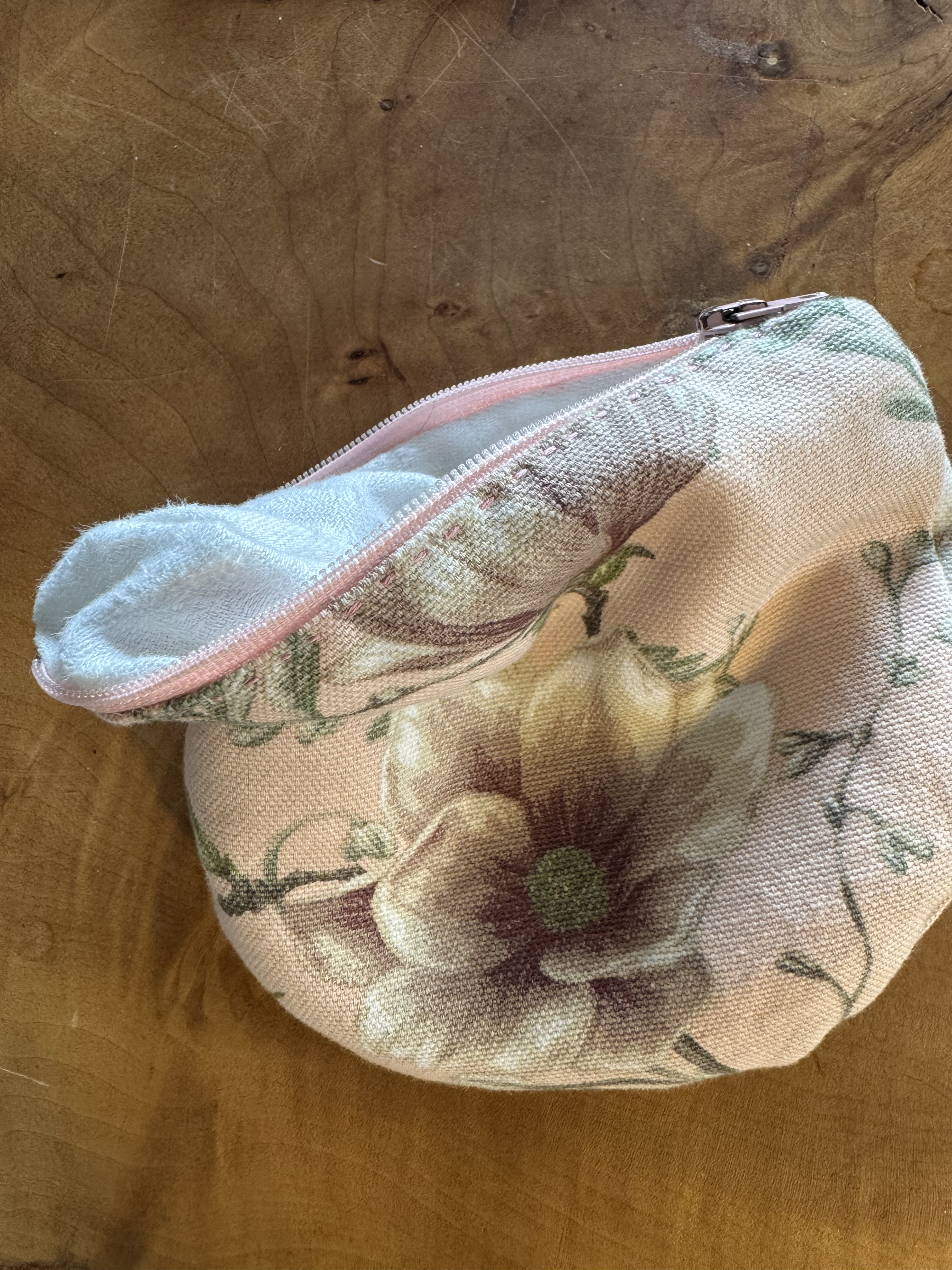
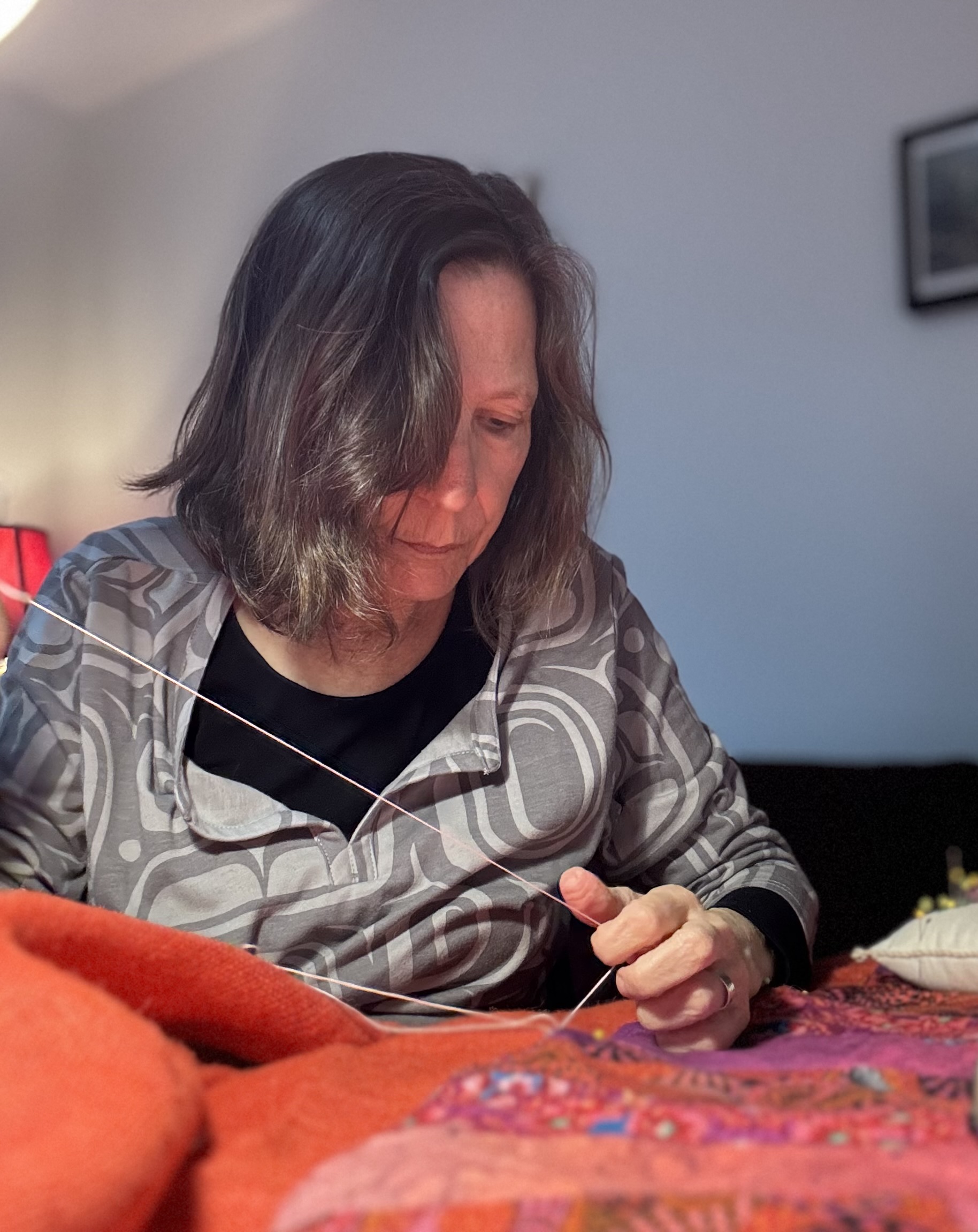
I didn’t have a chance to visit Tatter. However, in February, I took one of their classes on Zoom with Karen Stevens. We learned to hand-sew zippered pouches. Through this class, I rediscovered the enjoyment of hand sewing. The whole-body rhythm of a slow, contemplative backstitch and the satisfying emergence of a line of running stitches along a zipper‘s edge or around an appliqué. There is no rush with hand sewing, no urgency like I feel sometimes when I am at the machine. Hand sewing is portable and calming.
I learned some tips from Karen that I’ll share with you. Perhaps you already know this stuff, but for me, the following was revelatory information.
Don’t thread the needle, needle the thread. This practice makes so much sense, after years of trying to poke three saliva-soaked strands of embroidery thread into a tiny hole. Hold the very end of the thread(s) between index finger and thumb in your non-dominant hand while you angle the needle over the thread. Much easier to get eye over thread than thread into eye.
You don’t need knots. You can just sew one straight stitch several times over to start and end your length of thread. I think of it as akin to building a house with joinery rather than nails or glue.
Basting is a very useful practice. Sure, pins hold things together, but if you baste with big loopy stitches—it doesn’t take long—your fabric stays in place until you’re ready to anchor it with backstitches. I used to think of basting as a waste of time, but what is time for?
I am a big fan of upcycling stores
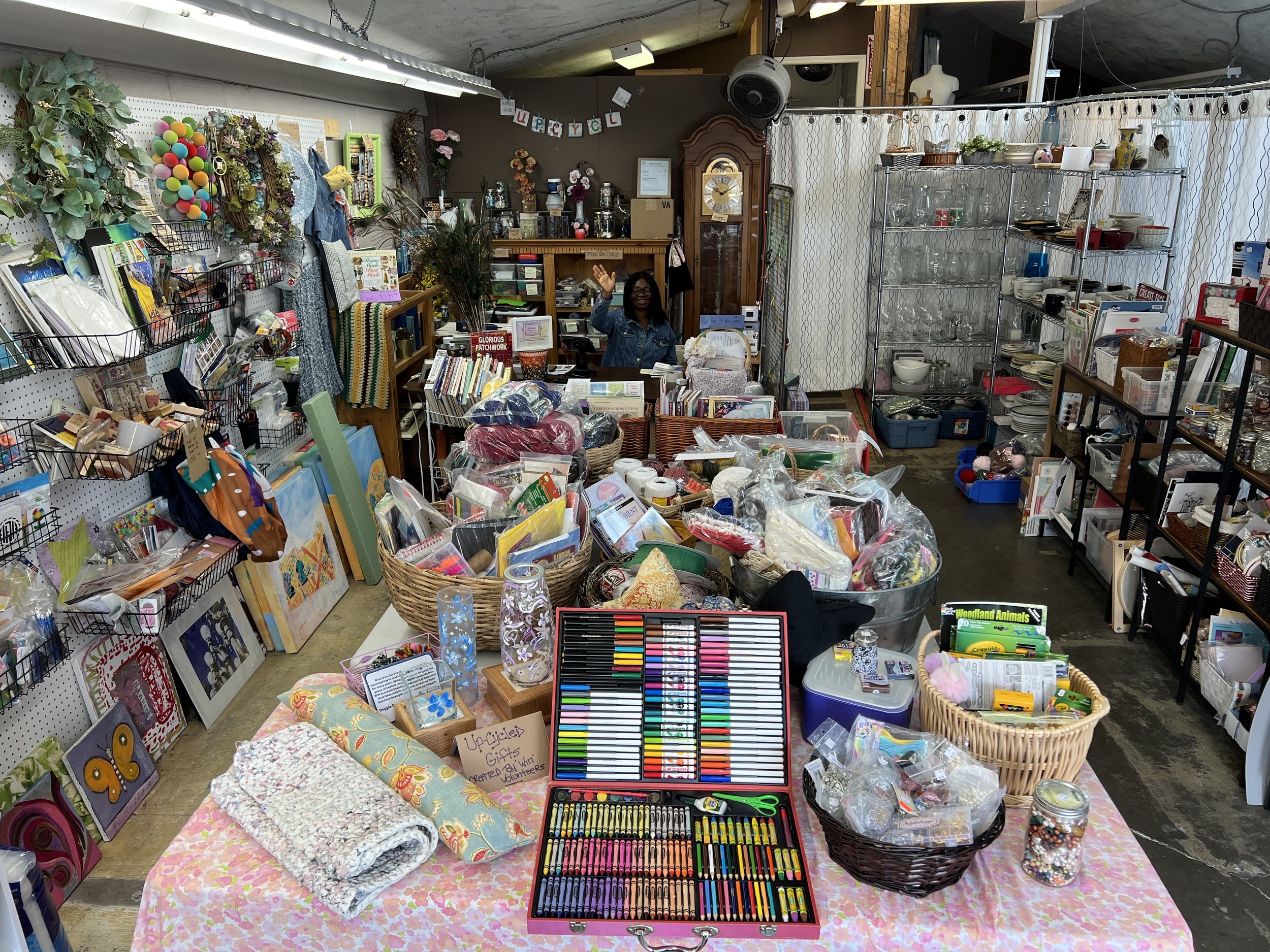
I happen to volunteer at one of those stores, Women in Need Upcycle and Craft, so I am biased. We just expanded to double the space, and every week I open boxes of fresh treasures to line our shelves. Some weeks it’s skeins of merino wool and tiny wooden canoes. Other times it might be a kit to make a paper lamp and bags of beautiful retro fabrics and lace.
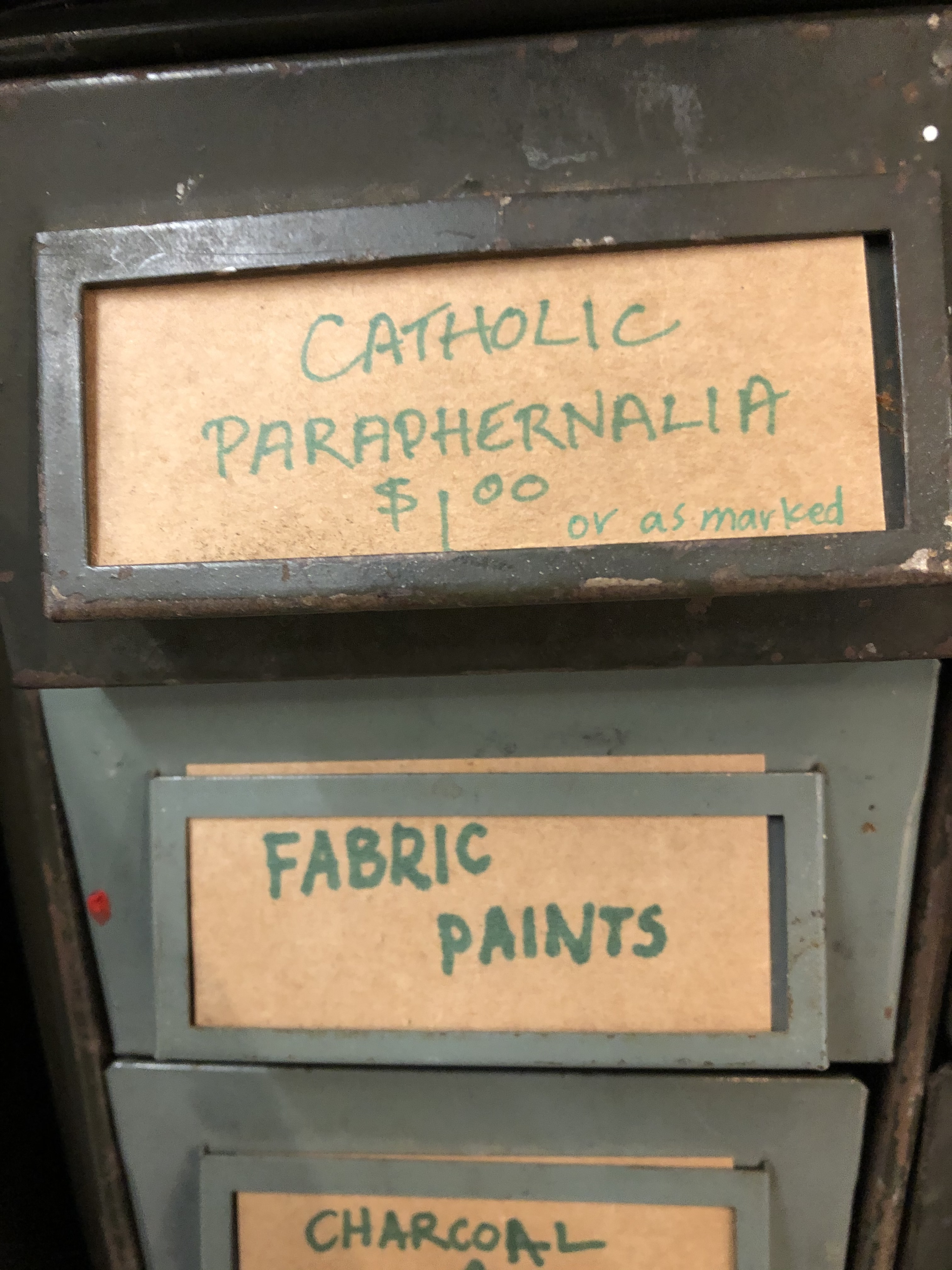
I appreciate all of our sister upcycling stores as well. The Green Thimble‘s name is alluring to eco-conscious sewists. Today, March 4, they are moving from their Quadra Street location to 2950 Douglas St. #400. At Green Thimble, I filled a small paper bag with scraps and loose buttons for only five dollars. I admired the refurbished sewing machines for sale and the bolts of fabric at bargain prices. Supply Creative Reuse Centre on lower Douglas is a finely curated collection of paper, books, cloth, yarn, buttons, ribbons, and more. I was impressed by their sliding scale prices. At Supply, I found a scrap of pink sheepskin for $1.50 that features as the centre of my wall hanging work-in-progress. Thrift/Craft in Market Square is a huge space filled with unusual items and hosted by a devoted proprietress. One of my favourite things there is the weird stuff housed in tiny drawers, for example, Catholic paraphernalia. In each of these places I encounter interesting people who like to chat about making things.
I am a big fan of creative immersion
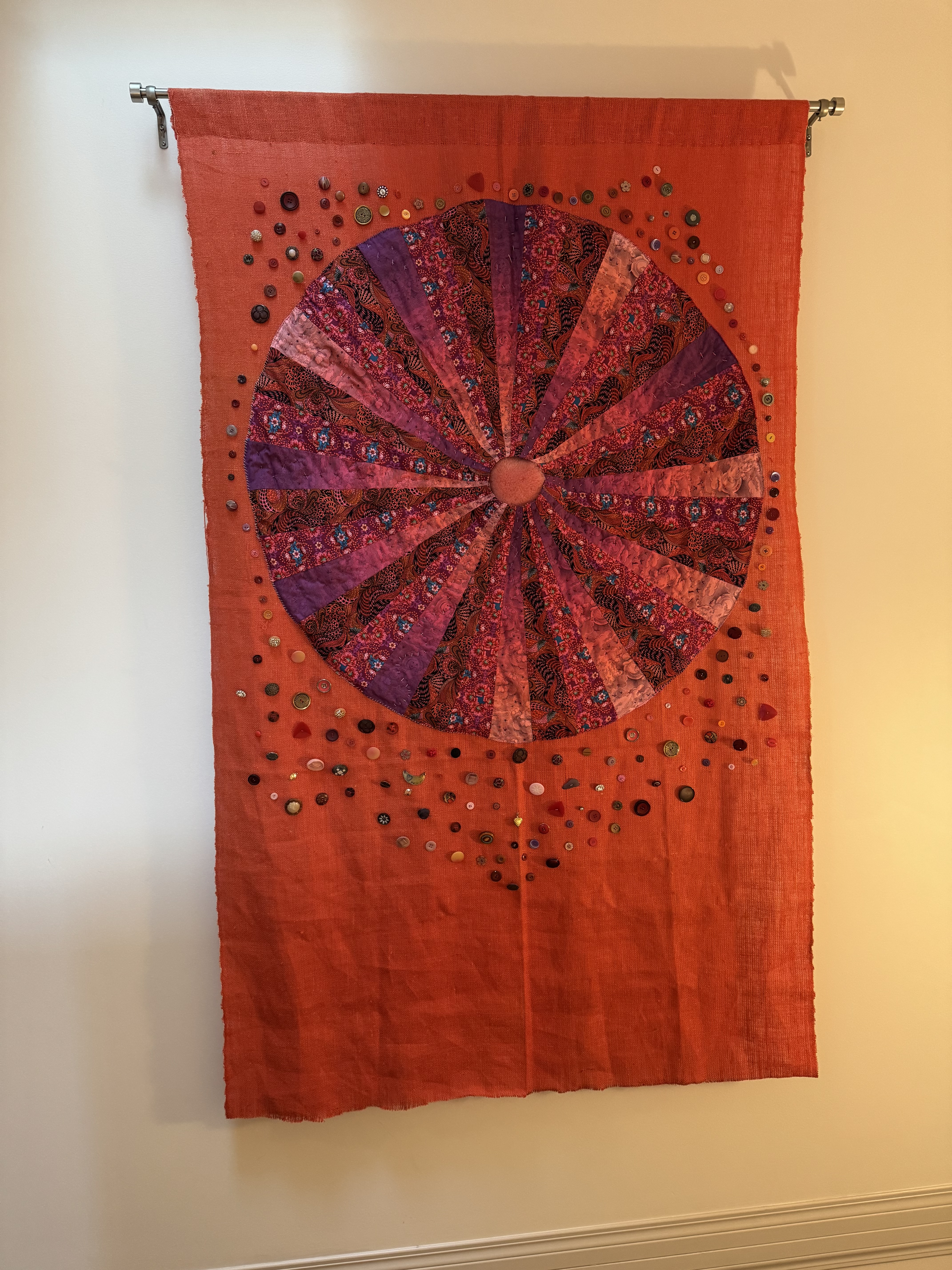
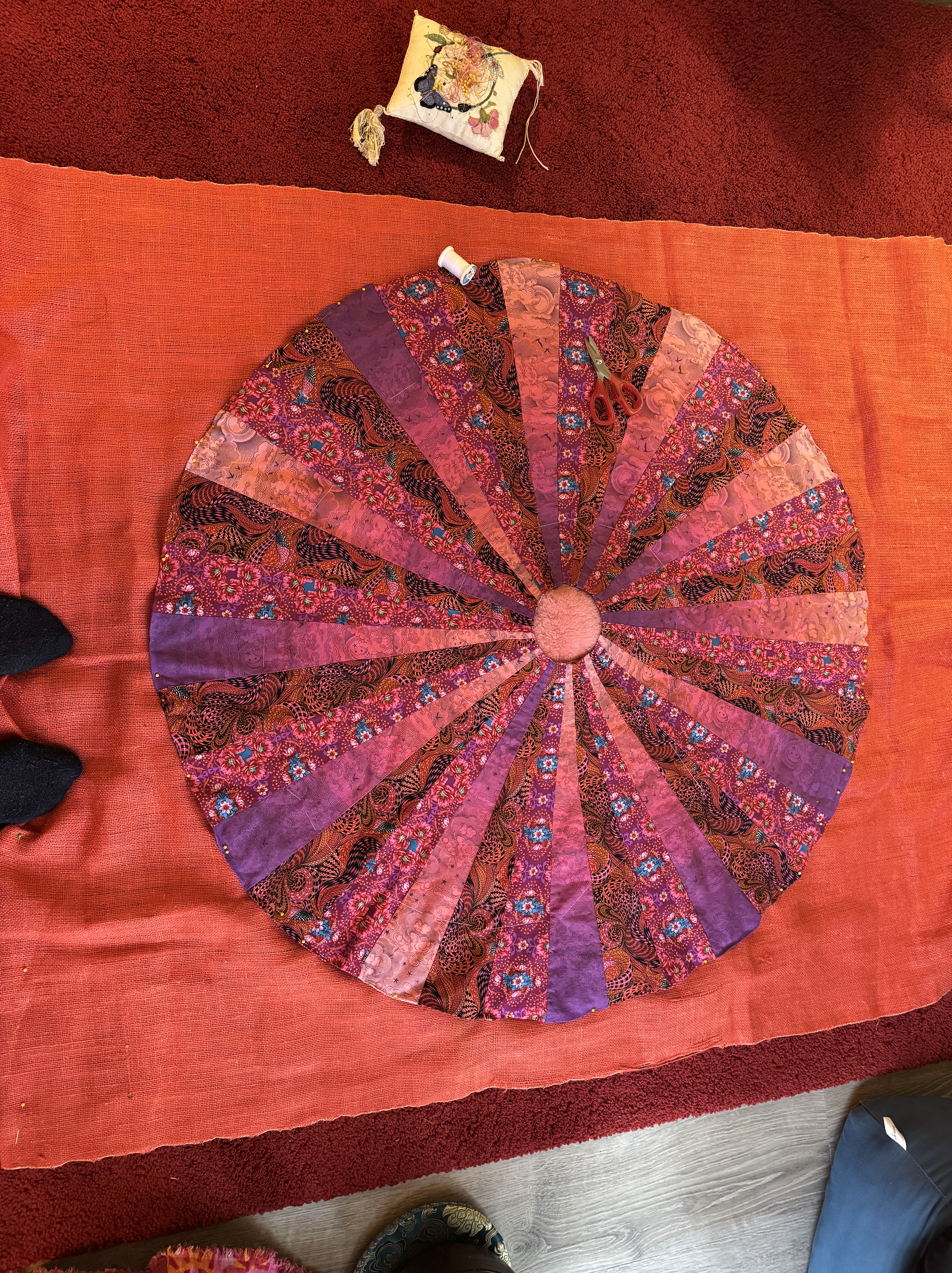
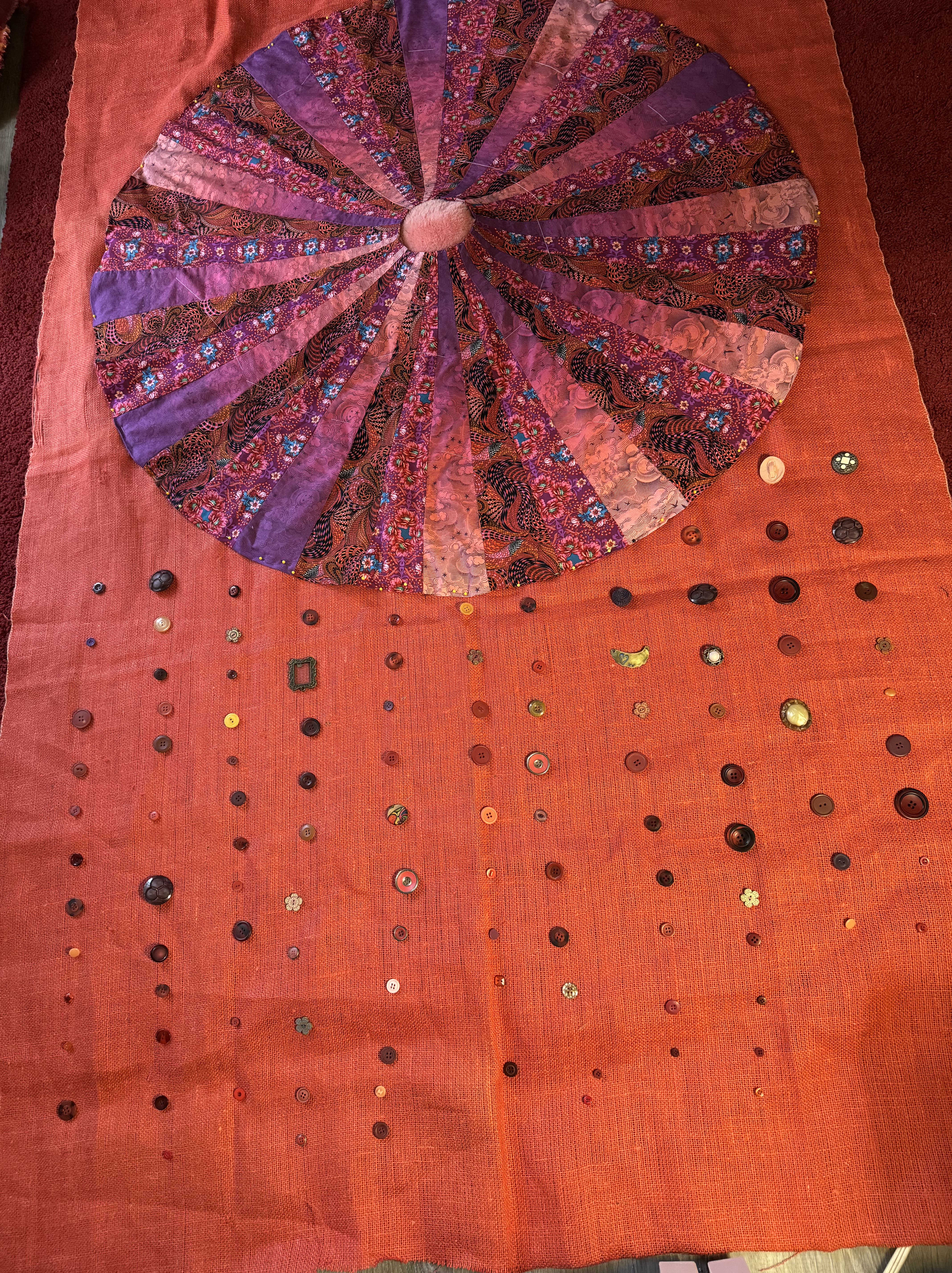
Immersing yourself in a creative project can lift your mood, and we could all use some mood uplift now. Am I right? I am presently working on “Ten Thousand Joys,” a large wall hanging in oranges, pinks, reds, and purples. At its centre is a fabric circle I created using a ten-degree wedge. I cut and sewed three alternating brightly-patterned fabrics together to make this 45-inch mandala. I cut an old blanket into cascading circles to lay under the mandala to create a three-dimensional effect. At the centre, the bit of pink sheepskin peeps through. I basted the padding onto a big piece of orange burlap I found at Value Village and then basted the circle onto the padding. Now I am in the process of using embroidery thread to sew the circle onto its backing at the circumference. I’ll add lots of embroidery stitches in bright colours, zig-zagging up and down the long wedges. The hanging will be finished by sewing on, not ten thousand, but dozens of pink, red, and purple buttons around the central circle. It feels inevitable that I will make a “Ten Thousand Sorrows” wall hanging next.
“When you open your heart, you get life's ten thousand joys, and ten thousand sorrows.” Chuang Tzu
When I was in my forties, my mother was in her seventies. (We could rapidly figure out each other’s age because I was born when she was 30.) Those days, I had scant time for or interest in her stories. Busy with kids, negotiating the break-up of my marriage, and immersed in the chaotic life of a graduate student, I was living my life 3,000 miles away from my mother.
We talked on the phone weekly and visited once or twice a year. When she started to tell a story from the past, I often zoned out or became irritated. I didn’t really care, or I thought I’d heard it before. She sensed my impatience because eventually she stopped expecting a weekly phone call. “You sound too busy,” she said. I didn’t disagree. My forties turned to fifties; her seventies turned to eighties. We kept in touch, but calls were infrequent.
On Valentines Day, it will be six years since her death. I am 66 now, and at least a couple of times each week, I think of something I want to ask her. Some thread we dropped that I’d like to pick up again. Some mystery from her past I want to understand. Some memory I want her to clarify. (There are so many amorphous, shady memories—are they true?)
How did you make that wonderful crème caramel? I wish I’d gotten the recipe. Tell me more about the trip you took to Russia. When you returned from the trip and tried to tell me about it, I had so much on my mind I didn’t listen. But now I really want to know. And the other trips… so many European cities you visited, sometimes with groups of students, showing them great works of art and architecture. I wish you could tell me more.
You didn’t talk to your own mother for decades. I never knew her, only met her once. Why were you estranged? Your childhood was traumatic. Is it true you missed a year of school because you didn’t have shoes to fit your feet? That you learned to drive the tractor at age nine (or was it 12) so you could help on the farm? That your dad kicked you out of the house at 17, but he’s the one you loved? Am I misremembering your narratives?
I have the old phone number in my head 416-922-9534; if only I could call, we would chat. She’d be happy to hear from me and to reminisce, I know. But she’s no longer available. The stories, too, are gone. They died with her.
I had the wherewithal to record my father talking about his life in 2014 when he was visiting (he was 87). I asked him a series of questions. Now, I am glad to have his voice preserved as he talks about his parents, being a father, his life as an academic and farmer, and formative childhood experiences. For example, he describes discovering an injured bird when he was a young boy, taking it home and nursing it back to health, then releasing it. That event cemented his lifelong love for birds.
I feel wistful now that I didn’t make audio recordings or write down some of my mother’s stories.
I signed up for an online course, “From Autobiography to Illustrated Story.” The goal is to produce a short, illustrated book about an object that we still have from childhood: its provenance and meaning to us. I have precious few objects to choose from. The yellow Tonka truck. A doll my mother made for me out of an old sock with yarn hair and an embroidered mouth, nose, and eyes. Little Bear, the Steiff teddy. And I have some things that belonged to my mother.
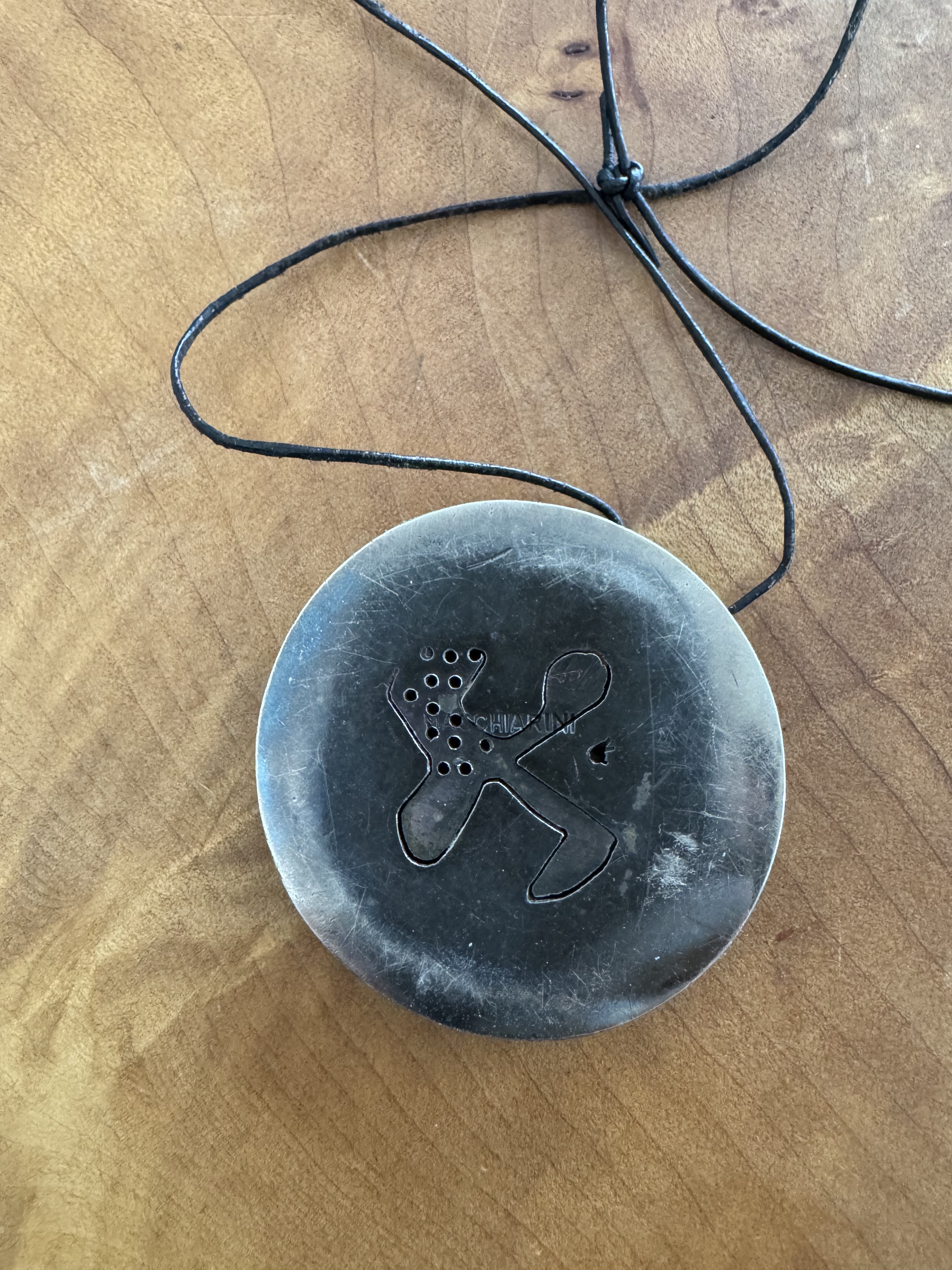
I decided I wanted to write about my mother’s Macchiarini pendant. My sister took it from her house after her death and gave it to me, thinking it suited me. I agree. Mom loved the work of Peter Macchiarini, an American Modernist jeweller (1909-2001) from North Beach, San Francisco. The several pieces my mother owned were passed down to us, her daughters. I have a couple of brooches, the pendant, and two belt buckles, and my sisters have other examples of his work.
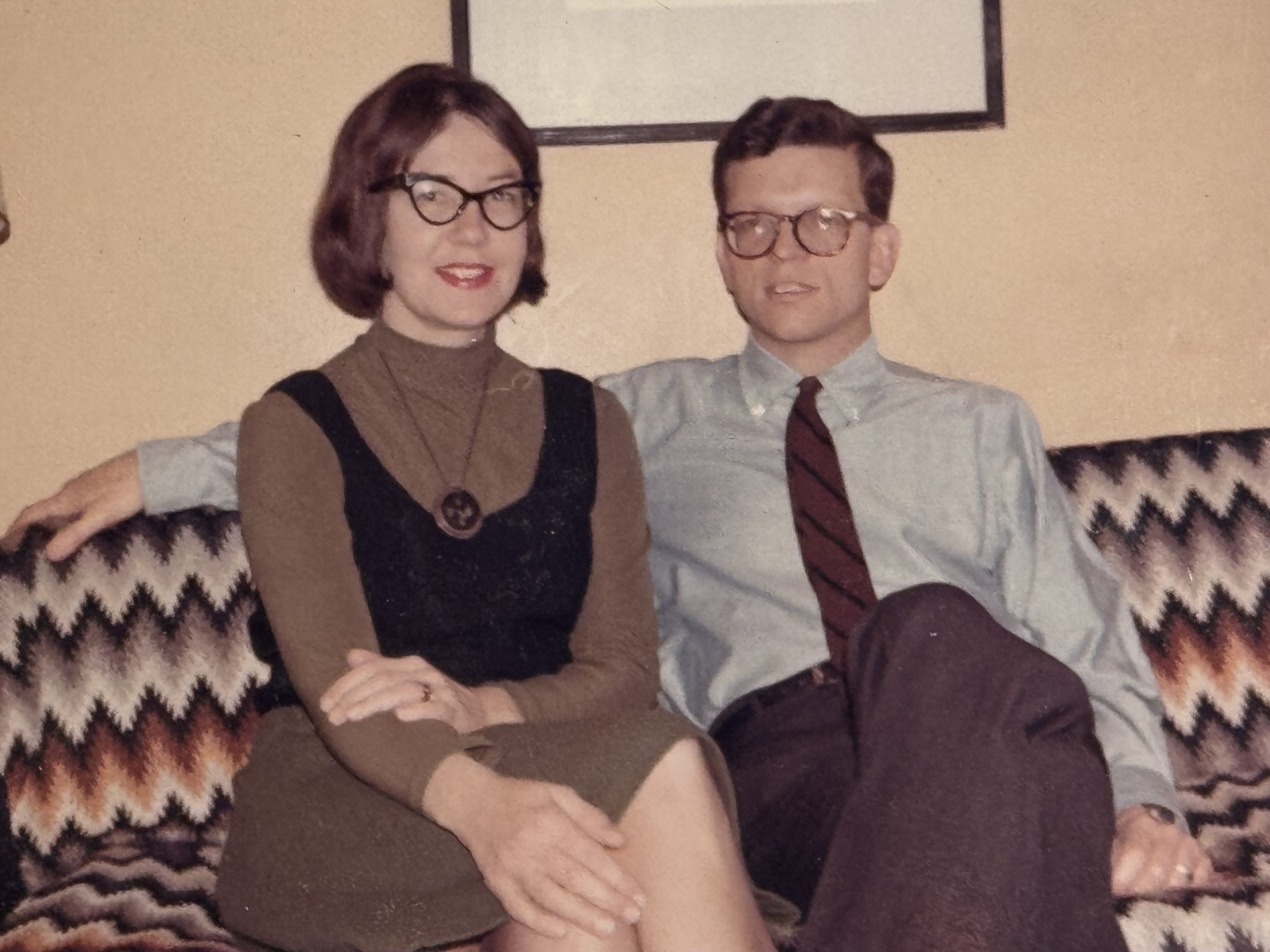
I want the pendant to tell a story—a story about my mother’s love for mid-century art, particularly from the Bay Area. Mom knew Peter, or at least I think she told me she did. She must have had anecdotes about how she bought the jewelry, what he was like, her San Francisco connection to him. She wore this pendant often, her signature piece. The photo of her and my dad shows her wearing it in 1964. She is wearing it again in the photo with her cat when she was in her sixties.
But the stories about Mom’s relationship with Macchiarini died with her. I can’t remember anything, and now I can’t ask her about them. What can I say about this unusual round pendant, a playful amoeba shape carved into dark wood and set in silver and gold? I can say that when I wear it, I feel warmth under its weight. Warmth around the heart, generated by affection. Our relationship was complicated. She was fucked up, inevitably passing along some of that to me. Yet there was so much love. She instilled in me a reverence for life’s beauty. And inextricable from that, a cellular knowledge of sadness.
I notice that my left hand is placed on my right arm just as my mother’s left hand is placed on her right arm in the 1964 photograph. Coincidence?
In mid-December, I bought a green glass jug in a second-hand store, half price. My aspiration was to make a beautiful winter bouquet for my friend, Lillian. I bought a bunch of silver dollar eucalyptus and two dozen white carnations. I envisioned white wintry bursts among the silvery green, but the more I trimmed and mixed the carnations with the stems of eucalyptus, the sillier and more incoherent it looked. I took basic Ikebana but still haven’t a clue how to make flowers and plants look good.
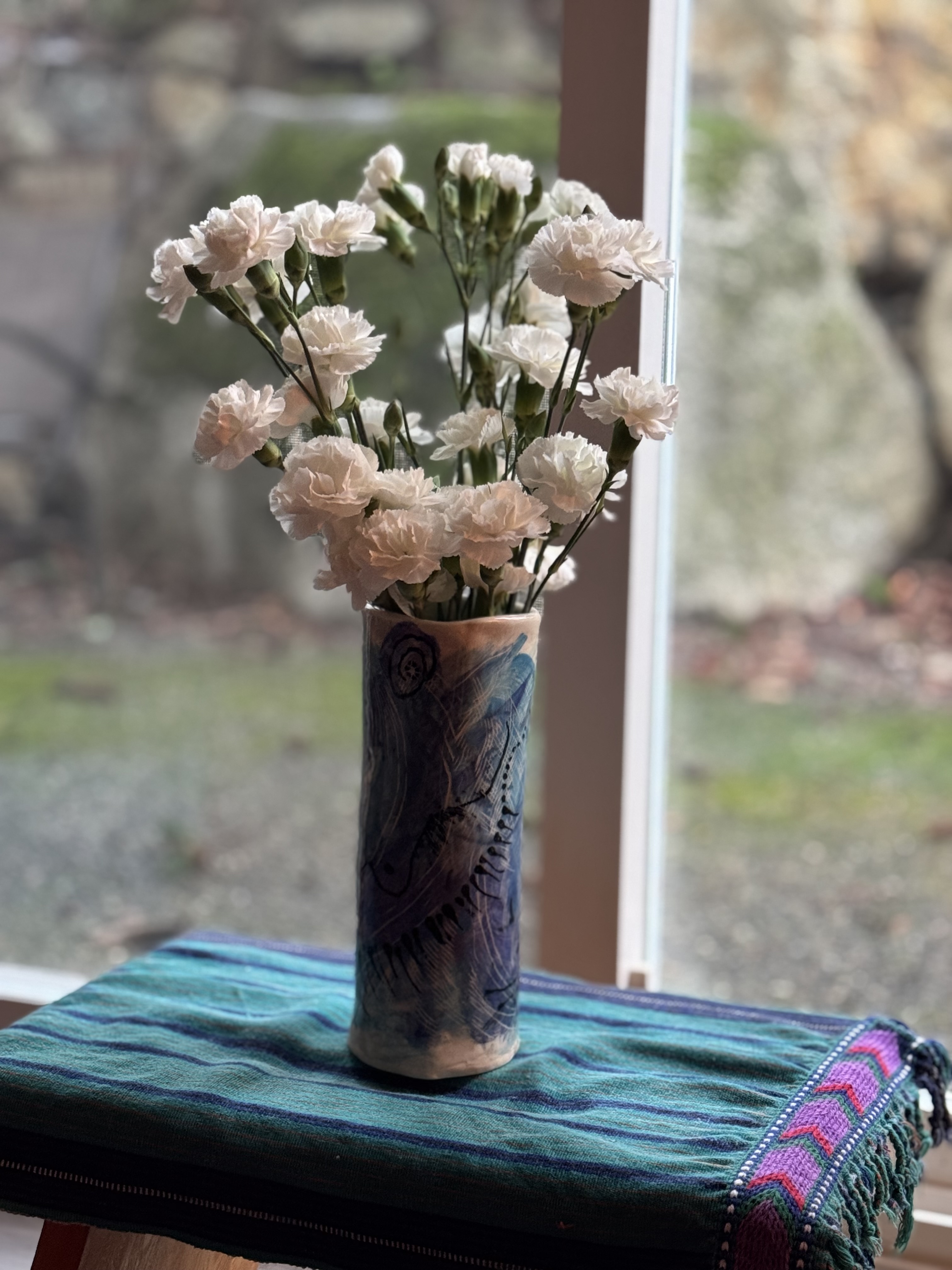
Finally, I used only the eucalyptus, splayed out in a free-fall arrangement. I attached a few small, red shiny balls to the stems, and the effect, I hope, was Christmassy and charming, if a bit messy. Lillian said she loved it. (But what could she say, really?) I was going to throw out the unused carnations, but it seemed such a waste, so I put them in a white and blue vase and placed it in my study on a low stool covered with a blue-green cloth.
I don’t like carnations, or I didn’t think that I did. I’ve seen too many sad, slender bunches wrapped in cellophane at the mini-mart next to the hospital. They make me think of last-minute purchases for the death bed, cheap flowers that outlive the person you visited. They seem so tight, orthodox, banal. Whorls of perfect, serrated petals, every bloom the same.
But they’ve grown on me. As I spend hours in their presence, they’ve become real. You could say I’ve become intimate with them. I sit here now, the last day of the year, gazing at their fresh ordinariness. The carnation is the sturdy, faithful flower that will see you through. Perhaps they are flower of the year: commonplace as canned milk. Carnations are one-foot-in-front-of-the-other flowers. Quotidian flowers. Bread-and-butter blooms. See you through the hardest times. Last for weeks. Nothing special.
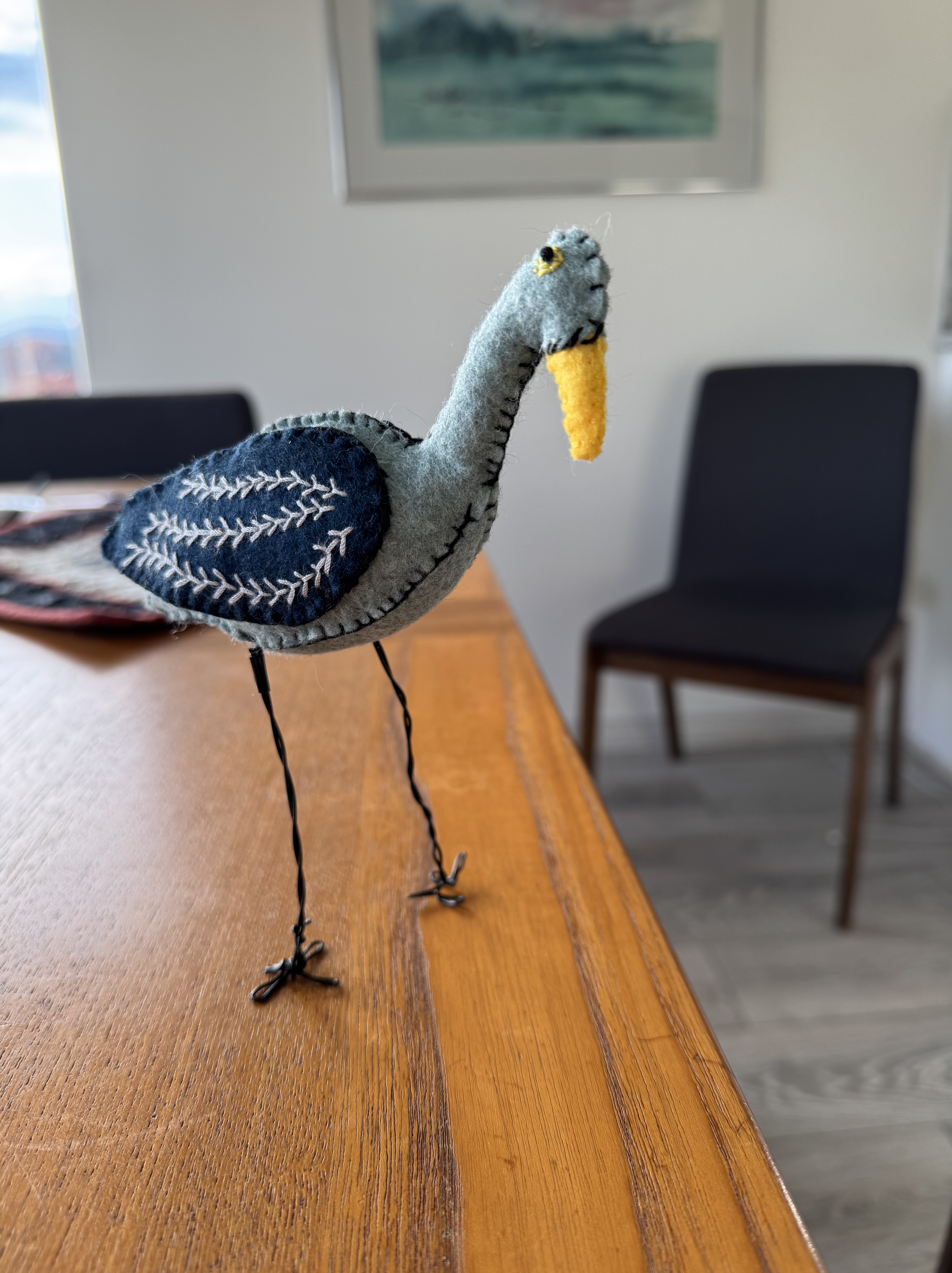
Although 2024 was my first year of so-called retirement, and thus I was given twenty additional hours each week, I wrote less, and I sewed less. (A few felt birds for family and other little felt creations, an apron, a crib quilt start, a fur-lined bag.) I did finish an editing certificate I started in 2020, which is a relief. And I made a lovely new friend and deepened existing friendships. I started a volunteer gig at a non-profit arts and crafts shop in August that has led to meeting many interesting people. Bonus: I get to surround myself with a messy profusion of materials that inspire me.
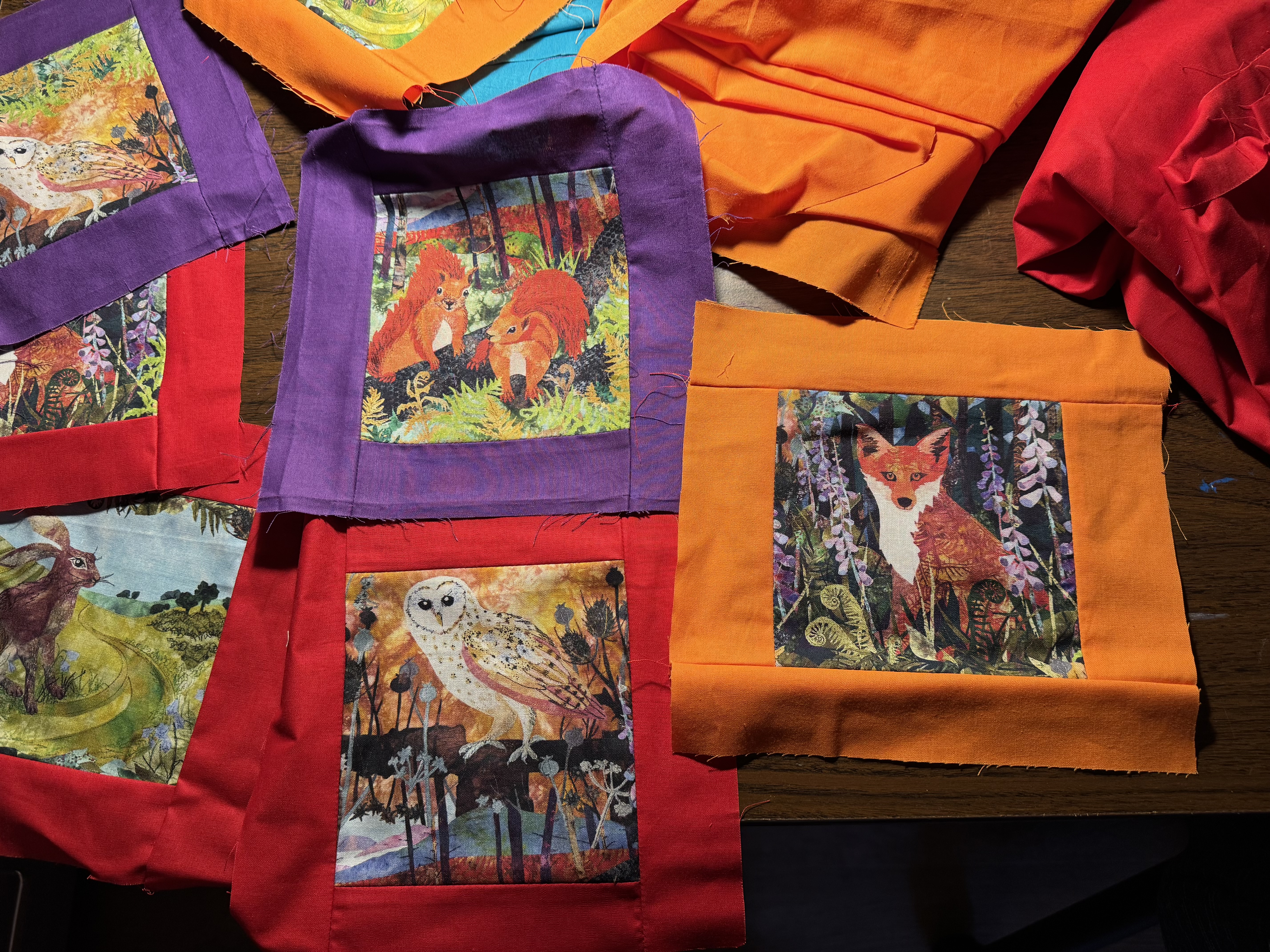
Kathryn’s robinAllison’s pigeonEvan’s heronNancy’s reversible purple apronNancy’s reversible purple apronSarah’s swanI made felt hearts for friends at Christmas.Nat’s puffinNat’s puffinI started a quilt for Lillian’s great grandson, FoxWilson the owl, a gift for Michael Magic bag lined with fake fur for Nat’s 30th birthdayWomen in Need’s Upcycle and Craft store on North Park Avenue. I work there on Thursday afternoons.
This year, I listened to probably one hundred dharma talks on Dharma Seed, with a broad aspiration of becoming more intimate with life—accepting whatever’s happening in my heart, whatever’s happening in the world. Making friends with wild mind. Accepting the truth of the way things are.
I read so many books this year. A couple that stick with me are Rebecca Solnit’s memoir, Recollections of My Nonexistence and The Age of Loneliness, a book of essays about life during the sixth extinction by Laura Marris.
Solnit writes a lot about being a woman. That’s what her title gestures toward—the peculiar “nonexistence” of being female in a patriarchy (remember mansplaining? She is behind that neologism[i]). She draws on John Berger’s 1972 Ways of Seeing, which I’ve known about for years and now am determined to read. She quotes words from him that jibe with my experience: “To be born a woman has been to be born, within an allotted and confined space, into the keeping of men. The social presence of women has developed as a result of their ingenuity in living under such tutelage with such a limited space. But this has been at the cost of a woman’s self being split into two.”
Perhaps that sounds dramatic in the Global North in 2024, but that has been my experience. Perhaps it’s different for lesbians. Perhaps it is different for women of subsequent generations, but Solnit and I were born three years apart (1961/1958), so we grew up at roughly the same time. Berger goes on,
“A woman must continually watch herself. … She has to survey everything she is and everything she does because how she appears to others, and ultimately how she appears to men, is of crucial importance for what is normally thought of as the success of her life. Her own sense of being in herself is supplanted by a sense of being appreciated as yourself by another.”
Solnit calls Berger brilliant and generous, to be able to imagine a woman’s experience, and I agree. What he writes here feels just as real as the carnations in front of me. Reading the passage and feeling its truth is freeing. No action needed, just awareness.
Similarly, truth pinged through me when I read Laura Marris writing about the age of loneliness. We become lonelier as we bear witness to the drastic reduction, or “great thinning,” of ordinary animals. Marris draws on the work of naturalist, Michael McCarthy, who writes of our baby boomer age group, “As we come to the end of our time, a different way of categorising us is beginning to manifest itself: we were the generation who, over the long course of our lives, saw the shadow fall across the face of the earth.”
Reading this series of essays, elegies to Earth as the shadow descends and animals disappear, I was gripped by a grief so deep I sat for a time and just cried. Again, the truth is freeing. Let’s not deny that this is happening. It’s really happening. We can still enjoy the beauty that is here.
In keeping with my mood of asceticism, I recently deleted my Facebook and Instagram accounts. Unlike the birds who used to sing outside my window, FB and IG will not be mourned. I feel light as I step through life with a new red pedometer safety-pinned to my leggings (the pedometer frees me from carrying a “smart” phone to count steps). Michael, Marvin, and I amble down to the beach at Thetis Cove to watch the sky change. Rippled water reflects a bank of pink clouds.
Thank you for reading. In the coming year, may you experience moments of lightness in a shadowy world.
Berger, John. 1972. Ways of Seeing. Penguin. Marris, Laura. 2024. The Age of Loneliness: Essays. Greywolf Press. McCarthy, Michael. 2015. The Moth Snowstorm: Nature and Joy. New York Review Books. Solnit, Rebecca. 2020. Recollections of My Nonexistence. Viking.
[i] From Wikipedia: The term mansplaining was inspired by an essay, “Men Explain Things to Me: Facts Didn’t Get in Their Way”, written by author Rebecca Solnit and published on TomDispatch.com on 13 April 2008. In the essay, Solnit told an anecdote about a man at a party who said he had heard she had written some books. She began to talk about her most recent, on Eadweard Muybridge, whereupon the man cut her off and asked if she had “heard about the very important Muybridge book that came out this year”—not considering that it might be (as, in fact, it was) Solnit’s book. Solnit did not use the word mansplaining in the essay, but she described the phenomenon as “something every woman knows”.
As I read the last line of Mary Oliver’s poem “Heavy”—”a love to which there is no reply”—it occurred to me that this describes my love for NYC. You can love NYC, but NYC doesn’t love you back. NYC doesn’t actually give a shit about you; the city is completely self-absorbed, and that’s just fine. It’s all part of the city’s mystique, its swirling, pigeon-flocked, neon-lit-glass-and-steel, rapid-fire, whirling-dervish, creative vibration.
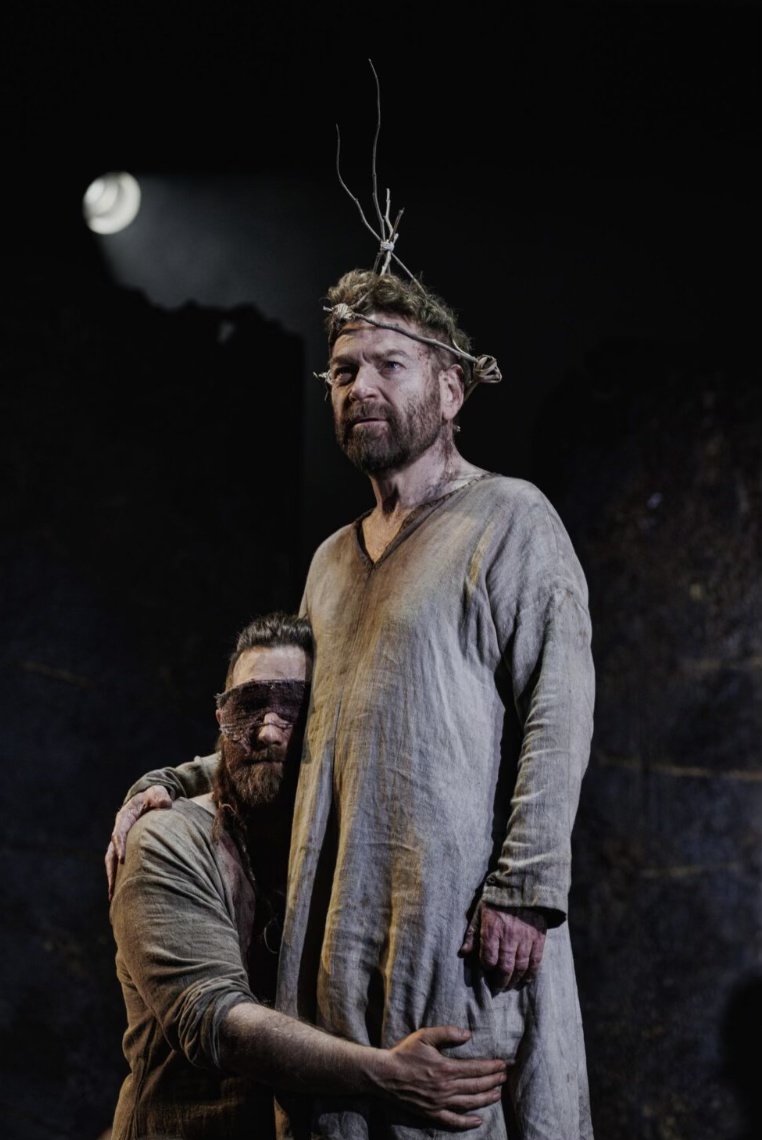
We stayed at a sweet hotel in the Flatiron district, saw wonderful exhibits at the Whitney and the Met, watched Kenneth Branagh as King Lear, went to a comedy show where five hilarious stand-up comedians made me laugh for ninety minutes. I loved all of it, every minute. But a few small vignettes stay with me and keep breaking the surface of my thoughts.
One dollar for an original print
In the Whitney Museum gift shop there’s a vending machine at one end where you can slide four quarters into the slots, push, and out pops an original print of some NYC iconic object or scene by Ana Inciardi. We put our quarters in, and now we own two tiny prints (2.5 inches by 3.5 inches): a black and white cookie and a NYC water tower. Inciardi is kind of genius, isn’t she? I don’t know if she profits from this—surely a print for a dollar is not netting her much money. But it is such a delightful thing to encounter: a vending machine dispensing original art. I want art vending machines to be installed everywhere, machines where you insert coins and receive poems, collages, small clay sculptures, watercolours, flash fiction, holograms, fabric art, tarot cards… Can you see it?
The women’s washroom at Barnes and Noble
To use the washroom at the Fifth Avenue location of Barnes and Noble, you must first purchase something. At the bottom of your receipt is the bathroom code. I bought The Temporary, a novel by Rachel Cusk, an author I have been wanting to read (the novel is wonderfully written, but very depressing). I then used the code to enter the women’s washroom, where there was a line up for the two working stalls (there always seems to be one stall with a scrawled “out of order” sign). A woman of colour (#1) exited one of the stalls, but the next person in line (white woman) looked in, then withdrew with a look of disgust on her face. Woman #1, was busy washing her hands. I said to woman #2, “what’s the problem? You’re not going in?” Woman #2, not making eye contact with me, said cooly, “they got stuff all over the seat.” I went into the stall and saw a fine spray of water droplets on the seat, likely created by the toilet’s back spray. Quickly removed with a wipe of toilet paper. The venomous way woman #2 said “they got stuff all over the seat” implied something terrible, perhaps excrement smeared everywhere. Her contemptuous reaction was so overblown and ridiculous—it felt symbolic of a rising wave of incivility and prejudice in (American) society. Ugh.
Four girls draw a statue
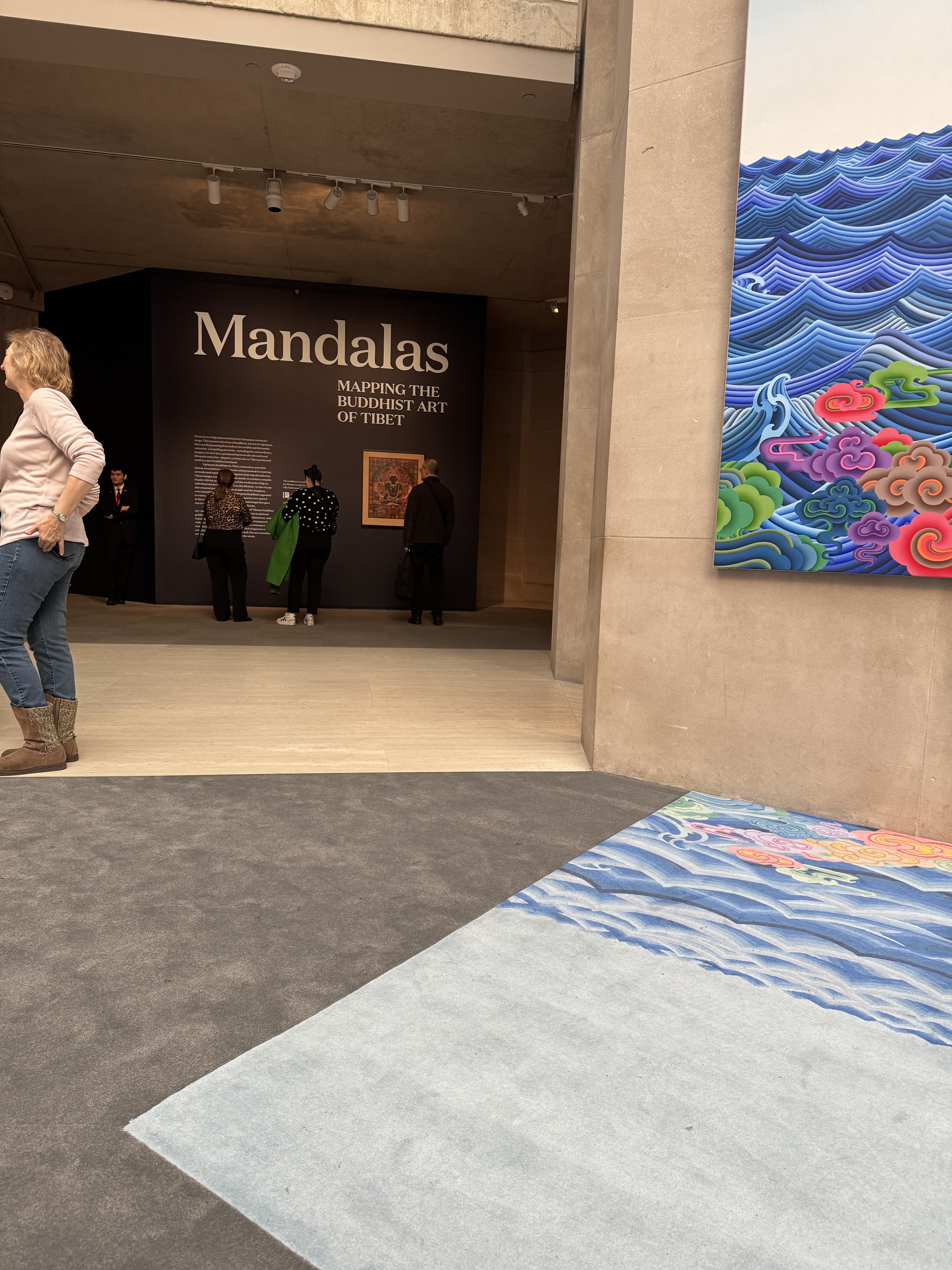
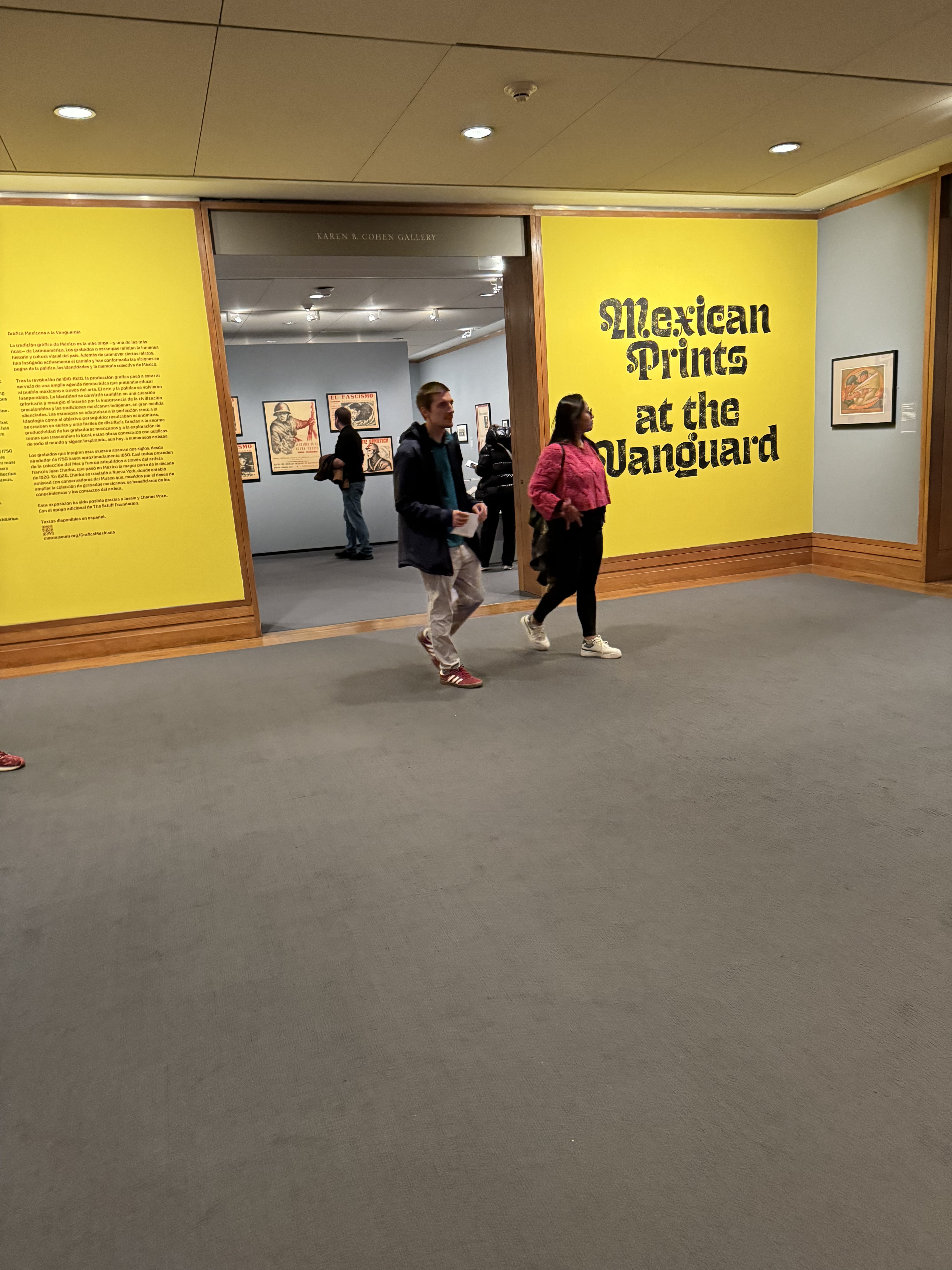
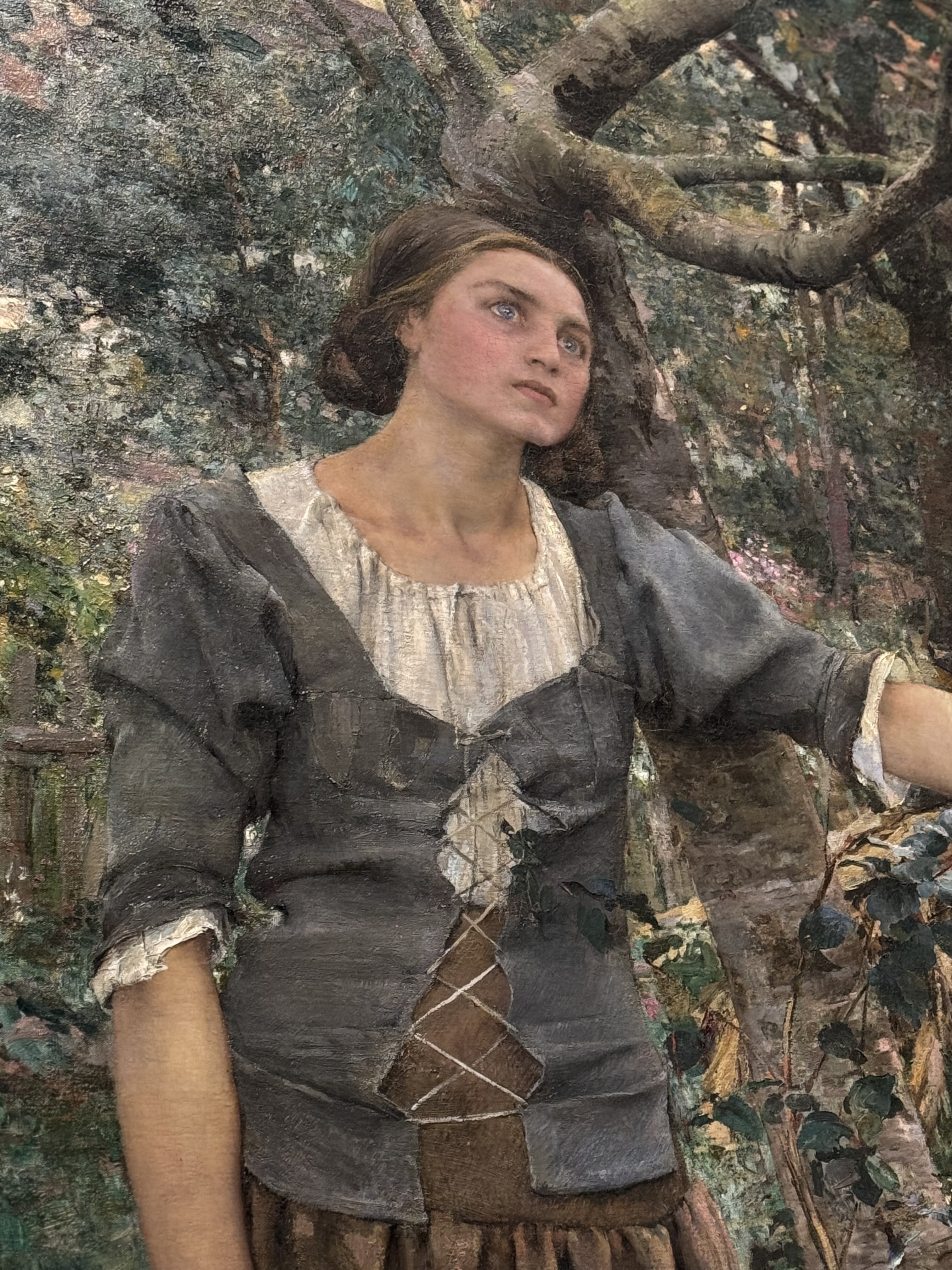
I loved the two exhibits we spent time with at the Metropolitan Museum of Art: Mandalas, Mapping the Buddhist Art of Tibet and Mexican Prints at the Vanguard. As we left the museum, passing through the Leon Levy and Shelby White court filled with ancient Greek and Roman statues, I saw four teen girls sitting on the marble floor in front of a bench, absorbed in drawing a statue of a nude man. This is what I will remember from the trip… their bowed heads, their silent engagement with the statue and with each other. A refreshing palate cleanser after bathroom woman #2’s remark. Oh, and the Joan of Arc by Jules Bastien-Lepage (1879): her face had me swooning.
Docent at the Met
We got a bit lost after the Mandala exhibit and asked a docent for help locate the gallery where the Mexican prints were on display. She led us rapidly through throngs of people, and I told her my mother had been a docent for years at the Art Gallery of Ontario (I had many moments of thinking of my mom in NYC—we visited the city together in my early twenties and saw, among other things, Zero Mostel in Fiddler on the Roof). The docent explained she had to do highlights tours for two years before they let her specialize in anything. I asked her what she specializes in now. Arms and armour, she answered. And I get to have another speciality, she said, but I am taking a break. Evidently, it’s exhausting to learn all there is to learn about the arms and armour in the Met’s extensive collection.
Pumpkin Pie at the Malibu Diner
Before the show at Gotham Comedy Club, West 23rd and 7thAvenue, we ate dinner at the Malibu Diner across the street. An old-fashioned American diner with a huge, laminated menu, plenty of booths with red vinyl benches, low chrome stools facing the long counter. All of the waiters spoke Spanish among themselves. When our waiter brought my twice-baked potato, I said Gracias Señor, and then he started to speak to me in Spanish, and I had to explain that I only know a few words. He laughed.
We paid for our meals and went to the club, but we were early. The woman said come back in half an hour; they were running late. Where to go? The cold wind bit our cheeks that night. So, we returned to the diner, where the waiters welcomed us like old friends. Come, come to the back, sit in this booth, where you won’t feel the wind that sneaks in whenever somebody opens the door. It’s warm back here. Our same waiter from before brought pumpkin pie with whipped cream. Sometimes eating dessert is the perfect way to pass time.
Shakespeare groupies
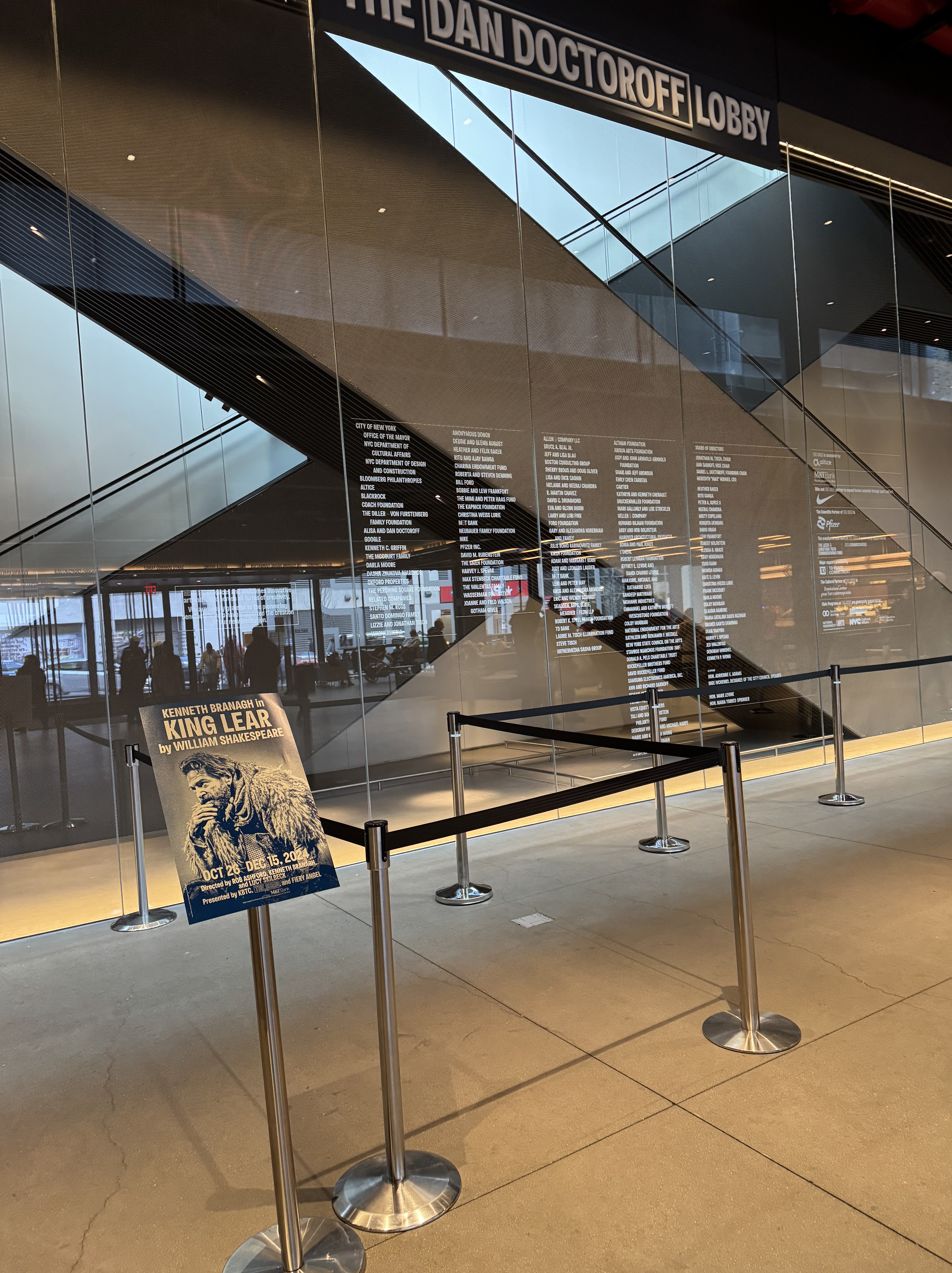
We took our excellent seats at the Griffin Theatre (at the Shed), where we had tickets to see King Lear. In front of us, two women about my age were taking off their coats and chatting. They started to engage us in conversation—where were we from? Did we go to a lot of Shakespeare plays? They had both lived in Atlanta and belonged to a Shakespeare reading group. When one of them moved to Baltimore, Maryland, they figured that was it—they wouldn’t see each other again. But then the Maryland woman saw an advertisement for King Lear with Kenneth Branagh and called her Atlanta friend. Why don’t I buy tickets? You can fly here. We’ll go together. So, Atlanta woman got a flight to Baltimore, and that morning they’d taken the train from Baltimore to Manhattan. We’re Shakespeare groupies, the blonde woman from Atlanta said. In April, we’re going to see Denzel Washington in Othello, said the Baltimore woman. Shakespeare groupies. I love it.
Window shopping
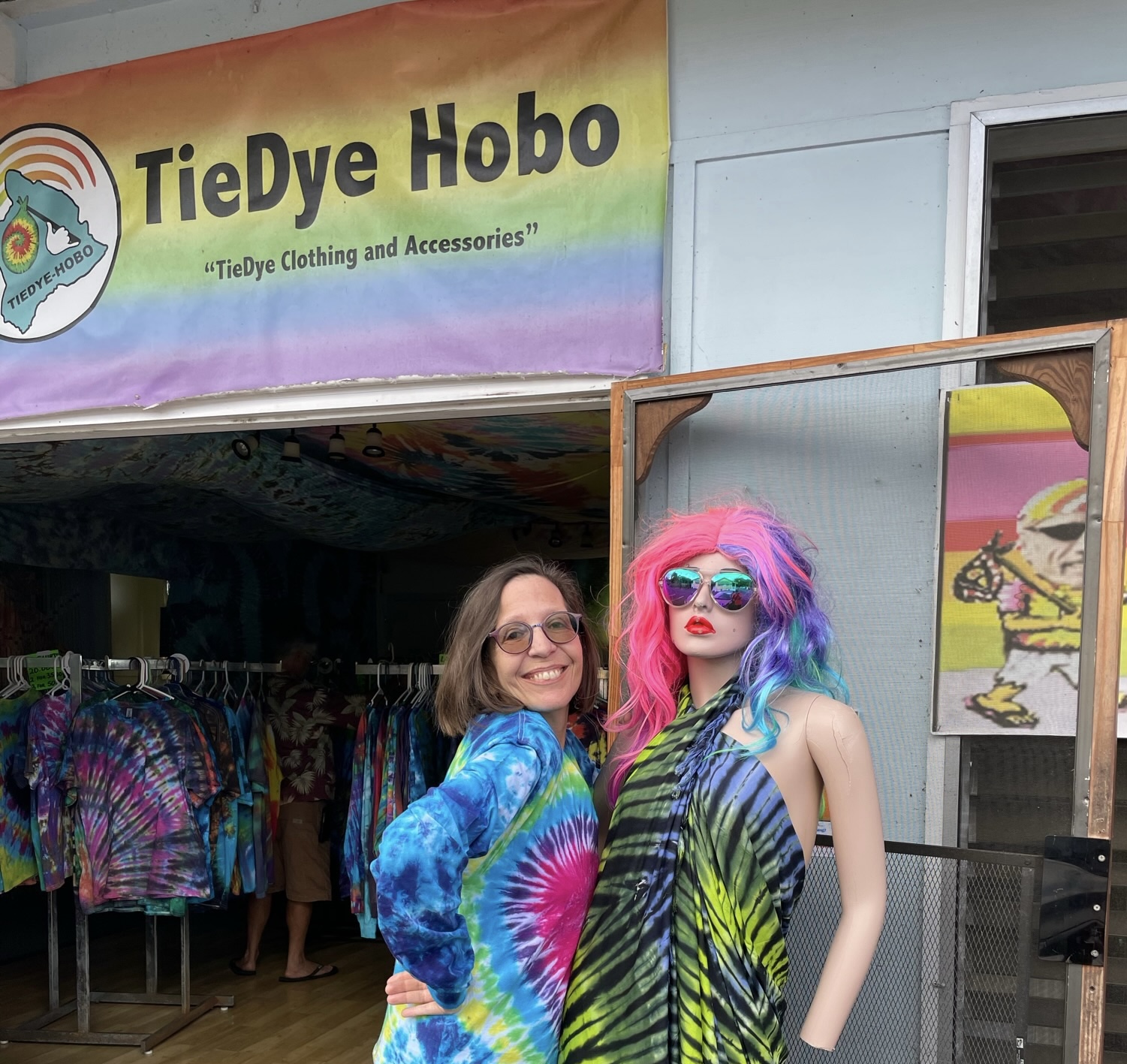
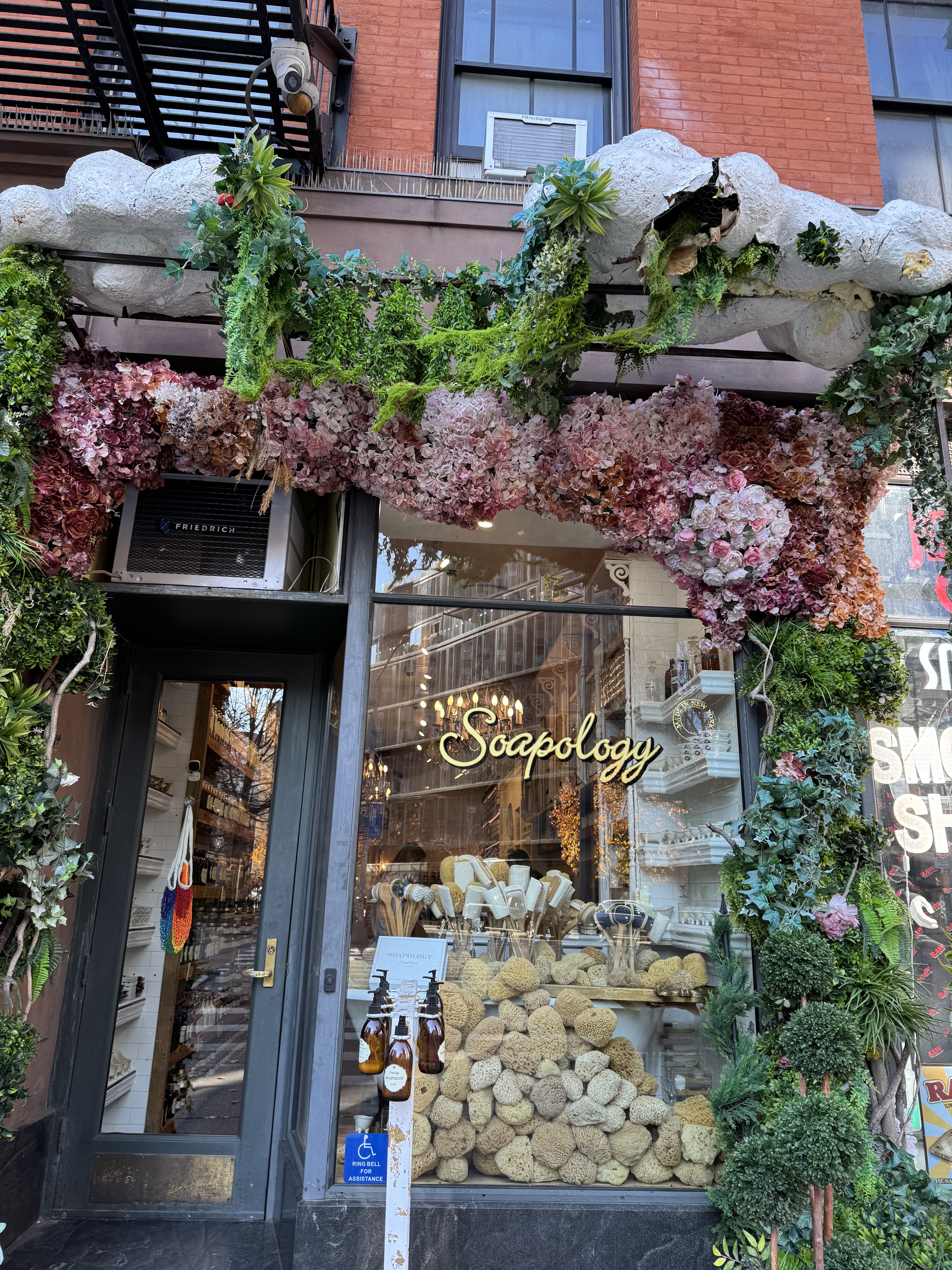
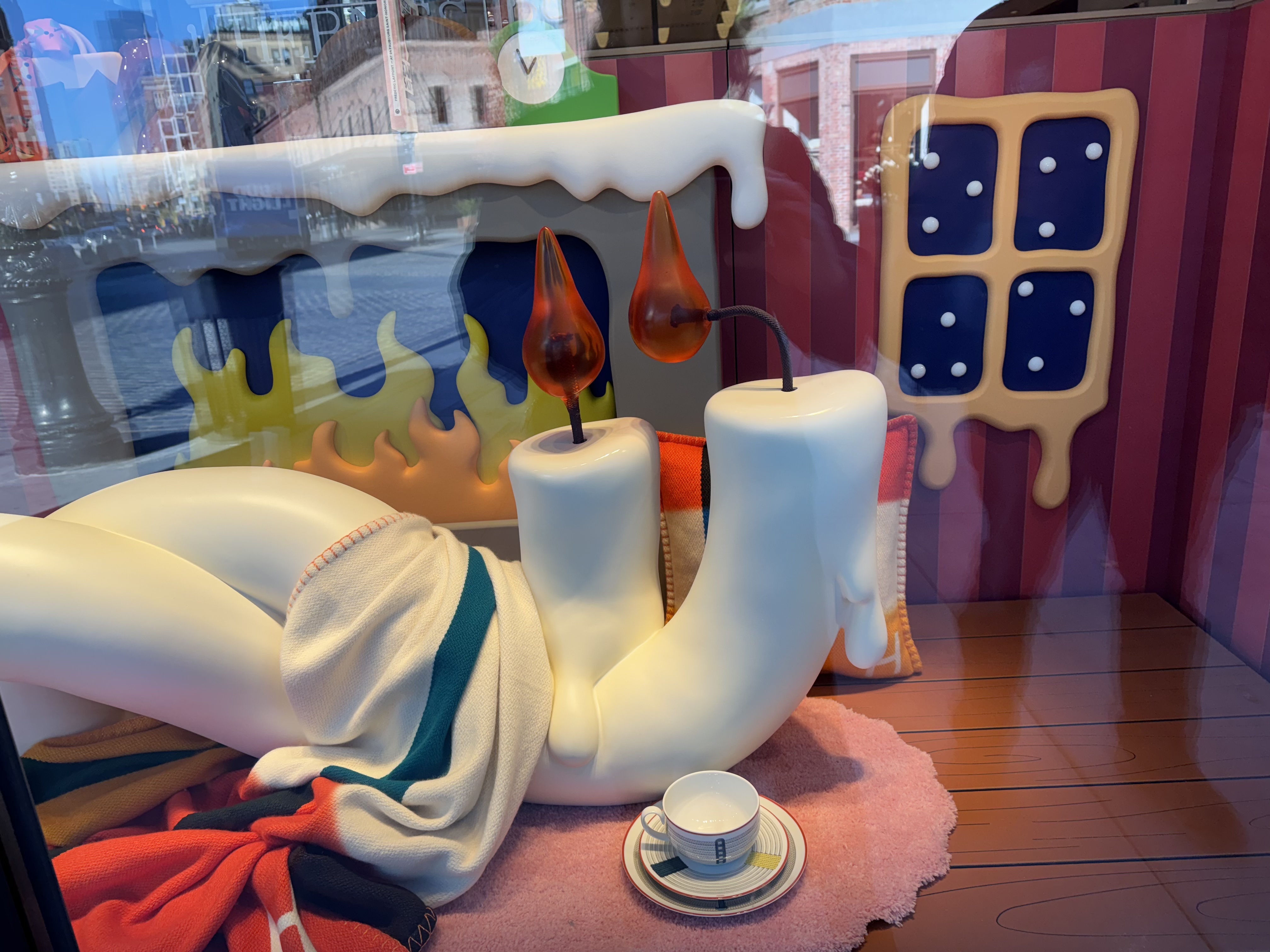
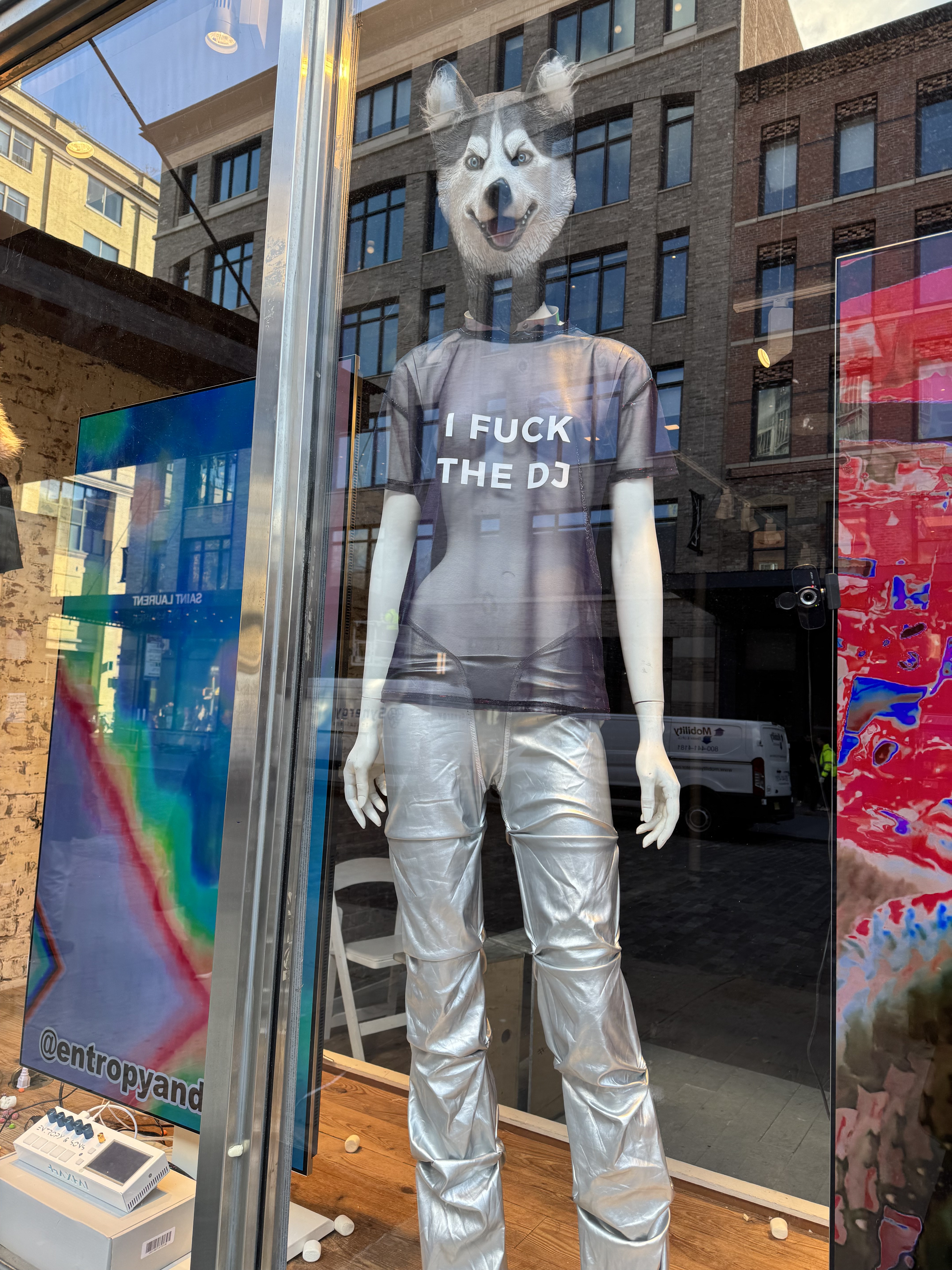
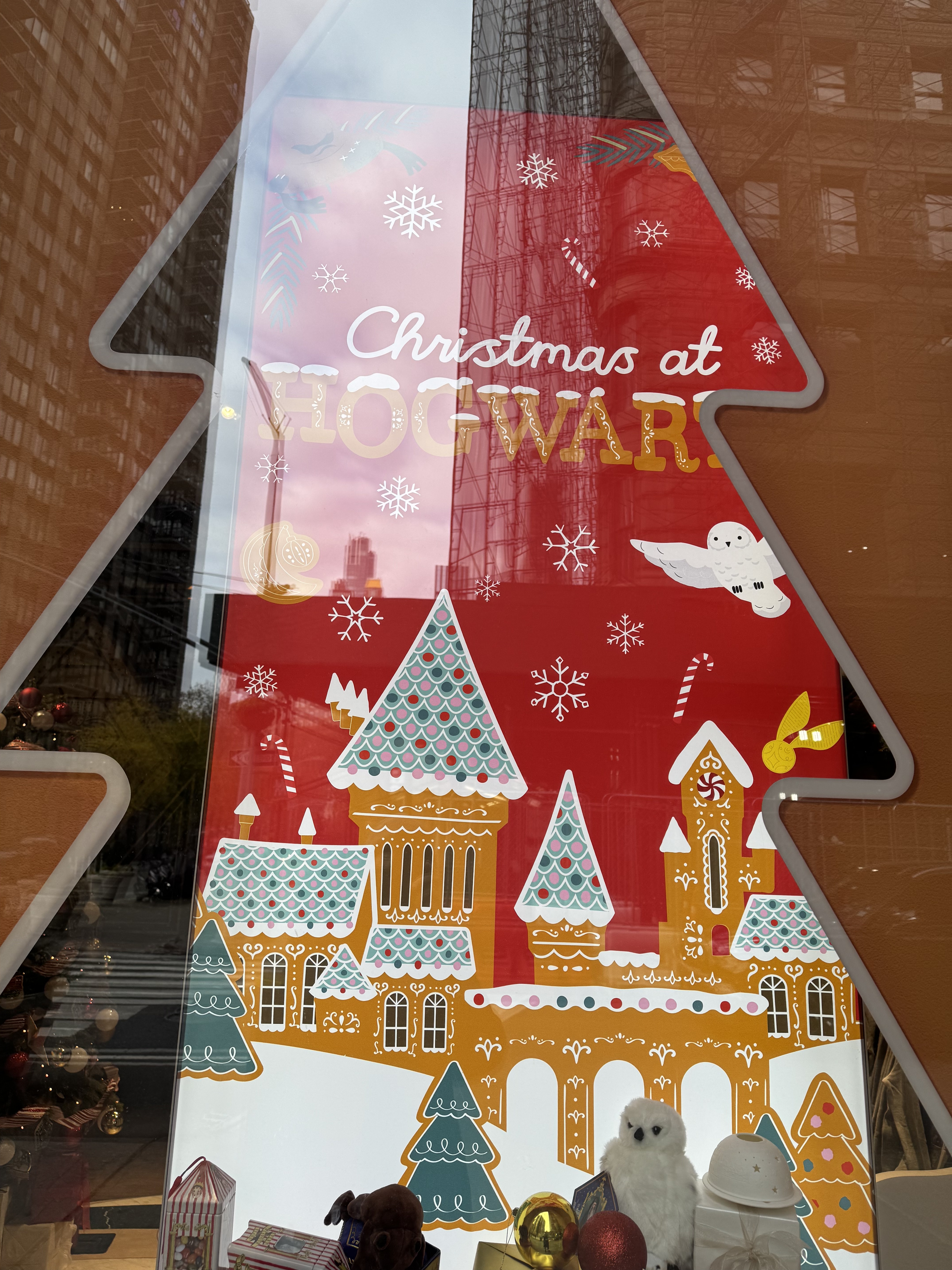
NYC is the best place to window shop. No need to buy a thing; just absorb the kaleidoscope of artifacts and moods rippling through glass. Mannequins wearing weird t-shirts, everything Harry Potter, bolts of cloth, soaps, sculpture, ceramics, sexy candles, life messages, and rainbow bagels.
Until next time…
We walked through Chelsea along a sidewalk that bordered a basketball court. Kids were shooting baskets on the first day of December, laughing, talking. A flock of grey pigeons passed overhead while the sun winked from behind a fringe of clouds. A bubble of pure joy passed through my body and into my head, exploding into a private smile. I love you, New York City; no reply necessary.
Sometimes a word rolls around in my mind for weeks. Lately, it’s “shed,” both noun and verb. I started to make notes about “shed” and its associations. When I saw the document file that I’d titled “The Word Shed,” I recognized a new meaning: my mind is a word shed. A space where I collect words, play with them, combine them, examine their denotations and connotations, milk their honey.
Shed the noun is a simple roofed structure, typically made of wood or metal, used as a storage space, a shelter for animals, or a workshop: a bicycle shed | a garden shed | a woodshed. Or a place to work. Last summer we met a couple at their yard sale, and they showed us the woman’s “She Shed” in the backyard. They’d built the small one-room shed during the pandemic: it was a place for her to work at home in peace and quiet. I’d never heard the term “She Shed” before. I like it better than “Man Cave.”
Michael’s drawing of an old shed located in my father and Marion’s sugar bush near Markdale, Ontario. We called it the “sugar shack.”
The Shed is a restaurant in Tofino where, two years ago on my sister’s birthday, I had a delicious salmon bowl that I recreated at home later. I knew the ingredients: salmon, quinoa, raisins, almonds, chopped apple, kale, white cheddar. I intuited a dressing of tahini, olive oil, lemon juice, garlic, honey, and yogurt. I discovered the recipe, handwritten on blue paper, in my recipe binder and realized that I’d somehow cared enough to reverse engineer the recipe, though I can’t remember writing it down.
I made the Salmon-Kale-Quinoa Bowl again the other night and it was delicious. I didn’t have white cheddar or puffed rice, so I used shaved parmesan and skipped the puffed rice.
The Shed restaurant invokes a homey feel. I remember being there with Jude and Michael, tucked into a cozy booth while rain spattered the windows and wind whistled outside. Like sitting in a warm shed on a stormy day. We walked on the beach after lunch in our rain gear.
Over the years, we’ve had two sheds built on our property for storage, bicycles, and garden stuff. Now we’re moving and clearing out the sheds. I’d forgotten about the stuff I stored there. Out of sight, out of mind were boxes of old letters, some going back forty years; kids’ artwork, writings, and report cards; notes from university courses; my old journals. Sorting and shedding and shredding old papers over the last few months has been part pain, part joy, and sometimes so funny I laughed out loud.
Another shed: On December 1, we’ll be in New York City to see Kenneth Branagh in the role of King Lear at the Shed, “a new cultural institution of and for the 21st century.” Their website explains: “We produce and welcome innovative art and ideas, across all forms of creativity, to build a shared understanding of our rapidly changing world and a more equitable society.” After a run in London, England, Branagh is bringing the play to this exclusive U.S. engagement.
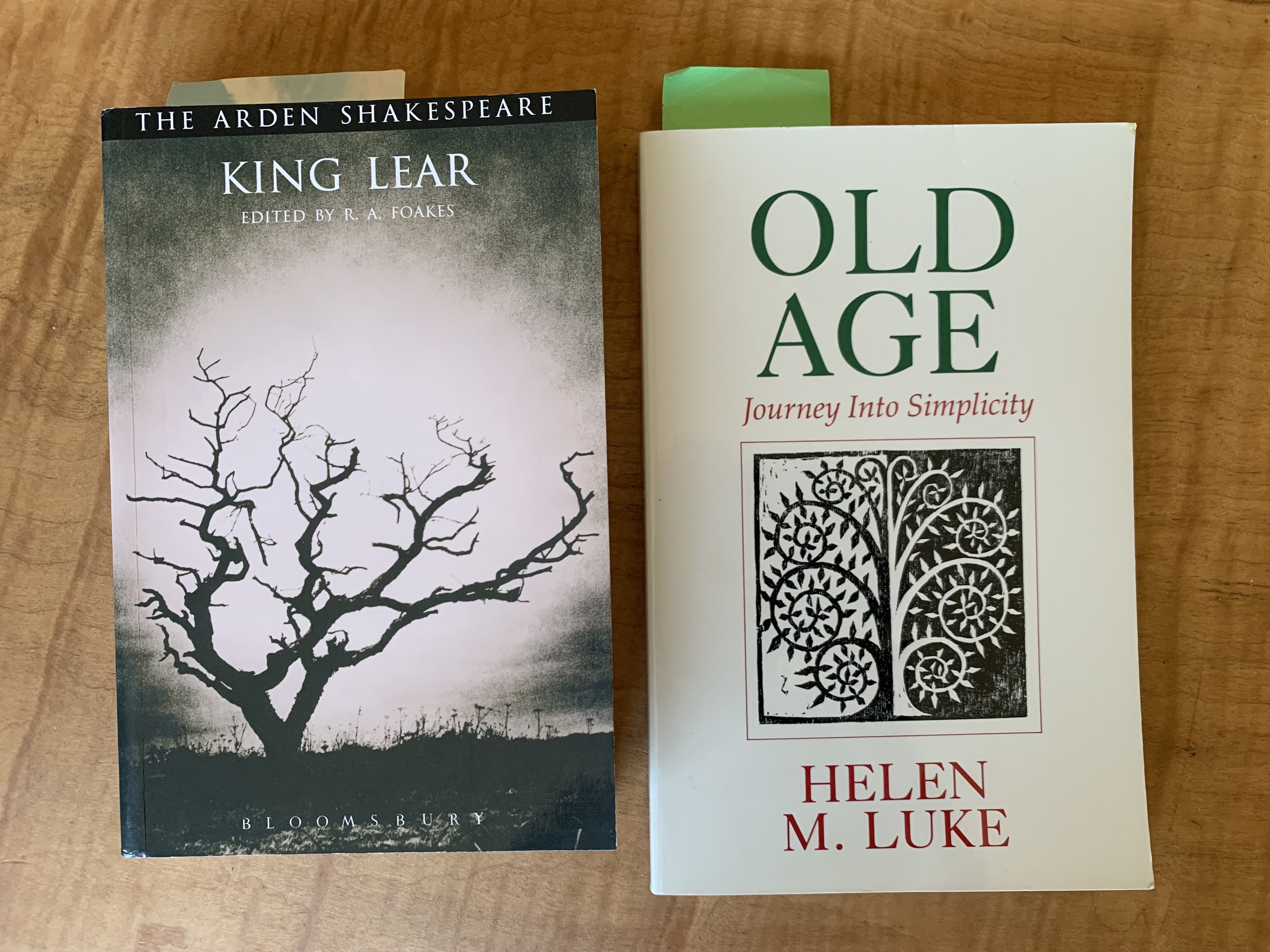
It’s months away, but of course we had to buy tickets early. It will be exciting to see Branagh play Lear in my favourite Shakespeare play. I am reading Helen Luke’s book Old Age, and the chapter on King Lear moved me, particularly when she refers to the two lines spoken by Lear to Cordelia in Act 5, Scene 3, “When thou dost ask me blessing I’ll kneel down / And ask of thee forgiveness.” Luke writes,
“If an old person does not feel his need to be forgiven by the young, he or she certainly has not grown into age, but merely fallen into it, and his or her ‘blessing’ would be worth nothing. The lines convey with the utmost brevity and power the truth that the blessing that the old may pass on to the young springs only out of that humility that is the fruit of wholeness, the humility that knows how to kneel, how to ask forgiveness” (p. 27).
Lear’s story resonates because he shows us that shedding egotism and pride may be followed by an exquisite sense of humility. Many of us experience this as we grow older. Only after Lear is hollowed out by loss can he enjoin Cordelia to “live / And pray, and sing, and tell old tales, and laugh / At gilded butterflies.” Only after loss decimates us, do we feel an unusual lightness of being. So different from the lightness of youth, this lightness we purchase with grief.
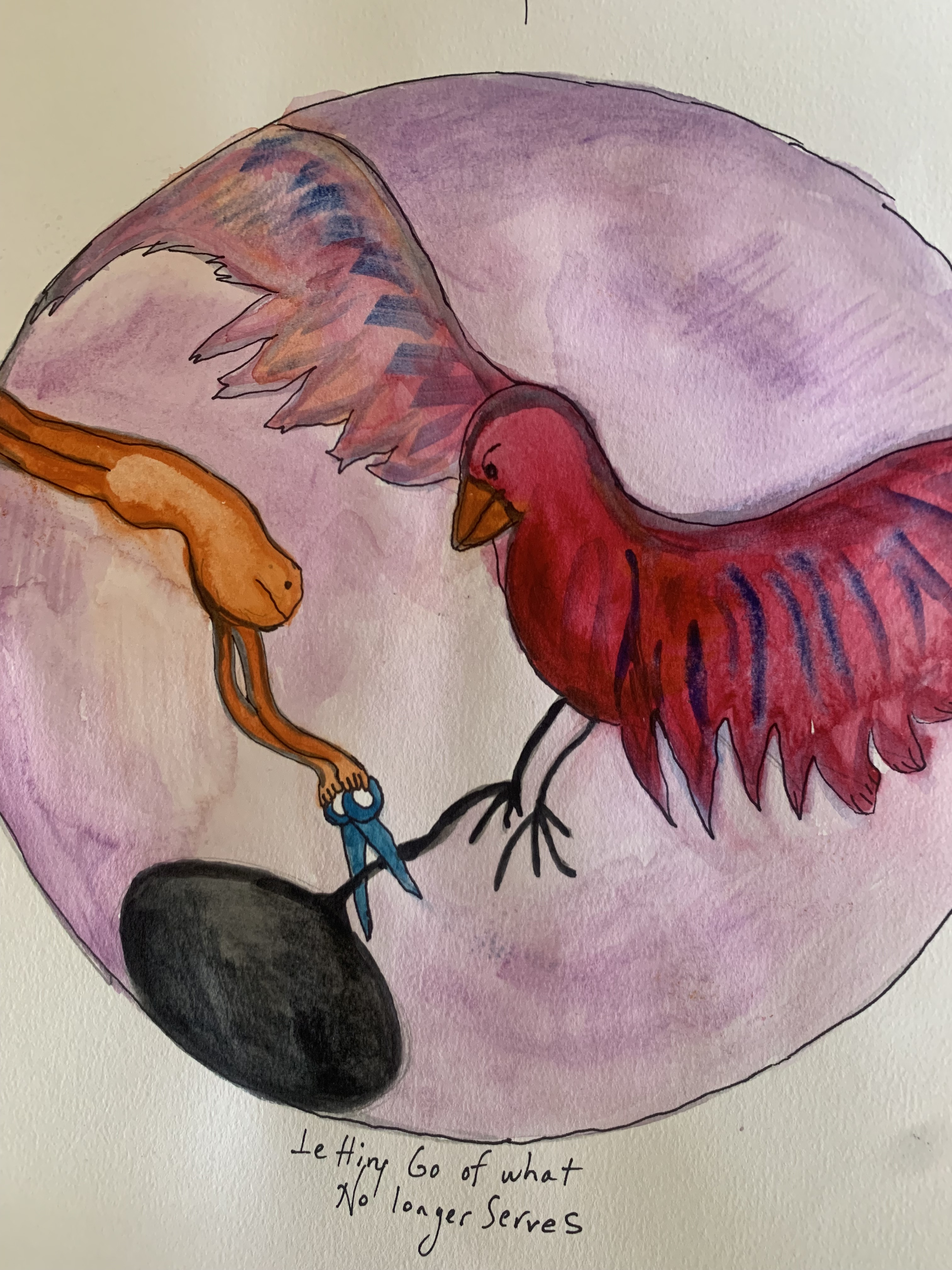
Shed your burden ~ watercolour by Madeline Walker
Then there’s the verb, “to shed.”
To rid oneself of superfluous or unwanted things or feelings…to give off, discharge, or expel, such as a cat shedding fur, a snake shedding skin, a tree shedding leaves.
Shedding blood. Bloodshed. Viral shedding. We all shed tears.
And don’t forget the intransitive verb, to woodshed: to practice a musical instrument, to work out jazz stylings, to go over difficult passages in a private place where you can’t be heard.
Isn’t it odd that the noun shed refers to a place where you store and keep and gather things, whereas the action word (transitive verb) means to let go of, release, slough off feelings, body parts, objects? These meanings are in tension with each other – one wants to keep, the other to release.
But perhaps it isn’t so odd. The tension between the noun and the verb merely replicates the push and pull we feel in our lives between holding close and letting go.
I start the year with a glance back over 2023. Last year, creativity often eluded me. She was a timid fox, hiding in her hole. I tried to lure her out, but at the first sign of self-doubt, she’d scurry back down the tunnel. Making things—in cloth or paint, in the kitchen, with words—can feel pointless in the face of climate crisis, grief, war, and ennui. And yet, don’t you think we must continue to create as an antidote to all the destruction?
When fox stayed out long enough, she inspired me to bake cakes, sew things, paint mandalas, and write stories and poems.
Baking
I love making cakes and preparing gifts for people. I fantasized once about starting a small business: I could make bespoke cakes and gifts to order (quilted bookmarks, small herb bouquets from my garden, stones from the beach that feel good in your hand). Nice idea, but maybe not a great business move.
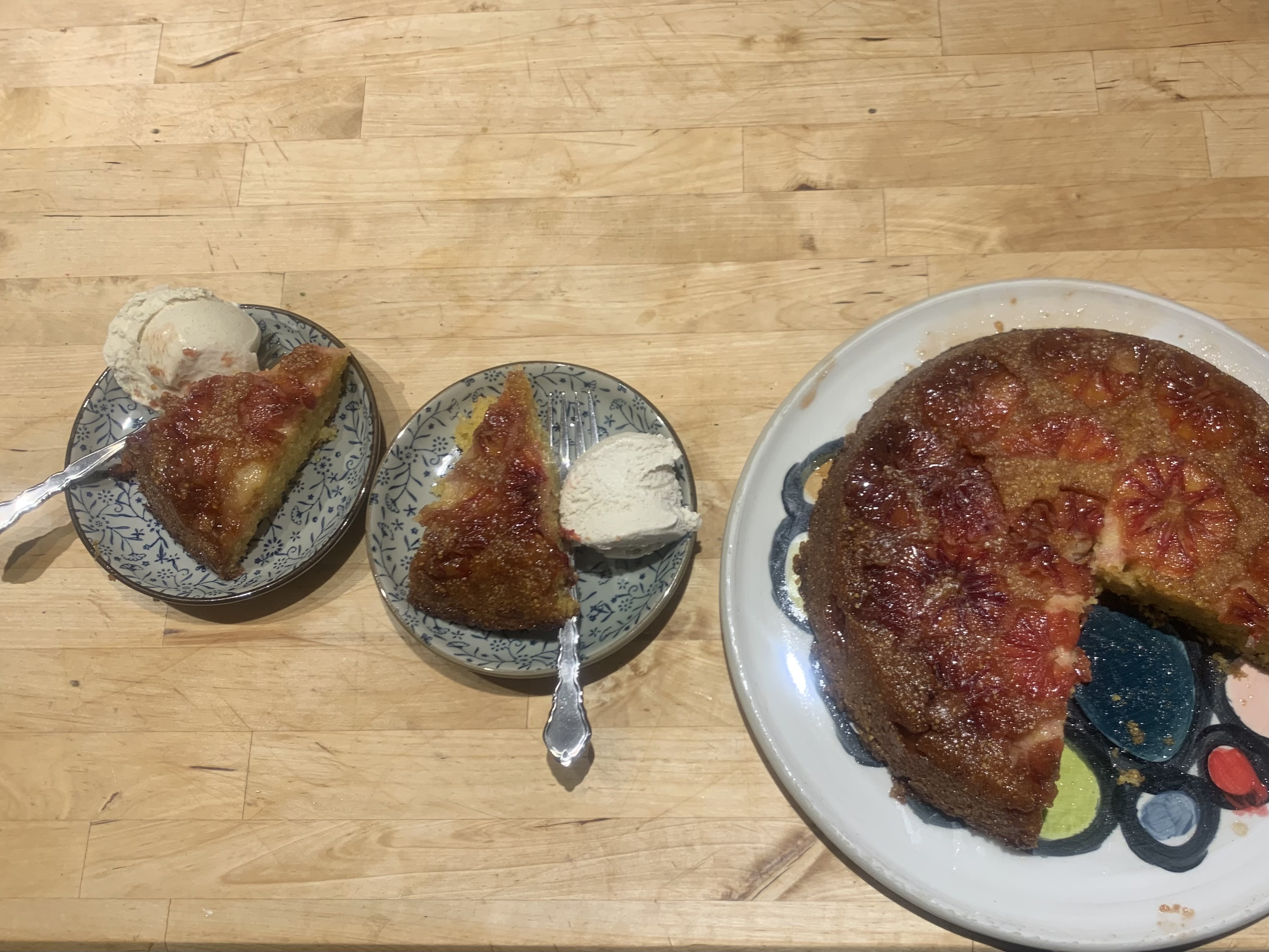
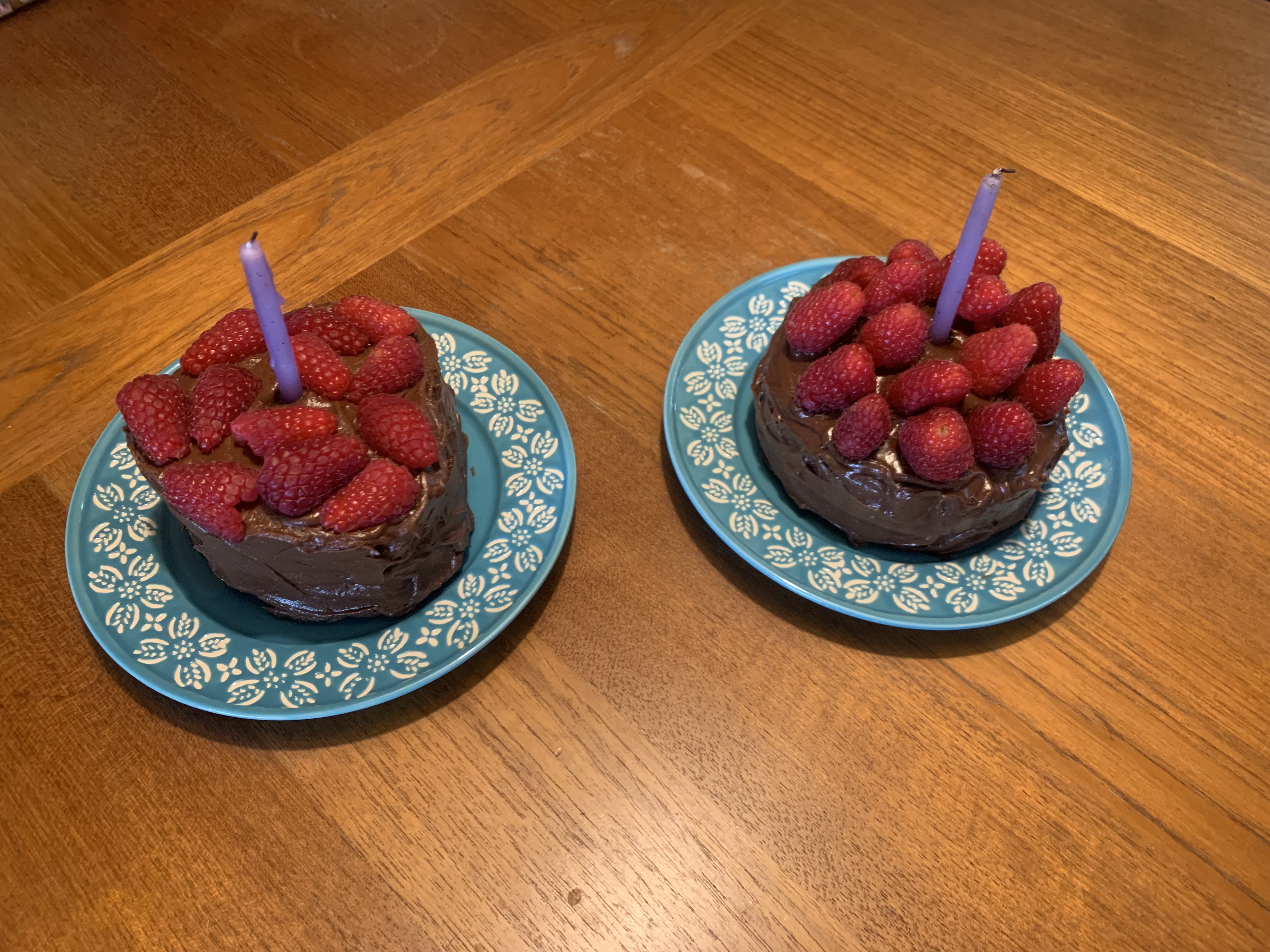
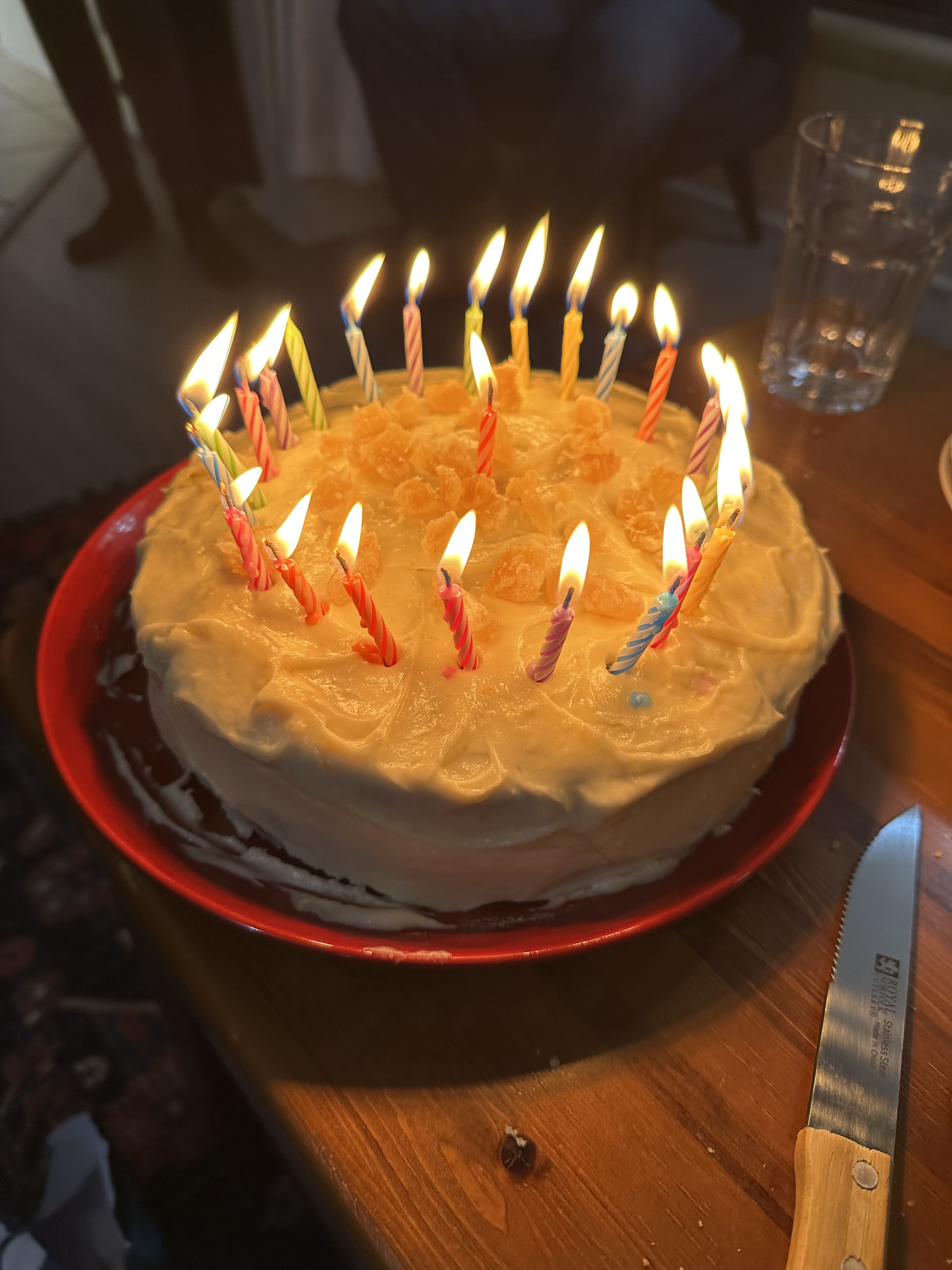
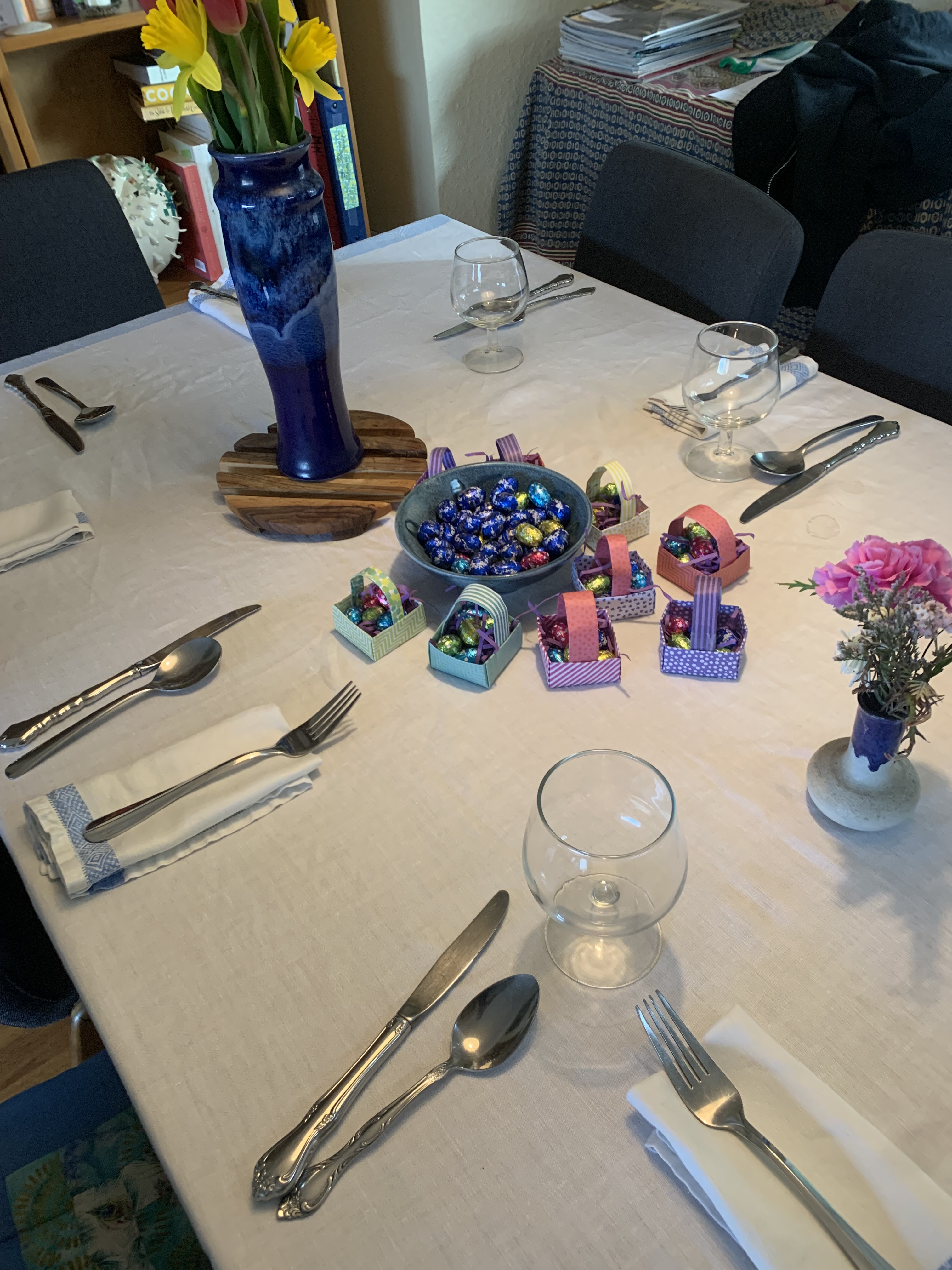
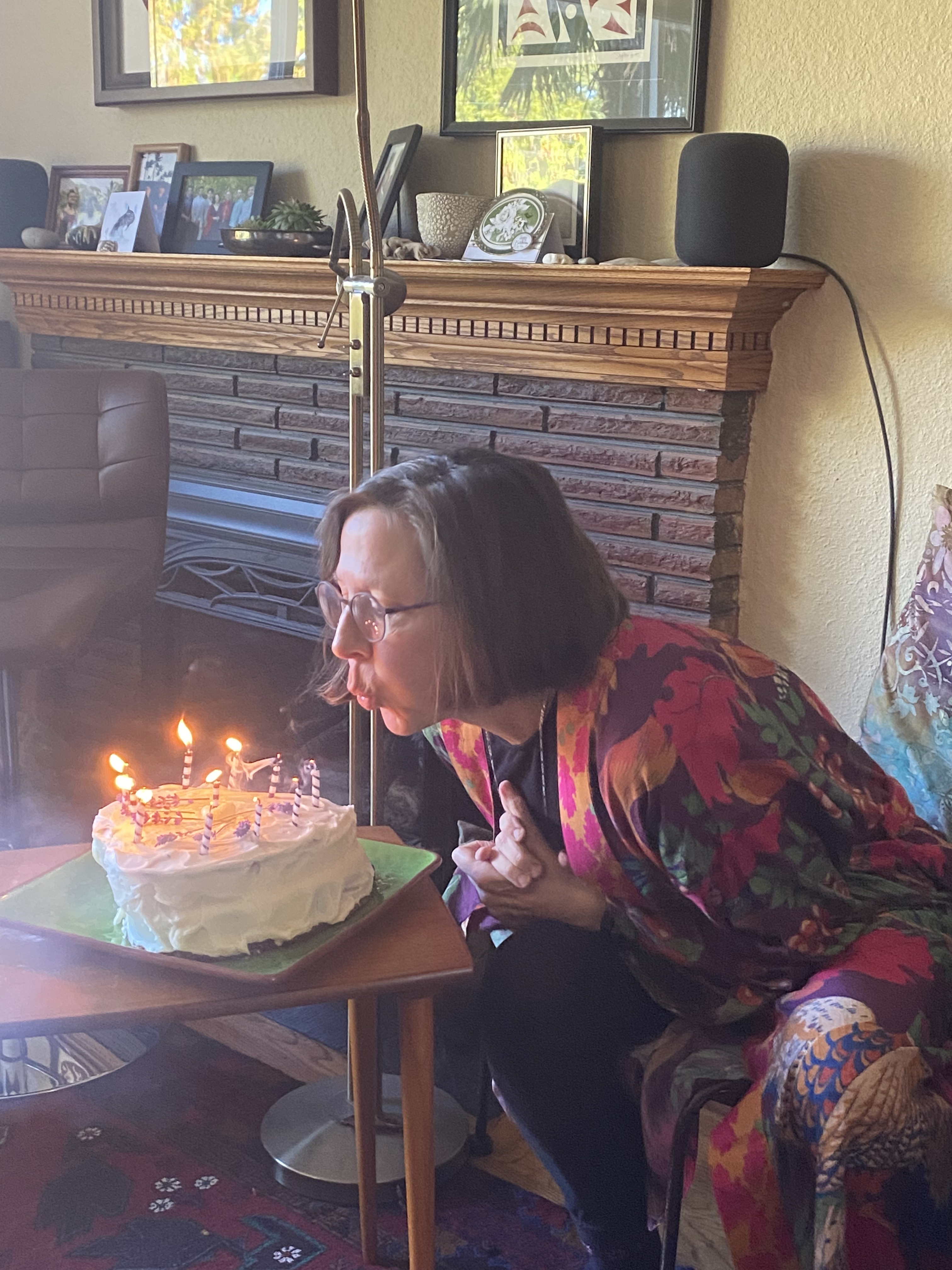
This year Michael got an upside-down blood orange cake for his February birthday, and we had fun sourcing the oranges. Found some good ones at the Market Garden on Catherine Street (where shoppers sometimes sit down to play the grand piano—such a cool store). I baked mini-chocolate cakes with strawberries later in the month for Barbara, and for Easter, an almond torte with whipped cream and more strawberries. Like my mother before me, I love to set a beautiful table, and Easter was no exception. The origami Easter baskets filled with foil-wrapped chocolate eggs provided a whimsical touch. (Entertain your inner child, I say.) For my own birthday party, a classic carrot cake baked in a heart-shaped pan frosted with cream cheese icing. For Andréa’s big five-oh: applesauce cake with three kinds of ginger. And for the final English conversation café at work: ginger cake with buttercream icing. What is it about a cake that speaks pure love?
Sewing
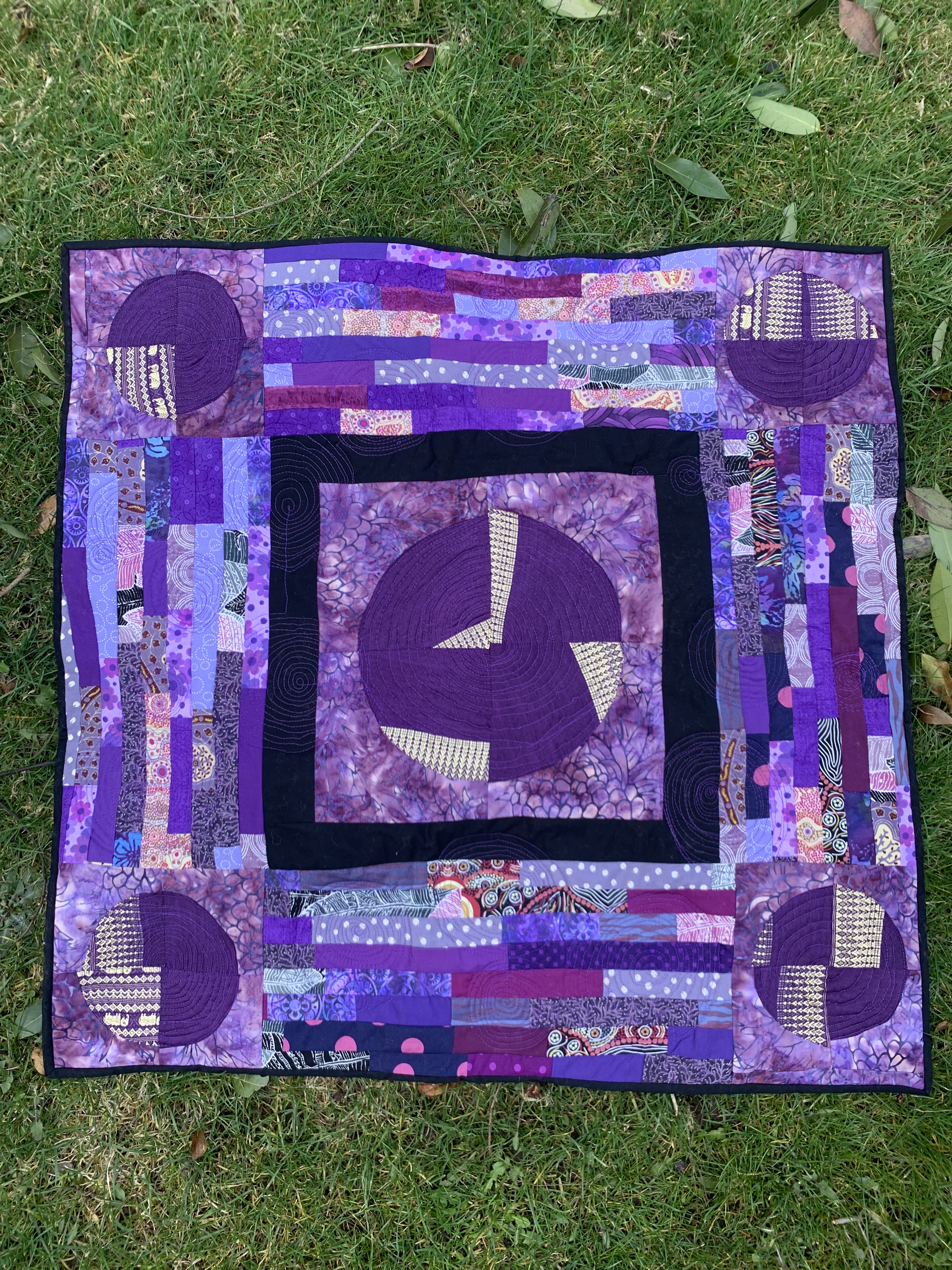
I didn’t make any new quilts, but I did sew a purple wall hanging, about 30 by 30 inches, that now hangs in our bedroom. I like to lie in bed and gaze at it. Four sentinel circles surround a larger one—all shot with gold thread (fragments cut from an old wraparound skirt from a yard sale). Those circles/mandalas ground me; cloth clocks tick noiselessly, watching over us as we sleep.
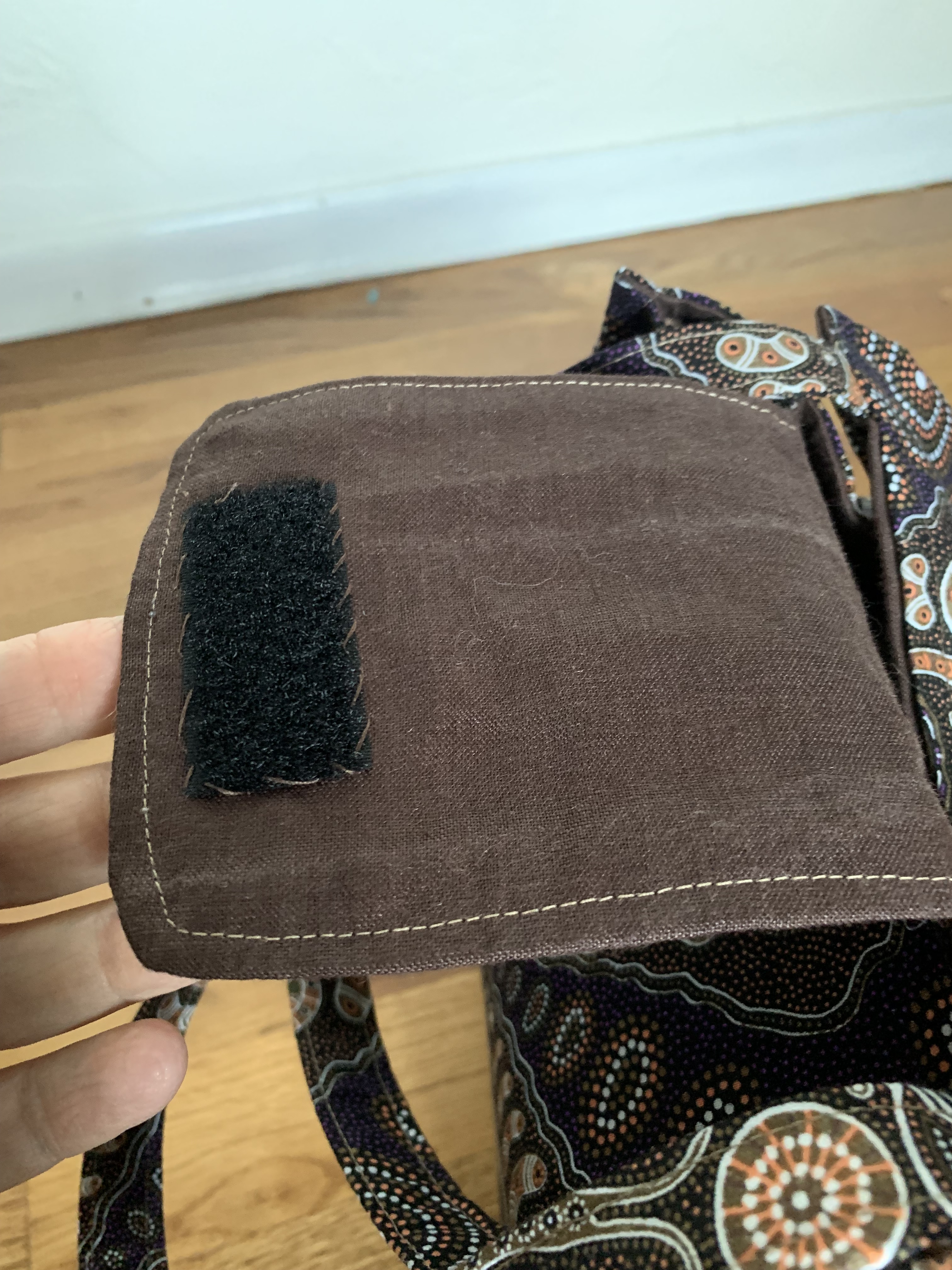
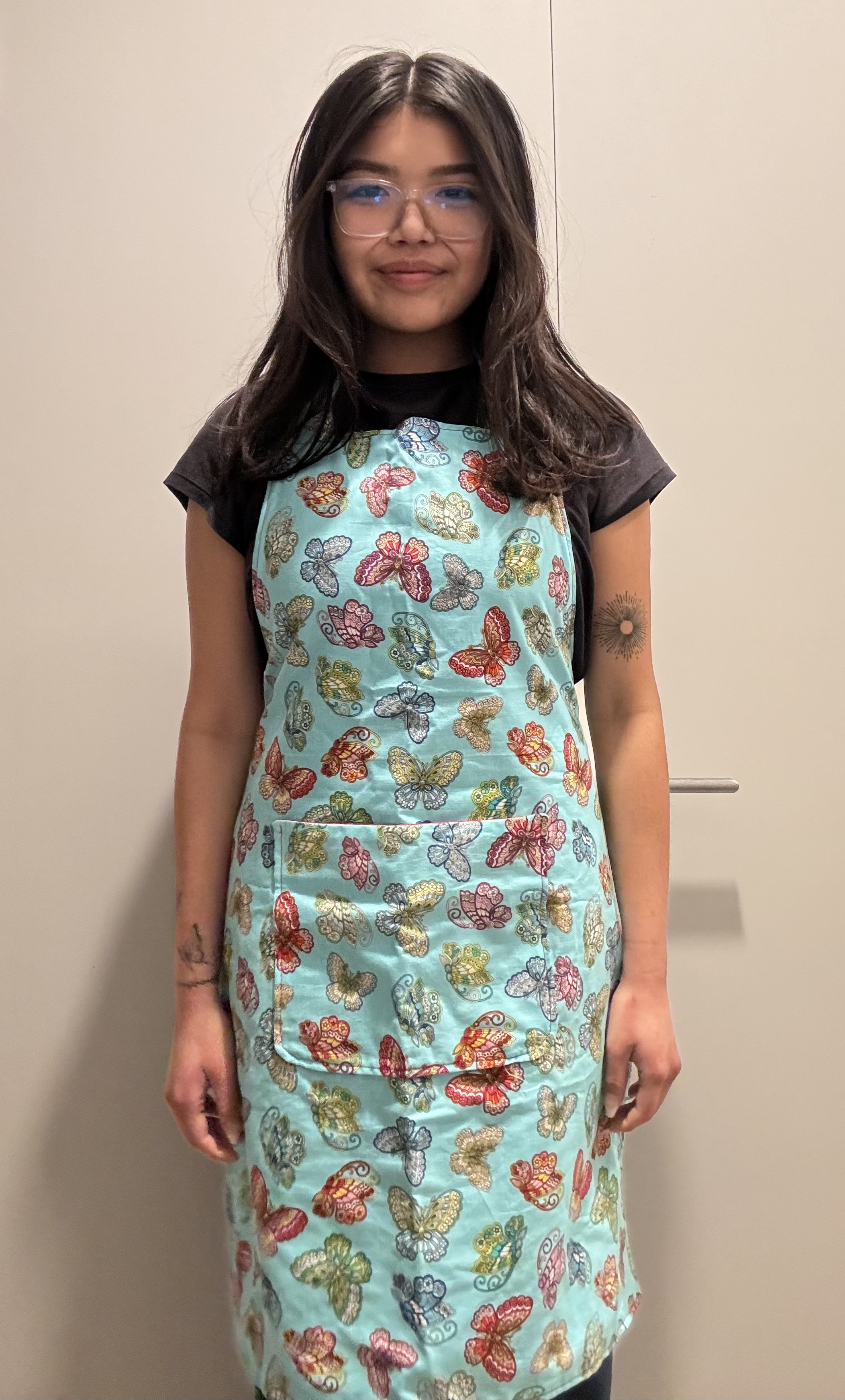
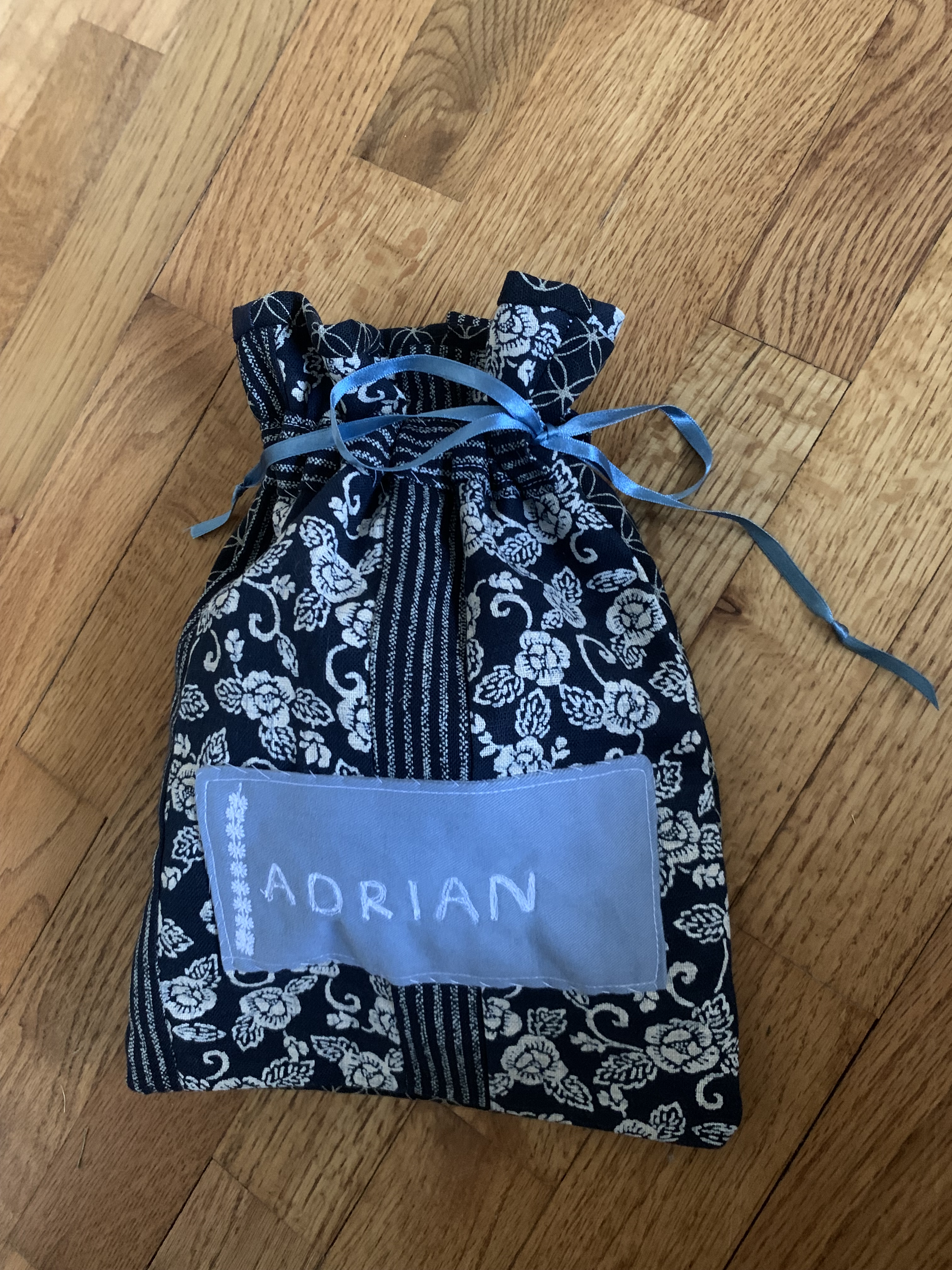
Smaller sewing projects attract me because results come together quickly. My sister Kathryn bought me a drapery panel of Indonesian fabric in browns, reds, and purples at a thrift store. A lot of fabric—40 by 83 inches—for only $4. I’ve enjoyed making some things from it: placemats and napkins mostly, and a sweet little fabric basket (I made a few of these for friends for Christmas, then filled them with chocolates and gifts). I felt most proud of the lunch bag I made for my boss, Nancy, because it tested my skill. I used fabric in a brown geometric pattern by an Australian Aboriginal designer. Then I lined the bag with sturdy brown linen from a too-big jacket I bought at a yard sale down the street. Nancy loves it. Adrian’s bag (filled with toys) for his second birthday involved some great scraps I bought from Smoking Lily on Government Street. Finally, I sewed a butterfly apron at Christmas for my niece. She is beautiful in any outfit, even an apron.
For my 65th birthday party (the theme was poetry and potluck), I made fabric wrappers for second-hand poetry books I bought for guests. So fun to comb through my stash and find colours and patterns that sing together. Party favours were fun when you were a kid, and they are even more fun when you’re an adult. Again, entertain that inner child…
Making Mandalas
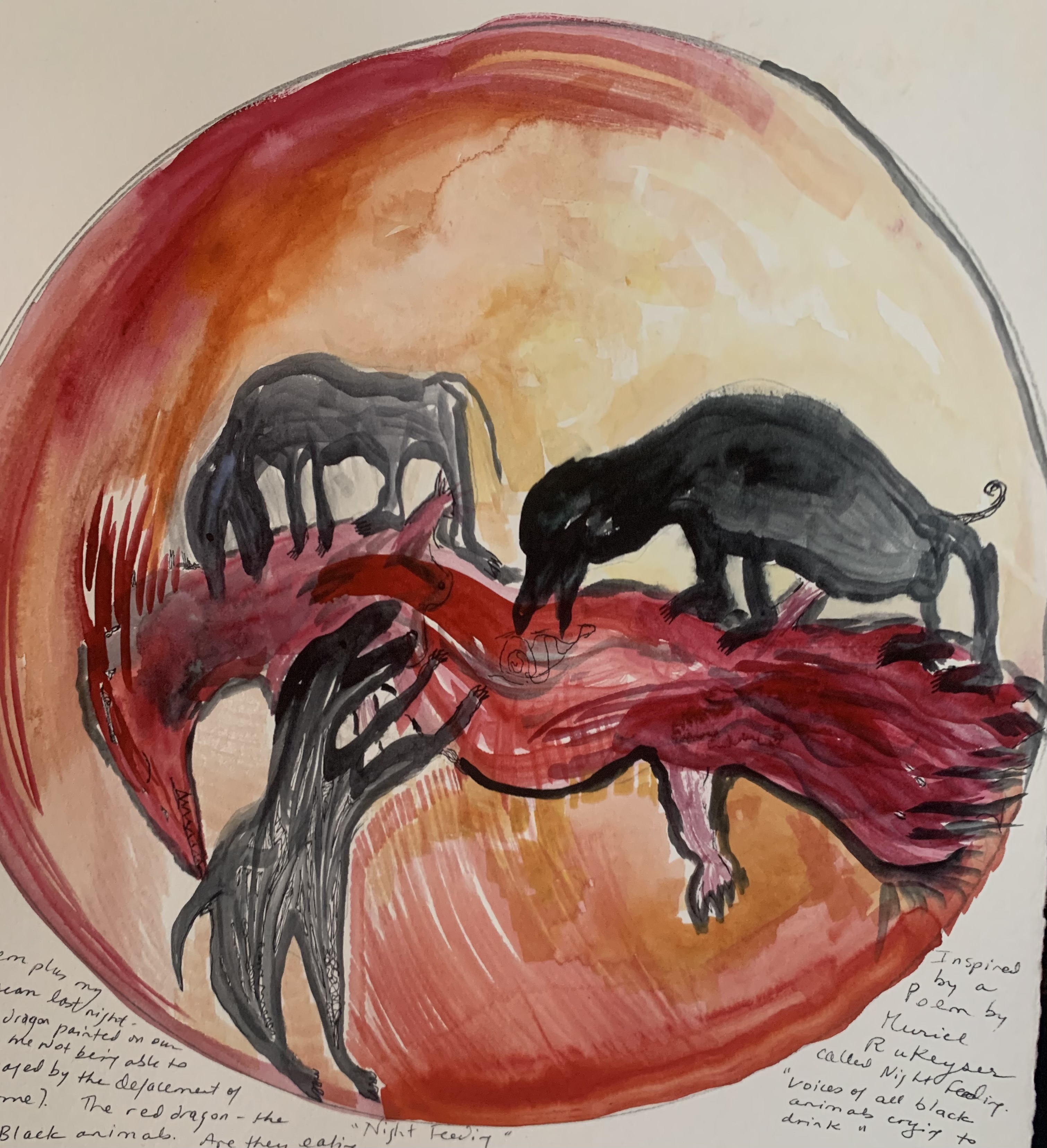
Michael and I had a Monday Mandala practice for a while, but it fizzled out sometime during the year. One exciting project: we delivered a multi-day mandala-making workshop in March and early April on Zoom. Our participants were mostly from New Mexico—all lovely, open-hearted women. It was a good experience. Michael was a guest presenter at two Creating Mandala monthly events. The CM team featured a new goddess each month, and Michael chose to talk about the High Priestess (Tarot) and Kali (Hindu goddess associated with death). I attended both of these events with pride and pleasure. Some mandalas last year were inspired by dreams—a rich transmutation. I dreamed I entered a room in my house and found that someone had painted on my white wall a red dragon being devoured by three beasts. Still musing on the meaning of that one.
Writing
Here’s where the fox was most recalcitrant. I aborted so many poems, blogposts, and stories last year, I am surprised to find anything in my files. I posted on this blog only five times in 2023. However, I did complete a series of linked short stories (started in previous years): Nothing is Wasted: The Stan and Deedee Stories. I shared them with a few friends and family members. If you are interested in reading them and you’d like a digital copy, let me know (maddyruthwalker@gmail.com) and I will send you one.
Some months, I had nothing new to share with my writing group. I’d scour the old folders for some scrap from the distant past to read. Or I’d just listen to others read their work. But that’s okay. I know that I’ll write again. When nothing seems to be happening, the fox is deep in her hole, pregnant with kits. How many will be born and when? Just have faith.
I wrote only a few poems in 2023, and one was for my birthday. Each guest was asked to bring a poem to share. It was extraordinary to see my friends and family members get up into the poetry seat and read poems they’d chosen, poems they’d written: one of the best gifts I’ve ever received. To close the offerings, I read my own poem– one that expresses the expansiveness I feel as we enter 2024. Happy New Year to you!
Expansion

I started slim
and willowy.
Then, whoosh of years.

My waist - heavy as grief,
soft as dough -
expanded.

Grief. Have you met her?
Well then you know the
grace that she bestows.

Hard things—she
cracks them open,
ignites a hotter flame,
imbues a deeper shade of red.

So, like my waist,
my heart’s made wide by grief,
a vast container for the love I feel
for trees, and animals, the sky,
the planet, for you, my friends,
for people everywhere,
for life expanding.
The bus to work takes about 40 minutes—the perfect length of time to listen to a dharma talk on Dharmaseed. I’m happier with this pastime than I am browsing Facebook or Instagram. The dharma talks inspire me and make me feel better about being alive, while Facebook or IG can make me feel dispirited. Recently, I listened to a talk by a dharma teacher I enjoy—Shelley Graf. She read an excerpt from Sharon Salzberg’s 2002 book on faith. I liked the quotation, but even more, I was intrigued by Salzberg’s book title: Faith: Trusting Your Own Deepest Experience.
Trusting your own deepest experience brought to mind a revelation I had when I started to see a therapist four years ago. Doesn’t sound like much, but it was profound for me: I am entitled to claim my own experience. During that therapy session, I had been dithering about whether I felt a certain way, circling around the ugliness of something, making excuses, minimizing my hurt, my terror, my sadness—in short, underplaying what I felt. “Oh, it wasn’t really so bad.” Nancy sat up straight in her chair, looked at me with intensity, and said, “Madeline, you are entitled to claim your own experience!” I laughed, “really?” I didn’t know that. To think I got to this stage in life feeling I couldn’t be honest about how it really was, how it really is, to be me. I came home that day and on the mirror in my sewing room, I wrote, “I am entitled to claim my experience.” I refresh it with a wine glass marker when it fades because it’s a crucial daily reminder.
Back to Salzberg’s book—well, I bought it and read it quickly, underlining the bits that made me cry or wake up or feel a swelling in my chest. There were many passages that made me feel good—made me feel connected to something bigger, something transcendent, which is what faith is, isn’t it? I love the sense that “no matter what happens, we can place our faith in the deepest part of ourselves, our buddha nature” (p. 170).
With those good feelings still germinating inside of me, I entered the course Michael and I are teaching on Zoom this weekend: Creating and Interpreting Personal Mandalas.[1] This morning, we led our participants through stages one through three. In stage one we rest in the darkness, in the womb. Being, not doing. As I started my mandala, I lined the womb-circle with layers of brown watercolour. Soon, a purple hyacinth spear emerged from the lining of the womb.
As I painted, my mind travelled back, back, back. Thirty-five years ago, I had several weeks off work to heal from surgery. Waiting time, resting time, stage one time. Hours in bed spent daydreaming, not doing, just being. My first husband and I lived in Toronto in a rented house on Devonshire, and the spacious front bedroom had big bay windows with generous ledges. The laser surgery I’d undergone was supposed to give me a chance at having babies, something I hungered for. When my friend Hannah visited me, she brought a potted hyacinth, not yet blooming. I put the plant on the window ledge, and it was as if I could feel the ache of that blue-blushed spear yearning to open.
It was early spring in Toronto: cold days, deluges, and then suddenly, bright hot sun. One day the hyacinth burst forth in a matter of hours, spraying the room with sweetness. Whenever I smell hyacinths, I go back to that time of hunger and healing. My body craved to follow the flower in her blossoming. But I had to wait.
My grandmother Marguerite and I were writing to each other that year. She sent me copies of Unity Church’s magazine and told me that she and other members of her congregation in Los Gatos, California, were praying for me to heal and get pregnant. I thanked her and pretended to be onside with her faith. But in fact, I thought it was silly. How quaint, a circle of old ladies in a church basement, holding hands and thinking of me.
Grandma Marguerite Walker in the Philippines, 1923
Months and months elapsed with no result. I thought the surgery hadn’t worked; after all, the doctor had told me I had only a 15% chance of having children. The odds weren’t great. Feeling like we needed a big change in our lives, my husband and I sold our stuff, quit our jobs, bought a Volkswagen van, and drove south. Almost a year after my surgery, we sat in a Planned Parenthood office in Green Bay, Wisconsin to learn the good news. I was pregnant.
The hyacinth I painted this morning seemed to have come from the deep well of memory— light-filled room, white sheets rumpled on the bed, the bluish spear opening as I kneeled nearby in my nightgown. Spring magic! And I thought of Sharon Salzberg writing about a research project undertaken in Korea: Women trying to conceive were prayed for at a distance, and these women became pregnant at twice the rate of those who received no prayers. I underlined that passage. Beautiful evidence of our “profound interconnectedness” (p. 147).
I think often of my grandmother’s faith, and how she and her Unity friends may have had some small part in my blossoming into a mother. And now, I blossom into belief in the interconnectedness of life, belief in the butterfly effect doing its work not only in the material world, but in the emotional realm too. The mistake we make, writes Salzberg, is to expect a certain outcome from our actions. We get attached to results, which leads to expectation. “When our intention is to do good for others, and we nurture that intention, we can have faith that in some way, often unknown to us, it ripples out” (p. 144). As we go deeper into spring and the hyacinths begin to open, let our loving intentions and kind actions ripple out in ways we will never know.
I’m not a gambler. I’ve never been one to buy scratch & win or lottery tickets, with the exception of raffle tickets for a good cause. But I have a weakness for the random—for letting books fall open, for reaching into my closet with my eyes closed. I wrote about random acts of reading in one of my early posts.
Lately, my hunger for the random has become ravenous. Perhaps it helps me cope with the relentlessness of karma, of knowing that everything arises as a result of a complex web of causes and conditions. If I just grab something, I cheat the chain of causality for one moment. An illusion of course, but it briefly satisfies something in me.
When I was at Women in Need thrift store a week ago, I bought a $5 jewelry “grab bag” and felt the thrill of not knowing what I would find inside. And then, at the Juan de Fuca 55+ Activity Centre Craft Fair last weekend, I picked up three “toonie bags,” again feeling excitement at the potential. I know the chances of getting things I neither want nor need are extremely high. But a pesky “what if?” tugs at me. What if there’s magic inside those bags?
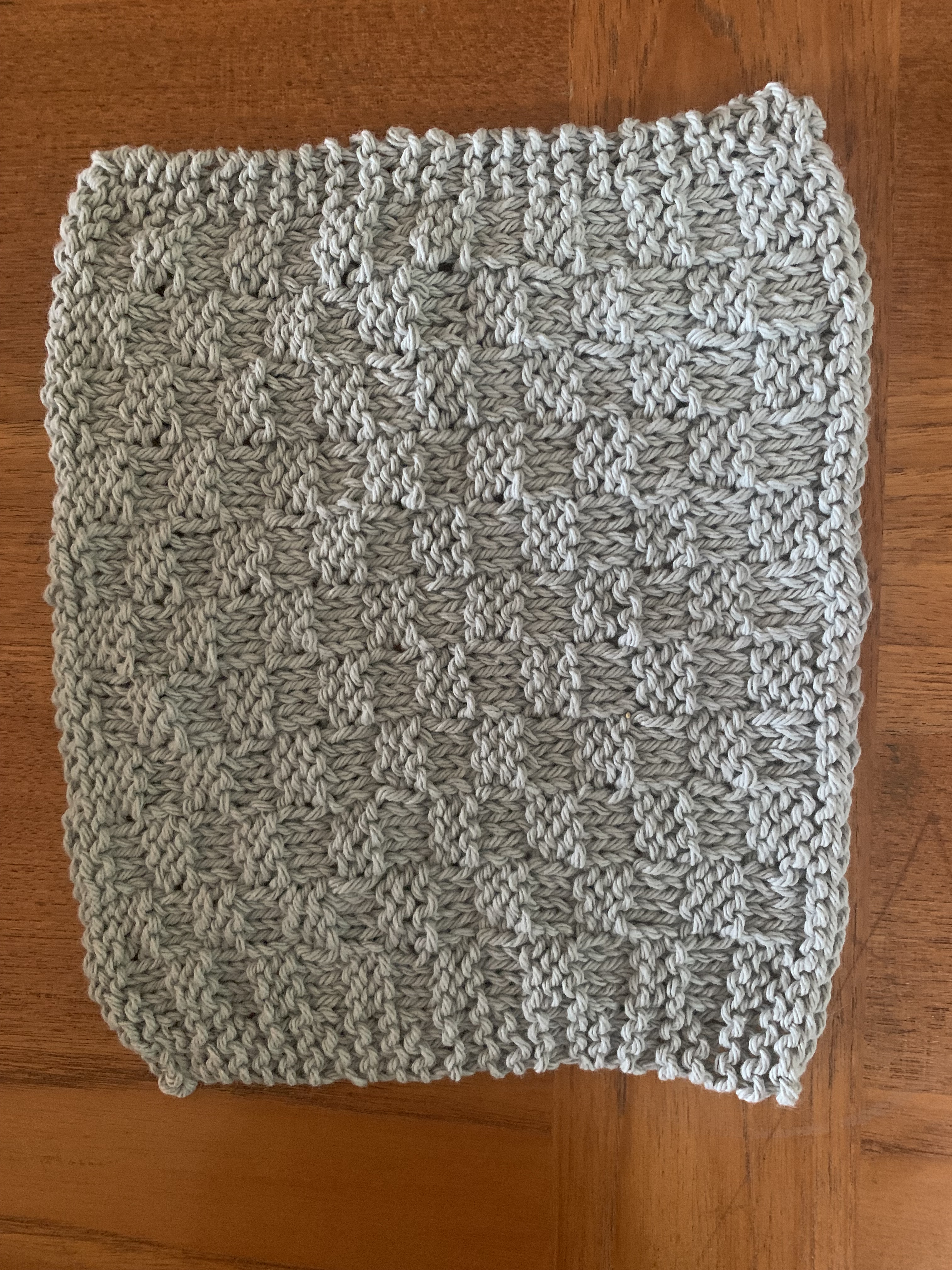
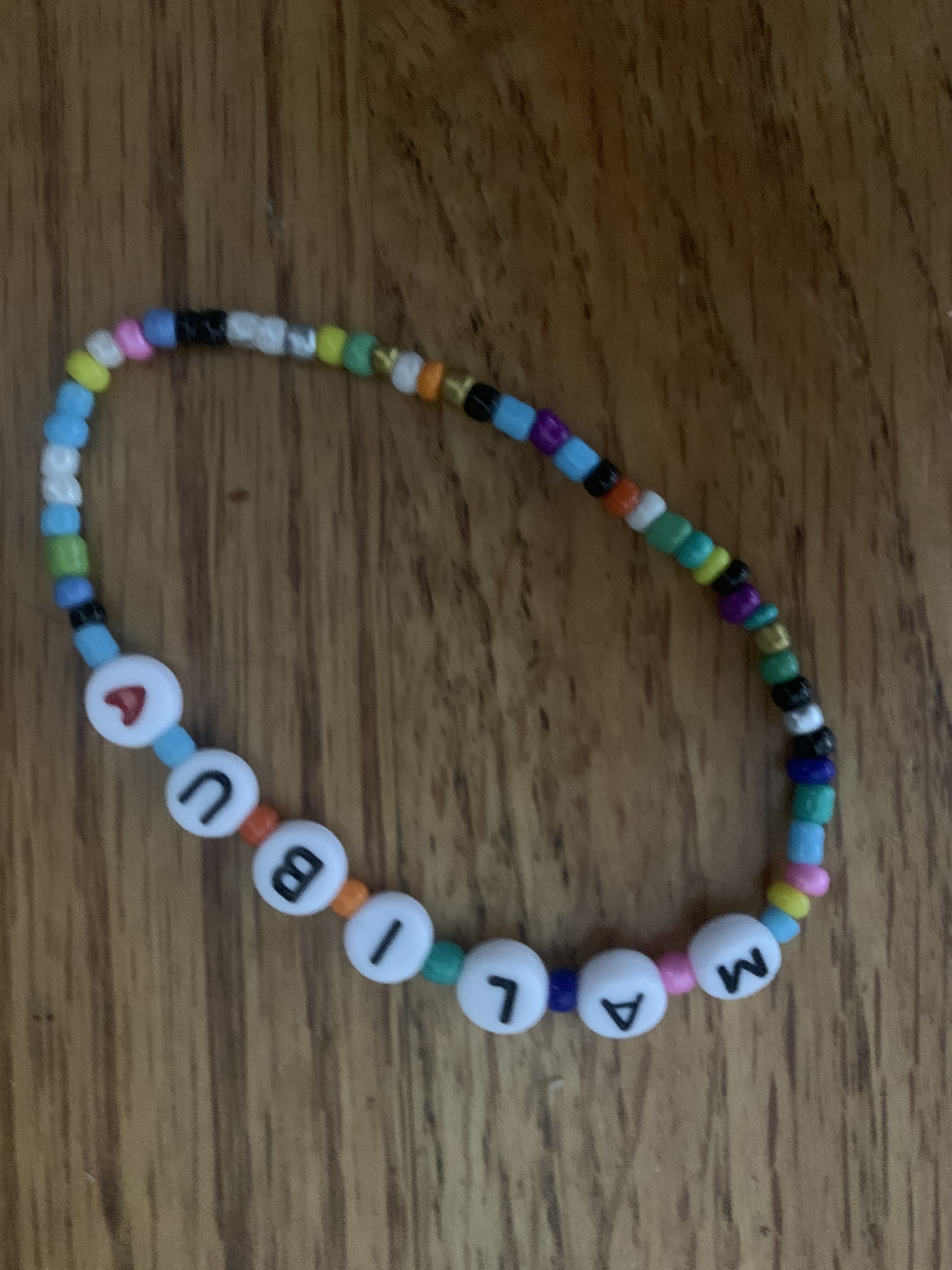
I tell myself it’s not such an expensive gambling habit: $11.00 spent over the past ten days. As you have probably already predicted, the $11.00 yielded mostly junk. Costume jewelry I would never wear. Small glass bowls, silver candles, a MALIBU beaded bracelet: all of these go right into the Goodwill donation bag. But there were a couple of things I liked. A cheesy “love” ring that nestles nicely next to my wedding ring for the time being. Three hand-crocheted dish rags in a shade of grey-green that I love and will use daily. And the priceless frisson of possibility … If I do this too often though—spend too much money on “grab bags”—I get disgusted with myself, like a gambler must feel about their addiction.
The thrill of grab bags
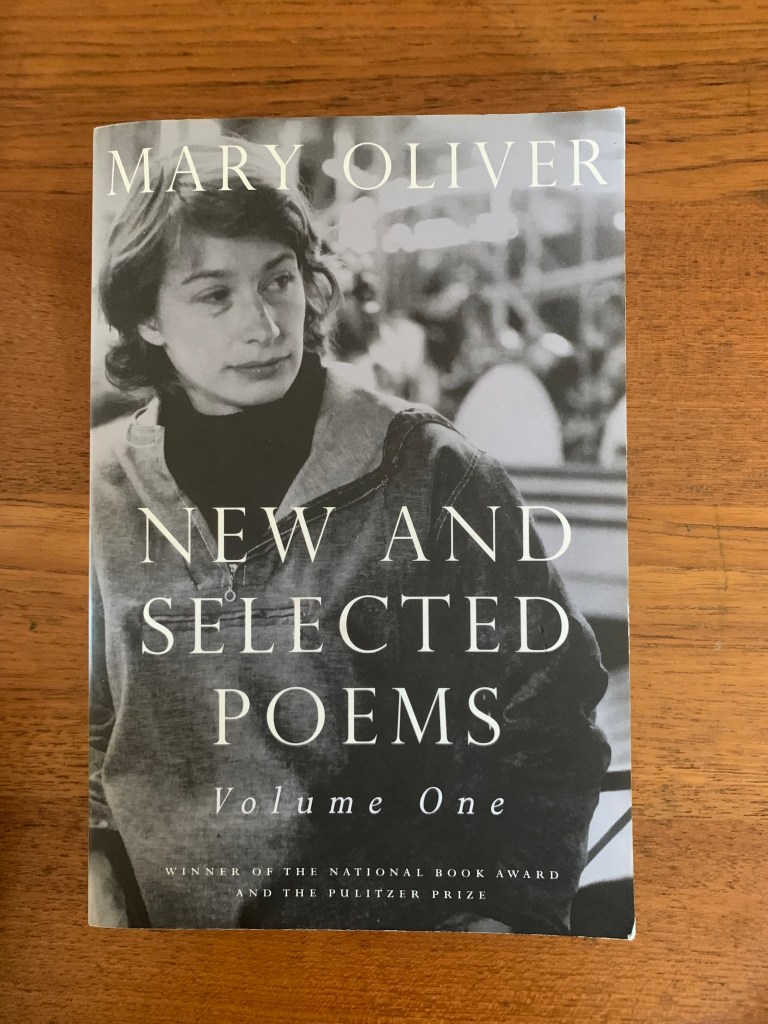
Today, Mandala Monday, I asked Michael to continue with the buffet of randomness. Last time, we each chose a tarot card to inspire us. This time for our mandala-making prompt, I suggested that I would take a book of poems by Mary Oliver and open it anywhere, read the poem, and we would create mandalas in response. Being game to participate in most of my creative ideas, he agreed. I opened to the poem, “White Owl Flies Into and Out of the Field.” Do you know this poem? The huge white owl, wingspan five feet, picks up a rodent from the snowy field and flies off to the frozen marshes to devour it. Oliver imagines the animal’s death in the jaws of the owl as something incandescent, perhaps even pleasurable. Death, she muses, may be entirely unlike the darkness we tend to imagine:
maybe death isn’t darkness, after all, but so much light wrapping itself around us — as soft as feathers —
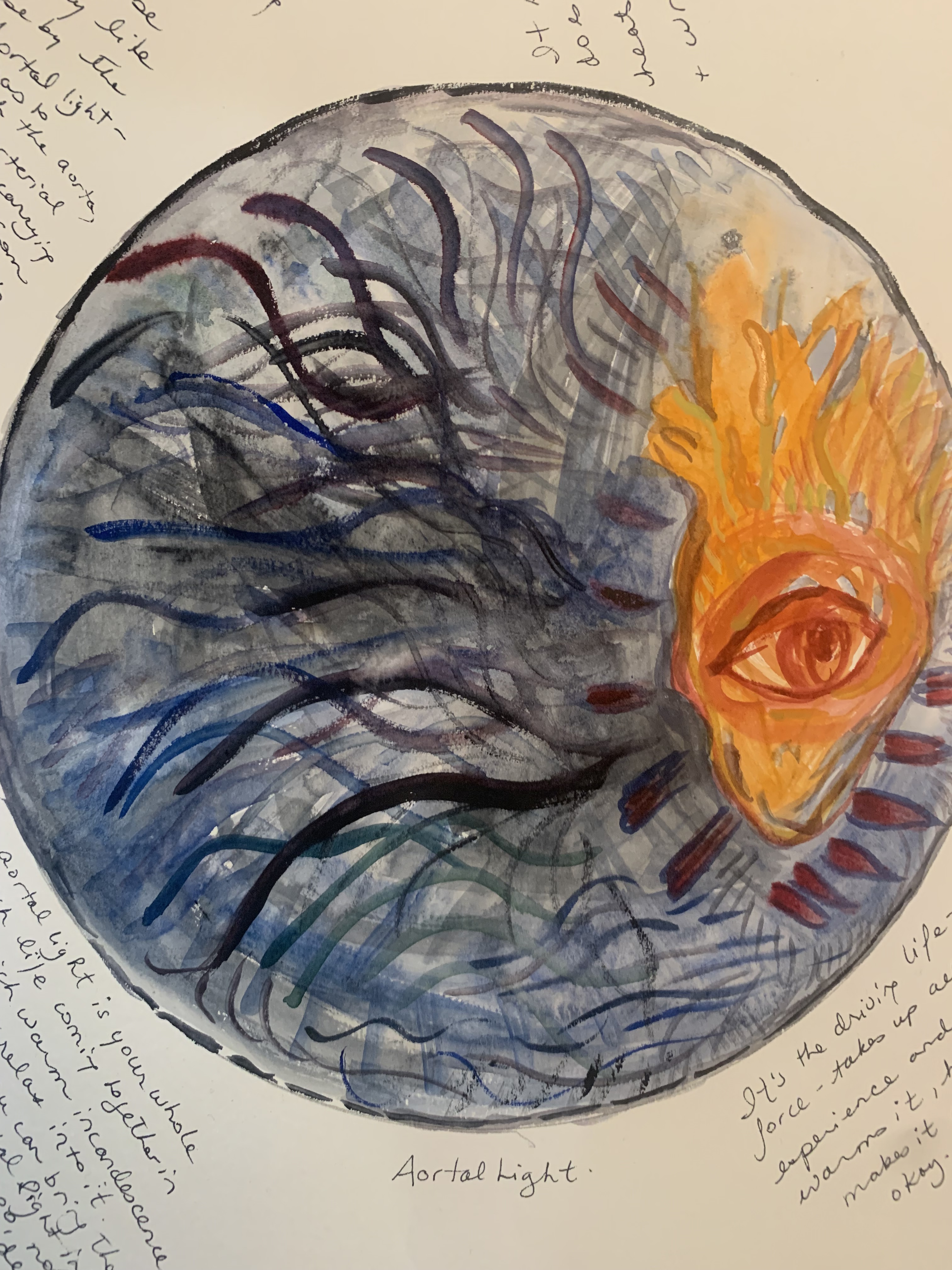
Michael and I sat across from each other at the dining room table, he with his IPad and I with old watercolours and a piece of heavy paper I’d traced a plate on. The songs from Leonard Cohen’s Old Ideas album surrounded us. We worked for a time. I sloshed paint and Michael used his magic wand. I persist in thinking of making digital art on an iPad as something otherworldly, technology out of my reach, which isn’t at all true. However, more and more, I recognize the ways I deceive myself, all of the little lies I tell to keep my life comfortable.
I like to mop up watery colour with an old rag, feel the wet paper under my palm, scrape at the bottom of the indigo blue with my brush, feel that I am using up every last bit of paint. The embodied experience of artmaking.
I got stuck on a phrase near the end of the poem, “aortal light.” Adjective + noun. Aortal – from aorta, the great arterial trunk that carries blood from the heart to be distributed by branch arteries through the body. I imagined aortal light as a lantern that pulses like a heart, sees all with a glowing eye. Warmth and insight at the end of life.
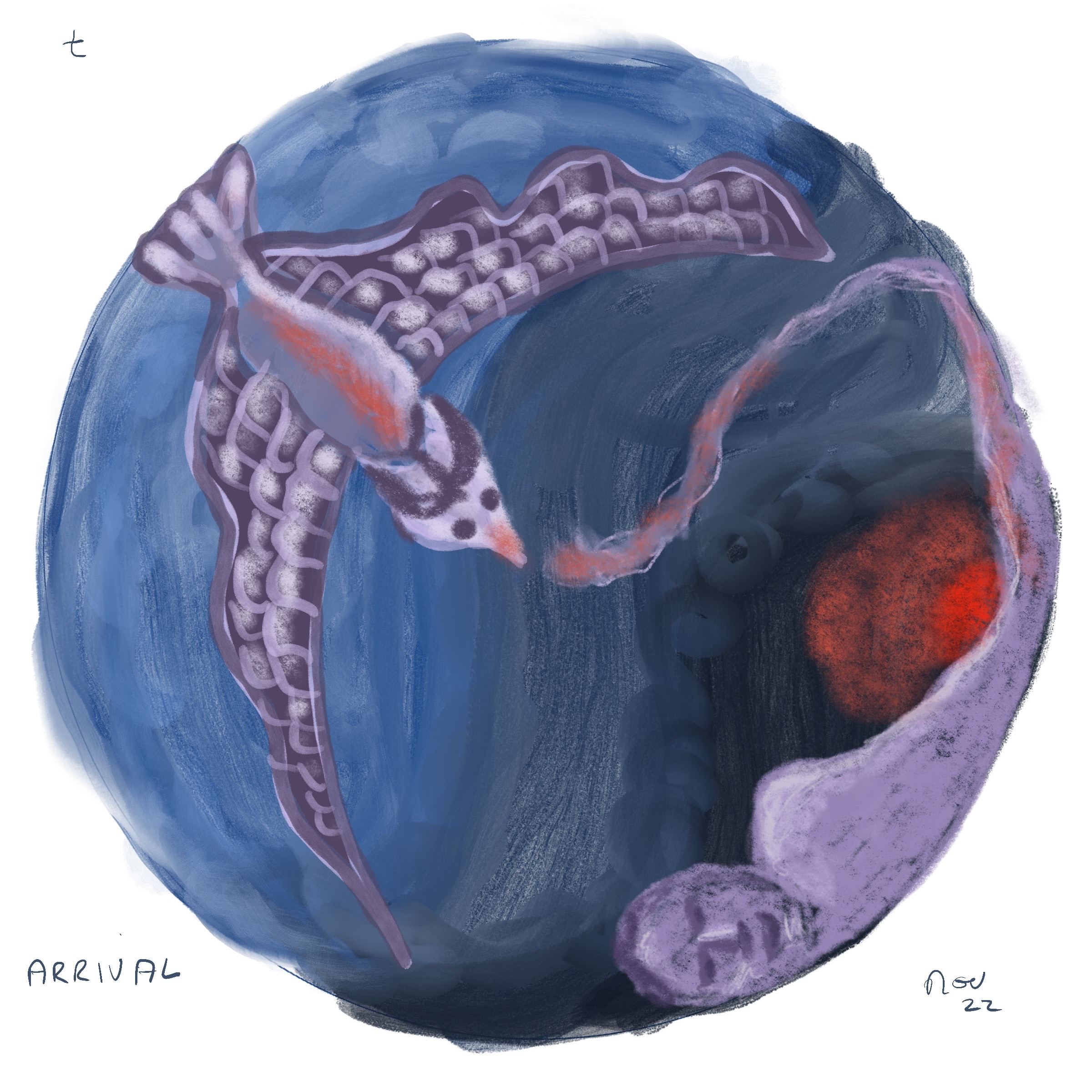
I fell in love with Michael’s “Arrival.” After creating hundreds of mandalas, he has developed a quick entry into the thriving, visceral archive of his subconscious. His images are evocative, and today both the image and the act of creation visibly disturbed him. I was riveted by the words he read to me after we’ve finished painting and writing. His honest expression of troubled feelings about the mandala—his fear of death—they scalded me. Would that I could be so honest! I like to think I won’t be scared when I am dying. I may be deceiving myself again.
Oliver writes, we “let ourselves be carried, as through the translucence of mica, to the river that is without the least dapple or shadow — that is nothing but light — scalding, aortal light — in which we are washed and washed out of our bones.”
Choosing the random means taking a chance. Please, big “S” Self, let me take more chances in this life. Not just by grabbing toonie bags and reading random poems—please let me take a chance in being honest, vulnerable.



















































 Madeline Ruth Walker