“In a time of destruction, create something.” Maxine Hong Kingston
I have been trying to write poems this year. If you love poetry, I recommend listening to The New Yorker poetry podcast. Poetry editor Kevin Young interviews poets who read a poem from the New Yorker archive plus one of their own poems. Also inspiring, if you are interested in haiku, is Natalie Goldberg’s book, Three Simple Lines. She writes about her pilgrimage to Japan, about haiku, about the first Japanese masters, Basho, Buson, Shiki.
I have started to write my own version of Haibun, a Japanese form that combines concise prose with a haiku. I loosely interpret this form, writing a daily observation in a few sentences plus a “sort of” haiku. No more 17 syllables, just three simple lines. Maybe these aren’t haibuns or haikus at all…. maybe they are just what they are.
I Womb
Morning crossword, four letter word, first site of eviction. “Womb,” I say aloud with certainty. But no, the answer is “Eden.”
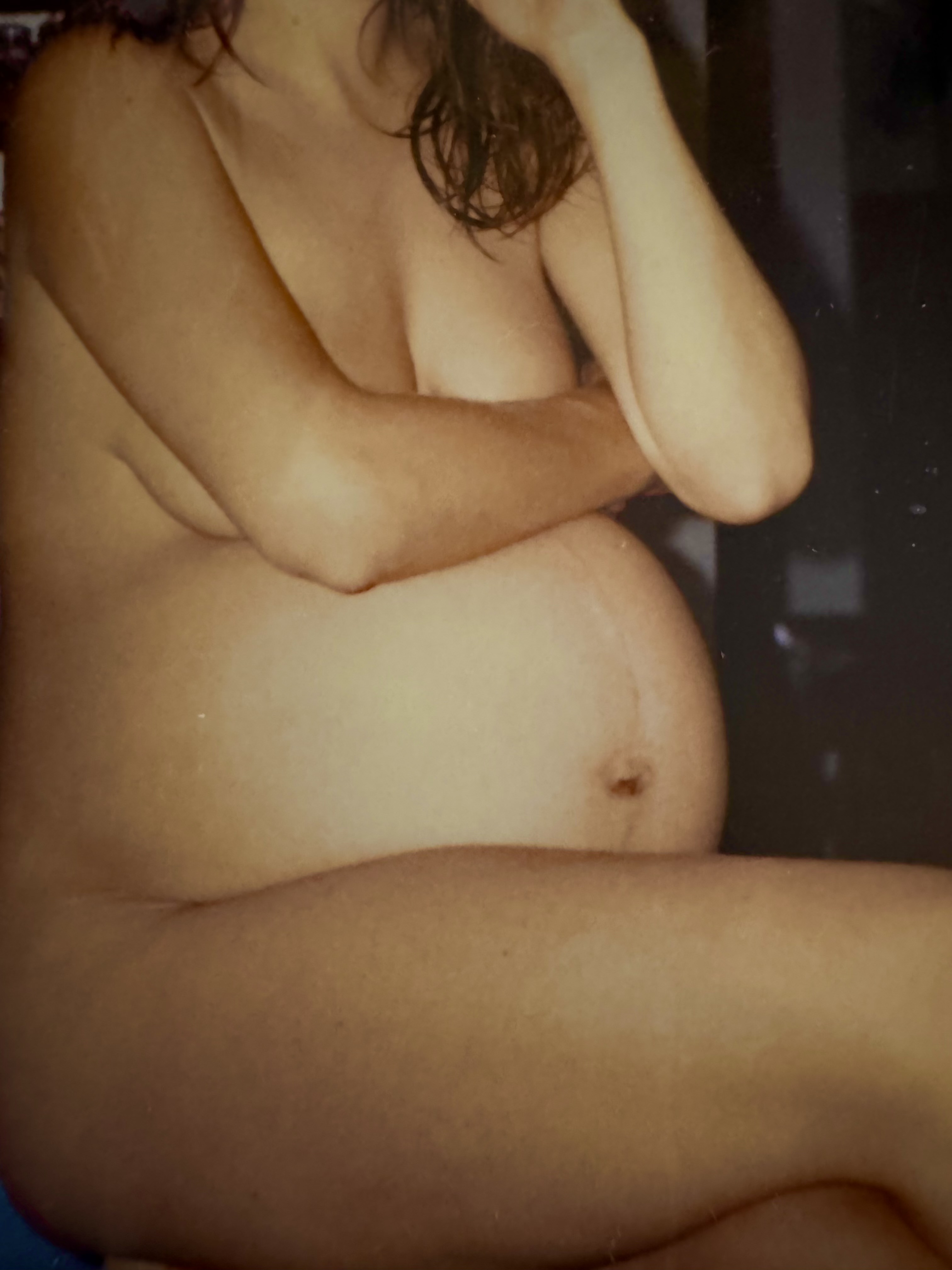
Every human’s first home, the blood red womb
II Orange
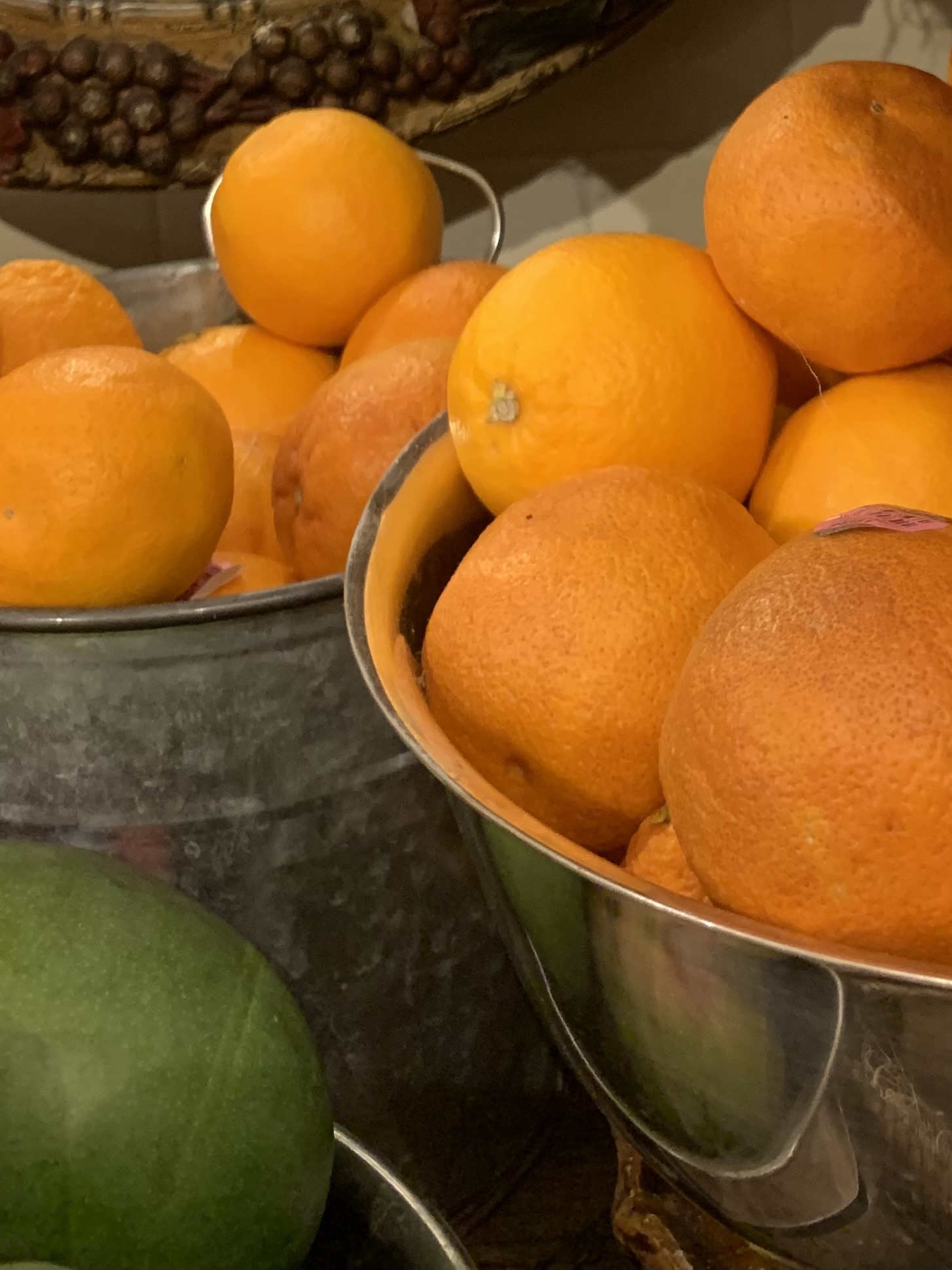
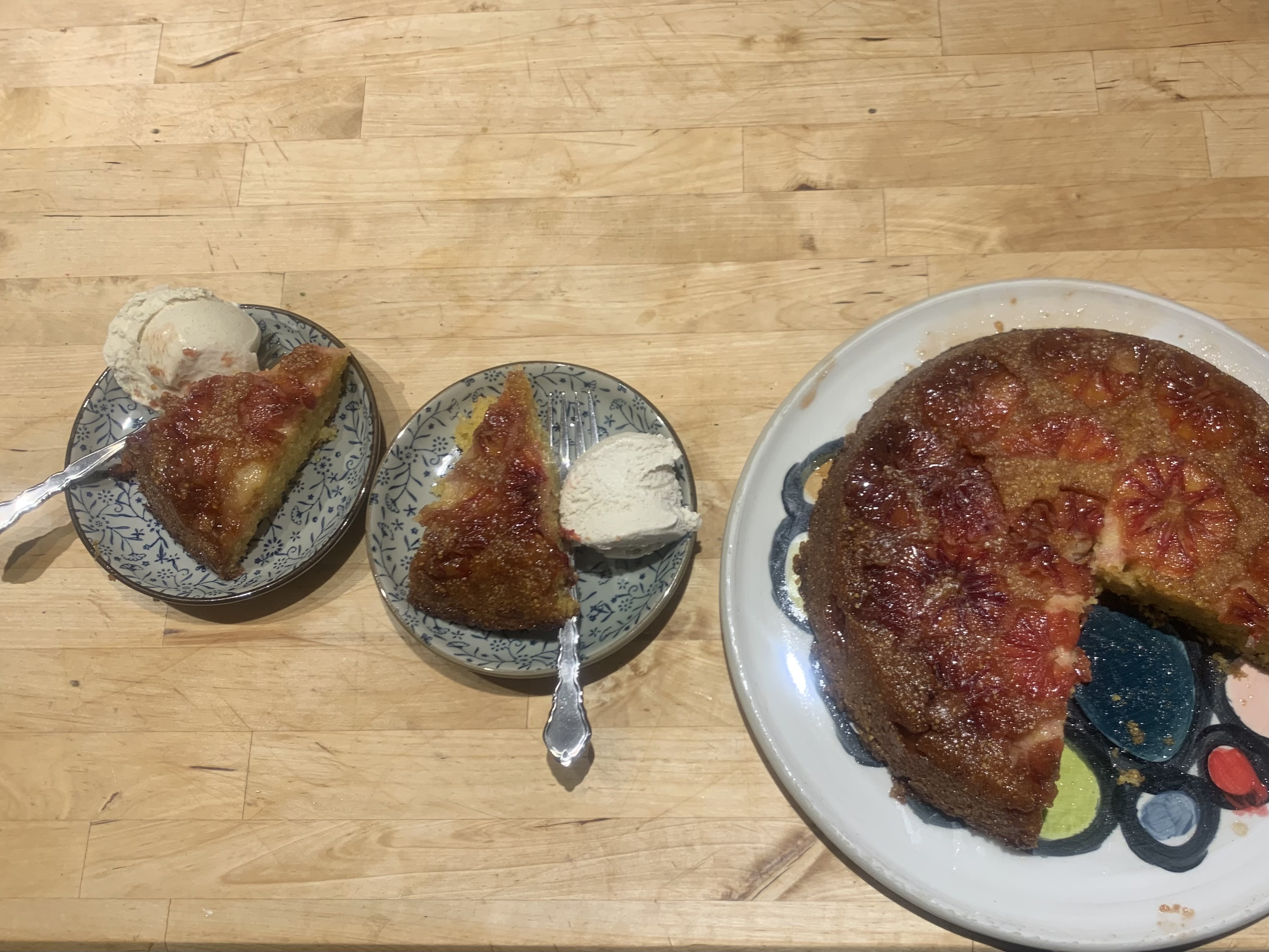
I go to the store to buy blood oranges for the cake and discover they have been rebranded raspberry oranges. the word “blood” is off-putting to consumers. I feel angry.
Remote, bloodless pale body of moon his face, forgotten
III Knife
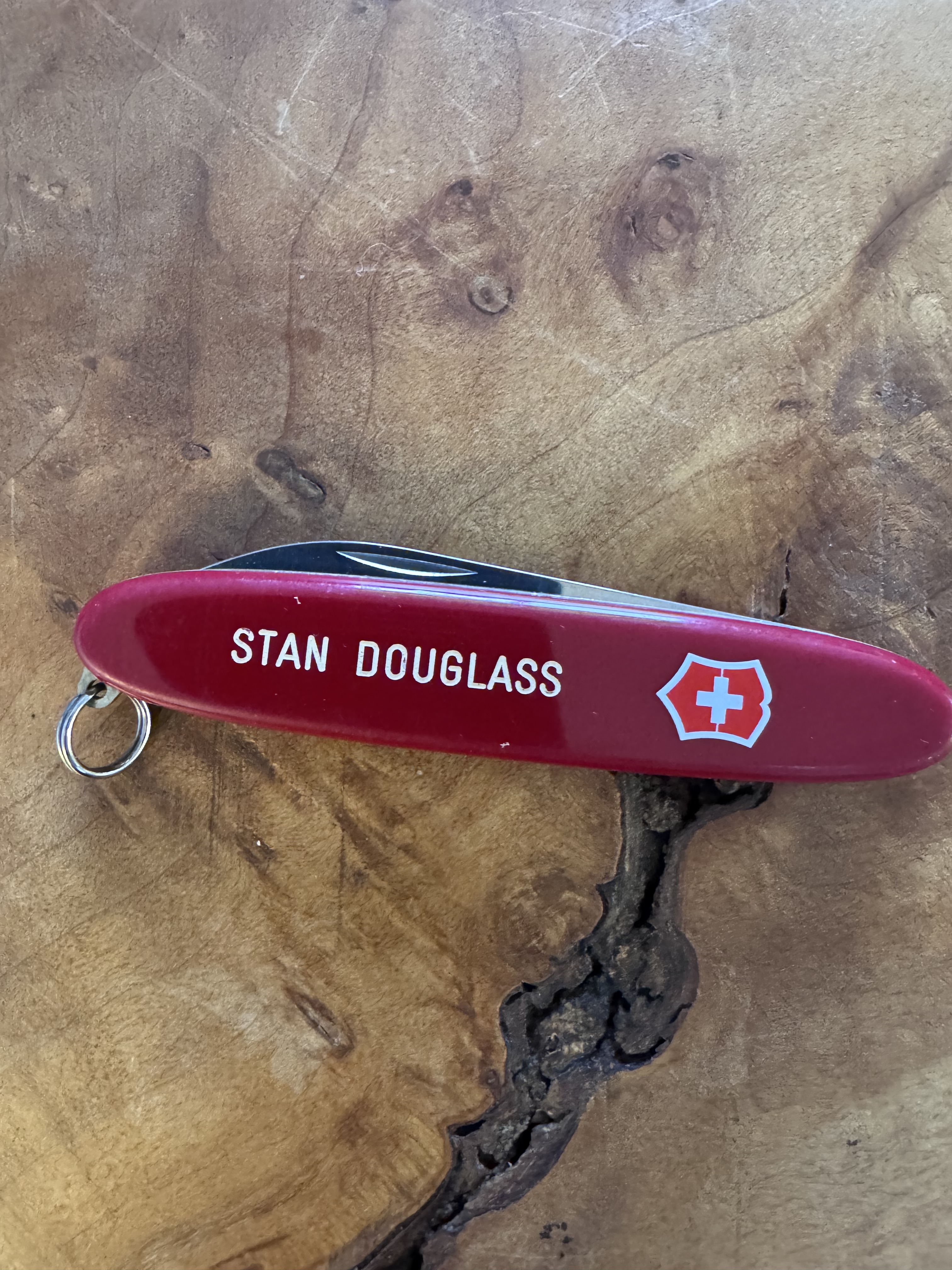
I go to an estate sale and buy a box of assorted junk for two dollars. At the bottom, I find a small Swiss army knife tucked into a black sleeve. The knife is marked with white letters: Stan Douglass. I look up Stan’s obituary.
When fifteen, only a lad, Stanley made a vow to serve the Lord
IV Ruth
My son and I walk along the street, heading to Value Village. He’s shouldering an old chair he took from a free pile, then regretted. I’m following. Suddenly a telephone pole is in front of me with
R U T H
painted in big red letters. Just a day ago, my friend and I compared middle names. Her middle name is Mazal meaning good luck. Mine is Ruth, I texted, and she texted back that “the biblical Ruth is a very special woman, and her name is synonymous with unwavering loyalty and kindness.”
Is it a sign? Four red letters tell my fortune
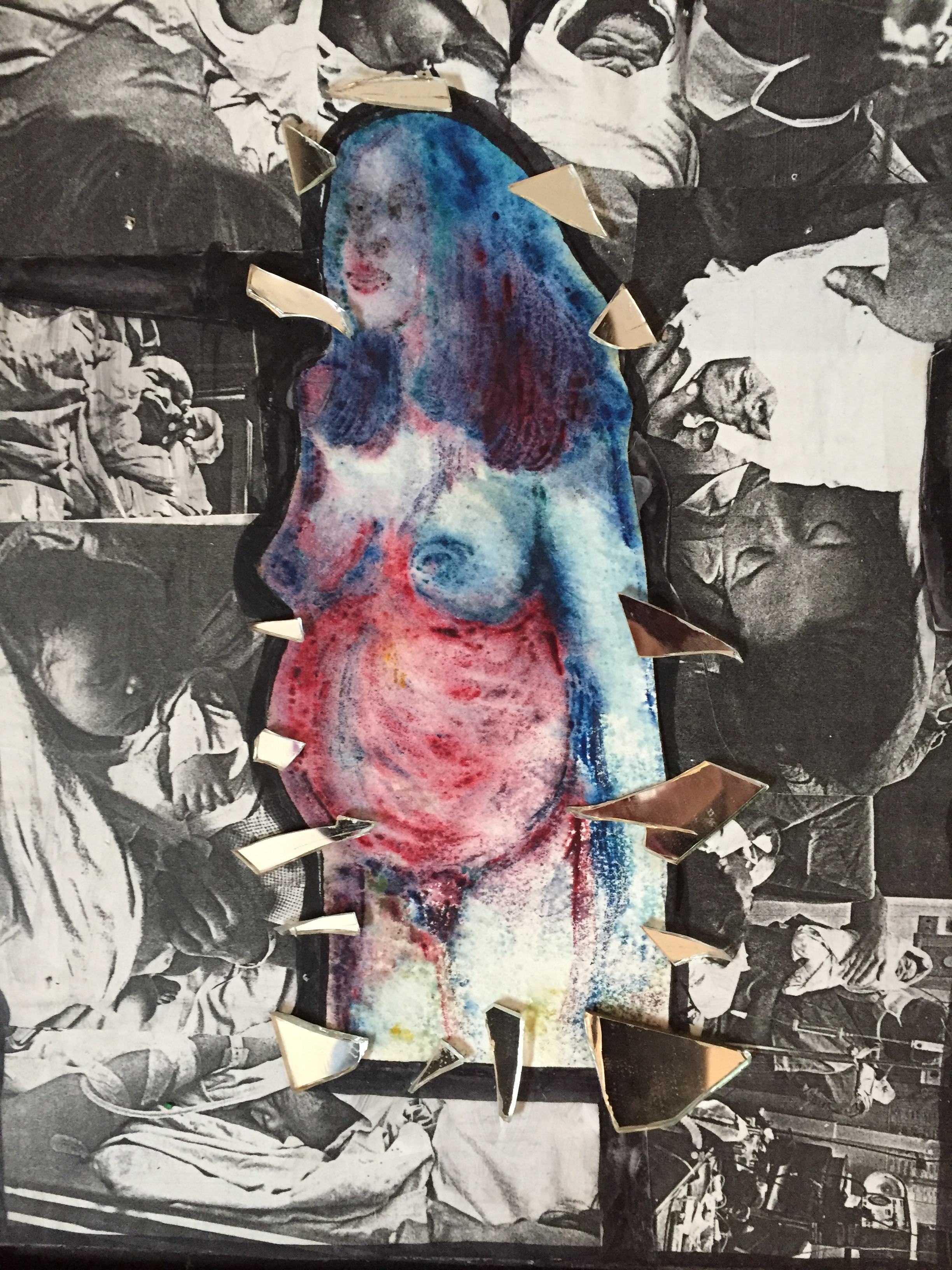
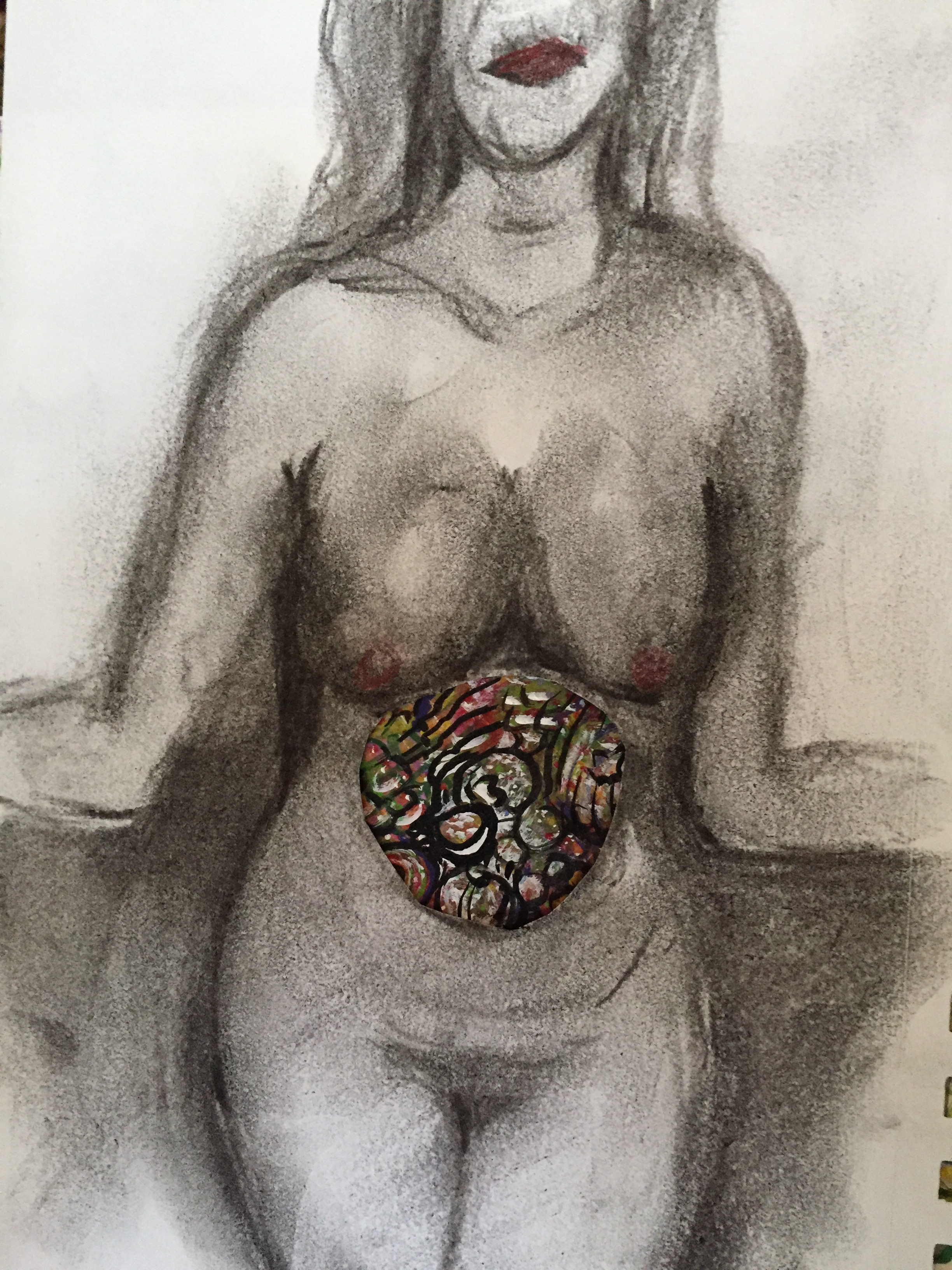
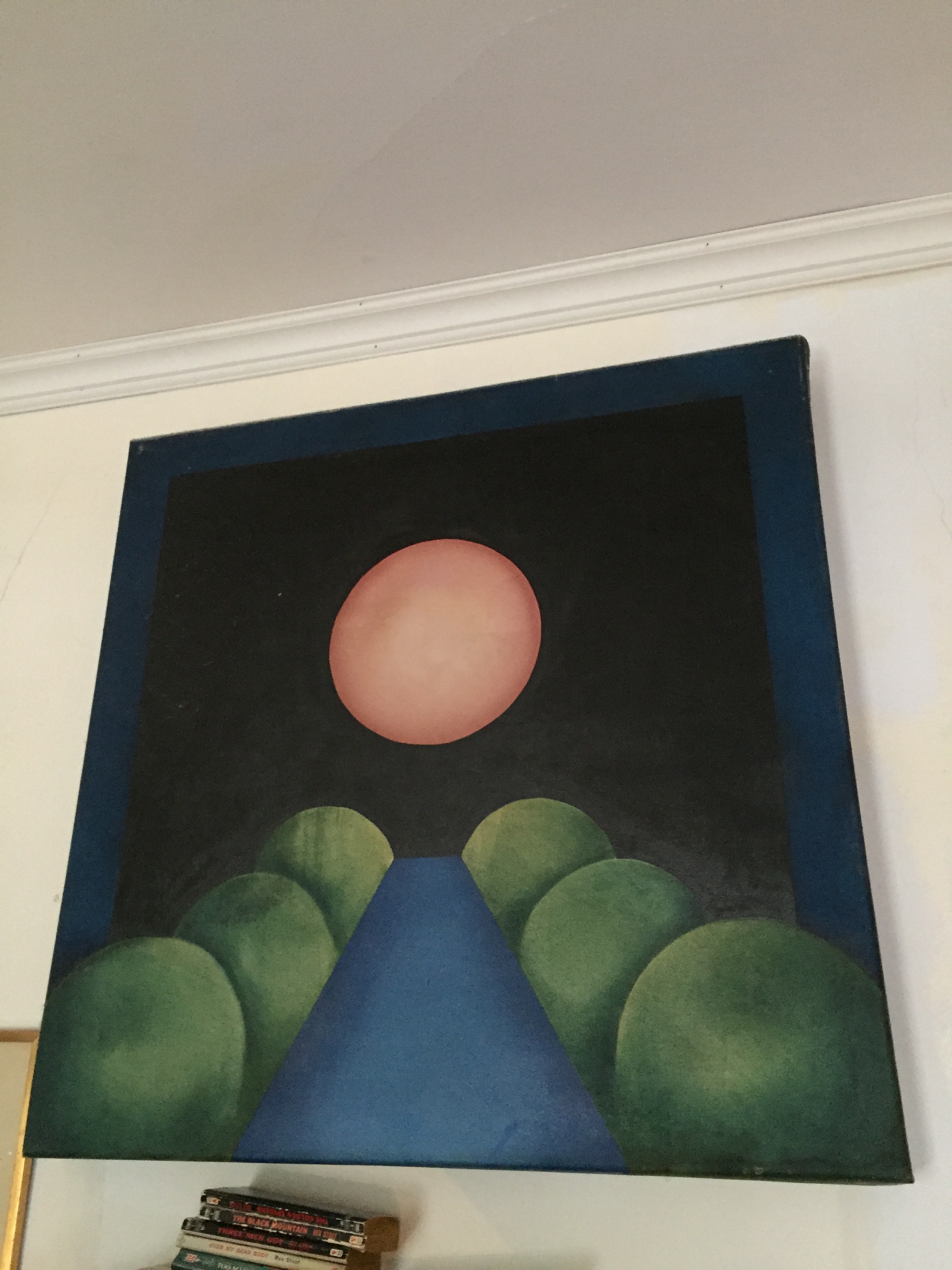
The moon painting is by Bob Sabatini. Other creations are mine.
I am in Toronto for a few days. This city was my home from 1965 to 1989.
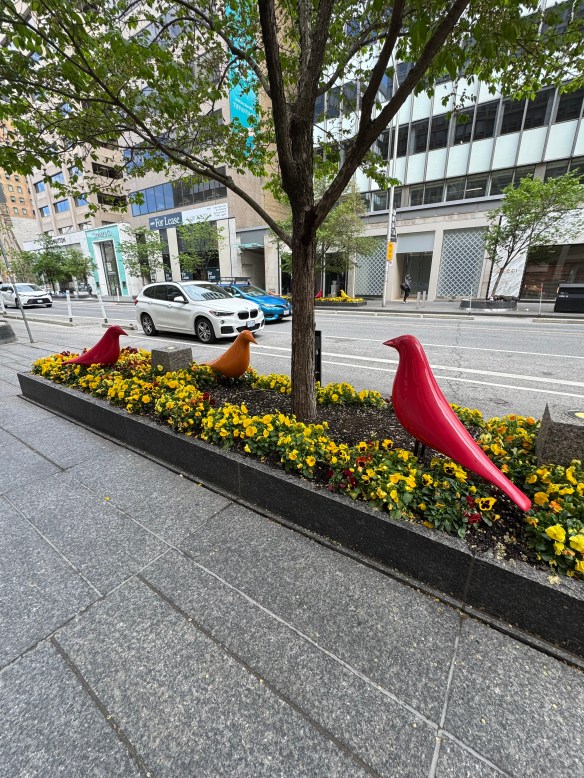
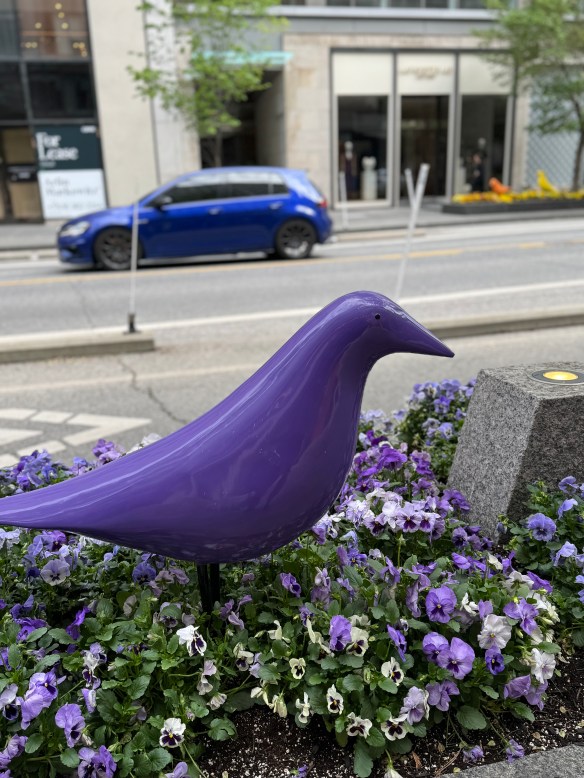
I have been walking Bloor Street West. First, the Mink Mile, that stretch between Yonge and Avenue Road lined with the tall glass storefronts: Zara, Birks, Lululemon, Holt Renfrew. Rich people shop here. Very few birds fly above these tall, inhospitable stores. Instead, big bird shapes in bright shiny colours line the sidewalks, ghosts of extinct species.
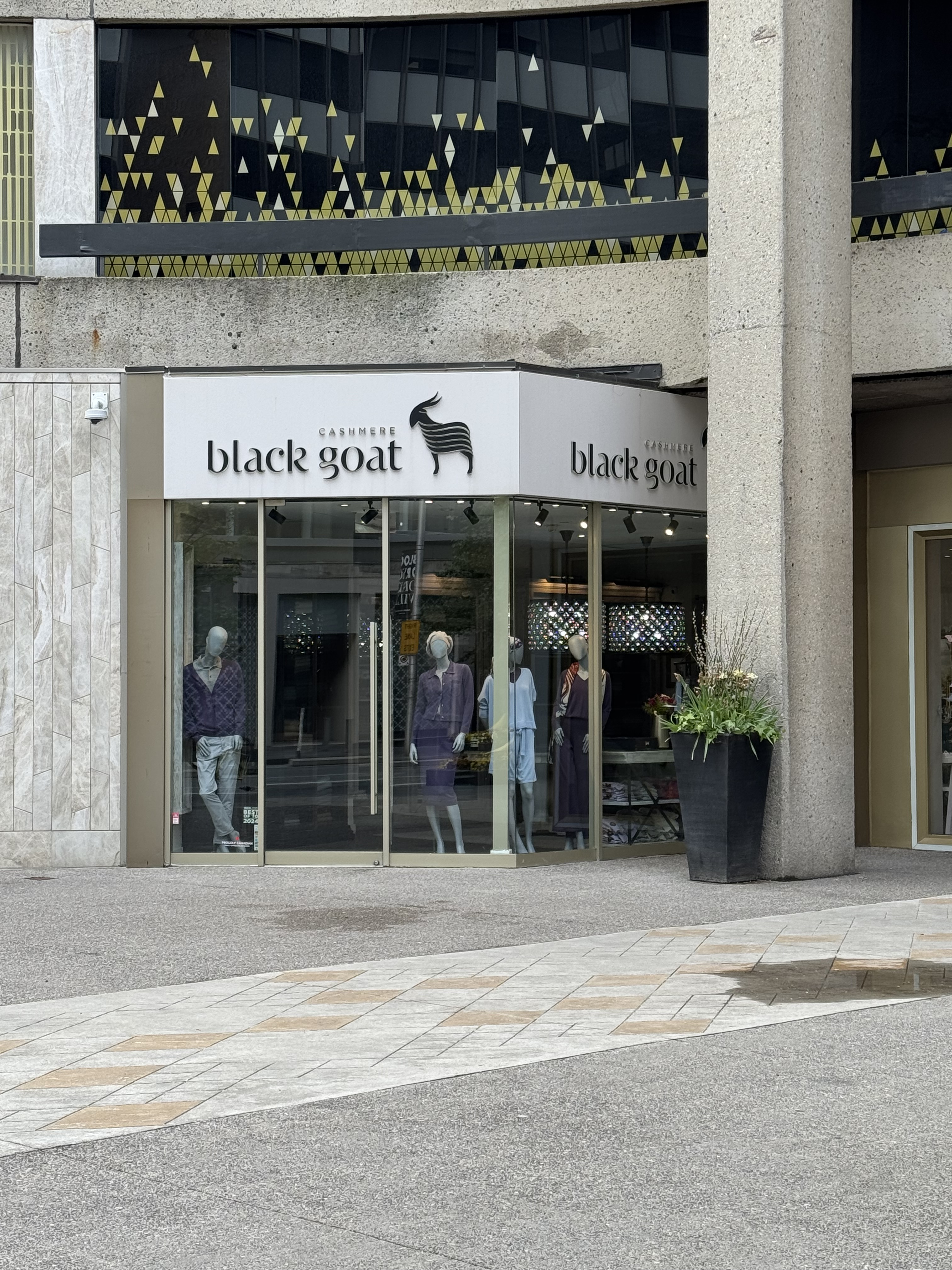
It’s cold in Toronto for late May. I wear a toque, jacket, leather gloves. But now I wish I’d brought a scarf. I admire the scarves in the window of Black Goat Cashmere, next to Ashley’s in what used to be called the Colonnade. This mall was one of my mother’s favourite places; after window shopping Bloor Street arm in arm, we’d drink coffee and eat pastries at the Coffee Mill at the back of the Colonnade.
I enter the store. Two saleswomen are upon me immediately. I ask about the small scarves, lifting one of them up out of the wooden box where they are displayed like confectionary, soft cashmere in artful designs, wool watercolours. “How much are these little ones?” “Oh,” says one of the women, advancing, “the Carre scarves are $385.” I laugh, folding the luxury item back into its box. “Perhaps in another lifetime.”
Pulling my zipper up to my chin and walking into a fierce wind, I take a detour to wander around the grounds of my alma mater, Victoria College. I feel nothing as I gaze over the green lawns, watching two young men kick a soccer ball. Alma mater means “nourishing mother,” but this place was not that for me. Those four years as an undergrad in English Literature are a blur. One thing stuck: a Shakespeare lecture by Northrop Frye when he—already extremely old—told us in his quavery voice that Bach’s Mass in B Minor was the voice of God speaking. All of us bent over our notebooks and wrote that down. It sounded profound.
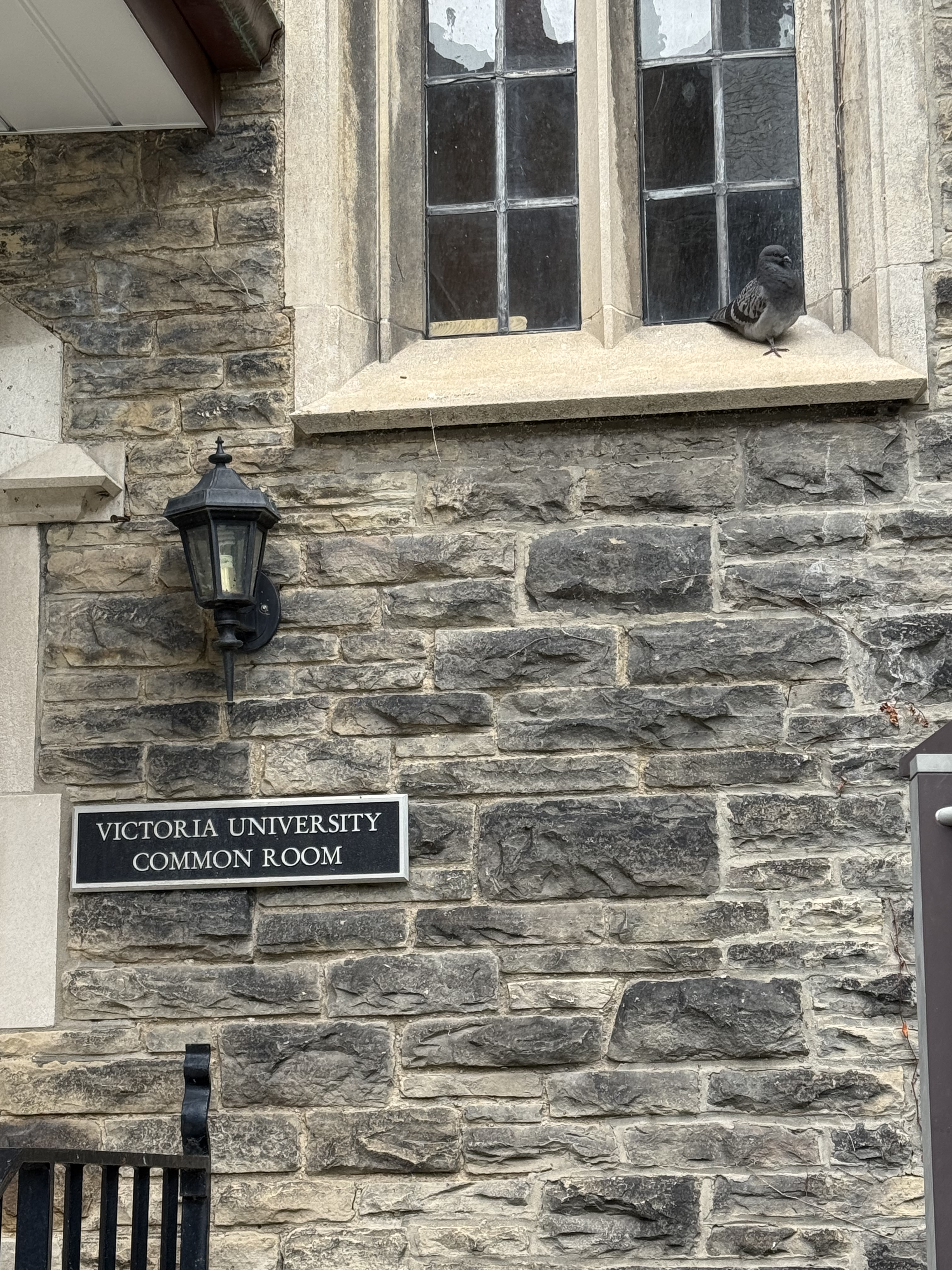
I was a lonely young woman. Barry Lopez writes that “It is not possible for human beings to outgrow loneliness,” and that seems true to me. Though I’m not as lonely as I was. I admire a pigeon perched in the recessed window of the Victoria University Common Room.
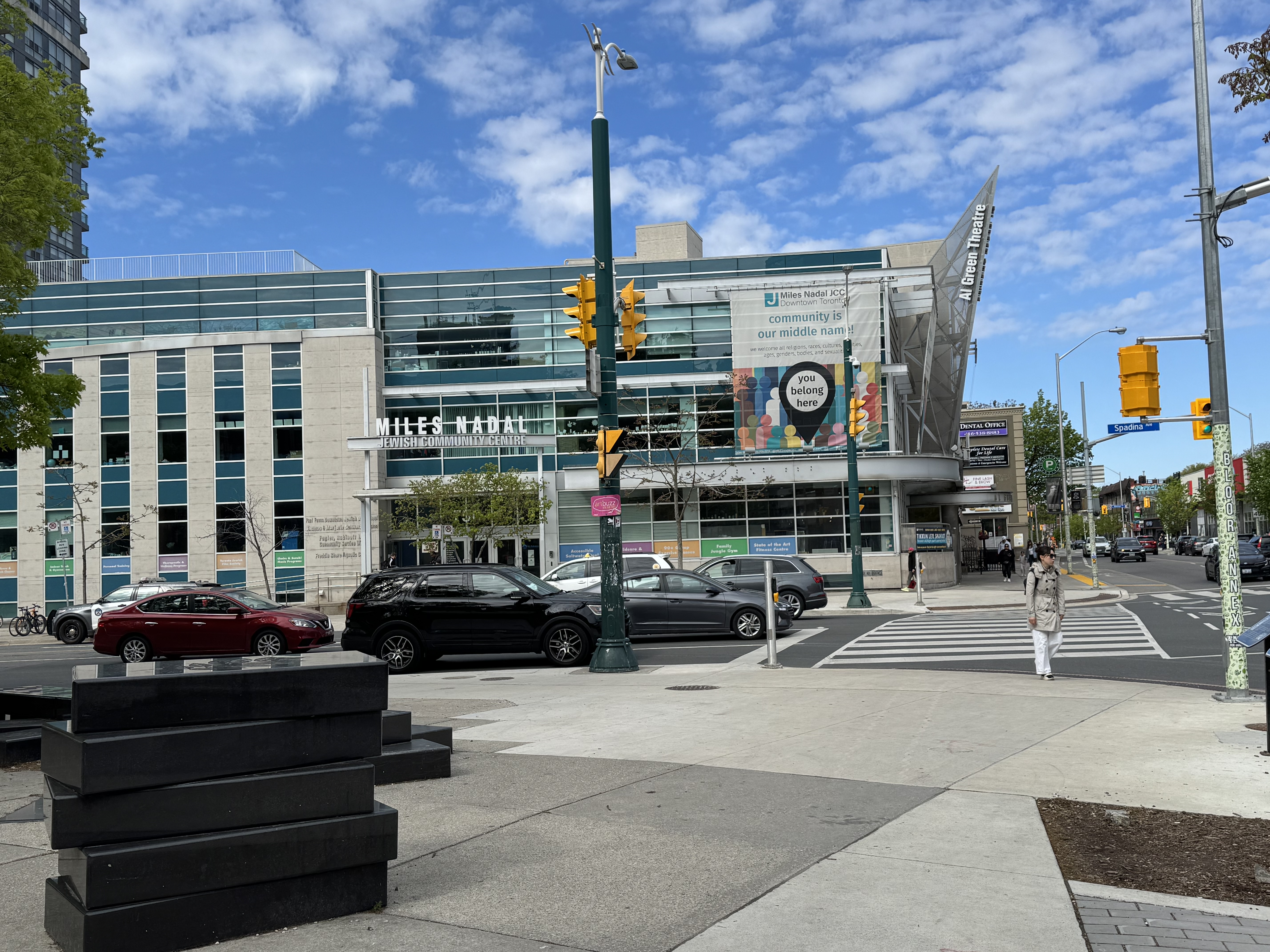
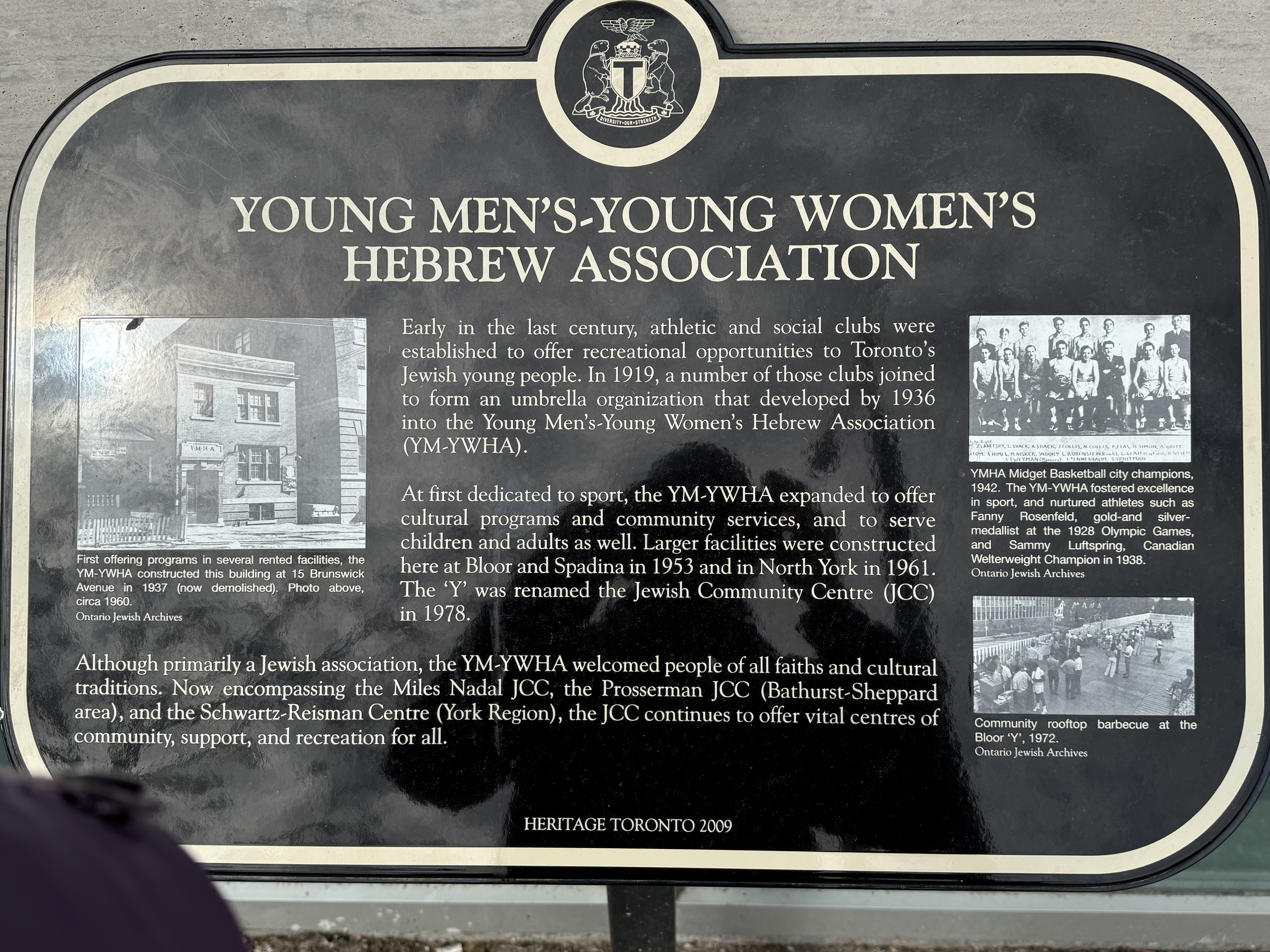
On the way up University back to Bloor Street, I check out the Gardiner Ceramic Museum, where I hope to see the work of contemporary ceramic artists, only to find that the main galleries are closed for renovation. I continue back along Bloor. It’s time for a coffee and I remember a Second Cup in the block before Spadina Avenue. And if that is no longer around, there’s a coffee shop in the old Jewish Community Centre (JCC), where my mother did aquafit for the last decade of her life. Back in the seventies, when it was the Young Men’s Hebrew Association, it was home to SEED, the alternative school my sisters and I went to as wild teens.
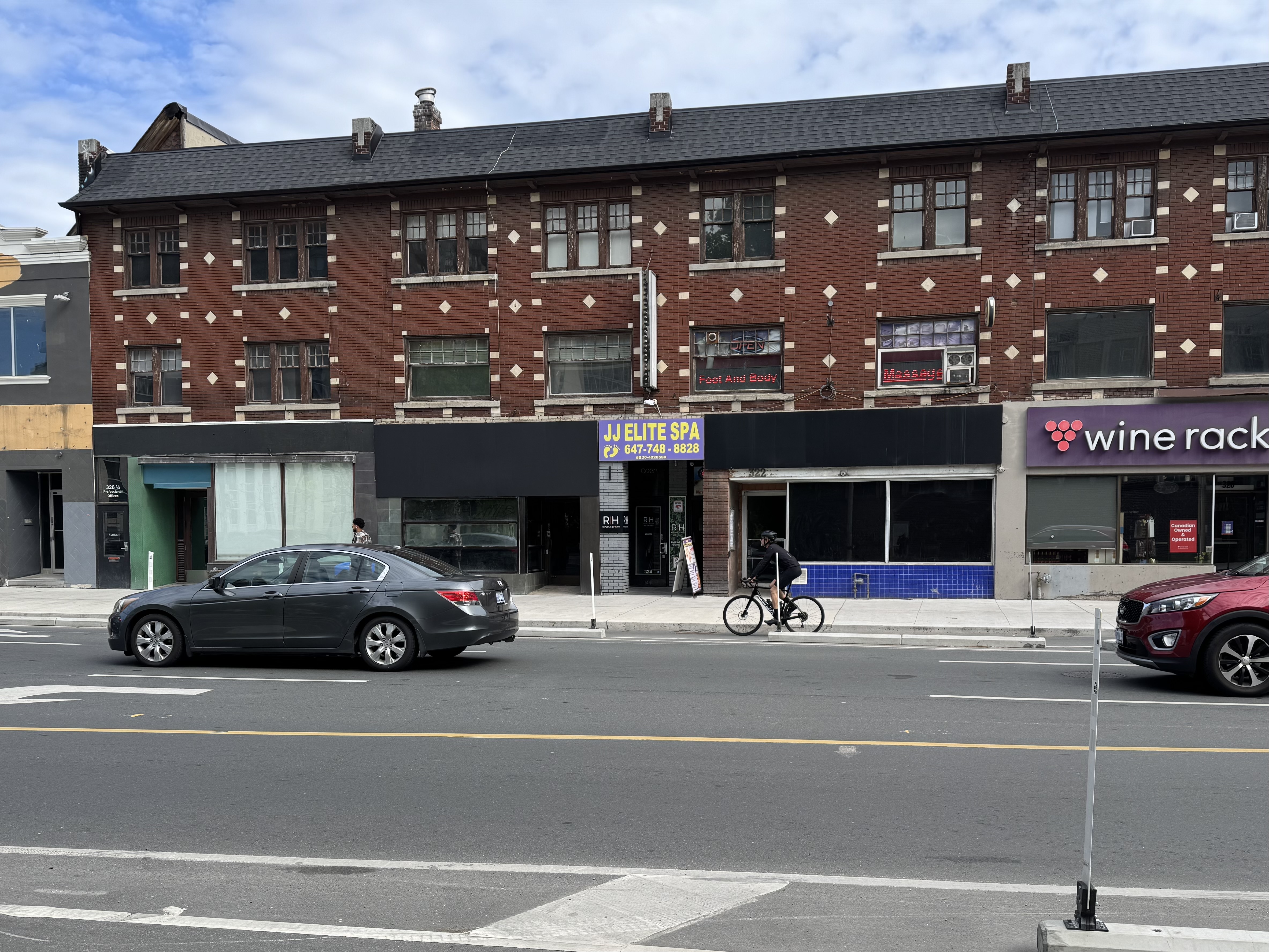
Second Cup is gone, and so are many of the other businesses on that block. Everything in life is impermanent, so I am not surprised Second Cup and Noah’s Health Foods have disappeared, and the spaces are vacant. Once upon a time there was a greasy spoon in this block where we drank coffee in thick cups, smoked cigarettes, and ate French fries. We walked over from “school” and stuffed our electric bodies into the vinyl booths, laughing, talking, flirting, mystified and excited by life. Once, for a time, my sister lived above the restaurant with her boyfriend, an apartment with burlap on the walls and plants everywhere. There’s history here.
The wine store remains. This is where we bought bottles for the meal marking my mother‘s death in February 2019. Her house is only a few blocks from this corner, and she died at home. We carried the clanking bottles through the snow. My sister made bouillabaisse and we sat around the teak table, drinking, eating, and telling our Virginia stories, stories filled with love, regret, sadness, and confusion.
I cross the street twice to the southwest corner and pull on the doors of the Jewish Community Centre, but my pull meets resistance. A security guard opens the door from the other side, just a few inches, and peers at me. “I am trying to get into the coffee shop,” I say. “No more coffee shop. Coffee shop no more,” a sort of palindrome of endings. And he closes the door in my face.
I keep walking. Surely, there is a sweet, cool, interesting café somewhere along Bloor. I am Ahab stalking the great flat white, but she’s nowhere to be found. I pass more than one Tim Hortons among the restaurants and bars still closed this cold morning, but no, I won’t go there. Cigarette butts decorate the grey pavement, evidence of parties spilling onto the street last night. Pigeons strut their stuff. I keep walking. Yes, I know Futures Bakery might be considered an interesting coffee shop, but I hold out for something else, some uncertain thing, something new, something not in the algorithm.
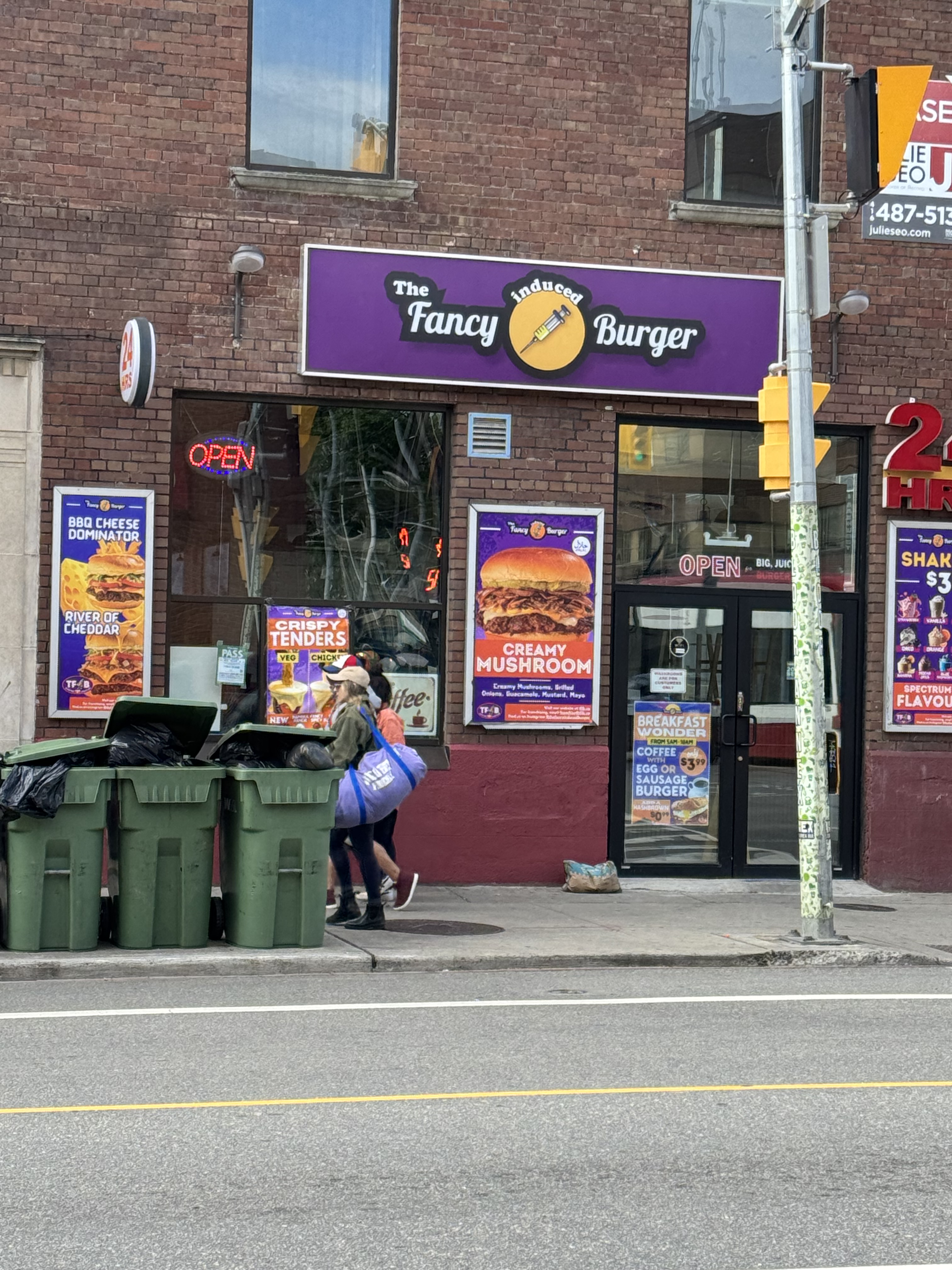
I keep walking. The Hungarian restaurant where we ordered dumplings and gravy and goulash soup: gone. The delicatessen and the cheese shop with a cow in the window: both gone. The café that once took up that southeast corner of Bloor and Bathurst: gone. Now there’s a Fancy Burger outlet, where you can add a syringe cheese shot to your beef patty for $1.49. This part of Bloor continues to metamorphize. Ethnic restaurants and record stores turn into cannabis shops and bubble tea counters. Used bookstores become pet pampering salons and tattoo parlours.
I am happy to see Midoco, the office supply shop, a place where you can lose yourself among the art supplies and fountain pens, is still in business. Ditto the Home Hardware.
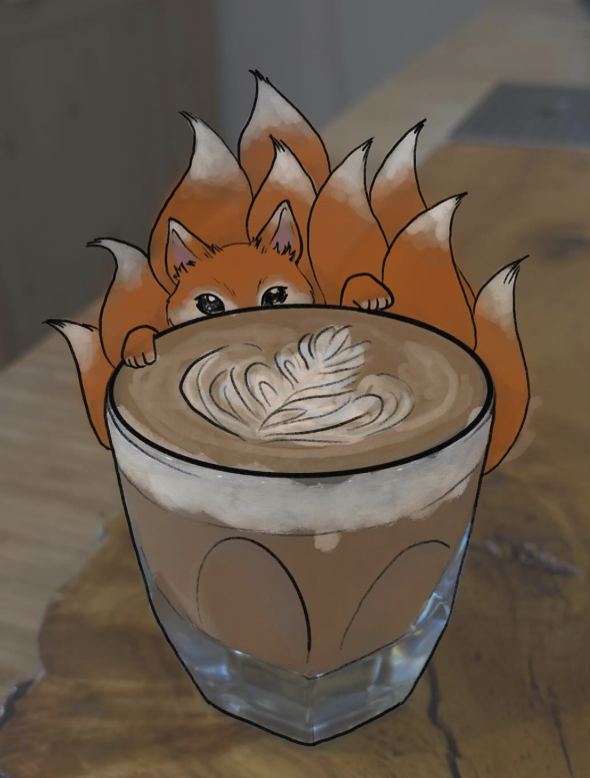
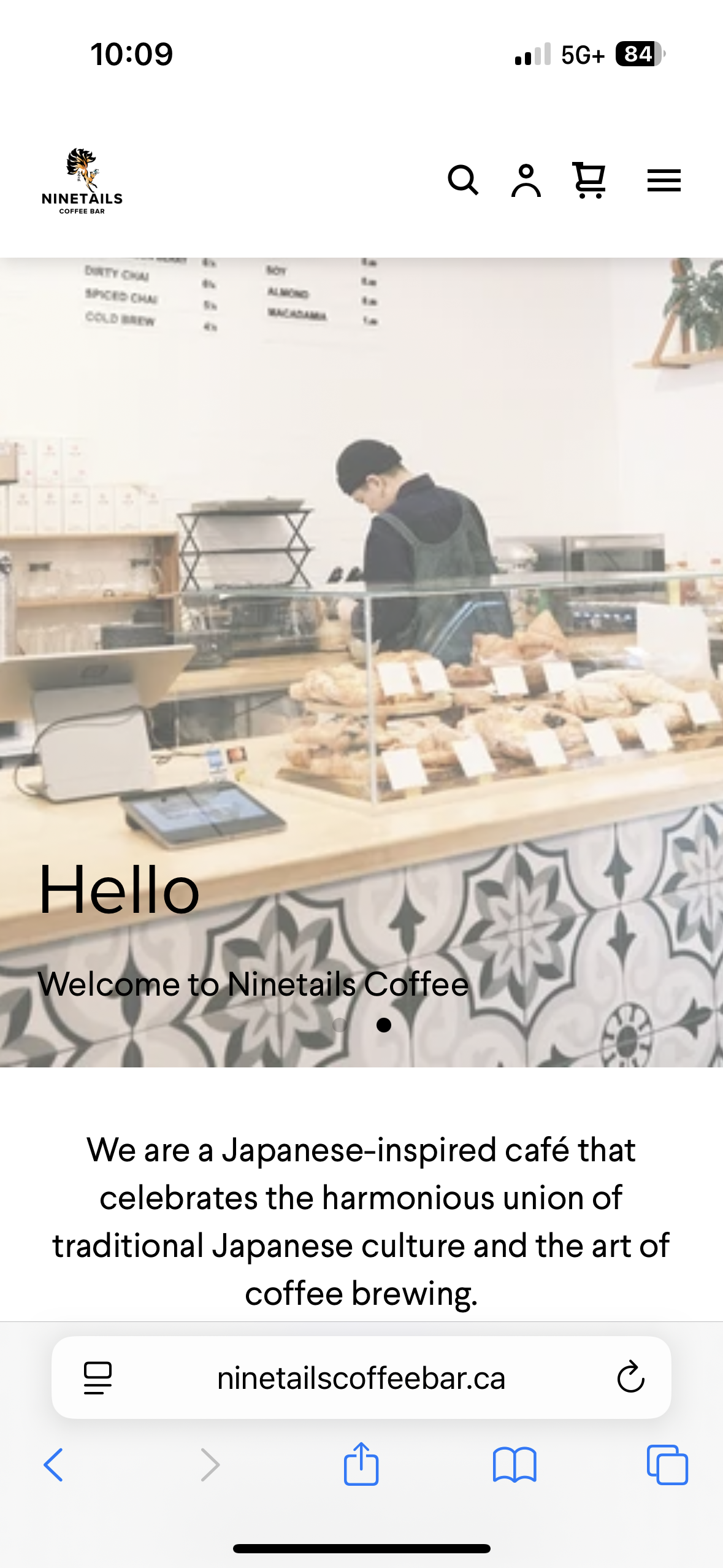
I keep walking, knowing that somewhere soon, I will come upon something interesting. I pass the small corner grocers, happy to see they still sell bargain produce and hanging pots of flowers. I pass Euclid, cross to the south side, and then, suddenly, there is an A-Frame sandwich board picturing a fox with many tails. I walk into Ninetails Coffee Bar, where two young Japanese women bustle behind a honey-coloured wood counter. White walls, a few small round tables graced by simple folding chairs. A coffee bar decorated with ceramic tiles patterned in grey, blue, and white. A full pastry case. Smiling faces welcome me.
My flat white, delivered in a short glass with a foamy fern on top, is delicious—strong and hot. While I drink my coffee I read about the coffee bar’s philosophy.
In Japanese folklore, Kitsune are foxes with mystical powers that can grow nine tails.
“we embrace the Japanese philosophy of ‘ichi-go ichi-e,’ which translates to ‘one opportunity, one encounter.’ This concept underscores the importance of cherishing every moment and every connection we make with our guests, as each encounter is unique and irreplaceable. Our goal is to provide you with a little window to Japan & Japanese culture within each visit.”
I gaze across Bloor to the north side and see, to my delight, a used bookstore that I’ll visit after I drink this coffee. It’s too easy to get lost in the past during this trip. Wandering through old neighbourhoods, remembering past experiences, feeling traces of old sadness and joy. But Toronto, like Freud’s Rome, is a metaphor for the mind. There is no denying that my personal history, etched through the decades, permeates my experience of Bloor West. I feel these vestiges of the past in my body.
But there is also the present: every moment is unique and irreplaceable.
The sun finally emerges from behind grey clouds on this cold day and streams through the glass over my table. I will never experience this moment again, as I drink this coffee, as I gaze at the people around me, the heavily inked man, the woman with green hair, as I examine the fox on the sandwich board outside, waving her many tails. She reminds me there is only one opportunity, one encounter. This is it.
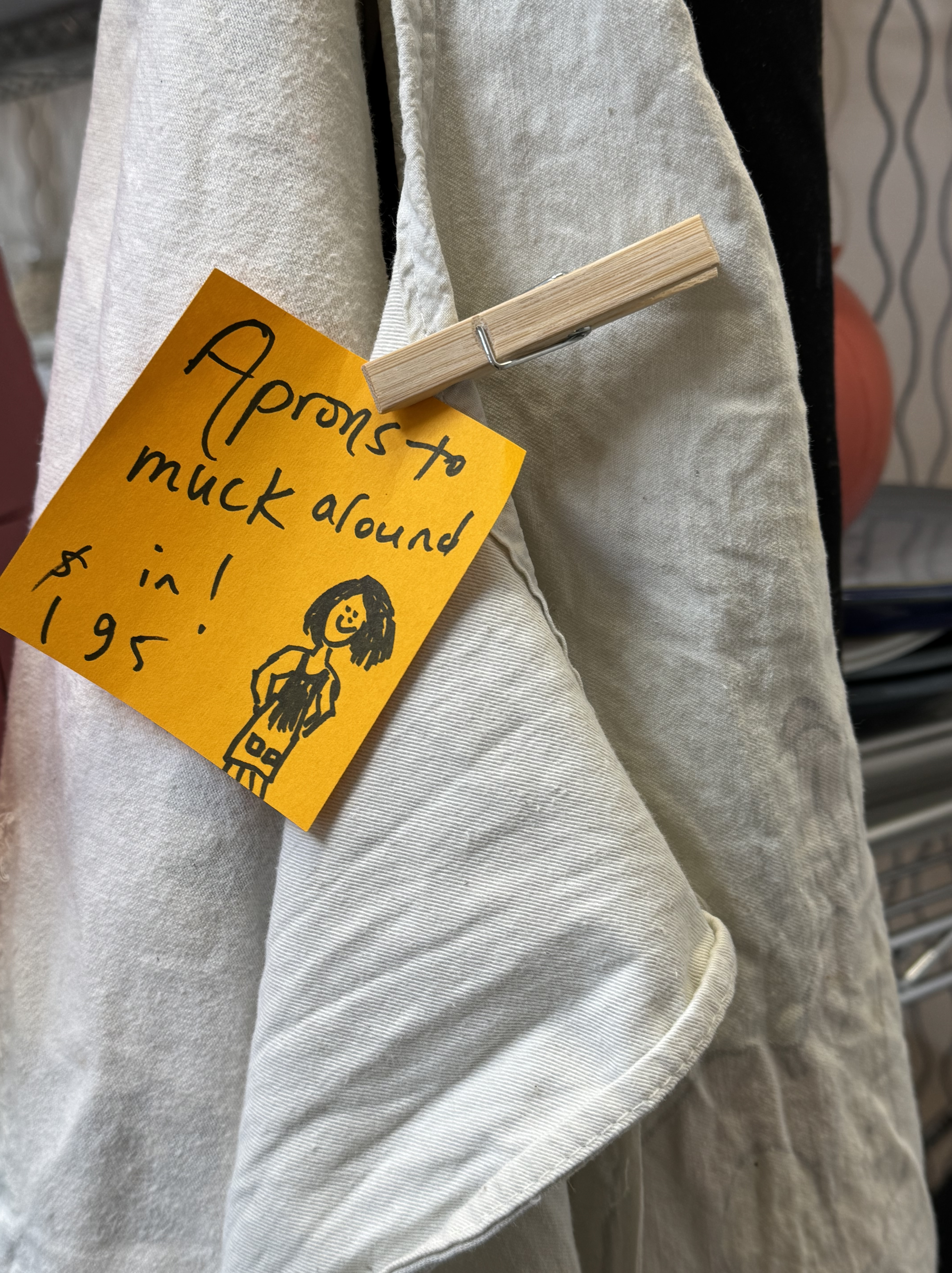
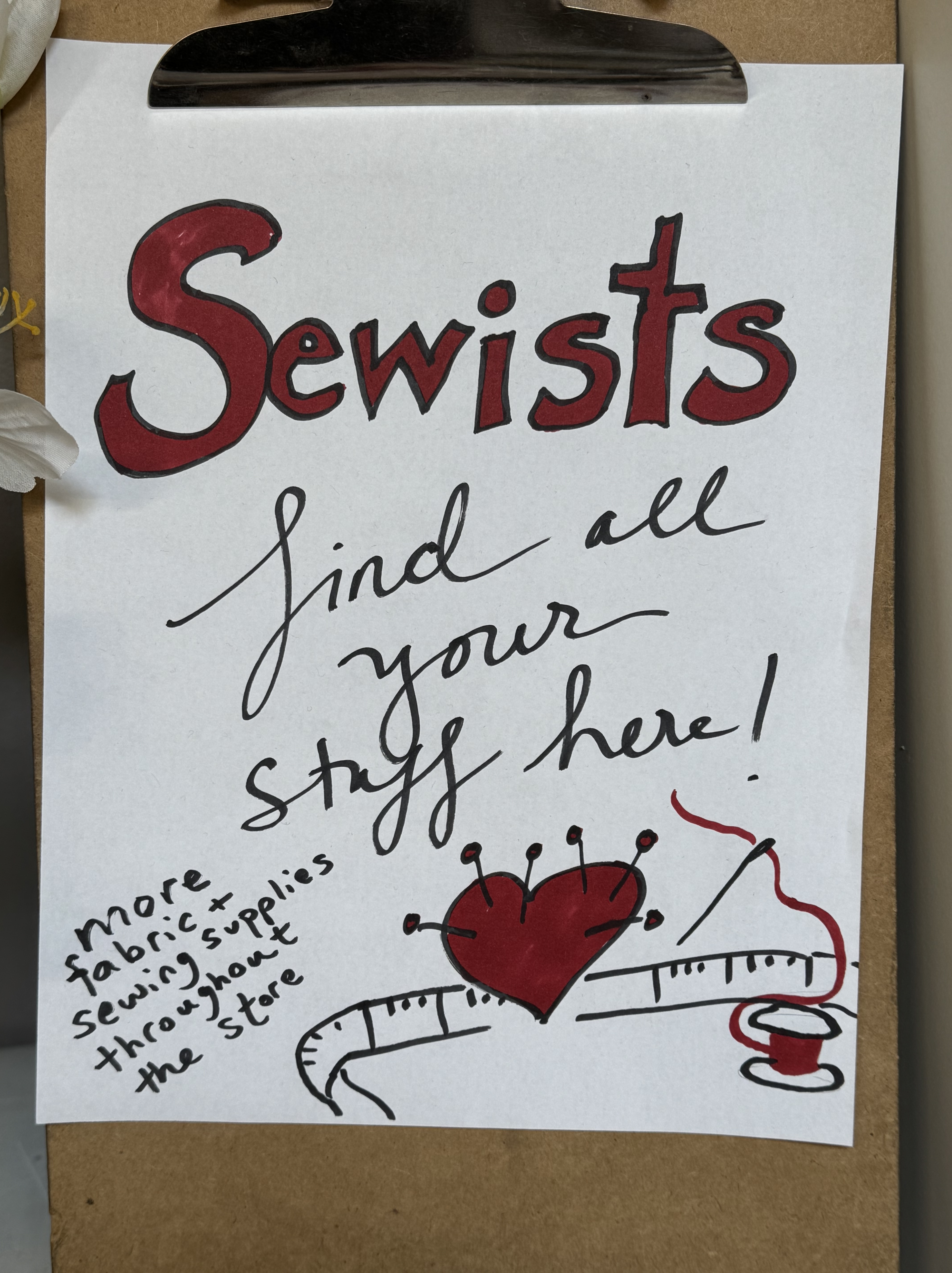
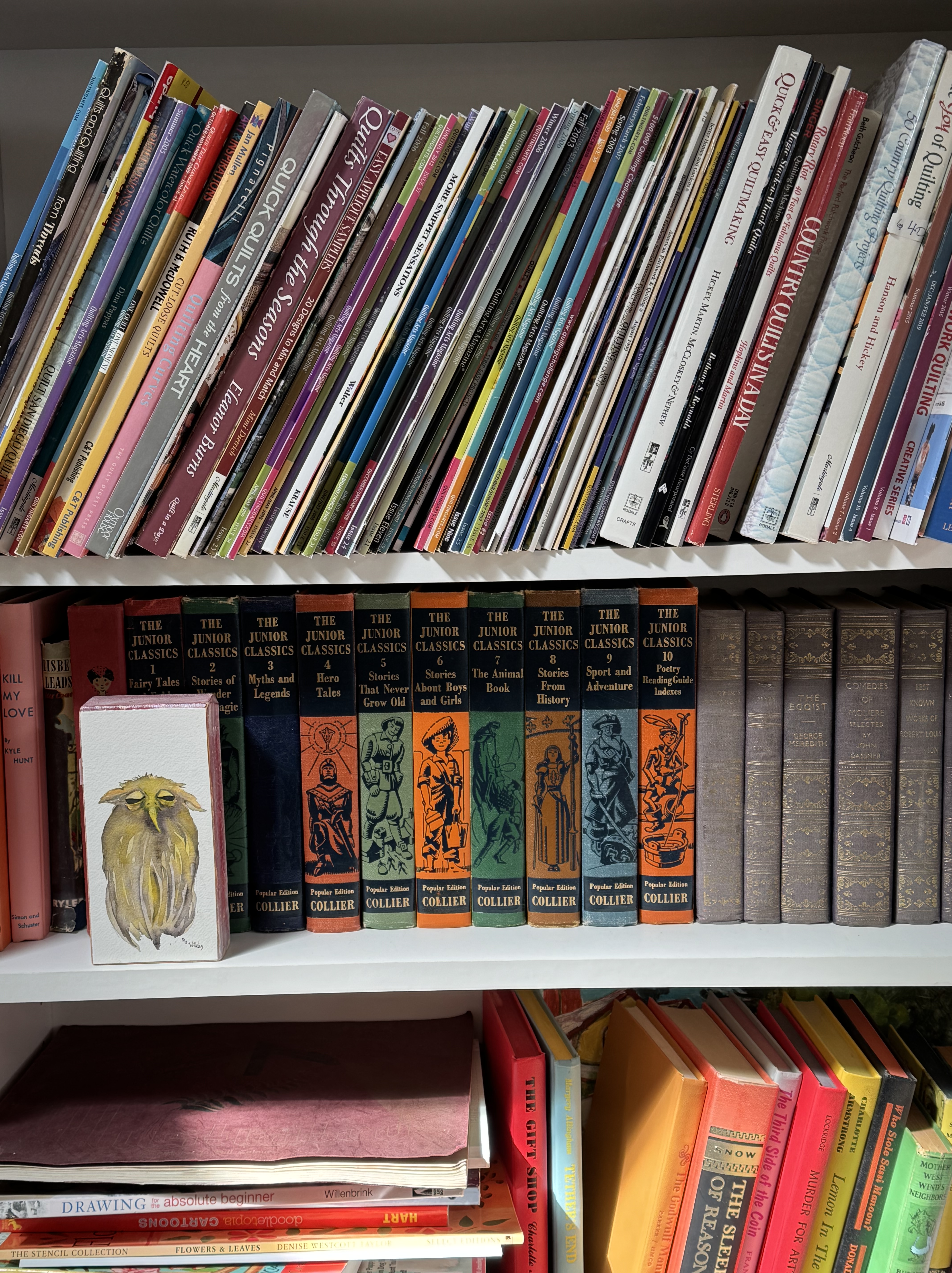
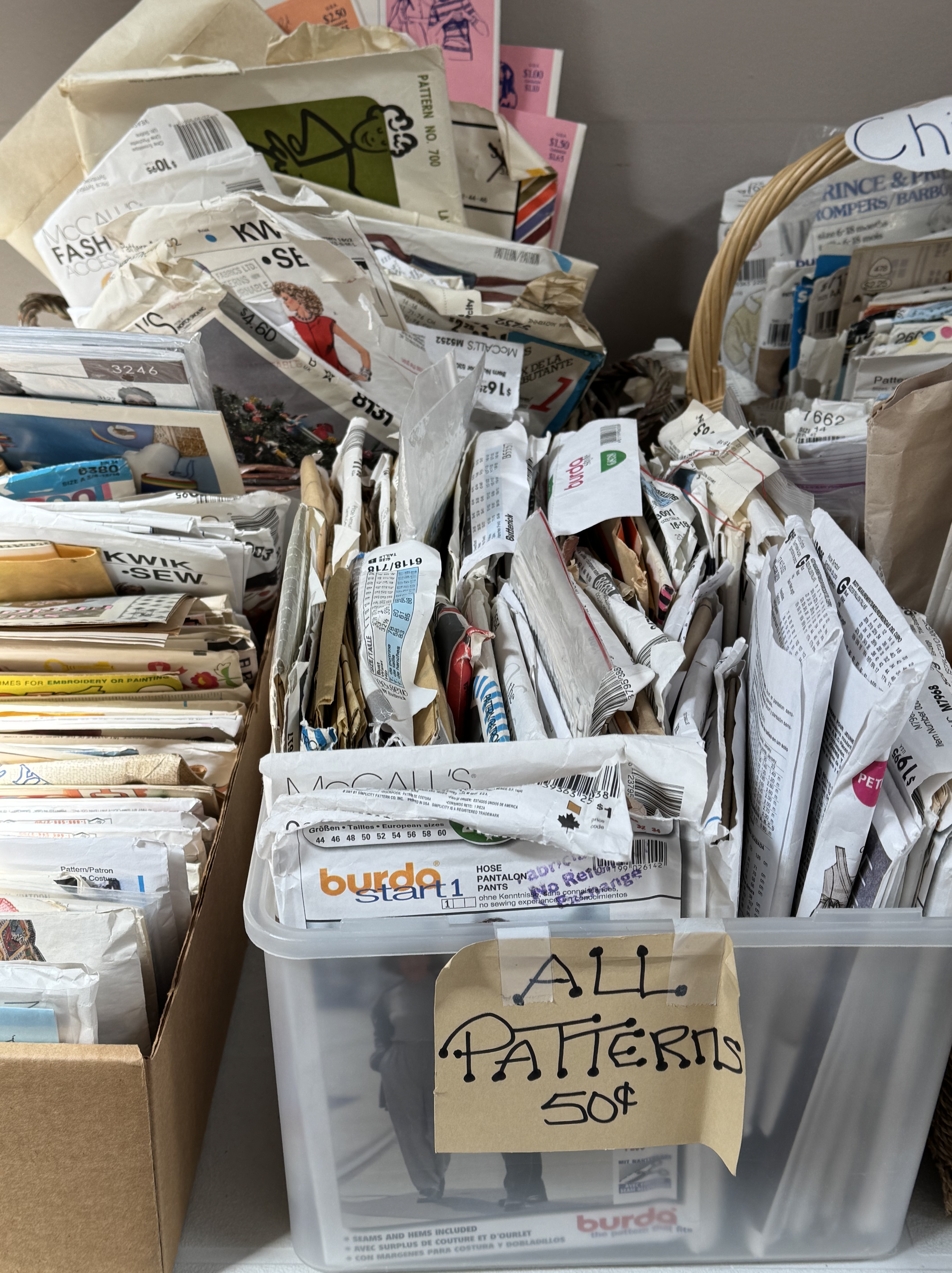
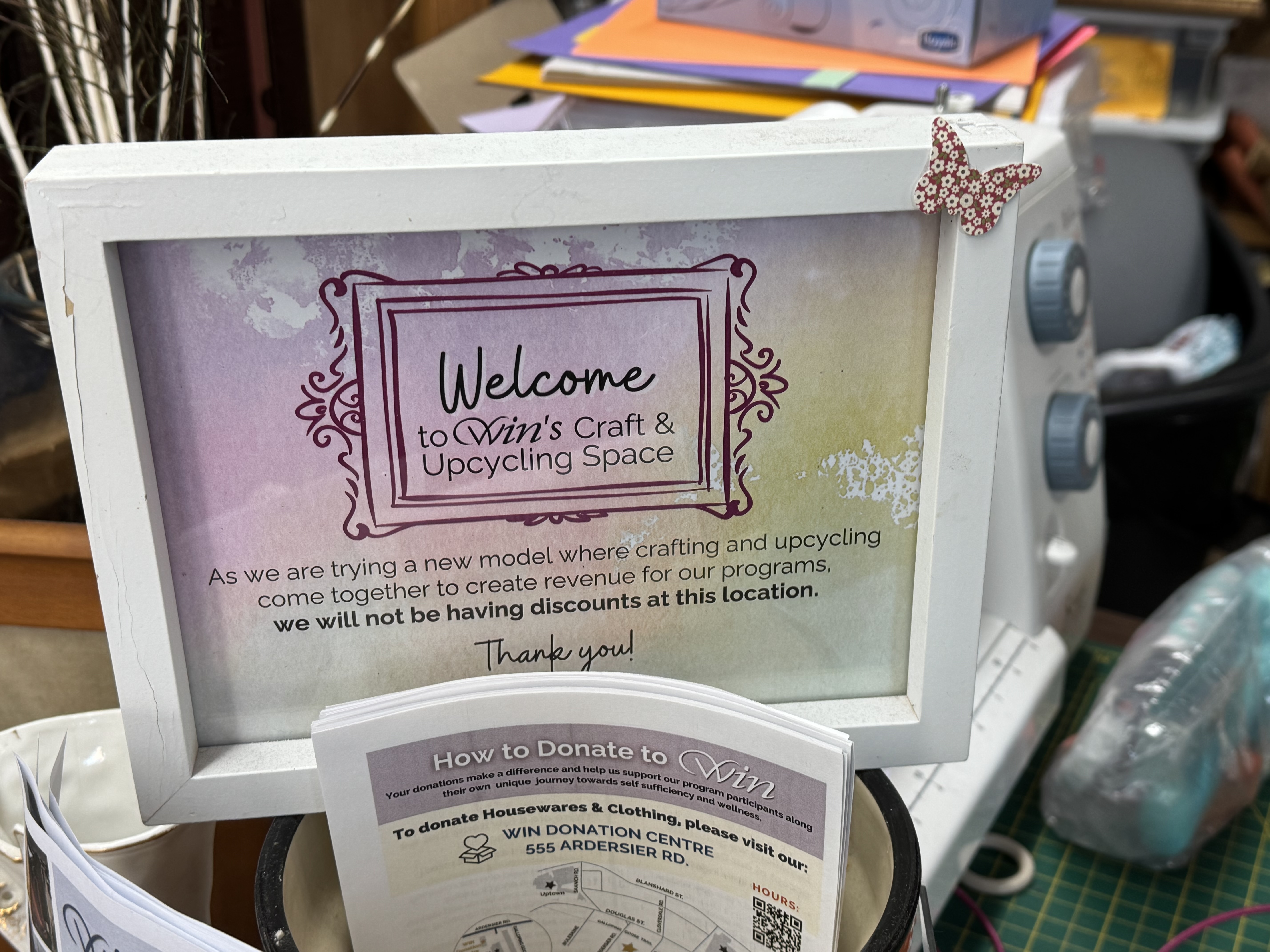
I work a volunteer shift at the upcycle store on Wednesdays. The people that come in delight me, entertain me, astonish me, educate me, soften me. Next week is my last shift at the store. I want to remember some of these people and their stories.
Once a pale man came in and asked if we had a leather hole punch. He didn’t want to buy one, just borrow it so that he could put an additional hole in his belt. He was losing weight, and his pants were hanging on him. Alas, I said, we don’t have one right now. I’m sorry.
I thought about him for weeks, his weight loss, his thinning frame, his sad face. I wondered about his story. Perhaps he was lovesick.
I can no longer untangle my hair I feed on my own flesh in secret. Do you want to measure how much I long for you? Look at my belt, how loose it hangs.
Anonymous, Six Dynasties Translated from the Chinese by Kenneth Rexroth
As if to balance the sadness of the shrinking man, the joy of meeting Randy bloomed inside of me for weeks. He flounced into the store a few days before Thanksgiving, smelling gloriously of rosemary and thyme. Randy is a contemporary dandy, stained waistcoat and tight jeans, flowing grey hair, phlegmy smoker’s laugh lighting up his brown, creased face. He brought crackling energy into the store with him, along with a small plastic bag of herbs.
Do you have any Scrabble tiles? he asked. Yes, I handed him two tall mason jars filled with tiles, and as he dug through his pockets for the cash to pay for them, he told me there was always a few Scrabble boards set up on his coffee table. When my friends come over, he said, they add a word or two or three. We play a never-ending game and nobody keeps score.
What a mouth-watering smell! He opened the plastic bag for me to see the long sprigs of green. I picked them at the side of the road, he told me, just around the corner. The herbs were volunteer plants, free for anybody that wanted them. I need sage, I said, for the Thanksgiving turkey. Oh, he said, I think there was sage growing as well. We smiled and said our goodbyes. An hour later he was back with three sprigs of sage he had picked for me and my turkey.
When I asked a young fellow what he was planning to make with the feathers he was buying, he challenged me: Guess. A headdress? No, good guess, but I am making flies for fly fishing, something his dad taught him to do. He fishes for cutthroat trout under the Bay Bridge with a bunch of female fishers who’d turned him on to it. I never knew!
Last week, a woman came in and poked into the baskets of wool, humming a tune. I noticed her tone—it was strong and true. You have such a beautiful voice, I said. Why don’t you sing us something? Suddenly, gloriously, she burst into “I’m Called Little Buttercup,” from Gilbert and Sullivan’s HMS Pinafore. Her rich mezzo-soprano filled the store as she strutted down the aisles, outthrust chest, a beautiful dockside vendor in love with the captain. I and another shopper were the lucky audience, mesmerized by a performance delivered among stickers and glue, balls of wool, knitting needles, jars of coloured beads.
I love hearing about the celebrations people are planning. The woman in her thirties who bought armloads of artificial flowers and a bolt of pale pink draping fabric for the table. She and her siblings had been planning a surprise party for their mother’s sixtieth birthday. She keeps mentioning she’s turning sixty, as if reminding us, said the young woman. She’s worried we’ve forgotten. Little does she know what’s in store! I laughed with her, feeling mudita, imagining the pleasure and wonder of her mother on that day. Surprise!
Finally, I sold the white canvas tent that was propped in the corner for months. The tent is perfect for children to hide and play in, and a woman bought it for her grandchildren. I told her about the teddy bear’s picnic birthday party I’d thrown for my four-year-old so many Decembers ago. We had a play tent pitched in our living room, and the children and their stuffies enjoyed tea and cake. The woman became excited and touched my shoulder in thanks. What a great idea! I’ve got to do that for my grandson! Then she told me that one Christmas her mother-in-law opened the gift of a vibrator in front of the whole family. I wasn’t sure what prompted the story, but we had a good laugh. Teddy bear picnics and vibrators, all in one afternoon.
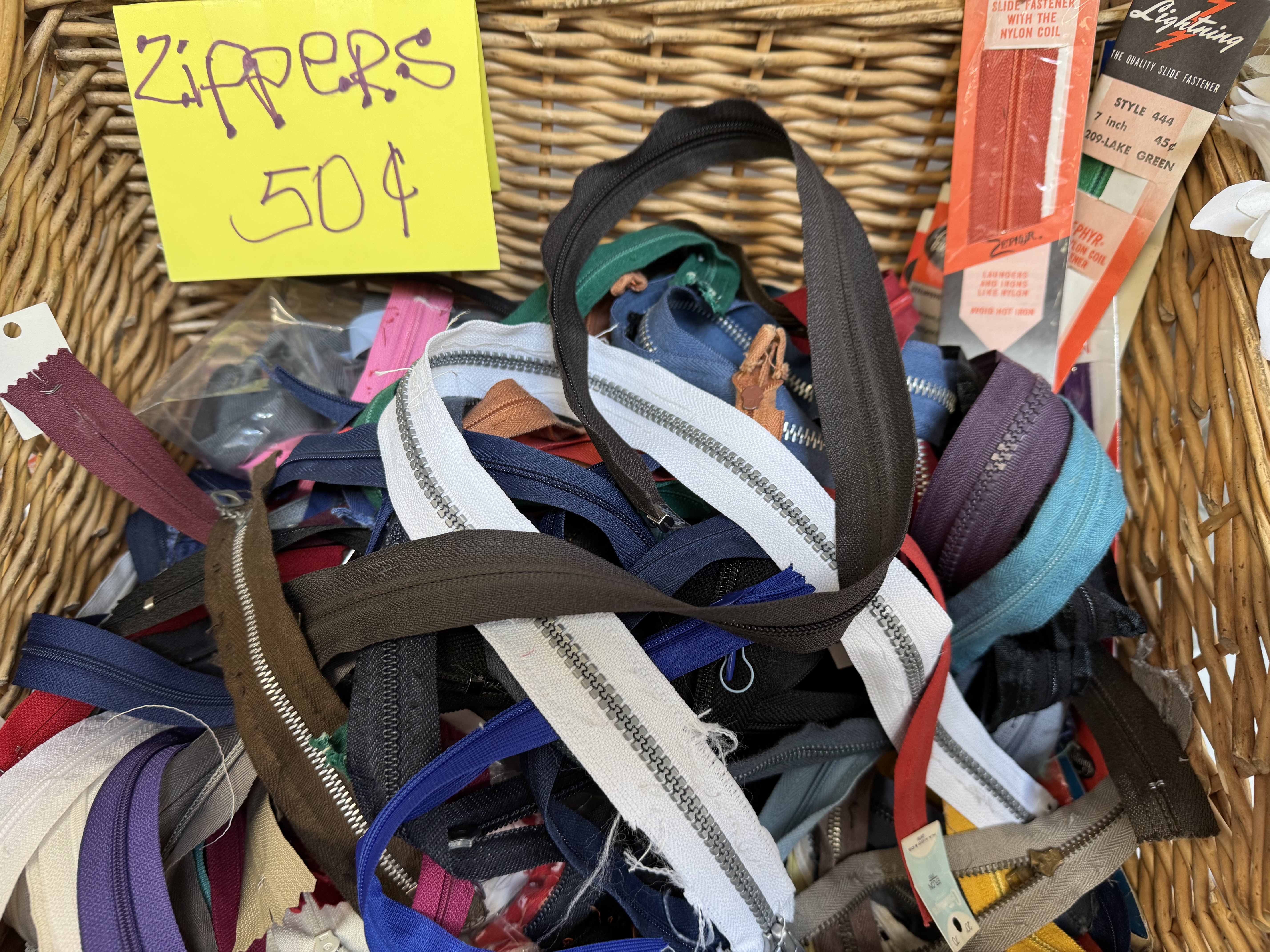
There’s a regular customer who brings her baby buggy into the store, speaking softly and playfully to her little boy as she shops. She buys bits of fabric, thread, and zippers. Last week, as she paid for her stuff and her baby chortled and tried to put his toes in his mouth in the buggy beside her, she ran her hand over the camel-brown smocked dress she wore and its complementary quilted vest. I made all of this from an old bedsheet, she said. At times like this, I thought, I wish I could whistle. A good long, low whistle to show my WOW in a visceral way. Instead, I shook my head: You are amazing! Queen of Upcycling!
One day I was emptying out the green donation boxes, pricing and sorting items. My hand fastened on something soft. A bit of plush grey fur, perhaps once the collar of a stylish coat. Wrapped in thin tissue paper, there was a small tag safety-pinned to the edge: Chinchilla, written in the shaky script of somebody very old. Suddenly, I was back in the furrier’s on Spadina Avenue, sitting cross-legged on the dusty floor, playing with scraps of chinchilla, beaver, spotted lynx. I caressed them one at a time, rubbed them against my cheek. My mother and the furrier stood above me, two voices discussing the racoon coat she’d ordered. What happened to that coat? And why was my mother—a passionate animal lover—buying a custom-made fur coat?
People stream into the store. Have you got books on stained glass? Do you have leatherwork tools? Ever get pillow inserts? Sometimes I say no, sometimes yes, but other times I’m not sure, and we set out to look together, sifting through the boxes and baskets. Sometimes people cry out in delight when they find just what they were looking for. A particular size of crochet hook, fabric printed with mushrooms, a colouring book of Frida Kahlo drawings.
Last week, a short bespectacled woman said she had an unusual request: golf balls. She was undergoing physiotherapy for an injured hand and the therapist had told her to squeeze a golf ball. I haven’t seen any golf balls, I said, but I think I can help. I remembered that morning finding a bag of large wooden beads strung onto a white shoelace. I thought of a small child or a very old person practicing fine motor skills, threading each bead onto the end of the lace. I found the bag and fished out three of the beads. They were about the size of golf balls. Will this do? I asked as I slipped them into her cupped hands. They’re perfect! And we agreed that they were much nicer to handle, a globe of burnished brown wood rather than a cold, plastic golf ball.
At the end of every shift, as I cash out, sweep the cement floor, turn off the heat and lights, lock the door, I feel full of the people I’ve met, the stories I’ve heard.
When I was in my forties, my mother was in her seventies. (We could rapidly figure out each other’s age because I was born when she was 30.) Those days, I had scant time for or interest in her stories. Busy with kids, negotiating the break-up of my marriage, and immersed in the chaotic life of a graduate student, I was living my life 3,000 miles away from my mother.
We talked on the phone weekly and visited once or twice a year. When she started to tell a story from the past, I often zoned out or became irritated. I didn’t really care, or I thought I’d heard it before. She sensed my impatience because eventually she stopped expecting a weekly phone call. “You sound too busy,” she said. I didn’t disagree. My forties turned to fifties; her seventies turned to eighties. We kept in touch, but calls were infrequent.
On Valentines Day, it will be six years since her death. I am 66 now, and at least a couple of times each week, I think of something I want to ask her. Some thread we dropped that I’d like to pick up again. Some mystery from her past I want to understand. Some memory I want her to clarify. (There are so many amorphous, shady memories—are they true?)
How did you make that wonderful crème caramel? I wish I’d gotten the recipe. Tell me more about the trip you took to Russia. When you returned from the trip and tried to tell me about it, I had so much on my mind I didn’t listen. But now I really want to know. And the other trips… so many European cities you visited, sometimes with groups of students, showing them great works of art and architecture. I wish you could tell me more.
You didn’t talk to your own mother for decades. I never knew her, only met her once. Why were you estranged? Your childhood was traumatic. Is it true you missed a year of school because you didn’t have shoes to fit your feet? That you learned to drive the tractor at age nine (or was it 12) so you could help on the farm? That your dad kicked you out of the house at 17, but he’s the one you loved? Am I misremembering your narratives?
I have the old phone number in my head 416-922-9534; if only I could call, we would chat. She’d be happy to hear from me and to reminisce, I know. But she’s no longer available. The stories, too, are gone. They died with her.
I had the wherewithal to record my father talking about his life in 2014 when he was visiting (he was 87). I asked him a series of questions. Now, I am glad to have his voice preserved as he talks about his parents, being a father, his life as an academic and farmer, and formative childhood experiences. For example, he describes discovering an injured bird when he was a young boy, taking it home and nursing it back to health, then releasing it. That event cemented his lifelong love for birds.
I feel wistful now that I didn’t make audio recordings or write down some of my mother’s stories.
I signed up for an online course, “From Autobiography to Illustrated Story.” The goal is to produce a short, illustrated book about an object that we still have from childhood: its provenance and meaning to us. I have precious few objects to choose from. The yellow Tonka truck. A doll my mother made for me out of an old sock with yarn hair and an embroidered mouth, nose, and eyes. Little Bear, the Steiff teddy. And I have some things that belonged to my mother.
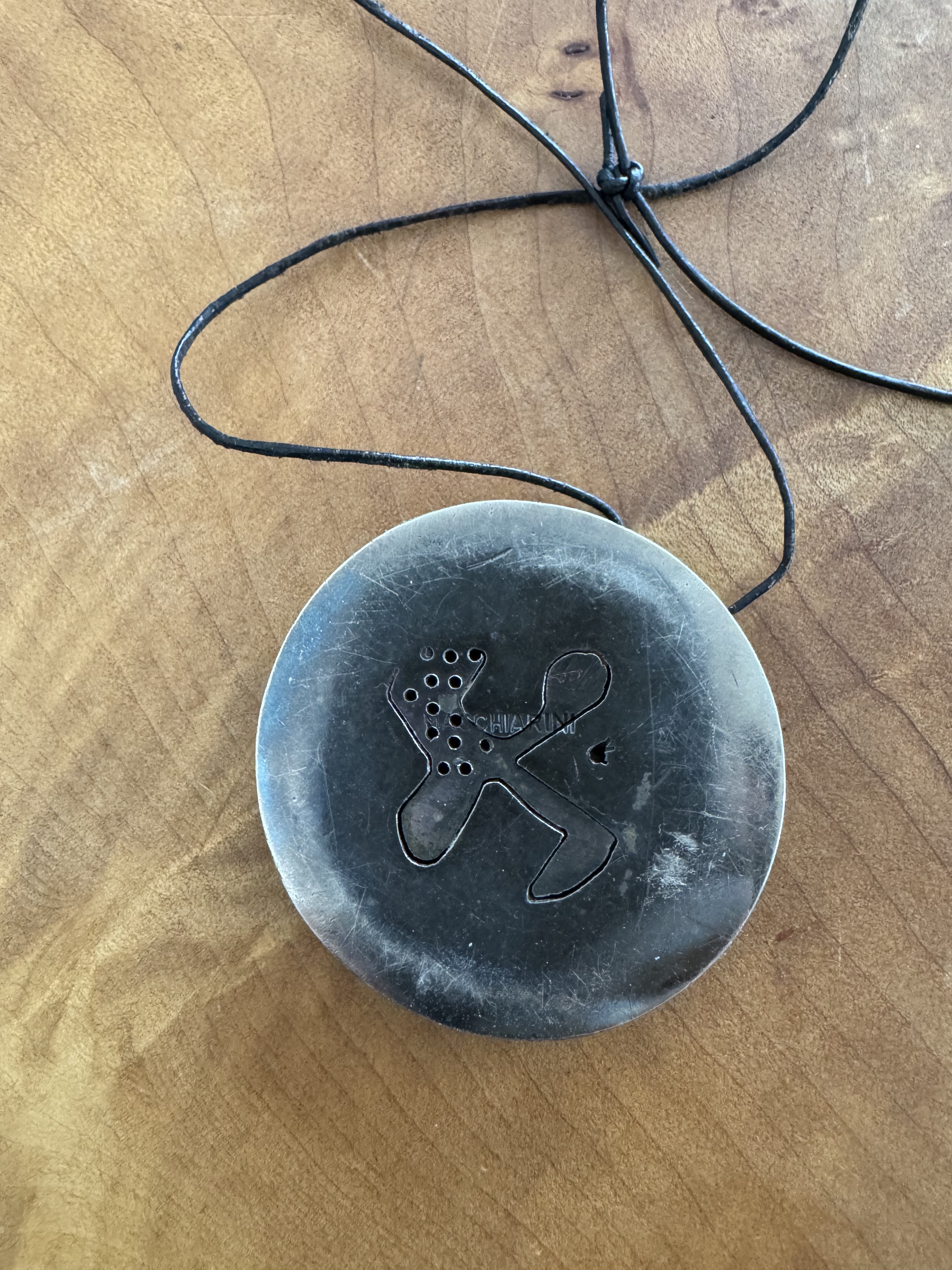
I decided I wanted to write about my mother’s Macchiarini pendant. My sister took it from her house after her death and gave it to me, thinking it suited me. I agree. Mom loved the work of Peter Macchiarini, an American Modernist jeweller (1909-2001) from North Beach, San Francisco. The several pieces my mother owned were passed down to us, her daughters. I have a couple of brooches, the pendant, and two belt buckles, and my sisters have other examples of his work.
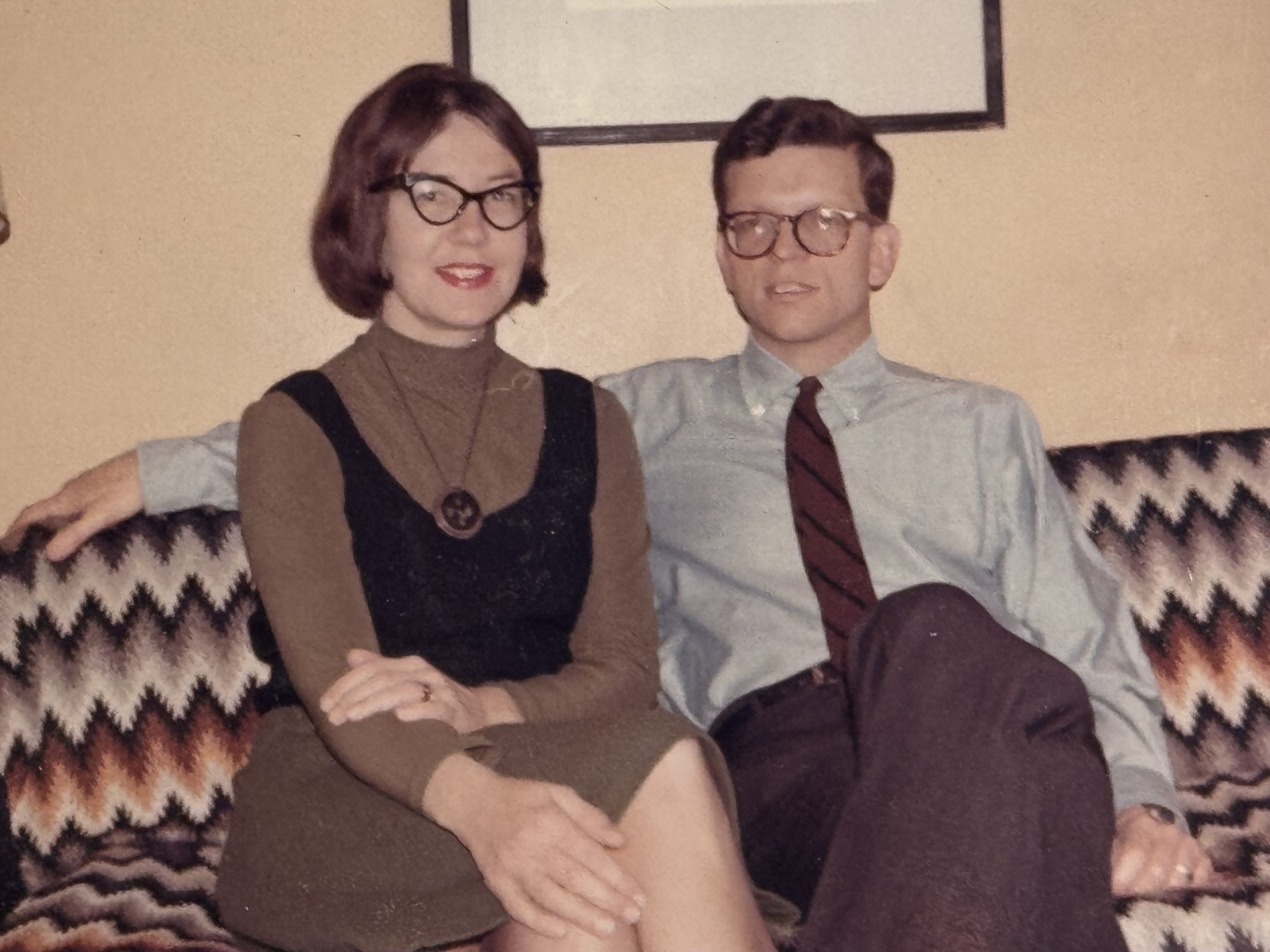
I want the pendant to tell a story—a story about my mother’s love for mid-century art, particularly from the Bay Area. Mom knew Peter, or at least I think she told me she did. She must have had anecdotes about how she bought the jewelry, what he was like, her San Francisco connection to him. She wore this pendant often, her signature piece. The photo of her and my dad shows her wearing it in 1964. She is wearing it again in the photo with her cat when she was in her sixties.
But the stories about Mom’s relationship with Macchiarini died with her. I can’t remember anything, and now I can’t ask her about them. What can I say about this unusual round pendant, a playful amoeba shape carved into dark wood and set in silver and gold? I can say that when I wear it, I feel warmth under its weight. Warmth around the heart, generated by affection. Our relationship was complicated. She was fucked up, inevitably passing along some of that to me. Yet there was so much love. She instilled in me a reverence for life’s beauty. And inextricable from that, a cellular knowledge of sadness.
I notice that my left hand is placed on my right arm just as my mother’s left hand is placed on her right arm in the 1964 photograph. Coincidence?
The bus to work takes about 40 minutes—the perfect length of time to listen to a dharma talk on Dharmaseed. I’m happier with this pastime than I am browsing Facebook or Instagram. The dharma talks inspire me and make me feel better about being alive, while Facebook or IG can make me feel dispirited. Recently, I listened to a talk by a dharma teacher I enjoy—Shelley Graf. She read an excerpt from Sharon Salzberg’s 2002 book on faith. I liked the quotation, but even more, I was intrigued by Salzberg’s book title: Faith: Trusting Your Own Deepest Experience.
Trusting your own deepest experience brought to mind a revelation I had when I started to see a therapist four years ago. Doesn’t sound like much, but it was profound for me: I am entitled to claim my own experience. During that therapy session, I had been dithering about whether I felt a certain way, circling around the ugliness of something, making excuses, minimizing my hurt, my terror, my sadness—in short, underplaying what I felt. “Oh, it wasn’t really so bad.” Nancy sat up straight in her chair, looked at me with intensity, and said, “Madeline, you are entitled to claim your own experience!” I laughed, “really?” I didn’t know that. To think I got to this stage in life feeling I couldn’t be honest about how it really was, how it really is, to be me. I came home that day and on the mirror in my sewing room, I wrote, “I am entitled to claim my experience.” I refresh it with a wine glass marker when it fades because it’s a crucial daily reminder.
Back to Salzberg’s book—well, I bought it and read it quickly, underlining the bits that made me cry or wake up or feel a swelling in my chest. There were many passages that made me feel good—made me feel connected to something bigger, something transcendent, which is what faith is, isn’t it? I love the sense that “no matter what happens, we can place our faith in the deepest part of ourselves, our buddha nature” (p. 170).
With those good feelings still germinating inside of me, I entered the course Michael and I are teaching on Zoom this weekend: Creating and Interpreting Personal Mandalas.[1] This morning, we led our participants through stages one through three. In stage one we rest in the darkness, in the womb. Being, not doing. As I started my mandala, I lined the womb-circle with layers of brown watercolour. Soon, a purple hyacinth spear emerged from the lining of the womb.
As I painted, my mind travelled back, back, back. Thirty-five years ago, I had several weeks off work to heal from surgery. Waiting time, resting time, stage one time. Hours in bed spent daydreaming, not doing, just being. My first husband and I lived in Toronto in a rented house on Devonshire, and the spacious front bedroom had big bay windows with generous ledges. The laser surgery I’d undergone was supposed to give me a chance at having babies, something I hungered for. When my friend Hannah visited me, she brought a potted hyacinth, not yet blooming. I put the plant on the window ledge, and it was as if I could feel the ache of that blue-blushed spear yearning to open.
It was early spring in Toronto: cold days, deluges, and then suddenly, bright hot sun. One day the hyacinth burst forth in a matter of hours, spraying the room with sweetness. Whenever I smell hyacinths, I go back to that time of hunger and healing. My body craved to follow the flower in her blossoming. But I had to wait.
My grandmother Marguerite and I were writing to each other that year. She sent me copies of Unity Church’s magazine and told me that she and other members of her congregation in Los Gatos, California, were praying for me to heal and get pregnant. I thanked her and pretended to be onside with her faith. But in fact, I thought it was silly. How quaint, a circle of old ladies in a church basement, holding hands and thinking of me.
Grandma Marguerite Walker in the Philippines, 1923
Months and months elapsed with no result. I thought the surgery hadn’t worked; after all, the doctor had told me I had only a 15% chance of having children. The odds weren’t great. Feeling like we needed a big change in our lives, my husband and I sold our stuff, quit our jobs, bought a Volkswagen van, and drove south. Almost a year after my surgery, we sat in a Planned Parenthood office in Green Bay, Wisconsin to learn the good news. I was pregnant.
The hyacinth I painted this morning seemed to have come from the deep well of memory— light-filled room, white sheets rumpled on the bed, the bluish spear opening as I kneeled nearby in my nightgown. Spring magic! And I thought of Sharon Salzberg writing about a research project undertaken in Korea: Women trying to conceive were prayed for at a distance, and these women became pregnant at twice the rate of those who received no prayers. I underlined that passage. Beautiful evidence of our “profound interconnectedness” (p. 147).
I think often of my grandmother’s faith, and how she and her Unity friends may have had some small part in my blossoming into a mother. And now, I blossom into belief in the interconnectedness of life, belief in the butterfly effect doing its work not only in the material world, but in the emotional realm too. The mistake we make, writes Salzberg, is to expect a certain outcome from our actions. We get attached to results, which leads to expectation. “When our intention is to do good for others, and we nurture that intention, we can have faith that in some way, often unknown to us, it ripples out” (p. 144). As we go deeper into spring and the hyacinths begin to open, let our loving intentions and kind actions ripple out in ways we will never know.
I often despair of my monkey mind, the jumble of thoughts that keep me from noticing what’s present. At the same time, I appreciate my tangential mind. I love following its pathways through shadowy tunnels of white-flowering hawthorns. I seem to always turn a corner to find myself in an unexpected field of light.
Today as I ate breakfast sitting at the kitchen table, I started to examine the ceramic trivet my father gave me years ago after a trip to Granada. The trivet is decorated with an Arabic design: a mandala in teal, navy, red, and cream. I love the waving flower petals that seem to be in motion, dancing in the wind. The Arabian design on the Spanish trivet took my mind to the poem I’d just been reading by St. Teresa of Avila (1515-1582), a mystic living in Spain after 700 years of Arab culture. St. Teresa was intimate with her God; you can feel it in her language. I re-read the lines,
A woman’s body, like the earth, has seasons;
when the mountain stream flows,
when the holy thaws,
when I am most fragile and in need,
it was then, it seems,
God came
closest.
God, like a medic on a field, is tending our souls
And then, a few lines down,
Why this great war between the countries—the countries—inside of us?
From “When the holy thaws” by St. Teresa of avila
My counsellor tells me that I aggress against myself—a pattern in my life. An ongoing war rages between the countries inside of me. I like to think of God as a medic tending to my wounds, lifting me off the battlefield, holding me close, bringing my countries to peace. I remembered the stage six mandala I drew recently, with a little girl and a dragon (my warring countries). I wrote tenderly to myself, “lay down your sword, little one.” Perhaps the holy is thawing.
I’d snagged that wonderful book, Love Poems from God: Twelve Sacred Voices from the East and West, from a cardboard box of free stuff. I love our neighbourhood. There is a little clearing across the street near the mail box where all of us take things we don’t want anymore. Neighbours and visitors from other parts of town come to adopt old things and bring them to their new homes—a brilliant system!
This book caught my eye. What a great find. But boxes of free stuff and friendly dogs are not all that’s on offer here. The neighbourhood has other delights. Yesterday, I started work early in my home office in the basement, checking copy edits for a book. At 10, I took a break from the highly focused work. Michael, Marvin, and I walked down to the Gorge where a pop-up concert was in full swing. A local musician, Danielle Lebeau-Peterson, was playing her guitar and singing under a white tent. Danielle is the daughter of my eldest son’s first music teachers—Connie and Niels, and I marvelled at the “small world” (we’re all connected) feel of Victoria. Her mouth is like her mother’s.
The clouds in the sky threatened rain, but so far it was dry, and children and their parents gathered around Danielle as she sang and played, smiled and bantered. She knew songs from Disney movies, which delighted the younger crowd. The Tillicum-Gorge Association folks had set up a table with a big urn of Tim Horton’s coffee, cartons of donuts, and boxes of Timbits. There was a clipboard with paper and the question, “What do you love about our neighbourhood?” The cheerful woman behind the table filled my cup with coffee, and I took up the pen and wrote, “Everything.”
We sat on the grass listening, and when Danielle asked for requests, I called out “Blackbird,” that gem of a song written by Paul McCartney. It was one of my father’s favourites, and she played and sang it perfectly—her clear ringing voice floating up and over the Gorge: “You were only waiting for this moment to be free.” I smiled while my tears fell on the grass, and Marvin tugged at his leash, tried to smell the woman sitting next to us. This is the first Father’s Day I’ve lived without a father. But he was there in the high, truthful notes of the song. He is still with us.
And now, I am still sitting here with the book of poems on one side of me and the trivet on the other, back from that pleasurable sojourn, ready to fill the hummingbird feeder with sugar water and play with the dog. I love my mind and my heart. I love the rich stuff of daily life that produces all of these memories, feelings, and thoughts. The tangents take me unexpected places, but they always lead me back home to love and beauty.
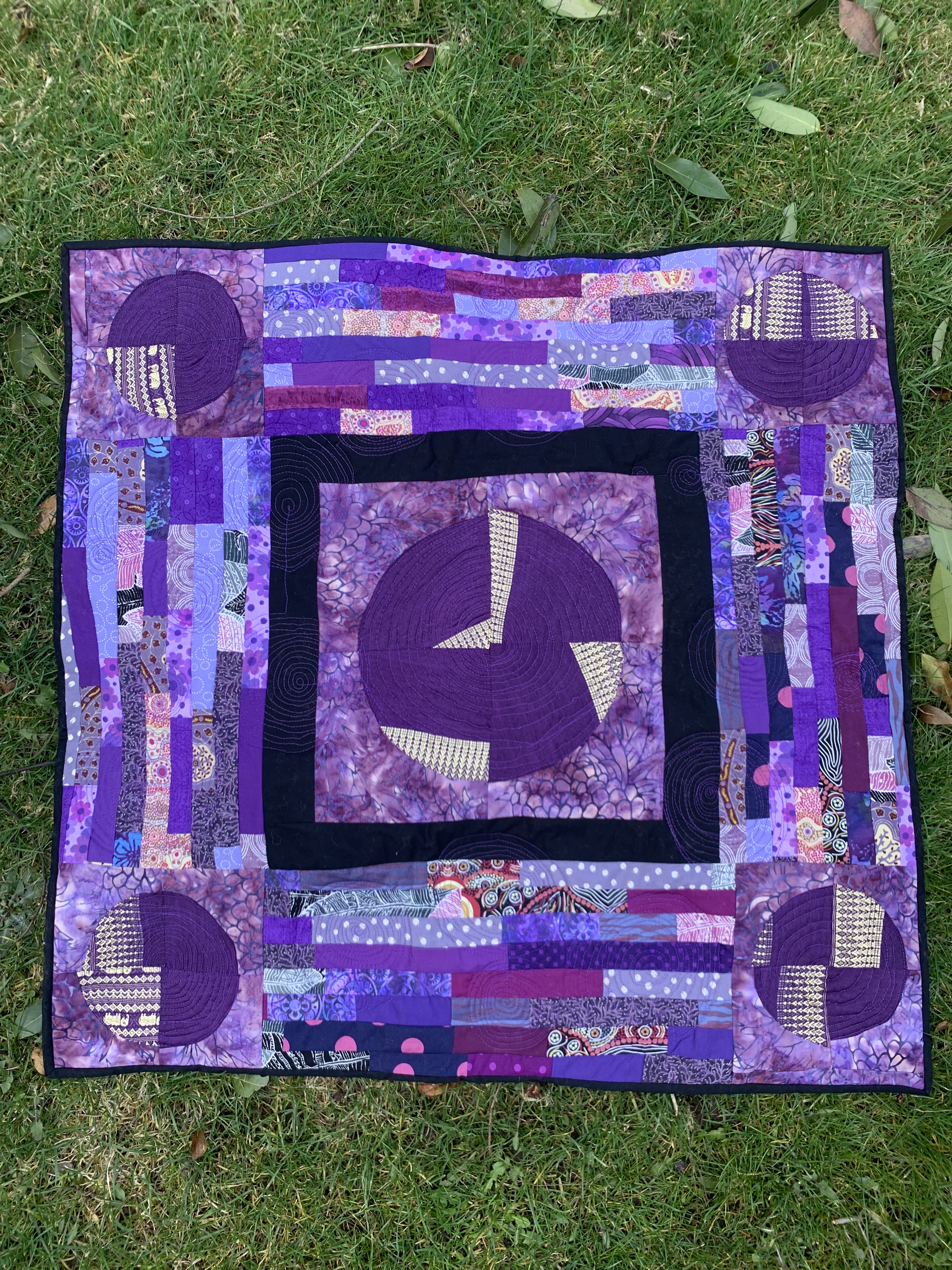
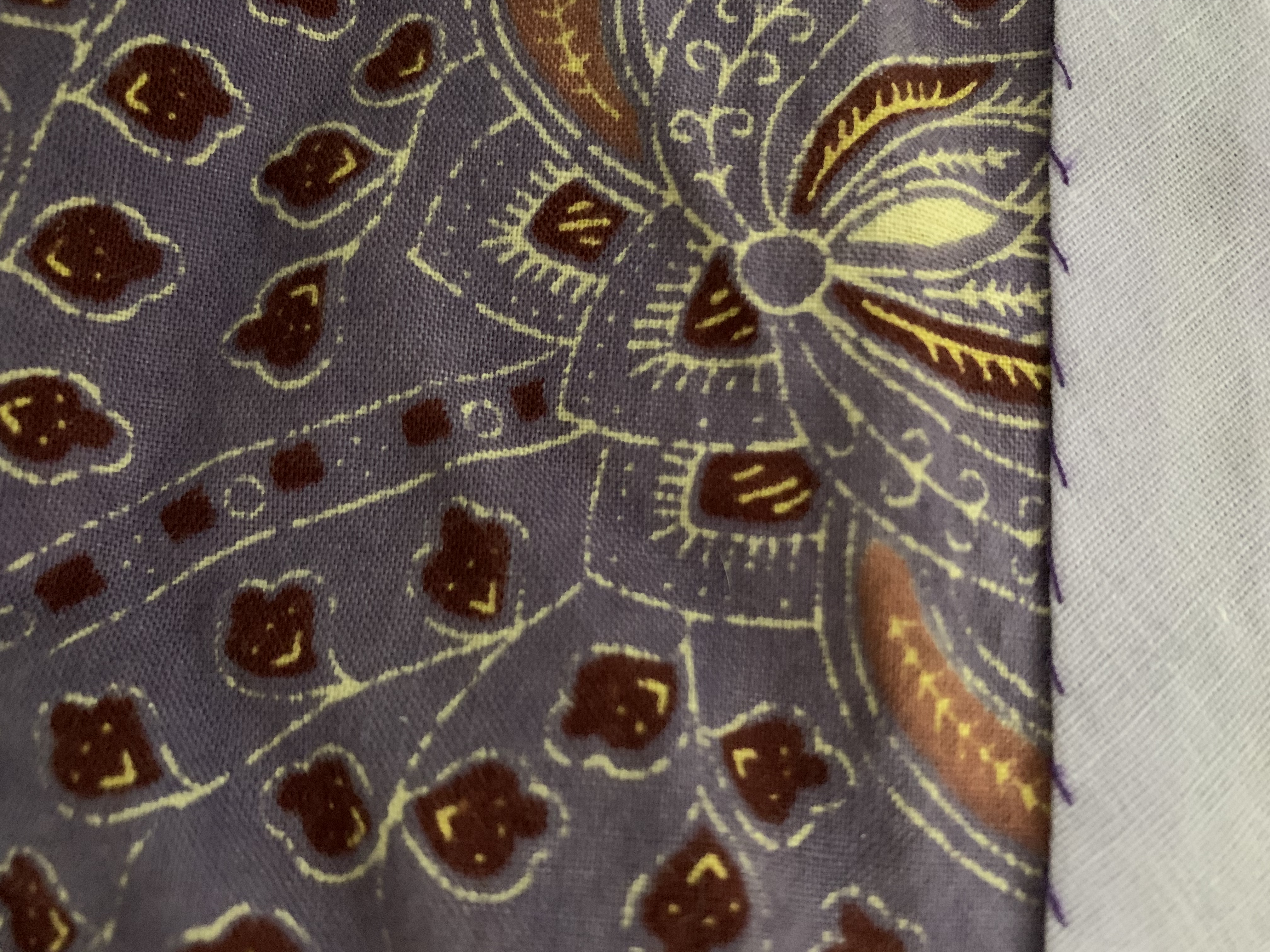
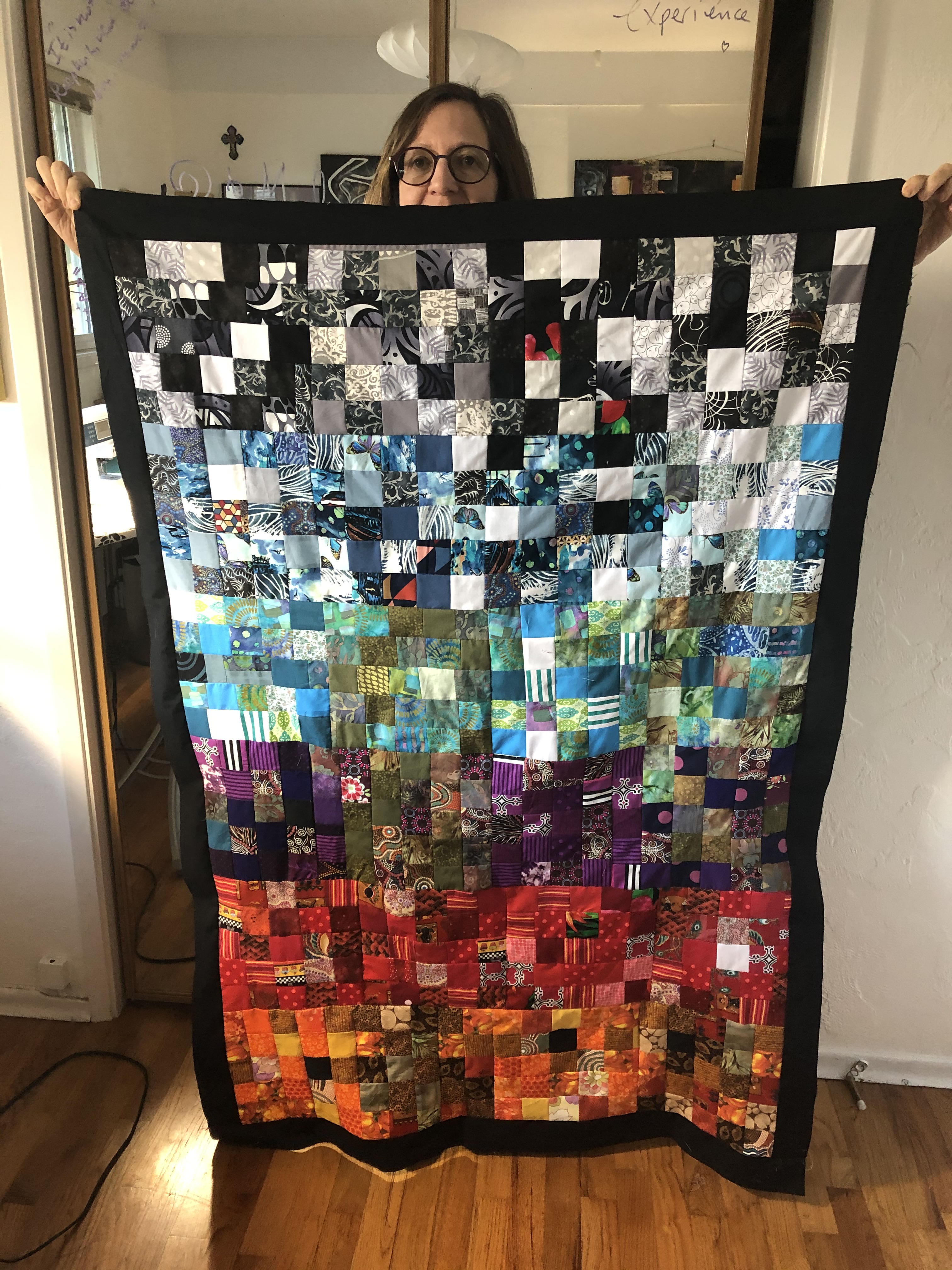
The lavender bias tape is sewn in small, even stitches along the inner edge of the richly patterned cloth. My grandmother once sat quietly, sewing this binding to finish the apron she was making for me. After wearing the apron for decades, I have been cutting it apart, incorporating squares of the purple, cream, and brown fabric into coasters for a friend, a shoulder bag for my niece, and now a quilt. These little squares and rectangles sew/sow history into new textiles.
The old apronMarguerite Potter Walker in 1922, Manila Phillipines
Grandma Marguerite Walker (nee Potter) was born in 1896 in Fort Scott, Kansas. Although I didn’t know her well, I have fond memories of her. She was gentle and genteel, soft-spoken, and poised. When my parents when to Europe for several weeks when I was 8 or 9, she came to stay with us in Toronto. She taught me how to set a table during that visit because, apparently, my mother had never taught me the correct way to place napkin, fork, knife, and spoon. I once visited her in Los Gatos, California, where she lived for many years. One day, we wandered about, looking at the shops. “What a lovely colour your blouse is,” grandma said to a woman we approached on the street. That stranger lit up from the compliment, and I never forgot that simple, kind exchange. Another time we heard ambulance sirens in the distance, and my grandmother prayed aloud that nobody was hurt. This was something new for me. “Prayer” was not in my parents’ lexicon. And in her letters, grandma wrote “thot” for thought, not because she didn’t know how to spell—she was an excellent speller—but because she had her own shorthand.
In my twenties, I underwent surgery to correct infertility. I was told after the surgery that I still had only a 15-20% chance of having children. Grandma Marguerite started sending me her copies of Unity magazine and told me her church congregation was praying for me. Ultimately, I gave birth to three healthy sons. I don’t know about cause–effect, but I was forever grateful to her for the energetic and spiritual work she undertook on my behalf. All of these warm memories float through me as I sew squares of Grandma’s apron into the mix of this new quilt, which I think I’ll call “windows to a purple world.”
Windows to a purple world (quilt in progress)
This type of sewing I’m describing is upcycling, but with a difference. Take fabric that’s been in your family or is otherwise meaningful and make it into something new. If you do this, you incorporate stories into your sewing. A couple of years ago my friend Nancy gave me a large basket of textiles from her family—old linen tablecloths and napkins in pastel green, pink and salmon that her mother and grandmother had used over many years. I cut these precious pieces apart, mixed in other contemporary fabrics, and fashioned pillowcases. I gave Nancy the pillows for her birthday. She can remember her mother and grandmother and meals at the family table whenever she looks at them.
I incorporated cloth from pink and green tablecloths and napkins from Nancy’s family into pillowcases.
Scattering scraps of one fabric over countless projects feels like I’m sowing seeds of connection far and wide. When Michael and drove to the Shakespeare Festival in Ashland, Oregon in the summer of 2017, we visited Sew Creative, a beautiful fabric store on the main drag. I fell in love with designs by Australian Aboriginal designers: swirly organic patterns that looked like amoebas and rhizomes done in purples, reds, browns, and oranges. And there was a binder there with each designer’s photograph and profile so I could learn about them–their processes and inspiration. I bought two one-yard pieces of fabric. During the last five years, I have cut and sewn those fabrics into countless things: purses, pouches, quilts, coasters. I love the dispersal of one thing into many. Cadmus sowed dragon’s teeth and up rose an army: the fierce Sparti (which means “sown”). I sow scraps of fabric and up rises. . . delight!
Pendleton Store, Ashland OregonAshland, Oregon – Shakespeare Festival 2017Michael and Madeline, AshlandThe two fabrics I chose
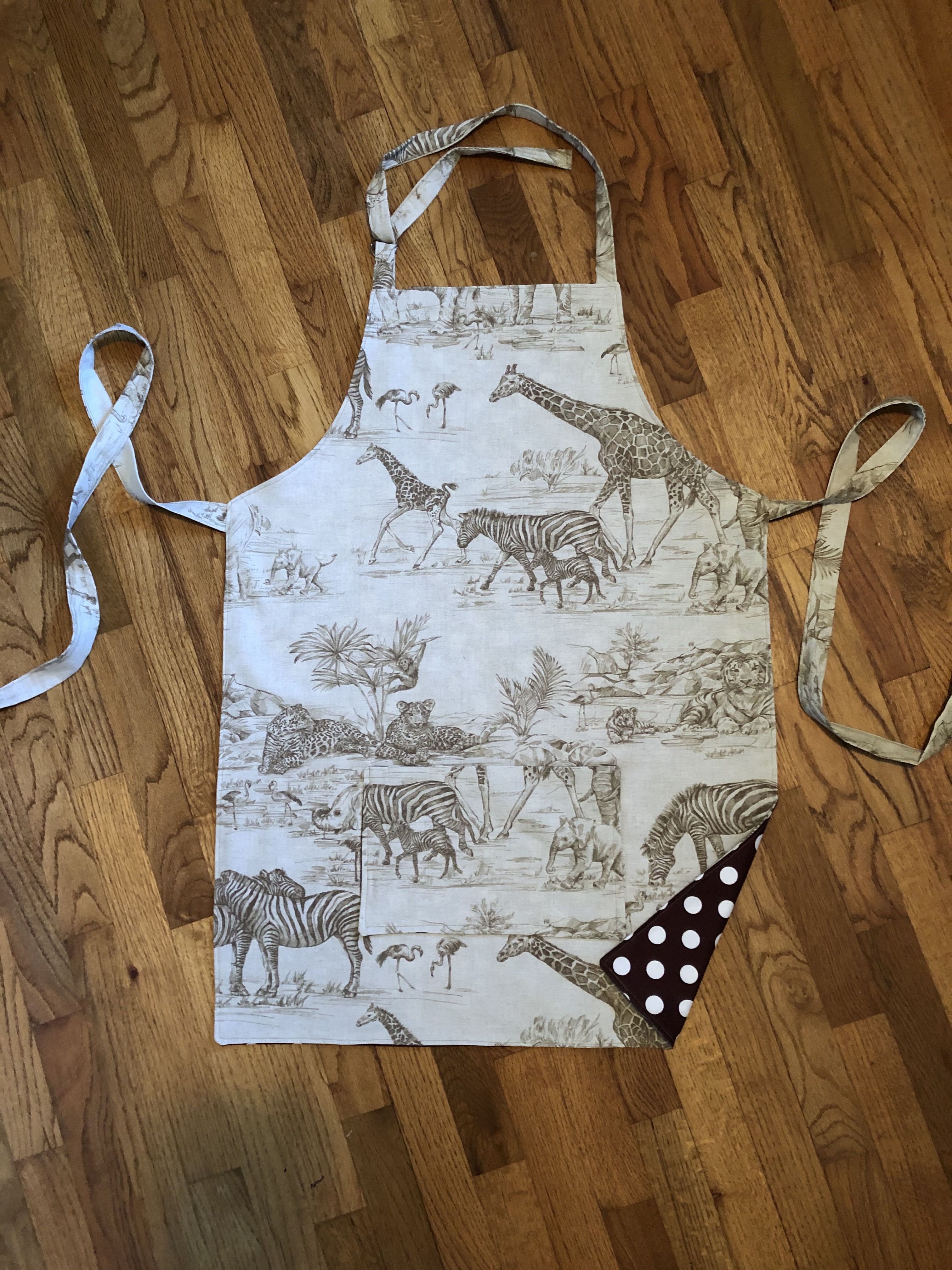
Scraps of the same fabric show up over and over again. The cloth Nat and Sam chose for their aprons (animals on the Serengeti; a bright turquoise broadcloth) show up in the bookmarks I recently made and distributed to friends and family. The blue tablecloth I bought at Value Village became the lining for my blue patchwork apron. It feels, at times, as if I—and not just the fabric—am being dispersed across time and space. It is too easy these days to disconnect and withdraw. I am trying to stay connected through writing and sewing, sewing and writing. Sowing myself far and wide through words and fabric.
“The American experience, the focus on individual achievement, the acquisition of goods and money to prove one’s social value, is built on this sense of loss, this alienation from the warmth of the home culture, isolation from genetic bonds. This separation from one’s tribe creates an inner loneliness that increases as one ages.”
Annie Proulx, “A Yard of Cloth” (p. 20) from Bird Cloud.
I read this passage last night, and I had to get out of bed to copy those sentences. They struck a chord in me. I too feel that “inner loneliness that increases as one ages.” My mother, who died on February 14, 2019, distanced herself from her family as a teenager. When she coloured her hair blonde, her father was furious. Either he told her to leave, or she left voluntarily to flee the strictness of their farm in Lodi, California, I’m not sure which. She ended up in Los Angeles, working the switchboard at Kaiser Hospital. She would later meet an older woman, Phyllis, who became a kind of mother to her, paying for her therapy. My mother would go on to complete a BA and MA at University of California, Berkeley.
Not only did my mother reject her parents, she spurned most of her seven siblings as well. However, she had a special bond with Fran, a gentle older sister who worked as a nurse. My mother claimed Fran saved her life by preventing their parents from treating my mother’s Bell’s Palsy with some kind of horse medicine. Most of these stories are so garbled in my memory. They seem half-fantasy and half-truth. I’m sure I have most of the stories slightly wrong.
But the feeling is real—of striking out, fleeing family, rejecting those who engendered you, separating from tribe. That was an element in my mother: brutal independence. I don’t need you. I depend on nobody but myself. I remember the last time I visited her in Toronto, her brother, an Evangelical preacher living somewhere in the States, called her, and I picked up the phone. Apparently, he called regularly, wanting to reconnect, and she always hung up on him. When I tried to hand the phone to her, she wouldn’t take the call. I was shocked. You won’t talk to your brother? He’ll just proselytize, she said.
My parents migrated from California to Toronto in 1965, another “alienation from the warmth of the home culture” that Proulx writes about. My mother left her adopted mother, Phyllis, which must have been heartbreaking for her, and my father left his mother. We three daughters were already used to being without a large tribe—we didn’t know most of our cousins or aunts and uncles. We were a nuclear family with no extended family to fall back on. I look back on how we grew up without the cushion of uncles, aunts, cousins, grandparents and how hard it is to survive that way. But we didn’t know anything different.
Then, repeating the pattern of migration and loss, my first husband and I left our home in Toronto with our first child. We left our parents and siblings—it felt exciting and freeing. We started a new life in Victoria in 1988. My kids grew up without getting to really know their Ontario grandparents.
I am thinking of my mother this weekend. It will be three years since she died. She was fierce and proud and insisted on individual achievement as the sine qua non. In her actions, she was a feminist. In elementary school, we were sent home for lunch every day for a 90 minute break, which necessitated mothers stay home to serve their kids lunch. She fought to get the school to allow us to stay there to eat a packed lunch so she could go out and work. Later, she pressed back when the bank wanted her ex-husband’s signature to get a mortgage. But she wouldn’t be called a feminist because she didn’t want to be seen as part of group of women who supported and uplifted each other, challenging the system together. All of her achievements in life, she thought, were due to her own hard work and merit plus a little help from individual friends. And it’s interesting how I’ve inherited some of this thinking, especially an unwillingness to ask for help.
My mother and her father
As humans, we work so hard to connect. It is our default—we need each other. I treasure my sisters now, and I create my own chosen family in my friends. However, that profound sense of loss lingers at the edges of life. It’s the legacy of leaving family behind and striking out on one’s one.
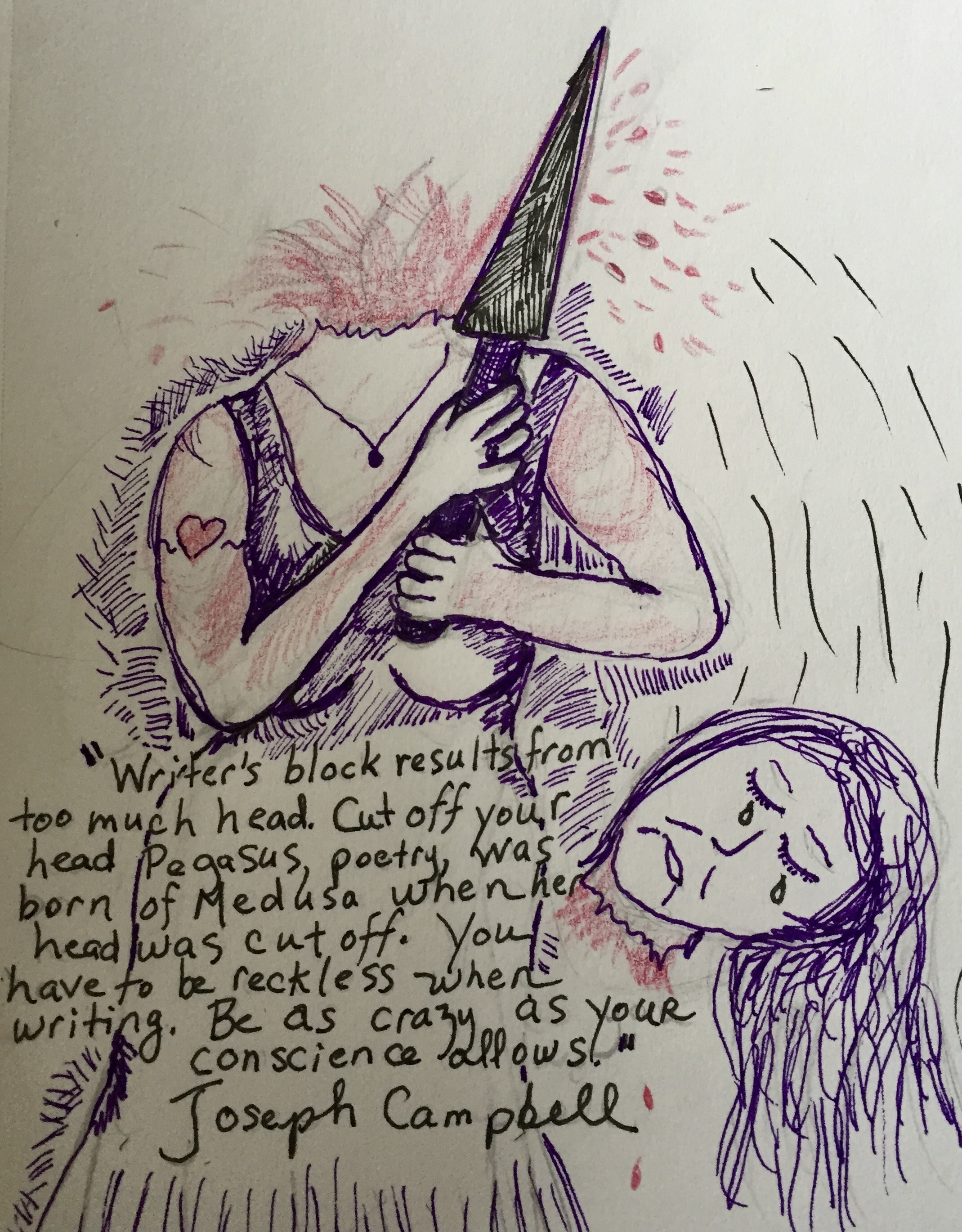
Swords
Swords are weapons of destruction and tools of discernment.
Swords are on my mind.
About a year ago, I created a website for my new editing business and wanted a brand identity. The Queen of swords from tarot seemed a perfect symbol for a female editor—the independent, unbiased woman, a seeker of truth, with clear boundaries and a direct style of communication. She sees problems and figures out how to solve them; she knows where to cut the extraneous to reveal the truth. Queens are about heart and swords are about mind—so she brings heart and mind into harmony.
I didn’t use a Queen of swords image from a tarot deck due to copyright laws. Instead, I planned to use an excerpt from a painting in the public domain, John Gilbert’s (1817-1897) Joan of Arc. I sent a mock-up of the website, including a sword image, to a few friends for their opinions. One of them noted that the image of Joan of Arc’s armour and sword was martial and scary and didn’t really reflect who I am. I agreed. I decided to let go of the sword as a metaphor for editing because of its primary associations with violence.
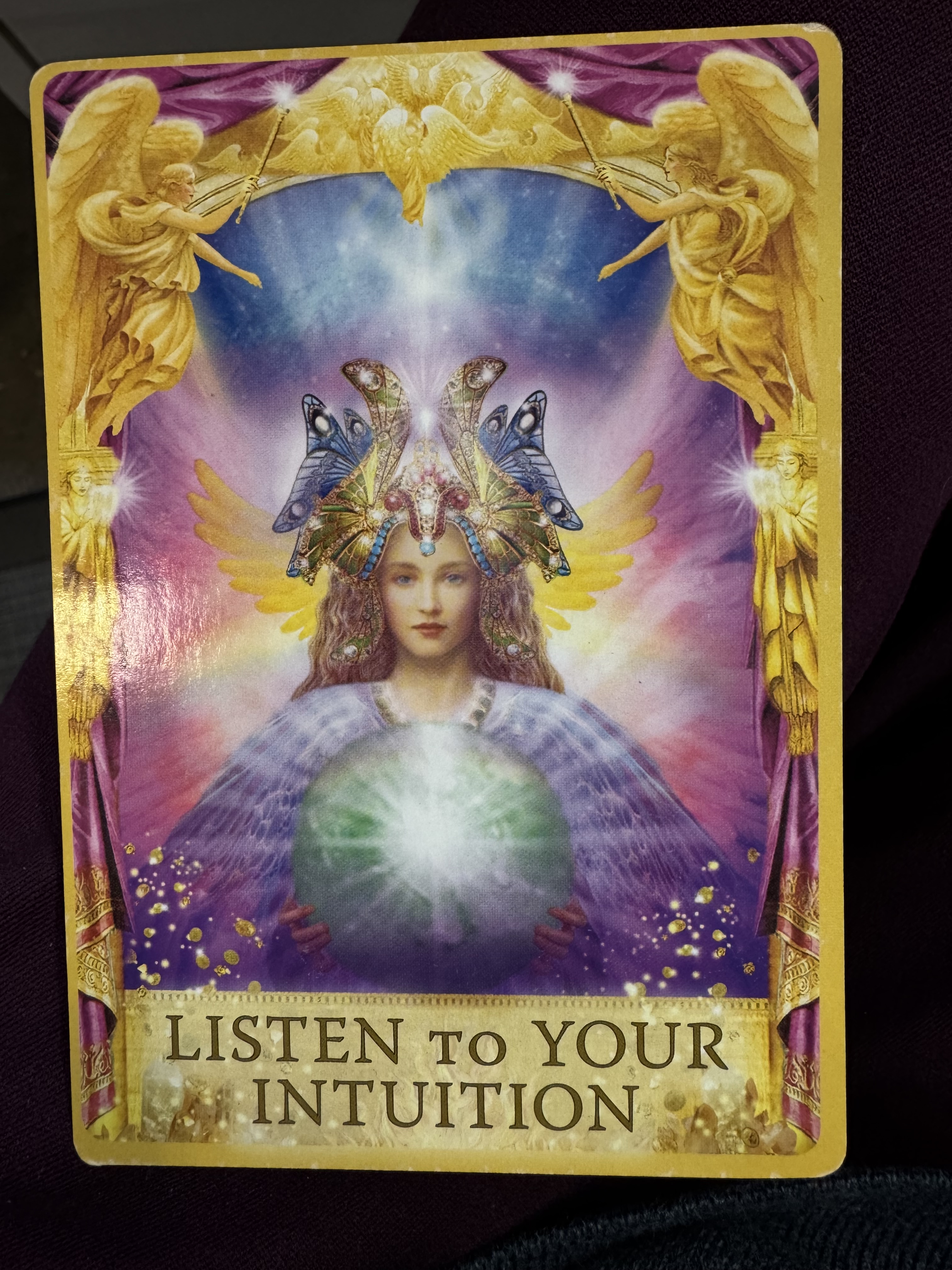
And yet, swords keep coming up. On December 31, 2021, Michael and I each drew a tarot card to guide us during 2022. He drew two of swords; I drew Queen of swords. Evidently, the sword has much to teach both of us this year, so I am listening. As Michael has been studying the tarot for several years now, I asked him about swords. His words are a synthesis of all he has read and studied from various sources (but his main influences are Mary Greer, Rachel Pollock, and Anthony Louis).
“The suit of swords is aligned with the element of air, which is the suit of mental processes and thoughts. Swords are aligned with thinking, intellect, reason, yang energy, severing unhealthy connections, and the courage of the warrior. They’re about logos, problem solving, things we have to work through before we can find serenity.
Swords are aligned with prajna, deciding what to accept and what to reject or cut; it’s the suit of discernment and decisiveness. Also, because swords are about mental things, they can also be about willful blindness, about illusion. Swords is where we discover the obscurations of mind that trap us.
Two of swords shows a woman blindfolded, and the eight shows a blindfolded, bound woman surrounded by swords. However, these are mental obscurations – imagined entrapments rather than actual physical imprisonment. The four of swords has a person lying on their back with three swords above – this is contemplation. Swords is about how you use your mind. Some sword cards are about meditation: training, calming, and taming the mind.
Swords are not just about cutting, but they’re also about piercing – which is penetrating insight.”
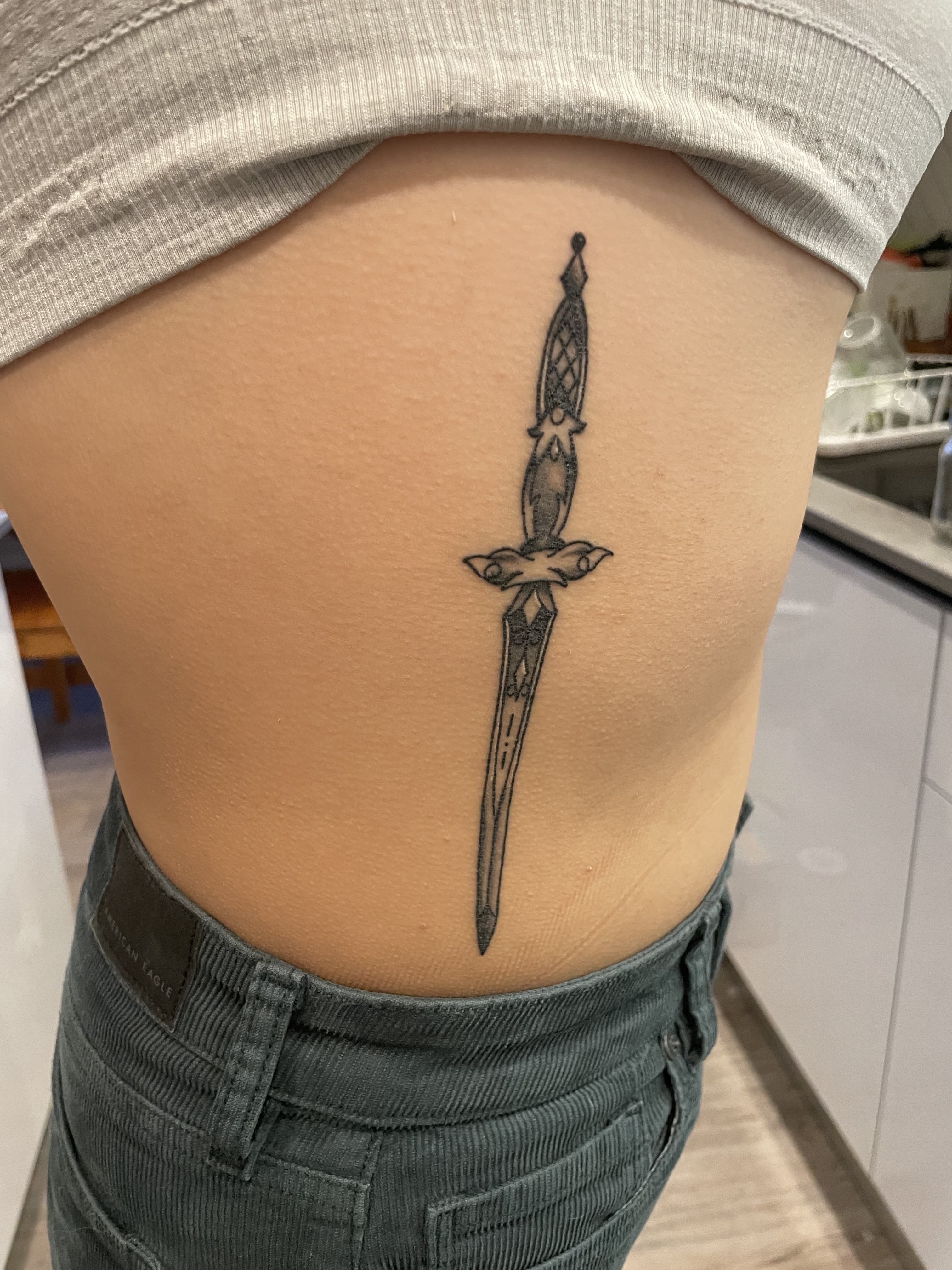
I asked Michael about his tattoo of the three of swords. “Well, threes are energy, vitality, motion – they arise from loss or partnership or conflict. Three of swords is heartbreak, alienation, and sorrow—mental alienation and loss. The three of swords invites us to find the sweetness and wisdom beneath our sorrow –that’s my take on it. Go underneath the sorrow – penetrate and pierce it.”
Cutting and piercing are the work of the sword. And underneath the pain is sweetness.
Recently, a client asked me to cut 40% from several of her book chapters—truly an exercise in figuring out what’s most important. Same thing in life. Look at what you most value and treasure it. Let go of what you no longer value.
As the Queen of swords accompanies me throughout this year, I would like to continue to examine the mental obscurations that trap me and prevent me from experiencing serenity. For example, much anxiety arises from worrying about the future, but I know there is no future. There is only today.
Michael’s tattooJoan of ArcN. ChurchillMy niece Sarah’s tattoo
My dad, 1927-2021, looking over his land soon after they bought the farm.
We walked slowly Thursday morning because overnight, recycling boxes and bags heaped with cans, bottles, cardboard, and newspaper had appeared at the curb. Blue splashes up and down the street that Marvin had to investigate, and so our walk slowed to a shuffle. He snuffled like a pig rooting for truffles, straining at the leash to lick the pizza box, to reach the Friskies can with a smidgen of catfood left on the rim. The night before, during his last walk of the day, he’d let out a volley of piercing barks at a pile of recycling across the street. Perhaps to his eyes, in the dark, the mound of stuff piled high above the blue box was a threatening mammal.
Early September’s morning chill, high scudding clouds above, and a Northern Flicker playing hide and seek in a hawthorn tree, his red head popping in and out of sight. The street is quiet—just the distant thunder of the McKenzie interchange as a blur of cars crosses into town. I am grateful to work at home, no need to commute. Instead, I love these 7 a.m. walks. Something in a recycling box caught my eye. Neatly folded on top of a pile of newspapers was a section of Saturday’s Globe and Mail, folded to the crossword puzzle. Every clue solved; every box filled with a neatly penciled block letter. Perfection. Did my puzzle-solving compatriot struggle over it as much as I had?
I felt connected to that person—their careful block letters different from my scribbled slanty ones, but we both finished the thing. Did they do it quickly, or did they stretch out the experience into Sunday or even farther down the week, relishing it? Did they approach the task methodically or fill in random clues? Did they ask for help or go it alone? Dictionary or no dictionary? Google or purely old school?
Marvin ate half of my pencil.
Think of all of us across the nation who turn to the crossword first thing on Saturday. Sharp number 2 pencil. Or maybe a mechanical one. Do some confident people use pens? Fresh white eraser by Mars. Or a pink Dixon, perhaps? We sit in armchairs, on couches, sprawled on deck chairs, scrunched on buses and subways, drinking lattes in coffee shops. All of us, together in the challenge.
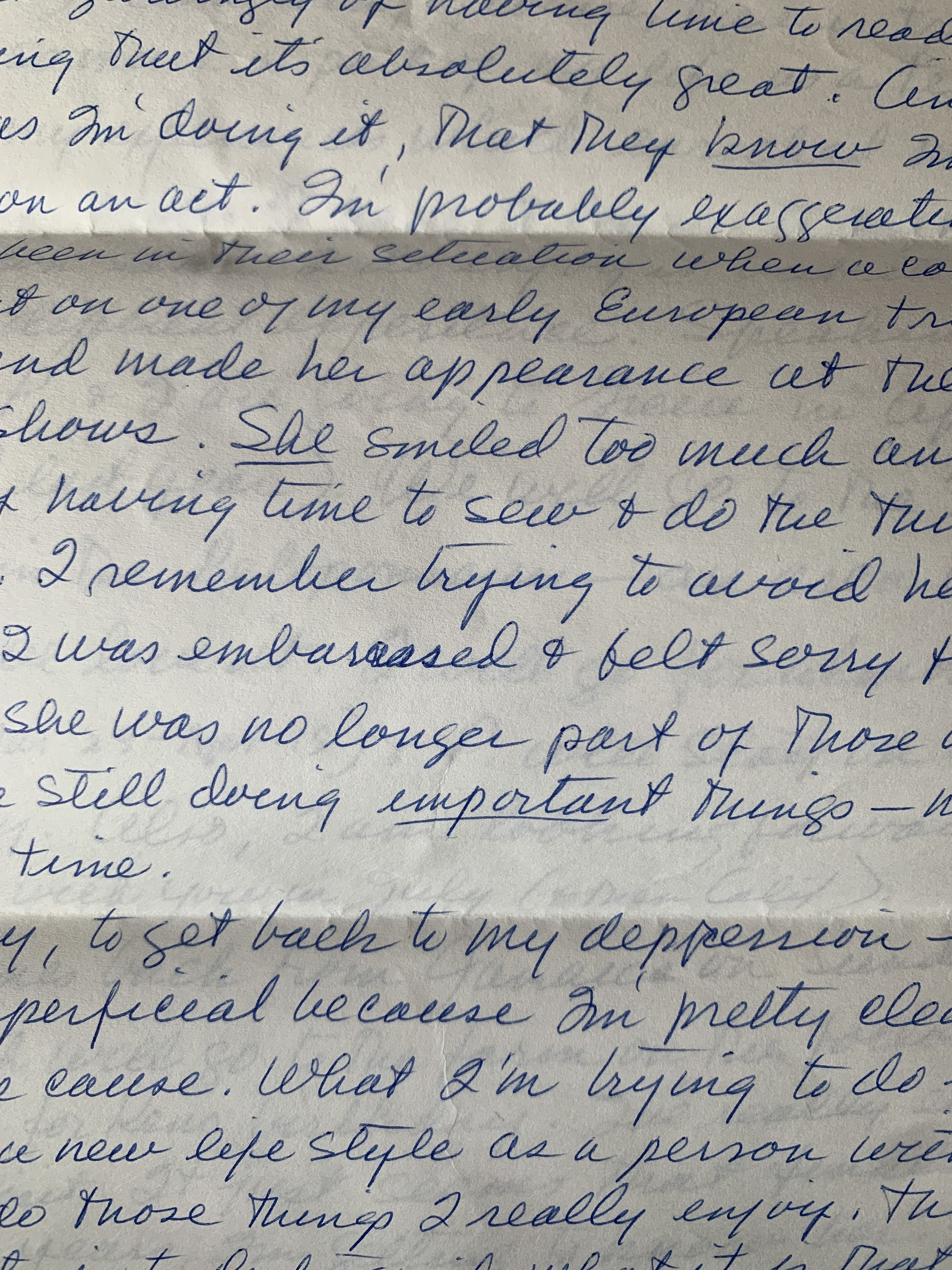
My mother did crosswords daily for the last 22 years of her life. They helped fill blocks of morning time after her mandatory retirement from her job as a lecturer in art history at Ryerson Polytechnic in Toronto. I found a letter from her dated February 1997. She had just received a package I’d sent intended to cheer her up:
“I didn’t realize my depression was so obvious. It isn’t a deep depression. It is simply that I no longer have an audience and no longer get paid for doing something I enjoy. The awful thing is that as soon as a person retires, he/she loses status. I notice it when I talk to people at Ryerson . . . They seem extra kind and sort of smile at me and ask me what I’m doing, etc. I smile back and try to talk glowingly of having time to read, etc. pretending that it’s absolutely great. And I know, as I’m doing it, that they know I’m putting on an act. . . So, I’m trying to develop a new lifestyle as a person with time to do those things I really enjoy. The difficulty is to distinguish what it is that I enjoy doing! Meanwhile, I do crossword puzzles, which is new for me and I’m getting pretty good at it (usually at breakfast), and it’s very nice to have the leisure not to have to rush.”
I started doing the Saturday crossword soon after my mother died in 2019. I thought they were too hard at first, and so I’d abandon them quickly. I have a healthy vocabulary, and I love language, but the crosswords seemed like something else. They’re filled with puns and tricks, and it seemed you had to be part of the in-crowd to get them: both hip to idiomatic English across the decades and savvy about current cultural trends. I’m just too literal, I thought, and what I know fills such a narrow groove. But then the challenge started to intrigue me. Now I look forward to the Saturday paper. After reading the headlines and the obituaries, I find the crossword, fold it into a nice rectangle, and begin.
All of this is a preface to say, I’ve had no will to write. Nothing seems worth writing about, these days. Life has a flat, fallow quality. Nothing’s important enough. Although there’s plenty of big bad news—pandemic, systemic racism, climate change—I don’t feel equipped to talk about any of it.
So, I push myself to finish this rather silly piece, a blog post about something as quotidian as the crossword puzzle. I stop and pause often to ask, “Why bother?” Why bother indeed. But it’s just that writing something, anything, seems as if it might be the antidote to the flat way I feel.
My thoughts return to my mother, sitting on the loveseat in her high-ceilinged living room, wrapped in a thick robe, blinds down, doing the crossword. Filling the hours. Her sleek black cat, Cicero, is curled up beside her. She is deep into it, puzzle dictionary next to her on the small rococo marble-topped table, Schubert’s Trout Quintet playing softly on the CD player. Missing the old nicotine rush, the sweet suck of smoke into her lungs, she holds the pencil like a cigarette for a moment. I miss her. In that old letter from ’97, she wrote,
“I’m probably exaggerating, but I have been in their situation [those Ryerson people who acted extra kind toward her] when a colleague retired and made her appearance at the annual fashion show. She smiled too much and talked of having time to sew and do the things she enjoyed. I remember trying to avoid her because I think I was embarrassed and felt sorry for her because she was no longer part of those of us who were still doing important things—not just passing time.”
Mama and me, back in the day.
Doing important things v. Just passing time. . . I flinch at my mother’s binary of “important” paid work and “just passing time.” But something in what she wrote resonates with me. I work part time as a self-employed editor, but lately, I often feel as if I’m just “passing time.”
Maybe this is just the flatness of grief. Flat-footed grief walks over me. After many losses, I am a fallow field—nothing growing here.
I have been reading memoirs about aging parents. . . Elizabeth Berg writes in hers, “I think as long as a parent is alive, it’s easier to feel young.” After my father died at the end of June, I’ve felt old, flat, fat, tired, sad. Nothing feels important. Especially not the weekly crossword. And yet, musing over the word problems gets my brain churning slowly, raking over clues like a pitchfork turning organic matter in the compost heap. I feel connected to crossword puzzlers across Canada. I imagine, for example, an old guy in Mahone Bay—let’s say he’s 82, goes by Ernest Nickerson and sits in the kitchen nook with morning coffee, chewing the end of the pencil as he tries to remember what a 10-sided shape is (79 across, 7 letters).
From our 2012 honeymoon in NYC
Remember geometry class in tenth grade? That’s where Ernest first noticed the girl who would be his wife, in geometry class at Mahone Bay School. As he digs deep for the name of a ten-sided shape, another thought is unearthed from that compost heap: Darlene’s thick red hair, held back with tortoiseshell barrettes. He couldn’t take his eyes off those red wings in front of him during class, couldn’t stop imagine pulling his fingers through that rough, dark crimson hair. He unclicks the delicate barrettes to let those wings loose to fly. If Darlene were alive now, Ernest thinks, she’d lean into my ear, her coarse grey hair tickling my nose, skinny shank up against mine, and whisper, “Decagon, Ernest. You knew that, honey.”
I write to get momentum, to feel connected to people, to create worlds. To feel connected to you, and Ernest, and Darlene. So, if you are a maker, a creative person, (we all are, each in our own way) remember: The work wants to be made, and it wants to be made by you. Even if it doesn’t seem important. Believe me, it’s important. It connects you to life. The fallow field regenerates.
Memoirs about aging and dying parents that I recommend:
Roz Chast, Can’t We Talk About Something More Pleasant?
Philip Roth, Patrimony: A True Story
Elizabeth Hay, All Things Consoled: A Daughter’s Memoir
Elizabeth Berg, I’ll Be Seeing You.
From a later trip to NYC, March 2019, after my mother died. Sugar skulls in a restaurant display.
Guest post by Judith Walker, aka Jude, my sister and a wonderful cook
Retro, old fashioned, nostalgic, comforting. These words will have different meanings for all of us, depending on our age and our interests. For me, the feelings of nostalgia, craving and comfort come from memories of meals and gatherings from my childhood in the 60s and 70s and also from early adulthood in the 80s, when I experimented with food and first cooked professionally.
When I was a kid we lived in California. Our mom wasn’t a confident cook, she was a late starter and as a young wife and mother struggled to fill her role as the family chef. Some of her meals included simple seasonal items that sound exotic but were quite ordinary for the time and place. Whole artichokes steamed with lemon and served with a bowl of mayo that we shared for dipping. After a lot of peeling and sucking on the tough leaves we were rewarded with the succulent heart. No mayo required, an amazing flavour burst that would linger on my palate for hours. Possibly my first sensuous experience. And the tacos. So basic and so good. We would all help prepare this meal, bowls of fried ground beef, chopped iceberg lettuce, chopped tomatoes, onions, grated cheese, mashed avocado, and sour cream. And hot sauce for Dad. It must have been the tortillas that made this such a memorable meal. In Berkeley, we had many Hispanic neighbours. I think my mom was able to find fresh tortillas in the local grocery store. I know that my first bite of a fresh corn tortilla in Mexico many years later flooded me with nostalgia.
Another go-to dish for special occasions was ceviche. Mom made one with scallops, shrimp, and onion chopped up and marinated in fresh lime juice. This was an easy dish she could prepare ahead of time and was elegant and delicious. I don’t recall what she served it with, I just ate it by the spoonful.
And then we moved to cold, Anglo-centric Toronto. No more avocados, scallops or tortillas. It was the 60s after all. So, overdone roast beef, watery spaghetti sauce and tuna casserole came into our lives. Our mother tried to teach us to cook when she went back to school. Cooking pasta (we called it noodles), chopping an onion, peeling veg, measuring, making rice and washing dishes were things we learned. I don’t think the results were great, but I am grateful for the lessons. My fave dish from those days was tuna casserole. I am serious. There is something about that combo of the salty tuna, the creamy blandness of the mushroom soup, slippery noodles and crispy edges that is the epitome of comfort food. I’m pretty sure I made this more than once on a hungover Sunday in my twenties. Better than Kraft dinner!
–cook 2 cups of broad egg noodles according to instructions -open and drain one can of chunk white tuna -open a can of Campbell’s cream of mushroom soup -drain the noodles and mix all the ingredients together in the noodle pot along with a nob of butter. -pour into a greased 9×9” pyrex dish. If you are feeling fancy sprinkle crushed saltine crackers on top. -bake at 350 till bubbling and crispy.
( I just checked the Joy of Cooking recipe, and they recommend seasoning the soup with dry sherry! Hilarious!)
Another recipe that was easy for us kids to make and that we actually ate was hotdogs in cornbread:
-put 6 hot dogs in a 9×9” pyrex dish -place in a hot oven and roast till a bit brown and blistered -mix one recipe of cornbread from the Joy of Cooking -pour it over the hot dogs and cook according to instructions -serve with butter and yellow mustard on the side
I sometimes crave this meal, but know if I made it I would eat the whole thing and quickly descend down the spiral of shame.
My mom tried, she just didn’t have much to work with and not much inspiration in those busy days. We never had Kraft slices, Wonder bread, pop or ketchup in the house. I didn’t know what pizza or french fries were till I was in junior high. I remember visiting my grade 7 friend in her wealthy parents’ fancy penthouse apartment. Their live-in cook would make us toasted Wonder bread topped with bacon and melted processed cheese. Served with ketchup. I loved it. However, I am grateful that our mother raised us on real food and set us on the path to healthy eating.
Things started looking up in the 80’s. Mediterranean, Asian and Indian food were starting to trend. My mother was travelling a lot then and brought back recipes and fresh ideas. We thumbed through Gourmet magazine and cookbooks looking for our next dinner adventure. The more complicated the better. We would make forays to Kensington market, Chinatown and little India seeking exotic ingredients. And then spend hours in the kitchen, often at Mom’s, gathered around the butcher block on our periodic Friday night family dinners, with mixed results. It was fun and challenging and I learned much that has stayed with me. Pasta from scratch, fresh herbs, toasting and grinding spices, rehydrating dried mushrooms and peppers, fresh cheeses…risotto! So much to discover.
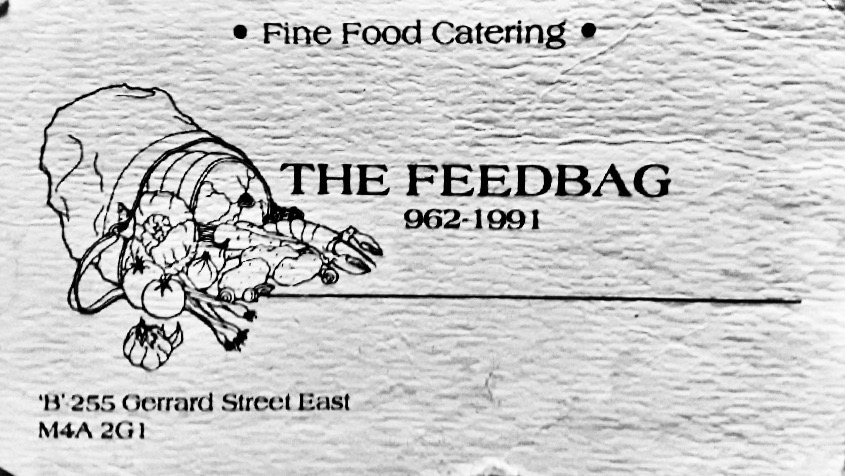
In the mid-80s, knowing nothing about running a business or professional cooking, I started a catering company with a couple of friends called “The Feed Bag.” It was hard work, fun, funny and pretty much a failure financially, but there were some great parties! We made hundreds of spring rolls, massive sushi platters, a ridiculous number of meat, cheese, veggie and fruit trays, with little money to show for it. One of our go-to cookbooks then was The Silver Palate. The quintessential 80s cooking guide. Every recipe has more fat then I would eat in a week now. Decadent. I recently pulled out my battered copy because of a challah recipe request from my sister. I looked back at the most raggedy pages and found one of our old tried and true recipes, chicken dijonaisse. So simple, so good. And easy. I made it recently with a few additions, some shallots, grated parmesan and fresh parsley, and ate it with egg noodles. Delish. Anything served over egg noodles is comfort food for me.
I also made a pineapple upside down cake a while ago, another childhood favourite. Honestly it wasn’t as great as I remember, I think I skimped on the butter in the caramel sauce. I did create an elevated version of this when I worked in fine dining. Individual servings baked in a ramekin with half of a ripe red plum on the bottom. It was beautiful when inverted on a plate surrounded with a creme anglaise or boozy sabayon.
I am not sure why food has been such a focus in my life. I am not academically inclined and hated school, so I managed to make a decent living and support my travels by working in kitchens. But it is more than that. Food was a conduit to my mother, a shared past, our phone conversations in her later years pretty much revolved around what we were cooking that day. And our cats, but that is a whole other story. It was one of my favourite parts of travelling and a wonderful way to connect to local communities and their customs and everyday life. You can learn so much about any part of our world by learning about the food the locals grow and eat and the history and traditions around them.
Researching, designing, cooking, sharing and eating food has sustained me on many levels for much of my life.
This was the menu request for my birthday dinner when I was a kid fifty-five years ago.
Baked chicken Potato salad Corn on the cob Watermelon Chocolate cake
I would grill the chicken now, but other than that I stand by this as my favourite summer meal.
Good food is good food.
The End
Note: I would like to give credit to Judy Gorton for the logo she created for “The Feedbag,” my first business and only adventure in catering. She has been a friend for almost 40 years and is a wonderful artist. I still remember part of the menu from the dinner party we catered for her as payment for the design:
Cornish game hen stuffed with basil couscous
Carrot sformato (an Italian savoury soufflé, my mom’s recipe)































 Madeline Ruth Walker