“When we run from our suffering we are actually running toward it.” Ajahn Chah
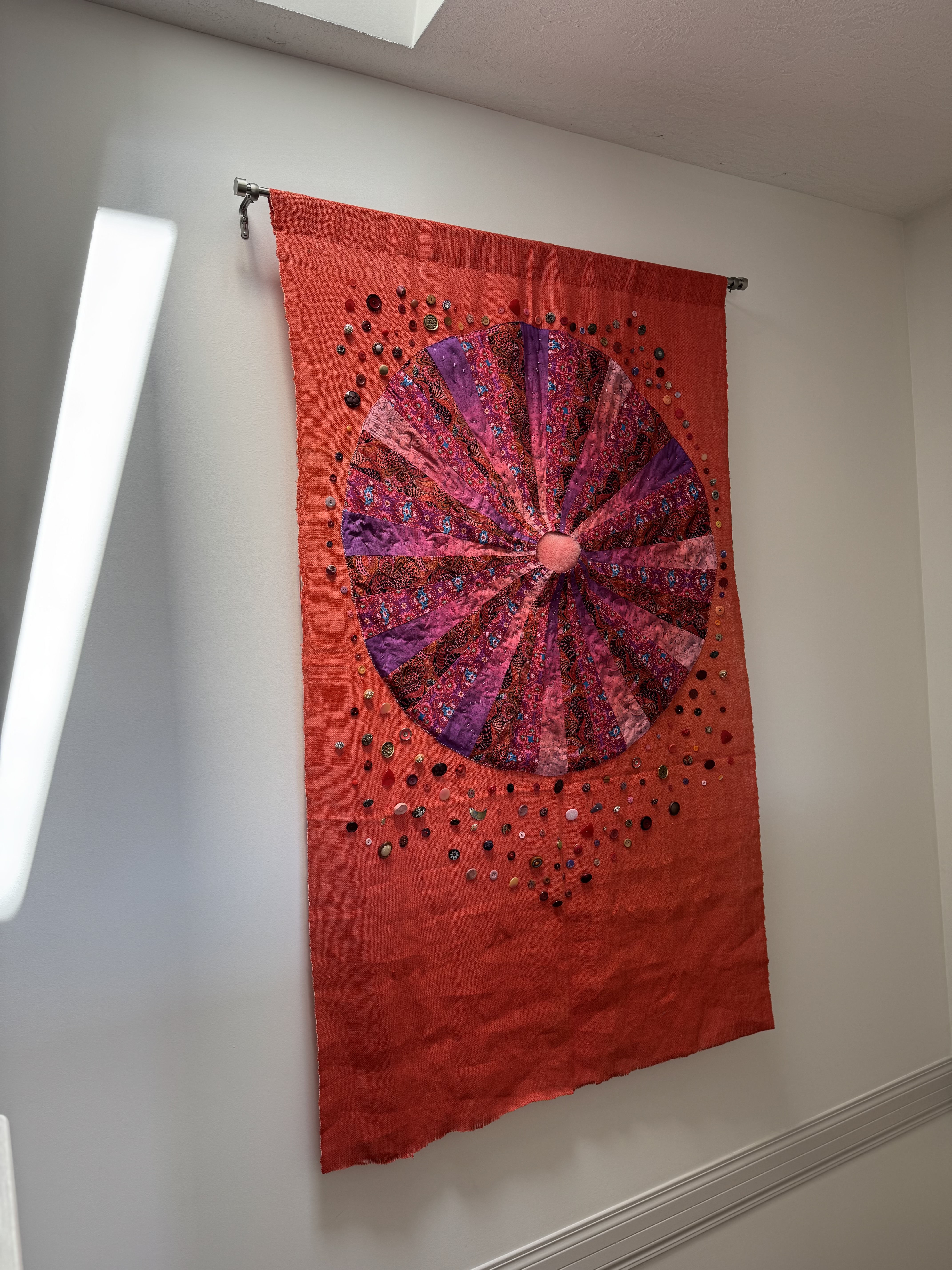
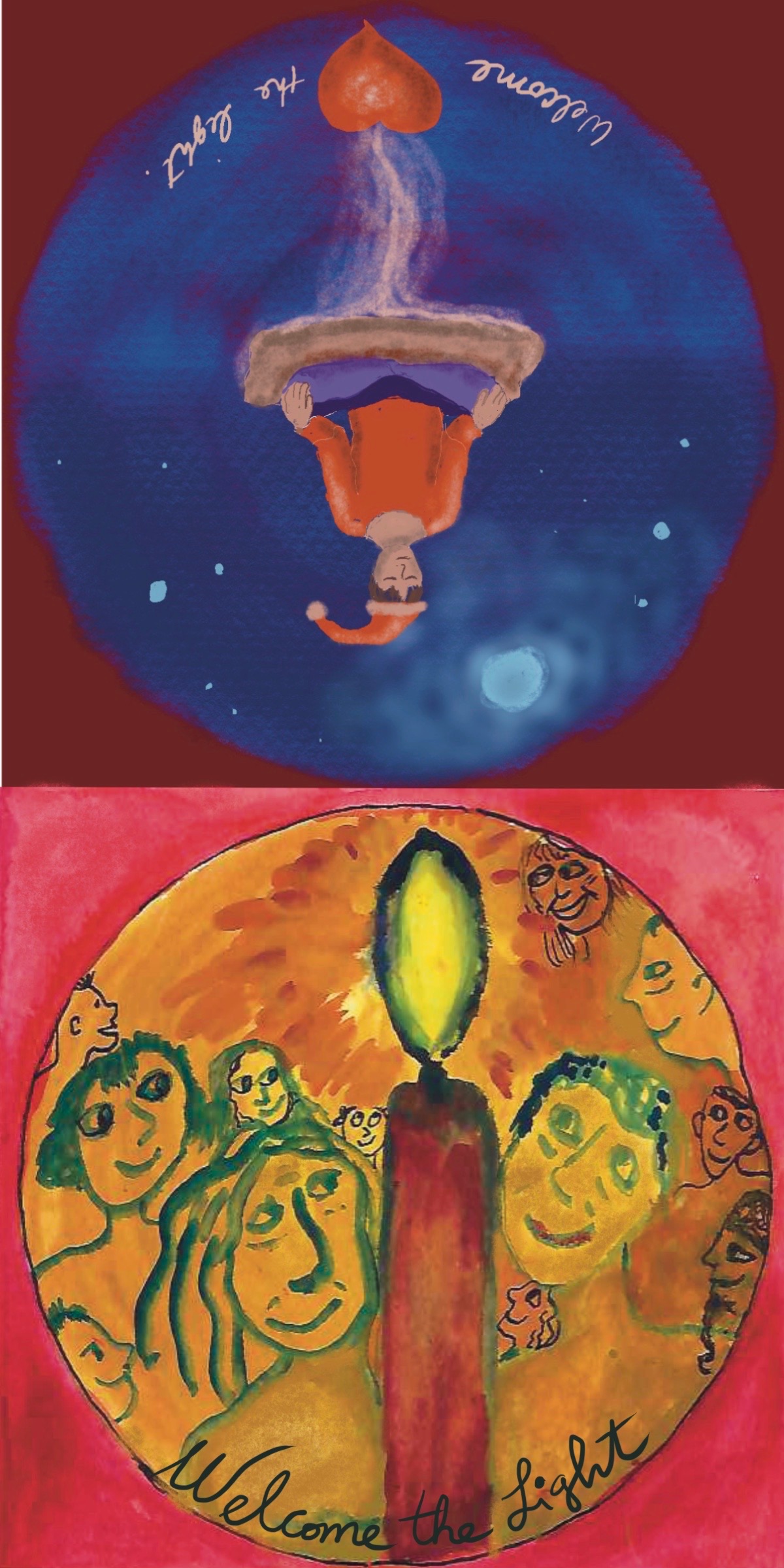
I’ve been basking in two messages from my unconscious this week. In one dream, a person wearing a bright tie-dyed shirt holds a hand lettered sign, “You are not alone.” In another dream, a young man, bearded, hugs me and whispers in my ear, “Thank you for your patience.” The messages are hackneyed, and yet they were delivered to me fresh, warm, colourful,by stately messengers. It doesn’t matter if they—the messages and the messengers—aren’t “real”; they are just as real as the people and events, the words, ideas, and things I encounter in my dream-like conscious life. And more to the point: They provide great comfort, having bathed me all week in an orange glow, a glow like that emanating from the 10,000 joys wall hanging, now installed in our stairwell.
The wall hanging seems to collect the sunlight falling in through the skylight and send back a peachy radiance. Several times now I’ve gone to flick the hall light off, thinking the switch is on when it shouldn’t be. No, the light is off, but 10,000 joys shed their own uncanny light.
When I made the piece, I kept telling myself, you don’t have to make its counterpart, 10,000 sorrows. It’s okay to just focus on joy right now. But of course, you cannot have 10,000 joys without 10,000 sorrows. I wish we taught this truth to children in kindergarten. You don’t experience joy without experiencing sorrow. And it’s okay. When you cling to joy and try to avoid sorrow, you just prolong it. I wish I’d gone to a Buddhist kindergarten, where these truths would be taught elegantly and logically, instead of being told by adults that “life isn’t fair,” which seems tawdry and cruel in comparison to the dharma.
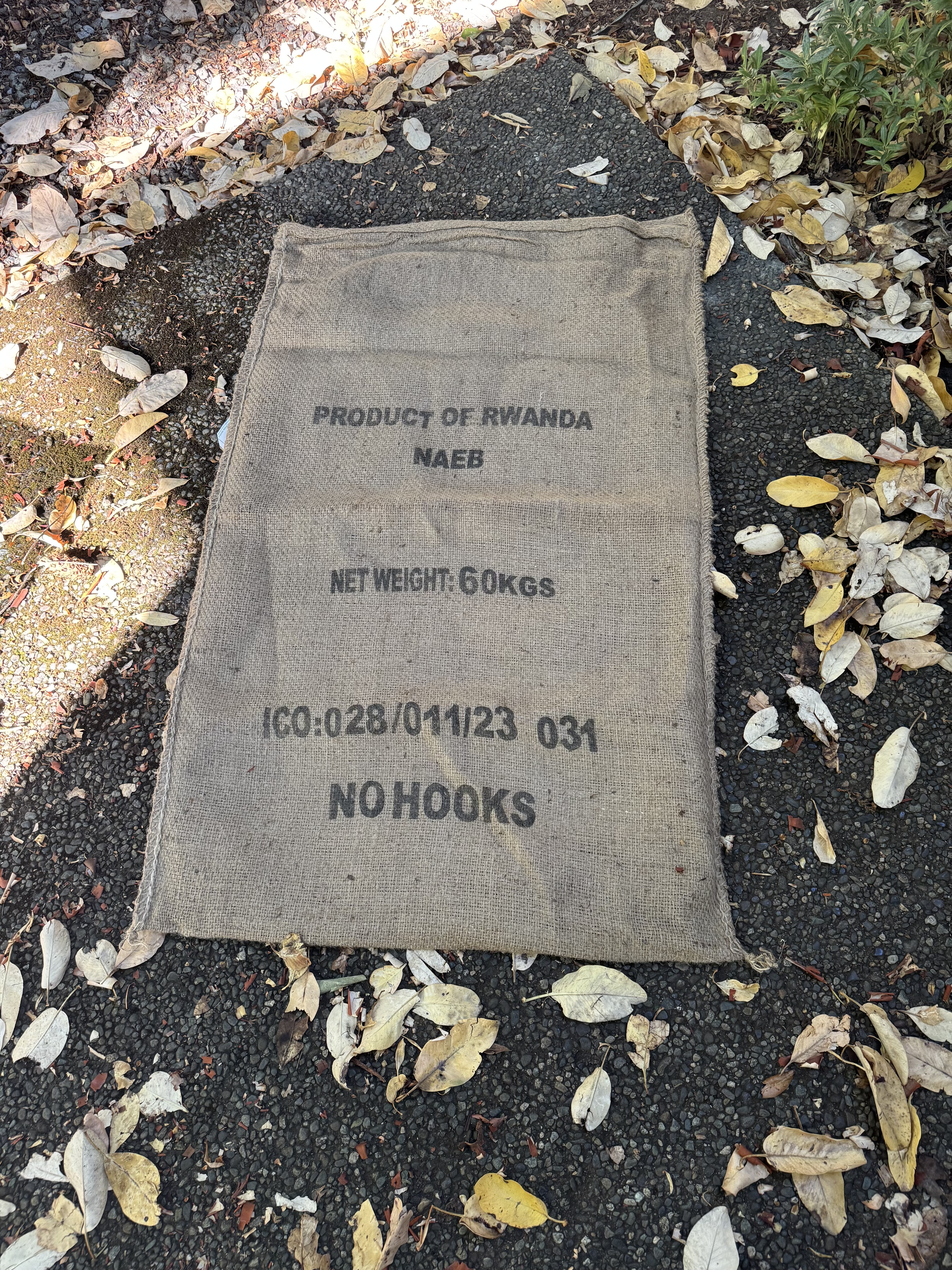
Inevitably, I am called upon to make joy’s counterpart. I had coffee with a friend yesterday at Esquimalt Roasting Company. As I waited at the counter for our lattés, I noticed a large burlap bag draped over a plastic bucket. I picked it up and showed it to the barista. Can I buy this? I asked. In my imagination, I was already picking its seams and spreading it out, a wide brown canvas for thousands of sorrows. It’s free! she responded. So now I have the backdrop for the wall hanging. I had originally thought it should be black, but brown is less dramatic than black, more subdued and complex, as sorrows often are, especially as we digest them.
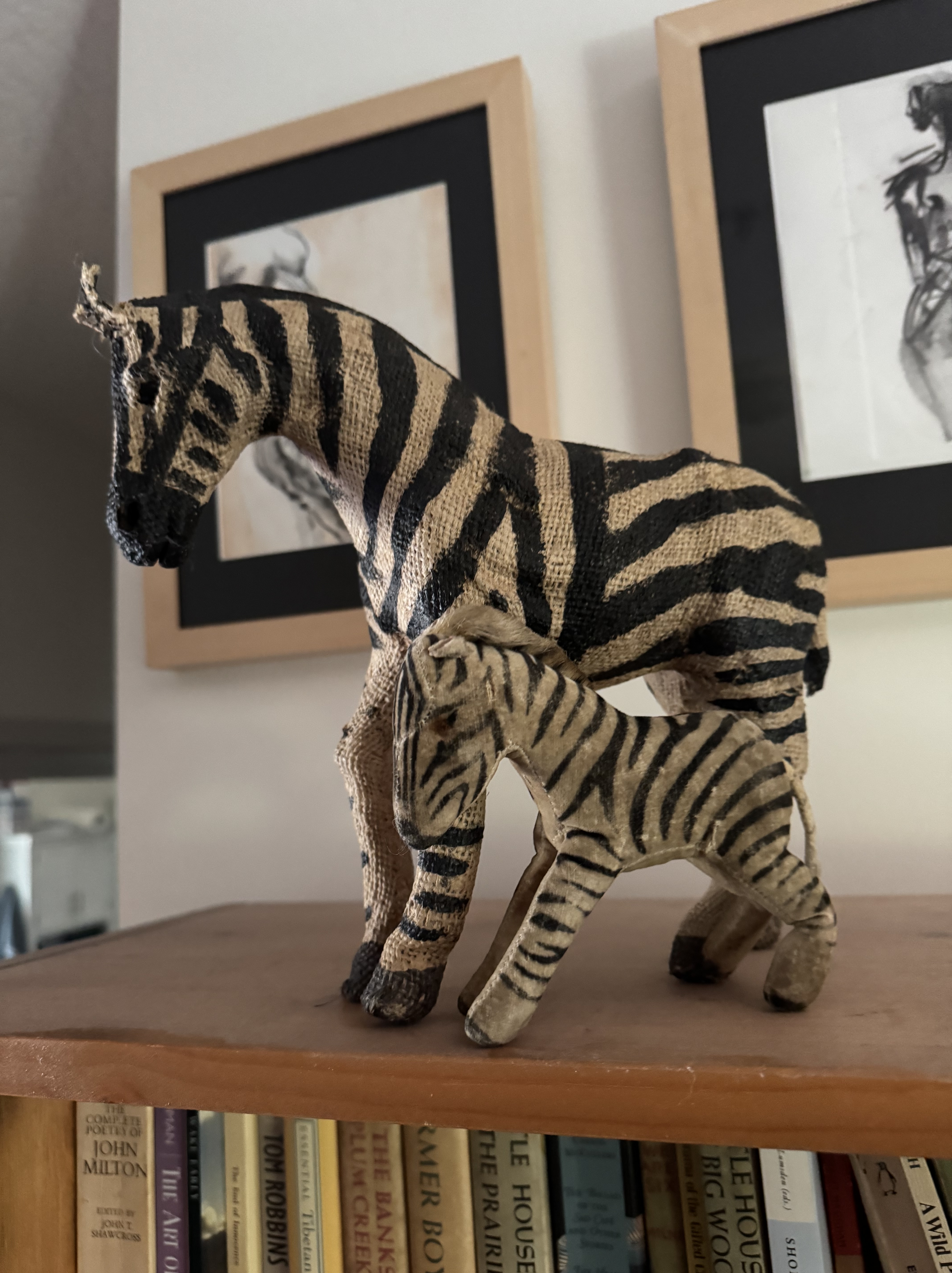
The burlap bag was pure serendipity. Another magical find was a zebra at the ReStore in Langford. Purchased for 70 cents ($1.00 but there was a 30% off sale). This zebra is majestic, dignified, kind, warm. She stands about 10 inches high. Her stripes are unrealistic, but otherwise she is a convincing animal. I dug out a stuffed toy zebra I’d kept from childhood in a box under the stairs. It’s remarkable this sixty-year old stuffed animal still stands! They now live together, mother and child, atop a bookshelf in our bedroom. I like to gaze at them from bed. Something about them feels calming, comforting. I loved my zebra striped one-piece bathing suit when I was eight years old. When I wore it, my reward was a zebra tan that was pure magic.
How to find comfort
Face fear, face grief, crunch on them like buttered toast, let them nourish you. Small striped body in the mirror, some kind of childhood magic. Let dreams bathe you in orange light. Sweet’s after tastes bitter, crying sparks a belly laugh. Joy and sorrow are so intertwined, you can’t tease them apart, please don’t waste time trying. Practice the butterfly hug: Hands cross collarbones, thumbs meet, fingers tap lightly, lightly. A comforting rhythm will come. It will come.
I am in Toronto for a few days. This city was my home from 1965 to 1989.
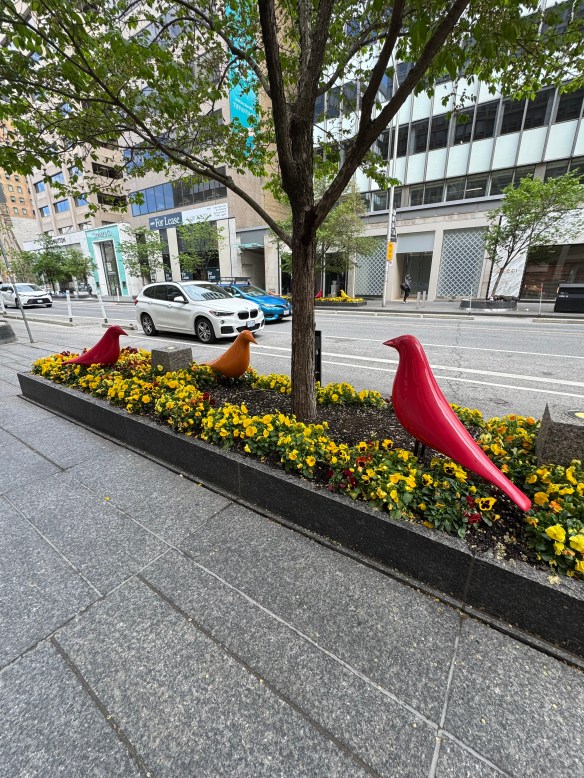
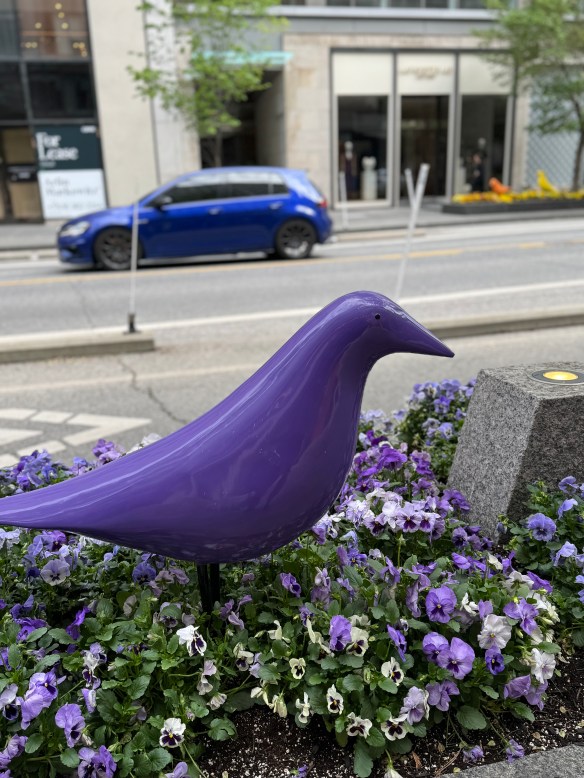
I have been walking Bloor Street West. First, the Mink Mile, that stretch between Yonge and Avenue Road lined with the tall glass storefronts: Zara, Birks, Lululemon, Holt Renfrew. Rich people shop here. Very few birds fly above these tall, inhospitable stores. Instead, big bird shapes in bright shiny colours line the sidewalks, ghosts of extinct species.
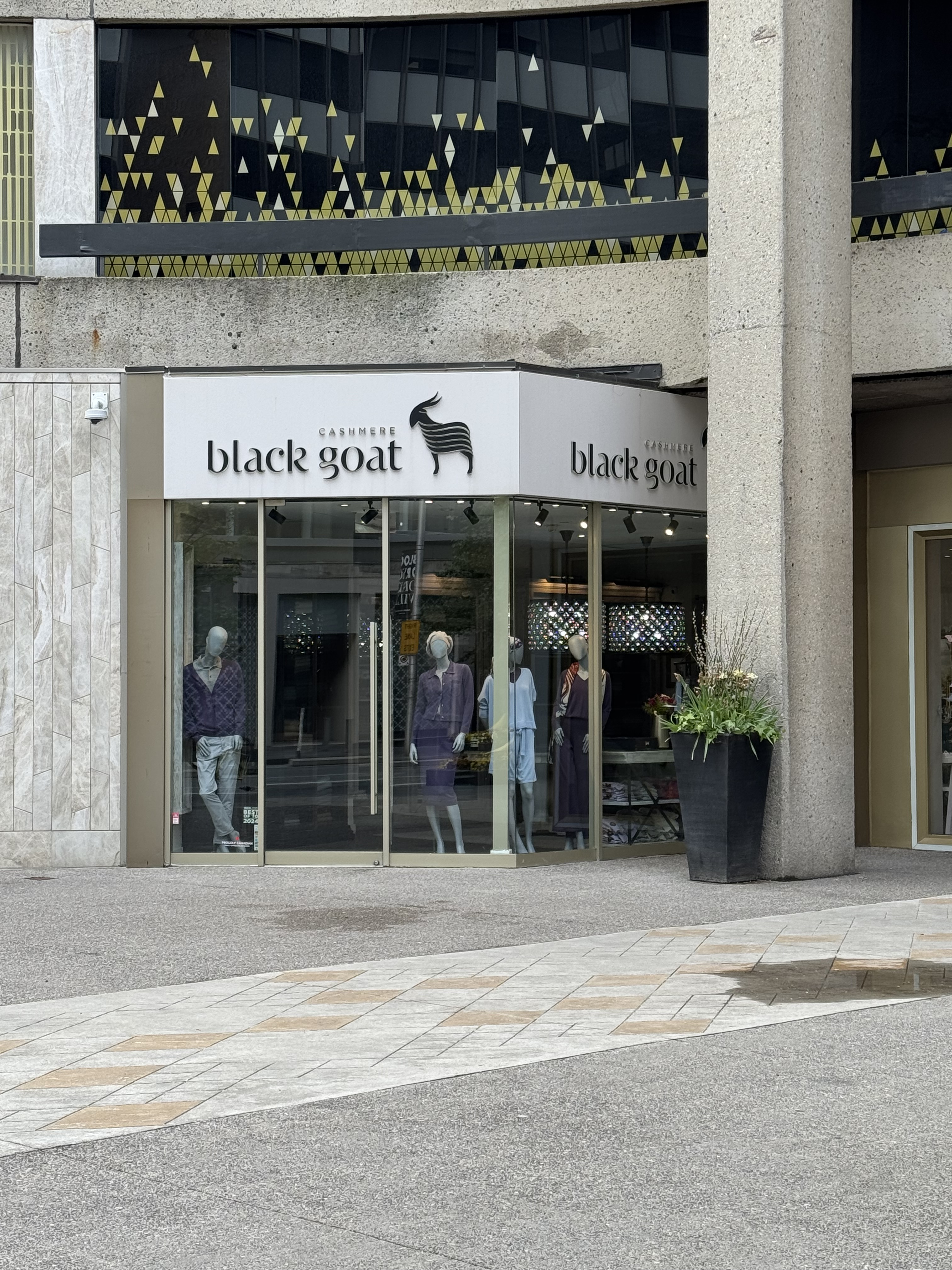
It’s cold in Toronto for late May. I wear a toque, jacket, leather gloves. But now I wish I’d brought a scarf. I admire the scarves in the window of Black Goat Cashmere, next to Ashley’s in what used to be called the Colonnade. This mall was one of my mother’s favourite places; after window shopping Bloor Street arm in arm, we’d drink coffee and eat pastries at the Coffee Mill at the back of the Colonnade.
I enter the store. Two saleswomen are upon me immediately. I ask about the small scarves, lifting one of them up out of the wooden box where they are displayed like confectionary, soft cashmere in artful designs, wool watercolours. “How much are these little ones?” “Oh,” says one of the women, advancing, “the Carre scarves are $385.” I laugh, folding the luxury item back into its box. “Perhaps in another lifetime.”
Pulling my zipper up to my chin and walking into a fierce wind, I take a detour to wander around the grounds of my alma mater, Victoria College. I feel nothing as I gaze over the green lawns, watching two young men kick a soccer ball. Alma mater means “nourishing mother,” but this place was not that for me. Those four years as an undergrad in English Literature are a blur. One thing stuck: a Shakespeare lecture by Northrop Frye when he—already extremely old—told us in his quavery voice that Bach’s Mass in B Minor was the voice of God speaking. All of us bent over our notebooks and wrote that down. It sounded profound.
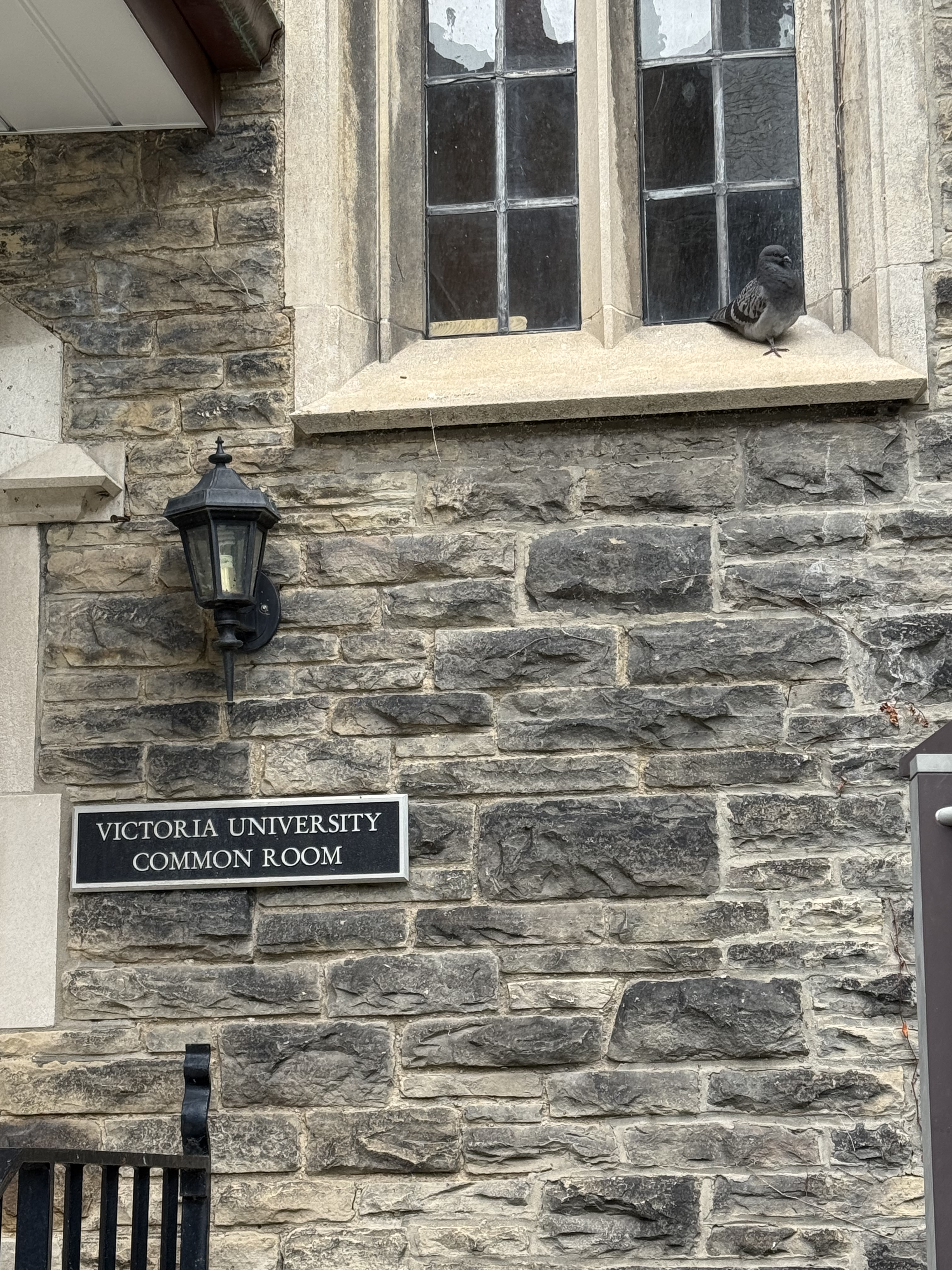
I was a lonely young woman. Barry Lopez writes that “It is not possible for human beings to outgrow loneliness,” and that seems true to me. Though I’m not as lonely as I was. I admire a pigeon perched in the recessed window of the Victoria University Common Room.
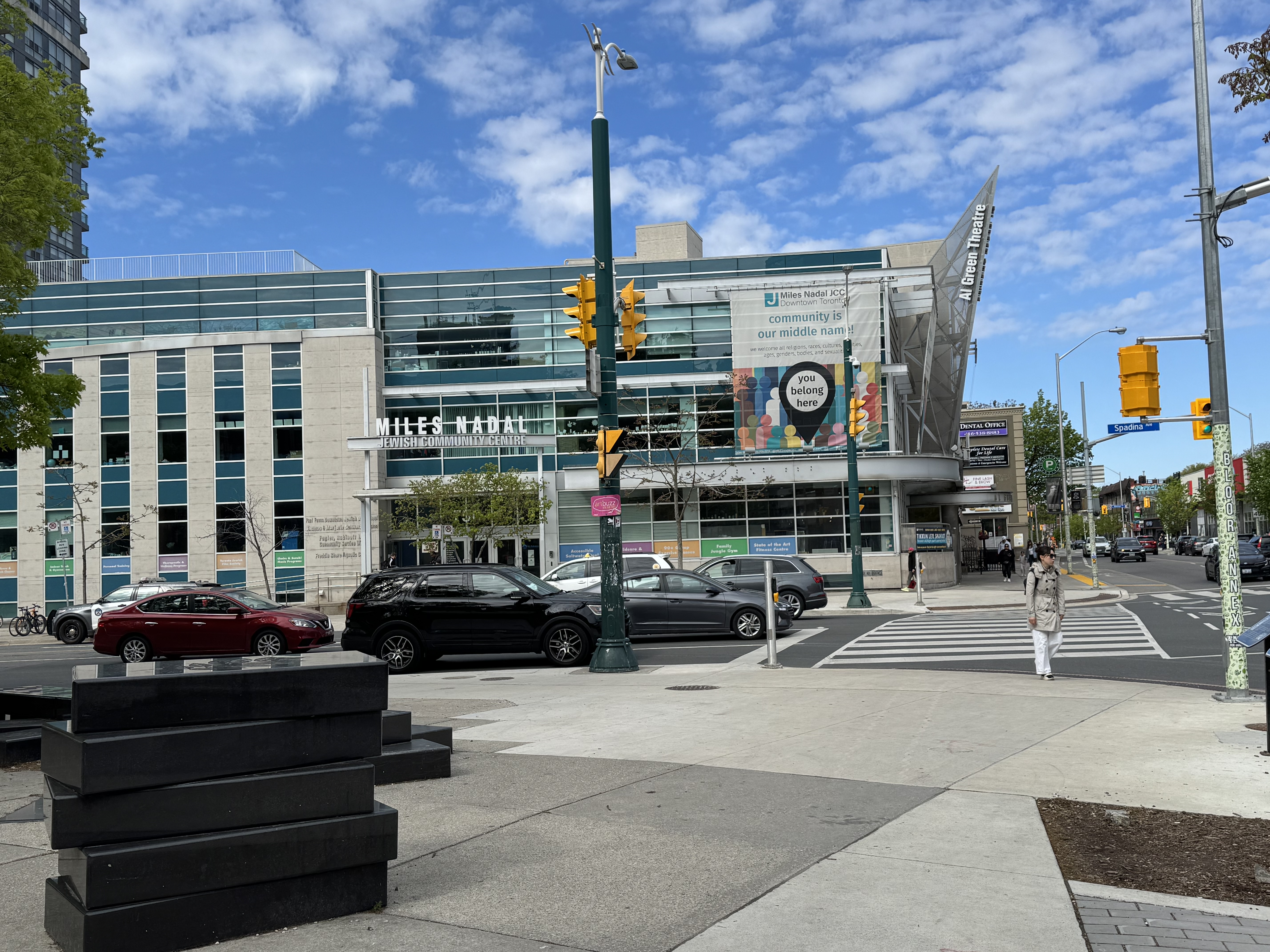
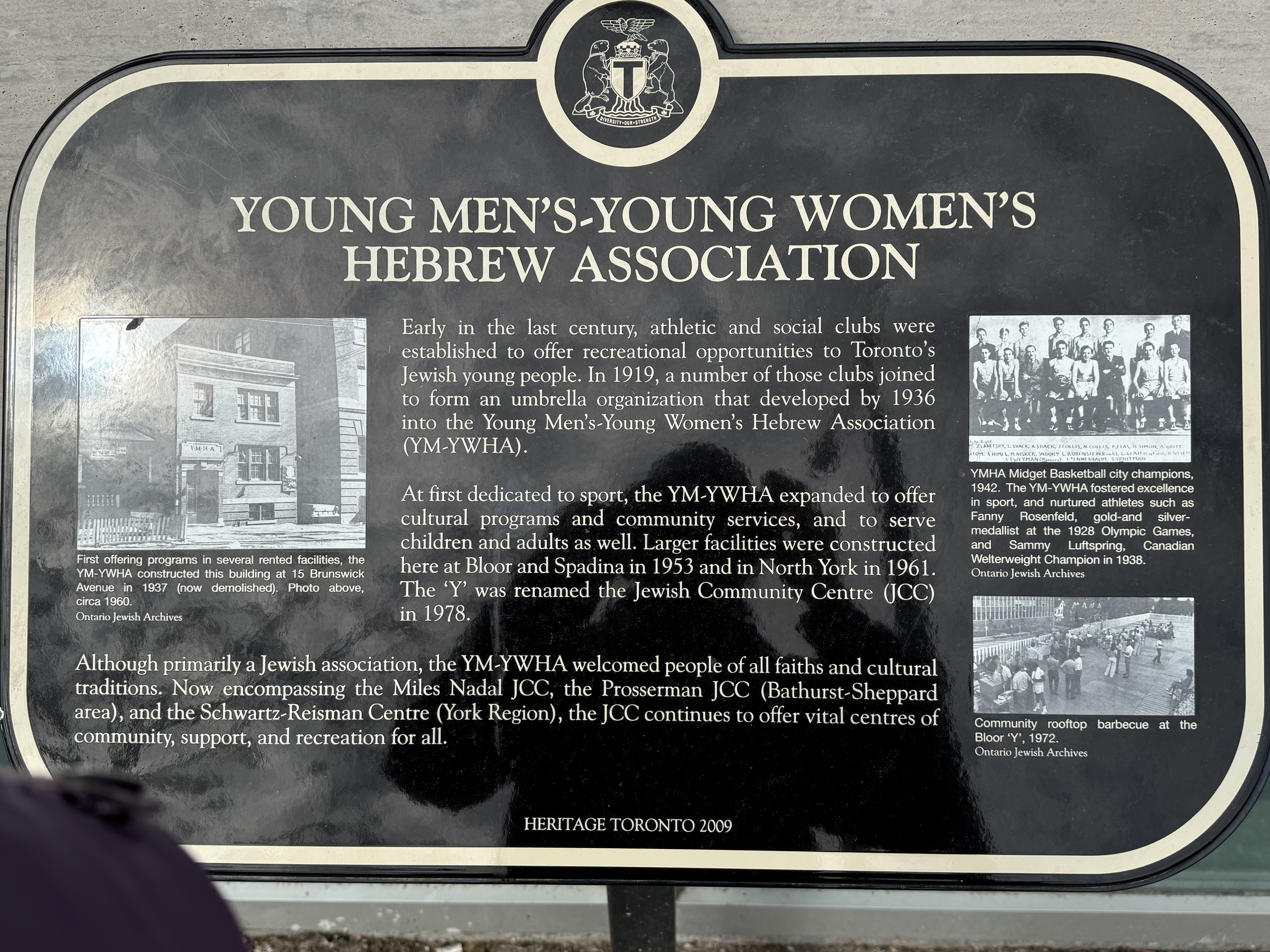
On the way up University back to Bloor Street, I check out the Gardiner Ceramic Museum, where I hope to see the work of contemporary ceramic artists, only to find that the main galleries are closed for renovation. I continue back along Bloor. It’s time for a coffee and I remember a Second Cup in the block before Spadina Avenue. And if that is no longer around, there’s a coffee shop in the old Jewish Community Centre (JCC), where my mother did aquafit for the last decade of her life. Back in the seventies, when it was the Young Men’s Hebrew Association, it was home to SEED, the alternative school my sisters and I went to as wild teens.
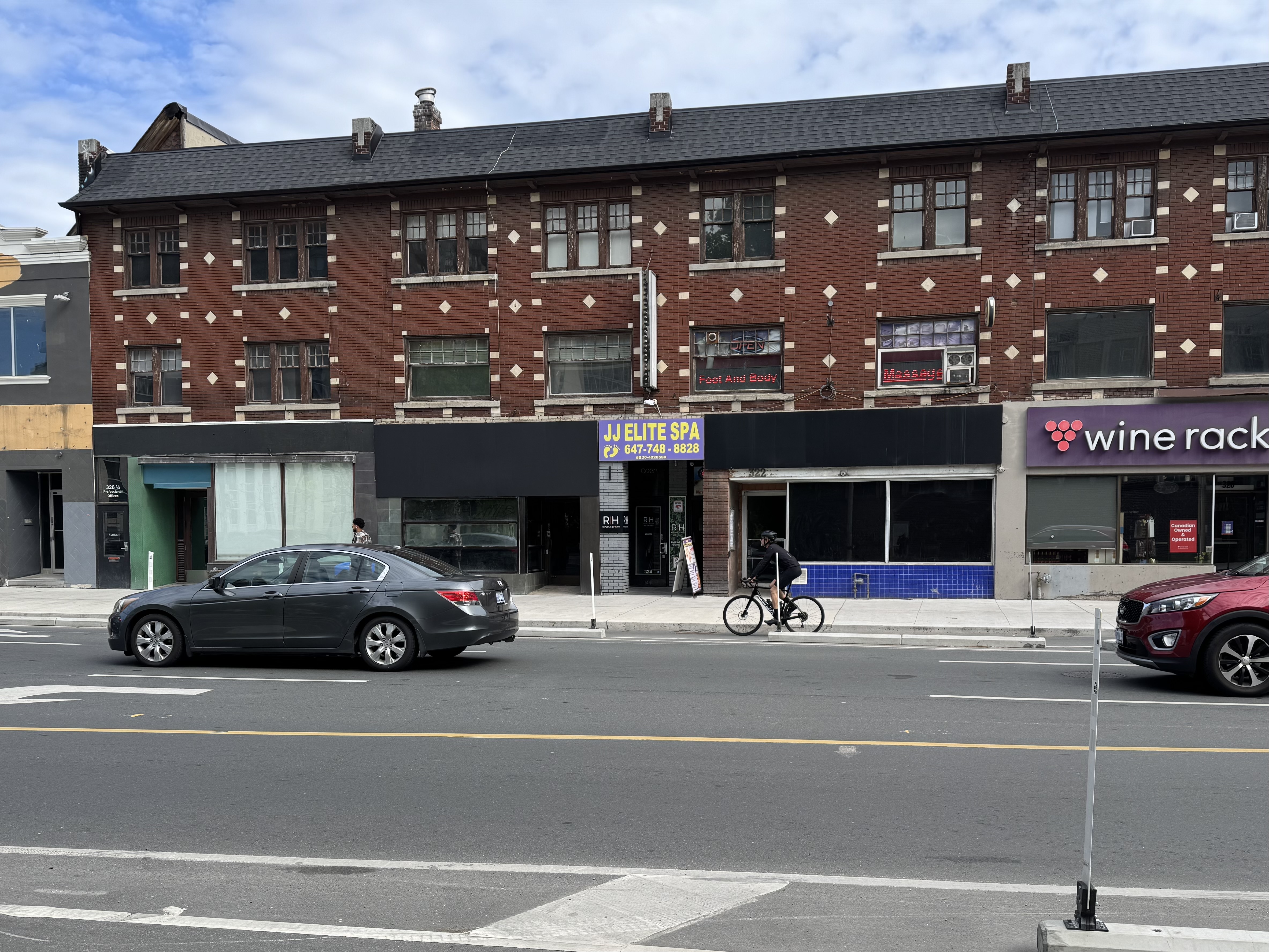
Second Cup is gone, and so are many of the other businesses on that block. Everything in life is impermanent, so I am not surprised Second Cup and Noah’s Health Foods have disappeared, and the spaces are vacant. Once upon a time there was a greasy spoon in this block where we drank coffee in thick cups, smoked cigarettes, and ate French fries. We walked over from “school” and stuffed our electric bodies into the vinyl booths, laughing, talking, flirting, mystified and excited by life. Once, for a time, my sister lived above the restaurant with her boyfriend, an apartment with burlap on the walls and plants everywhere. There’s history here.
The wine store remains. This is where we bought bottles for the meal marking my mother‘s death in February 2019. Her house is only a few blocks from this corner, and she died at home. We carried the clanking bottles through the snow. My sister made bouillabaisse and we sat around the teak table, drinking, eating, and telling our Virginia stories, stories filled with love, regret, sadness, and confusion.
I cross the street twice to the southwest corner and pull on the doors of the Jewish Community Centre, but my pull meets resistance. A security guard opens the door from the other side, just a few inches, and peers at me. “I am trying to get into the coffee shop,” I say. “No more coffee shop. Coffee shop no more,” a sort of palindrome of endings. And he closes the door in my face.
I keep walking. Surely, there is a sweet, cool, interesting café somewhere along Bloor. I am Ahab stalking the great flat white, but she’s nowhere to be found. I pass more than one Tim Hortons among the restaurants and bars still closed this cold morning, but no, I won’t go there. Cigarette butts decorate the grey pavement, evidence of parties spilling onto the street last night. Pigeons strut their stuff. I keep walking. Yes, I know Futures Bakery might be considered an interesting coffee shop, but I hold out for something else, some uncertain thing, something new, something not in the algorithm.
I keep walking. The Hungarian restaurant where we ordered dumplings and gravy and goulash soup: gone. The delicatessen and the cheese shop with a cow in the window: both gone. The café that once took up that southeast corner of Bloor and Bathurst: gone. Now there’s a Fancy Burger outlet, where you can add a syringe cheese shot to your beef patty for $1.49. This part of Bloor continues to metamorphize. Ethnic restaurants and record stores turn into cannabis shops and bubble tea counters. Used bookstores become pet pampering salons and tattoo parlours.
I am happy to see Midoco, the office supply shop, a place where you can lose yourself among the art supplies and fountain pens, is still in business. Ditto the Home Hardware.
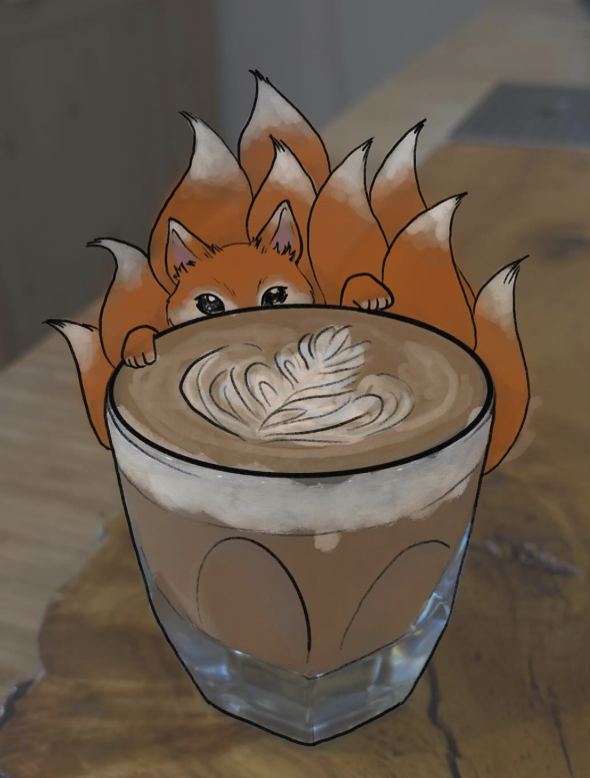
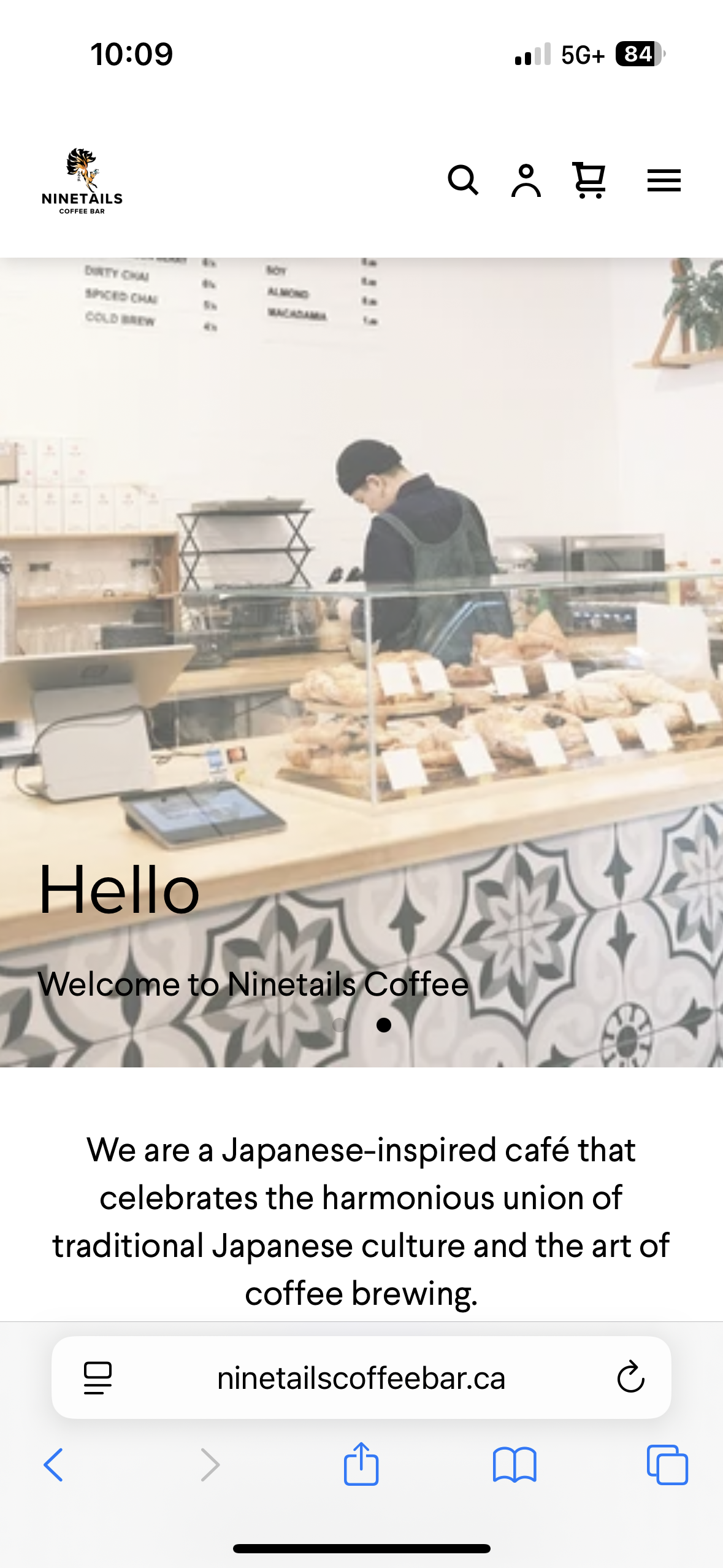
I keep walking, knowing that somewhere soon, I will come upon something interesting. I pass the small corner grocers, happy to see they still sell bargain produce and hanging pots of flowers. I pass Euclid, cross to the south side, and then, suddenly, there is an A-Frame sandwich board picturing a fox with many tails. I walk into Ninetails Coffee Bar, where two young Japanese women bustle behind a honey-coloured wood counter. White walls, a few small round tables graced by simple folding chairs. A coffee bar decorated with ceramic tiles patterned in grey, blue, and white. A full pastry case. Smiling faces welcome me.
My flat white, delivered in a short glass with a foamy fern on top, is delicious—strong and hot. While I drink my coffee I read about the coffee bar’s philosophy.
In Japanese folklore, Kitsune are foxes with mystical powers that can grow nine tails.
“we embrace the Japanese philosophy of ‘ichi-go ichi-e,’ which translates to ‘one opportunity, one encounter.’ This concept underscores the importance of cherishing every moment and every connection we make with our guests, as each encounter is unique and irreplaceable. Our goal is to provide you with a little window to Japan & Japanese culture within each visit.”
I gaze across Bloor to the north side and see, to my delight, a used bookstore that I’ll visit after I drink this coffee. It’s too easy to get lost in the past during this trip. Wandering through old neighbourhoods, remembering past experiences, feeling traces of old sadness and joy. But Toronto, like Freud’s Rome, is a metaphor for the mind. There is no denying that my personal history, etched through the decades, permeates my experience of Bloor West. I feel these vestiges of the past in my body.
But there is also the present: every moment is unique and irreplaceable.
The sun finally emerges from behind grey clouds on this cold day and streams through the glass over my table. I will never experience this moment again, as I drink this coffee, as I gaze at the people around me, the heavily inked man, the woman with green hair, as I examine the fox on the sandwich board outside, waving her many tails. She reminds me there is only one opportunity, one encounter. This is it.
On RARE 7, we’re riding with Grindy. Let me explain.
RARE means Radiant Abode Road Experience, a name we devised because our road trips have a magical quality. In Buddhism, the four radiant abodes are loving-kindness, compassion, joy, and equanimity. Our RAREs involve good measures of each of those qualities. I can’t remember precise years, but since we met in 2011, we’ve been on six RAREs: to the Sunshine Coast; round trip to Toronto; to Asheville, Oregon for the Shakespeare Festival; to Utah and Arizona; down the California coast to see the Redwoods; and to Naramata, BC for a wedding. There have been many mini-RARES, but true RARES must involve substantial driving and a shift into the road-trip ethos. The mood-shift usually happens around the third day. Time takes on another dimension. Long conversations and silences abound. It doesn’t matter what we do, see, eat, or drink—it is all food for breakthrough insights and feelings about life. So far, some of the discoveries on RARE 7: Accept sadness as part of everyday life. While we can’t deny the facts of aging, impermanence, and loss, we can transform our approach to dealing with them. Spontaneity doesn’t thrive on perfectionism. Let it be messy and muddy, sticky, and real. All you need is curiosity and willingness to try something new. Letting go and renunciation are both part of our path.
“Renunciation is realizing that our nostalgia for wanting to stay in a protected, limited, petty world is insane.” Pema Chodron
This RARE has an undertone of sadness. In Michael’s words, the space and texture of this RARE is “gentle, luminous, totally real, a little dark, honest, open-hearted.” Sure, we are joyful to be out on the road together, the summery weather, cold lakes, rolling rivers, green mountains wearing tattered scarves of snow. But we are also realistic—as we deal with aging and loss, there’s no pretending we feel great every day. We both struggle, sometimes dipping into dark holes for a time.
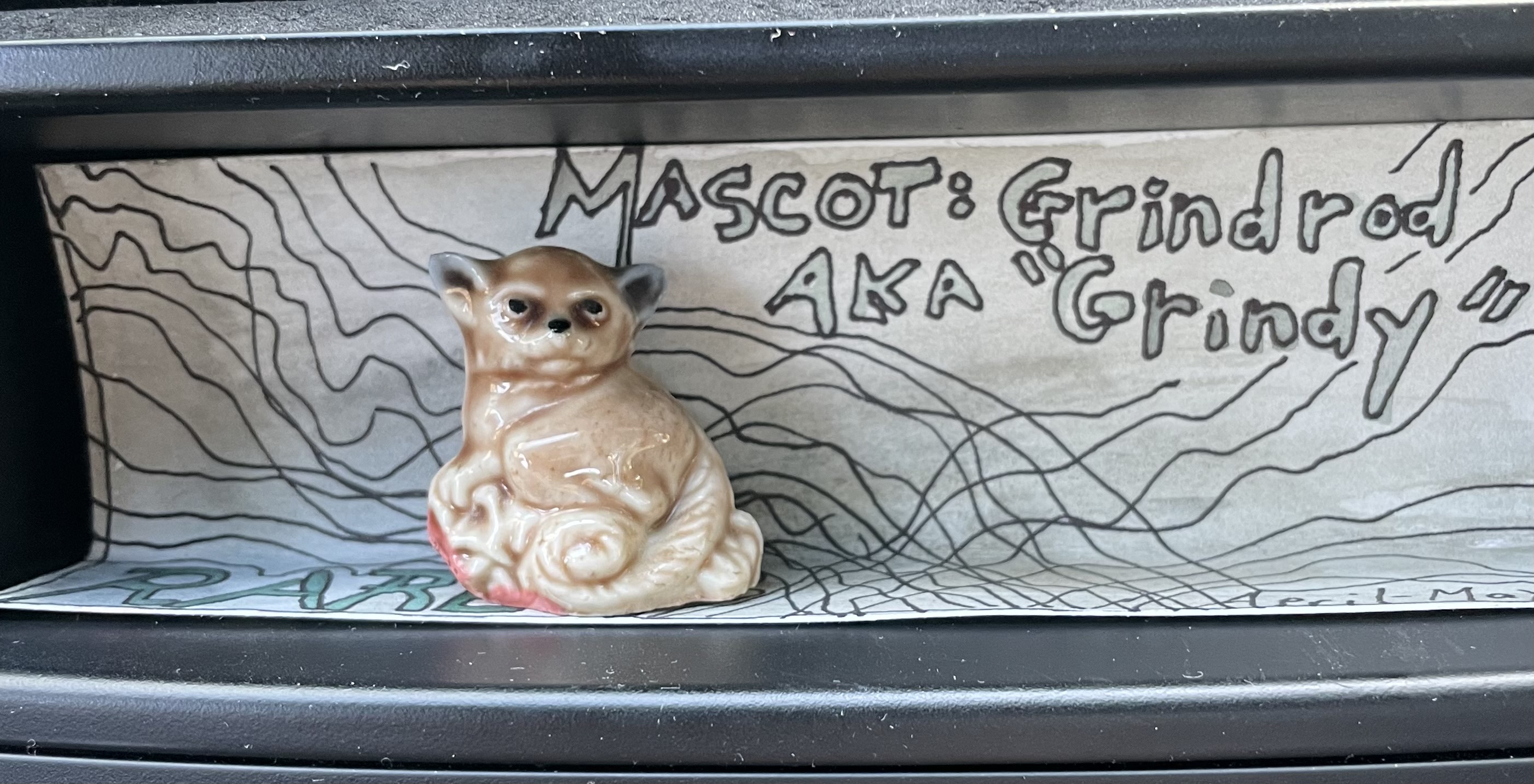
To align with our mood, we look for a suitable RARE mascot at a thrift store along the way. The first leg of RARE 7 took us to the Shuswap Lake area, so we stopped at the Salmon Arm Churches Thrift store and bought for $2 a ceramic lemur, one of those little Wade figurines that you used to find in boxes of Red Rose tea. Attracted to his sad expression, we named our little boy Grindrod after a farming town near to where we are staying in Sicamous, BC. “Grind”? Well, think daily grind, grist of living, the put-one-foot-in-front of the other aspects of life. And “rod”? Think resilience, the ramrod yet flexible backbone that holds us up. Short name, Grindy. On the road with Grindy.
There were some pink and frothy early RAREs. Lying on the pavement in downtown Seattle comes to mind, just so I could see the city sky and feel the sidewalk under me—acting kooky, acting playful. Trying to recreate that lightness is nostalgia for a protected, limited world. It’s insane.
On our second night in the lakeside cabin near Sicamous, we moved to the bunkbeds after a restless first night in the too-soft bed for adults. Nestled together in the lower bunk, a double, felt like being teenagers at summer camp. Except that, unlike teenagers, we lay back to back, reading. “There’s an old aunt in this book,” Michael says, “who believes that love isn’t a feeling, it’s a decision. What do you think?” We both do a half turn so we can see each other. “Yes, I agree. But maybe a feeling and a decision. What do you think?” He paused. “I’m not sure. I’ll have to think about it.”
Something is nudging my memory, and ten minutes later, I ask him if he’s reading Liane Moriarty’s The Last Anniversary. “Yes,” he says. “So am I!” I practically shout, overjoyed.
“I thought that thing about love being a decision sounded familiar. I’m almost finished the book.” “And I just started,” Michael said. Both of us had checked the e-book out of the library, without realizing the confluence. I love being married to a man who enjoys good-quality feel-good chick lit. We can compare notes on what the characters think and do. A truly RARE moment.
Michael
Perhaps it’s because I just had my 72nd birthday, or perhaps it’s emerging from the pandemic, but I’ve found myself wrestling with the realities of aging. Day to day life, even retired, feels full and heavily scheduled –this is why our road trip is such a welcome change of pace, and as Madeline says, it seems to kick in on the third day. I know that the RARE ethos is activating because a great deal of my usual mental activity is revealed to me as nonsense and begins to drop away.
Day three: let’s go hiking! We look up Sicamous Creek trails, and with a little help from GPS and the Sicamous Visitor Centre, find the trail head. The choices on the map we look at are Easier, Difficult, and More Difficult, and they are accompanied by GPS coordinates. The only trail available from where we are is not the easy one, but we bravely head off.
It’s so beautiful hiking the short distance to the waterfall— ice cold air, water music, and forest fragrance. I love it but find myself wishing the trail wasn’t so narrow, precarious, and steep, and the stairs that make up part of it are giving Madeline pain in her knee. It’s a very short hike, and back at the trail head I realize that my ability to navigate steep trails and uncertain footholds is not what it was. Strangely, I feel totally ok with this. RARE magic is kicking in.
Back at the cottage I search for trails in Sicamous that are easy and find the River Front Nature Park. It’s relatively short, flat, and “family friendly”, so off we go, while I’m thinking “I guess I’m going to have to stick to the codger trails.” What we find is an absolutely magical world in rich browns and ochres, with the trees just budding and spattered with green.
We walk along and talk about expectations and perfectionism—the feeling that we need to make the perfect choice, find the perfect hike, the perfect dinner, the perfect accommodation—and how impossible and corrosive this is. We designed this trip to be spontaneous: unplanned, staying for two or three nights and then moving on to wherever we feel like. Seeking perfection ensures disappointment; curiosity and acceptance allow me to appreciate experiences just as they are. I feel lighthearted for the first time in months, and I realize how much time and energy I spend thinking about how things “should be.”
One of my favourite teachers is Yongey Mingyur Rinpoche. He says “Like waves in the ocean, all things are impermanent. I will accept whatever happens and make it my friend.” I have been writing this in my gratitude journal each day for months, but on this RARE I feel like I am finally getting it. I am aging. I have back pains, hearing aids, and my memory isn’t what it was. I am afraid of falling, and I sometimes wake up in the middle of the night worrying about death. I also walk 9000 steps a day and ride my e-bike for 25 kilometers. I am kinder and more contemplative with each passing day, and I am learning to love myself just as I am. Like the landscape flying by our car windows, my thoughts and emotions are fleeting. Nothing hangs around for long, which is deeply comforting. Here is the teaching of RARE 7—when I stop fighting impermanence, it becomes my friend.
The bus to work takes about 40 minutes—the perfect length of time to listen to a dharma talk on Dharmaseed. I’m happier with this pastime than I am browsing Facebook or Instagram. The dharma talks inspire me and make me feel better about being alive, while Facebook or IG can make me feel dispirited. Recently, I listened to a talk by a dharma teacher I enjoy—Shelley Graf. She read an excerpt from Sharon Salzberg’s 2002 book on faith. I liked the quotation, but even more, I was intrigued by Salzberg’s book title: Faith: Trusting Your Own Deepest Experience.
Trusting your own deepest experience brought to mind a revelation I had when I started to see a therapist four years ago. Doesn’t sound like much, but it was profound for me: I am entitled to claim my own experience. During that therapy session, I had been dithering about whether I felt a certain way, circling around the ugliness of something, making excuses, minimizing my hurt, my terror, my sadness—in short, underplaying what I felt. “Oh, it wasn’t really so bad.” Nancy sat up straight in her chair, looked at me with intensity, and said, “Madeline, you are entitled to claim your own experience!” I laughed, “really?” I didn’t know that. To think I got to this stage in life feeling I couldn’t be honest about how it really was, how it really is, to be me. I came home that day and on the mirror in my sewing room, I wrote, “I am entitled to claim my experience.” I refresh it with a wine glass marker when it fades because it’s a crucial daily reminder.
Back to Salzberg’s book—well, I bought it and read it quickly, underlining the bits that made me cry or wake up or feel a swelling in my chest. There were many passages that made me feel good—made me feel connected to something bigger, something transcendent, which is what faith is, isn’t it? I love the sense that “no matter what happens, we can place our faith in the deepest part of ourselves, our buddha nature” (p. 170).
With those good feelings still germinating inside of me, I entered the course Michael and I are teaching on Zoom this weekend: Creating and Interpreting Personal Mandalas.[1] This morning, we led our participants through stages one through three. In stage one we rest in the darkness, in the womb. Being, not doing. As I started my mandala, I lined the womb-circle with layers of brown watercolour. Soon, a purple hyacinth spear emerged from the lining of the womb.
As I painted, my mind travelled back, back, back. Thirty-five years ago, I had several weeks off work to heal from surgery. Waiting time, resting time, stage one time. Hours in bed spent daydreaming, not doing, just being. My first husband and I lived in Toronto in a rented house on Devonshire, and the spacious front bedroom had big bay windows with generous ledges. The laser surgery I’d undergone was supposed to give me a chance at having babies, something I hungered for. When my friend Hannah visited me, she brought a potted hyacinth, not yet blooming. I put the plant on the window ledge, and it was as if I could feel the ache of that blue-blushed spear yearning to open.
It was early spring in Toronto: cold days, deluges, and then suddenly, bright hot sun. One day the hyacinth burst forth in a matter of hours, spraying the room with sweetness. Whenever I smell hyacinths, I go back to that time of hunger and healing. My body craved to follow the flower in her blossoming. But I had to wait.
My grandmother Marguerite and I were writing to each other that year. She sent me copies of Unity Church’s magazine and told me that she and other members of her congregation in Los Gatos, California, were praying for me to heal and get pregnant. I thanked her and pretended to be onside with her faith. But in fact, I thought it was silly. How quaint, a circle of old ladies in a church basement, holding hands and thinking of me.
Grandma Marguerite Walker in the Philippines, 1923
Months and months elapsed with no result. I thought the surgery hadn’t worked; after all, the doctor had told me I had only a 15% chance of having children. The odds weren’t great. Feeling like we needed a big change in our lives, my husband and I sold our stuff, quit our jobs, bought a Volkswagen van, and drove south. Almost a year after my surgery, we sat in a Planned Parenthood office in Green Bay, Wisconsin to learn the good news. I was pregnant.
The hyacinth I painted this morning seemed to have come from the deep well of memory— light-filled room, white sheets rumpled on the bed, the bluish spear opening as I kneeled nearby in my nightgown. Spring magic! And I thought of Sharon Salzberg writing about a research project undertaken in Korea: Women trying to conceive were prayed for at a distance, and these women became pregnant at twice the rate of those who received no prayers. I underlined that passage. Beautiful evidence of our “profound interconnectedness” (p. 147).
I think often of my grandmother’s faith, and how she and her Unity friends may have had some small part in my blossoming into a mother. And now, I blossom into belief in the interconnectedness of life, belief in the butterfly effect doing its work not only in the material world, but in the emotional realm too. The mistake we make, writes Salzberg, is to expect a certain outcome from our actions. We get attached to results, which leads to expectation. “When our intention is to do good for others, and we nurture that intention, we can have faith that in some way, often unknown to us, it ripples out” (p. 144). As we go deeper into spring and the hyacinths begin to open, let our loving intentions and kind actions ripple out in ways we will never know.
Everything becomes something else. For example, my husband, Michael, has become a man who likes Christmas. He wasn’t a big fan of December 25, but he’s supported my love for celebrations surrounding the holiday: the tree, gifts, music, cards, and baking. This year, something shifted for him. He decided to see what it feels like to open to positive Christmas energy.
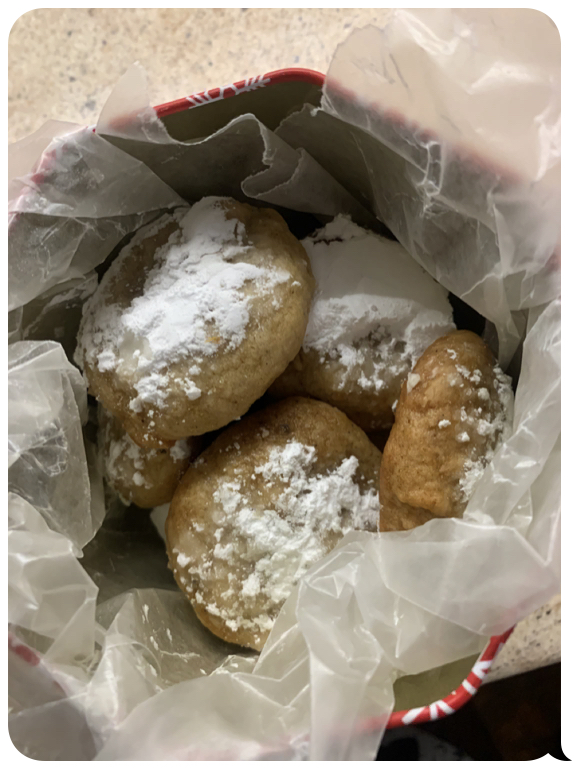
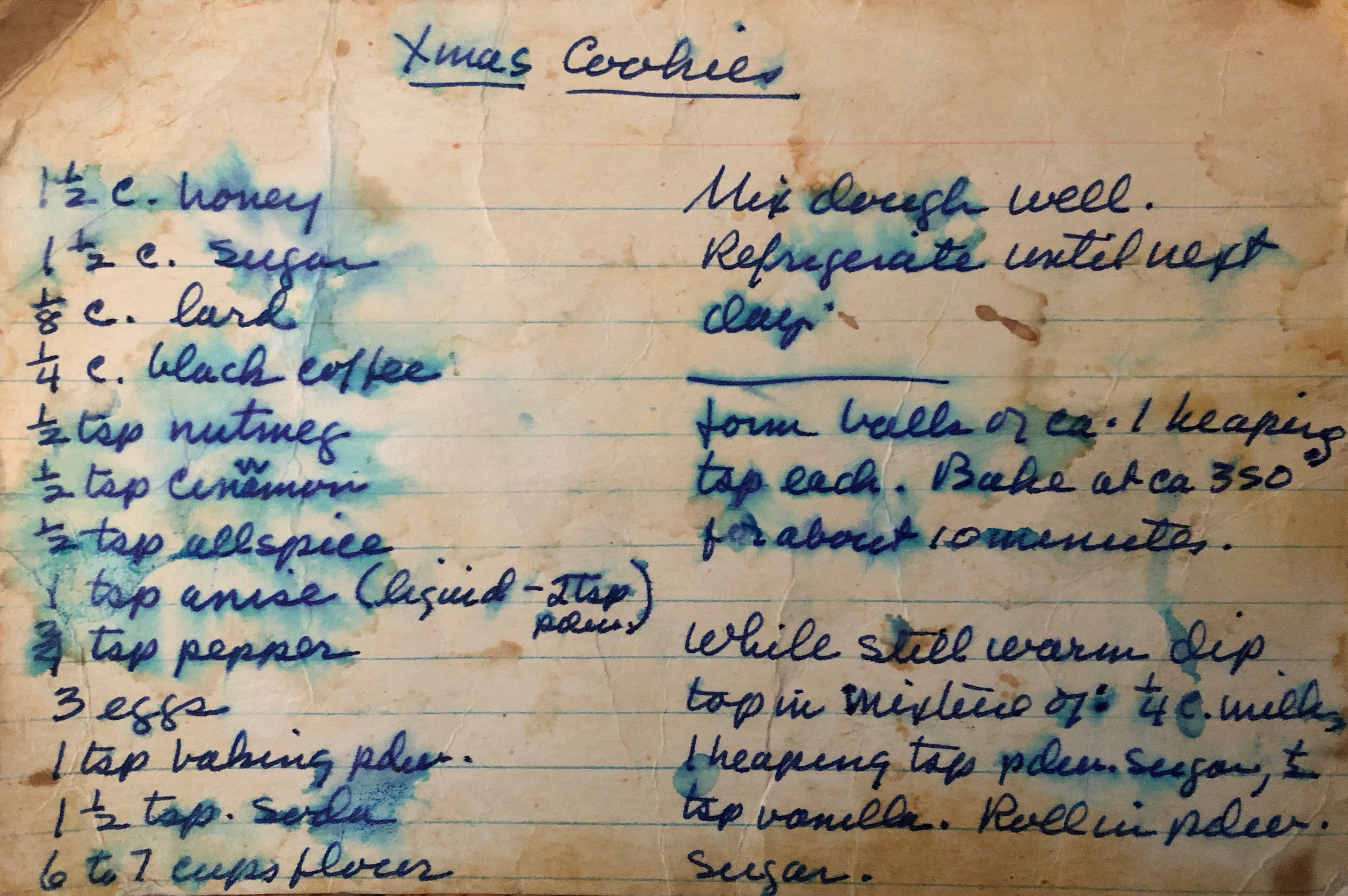
He enjoyed the pferffernüsse I baked, German Christmas cookies from my mother’s recipe. He bought some gifts and wrapped them. He admired the fat little tree I bought and helped me get it into the stand. When I suggested we join forces and design solstice cards then send them to friends and family, he was game. And when I had a yearning for the angel chimes from my childhood, we went together to buy them at a charming little shop at Mattick’s Farm. But best of all, he asked me if he could buy tickets to the sing-along Messiah for us. I lit up. Yes! We’ve gone to hear the Messiah before, and Michael—a good sport—had suffered through the fifty-three separate movements because he knows of my deep love for this piece of music.
But this was our first sing-along. We crowded into the pews at Alix Goolden Performance Hall, sitting in the soprano section in deference to my voice, and Michael went to the side table to borrow a score. I thought that I knew the soprano section so well, having heard it a million times before. I expected to keep up with just a printout of the lyrics. I was wrong.
The cold church filled with people in their various sections, many dressed in Christmas finery. Two sisters sitting next to me joked with us and rolled their eyes at the difficulty of some of those soprano runs—I mean, really? We faked it valiantly and giggled during the pauses. When at one point, I dropped my papers under the pew in front of us, the sister closest to me used her long strong leg and athletic foot to rescue them, pulling the damp papers back to me. We grinned at each other as I mouthed my thanks.
When Michael or close sister got lost in the score, one would notice the fluster of the other, and they would lean in front of me to whisper the page number. When it was time to sing our parts, we all stood, and it felt glorious to belt out the lines, “For unto us a child is born.” We cheered the amazing trumpet player during “The trumpet shall sound,” near the end of the concert. His cheeks ballooned red as pomegranates from the effort. Michael pounded his feet in high praise, earning a scowl from the sour woman in front of us and laughs from the sisters. Later, he said he had a wonderful time, even though he doesn’t sing soprano. He appreciated the experience of following the score all the way through.
Everything becomes something else. A resistance to Christmas becomes an embrace of the holiday. And then the storms hit, and we cancelled family Christmas. When I pulled the three of cups on the morning of the 22nd, I felt sure the tarot card augured well for me and my two sisters (and niece and son and husband) celebrating together the next day. But alas, the treacherous weather made travelling impossible, and instead of being together in person, we had a beautiful three-way telephone conversation filled with warmth, encouragement, and love. So that was what the tarot was telling me—find a way to celebrate, even if it’s not what you imagine it will be. Everything becomes something else, if you can just see it.
I craved Christmas this year. The year felt difficult, and Christmas seemed like a salve, a hygge solution to my discomfort. So, in my hunger for the lights, sights, and smells, I rushed to the Boy Scouts tree stand on December 1st—too early—and picked the chubbiest one I could find. Every morning I plugged in the coloured lights and enjoyed the sight of the branches decked with many home-made ornaments from over the decades. I especially treasure those old stars my children made in pre-school with their sweet faces in the middle of gold macaroni-studded frames.
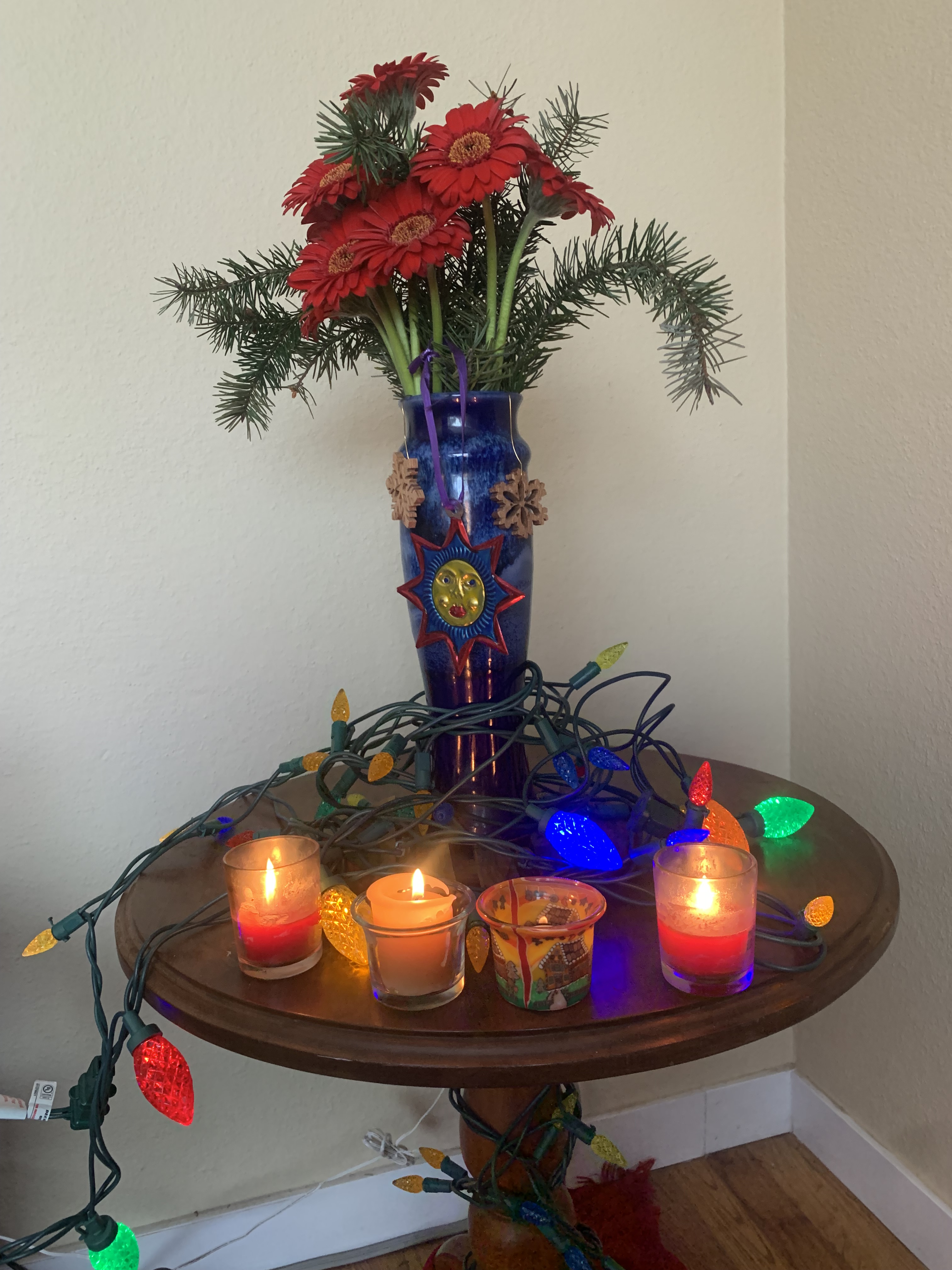
But then a few days ago, Michael said, “is that tree turning colour?” “Yes,” I had to admit. It was dry and yellowish green. So, on the solstice, we undecked the tree, unwound the lights, and tossed it at the side of the house to go into the chipper come January. Where the tree used to be, I placed a small round table holding a tall blue vase of red gerbera daisies—a gift from a friend. I mixed in some evergreen boughs and hung a few ornaments from the lip of the vase. I circled the coloured lights around the table’s base and the vase. Voila! Everything becomes something else: A Christmas tree becomes a festive bouquet.
Free yourself from fixed mind and you will see this—all things are in the process of continuously becoming something else. Witness the impermanence, get up close to it, get curious about it. It happens anyway, so allow it to happen with a loving, joyous, open heart. That’s the trick. And a micro dose of psilocybin doesn’t hurt, either.
I wish love, warmth, and all good things to you this season.
On Fridays I work a half-day at home, and every other Friday afternoon, I see my therapist. That Friday seemed like any other. I sat at my desk, sipped coffee, read student assignments, and provided written feedback using Word’s “comment” feature. I gazed intermittently at the grey skey outside the window. Taking a break between students, I checked “The Time is Now” for a writing prompt. Part of the Poets & Writers website, “The Time is Now” offers free weekly prompts for poetry, fiction, and non-fiction. I felt like writing something other than “you have a modifier problem in this sentence” or “a transition between these paragraphs will create a sense of flow.” That morning, the poetry prompt I read was this:
I clicked the hyperlink to read Kien Lam’s poem (I invite you to read it here). Then without thinking too much, I opened a fresh Word document and started to type couplets. The apocryphal story of your birth incorporating a fantastical tone. This is what I wrote:
Hallowe’en Baby
Like everyone, I come from a mother. I curled in a womb until the time of my
birth, when the veil between worlds, like a fully ripened cervix, was thinnest.
A beldam from the other side invaded the plexiglass cage where I
lay on my belly, helpless, hours old. That witch, she pulled me from my
crib into the stars, shrieking with laughter as my limbs contracted in fear.
She claimed to be my true Mother, but her touch was icy
and her tits were cold and milkless. I hung from her broom until
November first, when a meteor carried me, feverish, back to my crib.
I recovered there, alone, sucking my thumb for comfort. Nobody knew.
From that time, grief has grown thick as a callous to shield me from assailants:
For example, my Mother might try to pierce me again from the other side.
I didn’t toy with the poem too much—this is pretty much as it first flowed. At 1:00 p.m., my half-day of work over, I gathered my things, including the poem, which I’d printed out, and drove to my therapist’s office. I read the poem to her. I realized as I read it that it wasn’t just the prompt and Lam’s poem that had pushed the words out—it was remembering the story my mother had told me: I’d spent my first days of life separated from my parents, lying tummy down in a crib in the hospital nursery. My mother had a fever, and they put me in isolation to “protect me.” My father was at home caring for my two older sisters. I wasn’t held in my parents’ arms for days; I didn’t hear their familiar voices that I’d heard daily in utero. I lay there alone, not knowing when somebody would come to me. A connection was broken. That was 1958; I hope this separation between baby and parent wouldn’t happen today.
Writing the poem and reading it to Nancy felt like rupturing the dam holding back feeling and understanding. A river of sadness and comprehension washed over me. Pieces fell into place. My therapist’s contribution was to help me see the link between the absence of my parents’ touch and their voices in early infancy and my difficulty trusting connection in relationships.
For a day or two, I felt high with the transformative knowledge. It explained so much. Writing that poem had planted a seed, so I decided to change my writing practice in 2023. My memoir (Sow’s Ear), novel (Geraldine), and book of linked short stories (Deedee and Stan: Domestic Stories) languish in folders on my desktop. I don’t want to continue to stew about “getting published” in 2023, to desultorily send my work out to indie publishers. I want to write. The time is now. So, I signed up to receive weekly writing prompts, and my aspiration is to use the prompts to write, if not weekly, then often, sometimes writing poems and other times fiction and non-fiction.
I want to focus on the practice of writing: an embodied practice, a way of touching into deep feelings, into life’s mystery. My experience of writing “Hallowe’en Baby” was profoundly moving. I don’t expect all of my writing next year to be equally therapeutic, of course. However, I believe many revelations will emerge from writing this way.
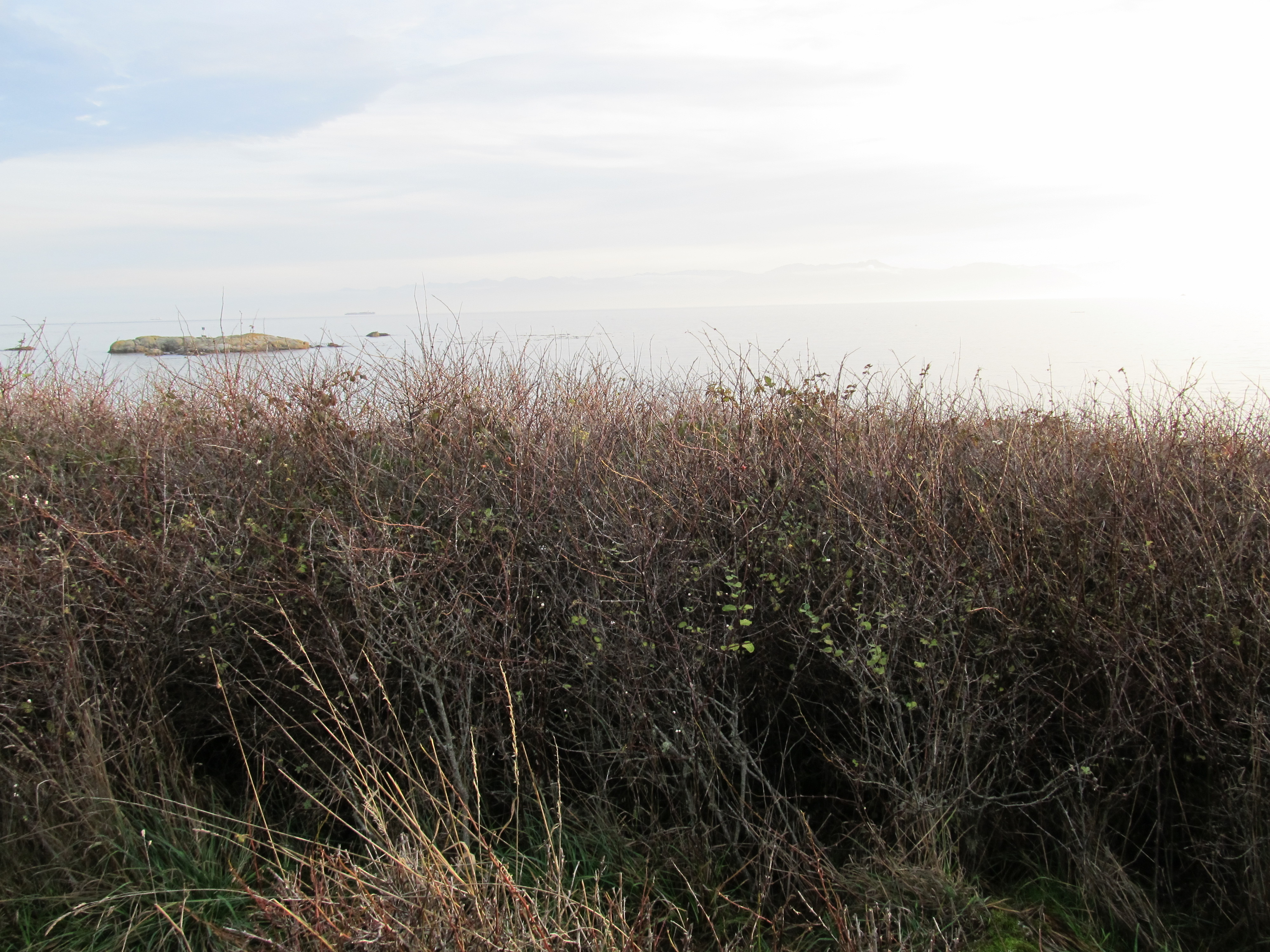
I’ve started on this week’s poetry prompt, following the Seamus Heaney poem, “Postscript”: “think back to a natural landscape that has made a lasting impression on you and write a poem addressed to a loved one that describes this unique terrain’s lasting beauty.” I realized, with sadness, that I’ve spent most of my life indoors. I can’t remember many natural landscapes that have made a “lasting impression.” Perhaps two or three. So, that’s quite a discovery! And it makes me want to get outside to observe the trees and the ocean, to feel the wind and sun, to watch the sky. It makes me want to go different places, to travel, to soak up the transient beauty of this world.
I’m not a gambler. I’ve never been one to buy scratch & win or lottery tickets, with the exception of raffle tickets for a good cause. But I have a weakness for the random—for letting books fall open, for reaching into my closet with my eyes closed. I wrote about random acts of reading in one of my early posts.
Lately, my hunger for the random has become ravenous. Perhaps it helps me cope with the relentlessness of karma, of knowing that everything arises as a result of a complex web of causes and conditions. If I just grab something, I cheat the chain of causality for one moment. An illusion of course, but it briefly satisfies something in me.
When I was at Women in Need thrift store a week ago, I bought a $5 jewelry “grab bag” and felt the thrill of not knowing what I would find inside. And then, at the Juan de Fuca 55+ Activity Centre Craft Fair last weekend, I picked up three “toonie bags,” again feeling excitement at the potential. I know the chances of getting things I neither want nor need are extremely high. But a pesky “what if?” tugs at me. What if there’s magic inside those bags?
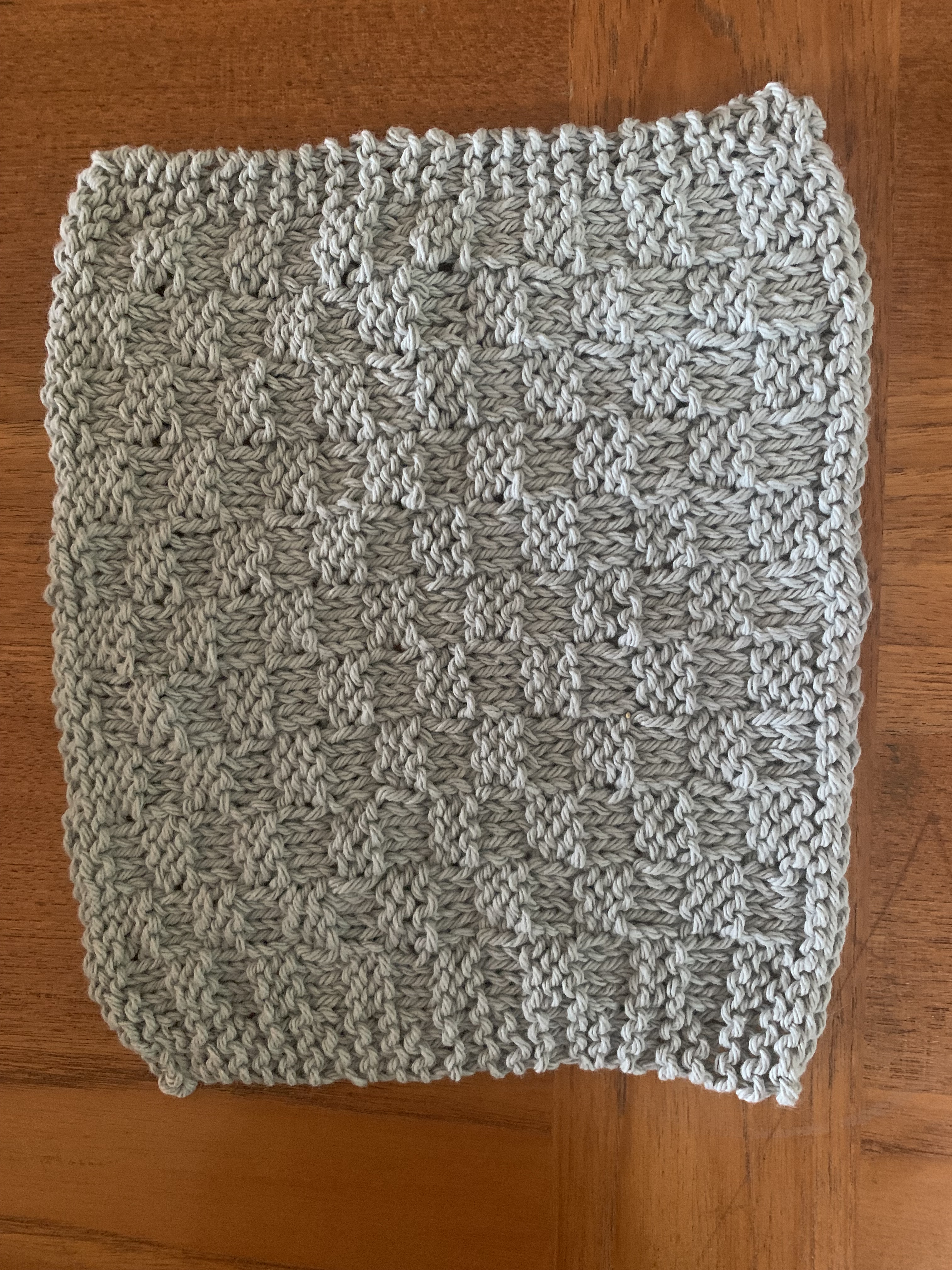
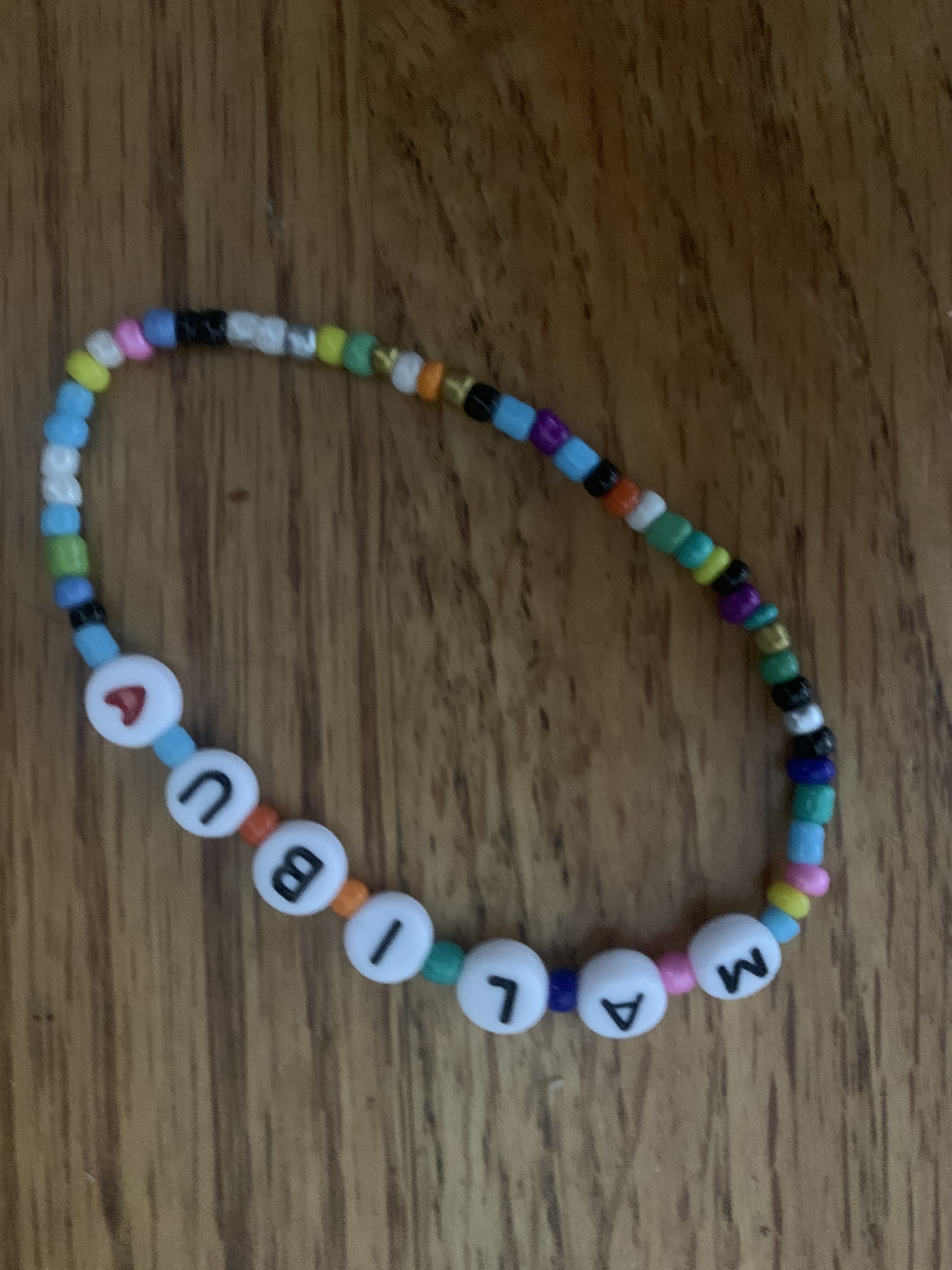
I tell myself it’s not such an expensive gambling habit: $11.00 spent over the past ten days. As you have probably already predicted, the $11.00 yielded mostly junk. Costume jewelry I would never wear. Small glass bowls, silver candles, a MALIBU beaded bracelet: all of these go right into the Goodwill donation bag. But there were a couple of things I liked. A cheesy “love” ring that nestles nicely next to my wedding ring for the time being. Three hand-crocheted dish rags in a shade of grey-green that I love and will use daily. And the priceless frisson of possibility … If I do this too often though—spend too much money on “grab bags”—I get disgusted with myself, like a gambler must feel about their addiction.
The thrill of grab bags
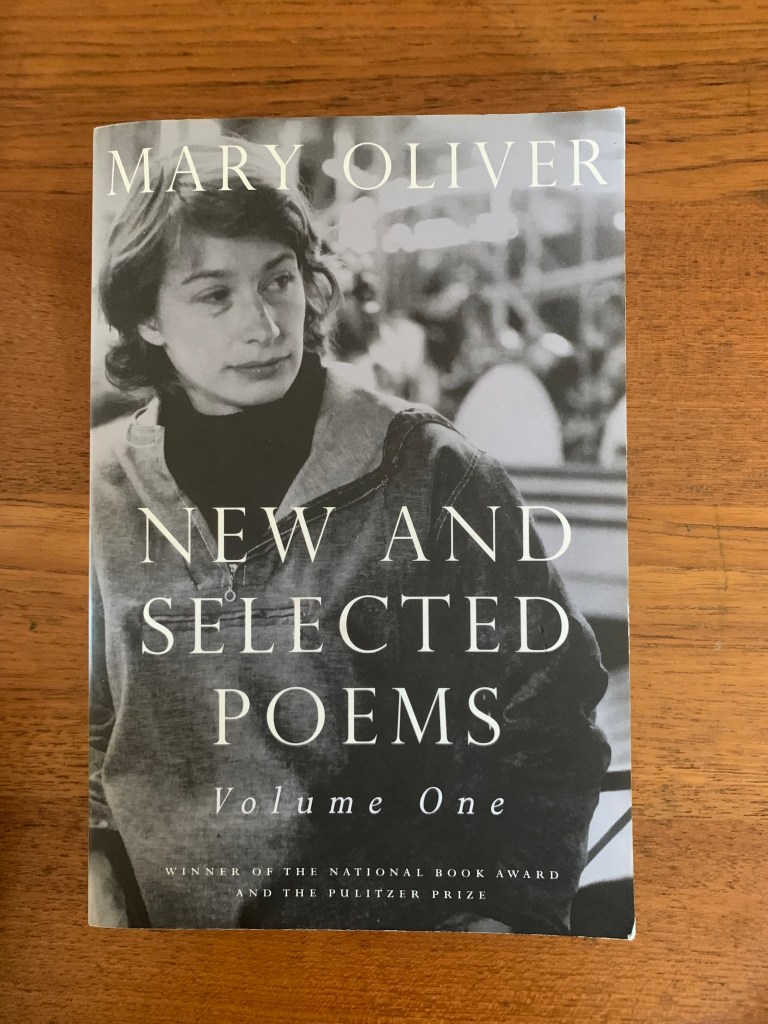
Today, Mandala Monday, I asked Michael to continue with the buffet of randomness. Last time, we each chose a tarot card to inspire us. This time for our mandala-making prompt, I suggested that I would take a book of poems by Mary Oliver and open it anywhere, read the poem, and we would create mandalas in response. Being game to participate in most of my creative ideas, he agreed. I opened to the poem, “White Owl Flies Into and Out of the Field.” Do you know this poem? The huge white owl, wingspan five feet, picks up a rodent from the snowy field and flies off to the frozen marshes to devour it. Oliver imagines the animal’s death in the jaws of the owl as something incandescent, perhaps even pleasurable. Death, she muses, may be entirely unlike the darkness we tend to imagine:
maybe death isn’t darkness, after all, but so much light wrapping itself around us — as soft as feathers —
Michael and I sat across from each other at the dining room table, he with his IPad and I with old watercolours and a piece of heavy paper I’d traced a plate on. The songs from Leonard Cohen’s Old Ideas album surrounded us. We worked for a time. I sloshed paint and Michael used his magic wand. I persist in thinking of making digital art on an iPad as something otherworldly, technology out of my reach, which isn’t at all true. However, more and more, I recognize the ways I deceive myself, all of the little lies I tell to keep my life comfortable.
I like to mop up watery colour with an old rag, feel the wet paper under my palm, scrape at the bottom of the indigo blue with my brush, feel that I am using up every last bit of paint. The embodied experience of artmaking.
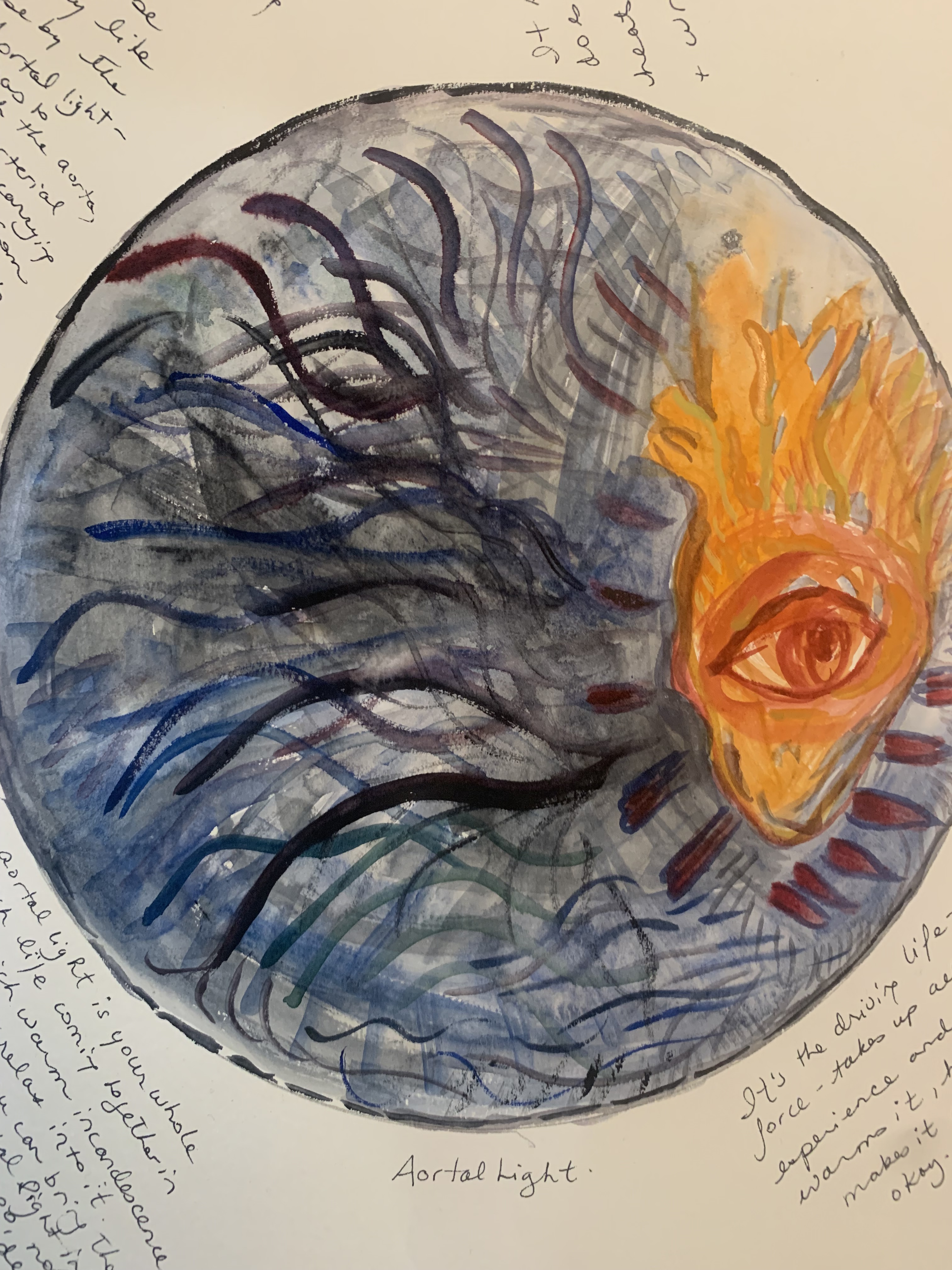
I got stuck on a phrase near the end of the poem, “aortal light.” Adjective + noun. Aortal – from aorta, the great arterial trunk that carries blood from the heart to be distributed by branch arteries through the body. I imagined aortal light as a lantern that pulses like a heart, sees all with a glowing eye. Warmth and insight at the end of life.
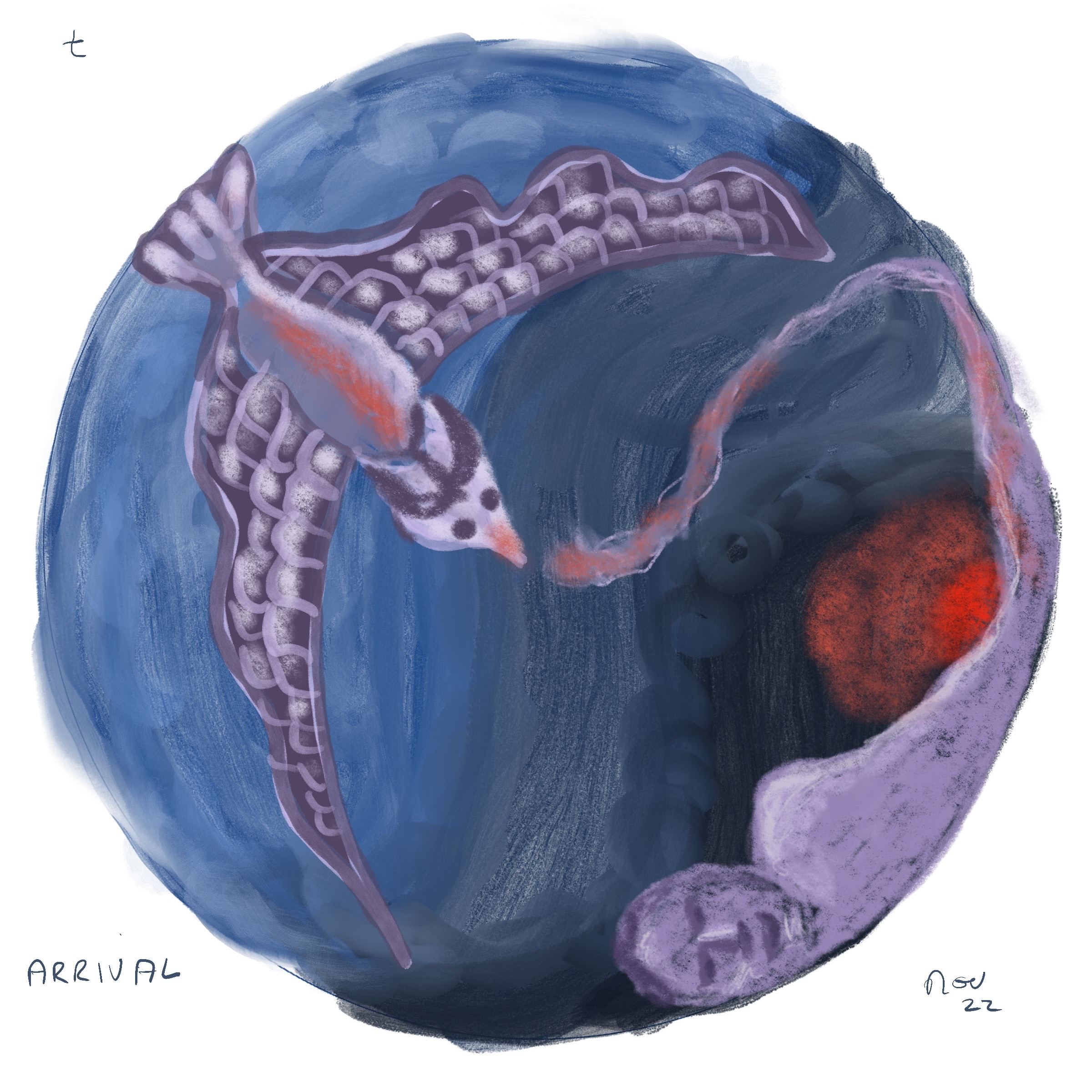
I fell in love with Michael’s “Arrival.” After creating hundreds of mandalas, he has developed a quick entry into the thriving, visceral archive of his subconscious. His images are evocative, and today both the image and the act of creation visibly disturbed him. I was riveted by the words he read to me after we’ve finished painting and writing. His honest expression of troubled feelings about the mandala—his fear of death—they scalded me. Would that I could be so honest! I like to think I won’t be scared when I am dying. I may be deceiving myself again.
Oliver writes, we “let ourselves be carried, as through the translucence of mica, to the river that is without the least dapple or shadow — that is nothing but light — scalding, aortal light — in which we are washed and washed out of our bones.”
Choosing the random means taking a chance. Please, big “S” Self, let me take more chances in this life. Not just by grabbing toonie bags and reading random poems—please let me take a chance in being honest, vulnerable.
“Human beings are creatures of belonging, though they may come to that sense of belonging only through long periods of exile and loneliness.”
David Whyte, The Three Marriages: Reimagining Work, Self and Relationship
Ever since I was small, I have felt I don’t belong. As I grow older, I see how this sense of not belonging is linked to black and white thinking: I am excluded either because I am not good enough or because I am superior (“arrogant worm,” as they say in AA). This strain of thought is endemic for alcoholics. To break the spell, it’s crucial to look for similarities not differences when you attend twelve step meetings or, indeed, whenever you feel the sharp edges of polarity creating a sense of distance.
For me and perhaps for you, the isolation resulting from the pandemic has exacerbated loneliness and a sense of exile. Last month I was feeling particularly alone in the sadness that can arise from being a parent. Only in recognizing that many other parents across the world share in this pain did I not feel so alone. Facebook groups and other modes of connecting across space and time are wonderful to bring a sense of “I’m not the only one.” But also useful has been the Buddhist practice of Tonglen, breathing in the thick suffering of others in your predicament and breathing out coolness and healing. This practice connects me with others, but more than that, it dissolves the sense of specialness and exclusion I am prone to. We’re all in this together.
There is another simple practice I have started. I review small events from the perspective of community. This week, for example, I went to an acupuncturist for the first time. She is a gentle young woman named Demi with a river of brown curls running down her back. She made me feel so comfortable and safe as she stuck a dozen needles into my legs, hands, and back. As I laid face down on the warm table in a quiet room, I felt joined with all of the other people suffering sciatica or other pain in their bodies, and I also felt part of a group of people who get acupuncture. I could picture hundreds of us lying on surfaces—floors, grassy fields, dusty streets, tables, beds—and kind practitioners breathing slowly and rhythmically, putting us at ease, as they insert the slim sharp points. I imagine a collective release of endorphins through bodies old and young, fat and slim, smooth and rough. I imagine our relief.
The next day, I suffered from self-doubt about my new editing business—will I get clients? Will people I’ve done work for get back in touch with me? And imposter syndrome: Am I really an editor or just pretending? Perhaps I don’t belong.
Drawing a tarot card, I asked, “What do I need to know right now?” I pulled the Six of Wands, then consulted Joan Bunning’s Learning the Tarot. She writes that “the Six of Wands appears when you have been working hard toward a goal, and success is finally within reach. . . . If you do not feel close to victory now, know that it is on its way provided you are doing all you can to make it happen.” I felt encouraged.
Amazingly, later that day, I received two emails from former clients who wanted me to do work for them. The next day, a new client gave me an update on work that is planned for this summer. And a referral from a colleague I thought would come to nothing yielded another email today asking for my services.
I feel not only encouraged by all of this positive activity, but connected to a community of editors. Yes, I belong. Amazed by the rightness of the card, I feel connected to all those people everywhere who use tarot to help them make sense of life. I can see the decks being shuffled and cut by hands everywhere—brown hands, gnarled hands, arthritic hands, young hands, a hand with a missing finger. . . . We shuffle and cut and draw and learn about ourselves and others, about our Fool’s journey on this Earth.
On Friday, I felt down again, and as I sat in the backyard with my next-door neighbour and we watched the puppies play, I shared a little of my current grief. She popped out of her lawn chair, “I’m going to get my Animal Spirit cards. They’ll help you to feel better.” She came back with the deck and I shuffled and drew. I tried to pull just one, but two cards were stuck together—Elephant and Otter. She read aloud the description of each animal, and a tear rolled down my cheek.
The descriptions felt resonant—the qualities of the unstoppable, gentle, noble elephant and the giddy and joyful otter were combined inside of me. I felt connected to my neighbour then, linked to her through her kindness to me and her willingness to explore beyond the rational self. I feel connected to everybody everywhere who is suffering and uses tools to understand themselves and bring solace: tarot, mandala-making, building sand-castles, creating songs and singing them, writing novels and poems, reading palms, tea-leaf interpretation, or casting the I Ching.
Then on Saturday, I was washing dishes and noticed movement in our back neighbour’s yard. Raccoons? I fetched my binoculars and trained them on a raccoon couple mating—the male straddling the female and biting her neck. Their black bandit masks and long striated fur were crystal clear through the binocs. I was awed. I am part of a community of animals—our bodies are drawn to one another, we mate. I am connected not only to a world of animal lovers, but to a world of lovers of animals. We train our binoculars on birds and lovely beasts of all kinds; we are curious about the natural life we are part of.
Antoine de Saint-Exupéry wrote that “what is essential is invisible to the eye,” and that has been my experience. An (invisible) sense of community is essential to me now more than ever. This week I call forth community in many ways. I call it forth through my pain and suffering. I call it through being a patient of acupuncture. I call it through using tarot and other mystical tools. I call it through imagining myself as a member of overlapping groups: editors, parents, and neighbours. And I call it through membership in a society of homo sapiens and other animals. An invisible sense of belonging keeps me going. I may not be able to touch you but I feel you.
Madeline: We could be driving anywhere—in a way, it doesn’t matter because it is all about the internal journey. One of the things we’ve been balancing and talking about is spontaneity and discipline or restraint (near antonyms of spontaneity). Michael calls the force opposing spontaneity (and one he associates with his own character) as “stick in the mudness,” though I don’t see him this way at all. He has a tonne of carefree magic in his soul balanced by “Great East Discipline” (one of his Buddhist names, which is very fitting).
We have tried to balance these two energies between us on this trip while we balance them in ourselves. Perhaps Michael has more discipline than I, and he has taught me that we need to spend the longer days in the car to cover the kilometres (Canada is enormous). Perhaps I have more appetite for being impulsive (“let’s stop at this lake and swim!”), but we need both of these energies to make the trip go. If Sponty runs the show, we follow every whim, popping into thrift stores and following hiking trails for an elusive kingfisher, and we never actually get to Toronto. If Sticky runs the show, we get there in record time, but exhausted, never loosening up and letting bursts of impulse reveal the magic in the everyday.
We have had some longer days, like July 16. We left the Soo at 8:20 a.m. and arrived in Kenora at 5:20 (well, 6:20, but we slipped into the Central Time Zone at some point). Pacing ourselves with frequent breaks and seat switches, we made it to Kenora feeling pretty good.
The long day (Soo to Kenora) made Winnipeg on July 17thpossible! Thunderstorms were predicted, so rather than camping (which we still haven’t gotten around to), we decided to do a short day, arriving in Winnipeg in the early afternoon and exploring. What treasures we beheld…
We wandered into Á la Page, a comfortable, homey business selling second-hand books at 200 Provencher Blvd. in St. Boniface, and found that all books were 50% off! The green corduroy couch near the front of the store beckoned—so comfy. I sat down and started paging through a book on intuitive healing while Michael looked at a book of Buddhist art. The catalogue had a definite leaning toward the metaphysical, and more than half the titles are in French. I asked the young man at the cash desk if the place was going out of business because the half-price sale seemed to me a sign. “Not yet,” he laughed. We chatted about how you have to be passionate about books to run an independent bookstore. I feel recommitted to supporting Victoria’s independent bookstores.
I loved St. Boniface not only for its charm and beauty, but also because I felt so comfortable speaking Anglais, whereas in Québec not so much. I had a thought I’d love to spend a summer in St. Boniface learning French and getting to know the neighbourhoods.
In the evening, we discovered a textile show by three Franco-Manitoban (is this a proper descriptor?) women—what a find! I fell in love with Rosemarie Péloquin’s felt faces and heads that depict old age in a truthful and tender way.
On our Winnipeg afternoon, we wandered. We embraced what we came upon in our wanderings. Discipline builds the dance floor for the jazz-dance of spontaneity.
Michael: One of the things I am learning on this trip is that Sponty helps me to open to the world with a child’s heart, and when I do that I find unforeseen jewels, such as Medicine Hat which I wrote about in an earlier post. Today I am reflecting on the magic of Manitoba.
Waking up in our little Jackfish Cabin and seeing a weather forecast of thunder storms, we decide to drive to Winnipeg, enjoy a shorter day, and see what we might find. What follows is completely magical.
We meet Barry S. Shore, owner and proprietor of Fat Cat Records. As Barry said, he “used to shoot for Warner Brothers”, and his walls were adorned with black and white photos of rock stars, clearly shot from the close to the action vantage point of a press photog— exquisitely, dramatically, and lovingly framed, faces wearing many masks: passion, sadness, feral snarls. Fat Cat specializes in West Coast Blues, which Barry explains to us is a sub genre of the blues with elements of jazz and bop built in. He has only been open three weeks, but this is his third record store, and this way he only has to sell the stuff he likes. He says the store gives him something to do in his retirement—hmmm, is there a theme here? We buy a music-themed print, a Fat Cat Records tee shirt and a Lynwood Slim CD. I am often struck by synchronicity, and as we leave it strikes me that we’ve been listening to Stuart McLean’s stories about Dave, owner of the Vinyl Café, Canada’s smallest record store. Wow, I think, we just met an aging Dave and visited the Vinyl Café!
Winnipeg Fringe is on, and after attending a stand up performance in St Boniface, we venture out for a walk on the boulevard. I wear hearing aids, and at times the internal combustion engine is the plague of my existence–cars without mufflers and motorcycles assault my senses in the most shocking and violent way. Today is one of those days, so I want, need respite. Across the street we see green grass beside railroad tracks and walk towards it, expecting tracks, grass, little more.
Instead we find a path that leads to a footbridge over the Assiniboine River, and a forested glen with a winding path. The reflections of the forest in the river, the sweetness of birdsong, Madeline’s hand in mine and our shared silence are entrancing and nourishing in a way that I really need. Another unexpected jewel.
As we return across the bridge, we find remnants of paper fastened to the bridge deck, printed but no longer legible. A placard explains that this is an art installation, Pages and Passages by Eric Plamondon. The pages are pulled from the stories of 30 Manitobans-poems by Louis Riel and Gabriel Dumont, but also more modern folk. Each pedestrian and cyclist can read the stories, but their passing obscures them a little more each day, thus with the passage of time we affect each other’s stories.
I have been thinking a lot about privilege on this trip, about how my privilege manifests in blind spots, which by definition I can’t see. This is another jewel-an opportunity to see how in just living my life, in just passing through, I affect the stories of others. I return to the road with a deep sense of gratitude and magic.
After a long stretch of driving, we arrived in Grand Forks longing for some good coffee. I thought maybe Jitters Espresso? But we agreed that the name bothered us; as Michael said, “they have a branding problem.” So we went for coffee at Marvelous Munchie’s bakery. It looked okay, and often bakeries have good coffee. We waited at the small counter while two locals got coffee and pie. We were next, but the coffee was all gone, so the bakery assistant offered to make another pot in one of the automatic drip coffee pots on a small counter behind her. She was being coached by the baker, a friendly woman in a white coat and hat who kept peeping out from the high rolling trays of donuts.
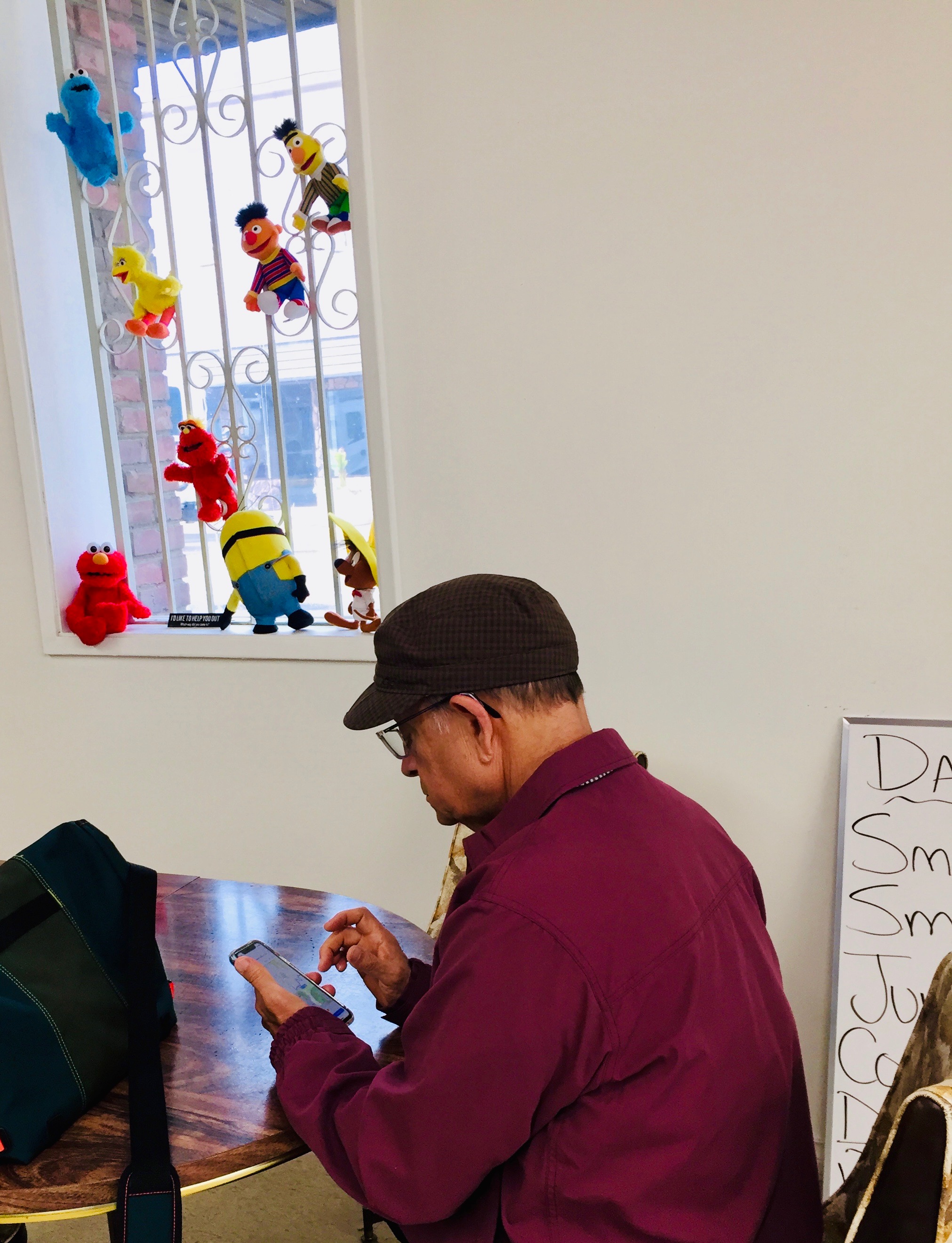
I went to the washroom, using a key that dangled off the end of a pastry brush. When I came back Michael was waiting at an imitation woodgrain table, with Bert, Ernie, the Cookie Monster, and Elmo climbing the window next to him. Later he told me what had gone down with the bakery assistant.
M: “Do you have any dark coffee?”
She looks at him quizzically. “Dark?”
M: “Yes, you know, a dark roast?”
She: “Well, we have Folgers.” The little hand lettered sign beside the cash register advertised coffee in a French press.
M: “What if I ordered the French press coffee, what kind do you use for that?”
She: “Folgers.”
So we waited 20 minutes for the regular Folgers (not French press), admiring the huge almost empty room that, as Michael said, could house both a daycare centre and a bakery. In fact, there were toys and a drawing easel and other children’s stuff at the back. There were houseplants everywhere and inspirational sayings taped to one wall. The locals were engaged in a lively conversation and seemed to be enjoying their pie and coffee.
The bakery assistant looked apologetic as the minutes ticked by. “This machine takes forever.” But it seemed she wasn’t really familiar with where the fill line was, and it finished dripping a while ago. The baker showed her gently. She was so apologetic. “I’m SOOO sorry,” she kept saying to us, bringing coffee and a little pitcher of cream. She was a big woman, perhaps in her early 40s, dark hair in a single long braid and wearing a blue tunic and sensible shoes. I saw the edge of a tattoo on her strong brown calf, just visible from under her dungarees.
We drank our Folgers and it didn’t really taste like anything except hot creamy water. But we didn’t want either the baker or her assistant to feel bad or like they had anything to apologize for, so we drank it up to the last drop.
Later that day in Nelson, I was set on shopping at the I.O.D.E. (mperial Order Daughters of the Empire) thrift shop on Baker Street. It had good reviews, as thrift shops go. Rain had been pouring down for hours. The green forests were dripping wet as we snaked through the Kooteneys. But now the sun came out as we walked down Baker Street, and I decided I wasn’t in the mood to shop at the I.O.D.E. Instead, I happened upon a very narrow fabric shop where I bought a half-metre of bird fabric that reminded me of Dr. Dolittle. I’m not sure what I will sew with this fabric, but I do have birds on the brain. Halcyon, the kingfisher, the birds on the fabric, the hummingbirds at our feeder in Victoria. The woman who ran the fabric shop had old treadle Singer sewing machines on display that we admired. (I like it how Michael happily goes to fabric and thrift stores with me and just finds a seat and reads while I browse.) I chatted to her about scraps. “I make scrappy quilts to use up the scraps, but it seems that no matter how many I use, I don’t make a dent in the scrap pile!” she exclaimed. I agreed that I had the same problem. I am pretty sure it’s because we keep buying new fabric. So even as we assiduously take from the scrap pile, we keep adding to it too because fabric is just so wonderful. Oh well. We could have worse problems.
Cranbrook Ed, by Michael
Our plan was to drive to Nelson and camp there, arriving early and having at least half a day and an evening to revel in the spiritually rich, friendly hippy vibe of this beautiful Kootenay town.
Best laid plans, as they say—after spending an hour waiting for coffee in Grand Forks we fought our way through a torrential downpour most of the way to Nelson. We loved the array of funky shops, but really wanted to get to Head-Smashed-In-Buffalo Jump in time for indigenous dancing the next day and had forgotten that we were about to lose an hour to the time zone change. Besides, the pouring rain made camping somewhat unappealing. So we decided to press on and stay at Cranbrook.
But first we shopped. We found a gong/singing bowl for our meditation shrine at home, and had the most wonderful conversation with the proprietor of Gaia Rising, who moved to Nelson from the lower east side of Vancouver, decades ago. We talked about community, addiction and consciousness raising-and I found myself thinking that I was really loving all the little connections we’ve been making along the way. People are so friendly-and then it occurred to me that we’re probably helping that along. I also bought a Peaceful Poppy shirt that seemed somehow to fit with the whole trip so far.
The late Stuart McLean loved “Small Town Canada”, and over the past three days I have thought about this frequently. The towns we have stopped in have been quirky, warm and welcoming, which seems quintessentially Canadian to me.
Cranbrook was pretty interesting. Madeline and I took pictures of a couple of signs: The Nails Christian Book Store, and very well-weathered Welcome to Downtown Cranbrook. These have to be seen to be appreciated, so we’re included the images with this post.
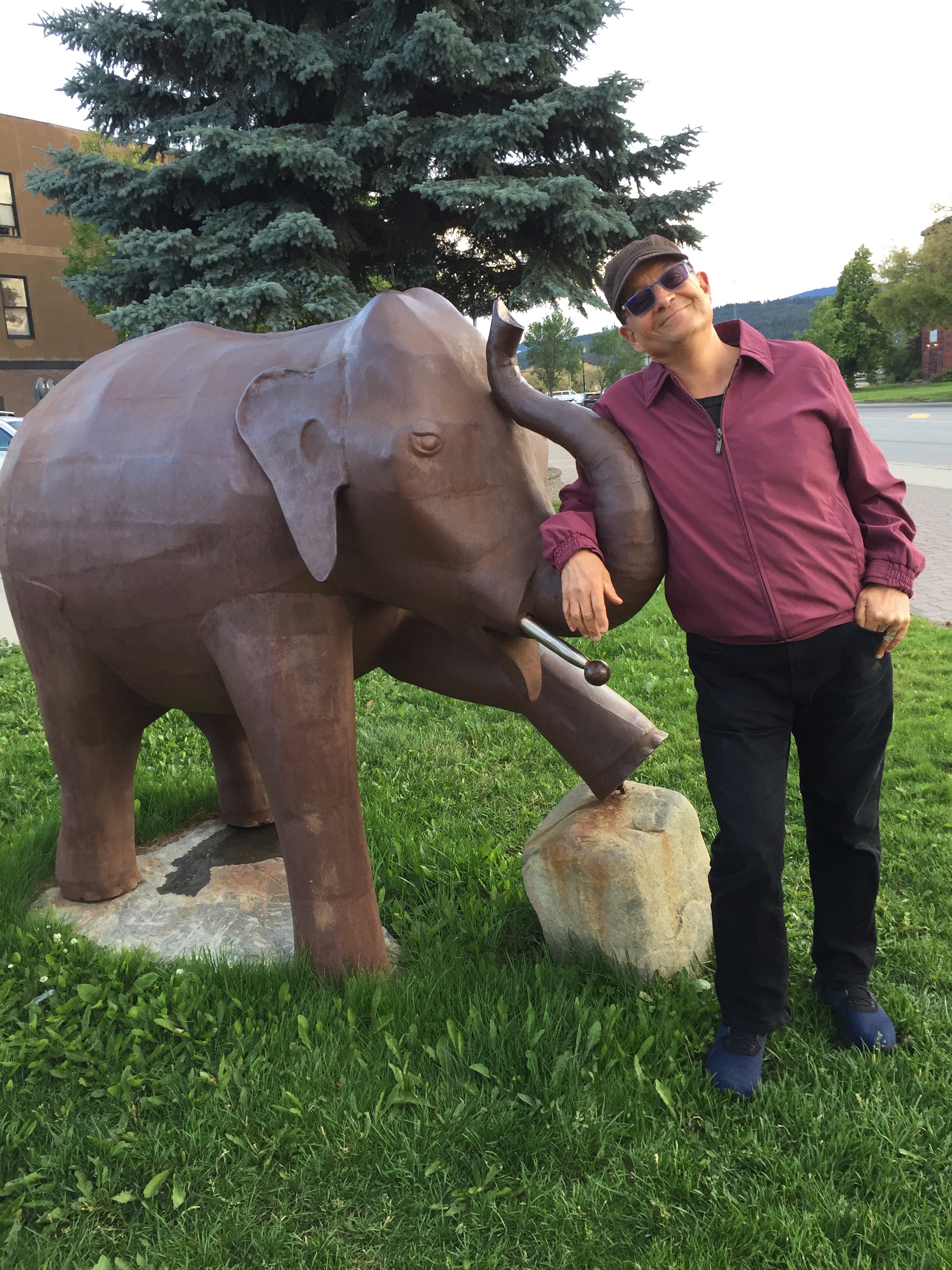
On the way back to our hotel I noticed a statue of a baby elephant—apropos, it seemed, of nothing. On reading the accompanying sign it turns out that in 1926 the Sells-Floto Circus visited Cranbrook and somehow lost fourteen elephants into the surrounding forest (my mind reels imagining how that happened). Most of them were recovered fairly quickly, but one—Charlie Ed—remained at large for 6 weeks. The post-capture celebration breakfast and parade in Cranbrook was memorable, and Mayor T.M. Roberts declared Charlie Ed to be an honourable citizen, upended a bottle of champagne over his head, and re-christened him Cranbrook Ed.


























 So we waited 20 minutes for the regular Folgers (not French press), admiring the huge almost empty room that, as Michael said, could house both a daycare centre and a bakery. In fact, there were toys and a drawing easel and other children’s stuff at the back. There were houseplants everywhere and inspirational sayings taped to one wall. The locals were engaged in a lively conversation and seemed to be enjoying their pie and coffee.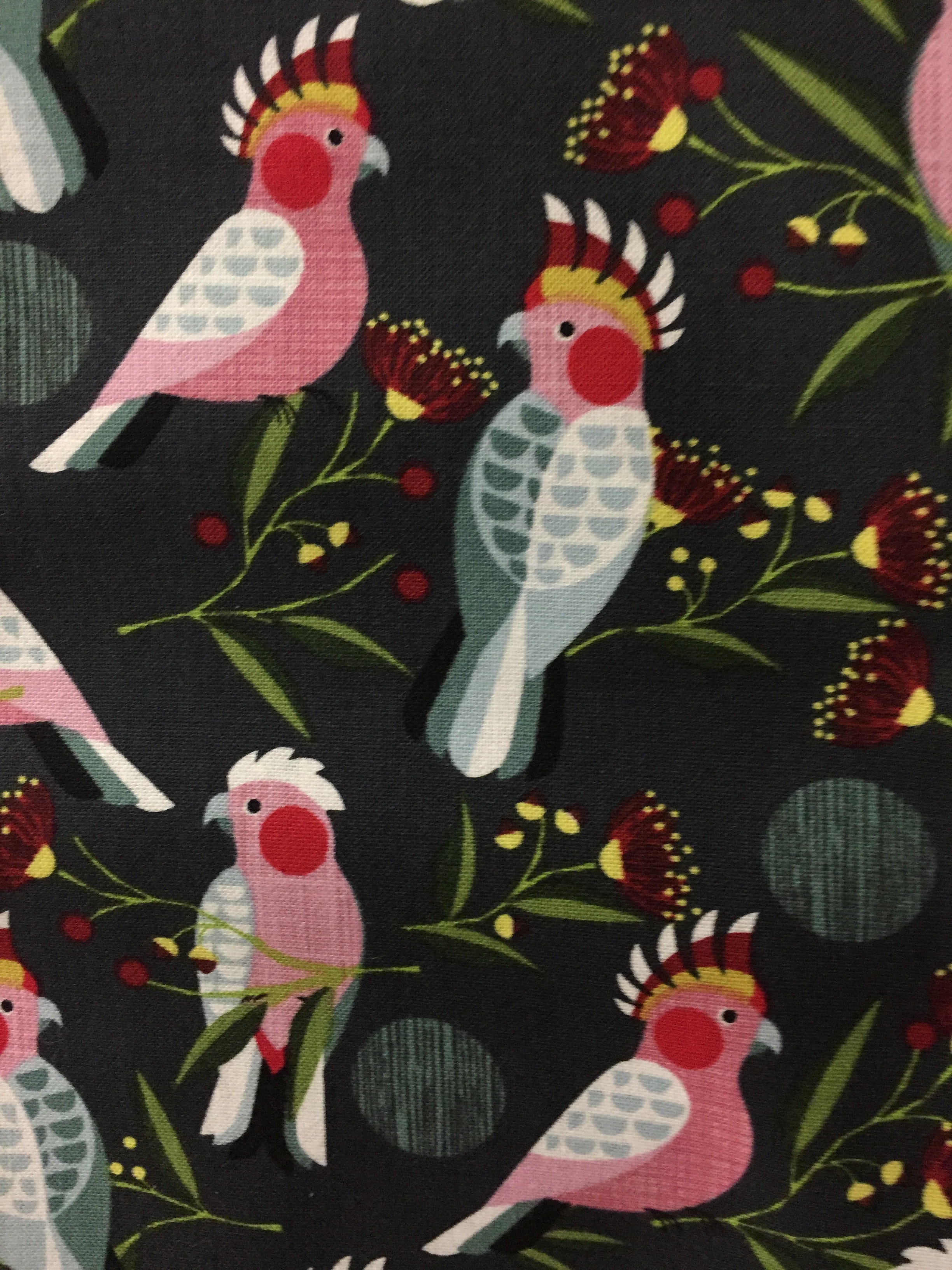



 Madeline Ruth Walker