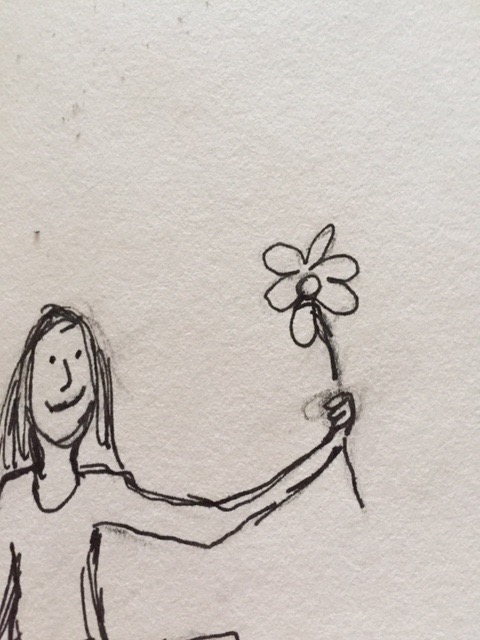
How to comfort yourself

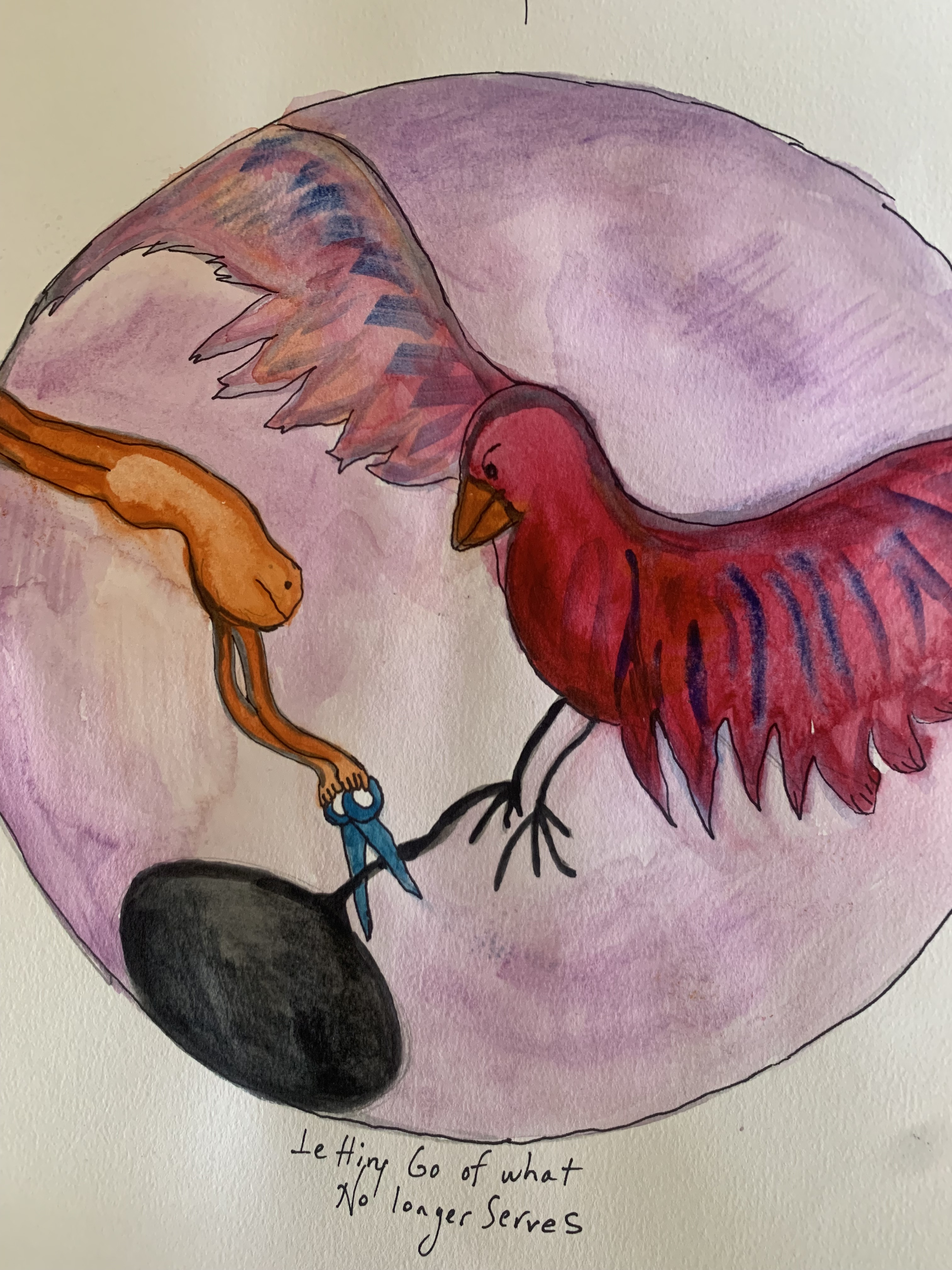
“When we run from our suffering we are actually running toward it.”  Ajahn Chah

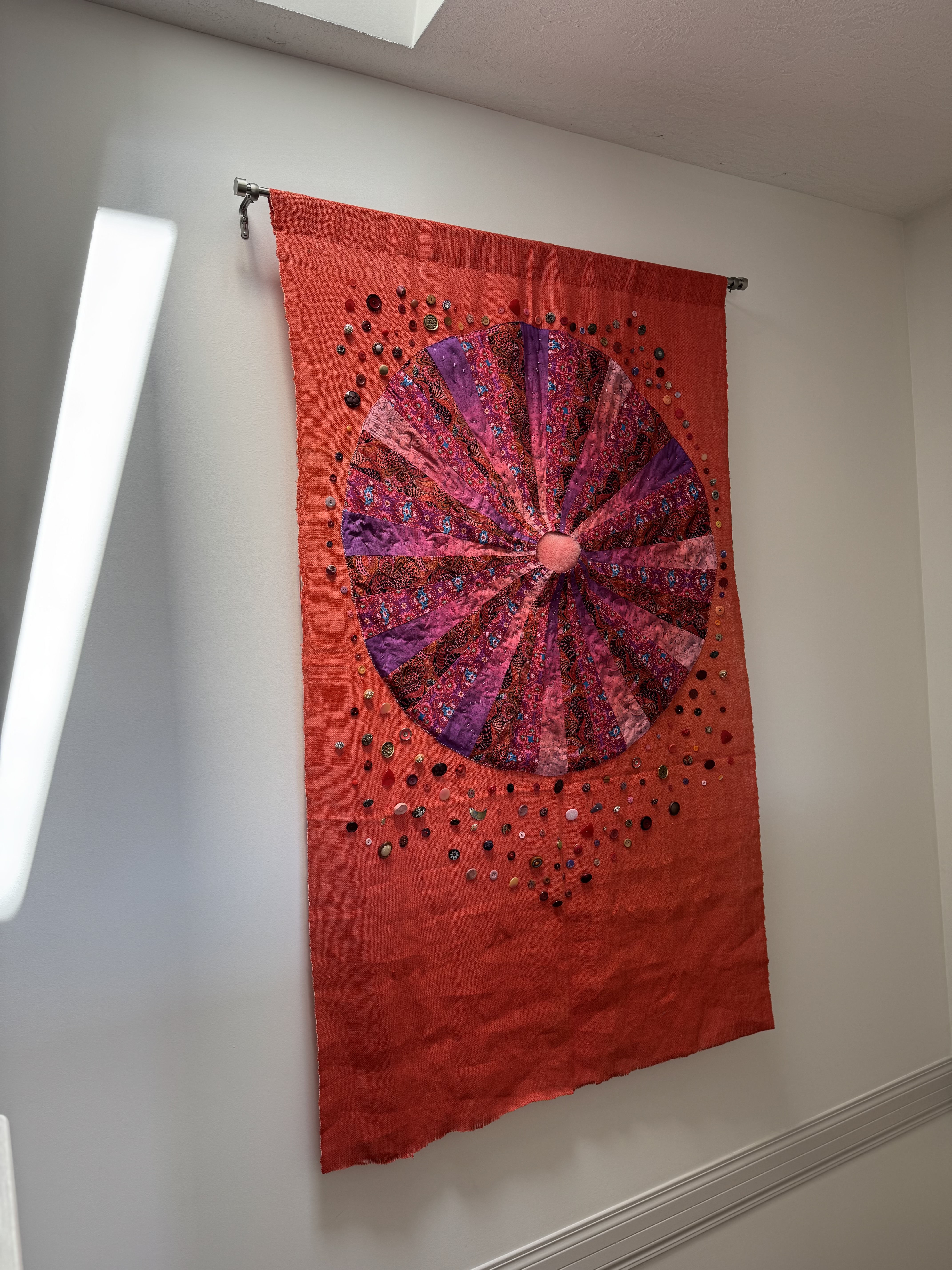
                                                                                                                                                                I’ve been basking in two messages from my unconscious this week. In one dream, a person wearing a bright tie-dyed shirt holds a hand lettered sign, “You are not alone.” In another dream, a young man, bearded, hugs me and whispers in my ear, “Thank you for your patience.” The messages are hackneyed, and yet they were delivered to me fresh, warm, colourful, by stately messengers. It doesn’t matter if they—the messages and the messengers—aren’t “real”; they are just as real as the people and events, the words, ideas, and things I encounter in my dream-like conscious life. And more to the point: They provide great comfort, having bathed me all week in an orange glow, a glow like that emanating from the 10,000 joys wall hanging, now installed in our stairwell.

The wall hanging seems to collect the sunlight falling in through the skylight and send back a peachy radiance. Several times now I’ve gone to flick the hall light off, thinking the switch is on when it shouldn’t be. No, the light is off, but 10,000 joys shed their own uncanny light.

When I made the piece, I kept telling myself, you don’t have to make its counterpart, 10,000 sorrows. It’s okay to just focus on joy right now. But of course, you cannot have 10,000 joys without 10,000 sorrows. I wish we taught this truth to children in kindergarten. You don’t experience joy without experiencing sorrow. And it’s okay. When you cling to joy and try to avoid sorrow, you just prolong it. I wish I’d gone to a Buddhist kindergarten, where these truths would be taught elegantly and logically, instead of being told by adults that “life isn’t fair,” which seems tawdry and cruel in comparison to the dharma. 

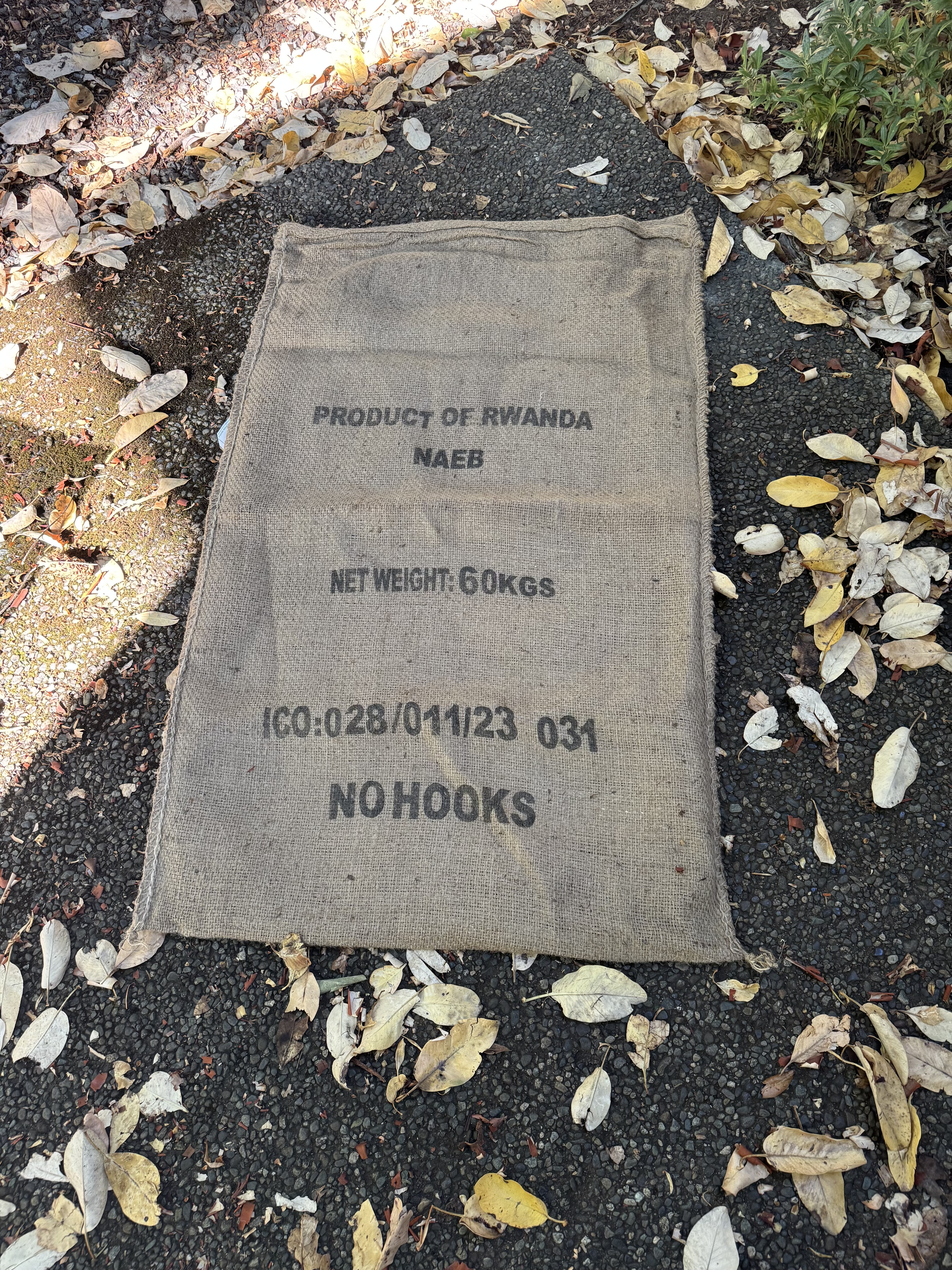
Inevitably, I am called upon to make joy’s counterpart. I had coffee with a friend yesterday at Esquimalt Roasting Company. As I waited at the counter for our lattés, I noticed a large burlap bag draped over a plastic bucket. I picked it up and showed it to the barista. Can I buy this? I asked. In my imagination, I was already picking its seams and spreading it out, a wide brown canvas for thousands of sorrows. It’s free! she responded. So now I have the backdrop for the wall hanging. I had originally thought it should be black, but brown is less dramatic than black, more subdued and complex, as sorrows often are, especially as we digest them.

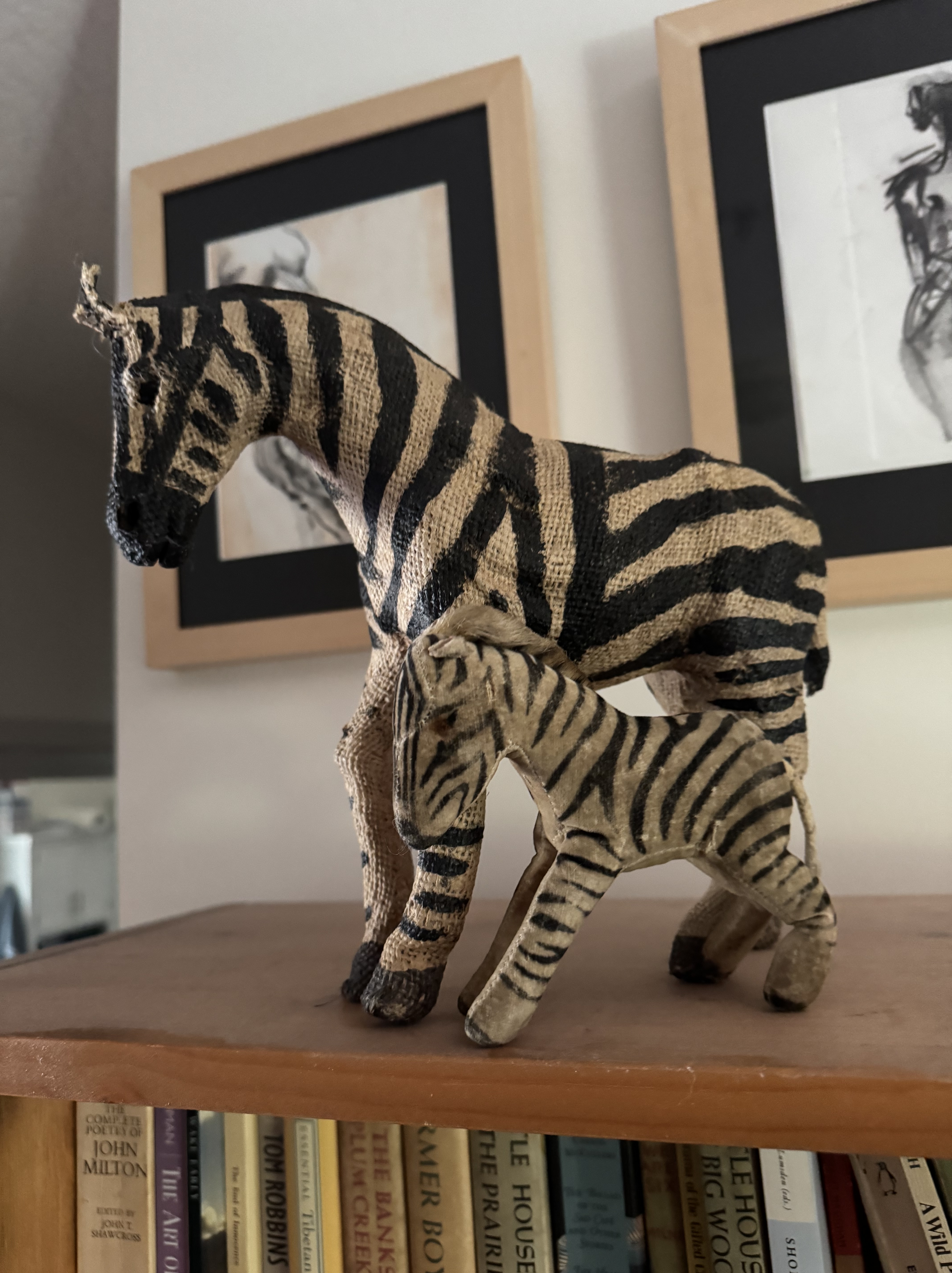
The burlap bag was pure serendipity. Another magical find was a zebra at the ReStore in Langford. Purchased for 70 cents ($1.00 but there was a 30% off sale). This zebra is majestic, dignified, kind, warm. She stands about 10 inches high. Her stripes are unrealistic, but otherwise she is a convincing animal. I dug out a stuffed toy zebra I’d kept from childhood in a box under the stairs. It’s remarkable this sixty-year old stuffed animal still stands! They now live together, mother and child, atop a bookshelf in our bedroom. I like to gaze at them from bed. Something about them feels calming, comforting. I loved my zebra striped one-piece bathing suit when I was eight years old. When I wore it, my reward was a zebra tan that was pure magic.

How to find comfort

Face fear, face grief,
crunch on them like buttered
toast, let them nourish
you. Small striped body
in the mirror, some kind of
childhood magic. Let dreams 
bathe you in orange light.
Sweet’s after tastes
bitter, crying sparks a belly 
laugh. Joy and sorrow 
are so intertwined, you can’t 
tease them apart, please
don’t waste time trying.
Practice the butterfly hug: 
Hands cross collarbones, 
thumbs meet, fingers tap lightly, 
lightly. A comforting rhythm 
will come. It will come. 

The Untangler

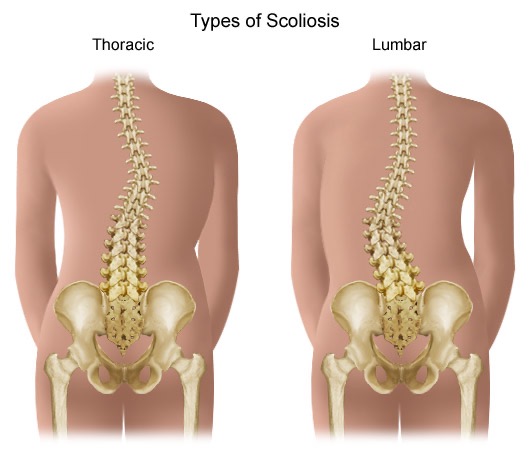
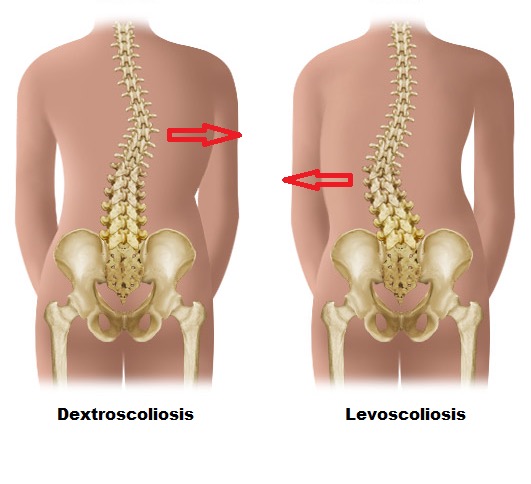
I can’t remember a time in my life when my right shoulder wasn’t lower than the left one. Its slope was unremarkable; this is just the way I am. Then, in my early sixties, a physiotherapist told me I have scoliosis; perhaps I’ve had it since childhood. I didn’t pay much attention. A year later, a Thai Massage practitioner sat behind me on the mat and looked at my twisted spine. “What happened to your back?” she said bluntly. This year it’s been harder than ever to stand up straight. I have daily lower back pain. I feel deformed, out of balance. I used to be five foot six, but during my last doctor’s appointment, I discovered I am now five feet four inches tall. A recent CT scan confirmed it: I have moderate lower thoracic/lumbar dextroscoliosis, a right-bending curvature of the spine. It’s time to figure out what to do. 

I started reading about the condition—S-curves, C-curves, thoracic and lumbar varieties, and treatments, including the Schrott method. I’ve looked at archival black-and-white photos of crooked backs, at racks and braces that looked like torture devices. I started doing yoga for scoliosis and made an appointment with a physiotherapist who specializes in treating this complex condition.

As I wait for my appointment, I have mental work to do. My sister told me about Dr. Joe Dispenza’s website, where there are inspiring stories of transformation and physical healing through meditation. I started to think about how powerful our minds and imaginations are. For many years, my friend Diane has exercised her powerful imagination as a force for good. She has had rheumatoid arthritis since she was 13 and uses visualization to help with her pain. “One of my most powerful visualizations is the dragon, which I call upon during episodes of severe pain,” writes Diane. Describing the creation of her dragon in 2010, Diane writes, “As I surrendered to the flow of molten sensation, the dragon appeared, and I clung to its fiery body until our energies merged. The pain and strength became one, flowing through us as we surrendered to the sensations.”

This visualization has transformed the way Diane sees pain—no longer as an enemy, but as sensation. Pain, she writes, is “neither ‘good’ nor ‘bad’—it simply exists, a presence I accept at the core of my being.”

Diane's AI created image of a woman riding a dragon.
Diane began creating AI images and digital iPad art to visually express what pain feels like in her body, hoping the images resonate with others experiencing pain and disability. This is one of Diane’s AI created images.

Another friend, Janis, visualizes protector angels to bring calm. When her schizophrenic daughter was in crisis, she imagined an angel lovingly holding her adult child, an image that helped her to sleep. 

Anybody in a twelve-step program knows the support that one’s imagined higher power can provide. It doesn’t matter if you visualize the ocean, the forest, a goddess, or your community as your higher power (it’s yours, after all)—the image you create can soothe, comfort, inspire, and heal.

I am reading Dr. Gladys McGarey’s book, The Well-Lived Life: A 103-Year-Old Doctor’s Six Secrets to Health and Happiness at Every Age. In one chapter, she writes about having breast cancer in her nineties. She combined visualization with a lumpectomy and radiation, knowing that how she thought about the tumour played an important part in healing. She started talking to the lump in her breast that she pictured as a “pretty little hand-tooled suitcase.” She spoke kindly to it: “Darling, we’re going to have a family reunion . . . . If there are other cancer cells in my body, call them together, and tell them to get in the suitcase and come on the trip.” I just love that image of the pretty suitcase and all the gathered cells going to a family reunion. There are no enemies inside of us, just family members, and some of them need to regroup elsewhere (or straighten up). 

Book cover of Gladys McGarey's book

Visualization is a powerful tool. 

As I thought about Diane fusing with her fiery dragon, the huge feathery wings of Janis’s angel, and Gladys McGarey’s darling hand-tooled suitcase, I wondered which image, combined with physiotherapy and exercises, could help me straighten my spine. 

I remembered a recent dream that—at the time—struck me as important. My husband Michael and one of my sons accompany me to a job interview. An unusual scene greets us: We are in a large, high-ceilinged space, with brown leather sofas and armchairs spread throughout and around the circumference of the room. My husband and son are told to sit on one of the outer sofas. It’s a public interview; many people are there as audience. A group of men and women at a long table interview me while I sit before them in a butter-soft armchair. The interview is short. I’m told that I have the job. I am the new Untangler. Applause crashes through the air. Everybody is so happy for me! I got the job as the Untangler! One interviewer remarks that I didn’t even need a graduate degree to get this job. Lucky me. 

When I woke from the dream, the unusual noun, untangler, floated free and visited me throughout the day. Now I am thinking of it again—what does it mean to be an untangler? 

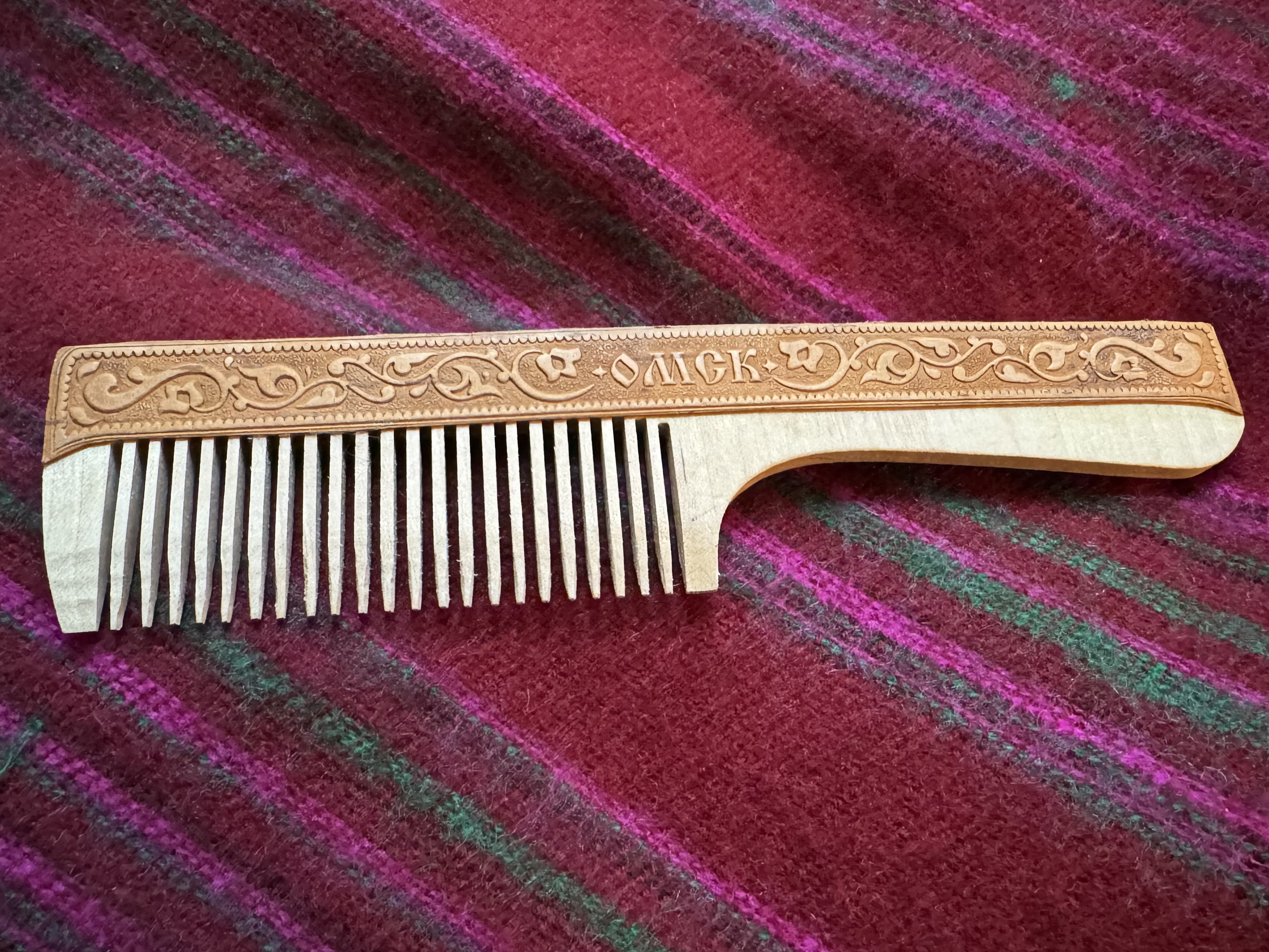
The comb is the foremost untangler, a simple yet effective tool. The earliest known comb was discovered in Syria and dates from 8,000 BC. Made from animal bone, it looks much like the combs we use now, with a handle and teeth. You can buy a cheap black plastic comb in any drugstore, but I am thinking of a more elegant object: the carved wooden comb my friend Olga gave to me. She brought it back from Omsk, Russia, her hometown. I keep that comb at my desk to remind me of her, but lately, I have been using it to comb my hair. To comb is to untangle, to straighten. 

A wooden comb with the handle carved with Omsk and garlands.

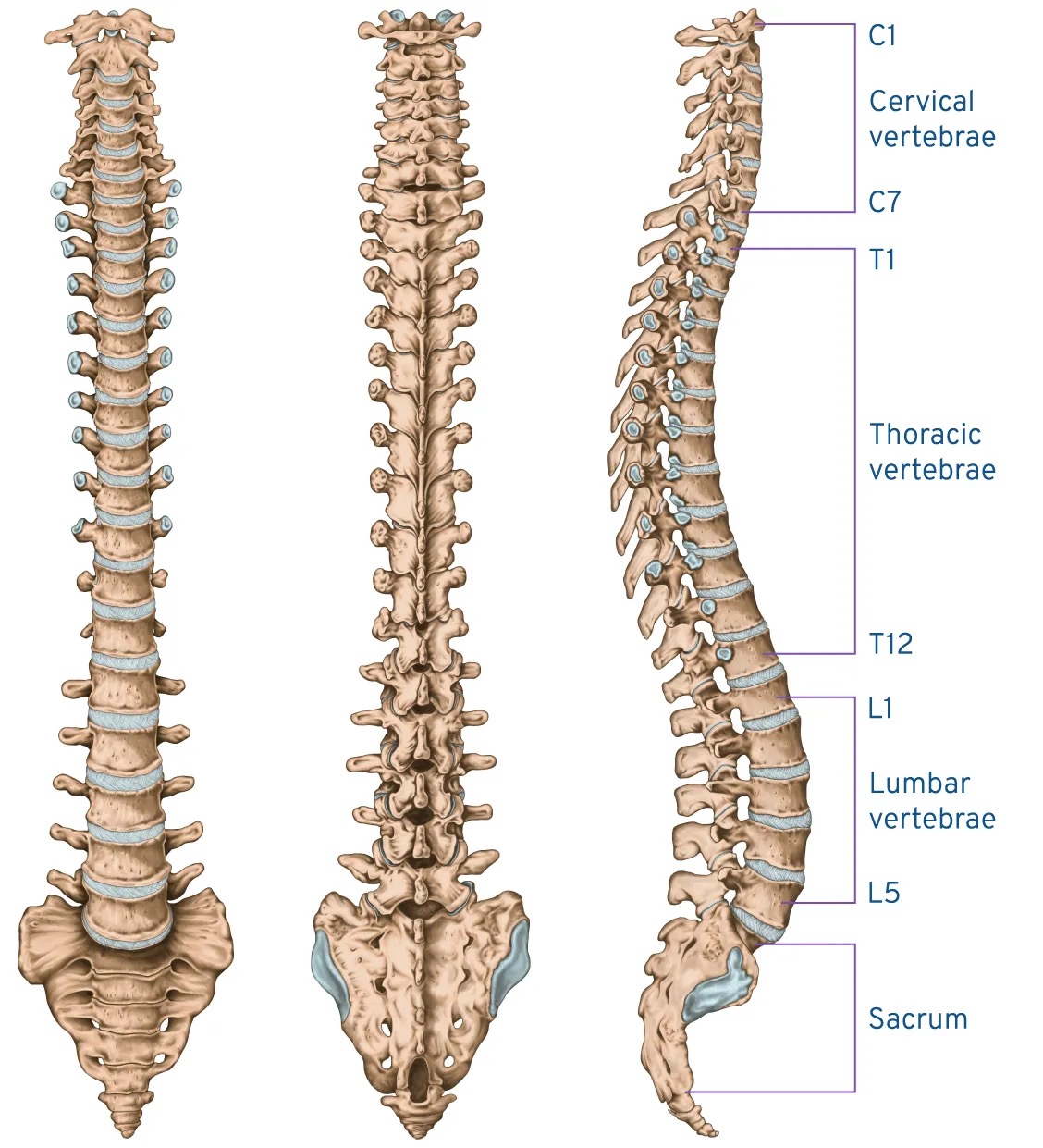
I choose to imagine that wooden comb combing my spine as I walk and when I meditate: long, smooth strokes. (Don’t get too literal; my knobby vertebrae would never fit between the teeth.) When the teeth meet a tangle of resistance, I tug a little, gently exerting pressure, pulling the spinal cord out of its curve. Combing the cervical vertebrae then to the thoracic—T1 right down to T12, then combing through lumbar 1, pulling a bit harder at L2, which—my scan shows—has slipped forward six millimetres to press the nerve, then L3 right down to the sacral region. Comb, comb, comb.  Straighten, darling spine, straighten. Who knows the power of the mind, the power of an image? I was hired as the untangler, so every day, I do my job. 

Anatomy of a spine: shows the cervical, thoracic and lumbar vertebrae sections.

Credits

Types of scoliosis: https://www.hudsonvalleyscoliosis.com/what-is-scoliosis/types-of-scoliosis/

Thank you to Diane, who gave me permission to share her dragon image and story and to Janis, who gave me permission to share her angel story.

Anatomy of spine: https://mxnspine.com/anatomy/

Creativity is a fox: A year in review

I start the year with a glance back over 2023. Last year, creativity often eluded me. She was a timid fox, hiding in her hole. I tried to lure her out, but at the first sign of self-doubt, she’d scurry back down the tunnel. Making things—in cloth or paint, in the kitchen, with words—can feel pointless in the face of climate crisis, grief, war, and ennui. And yet, don’t you think we must continue to create as an antidote to all the destruction?

When fox stayed out long enough, she inspired me to bake cakes, sew things, paint mandalas, and write stories and poems. 

Baking

I love making cakes and preparing gifts for people. I fantasized once about starting a small business: I could make bespoke cakes and gifts to order (quilted bookmarks, small herb bouquets from my garden, stones from the beach that feel good in your hand). Nice idea, but maybe not a great business move.

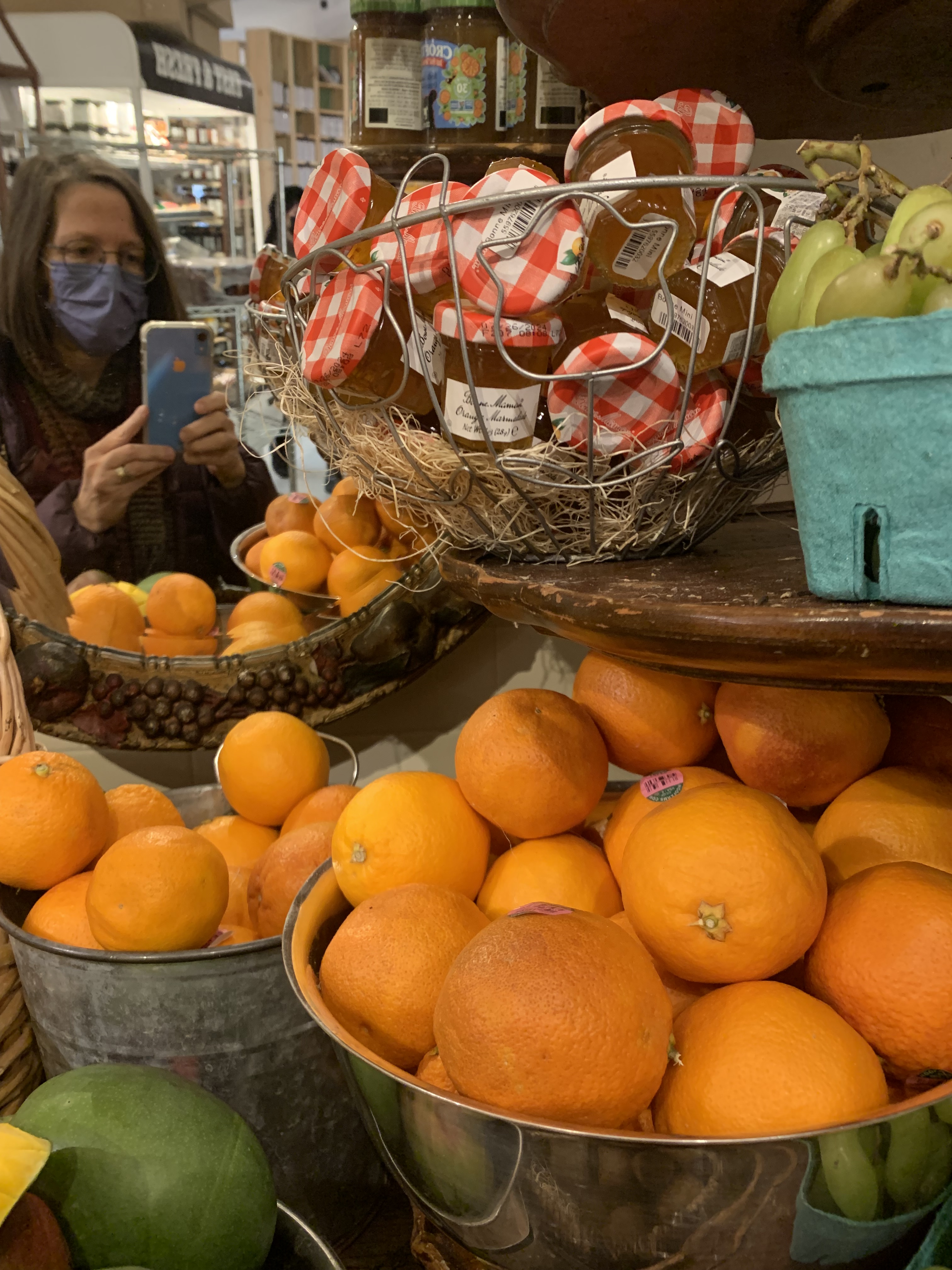
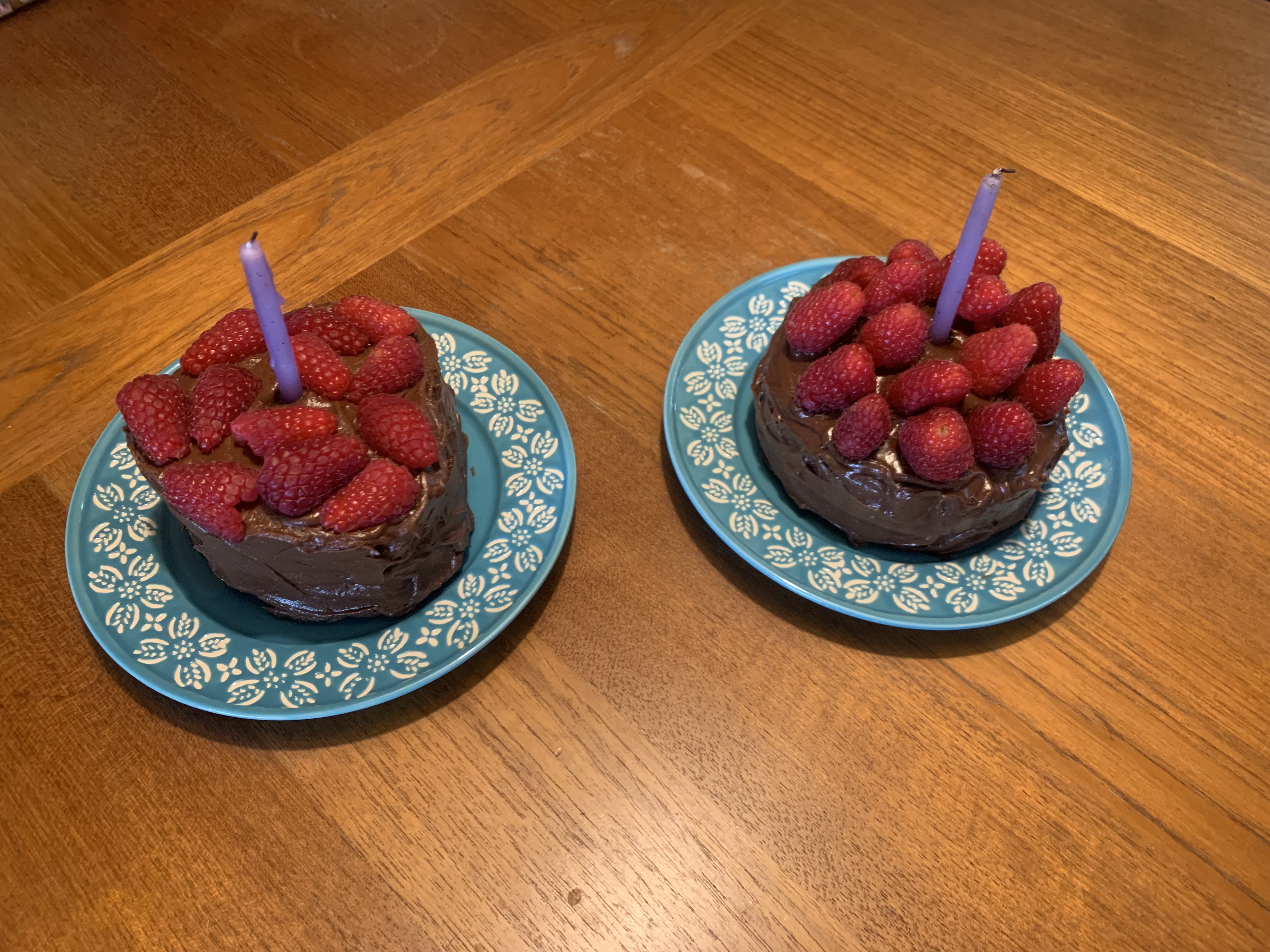
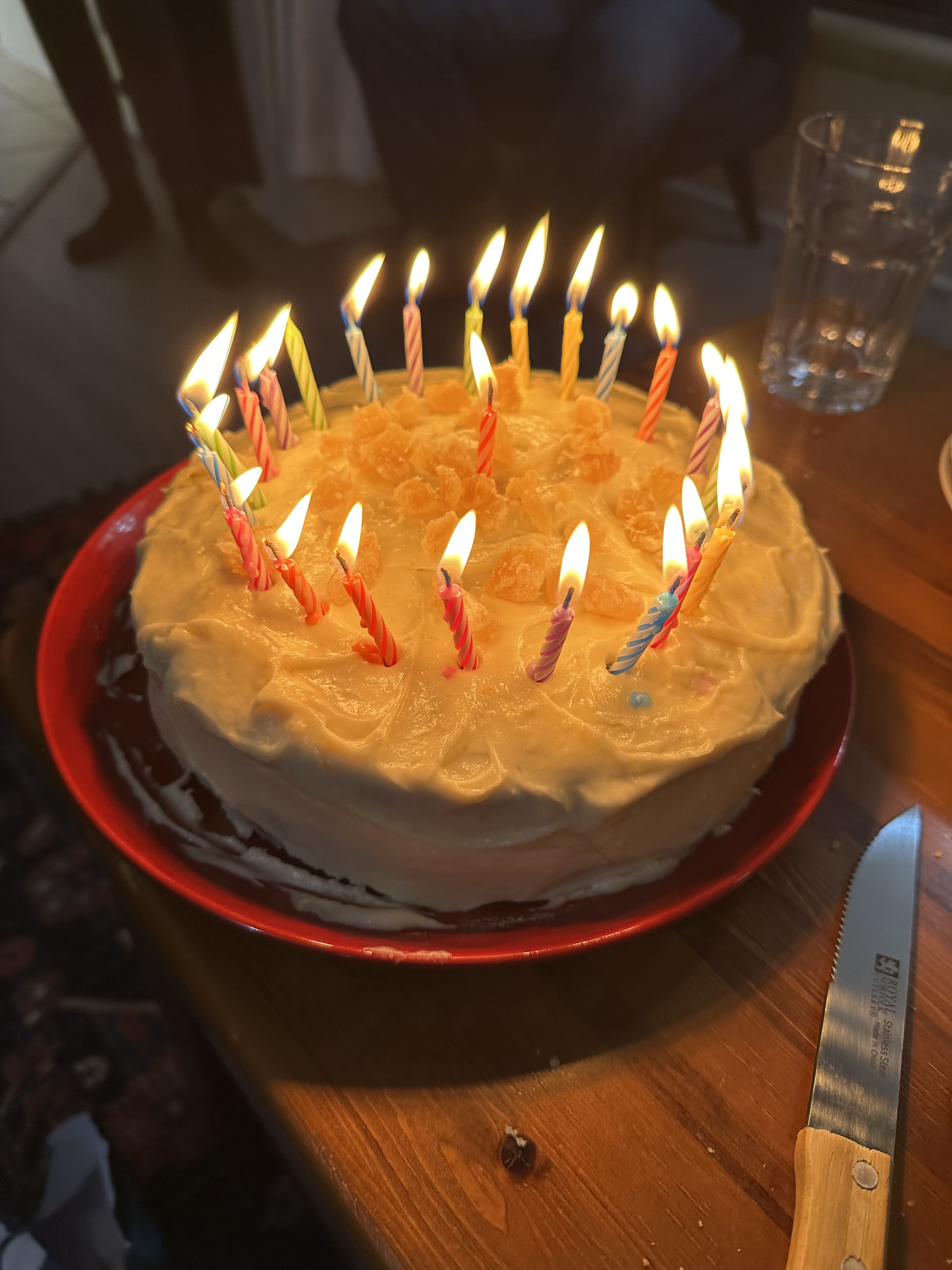
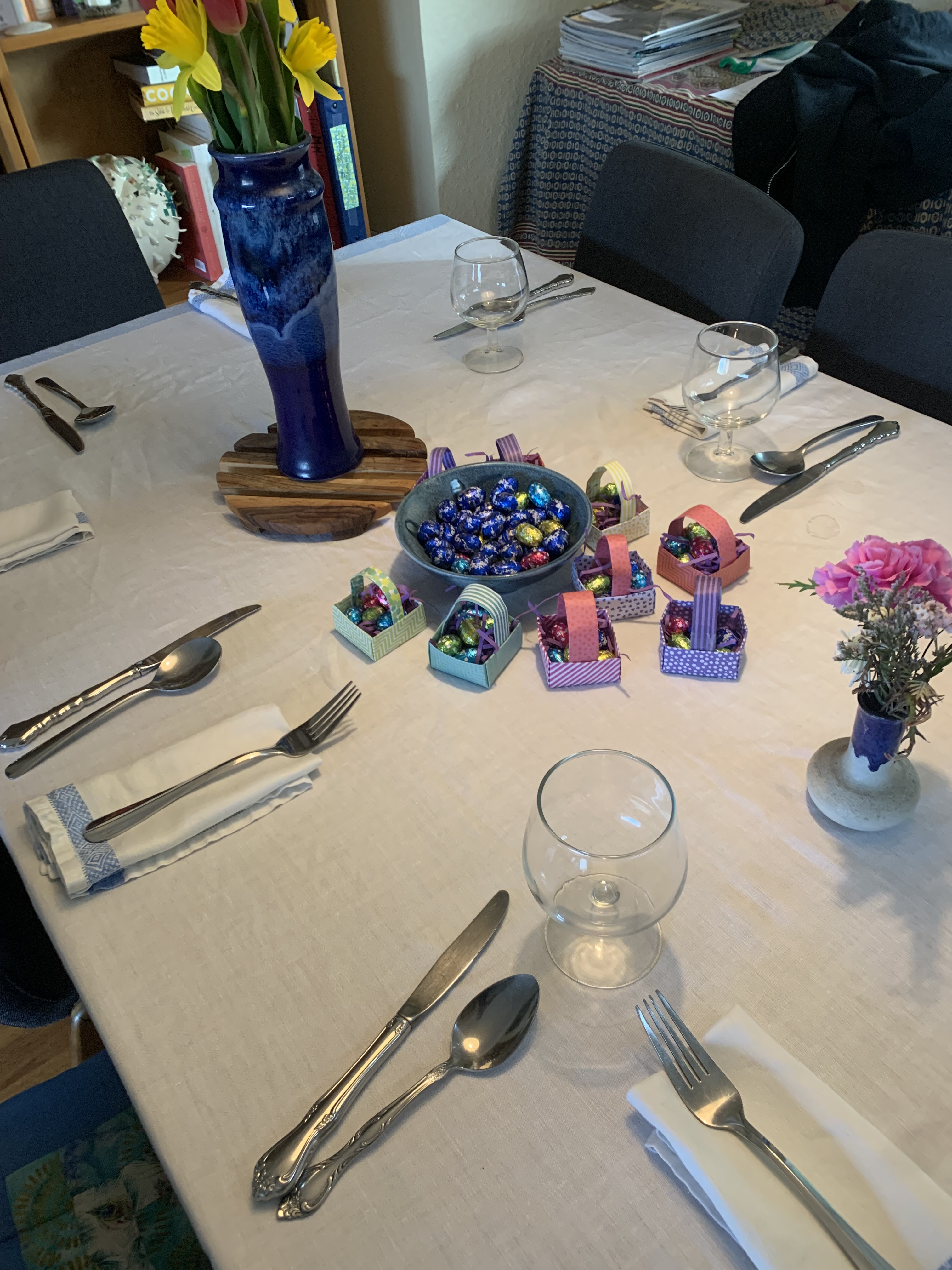
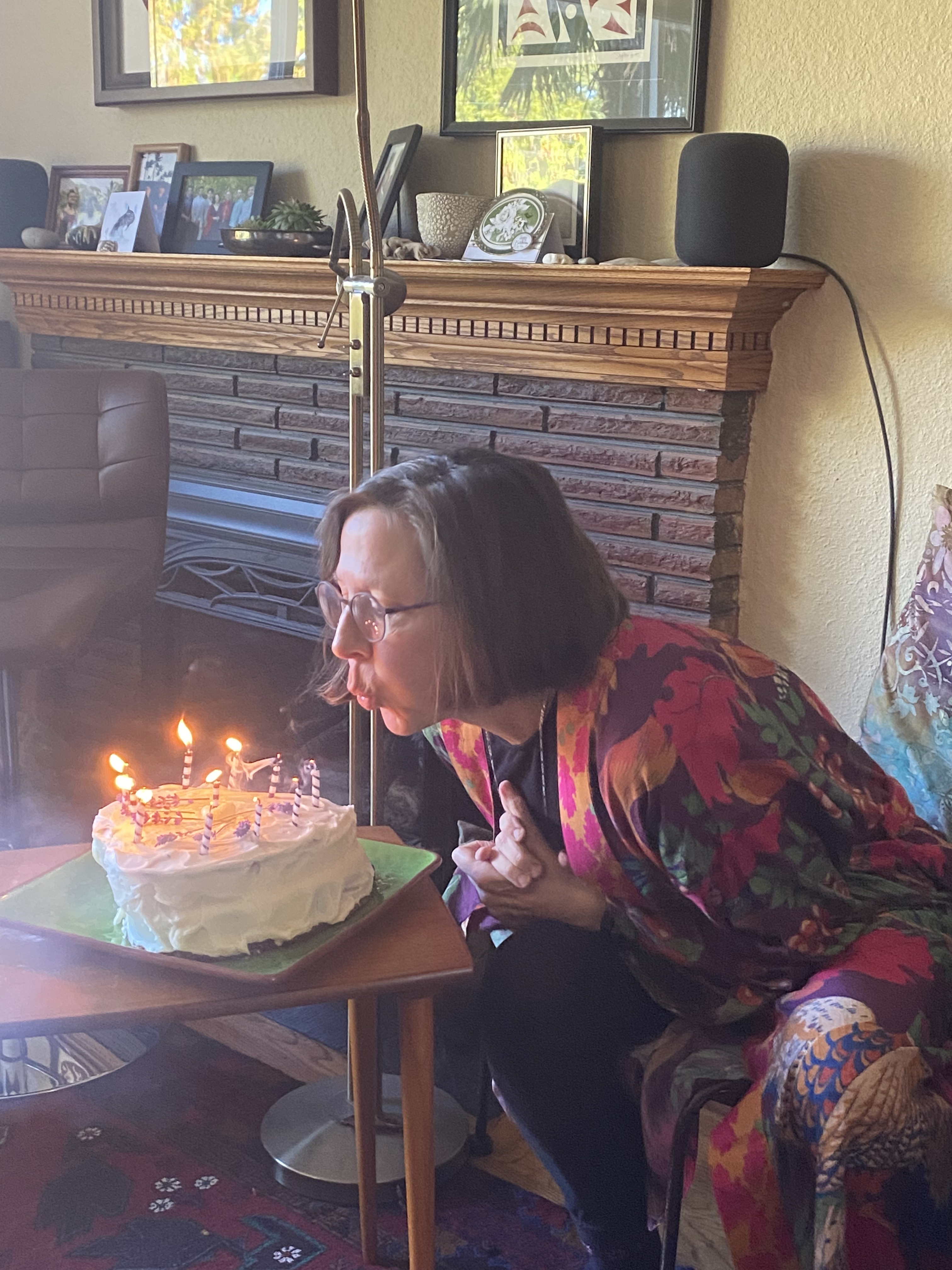
This year Michael got an upside-down blood orange cake for his February birthday, and we had fun sourcing the oranges. Found some good ones at the Market Garden on Catherine Street (where shoppers sometimes sit down to play the grand piano—such a cool store). I baked mini-chocolate cakes with strawberries later in the month for Barbara, and for Easter, an almond torte with whipped cream and more strawberries. Like my mother before me, I love to set a beautiful table, and Easter was no exception. The origami Easter baskets filled with foil-wrapped chocolate eggs provided a whimsical touch. (Entertain your inner child, I say.) For my own birthday party, a classic carrot cake baked in a heart-shaped pan frosted with cream cheese icing. For Andréa’s big five-oh: applesauce cake with three kinds of ginger. And for the final English conversation café at work: ginger cake with buttercream icing. What is it about a cake that speaks pure love?

Sewing

I didn’t make any new quilts, but I did sew a purple wall hanging, about 30 by 30 inches, that now hangs in our bedroom. I like to lie in bed and gaze at it. Four sentinel circles surround a larger one—all shot with gold thread (fragments cut from an old wraparound skirt from a yard sale). Those circles/mandalas ground me; cloth clocks tick noiselessly, watching over us as we sleep. 

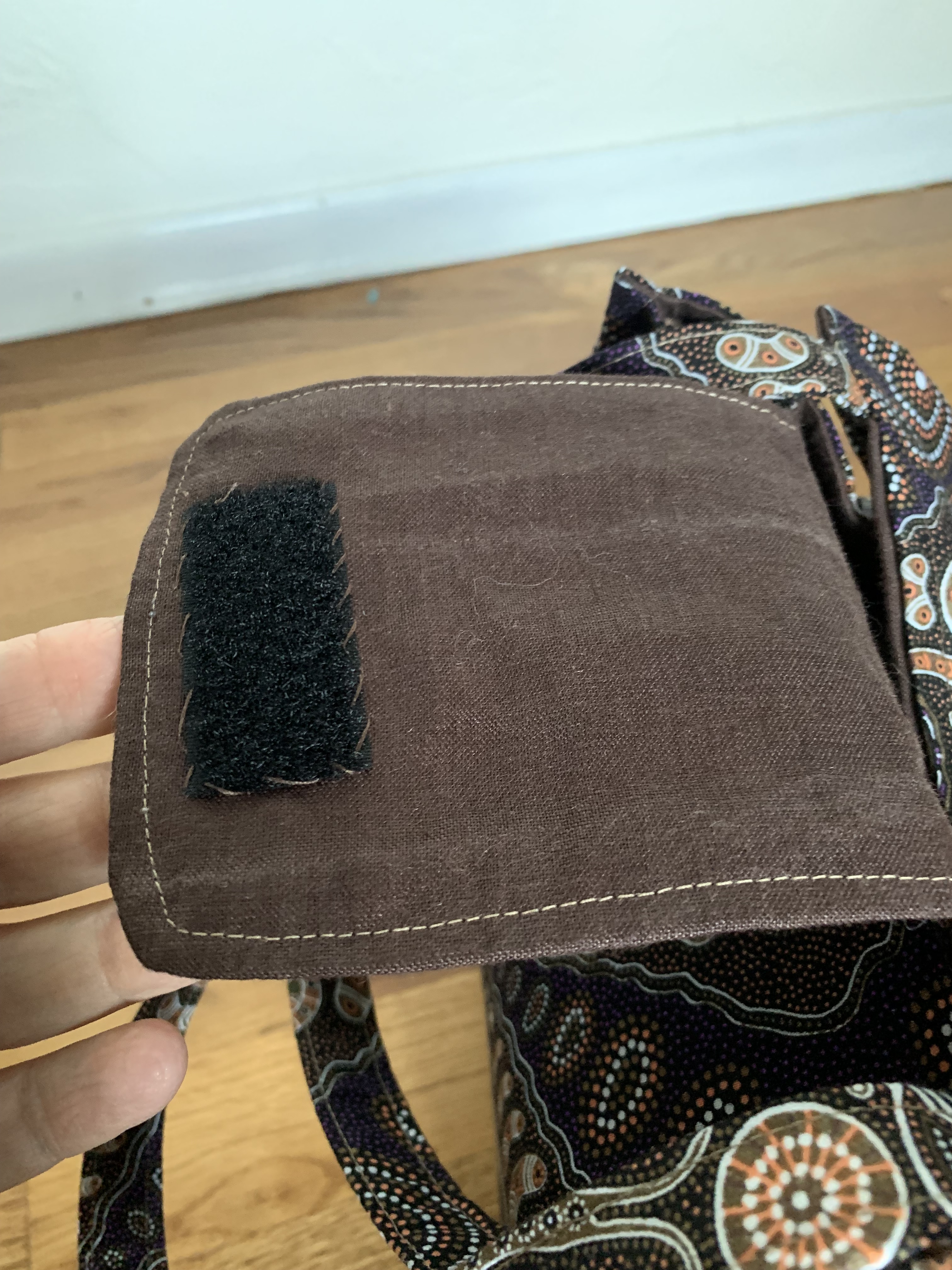
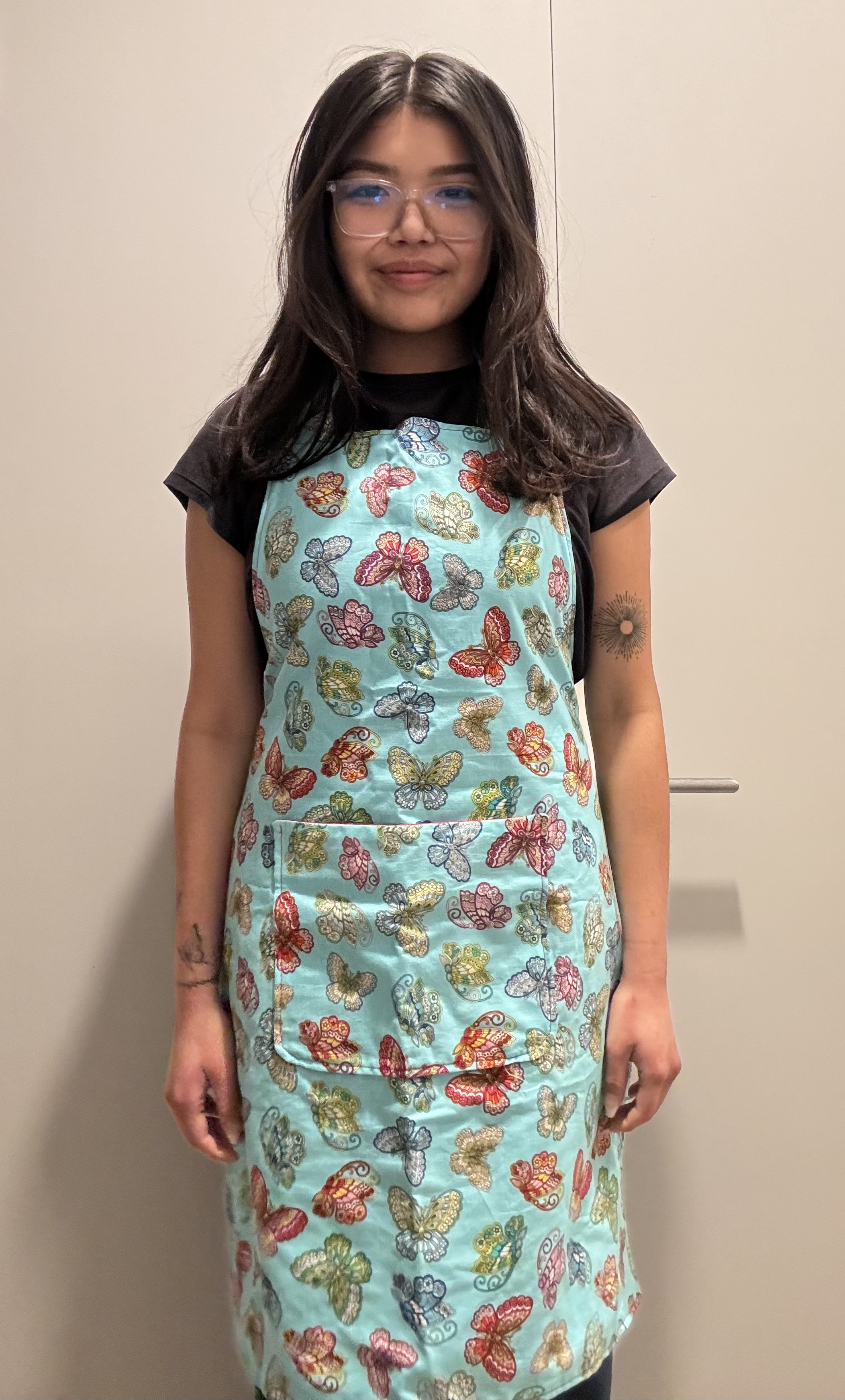
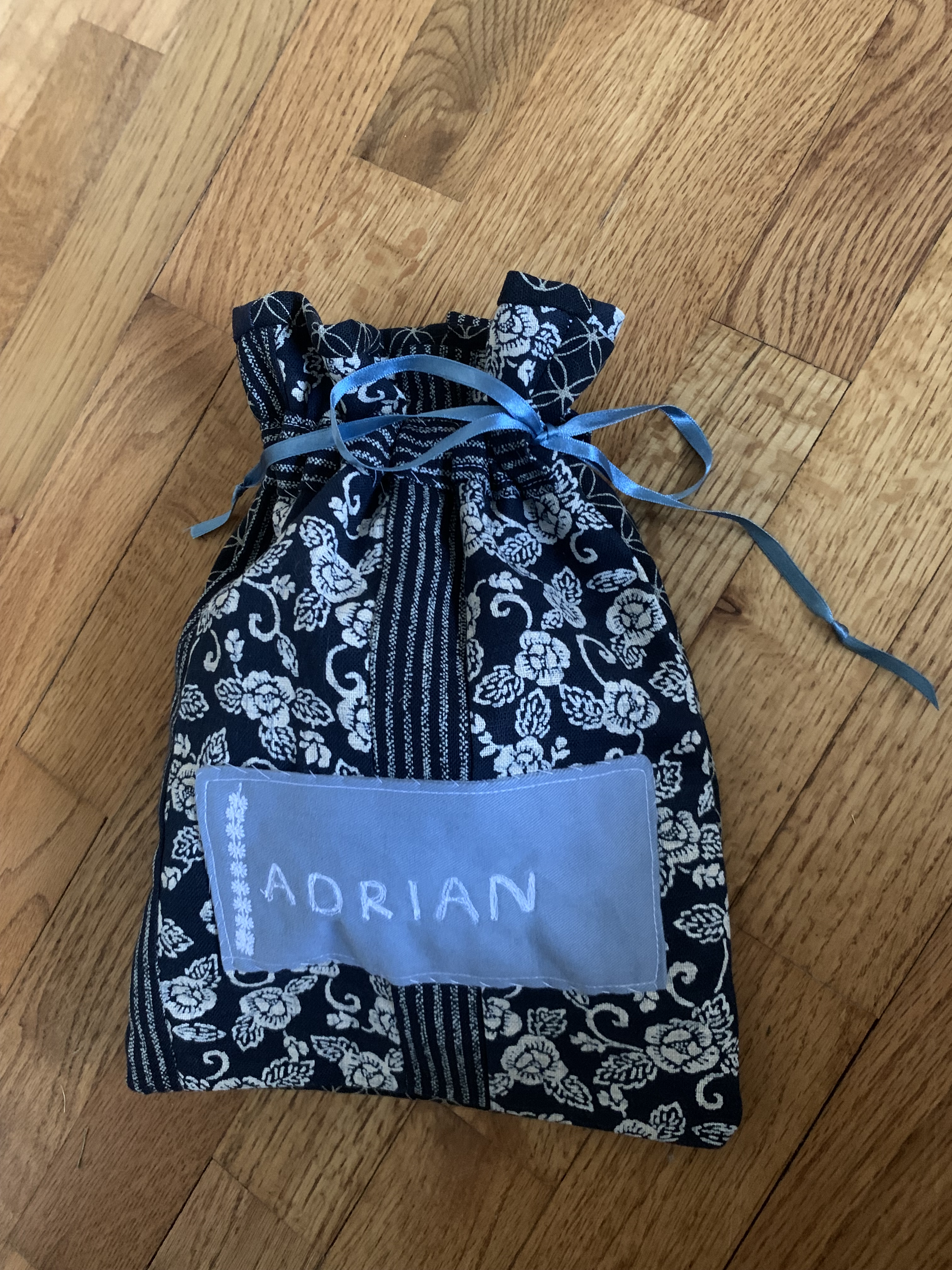
Smaller sewing projects attract me because results come together quickly. My sister Kathryn bought me a drapery panel of Indonesian fabric in browns, reds, and purples at a thrift store. A lot of fabric—40 by 83 inches—for only $4. I’ve enjoyed making some things from it: placemats and napkins mostly, and a sweet little fabric basket (I made a few of these for friends for Christmas, then filled them with chocolates and gifts). I felt most proud of the lunch bag I made for my boss, Nancy, because it tested my skill. I used fabric in a brown geometric pattern by an Australian Aboriginal designer. Then I lined the bag with sturdy brown linen from a too-big jacket I bought at a yard sale down the street. Nancy loves it. Adrian’s bag (filled with toys) for his second birthday involved some great scraps I bought from Smoking Lily on Government Street. Finally, I sewed a butterfly apron at Christmas for my niece. She is beautiful in any outfit, even an apron. 

For my 65th birthday party (the theme was poetry and potluck), I made fabric wrappers for second-hand poetry books I bought for guests. So fun to comb through my stash and find colours and patterns that sing together. Party favours were fun when you were a kid, and they are even more fun when you’re an adult. Again, entertain that inner child…

Making Mandalas

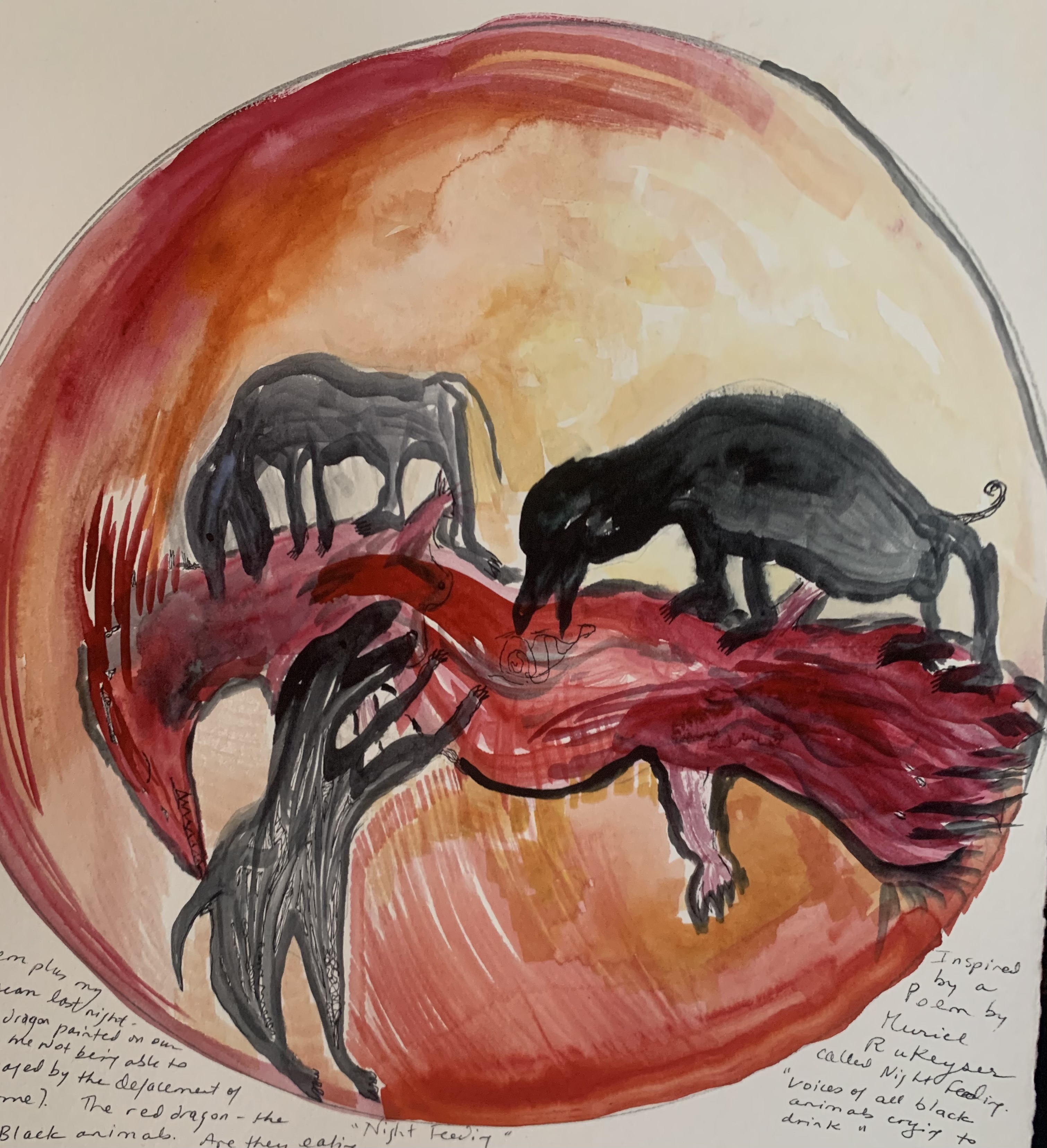
Michael and I had a Monday Mandala practice for a while, but it fizzled out sometime during the year. One exciting project: we delivered a multi-day mandala-making workshop in March and early April on Zoom. Our participants were mostly from New Mexico—all lovely, open-hearted women. It was a good experience. Michael was a guest presenter at two Creating Mandala monthly events. The CM team featured a new goddess each month, and Michael chose to talk about the High Priestess (Tarot) and Kali (Hindu goddess associated with death). I attended both of these events with pride and pleasure. Some mandalas last year were inspired by dreams—a rich transmutation. I dreamed I entered a room in my house and found that someone had painted on my white wall a red dragon being devoured by three beasts. Still musing on the meaning of that one. 

Writing

Here’s where the fox was most recalcitrant. I aborted so many poems, blogposts, and stories last year, I am surprised to find anything in my files. I posted on this blog only five times in 2023. However, I did complete a series of linked short stories (started in previous years): Nothing is Wasted: The Stan and Deedee Stories. I shared them with a few friends and family members. If you are interested in reading them and you’d like a digital copy, let me know (maddyruthwalker@gmail.com) and I will send you one. 

Some months, I had nothing new to share with my writing group. I’d scour the old folders for some scrap from the distant past to read. Or I’d just listen to others read their work. But that’s okay. I know that I’ll write again. When nothing seems to be happening, the fox is deep in her hole, pregnant with kits. How many will be born and when? Just have faith.

I wrote only a few poems in 2023, and one was for my birthday. Each guest was asked to bring a poem to share. It was extraordinary to see my friends and family members get up into the poetry seat and read poems they’d chosen, poems they’d written: one of the best gifts I’ve ever received. To close the offerings, I read my own poem– one that expresses the expansiveness I feel as we enter 2024. Happy New Year to you!

Expansion

I started slim 
and willowy.
Then, whoosh of years.

My waist - heavy as grief,
soft as dough -
expanded.

Grief. Have you met her?
Well then you know the
grace that she bestows.

Hard things—she
cracks them open, 
ignites a hotter flame, 
imbues a deeper shade of red. 

So, like my waist, 
my heart’s made wide by grief, 
a vast container for the love I feel 
for trees, and animals, the sky, 
the planet, for you, my friends,
for people everywhere, 
for life expanding.

Acquainted with grief–and joy

The other night, we watched the Bach Consort ensemble perform Handel’s Messiah (Knowledge Network). I’ve heard the Messiah hundreds of times, but this time one line resonated especially—Gaia Petrone, mezzosoprano singing, “He was despised and rejected of men, a man of sorrows and acquainted with grief” (Isaiah 53:3) Yes, Jesus was acquainted with grief. And as we traverse our later years, don’t we all become well acquainted with grief? In the last six years the losses just keep on coming, so grief has become an intimate familiar to me. 

And yet, there’s joy! The chorus sings “For unto us a child is born, unto us a son is given, and the government shall be upon His shoulder; and His name shall be called Wonderful, Counsellor, the mighty God, the Everlasting Father, the Prince of Peace” (Isaiah 9:6). My whole body is engulfed with joy tempered by grief; tears stream down my face. My intellect has no chance to do its fancy override of emotions, has no opportunity to ridicule me: You’re not Christian, Madeline, why so moved by this, you silly? The analytical brain successfully bypassed, I am immersed in the bittersweet joy­sadness of the words, bathed by a sense of the sacred: vaulted ceilings, stained-glass windows and flowing frescoes of a Viennese cathedral. The possibility of God. The swell of triumphant sound fills both church and body. 

The past rolls in. I go way back and find myself sitting beside my mother who gifted me with her love for classical music. We sink into the wine-red velvet seats of a hushed concert hall.  It was 1983, and I had my first job after graduating with a BA in English: I was secretary to the head engineer at the newly built Roy Thompson Hall in Toronto. There was one marvelous perk that kept me showing up at the gloomy subterranean office: free concert tickets. When I got tickets for the Toronto Symphony performing Beethoven’s Ninth and invited my mother, she was thrilled. During the final movement, as the four soloists and choir sang the “Ode to Joy,” I turned to her and saw her cheek wet with tears, her dark eye sparkling with complicated joy. Just as my father retreated into jazz to feel his feelings, classical music was the vehicle for my mother’s deepest emotions. Many times, I caught a glimpse of her crying as she sat on the living room couch, listening to a moving passage from a symphony or quartet or aria. As I wept last night over the Messiah, I felt our tears intermix. We are connected. 

I noticed another sweet outcome from watching the Messiah: the opportunity to hug an old friend no longer with us. One of the second violinists resembled Hanna, who died in 2018. I went to sleep with that image of the violinist merging with the face of my dear friend: wide grin, glasses, brown bob laced with grey. When I met her in the dream, she felt real as anything, and I stayed for a while in her warm, familiar embrace. I love that I can still access my lost ones in the dream world. 

So, in a few weeks the year rolls to a close. Last December I wrote about all the things I had accomplished during the year—sewing and writing projects, starting my business. What did I accomplish this year? I put one foot in front of the other every day. This December it feels like more than enough to just write a few paragraphs and give thanks for the good things in my life. 

The Walker Sisters, circa 1963, Berkeley California

In August my eldest sister and niece moved from Yellowknife to Nanaimo. The three Walker sisters haven’t lived in such proximity since the 1980s in Toronto. Our closeness brings me comfort and happiness. 

Walking the dog day in, day out, has given order to our lives. Sky and earth, weather, sun, moon, trees, and birds break through my orbit of self-absorption, and I am grateful for them all. To stand in rain puddles and watch the fast scud of grey clouds, cormorants flying low over the steel-gray Gorge—is to feel alive. 

Although my writing group only met a few times this year, I appreciate each member. Late one recent afternoon, we sat in a beautiful room as the winter light slanted through the tall windows, Japanese oranges in a brown bowl, our faces rapt as we listened to one another read our work. We need stories now, more than ever. 

This was a year for intake rather than output. I didn’t sew or write much. I read voraciously and watched a lot of television. Grateful to the authors whose words I enjoyed this year, too many to list. But three memoirs stand out for me. I loved poet Elizabeth Alexander’s narrative The Light of the World about her marriage to artist Ficre Ghebreyesus, his sudden death and her grief. She writes with the poet’s delicacy and attention to detail, and her grief/joy is palpable on each page. 

Vivian Gornick’s memoir, Fierce Attachments, about her fraught relationship with her depressed mother, Bess Gornick, resonated with me. Vivian struggles for independence from Bess while loving her with the potent mix of passion/compassion limned with hatred and resentment that seems particular to some mother-daughter bonds. 

Perhaps you have to be a Margaret Drabble lover or a lover of puzzles to appreciate this one (I am the former). In The Pattern in the Carpet: A Personal History with Jigsaws, Drabble leads us through her lifelong fascination with puzzles, mixing in portraits of family members, tidbits of the history of puzzles, and asides about memory, writing, and life. A circuitous maze-like quality to the writing brings form and content into alignment.

And so many good stories streaming on television. I was grateful for a daily escape from reality through hours and hours of Grey’s Anatomy, No Offence, Pretty Hard Cases, Succession, Shetland, The Chair, Shtisel, Lupin, and many more. . .

I look forward to the shortest day of the year and the return of the light. Thank you for reading, dear people. One foot in front of the other.

For the love of books

Five days ago, I woke with an exquisite feeling of all-body all-soul nourishment. A rare feeling. My vivid dream was that I was wandering through a used bookstore—a warren of small book-filled rooms bathed in soft amber light. Lots of burnished wood, small upholstered chairs at the end of each row of bookshelves to sit and pore over the pages of an illustrated Alice in Wonderland or Daumier’s lithographs. The dark orange spines of  Penguin editions beckon me, I walk dreamlike down corridors of books, taking volumes from shelves, paging through them, enjoying the quiet warmth of this place, just a clock ticking somewhere. It reminded me a bit of Bastion Books, one of the few remaining independent used bookstores in Victoria, with its welcoming nooks and crannies. In my dream, I wander to the far end of this bookstore to a small doorway then enter a compact room where my three sons sit on straight-backed chairs as if expecting me, all smiling as I approach. They rise to hug me. We embrace without words, and I feel their height and strength flow into me. And then I am awake, full to the brim.

The dream was significant to me now because I miss both hugging my sons and access to books (I haven’t explored the relationship between those two things…). Although I can talk to my sons on the phone, through text, or video-chat, their physical hugs are off limits. The libraries are shut, and the bookstores are too—they allow for online ordering, but the brick and mortar stores are locked, and I cannot materially browse, an activity that sustains me. In a synchronous turn of events, I came across The Booksellers, a documentary available online via Cinecenta, the movie theatre at the University where I work. Cinecenta is another small business suffering financially during this pandemic. Their theatre is dark and shuttered, the snack bar where I got so many coffees is now deserted. So they partnered with Kinosmith to offer this documentary. After clicking a link provided on their website and paying by credit card, I was able to watch a fascinating exploration of booksellers in New York City. This history of the rare and antiquarian book trade in that diverse city was peppered with interviews with some of the unusual and eccentric people that devote their lives to books as precious objects.

After watching the doc, I started to think about how my constrained access to books lately due to Covid-19 has actually enriched my life in an unforeseeable way. Because I didn’t have my usual broad choice of reading material, I started to forage a little more intently in the free little libraries in the neighbourhood. Some cautious neighbours had removed all of the books from the shelves of their little libraries and posted signs explaining that they would re-stock after the risk of virus contamination had decreased. Thankfully, others had kept their books on the shelves, and I found myself returning to these spots over and over and taking books I wouldn’t normally be interested in.

IMG_1608A few weeks ago, I picked up Octavia Butler’s The Parable of the Sower from the cute little library on the front yard of a house around the corner. “Take a Book, Leave a Book” was painted in curlicued white letters across the blue cupboard doors. When I was a teenager, I decided I wasn’t interested in science fiction. Somehow, I only wanted to read things that were “real.” So I turned to 19th century British novels and early-mid 20th century American writers like Philip Roth and Saul Bellow. Of course I have cast my reading net much wider since then, but I still don’t tend to be drawn to science fiction or its sister genres, fantasy and horror.  Yet, as I dug into Butler’s novel, I became engrossed by the young female narrator/ protagonist Lauren who is bent on survival in a dystopian America of the future. Her warrior spirit drives her to escape from the murder of her family and razing of her home in a gated community in Southern California and form a motley tribe of people all searching for safety. Due to her mother’s drug abuse, Lauren was born with hyperempathy, a disability that has her feeling other people’s pain to a debilitating degree. She develops a religion called Earthseed, whose God is Change because the only thing we can be certain of is that everything changes. What felt eerie about this novel, written in 1993, was that Butler’s portrayal of a dystopian nation read as strongly resembling Trump’s America.

After finishing The Parable of the Sower, I felt I must read the sequel, Parable of the Talents (1998); however, only in a world of magic would I find that book in a free little library. So I borrowed Michael’s Kindle and splurged on the e-book, and I am devouring it now. I’m still in the early chapters, and I am curious what will happen to the tyrannical megalomaniac president whose slogan is “Make America Great Again.” I am not kidding—this president really is a character in a novel published in 1998.

IMG_0812I always prefer books as objects over digitized texts. I love the feel and look of books. I love to explore marginalia and marks, run my hands over bindings, examine tatters and pages folded over, text that has been underlined. The other day I picked up a well worn novel (The Lotus Eaters by Tatjana Soli) from a free library that had written in the inside cover in elegant cursive, “Property of” followed by a rectangular stamp: The Cavern Hotel and Café, El Nido, Palawan. I Googled this mysterious place and discovered it is a hotel offering pod accommodations in the Philippines. So interesting. (The next day, Trip Advisor wondered if I would like to see the current rates for staying the Cavern.)

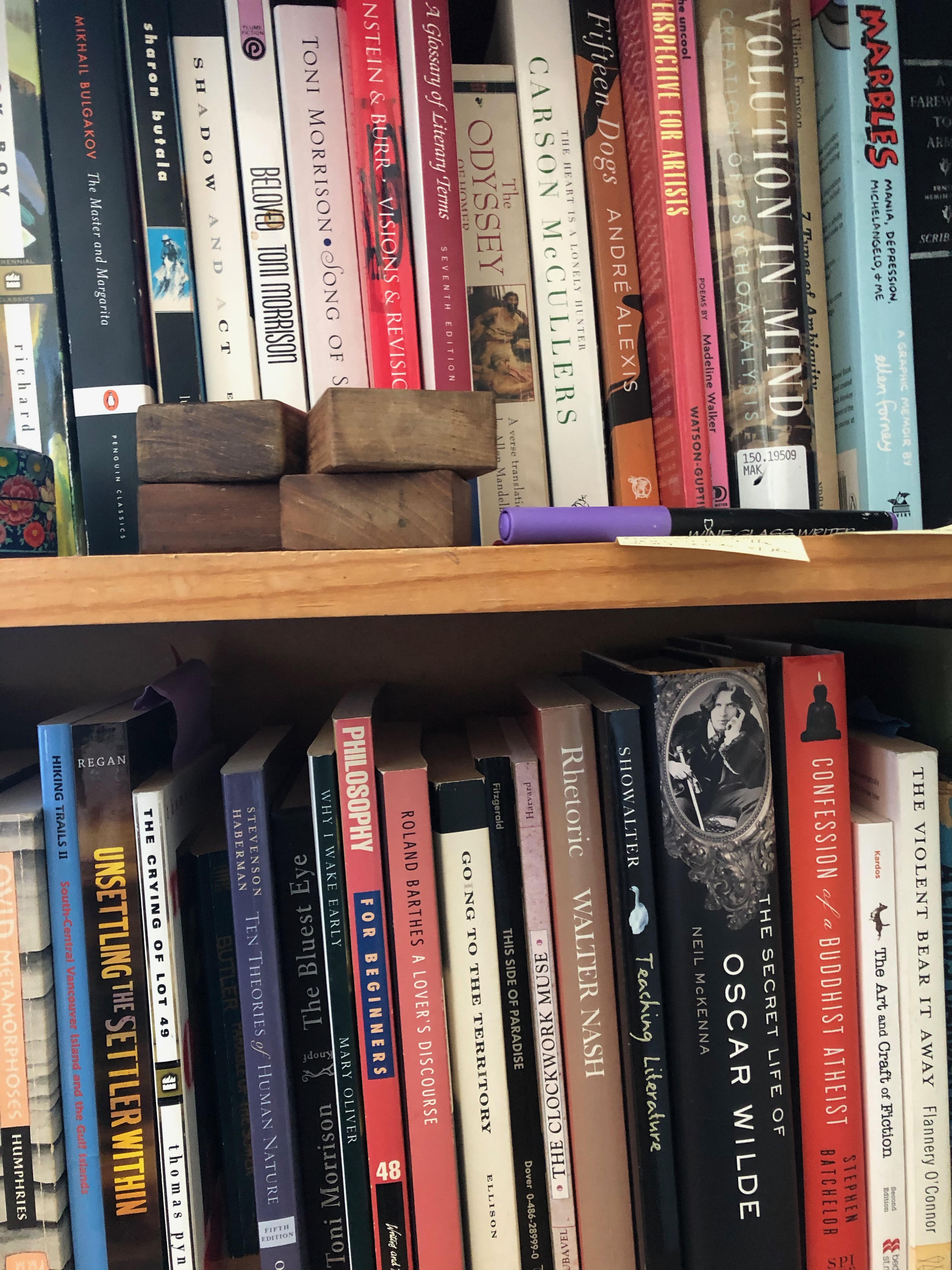
Even though I recycle books through free libraries and friends, I do keep a library at home of books that I love: poetry and feminism, how to write and teach writing, graphic novels and memoirs, and twentieth-century American novels I had the privilege of studying and teaching for a short while.  But lately I have appreciated how the e-book allows me to read while Michael sleeps. With the slim Kindle propped up under the covers as I curl around it in IMG_0788 2the dark, I enter into the world of Butler’s novel, where kindness is the last good thing, where people band together in tribes because love and human relationships are all that we have, and where impermanence is the only truth. Wait a minute, all of that is sounding familiar. Is it really the future, or is it now?

I wake up every morning in this dream-like world, and I say to myself, “I wonder what will happen today?”


Shake your wet weathers in the warm wind

Bouts of anxiety come and go these days: chest tightens, stomach burns, heart flutters. Tears come at any time, unbidden. My hands and face feel raw. My heart even more so. I  am finding comfort in small things. When I saw #StayHomeWriMo’s mental health prompt, “starting re-reading one of your favourite kids’ books,” I took Little House in the Big Woods and Little House on the Prairie off the shelf, the first two books of a series based on Laura Ingalls Wilder’s childhood, specifically pioneer and settler life in Wisconsin, Kansas, Minnesota, and Iowa in the late 1800s. I have the first four books, and I’ve kept them since childhood, moving them from house to house dozens of times. Faded covers, deckled edge pages, and canary yellow flyleaves. Garth Williams’s droll pen and ink illustrations make the stories and the characters come alive. Rereading them more than fifty years later, they produce the same warm feelings of comfort and safety they did back then.

Screen Shot 2020-04-10 at 12.56.29 PM

As I snuggle in bed, I enter a fictional world governed by capable, predictable adults. Wolves howl outside, bears roam the woods, storms erupt and cold winds thrash against the house, malaria descends upon the family, and Indians living down in the creek beds want to kill and scalp all white people. Yet Ma and Pa are there, keeping Laura, Mary, and baby Carrie safe.

Nestling into words and images describing snug, clean, safe indoor environments, I enter the log house in the big Wisconsin woods (Book 1). In the deep of winter, fire shines on the hearth, bulldog Jack and Black Susan the cat stretch out on the warm wood floor. Comfy in her red flannel nightgown, tucked into the trundle bed she shares with her sister, Laura “looked at Pa sitting on the bench by the hearth, the firelight gleaming on his brown hair and beard and glistening on the honey-brown  fiddle. She looked at Ma, gently rocking and knitting. She thought to herself, ‘This is now.’”

IMG_0738

Like a swarm of bees, I can feel the critical arguments seething through my mind as I continue reading: I am trained to call out patriarchal culture, gender construction, racism, oppression, and colonialism, and it’s all there in these books. But I switch off those arguments, sinking into our collective unconscious where an archetypal protector tucks us into cozy trundle beds, watching over us, every one, during this difficult time.

I remembered my 60th birthday party, a year and a half ago. Despite drawing a tarot card that spelled disaster, I experienced the snug feeling of being safe, loved, and watched over. Those were happier times when we were able to gather—when physical distancing was unthinkable.  I invited a friend to the party who reads the tarot, specifically the Motherpeace deck. Karen Vogel and Vicki Noble created Motherpeace tarot in the late 1970s in Berkeley, California, where they worked together as academics, feminists, and sacred healers. This big round deck draws on ancient Goddess wisdom, the occult, magic, myth, and feminine energies. Although when I first saw the deck, I felt disappointed by what I perceived to be crude artwork, I became more and more interested in how these two women had translated the 78 cards from more traditional decks into sacred feminine images.

At my party, I felt honoured by Pamela’s willingness to read for my friends, and one by one, I asked people if they would like a reading. Several of my women friends did, and so by turns, they sat in my low bamboo writing chair that I had dragged into the living room from my sewing room. Pamela, having spread her blue velvet cloth over a low footstool, handed each querent the deck to shuffle. It takes a bit of time to get used to working those big circular cards into a shuffling sequence, and I noticed each of my friends handled the task slightly differently. Pamela asked each woman for her question: What do you want to know? Not a yes/no binary question, but a how or why or what question. Next, Pamela asked them to cut the cards three times, choose three cards, and lay them down. The three-card sequence represents the past, present, and future.

Sometimes, through the buzz of conversations, soft lamplight, music, balanced plates of food, and milling bodies, I glanced at the rapt look on the querent’s face as Pamela leaned in toward her, long blonde hair falling around her beautiful serious face. Sometimes I heard laughter from that corner. And I kept getting little warm flutters in my heart—thinking of how happy it made me for each of my female friends to have this loving attention paid to her for a few moments. To consider her life as this rich, mysterious path. To feel the soundings of old wisdom, submerged, but like a vein of molten lava, spreading warmth and understanding into her body, from the seat of her pants into her torso. But of course these are my feelings about tarot—not theirs. Yet it made me happy. It was as much a gift to me as a gift to each of them.

It was enough for me to know the gift Pamela had given my friends, but then, as I stood in the doorway saying good-bye to a guest, she patted the pillow on the wicker chair. “Your turn.” I sat down, and when she asked me for my question, it came without hesitation, from where, I don’t know: “How do I connect with my power?” The first card, my past, I didn’t take too seriously—six of cups with three women in the water and three riding a wave of orgasm. Perhaps it signified all of the good love I had been experiencing since I met Michael. Perhaps I had started to take it for granted, this bath of love I swim in.
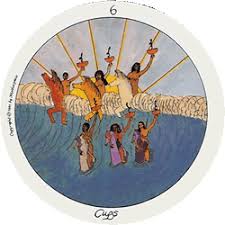
six of cups

But the present card was the Tower, a powerful card of transformation. “This is the card of big change,” said Pamela. “The card that signals big change in a person’s life, like when your husband leaves you—not like this is actually going to happen,” she laughed. And we both looked across the room and smiled at Michael, who was oblivious to our reading, deep in conversation with one of my sons. “I’ve been getting messages that I need to surrender to something,” I hold her. “Well now you have no choice. It could just be turning 60, the big change.”
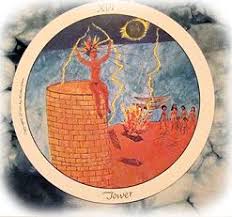
tower motherpeaceAt the time, I thought the big change the Tower signified was the crumbling of ego. I was being called to surrender to the slow incremental losses of old age. But the Tower signifies sudden change, and today I believe it foretold the capital c Change the pandemic has brought: change that shakes the very foundations of our lives, change that brings our beliefs and systems under scrutiny and asks us what is most important in life.

My future card, the ace of wands, depicts a small brown body breaking free from a blue eggshell, surrounded by flames. Rebirth, creativity, and victory follow sudden loss. All of my life, I have swum against the river trying to locate firm ground. But wait a second, could surrendering to the flow, to the changes, be a way of accessing my power—connecting with it? Letting go, like surrendering to the body’s irresistable contractions during birth, could be the opening to rapture. Ego dissolves into the deep thrum, the slow heartbeat of the Earth that we finally hear when our struggles to get ahead, to get somewhere cease. All my fighting is just thrashing around on the water. Let go and get swept into the current. That seems about right.

ace of wands motherpeace

Later that evening, we lit sparklers and ate a cake, resplendent with glossy chocolate ganache and “Happy Birthday Madeline” in piped white sugar lettering. People hung around for a while, then started to leave—much hugging and laughing in the small entranceway. In the now quiet house, Michael and I cleaned the kitchen and put away the leftovers. Something about hearing the dishwasher clicking into its cycle, wiping down the counters, folding damp dishtowels over the oven door, turning off the porch light, rearranging the chairs felt so simple, safe, and sweet. I had a memory of early childhood, when my father used to go around the house and secure everything. Lights off, things put away, daughters in bed, kissed goodnight. Only the whistle of the radiators and murmur of mother and father talking in their bedroom. Nobody, nothing can hurt me now. Did this ever really happen? I don’t know, but the sensation of being safe and warm was real, just as these last few nights I’ve channelled Laura in bed in the little house in the Big Woods to help calm my anxiety.
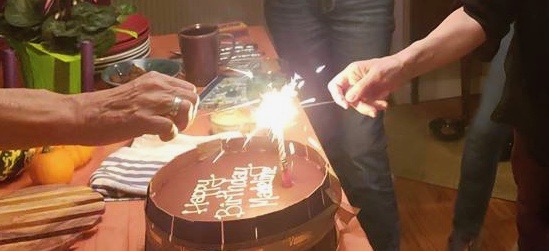
Version 2

As I lay in bed that night beside my husband, I felt safe, warm, and contented. Now that I had been given permission by the Tower, I could let go. Everything was coming apart anyway, we were all falling, so I didn’t need to hang on so fiercely after all. I fell asleep and dreamt of blue bits of eggshell scattered over the ground, the detritus from rebirth. They crunched under my bare feet as I shook my wet feathers in the warm wind.

The meaning of that dream feels clearer now, many months later. Now that the big Change is here, we get to choose our rebirth. I like to think of all of us as little birds shaking our wet feathers in the warm wind, bits of shell still clinging. We will fly again.


Resources for anxiety

https://bouncebackbc.ca/what-is-bounceback/

https://www.anxietycanada.com/

Resources for writers

NaNoWriMo https://nanowrimo.org/ Sign up with the organization that puts on National Novel Writing Month (November) to get their Covid 19 prompts

How to write when life is sad and wretched: https://discover.submittable.com/blog/how-to-write-when-life-is-sad-and-wretched/

Helen Sword (there is a free online writing retreat coming up later this month): https://www.helensword.com/


.


Open channel to the soul: A year of creative expression

“In the greatest confusion there is still an open channel to the soul. It may be difficult to find because by midlife it is overgrown, and some of the wildest thickets that surround it grow out of what we describe as our education. But the channel is always there, and it is our business to keep it open, to have access to the deepest part of ourselves…”

Saul Bellow, foreword to Allan Bloom, The Closing of the American Mind

As I look back over the year, I see that my ongoing mission has been to keep play and creativity alive in my everyday life. I like to think this everyday work/play as a way to keep the channel to my soul open, tender, and raw.  I do this mostly through writing and sewing.

Writing

This year I wrote quite a bit—I wrote everyday gratitudes, and sometimes I wrote “morning pages” (see Julia Cameron’s The Artist’s Way to know more about morning pages). I wrote blogposts, a short story, and a personal essay.  Every year I aspire to what I idealize as “a regular writing practice,” some idealistic daily routine where I put writing first, a priority in my life, and set writing goals. But so far, I haven’t achieved this. I wonder whether this year it’s time to lay the dream to rest and just write when I can for the sheer joy of it, to express myself, to explore my ideas.

After my mother died in February, I wrote an essay, “Holding Space for Death,” which I shared with my writing group and with Michael. In this personal essay, I try to articulate my complex response to my mother’s death. I describe how the Heart Sutra helped me make sense of the experience of grieving. I submitted the piece twice to literary journals. It was rejected twice. I continue to feel tension and yearning around the idea of publishing. In academic circles, publishing a piece in a respected journal or publishing a book is the be-all and end-all—it is the intended outcome of most writing.  It’s been hard for me to let go of that idea, as it was drummed into me throughout my graduate degrees.

Holding space

My illustration for “Holding Space for Death”

So in rejection of the idea that I should gain approval by being published in traditional venues, I continue to write this blog: 21 posts in 2019 including this one. I wrote poems and travelogues, mused on stuckness, and visited my little girl self. There were a few shared/ guest posts in there—one from my sister (thank you Judith), and Michael and I shared the blog during our summer road trip–such fun! I appreciate all of my reader comments this year—thank you so much for reading and being interested and responding to my ideas, poetry, and drawings.

Another way I’ve taken a detour around the publishing game is by printing a short story I wrote. I had a local company make copies and staple it as a small booklet with a few of my sketches as illustrations. My talented son provided the cover art.  I gave the little story to family and some friends as a Christmas gift. I gave the inexpensive gift of creative expression.

How To Love Things Into Being

Nat’s beautiful cover for my short story

Although I am pretty sure I completed my memoir in 2018, I got feedback from four readers in 2019: some very good feedback. Mostly, I learned that my analytical writing doesn’t mix well with storytelling, but that I can tell stories that hold interest. I don’t see any reason to pursue publication for the memoir; writing it was a wild and beautiful process.  But I do think there are some good chapters that may be reincarnated elsewhere. For example, the strong chapter on my Fez experience (living in Fez, Morocco for a month in the early 1980s) could be the beginning of a book of linked short stories.  Watch for it.

Sewing

I love to sew. It is only in sewing and writing that I achieve what Mihaly Csikszentmihalyi calls “flow,” losing sense of time and place as one becomes immersed in an activity.

My sewing projects were various: pillow cases, napkins, mesh produce bags, a zippered laptop case and small zippered purses for coins, make-up, or iPod cords. Drawstring and buttoned purses for tarot cards. I created one cloth bag in rich reds and pinks as a container for a copy of The Velveteen Rabbit, a gift to Michael for his birthday this year (in this, one of his favourite books, we learn that the wonder of a lifetime of being loved transcends the telltale signs of ageing). A pair of little bags on long straps—one green/blue and one purple—went to an adorable pair of young sisters, daughters of a friend.

The biggest project was a quilt in memory of my stepson, who died in 2016. I used some of his shirts to create a pattern of triangles.  I worked on the quilt in fits and starts for 10 months, an emotional journey. I felt closer to Alex through the design and slow sewing of this piece.


Working with old family fabric became very special to me when I recently used some household linens that my dear friend had found when going through her parents’ house after their deaths.  When she gave them to me, I incorporated the delicate aged napkins into 2 pillow cases, one pink and one green. I see more of this kind of sewing in my future–using old cloth to fashion new objects.

This slideshow requires JavaScript.

And more

Although sewing and writing are my creative mainstays, I continued to draw and paint as well.  I make birthday and other cards for friends and family using watercolours, collage, and ink. I illustrated the blog (for example, far left, far right), the memoir (fire picture), and the Christmas present story (flying chair).

And then there is whiteboard “art”: Michael and I take turns making coffee in the morning, and as we wait for the coffee to steep in the French press, we draw images and write poems on the little whiteboard in the kitchen. That before-caffeine freestyle drawing produces some kooky stuff, sometimes based on the dreams either one of us has woken from.

IMG_3712

M & M Blend Coffee: A white board drawing

I bought a ukulele this year and Michael and I start beginner lessons next week at our local Silver Threads Centre. I aspire to learn enough chords and songs to accompany myself in singing some favourite Bonnie Raitt tunes. It was an old dream of mine to be a blues singer. . . .  And I almost forget. In 2020 I want to overcome the fear of a lifetime: Get up and DANCE in  public.
IMG_0231

According to Nina Wise, creativity is all about “having the courage to invent our lives—concoct lovemaking games, cook up a new recipe, paint a kitchen cabinet, build sculptures on the beach, and sing in the shower.”   She encourages us to by-pass the censoring voice that says “Stop!”  To cultivate the one that says “Yes! Go!”

For me, what has helped to achieve this creative freedom is to stop comparing myself to others so much, to stop worrying what others will think. My aim is not to become or be an artist. I am a maker. A creative. These are better nouns–less pressure.

I am never completely successful in banishing the people pleasing aspect of making–after all I really do care what people think. But external audience is not my first thought anymore. I am my first audience: I have to love what I make.

I express myself  because creative expression is my lifeblood. Seriously, being a maker keeps me alive. And I do it because the process and the product please me, the creating and the creation wake me up to life and to myself. And then I hope what I make pleases a few other people. That’s it. Creative expression is whispering to you. Creative expression is your birthright. Listen and say Yes! Say Go!

Recommended: Nina Wise, A Big New Free Happy Unusual Life: Self-expression and Spiritual Practice for Those who Have Time for Neither. Broadway Books 2002.


Sticky and Sponty

By Madeline and Michael

Madeline: We could be driving anywhere—in a way, it doesn’t matter because it is all about the internal journey. One of the things we’ve been balancing and talking about is spontaneity and discipline or restraint (near antonyms of spontaneity).  Michael calls the force opposing spontaneity (and one he associates with his own character) as “stick in the mudness,” though I don’t see him this way at all. He has a tonne of carefree magic in his soul balanced by “Great East Discipline” (one of his Buddhist names, which is very fitting).

We have tried to balance these two energies between us on this trip while we balance them in ourselves.  Perhaps Michael has more discipline than I, and he has taught me that we need to spend the longer days in the car to cover the kilometres (Canada is enormous).  Perhaps I have more appetite for being impulsive (“let’s stop at this lake and swim!”), but we need both of these energies to make the trip go. If Sponty runs the show, we follow every whim, popping into thrift stores and following hiking trails for an elusive kingfisher, and we never actually get to Toronto. If Sticky runs the show, we get there in record time, but exhausted, never loosening up and letting bursts of impulse reveal the magic in the everyday.

IMG_4142

We have had some longer days, like July 16. We left the Soo at 8:20 a.m. and arrived in Kenora at 5:20 (well, 6:20, but we slipped into the Central Time Zone at some point). Pacing ourselves with frequent breaks and seat switches, we made it to Kenora feeling pretty good.

The long day (Soo to Kenora) made Winnipeg on July 17thpossible! Thunderstorms were predicted, so rather than camping (which we still haven’t gotten around to), we decided to do a short day, arriving in Winnipeg in the early afternoon and exploring.  What treasures we beheld…

We wandered into Á la Page, a comfortable, homey business selling second-hand books at 200 Provencher Blvd. in St. Boniface, and found that all books were 50% off!  The green corduroy couch near the front of the store beckoned—so comfy. I sat down and started paging through a book on intuitive healing while Michael looked at a book of Buddhist art. The catalogue had a definite leaning toward the metaphysical, and more than half the titles are in French.  I asked the young man at the cash desk if the place was going out of business because the half-price sale seemed to me a sign. “Not yet,” he laughed. We chatted about how you have to be passionate about books to run an independent bookstore. I feel recommitted to supporting Victoria’s independent bookstores.

IMG_0636

I loved St. Boniface not only for its charm and beauty, but also because I felt so comfortable speaking Anglais, whereas in Québec not so much. I had a thought I’d love to spend a summer in St. Boniface learning French and getting to know the neighbourhoods.

In the evening, we discovered a textile show by three Franco-Manitoban (is this a proper descriptor?) women—what a find! I fell in love with Rosemarie Péloquin’s felt faces and heads that depict old age in a truthful and tender way.

On our Winnipeg afternoon, we wandered. We embraced what we came upon in our wanderings.  Discipline builds the dance floor for the jazz-dance of spontaneity.

Michael: One of the things I am learning on this trip is that Sponty helps me to open to the world with a child’s heart, and when I do that I find unforeseen jewels, such as Medicine Hat which I wrote about in an earlier post. Today I am reflecting on the magic of Manitoba.

Waking up in our little Jackfish Cabin and seeing a weather forecast of thunder storms, we decide to drive to Winnipeg, enjoy a shorter day, and see what we might find.  What follows is completely magical.

We meet Barry S. Shore, owner and proprietor of Fat Cat Records.  As Barry said, he “used to shoot for Warner Brothers”, and his walls were adorned with black and white photos of rock stars, clearly shot from the close to the action vantage point of a press photog— exquisitely, dramatically, and lovingly framed, faces wearing many masks: passion, sadness, feral snarls. Fat Cat specializes in West Coast Blues, which Barry explains to us is a sub genre of the blues with elements of jazz and bop built in.  He has only been open three weeks, but this is his third record store, and this way he only has to sell the stuff he likes.  He says the store gives him something to do  in his retirement—hmmm, is there a theme here? We buy a music-themed print, a Fat Cat Records tee shirt and a Lynwood Slim CD.  I am often struck by synchronicity, and as we leave it strikes me that we’ve been listening to Stuart McLean’s stories about Dave, owner of the Vinyl Café, Canada’s smallest record store. Wow, I think, we just met an aging Dave and visited the Vinyl Café!

IMG_0637

Winnipeg Fringe is on, and after attending a stand up performance in St Boniface, we venture out for a walk on the boulevard. I wear hearing aids, and at times the internal combustion engine is the plague of my existence–cars without mufflers and motorcycles assault my senses in the most shocking and violent way.  Today is one of those days, so I want, need respite. Across the street we see green grass beside railroad tracks and walk towards it, expecting tracks, grass, little more.

Instead we find a path that leads to a footbridge over the Assiniboine River, and a forested glen with a winding path.  The reflections of the forest in the river, the sweetness of birdsong, Madeline’s hand in mine and our shared silence are entrancing and nourishing in a way that I really need.  Another unexpected jewel.

IMG_0641IMG_0639

As we return across the bridge, we find remnants of paper fastened to the bridge deck, printed but no longer legible.  A placard explains that this is an art installation, Pages and Passages by Eric Plamondon. The pages are pulled from the stories of 30 Manitobans-poems by Louis Riel and Gabriel Dumont, but also more modern folk. Each pedestrian and cyclist can read the stories, but their passing obscures them a little more each day, thus with the passage of time we affect each other’s stories.

IMG_0643

I have been thinking a lot about privilege on this trip, about how my privilege manifests in blind spots, which by definition I can’t see. This is another jewel-an opportunity to see how in just living my life, in just passing through, I affect the stories of others.  I return to the road with a deep sense of gratitude and magic.


Sweet milk for the hummingbirds

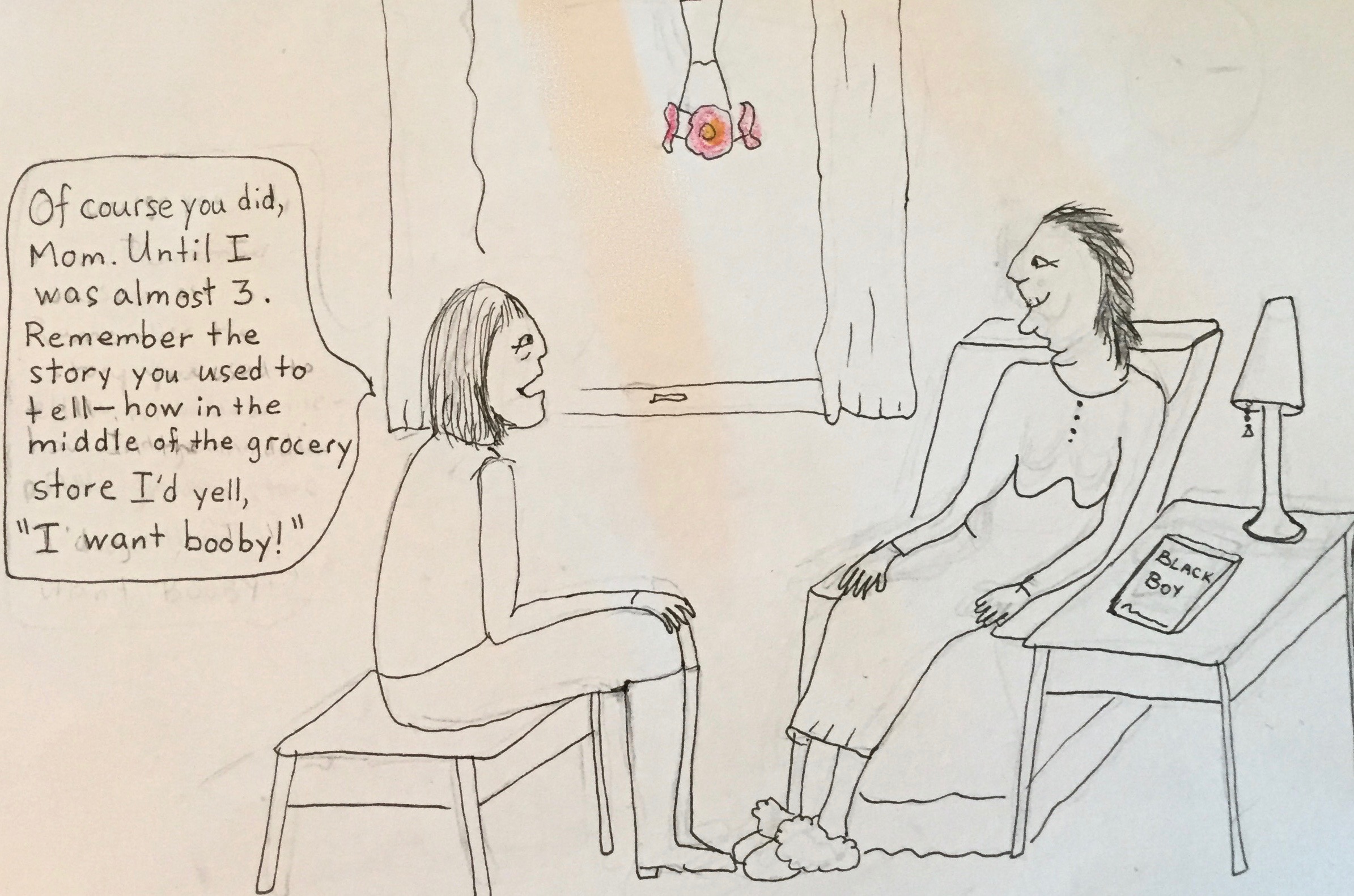
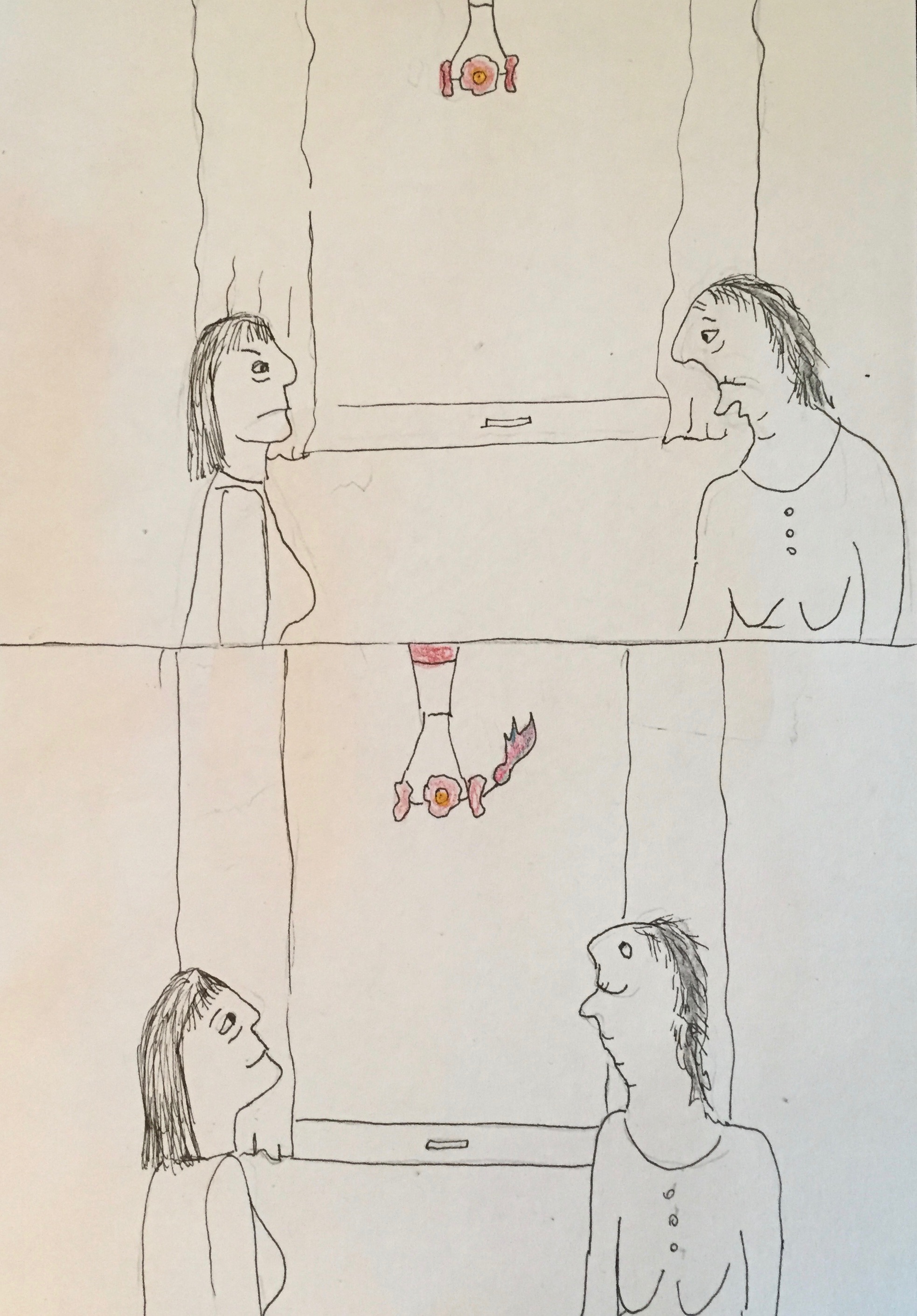
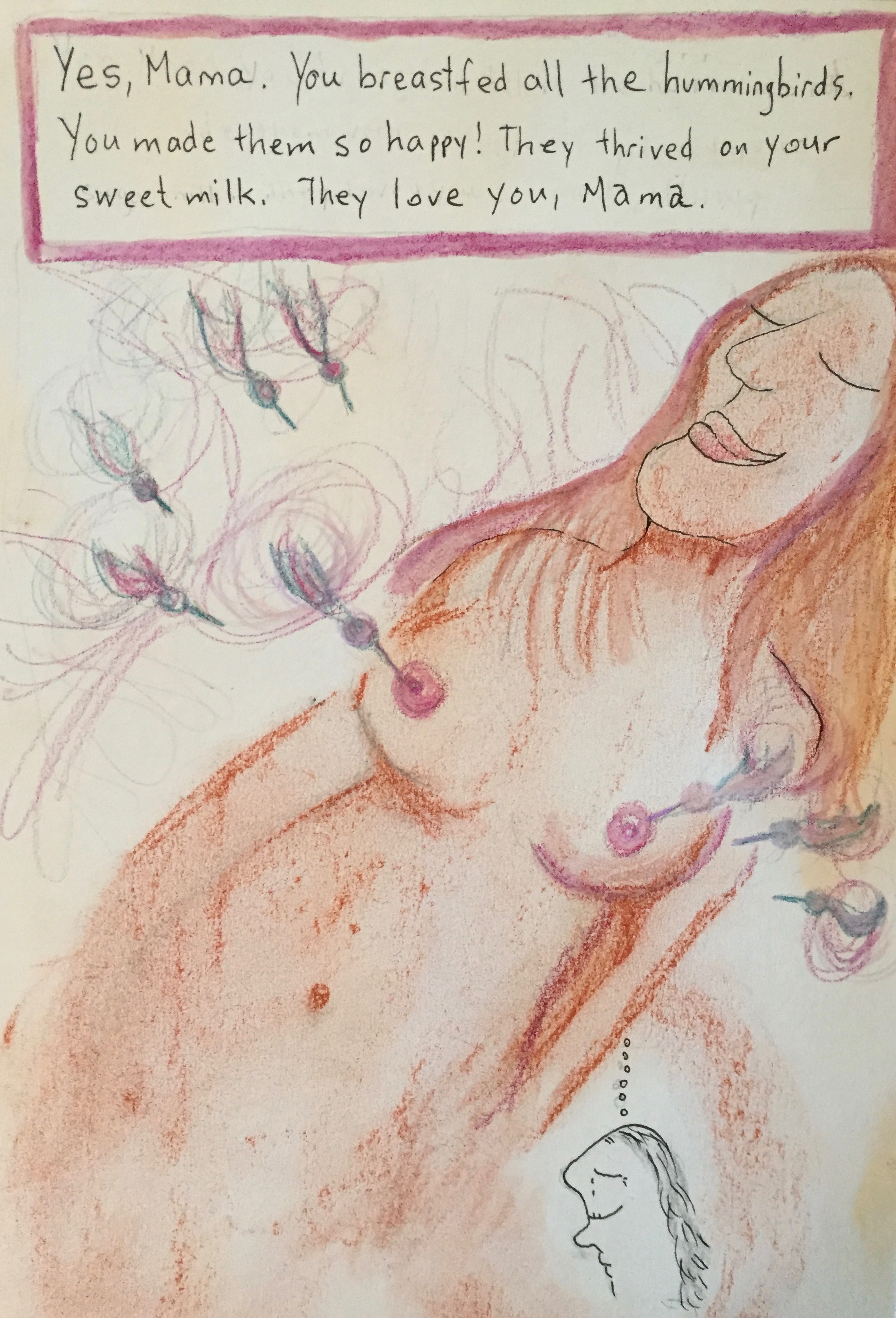
I am not going to say anything about this latest comic except that I submitted it as the final assignment for our “Going in for the Snakes” course.  Anything I say will cloud your reception of the work, so I’ll just let it stand.

I start an intensive course in graphic memoir in mid-November.

IMG_2222IMG_2223IMG_2224IMG_2225IMG_2226IMG_2227IMG_2228IMG_2229IMG_2230IMG_2231IMG_2232IMG_2233IMG_2234Thanks for reading.

The bird-light bones of change

Last year I bought my first Tarot deck with the intention to learn about this ancient tool. My purpose was to use the cards to understand myself and my life better, rather than as a way to divine the future.  So when I drew the Death card reversed last week, I was not alarmed. I did not read the card as a warning that somebody would die soon. Somebody is always going to die.

Anthony Louis says that death reversed is about resisting necessary change (death upright is about transformation).  He writes, “you are clinging to an outmoded situation, relationship, or attitude that really should be discarded.” I had asked the question before I drew: what will help me most going forward to heal myself, my whole self? And the answer I get is that I am clinging to the past because I fear change. It is time to discard a mode of living. By clinging to it, I am hindering my growth. My sense is that the outmoded ways I resist changing are, one, depending on my “rational” way of making decisions and two, living impulsively. I picture these modes as living from the top part of my body, neck up, rather than centering in on the heart. I have been slowly transforming into a fully intuitive being who follows deep inner knowing: not impulse, but intuition. I can trust my inner process, my discernment, my inner guide.  That feels very right at the moment. And it doesn’t mean eschewing intellect or reason. Of course there is a place for those!  It just means that when I feel scattered, my thoughts whipping around my head, and confusion reigning, I need to settle back into my body, put my hand on my heart, and sit with what’s happening at the moment, asking myself, what do I need right now?  Answers do come, sometimes slowly, other times quickly. Deep knowing has its own timetable.  The knowledge that comes is sometimes mysterious, yet pretty much unassailable.

I had a recurring dream as a child that I was clawing my way through a dark underground tunnel. The physical feelings accompanying the dream were pain, suffocation, fear, and claustrophobia.  And then, after a long time, bloody-knuckled and exhausted, I saw light. I came out into the air, greeted by a daisy growing at the mouth of the tunnel. And the lightness I felt then was like the lightness you feel after setting down your pack at the top of the mountain. I can still recreate those sensations of the childhood dream, though I haven’t had it for decades. For a long time I thought it was about birth, then I thought perhaps it was about death. It’s probably about both, but it’s also about the journey from living in the head to living from the heart.

In my mandala, I painted that  underground journey.

img_1572

In my book of poems, I wrote about it in a poem called “Daisy”: “But finally I came up into the day and/ a big daisy—such a cartoonish flower—/was handed to me./ I sat on green grass at the mouth of the hole,/ crosslegged, light, my bones like a bird’s, holding a large/ white-petalled, yolk-centred flower that seems now like the repository of all happiness!”

img_1577

Reference

Louis, Anthony.  (2001). Tarot: Plain and simple.  St. Paul, MO: Llewellyn Publications.