“In a time of destruction, create something.” Maxine Hong Kingston
I have been trying to write poems this year. If you love poetry, I recommend listening to The New Yorker poetry podcast. Poetry editor Kevin Young interviews poets who read a poem from the New Yorker archive plus one of their own poems. Also inspiring, if you are interested in haiku, is Natalie Goldberg’s book, Three Simple Lines. She writes about her pilgrimage to Japan, about haiku, about the first Japanese masters, Basho, Buson, Shiki.
I have started to write my own version of Haibun, a Japanese form that combines concise prose with a haiku. I loosely interpret this form, writing a daily observation in a few sentences plus a “sort of” haiku. No more 17 syllables, just three simple lines. Maybe these aren’t haibuns or haikus at all…. maybe they are just what they are.
I Womb
Morning crossword, four letter word, first site of eviction. “Womb,” I say aloud with certainty. But no, the answer is “Eden.”
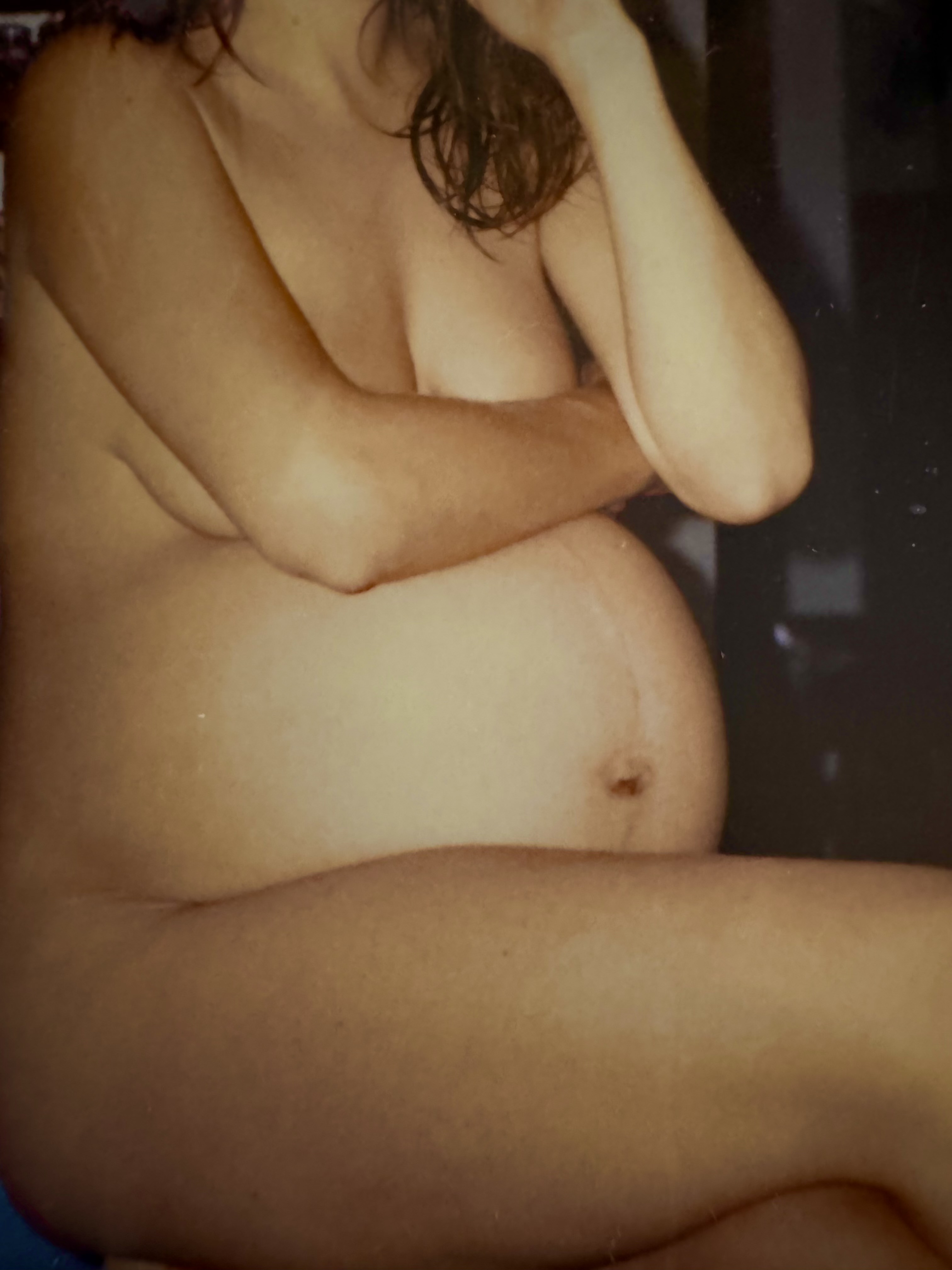
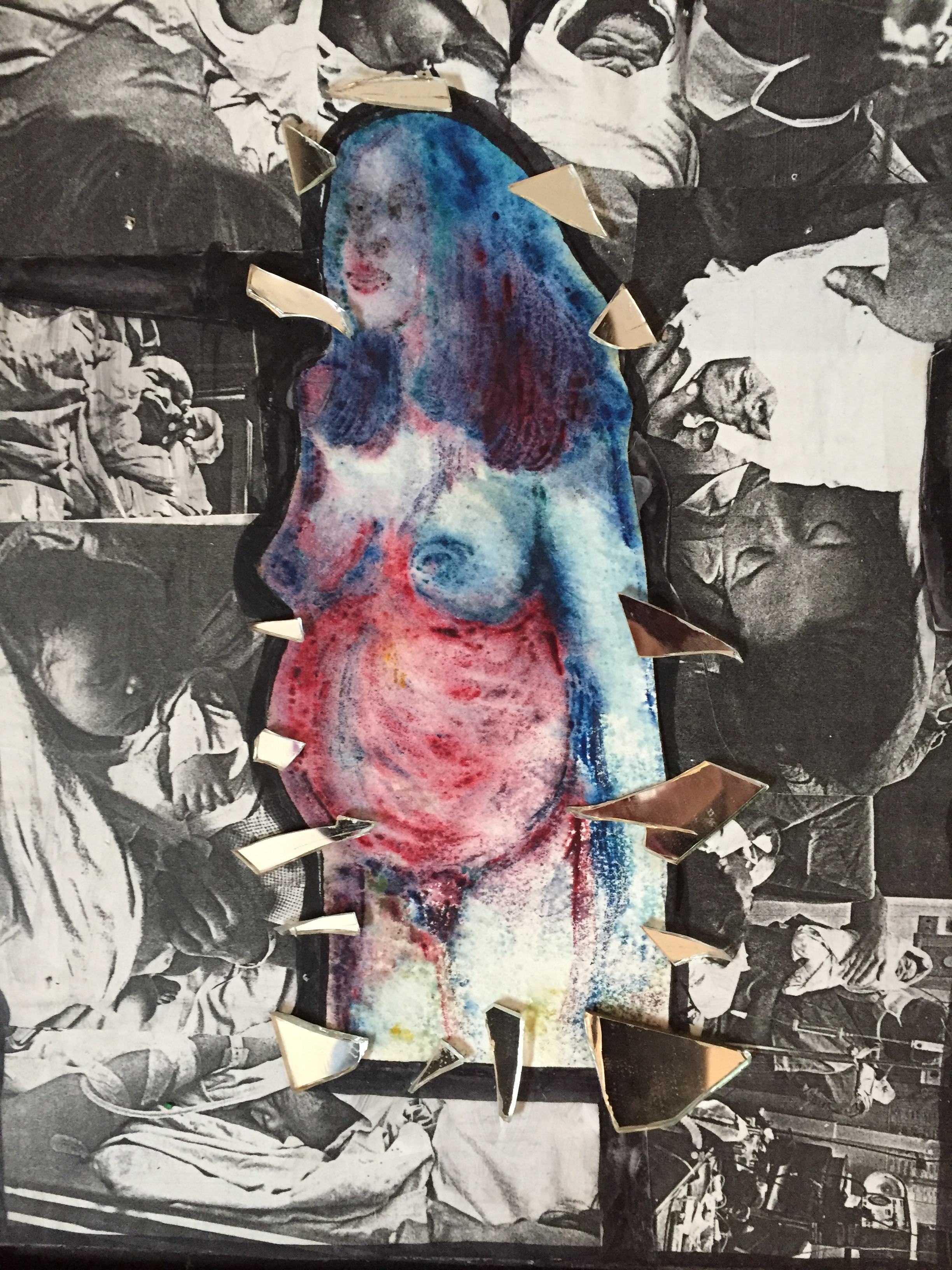
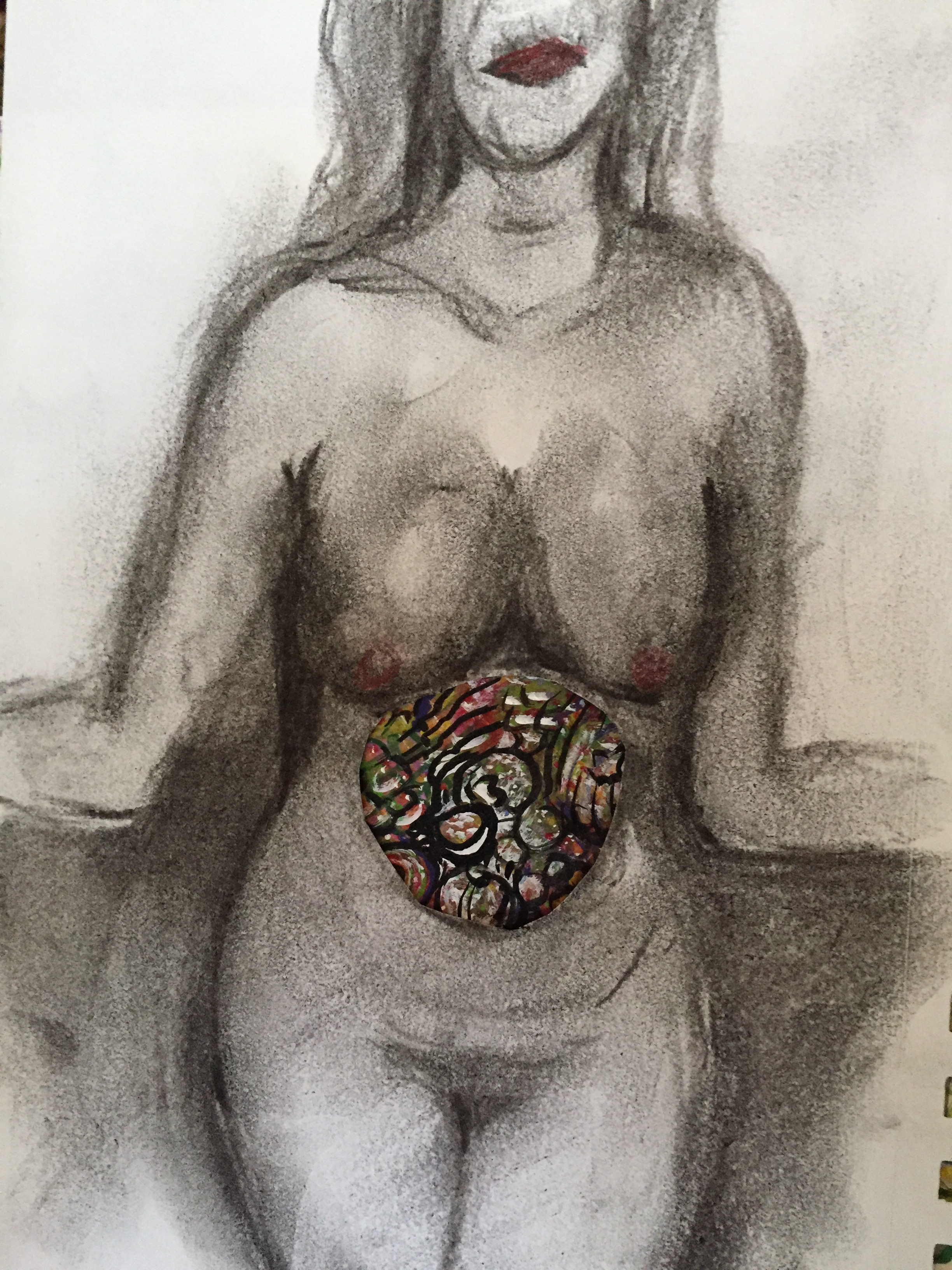
Every human’s first home, the blood red womb
II Orange
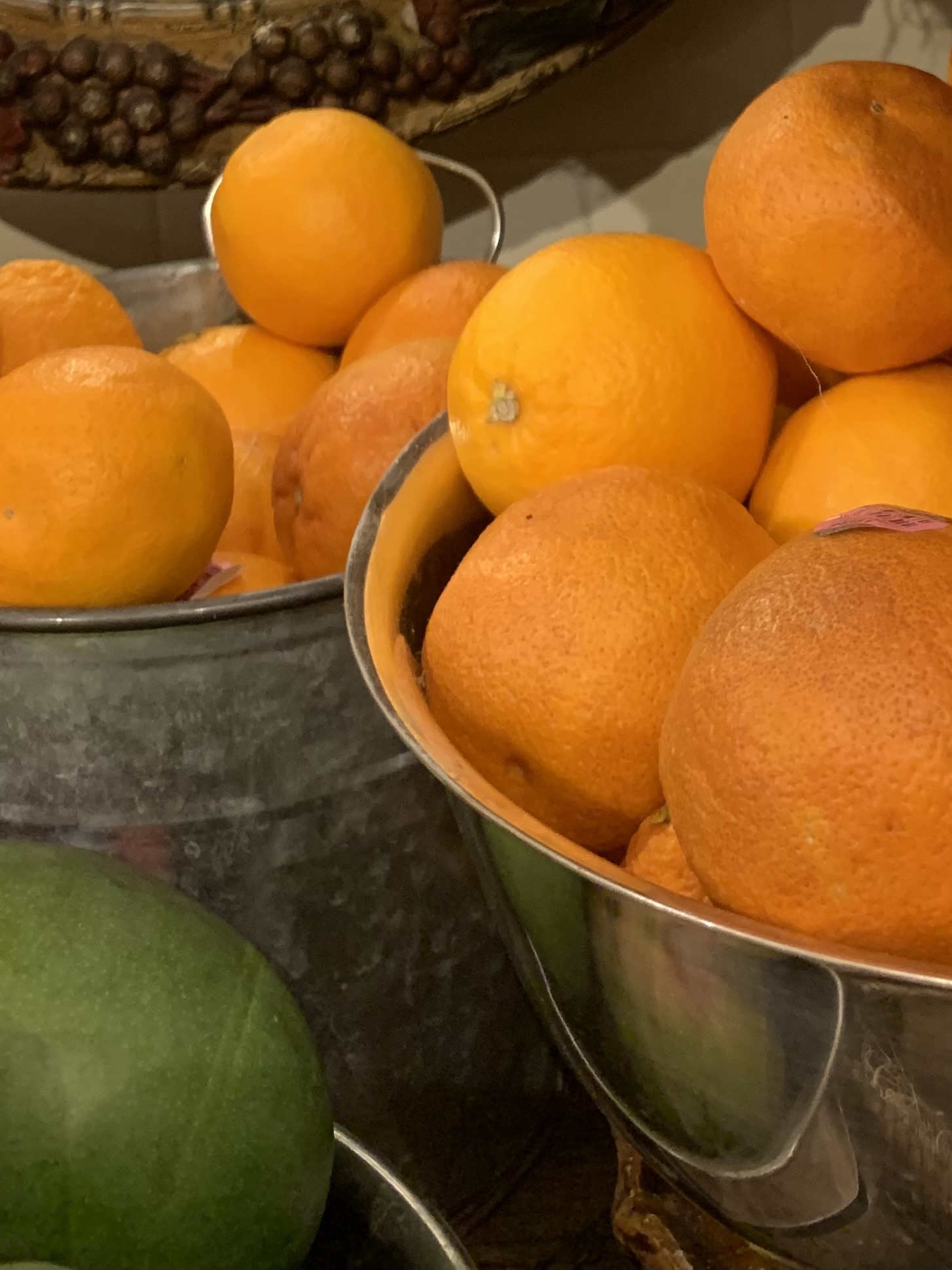
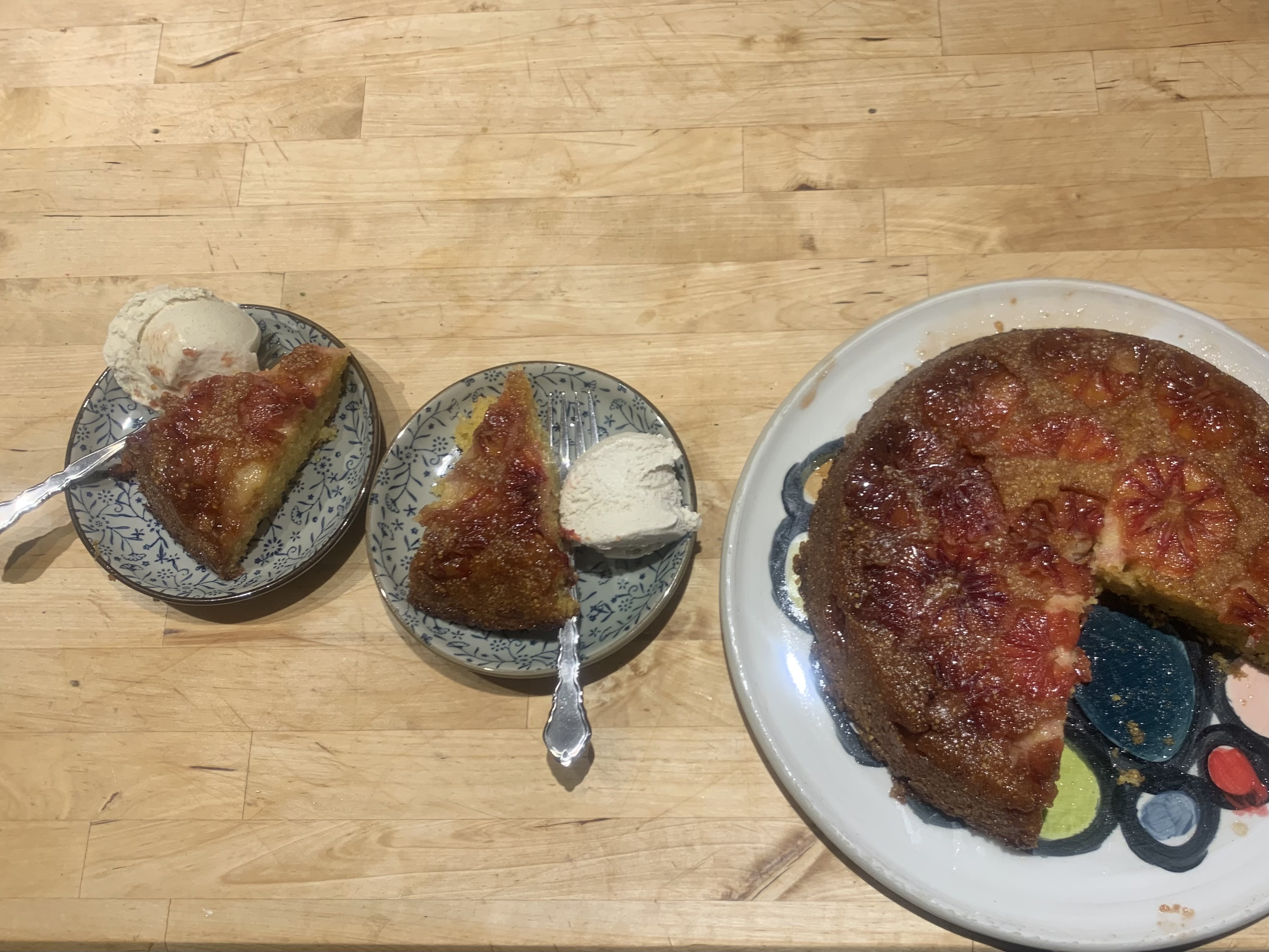
I go to the store to buy blood oranges for the cake and discover they have been rebranded raspberry oranges. the word “blood” is off-putting to consumers. I feel angry.
Remote, bloodless pale body of moon his face, forgotten
III Knife
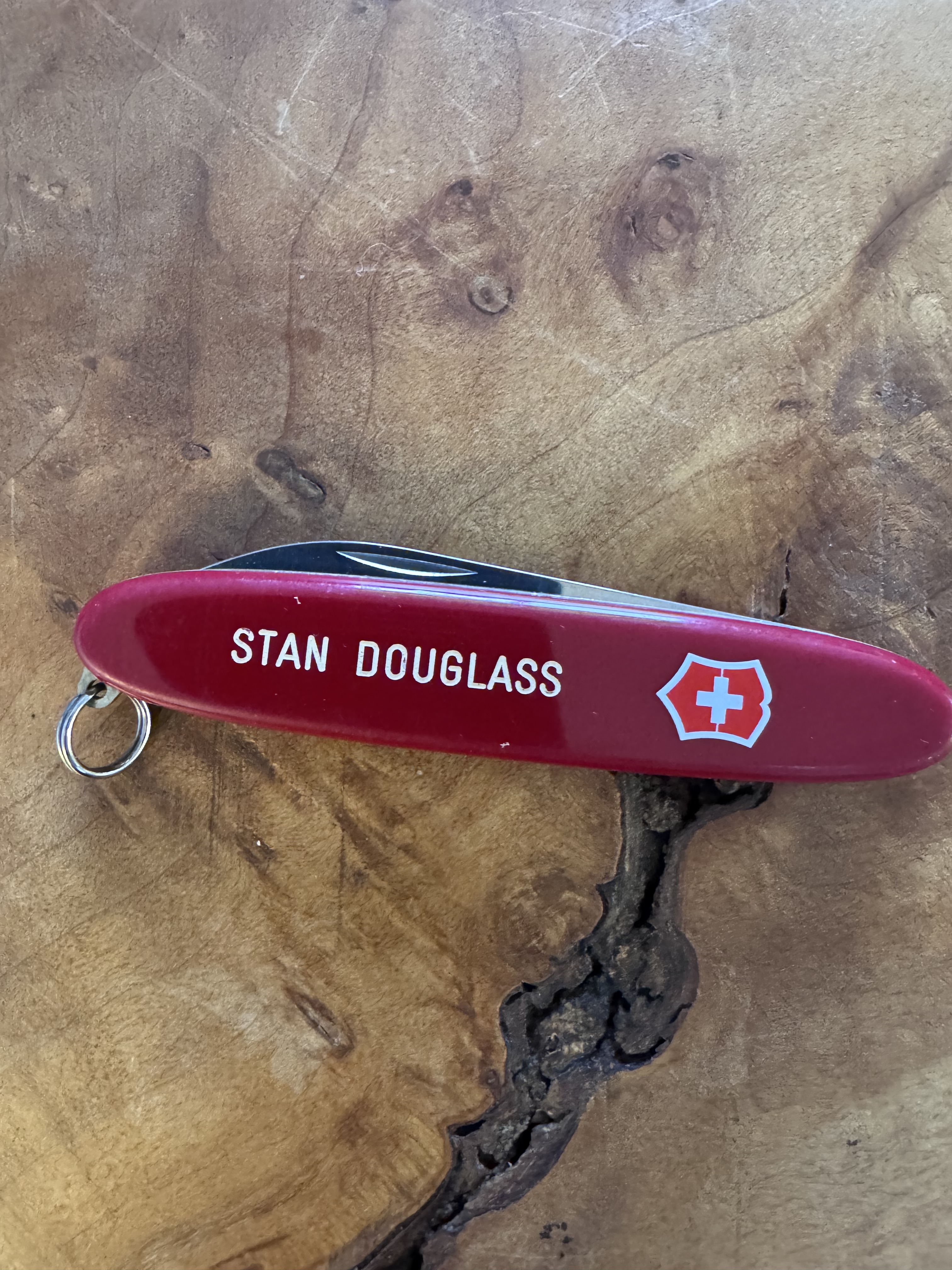
I go to an estate sale and buy a box of assorted junk for two dollars. At the bottom, I find a small Swiss army knife tucked into a black sleeve. The knife is marked with white letters: Stan Douglass. I look up Stan’s obituary.
When fifteen, only a lad, Stanley made a vow to serve the Lord
IV Ruth
My son and I walk along the street, heading to Value Village. He’s shouldering an old chair he took from a free pile, then regretted. I’m following. Suddenly a telephone pole is in front of me with
R U T H
painted in big red letters. Just a day ago, my friend and I compared middle names. Her middle name is Mazal meaning good luck. Mine is Ruth, I texted, and she texted back that “the biblical Ruth is a very special woman, and her name is synonymous with unwavering loyalty and kindness.”
Is it a sign? Four red letters tell my fortune
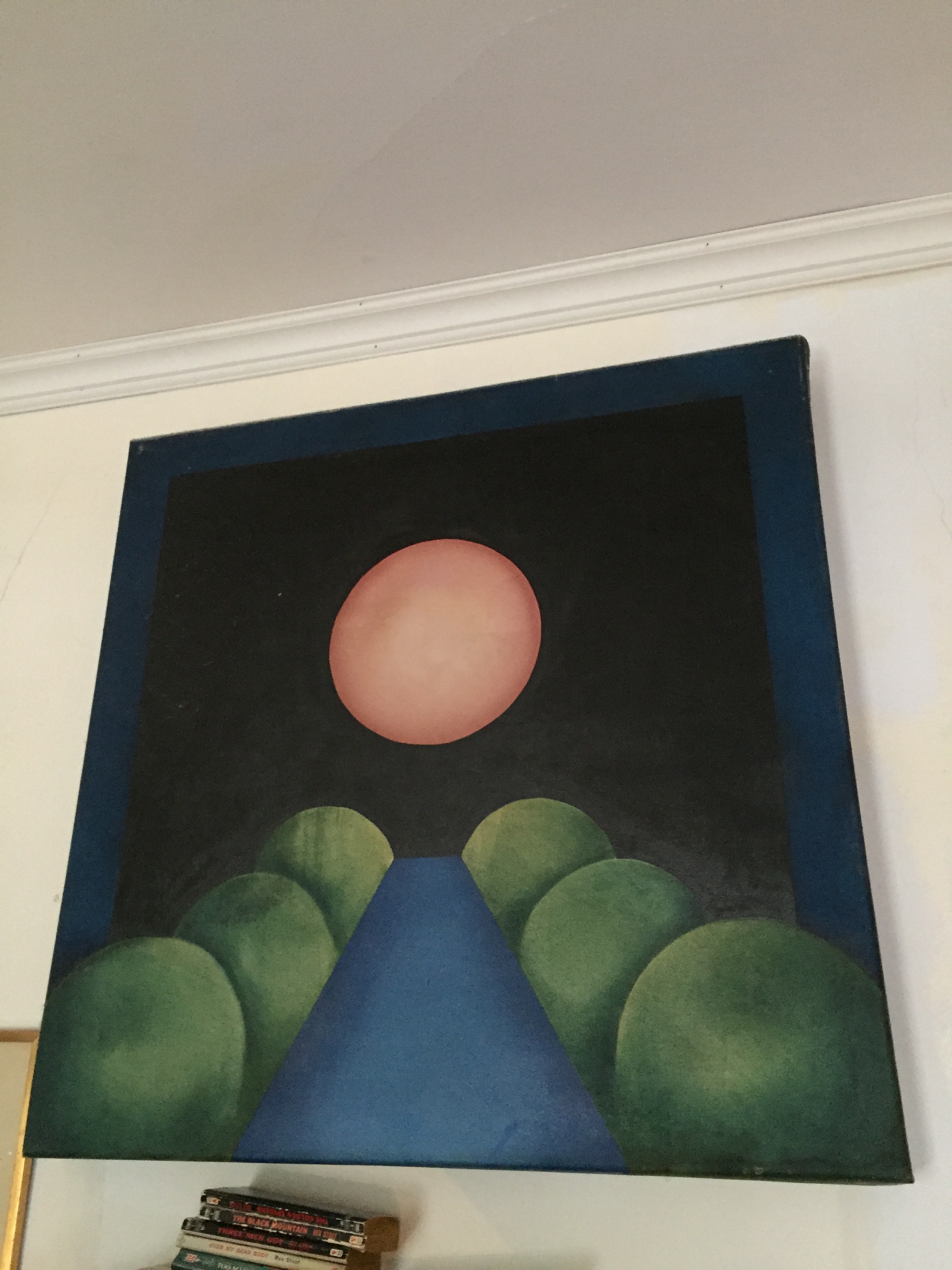
The moon painting is by Bob Sabatini. Other creations are mine.
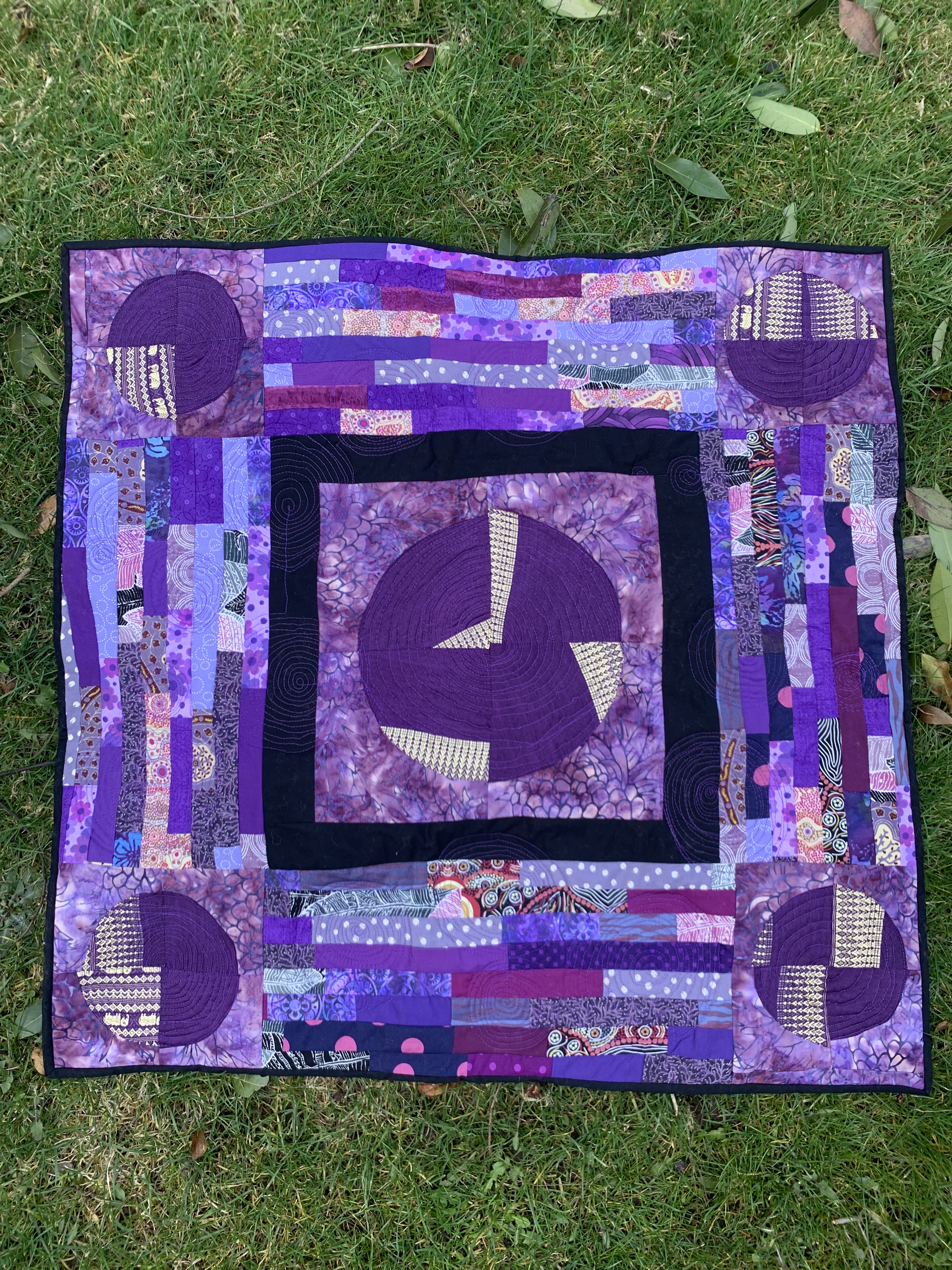
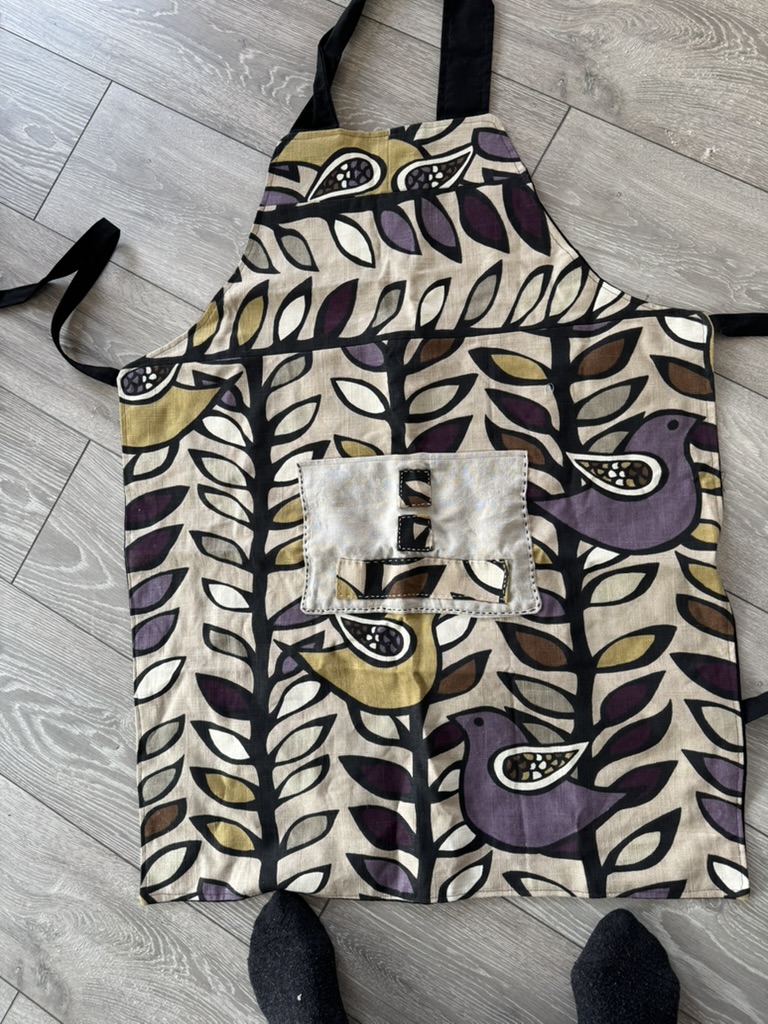
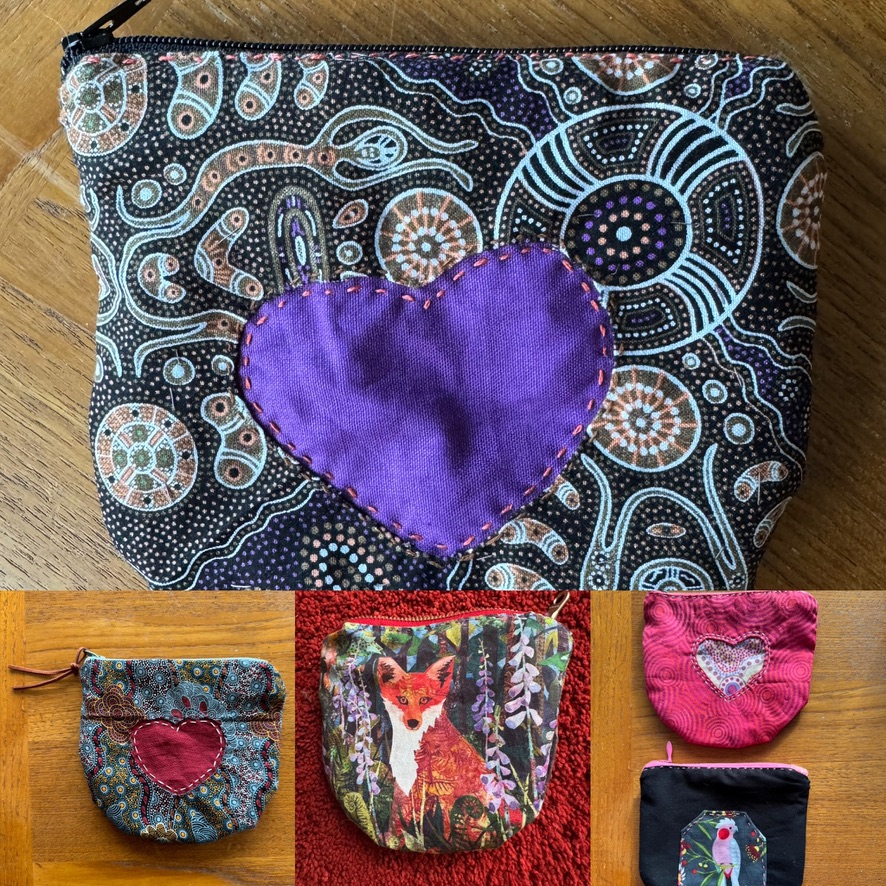
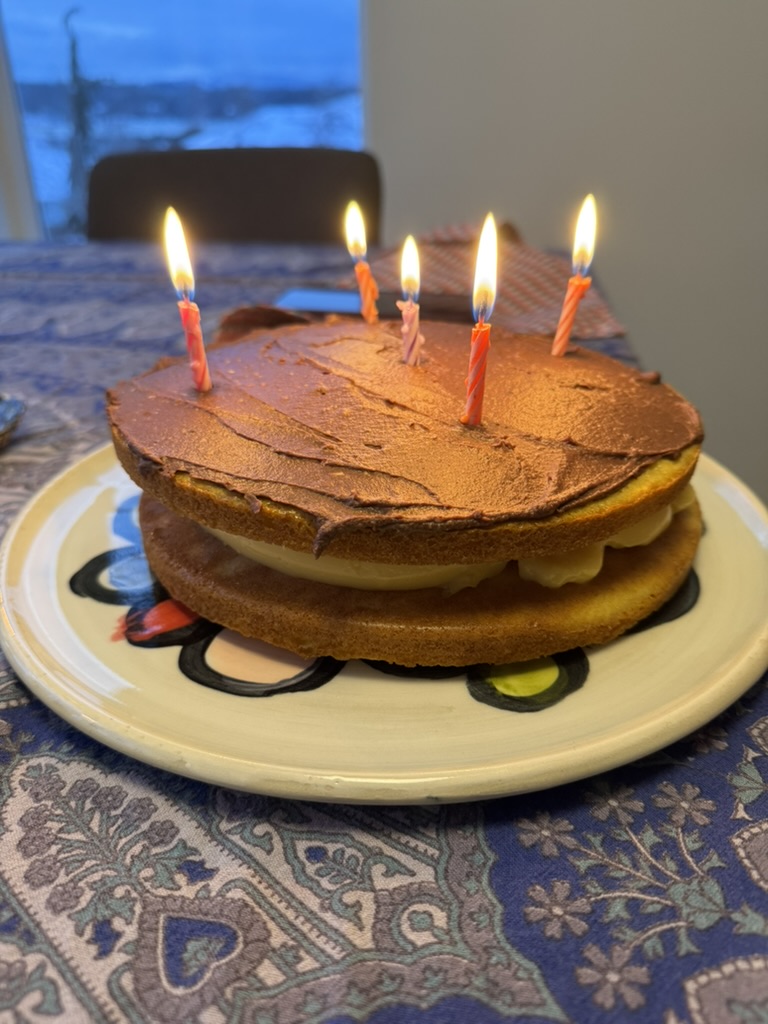
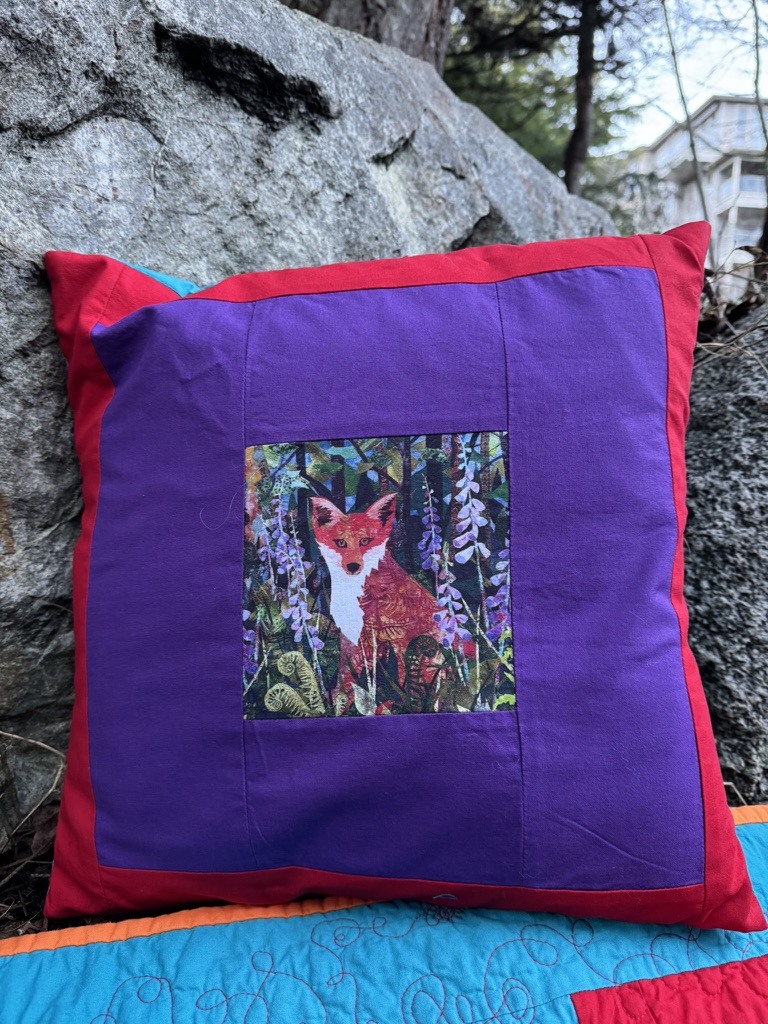
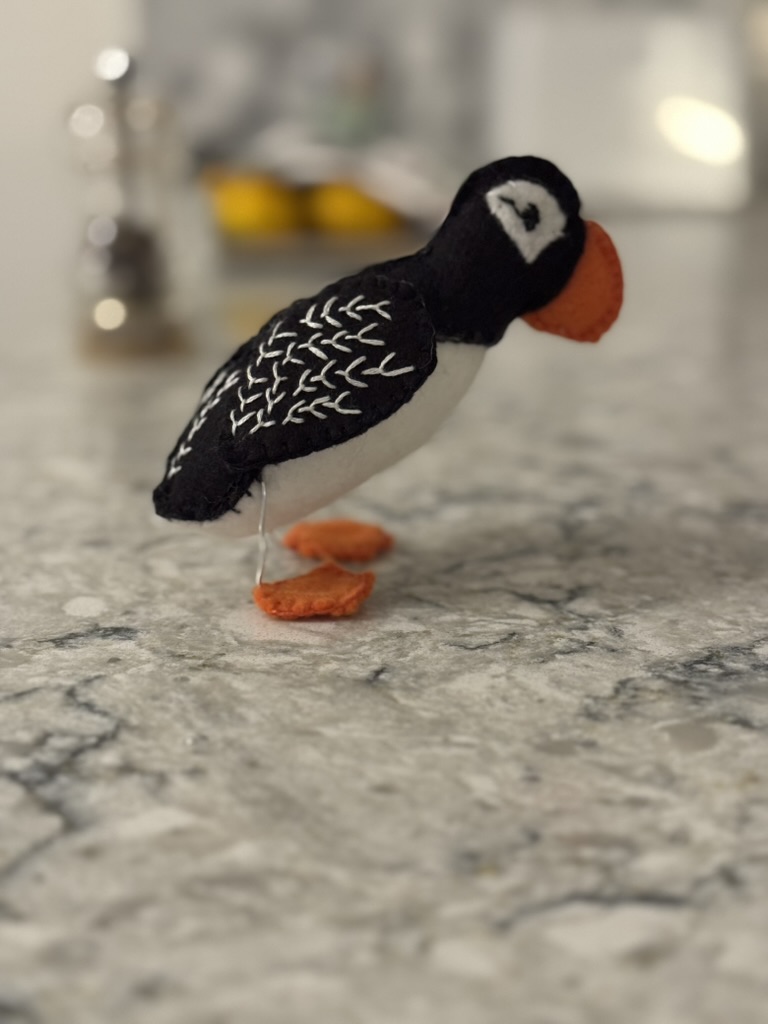
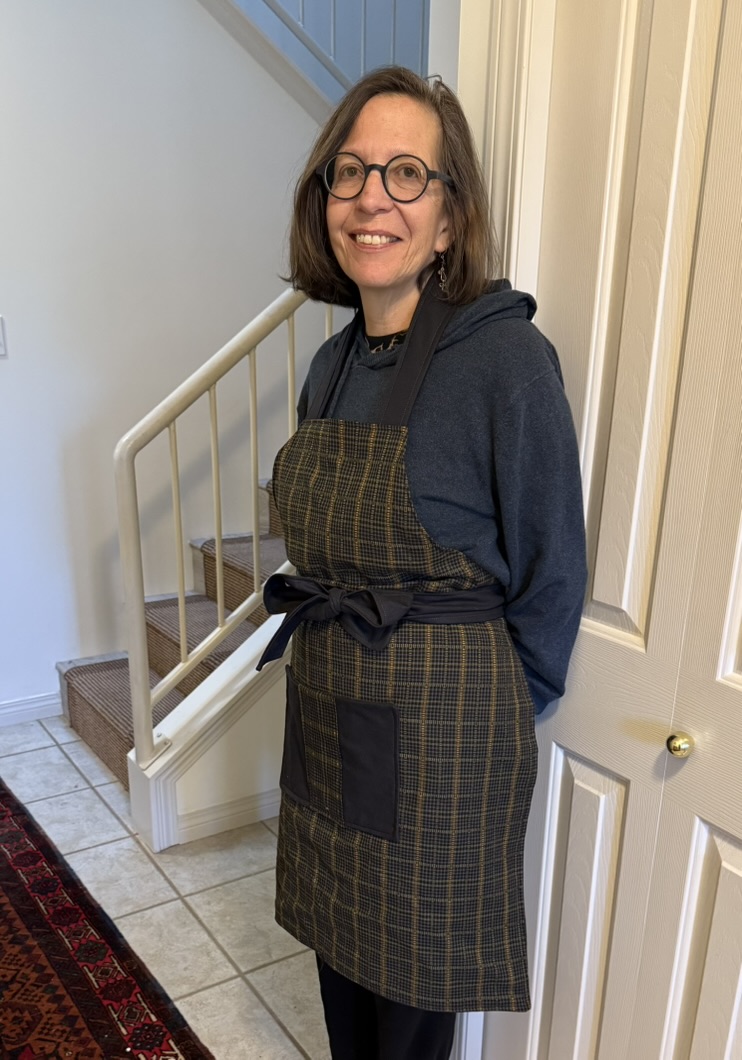
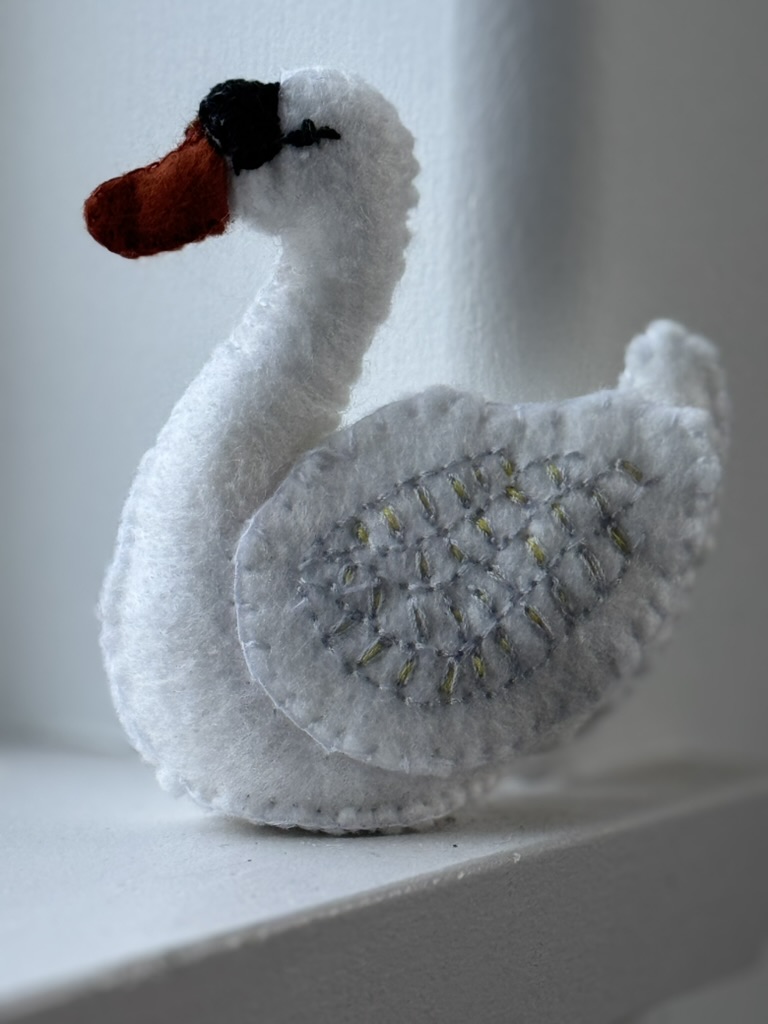
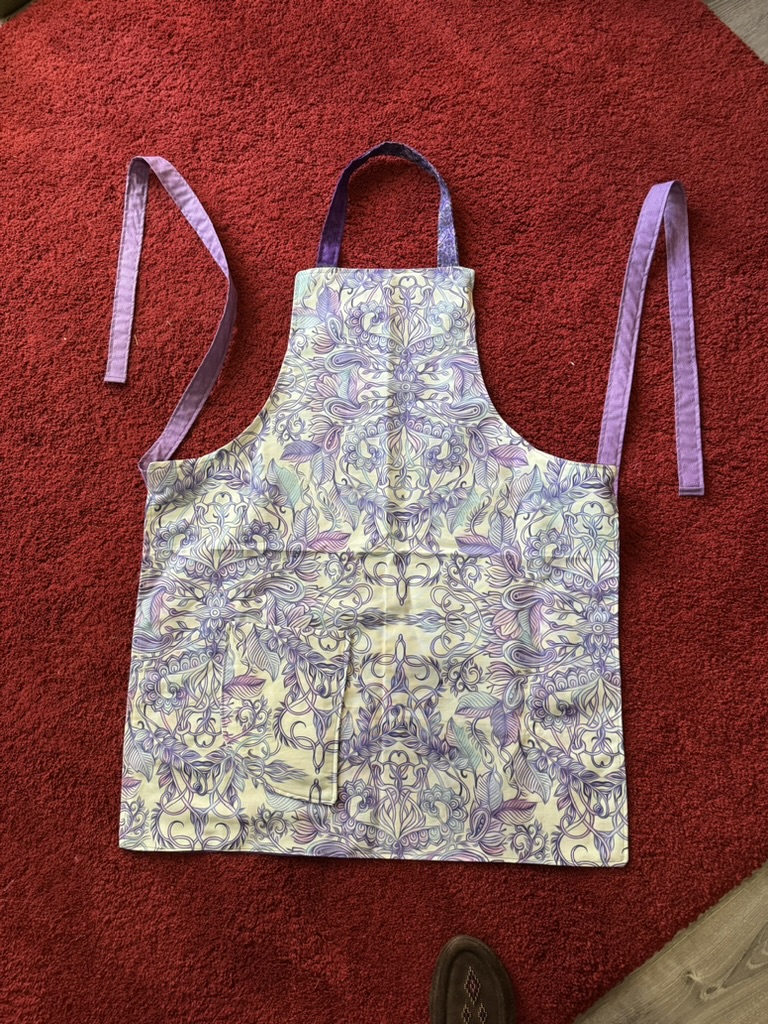
It’s my 67th birthday today, a good day to review the year in creation. What did I make this year? Eleven blog posts (this is the twelfth); a few stories, poems, and essays; felt birds for family members and felt Christmas decorations; three aprons (one for Nancy, one for Meytal, one for me); a baby quilt and matching pillow for the great grandson of my friend, Lillian; embroidered pillows for my niece; a patchwork pillow for my friend Janis; little zippered bags for everyone; “One Thousand Joys,” a wall hanging for our stairwell; a lunch bag for me; some drawings and comics; a sling bag for Nancy; some collages (thank you Kathryn for the inspiration); and cakes and more cakes for friends and family.
Living a creative life feels as important as ever.
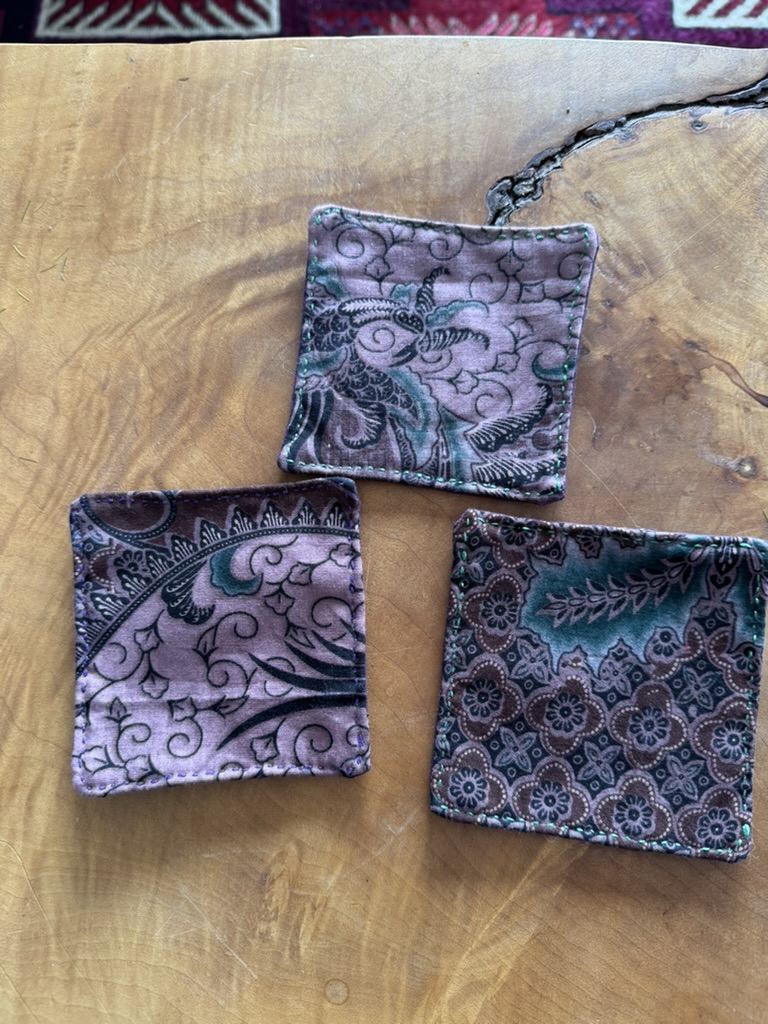
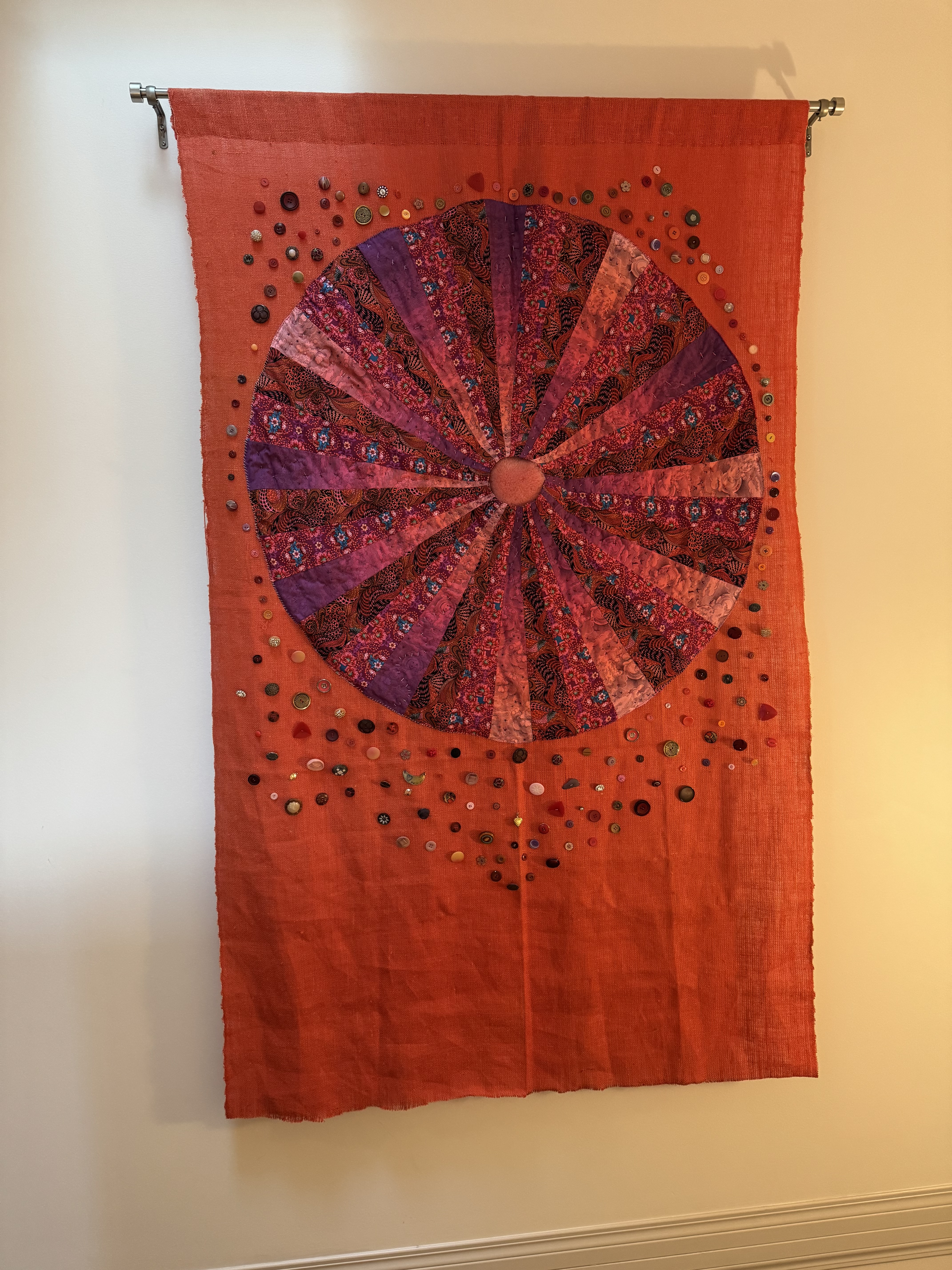
Coasters made from a shirt I bought at a yard sale10,000 JoysMe and Nancy – her birthday apronKathryn’s vegan chocolate cakea pillow for Janis’s birthdayMeytal’s birthday apronSling bag for NancyMichael wanted a Boston Cream Pie and I deliveredA lunch bag for meTwo pillows for my niece’s birthdayA quilt and pillow for a little baby I’ll never meetMichael named the owl I made him “Winston”Nat’s puffinI wanted an autumn apron, so I made thisFelt tree ornaments for my dear writing group membersSarah’s swanEvan’s heronCollage: Pieces of Me
Show and Tell

In old age,
let us
return to kindergarten
rituals.

Show something,
then tell about it
during circle time
with our friends.

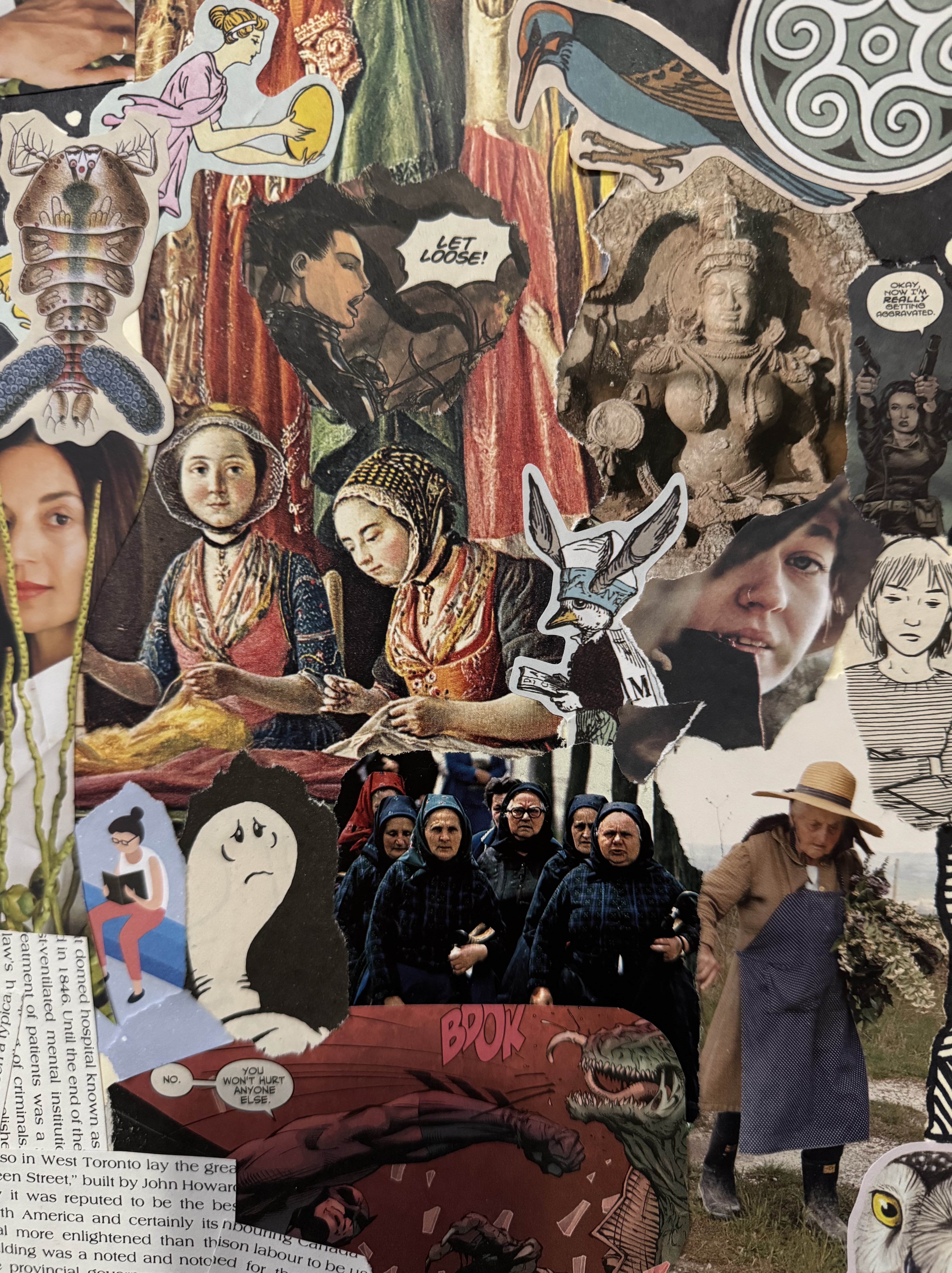
I went to collage club
at the library
Women of all ages were
cutting up old magazines.
Glue sticks and colourful scissors
lay across white tables like
sacred instruments.

As we cut, some of us
spoke; others
remained silent.

I made a collage
about the pieces of me.

Cool and aloof,
wise owl
serious as I sew buttons.
Sometimes a poor silly worm,
my blind eyes sensing light.

In past lives I was
fertility goddess,
discus thrower
seamstress
parasitic crustacean.

Inside of me, Batman blocks a monster:
“No, you won’t hurt anyone else.”

Inside of me, a bitch brandishes her guns:
“Now, I’m really getting aggravated,” she says, her voice rising on the smoke.
If women let loose their anger, the world would burn.

One spring day in Toronto,
forty years ago,
I rode the Queen West streetcar to work.
As we clattered past the mental
institution, number 999,
a statuesque woman, her
proud head shorn,
strode the sidewalk, naked.
Her brown thighs shimmered in
the light, her high breasts bounced lightly,
nipples hardened in the coolness
of that morning.
Everyone around me was,
for a moment, silent, awed
by this strange beauty.

Crustacean, crone, bird,
woman, warrior, gatherer of words,
seamstress of memories
Can you see all the pieces of me?
Sometimes a word rolls around in my mind for weeks. Lately, it’s “shed,” both noun and verb. I started to make notes about “shed” and its associations. When I saw the document file that I’d titled “The Word Shed,” I recognized a new meaning: my mind is a word shed. A space where I collect words, play with them, combine them, examine their denotations and connotations, milk their honey.
Shed the noun is a simple roofed structure, typically made of wood or metal, used as a storage space, a shelter for animals, or a workshop: a bicycle shed | a garden shed | a woodshed. Or a place to work. Last summer we met a couple at their yard sale, and they showed us the woman’s “She Shed” in the backyard. They’d built the small one-room shed during the pandemic: it was a place for her to work at home in peace and quiet. I’d never heard the term “She Shed” before. I like it better than “Man Cave.”
Michael’s drawing of an old shed located in my father and Marion’s sugar bush near Markdale, Ontario. We called it the “sugar shack.”
The Shed is a restaurant in Tofino where, two years ago on my sister’s birthday, I had a delicious salmon bowl that I recreated at home later. I knew the ingredients: salmon, quinoa, raisins, almonds, chopped apple, kale, white cheddar. I intuited a dressing of tahini, olive oil, lemon juice, garlic, honey, and yogurt. I discovered the recipe, handwritten on blue paper, in my recipe binder and realized that I’d somehow cared enough to reverse engineer the recipe, though I can’t remember writing it down.
I made the Salmon-Kale-Quinoa Bowl again the other night and it was delicious. I didn’t have white cheddar or puffed rice, so I used shaved parmesan and skipped the puffed rice.
The Shed restaurant invokes a homey feel. I remember being there with Jude and Michael, tucked into a cozy booth while rain spattered the windows and wind whistled outside. Like sitting in a warm shed on a stormy day. We walked on the beach after lunch in our rain gear.
Over the years, we’ve had two sheds built on our property for storage, bicycles, and garden stuff. Now we’re moving and clearing out the sheds. I’d forgotten about the stuff I stored there. Out of sight, out of mind were boxes of old letters, some going back forty years; kids’ artwork, writings, and report cards; notes from university courses; my old journals. Sorting and shedding and shredding old papers over the last few months has been part pain, part joy, and sometimes so funny I laughed out loud.
Another shed: On December 1, we’ll be in New York City to see Kenneth Branagh in the role of King Lear at the Shed, “a new cultural institution of and for the 21st century.” Their website explains: “We produce and welcome innovative art and ideas, across all forms of creativity, to build a shared understanding of our rapidly changing world and a more equitable society.” After a run in London, England, Branagh is bringing the play to this exclusive U.S. engagement.
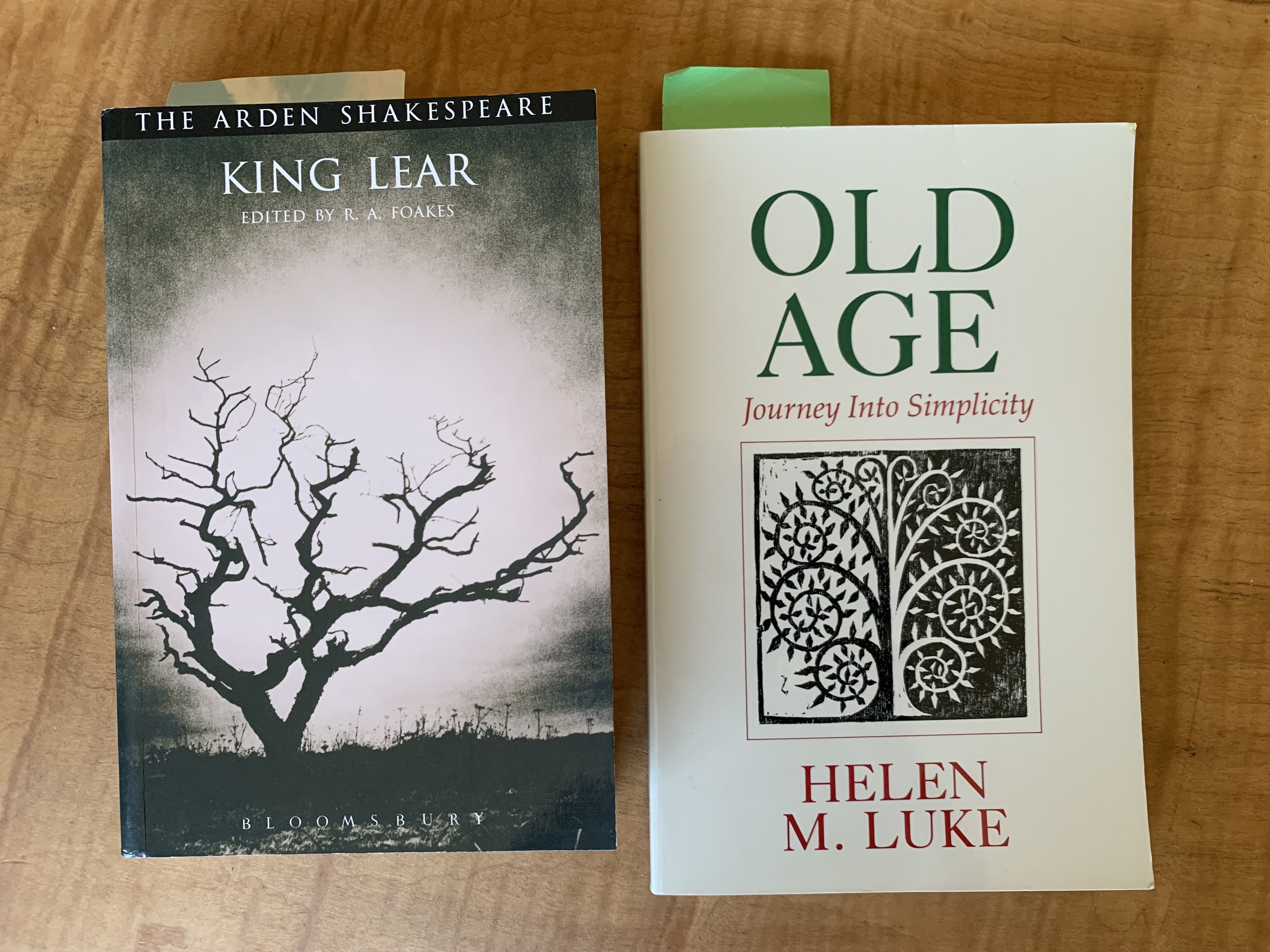
It’s months away, but of course we had to buy tickets early. It will be exciting to see Branagh play Lear in my favourite Shakespeare play. I am reading Helen Luke’s book Old Age, and the chapter on King Lear moved me, particularly when she refers to the two lines spoken by Lear to Cordelia in Act 5, Scene 3, “When thou dost ask me blessing I’ll kneel down / And ask of thee forgiveness.” Luke writes,
“If an old person does not feel his need to be forgiven by the young, he or she certainly has not grown into age, but merely fallen into it, and his or her ‘blessing’ would be worth nothing. The lines convey with the utmost brevity and power the truth that the blessing that the old may pass on to the young springs only out of that humility that is the fruit of wholeness, the humility that knows how to kneel, how to ask forgiveness” (p. 27).
Lear’s story resonates because he shows us that shedding egotism and pride may be followed by an exquisite sense of humility. Many of us experience this as we grow older. Only after Lear is hollowed out by loss can he enjoin Cordelia to “live / And pray, and sing, and tell old tales, and laugh / At gilded butterflies.” Only after loss decimates us, do we feel an unusual lightness of being. So different from the lightness of youth, this lightness we purchase with grief.
Shed your burden ~ watercolour by Madeline Walker
Then there’s the verb, “to shed.”
To rid oneself of superfluous or unwanted things or feelings…to give off, discharge, or expel, such as a cat shedding fur, a snake shedding skin, a tree shedding leaves.
Shedding blood. Bloodshed. Viral shedding. We all shed tears.
And don’t forget the intransitive verb, to woodshed: to practice a musical instrument, to work out jazz stylings, to go over difficult passages in a private place where you can’t be heard.
Isn’t it odd that the noun shed refers to a place where you store and keep and gather things, whereas the action word (transitive verb) means to let go of, release, slough off feelings, body parts, objects? These meanings are in tension with each other – one wants to keep, the other to release.
But perhaps it isn’t so odd. The tension between the noun and the verb merely replicates the push and pull we feel in our lives between holding close and letting go.
When I can’t sleep, I am glad to find my e-reader on the bedside table. In the middle of the night, I pick it up and read quietly, bathed in soft light, disturbing nobody. Last night, I found treasure after midnight: two books I’d bought in 2021 by Charlotte Joko Beck, my favourite Zen teacher.
I read for an hour or so, finding many paragraphs I’d highlighted. I savoured her wisdom again. How could I have forgotten you, Joko? I fell asleep calmed by her words. This, I hope, gives the flavour of her teachings:
When expectation fails—when we don’tget what we’re after—at that point, practice can begin. . . . Disappointment is our true friend, our unfailing guide; but of course nobody likes such a friend.
When we refuse to work with our disappointment, we break the Precepts: rather than experience the disappointment, we resort to anger, greed, gossip, criticism. Yet it’s the moment of being that disappointment which is fruitful; and, if we are not willing to do that, at least we should notice that we are not willing. The moment of disappointment in life is an incomparable gift that we receive many times a day if we’re alert. This gift is always present in anyone’s life, that moment when “It’s not the way I want it!”
Everyday Zen: Love and Work (1989)
The morning before, I’d quickly sketched on my whiteboard a comic of a little girl disappointed with life, as if it’s life’s fault somehow that we are disappointed. To admit that I’m disappointed feels difficult. Rather, I fake it—everything is fine. And I hate to see disappointment on the face of somebody I love. I want to fix it—to remove the disappointment, find an antidote. This reaction leads to all kinds of fuckery, as you can imagine.
What strange serendipity to find Joko’s words about disappointment. What if disappointment is a gift?
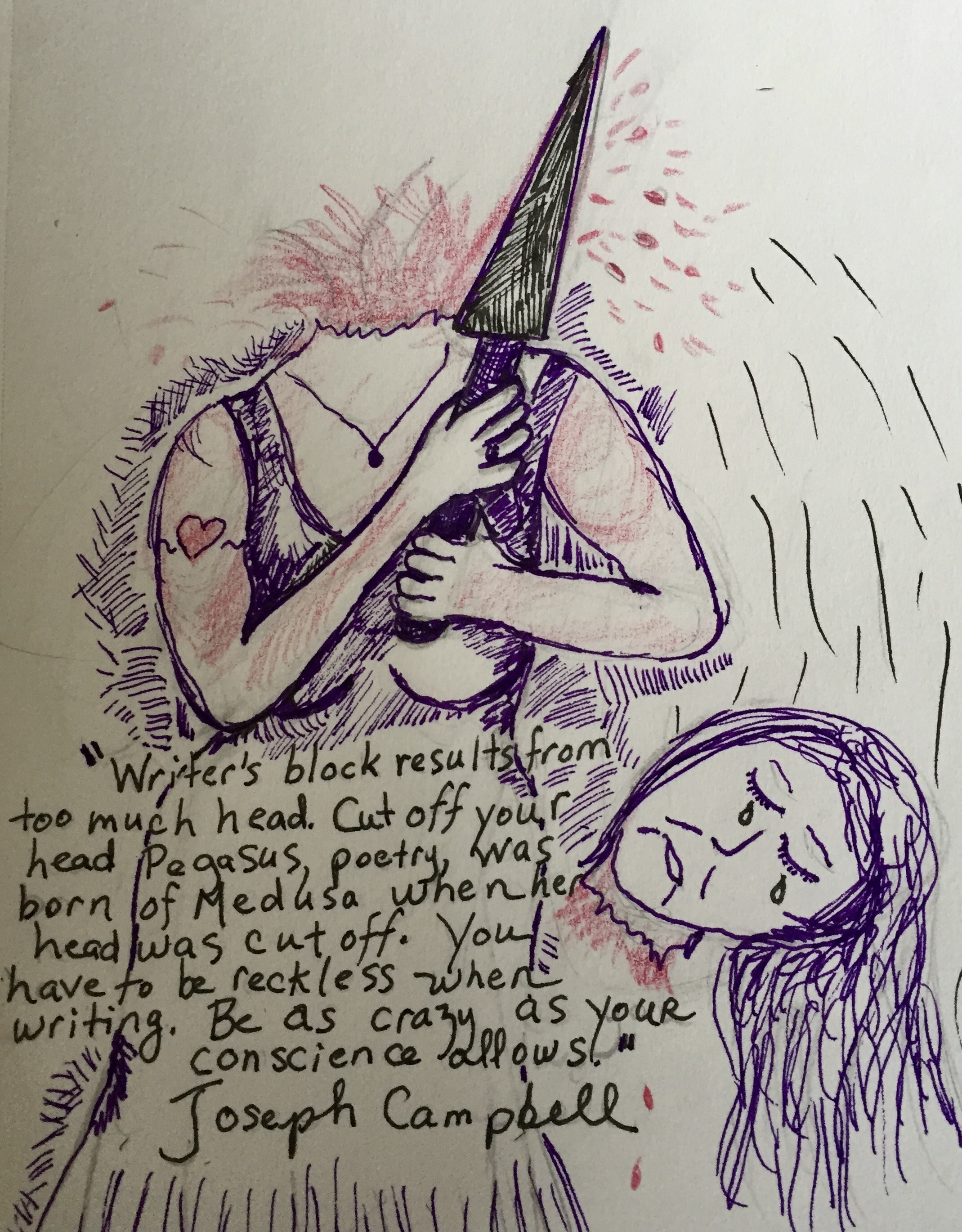
I cannot seem to write freely anymore. This change is so disappointing! I feel resistance to my own writing and powerless to give good advice to students about how to overcome writing paralysis. It’s been some months since I wrote freely. Everything I put down seems irrelevant or stupid. I’ve started many blogposts and abandoned them after a paragraph or two. After reading Joko, I said to myself, okay—I am here with my disappointment. Here it is, I feel it, and I’ll write through it, through the obstacle. The obstacle is the path. I pull up the abandoned blogpost from last week. Try again.
My first class as a new graduate student was on September 11, 2001. After watching the twin towers go down in smoldering ruins on our TV, I left the house, trembling, to attend a class in African American literature. My professor, a young, blond, white man around 10 years my junior, not only didn’t mention his own whiteness in relation to the topic of African American literature, but also didn’t mention the traumatic horror of 9/11 that hadjust happened that morning. It was as if we were in the mythic, impregnable ivory tower—only abstract ideas are permitted here. No planes can touch us. Real politics, real life, real hatred, real racism, poverty, oppression—stay outside the moat, outside the fly zone. When I think of his omission now, I realize how bizarre it was. He was the teacher; we followed his lead and stayed silent about what had just happened. History happened. I know now that it was fear that stopped him. He didn’t know how to handle the mess of us being angry, scared, facing the horror. So he never mentioned the planes, the smoke, the ash, the buildings collapsing in rubble.
Twenty-two years later, I’ve experienced three different roles at the university: student, faculty, and staff member. And this semester, I end my sojourn here. I can say that things have changed for the better. We have evolved.
We were blind to our privilege back then (well, we still are, it’s a work in progress). The prof who didn’t acknowledge the significance of his whiteness in relation to the topic of African America and Blackness is only one example. Students were considered brains walking around on legs—not full humans with mutable emotions. Not people with hearts, failing bodies, families, jobs, depression, ADHD, mental illness. We were confused, unhappy, imperfect, terrified to admit our vulnerabilities, worried we weren’t smart enough. I remember one professor (another young white male) saying to us, “When I was a student, I never asked for an extension. I was always able to meet the deadlines. If I could do it, so can you. No extensions will be given in this class.” He had no clue that some of us might be dealing with financial and emotional burdens, children who needed care, challenges to our executive functioning, depression, two or three jobs….
I went to a learning and teaching conference during the last week of August. The theme was Accessibility, Relationality and Belonging. The keynote speaker, Jackie Stewart (UBC), talked about how to advance equity in university classes and beyond, at the level of program, institution, and society. She talked about collecting data from the grandmother’s perspective, not from big brother’s top-down perspective. An approach of care—we want to see all students succeed—rather than from power. It was wonderful to attend sessions on why we should teach queer theory in first year, on how to coach your ADHD students in executive functioning. Another session on a new Indigenous-student-only academic writing course. I learned about the hidden curriculum: All of those things we assume students should “already know,” but don’t.
At the executive functioning workshop, the facilitator told us how to incorporate into our syllabi a request-for-extension form. Students can just complete a digital form and get the extension they need without embarrassment or anxiety. Inform them not just of due dates, but also suggested start dates for assignments. We always just thought, “they should figure it out themselves.” Really?
In the queer theory session, Michael Reed showed us a video that made us cry, made us realize this is why we need to—if not teach queer theory in our first year classes—at least include something in our syllabi to show we are allies. Maybe something as simple as, here’s the location of the closest gender-neutral bathroom. We see you, trans and non-binary students. You belong.
I walked back to my office in the library at the end of the conference, past the Digicasters with their welcoming and inclusive messages: “We have screen readers, ask us!” “We have a respite room if you need to take a nap!” Libraries have evolved. Somewhere along the way, we realized we are here to serve the students. And no, it’s not “hand holding.”
I feel content with all I’ve learned. It’s too late for me to incorporate these innovations into my teaching, but I’ve enjoyed witnessing the consciousness-raising taking place in higher education.
The pandemic really kickstarted this movement. We admitted we were tired, stressed, and scared—staff, instructors, and students all. We needed to infuse our teaching and learning with kindness, patience, care, and transparency. This is real life, not the ivory tower.
And I come back to Joko Beck, relieved that I’ve made it this far in my writing. Perhaps I just had to walk around the (writer’s) block in my path. Not an obstacle, just a detour. Joko Beck writes in Nothing Special (1993),
“As we watch the mind over the years, the hopes slowly wear out. And we’re left with what? It may seem gruesome, I know: we’re left with life as it is. … Turning our lives of drama to lives of no drama means turning a life where we’re constantly seeking, analyzing, hoping, and dreaming into one of experiencing life as it appears, right now. The key factor is awareness, just experiencing the pain as it is. Paradoxically, this is joy. There is no other joy on this earth except this.”
I find this so consoling—no other joy on this earth than life / pain as it is. Disappointment? Admit it, feel it. Writer’s block? Write around it, through it. Insomnia? Read Zen wisdom in the middle of the night.
I often despair of my monkey mind, the jumble of thoughts that keep me from noticing what’s present. At the same time, I appreciate my tangential mind. I love following its pathways through shadowy tunnels of white-flowering hawthorns. I seem to always turn a corner to find myself in an unexpected field of light.
Today as I ate breakfast sitting at the kitchen table, I started to examine the ceramic trivet my father gave me years ago after a trip to Granada. The trivet is decorated with an Arabic design: a mandala in teal, navy, red, and cream. I love the waving flower petals that seem to be in motion, dancing in the wind. The Arabian design on the Spanish trivet took my mind to the poem I’d just been reading by St. Teresa of Avila (1515-1582), a mystic living in Spain after 700 years of Arab culture. St. Teresa was intimate with her God; you can feel it in her language. I re-read the lines,
A woman’s body, like the earth, has seasons;
when the mountain stream flows,
when the holy thaws,
when I am most fragile and in need,
it was then, it seems,
God came
closest.
God, like a medic on a field, is tending our souls
And then, a few lines down,
Why this great war between the countries—the countries—inside of us?
From “When the holy thaws” by St. Teresa of avila
My counsellor tells me that I aggress against myself—a pattern in my life. An ongoing war rages between the countries inside of me. I like to think of God as a medic tending to my wounds, lifting me off the battlefield, holding me close, bringing my countries to peace. I remembered the stage six mandala I drew recently, with a little girl and a dragon (my warring countries). I wrote tenderly to myself, “lay down your sword, little one.” Perhaps the holy is thawing.
I’d snagged that wonderful book, Love Poems from God: Twelve Sacred Voices from the East and West, from a cardboard box of free stuff. I love our neighbourhood. There is a little clearing across the street near the mail box where all of us take things we don’t want anymore. Neighbours and visitors from other parts of town come to adopt old things and bring them to their new homes—a brilliant system!
This book caught my eye. What a great find. But boxes of free stuff and friendly dogs are not all that’s on offer here. The neighbourhood has other delights. Yesterday, I started work early in my home office in the basement, checking copy edits for a book. At 10, I took a break from the highly focused work. Michael, Marvin, and I walked down to the Gorge where a pop-up concert was in full swing. A local musician, Danielle Lebeau-Peterson, was playing her guitar and singing under a white tent. Danielle is the daughter of my eldest son’s first music teachers—Connie and Niels, and I marvelled at the “small world” (we’re all connected) feel of Victoria. Her mouth is like her mother’s.
The clouds in the sky threatened rain, but so far it was dry, and children and their parents gathered around Danielle as she sang and played, smiled and bantered. She knew songs from Disney movies, which delighted the younger crowd. The Tillicum-Gorge Association folks had set up a table with a big urn of Tim Horton’s coffee, cartons of donuts, and boxes of Timbits. There was a clipboard with paper and the question, “What do you love about our neighbourhood?” The cheerful woman behind the table filled my cup with coffee, and I took up the pen and wrote, “Everything.”
We sat on the grass listening, and when Danielle asked for requests, I called out “Blackbird,” that gem of a song written by Paul McCartney. It was one of my father’s favourites, and she played and sang it perfectly—her clear ringing voice floating up and over the Gorge: “You were only waiting for this moment to be free.” I smiled while my tears fell on the grass, and Marvin tugged at his leash, tried to smell the woman sitting next to us. This is the first Father’s Day I’ve lived without a father. But he was there in the high, truthful notes of the song. He is still with us.
And now, I am still sitting here with the book of poems on one side of me and the trivet on the other, back from that pleasurable sojourn, ready to fill the hummingbird feeder with sugar water and play with the dog. I love my mind and my heart. I love the rich stuff of daily life that produces all of these memories, feelings, and thoughts. The tangents take me unexpected places, but they always lead me back home to love and beauty.
“The American experience, the focus on individual achievement, the acquisition of goods and money to prove one’s social value, is built on this sense of loss, this alienation from the warmth of the home culture, isolation from genetic bonds. This separation from one’s tribe creates an inner loneliness that increases as one ages.”
Annie Proulx, “A Yard of Cloth” (p. 20) from Bird Cloud.
I read this passage last night, and I had to get out of bed to copy those sentences. They struck a chord in me. I too feel that “inner loneliness that increases as one ages.” My mother, who died on February 14, 2019, distanced herself from her family as a teenager. When she coloured her hair blonde, her father was furious. Either he told her to leave, or she left voluntarily to flee the strictness of their farm in Lodi, California, I’m not sure which. She ended up in Los Angeles, working the switchboard at Kaiser Hospital. She would later meet an older woman, Phyllis, who became a kind of mother to her, paying for her therapy. My mother would go on to complete a BA and MA at University of California, Berkeley.
Not only did my mother reject her parents, she spurned most of her seven siblings as well. However, she had a special bond with Fran, a gentle older sister who worked as a nurse. My mother claimed Fran saved her life by preventing their parents from treating my mother’s Bell’s Palsy with some kind of horse medicine. Most of these stories are so garbled in my memory. They seem half-fantasy and half-truth. I’m sure I have most of the stories slightly wrong.
But the feeling is real—of striking out, fleeing family, rejecting those who engendered you, separating from tribe. That was an element in my mother: brutal independence. I don’t need you. I depend on nobody but myself. I remember the last time I visited her in Toronto, her brother, an Evangelical preacher living somewhere in the States, called her, and I picked up the phone. Apparently, he called regularly, wanting to reconnect, and she always hung up on him. When I tried to hand the phone to her, she wouldn’t take the call. I was shocked. You won’t talk to your brother? He’ll just proselytize, she said.
My parents migrated from California to Toronto in 1965, another “alienation from the warmth of the home culture” that Proulx writes about. My mother left her adopted mother, Phyllis, which must have been heartbreaking for her, and my father left his mother. We three daughters were already used to being without a large tribe—we didn’t know most of our cousins or aunts and uncles. We were a nuclear family with no extended family to fall back on. I look back on how we grew up without the cushion of uncles, aunts, cousins, grandparents and how hard it is to survive that way. But we didn’t know anything different.
Then, repeating the pattern of migration and loss, my first husband and I left our home in Toronto with our first child. We left our parents and siblings—it felt exciting and freeing. We started a new life in Victoria in 1988. My kids grew up without getting to really know their Ontario grandparents.
I am thinking of my mother this weekend. It will be three years since she died. She was fierce and proud and insisted on individual achievement as the sine qua non. In her actions, she was a feminist. In elementary school, we were sent home for lunch every day for a 90 minute break, which necessitated mothers stay home to serve their kids lunch. She fought to get the school to allow us to stay there to eat a packed lunch so she could go out and work. Later, she pressed back when the bank wanted her ex-husband’s signature to get a mortgage. But she wouldn’t be called a feminist because she didn’t want to be seen as part of group of women who supported and uplifted each other, challenging the system together. All of her achievements in life, she thought, were due to her own hard work and merit plus a little help from individual friends. And it’s interesting how I’ve inherited some of this thinking, especially an unwillingness to ask for help.
My mother and her father
As humans, we work so hard to connect. It is our default—we need each other. I treasure my sisters now, and I create my own chosen family in my friends. However, that profound sense of loss lingers at the edges of life. It’s the legacy of leaving family behind and striking out on one’s one.
Swords
Swords are weapons of destruction and tools of discernment.
Swords are on my mind.
About a year ago, I created a website for my new editing business and wanted a brand identity. The Queen of swords from tarot seemed a perfect symbol for a female editor—the independent, unbiased woman, a seeker of truth, with clear boundaries and a direct style of communication. She sees problems and figures out how to solve them; she knows where to cut the extraneous to reveal the truth. Queens are about heart and swords are about mind—so she brings heart and mind into harmony.
I didn’t use a Queen of swords image from a tarot deck due to copyright laws. Instead, I planned to use an excerpt from a painting in the public domain, John Gilbert’s (1817-1897) Joan of Arc. I sent a mock-up of the website, including a sword image, to a few friends for their opinions. One of them noted that the image of Joan of Arc’s armour and sword was martial and scary and didn’t really reflect who I am. I agreed. I decided to let go of the sword as a metaphor for editing because of its primary associations with violence.
And yet, swords keep coming up. On December 31, 2021, Michael and I each drew a tarot card to guide us during 2022. He drew two of swords; I drew Queen of swords. Evidently, the sword has much to teach both of us this year, so I am listening. As Michael has been studying the tarot for several years now, I asked him about swords. His words are a synthesis of all he has read and studied from various sources (but his main influences are Mary Greer, Rachel Pollock, and Anthony Louis).
“The suit of swords is aligned with the element of air, which is the suit of mental processes and thoughts. Swords are aligned with thinking, intellect, reason, yang energy, severing unhealthy connections, and the courage of the warrior. They’re about logos, problem solving, things we have to work through before we can find serenity.
Swords are aligned with prajna, deciding what to accept and what to reject or cut; it’s the suit of discernment and decisiveness. Also, because swords are about mental things, they can also be about willful blindness, about illusion. Swords is where we discover the obscurations of mind that trap us.
Two of swords shows a woman blindfolded, and the eight shows a blindfolded, bound woman surrounded by swords. However, these are mental obscurations – imagined entrapments rather than actual physical imprisonment. The four of swords has a person lying on their back with three swords above – this is contemplation. Swords is about how you use your mind. Some sword cards are about meditation: training, calming, and taming the mind.
Swords are not just about cutting, but they’re also about piercing – which is penetrating insight.”
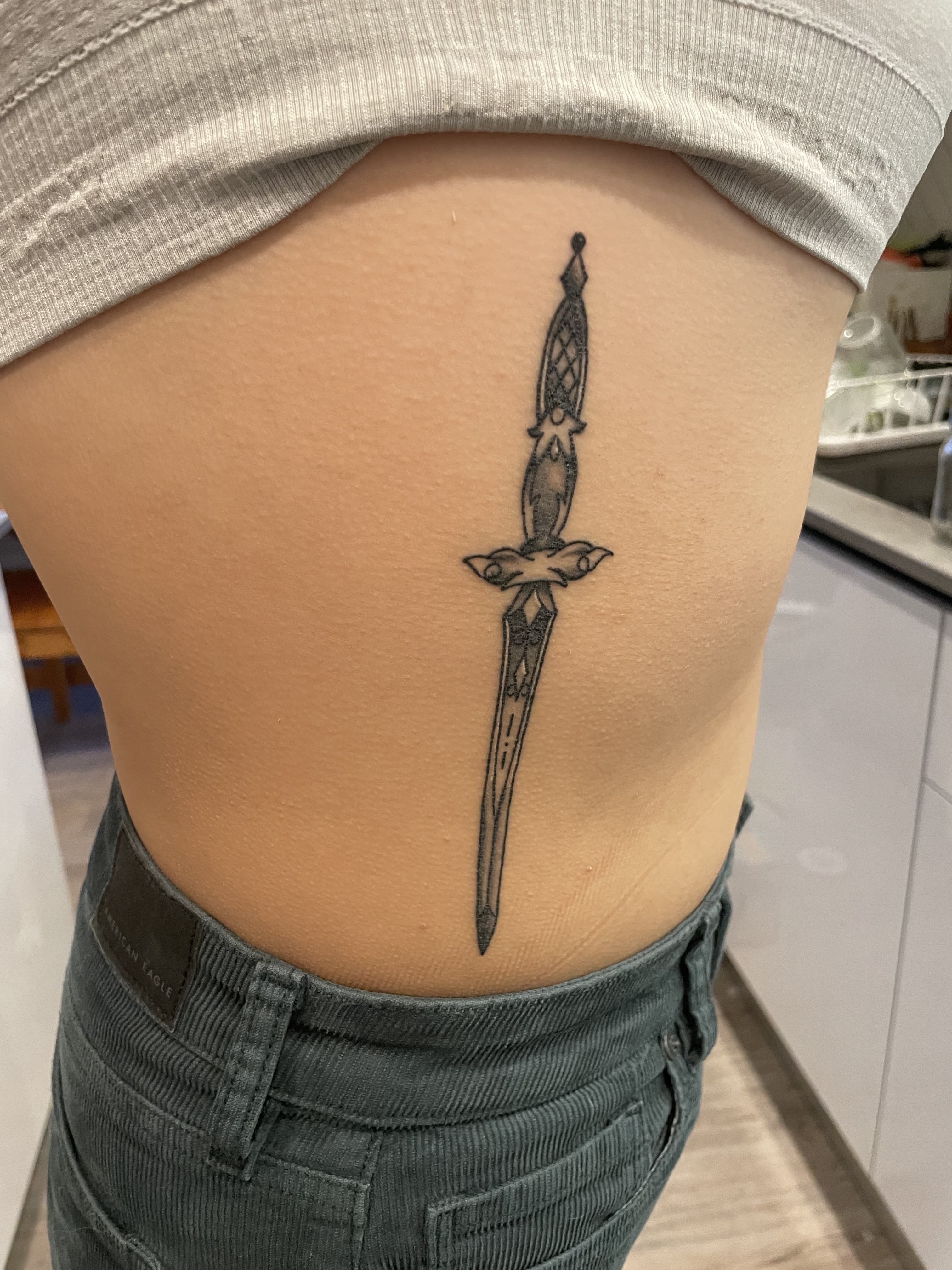
I asked Michael about his tattoo of the three of swords. “Well, threes are energy, vitality, motion – they arise from loss or partnership or conflict. Three of swords is heartbreak, alienation, and sorrow—mental alienation and loss. The three of swords invites us to find the sweetness and wisdom beneath our sorrow –that’s my take on it. Go underneath the sorrow – penetrate and pierce it.”
Cutting and piercing are the work of the sword. And underneath the pain is sweetness.
Recently, a client asked me to cut 40% from several of her book chapters—truly an exercise in figuring out what’s most important. Same thing in life. Look at what you most value and treasure it. Let go of what you no longer value.
As the Queen of swords accompanies me throughout this year, I would like to continue to examine the mental obscurations that trap me and prevent me from experiencing serenity. For example, much anxiety arises from worrying about the future, but I know there is no future. There is only today.
Michael’s tattooJoan of ArcN. ChurchillMy niece Sarah’s tattoo
We’ve been drawing and writing and sewing around here. Michael ordered a drawing bench from Nicole Sleeth and arranged to pick it up on Saturday. Sleeth is a painter, but as a sideline she sells handmade benches that are great for life drawing, as they comfortably accommodate the shape of your body when you are facing a model. I asked Michael if I could come along for the ride, expecting to simply pick up the bench and head home again. But when we knocked on the door, Sleeth welcomed us in, beckoning down a long narrow passageway, past her two little sausage-shaped dogs, into the studio, a long, light-filled room. I was excited to visit a working painter’s studio and see the canvases in progress; new finished work hanging on the walls; shelves of paints, supplies, and curious objects; huge windows facing Fisgard Street; a couch where, once they were tired of barking, the two dogs curled up and observed their owner chatting with us.
Last September, we visited Sleeth’s show “All Eyes on You” at Fortune Gallery. Her work “centers on the female figure as an exploration of power, connection, and lived experience.” Standing before each monumental painting, I felt the personality of the woman before me. The unashamed, unadorned nakedness of women looking comfortable in their bodies startled me at first, but I was soon drinking in the honesty of these representations. I enjoyed that exhibit so much, I saved the postcard. It made me realize I am more at home in my own ageing, sagging body now than I ever was in my twenties or thirties. Later that day, I revisited the studio in my mind and appreciated Sleeth’s gracious unexpected welcome, another one of many small adventures we’ve been having this year, my year off work.
The second half of my year’s leave hasn’t gone as planned—Covid-19 cancelled our trip to Haida Gwaii, where we would have been this week, exploring the parks and learning more about the Haida Nation. So instead of travelling afar, we focus on home, neighbourhood, and our creative journeys, all of which bring contentment. Now that I’ve finished the Eight Worldly Winds project (more on that next time), I will start working on a Courage Cape. The cape is my idea in response to a life coach who asked what I could do to grow my courage as I set out to start my own editing business.
Earlier this month, I had a free life coaching session on Zoom with Lori-anne Demers, who helped me to figure out what I need in order to be/see myself as an entrepreneur. When I go back to work in July, I will concurrently develop a plan for eventual self-employment as a writing coach and editor. Having skills and experience is one thing—I have a PhD and many years of experience in writing, editing, and teaching. In June, I start the first course in Simon Fraser University’s editing certificate program to consolidate some of those skills. But it’s the chutzpah of charging what I’m worth and facing the world with confidence that scare the shit out of me. So Lori-anne asked what I might do to feel into my courage—what symbolic creative act will give me fortitude as I launch this new enterprise? “I’ll sew a Courage Cape,” I said.
The Courage Cape idea just came out my mouth–no premeditation. I love sewing quilts, pillows, bags, and potholders. Lately, I’ve been eager to graduate to sewing garments. I recently ordered Stylish Wraps Sewing Book, by Yoshiko Tsukiori, from Bolen’s Books and picked it up on Saturday before we visited Nicole Sleeth’s studio. The hooded cape—one of the easier patterns—looked like just the ticket, I thought yesterday as I browsed through the different styles. I love capes; wearing them requires the kind of panache that I aspire to. But Tsukiori’s recommendation to use boiled wool to construct the cape had me worried. Boiled wool is about $30 a metre, and I know I make mistakes when I sew something for the first time. I didn’t want to waste money.
So today I got on my bike. It’s a glorious day—sunny and warm. I cycled the E & N trail to Store Street, admiring all of the graffiti along the way. I locked my bike in front of Value Village. They’ve reopened with new safety protocols. A vivacious young woman with purple hair, a plexiglass face shield, and a ready smile was stationed at the entrance, spraying each shopper’s hands with sanitizer. I headed straight to the back. I found a big royal blue wool blanket with understated green criss-crosses for $5.99. It’s in the washing machine right now. I’ll use this wool for the first rendition of the cape. We’ll see how that goes. When I finally make a Courage Cape I am satisfied with (who knows, it may be the first iteration), I see myself wearing it with confidence as I edit a mystery novel, my feet crossed casually on my desk.
Forty-five days left until I return to work. I counted this morning. May I treasure each adventure. May you treasure each of your adventures.
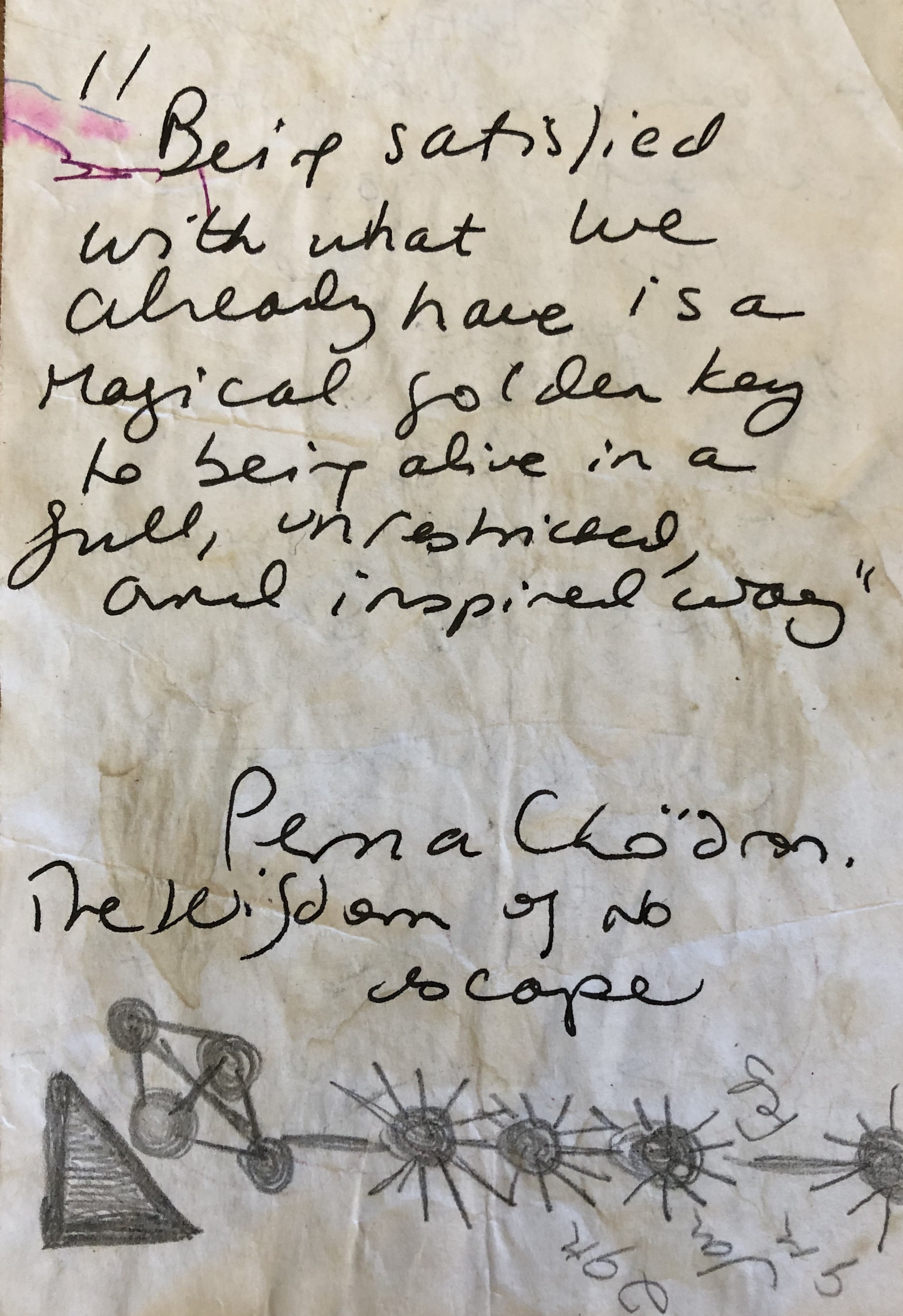
“Being satisfied with what we already have is a magical golden key to being alive in a full, unrestricted and inspired way.” Pema Chodron, The Wisdom of No Escape. I keep this little piece of paper on my desk to remind me that I have all I need to be content with life. It’s all here.
“In the greatest confusion there is still an open channel to the soul. It may be difficult to find because by midlife it is overgrown, and some of the wildest thickets that surround it grow out of what we describe as our education. But the channel is always there, and it is our business to keep it open, to have access to the deepest part of ourselves…”
Saul Bellow, foreword to Allan Bloom, The Closing of the American Mind
As I look back over the year, I see that my ongoing mission has been to keep play and creativity alive in my everyday life. I like to think this everyday work/play as a way to keep the channel to my soul open, tender, and raw. I do this mostly through writing and sewing.
Writing
This year I wrote quite a bit—I wrote everyday gratitudes, and sometimes I wrote “morning pages” (see Julia Cameron’s The Artist’s Way to know more about morning pages). I wrote blogposts, a short story, and a personal essay. Every year I aspire to what I idealize as “a regular writing practice,” some idealistic daily routine where I put writing first, a priority in my life, and set writing goals. But so far, I haven’t achieved this. I wonder whether this year it’s time to lay the dream to rest and just write when I can for the sheer joy of it, to express myself, to explore my ideas.
After my mother died in February, I wrote an essay, “Holding Space for Death,” which I shared with my writing group and with Michael. In this personal essay, I try to articulate my complex response to my mother’s death. I describe how the Heart Sutra helped me make sense of the experience of grieving. I submitted the piece twice to literary journals. It was rejected twice. I continue to feel tension and yearning around the idea of publishing. In academic circles, publishing a piece in a respected journal or publishing a book is the be-all and end-all—it is the intended outcome of most writing. It’s been hard for me to let go of that idea, as it was drummed into me throughout my graduate degrees.
My illustration for “Holding Space for Death”
So in rejection of the idea that I should gain approval by being published in traditional venues, I continue to write this blog: 21 posts in 2019 including this one. I wrote poems and travelogues, mused on stuckness, and visited my little girl self. There were a few shared/ guest posts in there—one from my sister (thank you Judith), and Michael and I shared the blog during our summer road trip–such fun! I appreciate all of my reader comments this year—thank you so much for reading and being interested and responding to my ideas, poetry, and drawings.
Another way I’ve taken a detour around the publishing game is by printing a short story I wrote. I had a local company make copies and staple it as a small booklet with a few of my sketches as illustrations. My talented son provided the cover art. I gave the little story to family and some friends as a Christmas gift. I gave the inexpensive gift of creative expression.
Nat’s beautiful cover for my short story
Although I am pretty sure I completed my memoir in 2018, I got feedback from four readers in 2019: some very good feedback. Mostly, I learned that my analytical writing doesn’t mix well with storytelling, but that I can tell stories that hold interest. I don’t see any reason to pursue publication for the memoir; writing it was a wild and beautiful process. But I do think there are some good chapters that may be reincarnated elsewhere. For example, the strong chapter on my Fez experience (living in Fez, Morocco for a month in the early 1980s) could be the beginning of a book of linked short stories. Watch for it.
Sewing
I love to sew. It is only in sewing and writing that I achieve what Mihaly Csikszentmihalyi calls “flow,” losing sense of time and place as one becomes immersed in an activity.
My sewing projects were various: pillow cases, napkins, mesh produce bags, a zippered laptop case and small zippered purses for coins, make-up, or iPod cords. Drawstring and buttoned purses for tarot cards. I created one cloth bag in rich reds and pinks as a container for a copy of The Velveteen Rabbit, a gift to Michael for his birthday this year (in this, one of his favourite books, we learn that the wonder of a lifetime of being loved transcends the telltale signs of ageing). A pair of little bags on long straps—one green/blue and one purple—went to an adorable pair of young sisters, daughters of a friend.
The biggest project was a quilt in memory of my stepson, who died in 2016. I used some of his shirts to create a pattern of triangles. I worked on the quilt in fits and starts for 10 months, an emotional journey. I felt closer to Alex through the design and slow sewing of this piece.
Working with old family fabric became very special to me when I recently used some household linens that my dear friend had found when going through her parents’ house after their deaths. When she gave them to me, I incorporated the delicate aged napkins into 2 pillow cases, one pink and one green. I see more of this kind of sewing in my future–using old cloth to fashion new objects.
This slideshow requires JavaScript.
And more
Although sewing and writing are my creative mainstays, I continued to draw and paint as well. I make birthday and other cards for friends and family using watercolours, collage, and ink. I illustrated the blog (for example, far left, far right), the memoir (fire picture), and the Christmas present story (flying chair).
From summer blog post
From the memoir
From the short story Christmas present
And then there is whiteboard “art”: Michael and I take turns making coffee in the morning, and as we wait for the coffee to steep in the French press, we draw images and write poems on the little whiteboard in the kitchen. That before-caffeine freestyle drawing produces some kooky stuff, sometimes based on the dreams either one of us has woken from.
M & M Blend Coffee: A white board drawing
I bought a ukulele this year and Michael and I start beginner lessons next week at our local Silver Threads Centre. I aspire to learn enough chords and songs to accompany myself in singing some favourite Bonnie Raitt tunes. It was an old dream of mine to be a blues singer. . . . And I almost forget. In 2020 I want to overcome the fear of a lifetime: Get up and DANCE in public.
According to Nina Wise, creativity is all about “having the courage to invent our lives—concoct lovemaking games, cook up a new recipe, paint a kitchen cabinet, build sculptures on the beach, and sing in the shower.” She encourages us to by-pass the censoring voice that says “Stop!” To cultivate the one that says “Yes! Go!”
For me, what has helped to achieve this creative freedom is to stop comparing myself to others so much, to stop worrying what others will think. My aim is not to become or be an artist. I am a maker. A creative. These are better nouns–less pressure.
I am never completely successful in banishing the people pleasing aspect of making–after all I really do care what people think. But external audience is not my first thought anymore. I am my first audience: I have to love what I make.
I express myself because creative expression is my lifeblood. Seriously, being a maker keeps me alive. And I do it because the process and the product please me, the creating and the creation wake me up to life and to myself. And then I hope what I make pleases a few other people. That’s it. Creative expression is whispering to you. Creative expression is your birthright. Listen and say Yes! Say Go!
Recommended: Nina Wise, A Big New Free Happy Unusual Life: Self-expression and Spiritual Practice for Those who Have Time for Neither. Broadway Books 2002.
A curse and a gift of ageing is a growing awareness of the ways I have been inauthentic in my life. Lately, I have become profoundly aware of the disconnection between my body and my mind. I have ignored my body for so long, shut it up into submission, taken it for granted. These pronouncements presume a Cartesian dualism, an assumption that mind and body are separate, and though I realize they are not, that is how I have felt in my life—my body and mind feel separate.
Two years ago I started a graphic memoir, Let me hear your body talk. It was my attempt to illustrate the life of my body from infancy to the present day. After a dozen or so pages, I stopped and let the project languish. My reason was that I was too clumsy an artist to render my ideas. But another reason I stopped was that as I worked through my childhood and teenage years, drawing and writing, I felt acutely uncomfortable with how I had regularly ignored my body’s signals. From emotional eating to having sex with somebody who repulsed me, to neglecting pain, to resisting the gut’s intuition. I had abused my body through various compulsions: I was addicted early on to the approval of others, and later to food, cigarettes, and booze. Never having learned how to honour my body as precious, I considered it as merely an appendage to my brain/mind, which I believed was more valuable.
Although I can’t speak for others, my memory is that as a family, we weren’t grounded in our bodies. Moving the body, appreciating the body, enjoying the body, listening to the body: these were not on the agenda when I was a child. Sports, exercise, or creative body expression were not encouraged or modelled by my parents. Sex was rarely discussed or mentioned, though it might have been alluded to. When I took up running in my late thirties, my mother commented, “You’re not overweight, so why? It can’t be good for you, jiggling around like that.” I suppose when I was very young, I lived shamelessly and happily in my skin, but I cannot remember. In our family, intellect was prized above all.
Of course, this is not to suggest my body has not been a source of bliss. Sex can be rapturous. . . the ruminating mind dissolves as every nerve ending sparkles and shimmers. Being pregnant, giving birth, breastfeeding: all gave me tremendous pleasure/transcendent pain and left me with gratitude, love, and respect for my body and its capacity. But as the excerpt from my memoir shows, as a young woman I tuned out my body’s sensations and needs. My people-pleasing antennae were turned way up; I wanted not to be a problem to others, so I suffered, often silently. I wanted to please the man I was with; my pleasure was secondary.
These days, I meditate daily. Although my thoughts quiet for minutes at a time, I still haven’t felt fully connected to my body. Looking to change this, I bought Reggie Ray’s book, The Awakening Bodyon somatic meditation. Ray provides instructions on six somatic meditations. One resonated more than the others: yin breathing. “The place of yin is in the lower belly, approximately a couple of inches below the navel and in about the middle of the body. . . In Taoist meditation, this place in the lower belly is known as the lower dan t’ien” (p. 67).Ray goes on to write that the lower dan t’ien’s role in the body “is the inner expression of the fundamental space of the cosmos, the original womb out of which all energy and life arise. It is the microcosmic expression of the same limitless reality we meet ‘outside’ in the earth at its infinite depth.” The concept of the “original womb” may sound inflated or unbelievable, and yet I immediately understood this concept because I had experienced the yin space before.
A few years ago, I had felt this space, an oval the size of a duck’s egg located about three inches below the navel, as a mysterious source of deep pleasure. At that time, I welcomed it, but I didn’t understand it. It would come to me late at night as I was drifting off to sleep, a pulsing sense of well-being in my whole body, but originating there at the body’s root—tingling pleasure that was not exactly sexual. A radiating pleasure-consciousness that felt rooted, centred, yet expansive. It’s hard to explain. As I said, it’s mysterious.
Lately, I have been doing yin breathing, breathing in and out through the lower dan t’ien and thereby, “roaming on the boundary between consciousness (the ego domain) and the unconscious (the deep Soma). As a result, my body consciousness may be shifting. Recently, we went to hear live jazz, the Amina Figarova Sextet, and I enjoyed music more than ever before. Instead of listening in my head, my whole body heard and felt. I enter the piano’s thrum, the saxophone’s sugarplum melodies, the drum’s silvery beats; I swallow the flute’s shivers and I become the tall brown bass, plucked. My body is a repository for sound and I can’t help but move to the rhythms. I fill with jazz colours, jazz feelings. Body and mind are one. Feels so good.
Madeline: We could be driving anywhere—in a way, it doesn’t matter because it is all about the internal journey. One of the things we’ve been balancing and talking about is spontaneity and discipline or restraint (near antonyms of spontaneity). Michael calls the force opposing spontaneity (and one he associates with his own character) as “stick in the mudness,” though I don’t see him this way at all. He has a tonne of carefree magic in his soul balanced by “Great East Discipline” (one of his Buddhist names, which is very fitting).
We have tried to balance these two energies between us on this trip while we balance them in ourselves. Perhaps Michael has more discipline than I, and he has taught me that we need to spend the longer days in the car to cover the kilometres (Canada is enormous). Perhaps I have more appetite for being impulsive (“let’s stop at this lake and swim!”), but we need both of these energies to make the trip go. If Sponty runs the show, we follow every whim, popping into thrift stores and following hiking trails for an elusive kingfisher, and we never actually get to Toronto. If Sticky runs the show, we get there in record time, but exhausted, never loosening up and letting bursts of impulse reveal the magic in the everyday.
We have had some longer days, like July 16. We left the Soo at 8:20 a.m. and arrived in Kenora at 5:20 (well, 6:20, but we slipped into the Central Time Zone at some point). Pacing ourselves with frequent breaks and seat switches, we made it to Kenora feeling pretty good.
The long day (Soo to Kenora) made Winnipeg on July 17thpossible! Thunderstorms were predicted, so rather than camping (which we still haven’t gotten around to), we decided to do a short day, arriving in Winnipeg in the early afternoon and exploring. What treasures we beheld…
We wandered into Á la Page, a comfortable, homey business selling second-hand books at 200 Provencher Blvd. in St. Boniface, and found that all books were 50% off! The green corduroy couch near the front of the store beckoned—so comfy. I sat down and started paging through a book on intuitive healing while Michael looked at a book of Buddhist art. The catalogue had a definite leaning toward the metaphysical, and more than half the titles are in French. I asked the young man at the cash desk if the place was going out of business because the half-price sale seemed to me a sign. “Not yet,” he laughed. We chatted about how you have to be passionate about books to run an independent bookstore. I feel recommitted to supporting Victoria’s independent bookstores.
I loved St. Boniface not only for its charm and beauty, but also because I felt so comfortable speaking Anglais, whereas in Québec not so much. I had a thought I’d love to spend a summer in St. Boniface learning French and getting to know the neighbourhoods.
In the evening, we discovered a textile show by three Franco-Manitoban (is this a proper descriptor?) women—what a find! I fell in love with Rosemarie Péloquin’s felt faces and heads that depict old age in a truthful and tender way.
On our Winnipeg afternoon, we wandered. We embraced what we came upon in our wanderings. Discipline builds the dance floor for the jazz-dance of spontaneity.
Michael: One of the things I am learning on this trip is that Sponty helps me to open to the world with a child’s heart, and when I do that I find unforeseen jewels, such as Medicine Hat which I wrote about in an earlier post. Today I am reflecting on the magic of Manitoba.
Waking up in our little Jackfish Cabin and seeing a weather forecast of thunder storms, we decide to drive to Winnipeg, enjoy a shorter day, and see what we might find. What follows is completely magical.
We meet Barry S. Shore, owner and proprietor of Fat Cat Records. As Barry said, he “used to shoot for Warner Brothers”, and his walls were adorned with black and white photos of rock stars, clearly shot from the close to the action vantage point of a press photog— exquisitely, dramatically, and lovingly framed, faces wearing many masks: passion, sadness, feral snarls. Fat Cat specializes in West Coast Blues, which Barry explains to us is a sub genre of the blues with elements of jazz and bop built in. He has only been open three weeks, but this is his third record store, and this way he only has to sell the stuff he likes. He says the store gives him something to do in his retirement—hmmm, is there a theme here? We buy a music-themed print, a Fat Cat Records tee shirt and a Lynwood Slim CD. I am often struck by synchronicity, and as we leave it strikes me that we’ve been listening to Stuart McLean’s stories about Dave, owner of the Vinyl Café, Canada’s smallest record store. Wow, I think, we just met an aging Dave and visited the Vinyl Café!
Winnipeg Fringe is on, and after attending a stand up performance in St Boniface, we venture out for a walk on the boulevard. I wear hearing aids, and at times the internal combustion engine is the plague of my existence–cars without mufflers and motorcycles assault my senses in the most shocking and violent way. Today is one of those days, so I want, need respite. Across the street we see green grass beside railroad tracks and walk towards it, expecting tracks, grass, little more.
Instead we find a path that leads to a footbridge over the Assiniboine River, and a forested glen with a winding path. The reflections of the forest in the river, the sweetness of birdsong, Madeline’s hand in mine and our shared silence are entrancing and nourishing in a way that I really need. Another unexpected jewel.
As we return across the bridge, we find remnants of paper fastened to the bridge deck, printed but no longer legible. A placard explains that this is an art installation, Pages and Passages by Eric Plamondon. The pages are pulled from the stories of 30 Manitobans-poems by Louis Riel and Gabriel Dumont, but also more modern folk. Each pedestrian and cyclist can read the stories, but their passing obscures them a little more each day, thus with the passage of time we affect each other’s stories.
I have been thinking a lot about privilege on this trip, about how my privilege manifests in blind spots, which by definition I can’t see. This is another jewel-an opportunity to see how in just living my life, in just passing through, I affect the stories of others. I return to the road with a deep sense of gratitude and magic.























 Madeline Ruth Walker