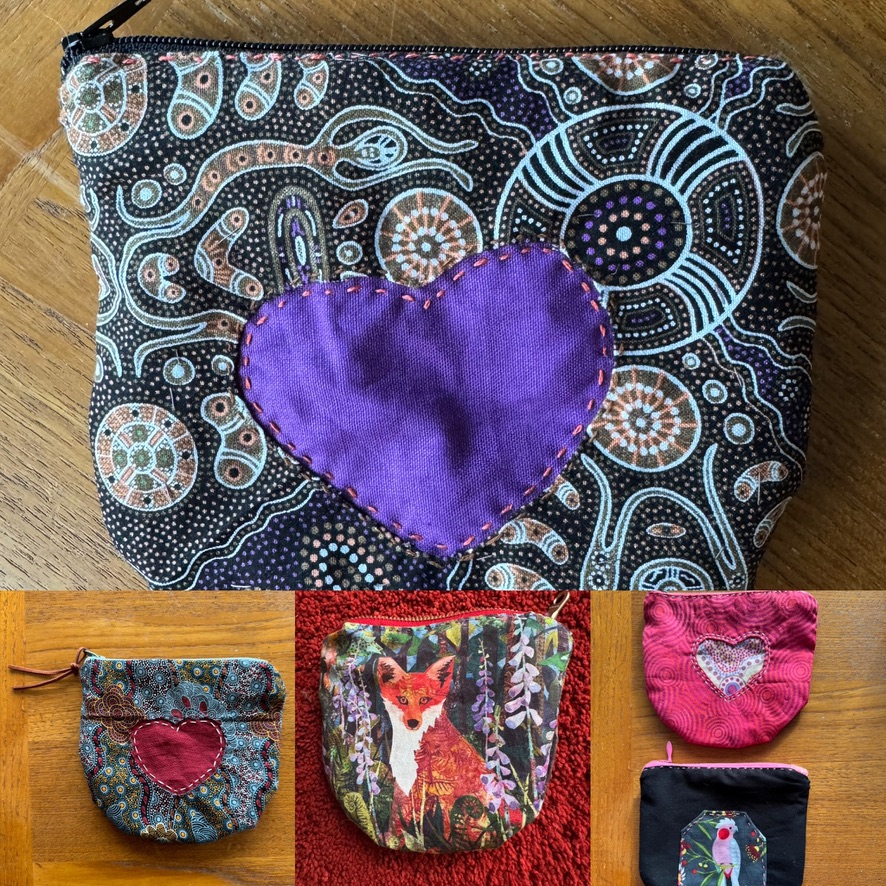
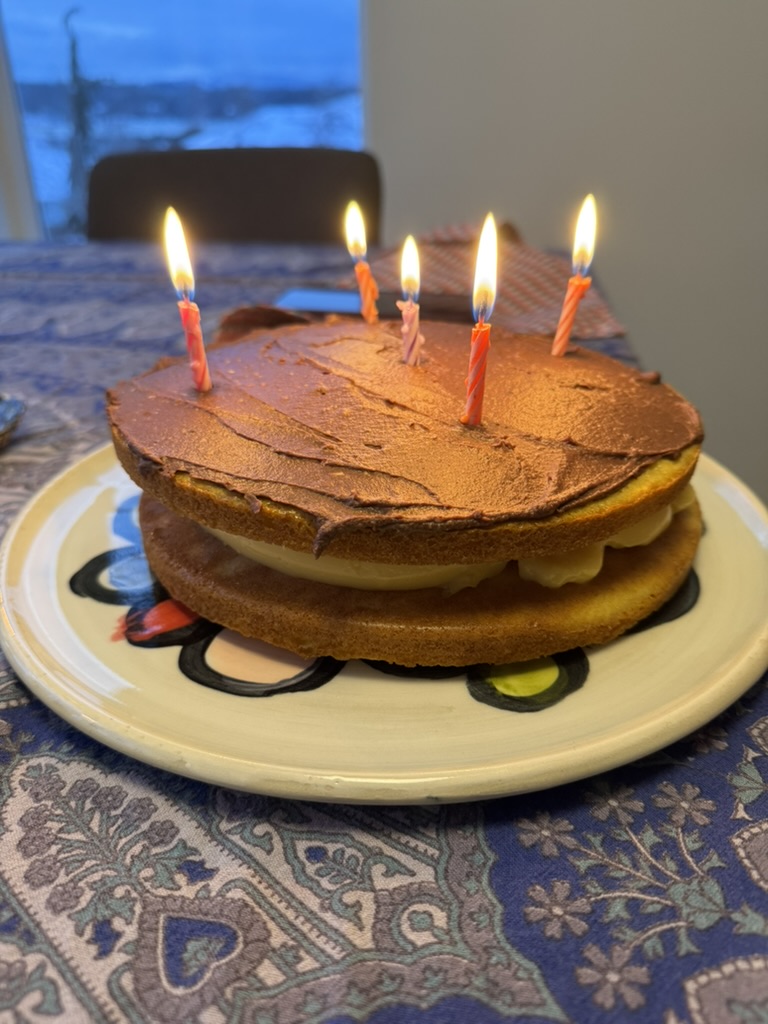
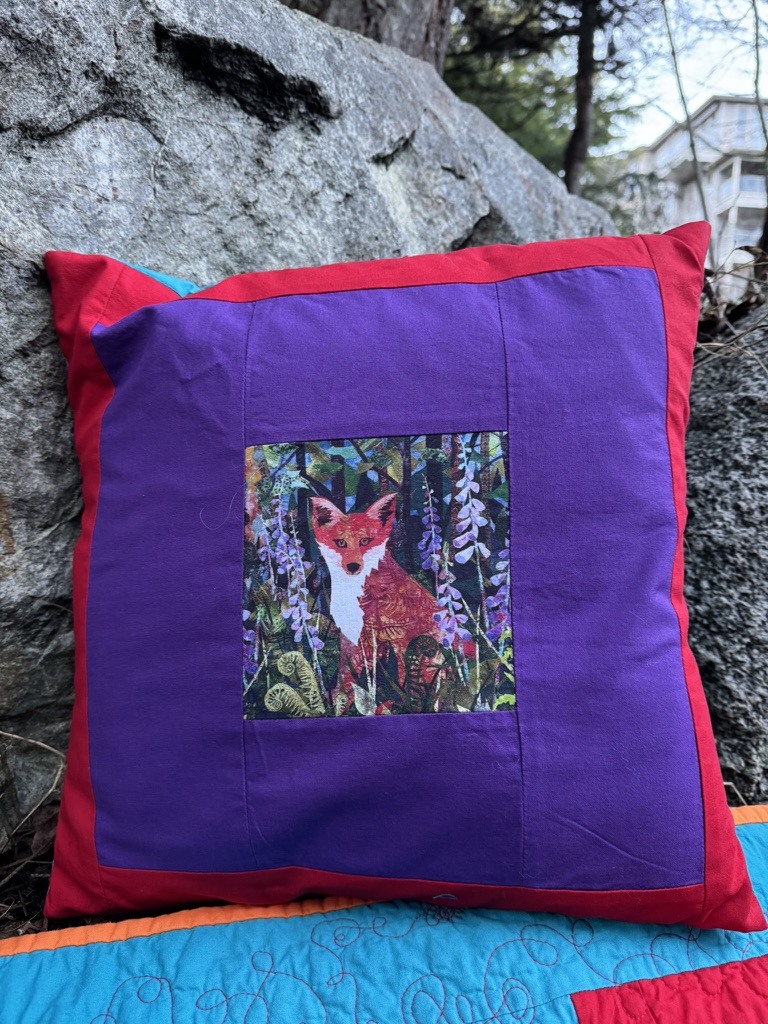
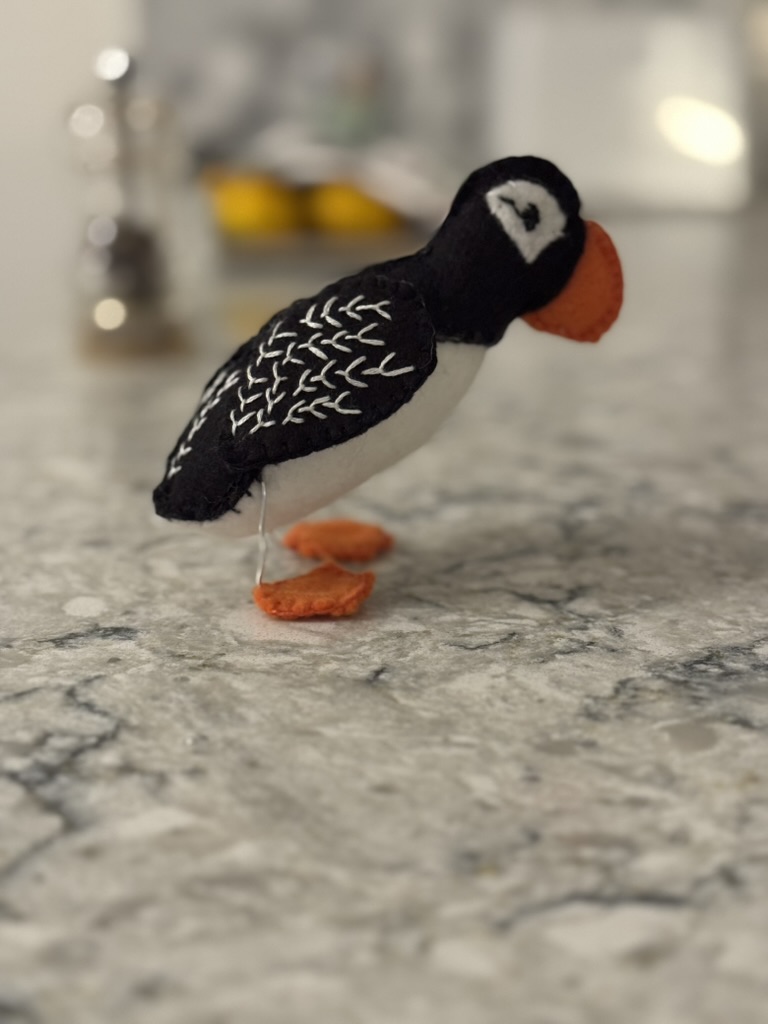
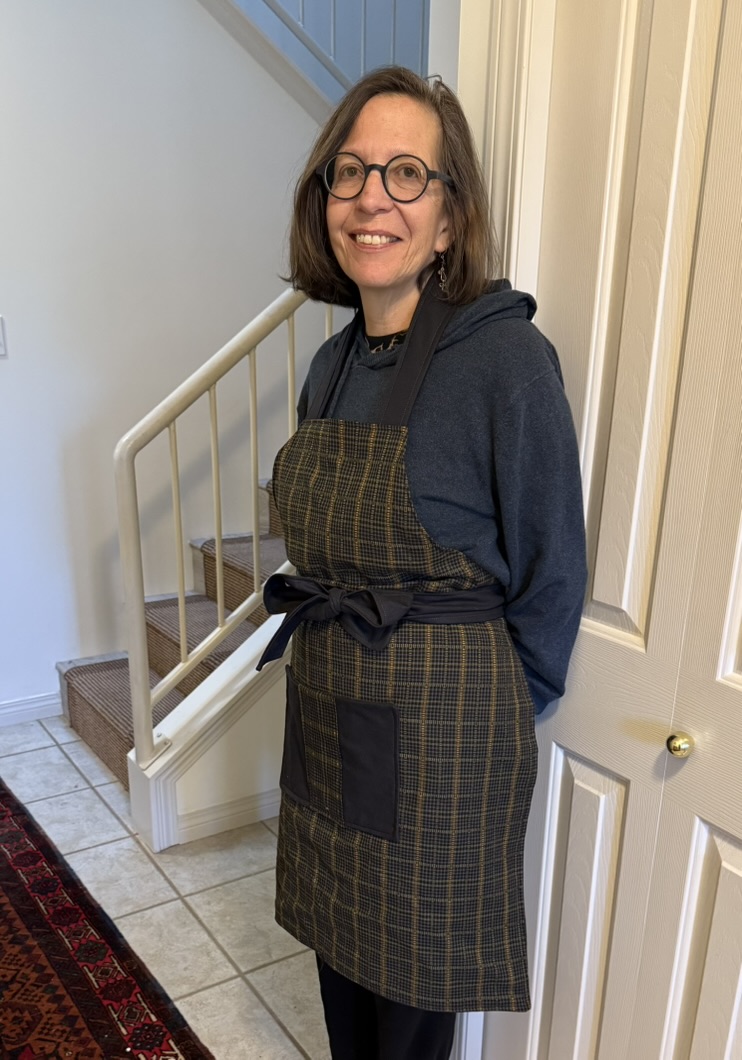
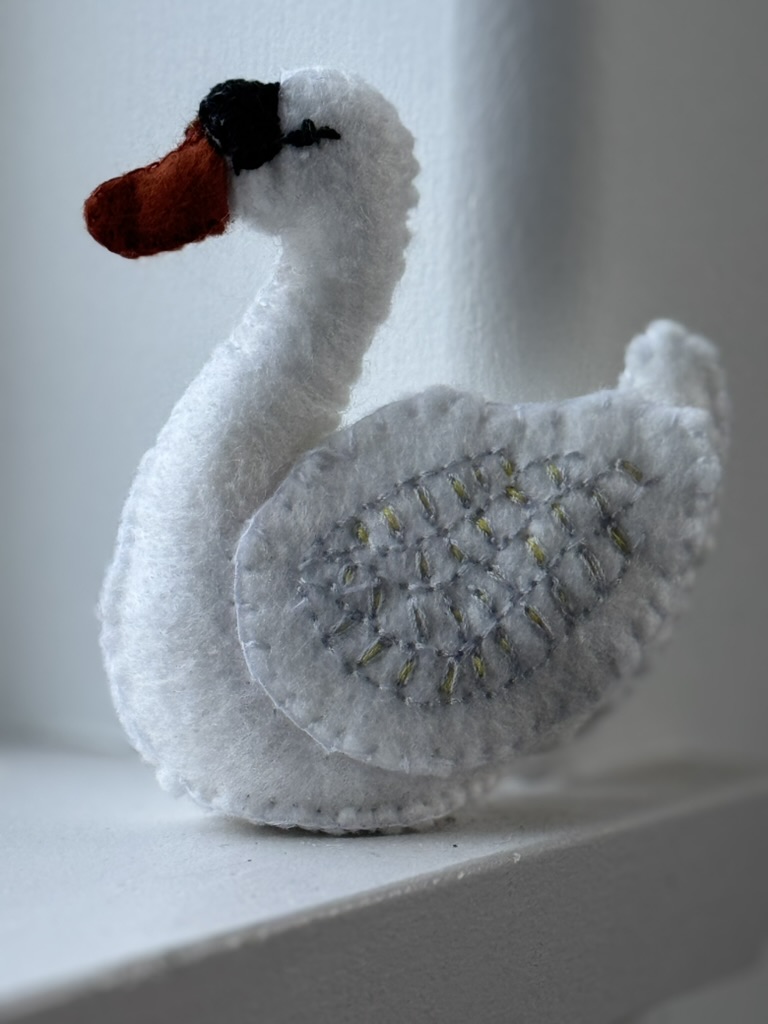
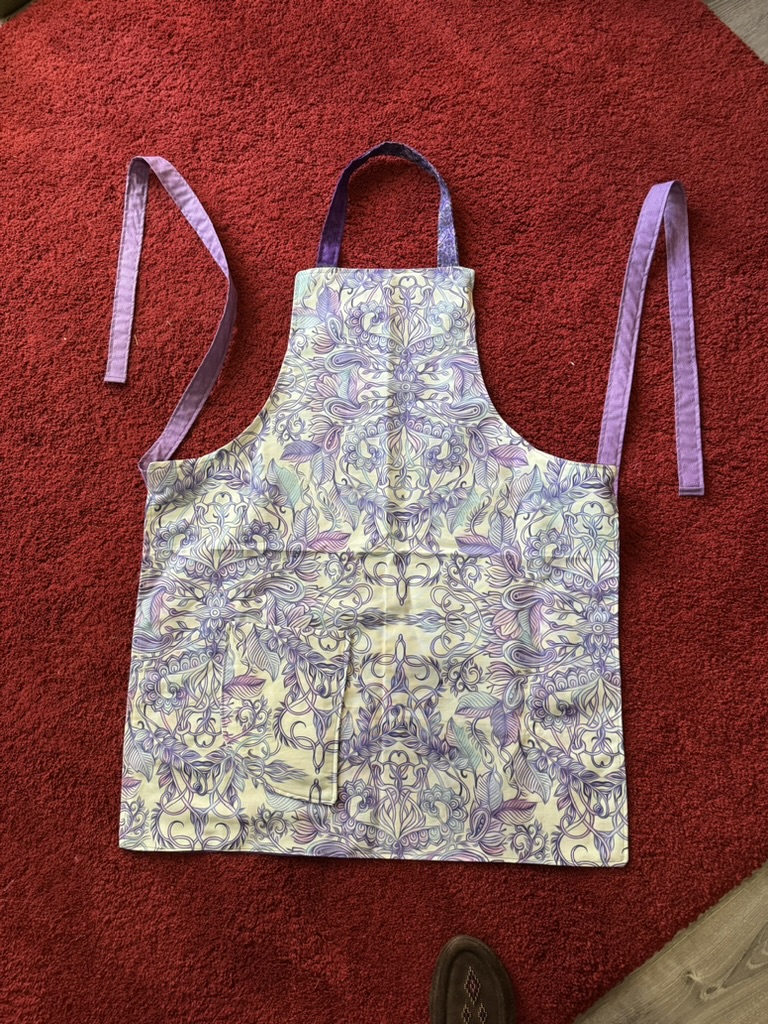
It’s my 67th birthday today, a good day to review the year in creation. What did I make this year? Eleven blog posts (this is the twelfth); a few stories, poems, and essays; felt birds for family members and felt Christmas decorations; three aprons (one for Nancy, one for Meytal, one for me); a baby quilt and matching pillow for the great grandson of my friend, Lillian; embroidered pillows for my niece; a patchwork pillow for my friend Janis; little zippered bags for everyone; “One Thousand Joys,” a wall hanging for our stairwell; a lunch bag for me; some drawings and comics; a sling bag for Nancy; some collages (thank you Kathryn for the inspiration); and cakes and more cakes for friends and family.
Living a creative life feels as important as ever.
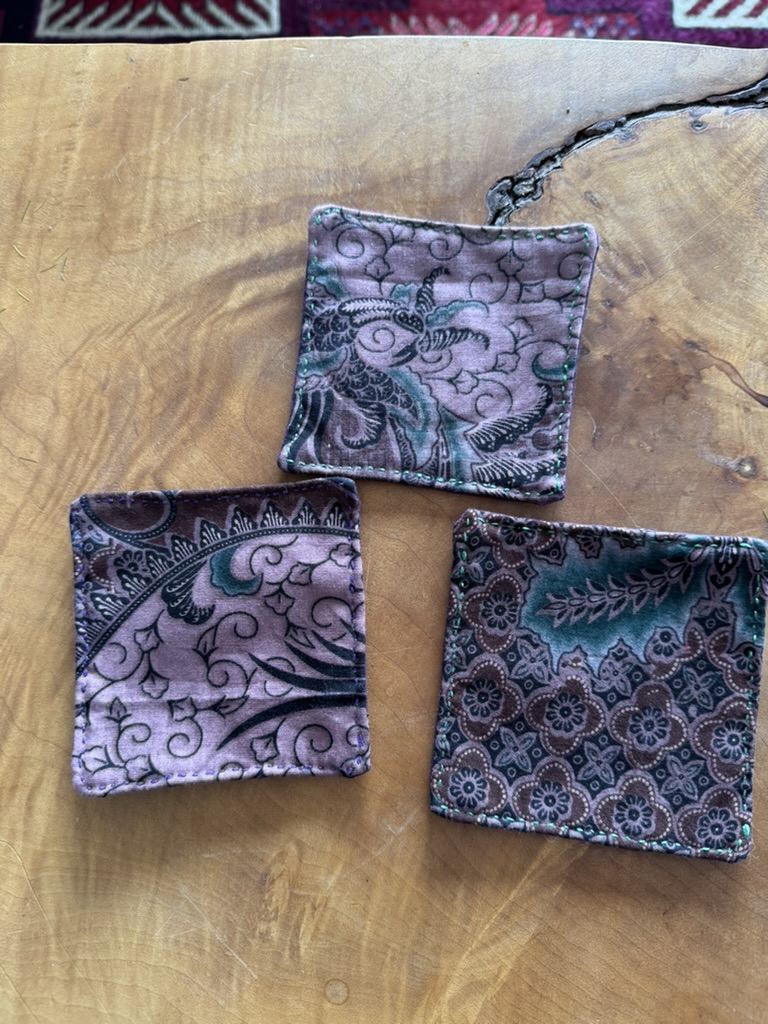
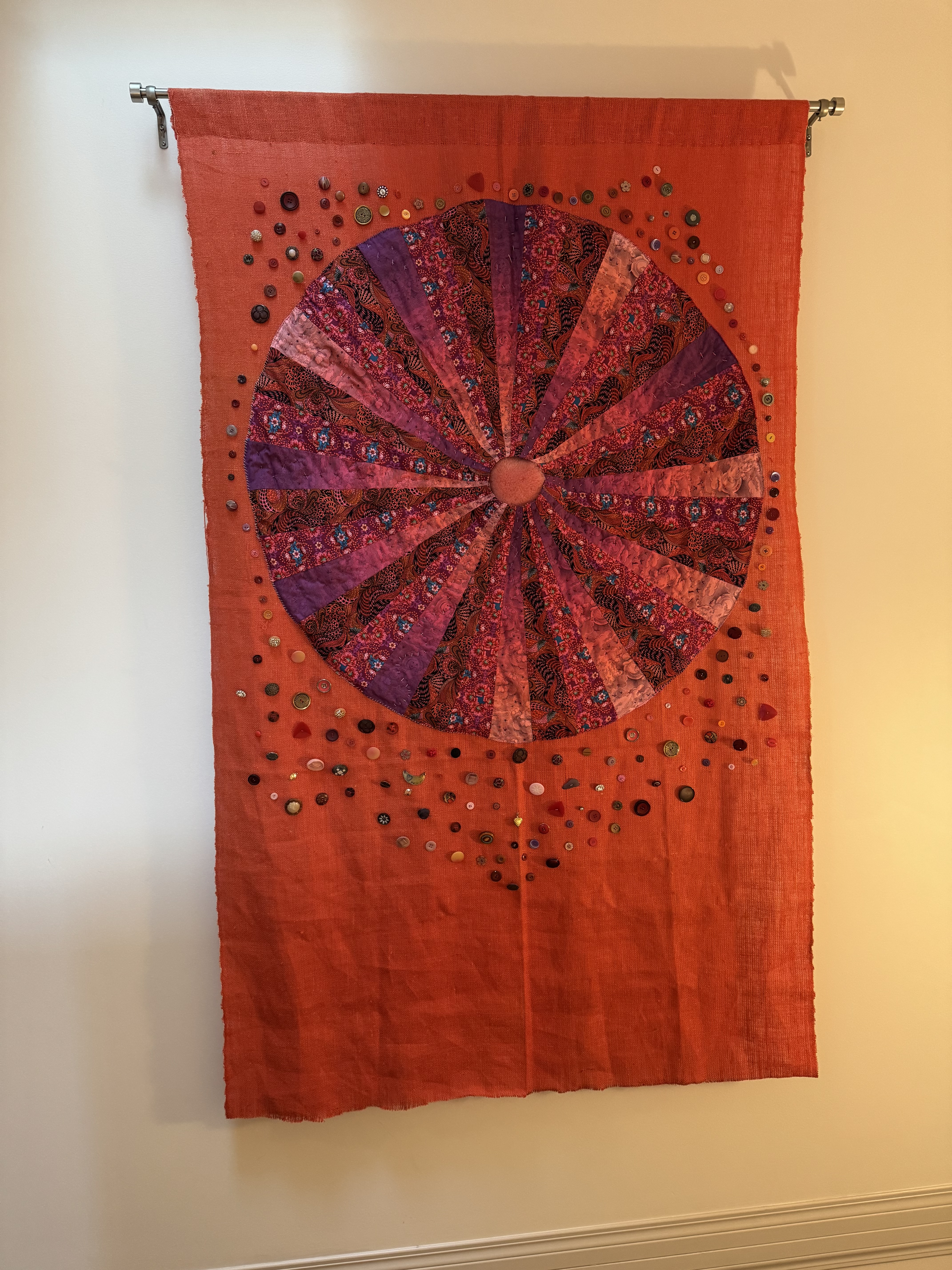
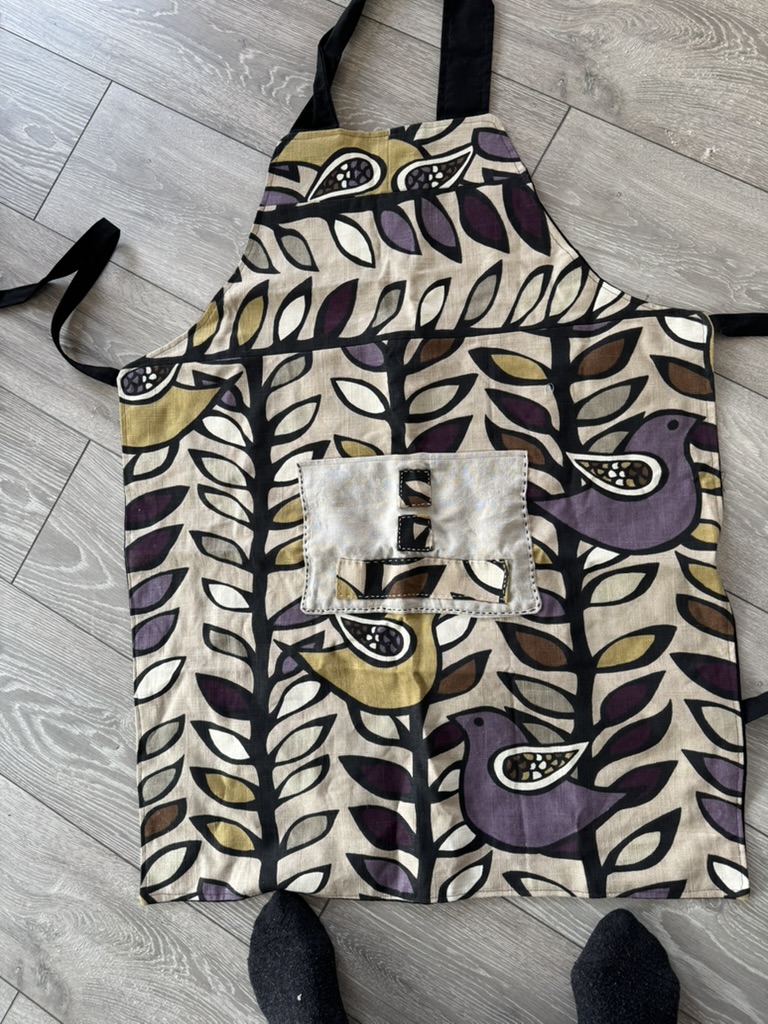
Coasters made from a shirt I bought at a yard sale10,000 JoysMe and Nancy – her birthday apronKathryn’s vegan chocolate cakea pillow for Janis’s birthdayMeytal’s birthday apronSling bag for NancyMichael wanted a Boston Cream Pie and I deliveredA lunch bag for meTwo pillows for my niece’s birthdayA quilt and pillow for a little baby I’ll never meetMichael named the owl I made him “Winston”Nat’s puffinI wanted an autumn apron, so I made thisFelt tree ornaments for my dear writing group membersSarah’s swanEvan’s heronCollage: Pieces of Me
Show and Tell

In old age,
let us
return to kindergarten
rituals.

Show something,
then tell about it
during circle time
with our friends.

I went to collage club
at the library
Women of all ages were
cutting up old magazines.
Glue sticks and colourful scissors
lay across white tables like
sacred instruments.

As we cut, some of us
spoke; others
remained silent.

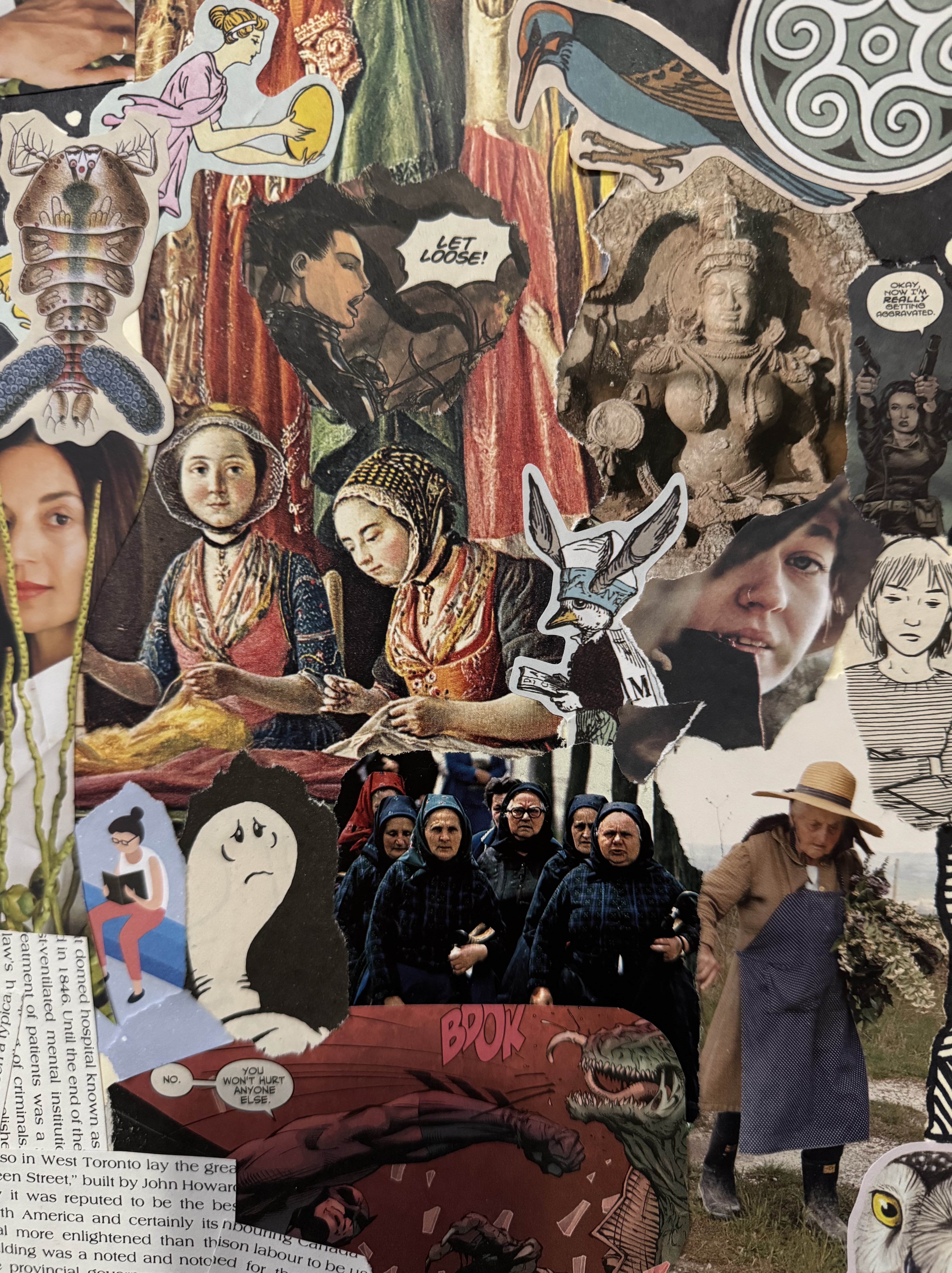
I made a collage
about the pieces of me.

Cool and aloof,
wise owl
serious as I sew buttons.
Sometimes a poor silly worm,
my blind eyes sensing light.

In past lives I was
fertility goddess,
discus thrower
seamstress
parasitic crustacean.

Inside of me, Batman blocks a monster:
“No, you won’t hurt anyone else.”

Inside of me, a bitch brandishes her guns:
“Now, I’m really getting aggravated,” she says, her voice rising on the smoke.
If women let loose their anger, the world would burn.

One spring day in Toronto,
forty years ago,
I rode the Queen West streetcar to work.
As we clattered past the mental
institution, number 999,
a statuesque woman, her
proud head shorn,
strode the sidewalk, naked.
Her brown thighs shimmered in
the light, her high breasts bounced lightly,
nipples hardened in the coolness
of that morning.
Everyone around me was,
for a moment, silent, awed
by this strange beauty.

Crustacean, crone, bird,
woman, warrior, gatherer of words,
seamstress of memories
Can you see all the pieces of me?
Last year, Benji was hit by a car. He was Alma’s last cat of the dozen that graced her long life. I heard the thud as I sat sewing at the bay window. When I looked up, Benji lay crumpled on the street and no car in sight. Some asshole hit him and drove off. I threw down my sewing and ran into the street, grabbing my shawl on the way. He was still alive, making a peculiar huffing noise, blood trickling from his jaw that looked all crooked.
Oh no, this will destroy Alma. I scooped his light body up from the pavement and cradled him in the shawl. When I knocked at Alma’s door, it took a while for her to open it. Her eyesight wasn’t the best, so at first, I think she thought I was bringing her a loaf of my sourdough, wrapped in a kitchen towel. But soon she realized what was in my arms and began to cry.
Alma, we’ll can take him to Peter right away. Our healer Peter lives in a cottage just around the corner. Get in my sidecar, I told her, and I’ll hand Benji to you. Her crying had evolved into low keening. I dropped her purple cape over her shoulders, and she slipped on her sandals. I opened the door of the sidecar attached to my bike, and she slid into the seat, creakily, and held her arms open as if to take a baby. Benji was her baby—a cat she’d coddled and loved since he was a feral kitten, discovered in the old shed behind my cottage with three litter mates. We figured the mother had been killed by a car or racoon. The kittens were starving. We found homes for them, all but one. Alma had been without a cat for almost a year then, and when she saw little squirming Benji, she said she had to have him. Or he had to have her.
She fed him with an eyedropper for weeks and carried him close to her warm, wrinkled breast in a sling she asked me to sew for her. I made the sling with indigo cloth I had left over after making Peter’s shirt. Alma was a sight to behold, walking slowly to the corner store with her shopping cart, the sling around her front, a tiny feline face peeping from the folds of blue cloth.
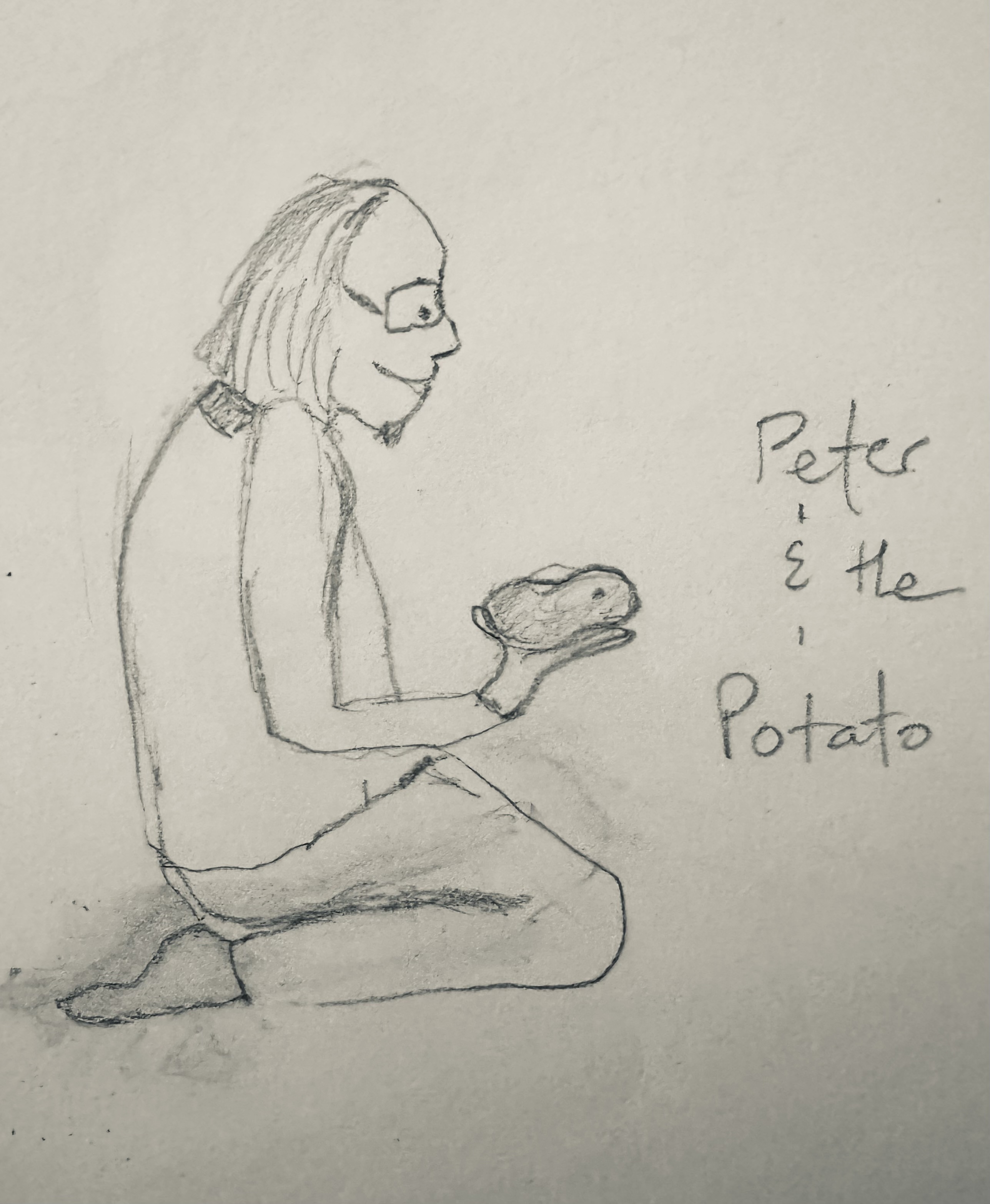
Oh Benji, Benji. Out of my peripheral vision, I could see Alma bent deep over his little body as I pumped the bike, swooshing down the road and around the corner. It took us only a minute to get to Peter’s. We knocked on the door, no answer, so I figured he was in the garden. We trod the narrow path beside the cottage. His back was to us as he sat on his haunches, examining a potato he had just dug from the soil. I looked fondly at the blue indigo cloth straining across the breadth of his back, a breadth of skin and warm muscle I had run my hands over just last night. My knees trembled with desire as I approached him with Benji now in my arms, Alma hobbling behind me.
An hour later, we sat in Peter’s front room on low velvet couches, drinking jasmine tea. Alma was holding a lifeless Benji in her lap. Peter had determined the injuries too severe to save him, so he’d administered a lethal drug in a long needle while Alma stroked the fur, matted with blood. Now, Benji looked so peaceful, curled up in my red wool shawl, Alma’s hand under his little skull.
Neither love nor money will persuade me to ever get another cat, Alma said, her voice soft and sad. She’d stretched her stick-thin legs out before her. Alma liked to wear sandals most of the year, except when it snowed, liked her feet to feel the air, and today I could see her thick greenish toenails and large bunions up close. She was terribly old.
Peter heaved a great sigh. Benji was a fine cat, he said. We had all loved Benji’s antics. He’d dance like Baryshnikov, trying to swat the clouds of gnats that floated above the garden beds in summer. His meow was a sweet question mark, meaow? And if you were lucky enough to hold him in your lap, you were blessed with a vibrational purr that set your thighs buzzing. A deep warmth and contentment emanated from his slight, stripey body. We all loved Benji.
Peter sighed again, shaking his head at the loss. We came to Peter with our sick and injured pets and even, sometimes, with our own ailments. His stinging nettle tonic has reduced my hay fever. His black cohosh tea has helped women all over our neighbourhood with menopause. Peter is not just a skilled herbalist. His magic hands can make me come just by stroking my breasts.
Several weeks after Benji died, a sunny June Saturday, I was at a yard sale with Alma. On summer weekends, Alma and I did the yard sale circuit together on my bike. I pedaled, and she rode sidecar. She has a thing for small dishes, tiny saucers and bowls, sized for fairies. I like to collect children’s books. I don’t have children, and I never will have. I’m fifty this year, but nonetheless I’m charmed by simple stories and illustrations. I would rather read three or four children’s books to myself at bedtime than a novel filled with crime, sex, mystery, and drama.
A book caught my eye, titled Part-time Dog. I opened the cover to the copyright page to check the publication year, 1965. I always do that first because I prefer old books. They provide the most comfort. I bought it, along with several others, two dollars for the lot. Alma found a gold rimmed bowl decorated with an image of two goldfish. Later, we had dinner at my place—a big salad and thick slices of my sourdough. After dinner I gave Alma a framed photograph of Benji dancing in the garden that I’d taken the year before. I’d caught him with both paws in the air, his golden eyes glittering with excitement. One small foot was off the ground as he leapt. The sun played over his orange and brown stripes, and the patch of white on his face made him look almost human. When Alma saw it, tears rolled down her wrinkly face. I moved next to her on the couch and put my arm around her. Not for the first time, Alma said that neither love nor money would persuade her to get another cat. Benji was the best and the last.
That night after Alma left, Peter slipped in my back door, and we made love silently. Through the open window, we heard whoo-hoo from the owl in the tall pine. I felt us smile in unison. What if this life was an illusion? What if I were a character in a children’s story about a happy seamstress and her herbalist? After Peter left, I lay in my narrow bed with the stack of new-to-me children’s books on the bedside table. Part-time Dog was on top, so I started with that.
Brownie is a small stray dog who shows up in the neighbourhood. He starts walking with the children to school, accompanies Mrs. Butterworth to the bank and watches Mrs. Tweedy rake the leaves in her yard. But he has no home, nowhere to go at night, so he sleeps under someone’s porch. Three women in the neighbourhood decide to adopt Brownie. It would be too much work for one of them to have him all the time. So, one gives him breakfast and keeps him in the morning, one has him in the afternoon and gives him his dinner, and another has Brownie every night, where he sleeps in his warm bed, safe and sound. I liked the book so much, I read it again, then fell asleep, dreaming of a little brown dog curled up at my feet.
In September, Peter noticed a white cat in his garden, sleeping on a warm stone, and he scratched her chin and stroked her, gave her some salmon he was cooking for lunch, and then asked around the neighbourhood. Nobody knew anything about her. She was a short-haired female with one blue eye and one golden, and he named her Nia. Peter worried he’d be taking her from her family, but still, nobody claimed her.
She claimed us, wandering back and forth from my cottage to Peter’s. When Peter gardened, she stayed close to his side, and when I sewed, she spread out on the table next to me, her purr matching the vibration of the sewing machine. And though Alma said she’d not have another cat for love nor money, there were many nights when Nia wandered into her cottage and curled up on her bed.
Christmas was simple and good. Alma, Peter, and Nia came to my cottage. We had a stew made with pumpkin from the garden and my sourdough bread. For dessert, Peter brought an apple cranberry pie he’d baked. We walked Alma home, then we went to Peter’s cottage because his bed is bigger than mine. I stayed all night. When I got up, Nia was nowhere to be found. After we drank our coffee, Peter went and called for the cat, but she didn’t come running, her white tail twitching and her little bell tinkling, as she usually did. Frost painted the windows white, and a crust of ice capped the blue bowl of water we kept outside for her. We went to my cottage next, but Nia wasn’t there. At Alma’s, we knocked at the door. No answer, so Peter opened it gingerly, and we called through. Silence. We walked to the back, to Alma’s bedroom, where she lay peacefully, her long white hair flowing out around her across the dark pillowcase, eyes closed in her wrinkled brown face. We knew her life was over. Nia lay at Alma’s feet, purring deep and low.
Later when we cleaned Alma’s cottage and found a copy of her last will and testament, we discovered she’d left the cottage to both of us. When Peter asked me to marry him in the spring, I said yes, you make me happy. But there’s one condition. Let’s keep things as they are.
We sleep sometimes at my place, sometimes at Peter’s, and other times at Alma’s. We kept things the same. The blue sling that kept Benji close to Alma’s chest hangs on the hook near the door, the framed photograph of him on the living room wall. The tiny dishes, neatly arranged, are displayed the way Alma liked them, on open shelves in the kitchen. Nia wanders from one cottage to the other to the other. She knows that food, water, and love are everywhere.
Note: Part-time Dog is a book I read to my children by Jane Thayer, pictures by Seymour Fleishman
Sometimes a word rolls around in my mind for weeks. Lately, it’s “shed,” both noun and verb. I started to make notes about “shed” and its associations. When I saw the document file that I’d titled “The Word Shed,” I recognized a new meaning: my mind is a word shed. A space where I collect words, play with them, combine them, examine their denotations and connotations, milk their honey.
Shed the noun is a simple roofed structure, typically made of wood or metal, used as a storage space, a shelter for animals, or a workshop: a bicycle shed | a garden shed | a woodshed. Or a place to work. Last summer we met a couple at their yard sale, and they showed us the woman’s “She Shed” in the backyard. They’d built the small one-room shed during the pandemic: it was a place for her to work at home in peace and quiet. I’d never heard the term “She Shed” before. I like it better than “Man Cave.”
Michael’s drawing of an old shed located in my father and Marion’s sugar bush near Markdale, Ontario. We called it the “sugar shack.”
The Shed is a restaurant in Tofino where, two years ago on my sister’s birthday, I had a delicious salmon bowl that I recreated at home later. I knew the ingredients: salmon, quinoa, raisins, almonds, chopped apple, kale, white cheddar. I intuited a dressing of tahini, olive oil, lemon juice, garlic, honey, and yogurt. I discovered the recipe, handwritten on blue paper, in my recipe binder and realized that I’d somehow cared enough to reverse engineer the recipe, though I can’t remember writing it down.
I made the Salmon-Kale-Quinoa Bowl again the other night and it was delicious. I didn’t have white cheddar or puffed rice, so I used shaved parmesan and skipped the puffed rice.
The Shed restaurant invokes a homey feel. I remember being there with Jude and Michael, tucked into a cozy booth while rain spattered the windows and wind whistled outside. Like sitting in a warm shed on a stormy day. We walked on the beach after lunch in our rain gear.
Over the years, we’ve had two sheds built on our property for storage, bicycles, and garden stuff. Now we’re moving and clearing out the sheds. I’d forgotten about the stuff I stored there. Out of sight, out of mind were boxes of old letters, some going back forty years; kids’ artwork, writings, and report cards; notes from university courses; my old journals. Sorting and shedding and shredding old papers over the last few months has been part pain, part joy, and sometimes so funny I laughed out loud.
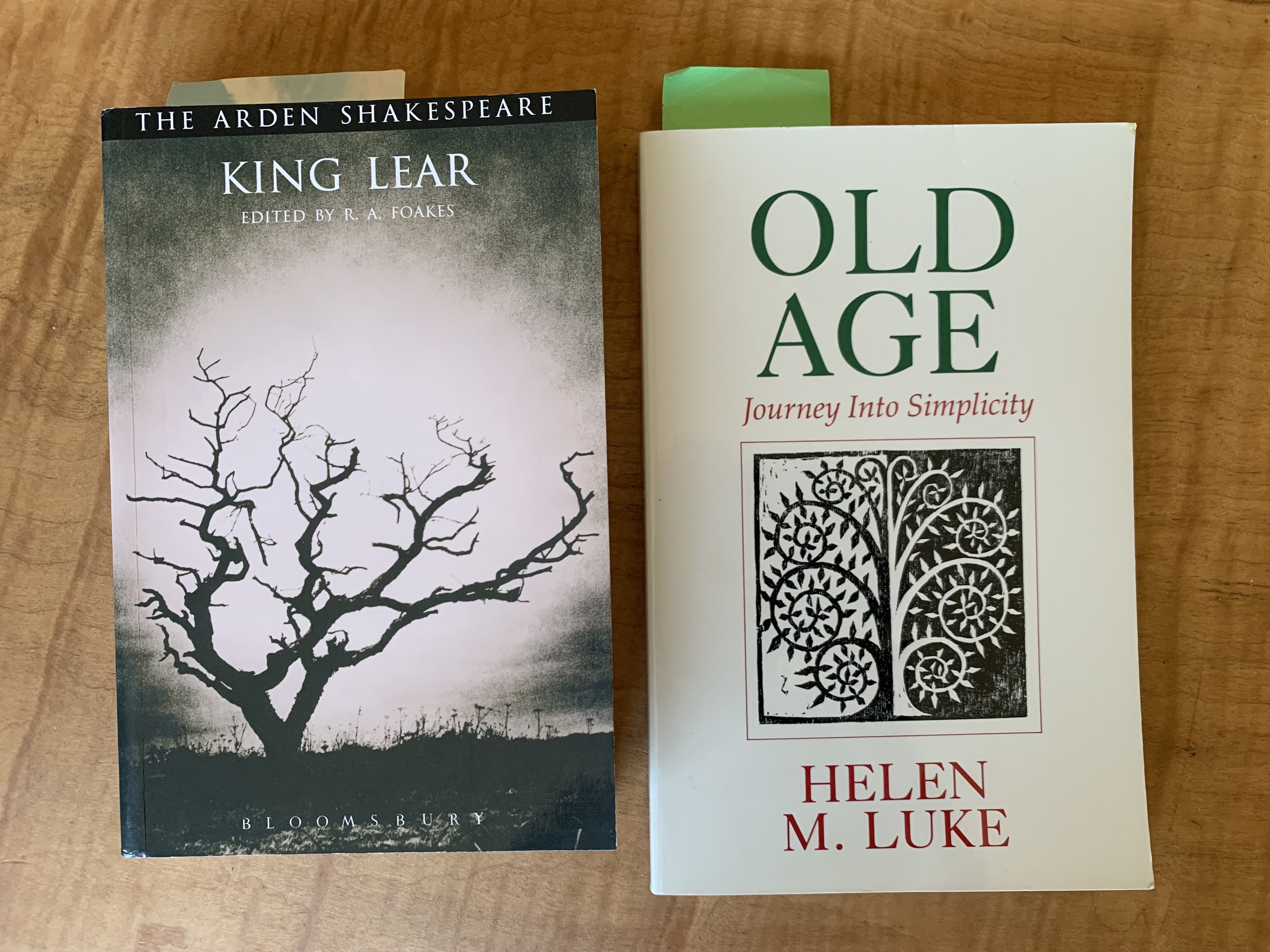
Another shed: On December 1, we’ll be in New York City to see Kenneth Branagh in the role of King Lear at the Shed, “a new cultural institution of and for the 21st century.” Their website explains: “We produce and welcome innovative art and ideas, across all forms of creativity, to build a shared understanding of our rapidly changing world and a more equitable society.” After a run in London, England, Branagh is bringing the play to this exclusive U.S. engagement.
It’s months away, but of course we had to buy tickets early. It will be exciting to see Branagh play Lear in my favourite Shakespeare play. I am reading Helen Luke’s book Old Age, and the chapter on King Lear moved me, particularly when she refers to the two lines spoken by Lear to Cordelia in Act 5, Scene 3, “When thou dost ask me blessing I’ll kneel down / And ask of thee forgiveness.” Luke writes,
“If an old person does not feel his need to be forgiven by the young, he or she certainly has not grown into age, but merely fallen into it, and his or her ‘blessing’ would be worth nothing. The lines convey with the utmost brevity and power the truth that the blessing that the old may pass on to the young springs only out of that humility that is the fruit of wholeness, the humility that knows how to kneel, how to ask forgiveness” (p. 27).
Lear’s story resonates because he shows us that shedding egotism and pride may be followed by an exquisite sense of humility. Many of us experience this as we grow older. Only after Lear is hollowed out by loss can he enjoin Cordelia to “live / And pray, and sing, and tell old tales, and laugh / At gilded butterflies.” Only after loss decimates us, do we feel an unusual lightness of being. So different from the lightness of youth, this lightness we purchase with grief.
Shed your burden ~ watercolour by Madeline Walker
Then there’s the verb, “to shed.”
To rid oneself of superfluous or unwanted things or feelings…to give off, discharge, or expel, such as a cat shedding fur, a snake shedding skin, a tree shedding leaves.
Shedding blood. Bloodshed. Viral shedding. We all shed tears.
And don’t forget the intransitive verb, to woodshed: to practice a musical instrument, to work out jazz stylings, to go over difficult passages in a private place where you can’t be heard.
Isn’t it odd that the noun shed refers to a place where you store and keep and gather things, whereas the action word (transitive verb) means to let go of, release, slough off feelings, body parts, objects? These meanings are in tension with each other – one wants to keep, the other to release.
But perhaps it isn’t so odd. The tension between the noun and the verb merely replicates the push and pull we feel in our lives between holding close and letting go.
On RARE 7, we’re riding with Grindy. Let me explain.
RARE means Radiant Abode Road Experience, a name we devised because our road trips have a magical quality. In Buddhism, the four radiant abodes are loving-kindness, compassion, joy, and equanimity. Our RAREs involve good measures of each of those qualities. I can’t remember precise years, but since we met in 2011, we’ve been on six RAREs: to the Sunshine Coast; round trip to Toronto; to Asheville, Oregon for the Shakespeare Festival; to Utah and Arizona; down the California coast to see the Redwoods; and to Naramata, BC for a wedding. There have been many mini-RARES, but true RARES must involve substantial driving and a shift into the road-trip ethos. The mood-shift usually happens around the third day. Time takes on another dimension. Long conversations and silences abound. It doesn’t matter what we do, see, eat, or drink—it is all food for breakthrough insights and feelings about life. So far, some of the discoveries on RARE 7: Accept sadness as part of everyday life. While we can’t deny the facts of aging, impermanence, and loss, we can transform our approach to dealing with them. Spontaneity doesn’t thrive on perfectionism. Let it be messy and muddy, sticky, and real. All you need is curiosity and willingness to try something new. Letting go and renunciation are both part of our path.
“Renunciation is realizing that our nostalgia for wanting to stay in a protected, limited, petty world is insane.” Pema Chodron
This RARE has an undertone of sadness. In Michael’s words, the space and texture of this RARE is “gentle, luminous, totally real, a little dark, honest, open-hearted.” Sure, we are joyful to be out on the road together, the summery weather, cold lakes, rolling rivers, green mountains wearing tattered scarves of snow. But we are also realistic—as we deal with aging and loss, there’s no pretending we feel great every day. We both struggle, sometimes dipping into dark holes for a time.
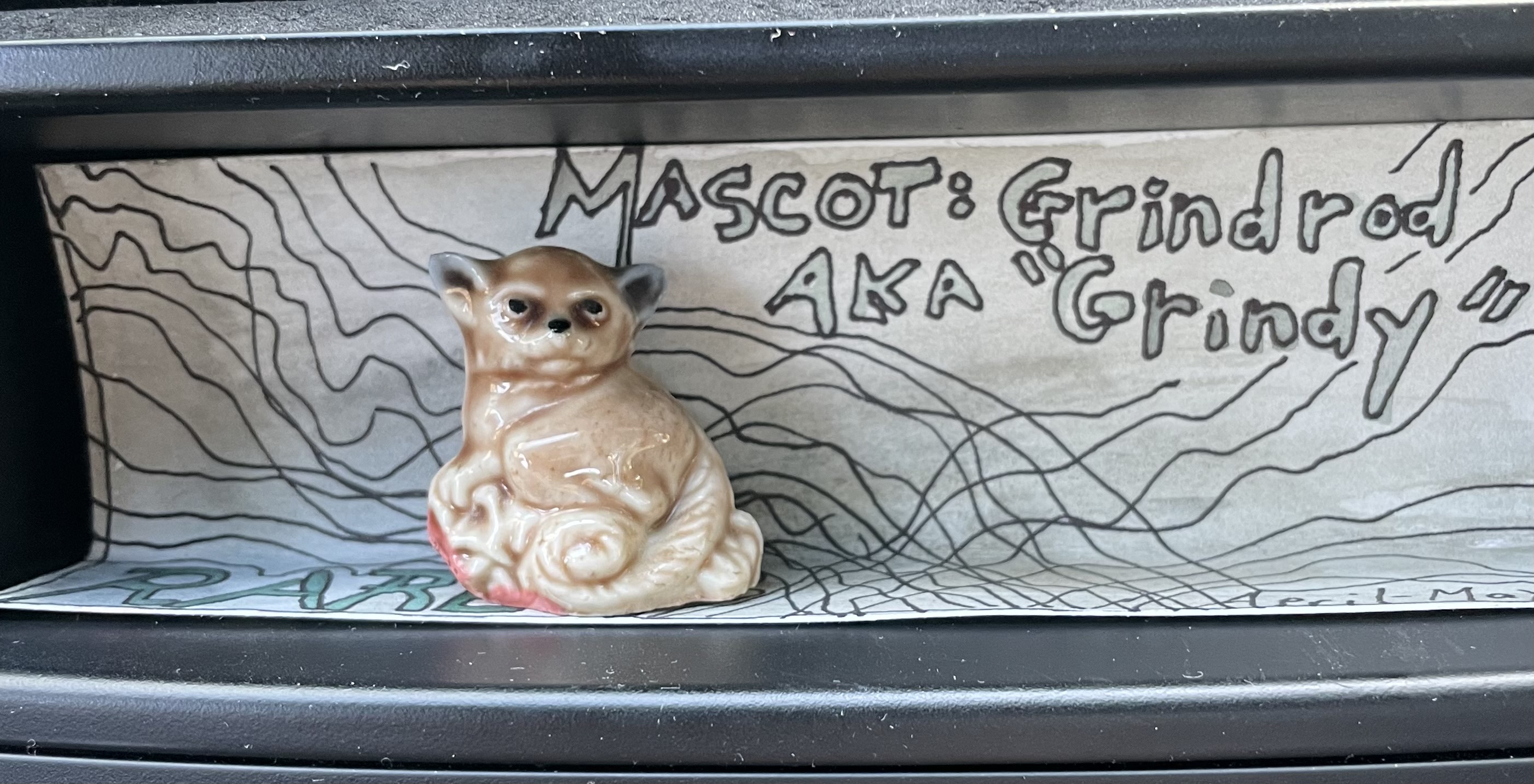
To align with our mood, we look for a suitable RARE mascot at a thrift store along the way. The first leg of RARE 7 took us to the Shuswap Lake area, so we stopped at the Salmon Arm Churches Thrift store and bought for $2 a ceramic lemur, one of those little Wade figurines that you used to find in boxes of Red Rose tea. Attracted to his sad expression, we named our little boy Grindrod after a farming town near to where we are staying in Sicamous, BC. “Grind”? Well, think daily grind, grist of living, the put-one-foot-in-front of the other aspects of life. And “rod”? Think resilience, the ramrod yet flexible backbone that holds us up. Short name, Grindy. On the road with Grindy.
There were some pink and frothy early RAREs. Lying on the pavement in downtown Seattle comes to mind, just so I could see the city sky and feel the sidewalk under me—acting kooky, acting playful. Trying to recreate that lightness is nostalgia for a protected, limited world. It’s insane.
On our second night in the lakeside cabin near Sicamous, we moved to the bunkbeds after a restless first night in the too-soft bed for adults. Nestled together in the lower bunk, a double, felt like being teenagers at summer camp. Except that, unlike teenagers, we lay back to back, reading. “There’s an old aunt in this book,” Michael says, “who believes that love isn’t a feeling, it’s a decision. What do you think?” We both do a half turn so we can see each other. “Yes, I agree. But maybe a feeling and a decision. What do you think?” He paused. “I’m not sure. I’ll have to think about it.”
Something is nudging my memory, and ten minutes later, I ask him if he’s reading Liane Moriarty’s The Last Anniversary. “Yes,” he says. “So am I!” I practically shout, overjoyed.
“I thought that thing about love being a decision sounded familiar. I’m almost finished the book.” “And I just started,” Michael said. Both of us had checked the e-book out of the library, without realizing the confluence. I love being married to a man who enjoys good-quality feel-good chick lit. We can compare notes on what the characters think and do. A truly RARE moment.
Michael
Perhaps it’s because I just had my 72nd birthday, or perhaps it’s emerging from the pandemic, but I’ve found myself wrestling with the realities of aging. Day to day life, even retired, feels full and heavily scheduled –this is why our road trip is such a welcome change of pace, and as Madeline says, it seems to kick in on the third day. I know that the RARE ethos is activating because a great deal of my usual mental activity is revealed to me as nonsense and begins to drop away.
Day three: let’s go hiking! We look up Sicamous Creek trails, and with a little help from GPS and the Sicamous Visitor Centre, find the trail head. The choices on the map we look at are Easier, Difficult, and More Difficult, and they are accompanied by GPS coordinates. The only trail available from where we are is not the easy one, but we bravely head off.
It’s so beautiful hiking the short distance to the waterfall— ice cold air, water music, and forest fragrance. I love it but find myself wishing the trail wasn’t so narrow, precarious, and steep, and the stairs that make up part of it are giving Madeline pain in her knee. It’s a very short hike, and back at the trail head I realize that my ability to navigate steep trails and uncertain footholds is not what it was. Strangely, I feel totally ok with this. RARE magic is kicking in.
Back at the cottage I search for trails in Sicamous that are easy and find the River Front Nature Park. It’s relatively short, flat, and “family friendly”, so off we go, while I’m thinking “I guess I’m going to have to stick to the codger trails.” What we find is an absolutely magical world in rich browns and ochres, with the trees just budding and spattered with green.
We walk along and talk about expectations and perfectionism—the feeling that we need to make the perfect choice, find the perfect hike, the perfect dinner, the perfect accommodation—and how impossible and corrosive this is. We designed this trip to be spontaneous: unplanned, staying for two or three nights and then moving on to wherever we feel like. Seeking perfection ensures disappointment; curiosity and acceptance allow me to appreciate experiences just as they are. I feel lighthearted for the first time in months, and I realize how much time and energy I spend thinking about how things “should be.”
One of my favourite teachers is Yongey Mingyur Rinpoche. He says “Like waves in the ocean, all things are impermanent. I will accept whatever happens and make it my friend.” I have been writing this in my gratitude journal each day for months, but on this RARE I feel like I am finally getting it. I am aging. I have back pains, hearing aids, and my memory isn’t what it was. I am afraid of falling, and I sometimes wake up in the middle of the night worrying about death. I also walk 9000 steps a day and ride my e-bike for 25 kilometers. I am kinder and more contemplative with each passing day, and I am learning to love myself just as I am. Like the landscape flying by our car windows, my thoughts and emotions are fleeting. Nothing hangs around for long, which is deeply comforting. Here is the teaching of RARE 7—when I stop fighting impermanence, it becomes my friend.
I’ve devoured most of Anne Tyler’s novels in the last two years. It was one of those felicitous discoveries—a wonderful, prolific novelist I hadn’t read yet. Yes, I’d heard the title The Accidental Tourist, but it wasn’t until I found Breathing Lessons in a little free library on Brunswick Avenue, Toronto, a couple of summers ago, that I became engaged, in love with her characters, the messy lives, flawed people and relationships, random and serendipitous comings-together, the tenderness, the realness, the love. I was hooked. I read all of the novels available from the library and bought a couple that weren’t, and then, just a few weeks ago, I found Ladder of Years in a box of free books across the street. What a find! Read this:
“When my first wife was dying, . . . I used to sit by her bed and I thought, This is her true face. It was all hollowed and sharpened. In her youth she’d been very pretty, but now I saw that her younger face had been just a kind of rough draft. Old age was the completed form, the final, finished version she’d been aiming at from the start. The real thing at last! I thought, and I can’t tell you how that notion colored things for me from then on. Attractive young people saw on the street looked so. . . temporary. I asked myself why they bothered dolling up. Didn’t they understand where they were headed? But nobody ever does, it seems.”
From Ladder of Years by Anne Tyler
I was disarmed by that paragraph. My perspective about my aging face swiveled to a fresh view: the temporary beauty of my youth was just a rough draft. This idea appeals to me not just because it helps me consider my face as closing in on the finished version, the real thing. It’s also because I work with writers, and I see lots of rough drafts, and I found the metaphor very appealing. Not only are our lives works-in-progress—our faces are also works-in-progress. The changes I see in mine are not to be read as signs of deterioration; they are signs of me becoming more me.
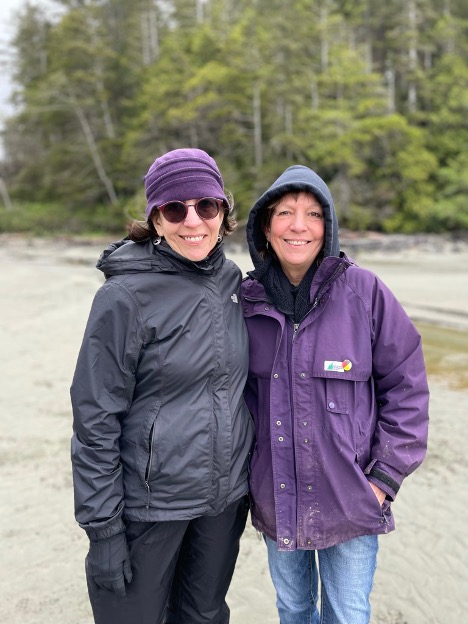
Photo credit: Judith Walker
I am also reading Stranger in a Strange Land, by Robert Heinlein. Years ago, when Michael first used the verb “grok,” I asked him what it meant, and he told me about Heinlein’s science fiction classic. I’m finally reading it, discovering a new world, new words: grok (to fully understand, become one with), discorporate (to die), and water brother (someone you shared a drink of water with, which binds you together).
Valentine Michael Smith (the Martian in the novel) would have loved Vancouver Island Musicfest, teeming with water brothers. We were there last week-end, and still, I am digesting the banquet that it was. On Saturday morning, we found seats in the barn, one of the small stage venues. The place smelled of horses, and the was air thick with hay particles. On the stage, the musicians settled with their instruments—soundchecks, noodling. This was our first time hearing live music for a while—and I sat upright with anticipation. The workshop was well-titled “Great Guitars,” and soon I was swept into the greatness of a bunch of highly skilled and talented guitarists playing, singing, and sometimes jamming.
Photo credit: Michael Carpenter
Meredith Axelrod, who blushed beet red when she got a name wrong, sang an old Carter Family song called “Hello Stranger”: “Hello, stranger, put your loving hand in mine/ Hello, stranger, put your loving hand in mine/ You are a stranger and you’re a pal of mine.” Her charming manner and amber voice were a tonic to start the show. Her second song featured the line, “I’m gon’ wash my face in the Gulf of Mexico.” She rose, raised her jean-clad leg, and set one foot on her chair, cradling her glowing Wyatt Wilkie guitar. I liked her old-timey manner and voice. I imagined her scooping salt-warm water from the Gulf and splashing it over her face between blonde wings of hair.
I liked everyone on the stage. Jeff Plankenhorn, wearing his special “Plank” cross between a lap steel guitar and an electric guitar, sang that even a blind man can tell if he’s walking in the sun. Jack Semple was there, showing off with his masterful classical gas. Dave Kelly reminded me of Clapton with his British accent and easy elegance. He played a Son House blues tune as a pigeon flew up into the rafters. Then there were the old guys at the back of the stage who—not needing to be seen or noticed—had tucked their egos into the back pockets of their jeans. They picked away, nodding and tapping, studying their instruments, heads down. Music has its own rewards.
The star of the show was Melody Angel, guitarist and singer from the south side of Chicago. When she sang “Hey Joe,” Michael leaned over and said, “I think she’s channelling Jimi.” Her muscular voice growled up over the crowd, and we pulsed along with her guitar. She pushed notes up the ladder of sound, climbing, climbing, raising our energy. Michael’s lit-up face was plastered with a beautiful smile, and he wiped a tear from his eye. My throat was thick with emotion as I looked around at the performers and the audience, all of us gathering to grok this powerful medium of music, the great connector, the universal love potion. As we clapped and clapped some more, I was filled with sound, in love with the world
In the summer of 2011, Michael and I bought tickets to the Edmonton Folk Festival. We knew we were taking a chance—we’d met only two months earlier, and to spend so much time together was a quick, risky test of our compatibility. We drove through the mountains, stopping at cheap hotels and laughing a lot.
On the way, I got schooled in the songs of Stephen Fearing, and then we listened to Captain Fantastic and the Brown Dirt Cowboy—the whole album—loud. I’d never really heard Elton John until that day. At the festival, we swooned over Matt Anderson and Taj Mahal and got closer and closer to each other. Our love was just a rough draft then, and the music we shared on the way to Edmonton and at the festival was like the first version you write—filled with exploration. The discovery draft, we call it at the Writing Centre. More than a decade passed. And last week-end, at another music festival, we added some nice touches to the current draft. We shared music, and that’s like co-writing a paragraph. We move slowly, inexorably toward the final, finished version, becoming more ourselves each day.
I often despair of my monkey mind, the jumble of thoughts that keep me from noticing what’s present. At the same time, I appreciate my tangential mind. I love following its pathways through shadowy tunnels of white-flowering hawthorns. I seem to always turn a corner to find myself in an unexpected field of light.
Today as I ate breakfast sitting at the kitchen table, I started to examine the ceramic trivet my father gave me years ago after a trip to Granada. The trivet is decorated with an Arabic design: a mandala in teal, navy, red, and cream. I love the waving flower petals that seem to be in motion, dancing in the wind. The Arabian design on the Spanish trivet took my mind to the poem I’d just been reading by St. Teresa of Avila (1515-1582), a mystic living in Spain after 700 years of Arab culture. St. Teresa was intimate with her God; you can feel it in her language. I re-read the lines,
A woman’s body, like the earth, has seasons;
when the mountain stream flows,
when the holy thaws,
when I am most fragile and in need,
it was then, it seems,
God came
closest.
God, like a medic on a field, is tending our souls
And then, a few lines down,
Why this great war between the countries—the countries—inside of us?
From “When the holy thaws” by St. Teresa of avila
My counsellor tells me that I aggress against myself—a pattern in my life. An ongoing war rages between the countries inside of me. I like to think of God as a medic tending to my wounds, lifting me off the battlefield, holding me close, bringing my countries to peace. I remembered the stage six mandala I drew recently, with a little girl and a dragon (my warring countries). I wrote tenderly to myself, “lay down your sword, little one.” Perhaps the holy is thawing.
I’d snagged that wonderful book, Love Poems from God: Twelve Sacred Voices from the East and West, from a cardboard box of free stuff. I love our neighbourhood. There is a little clearing across the street near the mail box where all of us take things we don’t want anymore. Neighbours and visitors from other parts of town come to adopt old things and bring them to their new homes—a brilliant system!
This book caught my eye. What a great find. But boxes of free stuff and friendly dogs are not all that’s on offer here. The neighbourhood has other delights. Yesterday, I started work early in my home office in the basement, checking copy edits for a book. At 10, I took a break from the highly focused work. Michael, Marvin, and I walked down to the Gorge where a pop-up concert was in full swing. A local musician, Danielle Lebeau-Peterson, was playing her guitar and singing under a white tent. Danielle is the daughter of my eldest son’s first music teachers—Connie and Niels, and I marvelled at the “small world” (we’re all connected) feel of Victoria. Her mouth is like her mother’s.
The clouds in the sky threatened rain, but so far it was dry, and children and their parents gathered around Danielle as she sang and played, smiled and bantered. She knew songs from Disney movies, which delighted the younger crowd. The Tillicum-Gorge Association folks had set up a table with a big urn of Tim Horton’s coffee, cartons of donuts, and boxes of Timbits. There was a clipboard with paper and the question, “What do you love about our neighbourhood?” The cheerful woman behind the table filled my cup with coffee, and I took up the pen and wrote, “Everything.”
We sat on the grass listening, and when Danielle asked for requests, I called out “Blackbird,” that gem of a song written by Paul McCartney. It was one of my father’s favourites, and she played and sang it perfectly—her clear ringing voice floating up and over the Gorge: “You were only waiting for this moment to be free.” I smiled while my tears fell on the grass, and Marvin tugged at his leash, tried to smell the woman sitting next to us. This is the first Father’s Day I’ve lived without a father. But he was there in the high, truthful notes of the song. He is still with us.
And now, I am still sitting here with the book of poems on one side of me and the trivet on the other, back from that pleasurable sojourn, ready to fill the hummingbird feeder with sugar water and play with the dog. I love my mind and my heart. I love the rich stuff of daily life that produces all of these memories, feelings, and thoughts. The tangents take me unexpected places, but they always lead me back home to love and beauty.
“The American experience, the focus on individual achievement, the acquisition of goods and money to prove one’s social value, is built on this sense of loss, this alienation from the warmth of the home culture, isolation from genetic bonds. This separation from one’s tribe creates an inner loneliness that increases as one ages.”
Annie Proulx, “A Yard of Cloth” (p. 20) from Bird Cloud.
I read this passage last night, and I had to get out of bed to copy those sentences. They struck a chord in me. I too feel that “inner loneliness that increases as one ages.” My mother, who died on February 14, 2019, distanced herself from her family as a teenager. When she coloured her hair blonde, her father was furious. Either he told her to leave, or she left voluntarily to flee the strictness of their farm in Lodi, California, I’m not sure which. She ended up in Los Angeles, working the switchboard at Kaiser Hospital. She would later meet an older woman, Phyllis, who became a kind of mother to her, paying for her therapy. My mother would go on to complete a BA and MA at University of California, Berkeley.
Not only did my mother reject her parents, she spurned most of her seven siblings as well. However, she had a special bond with Fran, a gentle older sister who worked as a nurse. My mother claimed Fran saved her life by preventing their parents from treating my mother’s Bell’s Palsy with some kind of horse medicine. Most of these stories are so garbled in my memory. They seem half-fantasy and half-truth. I’m sure I have most of the stories slightly wrong.
But the feeling is real—of striking out, fleeing family, rejecting those who engendered you, separating from tribe. That was an element in my mother: brutal independence. I don’t need you. I depend on nobody but myself. I remember the last time I visited her in Toronto, her brother, an Evangelical preacher living somewhere in the States, called her, and I picked up the phone. Apparently, he called regularly, wanting to reconnect, and she always hung up on him. When I tried to hand the phone to her, she wouldn’t take the call. I was shocked. You won’t talk to your brother? He’ll just proselytize, she said.
My parents migrated from California to Toronto in 1965, another “alienation from the warmth of the home culture” that Proulx writes about. My mother left her adopted mother, Phyllis, which must have been heartbreaking for her, and my father left his mother. We three daughters were already used to being without a large tribe—we didn’t know most of our cousins or aunts and uncles. We were a nuclear family with no extended family to fall back on. I look back on how we grew up without the cushion of uncles, aunts, cousins, grandparents and how hard it is to survive that way. But we didn’t know anything different.
Then, repeating the pattern of migration and loss, my first husband and I left our home in Toronto with our first child. We left our parents and siblings—it felt exciting and freeing. We started a new life in Victoria in 1988. My kids grew up without getting to really know their Ontario grandparents.
I am thinking of my mother this weekend. It will be three years since she died. She was fierce and proud and insisted on individual achievement as the sine qua non. In her actions, she was a feminist. In elementary school, we were sent home for lunch every day for a 90 minute break, which necessitated mothers stay home to serve their kids lunch. She fought to get the school to allow us to stay there to eat a packed lunch so she could go out and work. Later, she pressed back when the bank wanted her ex-husband’s signature to get a mortgage. But she wouldn’t be called a feminist because she didn’t want to be seen as part of group of women who supported and uplifted each other, challenging the system together. All of her achievements in life, she thought, were due to her own hard work and merit plus a little help from individual friends. And it’s interesting how I’ve inherited some of this thinking, especially an unwillingness to ask for help.
My mother and her father
As humans, we work so hard to connect. It is our default—we need each other. I treasure my sisters now, and I create my own chosen family in my friends. However, that profound sense of loss lingers at the edges of life. It’s the legacy of leaving family behind and striking out on one’s one.
Swords
Swords are weapons of destruction and tools of discernment.
Swords are on my mind.
About a year ago, I created a website for my new editing business and wanted a brand identity. The Queen of swords from tarot seemed a perfect symbol for a female editor—the independent, unbiased woman, a seeker of truth, with clear boundaries and a direct style of communication. She sees problems and figures out how to solve them; she knows where to cut the extraneous to reveal the truth. Queens are about heart and swords are about mind—so she brings heart and mind into harmony.
I didn’t use a Queen of swords image from a tarot deck due to copyright laws. Instead, I planned to use an excerpt from a painting in the public domain, John Gilbert’s (1817-1897) Joan of Arc. I sent a mock-up of the website, including a sword image, to a few friends for their opinions. One of them noted that the image of Joan of Arc’s armour and sword was martial and scary and didn’t really reflect who I am. I agreed. I decided to let go of the sword as a metaphor for editing because of its primary associations with violence.
And yet, swords keep coming up. On December 31, 2021, Michael and I each drew a tarot card to guide us during 2022. He drew two of swords; I drew Queen of swords. Evidently, the sword has much to teach both of us this year, so I am listening. As Michael has been studying the tarot for several years now, I asked him about swords. His words are a synthesis of all he has read and studied from various sources (but his main influences are Mary Greer, Rachel Pollock, and Anthony Louis).
“The suit of swords is aligned with the element of air, which is the suit of mental processes and thoughts. Swords are aligned with thinking, intellect, reason, yang energy, severing unhealthy connections, and the courage of the warrior. They’re about logos, problem solving, things we have to work through before we can find serenity.
Swords are aligned with prajna, deciding what to accept and what to reject or cut; it’s the suit of discernment and decisiveness. Also, because swords are about mental things, they can also be about willful blindness, about illusion. Swords is where we discover the obscurations of mind that trap us.
Two of swords shows a woman blindfolded, and the eight shows a blindfolded, bound woman surrounded by swords. However, these are mental obscurations – imagined entrapments rather than actual physical imprisonment. The four of swords has a person lying on their back with three swords above – this is contemplation. Swords is about how you use your mind. Some sword cards are about meditation: training, calming, and taming the mind.
Swords are not just about cutting, but they’re also about piercing – which is penetrating insight.”
I asked Michael about his tattoo of the three of swords. “Well, threes are energy, vitality, motion – they arise from loss or partnership or conflict. Three of swords is heartbreak, alienation, and sorrow—mental alienation and loss. The three of swords invites us to find the sweetness and wisdom beneath our sorrow –that’s my take on it. Go underneath the sorrow – penetrate and pierce it.”
Cutting and piercing are the work of the sword. And underneath the pain is sweetness.
Recently, a client asked me to cut 40% from several of her book chapters—truly an exercise in figuring out what’s most important. Same thing in life. Look at what you most value and treasure it. Let go of what you no longer value.
As the Queen of swords accompanies me throughout this year, I would like to continue to examine the mental obscurations that trap me and prevent me from experiencing serenity. For example, much anxiety arises from worrying about the future, but I know there is no future. There is only today.
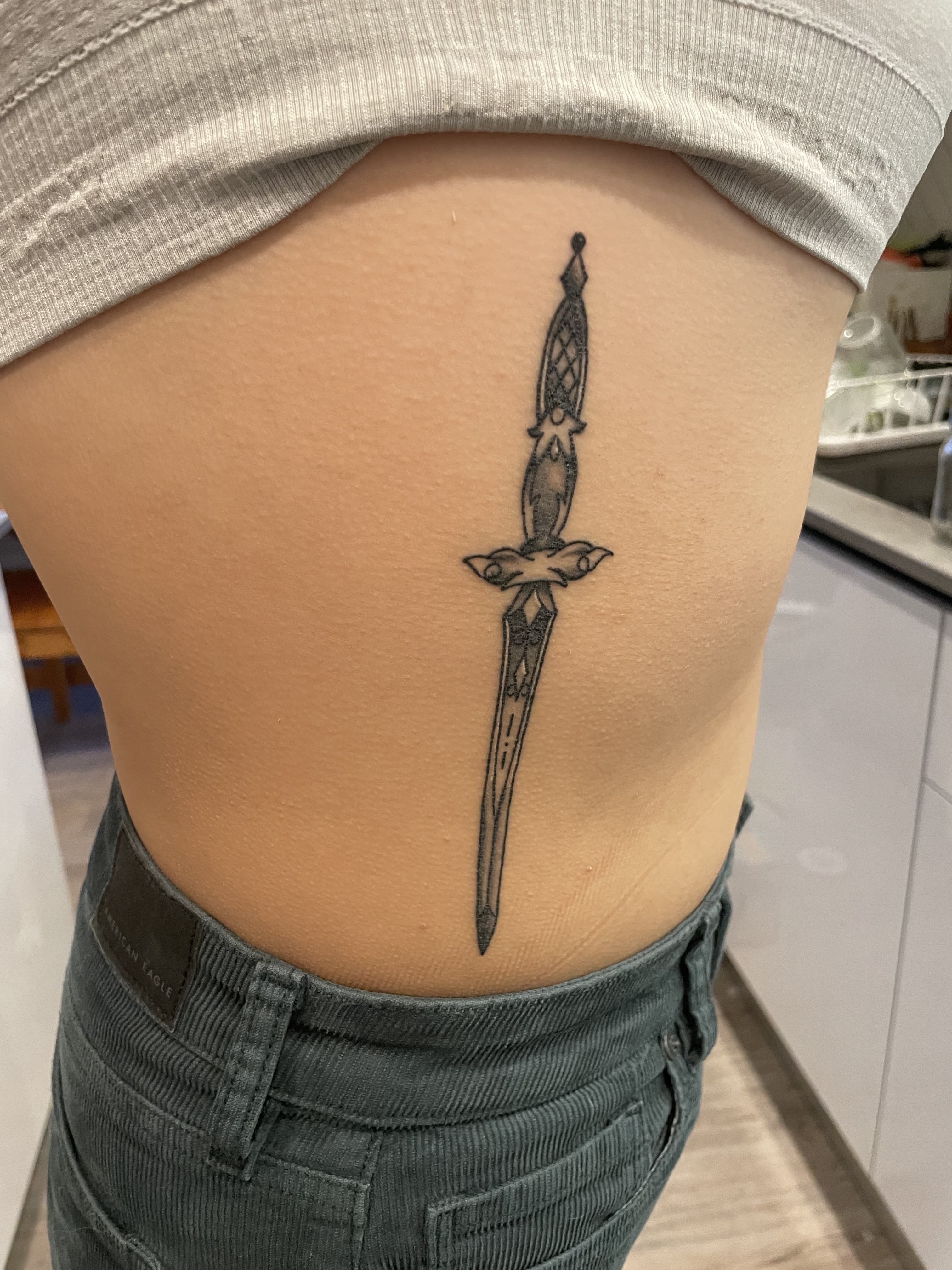
Michael’s tattooJoan of ArcN. ChurchillMy niece Sarah’s tattoo
Sometimes I get a couple of hours, sometimes a whole morning when luminous joy bubbles into life, oxygenating a flat week. Savour the perfection—then *pop* it’s gone. Lately, when I experience these rapturous periods, I am intensely aware of time fleeting, of the unreliability of “happiness,” of my inability to “keep” the moments, of my impotence in the face of life.
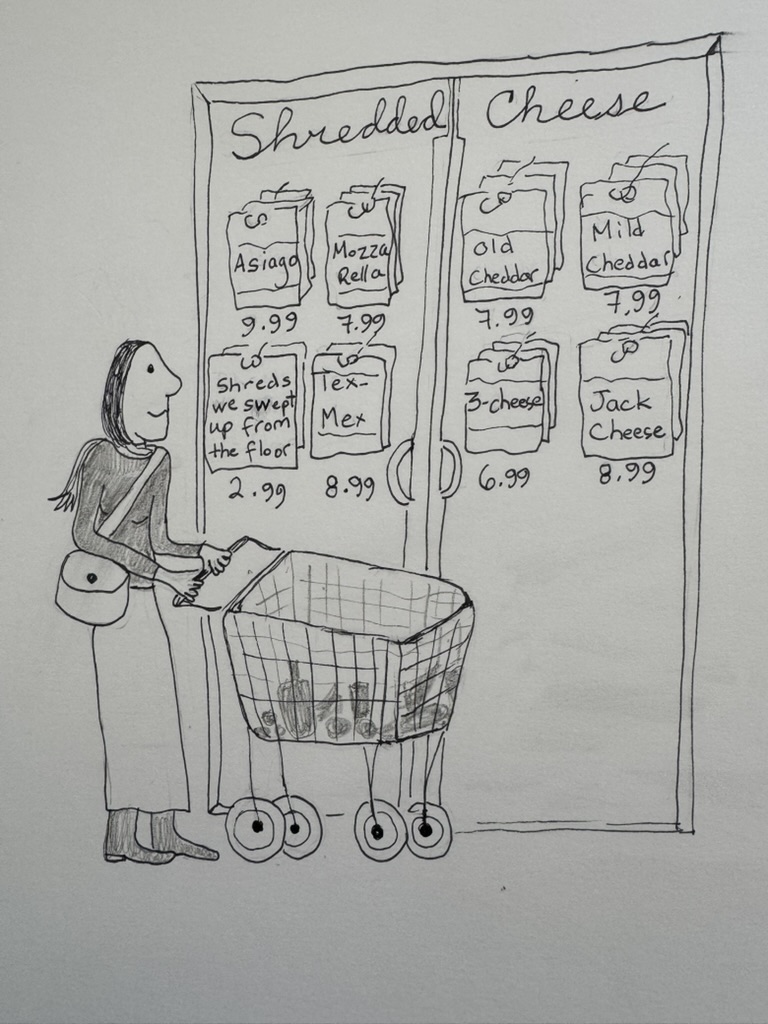
September 28 is a good day for birthdays. Two of my friends and our puppy were born on that day. Leading up to Tuesday, I was thinking about cake, how I love making, giving, and eating cake for birthdays and other occasions. But there is always the problem of excess. Do other cake bakers and eaters have the same problem? If there’s a big (9-inch) cake in the house—do you eat a slice every day for a week and gain five pounds? Or do you obsess over it, polishing it off in two or three days and feel sick? Or does it go into the compost because you can’t eat it all? Whichever scenario fits, the solution is the same: bake a small cake. Because small is practical and beautiful.
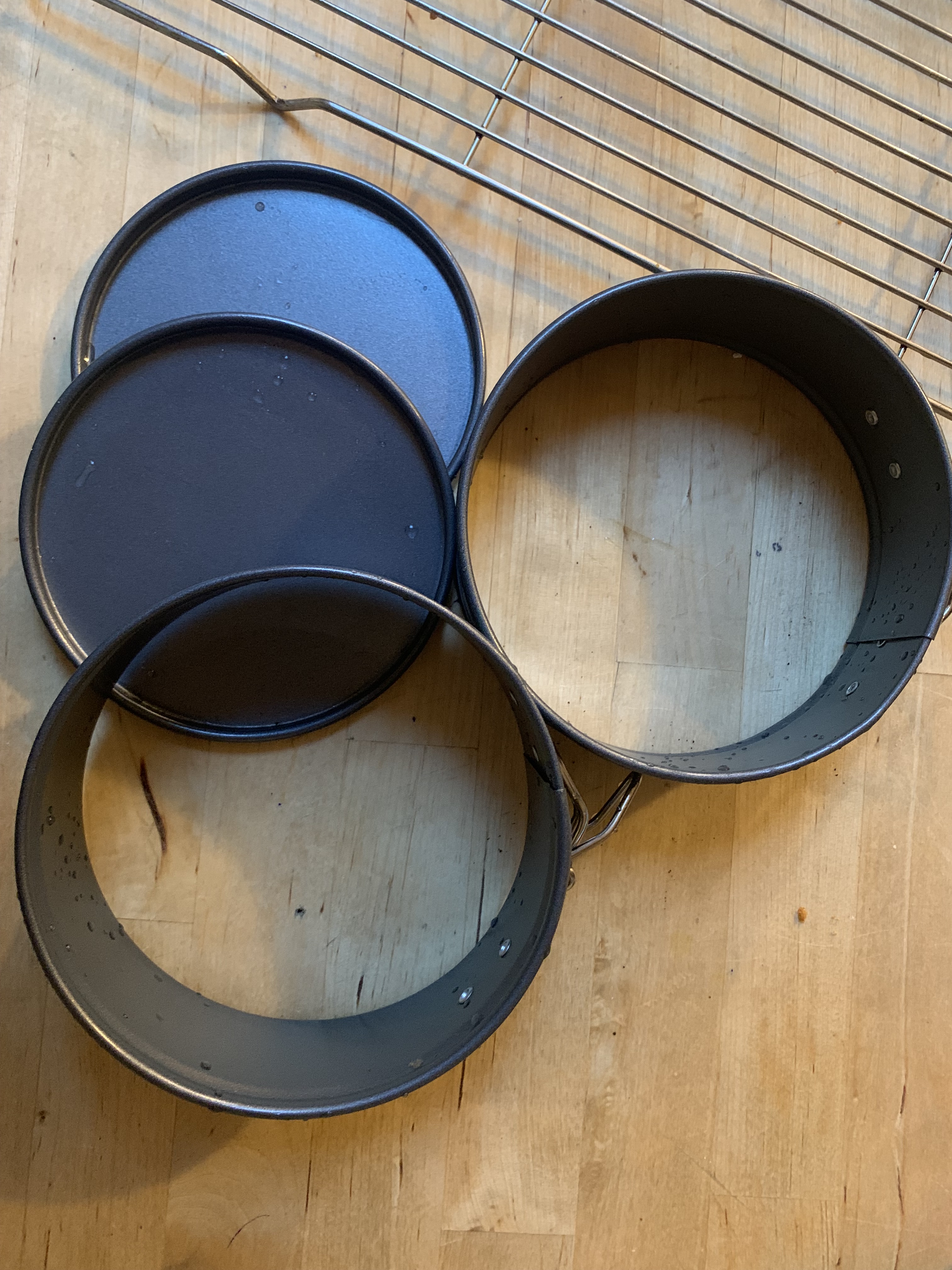
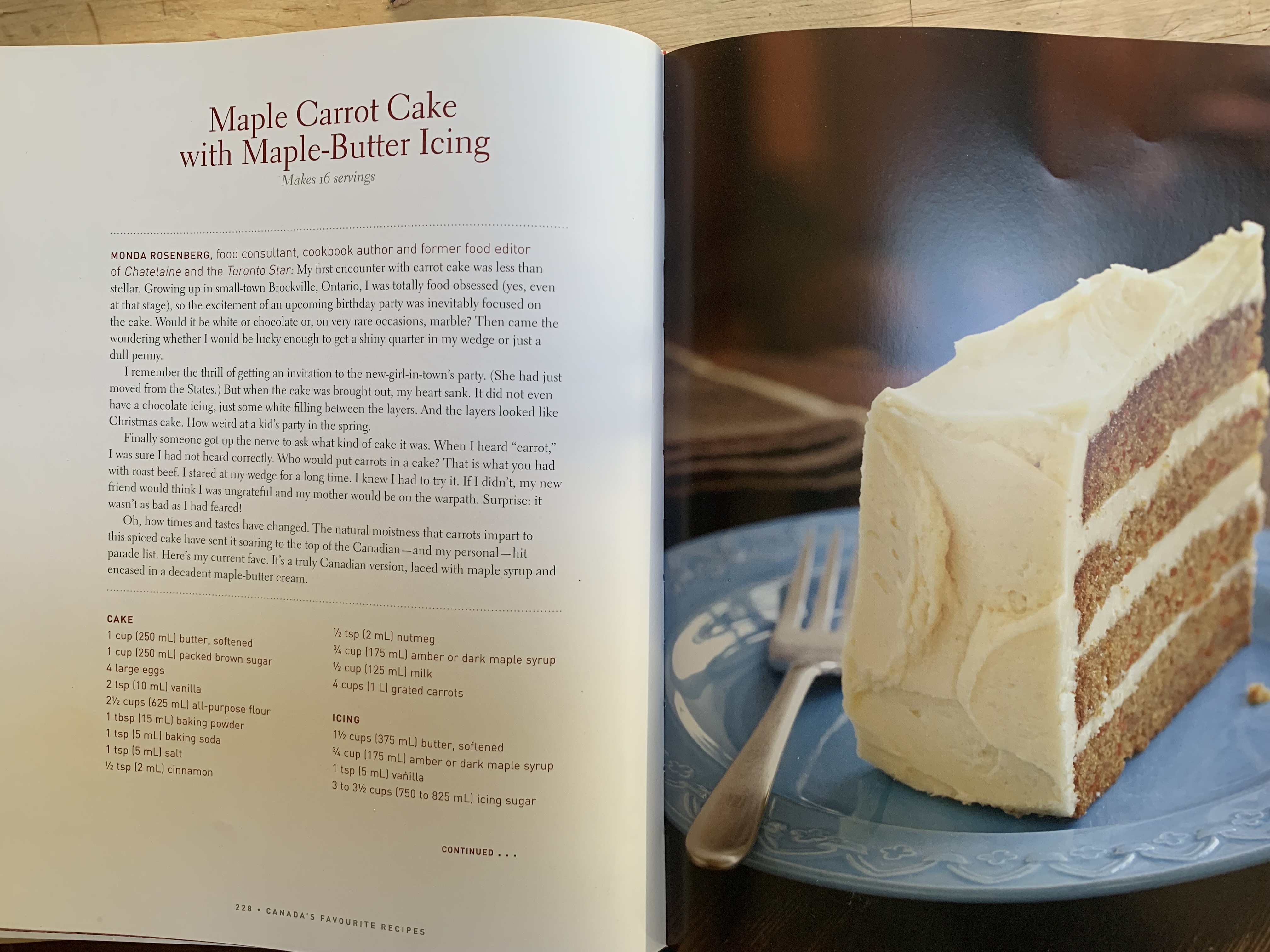
One day a couple of weeks ago, Michael and I headed to a kitchenware store, and I bought two sturdy 4.5-inch springform pans. I found a good recipe for carrot cake in Canada’s Favourite Recipes by Murray & Baird and halved the recipe. I wasn’t sure what it would yield; it turned out the batter filled the two small cake pans and three cupcake liners.
I sliced the two cakes horizontally to fill them, then frosted both cakes and cupcakes with maple butter frosting. I put the better-looking cake and the cupcakes aside for my friends, and Michael and I “tested” the other cake, eating one slice each for three nights. I know, I should have given both cakes as gifts, but I had to test cake production. Six tiny, perfect slices of carrot cake, sweet and moist. Who needs more than a few bites of something delicious?
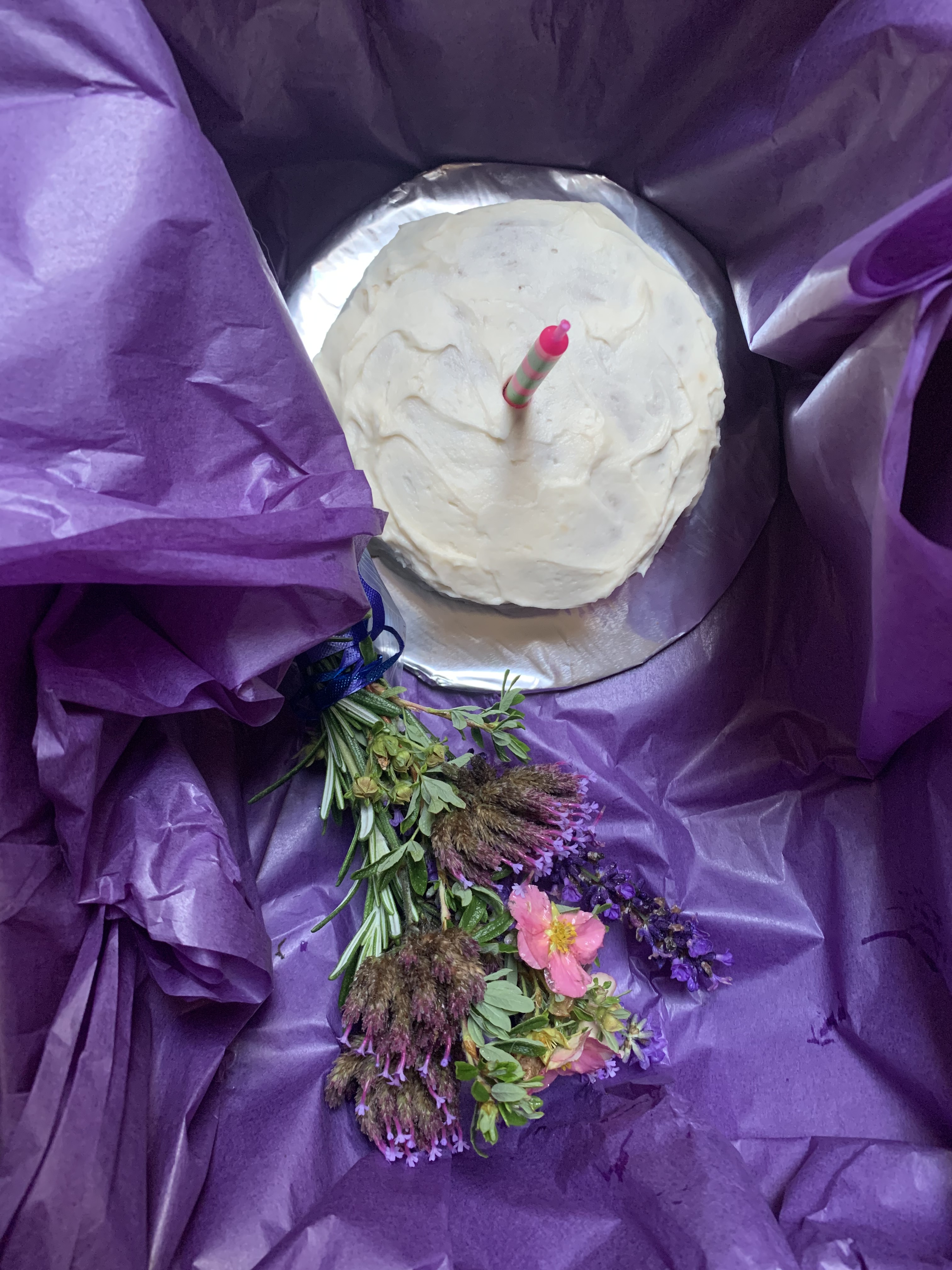
Then I assembled the birthday packages. I save good boxes, so I had two shoe boxes at hand made of strong cardboard. I lined each with purple tissue paper, then went out to the garden to pick posies. Fragrant thyme, rosemary, and lavender mixed with pink, red, and purple blooms, tied with a ribbon. I put the cupcakes in a plastic container and the cake on a round of cardboard cut from an old box and covered with foil. Cakes nestled in their boxes, I added the bouquets, a small box of Eddy matches, a candle on the cake, and loose candles for the cupcakes. I closed the lids, then taped birthday cards on the box tops.
On Tuesday morning, we fussed over birthday puppy Marvin with a new toy and some treats. Then, enjoying one of the perks of self-employment, I took off for an hour. After placing the birthday boxes in the front seat of the car, I drove along Craigflower to Vic West, listening to NPR’s jazz and blues station, window open to the breeze. The splendid fall day sparkled. Coppery leaves fell slowly from the trees, and the clear, cool, blue sky made me feel lighthearted. I parked and walked box #1 up to my friend’s townhouse door and placed it there. Then Google maps told me my other friend lived only 150 meters away. I knew they shared a neighbourhood, but I had no idea they were so close.
So rather than drive, I walked the other box through a children’s playground to my friend’s house, feeling so happy I could burst. And yet, the day before I was swimming in sadness about every little thing. I placed box #2 on the doorstep and walked back to my car, humming a song, alive to the crackling beauty of early autumn, favourite season.
You can’t have your cake and eat it too. I’d been thinking about that proverb and how it didn’t make any sense. Turns out Ursula Le Guin agrees with me. In 2010, 81-year-old Le Guin (1929–2018) started a blog and wrote delightful posts for seven years. Houghton Mifflin Harcourt published the collected blogposts as No Time to Spare: Thinking About What Matters (2017), which I recently finished. Many of the posts are about her cat, Pard, good reading for cat lovers:
One thing that mattered to Le Guin was figuring out weird language puzzles, including the annoying cake proverb. Of course if you have a cake you’re going to eat it! Le Guin wonders in her post about the logic of this proverb, but then it dawns on her that the verb “to have” has several meanings—a less common one is “to keep.” The order of the proverb also seems awry, so, she revises it, reversing the order and using “keep” instead of “have.” And suddenly it makes sense:
You can’t eat your cake and keep it too. You can’t have it both ways—eating and keeping.
When I got thank-you texts and emails later in the day from my friends, one of them ended her message saying she hoped we could get together more often in the coming year. I had acknowledged in my card that we had hardly seen each other lately, what with the pandemic and both of us being introverts. Her final line was, “nothing is forever.” I paused. Of course.
I can’t count on that fickle flicker that moves me to make cakes, write, sew, create. It comes, it goes, I can’t keep it, I can’t summon it. The work wants to be made, and the work—not you—chooses when and how. As I head for 63, I am keenly aware of energy slowly flagging, of a narrowing in my interests and available time, of the limits to life. All the more reason to relish eating the cake when it appears on a plate in front of you. Don’t even try to keep it.
My dad, 1927-2021, looking over his land soon after they bought the farm.
We walked slowly Thursday morning because overnight, recycling boxes and bags heaped with cans, bottles, cardboard, and newspaper had appeared at the curb. Blue splashes up and down the street that Marvin had to investigate, and so our walk slowed to a shuffle. He snuffled like a pig rooting for truffles, straining at the leash to lick the pizza box, to reach the Friskies can with a smidgen of catfood left on the rim. The night before, during his last walk of the day, he’d let out a volley of piercing barks at a pile of recycling across the street. Perhaps to his eyes, in the dark, the mound of stuff piled high above the blue box was a threatening mammal.
Early September’s morning chill, high scudding clouds above, and a Northern Flicker playing hide and seek in a hawthorn tree, his red head popping in and out of sight. The street is quiet—just the distant thunder of the McKenzie interchange as a blur of cars crosses into town. I am grateful to work at home, no need to commute. Instead, I love these 7 a.m. walks. Something in a recycling box caught my eye. Neatly folded on top of a pile of newspapers was a section of Saturday’s Globe and Mail, folded to the crossword puzzle. Every clue solved; every box filled with a neatly penciled block letter. Perfection. Did my puzzle-solving compatriot struggle over it as much as I had?
I felt connected to that person—their careful block letters different from my scribbled slanty ones, but we both finished the thing. Did they do it quickly, or did they stretch out the experience into Sunday or even farther down the week, relishing it? Did they approach the task methodically or fill in random clues? Did they ask for help or go it alone? Dictionary or no dictionary? Google or purely old school?
Marvin ate half of my pencil.
Think of all of us across the nation who turn to the crossword first thing on Saturday. Sharp number 2 pencil. Or maybe a mechanical one. Do some confident people use pens? Fresh white eraser by Mars. Or a pink Dixon, perhaps? We sit in armchairs, on couches, sprawled on deck chairs, scrunched on buses and subways, drinking lattes in coffee shops. All of us, together in the challenge.
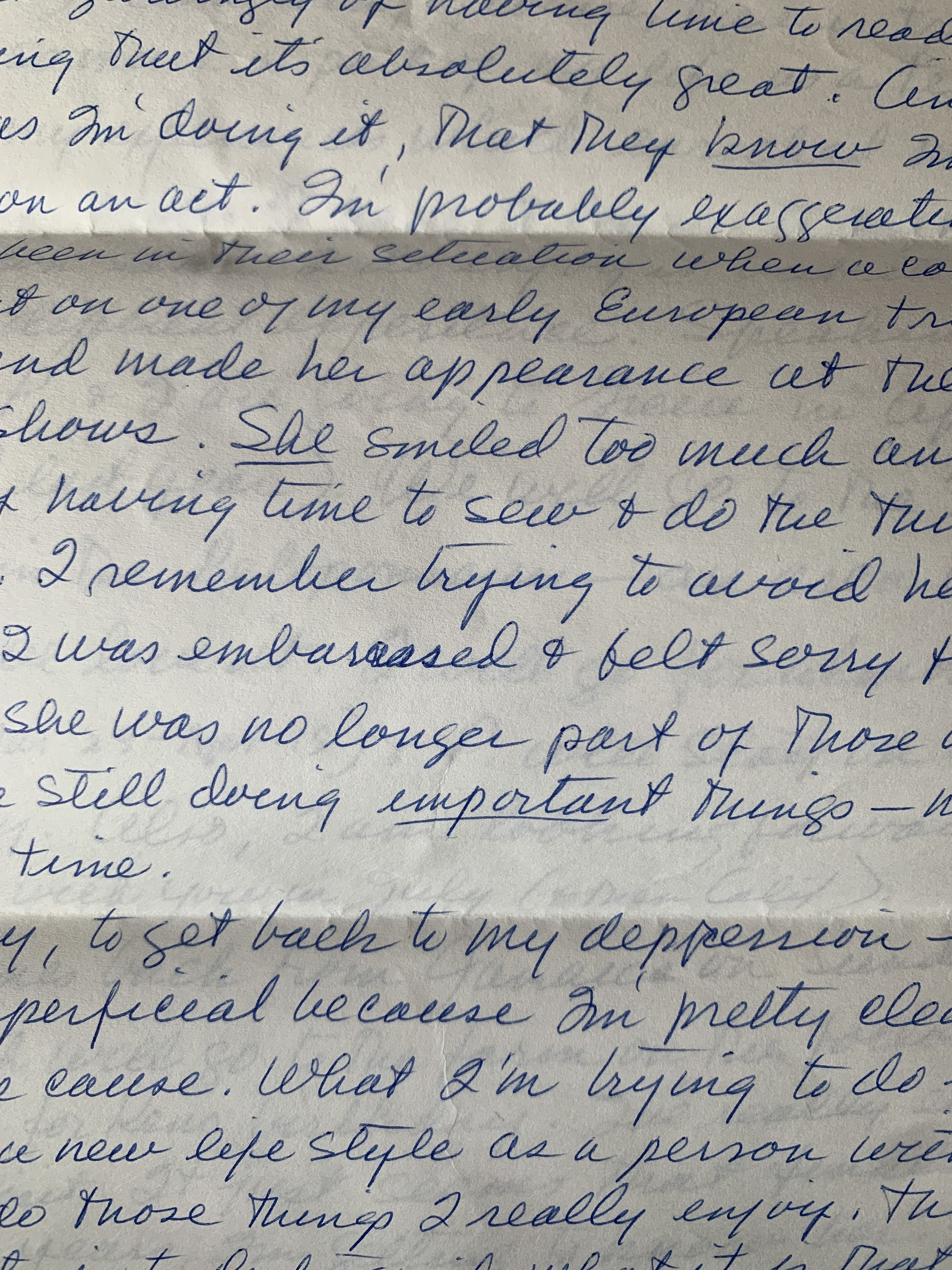
My mother did crosswords daily for the last 22 years of her life. They helped fill blocks of morning time after her mandatory retirement from her job as a lecturer in art history at Ryerson Polytechnic in Toronto. I found a letter from her dated February 1997. She had just received a package I’d sent intended to cheer her up:
“I didn’t realize my depression was so obvious. It isn’t a deep depression. It is simply that I no longer have an audience and no longer get paid for doing something I enjoy. The awful thing is that as soon as a person retires, he/she loses status. I notice it when I talk to people at Ryerson . . . They seem extra kind and sort of smile at me and ask me what I’m doing, etc. I smile back and try to talk glowingly of having time to read, etc. pretending that it’s absolutely great. And I know, as I’m doing it, that they know I’m putting on an act. . . So, I’m trying to develop a new lifestyle as a person with time to do those things I really enjoy. The difficulty is to distinguish what it is that I enjoy doing! Meanwhile, I do crossword puzzles, which is new for me and I’m getting pretty good at it (usually at breakfast), and it’s very nice to have the leisure not to have to rush.”
I started doing the Saturday crossword soon after my mother died in 2019. I thought they were too hard at first, and so I’d abandon them quickly. I have a healthy vocabulary, and I love language, but the crosswords seemed like something else. They’re filled with puns and tricks, and it seemed you had to be part of the in-crowd to get them: both hip to idiomatic English across the decades and savvy about current cultural trends. I’m just too literal, I thought, and what I know fills such a narrow groove. But then the challenge started to intrigue me. Now I look forward to the Saturday paper. After reading the headlines and the obituaries, I find the crossword, fold it into a nice rectangle, and begin.
All of this is a preface to say, I’ve had no will to write. Nothing seems worth writing about, these days. Life has a flat, fallow quality. Nothing’s important enough. Although there’s plenty of big bad news—pandemic, systemic racism, climate change—I don’t feel equipped to talk about any of it.
So, I push myself to finish this rather silly piece, a blog post about something as quotidian as the crossword puzzle. I stop and pause often to ask, “Why bother?” Why bother indeed. But it’s just that writing something, anything, seems as if it might be the antidote to the flat way I feel.
My thoughts return to my mother, sitting on the loveseat in her high-ceilinged living room, wrapped in a thick robe, blinds down, doing the crossword. Filling the hours. Her sleek black cat, Cicero, is curled up beside her. She is deep into it, puzzle dictionary next to her on the small rococo marble-topped table, Schubert’s Trout Quintet playing softly on the CD player. Missing the old nicotine rush, the sweet suck of smoke into her lungs, she holds the pencil like a cigarette for a moment. I miss her. In that old letter from ’97, she wrote,
“I’m probably exaggerating, but I have been in their situation [those Ryerson people who acted extra kind toward her] when a colleague retired and made her appearance at the annual fashion show. She smiled too much and talked of having time to sew and do the things she enjoyed. I remember trying to avoid her because I think I was embarrassed and felt sorry for her because she was no longer part of those of us who were still doing important things—not just passing time.”
Mama and me, back in the day.
Doing important things v. Just passing time. . . I flinch at my mother’s binary of “important” paid work and “just passing time.” But something in what she wrote resonates with me. I work part time as a self-employed editor, but lately, I often feel as if I’m just “passing time.”
Maybe this is just the flatness of grief. Flat-footed grief walks over me. After many losses, I am a fallow field—nothing growing here.
I have been reading memoirs about aging parents. . . Elizabeth Berg writes in hers, “I think as long as a parent is alive, it’s easier to feel young.” After my father died at the end of June, I’ve felt old, flat, fat, tired, sad. Nothing feels important. Especially not the weekly crossword. And yet, musing over the word problems gets my brain churning slowly, raking over clues like a pitchfork turning organic matter in the compost heap. I feel connected to crossword puzzlers across Canada. I imagine, for example, an old guy in Mahone Bay—let’s say he’s 82, goes by Ernest Nickerson and sits in the kitchen nook with morning coffee, chewing the end of the pencil as he tries to remember what a 10-sided shape is (79 across, 7 letters).
From our 2012 honeymoon in NYC
Remember geometry class in tenth grade? That’s where Ernest first noticed the girl who would be his wife, in geometry class at Mahone Bay School. As he digs deep for the name of a ten-sided shape, another thought is unearthed from that compost heap: Darlene’s thick red hair, held back with tortoiseshell barrettes. He couldn’t take his eyes off those red wings in front of him during class, couldn’t stop imagine pulling his fingers through that rough, dark crimson hair. He unclicks the delicate barrettes to let those wings loose to fly. If Darlene were alive now, Ernest thinks, she’d lean into my ear, her coarse grey hair tickling my nose, skinny shank up against mine, and whisper, “Decagon, Ernest. You knew that, honey.”
I write to get momentum, to feel connected to people, to create worlds. To feel connected to you, and Ernest, and Darlene. So, if you are a maker, a creative person, (we all are, each in our own way) remember: The work wants to be made, and it wants to be made by you. Even if it doesn’t seem important. Believe me, it’s important. It connects you to life. The fallow field regenerates.
Memoirs about aging and dying parents that I recommend:
Roz Chast, Can’t We Talk About Something More Pleasant?
Philip Roth, Patrimony: A True Story
Elizabeth Hay, All Things Consoled: A Daughter’s Memoir
Elizabeth Berg, I’ll Be Seeing You.
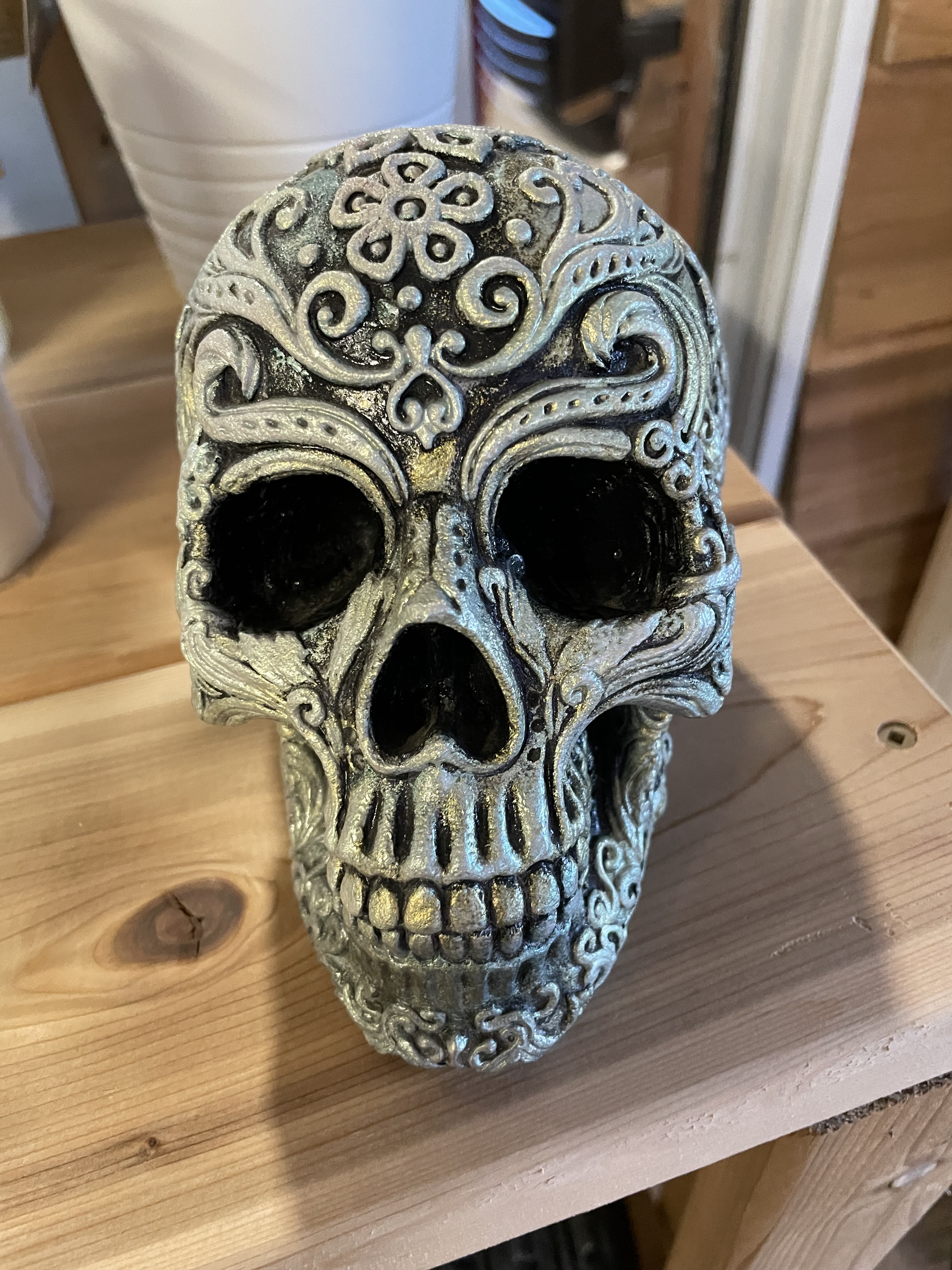
From a later trip to NYC, March 2019, after my mother died. Sugar skulls in a restaurant display.
In the last few weeks of my father’s life, my stepsister Sandra held the phone near his ear when one of us called. He lay in a bed set up in the living room, slipping in and out of consciousness. We’d given up on FaceTime; he could no longer see us. But perhaps he could hear my voice. You never know.
That day, perhaps two weeks before he died—I don’t remember—I felt desperate. I was frenzied in my wish to connect, to penetrate the veil, to make him hear me. But I had nothing to say other than I love you, you were a good father. He’d heard it all before.
So I sang. First, Summertime, from Porgy and Bess, my voice catching and scratching like an old record. Then, I pushed on with the next song that entered my head: Mac the Knife. I scrambled around the world wide web until I found the lyrics. Oh, the shark, babe, has such teeth, dear / And it shows them pearly white. Somehow, I thought he’d remember that song, but I don’t really know the melody beyond the first two lines. I faked it, trying too hard, straining, improvising, hoping. Hoping for what? For his sweet voice to say, “Madeline, that was wonderful”? Nothing.
So, then, a poem. I’ll read a poem. Robert Frost is a good safe bet.
I wanted to find Nothing Gold can Stay, a poem about impermanence. But my memory failed me. I couldn’t recall the title, so I accepted instead the first poem that popped up when I searched for Frost: Stopping by Woods on a Snowy Evening. I pressed on, putting as much feeling into my voice as I could, wishing I’d chosen a more dramatic poem, a poem I could really emote. Instead, just the simplicity of an Alex Colville painting. A man and his horse on the darkest evening of the year, stopping.
The woods are lovely, dark and deep, But I have promises to keep, And miles to go before I sleep, And miles to go before I sleep.
When I finished the last lines, my stepsister’s voice entered. She’d been there all along, holding the phone. She said kindly that she could listen to me all day, my voice was lovely. But Dad was asleep; he’d been asleep the whole time. She thought perhaps he could still hear me. Did he move an eyebrow?
But really, I know she didn’t have the heart to interrupt me. We said good-bye. A week later, I used the voice memo app on my iPhone to record myself singing “Blackbird” by the Beatles, Dad’s favourite song, and I texted it to Sandra, with a note, can I talk to Dad on Wednesday? But Tuesday was his last day here.
A frantic energy inhabited me during those final one-sided calls. Helpless, I worked overtime to get through, to make a mark. Hey you, this is your daughter. Papa! You there? Remember me? Your youngest daughter? Remember how you and I used to joke about you being King Lear, and I was your Cordelia? Sir, do you know me? Surely you do. Just give me a sign.
Father

In this wine-dark place
a tiny voice
a whisper:
hush, little baby, don’t you cry

From long ago
from far away
a thread
of red travels along
my bloodline

when that shark bites with his teeth,
babe
scarlet billows start to spread

and meets a tributary.
I know your voice.
You are mine.

I want you close
daughter,
but this trip
is made alone.

The woods in here
are dark and deep

I want to sleep,
dear, but
a worry burns:

Tell me, do I have
promises still to keep?

No, I hear you say,
no more promises to keep.

Spread your wings,
I hear you whisper

Take to the sky papa,
Take to the
red-blood sky.

































 Madeline Ruth Walker