“When we run from our suffering we are actually running toward it.” Ajahn Chah
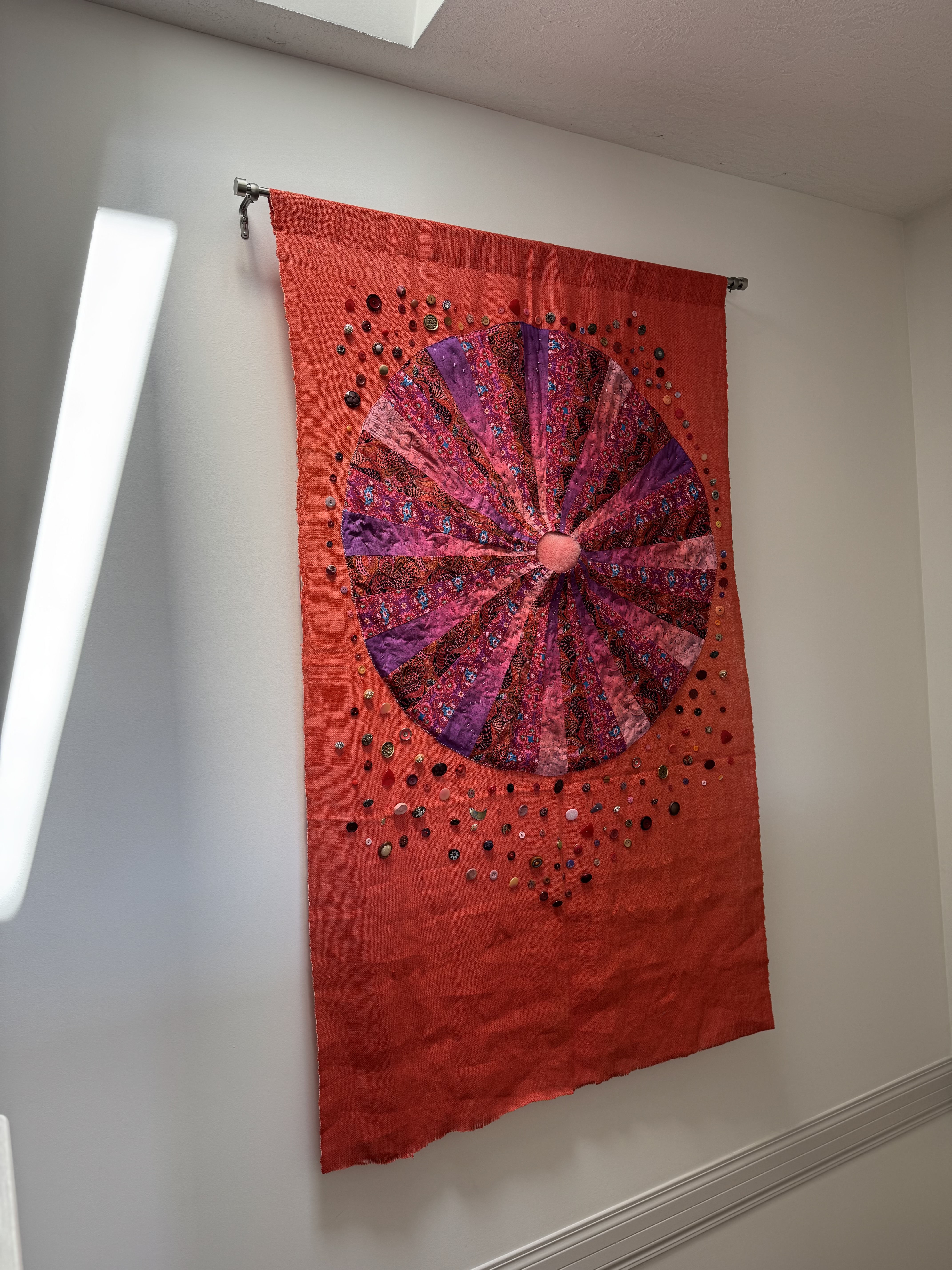
I’ve been basking in two messages from my unconscious this week. In one dream, a person wearing a bright tie-dyed shirt holds a hand lettered sign, “You are not alone.” In another dream, a young man, bearded, hugs me and whispers in my ear, “Thank you for your patience.” The messages are hackneyed, and yet they were delivered to me fresh, warm, colourful,by stately messengers. It doesn’t matter if they—the messages and the messengers—aren’t “real”; they are just as real as the people and events, the words, ideas, and things I encounter in my dream-like conscious life. And more to the point: They provide great comfort, having bathed me all week in an orange glow, a glow like that emanating from the 10,000 joys wall hanging, now installed in our stairwell.
The wall hanging seems to collect the sunlight falling in through the skylight and send back a peachy radiance. Several times now I’ve gone to flick the hall light off, thinking the switch is on when it shouldn’t be. No, the light is off, but 10,000 joys shed their own uncanny light.
When I made the piece, I kept telling myself, you don’t have to make its counterpart, 10,000 sorrows. It’s okay to just focus on joy right now. But of course, you cannot have 10,000 joys without 10,000 sorrows. I wish we taught this truth to children in kindergarten. You don’t experience joy without experiencing sorrow. And it’s okay. When you cling to joy and try to avoid sorrow, you just prolong it. I wish I’d gone to a Buddhist kindergarten, where these truths would be taught elegantly and logically, instead of being told by adults that “life isn’t fair,” which seems tawdry and cruel in comparison to the dharma.
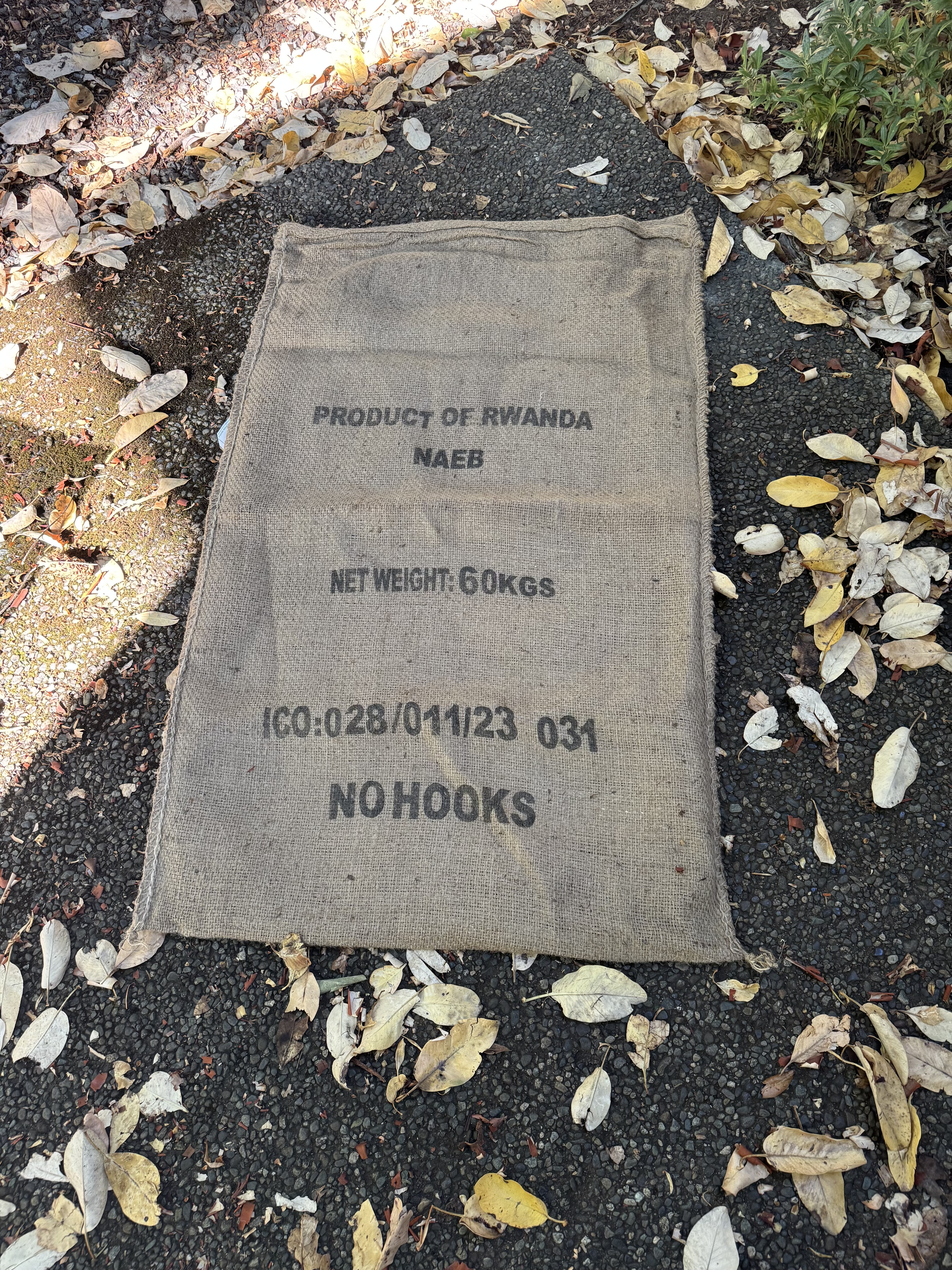
Inevitably, I am called upon to make joy’s counterpart. I had coffee with a friend yesterday at Esquimalt Roasting Company. As I waited at the counter for our lattés, I noticed a large burlap bag draped over a plastic bucket. I picked it up and showed it to the barista. Can I buy this? I asked. In my imagination, I was already picking its seams and spreading it out, a wide brown canvas for thousands of sorrows. It’s free! she responded. So now I have the backdrop for the wall hanging. I had originally thought it should be black, but brown is less dramatic than black, more subdued and complex, as sorrows often are, especially as we digest them.
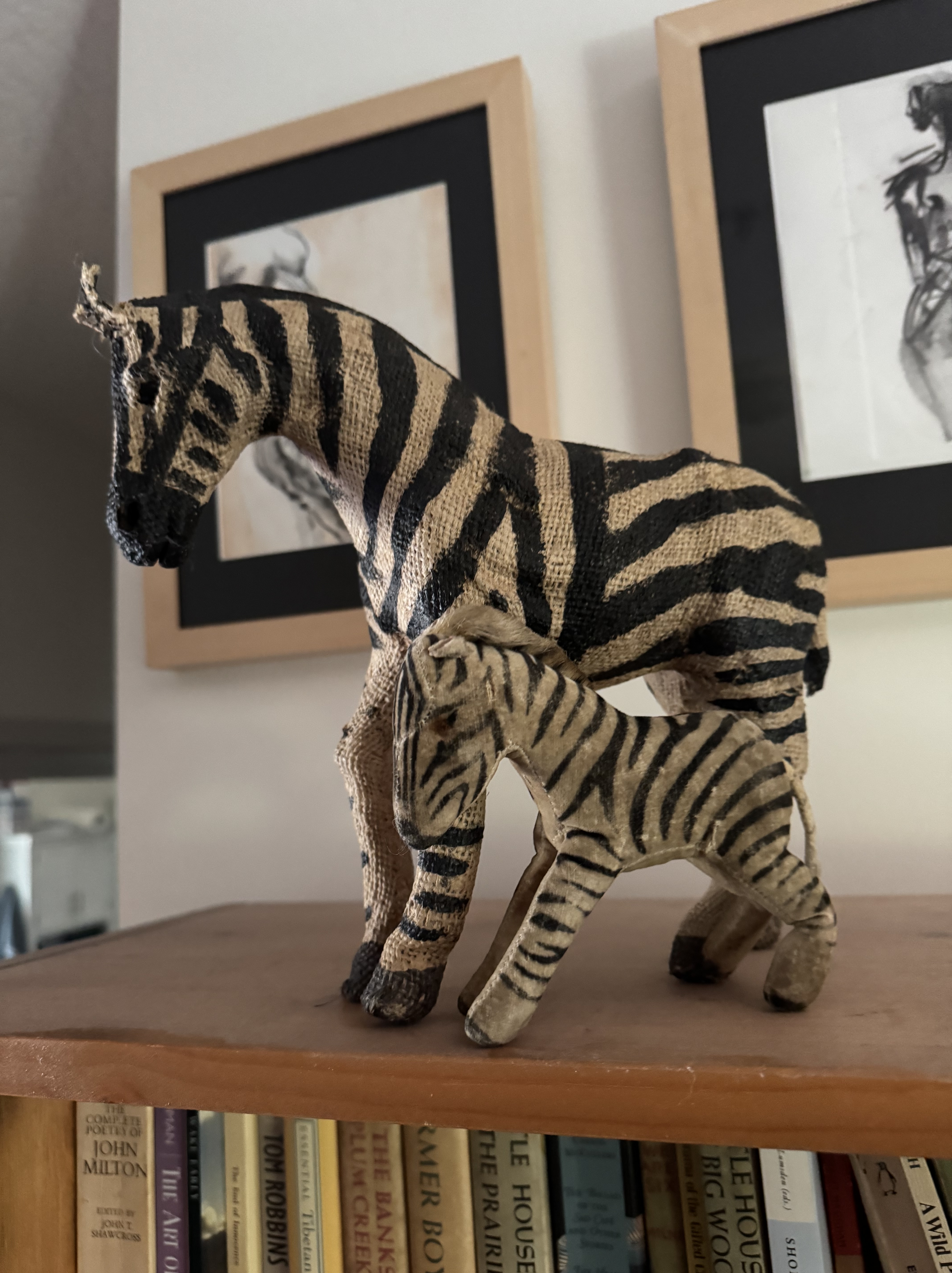
The burlap bag was pure serendipity. Another magical find was a zebra at the ReStore in Langford. Purchased for 70 cents ($1.00 but there was a 30% off sale). This zebra is majestic, dignified, kind, warm. She stands about 10 inches high. Her stripes are unrealistic, but otherwise she is a convincing animal. I dug out a stuffed toy zebra I’d kept from childhood in a box under the stairs. It’s remarkable this sixty-year old stuffed animal still stands! They now live together, mother and child, atop a bookshelf in our bedroom. I like to gaze at them from bed. Something about them feels calming, comforting. I loved my zebra striped one-piece bathing suit when I was eight years old. When I wore it, my reward was a zebra tan that was pure magic.
How to find comfort
Face fear, face grief, crunch on them like buttered toast, let them nourish you. Small striped body in the mirror, some kind of childhood magic. Let dreams bathe you in orange light. Sweet’s after tastes bitter, crying sparks a belly laugh. Joy and sorrow are so intertwined, you can’t tease them apart, please don’t waste time trying. Practice the butterfly hug: Hands cross collarbones, thumbs meet, fingers tap lightly, lightly. A comforting rhythm will come. It will come.
I am in Toronto for a few days. This city was my home from 1965 to 1989.
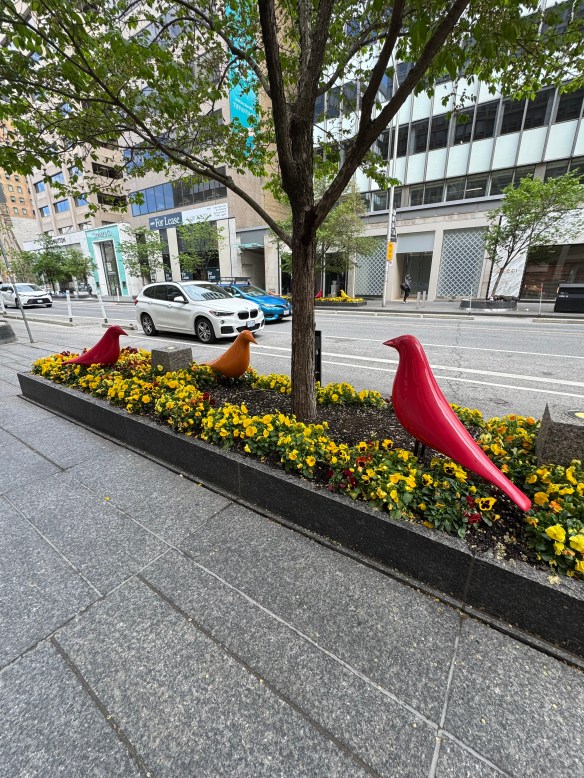
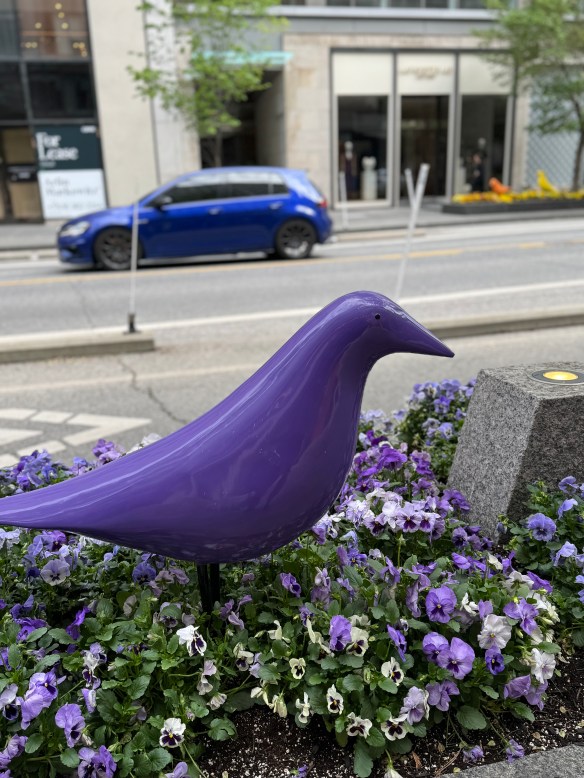
I have been walking Bloor Street West. First, the Mink Mile, that stretch between Yonge and Avenue Road lined with the tall glass storefronts: Zara, Birks, Lululemon, Holt Renfrew. Rich people shop here. Very few birds fly above these tall, inhospitable stores. Instead, big bird shapes in bright shiny colours line the sidewalks, ghosts of extinct species.
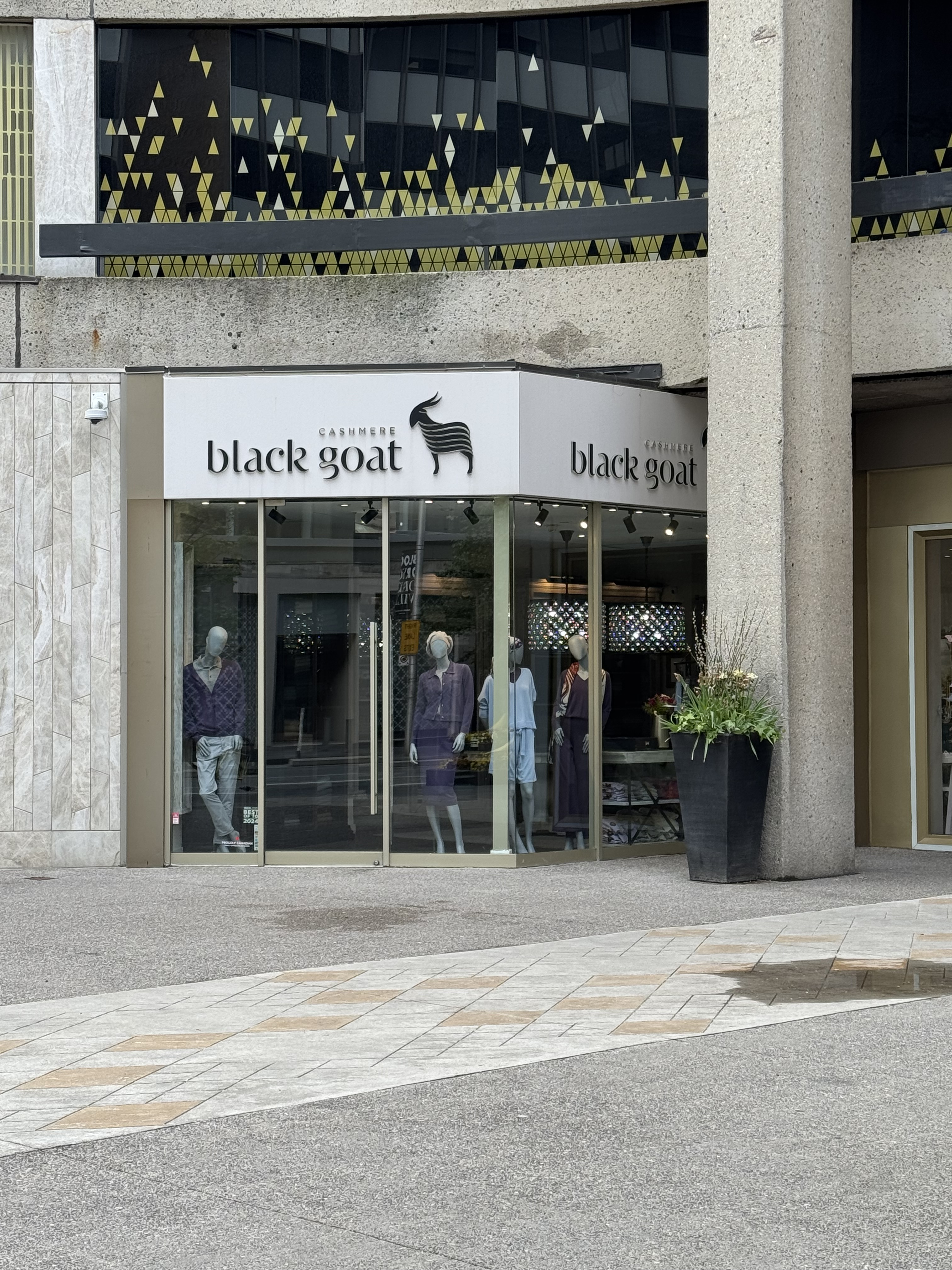
It’s cold in Toronto for late May. I wear a toque, jacket, leather gloves. But now I wish I’d brought a scarf. I admire the scarves in the window of Black Goat Cashmere, next to Ashley’s in what used to be called the Colonnade. This mall was one of my mother’s favourite places; after window shopping Bloor Street arm in arm, we’d drink coffee and eat pastries at the Coffee Mill at the back of the Colonnade.
I enter the store. Two saleswomen are upon me immediately. I ask about the small scarves, lifting one of them up out of the wooden box where they are displayed like confectionary, soft cashmere in artful designs, wool watercolours. “How much are these little ones?” “Oh,” says one of the women, advancing, “the Carre scarves are $385.” I laugh, folding the luxury item back into its box. “Perhaps in another lifetime.”
Pulling my zipper up to my chin and walking into a fierce wind, I take a detour to wander around the grounds of my alma mater, Victoria College. I feel nothing as I gaze over the green lawns, watching two young men kick a soccer ball. Alma mater means “nourishing mother,” but this place was not that for me. Those four years as an undergrad in English Literature are a blur. One thing stuck: a Shakespeare lecture by Northrop Frye when he—already extremely old—told us in his quavery voice that Bach’s Mass in B Minor was the voice of God speaking. All of us bent over our notebooks and wrote that down. It sounded profound.
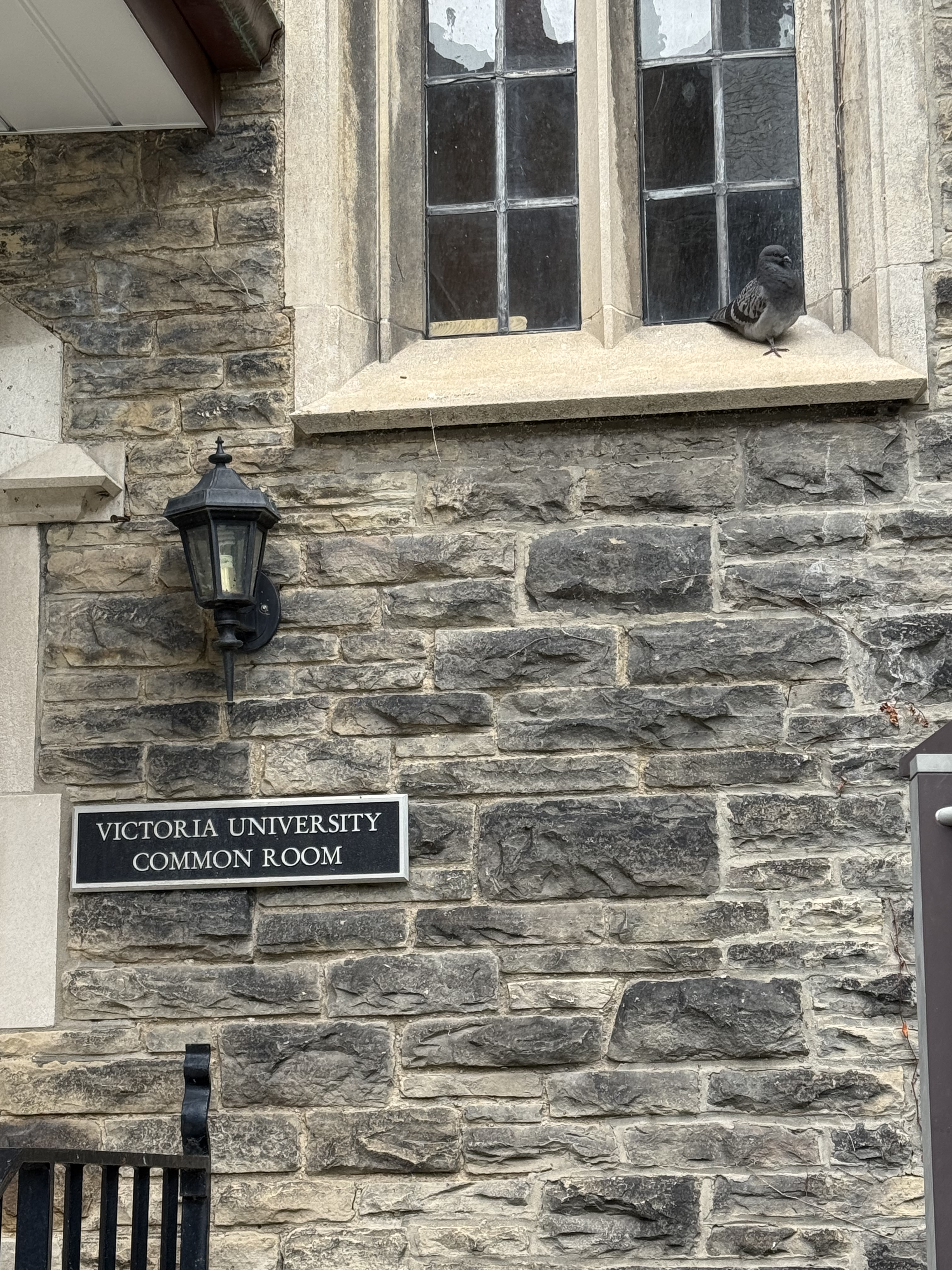
I was a lonely young woman. Barry Lopez writes that “It is not possible for human beings to outgrow loneliness,” and that seems true to me. Though I’m not as lonely as I was. I admire a pigeon perched in the recessed window of the Victoria University Common Room.
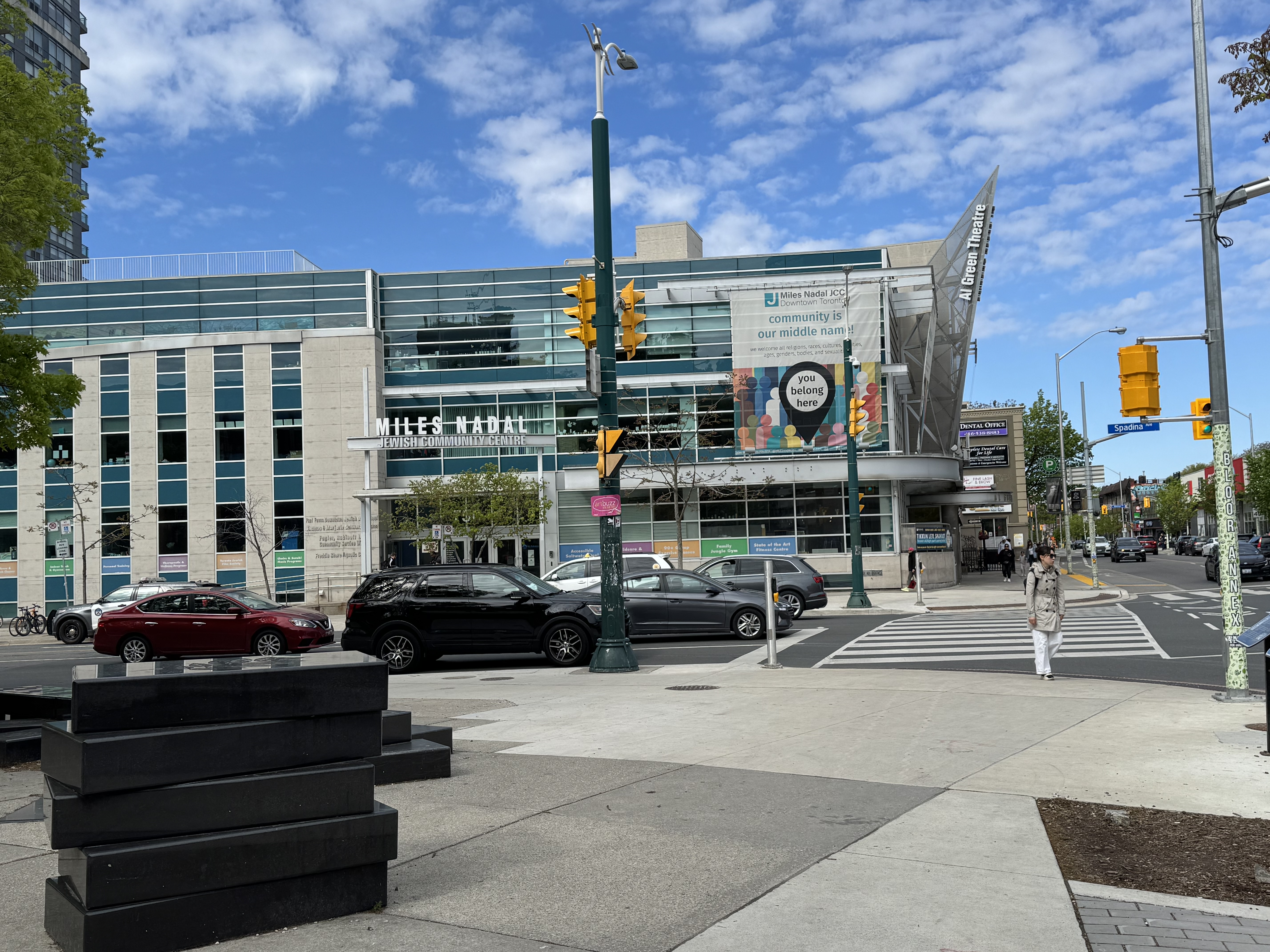
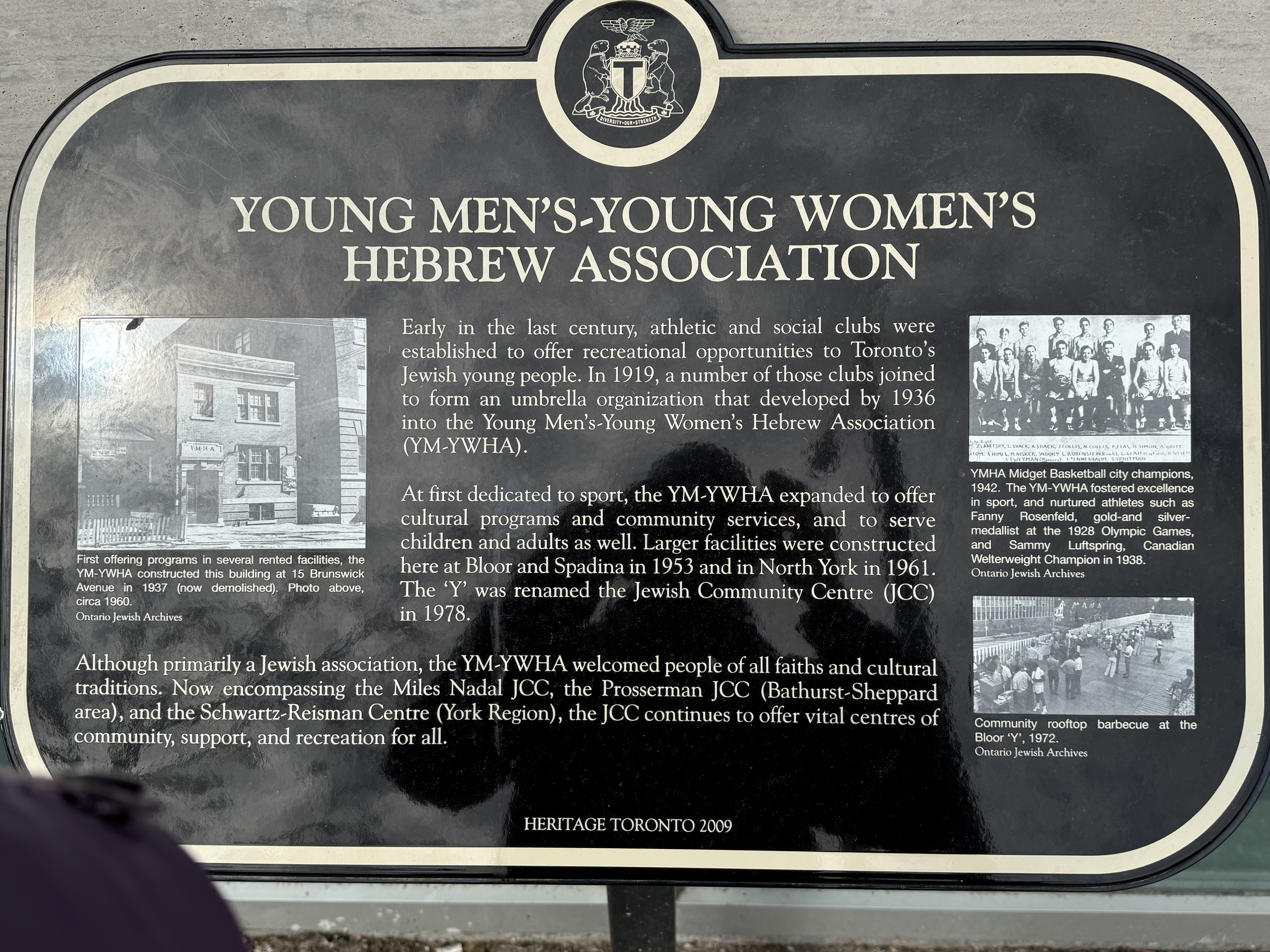
On the way up University back to Bloor Street, I check out the Gardiner Ceramic Museum, where I hope to see the work of contemporary ceramic artists, only to find that the main galleries are closed for renovation. I continue back along Bloor. It’s time for a coffee and I remember a Second Cup in the block before Spadina Avenue. And if that is no longer around, there’s a coffee shop in the old Jewish Community Centre (JCC), where my mother did aquafit for the last decade of her life. Back in the seventies, when it was the Young Men’s Hebrew Association, it was home to SEED, the alternative school my sisters and I went to as wild teens.
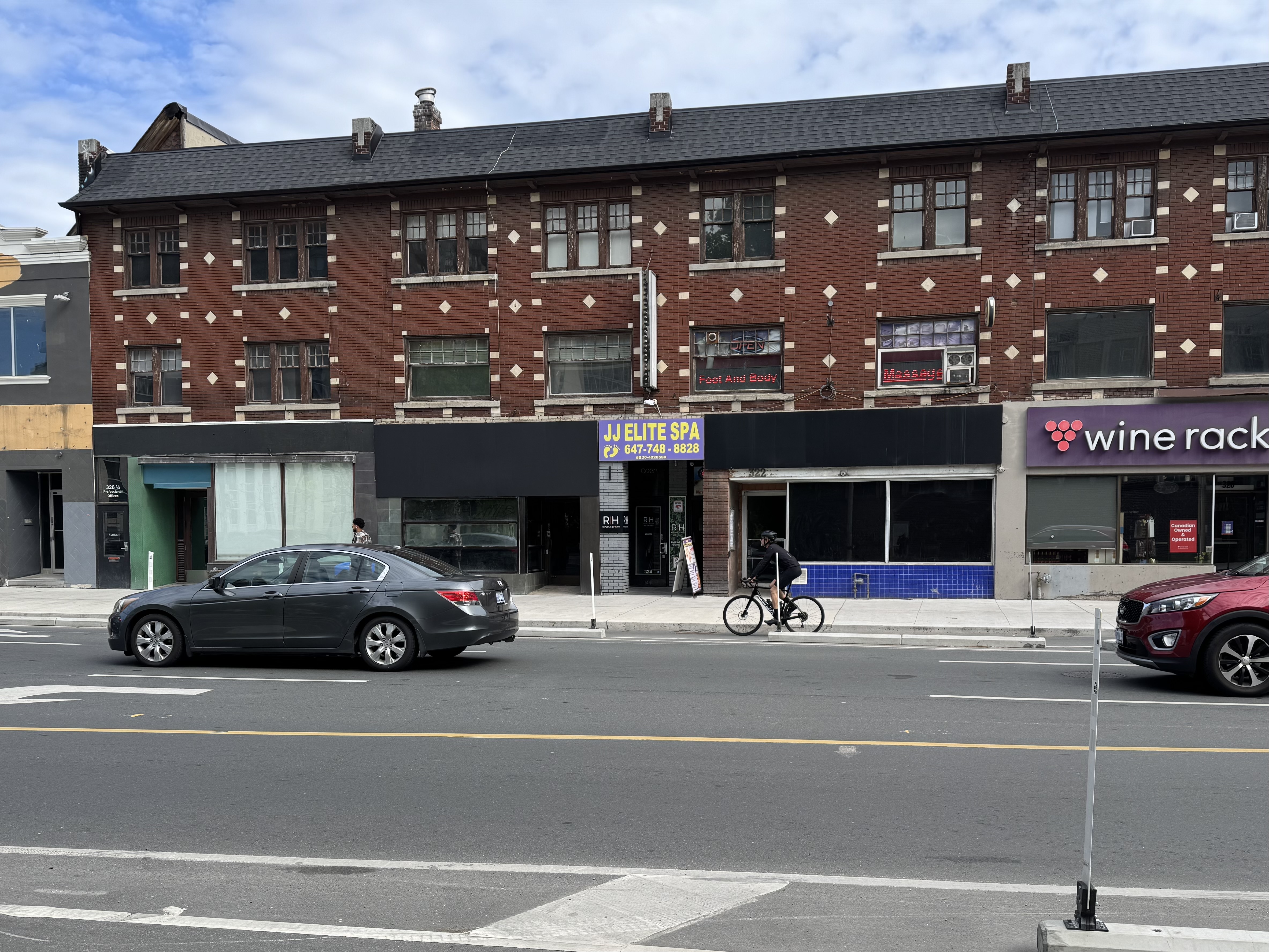
Second Cup is gone, and so are many of the other businesses on that block. Everything in life is impermanent, so I am not surprised Second Cup and Noah’s Health Foods have disappeared, and the spaces are vacant. Once upon a time there was a greasy spoon in this block where we drank coffee in thick cups, smoked cigarettes, and ate French fries. We walked over from “school” and stuffed our electric bodies into the vinyl booths, laughing, talking, flirting, mystified and excited by life. Once, for a time, my sister lived above the restaurant with her boyfriend, an apartment with burlap on the walls and plants everywhere. There’s history here.
The wine store remains. This is where we bought bottles for the meal marking my mother‘s death in February 2019. Her house is only a few blocks from this corner, and she died at home. We carried the clanking bottles through the snow. My sister made bouillabaisse and we sat around the teak table, drinking, eating, and telling our Virginia stories, stories filled with love, regret, sadness, and confusion.
I cross the street twice to the southwest corner and pull on the doors of the Jewish Community Centre, but my pull meets resistance. A security guard opens the door from the other side, just a few inches, and peers at me. “I am trying to get into the coffee shop,” I say. “No more coffee shop. Coffee shop no more,” a sort of palindrome of endings. And he closes the door in my face.
I keep walking. Surely, there is a sweet, cool, interesting café somewhere along Bloor. I am Ahab stalking the great flat white, but she’s nowhere to be found. I pass more than one Tim Hortons among the restaurants and bars still closed this cold morning, but no, I won’t go there. Cigarette butts decorate the grey pavement, evidence of parties spilling onto the street last night. Pigeons strut their stuff. I keep walking. Yes, I know Futures Bakery might be considered an interesting coffee shop, but I hold out for something else, some uncertain thing, something new, something not in the algorithm.
I keep walking. The Hungarian restaurant where we ordered dumplings and gravy and goulash soup: gone. The delicatessen and the cheese shop with a cow in the window: both gone. The café that once took up that southeast corner of Bloor and Bathurst: gone. Now there’s a Fancy Burger outlet, where you can add a syringe cheese shot to your beef patty for $1.49. This part of Bloor continues to metamorphize. Ethnic restaurants and record stores turn into cannabis shops and bubble tea counters. Used bookstores become pet pampering salons and tattoo parlours.
I am happy to see Midoco, the office supply shop, a place where you can lose yourself among the art supplies and fountain pens, is still in business. Ditto the Home Hardware.
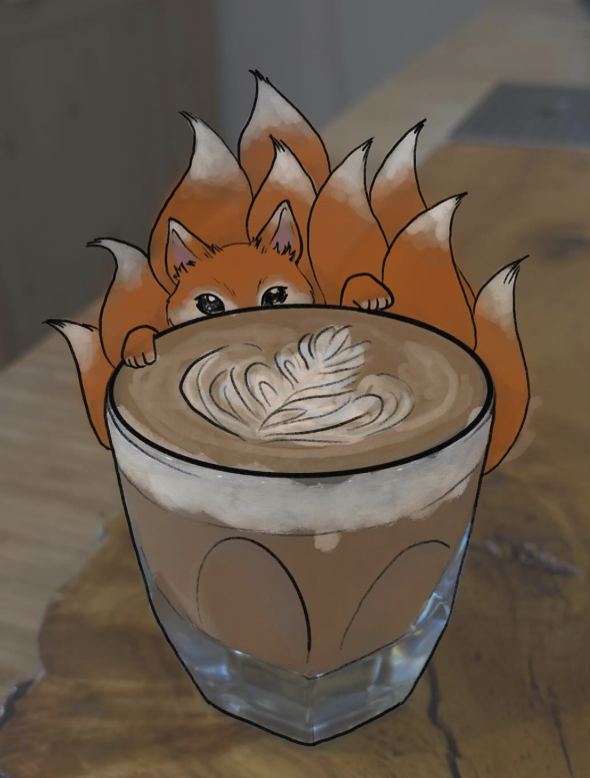
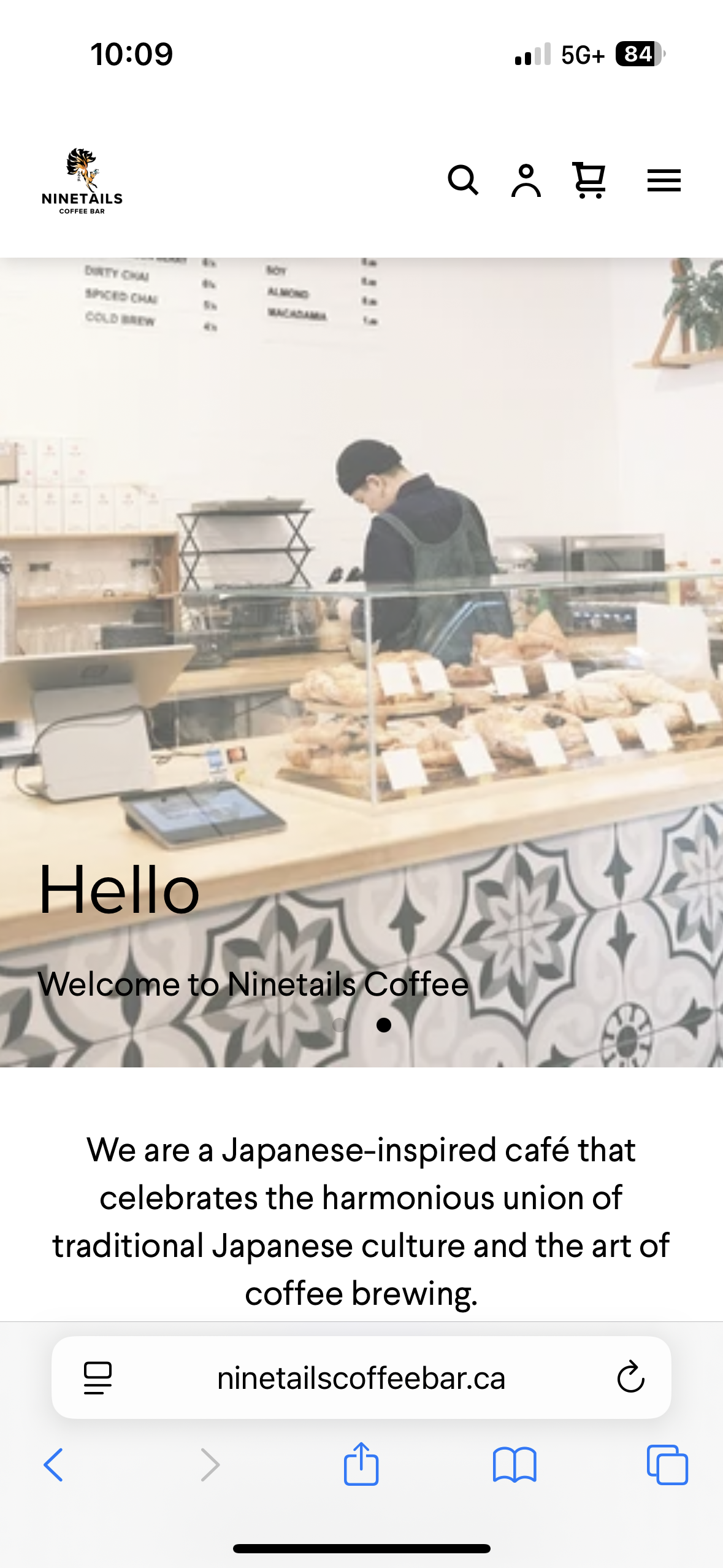
I keep walking, knowing that somewhere soon, I will come upon something interesting. I pass the small corner grocers, happy to see they still sell bargain produce and hanging pots of flowers. I pass Euclid, cross to the south side, and then, suddenly, there is an A-Frame sandwich board picturing a fox with many tails. I walk into Ninetails Coffee Bar, where two young Japanese women bustle behind a honey-coloured wood counter. White walls, a few small round tables graced by simple folding chairs. A coffee bar decorated with ceramic tiles patterned in grey, blue, and white. A full pastry case. Smiling faces welcome me.
My flat white, delivered in a short glass with a foamy fern on top, is delicious—strong and hot. While I drink my coffee I read about the coffee bar’s philosophy.
In Japanese folklore, Kitsune are foxes with mystical powers that can grow nine tails.
“we embrace the Japanese philosophy of ‘ichi-go ichi-e,’ which translates to ‘one opportunity, one encounter.’ This concept underscores the importance of cherishing every moment and every connection we make with our guests, as each encounter is unique and irreplaceable. Our goal is to provide you with a little window to Japan & Japanese culture within each visit.”
I gaze across Bloor to the north side and see, to my delight, a used bookstore that I’ll visit after I drink this coffee. It’s too easy to get lost in the past during this trip. Wandering through old neighbourhoods, remembering past experiences, feeling traces of old sadness and joy. But Toronto, like Freud’s Rome, is a metaphor for the mind. There is no denying that my personal history, etched through the decades, permeates my experience of Bloor West. I feel these vestiges of the past in my body.
But there is also the present: every moment is unique and irreplaceable.
The sun finally emerges from behind grey clouds on this cold day and streams through the glass over my table. I will never experience this moment again, as I drink this coffee, as I gaze at the people around me, the heavily inked man, the woman with green hair, as I examine the fox on the sandwich board outside, waving her many tails. She reminds me there is only one opportunity, one encounter. This is it.
When I was in my forties, my mother was in her seventies. (We could rapidly figure out each other’s age because I was born when she was 30.) Those days, I had scant time for or interest in her stories. Busy with kids, negotiating the break-up of my marriage, and immersed in the chaotic life of a graduate student, I was living my life 3,000 miles away from my mother.
We talked on the phone weekly and visited once or twice a year. When she started to tell a story from the past, I often zoned out or became irritated. I didn’t really care, or I thought I’d heard it before. She sensed my impatience because eventually she stopped expecting a weekly phone call. “You sound too busy,” she said. I didn’t disagree. My forties turned to fifties; her seventies turned to eighties. We kept in touch, but calls were infrequent.
On Valentines Day, it will be six years since her death. I am 66 now, and at least a couple of times each week, I think of something I want to ask her. Some thread we dropped that I’d like to pick up again. Some mystery from her past I want to understand. Some memory I want her to clarify. (There are so many amorphous, shady memories—are they true?)
How did you make that wonderful crème caramel? I wish I’d gotten the recipe. Tell me more about the trip you took to Russia. When you returned from the trip and tried to tell me about it, I had so much on my mind I didn’t listen. But now I really want to know. And the other trips… so many European cities you visited, sometimes with groups of students, showing them great works of art and architecture. I wish you could tell me more.
You didn’t talk to your own mother for decades. I never knew her, only met her once. Why were you estranged? Your childhood was traumatic. Is it true you missed a year of school because you didn’t have shoes to fit your feet? That you learned to drive the tractor at age nine (or was it 12) so you could help on the farm? That your dad kicked you out of the house at 17, but he’s the one you loved? Am I misremembering your narratives?
I have the old phone number in my head 416-922-9534; if only I could call, we would chat. She’d be happy to hear from me and to reminisce, I know. But she’s no longer available. The stories, too, are gone. They died with her.
I had the wherewithal to record my father talking about his life in 2014 when he was visiting (he was 87). I asked him a series of questions. Now, I am glad to have his voice preserved as he talks about his parents, being a father, his life as an academic and farmer, and formative childhood experiences. For example, he describes discovering an injured bird when he was a young boy, taking it home and nursing it back to health, then releasing it. That event cemented his lifelong love for birds.
I feel wistful now that I didn’t make audio recordings or write down some of my mother’s stories.
I signed up for an online course, “From Autobiography to Illustrated Story.” The goal is to produce a short, illustrated book about an object that we still have from childhood: its provenance and meaning to us. I have precious few objects to choose from. The yellow Tonka truck. A doll my mother made for me out of an old sock with yarn hair and an embroidered mouth, nose, and eyes. Little Bear, the Steiff teddy. And I have some things that belonged to my mother.
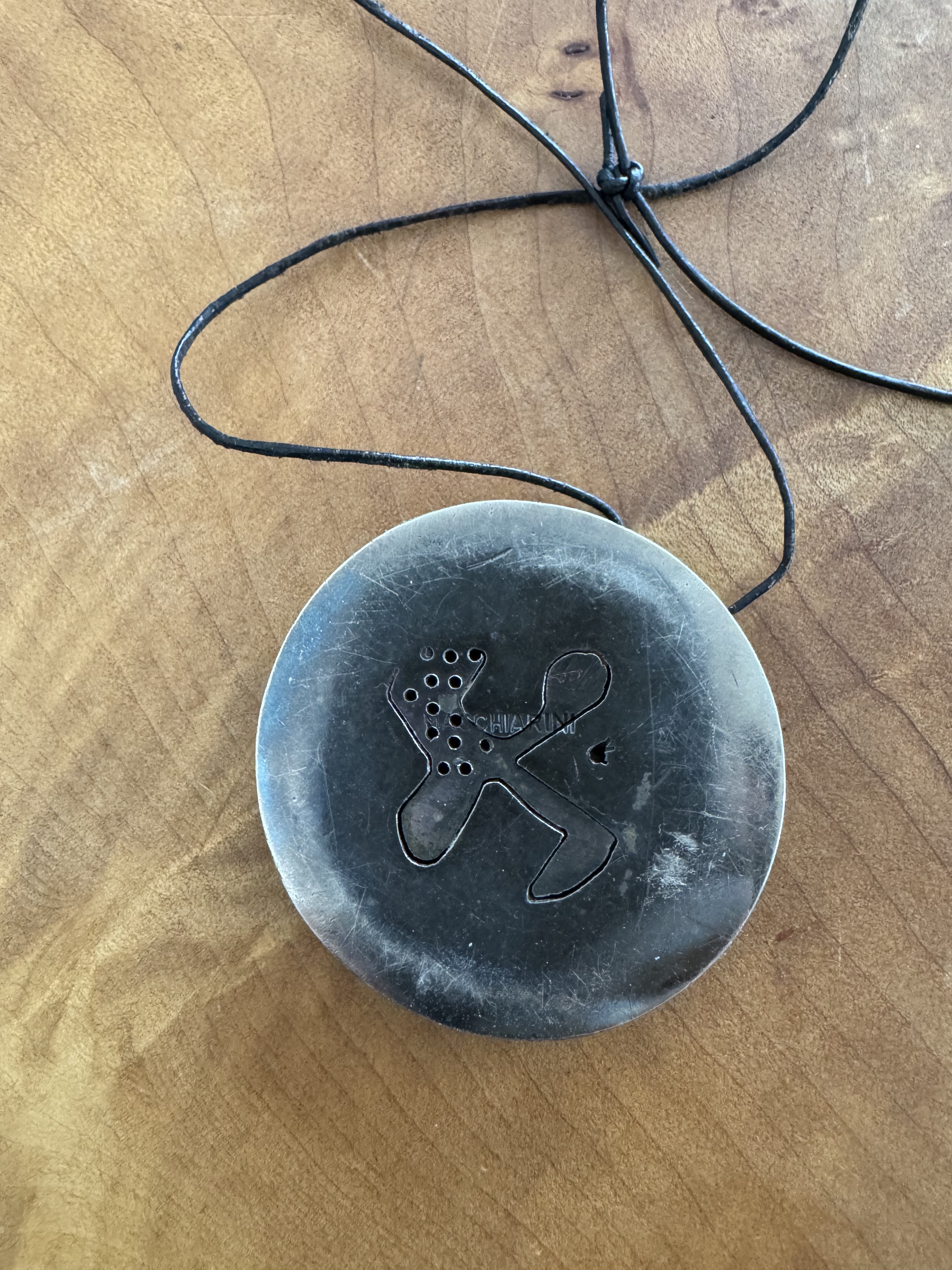
I decided I wanted to write about my mother’s Macchiarini pendant. My sister took it from her house after her death and gave it to me, thinking it suited me. I agree. Mom loved the work of Peter Macchiarini, an American Modernist jeweller (1909-2001) from North Beach, San Francisco. The several pieces my mother owned were passed down to us, her daughters. I have a couple of brooches, the pendant, and two belt buckles, and my sisters have other examples of his work.
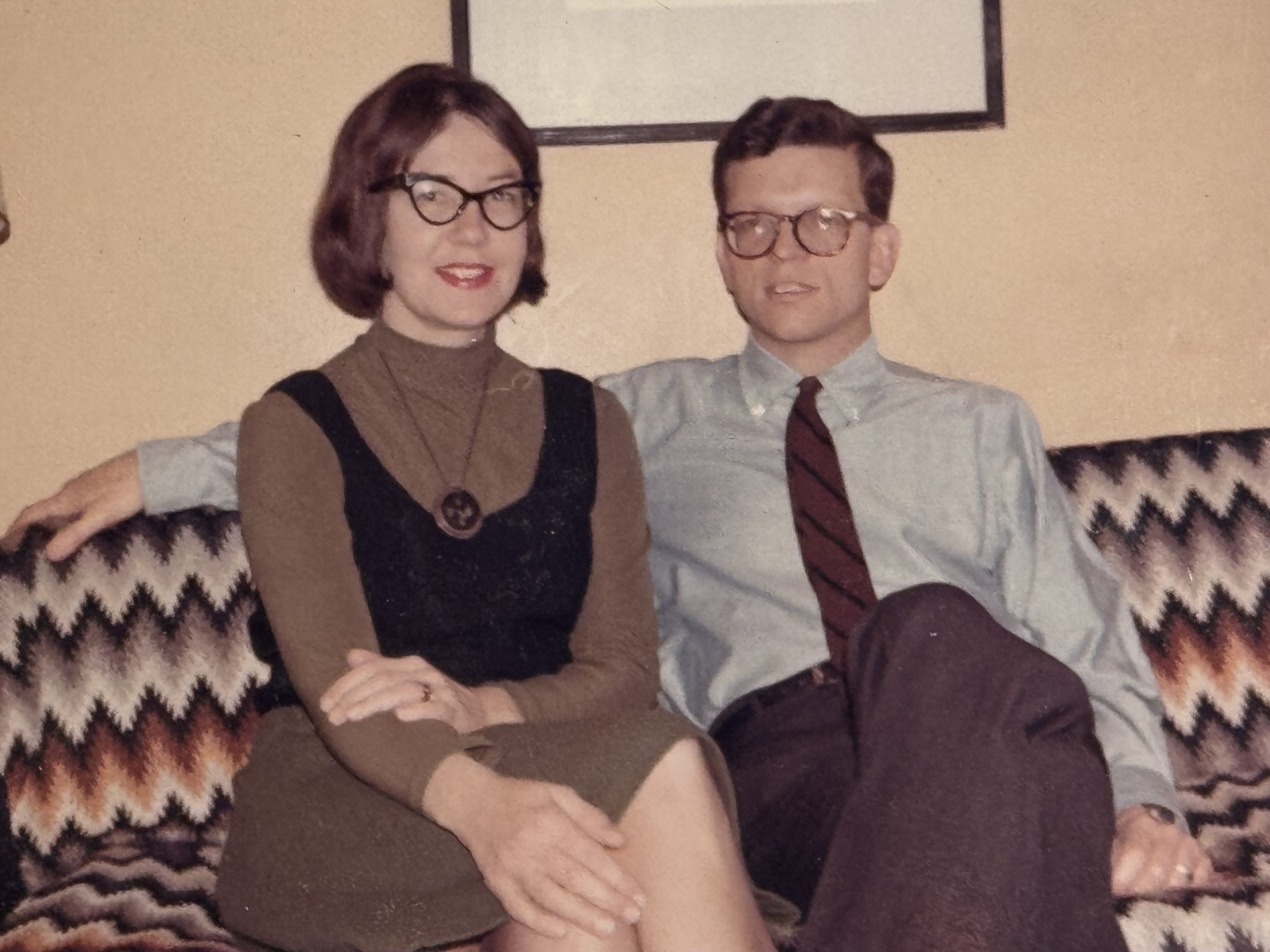
I want the pendant to tell a story—a story about my mother’s love for mid-century art, particularly from the Bay Area. Mom knew Peter, or at least I think she told me she did. She must have had anecdotes about how she bought the jewelry, what he was like, her San Francisco connection to him. She wore this pendant often, her signature piece. The photo of her and my dad shows her wearing it in 1964. She is wearing it again in the photo with her cat when she was in her sixties.
But the stories about Mom’s relationship with Macchiarini died with her. I can’t remember anything, and now I can’t ask her about them. What can I say about this unusual round pendant, a playful amoeba shape carved into dark wood and set in silver and gold? I can say that when I wear it, I feel warmth under its weight. Warmth around the heart, generated by affection. Our relationship was complicated. She was fucked up, inevitably passing along some of that to me. Yet there was so much love. She instilled in me a reverence for life’s beauty. And inextricable from that, a cellular knowledge of sadness.
I notice that my left hand is placed on my right arm just as my mother’s left hand is placed on her right arm in the 1964 photograph. Coincidence?
In mid-December, I bought a green glass jug in a second-hand store, half price. My aspiration was to make a beautiful winter bouquet for my friend, Lillian. I bought a bunch of silver dollar eucalyptus and two dozen white carnations. I envisioned white wintry bursts among the silvery green, but the more I trimmed and mixed the carnations with the stems of eucalyptus, the sillier and more incoherent it looked. I took basic Ikebana but still haven’t a clue how to make flowers and plants look good.
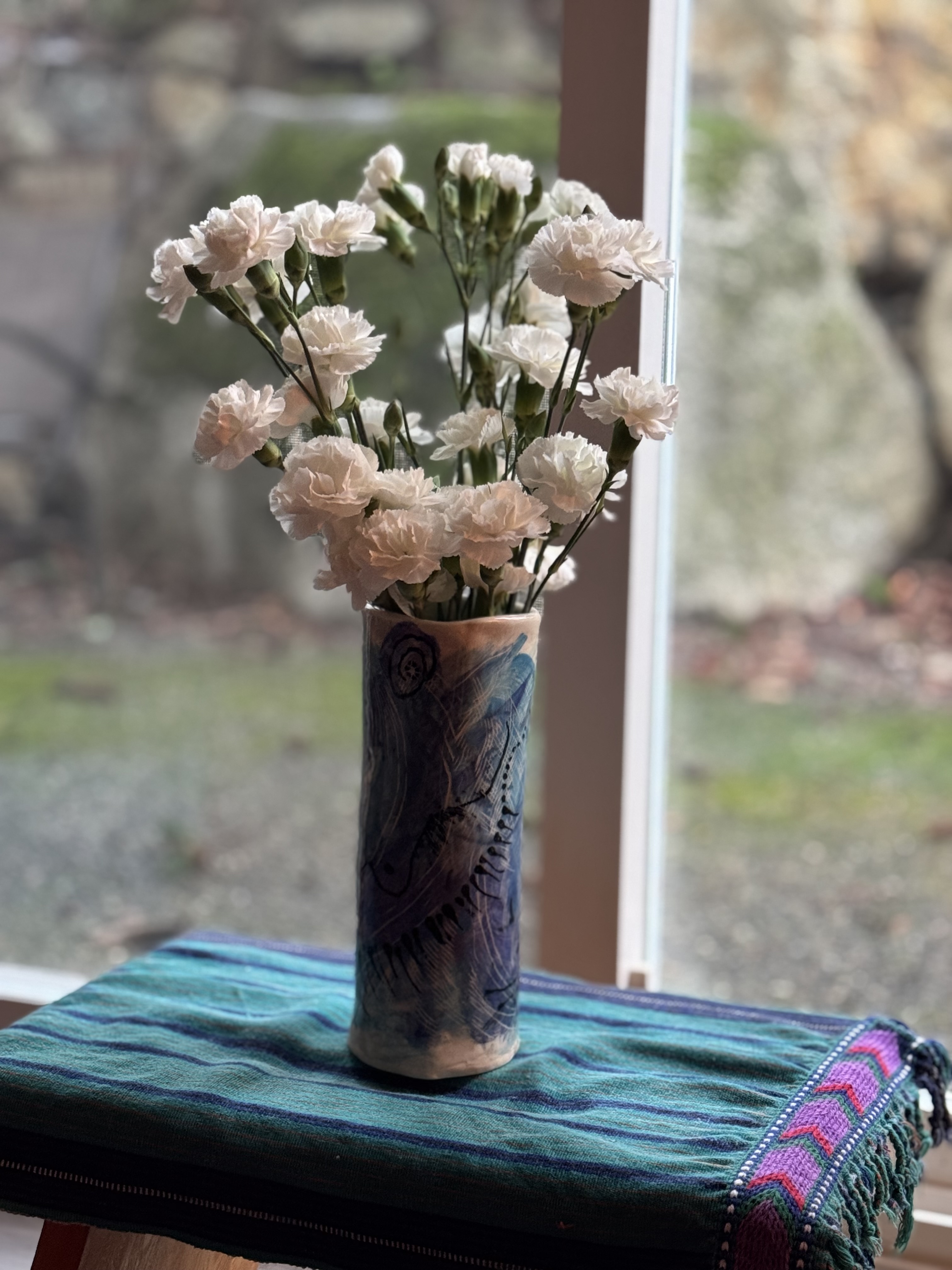
Finally, I used only the eucalyptus, splayed out in a free-fall arrangement. I attached a few small, red shiny balls to the stems, and the effect, I hope, was Christmassy and charming, if a bit messy. Lillian said she loved it. (But what could she say, really?) I was going to throw out the unused carnations, but it seemed such a waste, so I put them in a white and blue vase and placed it in my study on a low stool covered with a blue-green cloth.
I don’t like carnations, or I didn’t think that I did. I’ve seen too many sad, slender bunches wrapped in cellophane at the mini-mart next to the hospital. They make me think of last-minute purchases for the death bed, cheap flowers that outlive the person you visited. They seem so tight, orthodox, banal. Whorls of perfect, serrated petals, every bloom the same.
But they’ve grown on me. As I spend hours in their presence, they’ve become real. You could say I’ve become intimate with them. I sit here now, the last day of the year, gazing at their fresh ordinariness. The carnation is the sturdy, faithful flower that will see you through. Perhaps they are flower of the year: commonplace as canned milk. Carnations are one-foot-in-front-of-the-other flowers. Quotidian flowers. Bread-and-butter blooms. See you through the hardest times. Last for weeks. Nothing special.
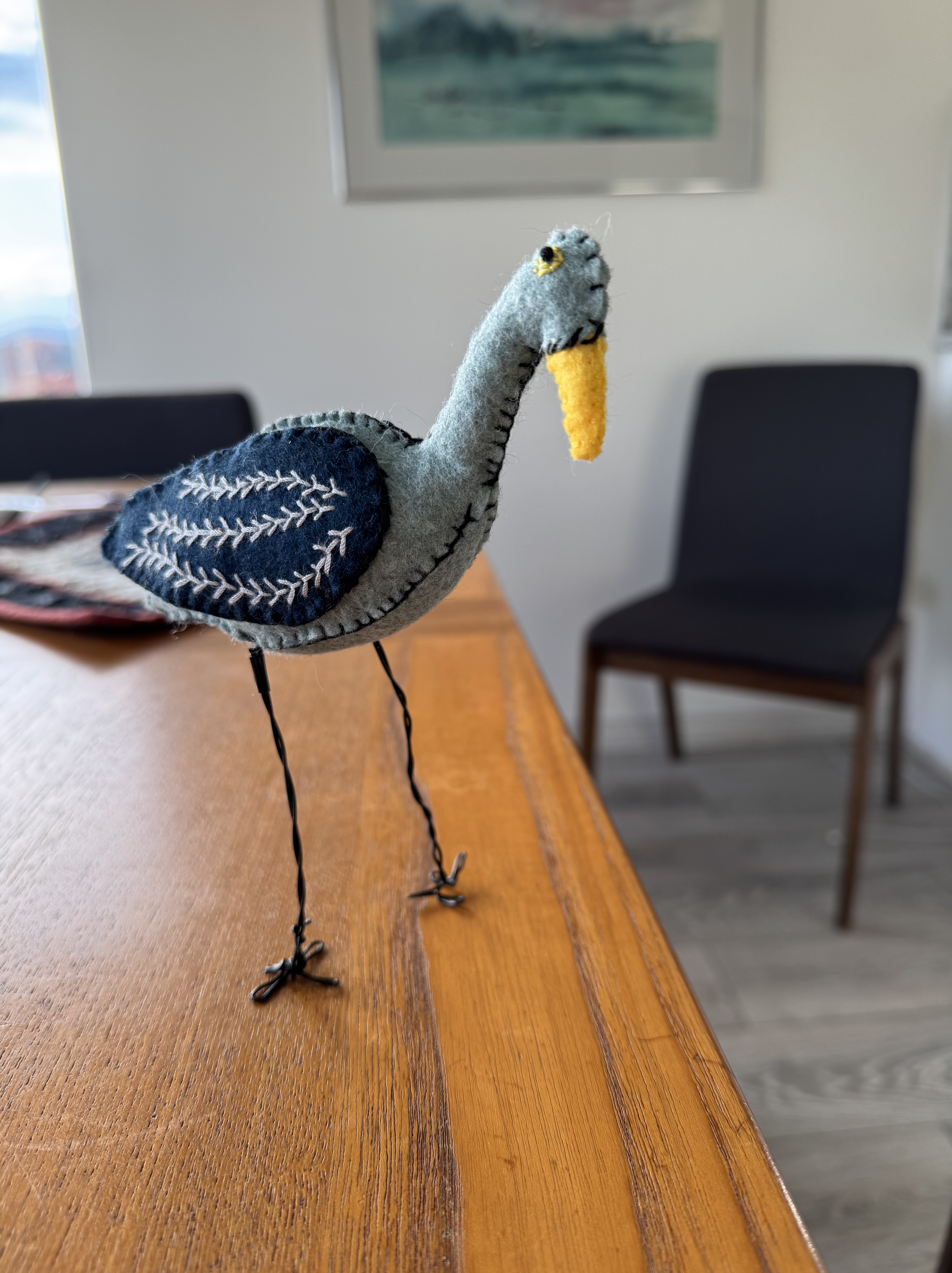
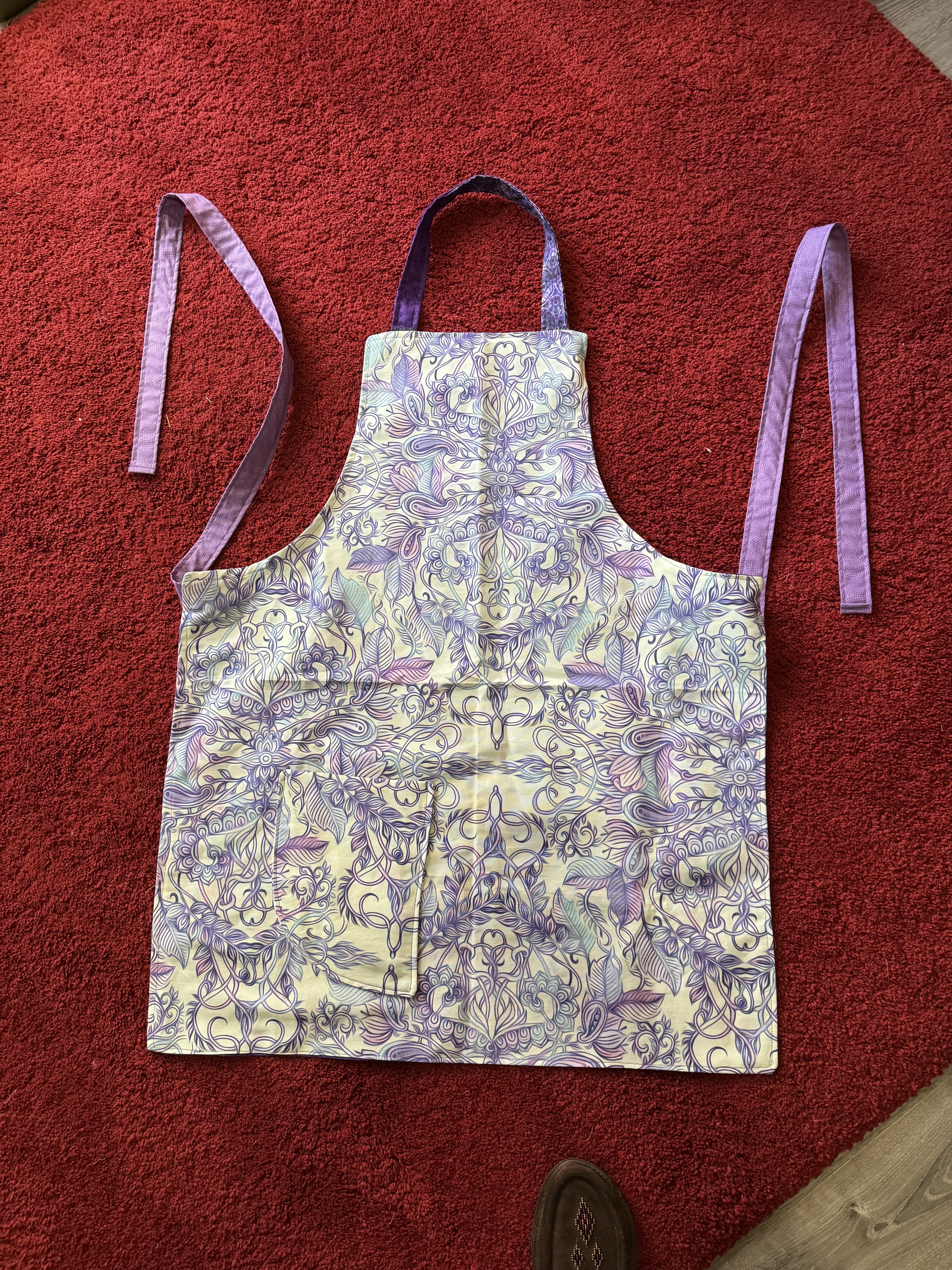
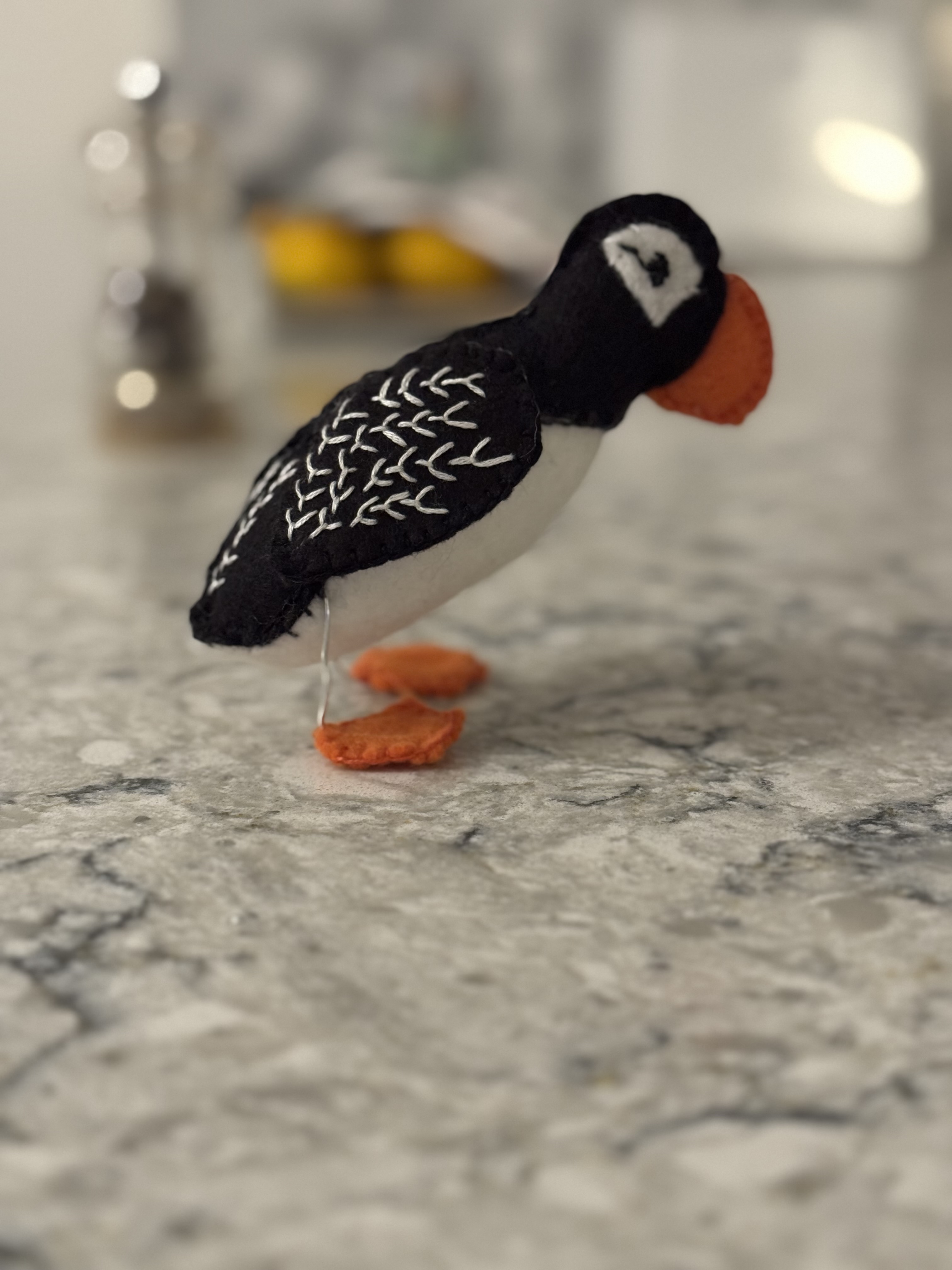
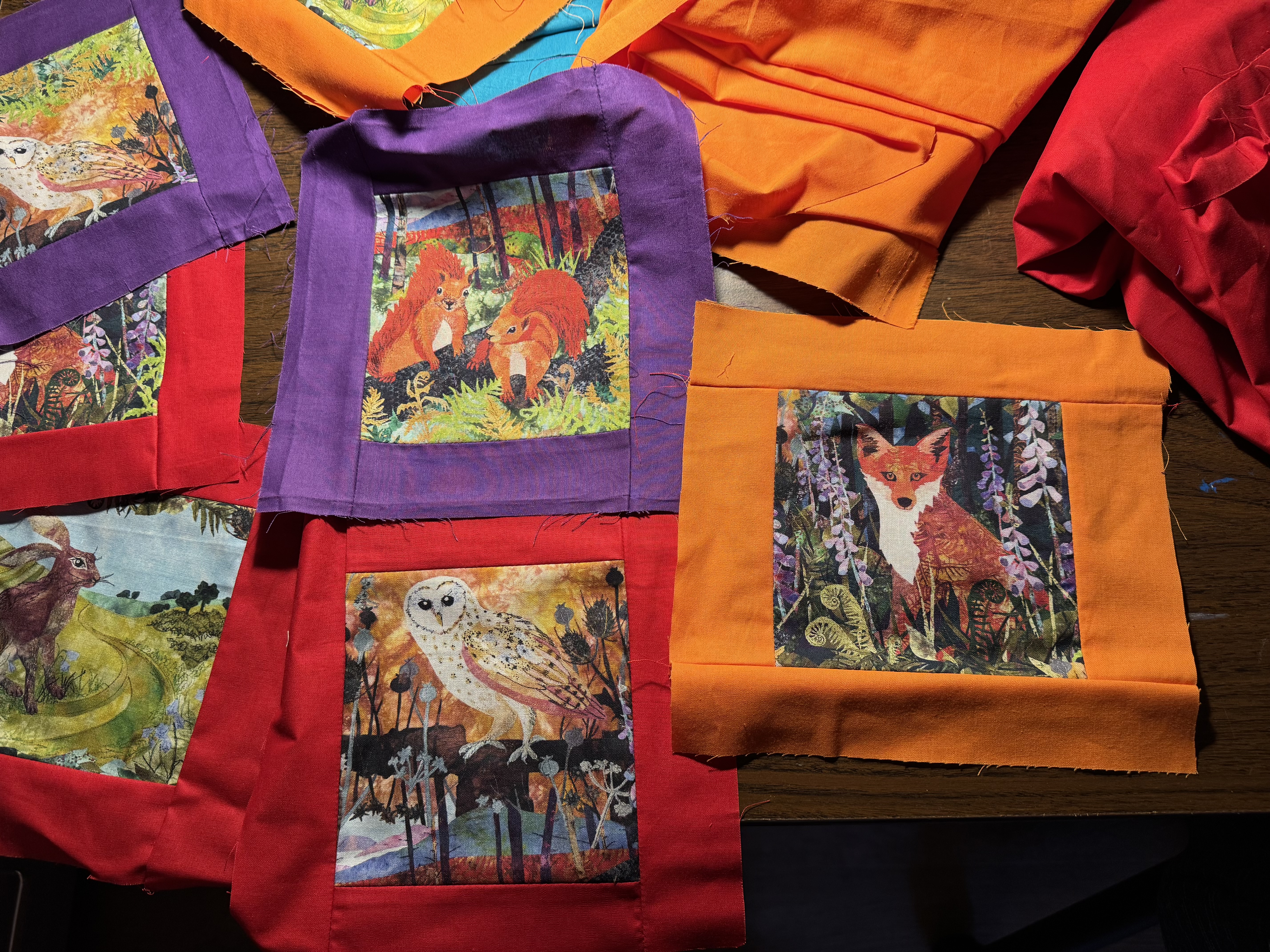
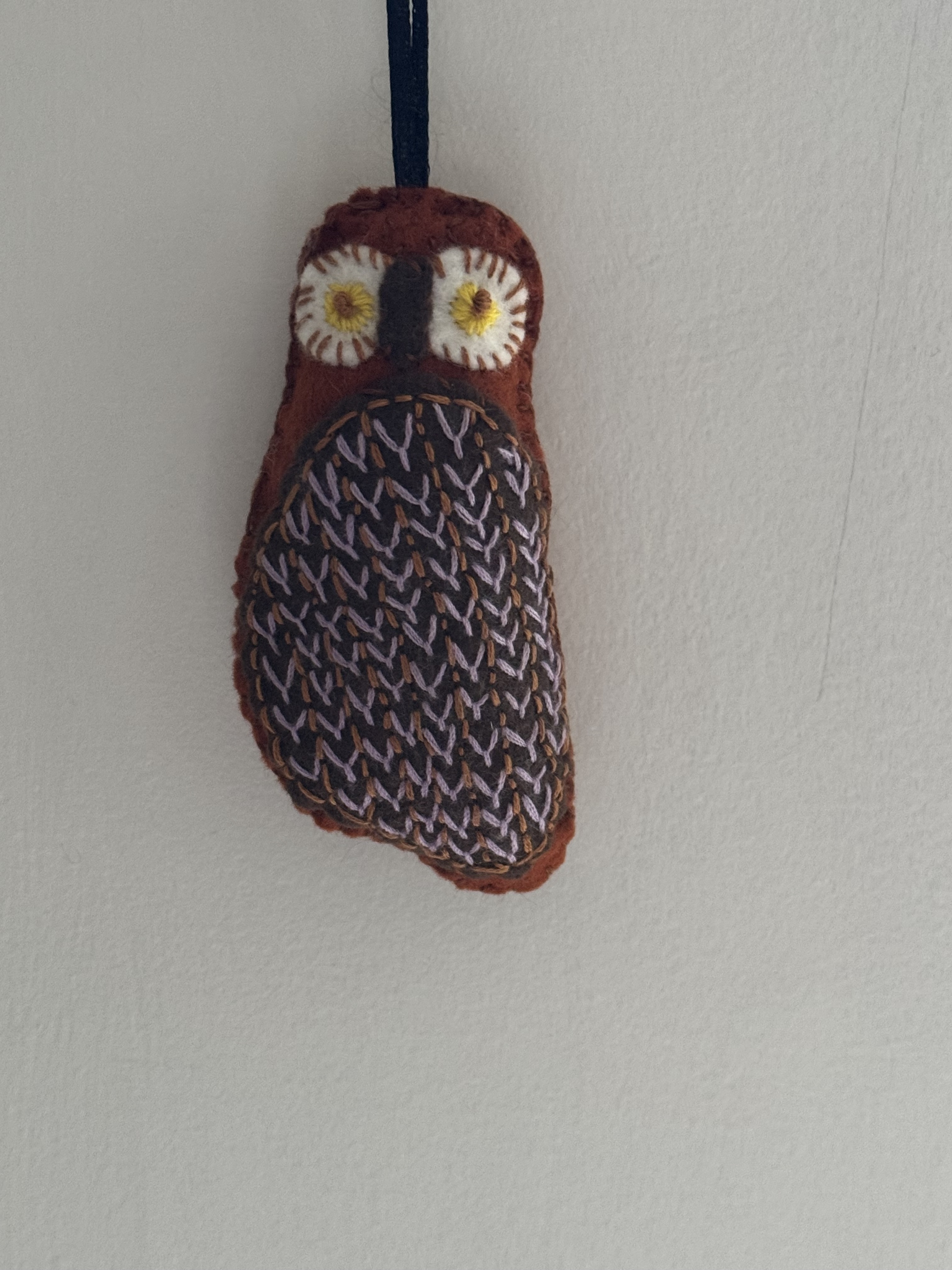
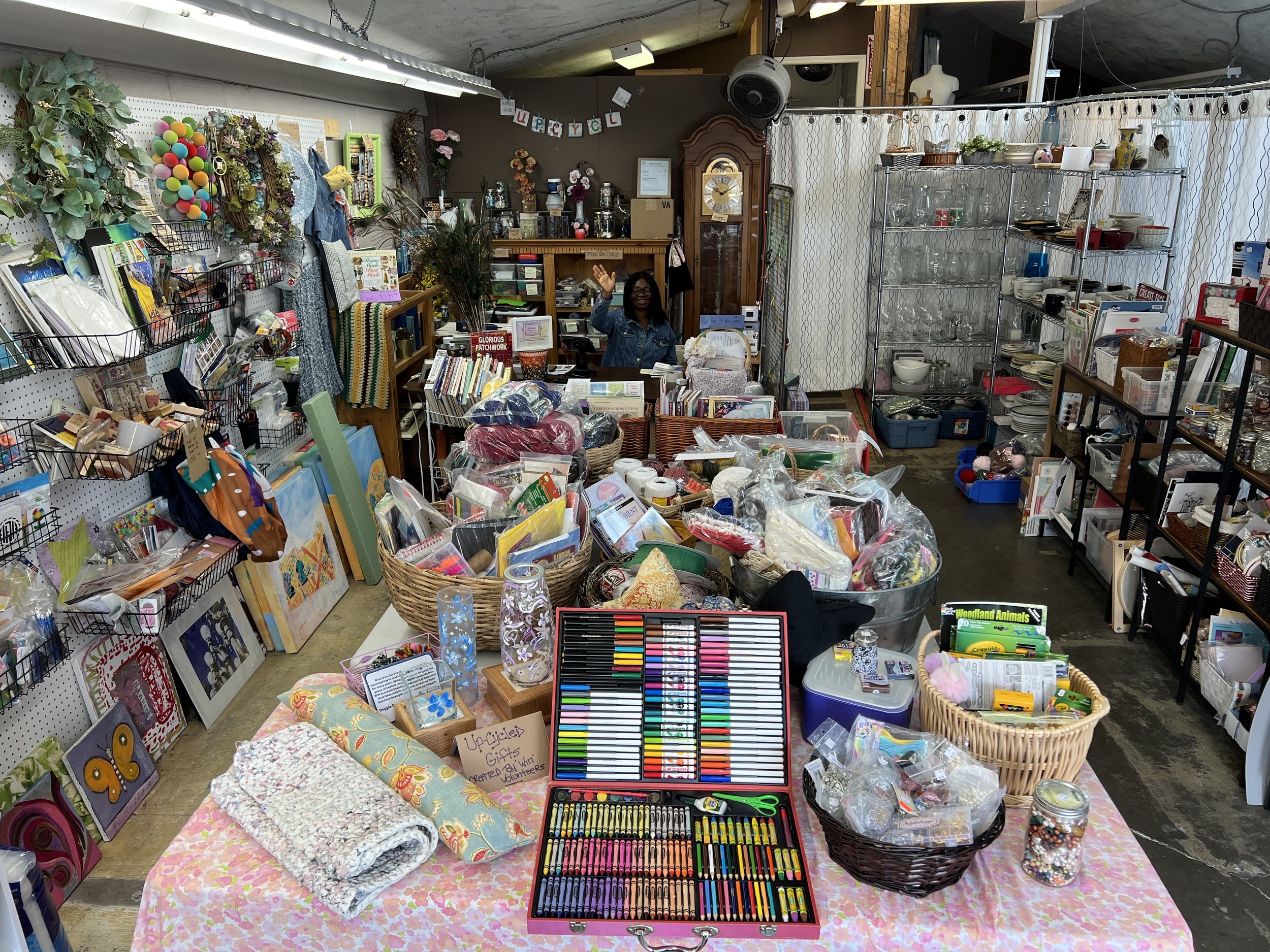
Although 2024 was my first year of so-called retirement, and thus I was given twenty additional hours each week, I wrote less, and I sewed less. (A few felt birds for family and other little felt creations, an apron, a crib quilt start, a fur-lined bag.) I did finish an editing certificate I started in 2020, which is a relief. And I made a lovely new friend and deepened existing friendships. I started a volunteer gig at a non-profit arts and crafts shop in August that has led to meeting many interesting people. Bonus: I get to surround myself with a messy profusion of materials that inspire me.
Kathryn’s robinAllison’s pigeonEvan’s heronNancy’s reversible purple apronNancy’s reversible purple apronSarah’s swanI made felt hearts for friends at Christmas.Nat’s puffinNat’s puffinI started a quilt for Lillian’s great grandson, FoxWilson the owl, a gift for Michael Magic bag lined with fake fur for Nat’s 30th birthdayWomen in Need’s Upcycle and Craft store on North Park Avenue. I work there on Thursday afternoons.
This year, I listened to probably one hundred dharma talks on Dharma Seed, with a broad aspiration of becoming more intimate with life—accepting whatever’s happening in my heart, whatever’s happening in the world. Making friends with wild mind. Accepting the truth of the way things are.
I read so many books this year. A couple that stick with me are Rebecca Solnit’s memoir, Recollections of My Nonexistence and The Age of Loneliness, a book of essays about life during the sixth extinction by Laura Marris.
Solnit writes a lot about being a woman. That’s what her title gestures toward—the peculiar “nonexistence” of being female in a patriarchy (remember mansplaining? She is behind that neologism[i]). She draws on John Berger’s 1972 Ways of Seeing, which I’ve known about for years and now am determined to read. She quotes words from him that jibe with my experience: “To be born a woman has been to be born, within an allotted and confined space, into the keeping of men. The social presence of women has developed as a result of their ingenuity in living under such tutelage with such a limited space. But this has been at the cost of a woman’s self being split into two.”
Perhaps that sounds dramatic in the Global North in 2024, but that has been my experience. Perhaps it’s different for lesbians. Perhaps it is different for women of subsequent generations, but Solnit and I were born three years apart (1961/1958), so we grew up at roughly the same time. Berger goes on,
“A woman must continually watch herself. … She has to survey everything she is and everything she does because how she appears to others, and ultimately how she appears to men, is of crucial importance for what is normally thought of as the success of her life. Her own sense of being in herself is supplanted by a sense of being appreciated as yourself by another.”
Solnit calls Berger brilliant and generous, to be able to imagine a woman’s experience, and I agree. What he writes here feels just as real as the carnations in front of me. Reading the passage and feeling its truth is freeing. No action needed, just awareness.
Similarly, truth pinged through me when I read Laura Marris writing about the age of loneliness. We become lonelier as we bear witness to the drastic reduction, or “great thinning,” of ordinary animals. Marris draws on the work of naturalist, Michael McCarthy, who writes of our baby boomer age group, “As we come to the end of our time, a different way of categorising us is beginning to manifest itself: we were the generation who, over the long course of our lives, saw the shadow fall across the face of the earth.”
Reading this series of essays, elegies to Earth as the shadow descends and animals disappear, I was gripped by a grief so deep I sat for a time and just cried. Again, the truth is freeing. Let’s not deny that this is happening. It’s really happening. We can still enjoy the beauty that is here.
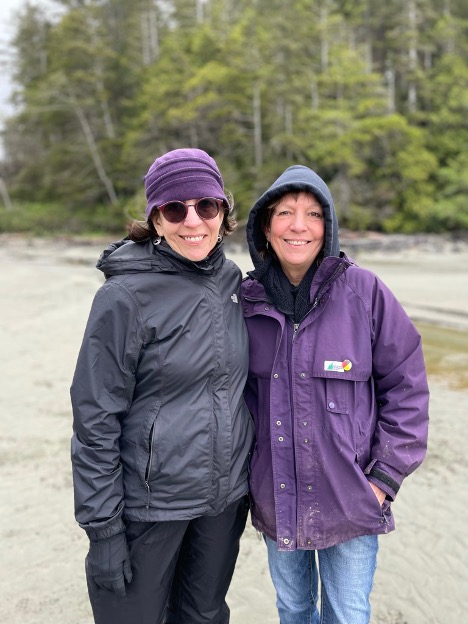
In keeping with my mood of asceticism, I recently deleted my Facebook and Instagram accounts. Unlike the birds who used to sing outside my window, FB and IG will not be mourned. I feel light as I step through life with a new red pedometer safety-pinned to my leggings (the pedometer frees me from carrying a “smart” phone to count steps). Michael, Marvin, and I amble down to the beach at Thetis Cove to watch the sky change. Rippled water reflects a bank of pink clouds.
Thank you for reading. In the coming year, may you experience moments of lightness in a shadowy world.
Berger, John. 1972. Ways of Seeing. Penguin. Marris, Laura. 2024. The Age of Loneliness: Essays. Greywolf Press. McCarthy, Michael. 2015. The Moth Snowstorm: Nature and Joy. New York Review Books. Solnit, Rebecca. 2020. Recollections of My Nonexistence. Viking.
[i] From Wikipedia: The term mansplaining was inspired by an essay, “Men Explain Things to Me: Facts Didn’t Get in Their Way”, written by author Rebecca Solnit and published on TomDispatch.com on 13 April 2008. In the essay, Solnit told an anecdote about a man at a party who said he had heard she had written some books. She began to talk about her most recent, on Eadweard Muybridge, whereupon the man cut her off and asked if she had “heard about the very important Muybridge book that came out this year”—not considering that it might be (as, in fact, it was) Solnit’s book. Solnit did not use the word mansplaining in the essay, but she described the phenomenon as “something every woman knows”.
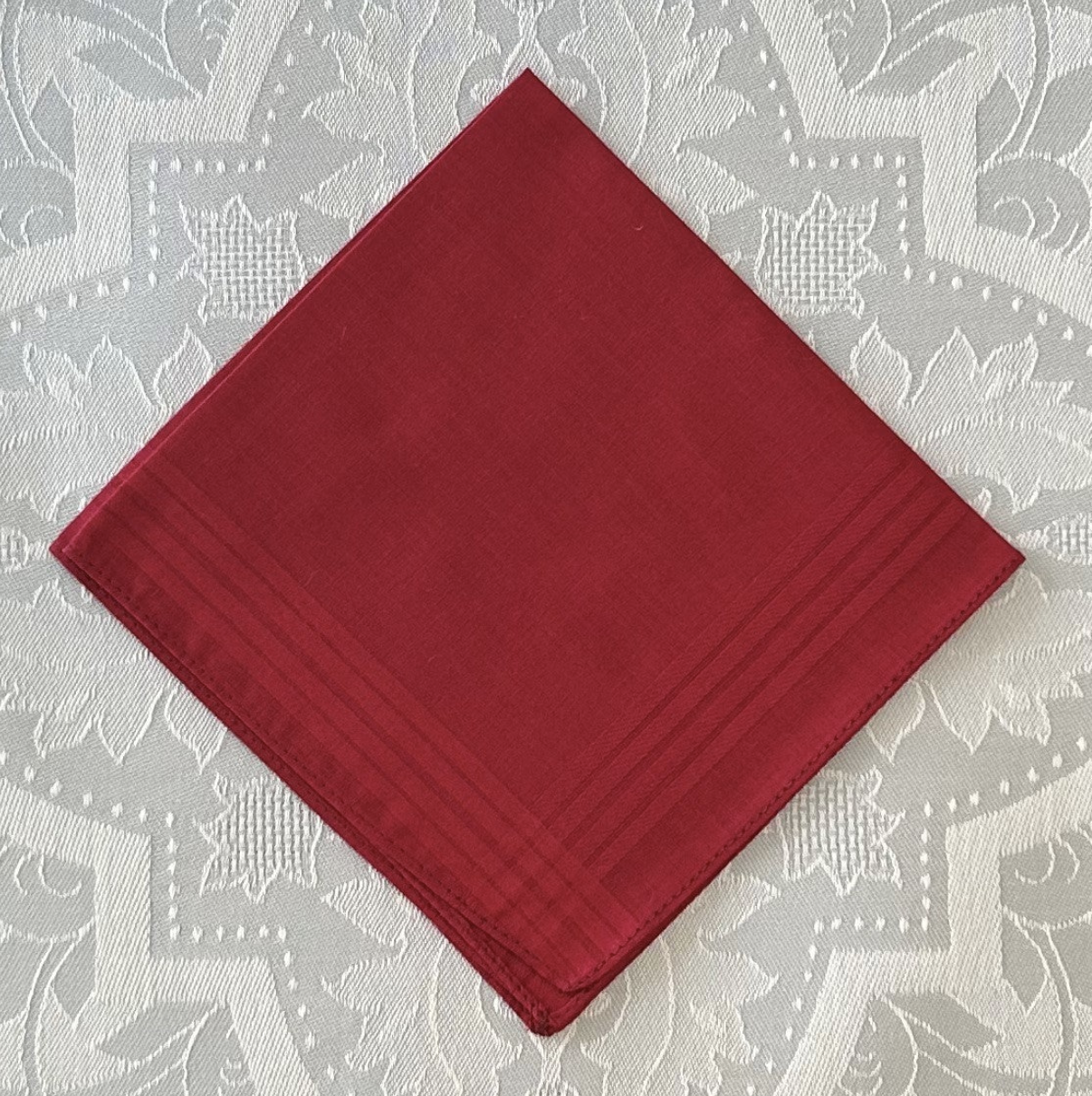
On Thursday, two days after the US election, I cycled to my volunteer gig at the craft store. Perhaps one of the last good-weather days for bike riding. No rain, trees shedding their remaining coloured leaves, a bright blue sky. The wind rushed into my face as I flew along the bike path, and my eyes started to water, which set forth a gush of tears because grief is like that. It sits inside you—a tight, impacted ball, unexpressed—and then some external trigger unfurls it like a flag. Eyes watering from the wind or a song or a television show. I cried all of the way, tears streaming down my cheeks, salt drops flying back into the wind that gave birth to them. I was happy to find in my purse a ruby-red cotton hanky to mop up the tears. Double delight.
I locked my bike then stopped at the Parsonage Cafe and waited for my order, a latte and warmed blueberry muffin with butter. The latte came first, and I asked about the muffin because I thought maybe they’d forgotten about it. The friendly counter guy said, “oh, it takes a few minutes because they warm muffins in the oven.” I smiled. When I got to the craft store, I turned on the lights and heat, cashed in, then took the warm muffin out of the brown paper bag. Two halves fell open, steaming. Salty butter had melted into the crumb to mix with soft, warm blueberries. I was expecting a little plastic tub of butter and a plastic knife, so what a delight. Thank you for doing it, delightfully, the old way. Like cotton handkerchiefs instead of Kleenex.
During my shift I met interesting people, as I do every week. Two women came in, one with an unusual looking buggy, not a baby buggy, but a pet buggy. Two zipped, mesh compartments were stacked on a wheeled frame. She came up to me immediately. “I have my two cats with me, is that okay?”
“Of course. I love cats. I’ll come to meet them.”
“This is Ronny, and this is Jimmy. Jimmy is a bit shy; you can see he’s at the back.” I could see two lean black cats—brothers I determined later—through the fine mesh. Ronny sniffed the hand I lay against the fabric. Jimmy just watched with golden eyes.
The two women browsed the store, staying a good long time. Other customers came in and out. A few years ago, I would have fretted over it. I actually didn’t know what the store policy was regarding animals. Was it okay that cats were in the store? Did other customers have allergies? Did somebody dislike cats? Were we breaking a rule? But I didn’t say a thing, and I didn’t worry. (I recognized, later, the delightful absence of worry). I just listened to the lovely chatter that fills the store and makes me want to come back and work another Thursday, even as I constantly wonder if it’s the right volunteer gig for me.
Women (mostly) talking about life and about their crafts and projects, oohing and ahhing over the treasures they find. Often chatting with me about what they’re working on, a crone stick or a pocket skirt or an appliqued cat pillow. Or they tell me whom they are buying materials for—a daughter learning to knit, a grandchild who loves stickers.
The cat owner talked with her friend, but she also spoke periodically to her cats. “Oh, Jimmy, what a nice stretch you’re having!” And “You boys are so good, so patient.” When she came to pay, she had a bag bulging with Christmas foam shapes. “I’m giving these to our craft leader at the church; she’ll have the children making wonderful things.” I don’t know for sure, but I hazard a guess that she is one of those revered creatures, a childless cat lady, the most generous and loving people around. Delight!
After my shift, I cashed out, set the alarm, turned the key. I unlocked my bike, then looked up at the darkening sky. It was only 4:15, but daylight savings is over and we’re in for early nights. I looked at my bike light and wondered how to turn it on. Somehow, I had forgotten. It had been months since I’d used it, not needing extra light during my summer rides. I tried a few things, but nothing worked, so I walked half a block to North Park Bikes. Leaving my bike just outside, I went into the store’s lower level where they do repairs. A friendly guy with a ginger beard asked if he could help. “I’m kinda embarrassed, but I’ve forgotten how to turn on my bike light.”
“Oh, don’t be embarrassed, just bring it in, we’ll figure it out.” I wheeled it in, and the first thing he tried (keep steady pressure on the + button) worked. “Thank you sooo much!” A simple, delightful thing: help asked for and freely given.
At the end of the day, I had many delights to gather (I have been inspired by Ross Gay’s Book of [More] Delightssince I finished it a few days ago; it’s just as good as the first book). Tears released into the wind, cotton hanky, butter melting into a warm muffin, sweet customers, absence of worry, childless cat ladies, help with my bike.
Sometimes a word rolls around in my mind for weeks. Lately, it’s “shed,” both noun and verb. I started to make notes about “shed” and its associations. When I saw the document file that I’d titled “The Word Shed,” I recognized a new meaning: my mind is a word shed. A space where I collect words, play with them, combine them, examine their denotations and connotations, milk their honey.
Shed the noun is a simple roofed structure, typically made of wood or metal, used as a storage space, a shelter for animals, or a workshop: a bicycle shed | a garden shed | a woodshed. Or a place to work. Last summer we met a couple at their yard sale, and they showed us the woman’s “She Shed” in the backyard. They’d built the small one-room shed during the pandemic: it was a place for her to work at home in peace and quiet. I’d never heard the term “She Shed” before. I like it better than “Man Cave.”
Michael’s drawing of an old shed located in my father and Marion’s sugar bush near Markdale, Ontario. We called it the “sugar shack.”
The Shed is a restaurant in Tofino where, two years ago on my sister’s birthday, I had a delicious salmon bowl that I recreated at home later. I knew the ingredients: salmon, quinoa, raisins, almonds, chopped apple, kale, white cheddar. I intuited a dressing of tahini, olive oil, lemon juice, garlic, honey, and yogurt. I discovered the recipe, handwritten on blue paper, in my recipe binder and realized that I’d somehow cared enough to reverse engineer the recipe, though I can’t remember writing it down.
I made the Salmon-Kale-Quinoa Bowl again the other night and it was delicious. I didn’t have white cheddar or puffed rice, so I used shaved parmesan and skipped the puffed rice.
The Shed restaurant invokes a homey feel. I remember being there with Jude and Michael, tucked into a cozy booth while rain spattered the windows and wind whistled outside. Like sitting in a warm shed on a stormy day. We walked on the beach after lunch in our rain gear.
Over the years, we’ve had two sheds built on our property for storage, bicycles, and garden stuff. Now we’re moving and clearing out the sheds. I’d forgotten about the stuff I stored there. Out of sight, out of mind were boxes of old letters, some going back forty years; kids’ artwork, writings, and report cards; notes from university courses; my old journals. Sorting and shedding and shredding old papers over the last few months has been part pain, part joy, and sometimes so funny I laughed out loud.
Another shed: On December 1, we’ll be in New York City to see Kenneth Branagh in the role of King Lear at the Shed, “a new cultural institution of and for the 21st century.” Their website explains: “We produce and welcome innovative art and ideas, across all forms of creativity, to build a shared understanding of our rapidly changing world and a more equitable society.” After a run in London, England, Branagh is bringing the play to this exclusive U.S. engagement.
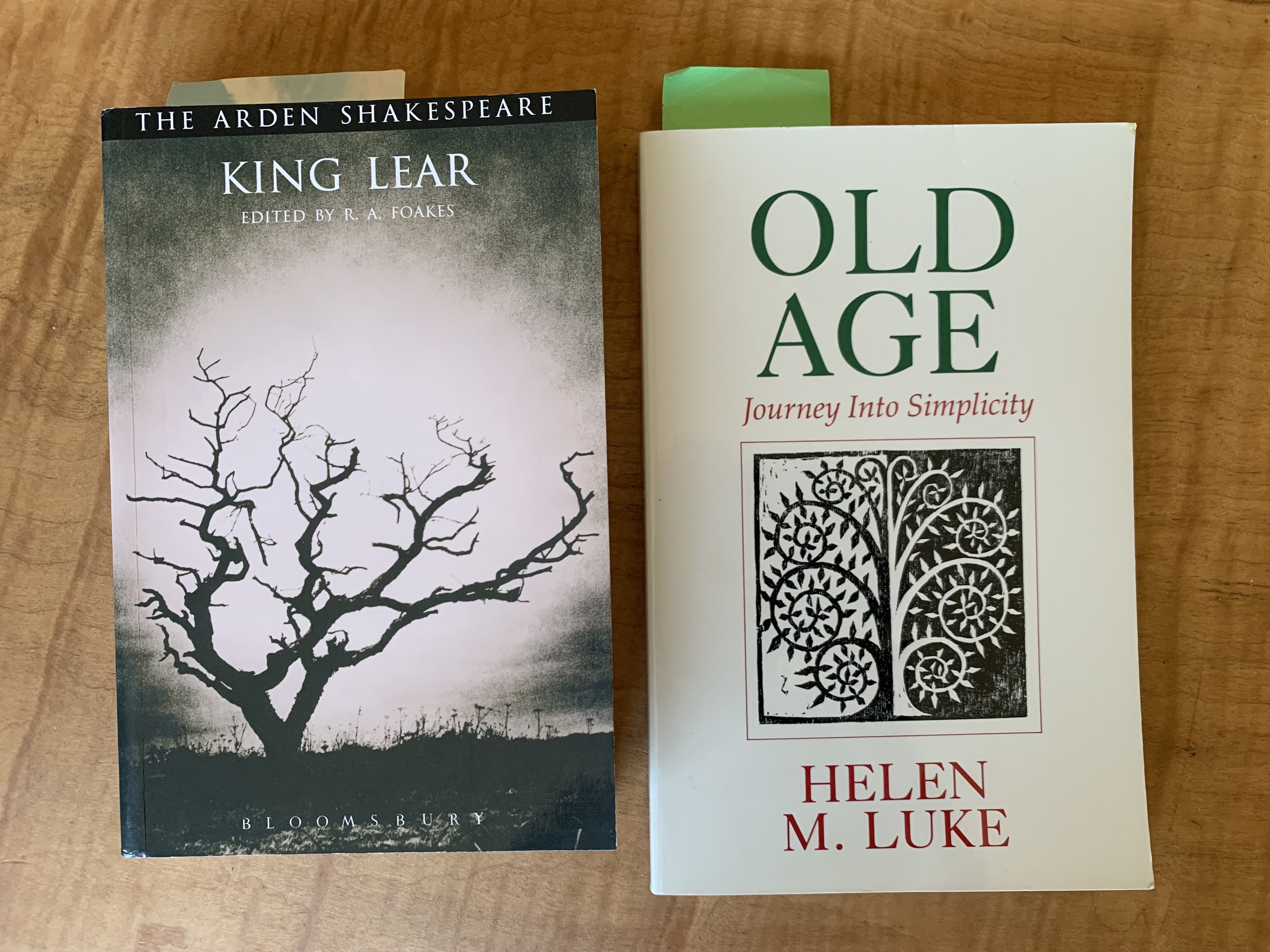
It’s months away, but of course we had to buy tickets early. It will be exciting to see Branagh play Lear in my favourite Shakespeare play. I am reading Helen Luke’s book Old Age, and the chapter on King Lear moved me, particularly when she refers to the two lines spoken by Lear to Cordelia in Act 5, Scene 3, “When thou dost ask me blessing I’ll kneel down / And ask of thee forgiveness.” Luke writes,
“If an old person does not feel his need to be forgiven by the young, he or she certainly has not grown into age, but merely fallen into it, and his or her ‘blessing’ would be worth nothing. The lines convey with the utmost brevity and power the truth that the blessing that the old may pass on to the young springs only out of that humility that is the fruit of wholeness, the humility that knows how to kneel, how to ask forgiveness” (p. 27).
Lear’s story resonates because he shows us that shedding egotism and pride may be followed by an exquisite sense of humility. Many of us experience this as we grow older. Only after Lear is hollowed out by loss can he enjoin Cordelia to “live / And pray, and sing, and tell old tales, and laugh / At gilded butterflies.” Only after loss decimates us, do we feel an unusual lightness of being. So different from the lightness of youth, this lightness we purchase with grief.
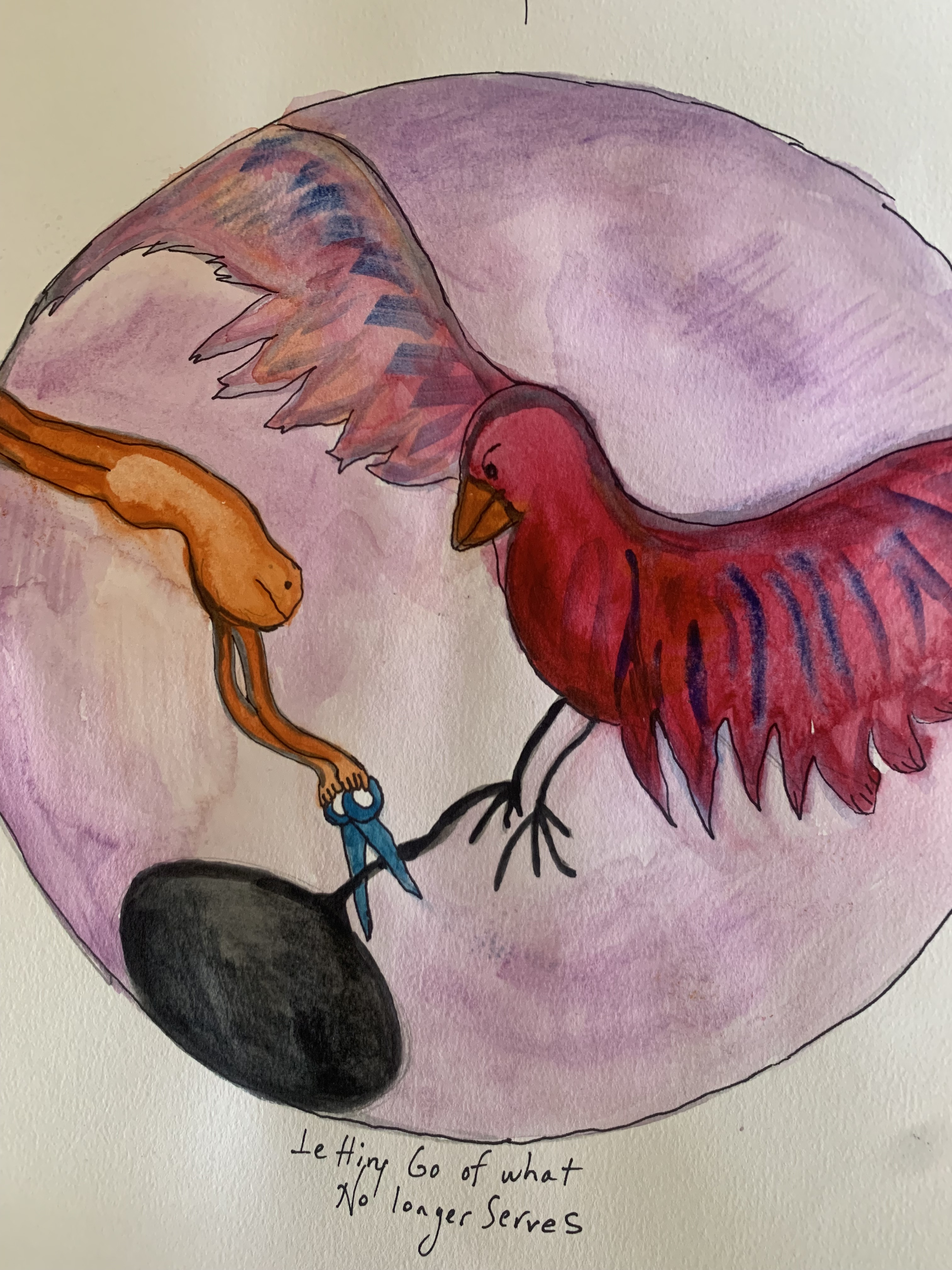
Shed your burden ~ watercolour by Madeline Walker
Then there’s the verb, “to shed.”
To rid oneself of superfluous or unwanted things or feelings…to give off, discharge, or expel, such as a cat shedding fur, a snake shedding skin, a tree shedding leaves.
Shedding blood. Bloodshed. Viral shedding. We all shed tears.
And don’t forget the intransitive verb, to woodshed: to practice a musical instrument, to work out jazz stylings, to go over difficult passages in a private place where you can’t be heard.
Isn’t it odd that the noun shed refers to a place where you store and keep and gather things, whereas the action word (transitive verb) means to let go of, release, slough off feelings, body parts, objects? These meanings are in tension with each other – one wants to keep, the other to release.
But perhaps it isn’t so odd. The tension between the noun and the verb merely replicates the push and pull we feel in our lives between holding close and letting go.
Last week, while on vacation in a small town in Mexico, I read Wintering by Katherine May. Perhaps it seems like an odd choice for a “beach read” in the sun. But the subtitle spoke to me: The Power of Rest and Retreat in Difficult Times. Something in me said—yes please! Give me permission to lay down my (figurative) sword, to retreat when things aren’t going smoothly. I was thirsty for her message that during fallow times, rather than pushing ourselves to do more, we need to withdraw and rest. We need to do less. In the book, winter is both a season and a metaphor for those difficult times; we periodically “winter” throughout our lives, not just from December to March. Wintering occurs when we encounter death, loss, illness, or other big change. When life disrupts us, shakes us up.
When May wrote about ritual, I took notice:
“We need the pauses that ritual gives us. So much of contemporary life is about the denial of personal darkness. We’re supposed to be always upbeat, always available, always bursting with energy and optimism. There’s simply no time for negative feelings… Ritual invites these things. … [Ritual] might draw attention to cyclical time, to the way that things come around again and again. That helps us to think about change, about how far we’ve come, about what we’ve lost.”
With Imbolc (February 1-2) on the horizon, I set an intention to mark the next pagan sabbat with ritual. Midway between Yule and the spring equinox, Imbolc is associated with new growth, new beginnings, hope, lambing (Imbolc is translated as “in the belly”), and Brigid, the Celtic goddess of fire and fertility. Some things we can do to mark this sabbat are to make a bonfire to symbolize the returning of the light (the darkest days of winter are behind us); create an Imbolc altar with the colours and objects associated with the sabbat; make a Brigid’s cross with reeds; and perform a house cleaning ritual: clean or declutter then “smudge the perimeter of each room with … salt, sage, candle flame, and water” and chant an incantation of cleansing as you move through the house. You can anoint doors and windowsills with “blessing oil” to prevent anything negative from crossing into your home.
These suggestions resonated. My intention was strong. I would set aside February 1st to create the altar and do the housecleaning ritual with Michael.
But a few days ago, we both got sick with Covid. Here we are on the eve of Imbolc with cotton wool heads and raspy throats, runny noses and low energy. My plan to make a day of the ritual retreated into the fallow field of sickness. So, we followed May’s message in Wintering: do less. We adapted ritual to align with healing.
Our minimalist Imbolc
For our “altar,” we used our dining room table. We spread the white tablecloth (not ironed, too much energy required). White symbolizes snow and purity. We placed a red candle from the Christmas Angel chimes into a tiny Noxema-blue jar that Olga’s son discovered on one of his beachcombing adventures. Red is rising sun; blue is flowing water. This morning, I finally managed to get out for a walk, and we passed our local farm-stand florist and picked up a “pixie bouquet” ($10). There were no daffodils or snowdrops (the flowers suggested for an Imbolc altar) available. Just red and orange flowers, which is fine because they conjure the rising sun and Brigid’s fire.
We collected the remaining items for our altar and ritual: a smudging stick I’d bought at a local garden stand a few years ago, a small pottery bowl filled with water, a fertility figure reminiscent of the Venus of Willendorf, and a sheep to symbolize “in the belly” and lambing season. Okay, strictly speaking it’s a ram, but we had to adapt.
Lambing season
When I think of lambing, I think of “the farm”: my father and stepmother’s 50-acre property in Bruce-Grey County, Ontario. They kept sheep for many years, and one winter I visited during lambing season. I remember my father getting up throughout the night to check on the heavily pregnant ewes. I went out with him once: I have an image of his hands slippery with blood in the dim, cold barn while he helped with a difficult birth. Afterwards, we watched carefully to make sure the newborn suckled properly. A rhythmic quiver in her long tail showed she’d latched on and was getting first milk.
Looking back, I now recognize the courage and commitment my father and stepmother must have had to buy those 50 acres and take that leap of faith. My dad, a city guy who fled academia, totally immersed himself in farming. He read everything he could about it and talked to the locals, hungry and humble in his search for knowledge and skill. Always experimenting, working hard, taking risks, living his dream. Facing all of the inevitable challenges and bad times farmers have. Being a so-called hobby farmer didn’t make him immune to bad weather, problems with stock, foxes killing the chickens, electric fences falling down, money shortages. Marion worked alongside him and also worked full-time as a nurse to finance the farm operations. Despite the challenges, they experienced much satisfaction and joy. Dad and Marion, I am so proud of your daring and adventure, your bravery and strength.
Cleaning and ritual
We didn’t have the energy to clean the whole house, so we chose just one thing: the bookcases. After removing the pottery and other knick-knacks, we dusted the shelves and the books’ spines and tops. We wiped down the objects, sorting out things that we no longer wanted. When the cleaning was complete, Michael found an incantation online that we said together as we moved clockwise through the house, flicking water from the little bowl, letting the earthy-sweet sage smoke float into the corners of the rooms. Brave red candle lit the way, and Marvin followed us from room to room.
With the purifying power of water, With the clean breath of air, With the passionate heat of fire, With the grounding energy of earth We cleanse this space
May the goddess bless this home, Making it sacred and pure, So that nothing but love and joy Shall enter through this door.
I worried a little that we were doing it wrong…but what’s right and what’s wrong? We made the ritual our own. We paused today to focus on the cycle of life and seasons. We purified our home for Imbolc, and we did it imperfectly.
Recommended Imbolc reading
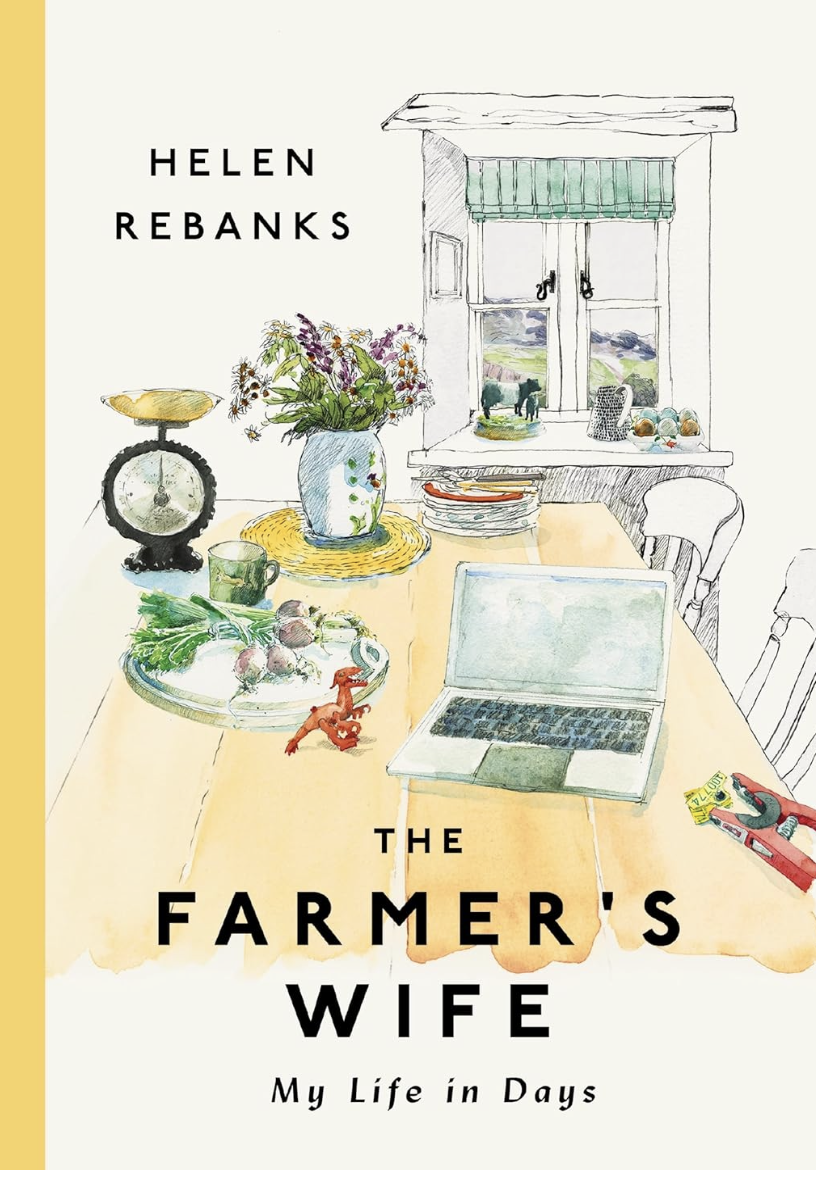
The Farmer’s Wife: My Life in Days, by Helen Rebanks. This heartfelt book, peppered with recipes, is an honest and passionate account of farming and raising a family in the Lake District, UK. There’s lambing, of course, but there is so much more. Rebanks writes about women’s role in farming: they often do all of the mundane, quotidian work that goes uncelebrated. So she celebrates the farmer’s wife by showing the importance of domestic and indoor work. I loved reading her descriptions of daily minutiae: the shopping, cooking, childcare, all mixed with tagging lambs’ ears, shovelling snow, gardening, and other outdoor chores. An equally important aspect of the book is her persuasive argument that we must support local, sustainable, biodiverse farms—such as theirs—to ensure a healthy future.
I start the year with a glance back over 2023. Last year, creativity often eluded me. She was a timid fox, hiding in her hole. I tried to lure her out, but at the first sign of self-doubt, she’d scurry back down the tunnel. Making things—in cloth or paint, in the kitchen, with words—can feel pointless in the face of climate crisis, grief, war, and ennui. And yet, don’t you think we must continue to create as an antidote to all the destruction?
When fox stayed out long enough, she inspired me to bake cakes, sew things, paint mandalas, and write stories and poems.
Baking
I love making cakes and preparing gifts for people. I fantasized once about starting a small business: I could make bespoke cakes and gifts to order (quilted bookmarks, small herb bouquets from my garden, stones from the beach that feel good in your hand). Nice idea, but maybe not a great business move.
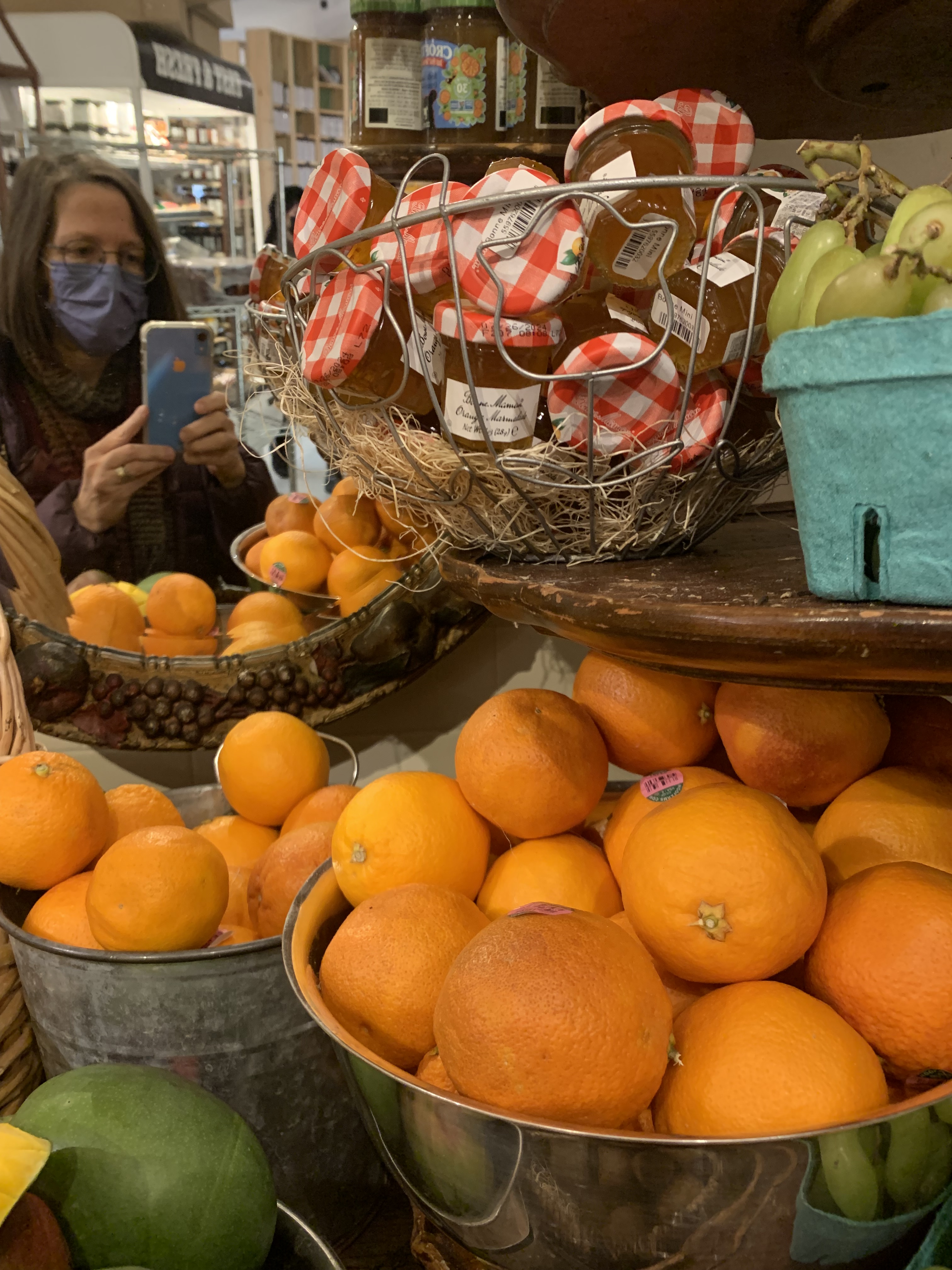
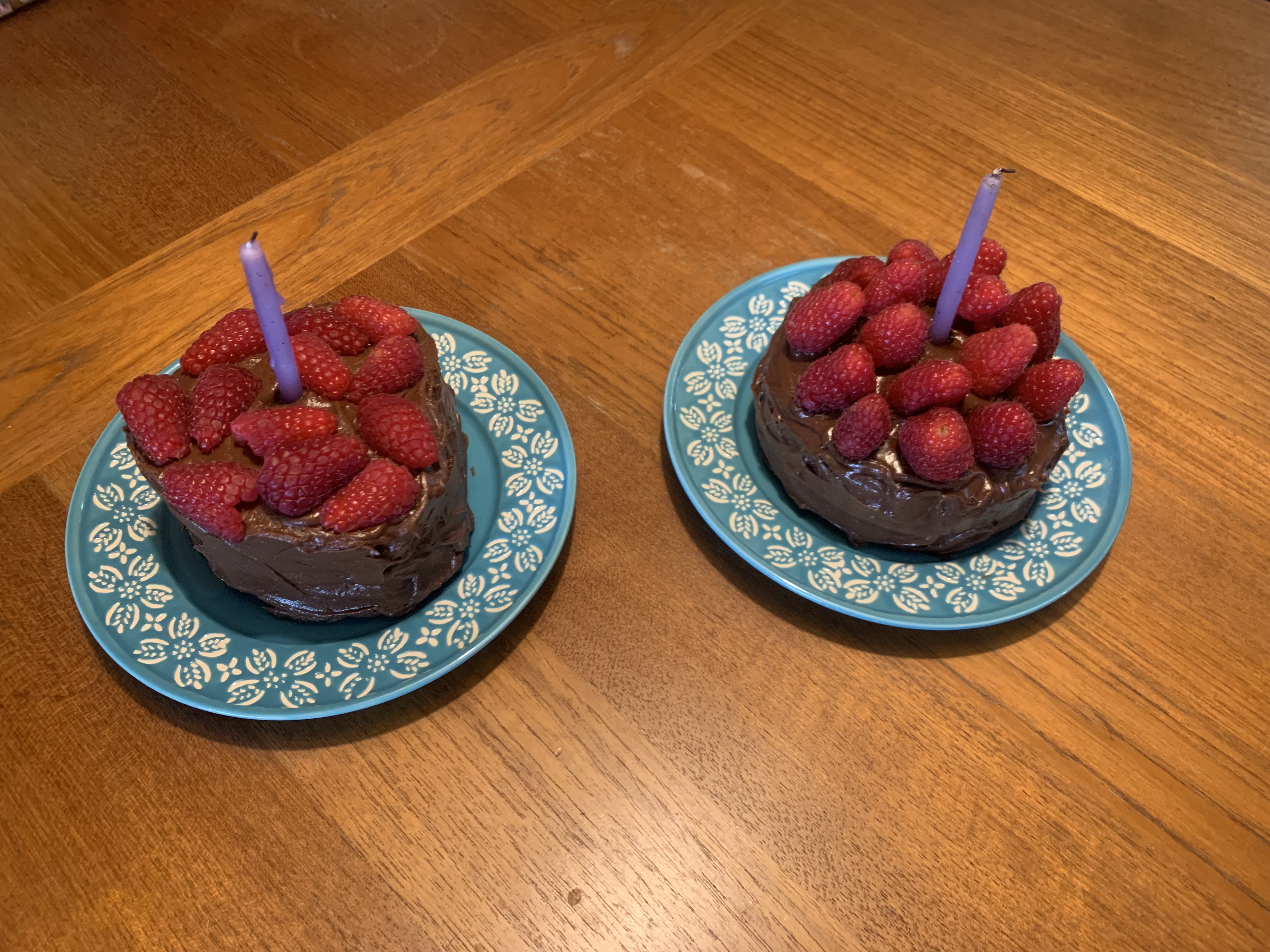
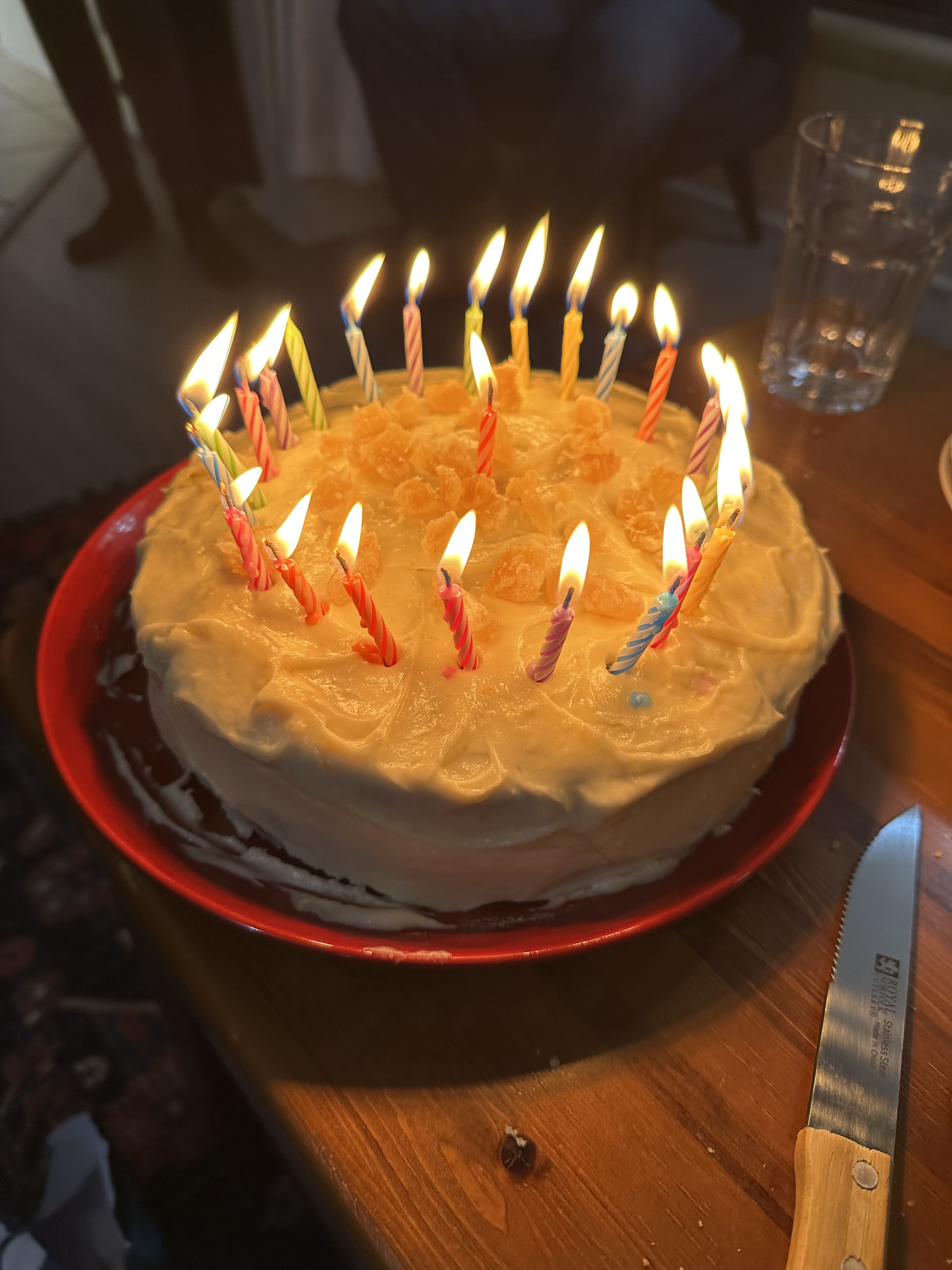
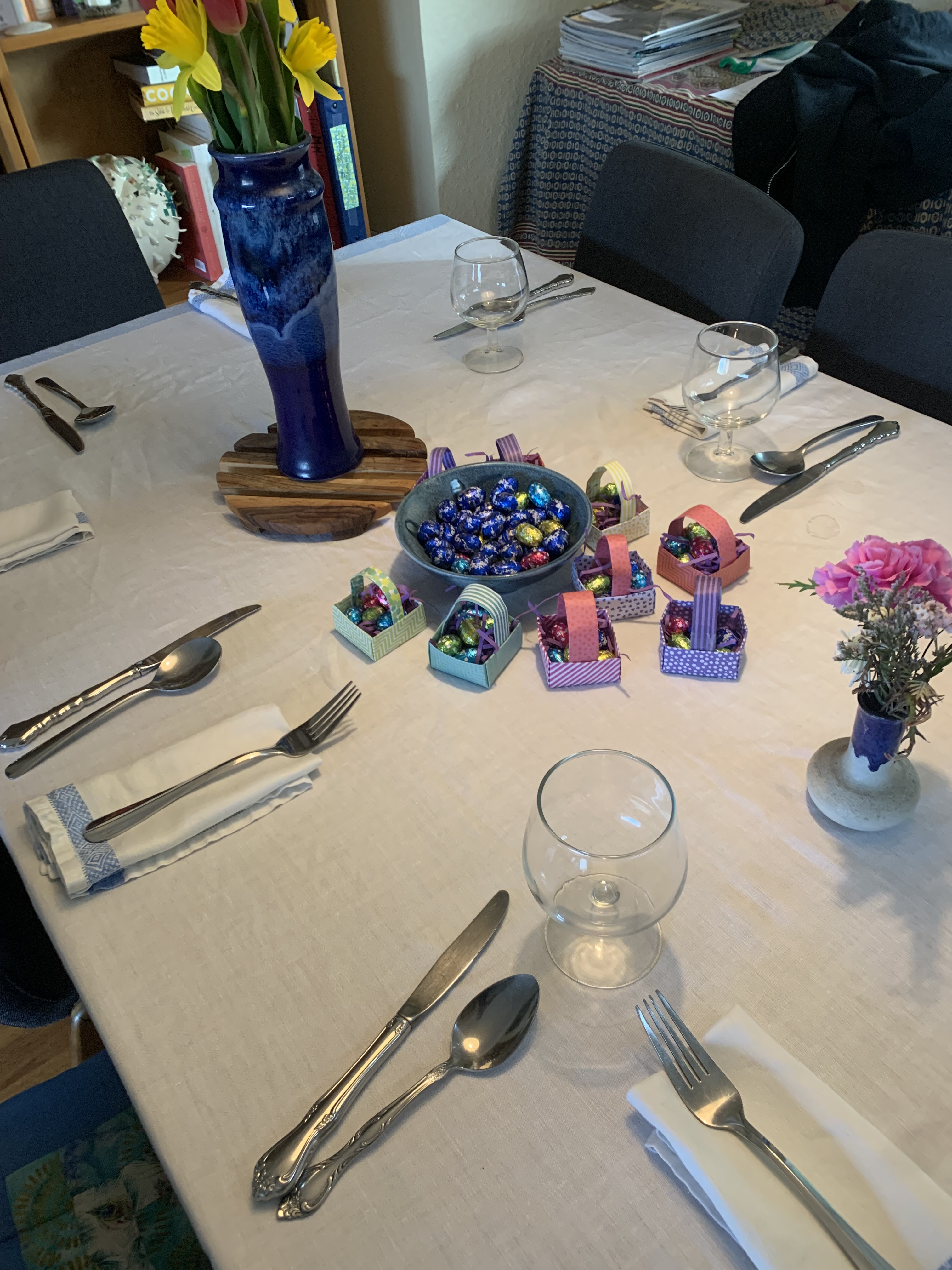
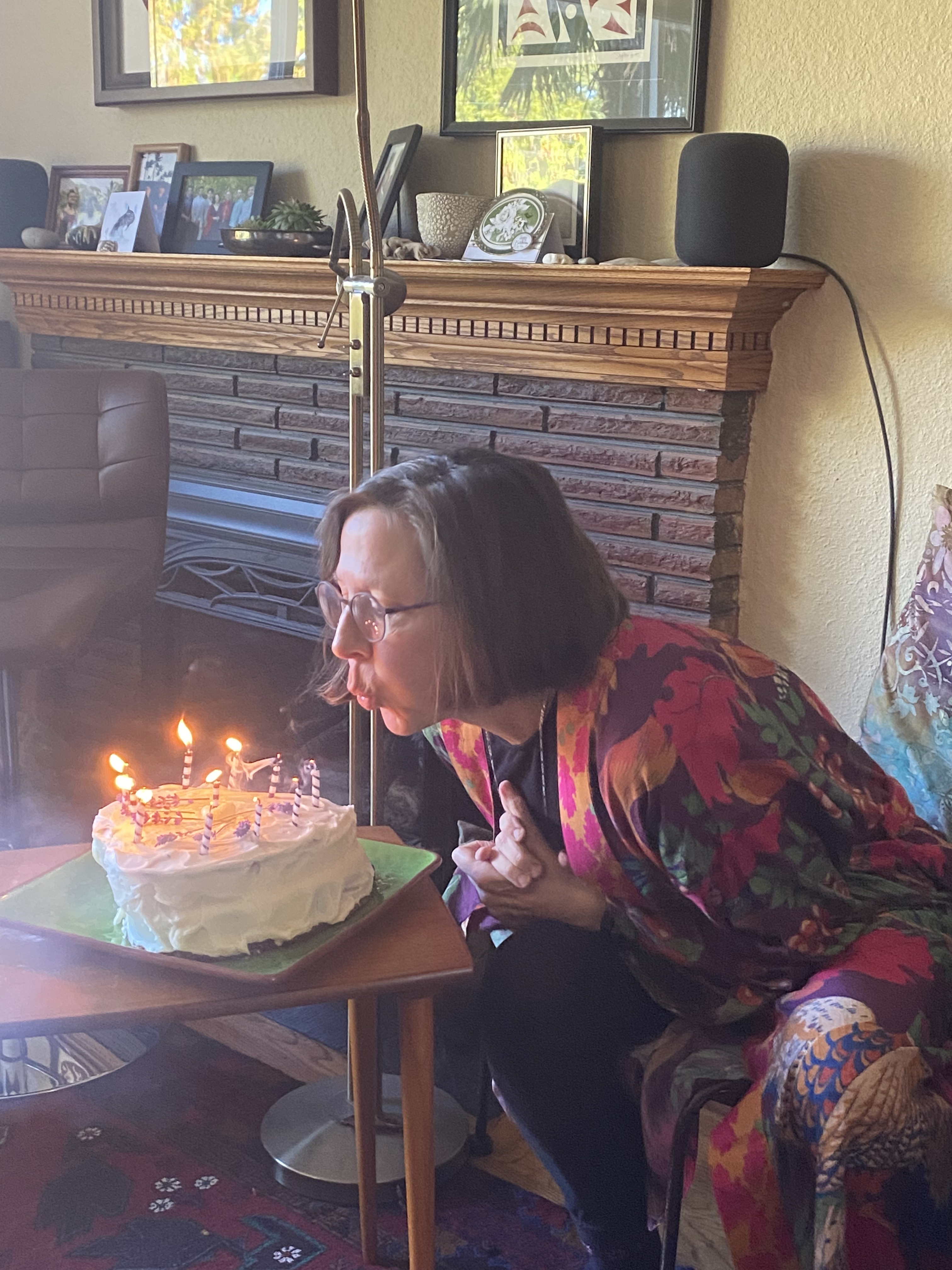
This year Michael got an upside-down blood orange cake for his February birthday, and we had fun sourcing the oranges. Found some good ones at the Market Garden on Catherine Street (where shoppers sometimes sit down to play the grand piano—such a cool store). I baked mini-chocolate cakes with strawberries later in the month for Barbara, and for Easter, an almond torte with whipped cream and more strawberries. Like my mother before me, I love to set a beautiful table, and Easter was no exception. The origami Easter baskets filled with foil-wrapped chocolate eggs provided a whimsical touch. (Entertain your inner child, I say.) For my own birthday party, a classic carrot cake baked in a heart-shaped pan frosted with cream cheese icing. For Andréa’s big five-oh: applesauce cake with three kinds of ginger. And for the final English conversation café at work: ginger cake with buttercream icing. What is it about a cake that speaks pure love?
Sewing
I didn’t make any new quilts, but I did sew a purple wall hanging, about 30 by 30 inches, that now hangs in our bedroom. I like to lie in bed and gaze at it. Four sentinel circles surround a larger one—all shot with gold thread (fragments cut from an old wraparound skirt from a yard sale). Those circles/mandalas ground me; cloth clocks tick noiselessly, watching over us as we sleep.
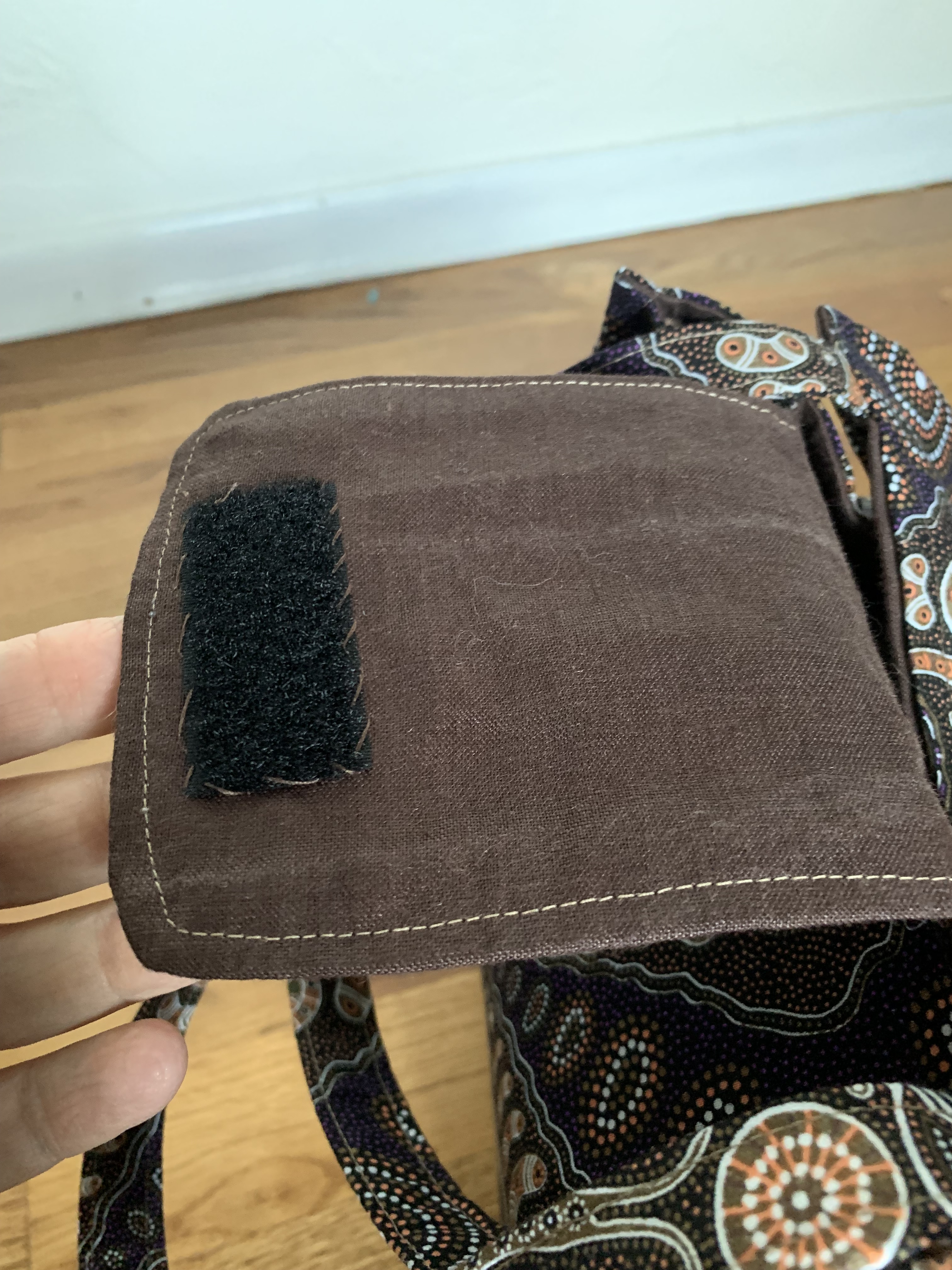
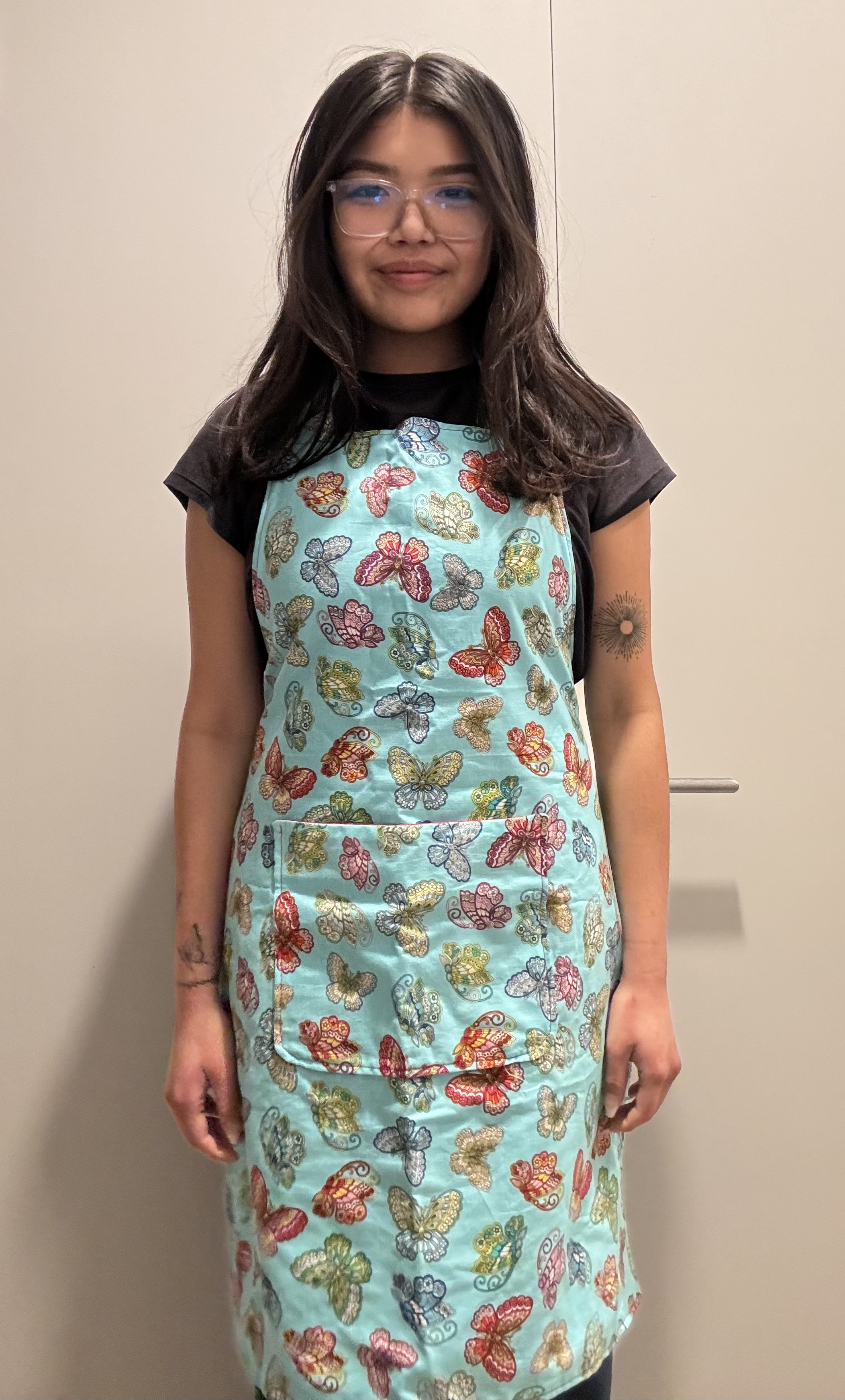
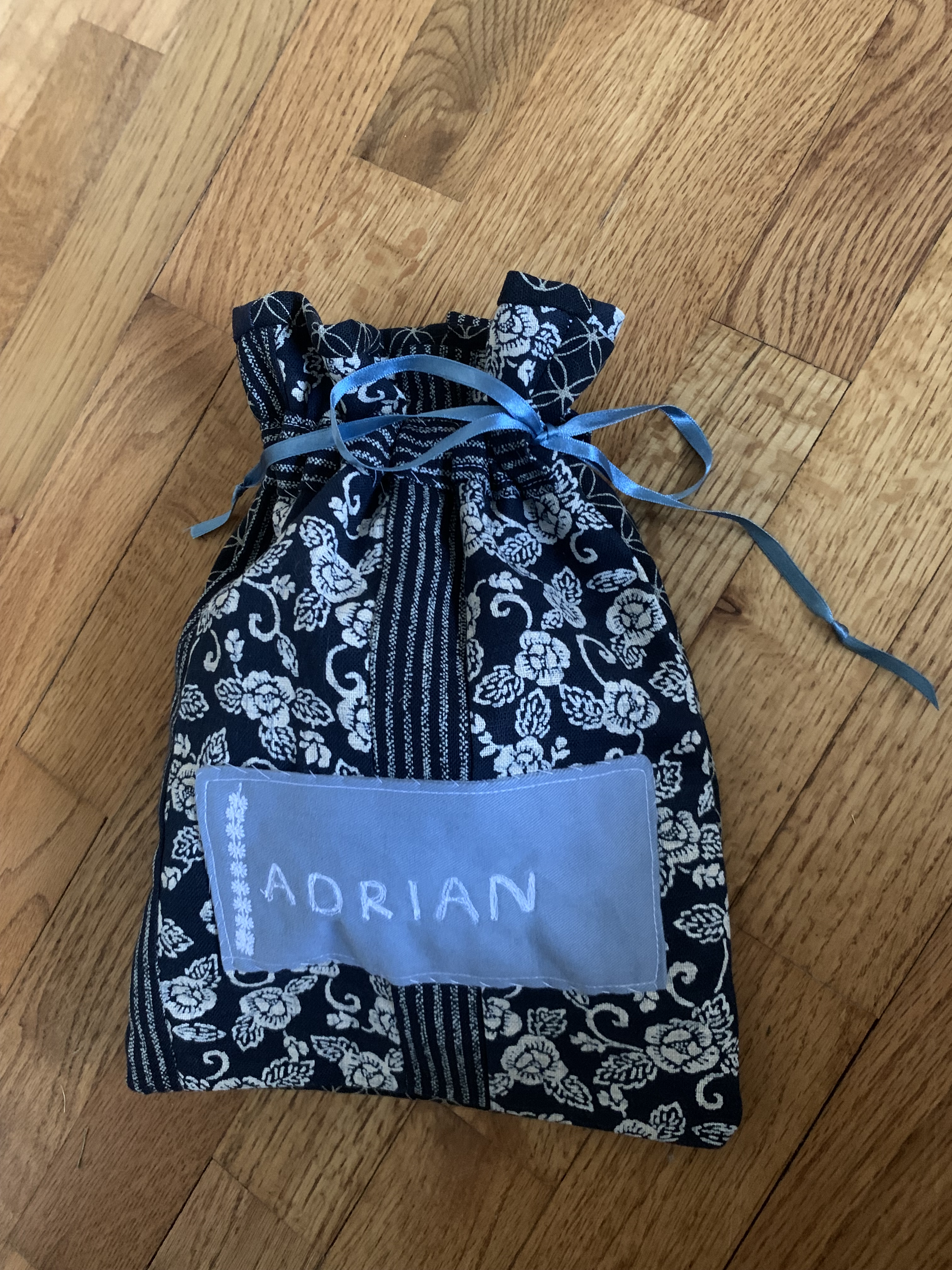
Smaller sewing projects attract me because results come together quickly. My sister Kathryn bought me a drapery panel of Indonesian fabric in browns, reds, and purples at a thrift store. A lot of fabric—40 by 83 inches—for only $4. I’ve enjoyed making some things from it: placemats and napkins mostly, and a sweet little fabric basket (I made a few of these for friends for Christmas, then filled them with chocolates and gifts). I felt most proud of the lunch bag I made for my boss, Nancy, because it tested my skill. I used fabric in a brown geometric pattern by an Australian Aboriginal designer. Then I lined the bag with sturdy brown linen from a too-big jacket I bought at a yard sale down the street. Nancy loves it. Adrian’s bag (filled with toys) for his second birthday involved some great scraps I bought from Smoking Lily on Government Street. Finally, I sewed a butterfly apron at Christmas for my niece. She is beautiful in any outfit, even an apron.
For my 65th birthday party (the theme was poetry and potluck), I made fabric wrappers for second-hand poetry books I bought for guests. So fun to comb through my stash and find colours and patterns that sing together. Party favours were fun when you were a kid, and they are even more fun when you’re an adult. Again, entertain that inner child…
Making Mandalas
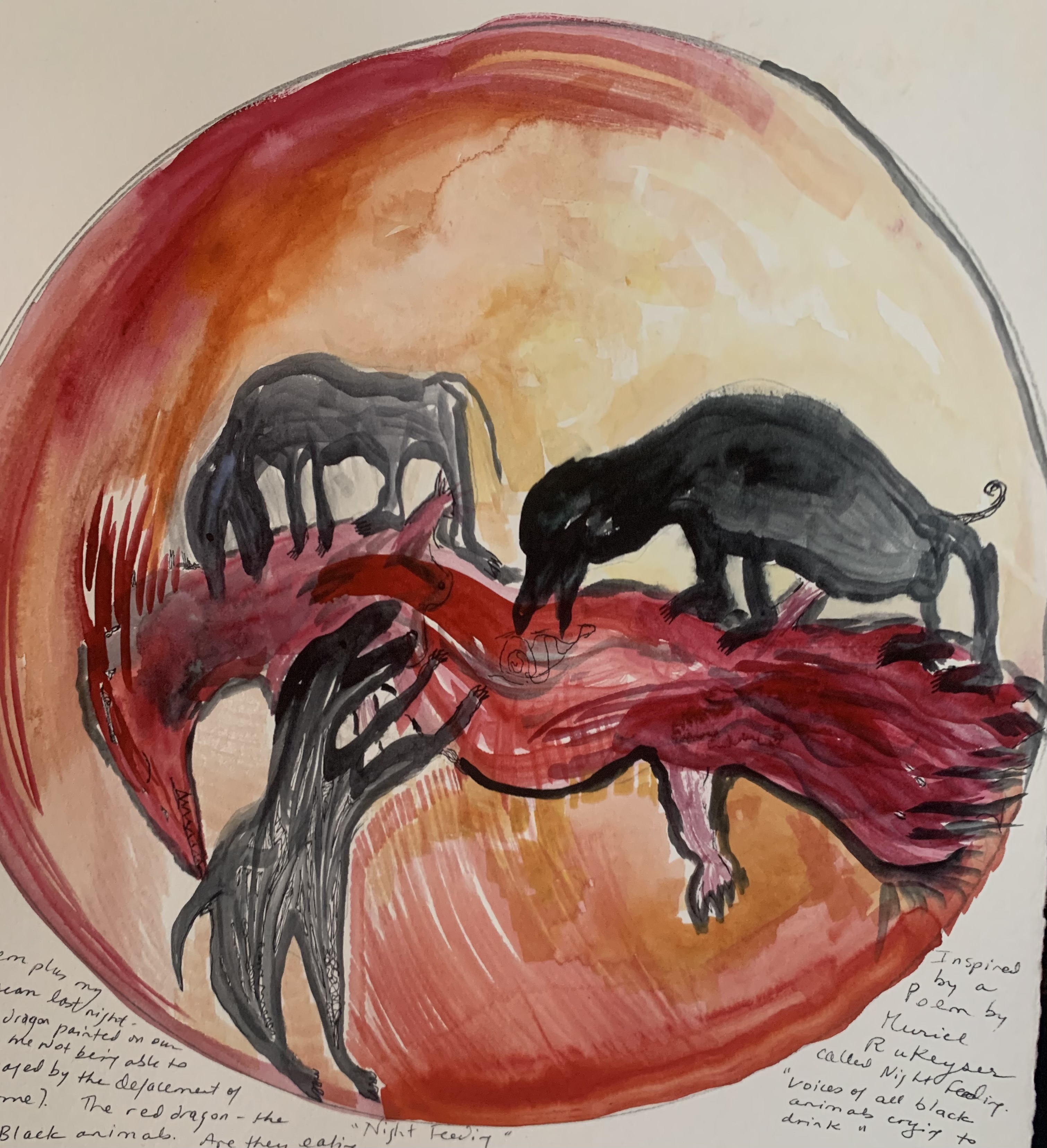
Michael and I had a Monday Mandala practice for a while, but it fizzled out sometime during the year. One exciting project: we delivered a multi-day mandala-making workshop in March and early April on Zoom. Our participants were mostly from New Mexico—all lovely, open-hearted women. It was a good experience. Michael was a guest presenter at two Creating Mandala monthly events. The CM team featured a new goddess each month, and Michael chose to talk about the High Priestess (Tarot) and Kali (Hindu goddess associated with death). I attended both of these events with pride and pleasure. Some mandalas last year were inspired by dreams—a rich transmutation. I dreamed I entered a room in my house and found that someone had painted on my white wall a red dragon being devoured by three beasts. Still musing on the meaning of that one.
Writing
Here’s where the fox was most recalcitrant. I aborted so many poems, blogposts, and stories last year, I am surprised to find anything in my files. I posted on this blog only five times in 2023. However, I did complete a series of linked short stories (started in previous years): Nothing is Wasted: The Stan and Deedee Stories. I shared them with a few friends and family members. If you are interested in reading them and you’d like a digital copy, let me know (maddyruthwalker@gmail.com) and I will send you one.
Some months, I had nothing new to share with my writing group. I’d scour the old folders for some scrap from the distant past to read. Or I’d just listen to others read their work. But that’s okay. I know that I’ll write again. When nothing seems to be happening, the fox is deep in her hole, pregnant with kits. How many will be born and when? Just have faith.
I wrote only a few poems in 2023, and one was for my birthday. Each guest was asked to bring a poem to share. It was extraordinary to see my friends and family members get up into the poetry seat and read poems they’d chosen, poems they’d written: one of the best gifts I’ve ever received. To close the offerings, I read my own poem– one that expresses the expansiveness I feel as we enter 2024. Happy New Year to you!
Expansion

I started slim
and willowy.
Then, whoosh of years.

My waist - heavy as grief,
soft as dough -
expanded.

Grief. Have you met her?
Well then you know the
grace that she bestows.

Hard things—she
cracks them open,
ignites a hotter flame,
imbues a deeper shade of red.

So, like my waist,
my heart’s made wide by grief,
a vast container for the love I feel
for trees, and animals, the sky,
the planet, for you, my friends,
for people everywhere,
for life expanding.








































 Madeline Ruth Walker