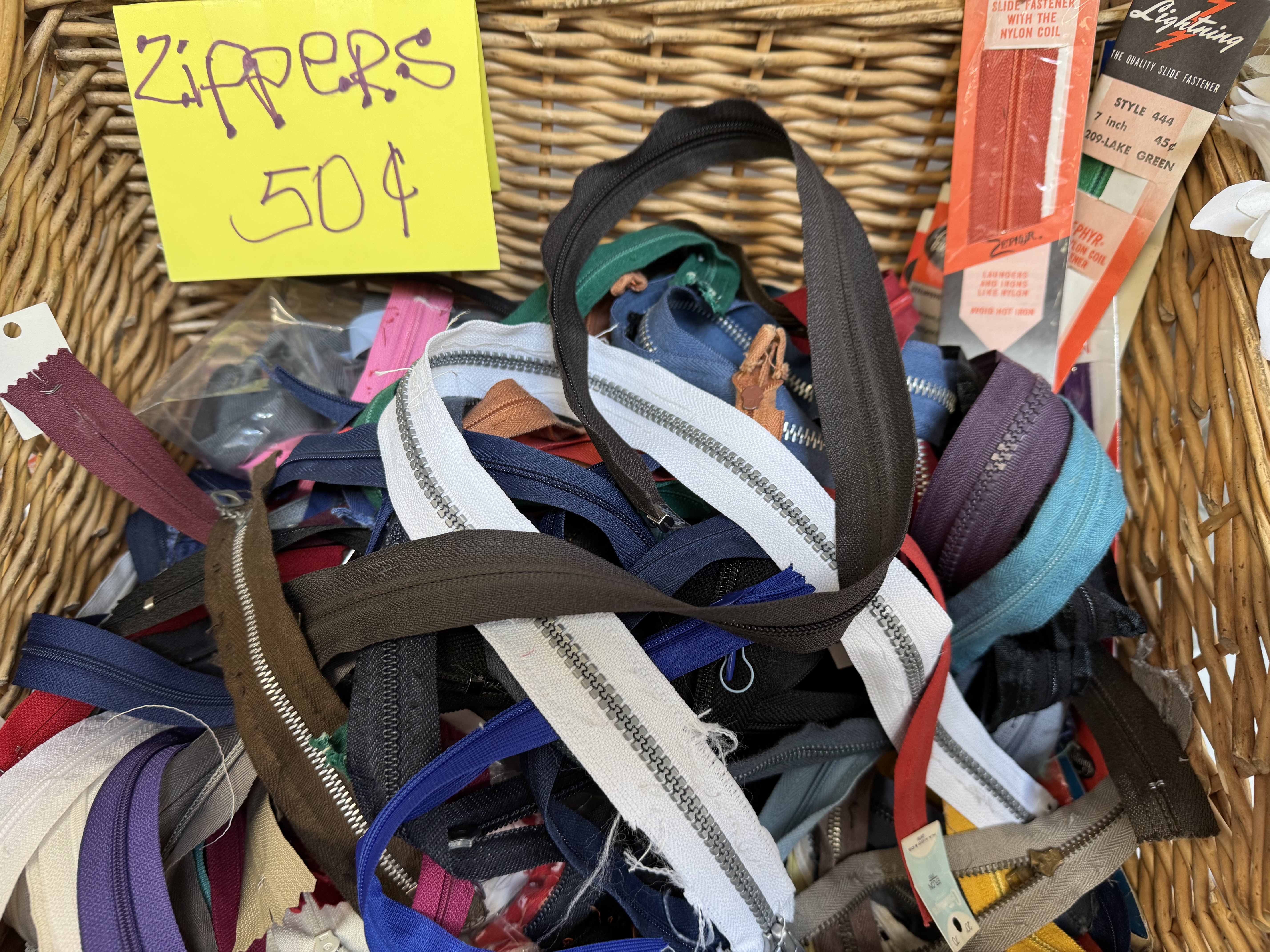
Zippers are fifty cents; Stories are free

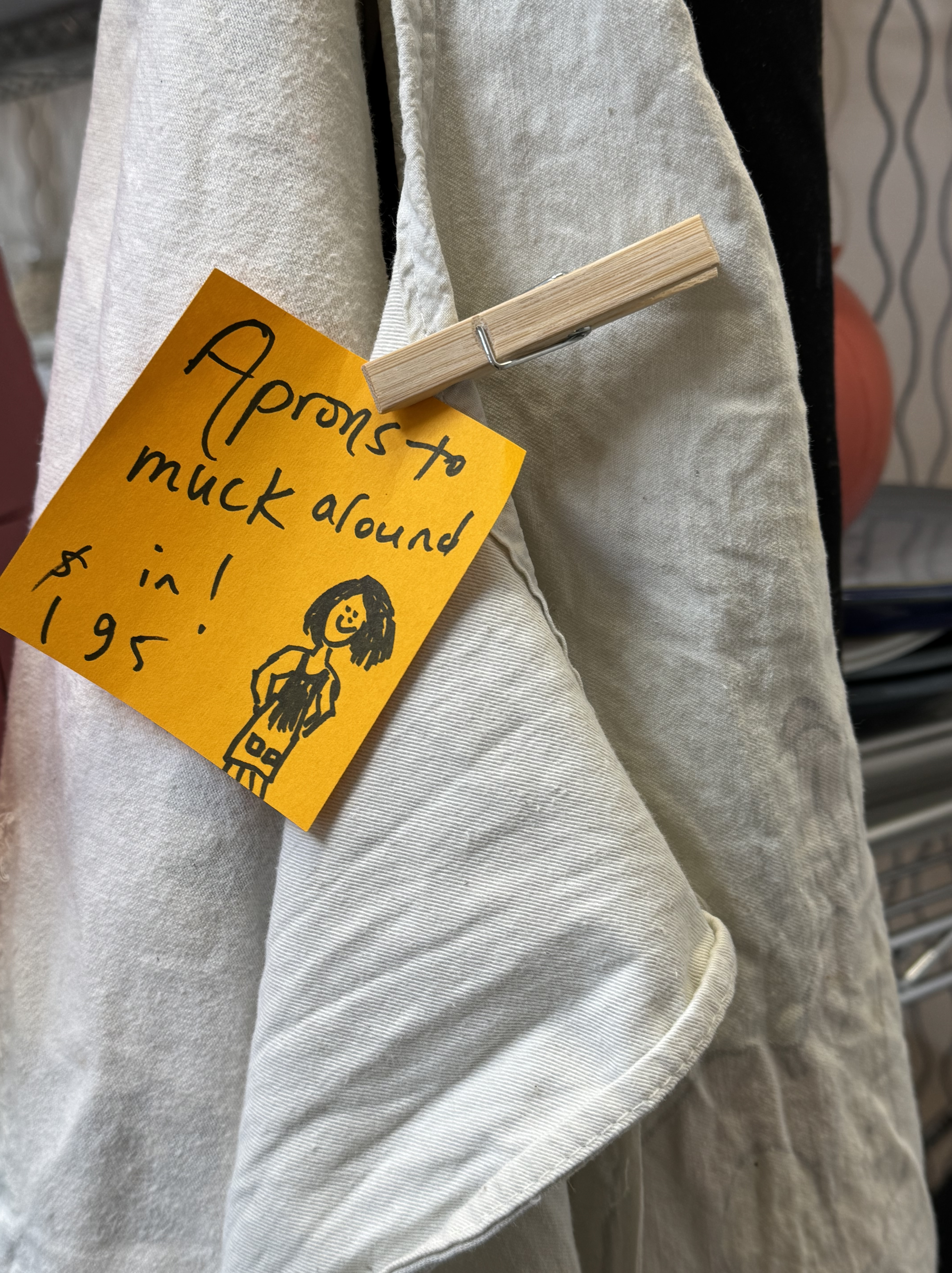
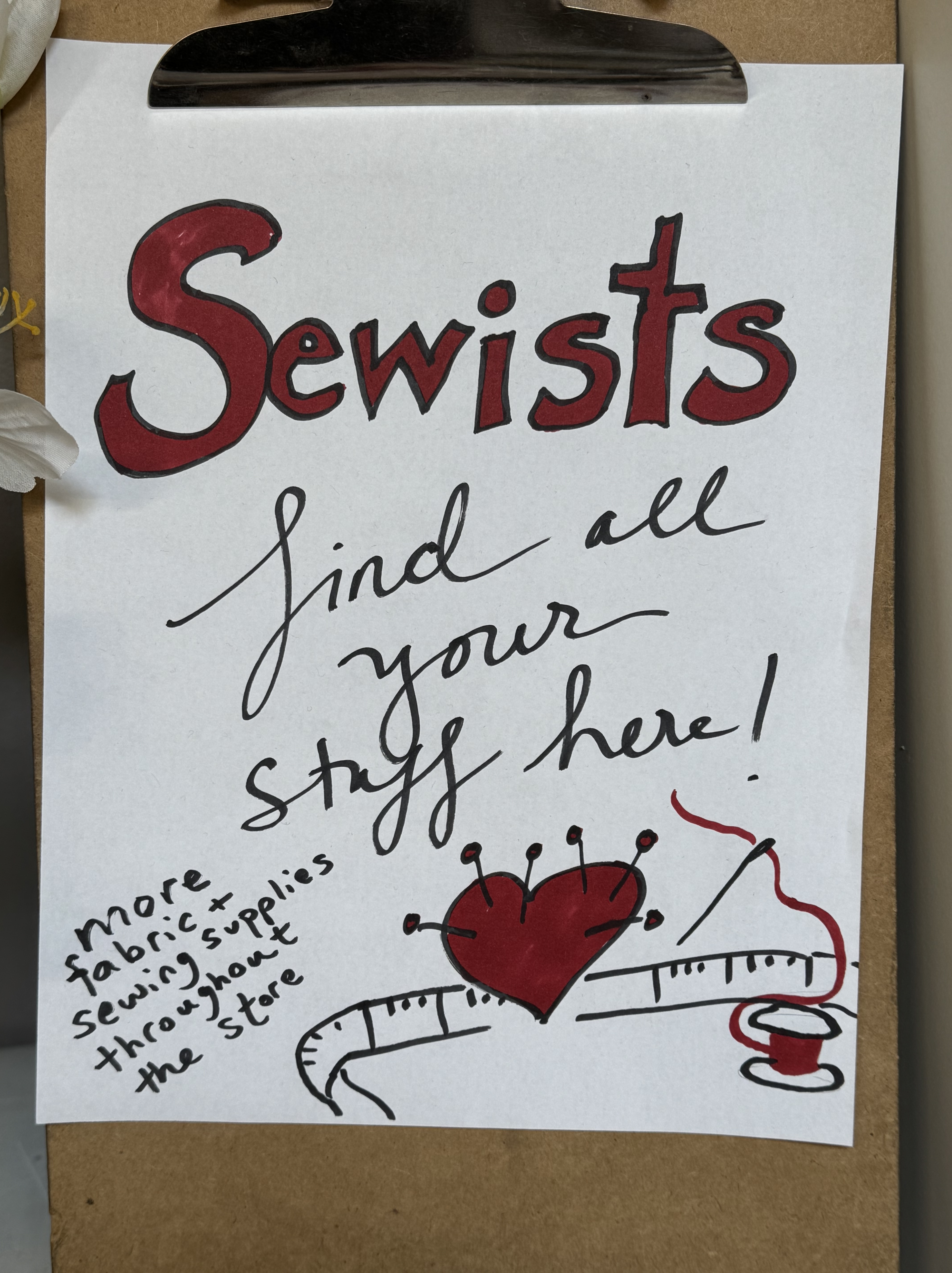
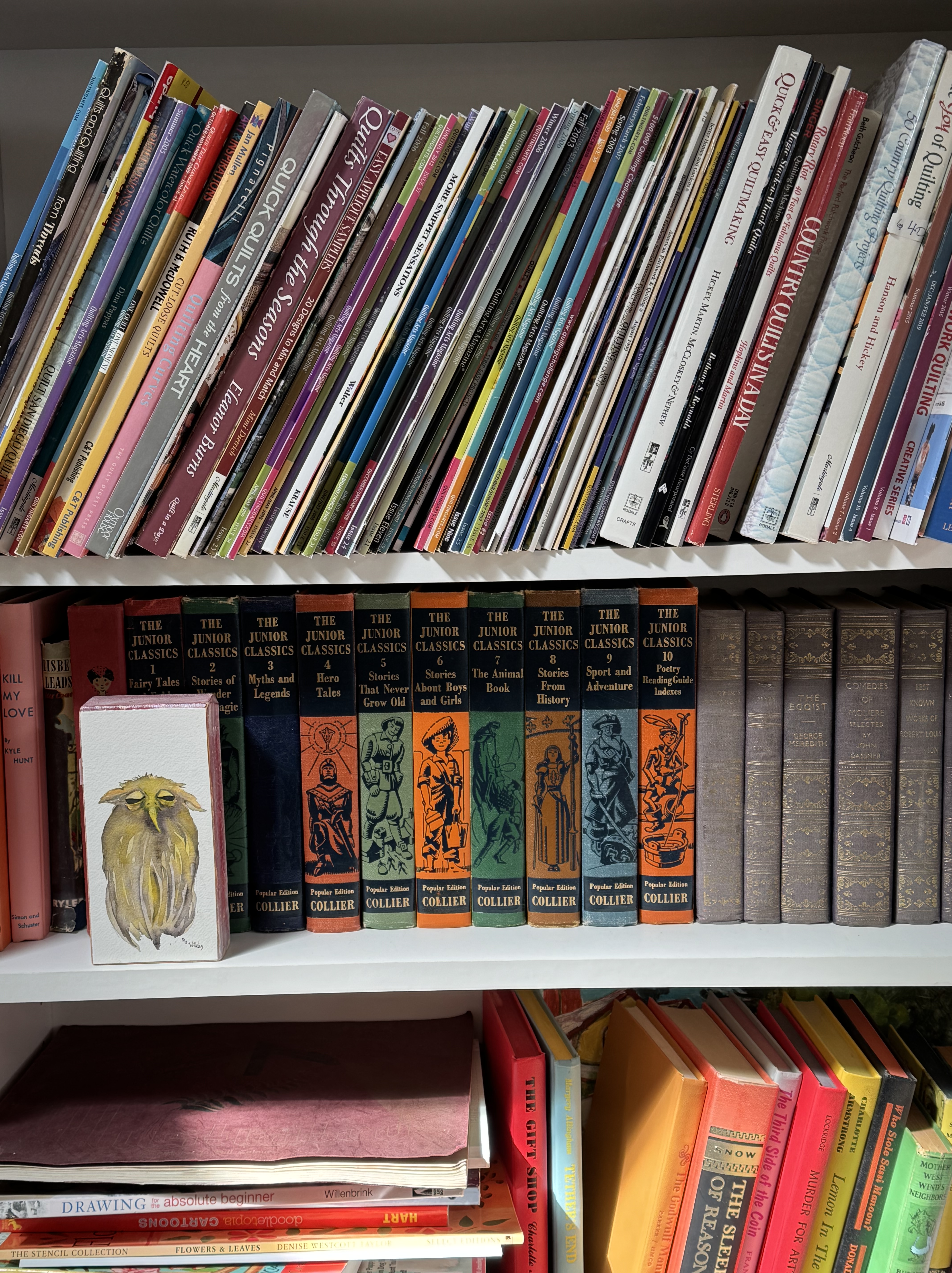
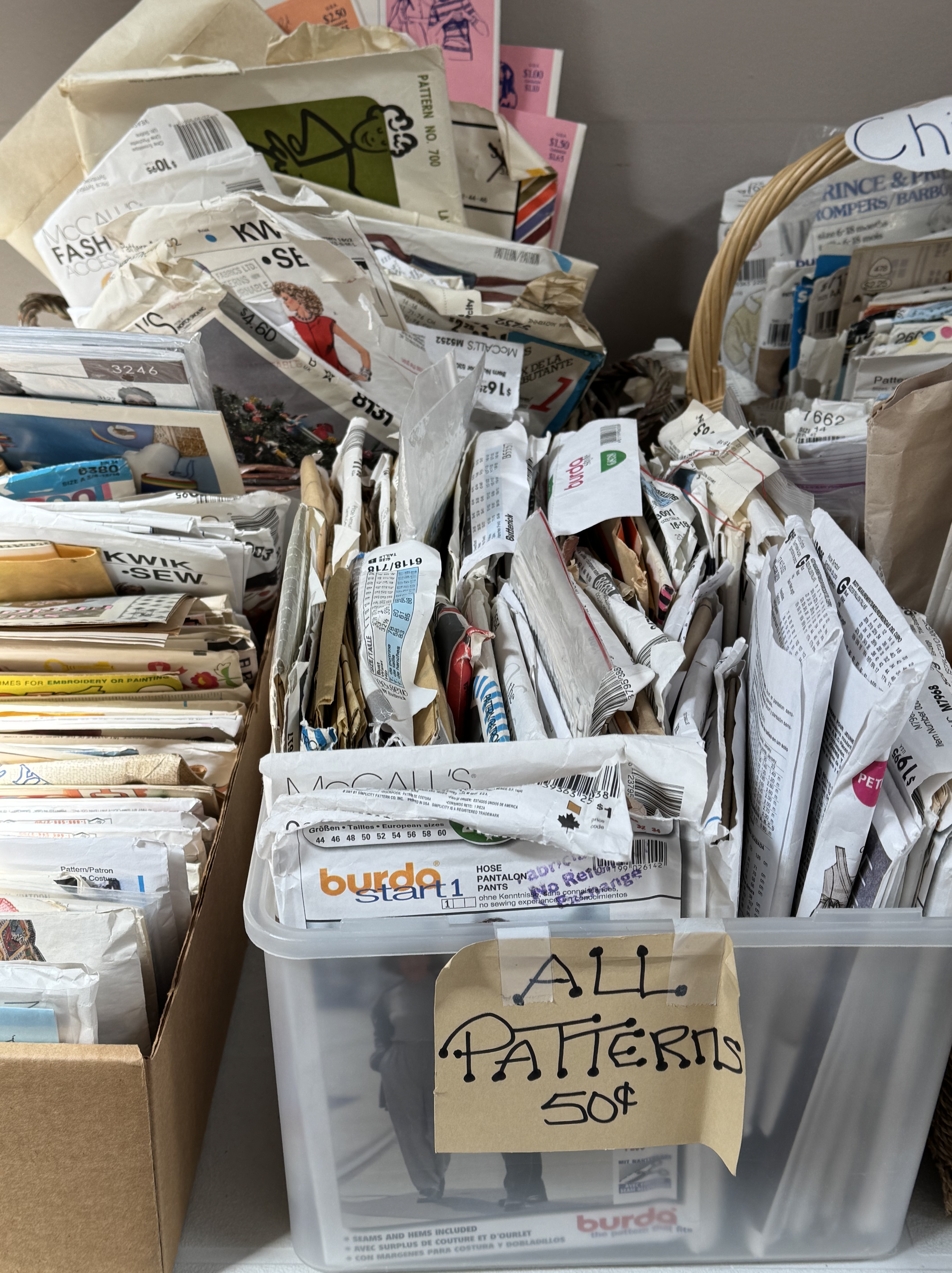
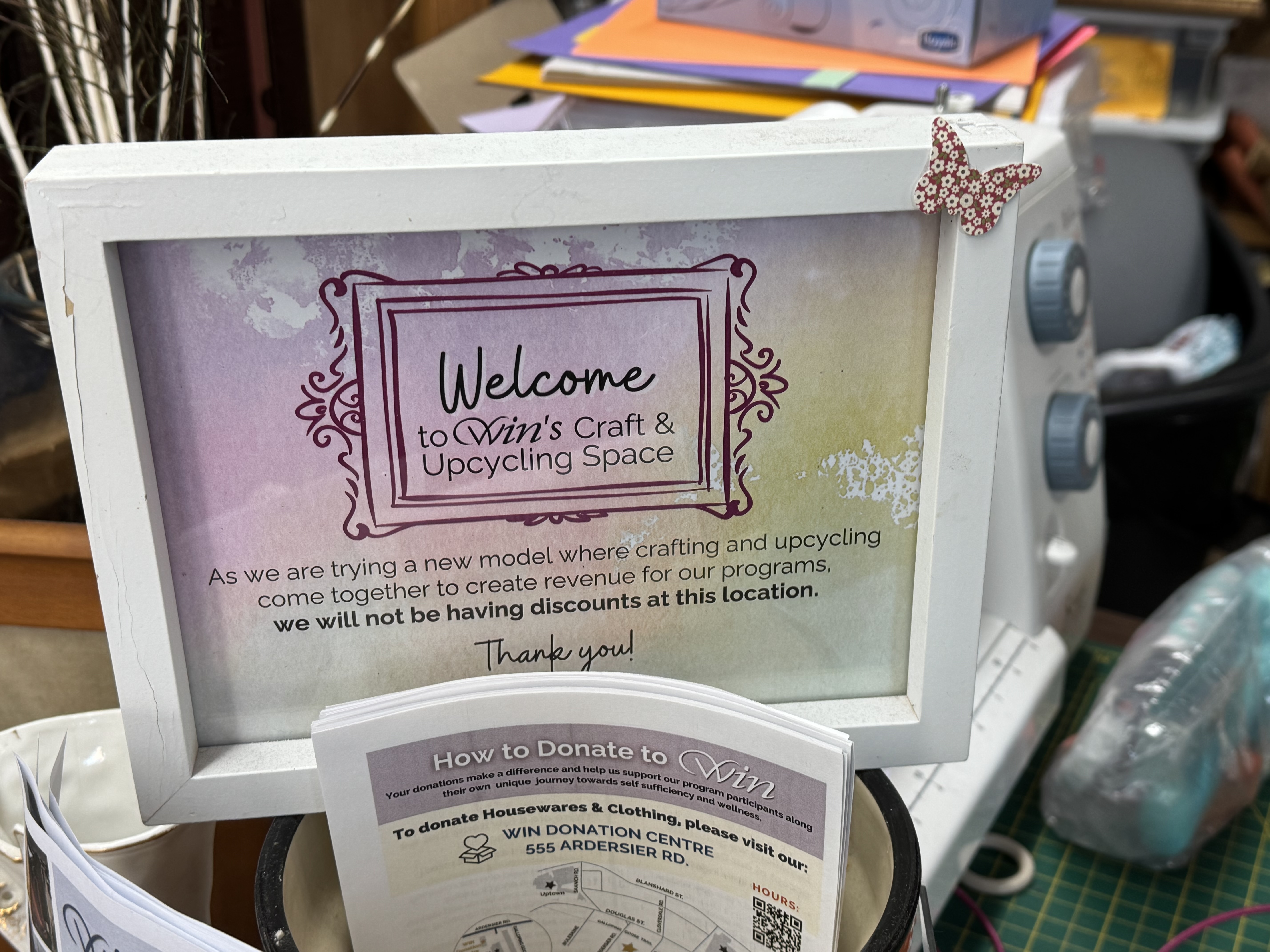
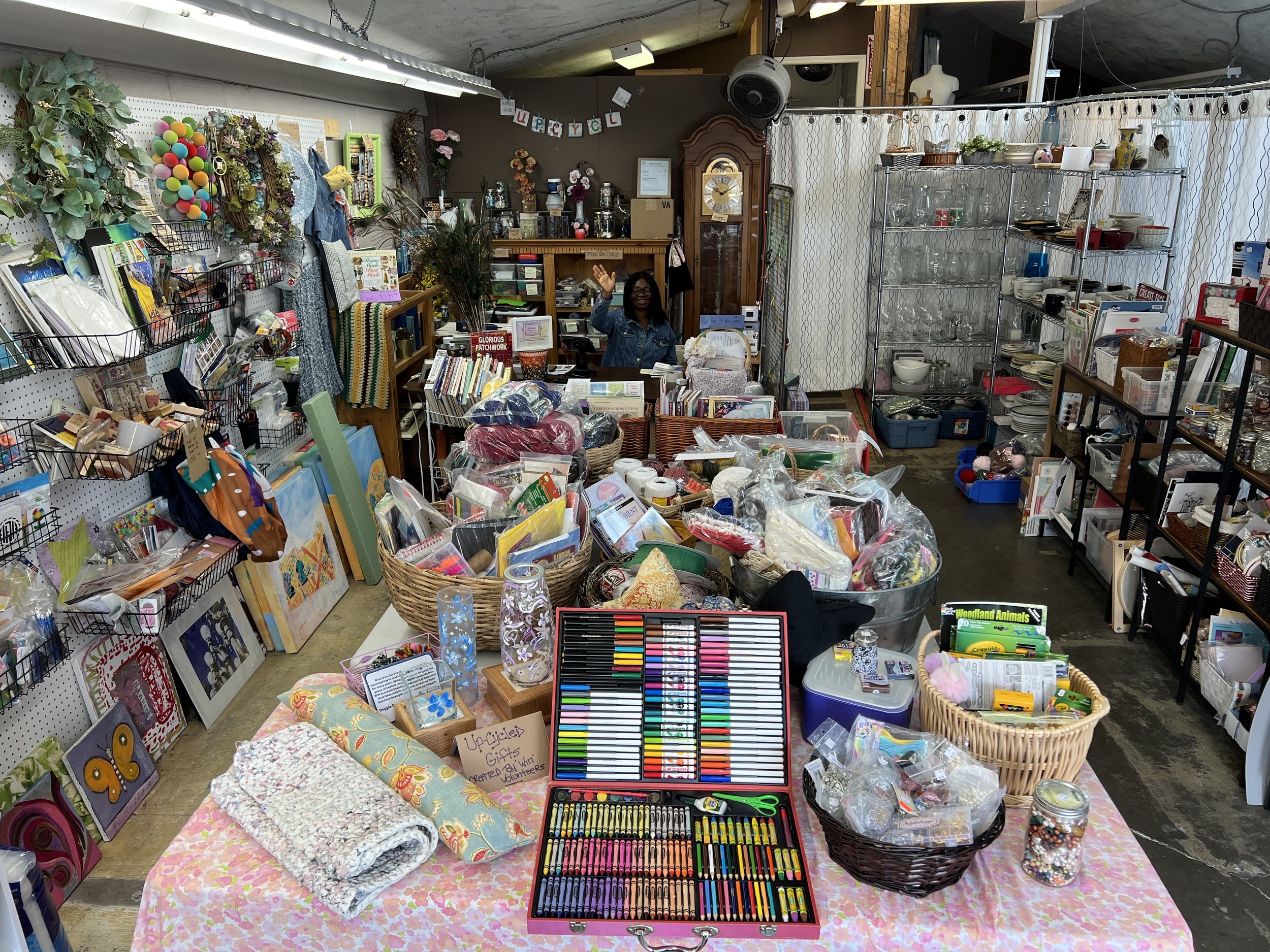
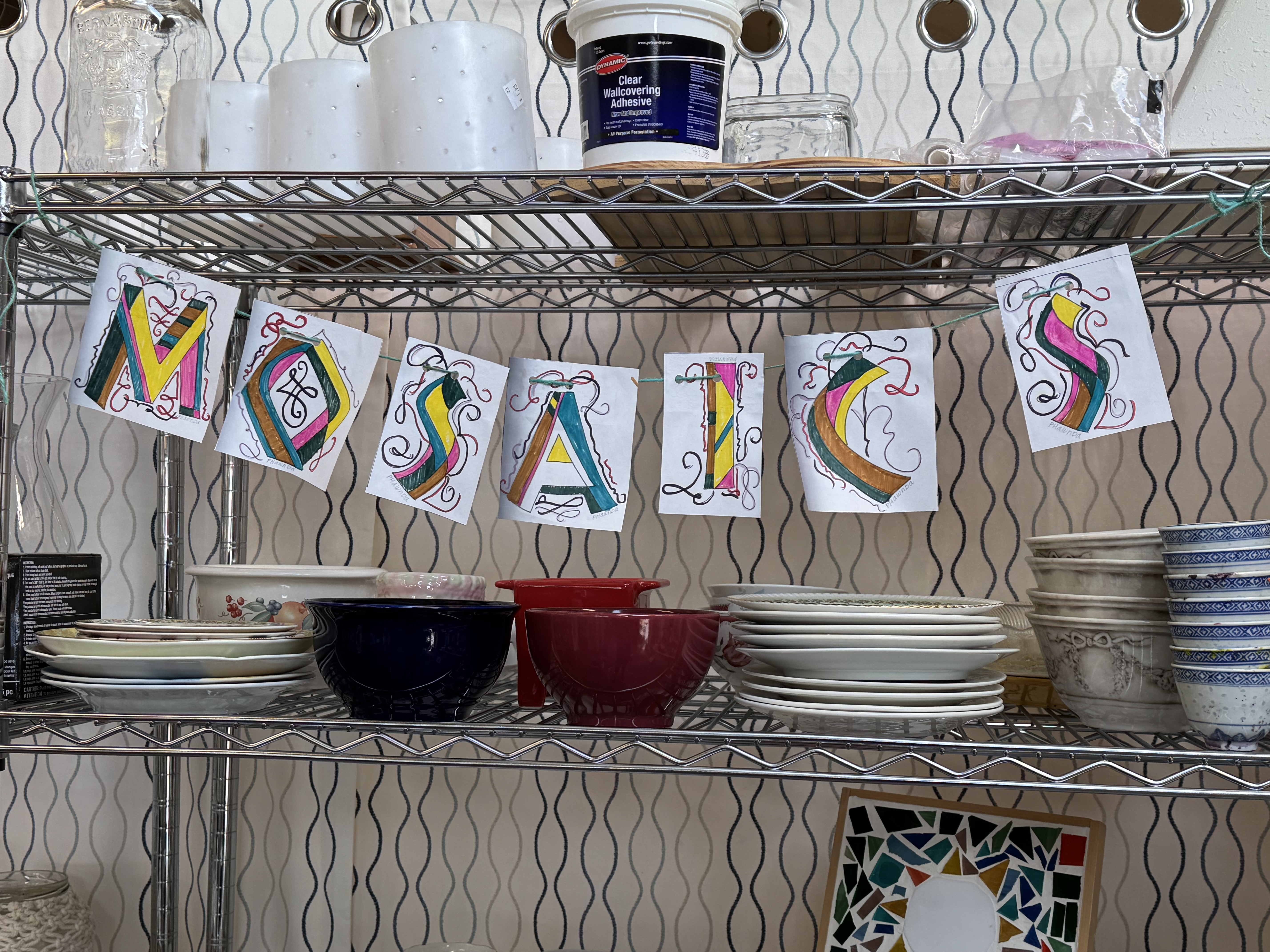
I work a volunteer shift at the upcycle store on Wednesdays. The people that come in delight me, entertain me, astonish me, educate me, soften me. Next week is my last shift at the store. I want to remember some of these people and their stories.

Once a pale man came in and asked if we had a leather hole punch. He didn’t want to buy one, just borrow it so that he could put an additional hole in his belt. He was losing weight, and his pants were hanging on him. Alas, I said, we don’t have one right now. I’m sorry.

I thought about him for weeks, his weight loss, his thinning frame, his sad face. I wondered about his story. Perhaps he was lovesick.

I can no longer untangle my hair
I feed on my own flesh in secret.
Do you want to measure how much I long for you?
Look at my belt, how loose it hangs.

Anonymous, Six Dynasties
Translated from the Chinese by Kenneth Rexroth

As if to balance the sadness of the shrinking man, the joy of meeting Randy bloomed inside of me for weeks. He flounced into the store a few days before Thanksgiving, smelling gloriously of rosemary and thyme. Randy is a contemporary dandy, stained waistcoat and tight jeans, flowing grey hair, phlegmy smoker’s laugh lighting up his brown, creased face. He brought crackling energy into the store with him, along with a small plastic bag of herbs. 

Do you have any Scrabble tiles? he asked. Yes, I handed him two tall mason jars filled with tiles, and as he dug through his pockets for the cash to pay for them, he told me there was always a few Scrabble boards set up on his coffee table. When my friends come over, he said, they add a word or two or three. We play a never-ending game and nobody keeps score.

What a mouth-watering smell! He opened the plastic bag for me to see the long sprigs of green. I picked them at the side of the road, he told me, just around the corner. The herbs were volunteer plants, free for anybody that wanted them. I need sage, I said, for the Thanksgiving turkey. Oh, he said, I think there was sage growing as well. We smiled and said our goodbyes. An hour later he was back with three sprigs of sage he had picked for me and my turkey. 

When I asked a young fellow what he was planning to make with the feathers he was buying, he challenged me: Guess. A headdress? No, good guess, but I am making flies for fly fishing, something his dad taught him to do. He fishes for cutthroat trout under the Bay Bridge with a bunch of female fishers who’d turned him on to it. I never knew!

Last week, a woman came in and poked into the baskets of wool, humming a tune. I noticed her tone—it was strong and true. You have such a beautiful voice, I said. Why don’t you sing us something? Suddenly, gloriously, she burst into “I’m Called Little Buttercup,” from Gilbert and Sullivan’s HMS Pinafore. Her rich mezzo-soprano filled the store as she strutted down the aisles, outthrust chest, a beautiful dockside vendor in love with the captain. I and another shopper were the lucky audience, mesmerized by a performance delivered among stickers and glue, balls of wool, knitting needles, jars of coloured beads. 

I love hearing about the celebrations people are planning. The woman in her thirties who bought armloads of artificial flowers and a bolt of pale pink draping fabric for the table. She and her siblings had been planning a surprise party for their mother’s sixtieth birthday. She keeps mentioning she’s turning sixty, as if reminding us, said the young woman. She’s worried we’ve forgotten. Little does she know what’s in store! I laughed with her, feeling mudita, imagining the pleasure and wonder of her mother on that day. Surprise! 

Finally, I sold the white canvas tent that was propped in the corner for months. The tent is perfect for children to hide and play in, and a woman bought it for her grandchildren. I told her about the teddy bear’s picnic birthday party I’d thrown for my four-year-old so many Decembers ago. We had a play tent pitched in our living room, and the children and their stuffies enjoyed tea and cake. The woman became excited and touched my shoulder in thanks. What a great idea! I’ve got to do that for my grandson! Then she told me that one Christmas her mother-in-law opened the gift of a vibrator in front of the whole family. I wasn’t sure what prompted the story, but we had a good laugh. Teddy bear picnics and vibrators, all in one afternoon.

There’s a regular customer who brings her baby buggy into the store, speaking softly and playfully to her little boy as she shops. She buys bits of fabric, thread, and zippers. Last week, as she paid for her stuff and her baby chortled and tried to put his toes in his mouth in the buggy beside her, she ran her hand over the camel-brown smocked dress she wore and its complementary quilted vest. I made all of this from an old bedsheet, she said. At times like this, I thought, I wish I could whistle. A good long, low whistle to show my WOW in a visceral way. Instead, I shook my head: You are amazing! Queen of Upcycling!

One day I was emptying out the green donation boxes, pricing and sorting items.  My hand fastened on something soft. A bit of plush grey fur, perhaps once the collar of a stylish coat. Wrapped in thin tissue paper, there was a small tag safety-pinned to the edge: Chinchilla, written in the shaky script of somebody very old. Suddenly, I was back in the furrier’s on Spadina Avenue, sitting cross-legged on the dusty floor, playing with scraps of chinchilla, beaver, spotted lynx. I caressed them one at a time, rubbed them against my cheek. My mother and the furrier stood above me, two voices discussing the racoon coat she’d ordered. What happened to that coat? And why was my mother—a passionate animal lover—buying a custom-made fur coat?  

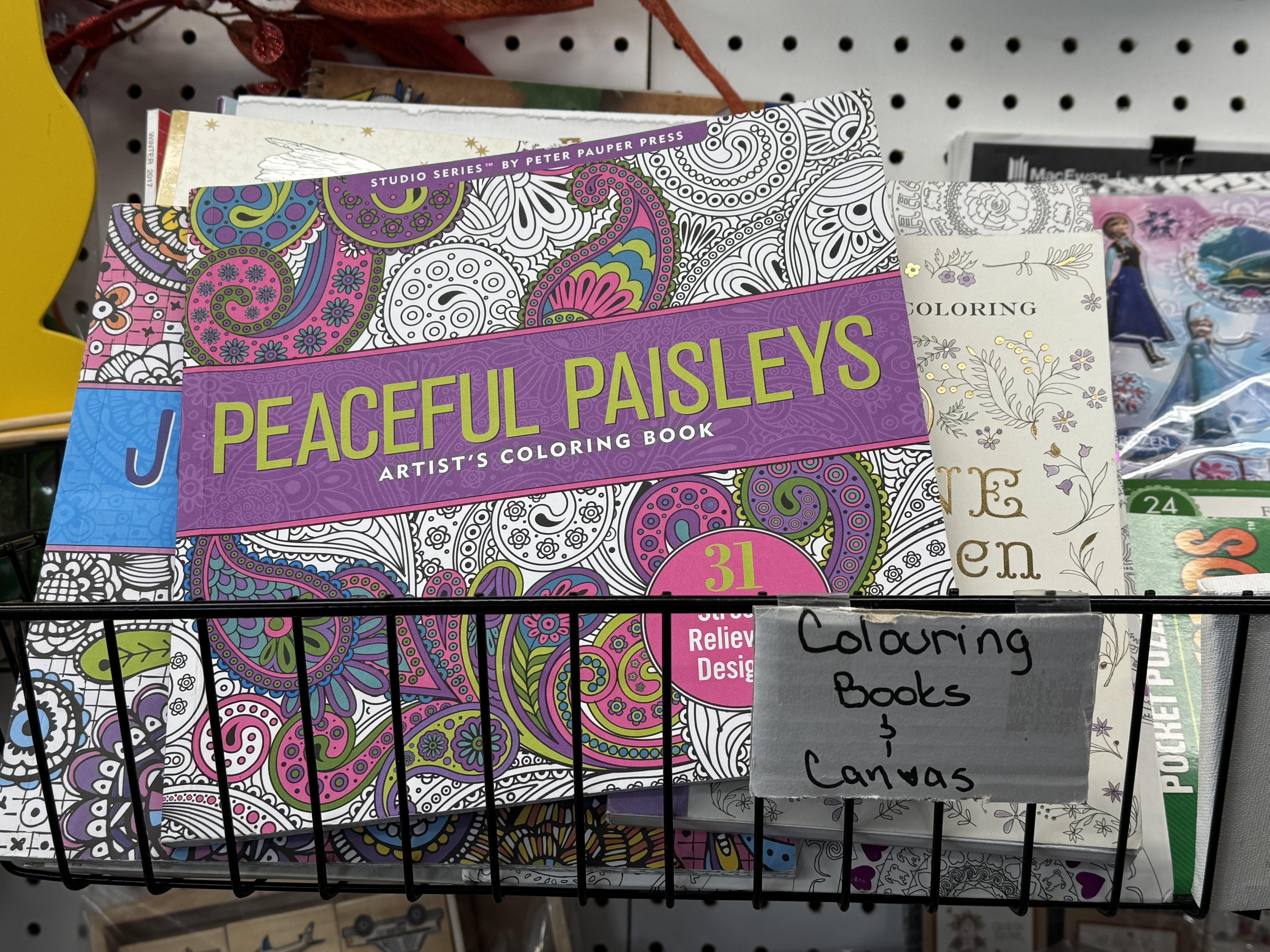
People stream into the store. Have you got books on stained glass? Do you have leatherwork tools? Ever get pillow inserts? Sometimes I say no, sometimes yes, but other times I’m not sure, and we set out to look together, sifting through the boxes and baskets. Sometimes people cry out in delight when they find just what they were looking for. A particular size of crochet hook, fabric printed with mushrooms, a colouring book of Frida Kahlo drawings. 

Last week, a short bespectacled woman said she had an unusual request: golf balls. She was undergoing physiotherapy for an injured hand and the therapist had told her to squeeze a golf ball. I haven’t seen any golf balls, I said, but I think I can help. I remembered that morning finding a bag of large wooden beads strung onto a white shoelace. I thought of a small child or a very old person practicing fine motor skills, threading each bead onto the end of the lace. I found the bag and fished out three of the beads. They were about the size of golf balls. Will this do?  I asked as I slipped them into her cupped hands. They’re perfect! And we agreed that they were much nicer to handle, a globe of burnished brown wood rather than a cold, plastic golf ball. 

At the end of every shift, as I cash out, sweep the cement floor, turn off the heat and lights, lock the door, I feel full of the people I’ve met, the stories I’ve heard. 
Becoming intimate with carnations and truth

In mid-December, I bought a green glass jug in a second-hand store, half price. My aspiration was to make a beautiful winter bouquet for my friend, Lillian. I bought a bunch of silver dollar eucalyptus and two dozen white carnations. I envisioned white wintry bursts among the silvery green, but the more I trimmed and mixed the carnations with the stems of eucalyptus, the sillier and more incoherent it looked. I took basic Ikebana but still haven’t a clue how to make flowers and plants look good. 

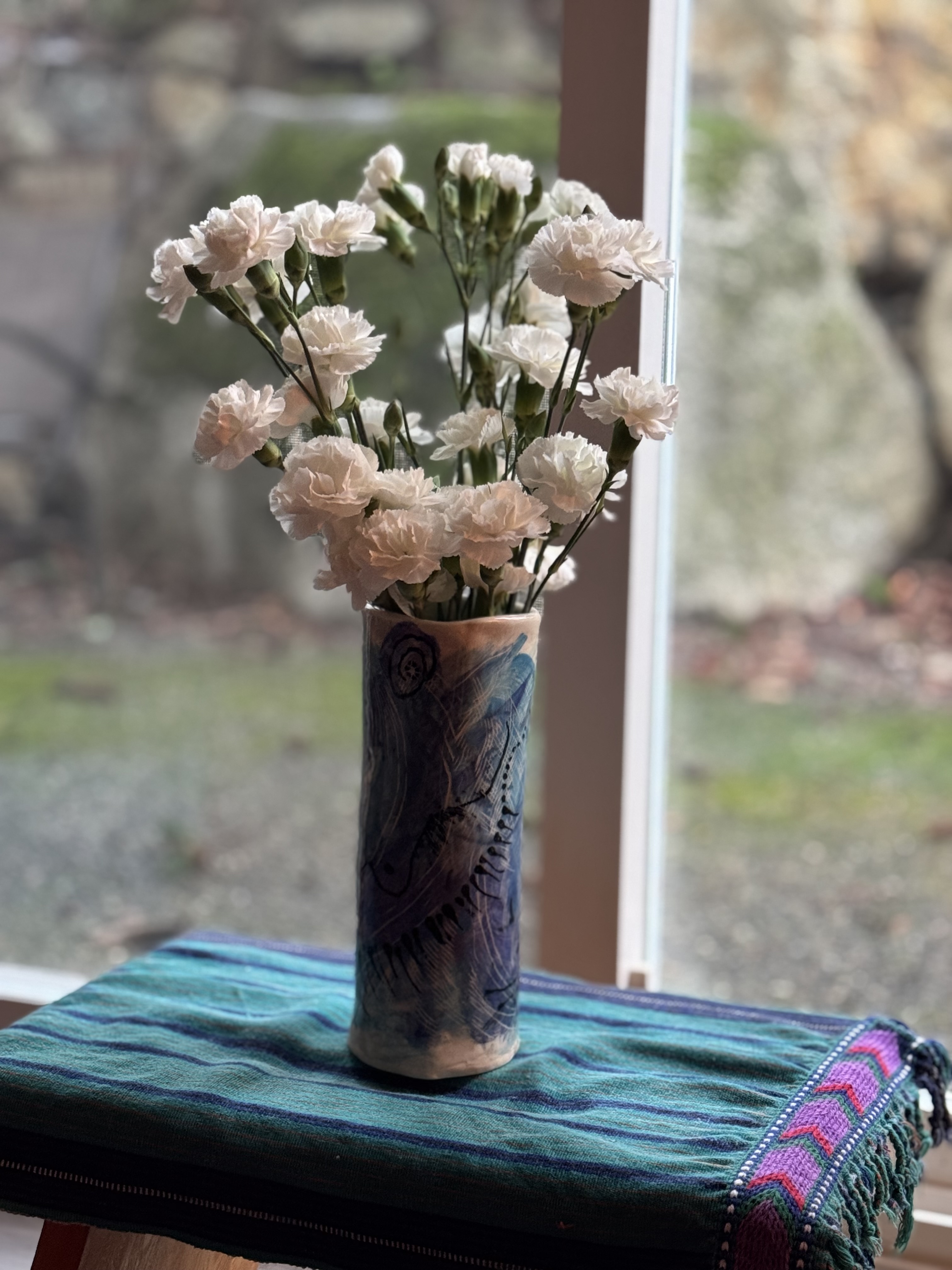
Finally, I used only the eucalyptus, splayed out in a free-fall arrangement. I attached a few small, red shiny balls to the stems, and the effect, I hope, was Christmassy and charming, if a bit messy. Lillian said she loved it. (But what could she say, really?) I was going to throw out the unused carnations, but it seemed such a waste, so I put them in a white and blue vase and placed it in my study on a low stool covered with a blue-green cloth. 

I don’t like carnations, or I didn’t think that I did. I’ve seen too many sad, slender bunches wrapped in cellophane at the mini-mart next to the hospital. They make me think of last-minute purchases for the death bed, cheap flowers that outlive the person you visited. They seem so tight, orthodox, banal. Whorls of perfect, serrated petals, every bloom the same.

But they’ve grown on me. As I spend hours in their presence, they’ve become real. You could say I’ve become intimate with them. I sit here now, the last day of the year, gazing at their fresh ordinariness. The carnation is the sturdy, faithful flower that will see you through. Perhaps they are flower of the year: commonplace as canned milk. Carnations are one-foot-in-front-of-the-other flowers. Quotidian flowers. Bread-and-butter blooms. See you through the hardest times. Last for weeks. Nothing special. 

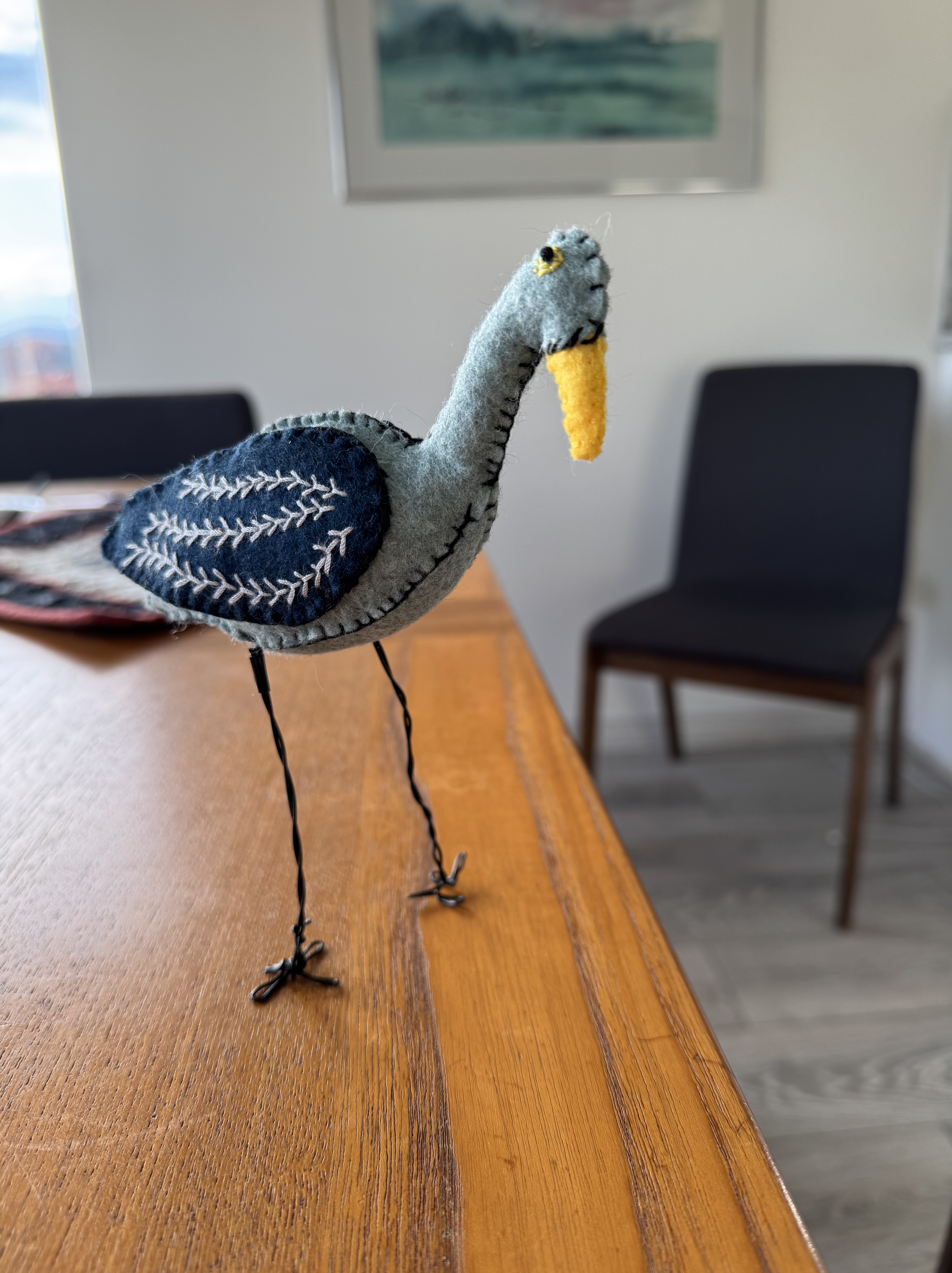
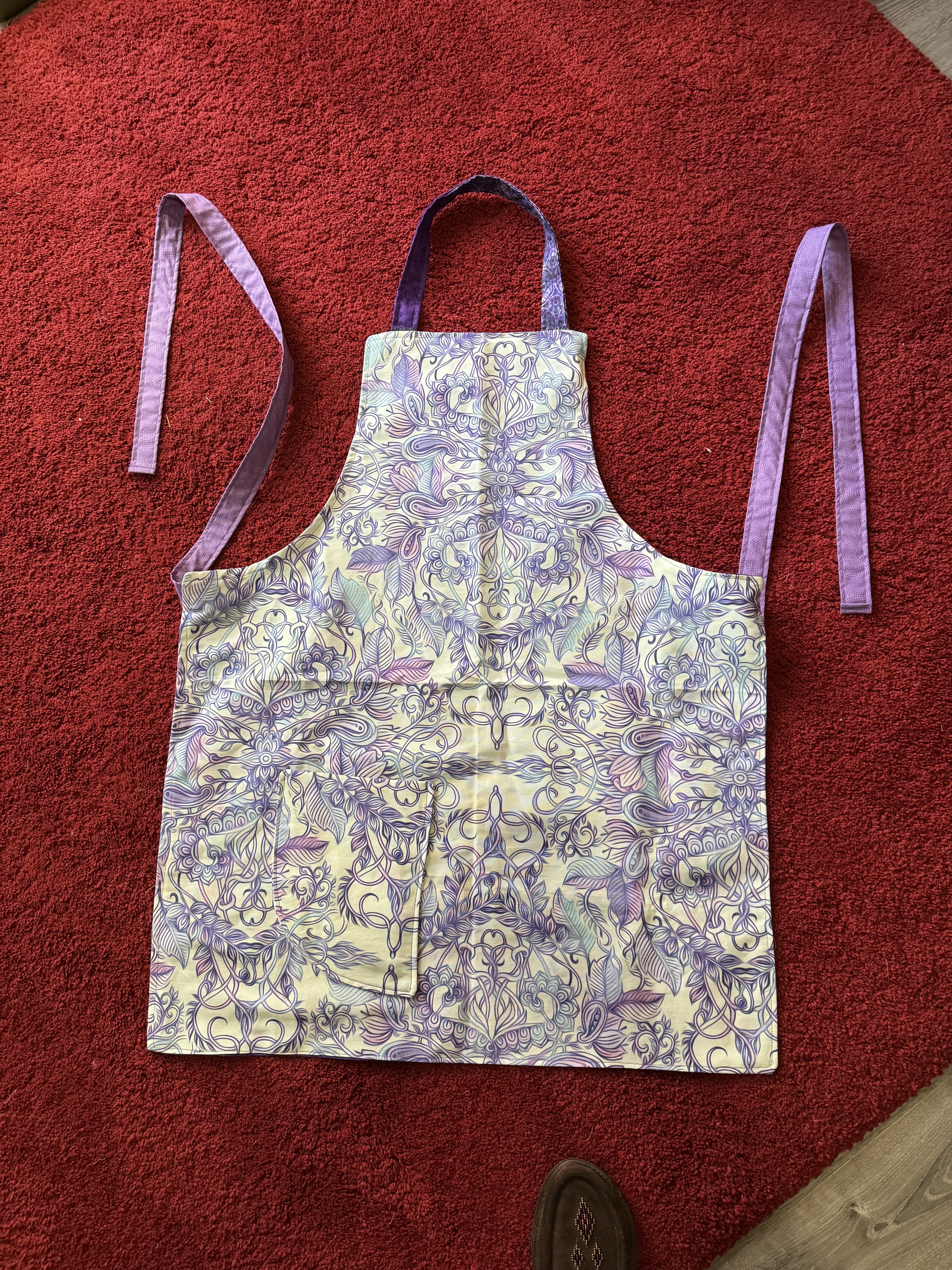
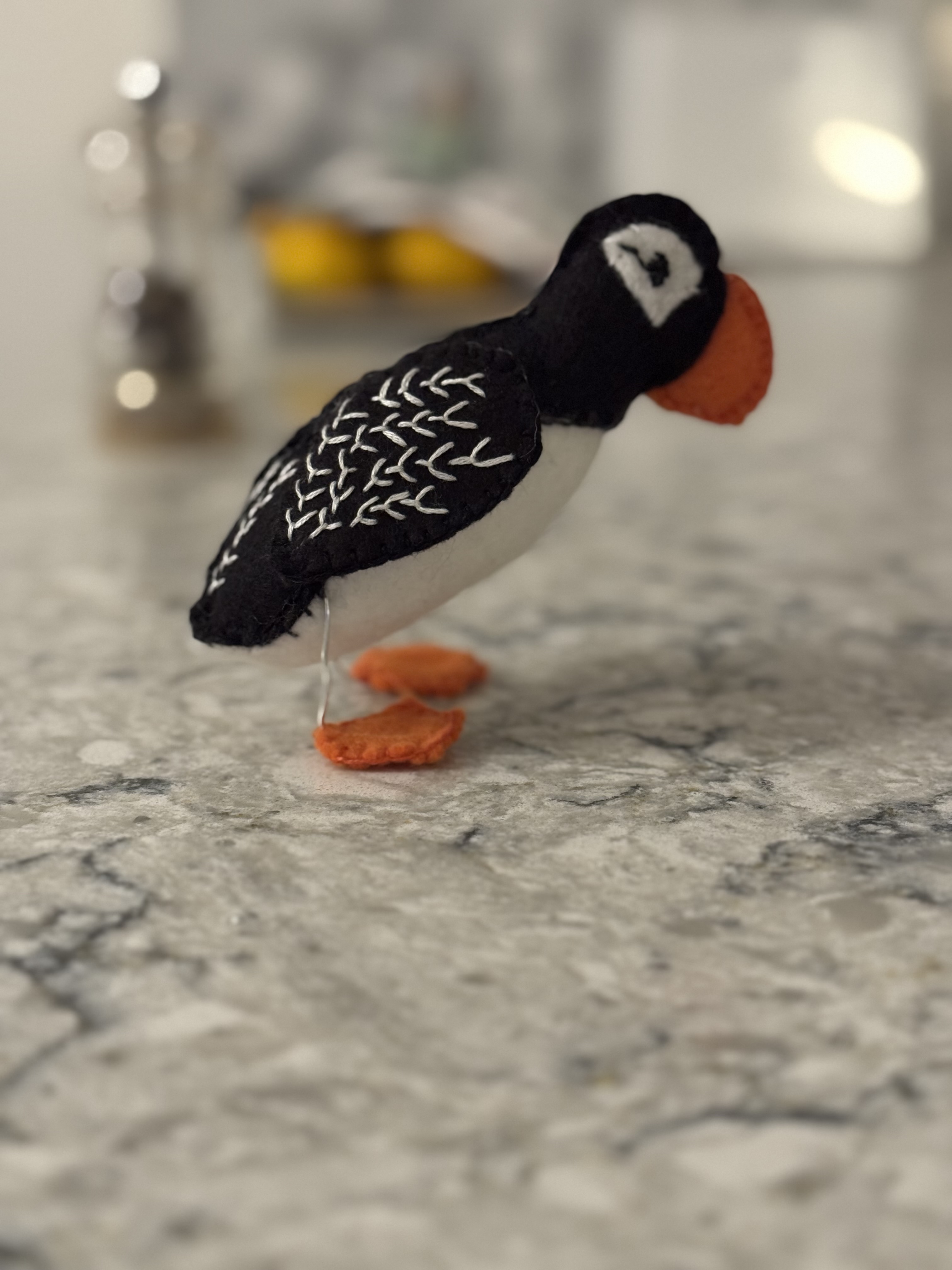
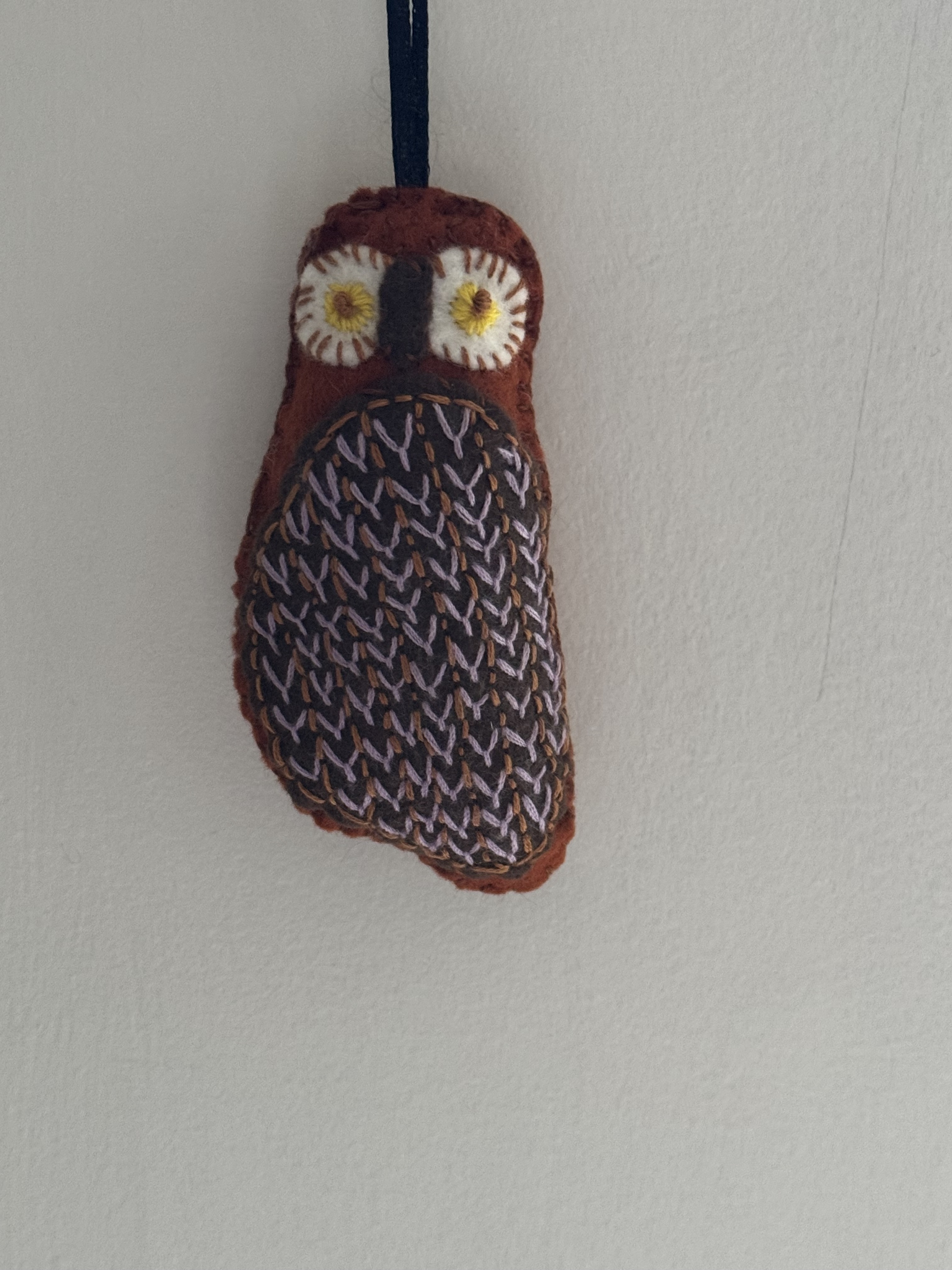
Although 2024 was my first year of so-called retirement, and thus I was given twenty additional hours each week, I wrote less, and I sewed less. (A few felt birds for family and other little felt creations, an apron, a crib quilt start, a fur-lined bag.) I did finish an editing certificate I started in 2020, which is a relief. And I made a lovely new friend and deepened existing friendships. I started a volunteer gig at a non-profit arts and crafts shop in August that has led to meeting many interesting people. Bonus: I get to surround myself with a messy profusion of materials that inspire me. 

This year, I listened to probably one hundred dharma talks on Dharma Seed, with a broad aspiration of becoming more intimate with life—accepting whatever’s happening in my heart, whatever’s happening in the world. Making friends with wild mind. Accepting the truth of the way things are.

I read so many books this year. A couple that stick with me are Rebecca Solnit’s memoir, Recollections of My Nonexistence and The Age of Loneliness, a book of essays about life during the sixth extinction by Laura Marris. 

Solnit writes a lot about being a woman. That’s what her title gestures toward—the peculiar “nonexistence” of being female in a patriarchy (remember mansplaining? She is behind that neologism[i]). She draws on John Berger’s 1972 Ways of Seeing, which I’ve known about for years and now am determined to read. She quotes words from him that jibe with my experience: “To be born a woman has been to be born, within an allotted and confined space, into the keeping of men. The social presence of women has developed as a result of their ingenuity in living under such tutelage with such a limited space. But this has been at the cost of a woman’s self being split into two.” 

Perhaps that sounds dramatic in the Global North in 2024, but that has been my experience. Perhaps it’s different for lesbians. Perhaps it is different for women of subsequent generations, but Solnit and I were born three years apart (1961/1958), so we grew up at roughly the same time. Berger goes on, 

“A woman must continually watch herself. … She has to survey everything she is and everything she does because how she appears to others, and ultimately how she appears to men, is of crucial importance for what is normally thought of as the success of her life. Her own sense of being in herself is supplanted by a sense of being appreciated as yourself by another.”

Solnit calls Berger brilliant and generous, to be able to imagine a woman’s experience, and I agree. What he writes here feels just as real as the carnations in front of me. Reading the passage and feeling its truth is freeing. No action needed, just awareness.

Similarly, truth pinged through me when I read Laura Marris writing about the age of loneliness. We become lonelier as we bear witness to the drastic reduction, or “great thinning,” of ordinary animals. Marris draws on the work of naturalist, Michael McCarthy, who writes of our baby boomer age group, “As we come to the end of our time, a different way of categorising us is beginning to manifest itself: we were the generation who, over the long course of our lives, saw the shadow fall across the face of the earth.” 

Reading this series of essays, elegies to Earth as the shadow descends and animals disappear, I was gripped by a grief so deep I sat for a time and just cried. Again, the truth is freeing. Let’s not deny that this is happening. It’s really happening. We can still enjoy the beauty that is here. 

In keeping with my mood of asceticism, I recently deleted my Facebook and Instagram accounts. Unlike the birds who used to sing outside my window, FB and IG will not be mourned. I feel light as I step through life with a new red pedometer safety-pinned to my leggings (the pedometer frees me from carrying a “smart” phone to count steps). Michael, Marvin, and I amble down to the beach at Thetis Cove to watch the sky change. Rippled water reflects a bank of pink clouds. 

Thank you for reading. In the coming year, may you experience moments of lightness in a shadowy world. 

Berger, John. 1972. Ways of Seeing. Penguin.
Marris, Laura. 2024. The Age of Loneliness: Essays. Greywolf Press.
McCarthy, Michael. 2015. The Moth Snowstorm: Nature and Joy. New York Review Books.
Solnit, Rebecca. 2020. Recollections of My Nonexistence. Viking.


[i] From Wikipedia: The term mansplaining was inspired by an essay, “Men Explain Things to Me: Facts Didn’t Get in Their Way”, written by author Rebecca Solnit and published on TomDispatch.com on 13 April 2008. In the essay, Solnit told an anecdote about a man at a party who said he had heard she had written some books. She began to talk about her most recent, on Eadweard Muybridge, whereupon the man cut her off and asked if she had “heard about the very important Muybridge book that came out this year”—not considering that it might be (as, in fact, it was) Solnit’s book. Solnit did not use the word mansplaining in the essay, but she described the phenomenon as “something every woman knows”.

The Untangler

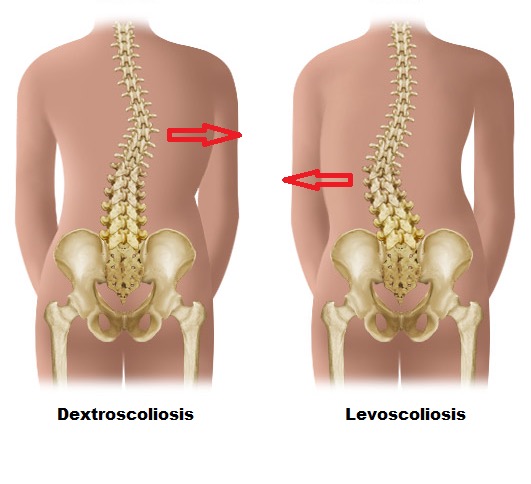
I can’t remember a time in my life when my right shoulder wasn’t lower than the left one. Its slope was unremarkable; this is just the way I am. Then, in my early sixties, a physiotherapist told me I have scoliosis; perhaps I’ve had it since childhood. I didn’t pay much attention. A year later, a Thai Massage practitioner sat behind me on the mat and looked at my twisted spine. “What happened to your back?” she said bluntly. This year it’s been harder than ever to stand up straight. I have daily lower back pain. I feel deformed, out of balance. I used to be five foot six, but during my last doctor’s appointment, I discovered I am now five feet four inches tall. A recent CT scan confirmed it: I have moderate lower thoracic/lumbar dextroscoliosis, a right-bending curvature of the spine. It’s time to figure out what to do. 

I started reading about the condition—S-curves, C-curves, thoracic and lumbar varieties, and treatments, including the Schrott method. I’ve looked at archival black-and-white photos of crooked backs, at racks and braces that looked like torture devices. I started doing yoga for scoliosis and made an appointment with a physiotherapist who specializes in treating this complex condition.

As I wait for my appointment, I have mental work to do. My sister told me about Dr. Joe Dispenza’s website, where there are inspiring stories of transformation and physical healing through meditation. I started to think about how powerful our minds and imaginations are. For many years, my friend Diane has exercised her powerful imagination as a force for good. She has had rheumatoid arthritis since she was 13 and uses visualization to help with her pain. “One of my most powerful visualizations is the dragon, which I call upon during episodes of severe pain,” writes Diane. Describing the creation of her dragon in 2010, Diane writes, “As I surrendered to the flow of molten sensation, the dragon appeared, and I clung to its fiery body until our energies merged. The pain and strength became one, flowing through us as we surrendered to the sensations.”

This visualization has transformed the way Diane sees pain—no longer as an enemy, but as sensation. Pain, she writes, is “neither ‘good’ nor ‘bad’—it simply exists, a presence I accept at the core of my being.”

Diane's AI created image of a woman riding a dragon.
Diane began creating AI images and digital iPad art to visually express what pain feels like in her body, hoping the images resonate with others experiencing pain and disability. This is one of Diane’s AI created images.

Another friend, Janis, visualizes protector angels to bring calm. When her schizophrenic daughter was in crisis, she imagined an angel lovingly holding her adult child, an image that helped her to sleep. 

Anybody in a twelve-step program knows the support that one’s imagined higher power can provide. It doesn’t matter if you visualize the ocean, the forest, a goddess, or your community as your higher power (it’s yours, after all)—the image you create can soothe, comfort, inspire, and heal.

I am reading Dr. Gladys McGarey’s book, The Well-Lived Life: A 103-Year-Old Doctor’s Six Secrets to Health and Happiness at Every Age. In one chapter, she writes about having breast cancer in her nineties. She combined visualization with a lumpectomy and radiation, knowing that how she thought about the tumour played an important part in healing. She started talking to the lump in her breast that she pictured as a “pretty little hand-tooled suitcase.” She spoke kindly to it: “Darling, we’re going to have a family reunion . . . . If there are other cancer cells in my body, call them together, and tell them to get in the suitcase and come on the trip.” I just love that image of the pretty suitcase and all the gathered cells going to a family reunion. There are no enemies inside of us, just family members, and some of them need to regroup elsewhere (or straighten up). 

Book cover of Gladys McGarey's book

Visualization is a powerful tool. 

As I thought about Diane fusing with her fiery dragon, the huge feathery wings of Janis’s angel, and Gladys McGarey’s darling hand-tooled suitcase, I wondered which image, combined with physiotherapy and exercises, could help me straighten my spine. 

I remembered a recent dream that—at the time—struck me as important. My husband Michael and one of my sons accompany me to a job interview. An unusual scene greets us: We are in a large, high-ceilinged space, with brown leather sofas and armchairs spread throughout and around the circumference of the room. My husband and son are told to sit on one of the outer sofas. It’s a public interview; many people are there as audience. A group of men and women at a long table interview me while I sit before them in a butter-soft armchair. The interview is short. I’m told that I have the job. I am the new Untangler. Applause crashes through the air. Everybody is so happy for me! I got the job as the Untangler! One interviewer remarks that I didn’t even need a graduate degree to get this job. Lucky me. 

When I woke from the dream, the unusual noun, untangler, floated free and visited me throughout the day. Now I am thinking of it again—what does it mean to be an untangler? 

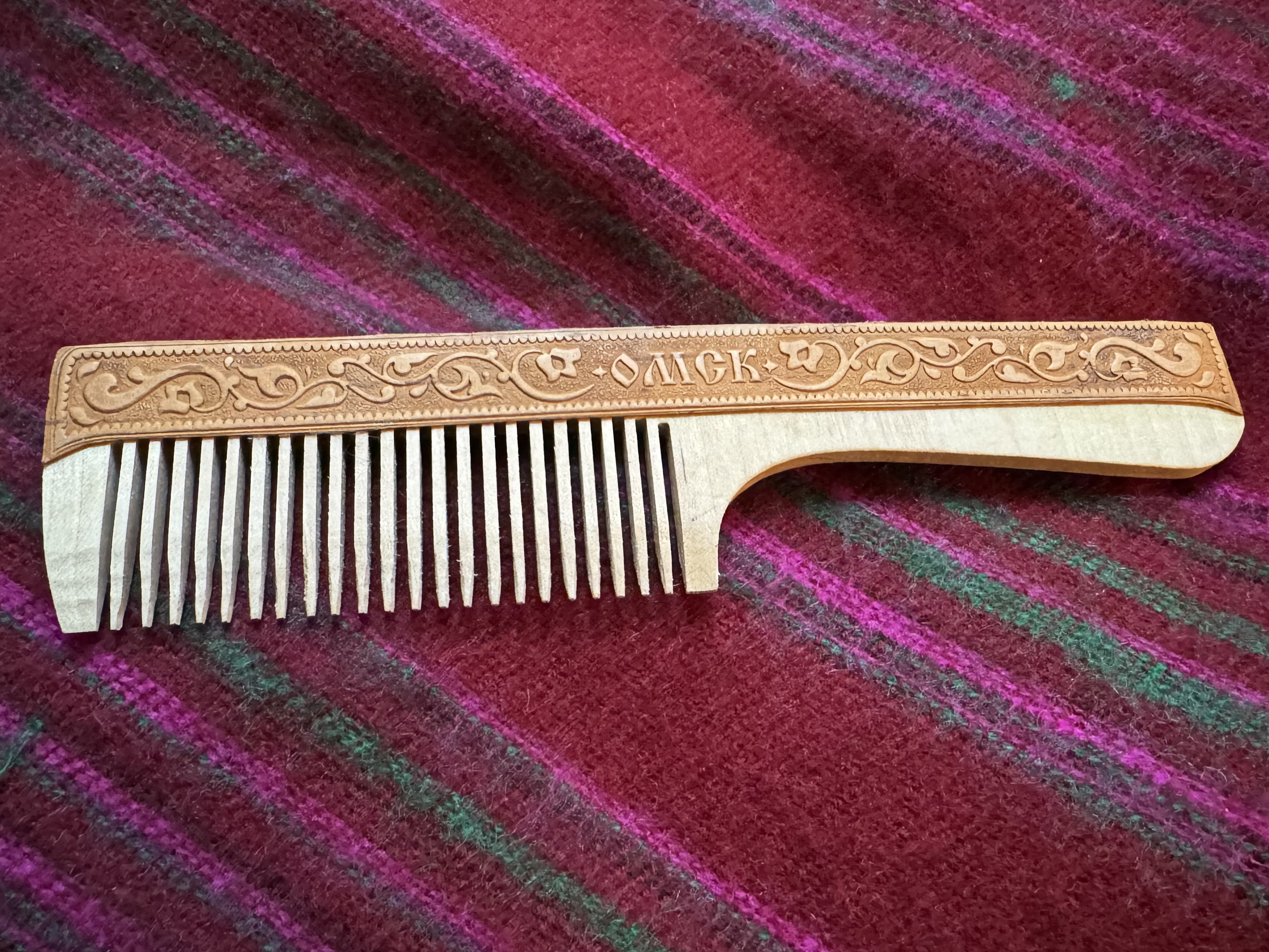
The comb is the foremost untangler, a simple yet effective tool. The earliest known comb was discovered in Syria and dates from 8,000 BC. Made from animal bone, it looks much like the combs we use now, with a handle and teeth. You can buy a cheap black plastic comb in any drugstore, but I am thinking of a more elegant object: the carved wooden comb my friend Olga gave to me. She brought it back from Omsk, Russia, her hometown. I keep that comb at my desk to remind me of her, but lately, I have been using it to comb my hair. To comb is to untangle, to straighten. 

A wooden comb with the handle carved with Omsk and garlands.

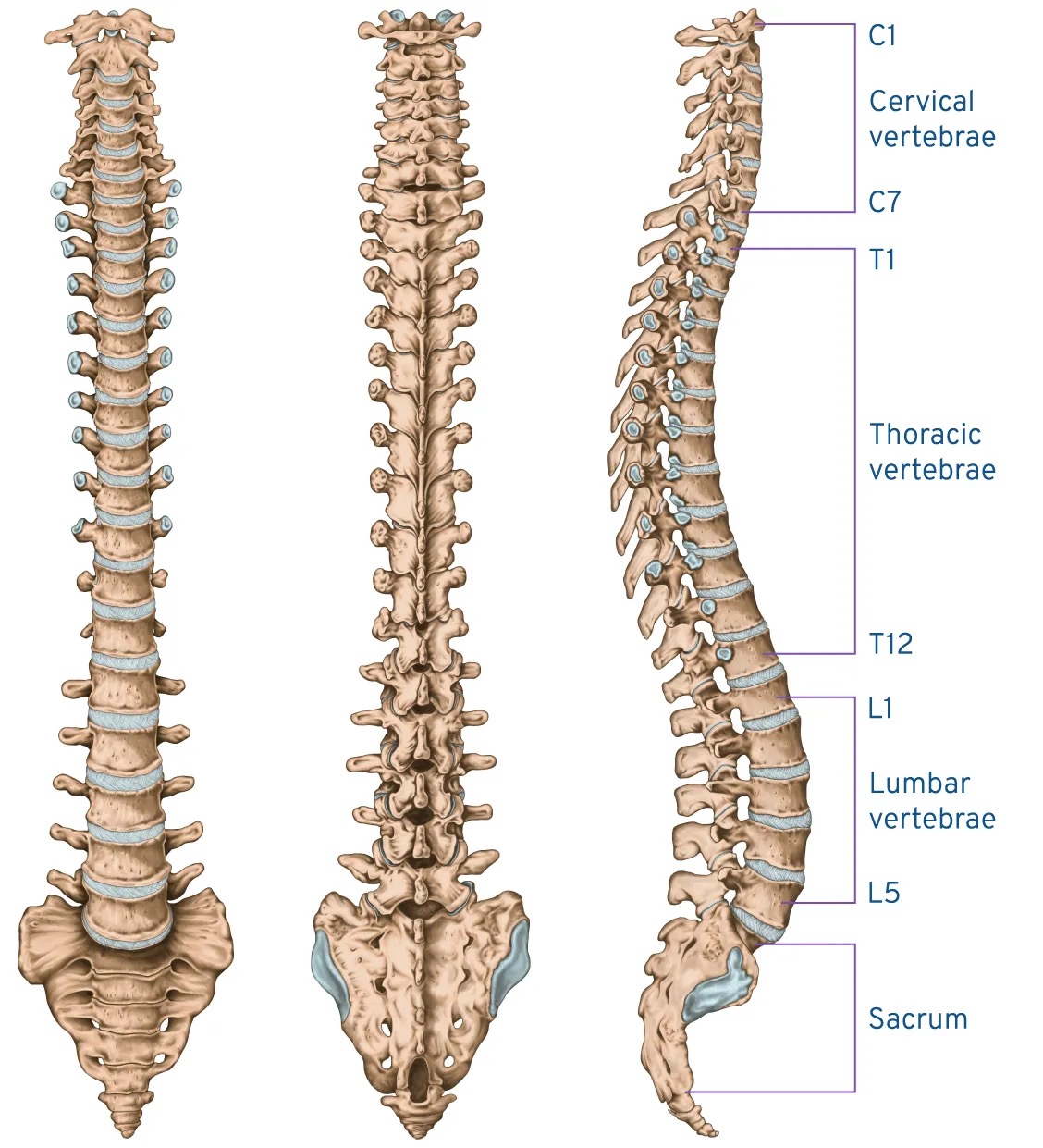
I choose to imagine that wooden comb combing my spine as I walk and when I meditate: long, smooth strokes. (Don’t get too literal; my knobby vertebrae would never fit between the teeth.) When the teeth meet a tangle of resistance, I tug a little, gently exerting pressure, pulling the spinal cord out of its curve. Combing the cervical vertebrae then to the thoracic—T1 right down to T12, then combing through lumbar 1, pulling a bit harder at L2, which—my scan shows—has slipped forward six millimetres to press the nerve, then L3 right down to the sacral region. Comb, comb, comb.  Straighten, darling spine, straighten. Who knows the power of the mind, the power of an image? I was hired as the untangler, so every day, I do my job. 

Anatomy of a spine: shows the cervical, thoracic and lumbar vertebrae sections.

Credits

Types of scoliosis: https://www.hudsonvalleyscoliosis.com/what-is-scoliosis/types-of-scoliosis/

Thank you to Diane, who gave me permission to share her dragon image and story and to Janis, who gave me permission to share her angel story.

Anatomy of spine: https://mxnspine.com/anatomy/

A sense of belonging

“Human beings are creatures of belonging, though they may come to that sense of belonging only through long periods of exile and loneliness.” 

David Whyte, The Three Marriages: Reimagining Work, Self and Relationship

Ever since I was small, I have felt I don’t belong. As I grow older, I see how this sense of not belonging is linked to black and white thinking: I am excluded either because I am not good enough or because I am superior (“arrogant worm,” as they say in AA). This strain of thought is endemic for alcoholics. To break the spell, it’s crucial to look for similarities not differences when you attend twelve step meetings or, indeed, whenever you feel the sharp edges of polarity creating a sense of distance. 

For me and perhaps for you, the isolation resulting from the pandemic has exacerbated loneliness and a sense of exile. Last month I was feeling particularly alone in the sadness that can arise from being a parent. Only in recognizing that many other parents across the world share in this pain did I not feel so alone. Facebook groups and other modes of connecting across space and time are wonderful to bring a sense of “I’m not the only one.” But also useful has been the Buddhist practice of Tonglen, breathing in the thick suffering of others in your predicament and breathing out coolness and healing. This practice connects me with others, but more than that, it dissolves the sense of specialness and exclusion I am prone to. We’re all in this together.   

There is another simple practice I have started. I review small events from the perspective of community. This week, for example, I went to an acupuncturist for the first time. She is a gentle young woman named Demi with a river of brown curls running down her back. She made me feel so comfortable and safe as she stuck a dozen needles into my legs, hands, and back. As I laid face down on the warm table in a quiet room, I felt joined with all of the other people suffering sciatica or other pain in their bodies, and I also felt part of a group of people who get acupuncture. I could picture hundreds of us lying on surfaces—floors, grassy fields, dusty streets, tables, beds—and kind practitioners breathing slowly and rhythmically, putting us at ease, as they insert the slim sharp points. I imagine a collective release of endorphins through bodies old and young, fat and slim, smooth and rough. I imagine our relief. 

The next day, I suffered from self-doubt about my new editing business—will I get clients? Will people I’ve done work for get back in touch with me? And imposter syndrome: Am I really an editor or just pretending? Perhaps I don’t belong.

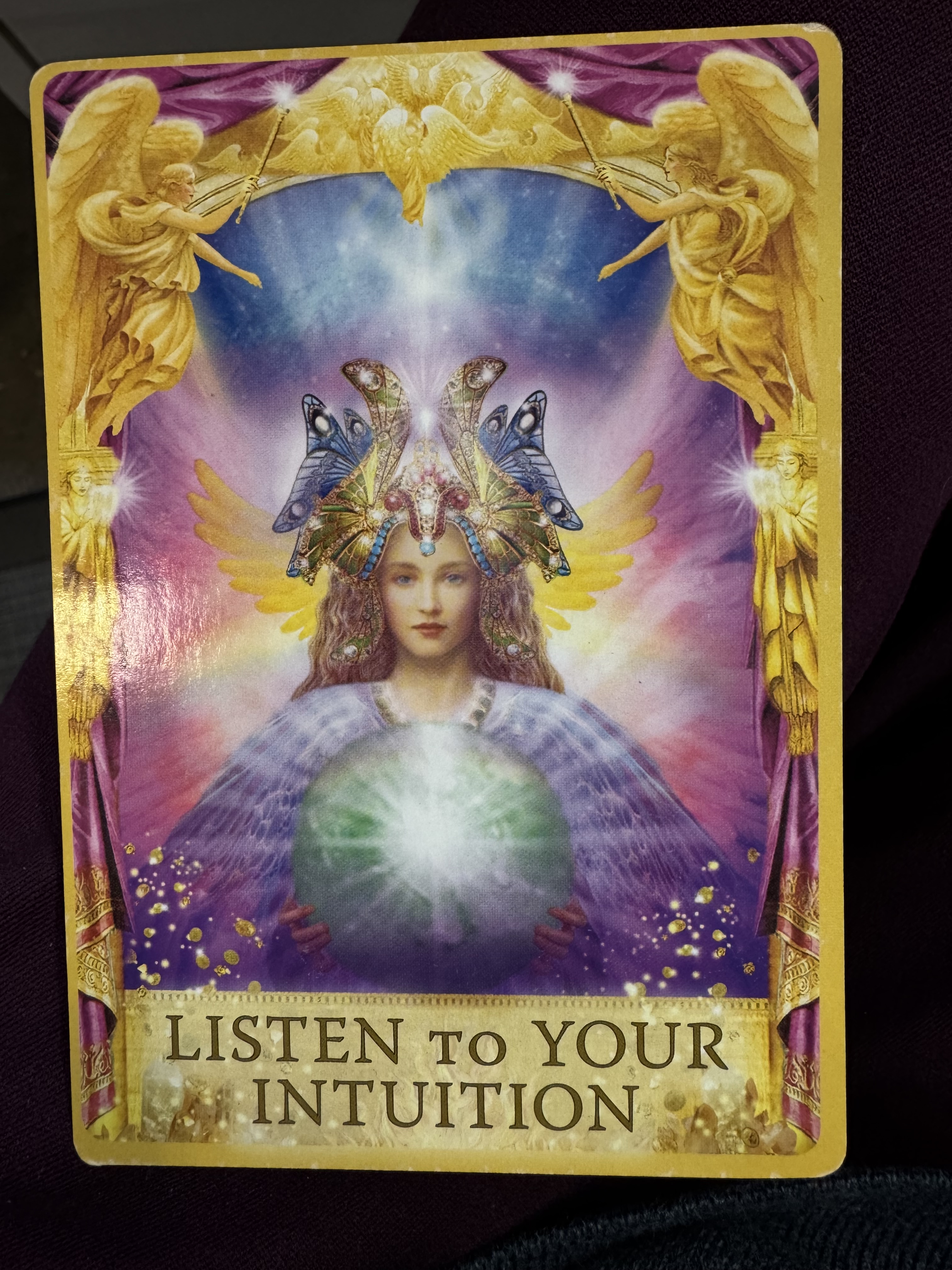
Drawing a tarot card, I asked, “What do I need to know right now?” I pulled the Six of Wands, then consulted Joan Bunning’s Learning the Tarot. She writes that “the Six of Wands appears when you have been working hard toward a goal, and success is finally within reach. . . . If you do not feel close to victory now, know that it is on its way provided you are doing all you can to make it happen.” I felt encouraged. 

Amazingly, later that day, I received two emails from former clients who wanted me to do work for them. The next day, a new client gave me an update on work that is planned for this summer. And a referral from a colleague I thought would come to nothing yielded another email today asking for my services.

I feel not only encouraged by all of this positive activity, but connected to a community of editors. Yes, I belong. Amazed by the rightness of the card, I feel connected to all those people everywhere who use tarot to help them make sense of life.  I can see the decks being shuffled and cut by hands everywhere—brown hands, gnarled hands, arthritic hands, young hands, a hand with a missing finger. . . . We shuffle and cut and draw and learn about ourselves and others, about our Fool’s journey on this Earth.

On Friday, I felt down again, and as I sat in the backyard with my next-door neighbour and we watched the puppies play, I shared a little of my current grief. She popped out of her lawn chair, “I’m going to get my Animal Spirit cards. They’ll help you to feel better.” She came back with the deck and I shuffled and drew. I tried to pull just one, but two cards were stuck together—Elephant and Otter. She read aloud the description of each animal, and a tear rolled down my cheek. 

The descriptions felt resonant—the qualities of the unstoppable, gentle, noble elephant and the giddy and joyful otter were combined inside of me. I felt connected to my neighbour then, linked to her through her kindness to me and her willingness to explore beyond the rational self. I feel connected to everybody everywhere who is suffering and uses tools to understand themselves and bring solace: tarot, mandala-making, building sand-castles, creating songs and singing them, writing novels and poems, reading palms, tea-leaf interpretation, or casting the I Ching. 

Then on Saturday, I was washing dishes and noticed movement in our back neighbour’s yard. Raccoons? I fetched my binoculars and trained them on a raccoon couple mating—the male straddling the female and biting her neck. Their black bandit masks and long striated fur were crystal clear through the binocs. I was awed. I am part of a community of animals—our bodies are drawn to one another, we mate. I am connected not only to a world of animal lovers, but to a world of lovers of animals. We train our binoculars on birds and lovely beasts of all kinds; we are curious about the natural life we are part of. 

Antoine de Saint-Exupéry wrote that “what is essential is invisible to the eye,” and that has been my experience. An (invisible) sense of community is essential to me now more than ever. This week I call forth community in many ways. I call it forth through my pain and suffering. I call it through being a patient of acupuncture. I call it through using tarot and other mystical tools. I call it through imagining myself as a member of overlapping groups: editors, parents, and neighbours. And I call it through membership in a society of homo sapiens and other animals. An invisible sense of belonging keeps me going. I may not be able to touch you but I feel you.

Sticky and Sponty

By Madeline and Michael

Madeline: We could be driving anywhere—in a way, it doesn’t matter because it is all about the internal journey. One of the things we’ve been balancing and talking about is spontaneity and discipline or restraint (near antonyms of spontaneity).  Michael calls the force opposing spontaneity (and one he associates with his own character) as “stick in the mudness,” though I don’t see him this way at all. He has a tonne of carefree magic in his soul balanced by “Great East Discipline” (one of his Buddhist names, which is very fitting).

We have tried to balance these two energies between us on this trip while we balance them in ourselves.  Perhaps Michael has more discipline than I, and he has taught me that we need to spend the longer days in the car to cover the kilometres (Canada is enormous).  Perhaps I have more appetite for being impulsive (“let’s stop at this lake and swim!”), but we need both of these energies to make the trip go. If Sponty runs the show, we follow every whim, popping into thrift stores and following hiking trails for an elusive kingfisher, and we never actually get to Toronto. If Sticky runs the show, we get there in record time, but exhausted, never loosening up and letting bursts of impulse reveal the magic in the everyday.

IMG_4142

We have had some longer days, like July 16. We left the Soo at 8:20 a.m. and arrived in Kenora at 5:20 (well, 6:20, but we slipped into the Central Time Zone at some point). Pacing ourselves with frequent breaks and seat switches, we made it to Kenora feeling pretty good.

The long day (Soo to Kenora) made Winnipeg on July 17thpossible! Thunderstorms were predicted, so rather than camping (which we still haven’t gotten around to), we decided to do a short day, arriving in Winnipeg in the early afternoon and exploring.  What treasures we beheld…

We wandered into Á la Page, a comfortable, homey business selling second-hand books at 200 Provencher Blvd. in St. Boniface, and found that all books were 50% off!  The green corduroy couch near the front of the store beckoned—so comfy. I sat down and started paging through a book on intuitive healing while Michael looked at a book of Buddhist art. The catalogue had a definite leaning toward the metaphysical, and more than half the titles are in French.  I asked the young man at the cash desk if the place was going out of business because the half-price sale seemed to me a sign. “Not yet,” he laughed. We chatted about how you have to be passionate about books to run an independent bookstore. I feel recommitted to supporting Victoria’s independent bookstores.

IMG_0636

I loved St. Boniface not only for its charm and beauty, but also because I felt so comfortable speaking Anglais, whereas in Québec not so much. I had a thought I’d love to spend a summer in St. Boniface learning French and getting to know the neighbourhoods.

In the evening, we discovered a textile show by three Franco-Manitoban (is this a proper descriptor?) women—what a find! I fell in love with Rosemarie Péloquin’s felt faces and heads that depict old age in a truthful and tender way.

On our Winnipeg afternoon, we wandered. We embraced what we came upon in our wanderings.  Discipline builds the dance floor for the jazz-dance of spontaneity.

Michael: One of the things I am learning on this trip is that Sponty helps me to open to the world with a child’s heart, and when I do that I find unforeseen jewels, such as Medicine Hat which I wrote about in an earlier post. Today I am reflecting on the magic of Manitoba.

Waking up in our little Jackfish Cabin and seeing a weather forecast of thunder storms, we decide to drive to Winnipeg, enjoy a shorter day, and see what we might find.  What follows is completely magical.

We meet Barry S. Shore, owner and proprietor of Fat Cat Records.  As Barry said, he “used to shoot for Warner Brothers”, and his walls were adorned with black and white photos of rock stars, clearly shot from the close to the action vantage point of a press photog— exquisitely, dramatically, and lovingly framed, faces wearing many masks: passion, sadness, feral snarls. Fat Cat specializes in West Coast Blues, which Barry explains to us is a sub genre of the blues with elements of jazz and bop built in.  He has only been open three weeks, but this is his third record store, and this way he only has to sell the stuff he likes.  He says the store gives him something to do  in his retirement—hmmm, is there a theme here? We buy a music-themed print, a Fat Cat Records tee shirt and a Lynwood Slim CD.  I am often struck by synchronicity, and as we leave it strikes me that we’ve been listening to Stuart McLean’s stories about Dave, owner of the Vinyl Café, Canada’s smallest record store. Wow, I think, we just met an aging Dave and visited the Vinyl Café!

IMG_0637

Winnipeg Fringe is on, and after attending a stand up performance in St Boniface, we venture out for a walk on the boulevard. I wear hearing aids, and at times the internal combustion engine is the plague of my existence–cars without mufflers and motorcycles assault my senses in the most shocking and violent way.  Today is one of those days, so I want, need respite. Across the street we see green grass beside railroad tracks and walk towards it, expecting tracks, grass, little more.

Instead we find a path that leads to a footbridge over the Assiniboine River, and a forested glen with a winding path.  The reflections of the forest in the river, the sweetness of birdsong, Madeline’s hand in mine and our shared silence are entrancing and nourishing in a way that I really need.  Another unexpected jewel.

IMG_0641IMG_0639

As we return across the bridge, we find remnants of paper fastened to the bridge deck, printed but no longer legible.  A placard explains that this is an art installation, Pages and Passages by Eric Plamondon. The pages are pulled from the stories of 30 Manitobans-poems by Louis Riel and Gabriel Dumont, but also more modern folk. Each pedestrian and cyclist can read the stories, but their passing obscures them a little more each day, thus with the passage of time we affect each other’s stories.

IMG_0643

I have been thinking a lot about privilege on this trip, about how my privilege manifests in blind spots, which by definition I can’t see. This is another jewel-an opportunity to see how in just living my life, in just passing through, I affect the stories of others.  I return to the road with a deep sense of gratitude and magic.


We are family

By Michael

The forests of northern Ontario are very different from those on the coast—the shapes and the colours of the trees are all intermixed and different—round deciduous balls of olive green, almost fluffy, and dark, perfectly conical fir trees with attractively mangled and misshapen tops poking up above the forest.  The lakes are like mirrors, punctuated by lovely little islands, often with a single cheeky tree stylishly placed at one end.  Group of Seven, I keep thinking—nature imitating art.  Thus the world unfurls as we drive from Sault Ste Marie to Toronto, seven hours, magical and ultimately exhausting.

IMG_0468

Driving into Toronto put me in mind of the vacuum tubes that were once used to transfer rolled-up messages around a huge warehouse. Everything was speeding up, and there were two, then four, then six lanes, filled with vehicles whose drivers switched from lane to lane with a ferocious regularity.  I felt like we were being sucked into the city, but it was oddly exhilarating—my caffeine-fuelled exhaustion somehow making me hyper vigilant. Soon I was switching lanes, eagerly agreeing with and following our GPS’s changing instructions.  “Save 7 minutes using alternate route—ok?” It was great fun until everything slowed down and the potholes multiplied, jarring me (and keeping me awake).

We were staying at Madeline’s mother and stepfather’s house in the Annex, in the heart of Toronto, and the garage we were to park in was tiny, and already filled with her stepfather’s large SUV.  It took three of us directing, worrying, and tucking side mirrors in to get our little red hatchback safely inside, at which point we decided it was Uber or public transit for the duration.

So for the next three days we stayed with Madeline’s dad in Etobicoke during the day, and had evenings with her stepfather, alternating between the two locations via Uber.

Madeline’s father lives in a condominium on the shore of Lake Ontario in the Mimico neighbourhood, and the whole area feels very spacious—there are people around, but nothing resembling a crowd.  He is 92 and while he uses a walker, he loves to go outside frequently.  While he moves slowly, he has a gritty determination and the heart of a hero. Their building is huge—the walk from the elevator to the cavernous lobby is the length of a football field, so often a rest break is needed between the journeys from elevator to lobby and from lobby to lake shore.

IMG_4062

The Annex is jammed with people, and the sidewalks along Bloor are being fenced off and torn up due to major construction.  Going walking was a process of navigating between the bodies, turning this way, then that, watching to make sure you don’t get run over by a frustrated driver, and swimming through a cacophony of horns as the cars jockeyed for position and tried desperately to beat the yellow light.

IMG_0612

These are the two cities we visited during our four nights in Toronto, and how different they were!  Etobicoke was slow, measured and meditative.  It was at first frustrating, but soon nourishing to slow down and experience time with this aging but determined man.  Once as we sat in the courtyard, he pointed out a beautiful butterfly sitting on the ground, and I thought what a gift it is to slow down and notice, and how he was helping me to do that. Toronto was hot, urgent, frenetic.  Madeline’s stepfather is a youthful 80, so we walked for blocks, talking about restaurants, politics, travel and remembering Madeline’s mom who passed away on Valentine’s day this year. It was busy, stressful, and at times over stimulating.

I am a west coast boy, and I have never really enjoyed Toronto.  My experience this visit was very different.  The evenings were warm and pleasantly humid, perfect for walking around and exploring. The old houses are grand, red brick singing against the green of the surrounding foliage.  One night we walked to a local high school where a beautiful all-weather track has been built. Runners and walkers were enjoying the warm summer evening, and after marvelling at the luminous sky, we walked a couple of circuits of the track.  I even ran for a hundred yards or so, grateful to be free of the darned driver’s seat for an extended period. One morning we found a combination coffee shop and cannabis dispensary.  On the main floor, a conventional coffee barista station, and a stairway leading up to the dispensary on the second floor. The coffee was extremely good, and it may have been my imagination but the atmosphere seemed a lot more chill than in most coffee places I have frequented.

On our last day we visited the Art Gallery of Ontario. While the Käthe Kollwitz exhibit we went to see was wonderful, I came away touched by two other elements. Brian Jungen is an indigenous artist from B.C. who uses commercial products such as leather sofas, Nike running shoes and baseball gloves to construct a giant tipi, a cigar store Indian, and traditional indigenous headdresses. Daphne Odjig’s painting, Family, reminded me of the purpose of our visit.

We are now heading home, driving, listening to Stuart Mclean’s wonderful stories, alternately laughing and crying as he describes the memories that make up a life and the kindnesses that human beings show each other when we live from our hearts.  It strikes me that for me this trip is all about family.  First there is the privilege of spending time with parents and loved ones and realizing how precious and fleeting this time can be. Secondly there is the realization that all of us who live in Canada are family, and that my job is to open my eyes, my ears, my heart to all of my family members, and to try to recognize the blind spots that my privilege creates.

IMG_0620

Folgers in a French Press

By Madeline

After a long stretch of driving, we arrived in Grand Forks longing for some good coffee. I thought maybe Jitters Espresso? But we agreed that the name bothered us; as Michael said, “they have a branding problem.” So we went for coffee at Marvelous Munchie’s bakery. It looked okay, and often bakeries have good coffee. We waited at the small counter while two locals got coffee and pie.  We were next, but the coffee was all gone, so the bakery assistant offered to make another pot in one of the automatic drip coffee pots on a small counter behind her. She was being coached by the baker, a friendly woman in a white coat and hat who kept peeping out from the high rolling trays of donuts.

IMG_4023

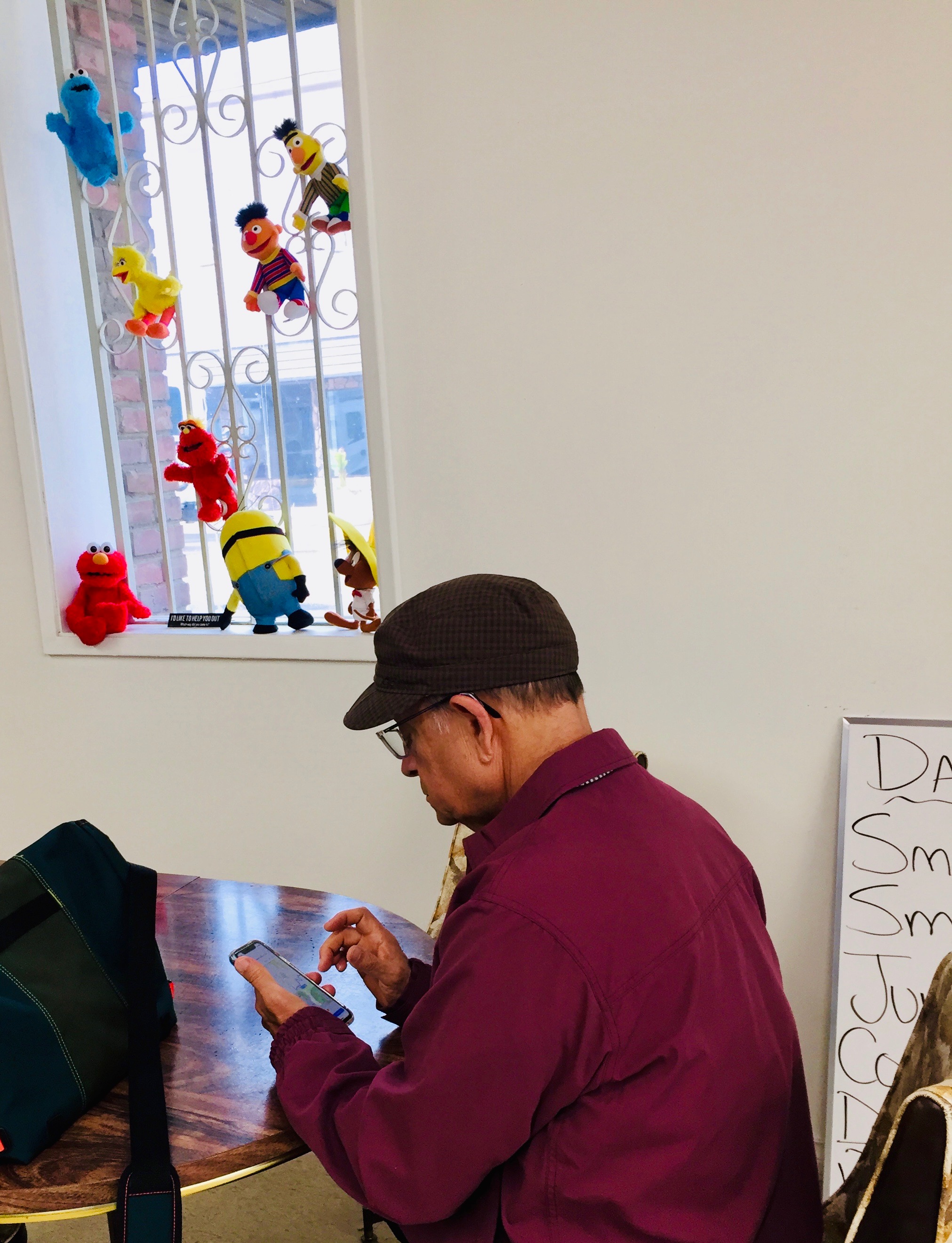
I went to the washroom, using a key that dangled off the end of a pastry brush. When I came back Michael was waiting at an imitation woodgrain table, with Bert, Ernie, the Cookie Monster, and Elmo climbing the window next to him.  Later he told me what had gone down with the bakery assistant.

M: “Do you have any dark coffee?”
She looks at him quizzically. “Dark?”
M: “Yes, you know, a dark roast?”
She: “Well, we have Folgers.” The little hand lettered sign beside the cash register advertised coffee in a French press.
M: “What if I ordered the French press coffee, what kind do you use for that?”
She: “Folgers.”

IMG_0386So we waited 20 minutes for the regular Folgers (not French press), admiring the huge almost empty room that, as Michael said, could house both a daycare centre and a bakery. In fact, there were toys and a drawing easel and other children’s stuff at the back.  There were houseplants everywhere and inspirational sayings taped to one wall.  The locals were engaged in a lively conversation and seemed to be enjoying their pie and coffee.
The bakery assistant looked apologetic as the minutes ticked by. “This machine takes forever.” But it seemed she wasn’t really familiar with where the fill line was, and it finished dripping a while ago. The baker showed her gently.  She was so apologetic.  “I’m SOOO sorry,” she kept saying to us, bringing coffee and a little pitcher of cream. She was a big woman, perhaps in her early 40s, dark hair in a single long braid and wearing a blue tunic and sensible shoes. I saw the edge of a tattoo on her strong brown calf, just visible from under her dungarees.

We drank our Folgers and it didn’t really taste like anything except hot creamy water.  But we didn’t want either the baker or her assistant to feel bad or like they had anything to apologize for, so we drank it up to the last drop.

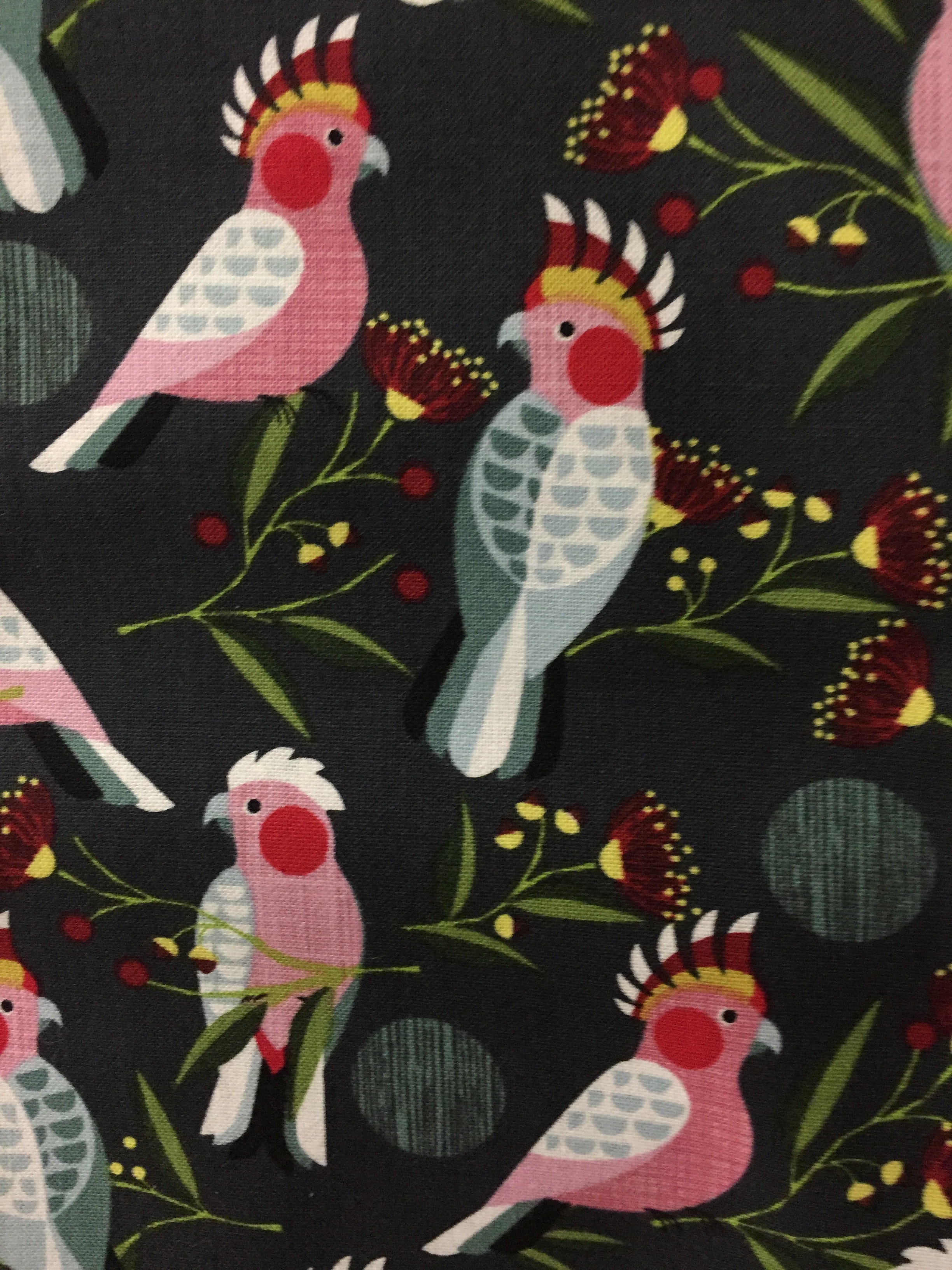
Later that day in Nelson, I was set on shopping at the I.O.D.E. (mperial Order Daughters of the Empire) thrift shop on Baker Street. It had good reviews, as thrift shops go. Rain had been pouring down for hours. The green forests were dripping wet as we snaked through the Kooteneys.  But now the sun came out as we walked down Baker Street, and I decided I wasn’t in the mood to shop at the I.O.D.E. Instead, I happened upon a very narrow fabric shop where I bought a half-metre of bird fabric that reminded me of Dr. Dolittle.  I’m not sure what I will sew with this fabric, but I do have birds on the brain. Halcyon, the kingfisher, the birds on the fabric, the hummingbirds at our feeder in Victoria.  The woman who ran the fabric shop had old treadle Singer sewing machines on display that we admired. (I like it how Michael happily goes to fabric and thrift stores with me and just finds a seat and reads while I browse.) I chatted to her about scraps. “I make scrappy quilts to use up the scraps, but it seems that no matter how many I use, I don’t make a dent in the scrap pile!” she exclaimed. I agreed that I had the same problem. I am pretty sure it’s because we keep buying new fabric. So even as we assiduously take from the scrap pile, we keep adding to it too because fabric is just so wonderful. Oh well. We could have worse problems. IMG_4043

Cranbrook Ed, by Michael

Our plan was to drive to Nelson and camp there, arriving early and having at least half a day and an evening to revel in the spiritually rich, friendly hippy vibe of this beautiful Kootenay town.

Best laid plans, as they say—after spending an hour waiting for coffee in Grand Forks we fought our way through a torrential downpour most of the way to Nelson.  We loved the array of funky shops, but really wanted to get to Head-Smashed-In-Buffalo Jump in time for indigenous dancing the next day and had forgotten that we were about to lose an hour to the time zone change.  Besides, the pouring rain made camping somewhat unappealing. So we decided to press on and stay at Cranbrook.

But first we shopped. We found a gong/singing bowl for our meditation shrine at home, and had the most wonderful conversation with the proprietor of Gaia Rising, who moved to Nelson from the lower east side of Vancouver, decades ago. We talked about community, addiction and consciousness raising-and I found myself thinking that I was really loving all the little connections we’ve been making along the way.  People are so friendly-and then it occurred to me that we’re probably helping that along. I also bought a Peaceful Poppy shirt that seemed somehow to fit with the whole trip so far.

The late Stuart McLean loved “Small Town Canada”, and over the past three days I have thought about this frequently.  The towns we have stopped in have been quirky, warm and welcoming, which seems quintessentially Canadian to me.

Cranbrook was pretty interesting. Madeline and I took pictures of a couple of signs: The Nails Christian Book Store, and very well-weathered Welcome to Downtown Cranbrook.  These have to be seen to be appreciated, so we’re included the images with this post.

IMG_4031IMG_4028IMG_0391

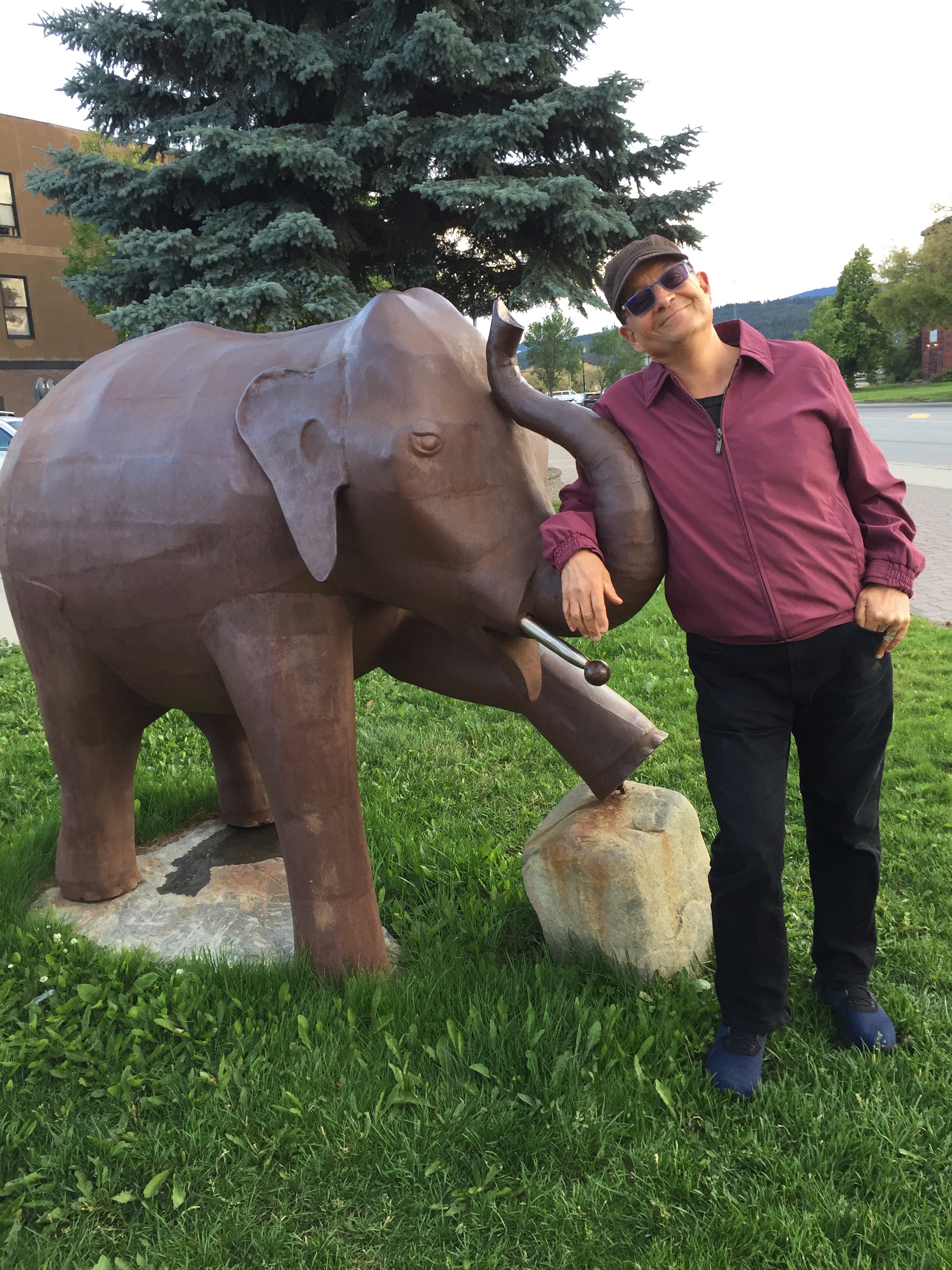
On the way back to our hotel I noticed a statue of a baby elephant—apropos, it seemed, of nothing. On reading the accompanying sign it turns out that in 1926 the Sells-Floto Circus visited Cranbrook and somehow lost fourteen elephants into the surrounding forest  (my mind reels imagining how that happened). Most of them were recovered fairly quickly, but one—Charlie Ed—remained at large for 6 weeks. The post-capture celebration breakfast and parade in Cranbrook was memorable, and Mayor T.M. Roberts declared Charlie Ed to be an honourable citizen, upended a bottle of champagne over his head, and re-christened him Cranbrook Ed.

IMG_0401

Next up, Alberta.

IMG_0393

No candy here, but you are loved

On Hallowe’en, after eating Michael’s amazing lamb curry, we went for a walk around the neighbourhood. Dusk, and the veil between the worlds was growing thin. We saw some spectacular sights: skeletons rattling from tree branches, dozens of glowing jack-o-lanterns, front-lawn cemeteries, and even fog machines blowing eerie mists over cardboard gravestones. We saw a few costumed kids, as well, and were reminded that we had no candy in our house.

On our return home, we closed the living room blinds and turned out the porch light. My husband printed a sign and taped it to the front door so there would be no confusion: “Sorry, there is  no candy available here. Please be safe and enjoy your Hallowe’en.” We are out of the habit of distributing candy to trick-or-treaters not only because our children have grown to be men, but because we rarely eat white sugar anymore.  My body suffers when I eat sweets—I experience an immediate high then a crash with aching joints and deep fatigue. So doling out mini Snickers bars or bags of M&M’s seems cruel. (Apologies to my own children for feeding them so much sugar over the years.)

We settled down to watch a movie, a documentary about Fred Rogers called “Won’t You Be My Neighbour?”  Mr. Roger’s Neighbourhood made its debut on national public television in February 1968. I didn’t watch the show as a child, but it aired until 2001 so my children watched it sometimes, and I always had a fondness for the show’s slow and gentle pace and the kindness reflected in the content.

As we watched, I found tears streaming down my face.

I cried when Fred Rogers, sitting on a low stool, angled his tall, lean body toward a small boy and listened carefully to what the child had to say. I cried when children thronged around him during his public appearances, and one little girl came right up to him and said “Mr. Rogers, I want to tell you something. I like you,” and he said “I like you too, dear. Thank you for telling me that,” and touched her arm. I wept some more when I heard him say, “I like you just the way you are” to the thousands of unseen children at home and again when I heard that the simple, scruffy Daniel the Tiger puppet spoke from Fred Roger’s own childhood fears and vulnerabilities. More tears came as I witnessed the kindness Rogers showed when he spoke to children about how confused, sad, or scared they felt about divorce, death, or war.  I cried out of sadness about my own childhood when I heard him say “Children have very deep feelings, just as everyone does.” And I cried the most when I heard him say that “Love is at the root of everything. All learning, all relationships. Love or the lack of it.”

It was my birthday present to myself, I realized, to release my sadness and joy through tears as I watched this movie. I feel happy that Fred Rogers created the show and made a difference in so many children’s lives. I suppose it was ironic that we hadn’t been neighbourly ourselves when we posted our “no candy” sign and shut out our young neighbours on Hallowe’en.

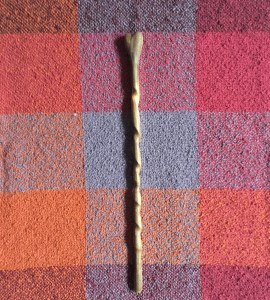
A few days later, I went to a craft fair with friends and found a man who carved wands out of wood.  A wand with a chisel design and a heart at one end caught my attention. After buying it for $10, I moved the wand through the air, imagining that as I waved it, love flowed from the tiny wooden heart and spread warmth and philia over those around me. I tested it on my two friends and a few of the craftspeople sitting at nearby tables. Feeling the immediate effects of the love wand, their smiles grew wide and shiny.  I was onto something.  So when I brought my wand and other purchases home, I thought back on Hallowe’en and imagined what might have transpired if I had in my possession that evening my magic wand. I would have cast a small yet convincing spell over all the children in the neighbourhood as they trudged house to house for treats. To the witches and zombies and superheroes—to all of them—I would have delivered a powerful message: You are loved just the way you are.IMG_3403

Michael’s Lamb Curry (the secret is in the onions)

serve with rice; 8 portions

2 large yellow onions, finely chopped
6 large cloves garlic and 1.5 inch knob of ginger – both minced
7 Roma tomatoes
3-3.5 lbs. lamb shoulder (boneless) cut into small cubes
14 oz. can chick peas, rinsed and drained
3 c. green beans, washed, trimmed and cut into 2 inch pieces
1/3 jar Patek’s Vindaloo paste
salt and freshly ground pepper to taste
approx. 1/2 tsp. cayenne (to taste)
2 tbsp. apple cider vinegar
1 tbsp. honey
olive oil as needed

Sauté onions, garlic, and ginger in olive oil over medium heat until you swear they are going to burn. Just keep turning them as they turn dark brown and you have to scrape them off the bottom of the pan. This takes a while. Meanwhile, pat the lamb cubes dry and fry in another pan in olive oil until brown, then deglaze the pan with a little water to get all the brown bits off.

Blanch and peel the tomatoes.

When onions are completely brown, add curry paste and fry into the onions, blending well.  Crush the tomatoes with your hands into the onion mixture. Stir. Add the lamb, the cut beans, and the chick peas, then mix in vinegar and honey. Add the cayenne to as hot as you like. Bring to a gentle simmer and cook 40 minutes or until the lamb is tender.

IMG_3398 2

Magic love wand: $10


Remembering Hanna

IMG_1739When Hanna came to visit, she brought candy. Not dark chocolate for the adults, but Twizzlers, sour worms, stuff kids devour. She sent birthday money and cards to my children. One summer she came to visit from Ontario and listened to my teenage son play clips from the music he was loving that season. She leaned in attentively when he described to her why he liked it. She was interested.

You were welcome at her house. John would make a beautiful latte for me while Hanna and I caught up on news.  Even if it had been over a year since our last visit, our talk felt seamless. It was that kind of friendship.

When I visited her in Toronto or Bradford, she would often drive me and whatever kids I brought with me up to my father’s farm and stay for lunch. She loved the green fields and the trees, the pond fringed by weeping willows and graced with swans. She loved to help others, and she thought nothing of going out of her way, driving three hours just to get you somewhere.

A few years ago, I visited Toronto with my new husband, and when I called to ask if we could see her, she invited me to the hospital where she was staying at the time. I was surprised and worried, but she treated the whole thing as natural, greeting us from the metal bed as if she were sitting on the couch in her living room.

Although self contained, sometimes she opened like a peony. We sat cross-legged on her bed once, and she lifted up her shirt to show me her mastectomy scars, raw ridges across her breastbone. She knew about impermanence, about the art of losing.

And she was loyal.  Though we didn’t see each other much, we remained friends for over 30 years. She always asked how my kids were doing, my parents, my sisters. And it was genuine, never pasted-on.  When my book of poetry was published a few years ago and a small launch was held in a Queen Street bar, she made sure she was there to quietly support me, even though she wasn’t well, and I could see it took prodigious effort to get there.

She threw the spotlight on others by drawing attention to their achievements whiledownplaying her own considerable ones. She saw mistakes and problems in the kindest light—her gentle brown eyes and wide smile encouraged you to just be yourself, it was okay.  She accepted you. “Oh Mad,” she would say, with a sing-song lilt—starting high on the “Oh” and down a perfect fifth on the “Mad.” Empathetic affection. We’re in this crazy world together.

She was proud of her kids and her husband, and she worried about them.  She knew she was going to leave us too soon, and she worried about that too, because she wanted her family to be okay without her.

The last time I saw Hanna was around a year ago. She was pretty sick, yet still going to work, her job another focus of her loyalty. She had always exuded a spritely energy, a kind of no-nonsense way of moving around her environment. But in the last couple of visits, she had slowed down and was finding her body unwieldy.

She had taken up knitting in a big way—following Arne and Carlos, the Scandinavian knitting duo. She wrote their names and blog address in her neat script on a post-it note for me to take home. We sat together on her living room couch, admiring her colourful hand-knit socks. “Maybe,” I told her, “I’ll take up knitting too.” Knitting keeps your mind off things, off the future, she told me. “You have to pay attention,” she told me, “or you’ll drop a stitch.”

I miss you, Han.