We trudge up our front steps in the early evening, returning from dinner with friends. We ate turkey, stuffing, beans and brussels sprouts, gravy, mashed potatoes. Our contribution was a salted caramel apple pie and vanilla ice-cream for dessert. We all ate too much. “I’m putting on my fat pants,” says my husband as he enters the code on the front door. At that moment, I turn on the steps to see a man pushing his daughter in a stroller across the street. The autumn light is waning. I catch the eye of this young father. It’s clear to me that he had heard what Michael said about fat pants. We share a smile.
That moment of human connection and common understanding made me happy all evening. What was it? It was knowing the feeling of eating too much and needing to get out of the jeans and zippered clothing, to put on the good old pjs with the forgiving drawstring. That young dad had a pair of fat pants too, I bet, a grungy pair of UVic sweats he pulls on when he’s eaten too many of his wife’s homemade cookies.
These days I wear fat pants most of the time. There has been a softening, not only of the gut, but of the days themselves. The hard beep of the alarm in the morning is gone, replaced by a warm hand touching my back, caressing my flank. The morning routine is unrushed. I push up the shade to see dawn clouds flushed in pink. The coffee tastes good.
I spend as long as possible in my pajamas, then switch to leggings with an elastic waist to take the dog for a walk. I step on the scale every once in a while, and my weight remains the same, hovering around 55 kilograms. But the body expands, loosens, just as time loosens around the edges. The weekends are no longer demarcated. The fence separating Saturday and Sunday from the rest of the week crumbles to reveal the long week as a flat green field. But as you traverse the field, day by day, hillocks rise up before you, unexpected, beautiful. A sudden offer, an old friend reaching out. Time to read a book in the middle of the day. The best morning glory muffin you’ve ever tasted.
Sometimes you panic because the borders have disappeared. Terrifying, all that unmarked space. So, you write to-do lists and make a lot of coffee dates and sign up for classes and try to get part-time work. Then you wake one morning, see the light leaking through the crack between blood-red curtains, hear the bird singing. You realize you’ve gone from writing in the first person to writing you, in the second person, and that you’re not even sure who you are anymore. Everything feels raw, your nerves pulsing beneath your bare skin. You realize you’ve gone from the occasional joy of a fat pants evening to a fat pants life, traversing a field without landmarks.
I am in Toronto for a few days. This city was my home from 1965 to 1989.
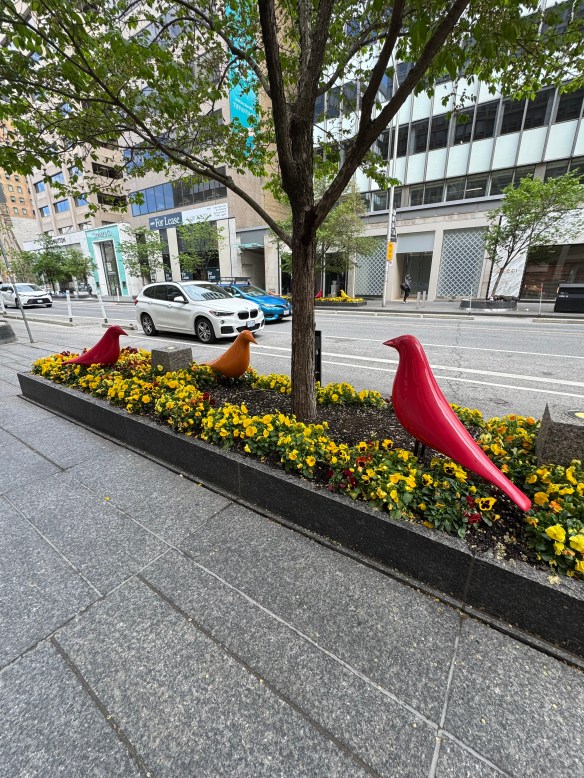
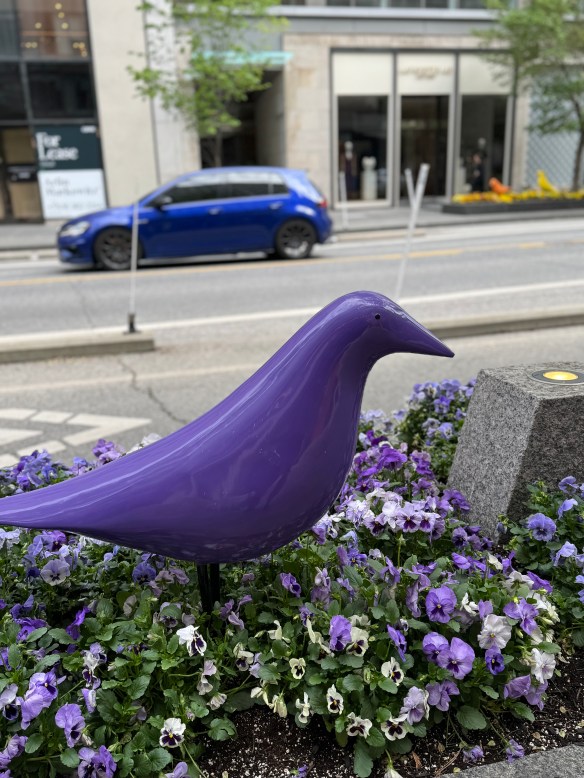
I have been walking Bloor Street West. First, the Mink Mile, that stretch between Yonge and Avenue Road lined with the tall glass storefronts: Zara, Birks, Lululemon, Holt Renfrew. Rich people shop here. Very few birds fly above these tall, inhospitable stores. Instead, big bird shapes in bright shiny colours line the sidewalks, ghosts of extinct species.
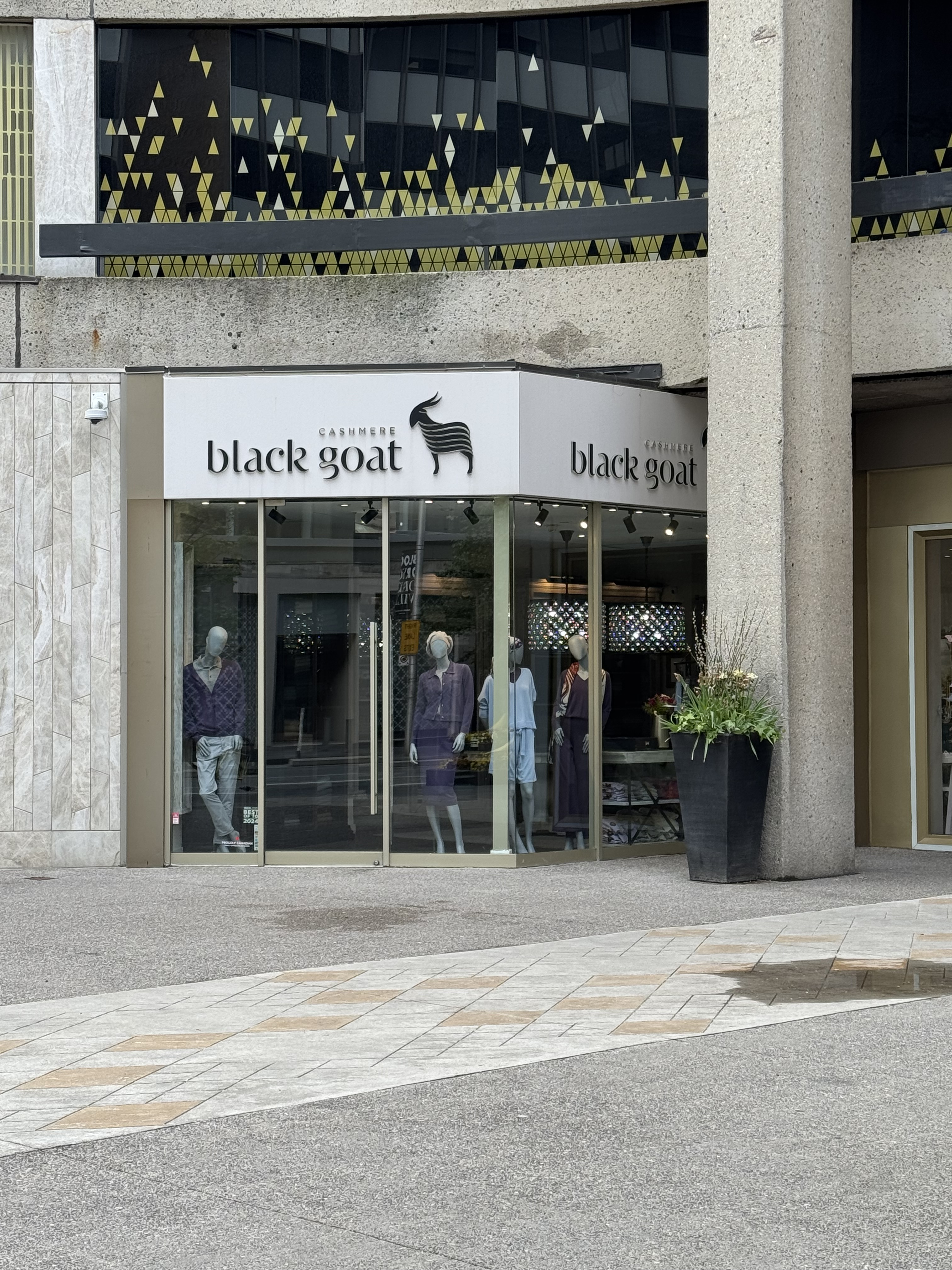
It’s cold in Toronto for late May. I wear a toque, jacket, leather gloves. But now I wish I’d brought a scarf. I admire the scarves in the window of Black Goat Cashmere, next to Ashley’s in what used to be called the Colonnade. This mall was one of my mother’s favourite places; after window shopping Bloor Street arm in arm, we’d drink coffee and eat pastries at the Coffee Mill at the back of the Colonnade.
I enter the store. Two saleswomen are upon me immediately. I ask about the small scarves, lifting one of them up out of the wooden box where they are displayed like confectionary, soft cashmere in artful designs, wool watercolours. “How much are these little ones?” “Oh,” says one of the women, advancing, “the Carre scarves are $385.” I laugh, folding the luxury item back into its box. “Perhaps in another lifetime.”
Pulling my zipper up to my chin and walking into a fierce wind, I take a detour to wander around the grounds of my alma mater, Victoria College. I feel nothing as I gaze over the green lawns, watching two young men kick a soccer ball. Alma mater means “nourishing mother,” but this place was not that for me. Those four years as an undergrad in English Literature are a blur. One thing stuck: a Shakespeare lecture by Northrop Frye when he—already extremely old—told us in his quavery voice that Bach’s Mass in B Minor was the voice of God speaking. All of us bent over our notebooks and wrote that down. It sounded profound.
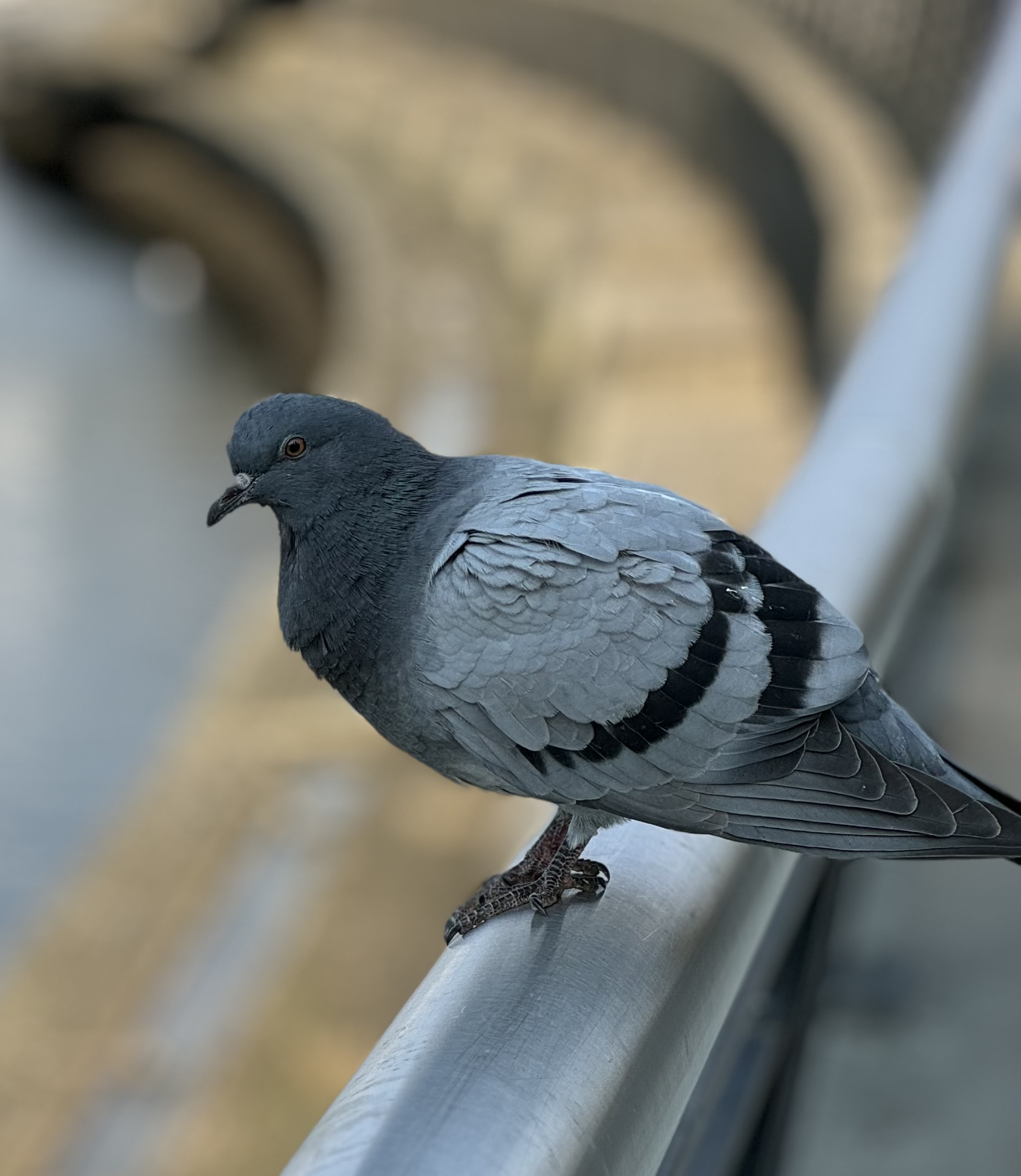
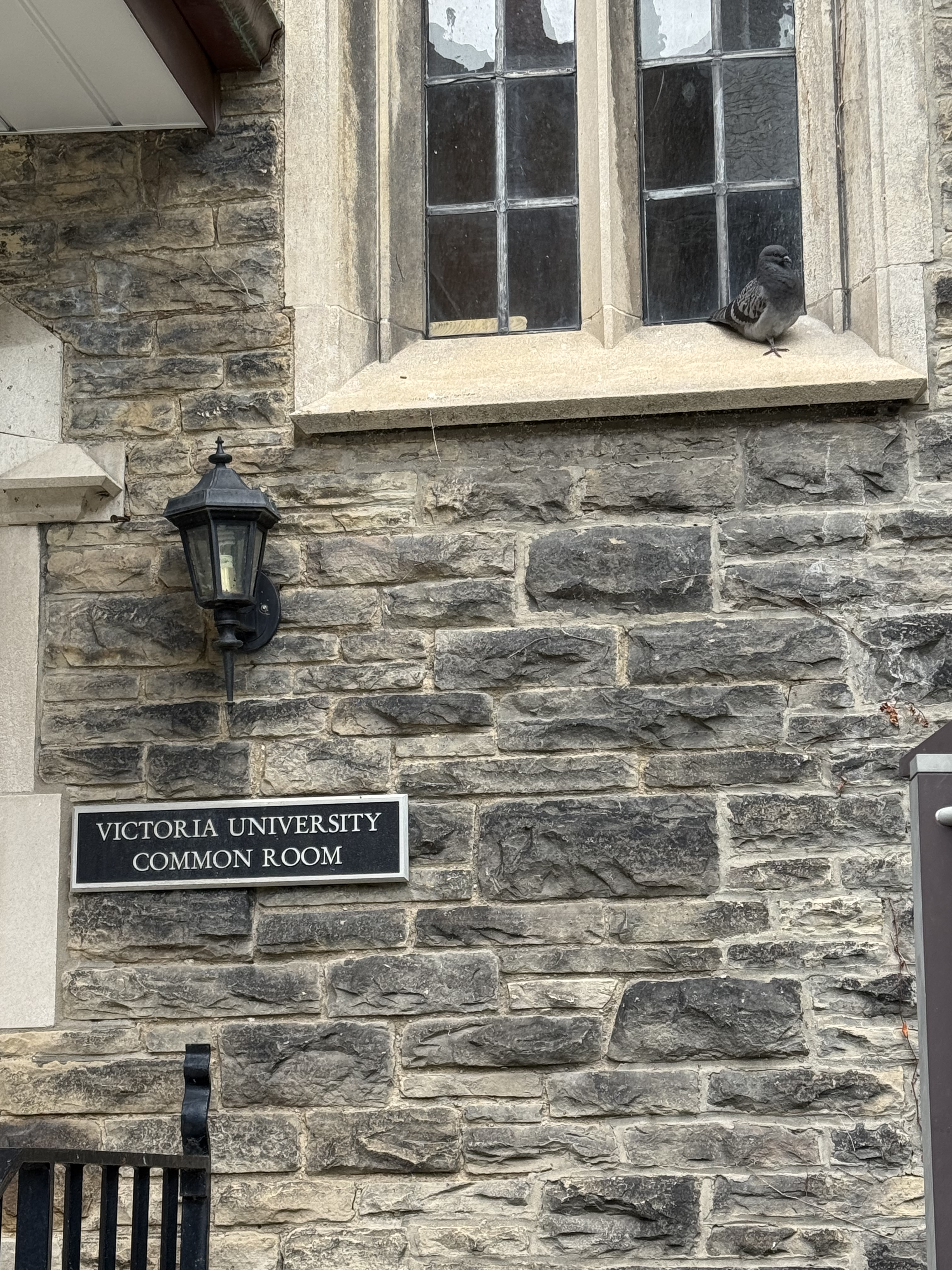
I was a lonely young woman. Barry Lopez writes that “It is not possible for human beings to outgrow loneliness,” and that seems true to me. Though I’m not as lonely as I was. I admire a pigeon perched in the recessed window of the Victoria University Common Room.
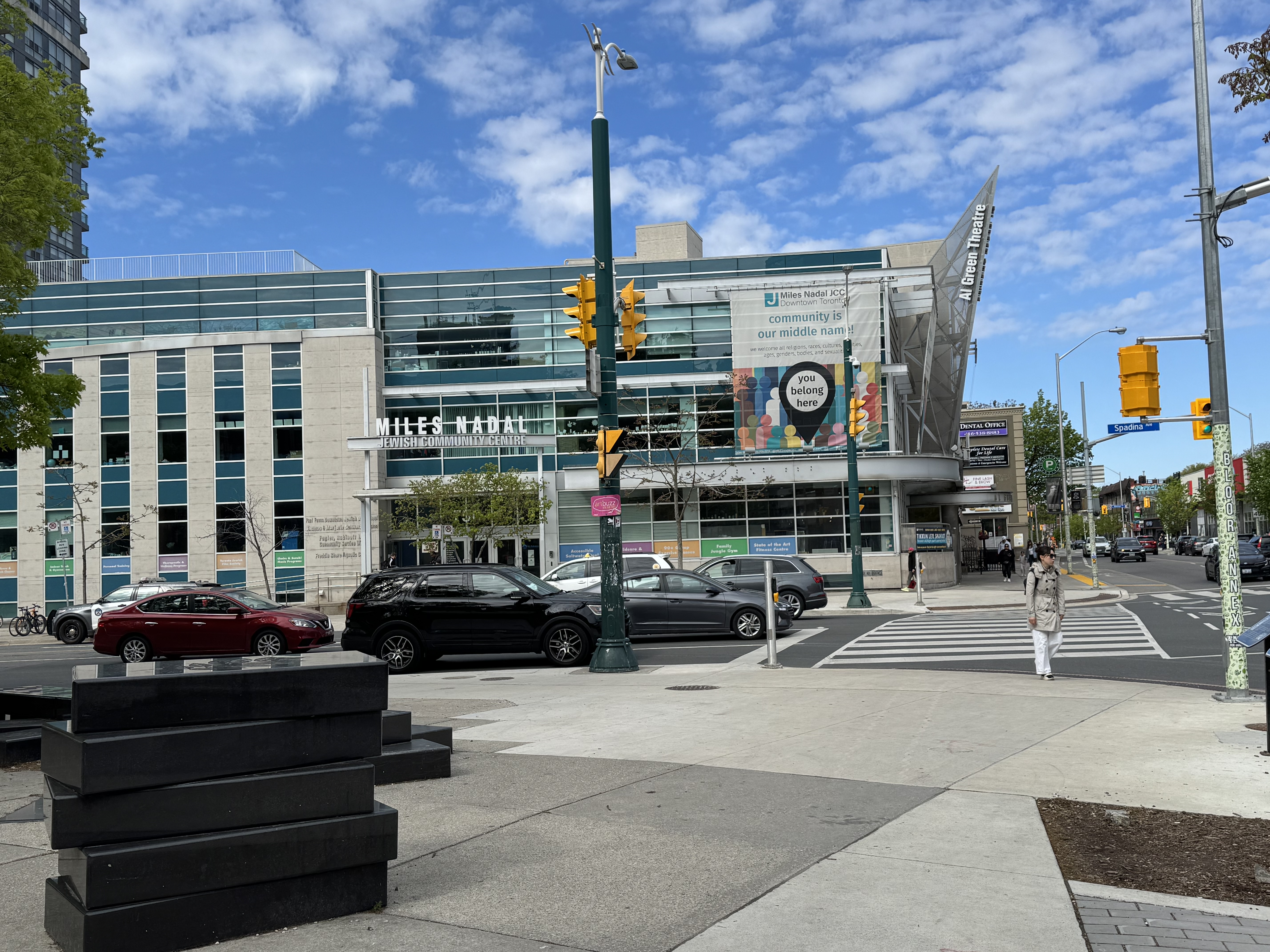
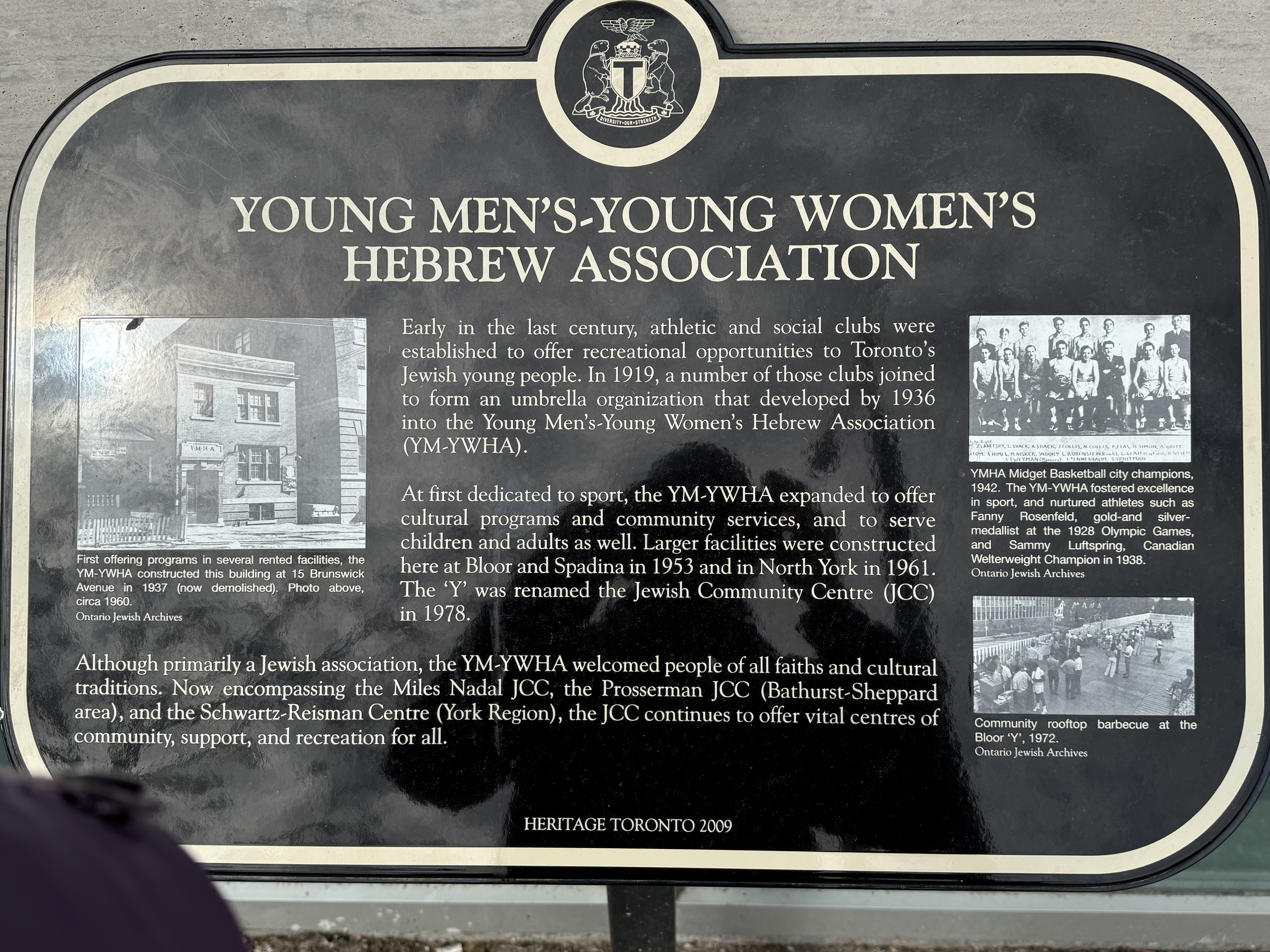
On the way up University back to Bloor Street, I check out the Gardiner Ceramic Museum, where I hope to see the work of contemporary ceramic artists, only to find that the main galleries are closed for renovation. I continue back along Bloor. It’s time for a coffee and I remember a Second Cup in the block before Spadina Avenue. And if that is no longer around, there’s a coffee shop in the old Jewish Community Centre (JCC), where my mother did aquafit for the last decade of her life. Back in the seventies, when it was the Young Men’s Hebrew Association, it was home to SEED, the alternative school my sisters and I went to as wild teens.
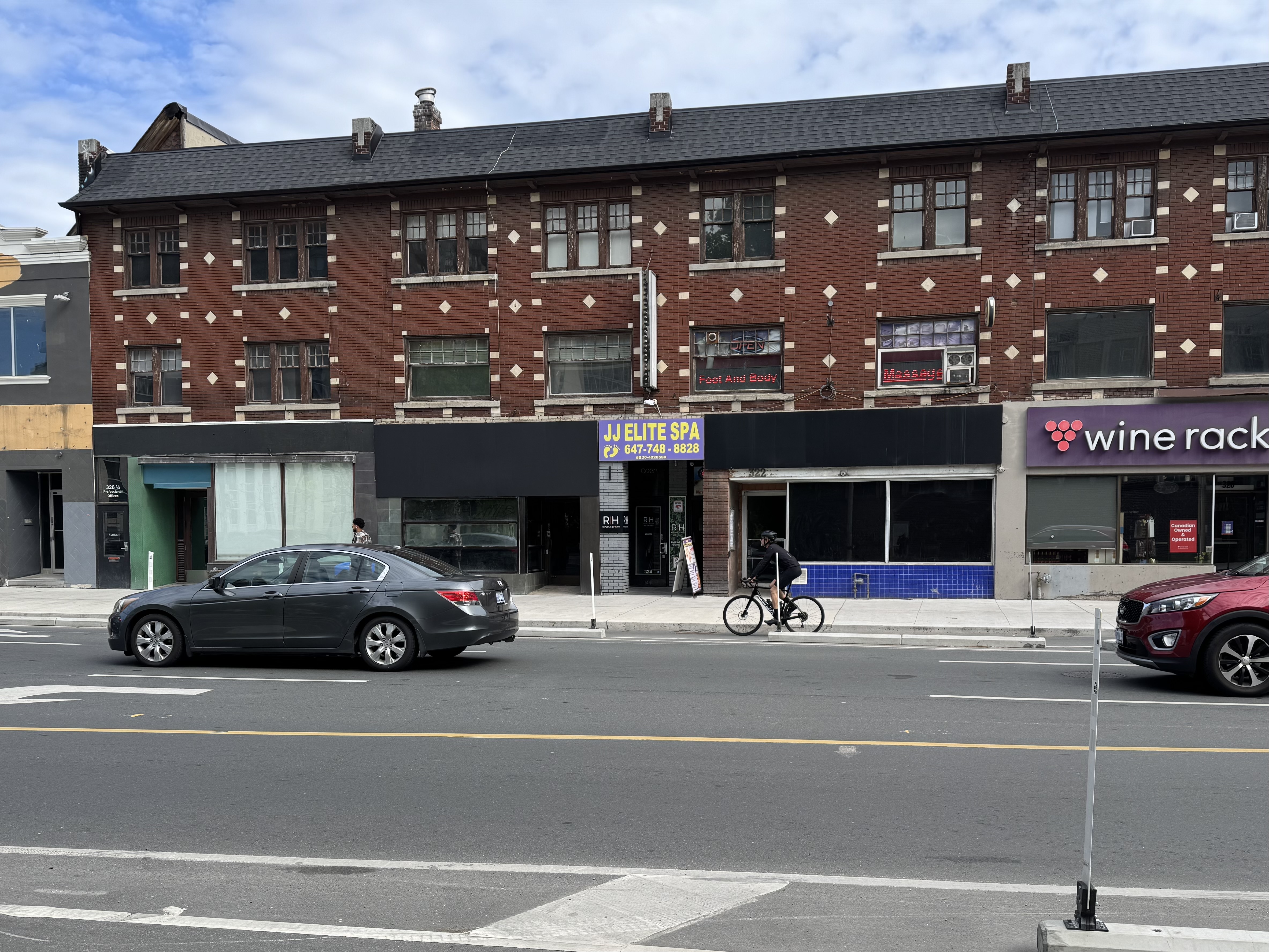
Second Cup is gone, and so are many of the other businesses on that block. Everything in life is impermanent, so I am not surprised Second Cup and Noah’s Health Foods have disappeared, and the spaces are vacant. Once upon a time there was a greasy spoon in this block where we drank coffee in thick cups, smoked cigarettes, and ate French fries. We walked over from “school” and stuffed our electric bodies into the vinyl booths, laughing, talking, flirting, mystified and excited by life. Once, for a time, my sister lived above the restaurant with her boyfriend, an apartment with burlap on the walls and plants everywhere. There’s history here.
The wine store remains. This is where we bought bottles for the meal marking my mother‘s death in February 2019. Her house is only a few blocks from this corner, and she died at home. We carried the clanking bottles through the snow. My sister made bouillabaisse and we sat around the teak table, drinking, eating, and telling our Virginia stories, stories filled with love, regret, sadness, and confusion.
I cross the street twice to the southwest corner and pull on the doors of the Jewish Community Centre, but my pull meets resistance. A security guard opens the door from the other side, just a few inches, and peers at me. “I am trying to get into the coffee shop,” I say. “No more coffee shop. Coffee shop no more,” a sort of palindrome of endings. And he closes the door in my face.
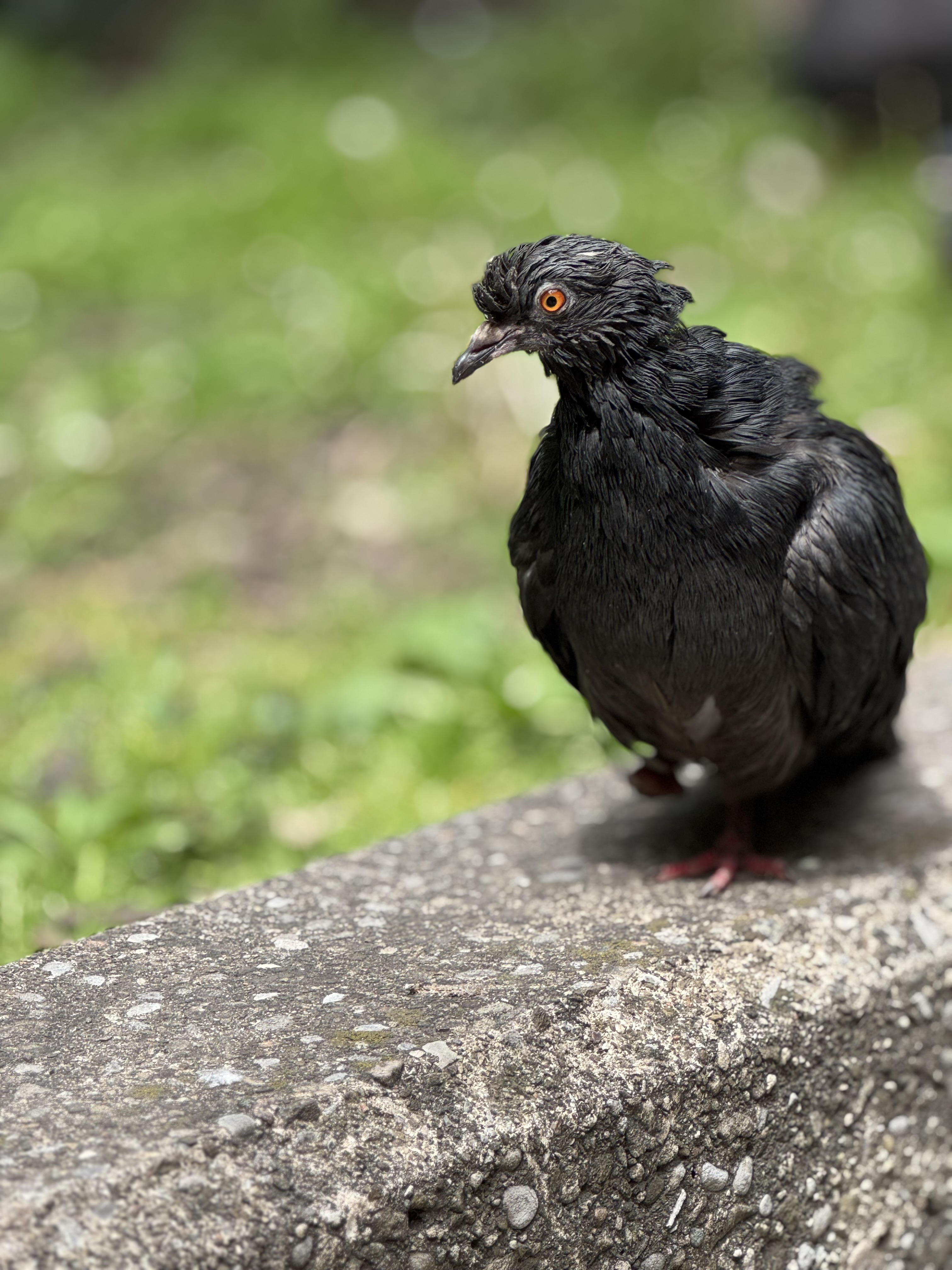
I keep walking. Surely, there is a sweet, cool, interesting café somewhere along Bloor. I am Ahab stalking the great flat white, but she’s nowhere to be found. I pass more than one Tim Hortons among the restaurants and bars still closed this cold morning, but no, I won’t go there. Cigarette butts decorate the grey pavement, evidence of parties spilling onto the street last night. Pigeons strut their stuff. I keep walking. Yes, I know Futures Bakery might be considered an interesting coffee shop, but I hold out for something else, some uncertain thing, something new, something not in the algorithm.
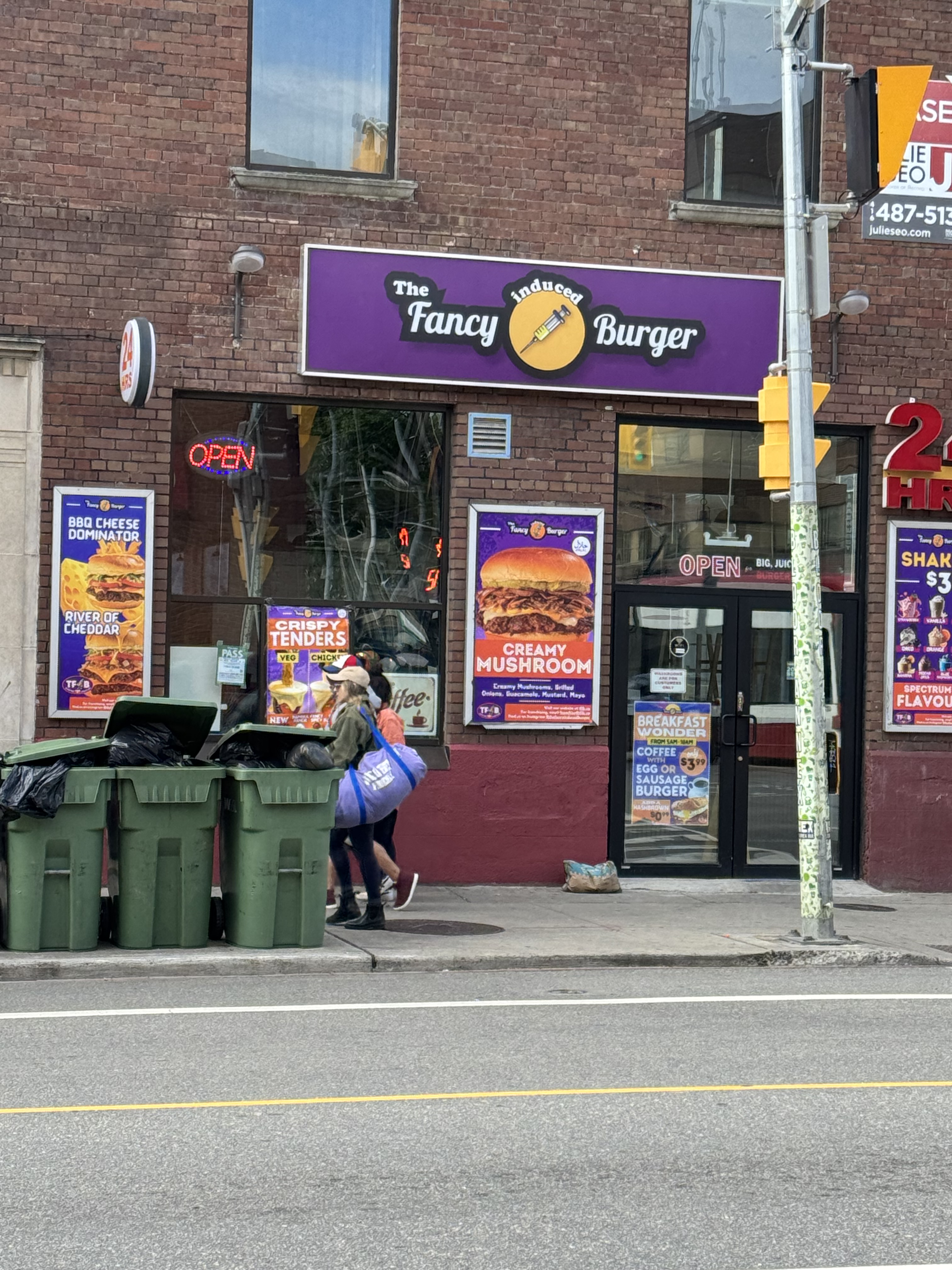
I keep walking. The Hungarian restaurant where we ordered dumplings and gravy and goulash soup: gone. The delicatessen and the cheese shop with a cow in the window: both gone. The café that once took up that southeast corner of Bloor and Bathurst: gone. Now there’s a Fancy Burger outlet, where you can add a syringe cheese shot to your beef patty for $1.49. This part of Bloor continues to metamorphize. Ethnic restaurants and record stores turn into cannabis shops and bubble tea counters. Used bookstores become pet pampering salons and tattoo parlours.
I am happy to see Midoco, the office supply shop, a place where you can lose yourself among the art supplies and fountain pens, is still in business. Ditto the Home Hardware.
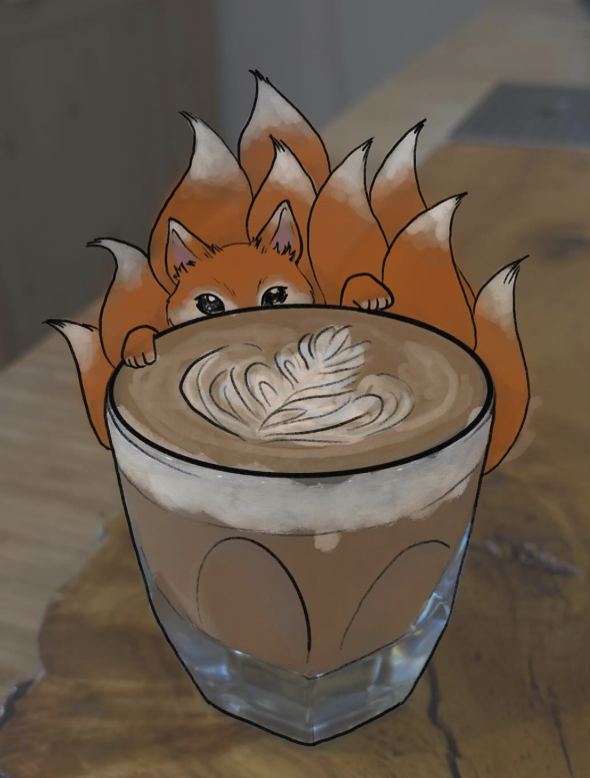
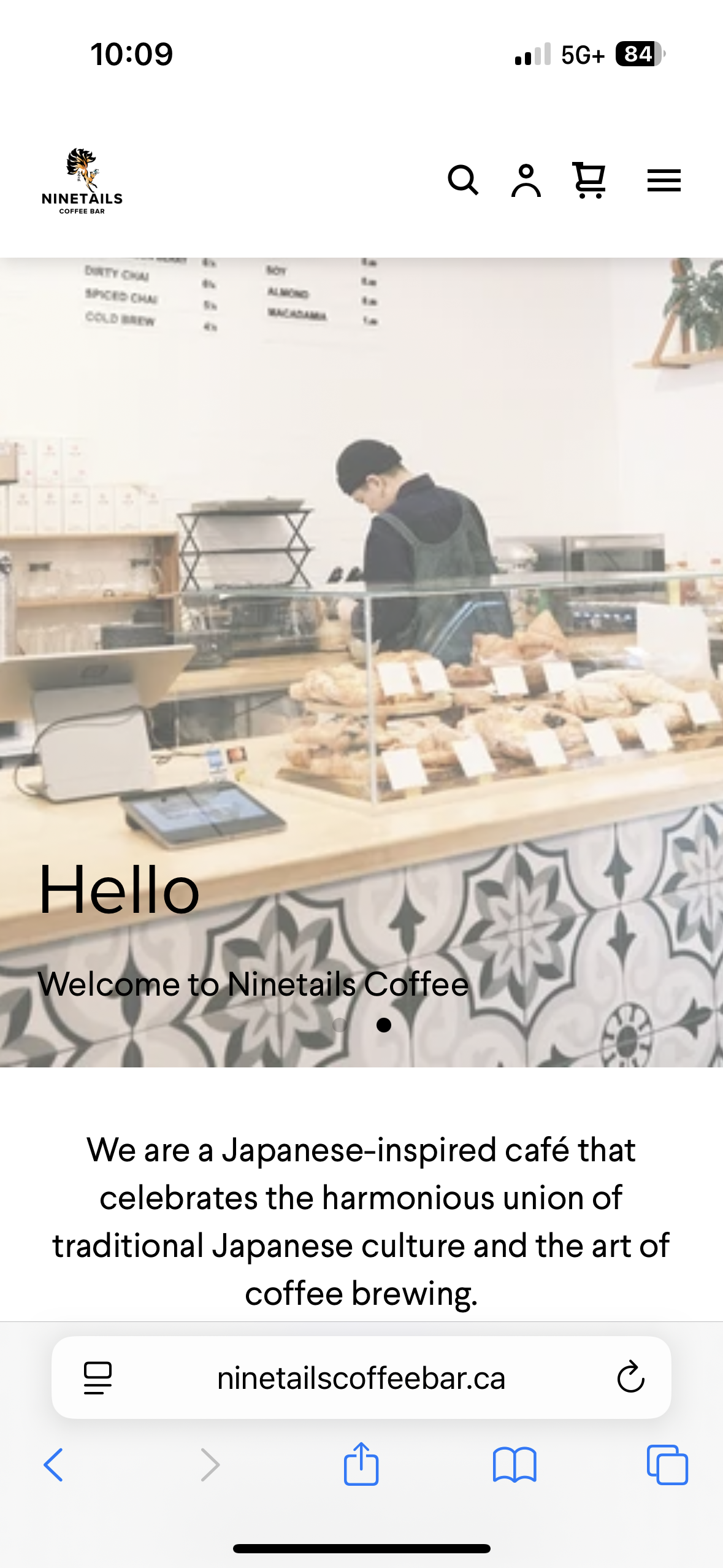
I keep walking, knowing that somewhere soon, I will come upon something interesting. I pass the small corner grocers, happy to see they still sell bargain produce and hanging pots of flowers. I pass Euclid, cross to the south side, and then, suddenly, there is an A-Frame sandwich board picturing a fox with many tails. I walk into Ninetails Coffee Bar, where two young Japanese women bustle behind a honey-coloured wood counter. White walls, a few small round tables graced by simple folding chairs. A coffee bar decorated with ceramic tiles patterned in grey, blue, and white. A full pastry case. Smiling faces welcome me.
My flat white, delivered in a short glass with a foamy fern on top, is delicious—strong and hot. While I drink my coffee I read about the coffee bar’s philosophy.
In Japanese folklore, Kitsune are foxes with mystical powers that can grow nine tails.
“we embrace the Japanese philosophy of ‘ichi-go ichi-e,’ which translates to ‘one opportunity, one encounter.’ This concept underscores the importance of cherishing every moment and every connection we make with our guests, as each encounter is unique and irreplaceable. Our goal is to provide you with a little window to Japan & Japanese culture within each visit.”
I gaze across Bloor to the north side and see, to my delight, a used bookstore that I’ll visit after I drink this coffee. It’s too easy to get lost in the past during this trip. Wandering through old neighbourhoods, remembering past experiences, feeling traces of old sadness and joy. But Toronto, like Freud’s Rome, is a metaphor for the mind. There is no denying that my personal history, etched through the decades, permeates my experience of Bloor West. I feel these vestiges of the past in my body.
But there is also the present: every moment is unique and irreplaceable.
The sun finally emerges from behind grey clouds on this cold day and streams through the glass over my table. I will never experience this moment again, as I drink this coffee, as I gaze at the people around me, the heavily inked man, the woman with green hair, as I examine the fox on the sandwich board outside, waving her many tails. She reminds me there is only one opportunity, one encounter. This is it.
Sometimes a word rolls around in my mind for weeks. Lately, it’s “shed,” both noun and verb. I started to make notes about “shed” and its associations. When I saw the document file that I’d titled “The Word Shed,” I recognized a new meaning: my mind is a word shed. A space where I collect words, play with them, combine them, examine their denotations and connotations, milk their honey.
Shed the noun is a simple roofed structure, typically made of wood or metal, used as a storage space, a shelter for animals, or a workshop: a bicycle shed | a garden shed | a woodshed. Or a place to work. Last summer we met a couple at their yard sale, and they showed us the woman’s “She Shed” in the backyard. They’d built the small one-room shed during the pandemic: it was a place for her to work at home in peace and quiet. I’d never heard the term “She Shed” before. I like it better than “Man Cave.”
Michael’s drawing of an old shed located in my father and Marion’s sugar bush near Markdale, Ontario. We called it the “sugar shack.”
The Shed is a restaurant in Tofino where, two years ago on my sister’s birthday, I had a delicious salmon bowl that I recreated at home later. I knew the ingredients: salmon, quinoa, raisins, almonds, chopped apple, kale, white cheddar. I intuited a dressing of tahini, olive oil, lemon juice, garlic, honey, and yogurt. I discovered the recipe, handwritten on blue paper, in my recipe binder and realized that I’d somehow cared enough to reverse engineer the recipe, though I can’t remember writing it down.
I made the Salmon-Kale-Quinoa Bowl again the other night and it was delicious. I didn’t have white cheddar or puffed rice, so I used shaved parmesan and skipped the puffed rice.
The Shed restaurant invokes a homey feel. I remember being there with Jude and Michael, tucked into a cozy booth while rain spattered the windows and wind whistled outside. Like sitting in a warm shed on a stormy day. We walked on the beach after lunch in our rain gear.
Over the years, we’ve had two sheds built on our property for storage, bicycles, and garden stuff. Now we’re moving and clearing out the sheds. I’d forgotten about the stuff I stored there. Out of sight, out of mind were boxes of old letters, some going back forty years; kids’ artwork, writings, and report cards; notes from university courses; my old journals. Sorting and shedding and shredding old papers over the last few months has been part pain, part joy, and sometimes so funny I laughed out loud.
Another shed: On December 1, we’ll be in New York City to see Kenneth Branagh in the role of King Lear at the Shed, “a new cultural institution of and for the 21st century.” Their website explains: “We produce and welcome innovative art and ideas, across all forms of creativity, to build a shared understanding of our rapidly changing world and a more equitable society.” After a run in London, England, Branagh is bringing the play to this exclusive U.S. engagement.
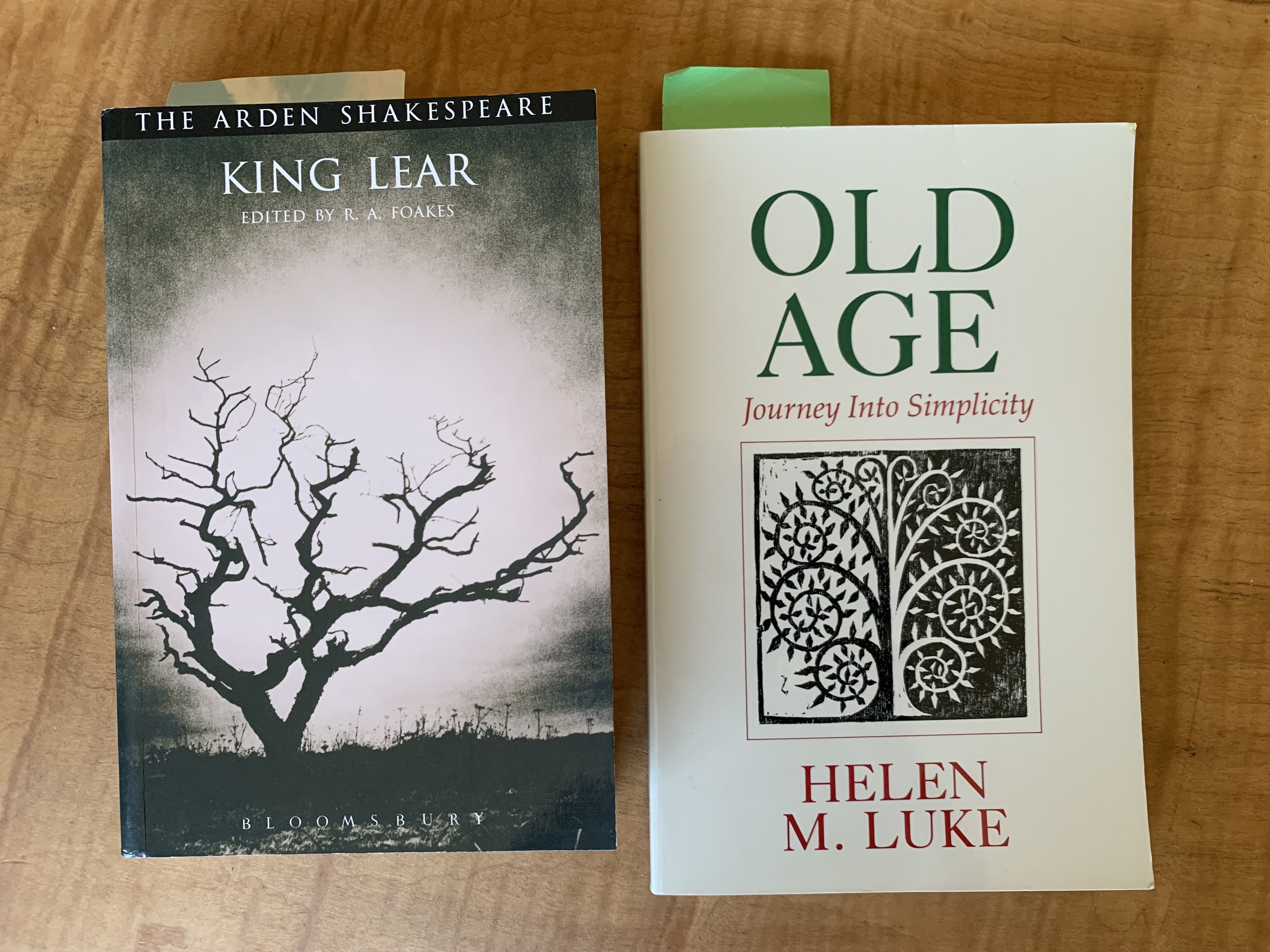
It’s months away, but of course we had to buy tickets early. It will be exciting to see Branagh play Lear in my favourite Shakespeare play. I am reading Helen Luke’s book Old Age, and the chapter on King Lear moved me, particularly when she refers to the two lines spoken by Lear to Cordelia in Act 5, Scene 3, “When thou dost ask me blessing I’ll kneel down / And ask of thee forgiveness.” Luke writes,
“If an old person does not feel his need to be forgiven by the young, he or she certainly has not grown into age, but merely fallen into it, and his or her ‘blessing’ would be worth nothing. The lines convey with the utmost brevity and power the truth that the blessing that the old may pass on to the young springs only out of that humility that is the fruit of wholeness, the humility that knows how to kneel, how to ask forgiveness” (p. 27).
Lear’s story resonates because he shows us that shedding egotism and pride may be followed by an exquisite sense of humility. Many of us experience this as we grow older. Only after Lear is hollowed out by loss can he enjoin Cordelia to “live / And pray, and sing, and tell old tales, and laugh / At gilded butterflies.” Only after loss decimates us, do we feel an unusual lightness of being. So different from the lightness of youth, this lightness we purchase with grief.
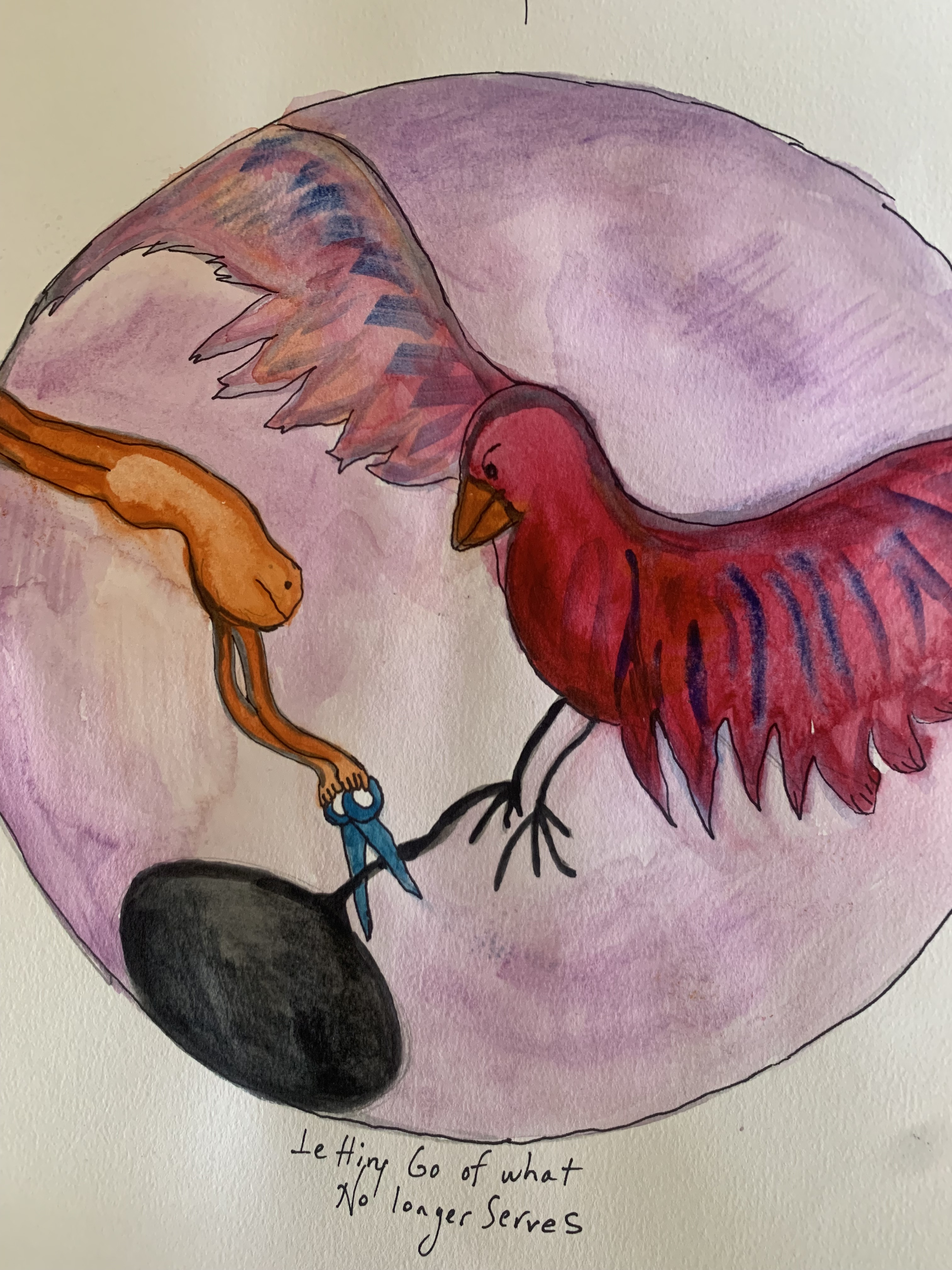
Shed your burden ~ watercolour by Madeline Walker
Then there’s the verb, “to shed.”
To rid oneself of superfluous or unwanted things or feelings…to give off, discharge, or expel, such as a cat shedding fur, a snake shedding skin, a tree shedding leaves.
Shedding blood. Bloodshed. Viral shedding. We all shed tears.
And don’t forget the intransitive verb, to woodshed: to practice a musical instrument, to work out jazz stylings, to go over difficult passages in a private place where you can’t be heard.
Isn’t it odd that the noun shed refers to a place where you store and keep and gather things, whereas the action word (transitive verb) means to let go of, release, slough off feelings, body parts, objects? These meanings are in tension with each other – one wants to keep, the other to release.
But perhaps it isn’t so odd. The tension between the noun and the verb merely replicates the push and pull we feel in our lives between holding close and letting go.
Last week, while on vacation in a small town in Mexico, I read Wintering by Katherine May. Perhaps it seems like an odd choice for a “beach read” in the sun. But the subtitle spoke to me: The Power of Rest and Retreat in Difficult Times. Something in me said—yes please! Give me permission to lay down my (figurative) sword, to retreat when things aren’t going smoothly. I was thirsty for her message that during fallow times, rather than pushing ourselves to do more, we need to withdraw and rest. We need to do less. In the book, winter is both a season and a metaphor for those difficult times; we periodically “winter” throughout our lives, not just from December to March. Wintering occurs when we encounter death, loss, illness, or other big change. When life disrupts us, shakes us up.
When May wrote about ritual, I took notice:
“We need the pauses that ritual gives us. So much of contemporary life is about the denial of personal darkness. We’re supposed to be always upbeat, always available, always bursting with energy and optimism. There’s simply no time for negative feelings… Ritual invites these things. … [Ritual] might draw attention to cyclical time, to the way that things come around again and again. That helps us to think about change, about how far we’ve come, about what we’ve lost.”
With Imbolc (February 1-2) on the horizon, I set an intention to mark the next pagan sabbat with ritual. Midway between Yule and the spring equinox, Imbolc is associated with new growth, new beginnings, hope, lambing (Imbolc is translated as “in the belly”), and Brigid, the Celtic goddess of fire and fertility. Some things we can do to mark this sabbat are to make a bonfire to symbolize the returning of the light (the darkest days of winter are behind us); create an Imbolc altar with the colours and objects associated with the sabbat; make a Brigid’s cross with reeds; and perform a house cleaning ritual: clean or declutter then “smudge the perimeter of each room with … salt, sage, candle flame, and water” and chant an incantation of cleansing as you move through the house. You can anoint doors and windowsills with “blessing oil” to prevent anything negative from crossing into your home.
These suggestions resonated. My intention was strong. I would set aside February 1st to create the altar and do the housecleaning ritual with Michael.
But a few days ago, we both got sick with Covid. Here we are on the eve of Imbolc with cotton wool heads and raspy throats, runny noses and low energy. My plan to make a day of the ritual retreated into the fallow field of sickness. So, we followed May’s message in Wintering: do less. We adapted ritual to align with healing.
Our minimalist Imbolc
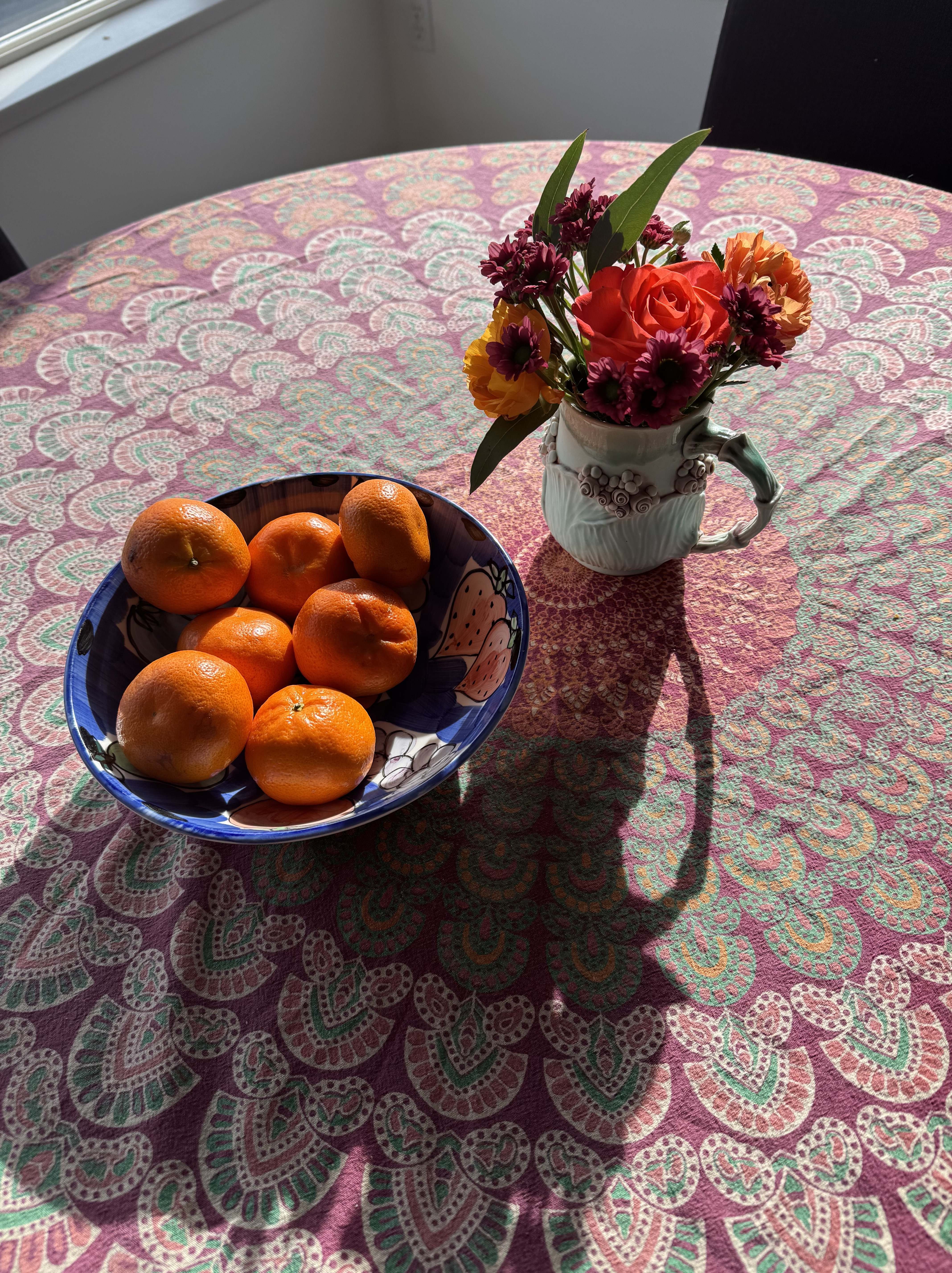
For our “altar,” we used our dining room table. We spread the white tablecloth (not ironed, too much energy required). White symbolizes snow and purity. We placed a red candle from the Christmas Angel chimes into a tiny Noxema-blue jar that Olga’s son discovered on one of his beachcombing adventures. Red is rising sun; blue is flowing water. This morning, I finally managed to get out for a walk, and we passed our local farm-stand florist and picked up a “pixie bouquet” ($10). There were no daffodils or snowdrops (the flowers suggested for an Imbolc altar) available. Just red and orange flowers, which is fine because they conjure the rising sun and Brigid’s fire.
We collected the remaining items for our altar and ritual: a smudging stick I’d bought at a local garden stand a few years ago, a small pottery bowl filled with water, a fertility figure reminiscent of the Venus of Willendorf, and a sheep to symbolize “in the belly” and lambing season. Okay, strictly speaking it’s a ram, but we had to adapt.
Lambing season
When I think of lambing, I think of “the farm”: my father and stepmother’s 50-acre property in Bruce-Grey County, Ontario. They kept sheep for many years, and one winter I visited during lambing season. I remember my father getting up throughout the night to check on the heavily pregnant ewes. I went out with him once: I have an image of his hands slippery with blood in the dim, cold barn while he helped with a difficult birth. Afterwards, we watched carefully to make sure the newborn suckled properly. A rhythmic quiver in her long tail showed she’d latched on and was getting first milk.
Looking back, I now recognize the courage and commitment my father and stepmother must have had to buy those 50 acres and take that leap of faith. My dad, a city guy who fled academia, totally immersed himself in farming. He read everything he could about it and talked to the locals, hungry and humble in his search for knowledge and skill. Always experimenting, working hard, taking risks, living his dream. Facing all of the inevitable challenges and bad times farmers have. Being a so-called hobby farmer didn’t make him immune to bad weather, problems with stock, foxes killing the chickens, electric fences falling down, money shortages. Marion worked alongside him and also worked full-time as a nurse to finance the farm operations. Despite the challenges, they experienced much satisfaction and joy. Dad and Marion, I am so proud of your daring and adventure, your bravery and strength.
Cleaning and ritual
We didn’t have the energy to clean the whole house, so we chose just one thing: the bookcases. After removing the pottery and other knick-knacks, we dusted the shelves and the books’ spines and tops. We wiped down the objects, sorting out things that we no longer wanted. When the cleaning was complete, Michael found an incantation online that we said together as we moved clockwise through the house, flicking water from the little bowl, letting the earthy-sweet sage smoke float into the corners of the rooms. Brave red candle lit the way, and Marvin followed us from room to room.
With the purifying power of water, With the clean breath of air, With the passionate heat of fire, With the grounding energy of earth We cleanse this space
May the goddess bless this home, Making it sacred and pure, So that nothing but love and joy Shall enter through this door.
I worried a little that we were doing it wrong…but what’s right and what’s wrong? We made the ritual our own. We paused today to focus on the cycle of life and seasons. We purified our home for Imbolc, and we did it imperfectly.
Recommended Imbolc reading
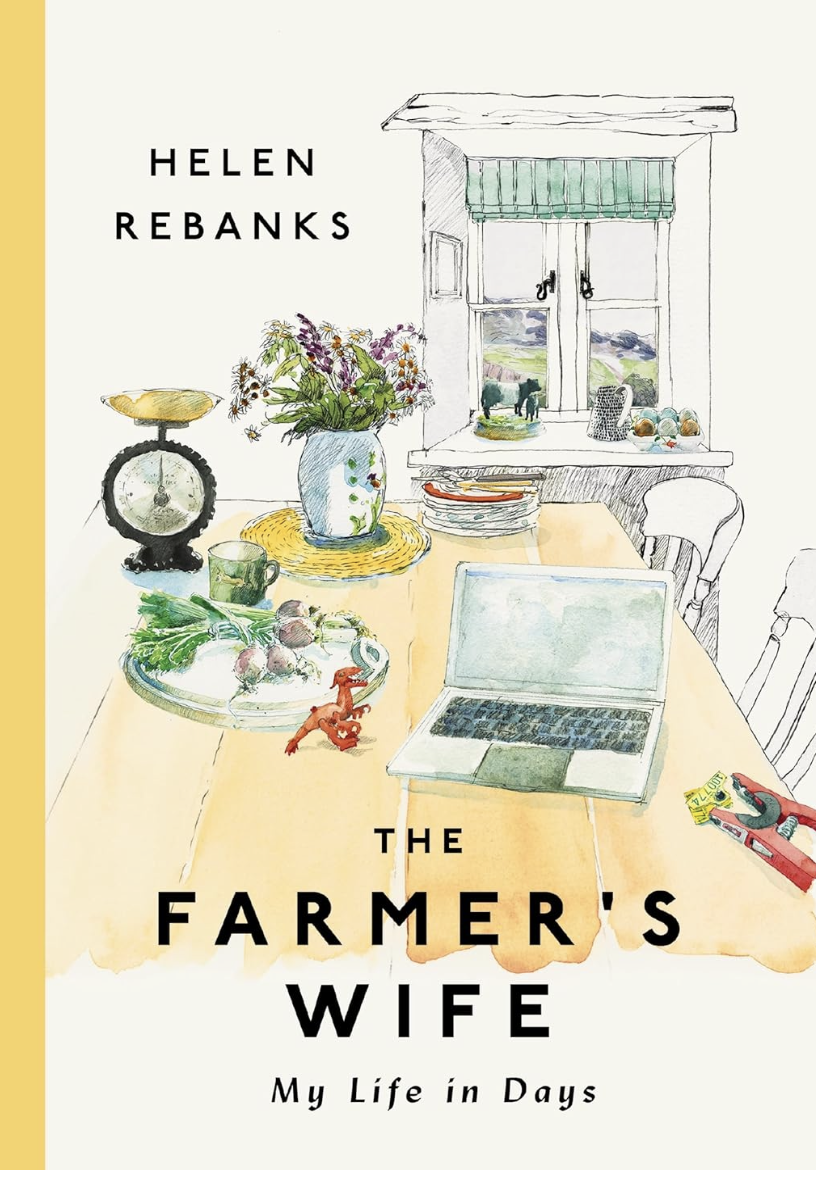
The Farmer’s Wife: My Life in Days, by Helen Rebanks. This heartfelt book, peppered with recipes, is an honest and passionate account of farming and raising a family in the Lake District, UK. There’s lambing, of course, but there is so much more. Rebanks writes about women’s role in farming: they often do all of the mundane, quotidian work that goes uncelebrated. So she celebrates the farmer’s wife by showing the importance of domestic and indoor work. I loved reading her descriptions of daily minutiae: the shopping, cooking, childcare, all mixed with tagging lambs’ ears, shovelling snow, gardening, and other outdoor chores. An equally important aspect of the book is her persuasive argument that we must support local, sustainable, biodiverse farms—such as theirs—to ensure a healthy future.
I start the year with a glance back over 2023. Last year, creativity often eluded me. She was a timid fox, hiding in her hole. I tried to lure her out, but at the first sign of self-doubt, she’d scurry back down the tunnel. Making things—in cloth or paint, in the kitchen, with words—can feel pointless in the face of climate crisis, grief, war, and ennui. And yet, don’t you think we must continue to create as an antidote to all the destruction?
When fox stayed out long enough, she inspired me to bake cakes, sew things, paint mandalas, and write stories and poems.
Baking
I love making cakes and preparing gifts for people. I fantasized once about starting a small business: I could make bespoke cakes and gifts to order (quilted bookmarks, small herb bouquets from my garden, stones from the beach that feel good in your hand). Nice idea, but maybe not a great business move.
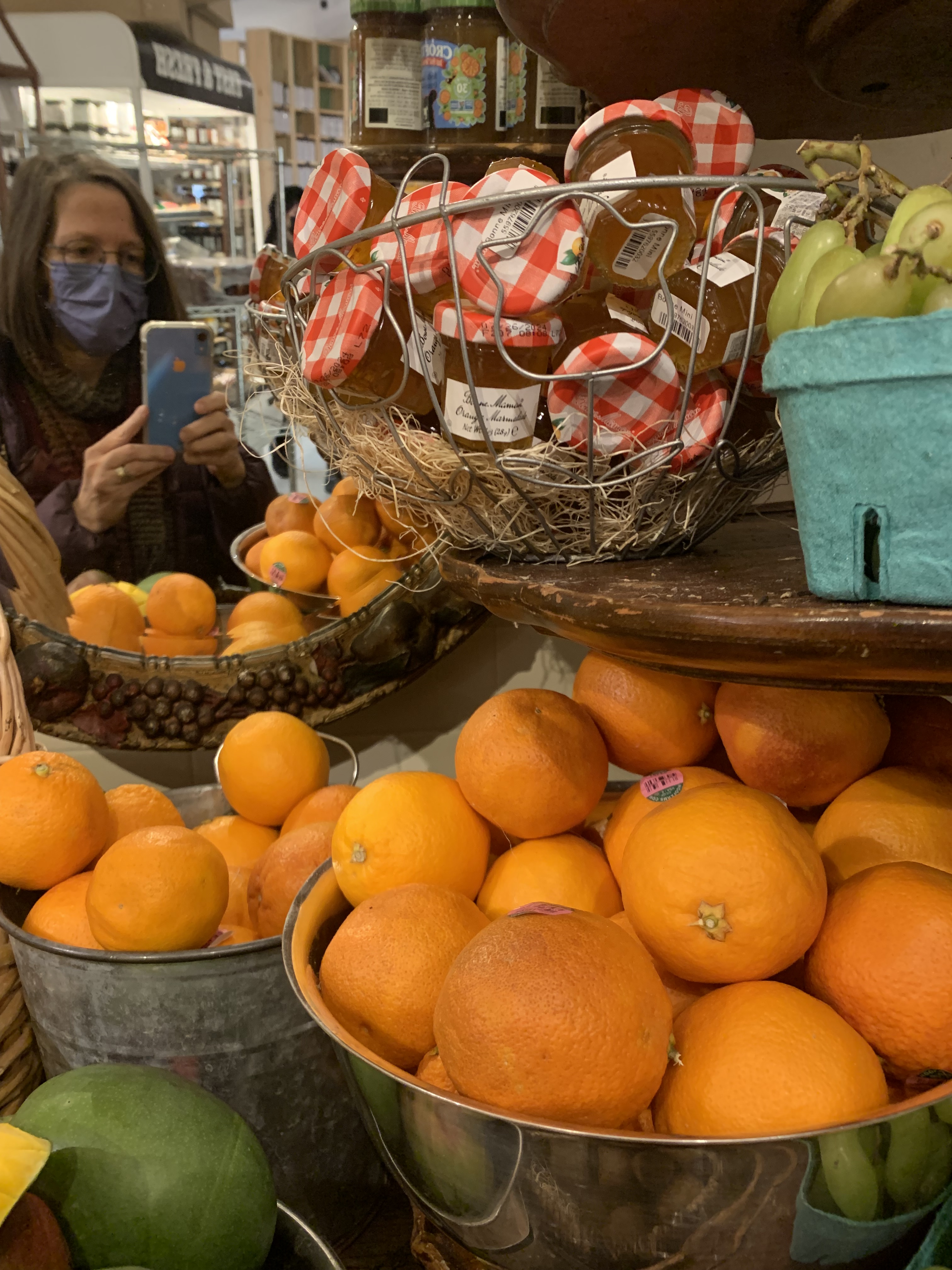
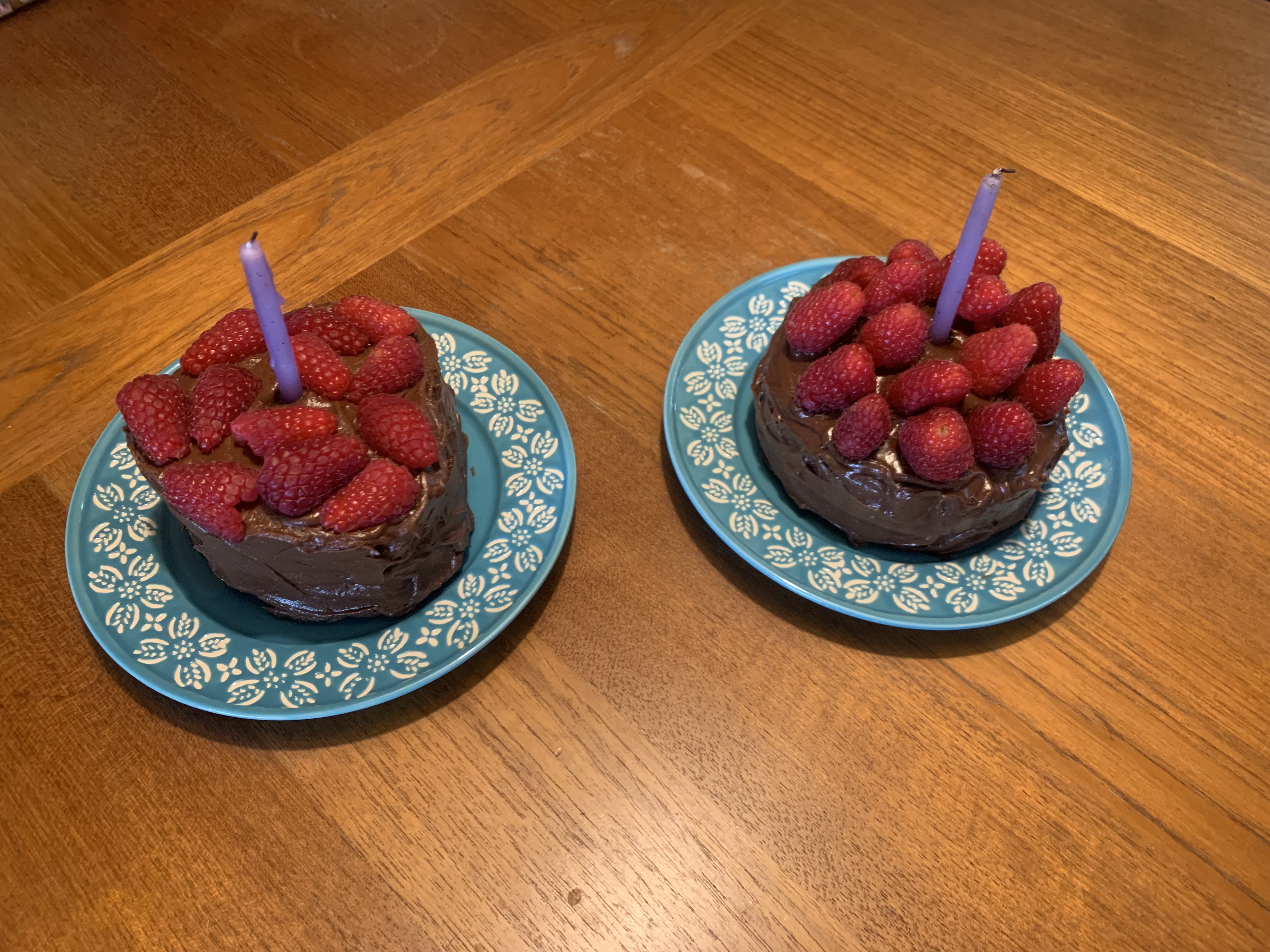
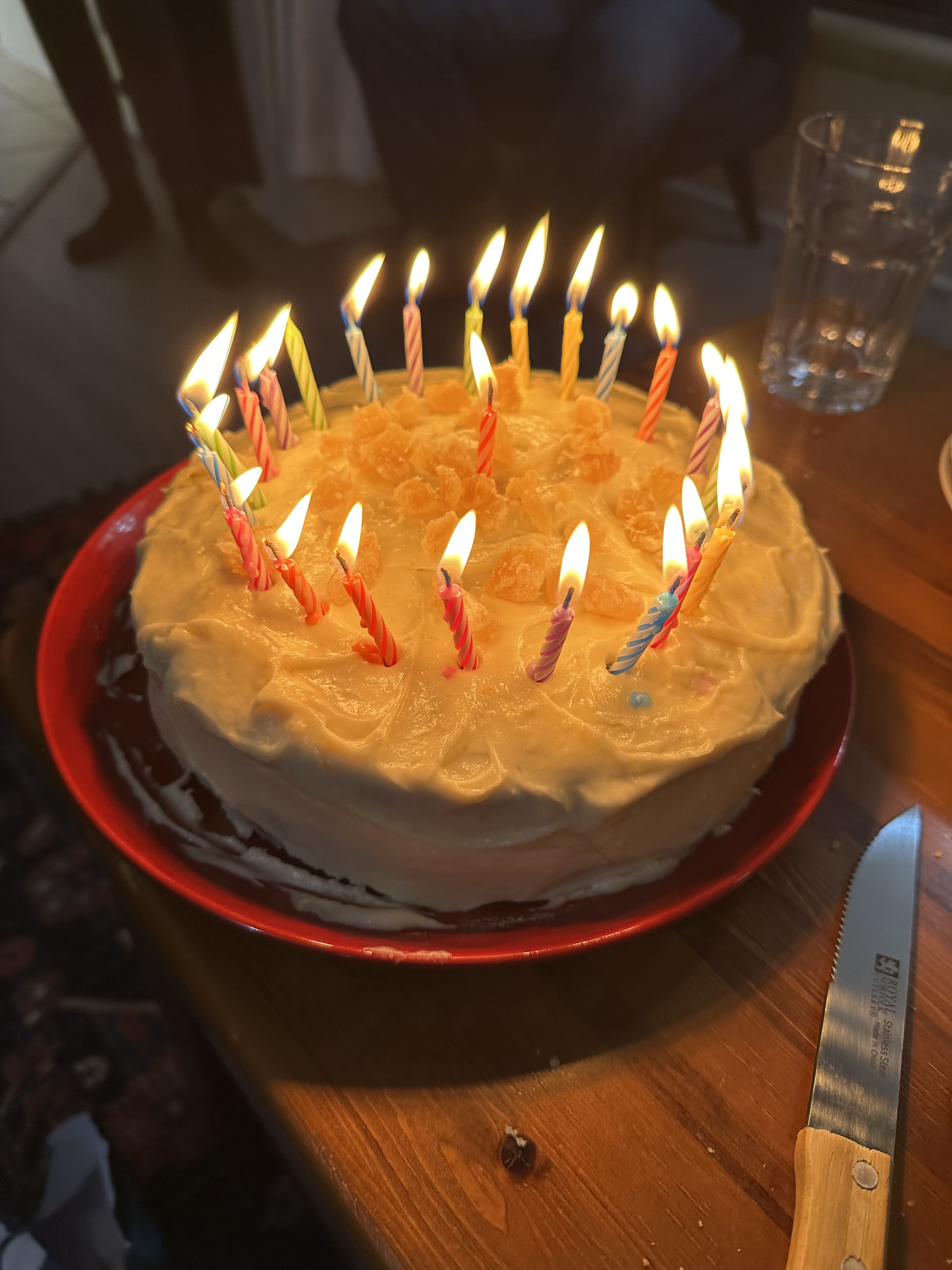
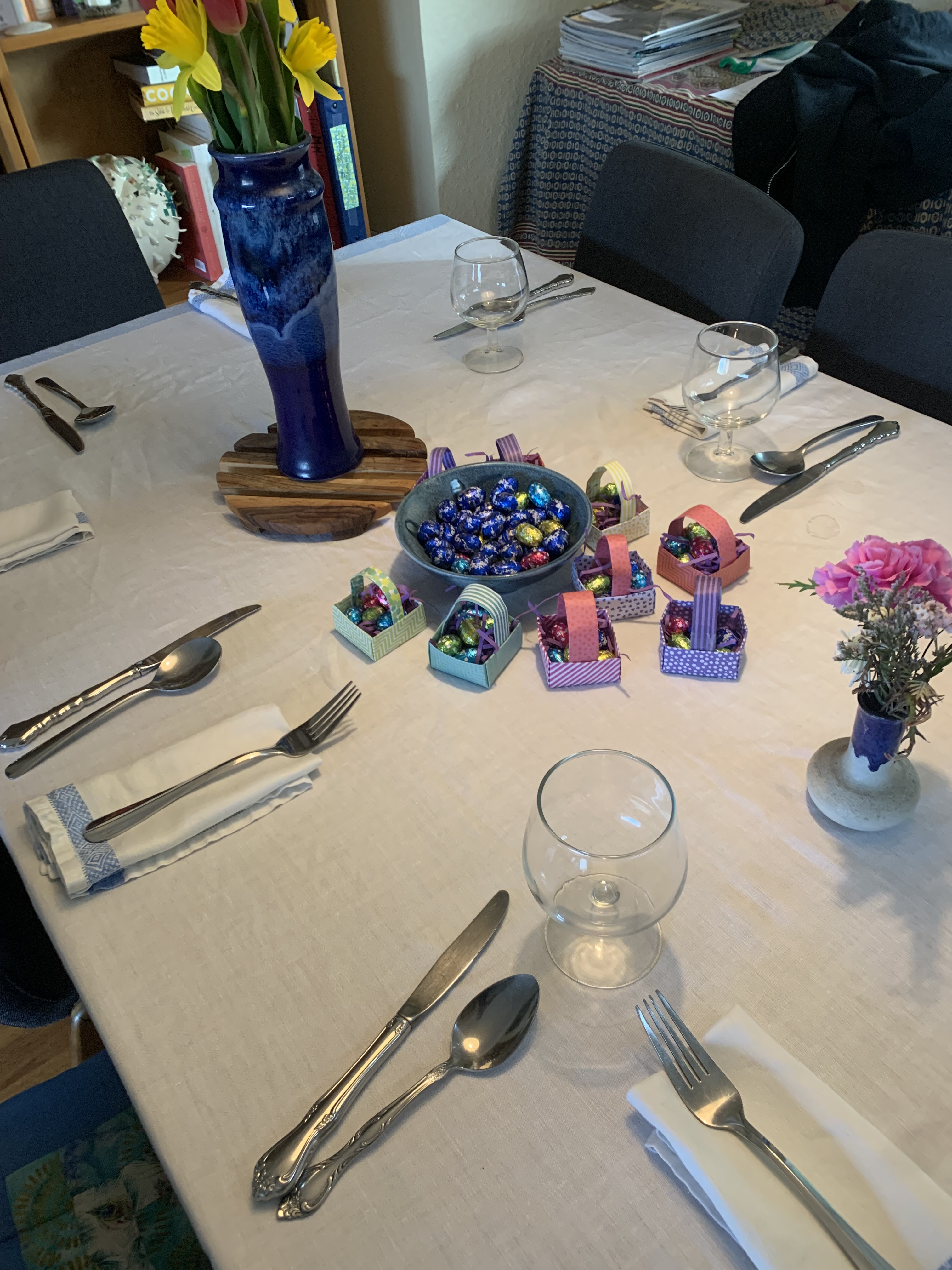
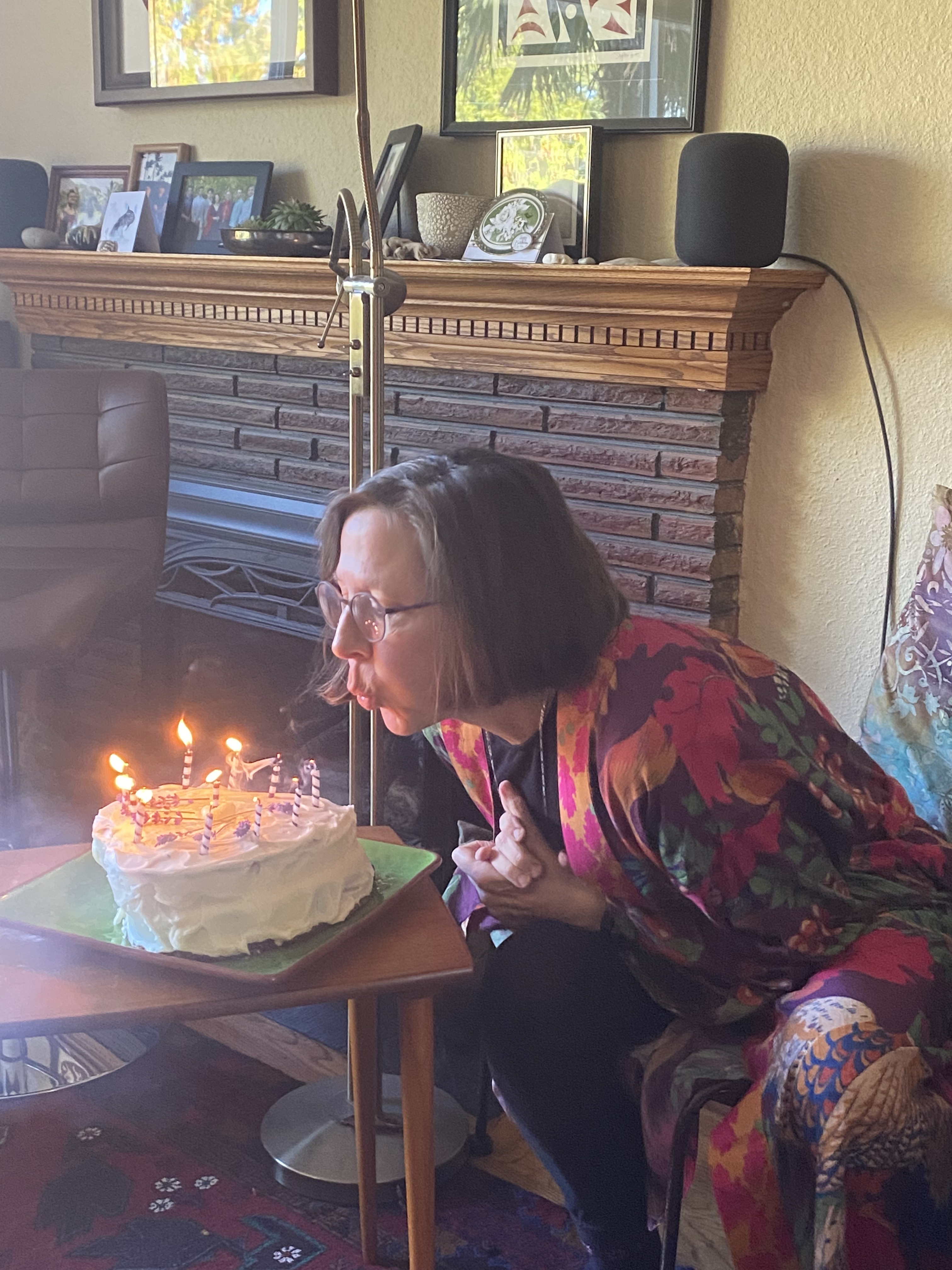
This year Michael got an upside-down blood orange cake for his February birthday, and we had fun sourcing the oranges. Found some good ones at the Market Garden on Catherine Street (where shoppers sometimes sit down to play the grand piano—such a cool store). I baked mini-chocolate cakes with strawberries later in the month for Barbara, and for Easter, an almond torte with whipped cream and more strawberries. Like my mother before me, I love to set a beautiful table, and Easter was no exception. The origami Easter baskets filled with foil-wrapped chocolate eggs provided a whimsical touch. (Entertain your inner child, I say.) For my own birthday party, a classic carrot cake baked in a heart-shaped pan frosted with cream cheese icing. For Andréa’s big five-oh: applesauce cake with three kinds of ginger. And for the final English conversation café at work: ginger cake with buttercream icing. What is it about a cake that speaks pure love?
Sewing
I didn’t make any new quilts, but I did sew a purple wall hanging, about 30 by 30 inches, that now hangs in our bedroom. I like to lie in bed and gaze at it. Four sentinel circles surround a larger one—all shot with gold thread (fragments cut from an old wraparound skirt from a yard sale). Those circles/mandalas ground me; cloth clocks tick noiselessly, watching over us as we sleep.
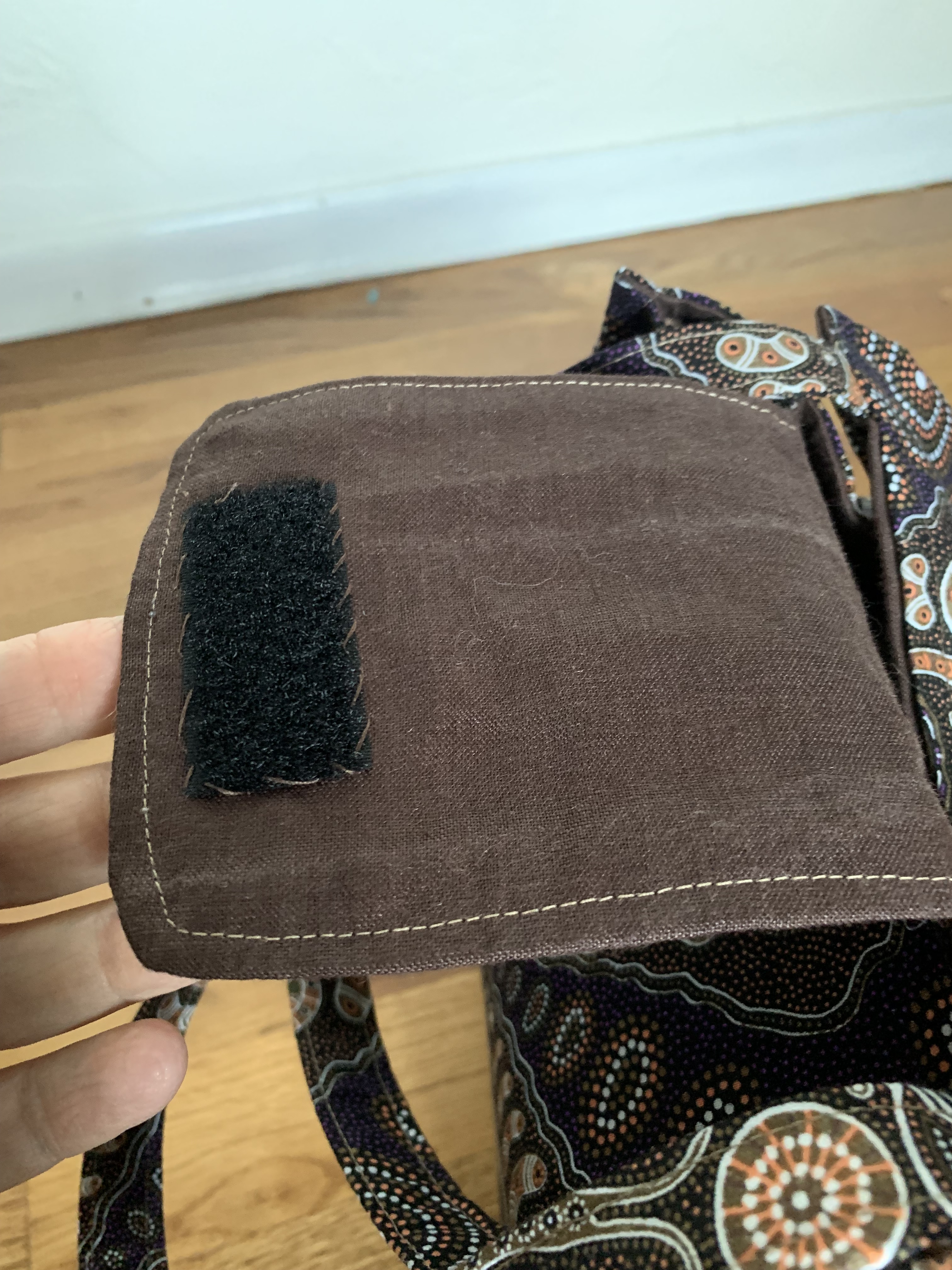
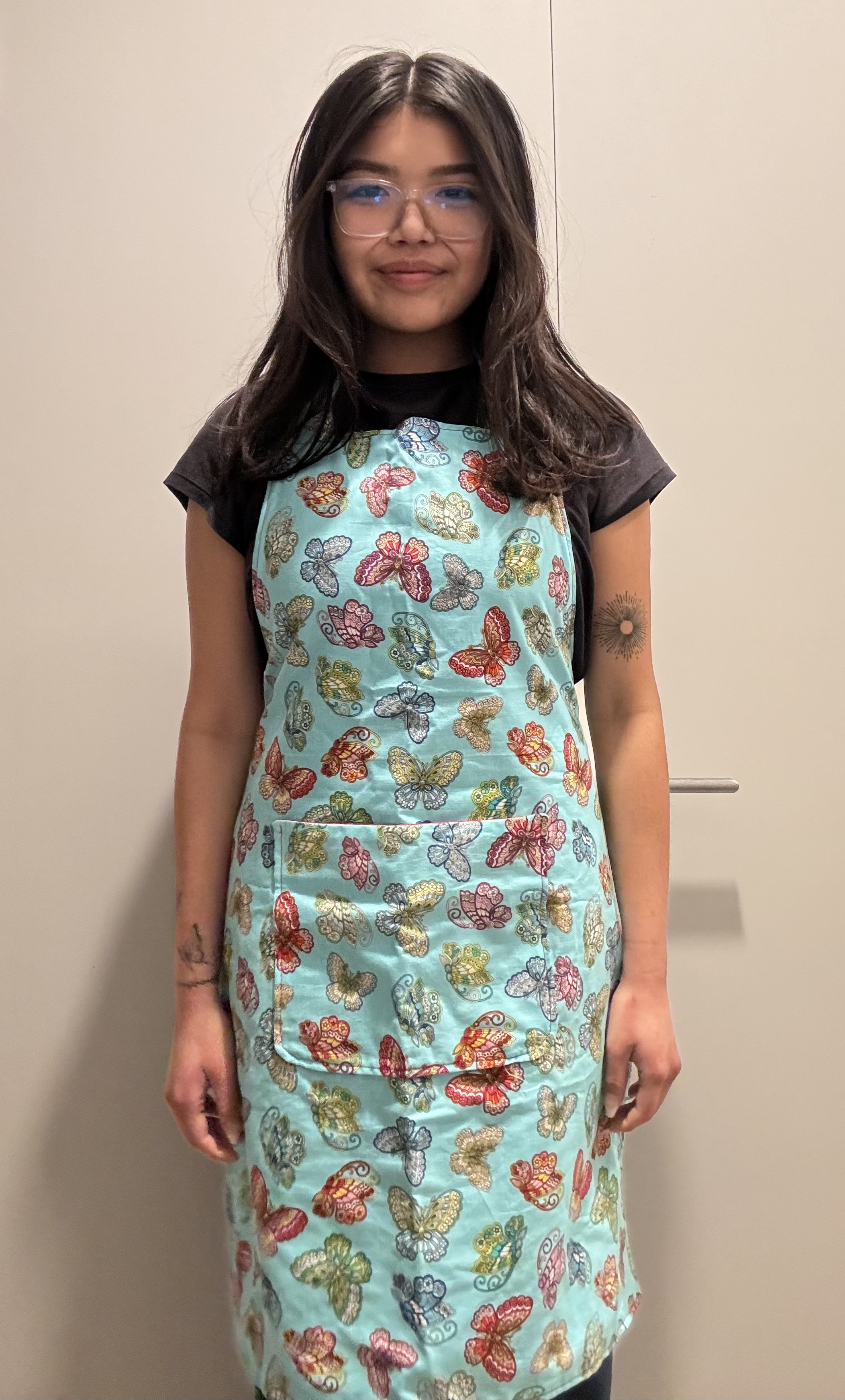
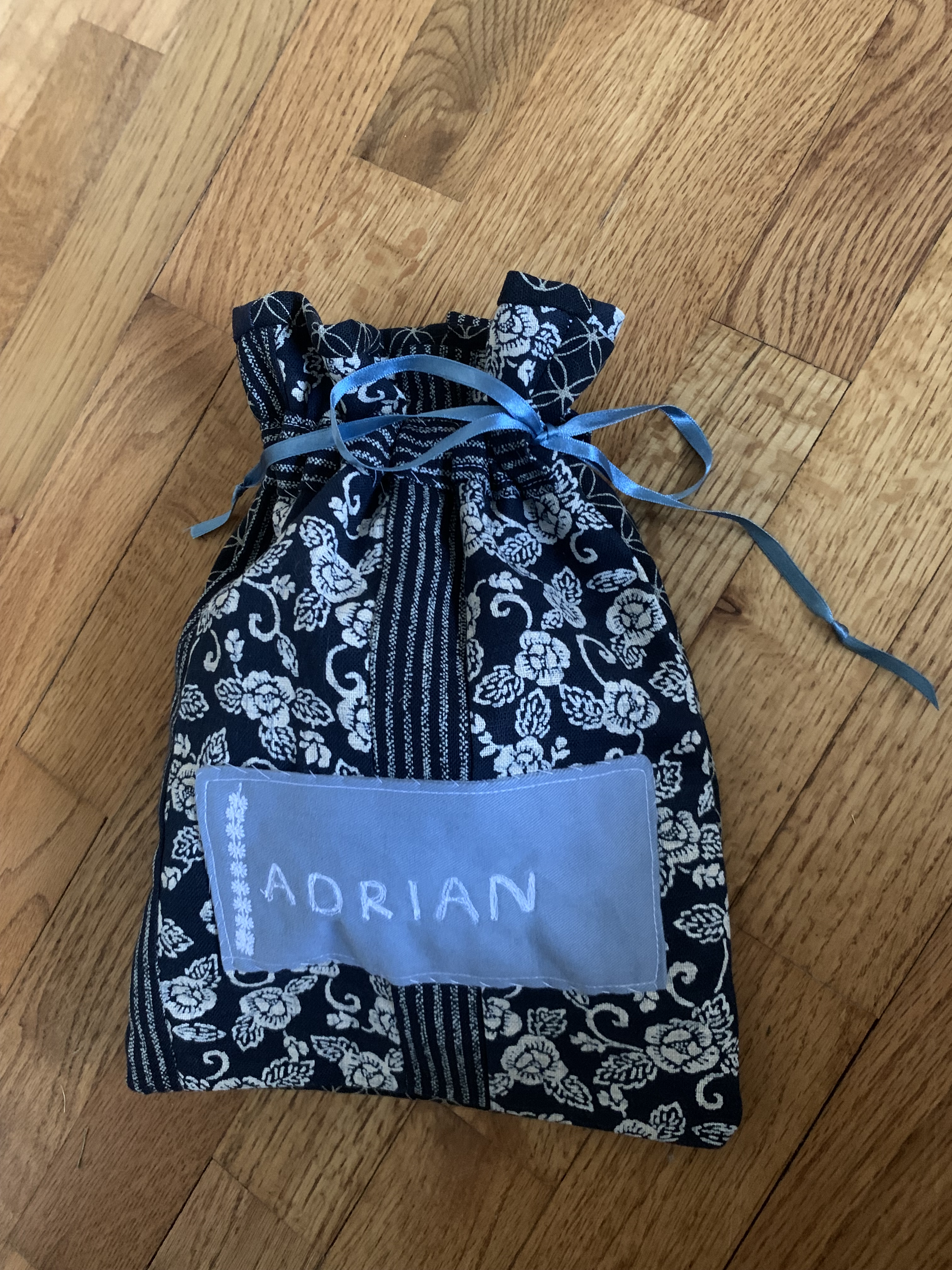
Smaller sewing projects attract me because results come together quickly. My sister Kathryn bought me a drapery panel of Indonesian fabric in browns, reds, and purples at a thrift store. A lot of fabric—40 by 83 inches—for only $4. I’ve enjoyed making some things from it: placemats and napkins mostly, and a sweet little fabric basket (I made a few of these for friends for Christmas, then filled them with chocolates and gifts). I felt most proud of the lunch bag I made for my boss, Nancy, because it tested my skill. I used fabric in a brown geometric pattern by an Australian Aboriginal designer. Then I lined the bag with sturdy brown linen from a too-big jacket I bought at a yard sale down the street. Nancy loves it. Adrian’s bag (filled with toys) for his second birthday involved some great scraps I bought from Smoking Lily on Government Street. Finally, I sewed a butterfly apron at Christmas for my niece. She is beautiful in any outfit, even an apron.
For my 65th birthday party (the theme was poetry and potluck), I made fabric wrappers for second-hand poetry books I bought for guests. So fun to comb through my stash and find colours and patterns that sing together. Party favours were fun when you were a kid, and they are even more fun when you’re an adult. Again, entertain that inner child…
Making Mandalas
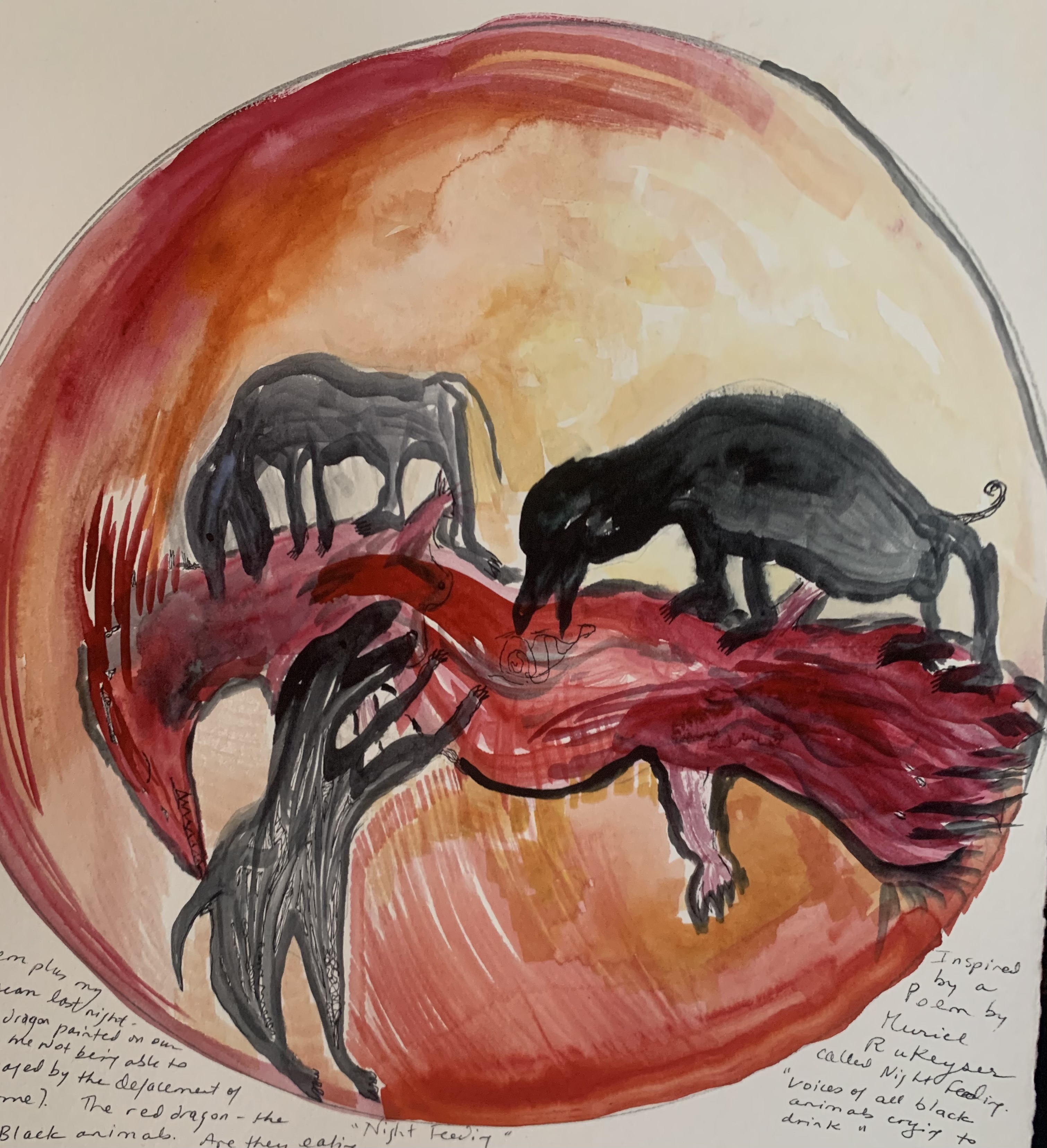
Michael and I had a Monday Mandala practice for a while, but it fizzled out sometime during the year. One exciting project: we delivered a multi-day mandala-making workshop in March and early April on Zoom. Our participants were mostly from New Mexico—all lovely, open-hearted women. It was a good experience. Michael was a guest presenter at two Creating Mandala monthly events. The CM team featured a new goddess each month, and Michael chose to talk about the High Priestess (Tarot) and Kali (Hindu goddess associated with death). I attended both of these events with pride and pleasure. Some mandalas last year were inspired by dreams—a rich transmutation. I dreamed I entered a room in my house and found that someone had painted on my white wall a red dragon being devoured by three beasts. Still musing on the meaning of that one.
Writing
Here’s where the fox was most recalcitrant. I aborted so many poems, blogposts, and stories last year, I am surprised to find anything in my files. I posted on this blog only five times in 2023. However, I did complete a series of linked short stories (started in previous years): Nothing is Wasted: The Stan and Deedee Stories. I shared them with a few friends and family members. If you are interested in reading them and you’d like a digital copy, let me know (maddyruthwalker@gmail.com) and I will send you one.
Some months, I had nothing new to share with my writing group. I’d scour the old folders for some scrap from the distant past to read. Or I’d just listen to others read their work. But that’s okay. I know that I’ll write again. When nothing seems to be happening, the fox is deep in her hole, pregnant with kits. How many will be born and when? Just have faith.
I wrote only a few poems in 2023, and one was for my birthday. Each guest was asked to bring a poem to share. It was extraordinary to see my friends and family members get up into the poetry seat and read poems they’d chosen, poems they’d written: one of the best gifts I’ve ever received. To close the offerings, I read my own poem– one that expresses the expansiveness I feel as we enter 2024. Happy New Year to you!
Expansion

I started slim
and willowy.
Then, whoosh of years.

My waist - heavy as grief,
soft as dough -
expanded.

Grief. Have you met her?
Well then you know the
grace that she bestows.

Hard things—she
cracks them open,
ignites a hotter flame,
imbues a deeper shade of red.

So, like my waist,
my heart’s made wide by grief,
a vast container for the love I feel
for trees, and animals, the sky,
the planet, for you, my friends,
for people everywhere,
for life expanding.
Sometimes I get a couple of hours, sometimes a whole morning when luminous joy bubbles into life, oxygenating a flat week. Savour the perfection—then *pop* it’s gone. Lately, when I experience these rapturous periods, I am intensely aware of time fleeting, of the unreliability of “happiness,” of my inability to “keep” the moments, of my impotence in the face of life.
September 28 is a good day for birthdays. Two of my friends and our puppy were born on that day. Leading up to Tuesday, I was thinking about cake, how I love making, giving, and eating cake for birthdays and other occasions. But there is always the problem of excess. Do other cake bakers and eaters have the same problem? If there’s a big (9-inch) cake in the house—do you eat a slice every day for a week and gain five pounds? Or do you obsess over it, polishing it off in two or three days and feel sick? Or does it go into the compost because you can’t eat it all? Whichever scenario fits, the solution is the same: bake a small cake. Because small is practical and beautiful.
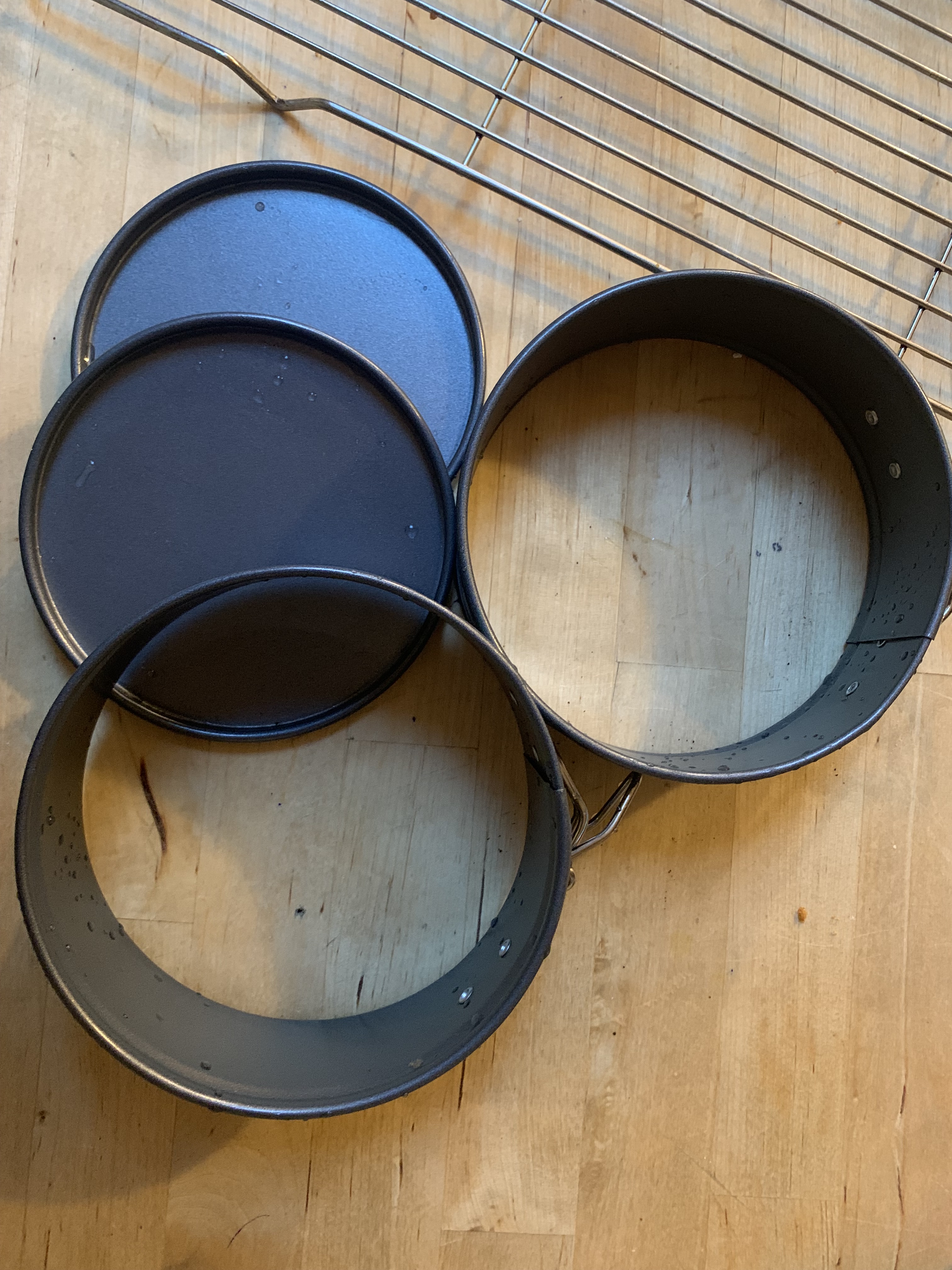
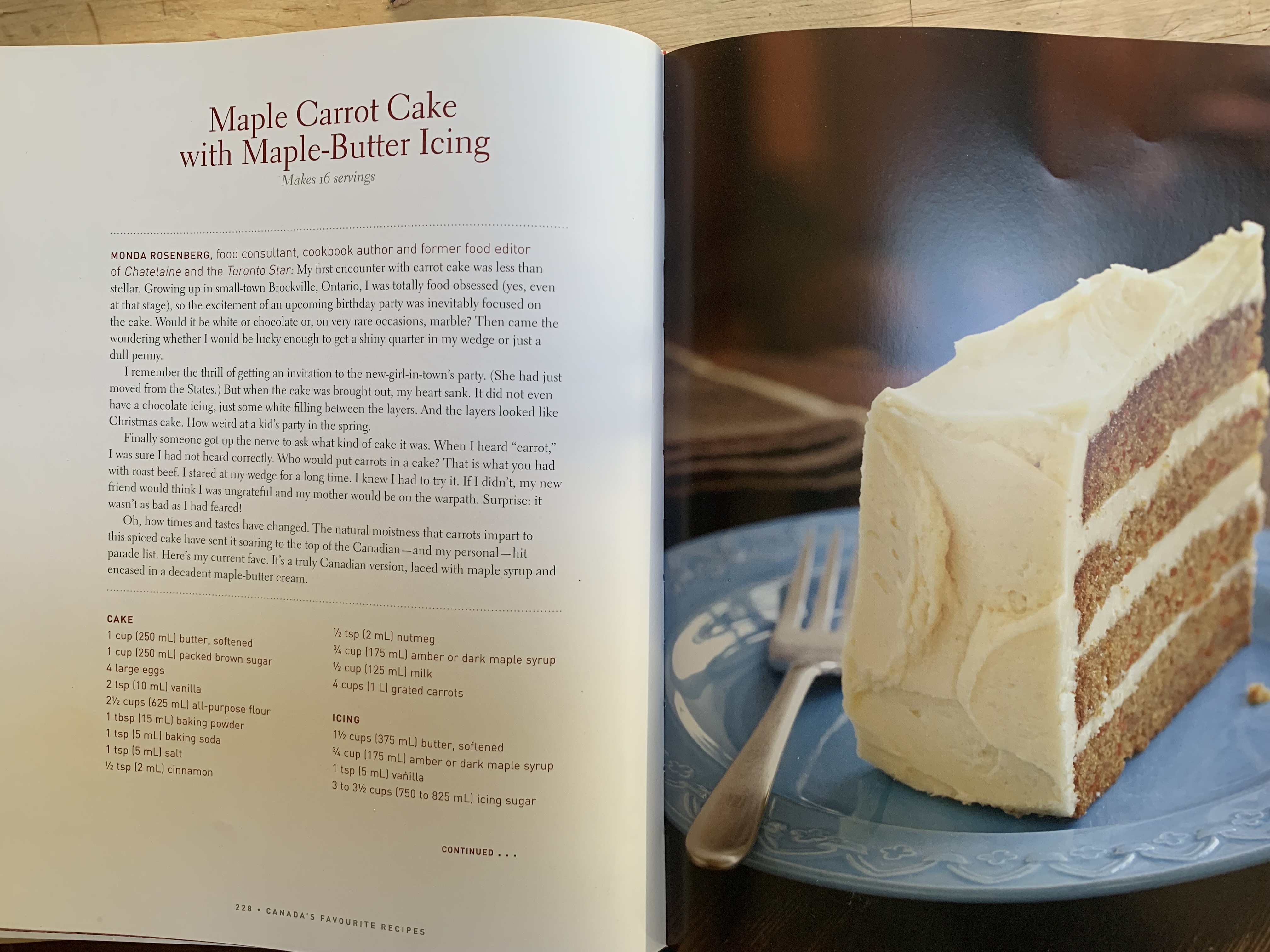
One day a couple of weeks ago, Michael and I headed to a kitchenware store, and I bought two sturdy 4.5-inch springform pans. I found a good recipe for carrot cake in Canada’s Favourite Recipes by Murray & Baird and halved the recipe. I wasn’t sure what it would yield; it turned out the batter filled the two small cake pans and three cupcake liners.
I sliced the two cakes horizontally to fill them, then frosted both cakes and cupcakes with maple butter frosting. I put the better-looking cake and the cupcakes aside for my friends, and Michael and I “tested” the other cake, eating one slice each for three nights. I know, I should have given both cakes as gifts, but I had to test cake production. Six tiny, perfect slices of carrot cake, sweet and moist. Who needs more than a few bites of something delicious?
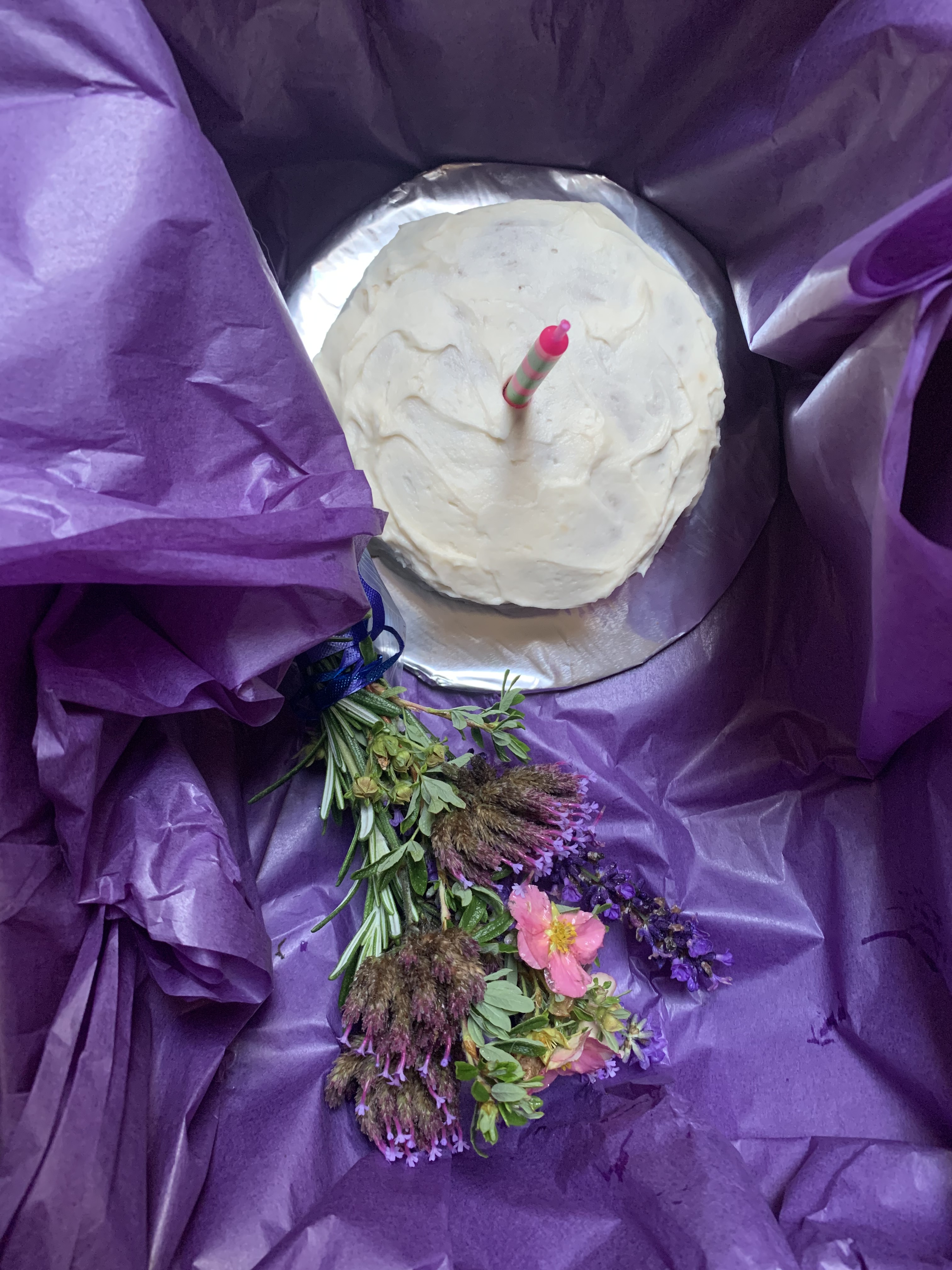
Then I assembled the birthday packages. I save good boxes, so I had two shoe boxes at hand made of strong cardboard. I lined each with purple tissue paper, then went out to the garden to pick posies. Fragrant thyme, rosemary, and lavender mixed with pink, red, and purple blooms, tied with a ribbon. I put the cupcakes in a plastic container and the cake on a round of cardboard cut from an old box and covered with foil. Cakes nestled in their boxes, I added the bouquets, a small box of Eddy matches, a candle on the cake, and loose candles for the cupcakes. I closed the lids, then taped birthday cards on the box tops.
On Tuesday morning, we fussed over birthday puppy Marvin with a new toy and some treats. Then, enjoying one of the perks of self-employment, I took off for an hour. After placing the birthday boxes in the front seat of the car, I drove along Craigflower to Vic West, listening to NPR’s jazz and blues station, window open to the breeze. The splendid fall day sparkled. Coppery leaves fell slowly from the trees, and the clear, cool, blue sky made me feel lighthearted. I parked and walked box #1 up to my friend’s townhouse door and placed it there. Then Google maps told me my other friend lived only 150 meters away. I knew they shared a neighbourhood, but I had no idea they were so close.
So rather than drive, I walked the other box through a children’s playground to my friend’s house, feeling so happy I could burst. And yet, the day before I was swimming in sadness about every little thing. I placed box #2 on the doorstep and walked back to my car, humming a song, alive to the crackling beauty of early autumn, favourite season.
You can’t have your cake and eat it too. I’d been thinking about that proverb and how it didn’t make any sense. Turns out Ursula Le Guin agrees with me. In 2010, 81-year-old Le Guin (1929–2018) started a blog and wrote delightful posts for seven years. Houghton Mifflin Harcourt published the collected blogposts as No Time to Spare: Thinking About What Matters (2017), which I recently finished. Many of the posts are about her cat, Pard, good reading for cat lovers:
One thing that mattered to Le Guin was figuring out weird language puzzles, including the annoying cake proverb. Of course if you have a cake you’re going to eat it! Le Guin wonders in her post about the logic of this proverb, but then it dawns on her that the verb “to have” has several meanings—a less common one is “to keep.” The order of the proverb also seems awry, so, she revises it, reversing the order and using “keep” instead of “have.” And suddenly it makes sense:
You can’t eat your cake and keep it too. You can’t have it both ways—eating and keeping.
When I got thank-you texts and emails later in the day from my friends, one of them ended her message saying she hoped we could get together more often in the coming year. I had acknowledged in my card that we had hardly seen each other lately, what with the pandemic and both of us being introverts. Her final line was, “nothing is forever.” I paused. Of course.
I can’t count on that fickle flicker that moves me to make cakes, write, sew, create. It comes, it goes, I can’t keep it, I can’t summon it. The work wants to be made, and the work—not you—chooses when and how. As I head for 63, I am keenly aware of energy slowly flagging, of a narrowing in my interests and available time, of the limits to life. All the more reason to relish eating the cake when it appears on a plate in front of you. Don’t even try to keep it.
Guest post by Judith Walker, aka Jude, my sister and a wonderful cook
Retro, old fashioned, nostalgic, comforting. These words will have different meanings for all of us, depending on our age and our interests. For me, the feelings of nostalgia, craving and comfort come from memories of meals and gatherings from my childhood in the 60s and 70s and also from early adulthood in the 80s, when I experimented with food and first cooked professionally.
When I was a kid we lived in California. Our mom wasn’t a confident cook, she was a late starter and as a young wife and mother struggled to fill her role as the family chef. Some of her meals included simple seasonal items that sound exotic but were quite ordinary for the time and place. Whole artichokes steamed with lemon and served with a bowl of mayo that we shared for dipping. After a lot of peeling and sucking on the tough leaves we were rewarded with the succulent heart. No mayo required, an amazing flavour burst that would linger on my palate for hours. Possibly my first sensuous experience. And the tacos. So basic and so good. We would all help prepare this meal, bowls of fried ground beef, chopped iceberg lettuce, chopped tomatoes, onions, grated cheese, mashed avocado, and sour cream. And hot sauce for Dad. It must have been the tortillas that made this such a memorable meal. In Berkeley, we had many Hispanic neighbours. I think my mom was able to find fresh tortillas in the local grocery store. I know that my first bite of a fresh corn tortilla in Mexico many years later flooded me with nostalgia.
Another go-to dish for special occasions was ceviche. Mom made one with scallops, shrimp, and onion chopped up and marinated in fresh lime juice. This was an easy dish she could prepare ahead of time and was elegant and delicious. I don’t recall what she served it with, I just ate it by the spoonful.
And then we moved to cold, Anglo-centric Toronto. No more avocados, scallops or tortillas. It was the 60s after all. So, overdone roast beef, watery spaghetti sauce and tuna casserole came into our lives. Our mother tried to teach us to cook when she went back to school. Cooking pasta (we called it noodles), chopping an onion, peeling veg, measuring, making rice and washing dishes were things we learned. I don’t think the results were great, but I am grateful for the lessons. My fave dish from those days was tuna casserole. I am serious. There is something about that combo of the salty tuna, the creamy blandness of the mushroom soup, slippery noodles and crispy edges that is the epitome of comfort food. I’m pretty sure I made this more than once on a hungover Sunday in my twenties. Better than Kraft dinner!
–cook 2 cups of broad egg noodles according to instructions -open and drain one can of chunk white tuna -open a can of Campbell’s cream of mushroom soup -drain the noodles and mix all the ingredients together in the noodle pot along with a nob of butter. -pour into a greased 9×9” pyrex dish. If you are feeling fancy sprinkle crushed saltine crackers on top. -bake at 350 till bubbling and crispy.
( I just checked the Joy of Cooking recipe, and they recommend seasoning the soup with dry sherry! Hilarious!)
Another recipe that was easy for us kids to make and that we actually ate was hotdogs in cornbread:
-put 6 hot dogs in a 9×9” pyrex dish -place in a hot oven and roast till a bit brown and blistered -mix one recipe of cornbread from the Joy of Cooking -pour it over the hot dogs and cook according to instructions -serve with butter and yellow mustard on the side
I sometimes crave this meal, but know if I made it I would eat the whole thing and quickly descend down the spiral of shame.
My mom tried, she just didn’t have much to work with and not much inspiration in those busy days. We never had Kraft slices, Wonder bread, pop or ketchup in the house. I didn’t know what pizza or french fries were till I was in junior high. I remember visiting my grade 7 friend in her wealthy parents’ fancy penthouse apartment. Their live-in cook would make us toasted Wonder bread topped with bacon and melted processed cheese. Served with ketchup. I loved it. However, I am grateful that our mother raised us on real food and set us on the path to healthy eating.
Things started looking up in the 80’s. Mediterranean, Asian and Indian food were starting to trend. My mother was travelling a lot then and brought back recipes and fresh ideas. We thumbed through Gourmet magazine and cookbooks looking for our next dinner adventure. The more complicated the better. We would make forays to Kensington market, Chinatown and little India seeking exotic ingredients. And then spend hours in the kitchen, often at Mom’s, gathered around the butcher block on our periodic Friday night family dinners, with mixed results. It was fun and challenging and I learned much that has stayed with me. Pasta from scratch, fresh herbs, toasting and grinding spices, rehydrating dried mushrooms and peppers, fresh cheeses…risotto! So much to discover.
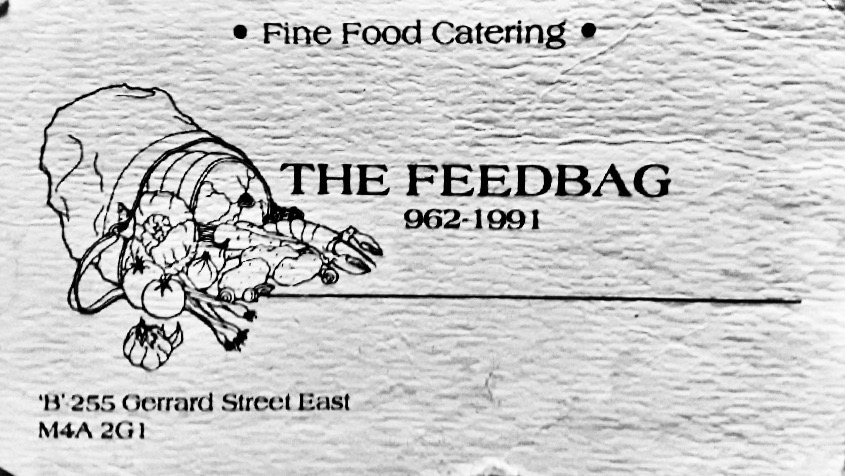
In the mid-80s, knowing nothing about running a business or professional cooking, I started a catering company with a couple of friends called “The Feed Bag.” It was hard work, fun, funny and pretty much a failure financially, but there were some great parties! We made hundreds of spring rolls, massive sushi platters, a ridiculous number of meat, cheese, veggie and fruit trays, with little money to show for it. One of our go-to cookbooks then was The Silver Palate. The quintessential 80s cooking guide. Every recipe has more fat then I would eat in a week now. Decadent. I recently pulled out my battered copy because of a challah recipe request from my sister. I looked back at the most raggedy pages and found one of our old tried and true recipes, chicken dijonaisse. So simple, so good. And easy. I made it recently with a few additions, some shallots, grated parmesan and fresh parsley, and ate it with egg noodles. Delish. Anything served over egg noodles is comfort food for me.
I also made a pineapple upside down cake a while ago, another childhood favourite. Honestly it wasn’t as great as I remember, I think I skimped on the butter in the caramel sauce. I did create an elevated version of this when I worked in fine dining. Individual servings baked in a ramekin with half of a ripe red plum on the bottom. It was beautiful when inverted on a plate surrounded with a creme anglaise or boozy sabayon.
I am not sure why food has been such a focus in my life. I am not academically inclined and hated school, so I managed to make a decent living and support my travels by working in kitchens. But it is more than that. Food was a conduit to my mother, a shared past, our phone conversations in her later years pretty much revolved around what we were cooking that day. And our cats, but that is a whole other story. It was one of my favourite parts of travelling and a wonderful way to connect to local communities and their customs and everyday life. You can learn so much about any part of our world by learning about the food the locals grow and eat and the history and traditions around them.
Researching, designing, cooking, sharing and eating food has sustained me on many levels for much of my life.
This was the menu request for my birthday dinner when I was a kid fifty-five years ago.
Baked chicken Potato salad Corn on the cob Watermelon Chocolate cake
I would grill the chicken now, but other than that I stand by this as my favourite summer meal.
Good food is good food.
The End
Note: I would like to give credit to Judy Gorton for the logo she created for “The Feedbag,” my first business and only adventure in catering. She has been a friend for almost 40 years and is a wonderful artist. I still remember part of the menu from the dinner party we catered for her as payment for the design:
Cornish game hen stuffed with basil couscous
Carrot sformato (an Italian savoury soufflé, my mom’s recipe)
My friend Nancy and I walk along the streets of her leafy neighbourhood. Suna, her little Shiba Inu, sniffs the shrubs and grass as we go. I notice a doe standing in the shadows a stone’s throw away.
“Look.”
“Yes, sometimes the mother deers think that Suna is a fawn, and they follow her because they think I’ve stolen their baby.”
I laugh at this endearing testament to the deep protective instinct mothers feel. Sure enough, this doe looks with interest at Suna, a plush fox-like dog with a curlicued tail. Her coat is the same colour as a fawn’s—I can see why the doe might wonder. We continue to walk, and I notice the doe has started to follow. Soon, she increases her pace and is very close behind us, an avid look in her eyes as she stares at Suna. Indeed, she seems determined to get close to the dog, and we walk a little faster to put some distance between us. The doe canters elegantly around parked cars on her slender matchstick legs, moist black snout and huge almond eyes leading the way. Nancy and I are alarmed. Might the doe attack us to get closer to what she believes is her offspring?
“Let’s go,” says Nancy, and we begin to run down the middle of the quiet street, Suna in tow. After a block or so, we slow down, and I see we have finally lost the doe. I feel strangely thrilled by this brush with an animal. To see close up her ardency—the quiver of her black nose, her flicking tail and tall twitching ears. To empathize with her desire to rescue something she thinks is hers. I wonder what would have happened if we had simply stopped. Perhaps the doe wanted nothing more than to make contact with Suna, to sniff and nuzzle her. She would quickly realize, “this is not my fawn.”
It’s been a fortnight of animal encounters. About two weeks ago, a nest cradling six or so baby robins in our yard was the epicenter of a grand battle between parent robins and several crows determined to capture and devour the babies. The bush is outside our bedroom window, and early in the mornings, we could hear the desperate chirping of the parents, the caw-caw of their opponents, the tiny cheeps of the chicks, and the rustling of the bush where the nest was located. It seemed that every day, one or two fewer chicks resided there. And soon there were none. Now the nest sits unoccupied, a bowl of fallen petals. I was angry at the crows and heartbroken for the robins, while at the same time recognizing how sentimental I was being about the ways of nature.
Empty Nest
A few days ago when I visited my favourite Arbutus tree in our local park, I witnessed two Great Horned Owls sitting about six metres away from me on a branch overhanging the Colquitz River. Astounded at my luck, I crouched on the riverbank, one hand resting on the smooth bark of the Arbutus, and observed them for several minutes. They looked calmly at me. I had a staring contest with the one on the left, and she was the first to blink and look away. The fellow on the right swivelled his large tufted head in a complete rotation. My kin.
Owl kin
Then there was a Cedar Waxwing sighting as we walked through a grassy meadow from the mall to our house a couple of days ago. His head a golden crested helmet, the vermilion patch on his wing like a talisman. I didn’t identify him at the time; when we got home, I got out the Golden Field Guide to the Birds of North America and found his picture. An old childhood memory surfaced: Our family lived in Boston one summer while my Dad did something at Harvard. We rescued an injured Cedar Waxwing, keeping him in a cardboard box. Care and feeding involved an eyedropper. I have a murky feeling that there is a bad ending to that story, involving a cat. My sisters probably remember more than I do.
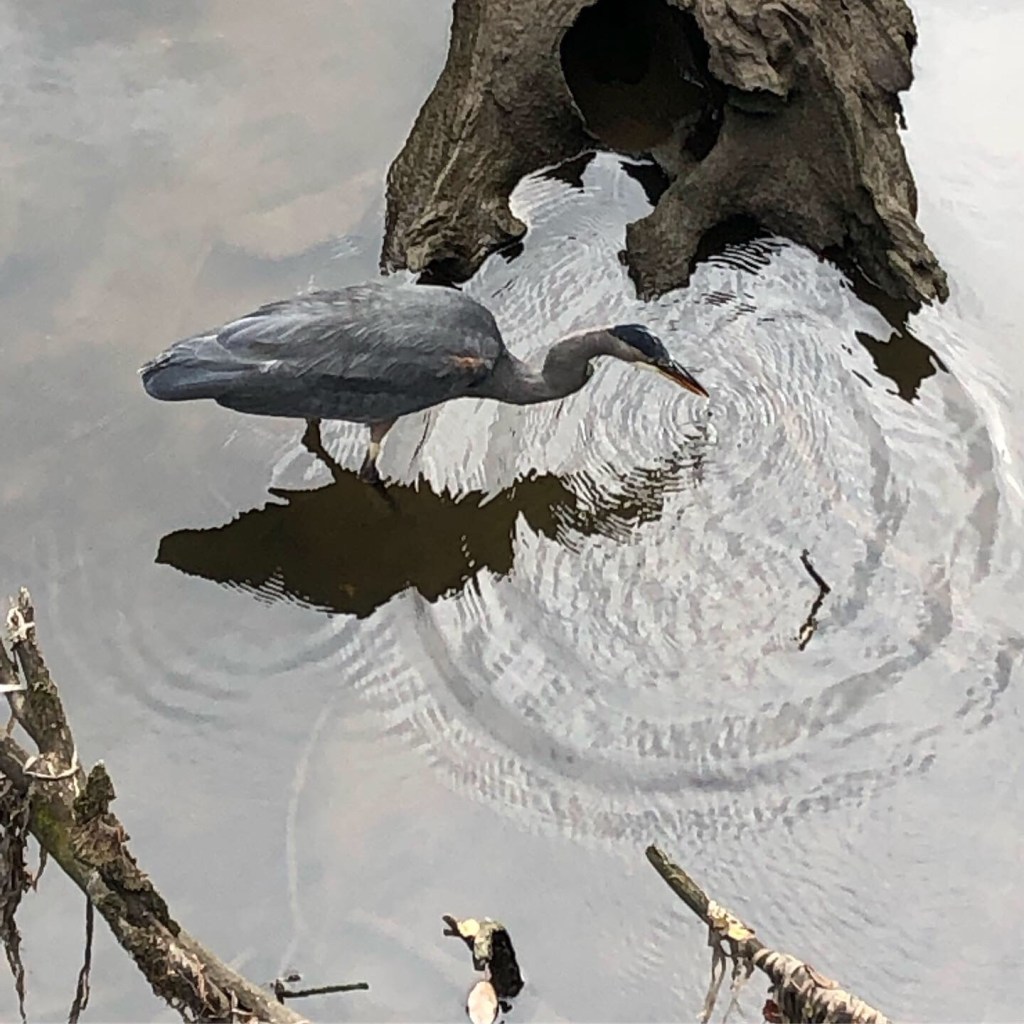
I’ve had numerous heron and rabbit sightings these past two weeks too, and yesterday morning the insistent mournful cry of a Northern Flicker punctuated my morning meditation. Our neighbour is the lucky one to host the hollow tree where the family lives. He reported today that baby Flicker pokes his head out of the hole a little more each day. This morning a chevron of honking Canada Geese passed over me as I watered the garden. I drank in the sight and the wistful sound, the sound of yearning.
Heron fishing in Colquitz Creek
I don’t think there are more animals and birds in our urban environment than there used to be. What has changed is my level of observation. Not working, slowing down, and staying close to home means I notice more of what’s happening around me.
This strong feeling of kinship with all of these animals has affected me. In January, I eliminated animal products from my diet. My bad cholesterol (LDL) has been too high for years. My doctor told me it was genetic and changing my diet would likely not have an effect. I disagreed: I proposed to eat vegan for six months and get my blood tested at the beginning and end of the period. Though at first I missed cream in my coffee and chunks of cheddar with my apples, I’ve grown to enjoy plant based cooking and eating.
It’s easy to tell people you are not eating animal products for health reasons (dietary veganism). How can they argue with that? If you say you’ve chosen this diet because you don’t want to harm animals (ethical veganism), some meat-eaters become uncomfortable and defensive. (I know because I felt this way.) I hate to cause discomfort, yet as I continue into the final month of my experiment, I realize my reasons for not eating animals products are not so simple as they first were.
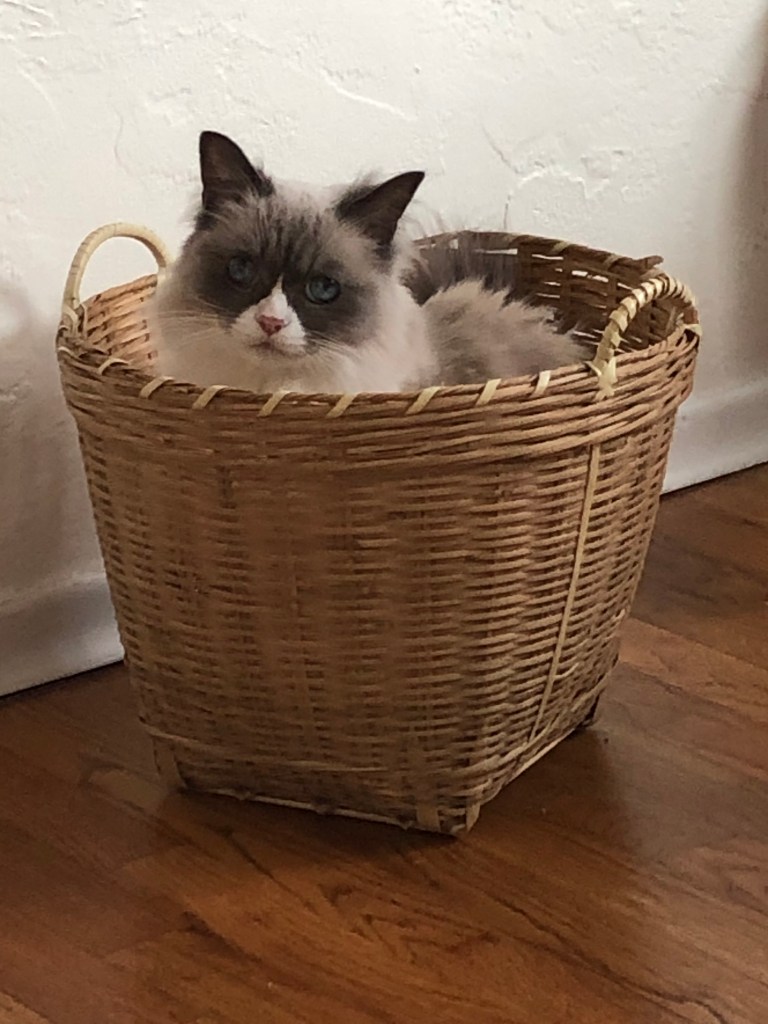
Yes, I want to be healthier, and I predict my blood test in July will be good news. But I also feel close to my animal family: the owls, the mother deer, the big rabbit who scooted in front of me on the path, the robins, the gorgeous Waxwing, the Flicker, the geese. Even the damn crows. Sure, I know none of those animals is on the menu. But I extend that feeling of kin to the big dairy cows with sad eyes hooked up to milking machines at the Saanich Fair last September. The chickens I imagine stuffed into too-small cages. The lambs my father used to raise on his farm and send to be butchered. My kith and kin, just as much as Joy, our Ragdoll cat lying beside me on the couch is family. I don’t know what I’ll do when this experiment in eating is over. What I do know is that I like this feeling of being connected to all sentient beings.
Five years ago I got interested in corn. I found out about maize, its history, breeding, and physiology, about Barbara McClintock’s work on maize genetics, leading to her Nobel Prize. I looked into corn’s many creation myths told by Indigenous tribes and cultures. I read about how genetically modified maize under the product name StarLink was sold in hundreds of different food products (for example, Taco Bell tacos) before it was recalled, not approved for human consumption by the FDA.
I was also interested at that time in giving objects voice in my poems, making objects subjects.
I spent some time reading, researching, and then writing a poem in which I envisioned a cob of corn speaking to a little girl at a Fourth of July picnic. I wanted to express how food is sacred, it has its own history of being used, abused, loved, and narrated by humans. With a 7,000 year history, corn is an especially rich source of stories.
I entered the resulting poem in CBC’s poetry contest that year. Of course I didn’t win. David Martin deserved the prize for his ambitious poem, “Tar Swan.”
But not winning meant that I buried the poem deep in my computer’s archives and banished the thought of it. It was, after all, “unprized.” But does that mean it’s not worth sharing?
I’ve been using Caroline Sharp’s A Writer’s Workbook to get my daily writing practice back on track. Today, I came across her inspiring words of encouragement:
“Practice, practice, practice. Stretch your voice. Assert your talent and speak loudly because this is a short time we have here, to be alive, here and now, with this pen and this piece of paper. This day matters and this word matters and your story matters.” (p. 34)
So take heart, writers. Keep writing. Don’t permit not getting the prize stop you from setting words down and then sharing them. We write to communicate, and if we keep waiting for prizes and praise, we may never connect to readers.
Corn speaks
I
Alicia, before you eat me,
listen, child,
listen:
Teosinte is my wild cousin five genes distant,
her leafy bush concealed a few hard nuggets,
hardy ancestors to my lush abundant bumps.
Before your big white American teeth
crunch me, think of my long history.
How centuries ago, early farmers in what
we now call Mexico worked to breed,
selectively, the very best parts of me.
Native Americans mythed me into being.
I am sister to squash and beans, I am
Mother corn. I shake my thighs in secret to
birth my maize. Sons and grandsons,
voyeurs, are dismayed, disgusted.
Are you amazed? When you see an ear of corn
looks like a baby wrapped in silk blankets
you might pause. But eventually you’ll see we are always
already cannibals, my dear.
I am Mondawmin, the sky-boy. I came
down to earth, surrendered my fight with Wunzh, was
buried bare and bronze in the earth, sprouted green with
silk-bright hair so hunters could stop
wandering and become farmers.
You eat pure history in my sweet starch.
Butter slides like sweat across the brown ribs
of the tiller of primordial fields.
Time throbs your tooth against the cob.
Alicia, stop girl and bless me!
You eat the creamy flesh of time,
you are connected to the calloused thumb of a
brown woman who seven centuries ago
culled the best and plumpest kernel from the plant
and bred me into being.
Bless the starch, the flesh, the sweet
kin to your own silky meat.
II
Okay Alicia, your corn is done,
spent cob lays on your plate,
dull remnant of a summer feast
beside the stub of a stale hotdog bun.
Has any other food been used, abused, so vigorously?
Kellogg’s, Karo, your will be done,
but those sly modifiers, those slick scientists
crept into my buttery insides and played with
my genes; those white coats took my soul when they called
their stuff Starlink and hid it in a taco shell.
Fool’s gold it was, fool’s gold.
I love to serve, to submit to your extractions of
sweet, of starch, of ethanol to run your
cars, but don’t mess with my soul.
Alicia, warn your people that I am not
just vegetable. I am woman, mother, sister, boy, god, goddess,
baby. The history of the Americas rests deep,
deep in my kernel.
Get back to basics, girl. Get back to sacred.
Third week of August, ancient tribes
worshipped me, my yellow more precious than gold.
Bless me girl,
Bless the starch, the flesh, the sweet
kin to your own silky meat.
Bless me.






































 Madeline Ruth Walker