“In a time of destruction, create something.” Maxine Hong Kingston
I have been trying to write poems this year. If you love poetry, I recommend listening to The New Yorker poetry podcast. Poetry editor Kevin Young interviews poets who read a poem from the New Yorker archive plus one of their own poems. Also inspiring, if you are interested in haiku, is Natalie Goldberg’s book, Three Simple Lines. She writes about her pilgrimage to Japan, about haiku, about the first Japanese masters, Basho, Buson, Shiki.
I have started to write my own version of Haibun, a Japanese form that combines concise prose with a haiku. I loosely interpret this form, writing a daily observation in a few sentences plus a “sort of” haiku. No more 17 syllables, just three simple lines. Maybe these aren’t haibuns or haikus at all…. maybe they are just what they are.
I Womb
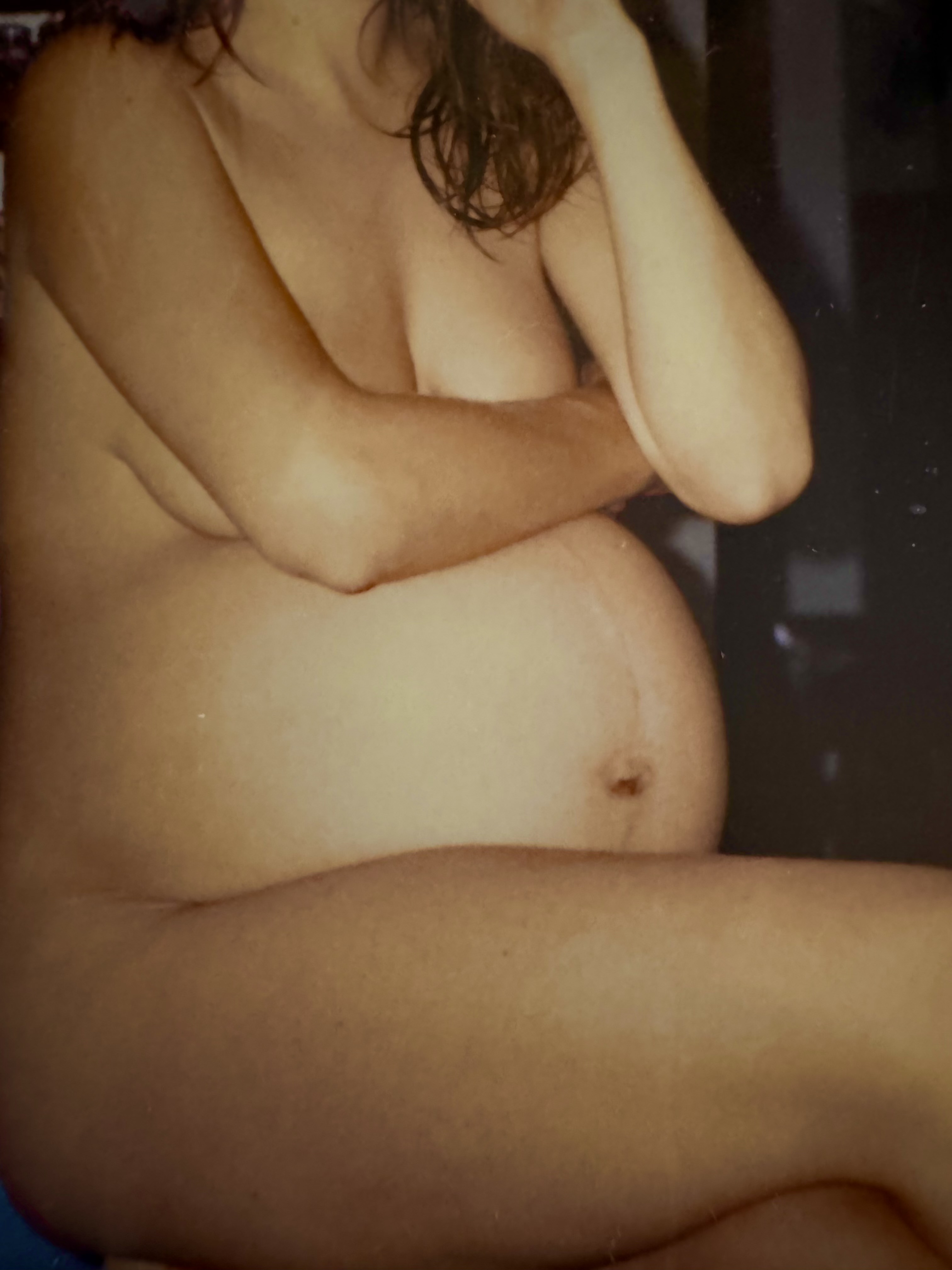
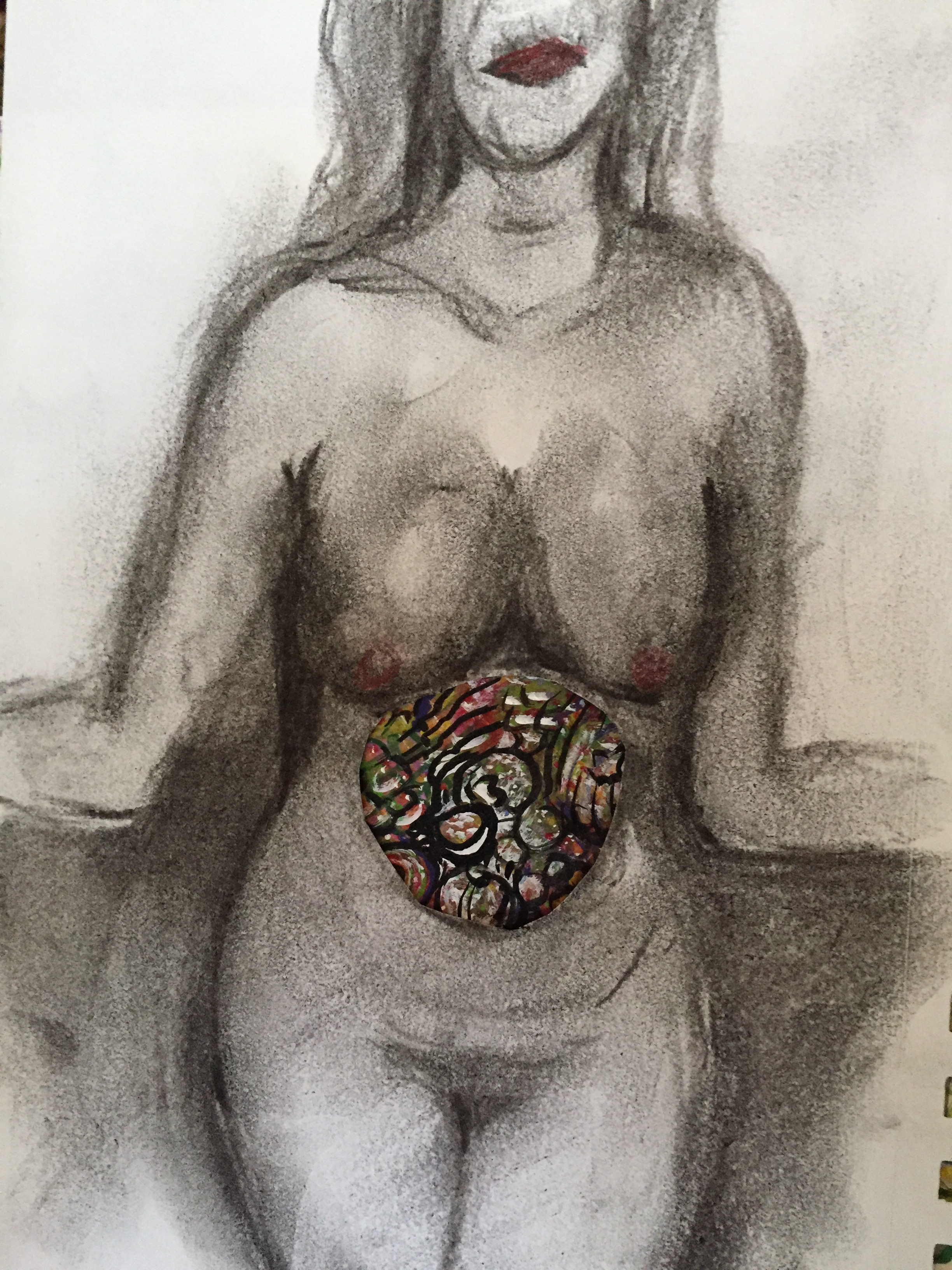
Morning crossword, four letter word, first site of eviction. “Womb,” I say aloud with certainty. But no, the answer is “Eden.”
Every human’s first home, the blood red womb
II Orange
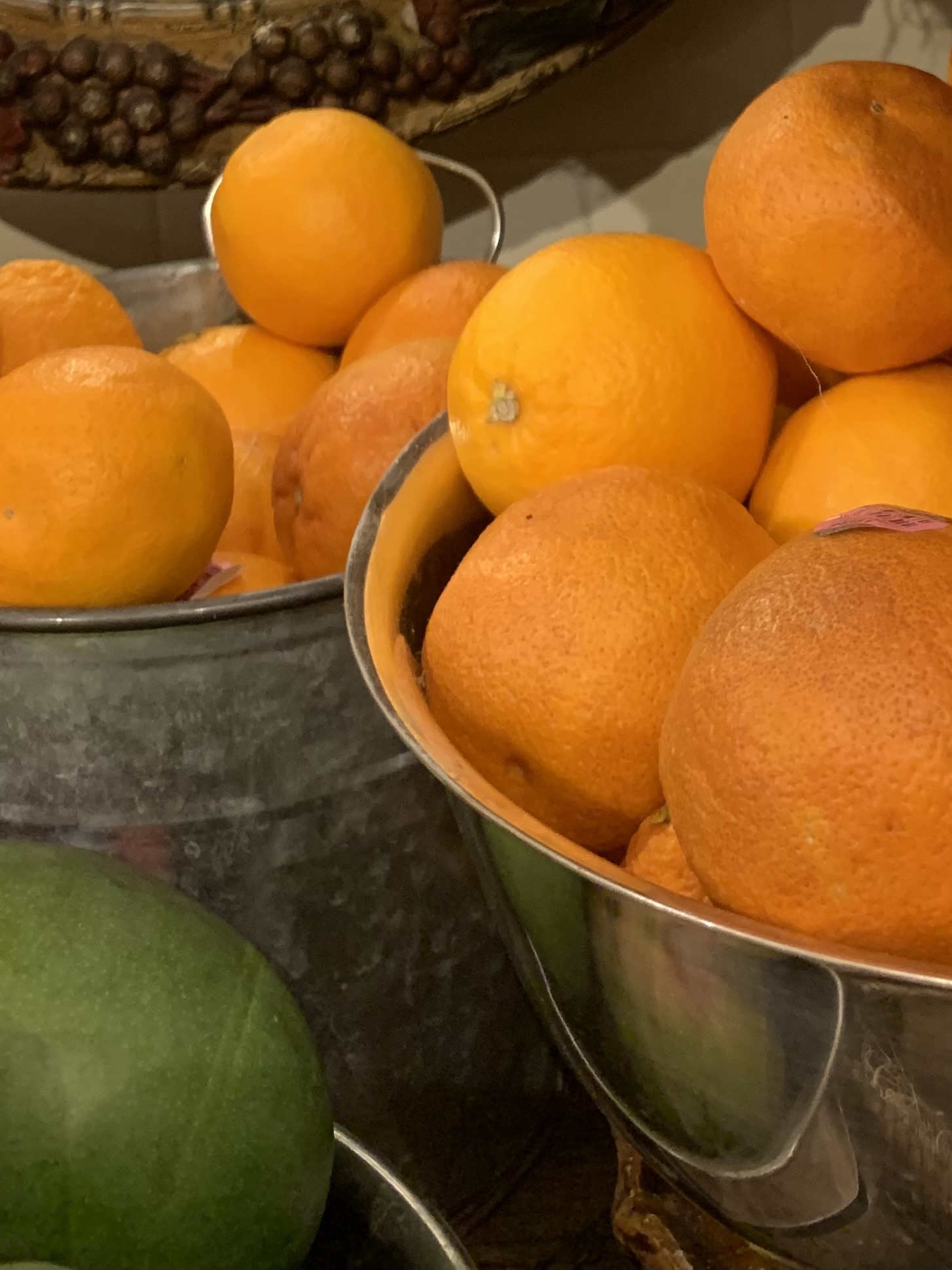
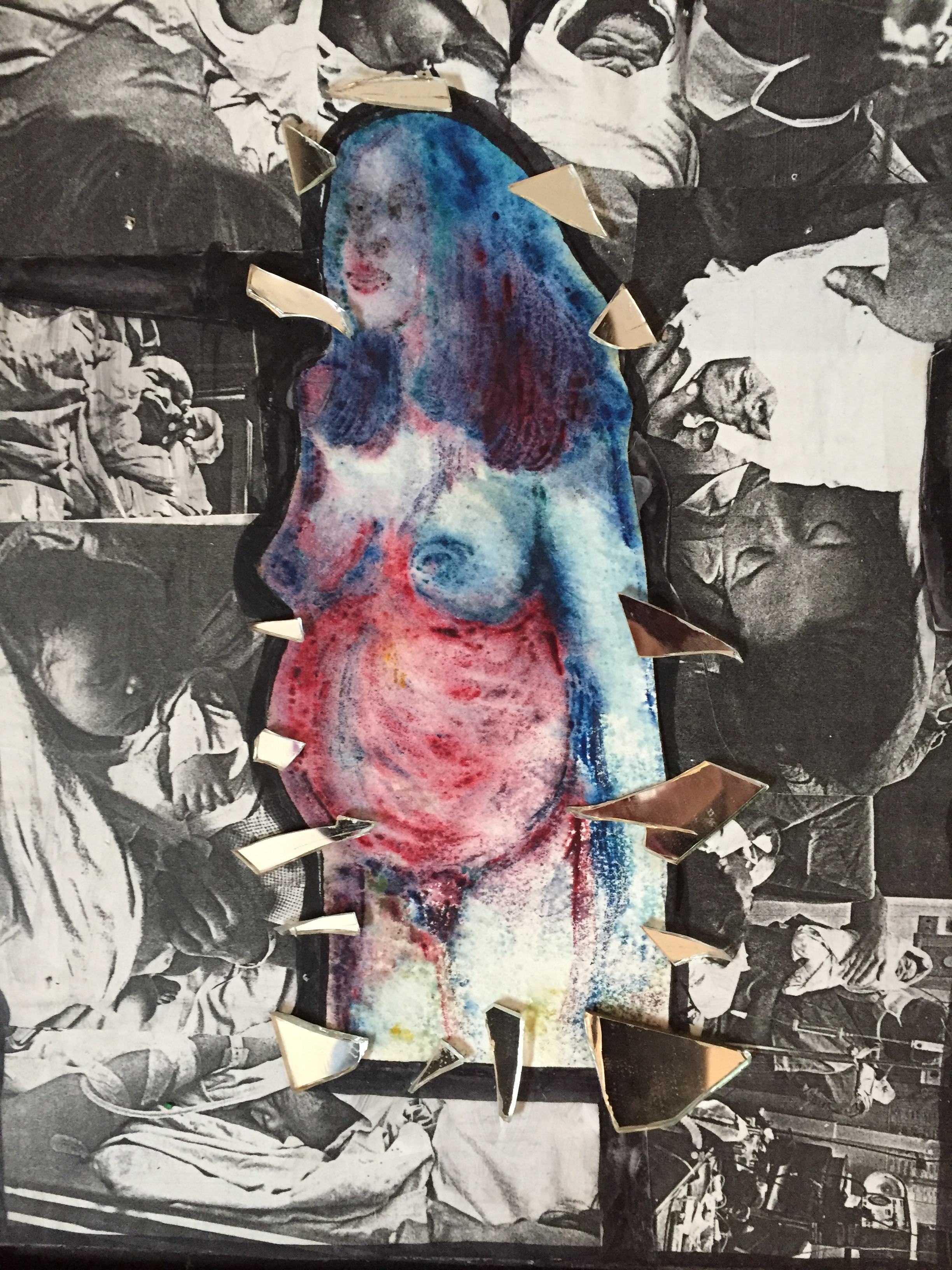
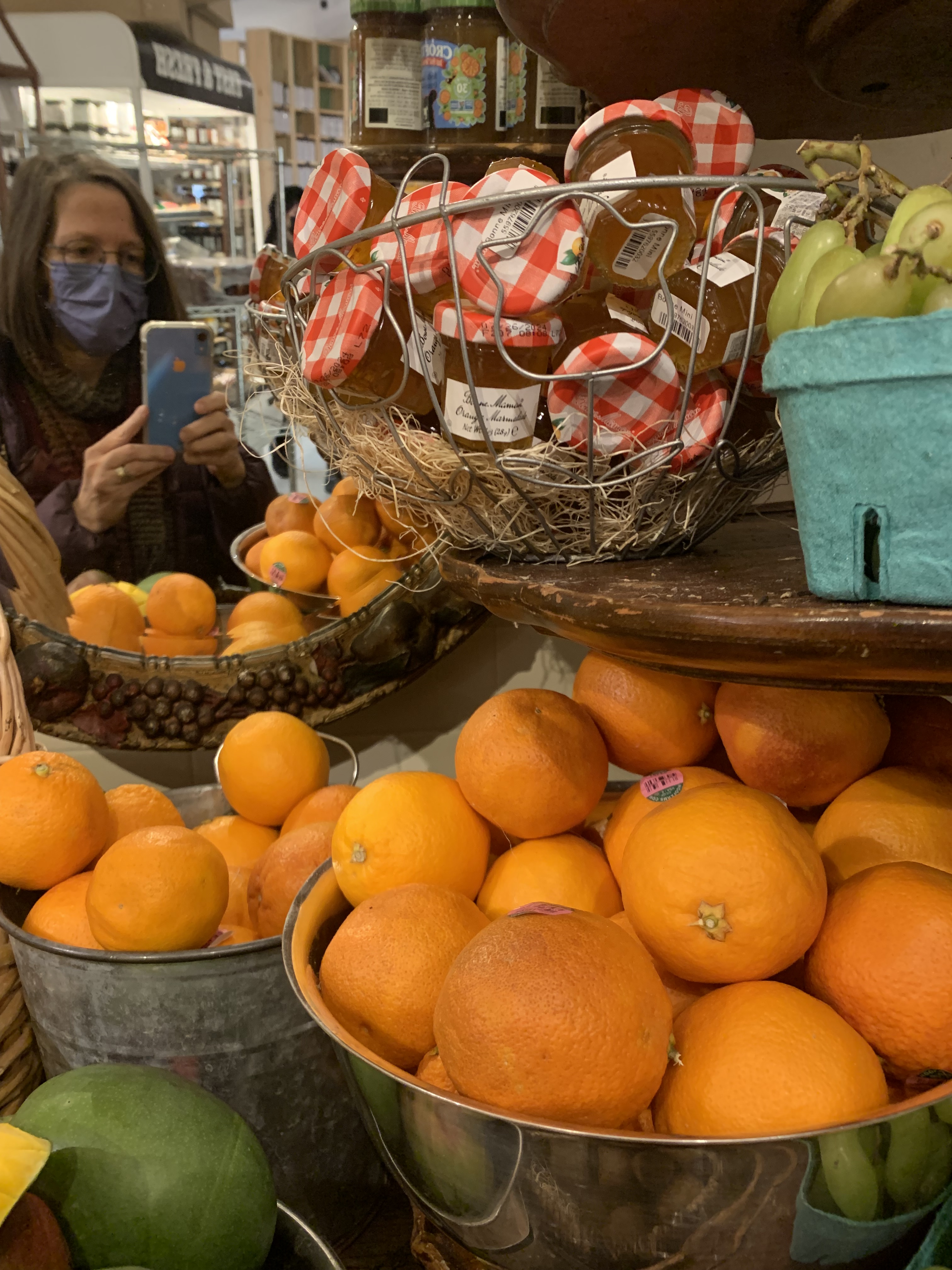
I go to the store to buy blood oranges for the cake and discover they have been rebranded raspberry oranges. the word “blood” is off-putting to consumers. I feel angry.
Remote, bloodless pale body of moon his face, forgotten
III Knife
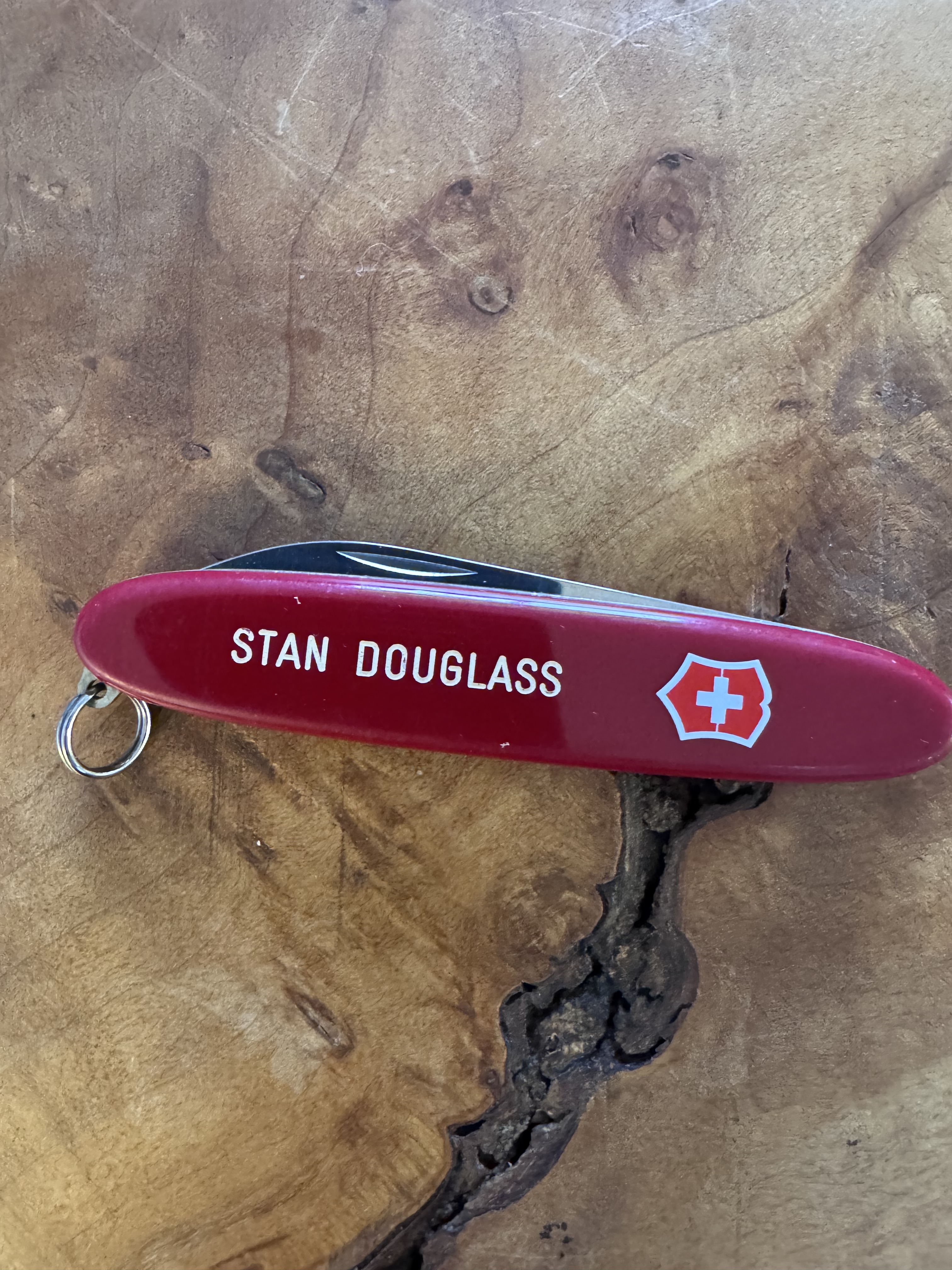
I go to an estate sale and buy a box of assorted junk for two dollars. At the bottom, I find a small Swiss army knife tucked into a black sleeve. The knife is marked with white letters: Stan Douglass. I look up Stan’s obituary.
When fifteen, only a lad, Stanley made a vow to serve the Lord
IV Ruth
My son and I walk along the street, heading to Value Village. He’s shouldering an old chair he took from a free pile, then regretted. I’m following. Suddenly a telephone pole is in front of me with
R U T H
painted in big red letters. Just a day ago, my friend and I compared middle names. Her middle name is Mazal meaning good luck. Mine is Ruth, I texted, and she texted back that “the biblical Ruth is a very special woman, and her name is synonymous with unwavering loyalty and kindness.”
Is it a sign? Four red letters tell my fortune
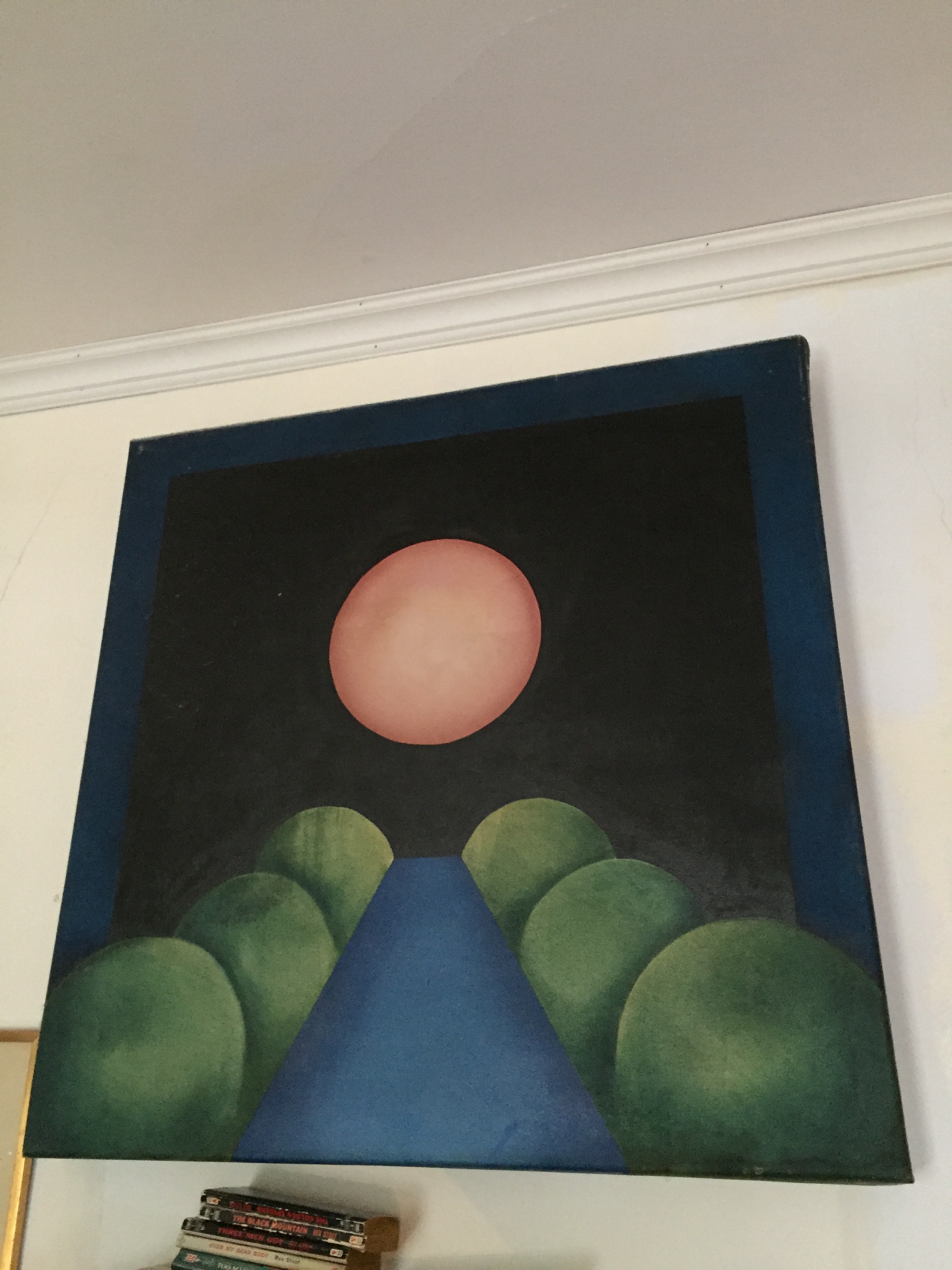
The moon painting is by Bob Sabatini. Other creations are mine.
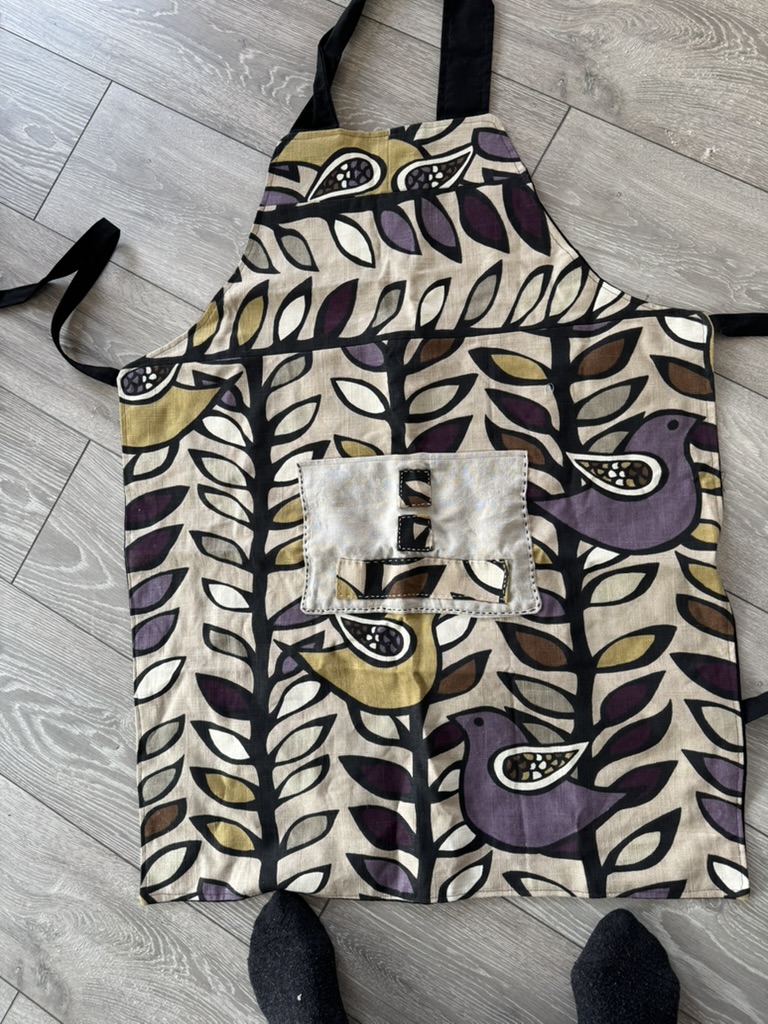
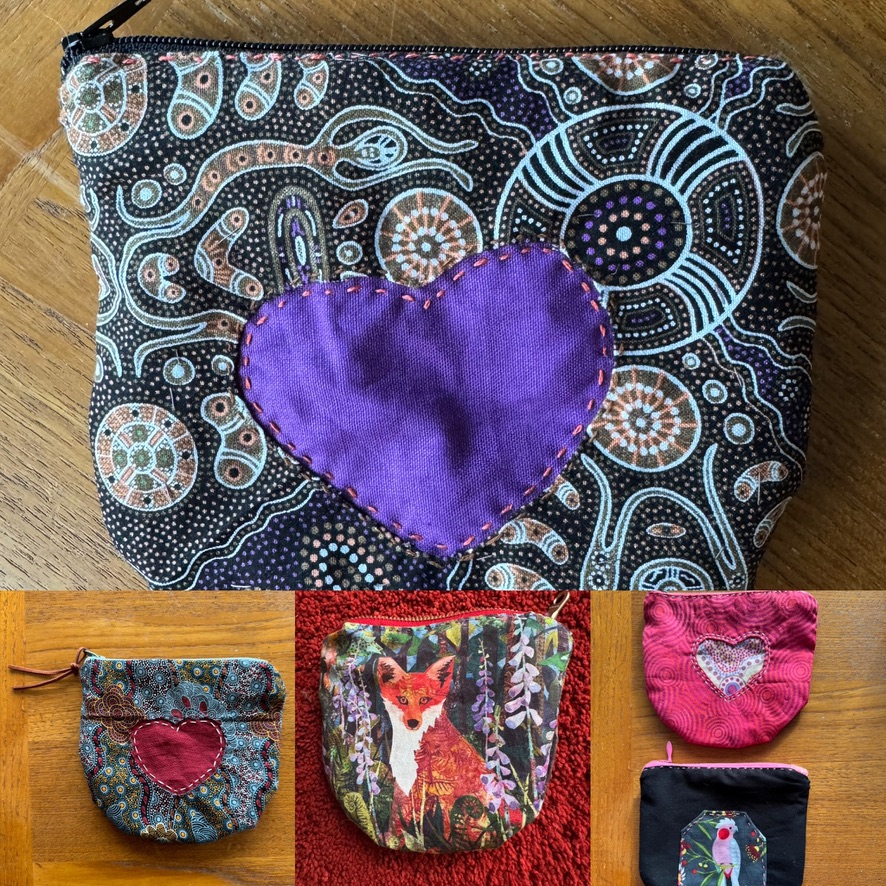
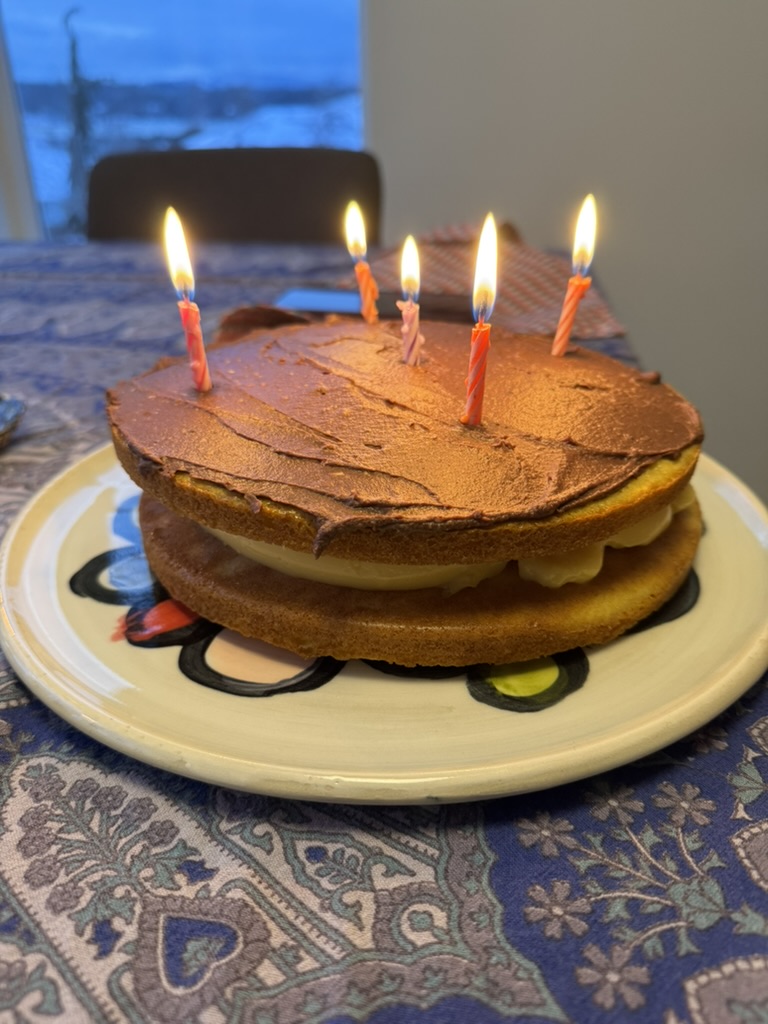
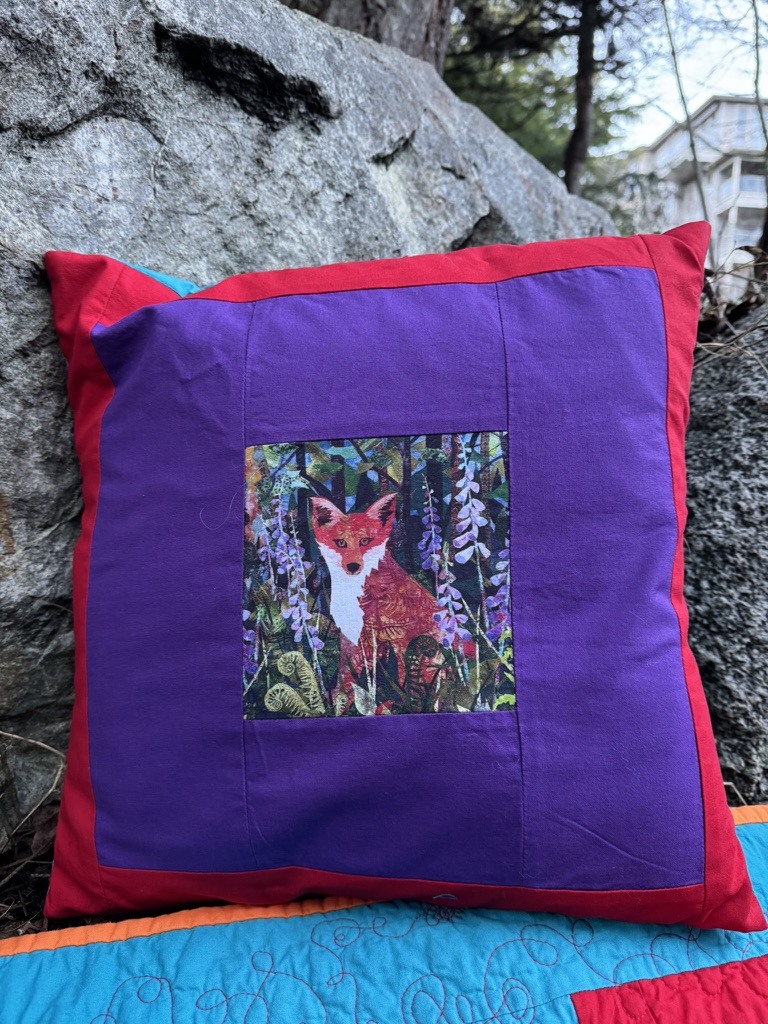
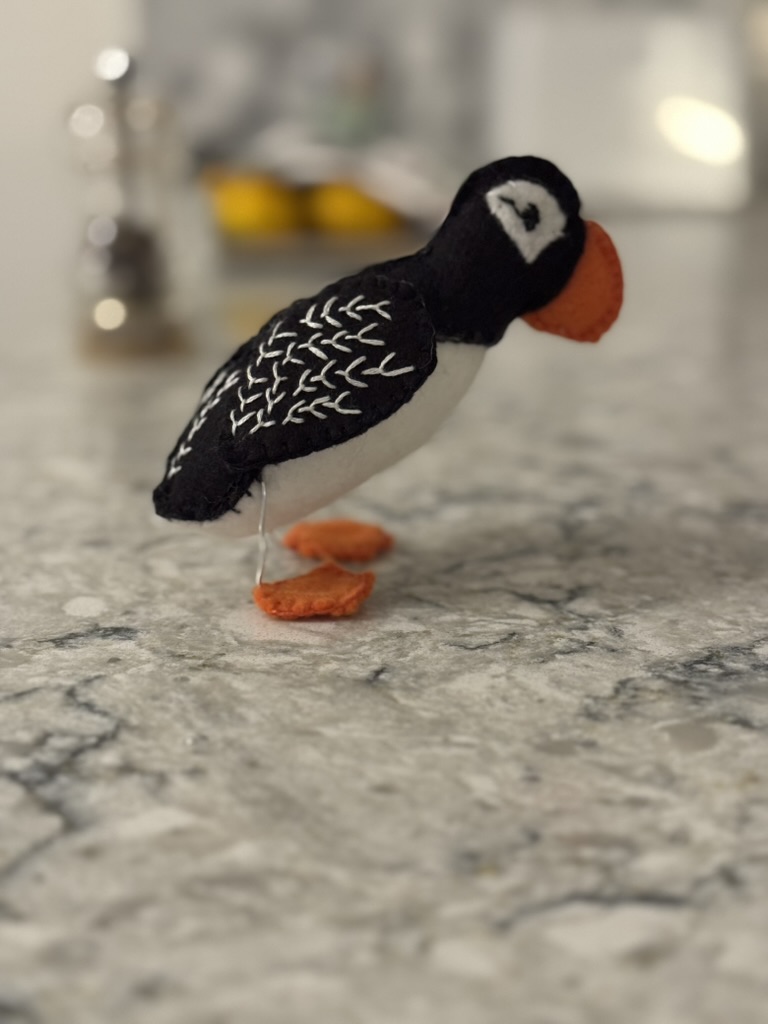
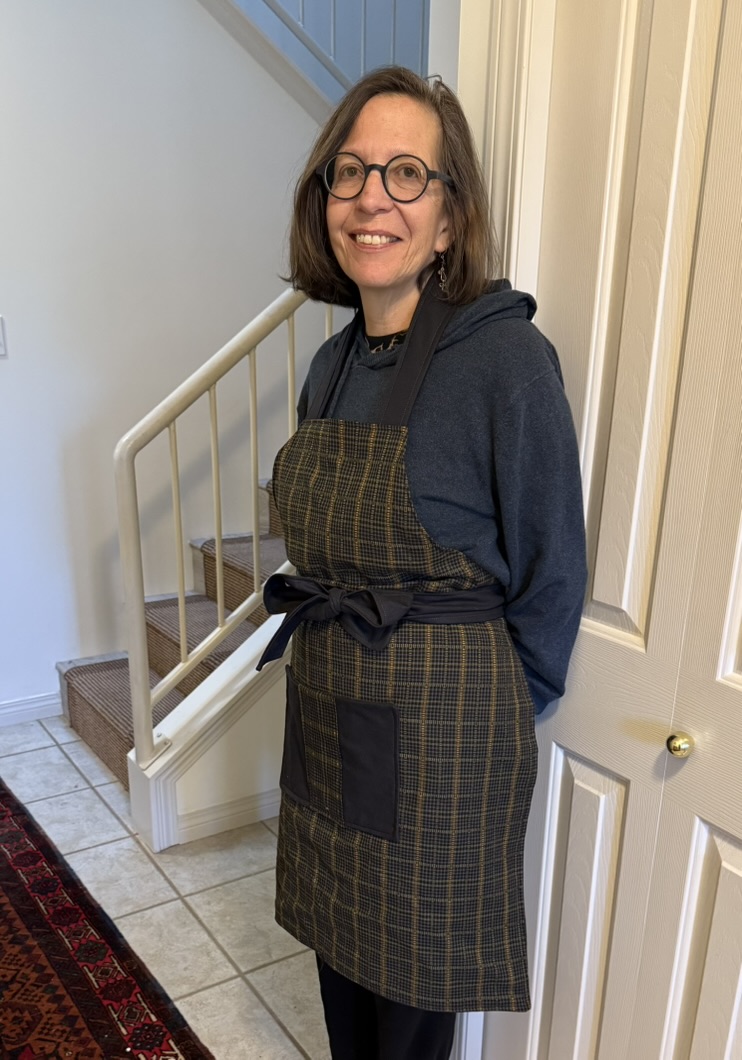
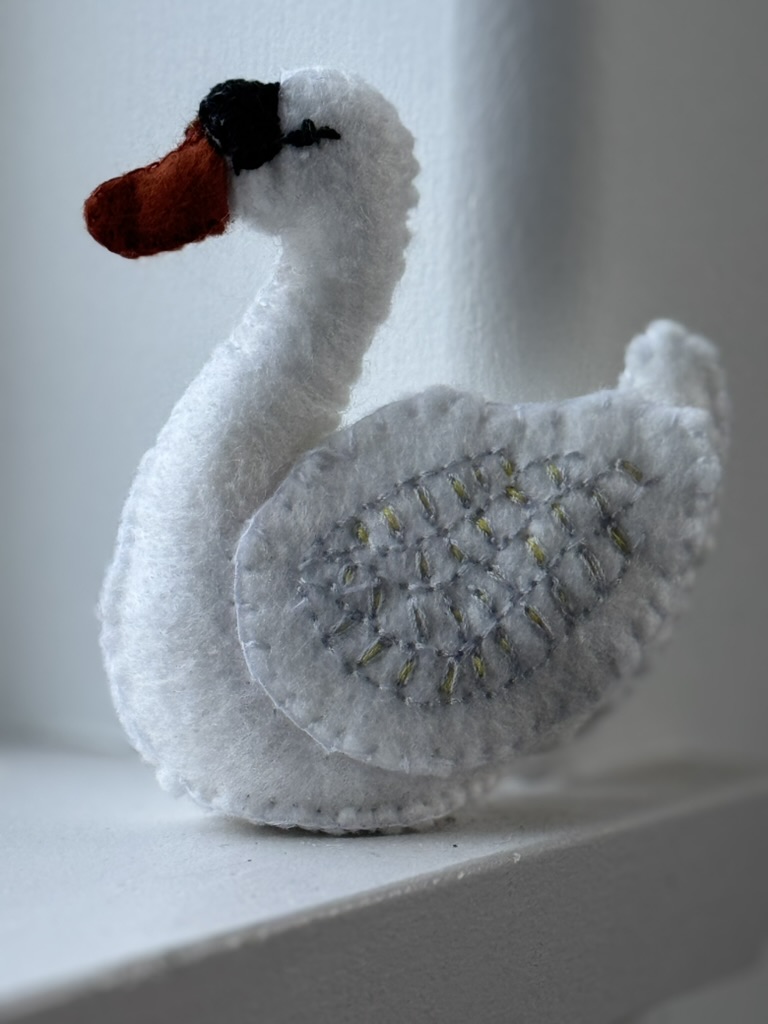
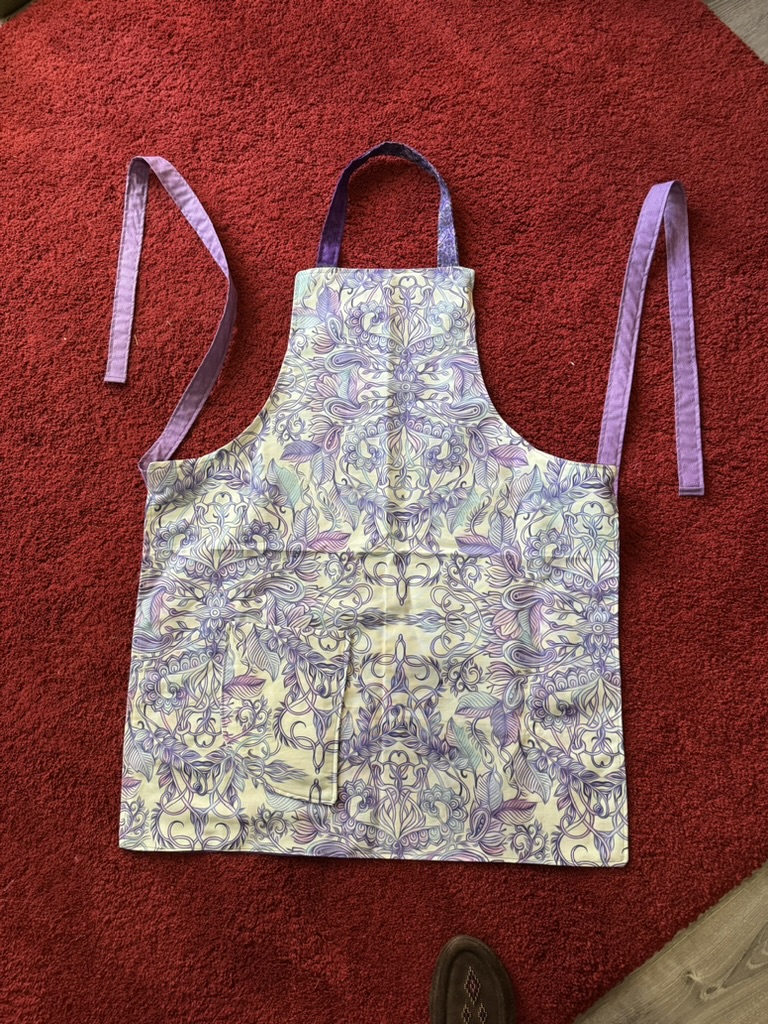
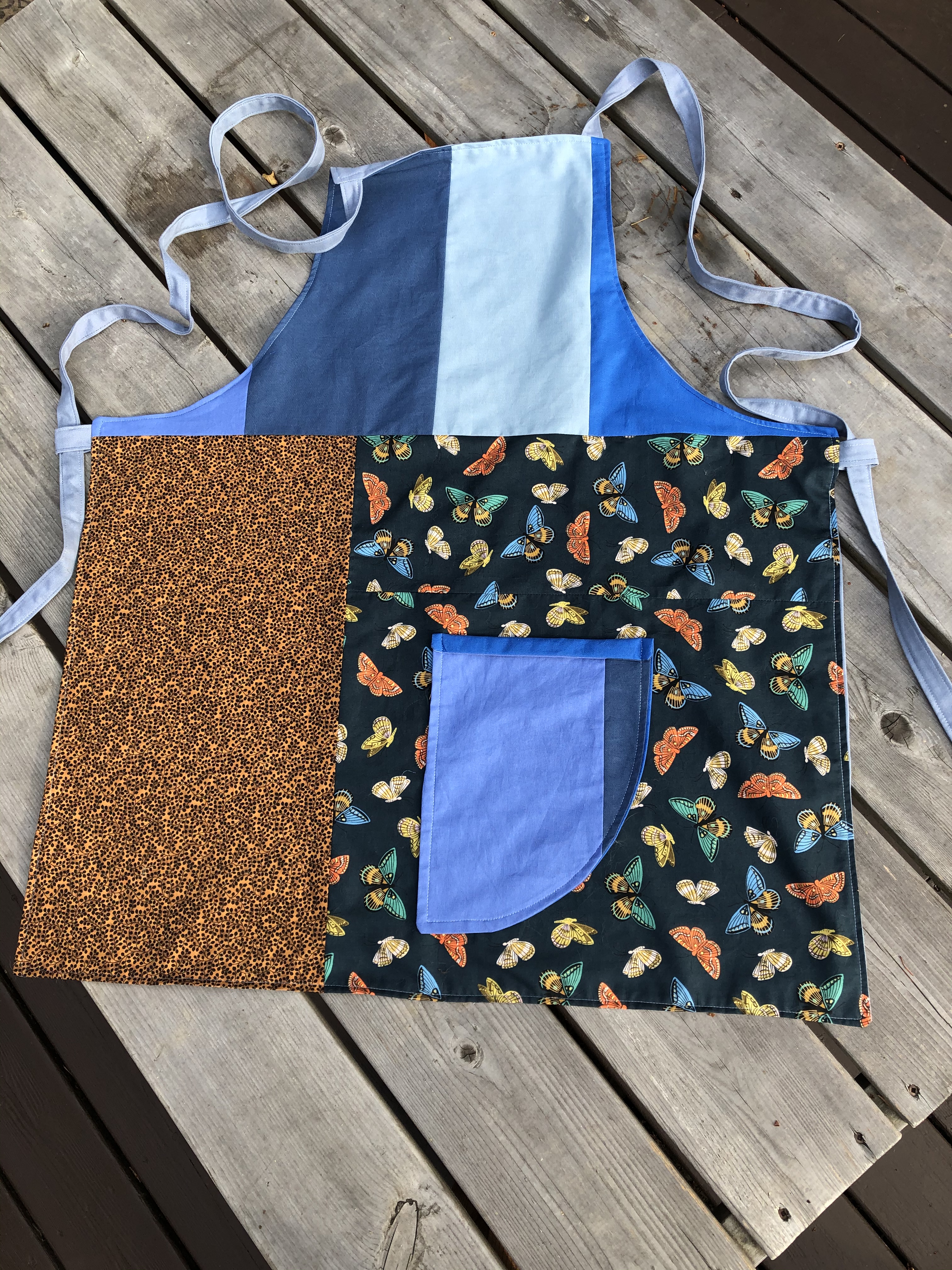
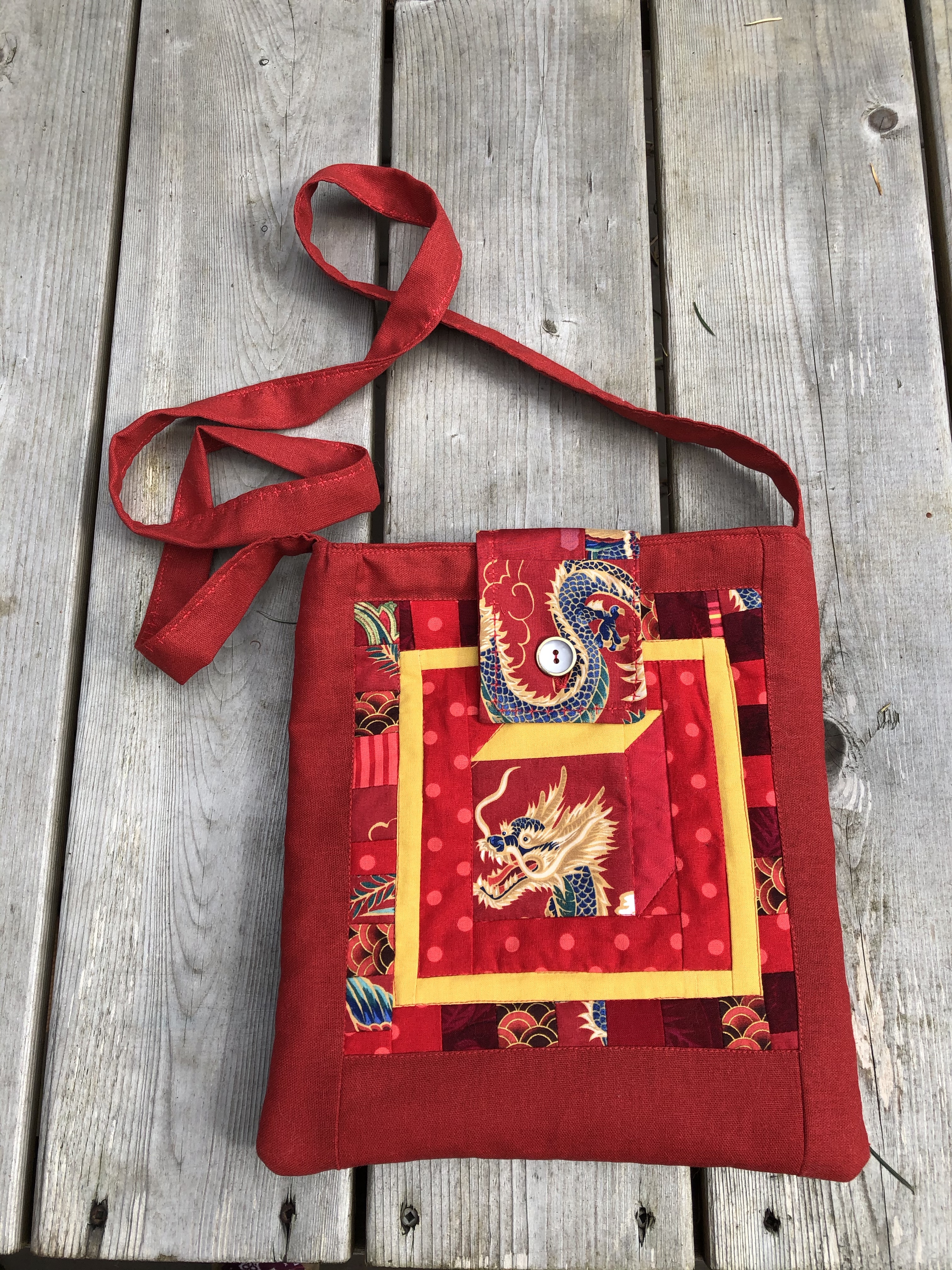
It’s my 67th birthday today, a good day to review the year in creation. What did I make this year? Eleven blog posts (this is the twelfth); a few stories, poems, and essays; felt birds for family members and felt Christmas decorations; three aprons (one for Nancy, one for Meytal, one for me); a baby quilt and matching pillow for the great grandson of my friend, Lillian; embroidered pillows for my niece; a patchwork pillow for my friend Janis; little zippered bags for everyone; “One Thousand Joys,” a wall hanging for our stairwell; a lunch bag for me; some drawings and comics; a sling bag for Nancy; some collages (thank you Kathryn for the inspiration); and cakes and more cakes for friends and family.
Living a creative life feels as important as ever.
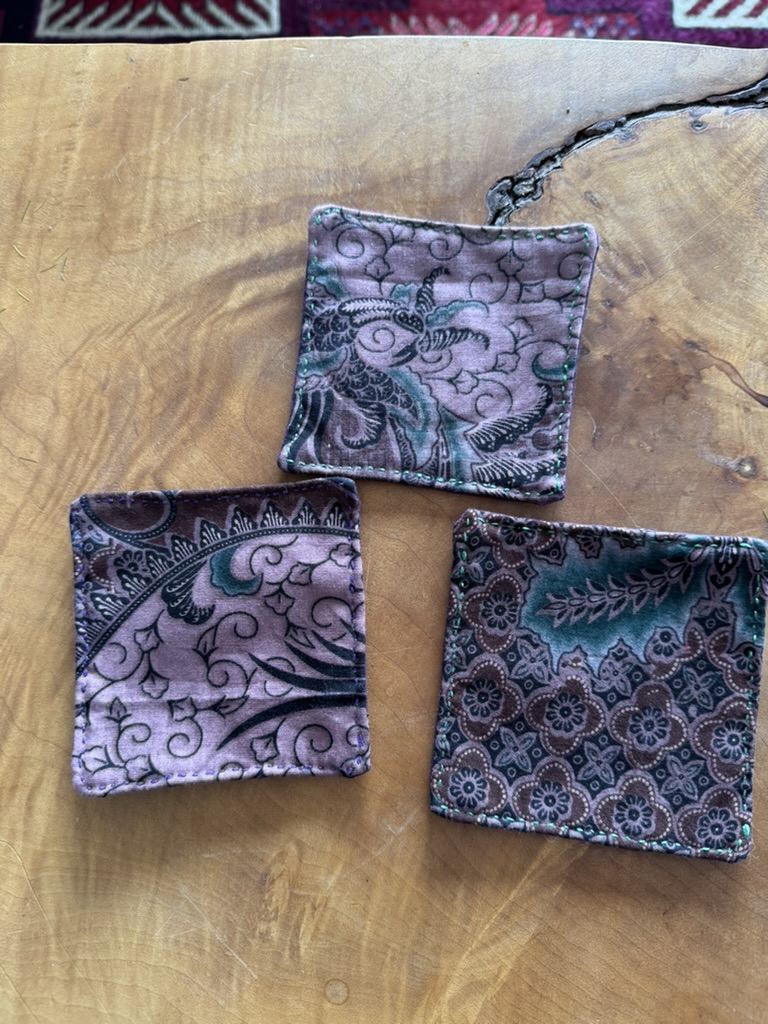
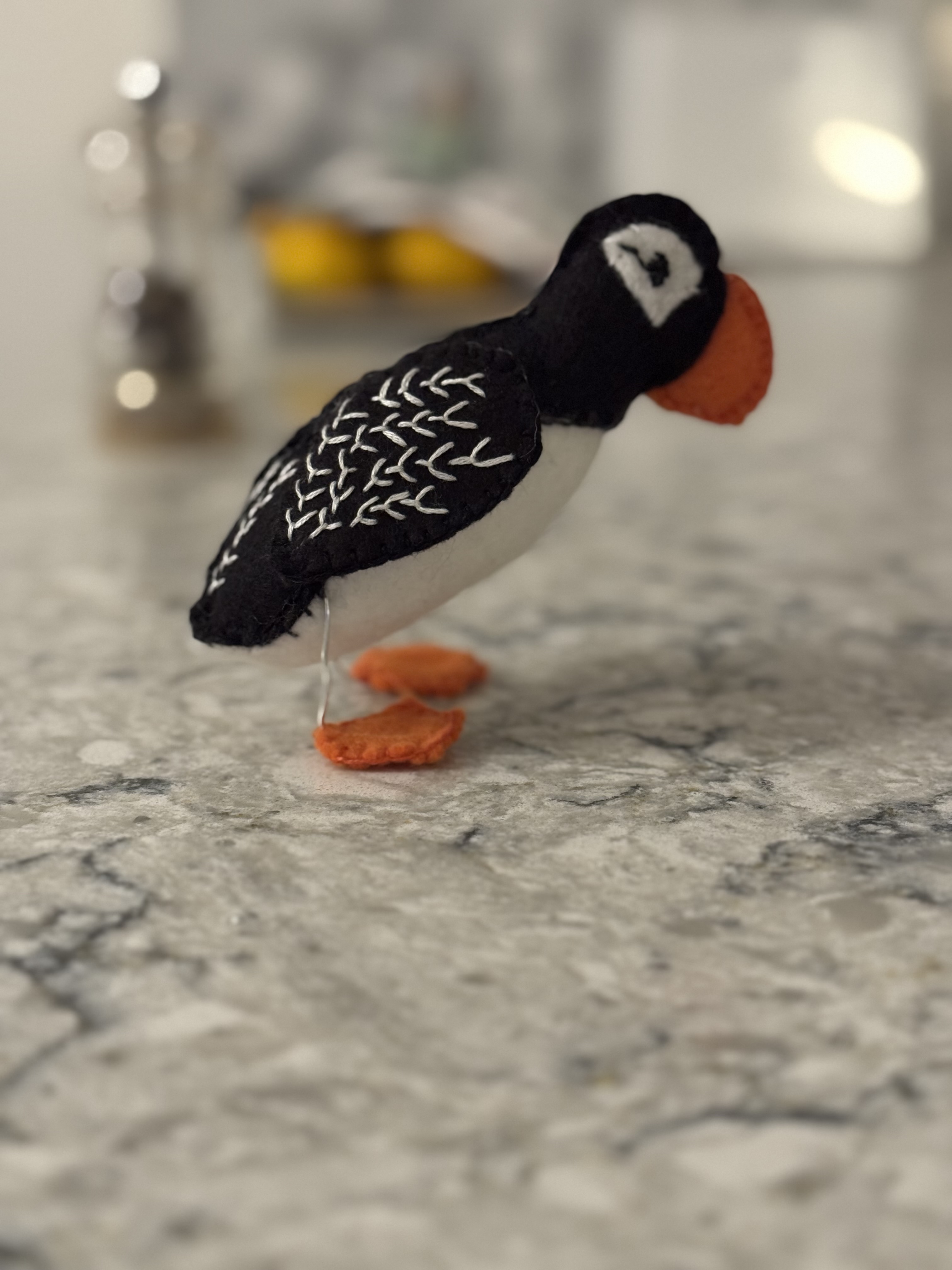
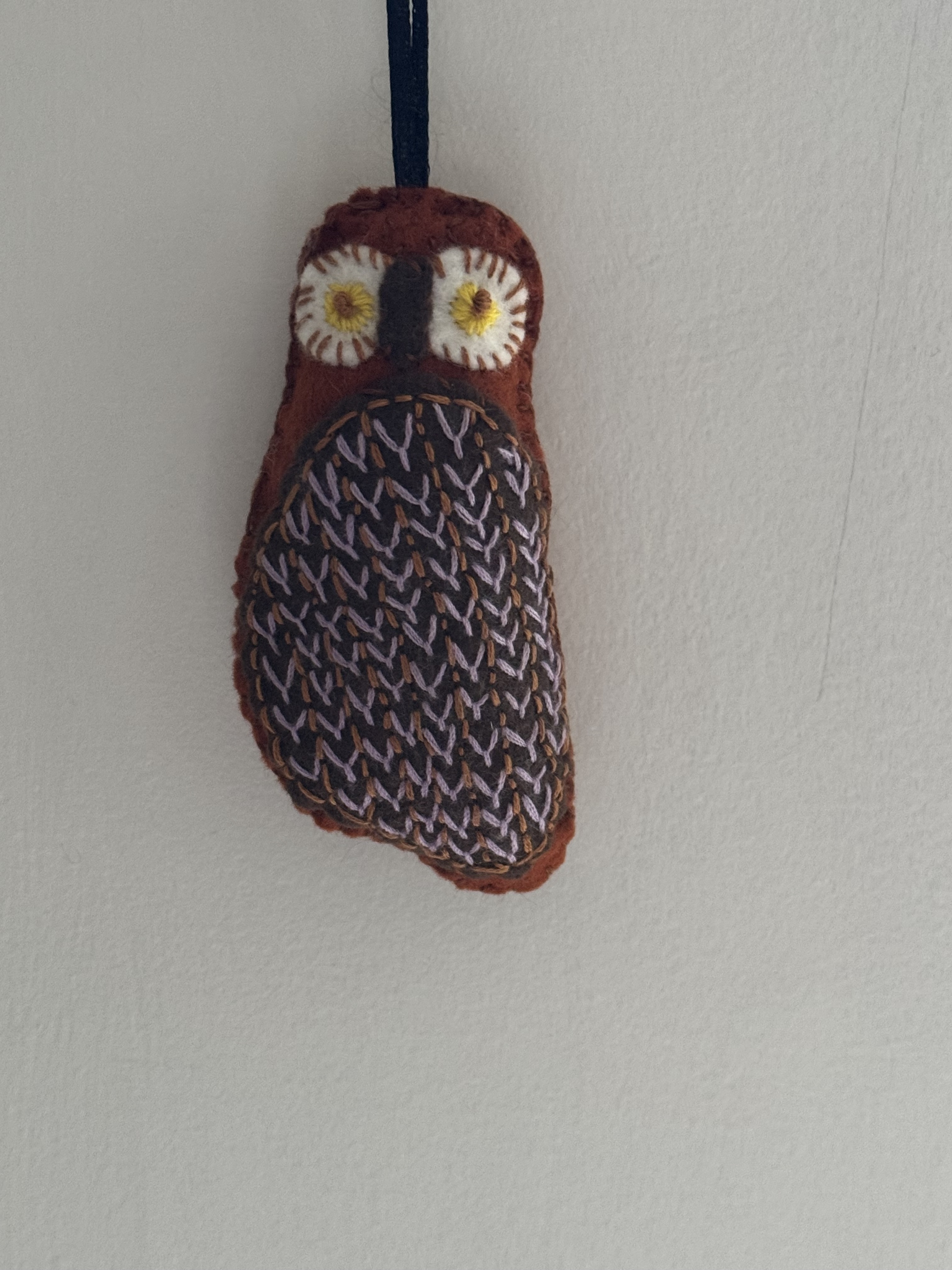
Coasters made from a shirt I bought at a yard sale10,000 JoysMe and Nancy – her birthday apronKathryn’s vegan chocolate cakea pillow for Janis’s birthdayMeytal’s birthday apronSling bag for NancyMichael wanted a Boston Cream Pie and I deliveredA lunch bag for meTwo pillows for my niece’s birthdayA quilt and pillow for a little baby I’ll never meetMichael named the owl I made him “Winston”Nat’s puffinI wanted an autumn apron, so I made thisFelt tree ornaments for my dear writing group membersSarah’s swanEvan’s heronCollage: Pieces of Me
Show and Tell

In old age,
let us
return to kindergarten
rituals.

Show something,
then tell about it
during circle time
with our friends.

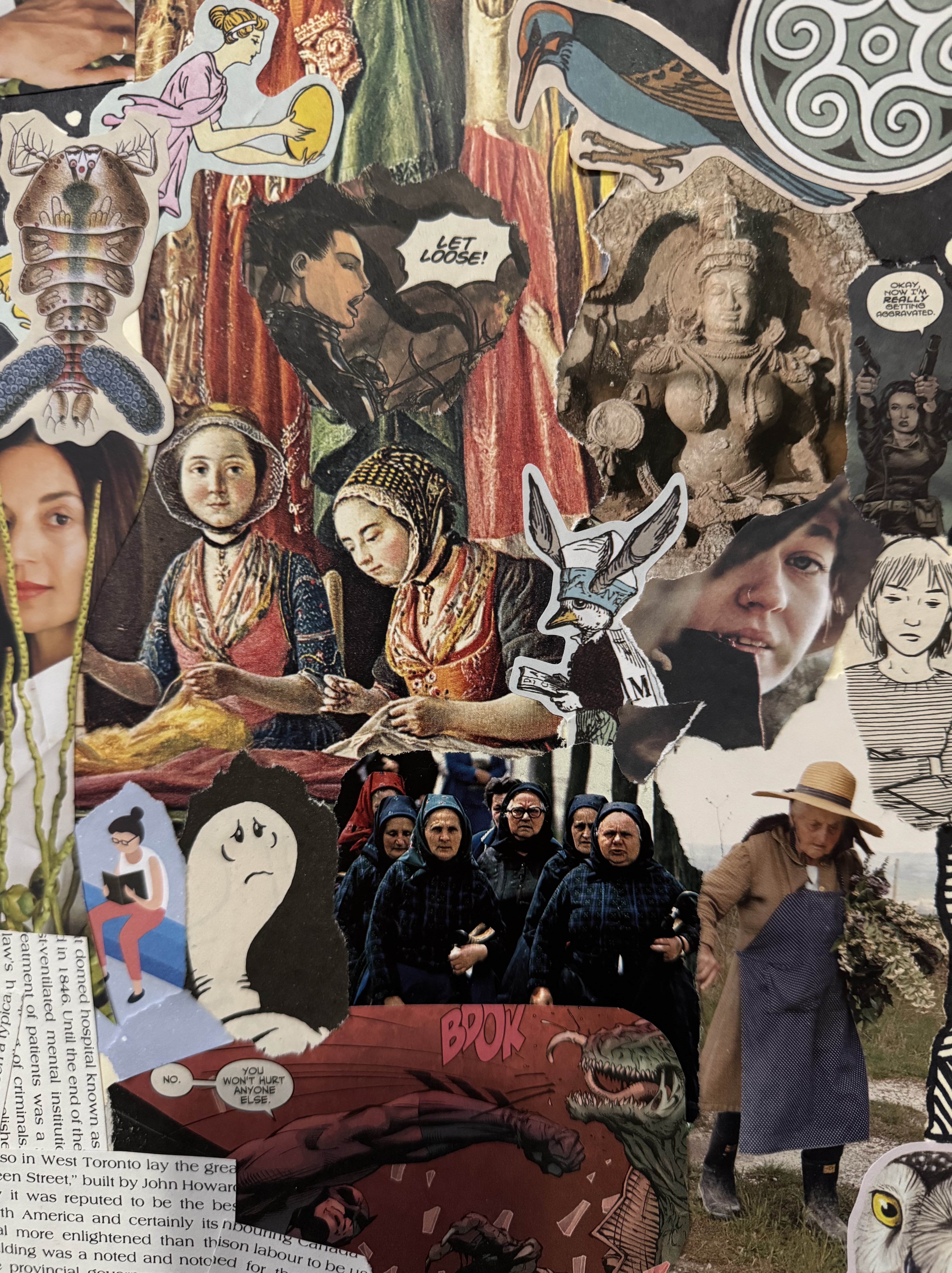
I went to collage club
at the library
Women of all ages were
cutting up old magazines.
Glue sticks and colourful scissors
lay across white tables like
sacred instruments.

As we cut, some of us
spoke; others
remained silent.

I made a collage
about the pieces of me.

Cool and aloof,
wise owl
serious as I sew buttons.
Sometimes a poor silly worm,
my blind eyes sensing light.

In past lives I was
fertility goddess,
discus thrower
seamstress
parasitic crustacean.

Inside of me, Batman blocks a monster:
“No, you won’t hurt anyone else.”

Inside of me, a bitch brandishes her guns:
“Now, I’m really getting aggravated,” she says, her voice rising on the smoke.
If women let loose their anger, the world would burn.

One spring day in Toronto,
forty years ago,
I rode the Queen West streetcar to work.
As we clattered past the mental
institution, number 999,
a statuesque woman, her
proud head shorn,
strode the sidewalk, naked.
Her brown thighs shimmered in
the light, her high breasts bounced lightly,
nipples hardened in the coolness
of that morning.
Everyone around me was,
for a moment, silent, awed
by this strange beauty.

Crustacean, crone, bird,
woman, warrior, gatherer of words,
seamstress of memories
Can you see all the pieces of me?
“When we run from our suffering we are actually running toward it.” Ajahn Chah
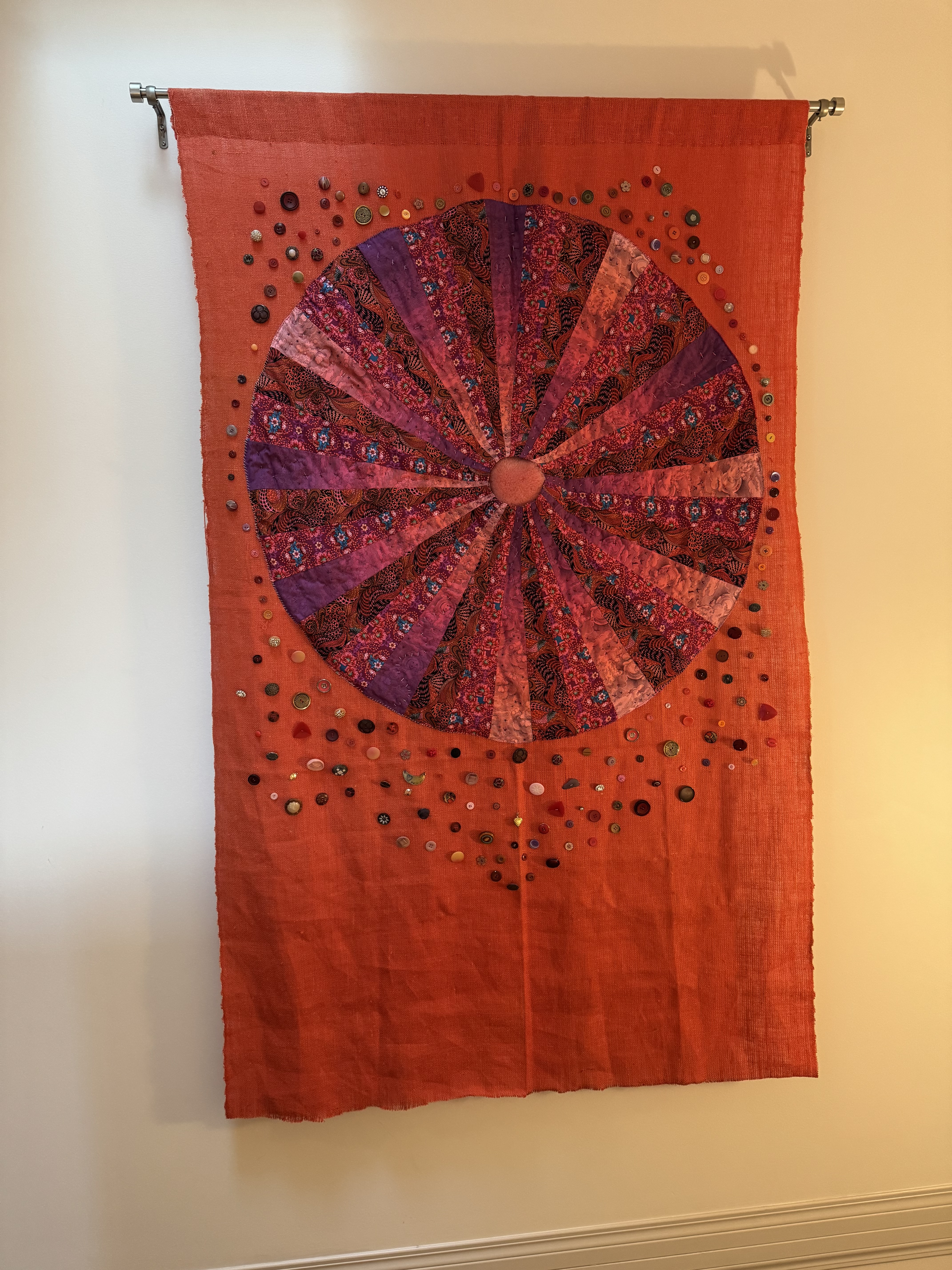
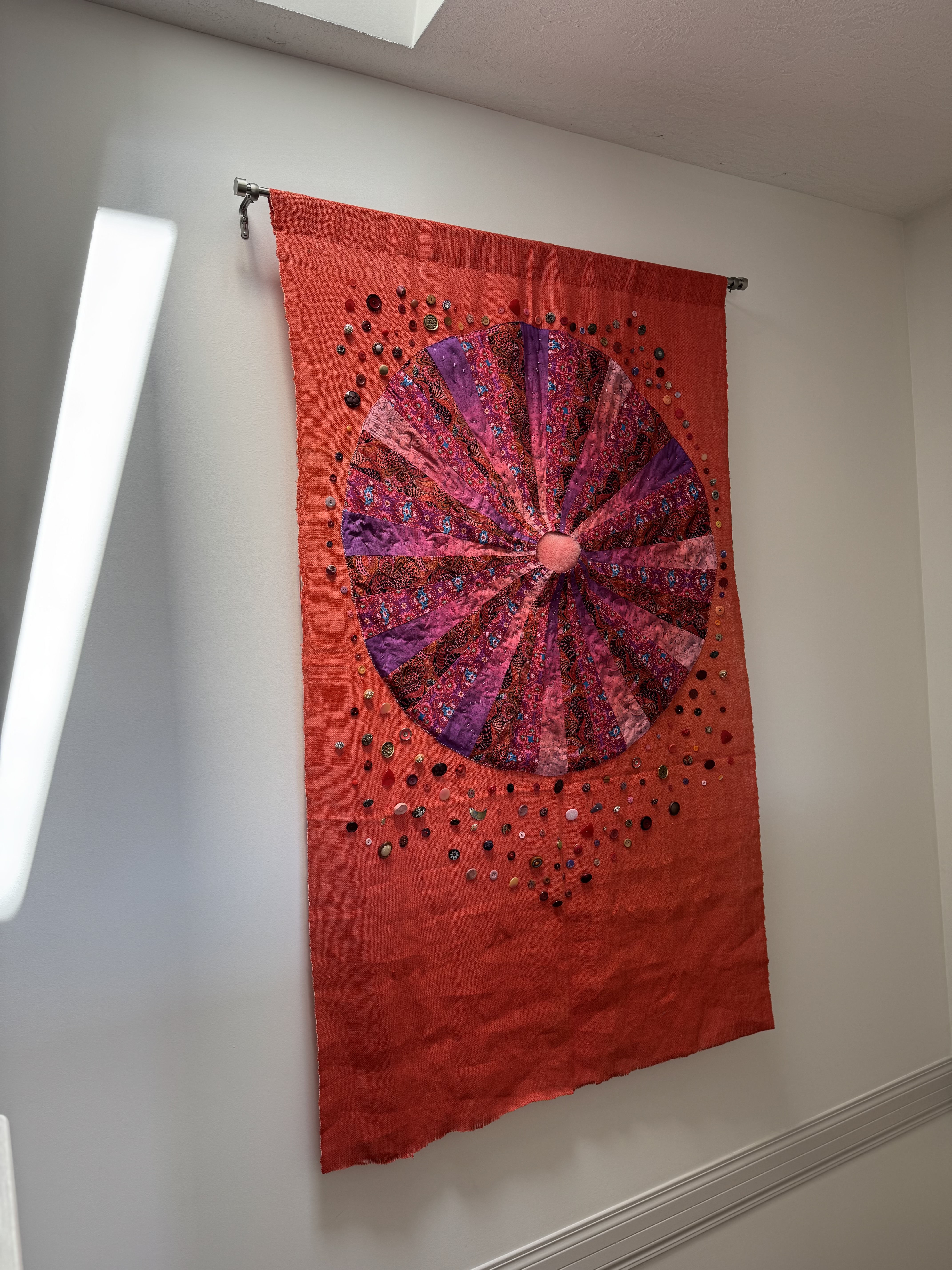
I’ve been basking in two messages from my unconscious this week. In one dream, a person wearing a bright tie-dyed shirt holds a hand lettered sign, “You are not alone.” In another dream, a young man, bearded, hugs me and whispers in my ear, “Thank you for your patience.” The messages are hackneyed, and yet they were delivered to me fresh, warm, colourful,by stately messengers. It doesn’t matter if they—the messages and the messengers—aren’t “real”; they are just as real as the people and events, the words, ideas, and things I encounter in my dream-like conscious life. And more to the point: They provide great comfort, having bathed me all week in an orange glow, a glow like that emanating from the 10,000 joys wall hanging, now installed in our stairwell.
The wall hanging seems to collect the sunlight falling in through the skylight and send back a peachy radiance. Several times now I’ve gone to flick the hall light off, thinking the switch is on when it shouldn’t be. No, the light is off, but 10,000 joys shed their own uncanny light.
When I made the piece, I kept telling myself, you don’t have to make its counterpart, 10,000 sorrows. It’s okay to just focus on joy right now. But of course, you cannot have 10,000 joys without 10,000 sorrows. I wish we taught this truth to children in kindergarten. You don’t experience joy without experiencing sorrow. And it’s okay. When you cling to joy and try to avoid sorrow, you just prolong it. I wish I’d gone to a Buddhist kindergarten, where these truths would be taught elegantly and logically, instead of being told by adults that “life isn’t fair,” which seems tawdry and cruel in comparison to the dharma.
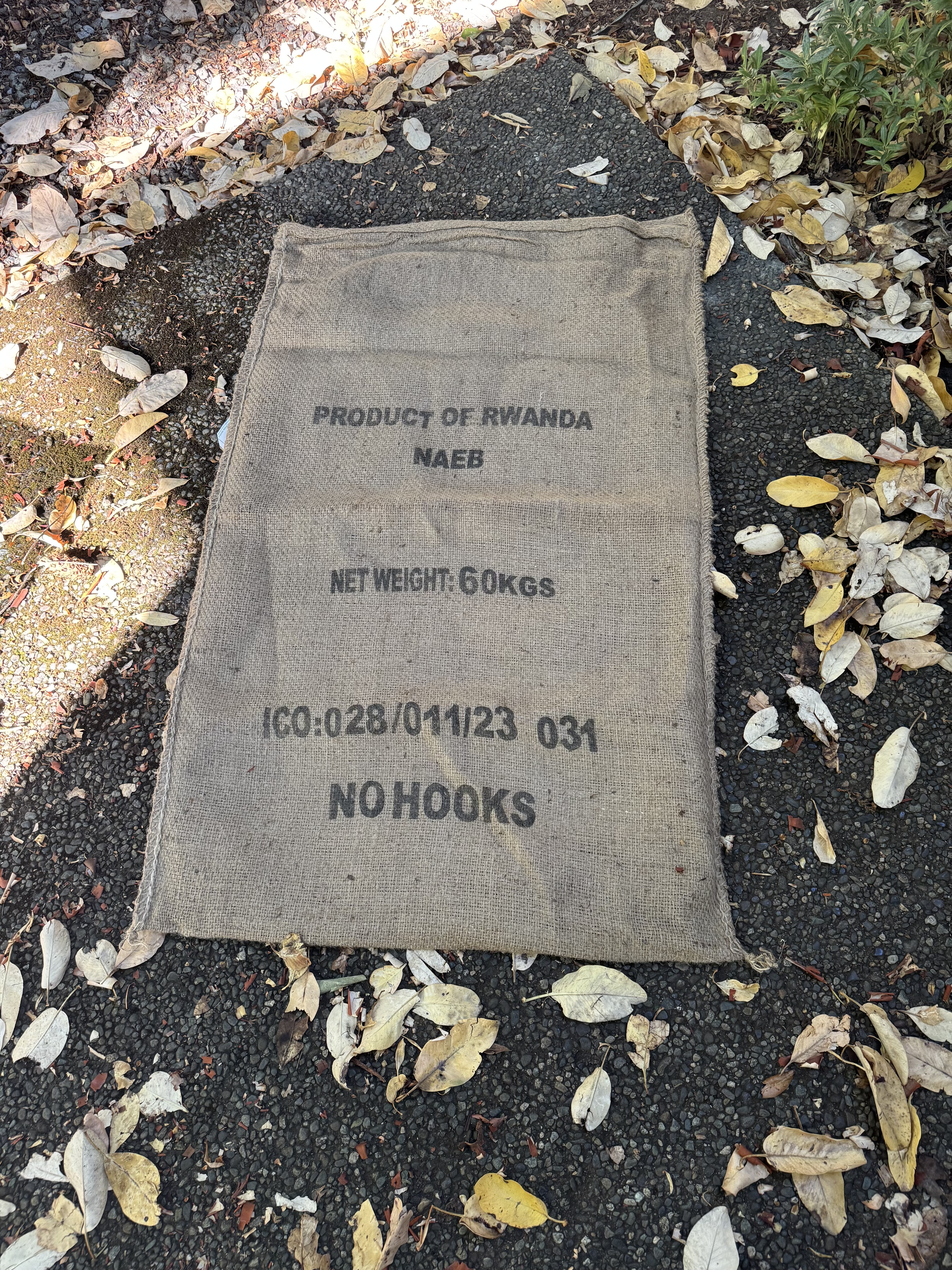
Inevitably, I am called upon to make joy’s counterpart. I had coffee with a friend yesterday at Esquimalt Roasting Company. As I waited at the counter for our lattés, I noticed a large burlap bag draped over a plastic bucket. I picked it up and showed it to the barista. Can I buy this? I asked. In my imagination, I was already picking its seams and spreading it out, a wide brown canvas for thousands of sorrows. It’s free! she responded. So now I have the backdrop for the wall hanging. I had originally thought it should be black, but brown is less dramatic than black, more subdued and complex, as sorrows often are, especially as we digest them.
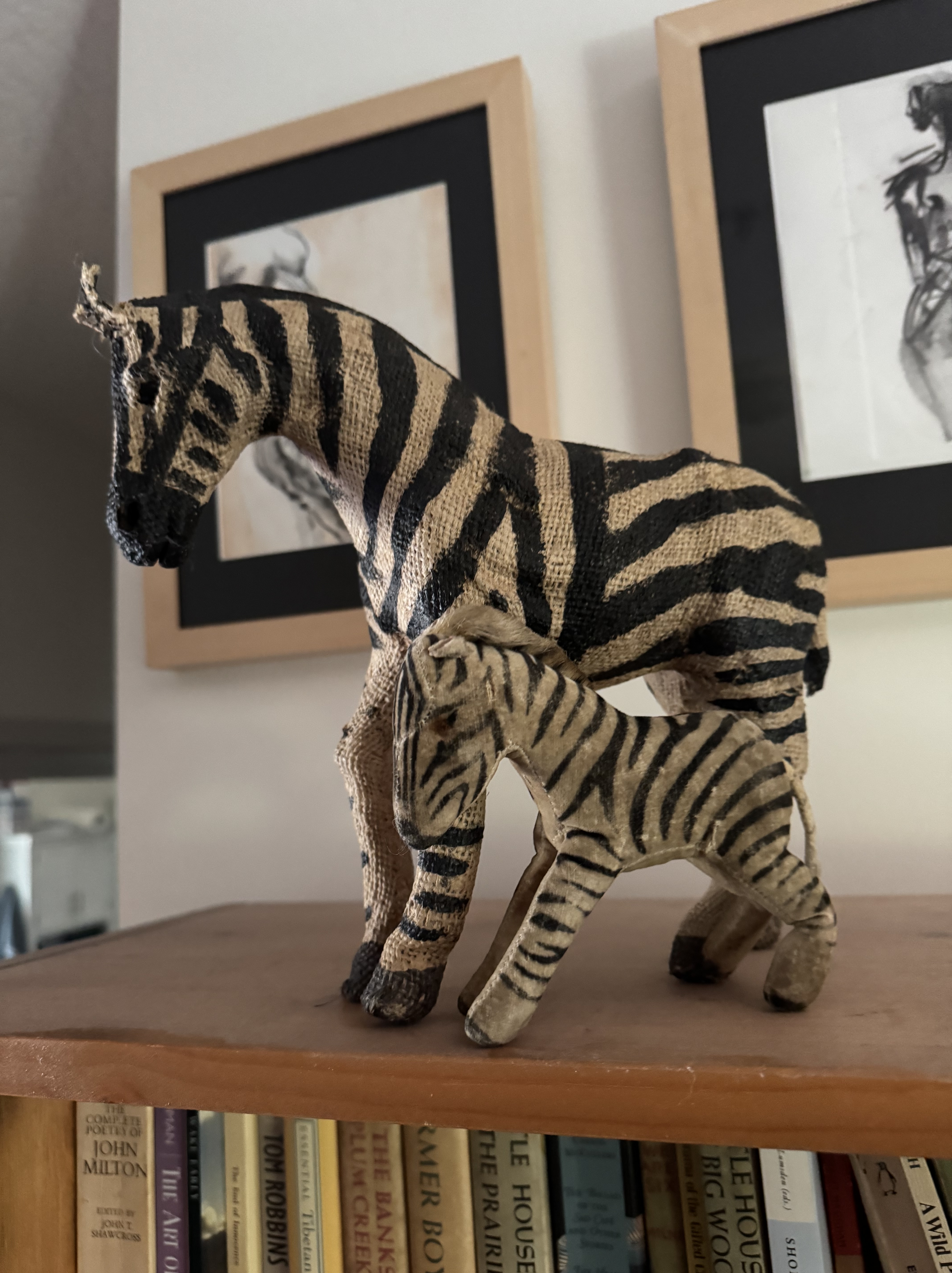
The burlap bag was pure serendipity. Another magical find was a zebra at the ReStore in Langford. Purchased for 70 cents ($1.00 but there was a 30% off sale). This zebra is majestic, dignified, kind, warm. She stands about 10 inches high. Her stripes are unrealistic, but otherwise she is a convincing animal. I dug out a stuffed toy zebra I’d kept from childhood in a box under the stairs. It’s remarkable this sixty-year old stuffed animal still stands! They now live together, mother and child, atop a bookshelf in our bedroom. I like to gaze at them from bed. Something about them feels calming, comforting. I loved my zebra striped one-piece bathing suit when I was eight years old. When I wore it, my reward was a zebra tan that was pure magic.
How to find comfort
Face fear, face grief, crunch on them like buttered toast, let them nourish you. Small striped body in the mirror, some kind of childhood magic. Let dreams bathe you in orange light. Sweet’s after tastes bitter, crying sparks a belly laugh. Joy and sorrow are so intertwined, you can’t tease them apart, please don’t waste time trying. Practice the butterfly hug: Hands cross collarbones, thumbs meet, fingers tap lightly, lightly. A comforting rhythm will come. It will come.
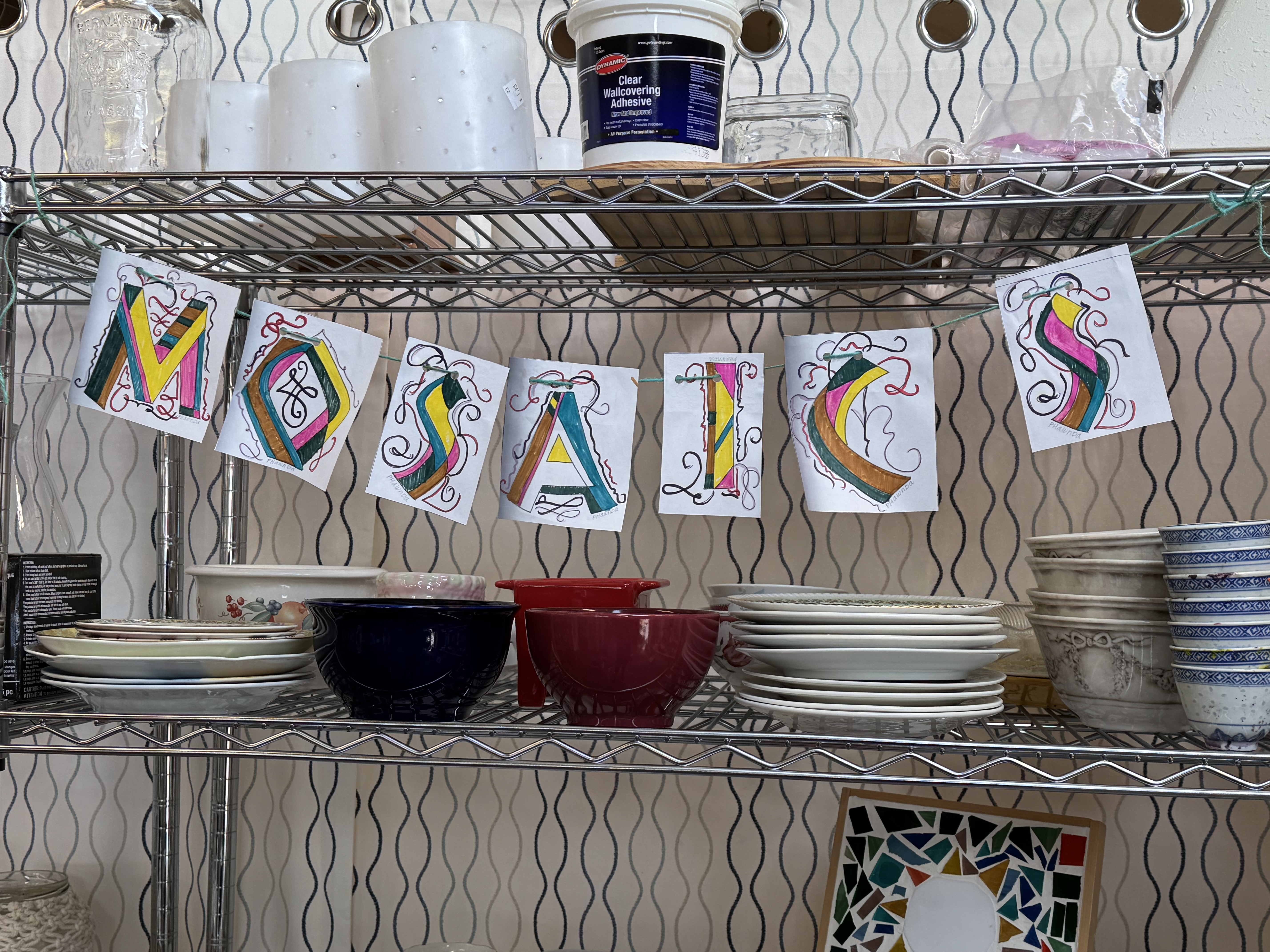
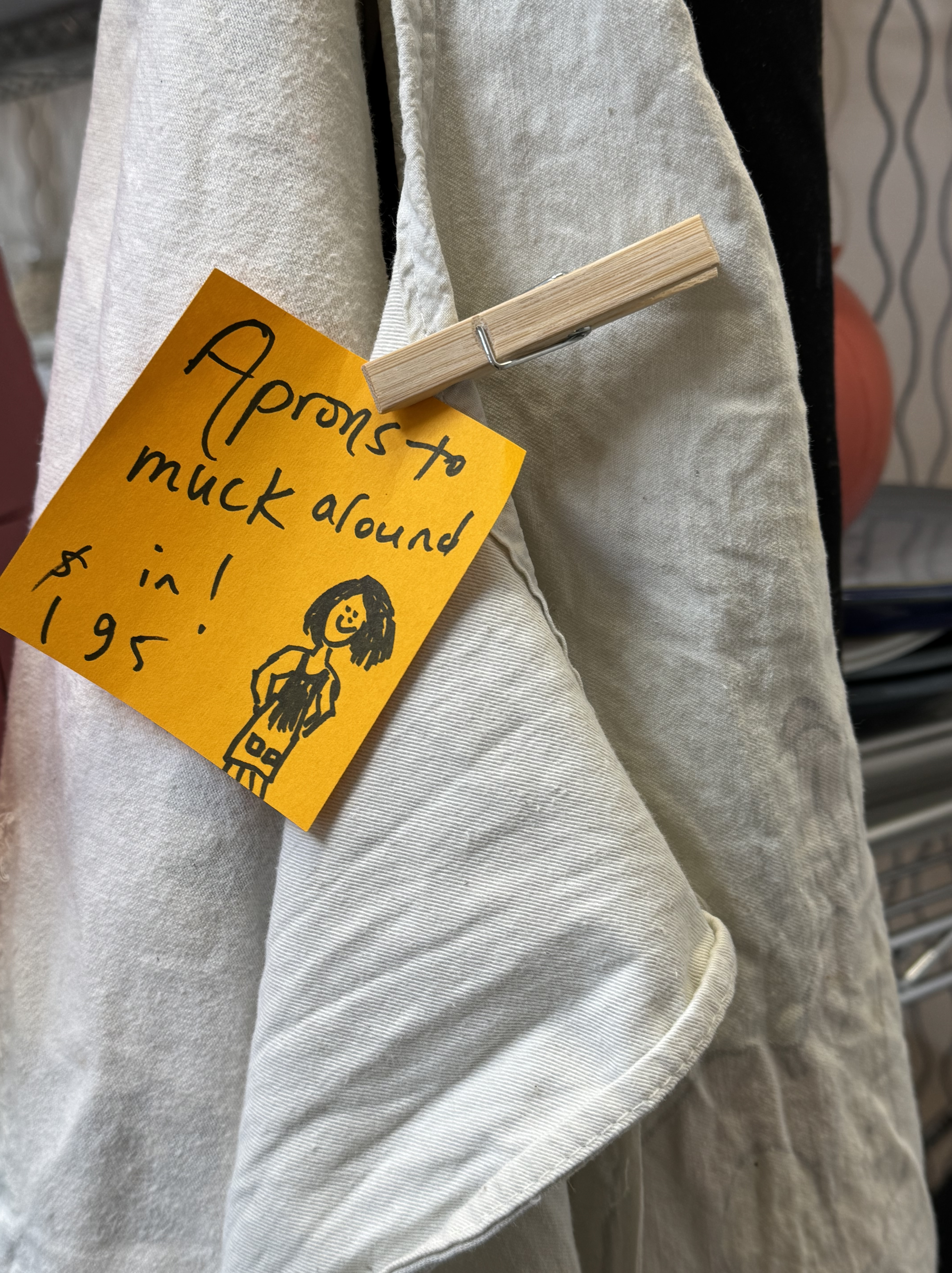
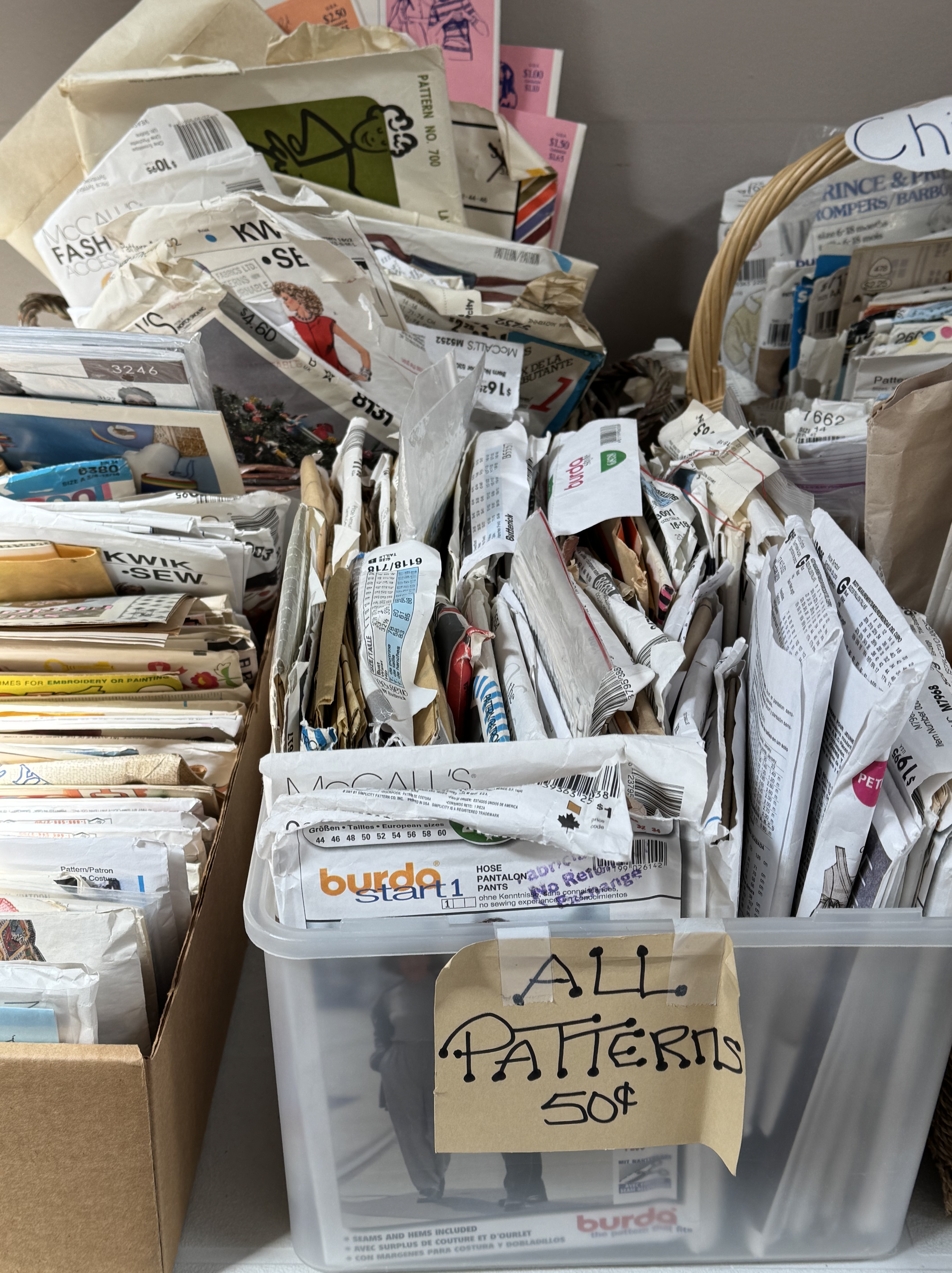
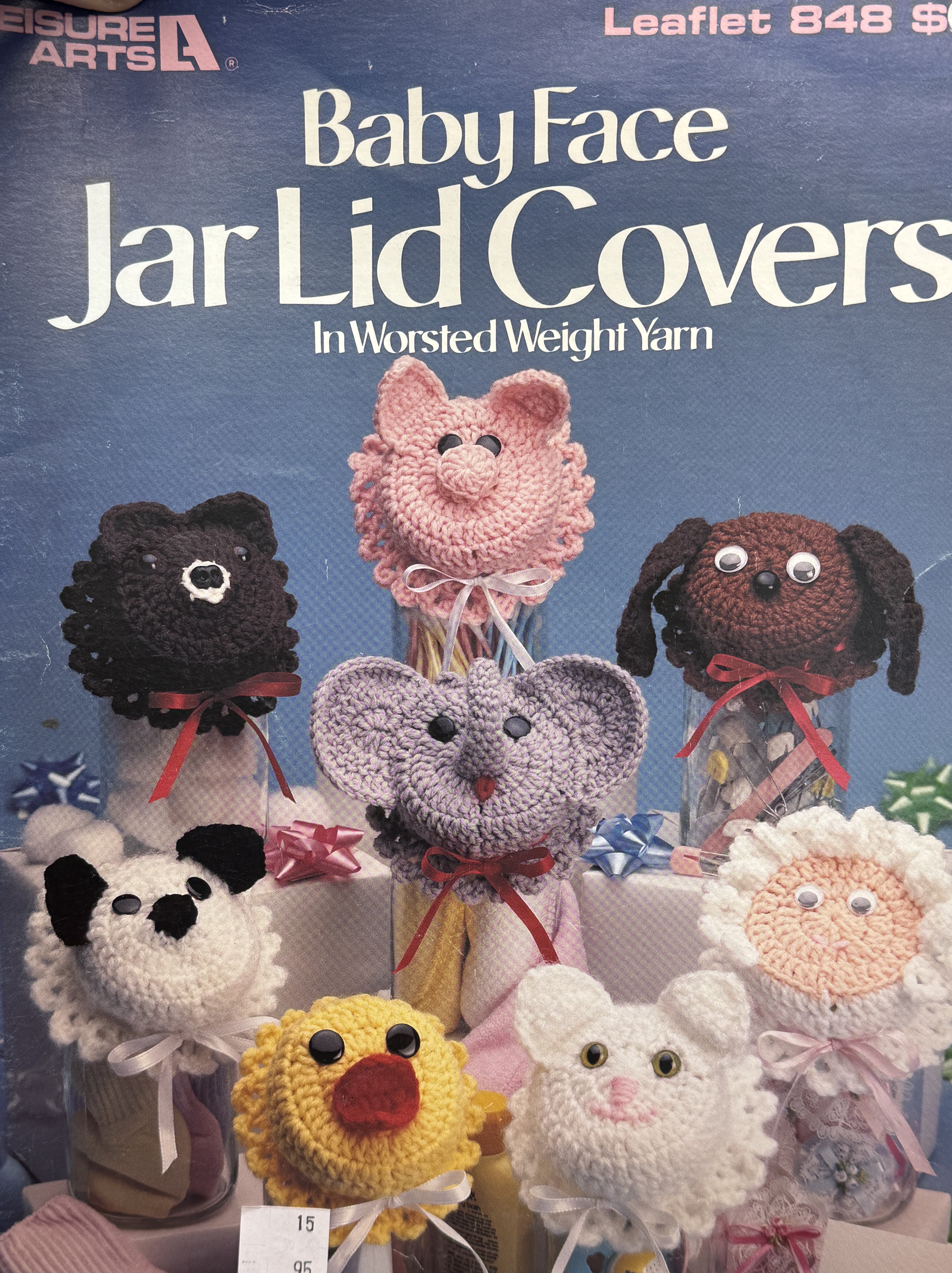
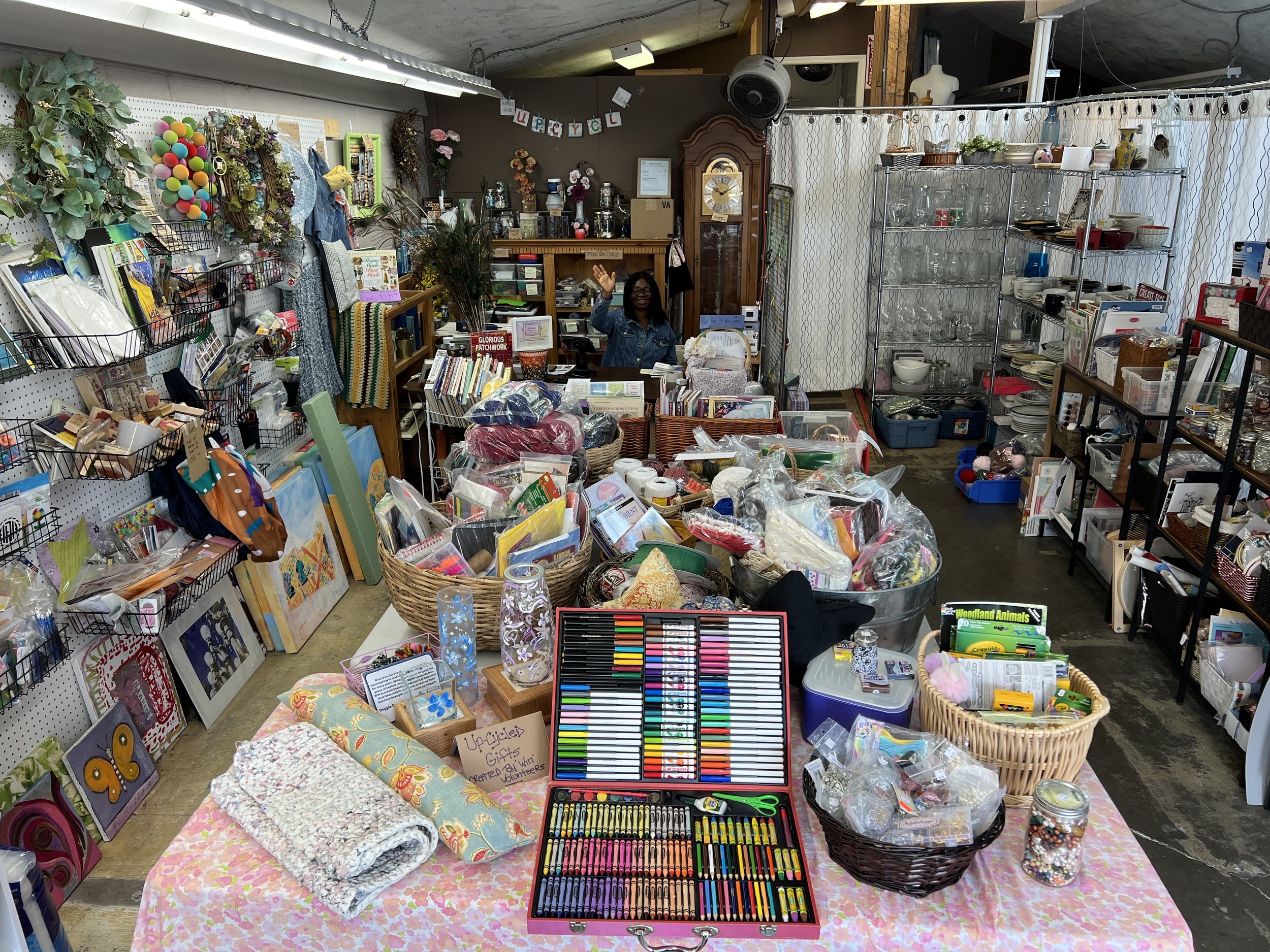
I work a volunteer shift at the upcycle store on Wednesdays. The people that come in delight me, entertain me, astonish me, educate me, soften me. Next week is my last shift at the store. I want to remember some of these people and their stories.
Once a pale man came in and asked if we had a leather hole punch. He didn’t want to buy one, just borrow it so that he could put an additional hole in his belt. He was losing weight, and his pants were hanging on him. Alas, I said, we don’t have one right now. I’m sorry.
I thought about him for weeks, his weight loss, his thinning frame, his sad face. I wondered about his story. Perhaps he was lovesick.
I can no longer untangle my hair I feed on my own flesh in secret. Do you want to measure how much I long for you? Look at my belt, how loose it hangs.
Anonymous, Six Dynasties Translated from the Chinese by Kenneth Rexroth
As if to balance the sadness of the shrinking man, the joy of meeting Randy bloomed inside of me for weeks. He flounced into the store a few days before Thanksgiving, smelling gloriously of rosemary and thyme. Randy is a contemporary dandy, stained waistcoat and tight jeans, flowing grey hair, phlegmy smoker’s laugh lighting up his brown, creased face. He brought crackling energy into the store with him, along with a small plastic bag of herbs.
Do you have any Scrabble tiles? he asked. Yes, I handed him two tall mason jars filled with tiles, and as he dug through his pockets for the cash to pay for them, he told me there was always a few Scrabble boards set up on his coffee table. When my friends come over, he said, they add a word or two or three. We play a never-ending game and nobody keeps score.
What a mouth-watering smell! He opened the plastic bag for me to see the long sprigs of green. I picked them at the side of the road, he told me, just around the corner. The herbs were volunteer plants, free for anybody that wanted them. I need sage, I said, for the Thanksgiving turkey. Oh, he said, I think there was sage growing as well. We smiled and said our goodbyes. An hour later he was back with three sprigs of sage he had picked for me and my turkey.
When I asked a young fellow what he was planning to make with the feathers he was buying, he challenged me: Guess. A headdress? No, good guess, but I am making flies for fly fishing, something his dad taught him to do. He fishes for cutthroat trout under the Bay Bridge with a bunch of female fishers who’d turned him on to it. I never knew!
Last week, a woman came in and poked into the baskets of wool, humming a tune. I noticed her tone—it was strong and true. You have such a beautiful voice, I said. Why don’t you sing us something? Suddenly, gloriously, she burst into “I’m Called Little Buttercup,” from Gilbert and Sullivan’s HMS Pinafore. Her rich mezzo-soprano filled the store as she strutted down the aisles, outthrust chest, a beautiful dockside vendor in love with the captain. I and another shopper were the lucky audience, mesmerized by a performance delivered among stickers and glue, balls of wool, knitting needles, jars of coloured beads.
I love hearing about the celebrations people are planning. The woman in her thirties who bought armloads of artificial flowers and a bolt of pale pink draping fabric for the table. She and her siblings had been planning a surprise party for their mother’s sixtieth birthday. She keeps mentioning she’s turning sixty, as if reminding us, said the young woman. She’s worried we’ve forgotten. Little does she know what’s in store! I laughed with her, feeling mudita, imagining the pleasure and wonder of her mother on that day. Surprise!
Finally, I sold the white canvas tent that was propped in the corner for months. The tent is perfect for children to hide and play in, and a woman bought it for her grandchildren. I told her about the teddy bear’s picnic birthday party I’d thrown for my four-year-old so many Decembers ago. We had a play tent pitched in our living room, and the children and their stuffies enjoyed tea and cake. The woman became excited and touched my shoulder in thanks. What a great idea! I’ve got to do that for my grandson! Then she told me that one Christmas her mother-in-law opened the gift of a vibrator in front of the whole family. I wasn’t sure what prompted the story, but we had a good laugh. Teddy bear picnics and vibrators, all in one afternoon.
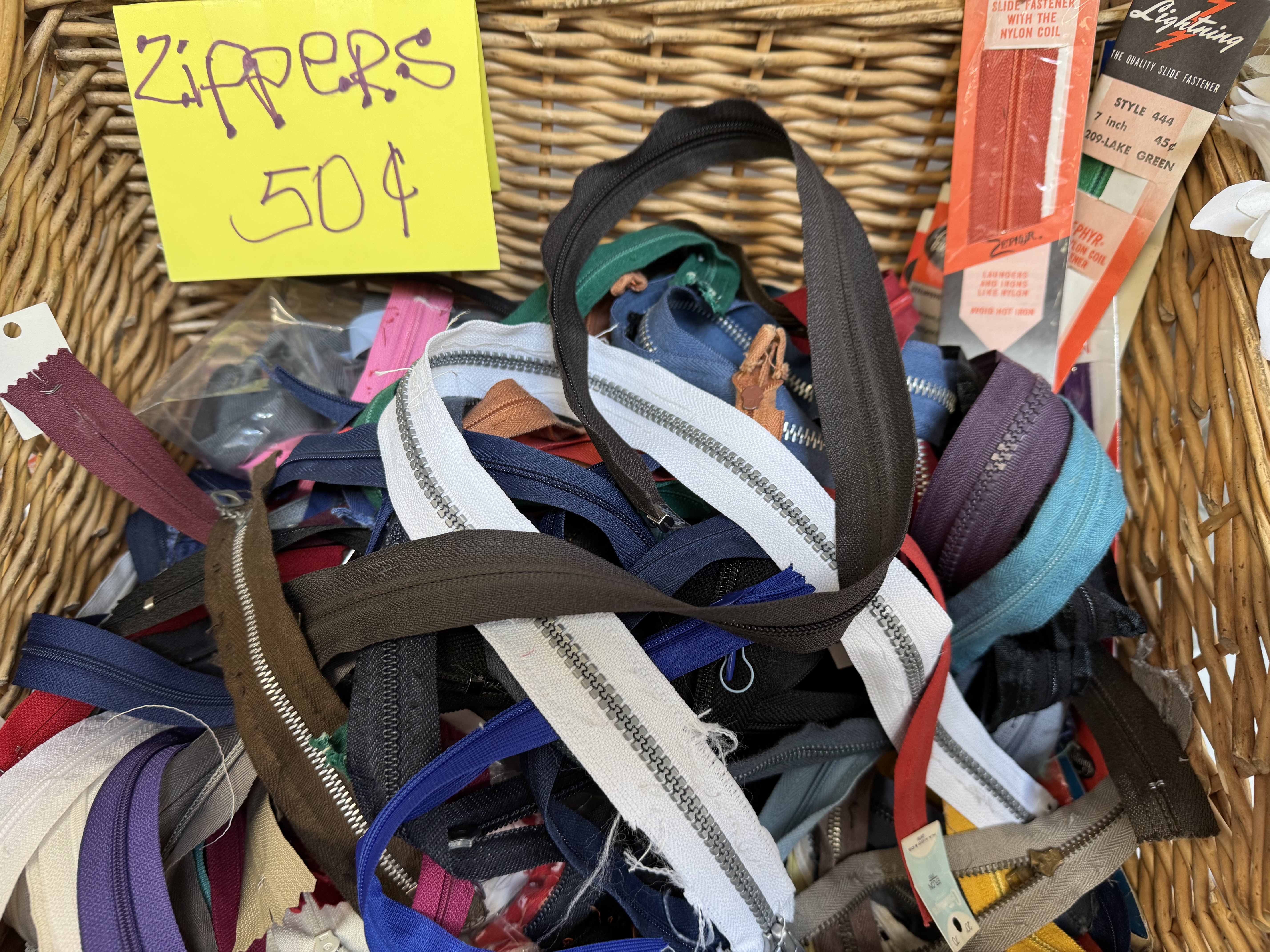
There’s a regular customer who brings her baby buggy into the store, speaking softly and playfully to her little boy as she shops. She buys bits of fabric, thread, and zippers. Last week, as she paid for her stuff and her baby chortled and tried to put his toes in his mouth in the buggy beside her, she ran her hand over the camel-brown smocked dress she wore and its complementary quilted vest. I made all of this from an old bedsheet, she said. At times like this, I thought, I wish I could whistle. A good long, low whistle to show my WOW in a visceral way. Instead, I shook my head: You are amazing! Queen of Upcycling!
One day I was emptying out the green donation boxes, pricing and sorting items. My hand fastened on something soft. A bit of plush grey fur, perhaps once the collar of a stylish coat. Wrapped in thin tissue paper, there was a small tag safety-pinned to the edge: Chinchilla, written in the shaky script of somebody very old. Suddenly, I was back in the furrier’s on Spadina Avenue, sitting cross-legged on the dusty floor, playing with scraps of chinchilla, beaver, spotted lynx. I caressed them one at a time, rubbed them against my cheek. My mother and the furrier stood above me, two voices discussing the racoon coat she’d ordered. What happened to that coat? And why was my mother—a passionate animal lover—buying a custom-made fur coat?
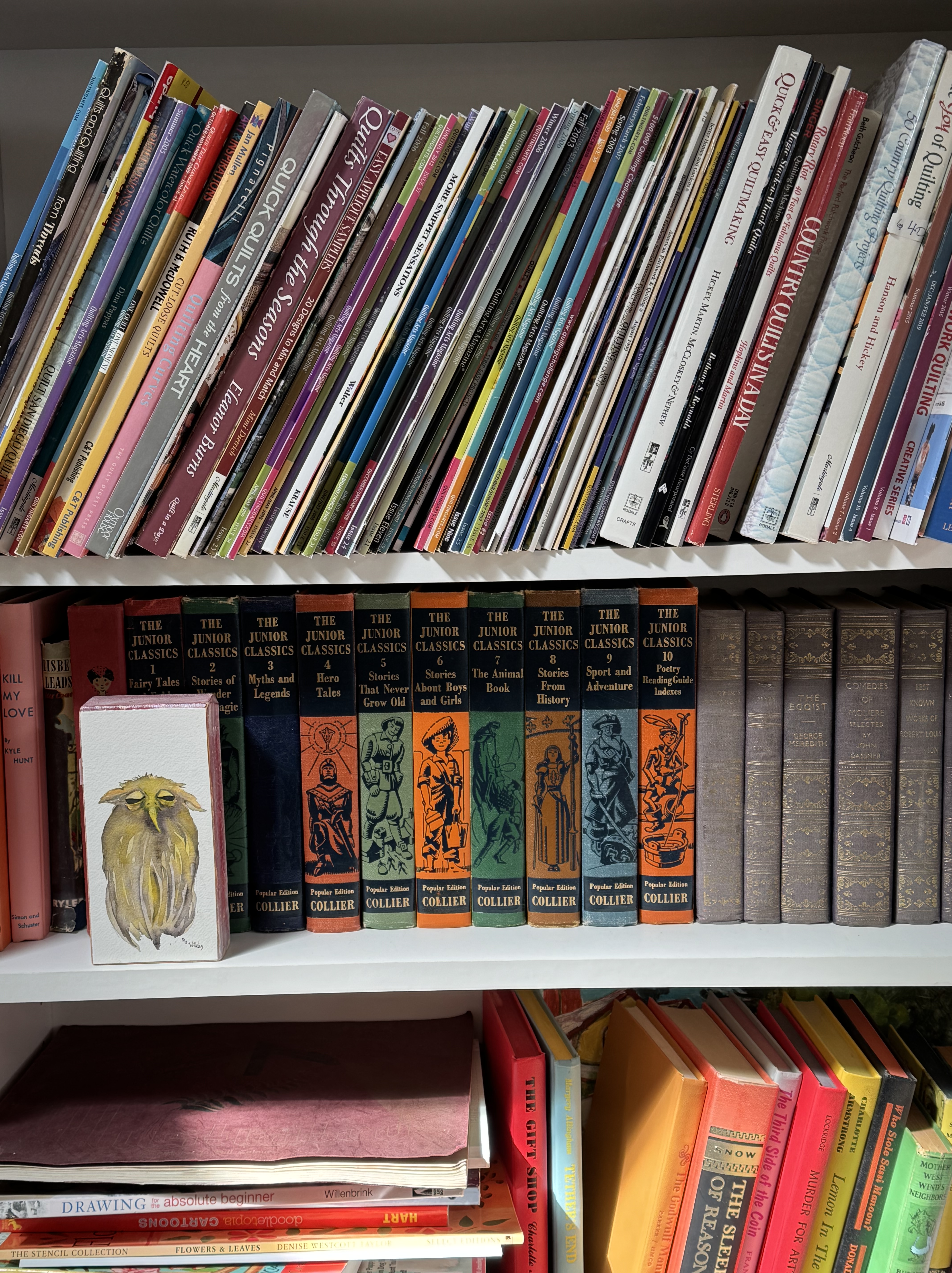
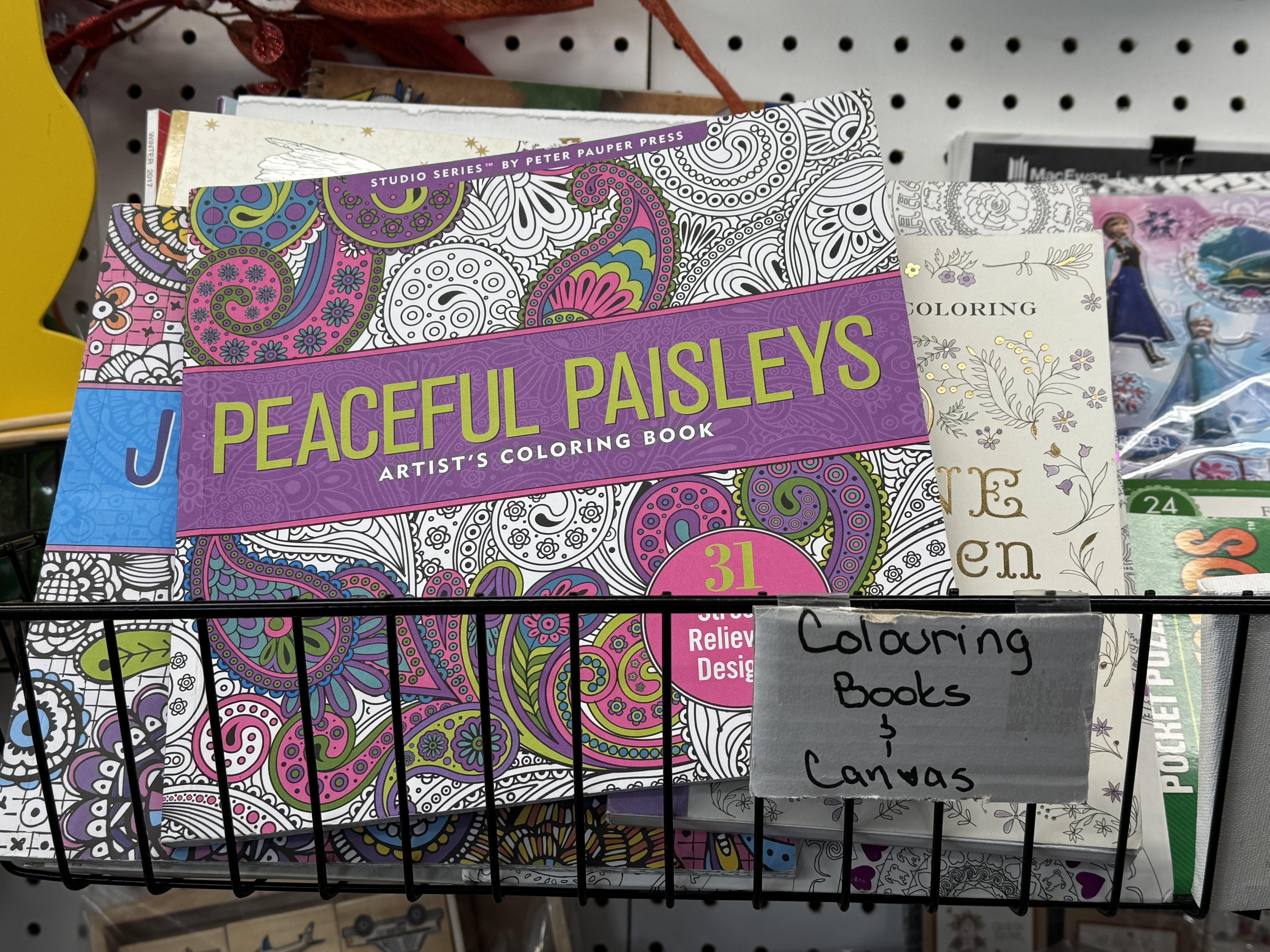
People stream into the store. Have you got books on stained glass? Do you have leatherwork tools? Ever get pillow inserts? Sometimes I say no, sometimes yes, but other times I’m not sure, and we set out to look together, sifting through the boxes and baskets. Sometimes people cry out in delight when they find just what they were looking for. A particular size of crochet hook, fabric printed with mushrooms, a colouring book of Frida Kahlo drawings.
Last week, a short bespectacled woman said she had an unusual request: golf balls. She was undergoing physiotherapy for an injured hand and the therapist had told her to squeeze a golf ball. I haven’t seen any golf balls, I said, but I think I can help. I remembered that morning finding a bag of large wooden beads strung onto a white shoelace. I thought of a small child or a very old person practicing fine motor skills, threading each bead onto the end of the lace. I found the bag and fished out three of the beads. They were about the size of golf balls. Will this do? I asked as I slipped them into her cupped hands. They’re perfect! And we agreed that they were much nicer to handle, a globe of burnished brown wood rather than a cold, plastic golf ball.
At the end of every shift, as I cash out, sweep the cement floor, turn off the heat and lights, lock the door, I feel full of the people I’ve met, the stories I’ve heard.
About a week ago, on our morning dog walk, we stood waiting for the traffic light to change and a young girl, perhaps nine, long dark hair, hooded coat and wearing a backpack, approached and stood near us. She looked over at us a couple of times. When the light turned green, she walked in front of us a few metres, but she kept turning back, peering around her big hood to look at me. And at one point, as we crossed the bridge over the Gorge, I decided to say something. “Do you like dogs?” I thought perhaps she was looking at us because of Marvin, our goldendoodle, who trundled along beside us, at the end of his purple leash. Lots of times kids want to pet him, but they’re too shy to ask.
“Yes, I like all animals,” she said. And then she spoke, in the most serious way, a line I will not soon forget: “I’m a big fan of nature.” I moved ahead of Michael and she and I walked together for a minute, discussing how we were both big fans of nature. Then we were at the school crosswalk where we parted ways.
We laughed affectionately about what she’d said—what a great line! “I’m a big fan of nature,” we kept saying to each other throughout the day, and then “I’m a big fan of ____” and we filled in the blank with whatever…fizzy water, sunsets, Marvin, taking out the garbage.
I’ve thought about that delightful exchange many times this week. The girl’s innocent enthusiasm for nature. A simple trust in the goodness of the natural world and people. Her approach wasn’t naïve; rather, it seemed wise. We spoke so briefly, but what she said made me want to adopt her attitude of fandom.
I am a big fan of hand sewing
When we went to NYC in December, I heard about Tatter, a Brooklyn-based textile organization that is “committed to preserving skills of the hand.” They promise a lot:
“We work with makers, archivists, and anthropologists to develop extended courses that use textiles as a portal to reclaim history, cultural encounter, indigenous practices, a harmonious relation to the natural world, and making as a tactic of collective liberation.”
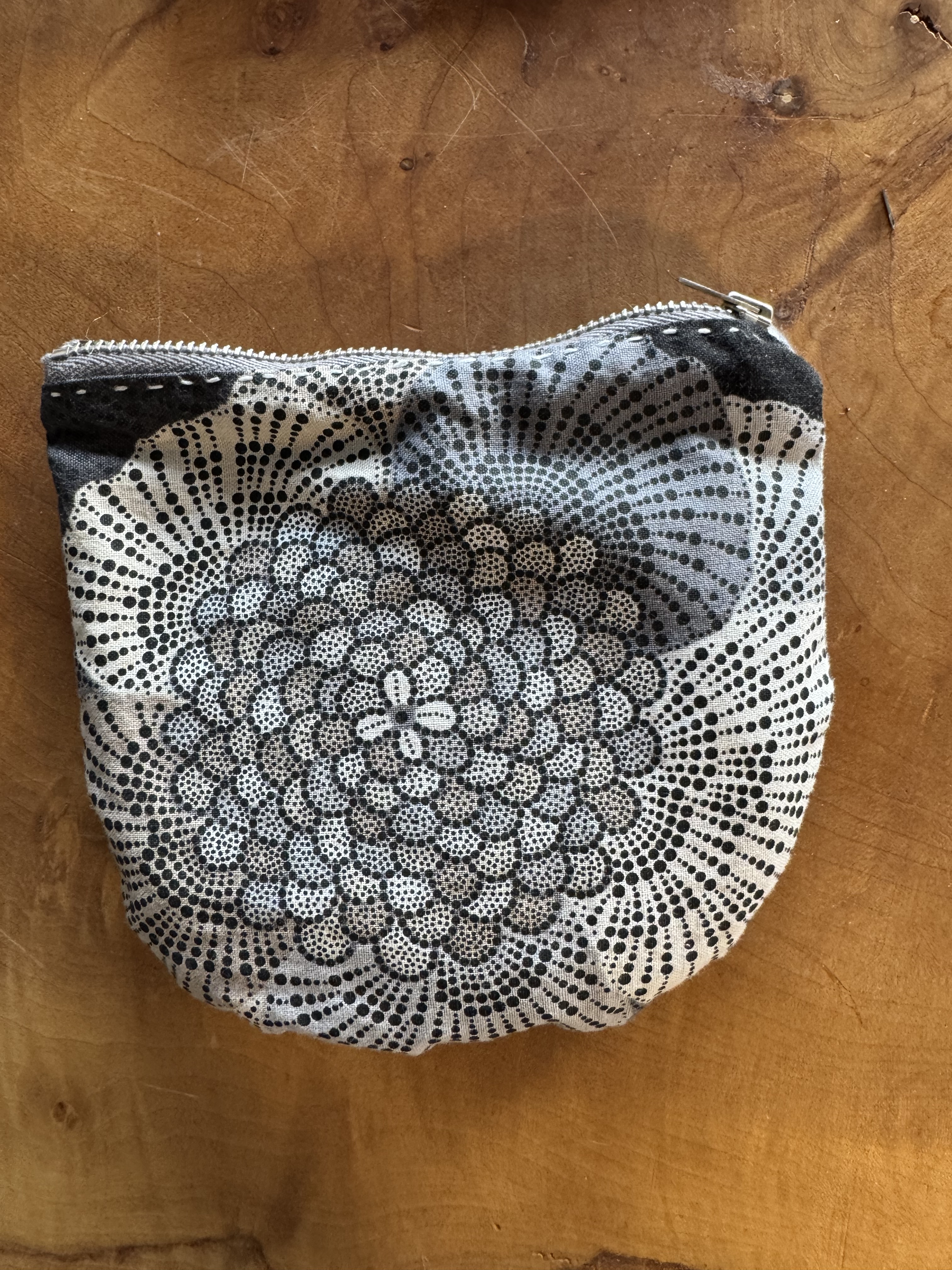
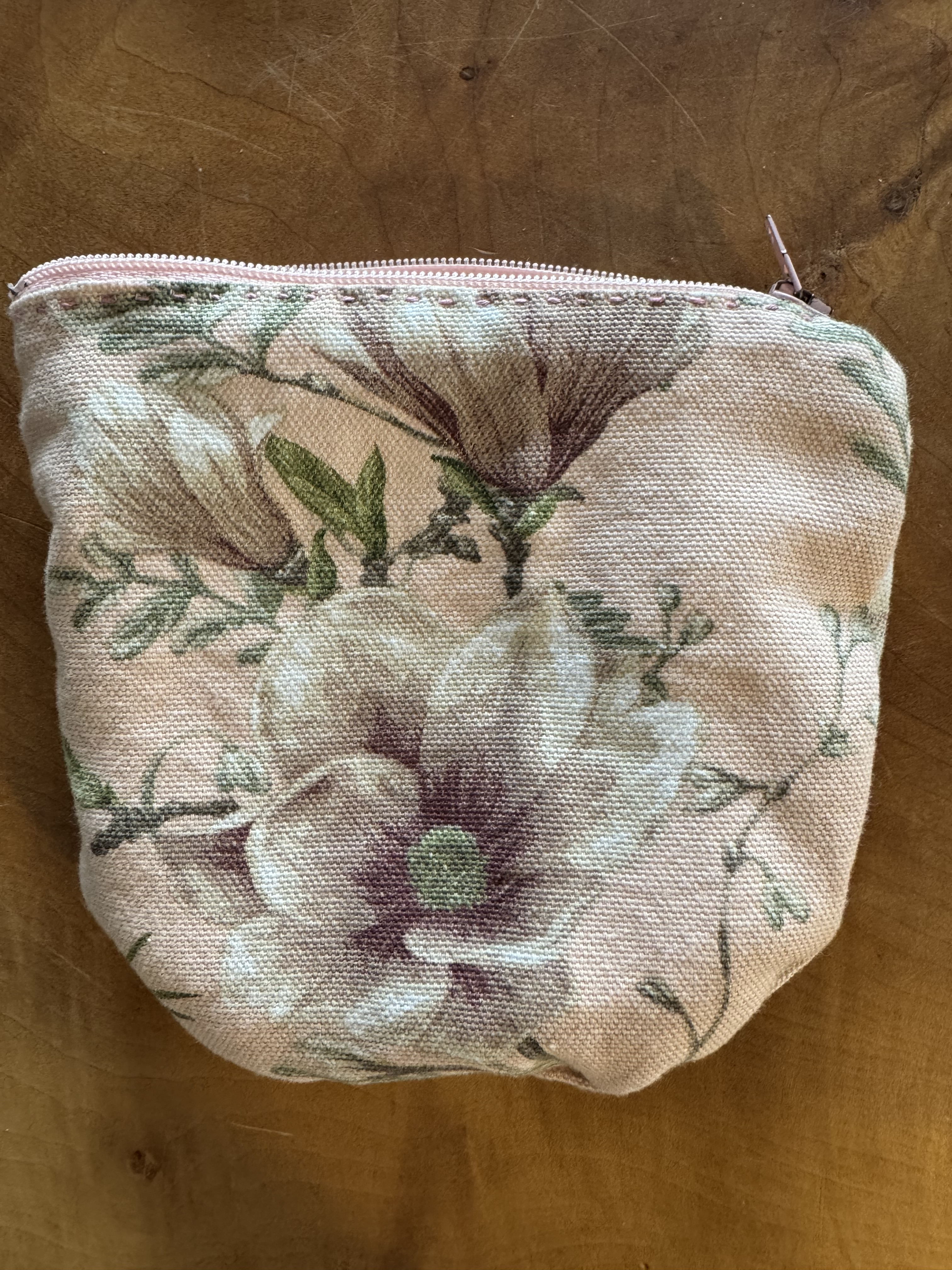
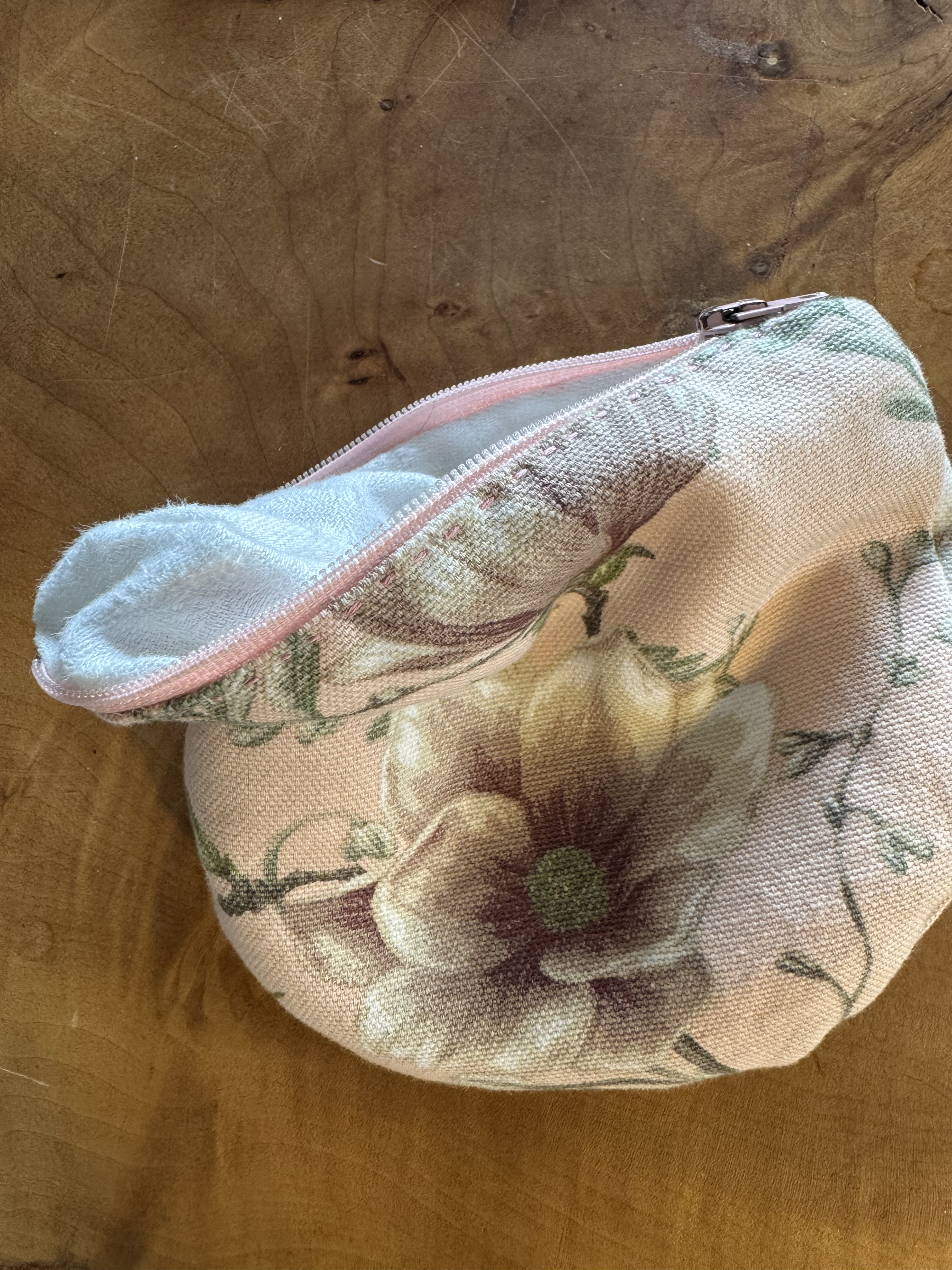
I didn’t have a chance to visit Tatter. However, in February, I took one of their classes on Zoom with Karen Stevens. We learned to hand-sew zippered pouches. Through this class, I rediscovered the enjoyment of hand sewing. The whole-body rhythm of a slow, contemplative backstitch and the satisfying emergence of a line of running stitches along a zipper‘s edge or around an appliqué. There is no rush with hand sewing, no urgency like I feel sometimes when I am at the machine. Hand sewing is portable and calming.
I learned some tips from Karen that I’ll share with you. Perhaps you already know this stuff, but for me, the following was revelatory information.
Don’t thread the needle, needle the thread. This practice makes so much sense, after years of trying to poke three saliva-soaked strands of embroidery thread into a tiny hole. Hold the very end of the thread(s) between index finger and thumb in your non-dominant hand while you angle the needle over the thread. Much easier to get eye over thread than thread into eye.
You don’t need knots. You can just sew one straight stitch several times over to start and end your length of thread. I think of it as akin to building a house with joinery rather than nails or glue.
Basting is a very useful practice. Sure, pins hold things together, but if you baste with big loopy stitches—it doesn’t take long—your fabric stays in place until you’re ready to anchor it with backstitches. I used to think of basting as a waste of time, but what is time for?
I am a big fan of upcycling stores
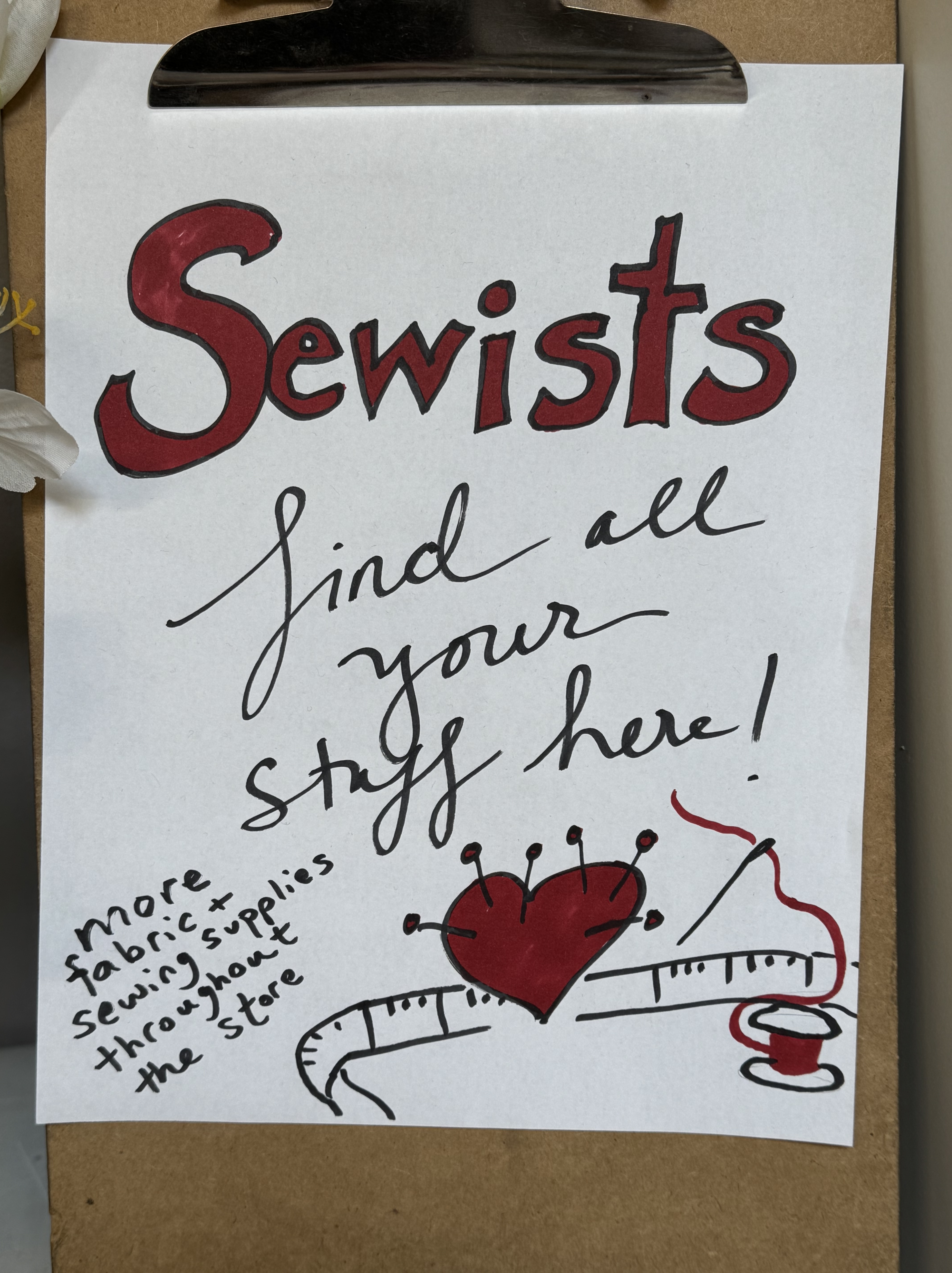
I happen to volunteer at one of those stores, Women in Need Upcycle and Craft, so I am biased. We just expanded to double the space, and every week I open boxes of fresh treasures to line our shelves. Some weeks it’s skeins of merino wool and tiny wooden canoes. Other times it might be a kit to make a paper lamp and bags of beautiful retro fabrics and lace.
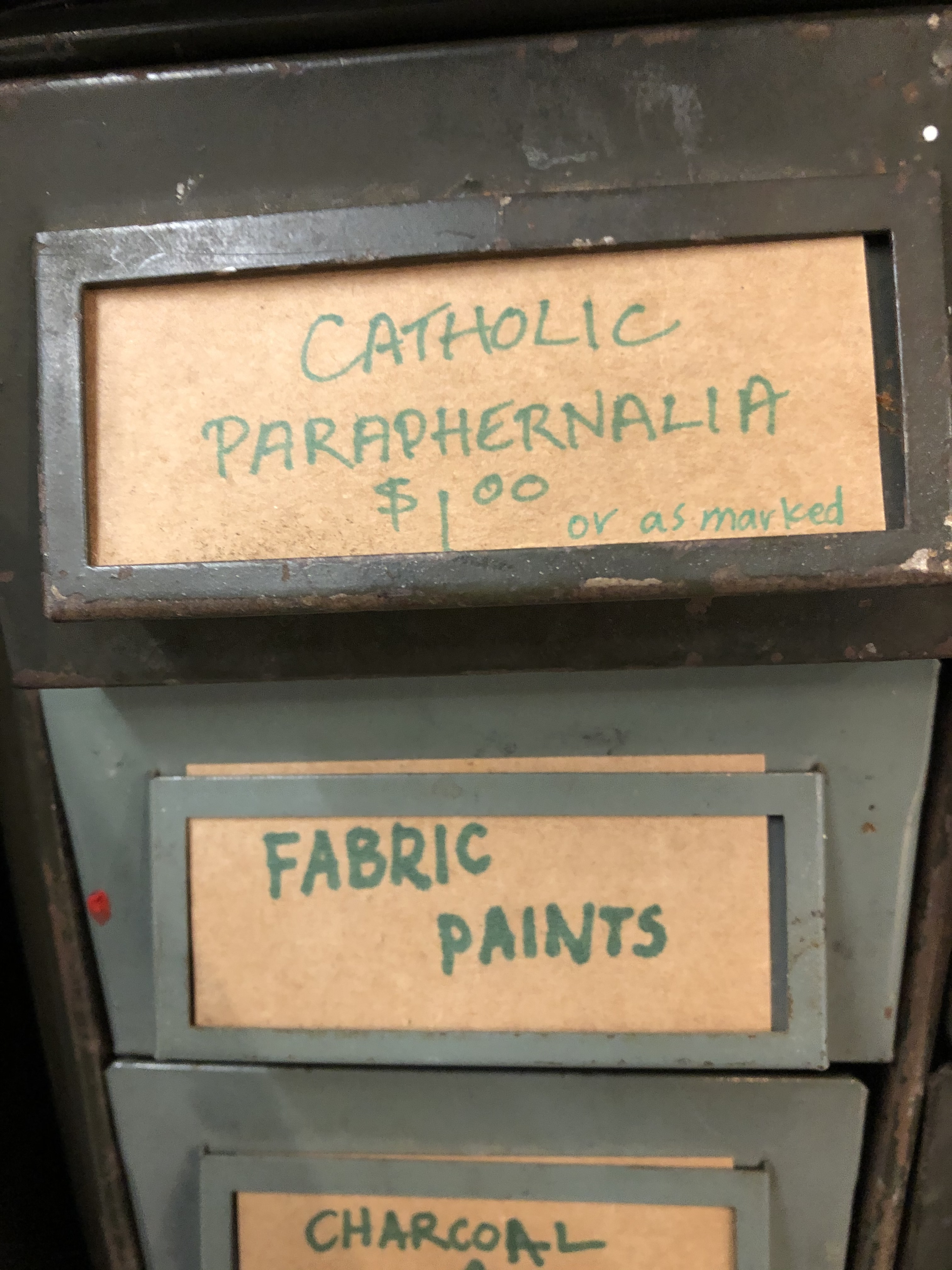
I appreciate all of our sister upcycling stores as well. The Green Thimble‘s name is alluring to eco-conscious sewists. Today, March 4, they are moving from their Quadra Street location to 2950 Douglas St. #400. At Green Thimble, I filled a small paper bag with scraps and loose buttons for only five dollars. I admired the refurbished sewing machines for sale and the bolts of fabric at bargain prices. Supply Creative Reuse Centre on lower Douglas is a finely curated collection of paper, books, cloth, yarn, buttons, ribbons, and more. I was impressed by their sliding scale prices. At Supply, I found a scrap of pink sheepskin for $1.50 that features as the centre of my wall hanging work-in-progress. Thrift/Craft in Market Square is a huge space filled with unusual items and hosted by a devoted proprietress. One of my favourite things there is the weird stuff housed in tiny drawers, for example, Catholic paraphernalia. In each of these places I encounter interesting people who like to chat about making things.
I am a big fan of creative immersion
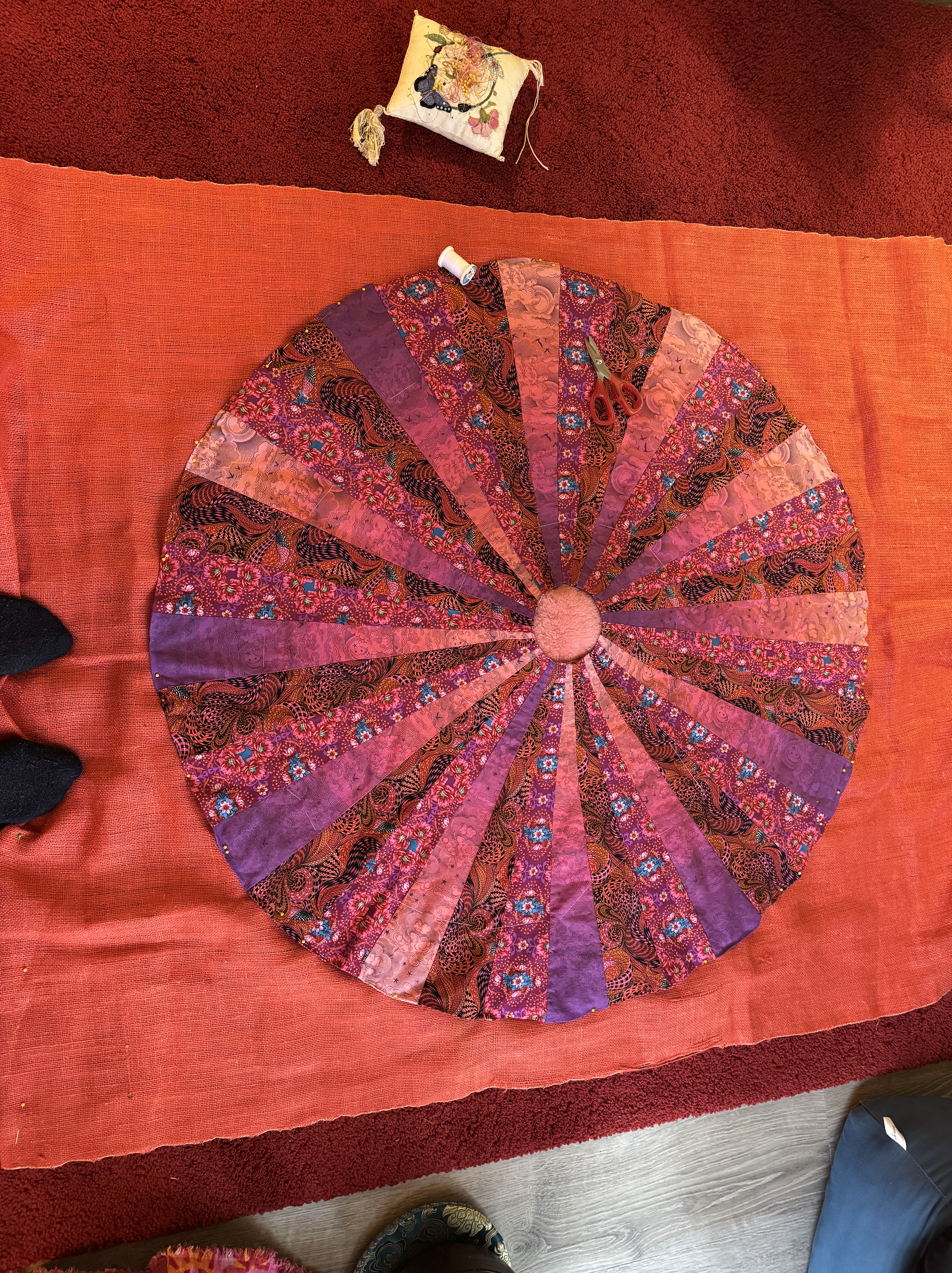
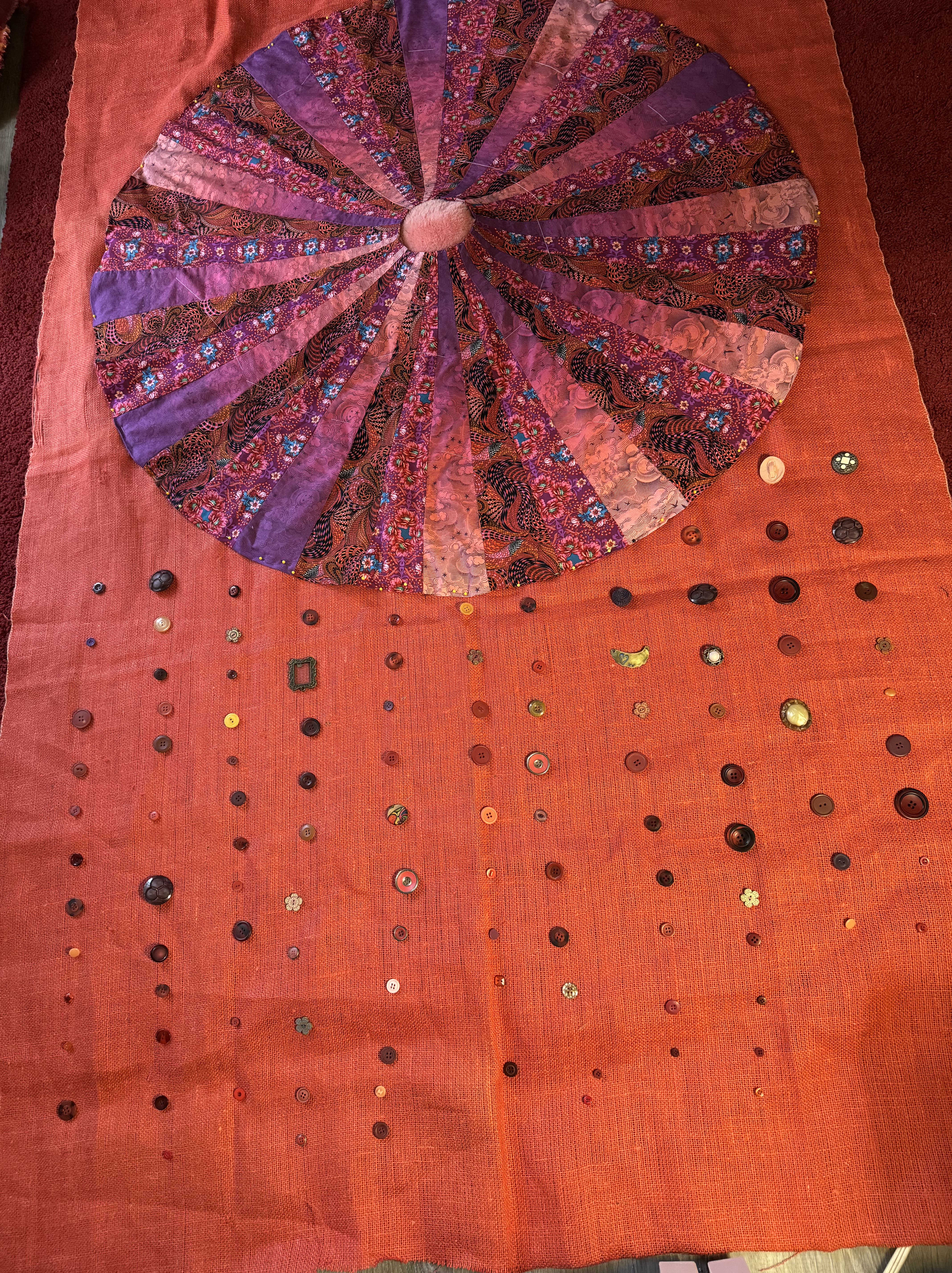
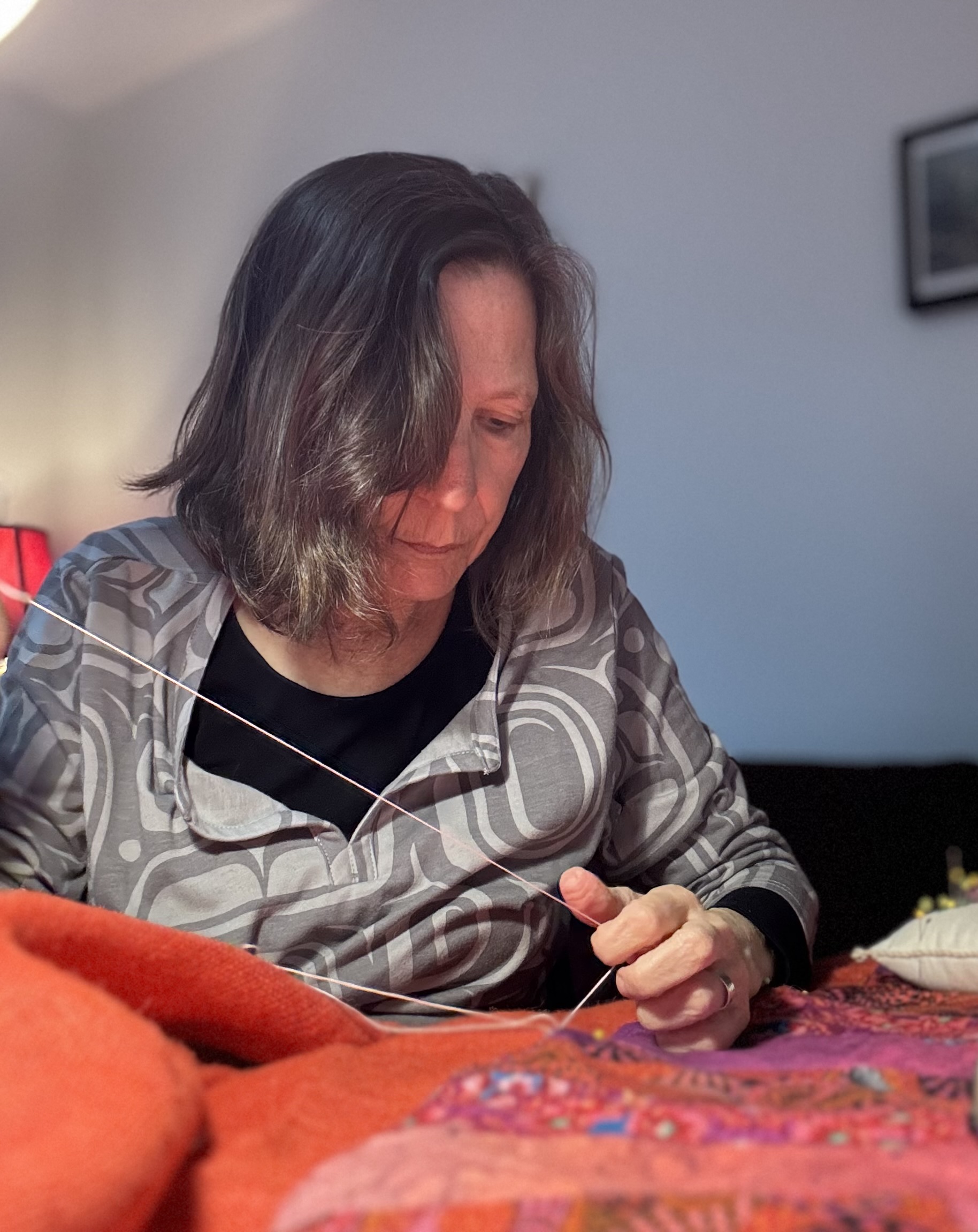
Immersing yourself in a creative project can lift your mood, and we could all use some mood uplift now. Am I right? I am presently working on “Ten Thousand Joys,” a large wall hanging in oranges, pinks, reds, and purples. At its centre is a fabric circle I created using a ten-degree wedge. I cut and sewed three alternating brightly-patterned fabrics together to make this 45-inch mandala. I cut an old blanket into cascading circles to lay under the mandala to create a three-dimensional effect. At the centre, the bit of pink sheepskin peeps through. I basted the padding onto a big piece of orange burlap I found at Value Village and then basted the circle onto the padding. Now I am in the process of using embroidery thread to sew the circle onto its backing at the circumference. I’ll add lots of embroidery stitches in bright colours, zig-zagging up and down the long wedges. The hanging will be finished by sewing on, not ten thousand, but dozens of pink, red, and purple buttons around the central circle. It feels inevitable that I will make a “Ten Thousand Sorrows” wall hanging next.
“When you open your heart, you get life's ten thousand joys, and ten thousand sorrows.” Chuang Tzu
In mid-December, I bought a green glass jug in a second-hand store, half price. My aspiration was to make a beautiful winter bouquet for my friend, Lillian. I bought a bunch of silver dollar eucalyptus and two dozen white carnations. I envisioned white wintry bursts among the silvery green, but the more I trimmed and mixed the carnations with the stems of eucalyptus, the sillier and more incoherent it looked. I took basic Ikebana but still haven’t a clue how to make flowers and plants look good.
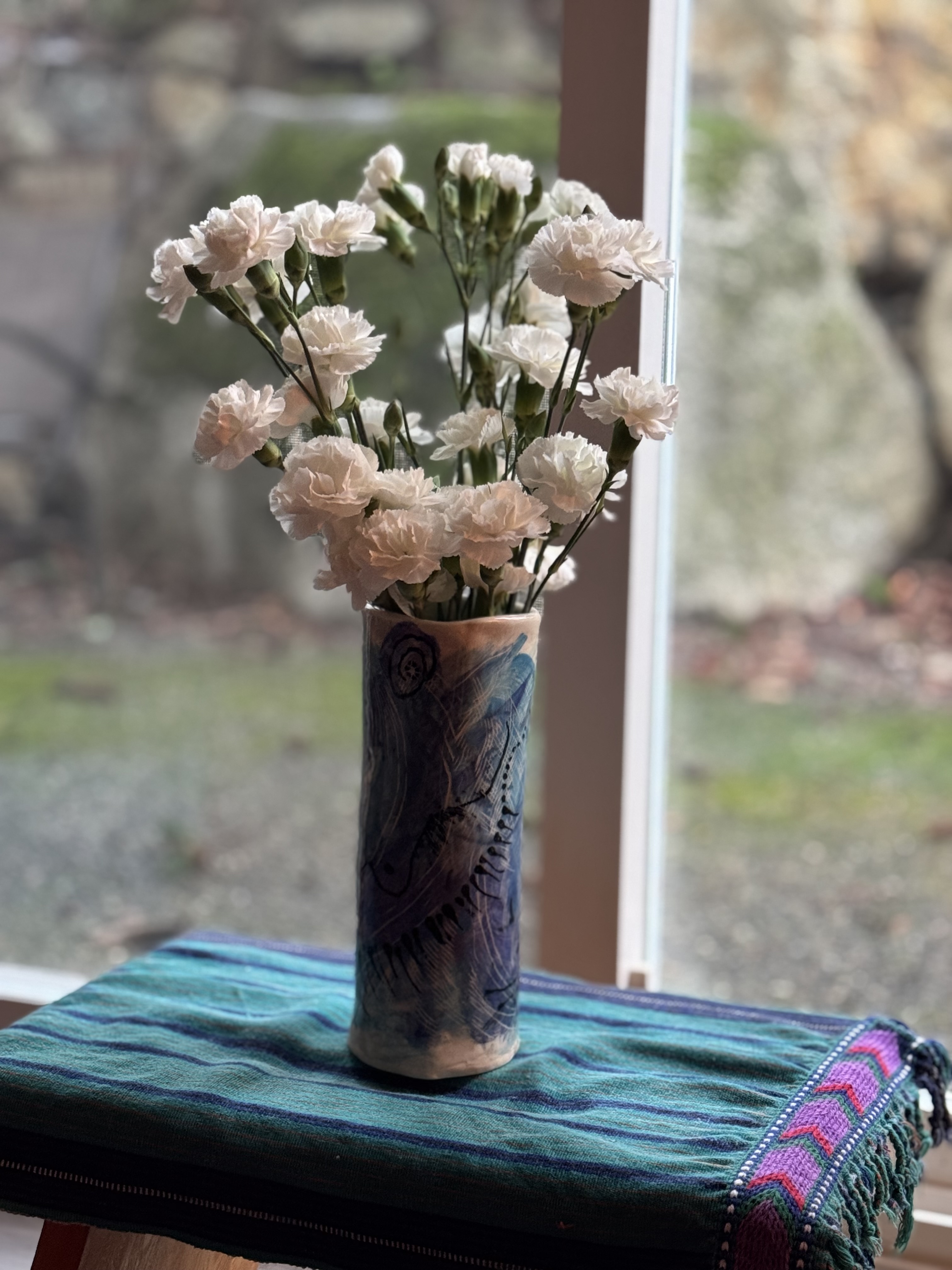
Finally, I used only the eucalyptus, splayed out in a free-fall arrangement. I attached a few small, red shiny balls to the stems, and the effect, I hope, was Christmassy and charming, if a bit messy. Lillian said she loved it. (But what could she say, really?) I was going to throw out the unused carnations, but it seemed such a waste, so I put them in a white and blue vase and placed it in my study on a low stool covered with a blue-green cloth.
I don’t like carnations, or I didn’t think that I did. I’ve seen too many sad, slender bunches wrapped in cellophane at the mini-mart next to the hospital. They make me think of last-minute purchases for the death bed, cheap flowers that outlive the person you visited. They seem so tight, orthodox, banal. Whorls of perfect, serrated petals, every bloom the same.
But they’ve grown on me. As I spend hours in their presence, they’ve become real. You could say I’ve become intimate with them. I sit here now, the last day of the year, gazing at their fresh ordinariness. The carnation is the sturdy, faithful flower that will see you through. Perhaps they are flower of the year: commonplace as canned milk. Carnations are one-foot-in-front-of-the-other flowers. Quotidian flowers. Bread-and-butter blooms. See you through the hardest times. Last for weeks. Nothing special.
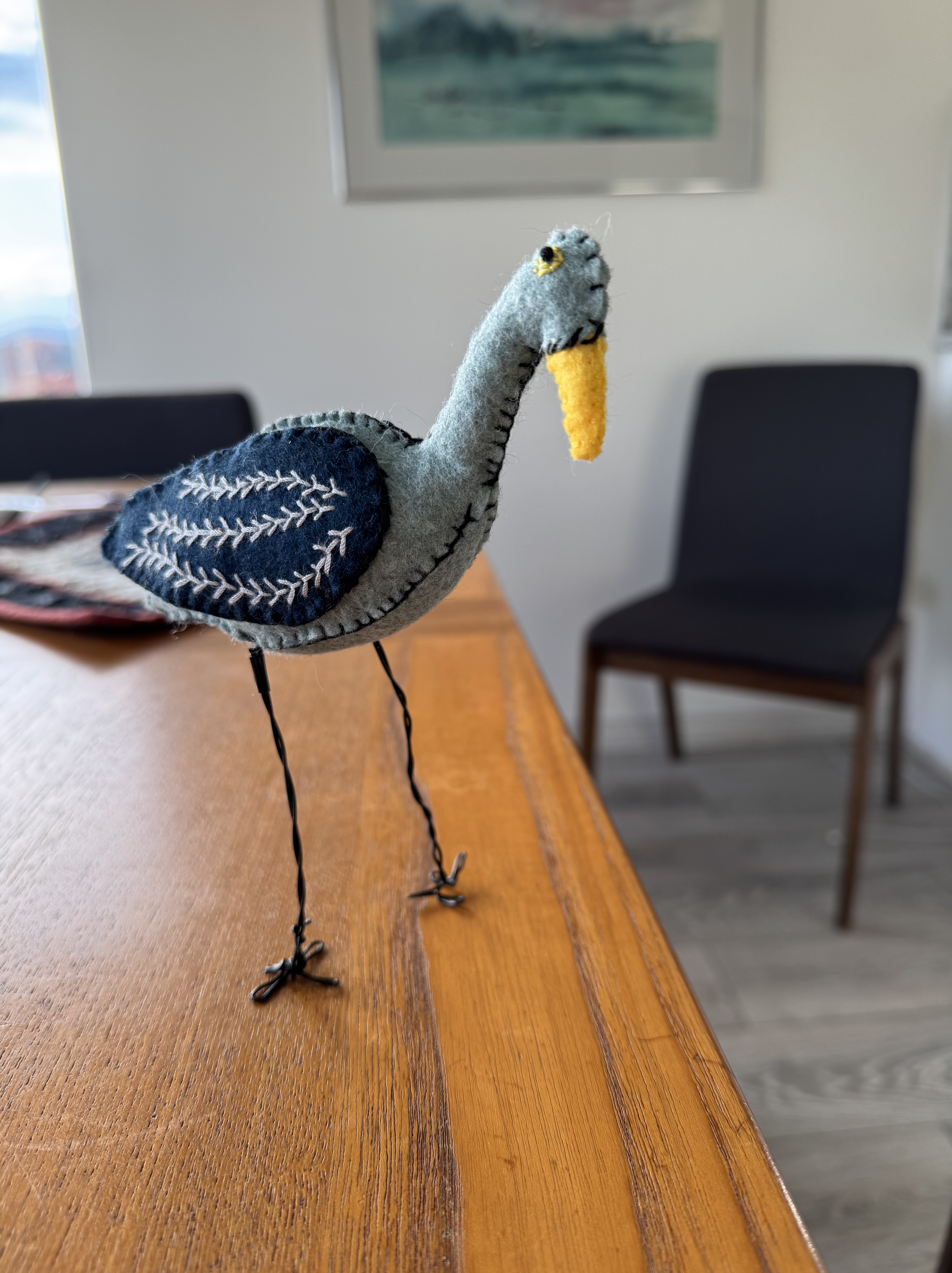
Although 2024 was my first year of so-called retirement, and thus I was given twenty additional hours each week, I wrote less, and I sewed less. (A few felt birds for family and other little felt creations, an apron, a crib quilt start, a fur-lined bag.) I did finish an editing certificate I started in 2020, which is a relief. And I made a lovely new friend and deepened existing friendships. I started a volunteer gig at a non-profit arts and crafts shop in August that has led to meeting many interesting people. Bonus: I get to surround myself with a messy profusion of materials that inspire me.
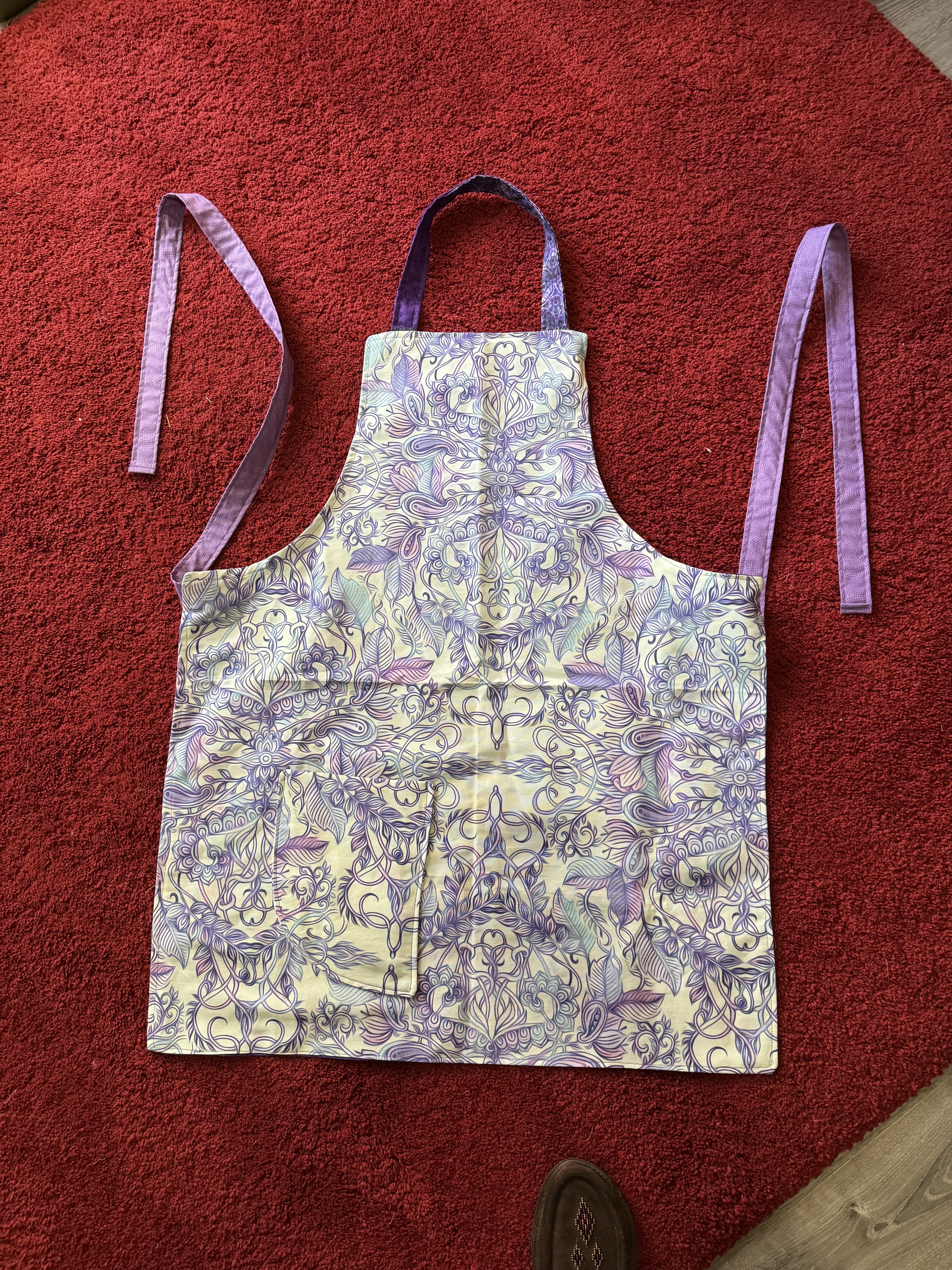
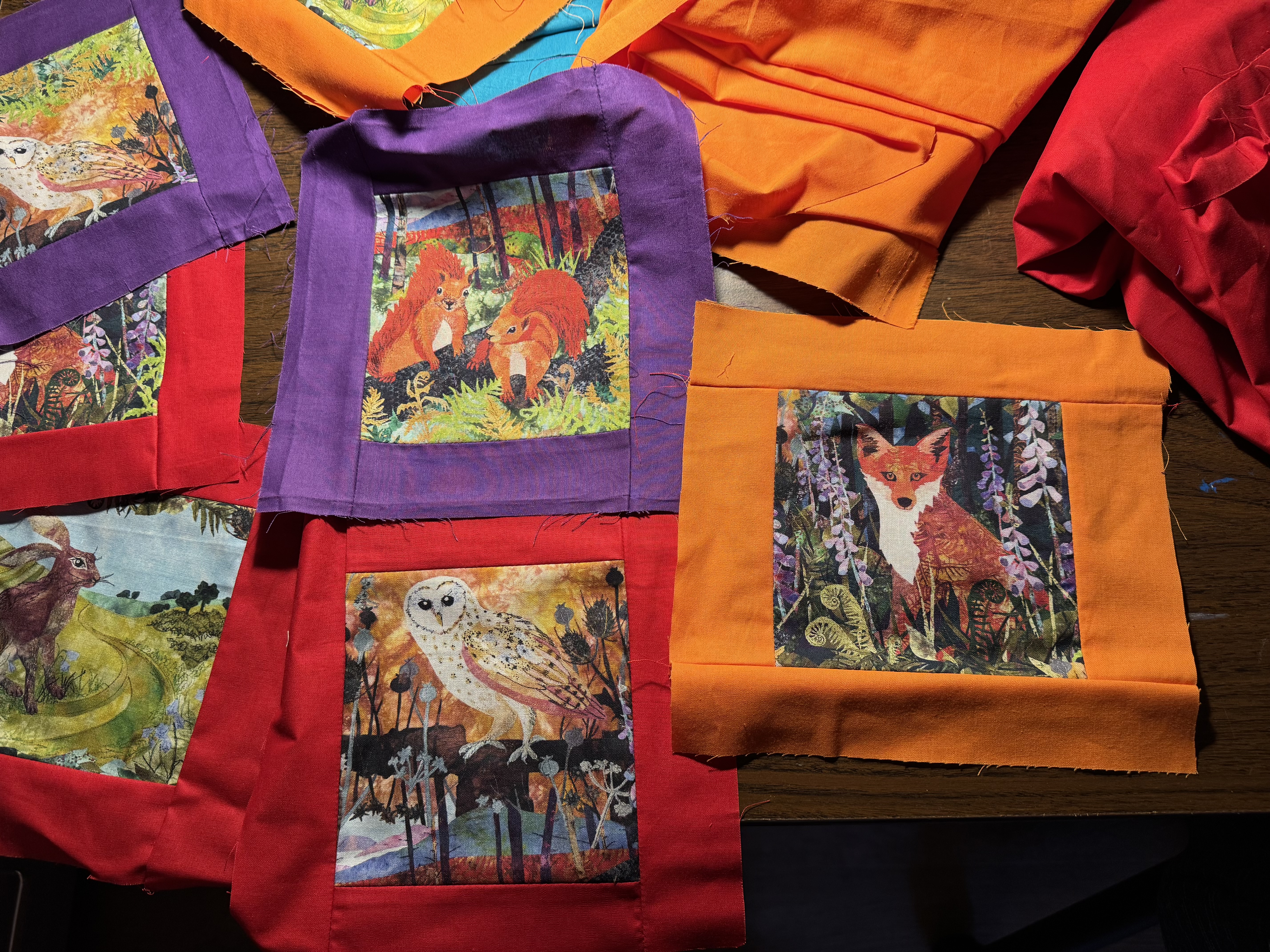
Kathryn’s robinAllison’s pigeonEvan’s heronNancy’s reversible purple apronNancy’s reversible purple apronSarah’s swanI made felt hearts for friends at Christmas.Nat’s puffinNat’s puffinI started a quilt for Lillian’s great grandson, FoxWilson the owl, a gift for Michael Magic bag lined with fake fur for Nat’s 30th birthdayWomen in Need’s Upcycle and Craft store on North Park Avenue. I work there on Thursday afternoons.
This year, I listened to probably one hundred dharma talks on Dharma Seed, with a broad aspiration of becoming more intimate with life—accepting whatever’s happening in my heart, whatever’s happening in the world. Making friends with wild mind. Accepting the truth of the way things are.
I read so many books this year. A couple that stick with me are Rebecca Solnit’s memoir, Recollections of My Nonexistence and The Age of Loneliness, a book of essays about life during the sixth extinction by Laura Marris.
Solnit writes a lot about being a woman. That’s what her title gestures toward—the peculiar “nonexistence” of being female in a patriarchy (remember mansplaining? She is behind that neologism[i]). She draws on John Berger’s 1972 Ways of Seeing, which I’ve known about for years and now am determined to read. She quotes words from him that jibe with my experience: “To be born a woman has been to be born, within an allotted and confined space, into the keeping of men. The social presence of women has developed as a result of their ingenuity in living under such tutelage with such a limited space. But this has been at the cost of a woman’s self being split into two.”
Perhaps that sounds dramatic in the Global North in 2024, but that has been my experience. Perhaps it’s different for lesbians. Perhaps it is different for women of subsequent generations, but Solnit and I were born three years apart (1961/1958), so we grew up at roughly the same time. Berger goes on,
“A woman must continually watch herself. … She has to survey everything she is and everything she does because how she appears to others, and ultimately how she appears to men, is of crucial importance for what is normally thought of as the success of her life. Her own sense of being in herself is supplanted by a sense of being appreciated as yourself by another.”
Solnit calls Berger brilliant and generous, to be able to imagine a woman’s experience, and I agree. What he writes here feels just as real as the carnations in front of me. Reading the passage and feeling its truth is freeing. No action needed, just awareness.
Similarly, truth pinged through me when I read Laura Marris writing about the age of loneliness. We become lonelier as we bear witness to the drastic reduction, or “great thinning,” of ordinary animals. Marris draws on the work of naturalist, Michael McCarthy, who writes of our baby boomer age group, “As we come to the end of our time, a different way of categorising us is beginning to manifest itself: we were the generation who, over the long course of our lives, saw the shadow fall across the face of the earth.”
Reading this series of essays, elegies to Earth as the shadow descends and animals disappear, I was gripped by a grief so deep I sat for a time and just cried. Again, the truth is freeing. Let’s not deny that this is happening. It’s really happening. We can still enjoy the beauty that is here.
In keeping with my mood of asceticism, I recently deleted my Facebook and Instagram accounts. Unlike the birds who used to sing outside my window, FB and IG will not be mourned. I feel light as I step through life with a new red pedometer safety-pinned to my leggings (the pedometer frees me from carrying a “smart” phone to count steps). Michael, Marvin, and I amble down to the beach at Thetis Cove to watch the sky change. Rippled water reflects a bank of pink clouds.
Thank you for reading. In the coming year, may you experience moments of lightness in a shadowy world.
Berger, John. 1972. Ways of Seeing. Penguin. Marris, Laura. 2024. The Age of Loneliness: Essays. Greywolf Press. McCarthy, Michael. 2015. The Moth Snowstorm: Nature and Joy. New York Review Books. Solnit, Rebecca. 2020. Recollections of My Nonexistence. Viking.
[i] From Wikipedia: The term mansplaining was inspired by an essay, “Men Explain Things to Me: Facts Didn’t Get in Their Way”, written by author Rebecca Solnit and published on TomDispatch.com on 13 April 2008. In the essay, Solnit told an anecdote about a man at a party who said he had heard she had written some books. She began to talk about her most recent, on Eadweard Muybridge, whereupon the man cut her off and asked if she had “heard about the very important Muybridge book that came out this year”—not considering that it might be (as, in fact, it was) Solnit’s book. Solnit did not use the word mansplaining in the essay, but she described the phenomenon as “something every woman knows”.
I start the year with a glance back over 2023. Last year, creativity often eluded me. She was a timid fox, hiding in her hole. I tried to lure her out, but at the first sign of self-doubt, she’d scurry back down the tunnel. Making things—in cloth or paint, in the kitchen, with words—can feel pointless in the face of climate crisis, grief, war, and ennui. And yet, don’t you think we must continue to create as an antidote to all the destruction?
When fox stayed out long enough, she inspired me to bake cakes, sew things, paint mandalas, and write stories and poems.
Baking
I love making cakes and preparing gifts for people. I fantasized once about starting a small business: I could make bespoke cakes and gifts to order (quilted bookmarks, small herb bouquets from my garden, stones from the beach that feel good in your hand). Nice idea, but maybe not a great business move.
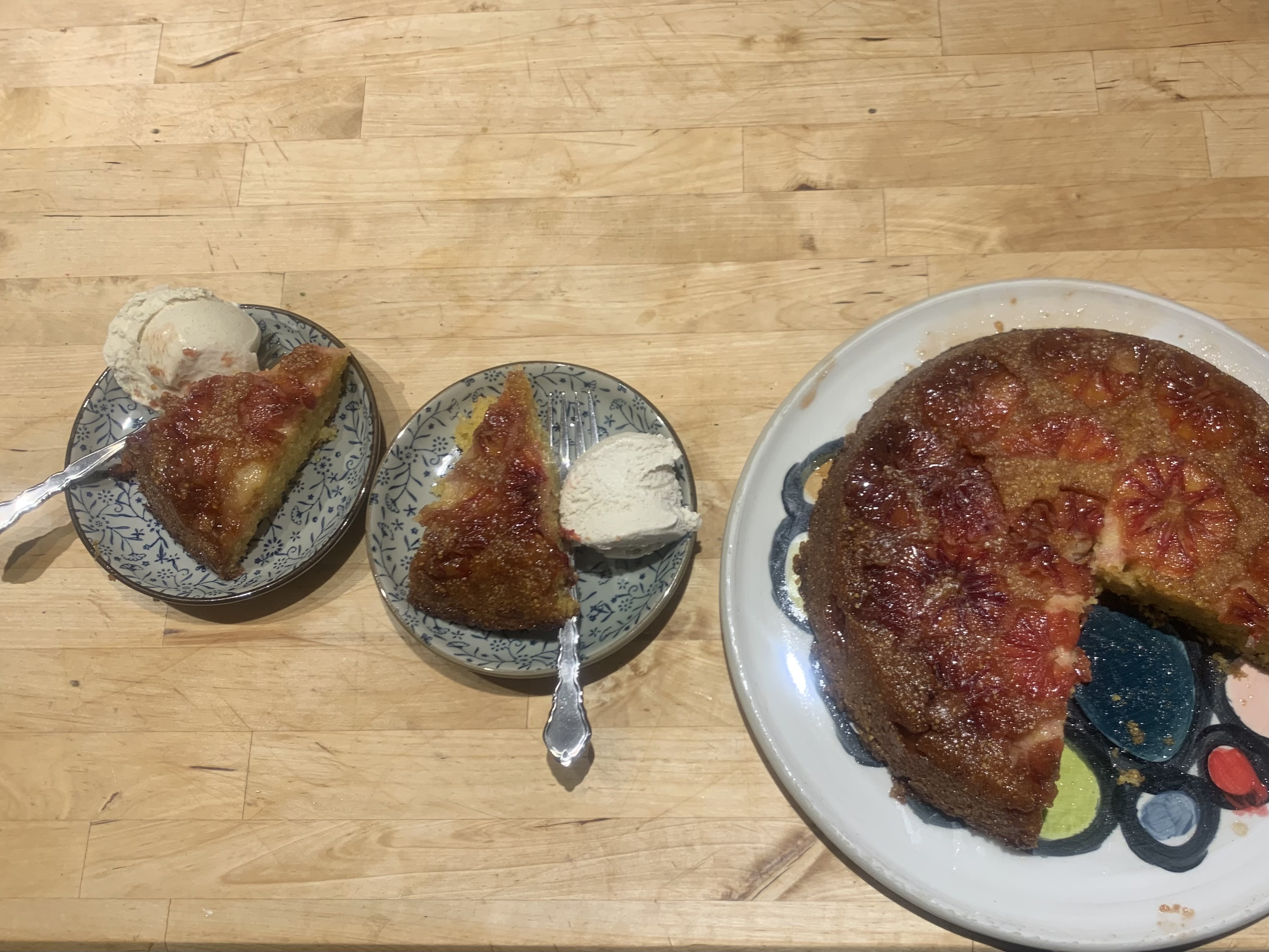
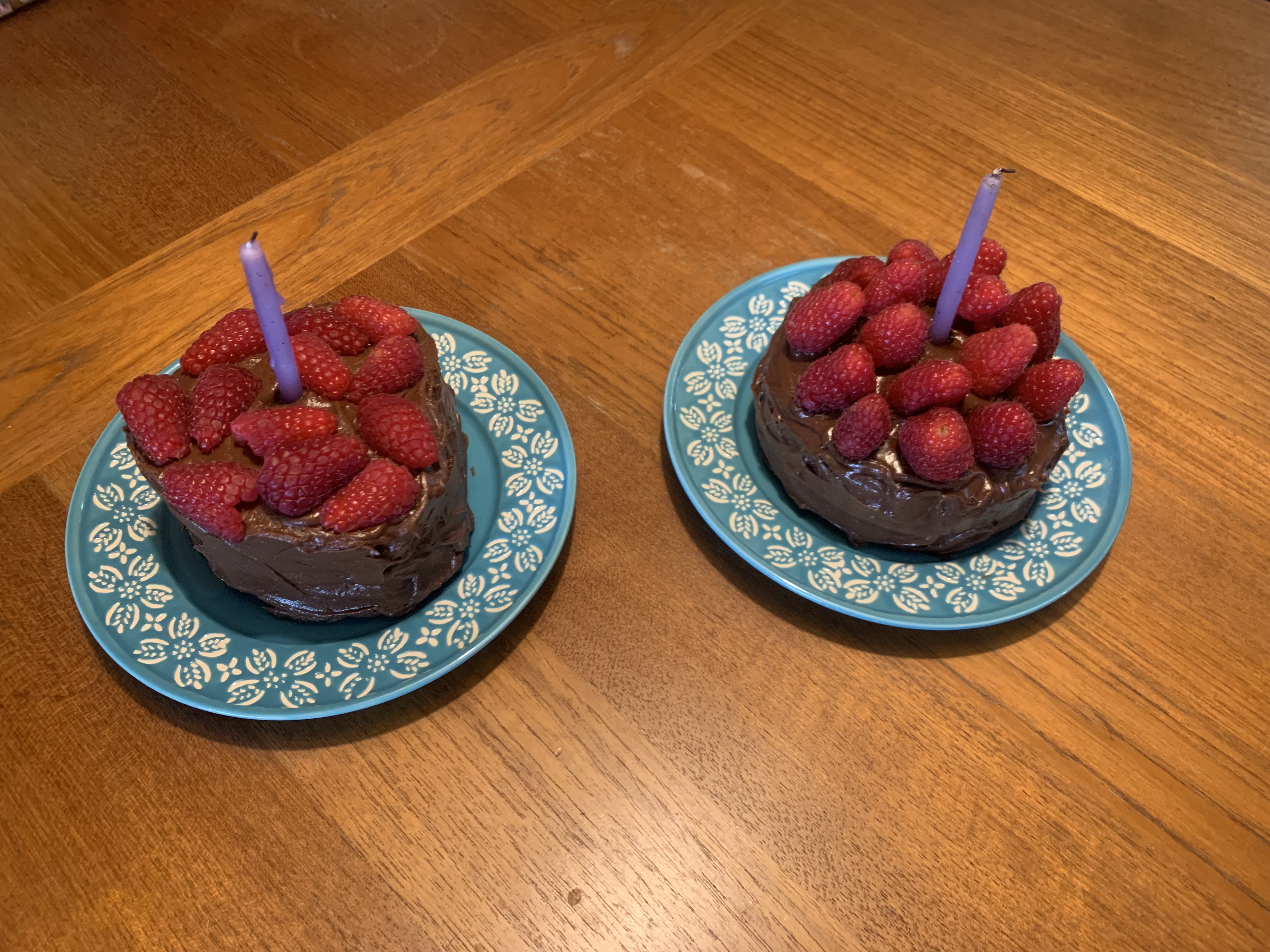
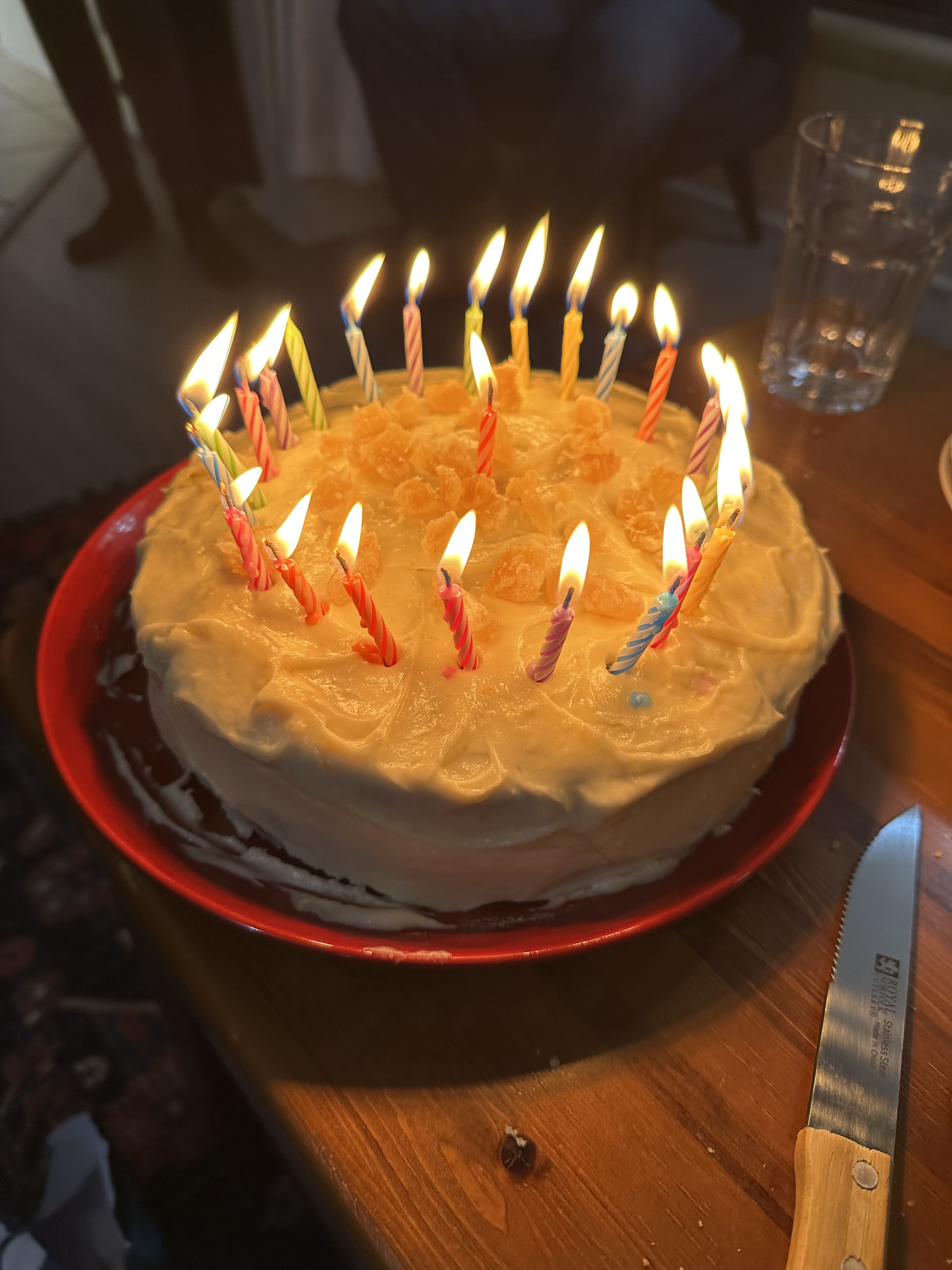
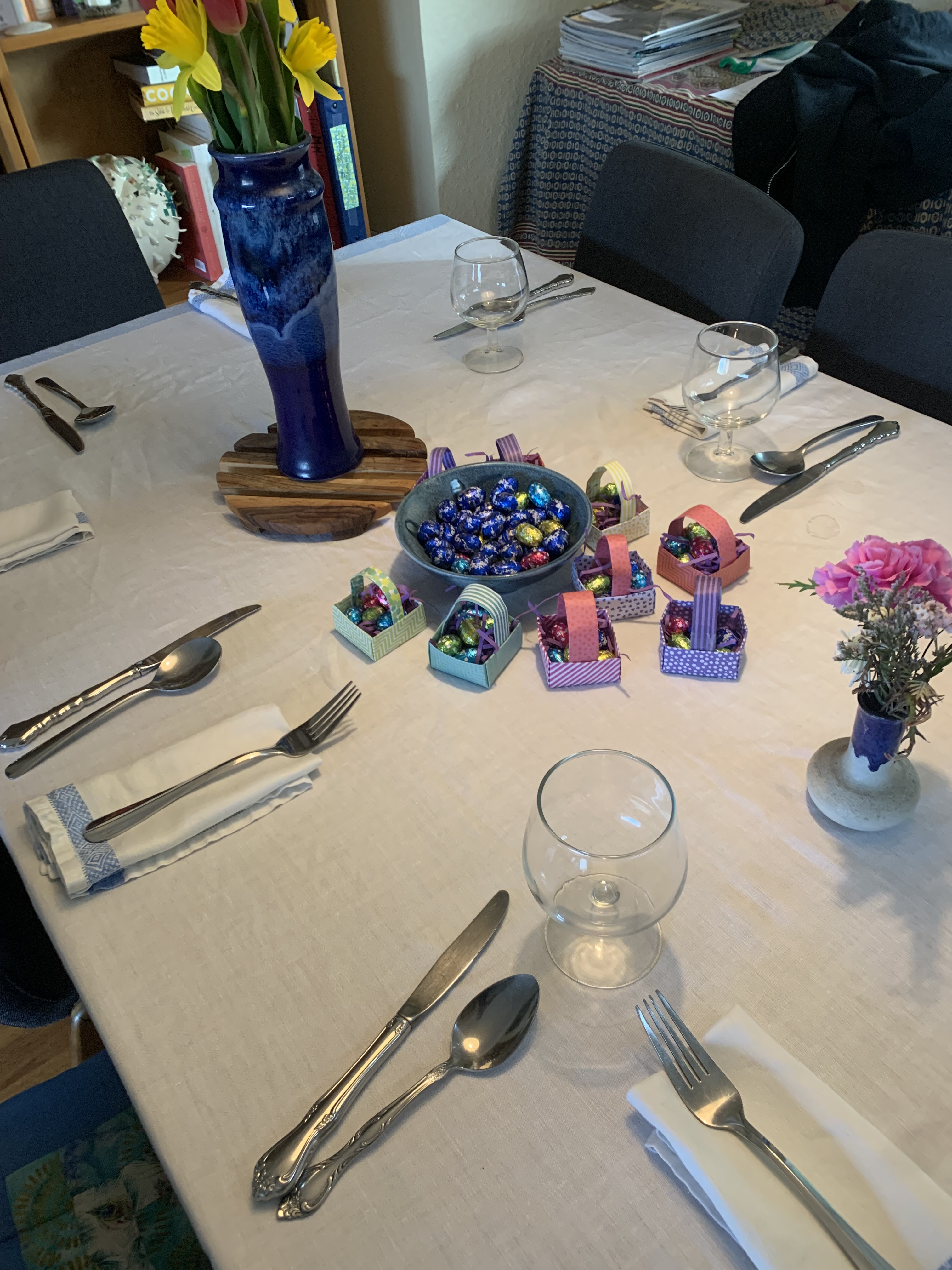
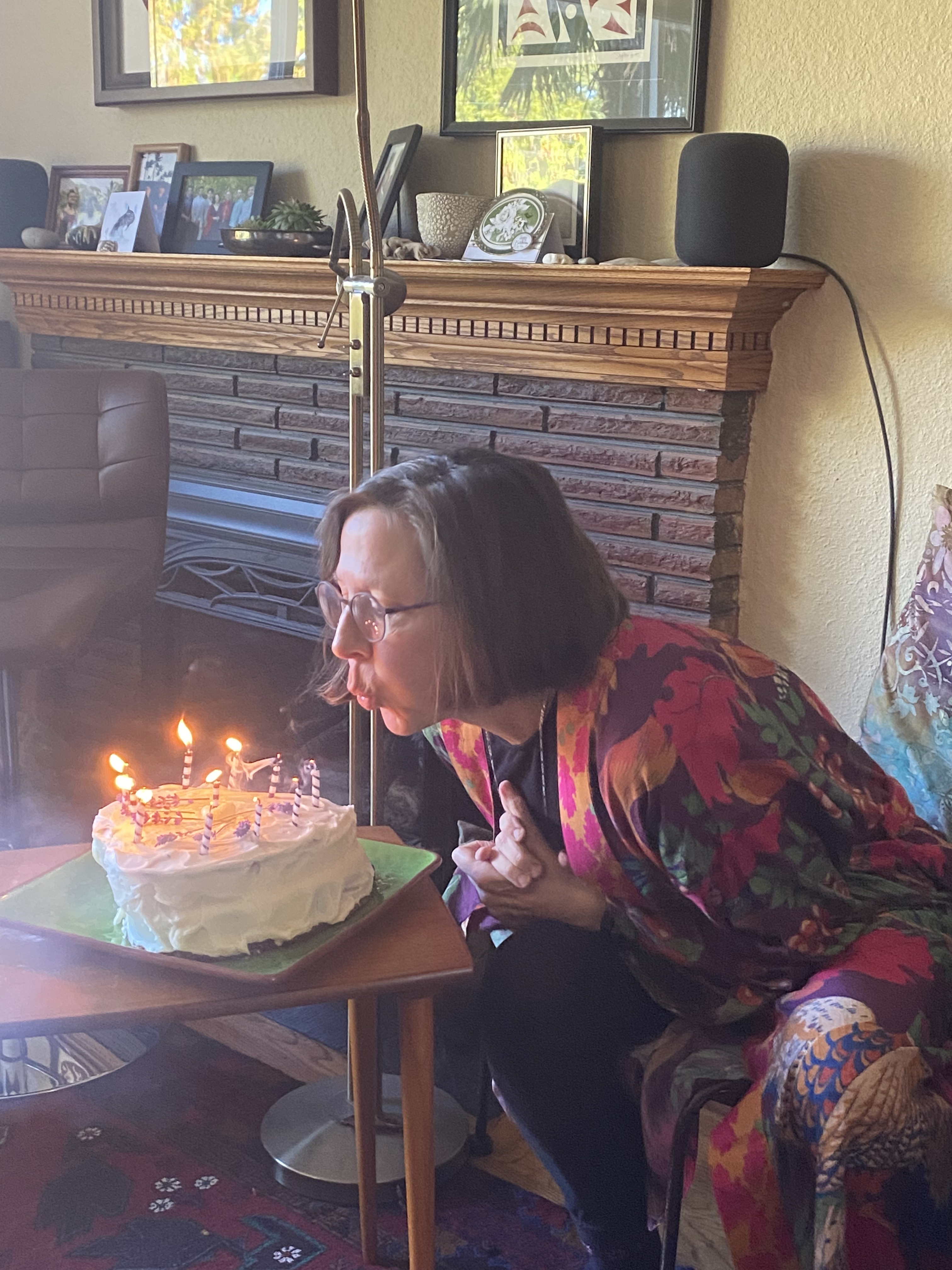
This year Michael got an upside-down blood orange cake for his February birthday, and we had fun sourcing the oranges. Found some good ones at the Market Garden on Catherine Street (where shoppers sometimes sit down to play the grand piano—such a cool store). I baked mini-chocolate cakes with strawberries later in the month for Barbara, and for Easter, an almond torte with whipped cream and more strawberries. Like my mother before me, I love to set a beautiful table, and Easter was no exception. The origami Easter baskets filled with foil-wrapped chocolate eggs provided a whimsical touch. (Entertain your inner child, I say.) For my own birthday party, a classic carrot cake baked in a heart-shaped pan frosted with cream cheese icing. For Andréa’s big five-oh: applesauce cake with three kinds of ginger. And for the final English conversation café at work: ginger cake with buttercream icing. What is it about a cake that speaks pure love?
Sewing
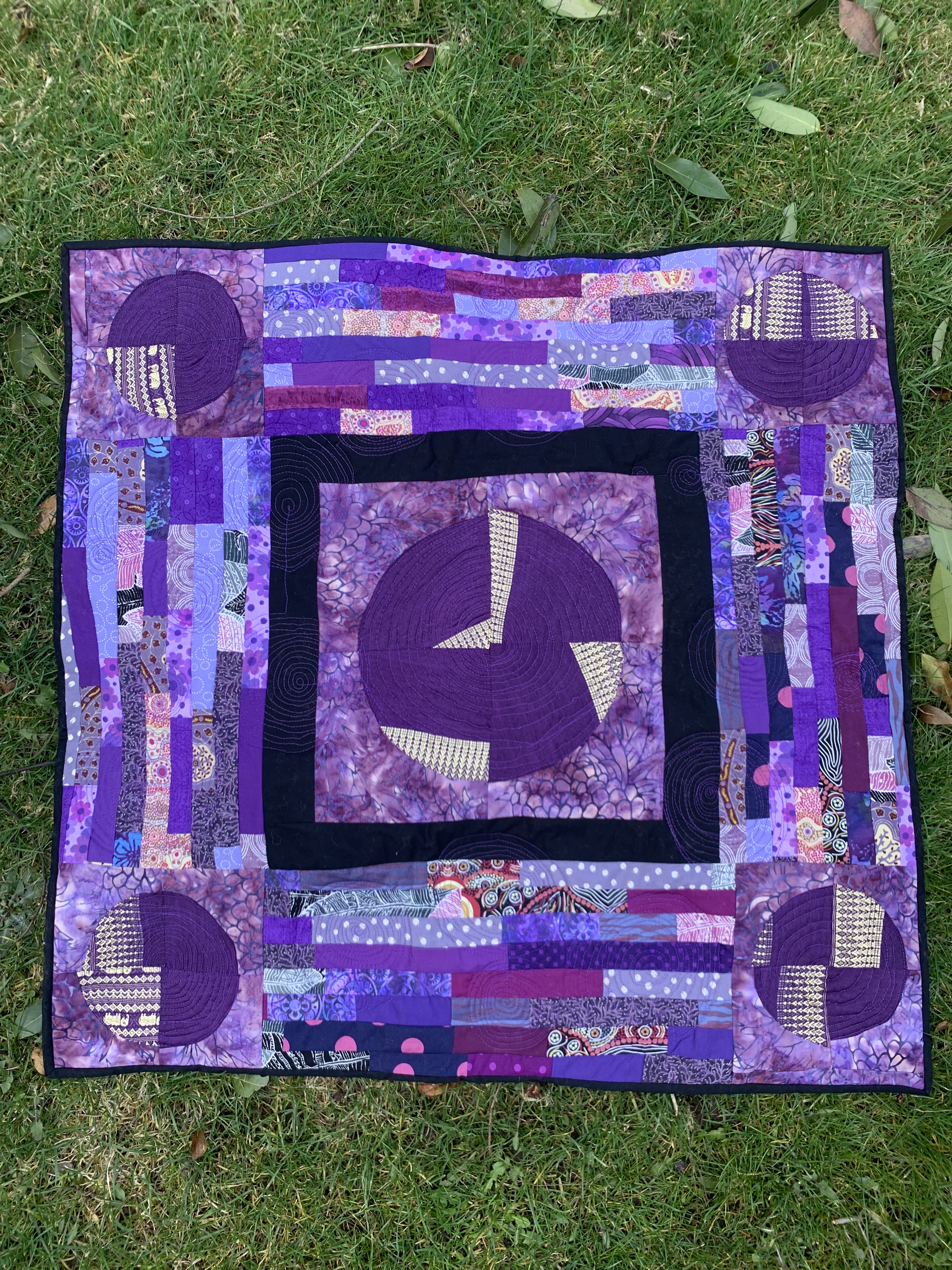
I didn’t make any new quilts, but I did sew a purple wall hanging, about 30 by 30 inches, that now hangs in our bedroom. I like to lie in bed and gaze at it. Four sentinel circles surround a larger one—all shot with gold thread (fragments cut from an old wraparound skirt from a yard sale). Those circles/mandalas ground me; cloth clocks tick noiselessly, watching over us as we sleep.
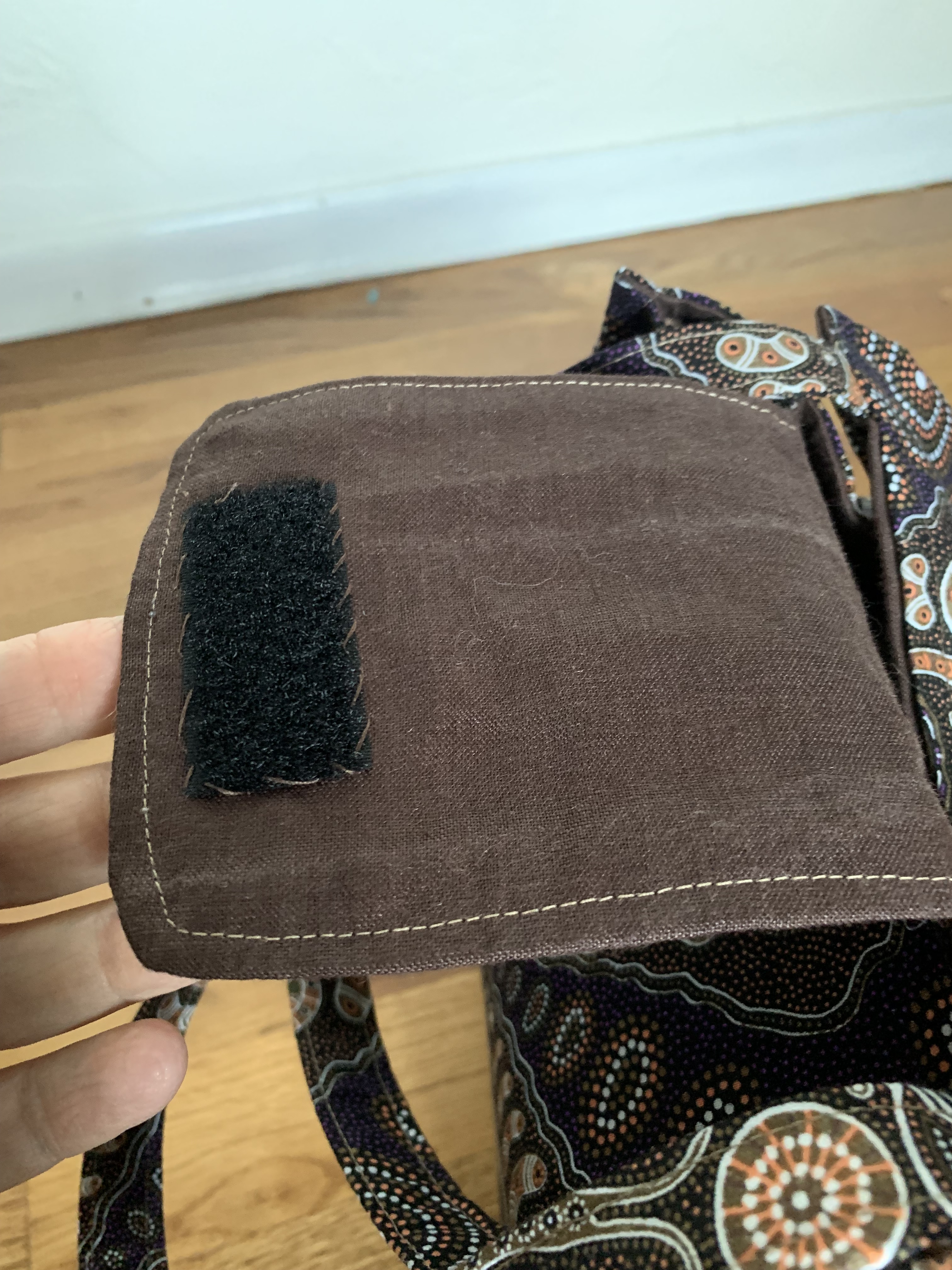
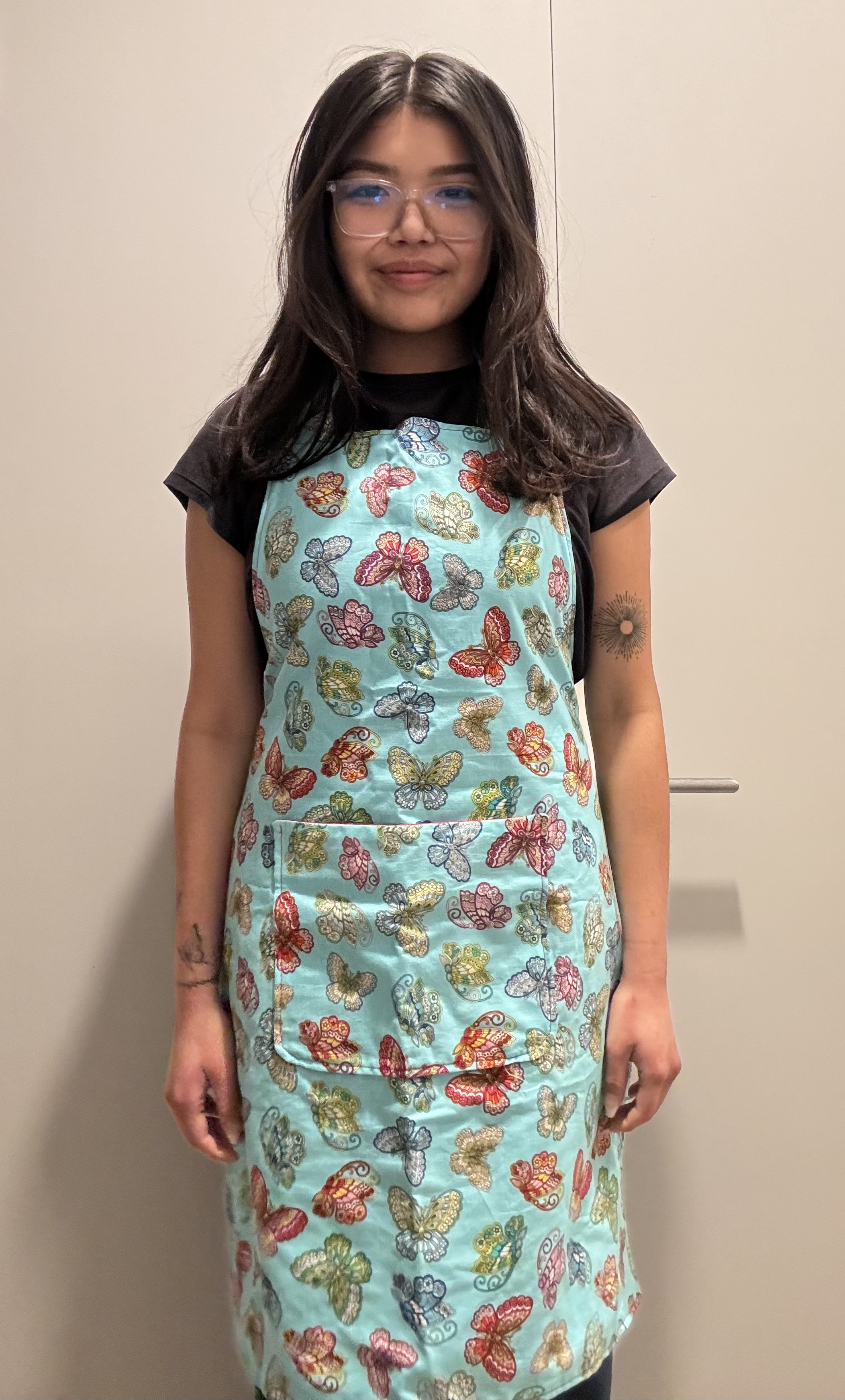
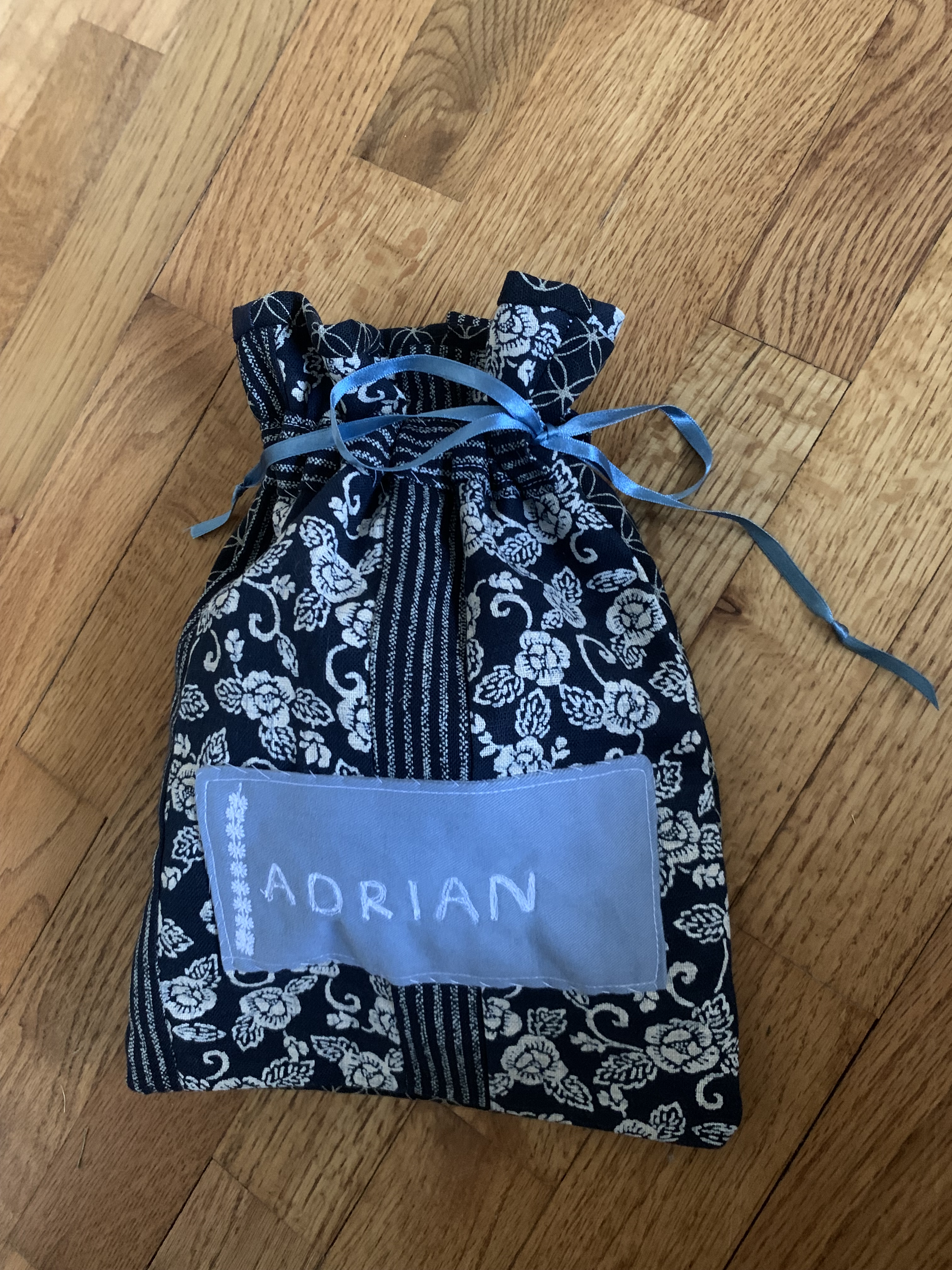
Smaller sewing projects attract me because results come together quickly. My sister Kathryn bought me a drapery panel of Indonesian fabric in browns, reds, and purples at a thrift store. A lot of fabric—40 by 83 inches—for only $4. I’ve enjoyed making some things from it: placemats and napkins mostly, and a sweet little fabric basket (I made a few of these for friends for Christmas, then filled them with chocolates and gifts). I felt most proud of the lunch bag I made for my boss, Nancy, because it tested my skill. I used fabric in a brown geometric pattern by an Australian Aboriginal designer. Then I lined the bag with sturdy brown linen from a too-big jacket I bought at a yard sale down the street. Nancy loves it. Adrian’s bag (filled with toys) for his second birthday involved some great scraps I bought from Smoking Lily on Government Street. Finally, I sewed a butterfly apron at Christmas for my niece. She is beautiful in any outfit, even an apron.
For my 65th birthday party (the theme was poetry and potluck), I made fabric wrappers for second-hand poetry books I bought for guests. So fun to comb through my stash and find colours and patterns that sing together. Party favours were fun when you were a kid, and they are even more fun when you’re an adult. Again, entertain that inner child…
Making Mandalas
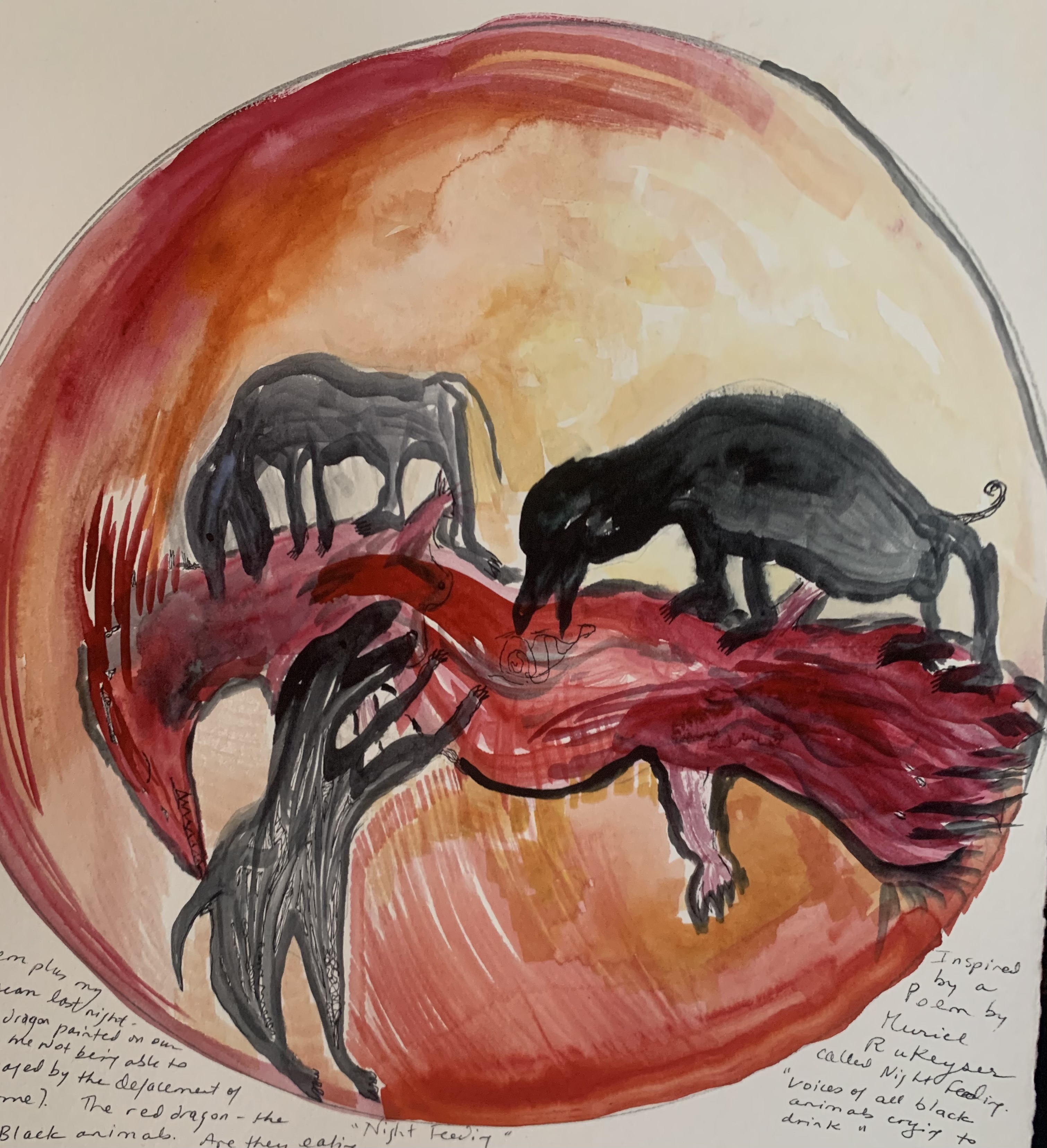
Michael and I had a Monday Mandala practice for a while, but it fizzled out sometime during the year. One exciting project: we delivered a multi-day mandala-making workshop in March and early April on Zoom. Our participants were mostly from New Mexico—all lovely, open-hearted women. It was a good experience. Michael was a guest presenter at two Creating Mandala monthly events. The CM team featured a new goddess each month, and Michael chose to talk about the High Priestess (Tarot) and Kali (Hindu goddess associated with death). I attended both of these events with pride and pleasure. Some mandalas last year were inspired by dreams—a rich transmutation. I dreamed I entered a room in my house and found that someone had painted on my white wall a red dragon being devoured by three beasts. Still musing on the meaning of that one.
Writing
Here’s where the fox was most recalcitrant. I aborted so many poems, blogposts, and stories last year, I am surprised to find anything in my files. I posted on this blog only five times in 2023. However, I did complete a series of linked short stories (started in previous years): Nothing is Wasted: The Stan and Deedee Stories. I shared them with a few friends and family members. If you are interested in reading them and you’d like a digital copy, let me know (maddyruthwalker@gmail.com) and I will send you one.
Some months, I had nothing new to share with my writing group. I’d scour the old folders for some scrap from the distant past to read. Or I’d just listen to others read their work. But that’s okay. I know that I’ll write again. When nothing seems to be happening, the fox is deep in her hole, pregnant with kits. How many will be born and when? Just have faith.
I wrote only a few poems in 2023, and one was for my birthday. Each guest was asked to bring a poem to share. It was extraordinary to see my friends and family members get up into the poetry seat and read poems they’d chosen, poems they’d written: one of the best gifts I’ve ever received. To close the offerings, I read my own poem– one that expresses the expansiveness I feel as we enter 2024. Happy New Year to you!
Expansion

I started slim
and willowy.
Then, whoosh of years.

My waist - heavy as grief,
soft as dough -
expanded.

Grief. Have you met her?
Well then you know the
grace that she bestows.

Hard things—she
cracks them open,
ignites a hotter flame,
imbues a deeper shade of red.

So, like my waist,
my heart’s made wide by grief,
a vast container for the love I feel
for trees, and animals, the sky,
the planet, for you, my friends,
for people everywhere,
for life expanding.
I know it was a horrible year, and yet it was somehow a good year for creativity. The work wanted to be made.
Writing
I finished the first draft of my first novel—as yet untitled. I have been living my own dictum. You only learn to write by writing, I tell the students I teach and tutor in academic writing. The more you write, the more you experiment, the more you learn how to write.
James Hillman said that “truth is revealed. It cannot ever be told. It has to appear inside the telling or through the telling.” Never have I found this more resonant than in writing fiction. I started out with a vague idea for a story, but it has only been inside the telling that truth has been revealed, an exciting and serendipitous—perhaps even magical—process.
I was privileged to have the first six months of the year off work and the second half working at home. This flexibility allowed me to establish a regular writing time in the mornings, so most days I wrote at least a paragraph and sometimes several pages. The novel is about 300 pages long. I will leave it to rest for a few weeks before I go back with an eye to editing. My small but loyal writing group helped me stay motivated, and I am grateful to them. I loved hearing other writers in the group read their work.
I published 18 blogposts in 2020. Long ago Michael helped me to be content with “3 plus me” (it’s written with a wineglass writer on my mirror). That just means if I like it and three other people like it (Michael is inevitably one of the three), then I am happy.
One of the posts this year was a beautiful guest blog by my sister. And we collaborated on a second one. I love collaborating on blog posts and I welcome any of you to get in touch with me if you want to write together.
Editing
This year I was accepted into Simon Fraser University’s Editing Certificate program and I have completed 3 of the 12 courses. I aim to finish in 2021, and intend to start my own freelance editing and writing coach business. I have done this kind of work as a side gig for years, but now I am ready to formalize my training and freelance in a serious way. Editing is a profoundly creative act. All of those decisions to be made about word choices and paragraphs, sytnax, architecture, punctuation. . . .
In my reading about editing, I came across Susan Bell’s, The artful edit, an interesting book about how to edit your own prose and hone your understanding of other people’s. I loved the way she takes the reader through the masterful editing of The Great Gatsby by Fitzgerald and his editor, Maxwell Perkins. She has provided me with so many ideas both in editing my own work and as I apply my skills to my clients’ writing.
Sewing
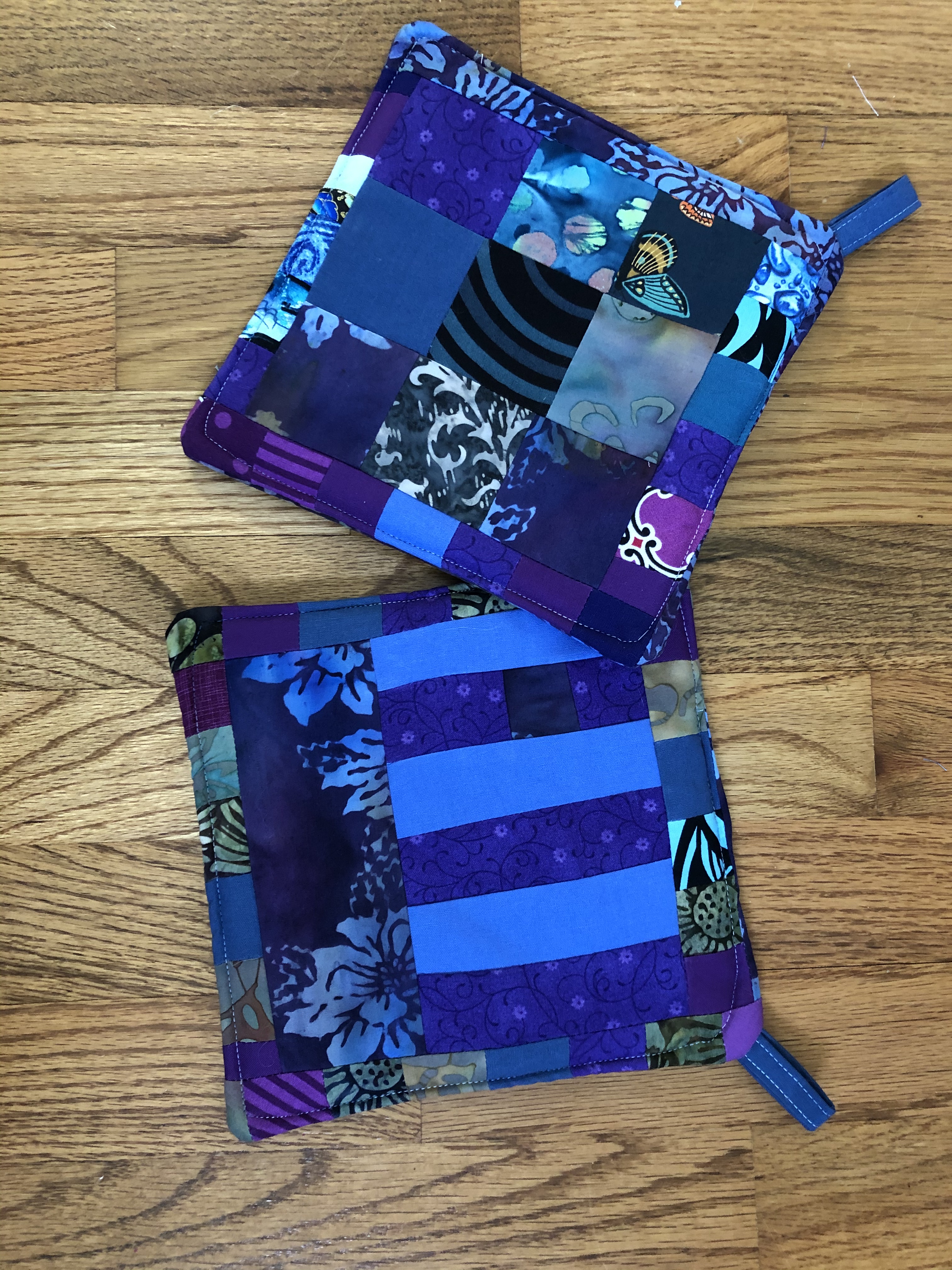
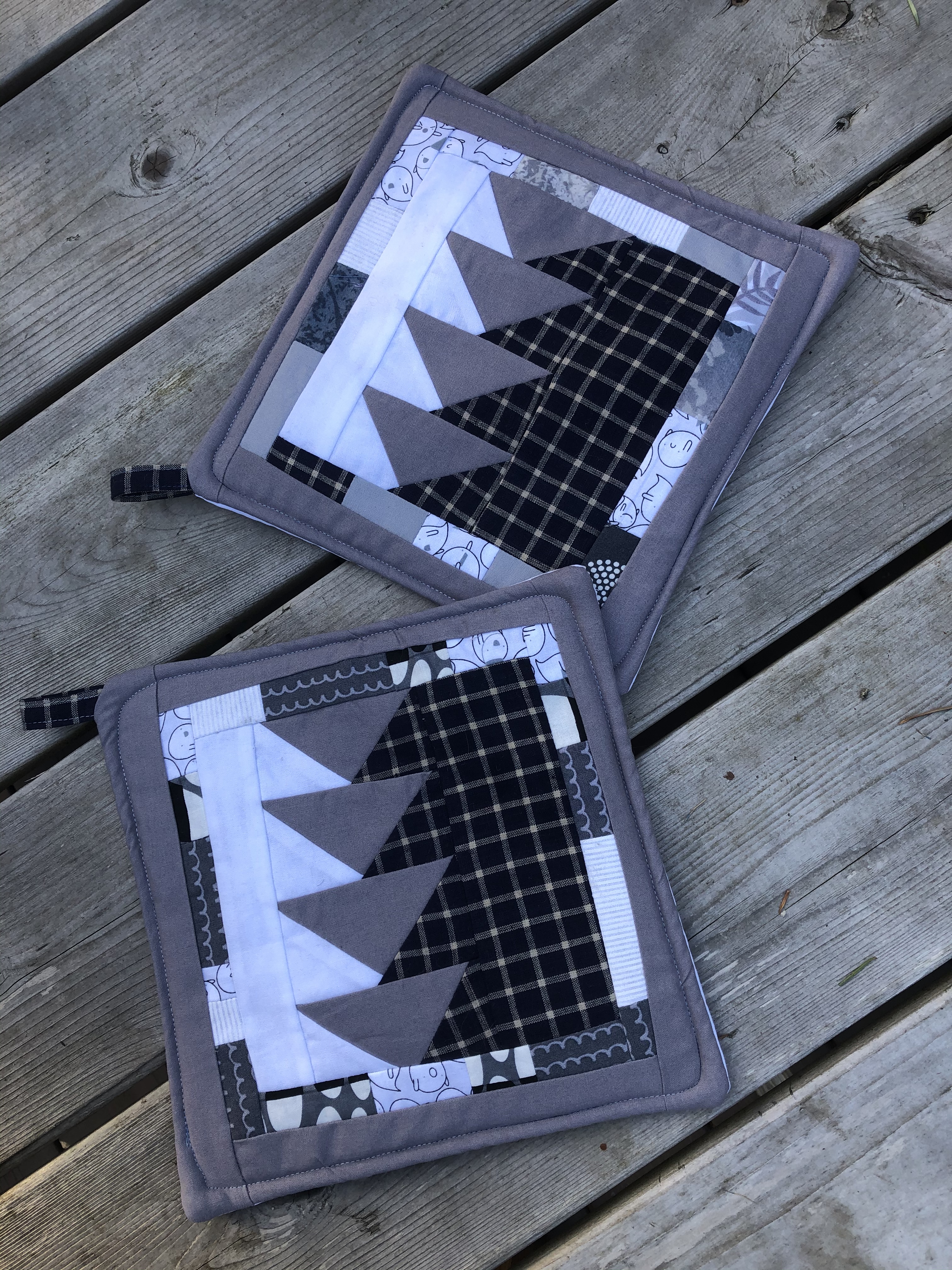
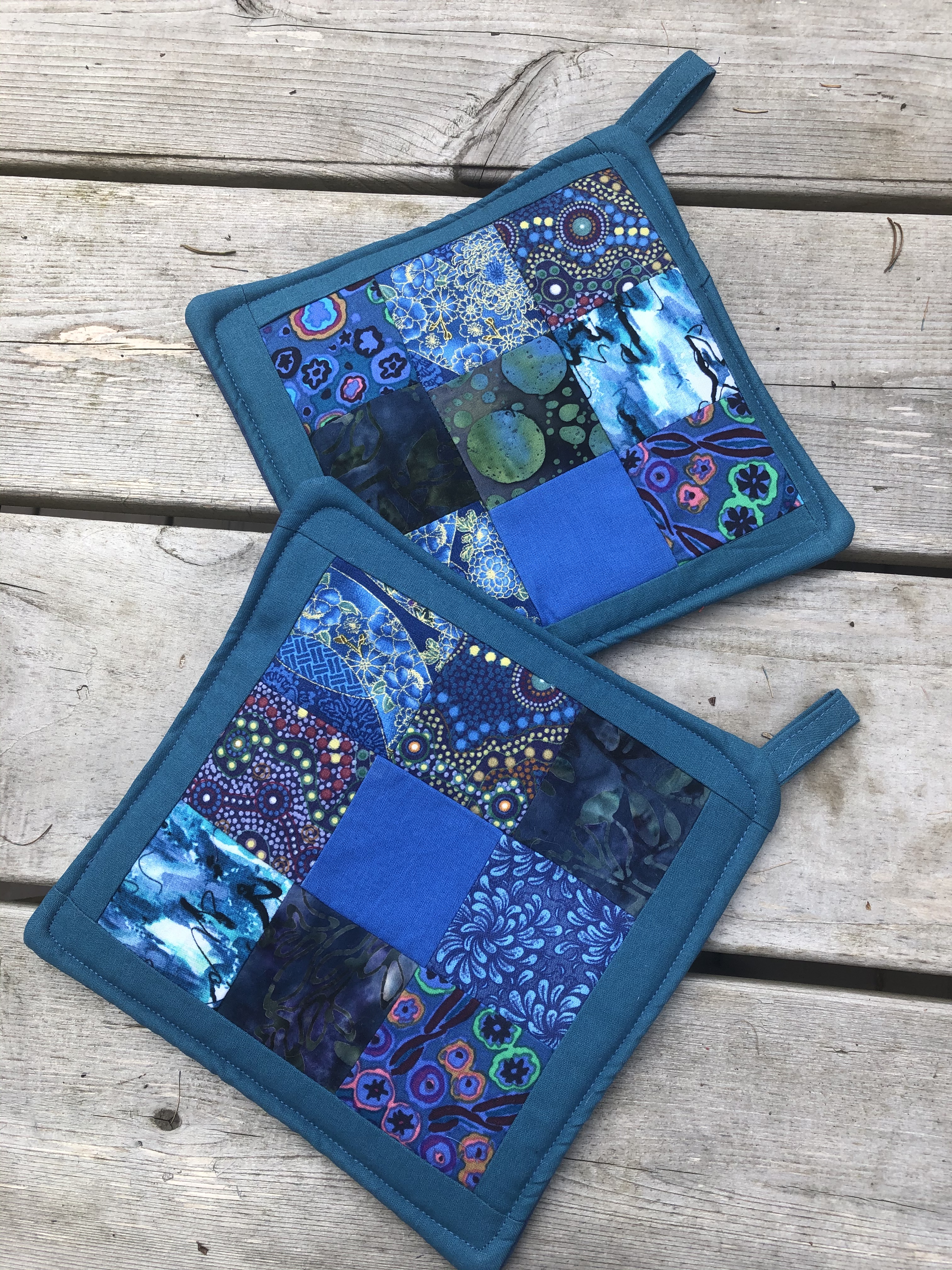
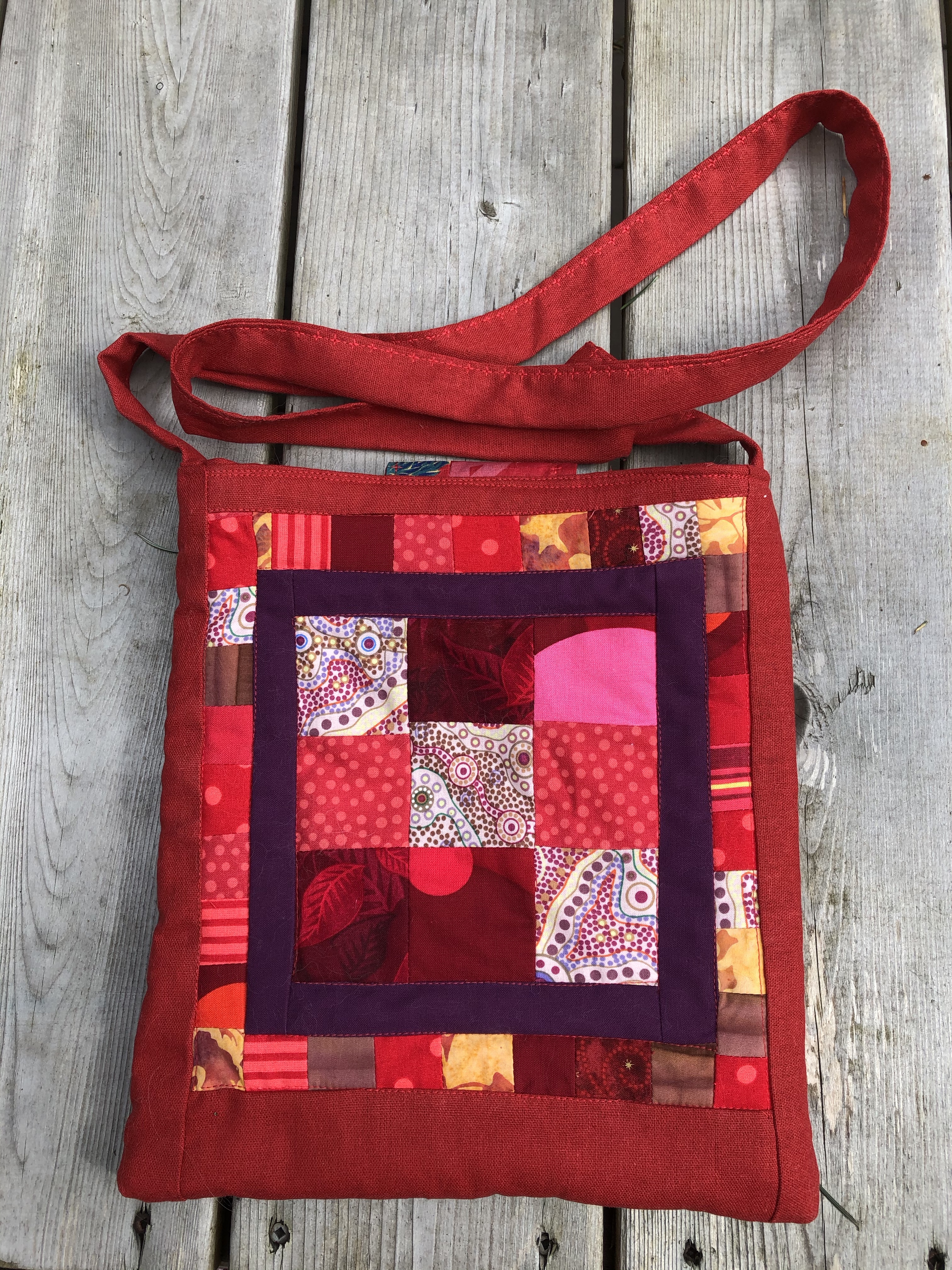
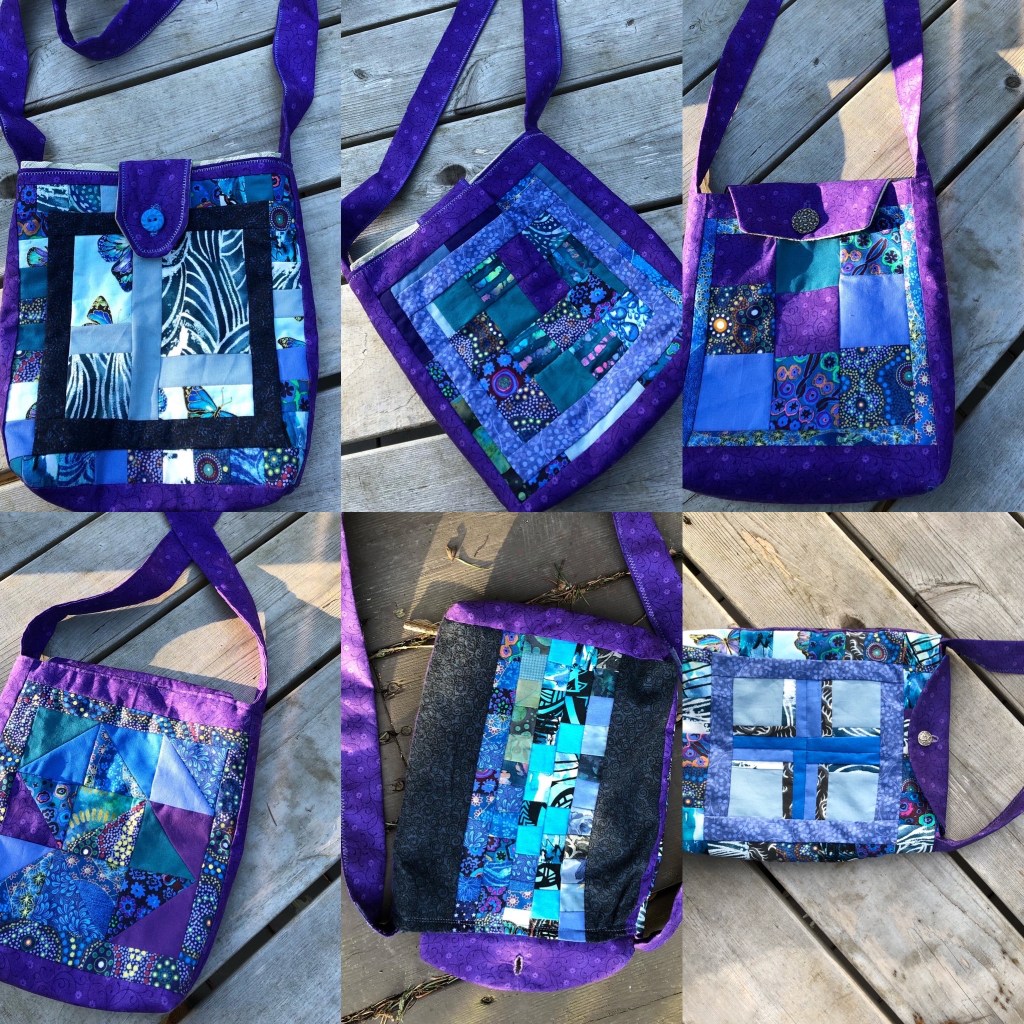
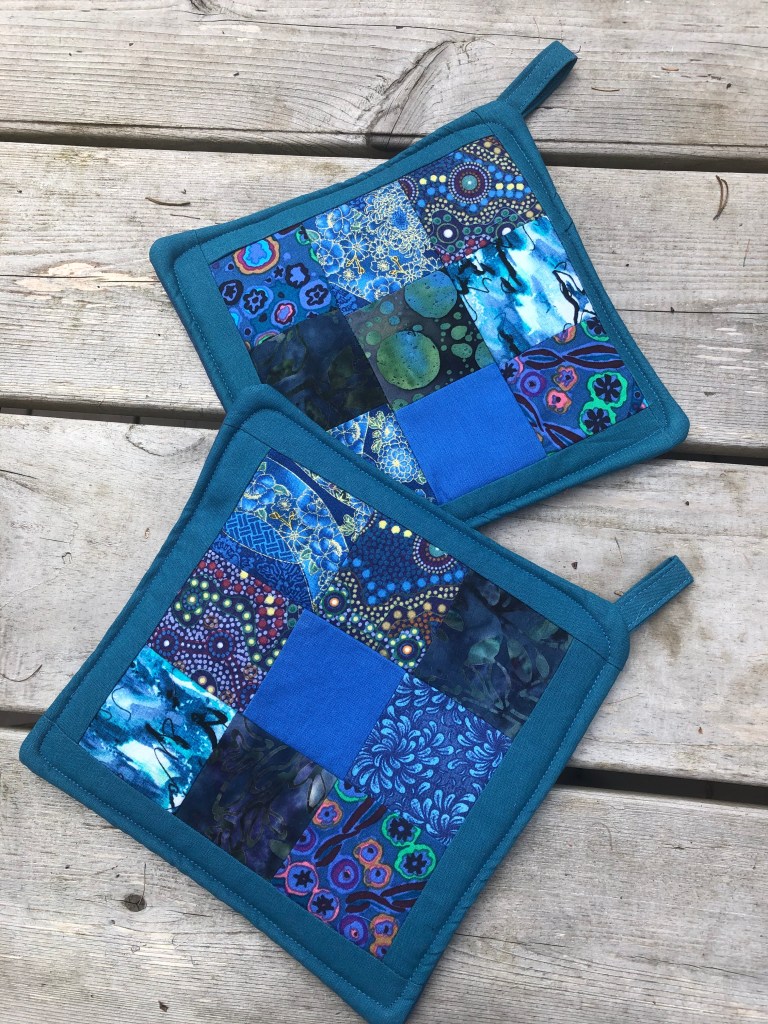
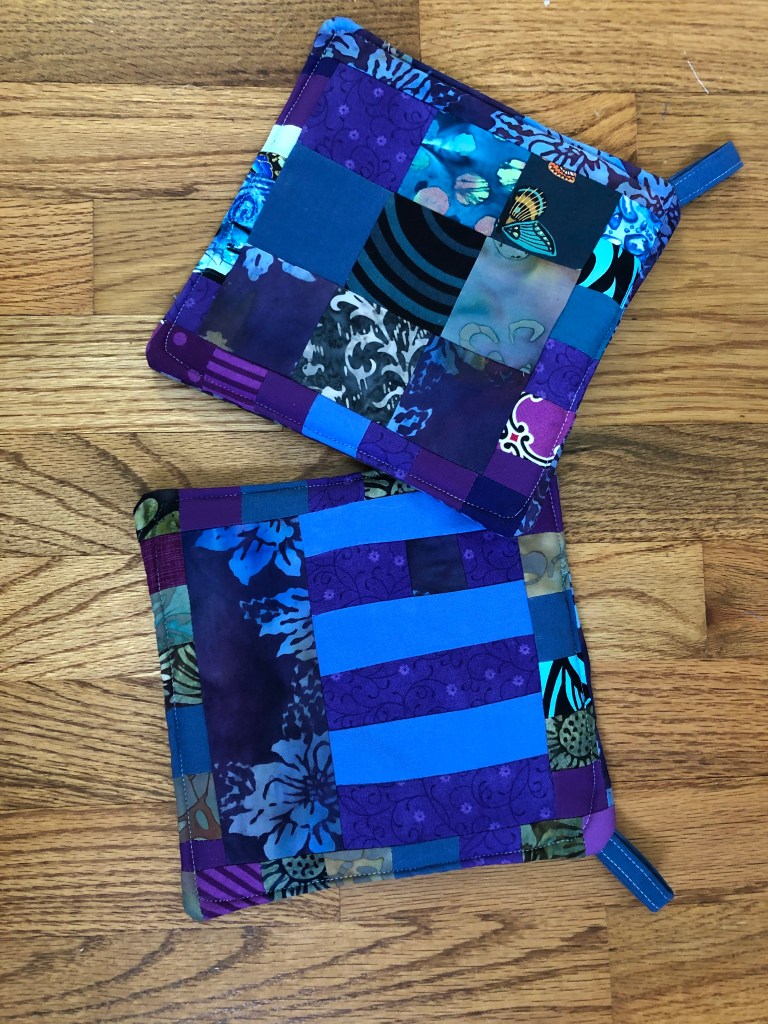
I sewed in fits and starts this year, but as I look back I realize I was productive, though it often didn’t feel that way. I finished the textile art piece Eight Worldy Winds early in the year. The piece now hangs on my office wall to remind me of the transitoriness of feelings, fortunes, and life itself. Then the pandemic shifted me into giving mode—I wanted to make small gifts for people. So I started with potholders I had promised to friends a long time ago, then I delved deep in my scrap supply to make one-of-a-kind bags for other friends. After that, I sewed masks. I have to admit, that was a duty more than a joy. Then I started making aprons for people I love. By the final apron, I felt I’d perfected the pattern. I almost forgot about the blue cape I made (my courage cape) out of an old wool blanket. So much fun!
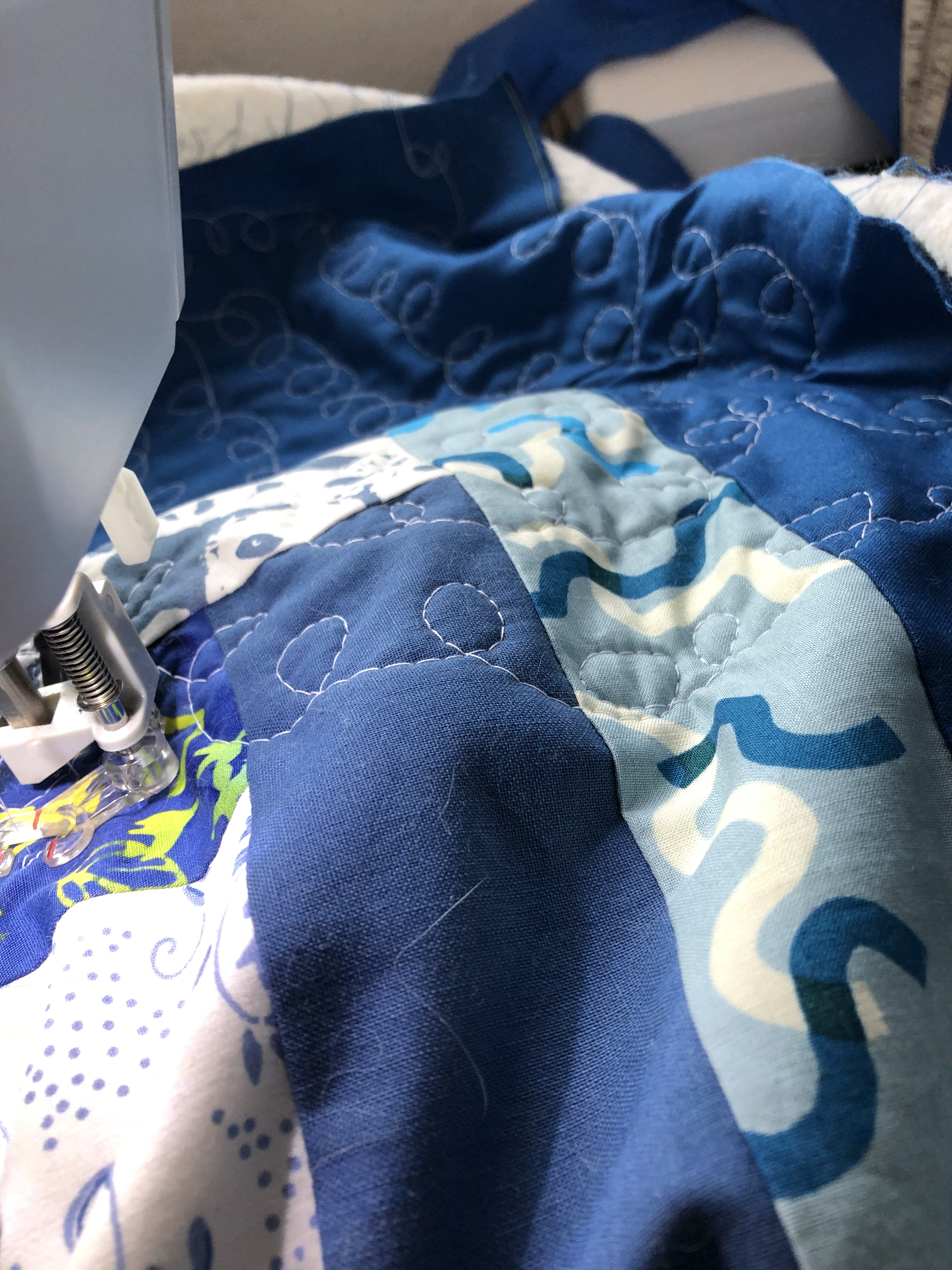
I went back to a bigger project with the Rhapsody in Blue quilt. It’s one of those weird quilts that actually look awful close up, with the mishmash of colours and patterns. But the total effect is pleasing. I started machine quilting of the top today, after pinning the whole quilt with safety pins. It’s the first time I’ve tried using curved safety pins to sandwich a quilt, and I like it. In the past, I’ve used the spray adhesive between layers, but I find it is not secure over time, and sometimes it takes me a while to finish a quilt top (now, especially, with a puppy).
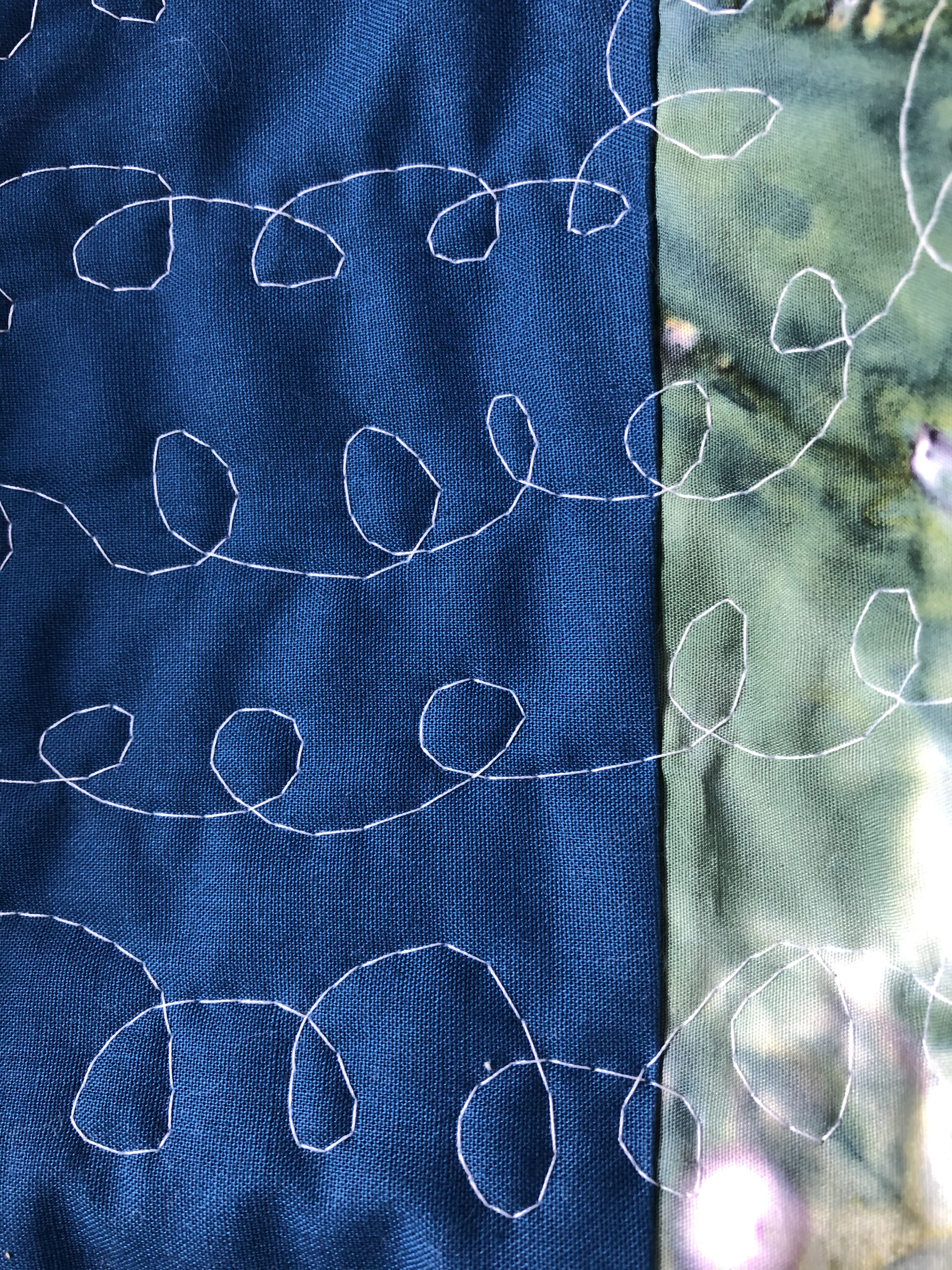
There is something incredibly liberating in free motion quilting. And it’s a physical act; my whole torso sways and moves as I push the material under the needle, forming loop de loops.
Puppy raising
Raising a puppy is a creative act. Just as raising children calls for creativity every day, so does having a puppy in the house. I used to make up games and stories, craft activities, and innovative ways to distract and delight my children. Now I am doing the same kind of thing with Marvin.
Going forward
I put sewing and writing on hold during our first few weeks with Marvin because it was an immersive experience—all of my energy was need to do my paid job and engage with and train the puppy. Those few weeks taught me an important lesson. I felt drained and bereft without my creative outlets. It is not just a luxury to take time to write and sew. Creativity is my lifeblood; creativity gives me momentum to keep on going; creativity feeds me. Especially in this year of the pandemic, I have leaned heavily on creativity, and I am so grateful to have the time to pursue my creative acts.
This year I let go of some things—drawing and my aspiration to learn to play the ukulele to accompany my singing. I just can’t do everything. So I focused on writing and sewing. I’m not sure what I’ll focus on in 2021. Some contemplation is in order.
Remember, creativity is your birthright. It’s not granted to just some people—we are all born with innate creativity. As children it seems more accessible and we rarely question it, but then its force seems to fade for some people. I encourage you to spark your creativity if it’s dormant. Write a poem, cook something new, learn a song, write a song, draw a comic, sew something. Make a birthday card for a friend. You never know. . . .
I have been sitting in discomfort, searching for how to begin. Fear of making a mistake keeps me from acting, from speaking. Perhaps some of you reading this feel the same way. Are you a privileged white person, trying to figure out how best to speak up, how to be part of the solution? Are you getting a crash course in systemic racism and wondering what to do with all the emotion and information? We can give money to Black Lives Matter causes if we’re financially able. But something more is being asked from us right now.
White silence is complicit, white silence is oppression. If you are white and you have a social media following, you have a responsibility to use that influence to draw attention to Black voices. I don’t have much of a following (but huge gratitude to those who DO follow me) and I am certainly no influencer. Nonetheless, I want to use some of my space today to draw attention to two incredible Black women textile artists: Sarah Bond and Bisa Butler.
From Modern Quilt Guild’s website
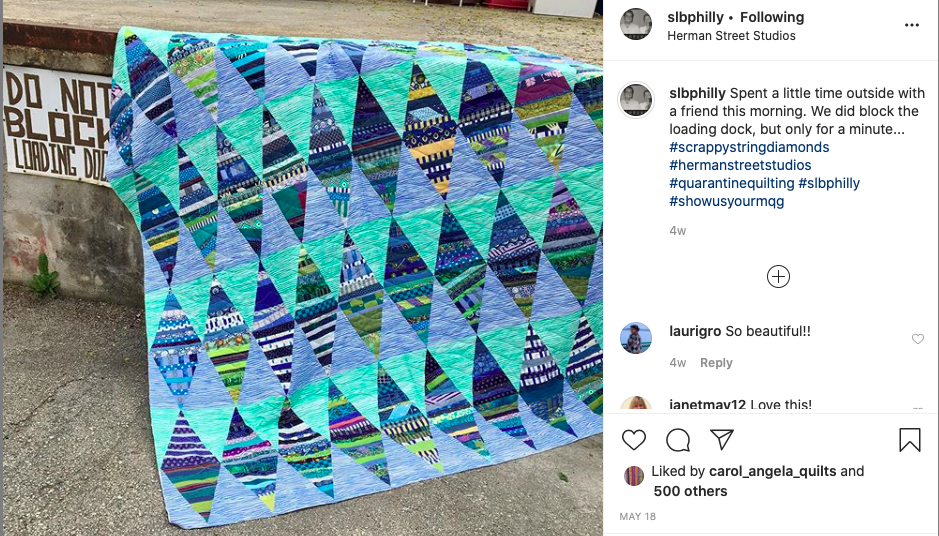
I’ve been following Philadelphian Sarah Bond on Instagram for a while, appreciating not only her beautiful quilts, but her frequent mention of herstory. A descendant of slaves, Bond is inspired by the quilts of her ForeMothers and by modern quilts, combining ideas from both into her bright geometric creations. I especially admire her scrappy diamonds.
Follow Sarah Bond on Instagram at @slbphilly Here is an image from her IG feed of one of those scrappy diamond quilts in delicious blues.
One of her recent projects is quilting together blocks created by young people at the Social Justice Sewing Academy (SJSA), an amazing organization that “empowers youth to use textile art as a vehicle for personal transformation and community cohesion and become agents of social change.” Their hands-on workshops are held across the United States. Check them out.
Fibre artist Bisa Butler’s vibrant portraiture needs no introduction to people in the textile arts scene, but until recently, I was oblivious to her work. Her bright Kool-Aid colours and realistic fabric portraits are legendary. As an art student at Howard University, Butler was influenced by Romare Bearden’s collage and the AfriCOBRA collective (one of the inspirations for the Black Arts Movement). As a young mother, she learned how to quilt and developed, through these combined influences, her unique fibre art style. Her work celebrates African American identity, history, and culture through intense fibre portraits. Sometimes she uses pieces of clothing from her family history in her work. This short film, Quilting for the Culture, will introduce you to the woman, her work, and her aesthetic:
I’m in awe of the skill and talent of these two women. I aim to continue learning more about Black artists, especially Black women artists and Black textile artists.
My creative space
As I prepare to return to work in two weeks, I’ve been cleaning up my creative space and reviewing the last six months of sewing. It’s been a productive time as the pandemic kept me close to home, close to my sewing machine. I find sewing brings joy and soothes grief—and I need that right now as our world is shaken by Covid-19, police brutality, and racism.
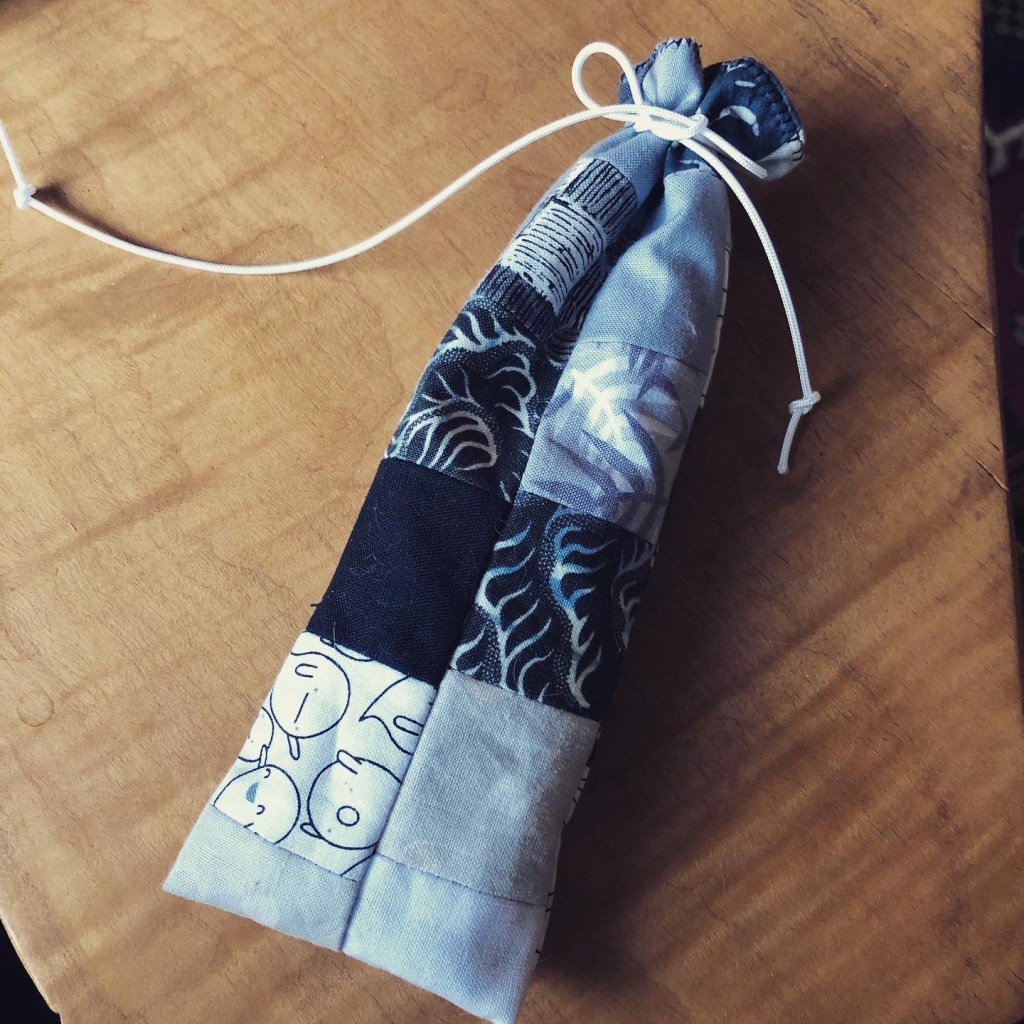
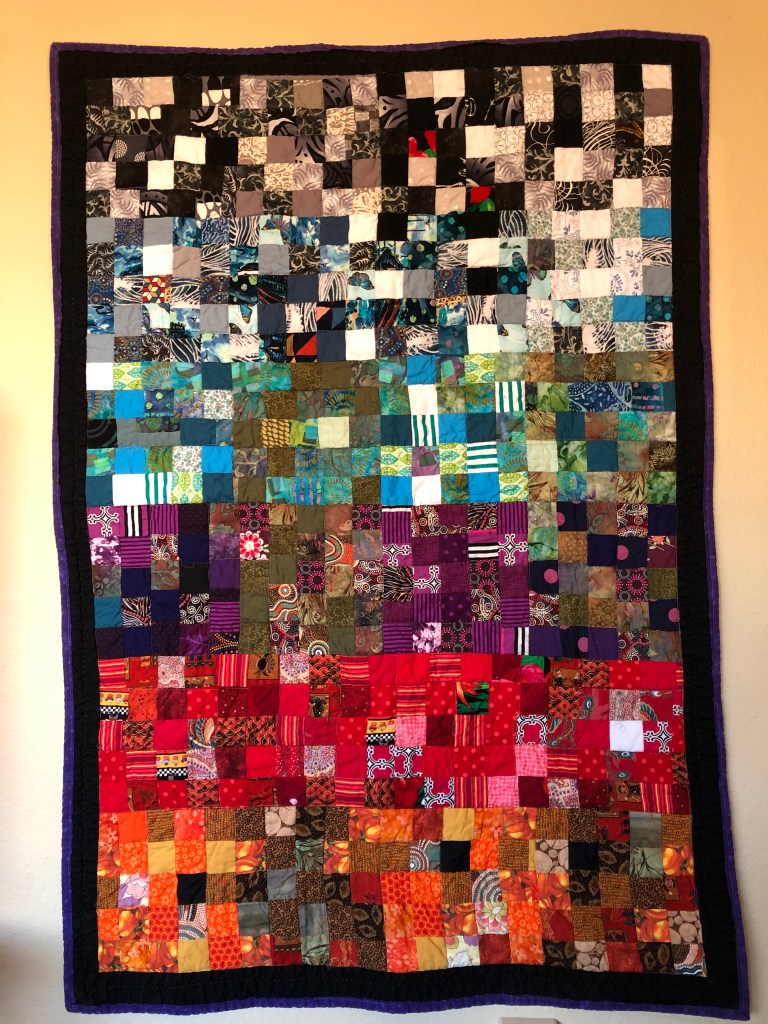
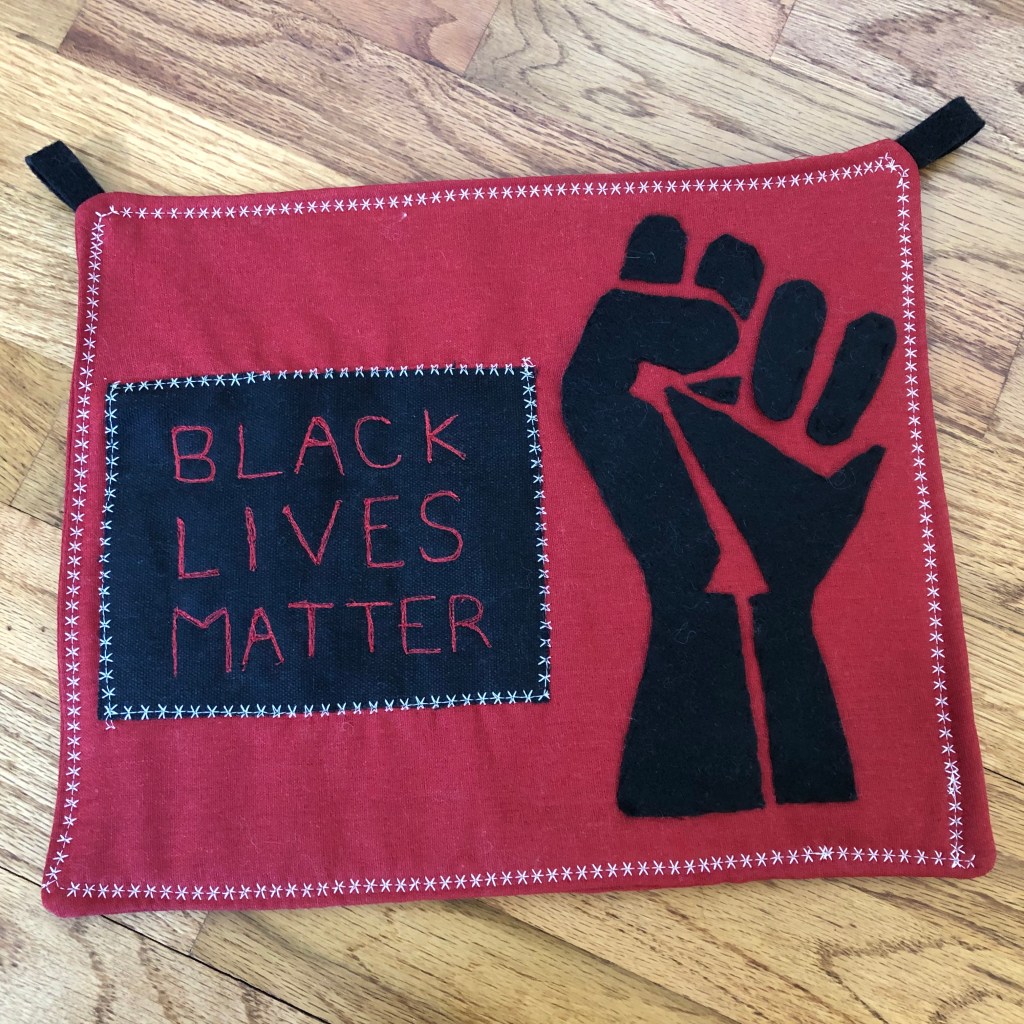
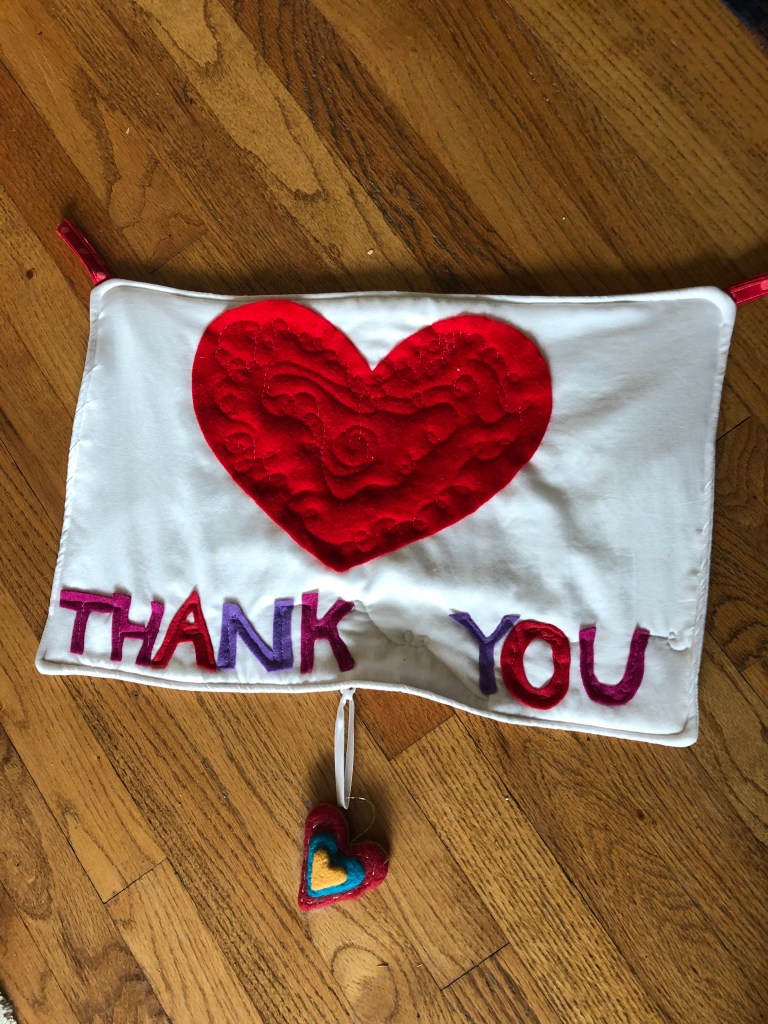
In January, I finished Four Seasons, a scrap quilt. After that, I sewed purses, potholders, and face masks galore and gave them all away. I also sewed my first garment, the “Courage Cape,” out of a $5 thrift store blanket. I made a couple of banners: “Thank You” to our health care workers, which hangs in our front window and “Black Lives Matter,” which hangs on our front door.
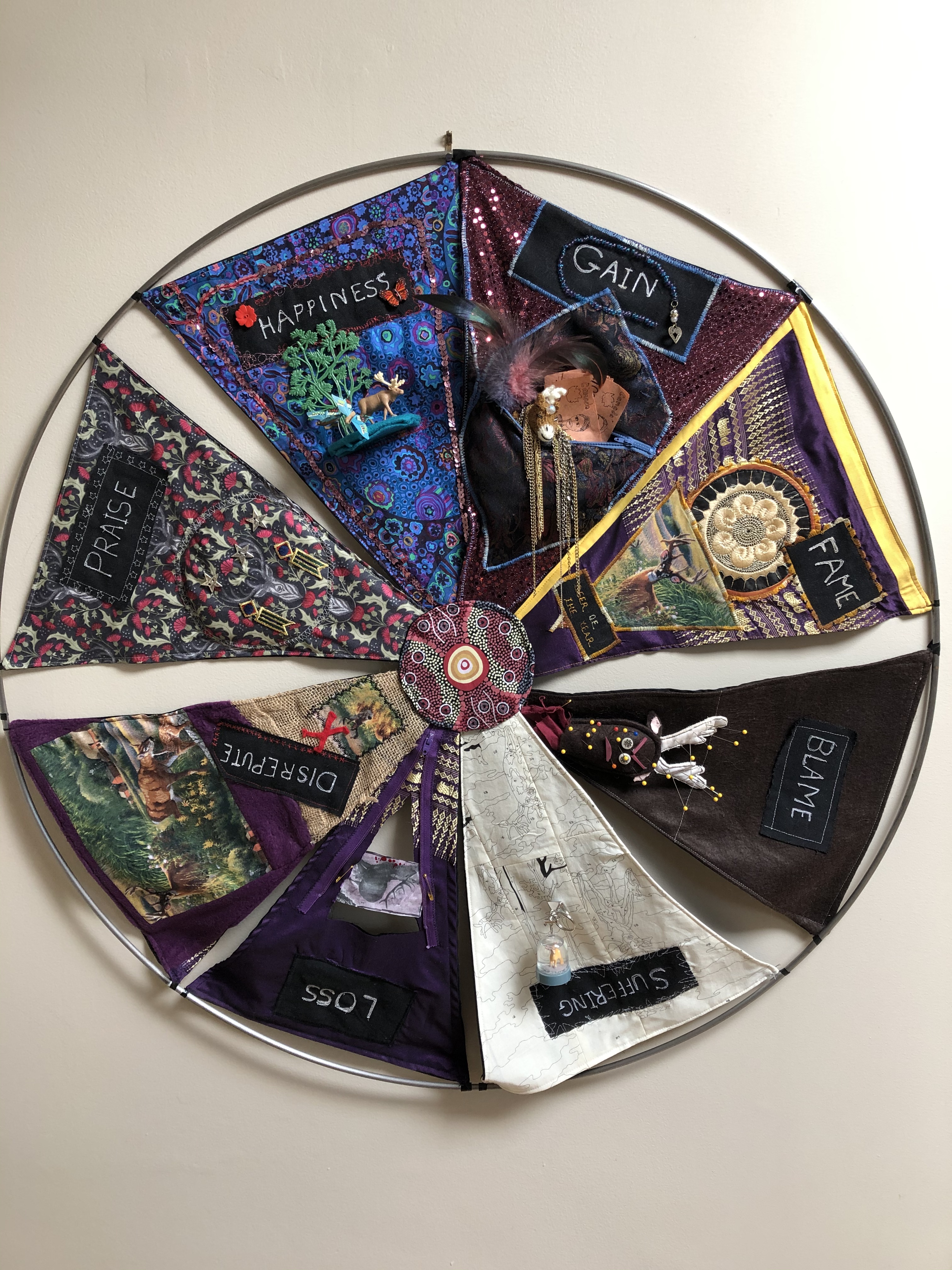
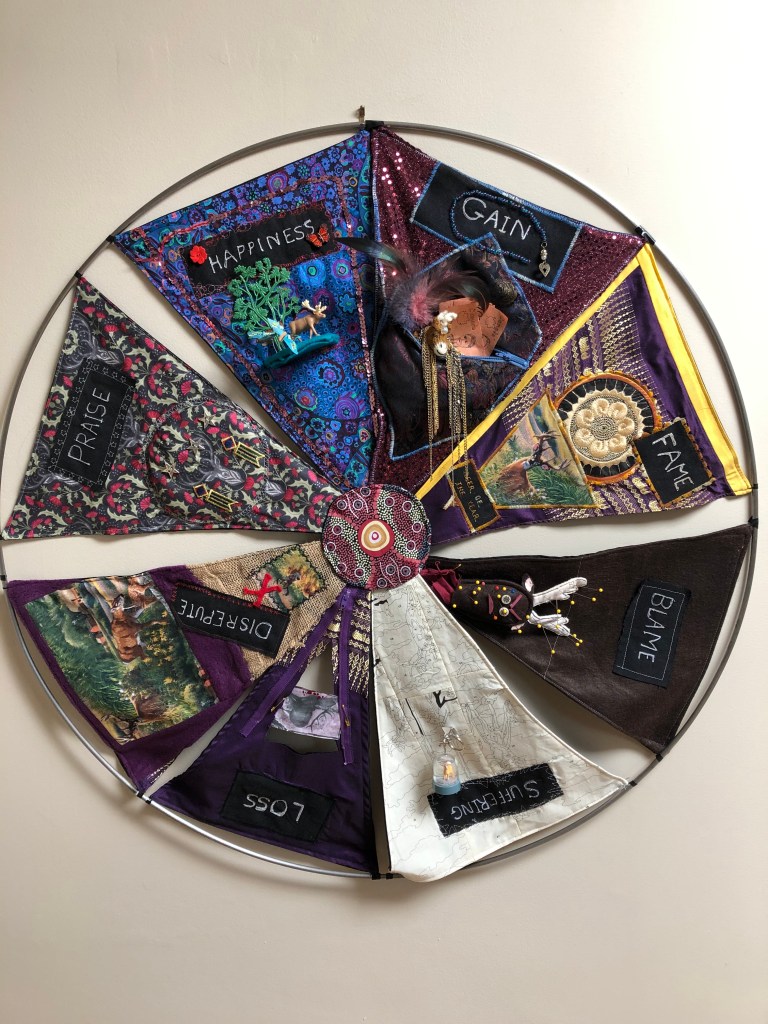
I finally completed Eight Worldly Winds, the first piece I’ve made that I dare to call “fibre art.” A series of eight triangular pennants arranged in a mandala feature a stag as protagonist and illustrate the eight worldly winds from Buddhist teachings. These consist of four opposing pairs of pleasures vs. discomforts: happiness/ suffering; praise/ blame; fame/ disrepute; and gain/ loss. Pema Chodron has a gift of making this teaching relevant to our lives:
“We try to hold on to fleeting pleasures and avoid discomfort in a world where everything is always changing. Our attachment to them is very strong, very visceral at either extreme. But at some point it might hit us that there’s more to liberation than trying to avoid discomfort, more to lasting happiness than pursuing temporary pleasures, temporary relief.”
Living Beautifully with Uncertainty and Change, 54-55
I am offering Four Seasons (approximately 38″ X 45″ quilt) and Eight Worldly Winds (35″ circular wall hanging) for a suggested donation of $250 each. All money raised will be donated to Black Lives Matter Vancouver (and I’ll post the receipt for funds donated here on the blog). Free shipping (my donation) in North America. If you are interested, please send me an email: maddyruthwalker@gmail.com
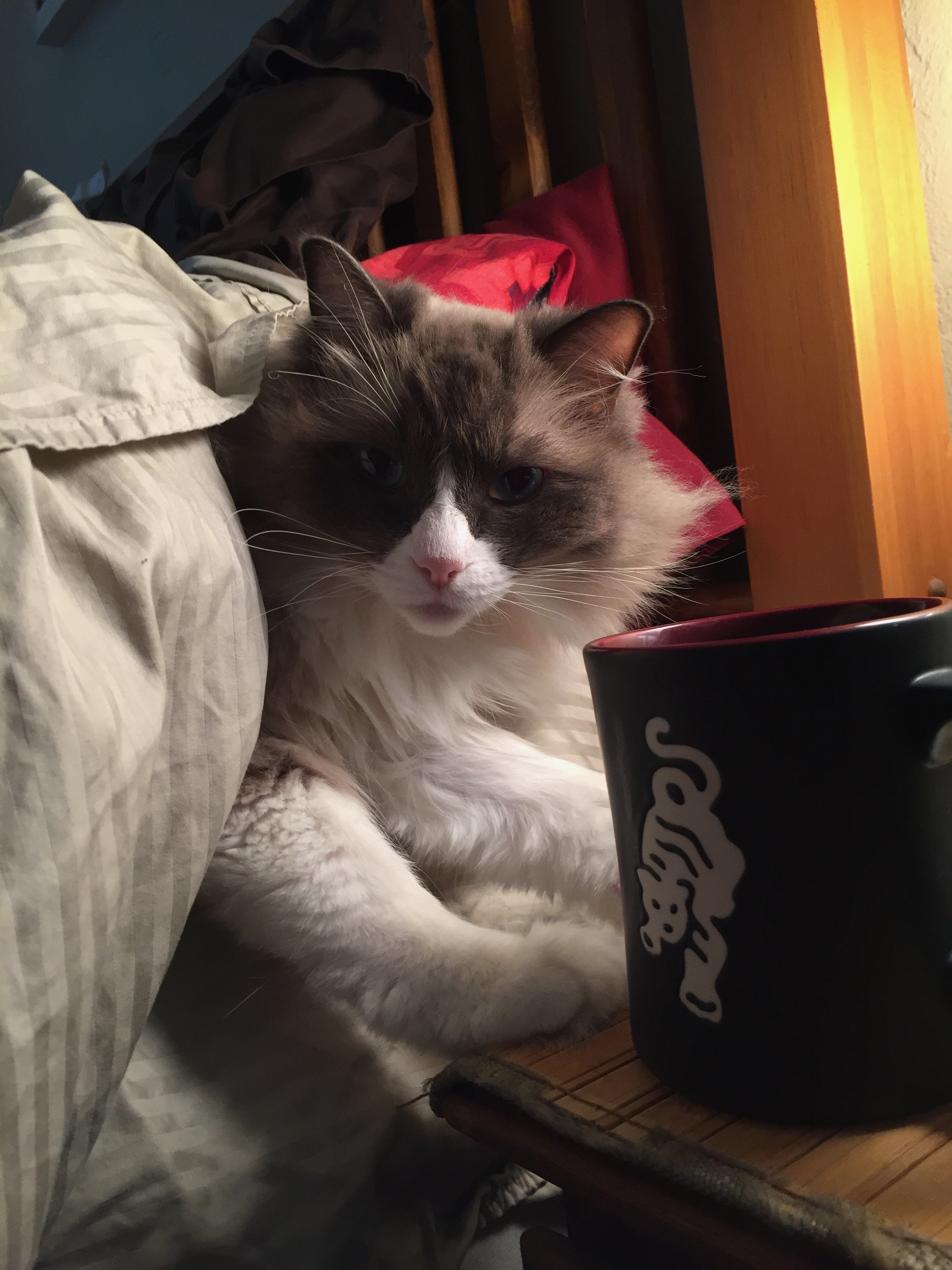
Yesterday I woke, and the world felt flattened out. The white pancake sky dropped beautiful snowflakes, but they were not for me. I felt the cool sheet beside me, the patch of bed our cat Andy used to warm with his furry bulk, kneading magnificently, then laying close beside me purring like a motor.
Andy Carpenter, June 10, 2008-January 2, 2019
Andy died on January 2nd, and we feel his absence. This morning, everything seemed dark and pointless. The fire inside me was out, just cold ashes. I missed Andy, but it was more than that. It was Australia, Iran, death, war, suffering, the climate crisis.
So, I did what needs to be done. Made coffee. Meditated. Got dressed. Breakfast. I forced myself to walk to the store for some groceries. On the trail through the woods, I didn’t stop to visit my tree, though I waved. I didn’t feel interested in life, didn’t feel my usual excitement about art, nature, friends, poetry.
I should be happy, I thought to myself: I have all of this time, and I don’t have to work until July. What a gift! But I couldn’t conjure up any energy, even though I had slept well. The art/sewing project was a stupid waste of time, and nothing seemed meaningful. I walked briskly, passing dogs cavorting in the snow while their owners chatted. I followed the flowing brown river.
At the store, I chose my items and lined up. The cashier was kind and friendly. She told me she was thinking of making grilled cheese sandwiches and tomato soup for lunch, perfect comfort food for the cold day. I smiled. I drank a cup of Christmas blend from the in-store Starbucks, gazing out of the window at the white sky.
Two men–store employees–sat across from me at separate tables. Each ate his lunch with his cell phone in front of him, scrolling busily as he wolfed down his food. Michael and I share a silly fantasy: we imagine that all of the folks who study their phones in public places are actually receiving instructions from their Masters about what to do next. Or perhaps from one Master. I laughed to myself about this and wished the two guys would put away their phones and have lunch together. Resist the Master!
And all of a sudden, I started to get interested in life again. I had a couple of ideas for “loss,” the next pennant in the series. I left the store and walked quickly home, my backpack bouncing as I strode along the snowy trail.
Was it the brisk walk in the cold, the exercise? Or the friendly interchange with the clerk? Was it caffeine? Humour? Or perhaps the combination of getting out for a walk, being among people, and consuming a psychoactive drug? In any case, I came home, cleaned house, then worked on my project. There is always a spark deep down inside. Sometimes I need to fan the embers.
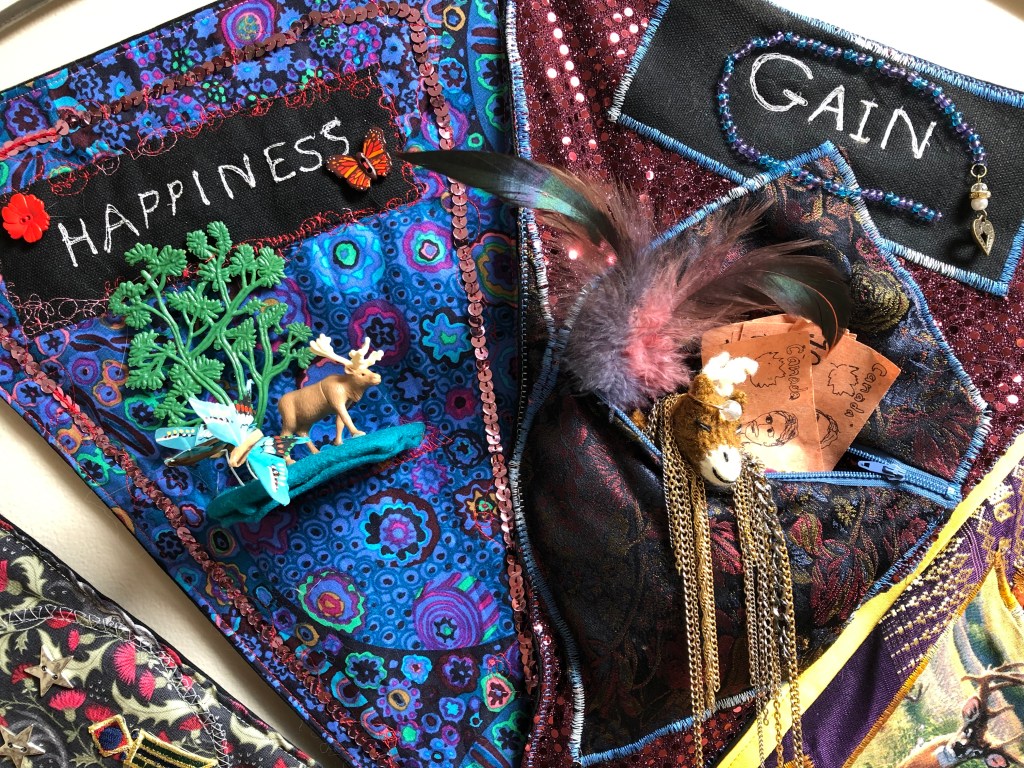
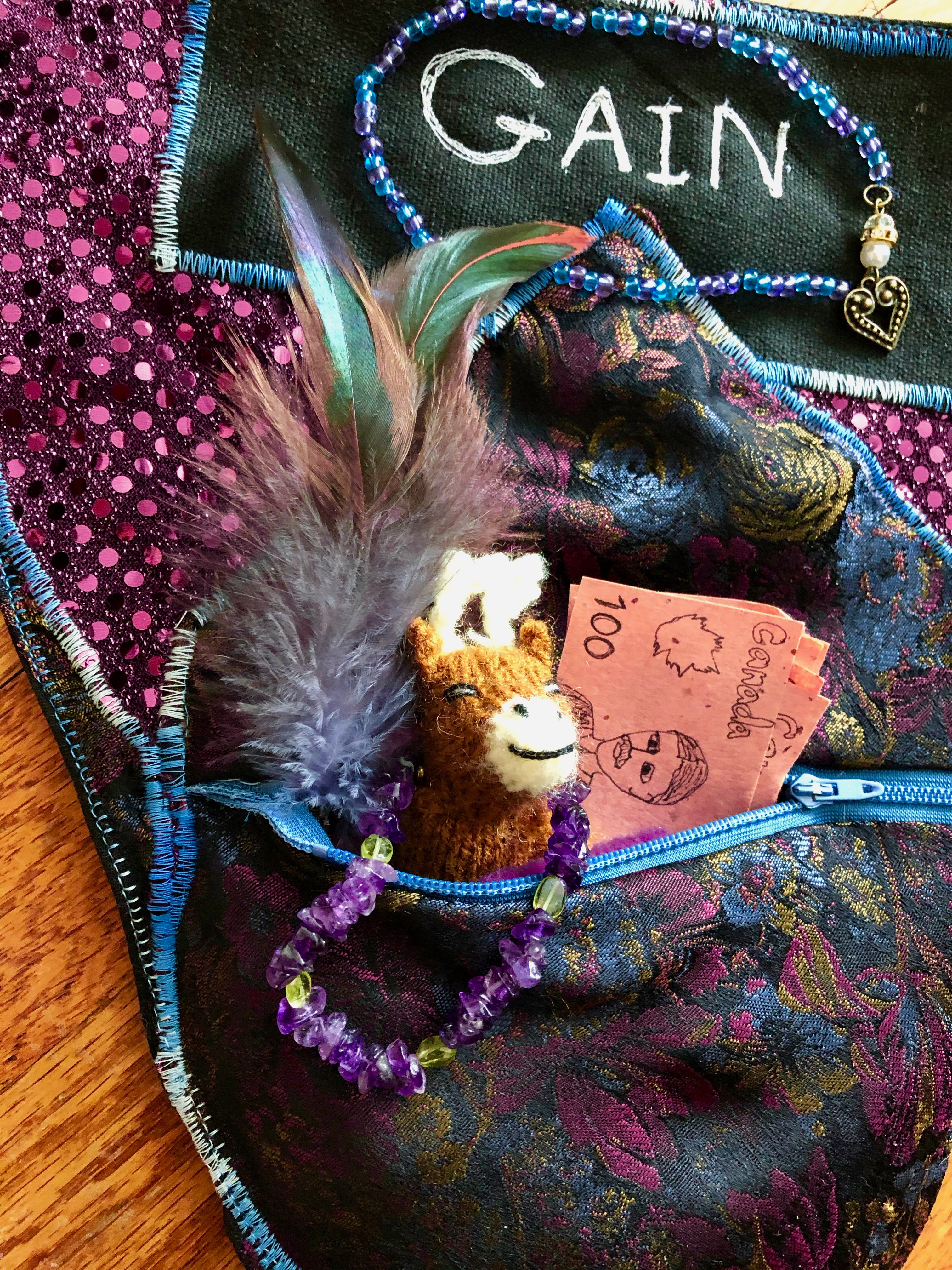
I finished the “Gain” pennant. Rainer Reindeer has made many gains in his life. He smiles smugly, proud of those gains. He lives surrounded by his wealth, cossetted by silk and sequins, beads and feathers. He keeps himself and his gains tightly zippered away from the world, trying to secure them against loss, but all is transitory, Rainer. Loss, you will see, is inevitable. . .























































 Two men–store employees–sat across from me at separate tables. Each ate his lunch with his cell phone in front of him, scrolling busily as he wolfed down his food. Michael and I share a silly fantasy: we imagine that all of the folks who study their phones in public places are actually receiving instructions from their Masters about what to do next. Or perhaps from one Master. I laughed to myself about this and wished the two guys would put away their phones and have lunch together. Resist the Master!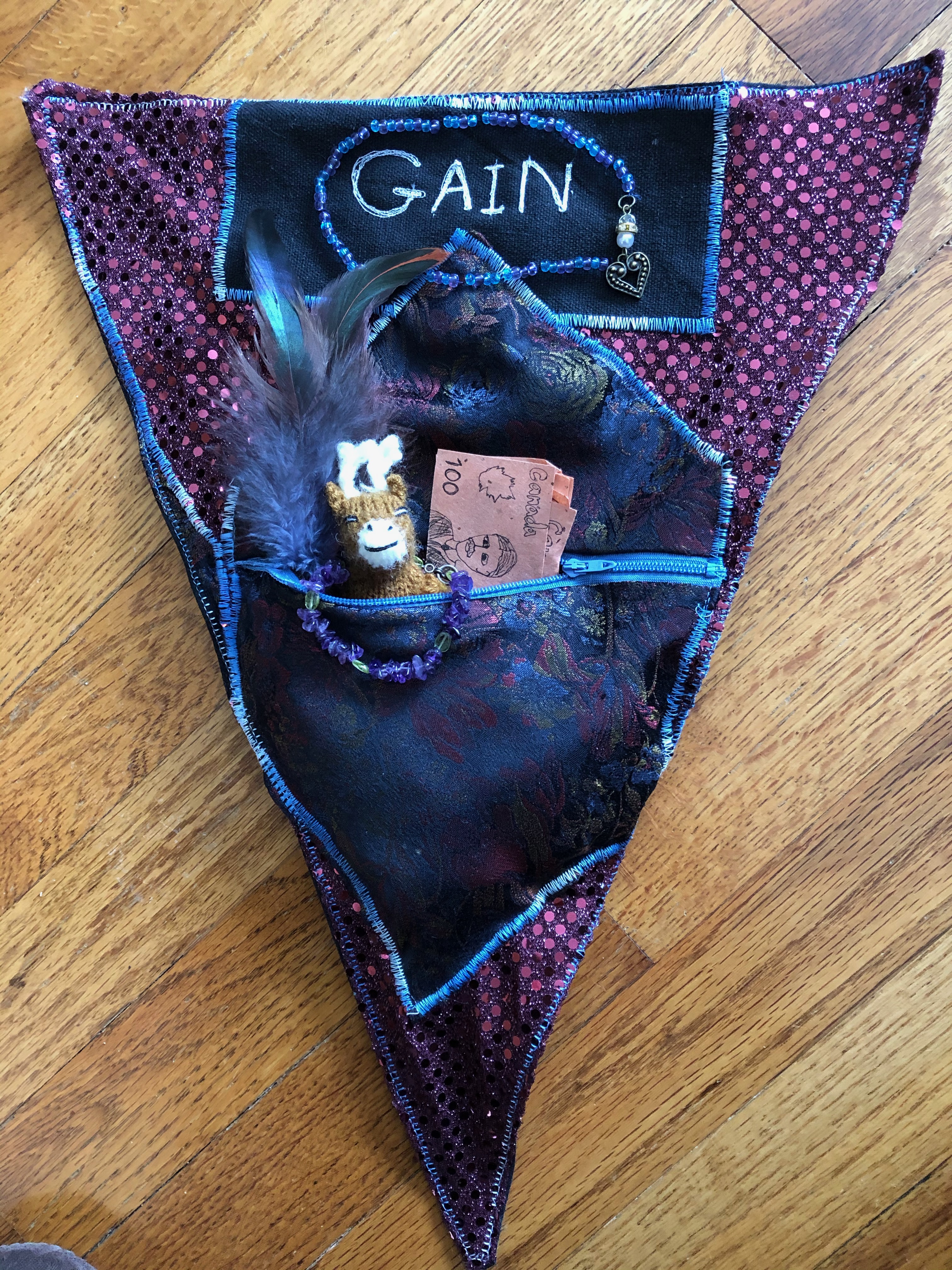
 Madeline Ruth Walker