A curse and a gift of ageing is a growing awareness of the ways I have been inauthentic in my life. Lately, I have become profoundly aware of the disconnection between my body and my mind. I have ignored my body for so long, shut it up into submission, taken it for granted. These pronouncements presume a Cartesian dualism, an assumption that mind and body are separate, and though I realize they are not, that is how I have felt in my life—my body and mind feel separate.
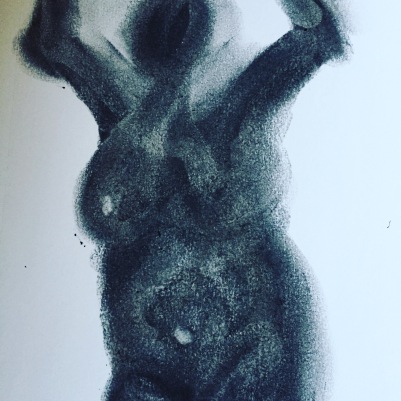
Two years ago I started a graphic memoir, Let me hear your body talk. It was my attempt to illustrate the life of my body from infancy to the present day. After a dozen or so pages, I stopped and let the project languish. My reason was that I was too clumsy an artist to render my ideas. But another reason I stopped was that as I worked through my childhood and teenage years, drawing and writing, I felt acutely uncomfortable with how I had regularly ignored my body’s signals. From emotional eating to having sex with somebody who repulsed me, to neglecting pain, to resisting the gut’s intuition. I had abused my body through various compulsions: I was addicted early on to the approval of others, and later to food, cigarettes, and booze. Never having learned how to honour my body as precious, I considered it as merely an appendage to my brain/mind, which I believed was more valuable.
Although I can’t speak for others, my memory is that as a family, we weren’t grounded in our bodies. Moving the body, appreciating the body, enjoying the body, listening to the body: these were not on the agenda when I was a child. Sports, exercise, or creative body expression were not encouraged or modelled by my parents. Sex was rarely discussed or mentioned, though it might have been alluded to. When I took up running in my late thirties, my mother commented, “You’re not overweight, so why? It can’t be good for you, jiggling around like that.” I suppose when I was very young, I lived shamelessly and happily in my skin, but I cannot remember. In our family, intellect was prized above all.
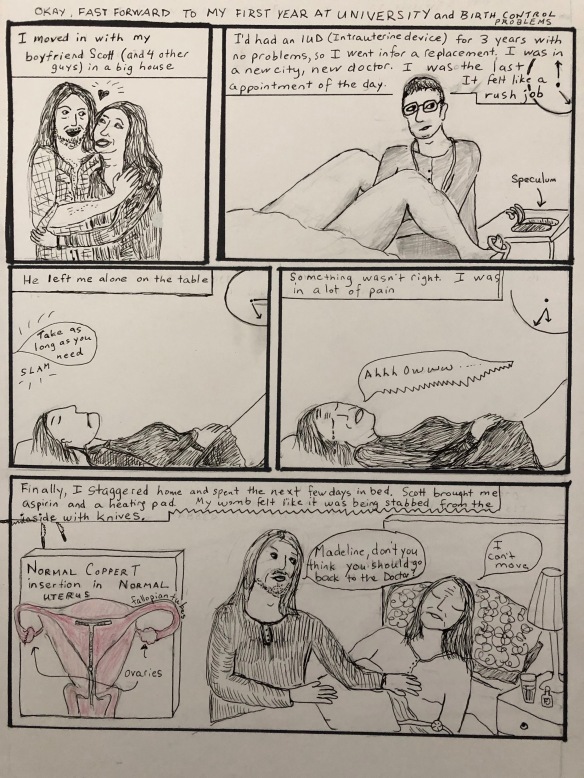
Of course, this is not to suggest my body has not been a source of bliss. Sex can be rapturous. . . the ruminating mind dissolves as every nerve ending sparkles and shimmers. Being pregnant, giving birth, breastfeeding: all gave me tremendous pleasure/transcendent pain and left me with gratitude, love, and respect for my body and its capacity. But as the excerpt from my memoir shows, as a young woman I tuned out my body’s sensations and needs. My people-pleasing antennae were turned way up; I wanted not to be a problem to others, so I suffered, often silently. I wanted to please the man I was with; my pleasure was secondary.

These days, I meditate daily. Although my thoughts quiet for minutes at a time, I still haven’t felt fully connected to my body. Looking to change this, I bought Reggie Ray’s book, The Awakening Body on somatic meditation. Ray provides instructions on six somatic meditations. One resonated more than the others: yin breathing. “The place of yin is in the lower belly, approximately a couple of inches below the navel and in about the middle of the body. . . In Taoist meditation, this place in the lower belly is known as the lower dan t’ien” (p. 67). Ray goes on to write that the lower dan t’ien’s role in the body “is the inner expression of the fundamental space of the cosmos, the original womb out of which all energy and life arise. It is the microcosmic expression of the same limitless reality we meet ‘outside’ in the earth at its infinite depth.” The concept of the “original womb” may sound inflated or unbelievable, and yet I immediately understood this concept because I had experienced the yin space before.
A few years ago, I had felt this space, an oval the size of a duck’s egg located about three inches below the navel, as a mysterious source of deep pleasure. At that time, I welcomed it, but I didn’t understand it. It would come to me late at night as I was drifting off to sleep, a pulsing sense of well-being in my whole body, but originating there at the body’s root—tingling pleasure that was not exactly sexual. A radiating pleasure-consciousness that felt rooted, centred, yet expansive. It’s hard to explain. As I said, it’s mysterious.
Lately, I have been doing yin breathing, breathing in and out through the lower dan t’ien and thereby, “roaming on the boundary between consciousness (the ego domain) and the unconscious (the deep Soma). As a result, my body consciousness may be shifting. Recently, we went to hear live jazz, the Amina Figarova Sextet, and I enjoyed music more than ever before. Instead of listening in my head, my whole body heard and felt. I enter the piano’s thrum, the saxophone’s sugarplum melodies, the drum’s silvery beats; I swallow the flute’s shivers and I become the tall brown bass, plucked. My body is a repository for sound and I can’t help but move to the rhythms. I fill with jazz colours, jazz feelings. Body and mind are one. Feels so good.

















 Bidding adieu to Cranbrook Ed, we crossed the border into Alberta and our sojourn to Head Smashed In Buffalo Jump. This world heritage site tells the story of the Blackfoot nation and their skilful and meticulously planned hunting process which drove herds of stampeding buffalo to their death over a carefully chosen cliff. Accessing the site from the west required us to drive over 30 km of gravel roads (we will come back to this shortly). We arrived in time to watch the dancing demonstrations, which were truly amazing, and were well explained by the emcee. The nobility, grace and skill of the dancers, combined with the dazzling ceremonial garb made for one continuous photo opportunity, and Madeline joined in a circle dance at the end.

 The exhibit spans five archeological levels and was beautifully illustrated. I found myself deeply humbled and moved by realizing that these peoples first used this buffalo jump site 6000 years ago. We are newcomers indeed! Everywhere like an echo or a refrain is the message that the sacred earth provides—and the realization that we are abusing her bounty.


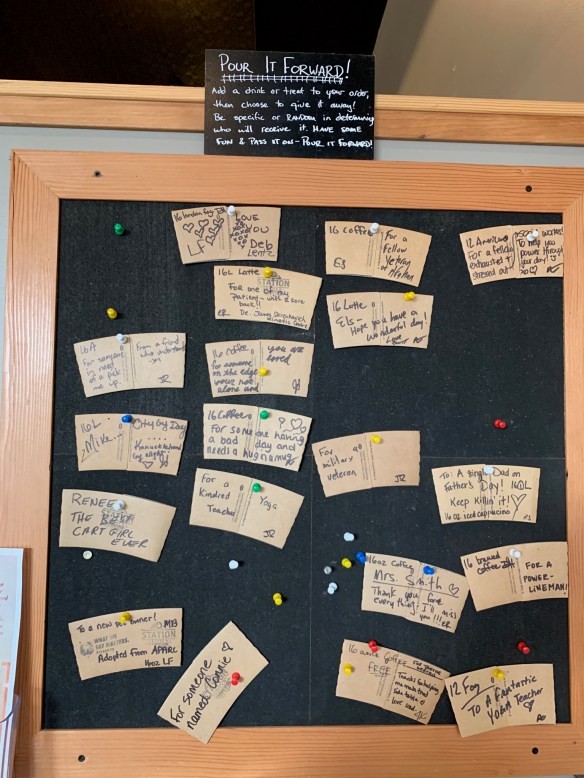


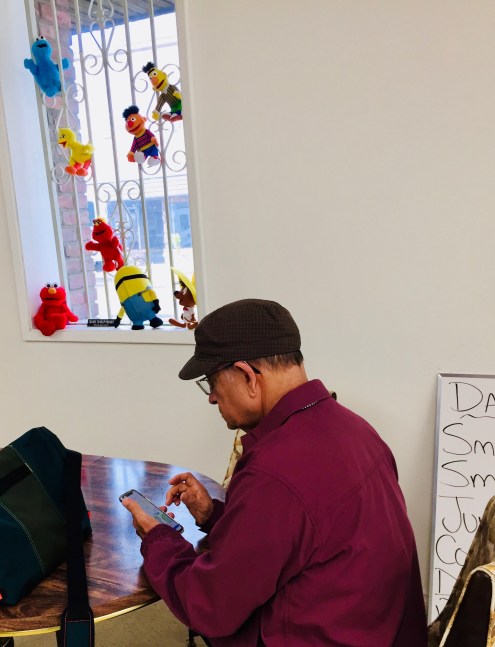
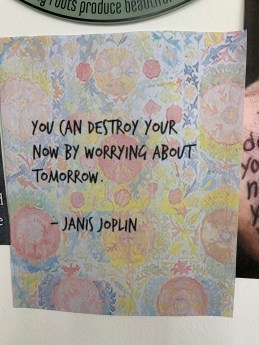 So we waited 20 minutes for the regular Folgers (not French press), admiring the huge almost empty room that, as Michael said, could house both a daycare centre and a bakery. In fact, there were toys and a drawing easel and other children’s stuff at the back. There were houseplants everywhere and inspirational sayings taped to one wall. The locals were engaged in a lively conversation and seemed to be enjoying their pie and coffee.