Slow rising stories


One autumn we went to visit my sister where she was cooking for a lodge in Cigarette Cove. Her partner ran the place and took visitors on fishing trips. We stayed for a few days, enjoying the remote location on the coast. The boys went fishing while I stayed with my sister in the warm kitchen, talking and laughing, catching up after months apart. I decided to make bread, but after all the preparation and long kneading, it didn’t rise. Disappointed, I threw the white blob atop a pile of food waste in a garbage can.

That night, we walked down the L-shaped dock to our rooms, the water lapping, the dogs running up and down among our legs, the moon laced with moving clouds. In the morning, we woke to the loons calling. When I went to make coffee in the big kitchen, the white blob had risen to a huge balloon of dough. My sister and I carefully removed it from the heap. I scraped off a few coffee grounds, punched it down, formed two loaves, let it rise again, and later that day we had the most delicious fresh bread for lunch.

My sister and I sometimes laugh about the legendary “garbage bread.” I love the slow riser, the late bloomer. The way that stories and bread and flowers surprise you when you least expect it. The way that people grow yeasty and bloomy in their late years, amazing us by finally doing what makes their hearts sing.

So I don’t need to rush the stories. Forget about the goal to have ten written by Christmas. Why?  I can let go of the expectations that academia trained in me: Always write to a deadline. Keep sending stuff out. Succumb to the pressure to publish. I don’t need to operate on that schedule. I can slow cook stories for months, if I want. Who cares?

These last few weeks I have been dipping into short stories by Raymond Carver (Where I’m Calling From) and Sharon Butala (Fever), two very different authors who do not satisfy. They leave me yearning and wondering. And yet in the wanting, there is such pleasure. They make me realize that I can let go of my need to have “closure” or  to “wrap up” my narratives. I was reminded of this as well when I saw more than one student in the Writing Centre this week asking for help in understanding Alice Munro’s “Gravel.” Wondering, feeling, not knowing—this is what stories by all three of these writers engender in me.

img_1091

From a story I am cooking now: The swimming pool came in and out of my shifting vision. White lights shimmered up through the blue water. The rest of the yard was in shadow. “Guys, c’mon,” I whispered behind me as we all scaled the concrete blocks like monkeys. Soft rock played through the open verandah door. “We’re going to get caught,” I said to the boys ascending behind me. And then suddenly I went over with a thud and red pain on the other side.

The boys leapt over to help me, saw the weird tilde of my white arm against the black grass. “Shit she broke it, I can tell by the swerve of it, look.” The other boy felt my arm near the elbow and I cried out in pain.

The soft rock clicked off and we heard clip clop steps from the pool deck. The walker was wearing heels. “What the hell is going on over here?” came a woman’s shrill voice. Soon she came flapping over to our huddle in a diaphanous gown, her perfumed head dunking into our circle of bodies. “You kids are trespassing, I should call the cops,” she cried again, trying to rouse the boys to lift their shaggy heads to look into her eyes. One of them, Pete, said, “Sorry, ma’am, but our friend has a broken arm. Can you call the ambulance, please?” Pete labored at enunciation, trying to pull up the sloppy vowels so he didn’t seem so wasted.

I was met at the hospital by my mother, who sat with me on a hard wooden bench in the hallway. “How could you be drinking? You’re under-aged. Like way under-aged! You’re 13, for god’s sake! Where the hell did you even get the booze? Who booted for you? I’ll wring their necks, the fuckers,” she spit-whispered into my ear. The crisp nurses clucked their disapproval as they passed. “No painkillers for you until the alcohol is out of your system,” said one when I groaned in agony. I was being punished. I could see it in their amused, accusing eyes.


Write what you don’t know

img_1075

“The writer is someone, who, embarking on a task, does not know what to do.” Donald Barthelme

I am reading Station Eleven by Emily St. Jean Mandel. Although I read Atwood’s MaddAddam trilogy, I haven’t really been curious about dystopian novels. But this book has me turning pages hungrily. One of Mandel’s themes is the persistence of the works of Shakespeare after the collapse of civilization. This got me thinking of what I know and what I don’t know and what to write about for story number eight.

What did Mandel know, I wondered, in order to write this so-readable novel? She looks blessedly young on the book’s back cover (b. 1979). Yet she writes confidently about Shakespeare, Toronto, BC’s Gulf Islands, pandemics, the life of an aging artist, multiple marriages, paramedicine, the end of civilization… and I am only on page 77. She mustn’t have “known” all this to start. Into the cauldron goes the writer’s research, experience, and imagination. Boil them together with a bit of newt’s eye and bat’s wing to produce fiction.

The old saw about “write what you know” keeps the writer in the silo of lived experience, starved for oxygen. You need all of it—research, imagination, experience, serendipity—to thrive as a fiction writer. One way to write yourself out of what you know and into what you don’t know is to use Peter Elbow’s loop writing methods described in Writing with Power. I decided to use the one where you sit down and write everything you think you know about a topic, then use that as fodder for a story. Mandel’s novel starts with a production of King Lear, so I thought why not use that play? I proceeded with interest.

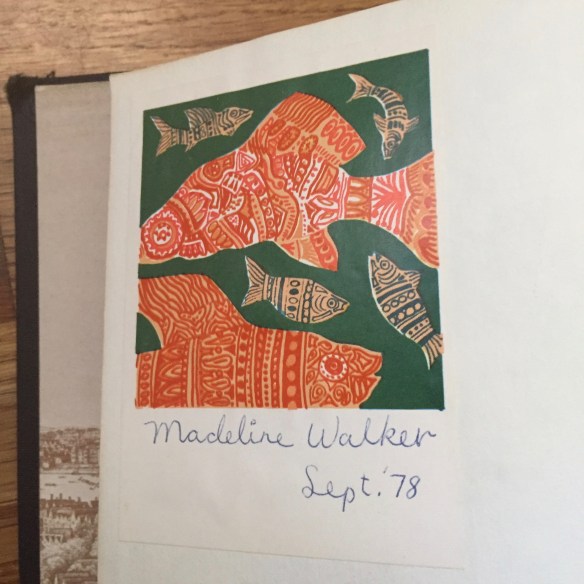
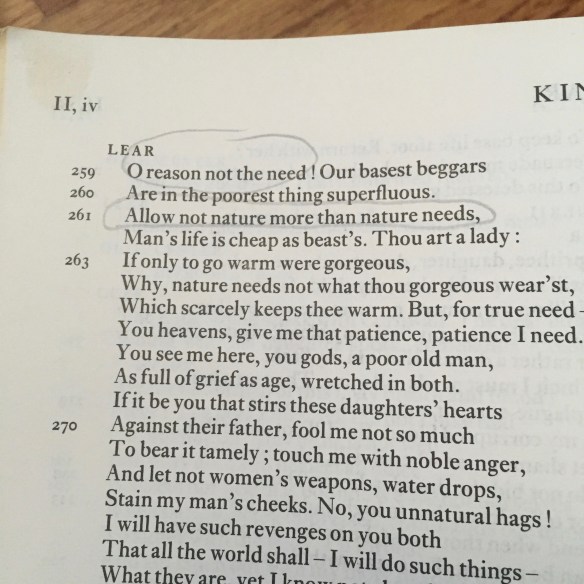
What do I know about King Lear? Well not much. I studied the play in the late seventies with the late great Northrop Frye. I still have my Pelican Complete Works of Shakespeare with my fish bookplate dated 1978, the year I took my sole Shakespeare class at University of Toronto, Victoria College. Frye was an eminent scholar, yet I remember little from the class. I do recall his long pauses as we waited with baited breath, our pens raised, ready to record his wisdom. And the only thing I remember from his lectures was not even about Shakespeare—it was about music. He said that Bach’s Mass in B Minor was surely the voice of God speaking through the composer. As for King Lear, well I remember only that I loved that play the best. A few of the most famous lines stick with me, and I notice as I page through the play that almost forty years ago, my twenty-year old self carefully circled in pencil any mention of nature, natural, and unnatural. I must have written an essay on that theme.

But really, what do I know of Lear? I remember my father joking with me, the youngest of his three daughters, that I was his Cordelia. A rather odd comparison, as I think of it now, but I loved his rueful laugh when he said it. Then there was my first husband’s favourite line from the play, “Reason not the need,” from Lear’s speech in Act 2, Scene 4:

O, reason not the need! Our basest beggars

Are in the poorest thing superfluous.

Allow not nature more than nature needs,

Man’s life’s as cheap as beast’s. Thou art a lady.

If only to go warm were gorgeous,

Why, nature needs not what thou gorgeous wear’st,

Which scarcely keeps thee warm. But, for true need—

My then-husband’s occasional invocation of that line has stayed with me these many years. When frugality became a constraint, he would implore, “reason not the need.” Let us not reduce our lives to need, to scrape by on the drab thrift store clothes, to make black bean soup again. Even beggars need a bit of splurge and splendor. Let’s treat ourselves. You only live once.

But there you go. What do I know of King Lear? A long ago reading for a Shakespeare class almost forty years ago. Frye’s wavering voice. A remembered association from my father’s mouth that cast me, in jest, as his Cordelia. A line spoken by my ex-husband that reverberates still. Reason not the need. And a bleak sadness when I think of Lear, a “poor, bare, forked animal” on the heath.

It was an interesting exercise. I really don’t know much about Lear. An embarrassingly small amount of material, in fact. But I was able to gather enough together to start. I wrote what I know, and that will lead me into what I don’t know. A few shoots that might sprout a story that is more interesting than my experience. Perhaps research will lead to a character based on Dr. Frye. Perhaps a re-reading of King Lear that may lead to something. Or another listen to Bach’s Mass in B Minor that might be fruitful. Or perhaps I can write a story with one character who always reasons the need and another who resists that dictum. Or a contemporary father who sees his daughters as modern-day versions of Goneril, Regan, and Cordelia, and those joking nicknames become more real than he ever intended. So many stories waiting to be written.

img_1077I do not know what to do, exactly (see Barthelme), but I know that limiting myself to writing only what I know is the equivalent of Goneril and Reagan’s telling their father, you don’t really need all that finery, that retinue. I join Lear in saying, “reason not the need.” Let me read, research, imagine. Let me grab from a cornucopia of ideas, thoughts, books, facts, art, beauty, and experiences to make stories. Here I go into story number eight. I’ll report back later.


The work wants to be made


I usually write about reading and writing, but today I want to expand and talk about other stuff as well—all the sources that have been sustaining me through this horrible summer. Summer of accidents, death, sadness, and grief.

Reading. I am reading Jonathan Lethem’s Motherless Brooklyn. I don’t remember meeting a more wonderful narrator—orphan-boy detective Lionel with Tourette’s syndrome.   His verbal and physical tics lift this detective story out of the ordinary. Lethem gives a master class in first person narration. I am less interested in the story than in the brill narration.

Writing. I finished my seventh story. My goal is still 10. I like this one, though I don’t know if any of them are any good. Sometimes ideas emerge from a deep well I didn’t know I had access too. Sometimes the process feels like automatic writing. . . “where is this coming from?” As Elizabeth Gilbert says in Big Magic, “The work wants to be made, and it wants to be made through you.” I am not even thinking as I write. The words just come out.

The latest, “Cones and Bottles” is about a woman Angela with a shitty childhood encountering a girl named Apeshit who is in the midst of her own shitty childhood. Angela confronts some of her demons around addiction and control. Ice cream cones and chocolate milk bottles figure in the story. Angela’s new neighbours invite her over for a barbecue.

At one point, as she carefully negotiated her sawdust hamburger, Angela ventured a question, “So is Ape short for April?”

“Ha, no, actually. That’s a good story,” answered Edie, licking mustard off her pudgy fingers. Angela noticed she had letters inexpertly tattooed on each finger of her left hand, just above the knuckles: P-A-R-T-Y. “Her real name is Mariah, you know, after the singer.” And then she interjected a phrase of a Carey song. “Touch my baw-dy, put me on the fl-o-o-o-o-r,” Edie crooned in a scratchy voice, pretending her hot dog was a mic. “But when she was little and we were trying to toilet train her, she used to shit on the floor, then start throwing it at us. I kid you not. Just like the apes going apeshit in the zoo. So we started calling her Apeshit, then Ape for short.”

Hen chimed in. “She still does it from time to time.”

“No kidding,” responded Angie, her flesh crawling from this description. She didn’t want to keep that image in her mind – the kid scooping soft turds from the floor and lobbing them at her parents. She imagined the damage done to the last apartment: smelly brown stains on carpets and walls.

* * *

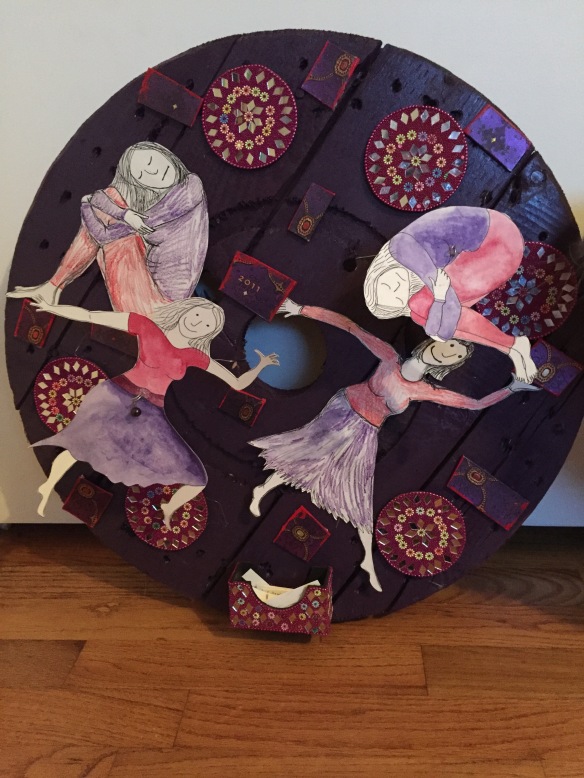
Art making. I found the wooden end of an electrical spool by the side of the road, around 22 inches in diameter. I brought it home and created “Shimmer” a mixed media piece with paper, glue, watercolour, acrylic, spraypaint, coloured pencil, straws, duct tape, wire, found objects. Shimmer has two women who spin for you (well four women, but only two can spin). One expands into dance, the other has contracted into solitude. Jewels sparkle here and there from found objects. There is a little glittery holder for my own version of angel cards at the bottom. This may not be finished.

Spin the girl, pick a card. Shimmer away/ Contract/ Expand/ Change/Everything changes all the time/ pick a card any card/ you never know what life holds for you.

Sewing: Working on “full moon rising quilt.” I love the batiks. I am learning to sew curves, sometimes tricky. This quilt is for a friend that I love.

Painting and writing, sewing and drawing, reading and thinking, dreaming and loving, crying and hugging. These all sustain me during the summer of pain.

P.S. would you like me to pick a card for you? Reply below. I’ll pick it and tell you what it says. IMG_1052


Learning the craft: first person first

I have been enjoying Bringing the Devil to His Knees: The Craft of Fiction and the Writing Life. The first essay is Richard Russo’s defence of omniscience, and he is very persuasive in showing writers the advantages of omniscience with examples from John Steinbeck and Jon Hassler (and others).

Okay, I am convinced. Problem is, it takes time, doesn’t it? To build to omniscience?

I have completed six stories now, and two out of six are third person. One of the third person narrations is close (we go into the thoughts of one of the characters), and the other, I suppose is “omniscient.” But that one felt very weird to write.  First person narration comes naturally, like a river flowing through me.  Third person omniscient feels distant from me, like I have stepped out of myself.  The disembodiment perhaps brings new powers over time.

I would like to write more in the third person, but I want to see if I can keep the energy of the first person and translate it into third person narration.  This feels like a process that cannot be rushed.

After my book of poems was published, I felt squeamish about it–that I was too confessional, too much of me was exposed.  And yet there is energy there, albeit awkward energy. There is soul. In writing fiction, I need to transmute that richness of my voice, my experience, into the more subtle delineations of the third person narrator.

I started a new full-time job on July 18 after four months “between jobs.” I realize the job takes a lot out of me, though I love it, and I am so grateful for employment that fits my skills and my interests.  I remain committed to my story writing, to learning the craft, to carving out some time each morning. I arranged a 9:30 start so I can fit in my writing time. IMG_0435The blog, however, will be more erratic.
In closing, I offer two paragraphs from my stories, one from a first person narration, the other from my most “omniscient” narrator:

I sat in the kitchen nook, feeling quite proprietorial by now. I liked this corner. It felt safe. The kitchen table was strewn with used coffee cups, a colouring book and crayons, a stack of library books in one corner. The other adults had things in hand—there was nothing to do. My son was taken care of. I liked the coffee made from beans from a local roastery. It was strong with real cream. I liked the big panel of windows behind me. I could turn my head and see the narrow yard with a rusty play gym and the compost pile, home to happy rats. I could see the sagging homemade cake perched atop the fridge, the goody bags lined up on the top shelf in the Ikea-styled kitchen. The sun had come out and I felt the warmth on my neck and a pleasant breeze from the open window beside me. The kids’ voices seemed as if they were coming from a distant country in another language. I liked the feel of the smooth cushion under my bare thighs.

Rinaldo unbuttoned the top two buttons of his madras shirt, lifted her small hand, and leaning over the bed, placed it on his bare chest, atop the layer of curly, sweaty hair. “Here, Mum, right here.” Ainslie’s thin arm was fully extended, the hand had disappeared into her son’s open shirt. His large hand covered hers, pinning it to his heart, the chest hair protruding from around the hand sandwich. He leaned over her, his other arm steadying his big leaning body so he wouldn’t fall into the bed. On this hot July day, he was wearing cargo shorts and his trunk-like thighs, also covered with thick dark hair, were pressed up against the wooden rail at the side of the bed. Ainslie opened her eyes, surprised but not alarmed by this new position she was in. Mother and son did not speak, but the room was not silent. The sound of Rinaldo’s heart seemed to fill the space, BA-doom, BA-doom, BA-doom. Ainslie felt the reverberations through her body.


Work mentioned

Baxter, Charles and Peter Turchi, Eds. Bringing the Devil to His Knees: The Craft of Fiction and the Writing Life. Ann Arbor: The University of Michigan Press, 2004.


When we were very young

I have been planning and musing over a short story idea, and one of the things I wish to implement is a wise narrating voice of a male ornithologist recalling his boyhood experiences. I thought of Rascal (1963), that beautifully written and illustrated memoir by Sterling North. The story covers one year (May 1918-May 1919) in the author’s life growing up in Wisconsin with his father and many pets, specifically his pet raccoon, Rascal. I was given the abridged version titled Little Rascal (probably for younger children), a red hardcover with a sketch of a raccoon embossed in black on the lower right corner of the book. There were more illustrations in that version than in the original Rascal: Gorgeous “scratchboard” illustrations by John Schoenherr that—although rendered only in black and white—glow with life and light.

I have kept some books from both my childhood and my children’s. But alas, not that book. I searched the shelves high and low. Although it was a favourite, I must have gotten rid of it during one of the many moving purges over the years. I took Rascal: A Memoir of a Better Era out of the curriculum library here at the University, and I’ve been enjoying reading the full version of the story.

North’s writing is spare and lovely. He explains the natural world simply, for the young reader, but without talking down to his junior audience. Indeed, the book captures the attention of readers of all ages. When the boy and his father realize Rascal, the pet raccoon, will need eventually to be caged because he’s developed a taste for sweet corn, Sterling’s father plans a trip in Northern Wisconsin, near Lake Superior for the three of them: father, son, and raccoon.

North describes this childhood idyll, two weeks of camping and fishing in the woods. One day, Sterling and Rascal make a discovery in their rambles along a river:

“Then, half a mile farther upstream, we came upon it suddenly—a little lake which was the very source, as round as a big drop of dew and as clear. Its shores were of clean sand and gravel, and it was cupped among low hills, forested with evergreens, with several white birches standing in sharp relief against this background of dark firs.

There were water lilies in the shallows, their floating pads large enough for little frogs to sit on, and blossoms the size of saucers, where green and scarlet dragonflies held court.” (93-4).

My experience of reading this book again is that I revert to the dreamy, safe space of my child self’s imagination. In these imaginary green spaces, I once felt that the world was whole and benign.

IMG_0949

Bookmark by Madeline Walker

North does not adorn his descriptions with multisyllabic adjectives; he sticks to plain words like “little” and “big,” “low” and “sharp,” and colour words “green and scarlet.” He welcomed me into this warm world when I was very young, and I love returning there.

There is a lake just a twenty-minute car ride from where I live. Recently my friend and I took a dip there. The water lilies had just emerged, pure and white amidst lacquered pads. As we slid into the cool water, we could see an eagle take flight from an old log across the small lake. He thrust his big wings, scooped the air, and was lifted up, up. His white head sparkled against the blue sky. Dark conifers surrounded us, and the dragonflies were dancing, just as they did one hundred years ago for Sterling North.

Work cited

North, Sterling. Rascal: A Memoir of a Better Era. New York, NY: E.P. Dutton & Co., 1963.


Random acts of reading: Little free libraries and green-coloured glasses

The inter-art subject was fun, but the constraint became too constraining (I was searching too hard to find perfect material). So this week I am moving to another subject—the gems acquired through random acts of reading.

I have always enjoyed wandering around libraries or my own library and picking a book at random (often with eyes closed), opening it wherever, and seeing what I get.* Perhaps this practice is a secular version of Bibliomancy, where a sacred book is balanced on its spine, allowed to fall open, and a passage selected with one’s eyes closed. My aim in this practice is not spiritual, but it is purposeful: I do these random acts of reading with the intention of finding some serendipitous truth or significance in the words I land on. As Swedish detective Kurt Wallender says in the marvelous PBS series “there are no coincidences.”

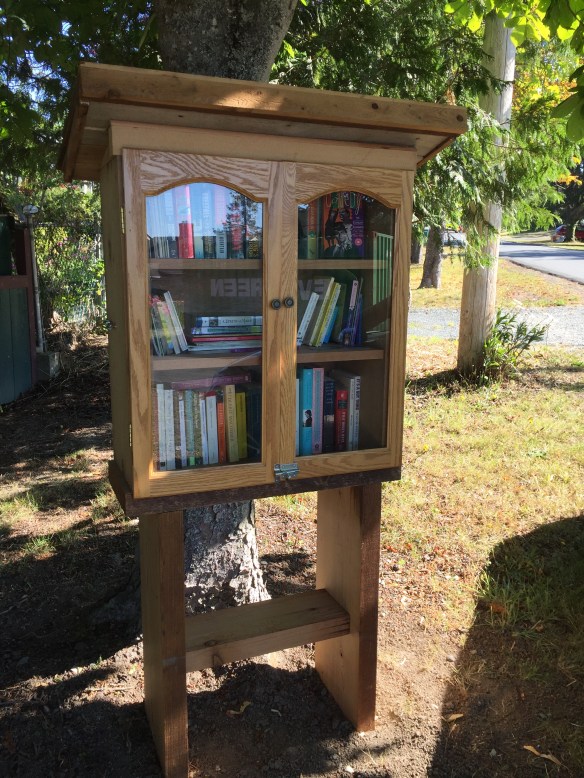
This week I enjoyed wandering around my neighbourhood, treasuring the last weeks of leisure (my new job begins July 18). We have at least three little free libraries in a five-block radius of our house.

I passed the newest and most elegant of the three mini libraries a few days ago and chose a couple of books. The following day, I dropped by the glass-doored cabinet and replenished the library’s supply with two books I have enjoyed and am ready to hand on: John Updike’s, The Beauty of the Lilies and Rachel Naomi Remen’s, Kitchen Table Wisdom.

One of the books I took was Anthony Trollope’s Early Short Stories. I enjoyed reading Trollope’s Barsetshire series in my twenties—they are highly addictive. But I didn’t know him as a story writer. As I am now writing stories, I thought I would explore his shorter fictions.

I opened the book randomly and started to read “La Mère Bauche.” I found the plot grim—a sixtyish stern mother (proprietress of a hotel) prevents her adult son from marrying his childhood sweetheart, and coerces the young woman (an orphan) to marry, instead, a fifty-year-old one-legged man. The young maid subsequently kills herself rather than submit to the man. The moral, I suppose, is that one shouldn’t meddle in the affairs of others: La Mère Bauche “never again laid down laws for the management of anyone” (90). Apparently Harper’s Magazine, who had commissioned the piece, hated it and never published it. I can see why.

As someone trying to learn the craft of fiction, I found more interesting than this nineteenth-century plot a physical detail of La Mère Bauche that carries symbolic weight. We are told in an early description of La Mère that “her eyebrows were large and bushy, but those alone would not have given her face that look of indomitable sternness which it possessed. Her eyebrows were serious in their effect, but not so serious as the pair of green spectacles which she always wore under them. It was thought by those who had analyzed the subject that the great secret of Madame Bauche’s power lay in her green spectacles” (66).

Madame’s green spectacles are referred to again at strategic moments. When the girl, Marie, beseeches her benefactress to consider her love for Madame’s son, “Madame Bauche’s spectacles remained unmoved; but not her heart” (72). Later, when angry with Marie, Madame is ready to carry out “all the threats conveyed by those terrible spectacles,” and an “angry fire glimmered through the green glasses” (p. 83).

At one point, those green spectacles take on a life of their own. When Marie closets herself in her room to weep after the wedding and refuses to leave, “twice did the green spectacles leave the room, covering eyes which also were not dry” (89). And Madame begins to wonder if she had perhaps done the wrong thing in insisting on this marriage.

Trollope uses the detail of the green spectacles judiciously. He doesn’t hammer away at the symbolism. Only much later did I wonder: If cheerful optimistic folks are said to see life through rose-coloured glasses, perhaps Madame’s green glasses illustrate her view of the world through the lens of jealousy and possessiveness. She must have her son all to herself and in clinging to him, she ruins four lives. If the glasses are the great secret of Madame’s power, they are also the secret of her tragic life. The glasses prevent her from following her compassionate heart.

This was a good story for me to learn about using character detail in a story. As David Lodge says, “all description in fiction is highly selective; its basic rhetorical technique is synecdoche, the part standing in for the whole” (68). Trollope’s careful use of green spectacles is a great example.

Trollope’s story had another message for me about the dangers of mothers clinging to their sons. I said good-bye to my youngest son on Wednesday. Two months shy of 22, he is off for an adventure, destination Halifax, with just a backpack and his dreams. For that good-bye, I put on my rose-coloured glasses and I am determined to keep them on.

*I was charmed to see that Ian Brown, in his memoir Sixty, enjoys the same practice of opening books, reading randomly, and finding treasure.

IMG_0915 (1)

Works Cited

Lodge, David. The Art of Fiction. London, England: Penguin Books, 1992.

Trollope, Anthony. 1859. “La Mère Bauche.” Early Short Stories. Oxford: Oxford University Press, 1994.


Inter-Art: Highbrow/ lowbrow reading

383228


I remember taking a required class on bibliography in grad school. That was fifteen years ago. Our prof, young and bold, had us dissect a book right down to its spine. That exercise felt sacrilegious—deface a book?

Another activity was to list all the books and other material we’d recently read that we didn’t mind people knowing about in one column, then write that other list—the texts we felt squirmy or embarrassed about—in a second column. I listed in column one all of the classics or books considered “literature” I had recently finished. And in column two: Maeve Binchy’s novels. I felt uncomfortable admitting that I loved curling up with her squishy sentimental fictions and a box of Kleenex. That was like admitting I enjoyed O Henry bars (Binchy) more than Green & Black’s organic dark chocolate (James Joyce). When I met my husband he was apologetic about listening to John Grisham audiobooks. My mother’s love for Rex Stout is something she hides in the basement while all of the history and art history books have pride of place in the living room. These prejudices are deep-seated: Are we worried about appearing dumb? Undiscerning?

Book snobbery is captured at a gut level in my favourite Margaret Drabble short story, “The Merry Widow.”

In tight third person, Drabble writes about her “merry widow” Elsa. Elsa’s husband Philip has recently died, and she feels liberated. She is looking forward to a holiday in Dorset at a cottage alone. The holiday was planned when Philip was still alive. She would have suffered through it, under his critical eye, but now the getaway has an enchanting aspect to it. It will be her first vacation without him after decades of unhappy marriage:

“She had been absolutely fed up to the back teeth with Philip, she said to herself, gritting those teeth tightly as she wrote to increase the standing order for oil delivery, as she rang the plumber to arrange to have a shower attachment fitted to the bathroom tap. Why on earth shouldn’t she have a shower attachment, at her age, with her pension and savings? Her jaw ached with retrospective anger. How mean he had become, how querulous, how determined to thwart every pleasure, to interfere with every friendship.” (p. 152)

For her trip, Elsa packs her bird book, her butterfly book, her flower book, her Pevsner, and her Margery Allingham omnibus. One of her greatest pleasures is to identify birds, butterflies, and flowers, a hobby that had irritated Philip no end. “It had seemed a harmless pleasure, until Philip attacked it. Harmless, innocent, and proper for the wife of a university lecturer. An interest in flowers and butterflies. What could be wrong with that? By some sleight of reasoning he had made it seem sinister, joyless, life-denying.” (p. 155). Drabble is so good at showing how a critical partner can grind his spouse down to a stub through continual undermining, sarcasm, and mockery. The belittled spouse loses all confidence and, ultimately, loses delight in life.

But back to my topic: categorizing some texts as “lowbrow.” Elsa loves the little Dorset holiday cottage and the “modest wilderness” around her. She enjoys her solitude, her wanderings and walks, a gin and tonic in the evenings. She reads and watches the long-tailed finches, relishing the luxury of answering to nobody, of doing exactly what she wants. She revels in her own company, realizing she had been crushed under Philip for a very long time.

“Philip, she reflected…would not have approved her choice of novel. She was reading a Margery Allingham omnibus, nostalgically, pointlessly. Philip had despised detective stories. He had mocked her pleasure in them. And indeed they were a bit silly, but that was the point of them. Yes, that was the point. After lunch, she took Margery Allingham into the paddock, with a rug and her sunhat, and lay under an apple tree.” (p. 161)

Throughout the story, Elsa reflects on how Philip would have judged her choices, and the reflection makes her relieved and happy that she is no longer under his surveillance. She doesn’t have to defend her reading preferences any longer—for example, “pointless” and pleasurable detective stories.

After Philip’s death, she cancelled his subscriptions to scholarly periodicals, which comprised his reading matter.

Now she could relax: eat what she wanted, take long hot showers, watch what she liked on TV, listen to Radio 2, identify flowers and birds, look at the local architecture, indulge in Margery Allingham’s entertaining stories. Philip’s snobbery and psychological abuse died along with him, and she feels suddenly extricated from under the shadow that greyed out her life. (Another shadow emerges in the story, but I won’t spoil it for you.)

That two-column exercise doesn’t work for me today: I can write only one eclectic list—the books I am reading. I don’t need to hide anything; I don’t need anybody’s approval. I hope the same goes for you.

cover-ADayintheLifeSmilingWoman

Drabble, M. (2012). The merry widow. In A day in the life of a smiling woman: Complete short stories (pp. 151-168). New York, NY: Houghton Mifflin Harcourt Publishing Co.