Becoming intimate with carnations and truth

In mid-December, I bought a green glass jug in a second-hand store, half price. My aspiration was to make a beautiful winter bouquet for my friend, Lillian. I bought a bunch of silver dollar eucalyptus and two dozen white carnations. I envisioned white wintry bursts among the silvery green, but the more I trimmed and mixed the carnations with the stems of eucalyptus, the sillier and more incoherent it looked. I took basic Ikebana but still haven’t a clue how to make flowers and plants look good. 

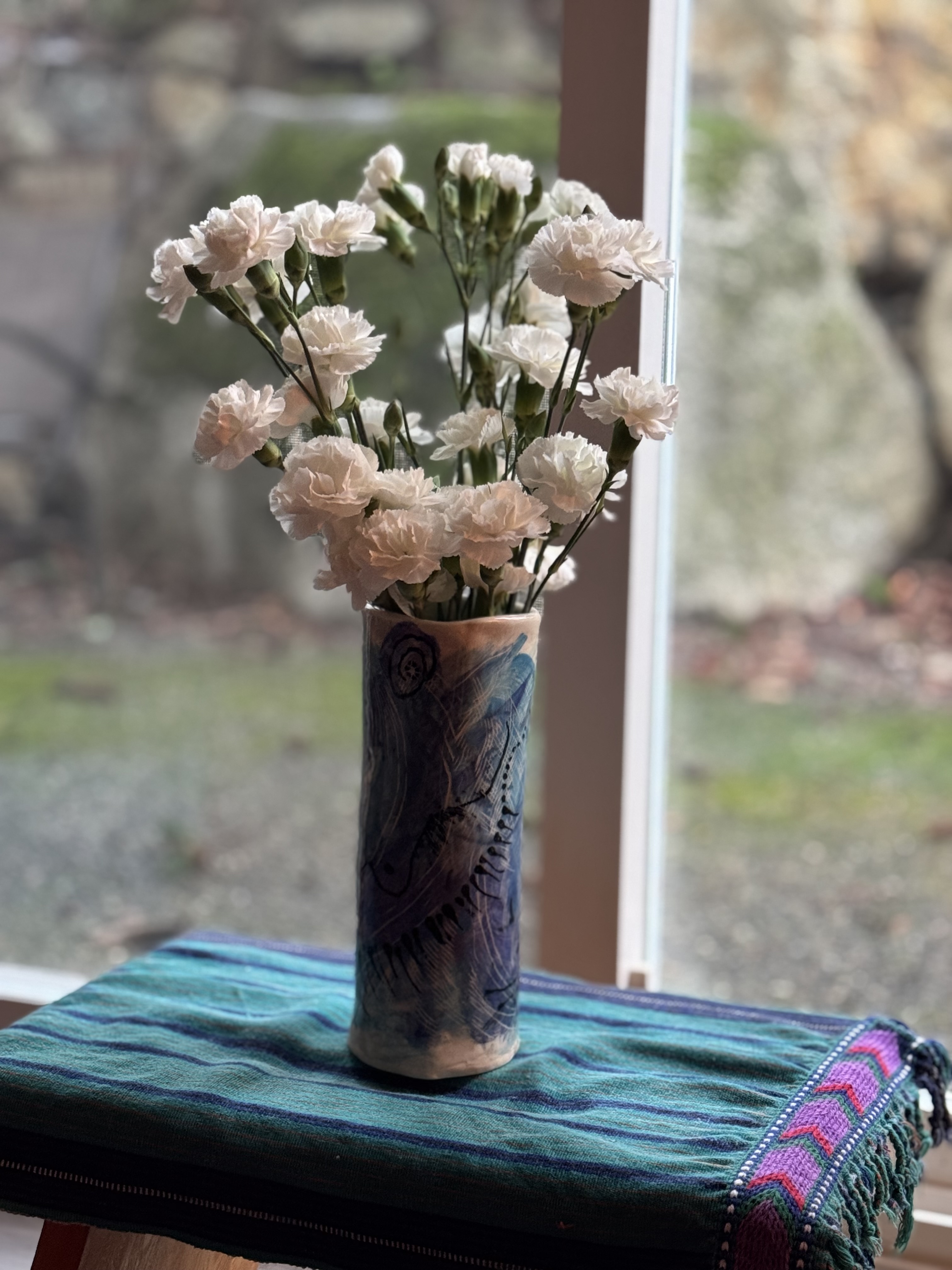
Finally, I used only the eucalyptus, splayed out in a free-fall arrangement. I attached a few small, red shiny balls to the stems, and the effect, I hope, was Christmassy and charming, if a bit messy. Lillian said she loved it. (But what could she say, really?) I was going to throw out the unused carnations, but it seemed such a waste, so I put them in a white and blue vase and placed it in my study on a low stool covered with a blue-green cloth. 

I don’t like carnations, or I didn’t think that I did. I’ve seen too many sad, slender bunches wrapped in cellophane at the mini-mart next to the hospital. They make me think of last-minute purchases for the death bed, cheap flowers that outlive the person you visited. They seem so tight, orthodox, banal. Whorls of perfect, serrated petals, every bloom the same.

But they’ve grown on me. As I spend hours in their presence, they’ve become real. You could say I’ve become intimate with them. I sit here now, the last day of the year, gazing at their fresh ordinariness. The carnation is the sturdy, faithful flower that will see you through. Perhaps they are flower of the year: commonplace as canned milk. Carnations are one-foot-in-front-of-the-other flowers. Quotidian flowers. Bread-and-butter blooms. See you through the hardest times. Last for weeks. Nothing special. 
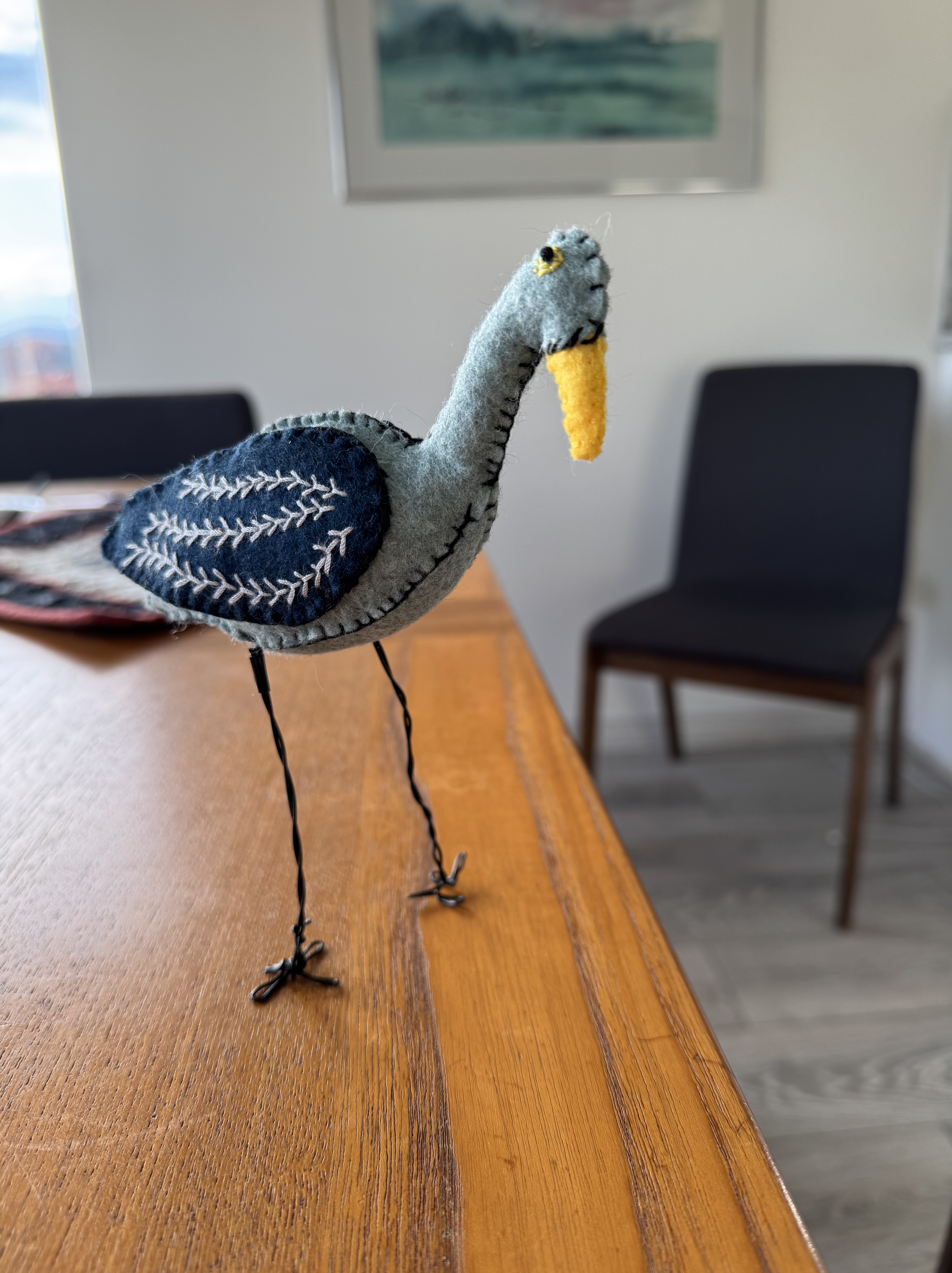
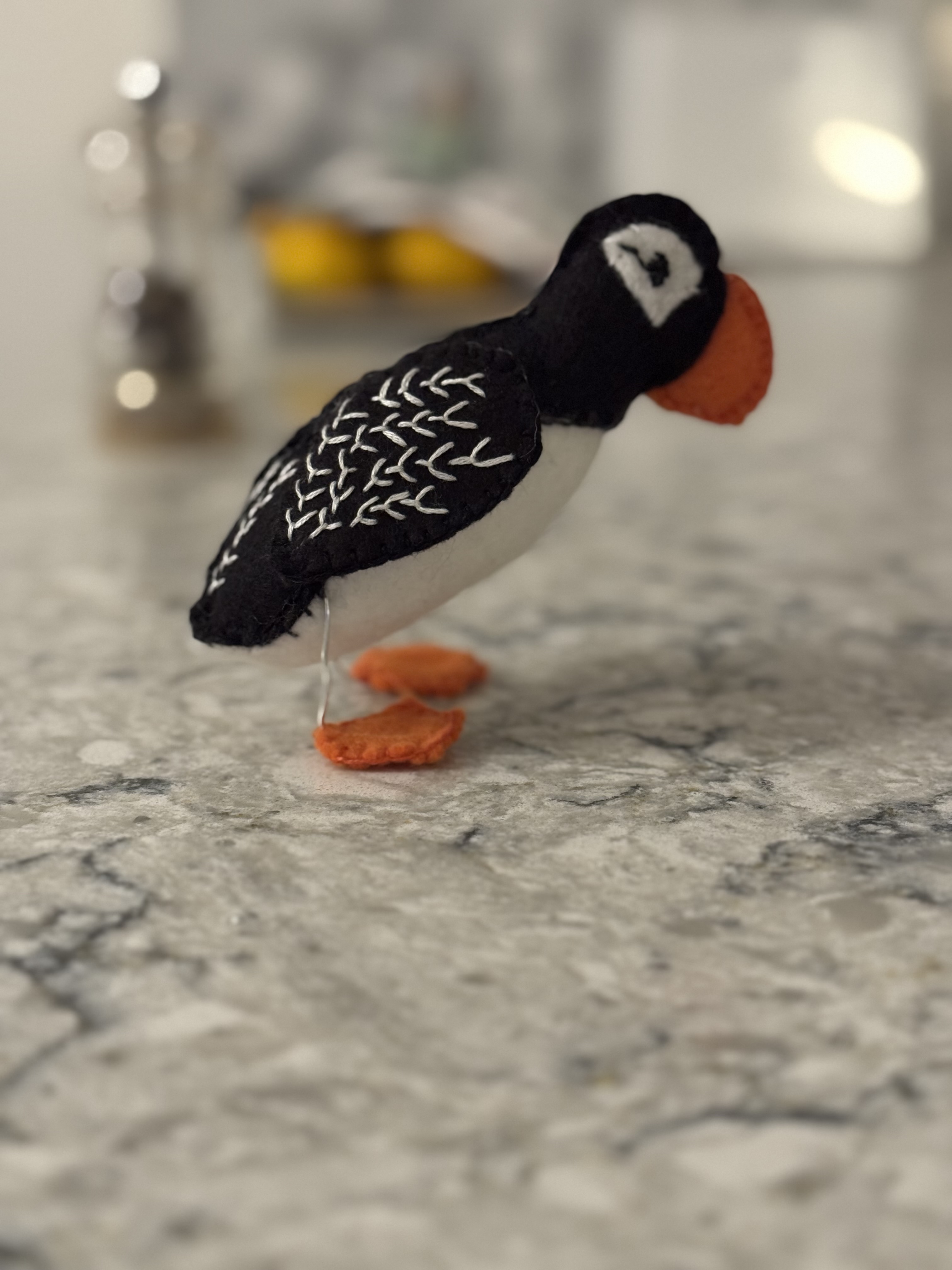
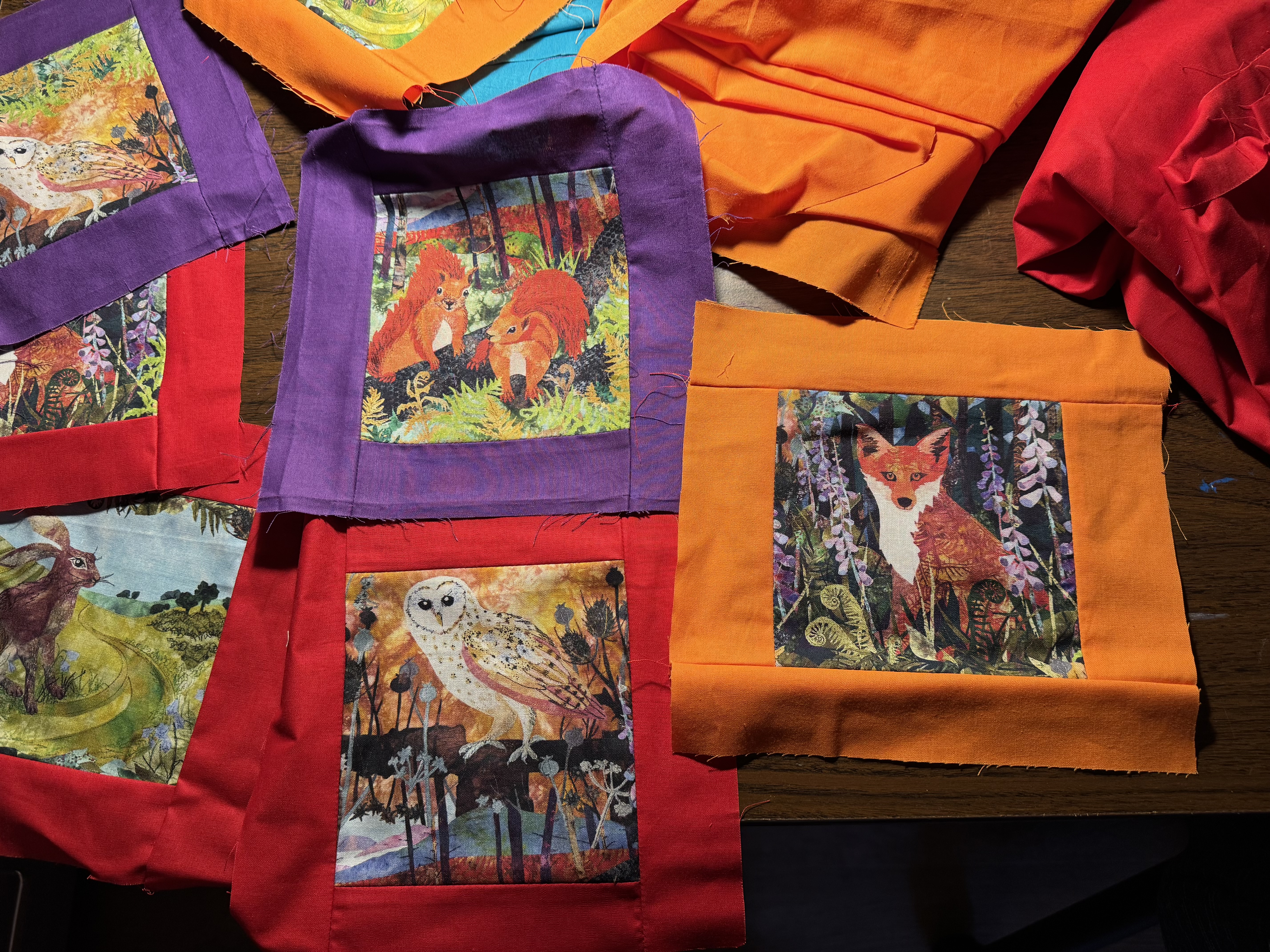
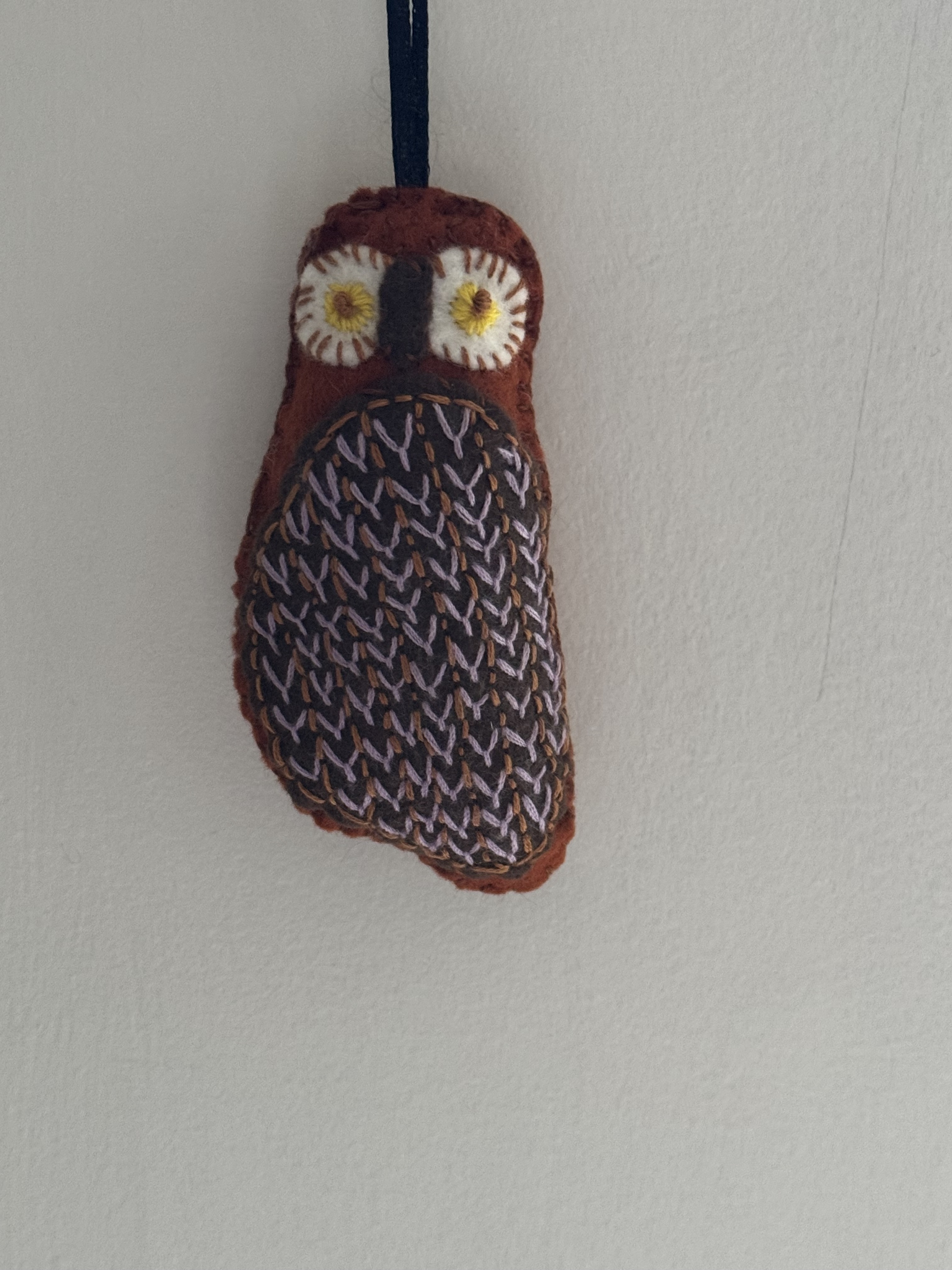
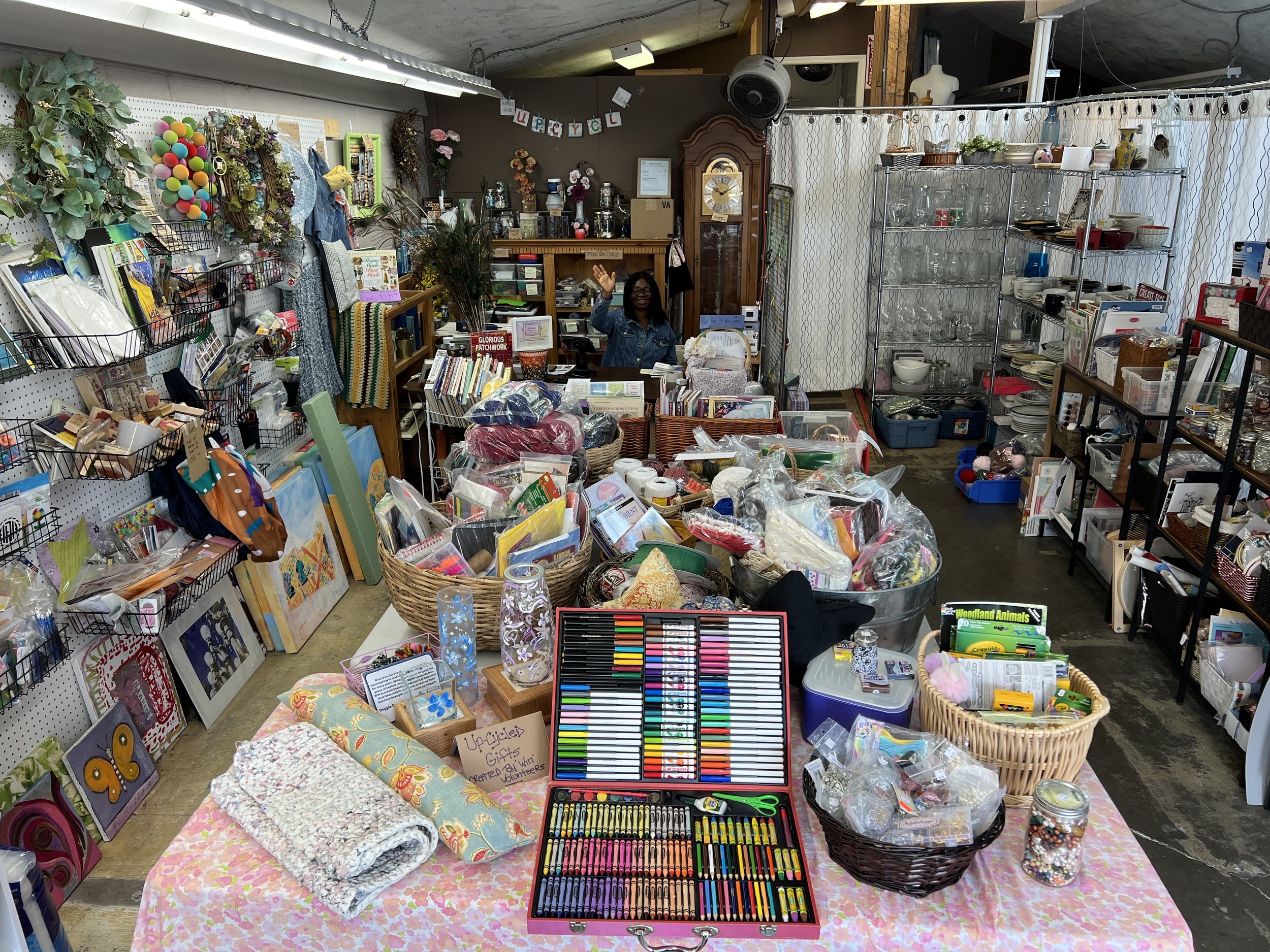
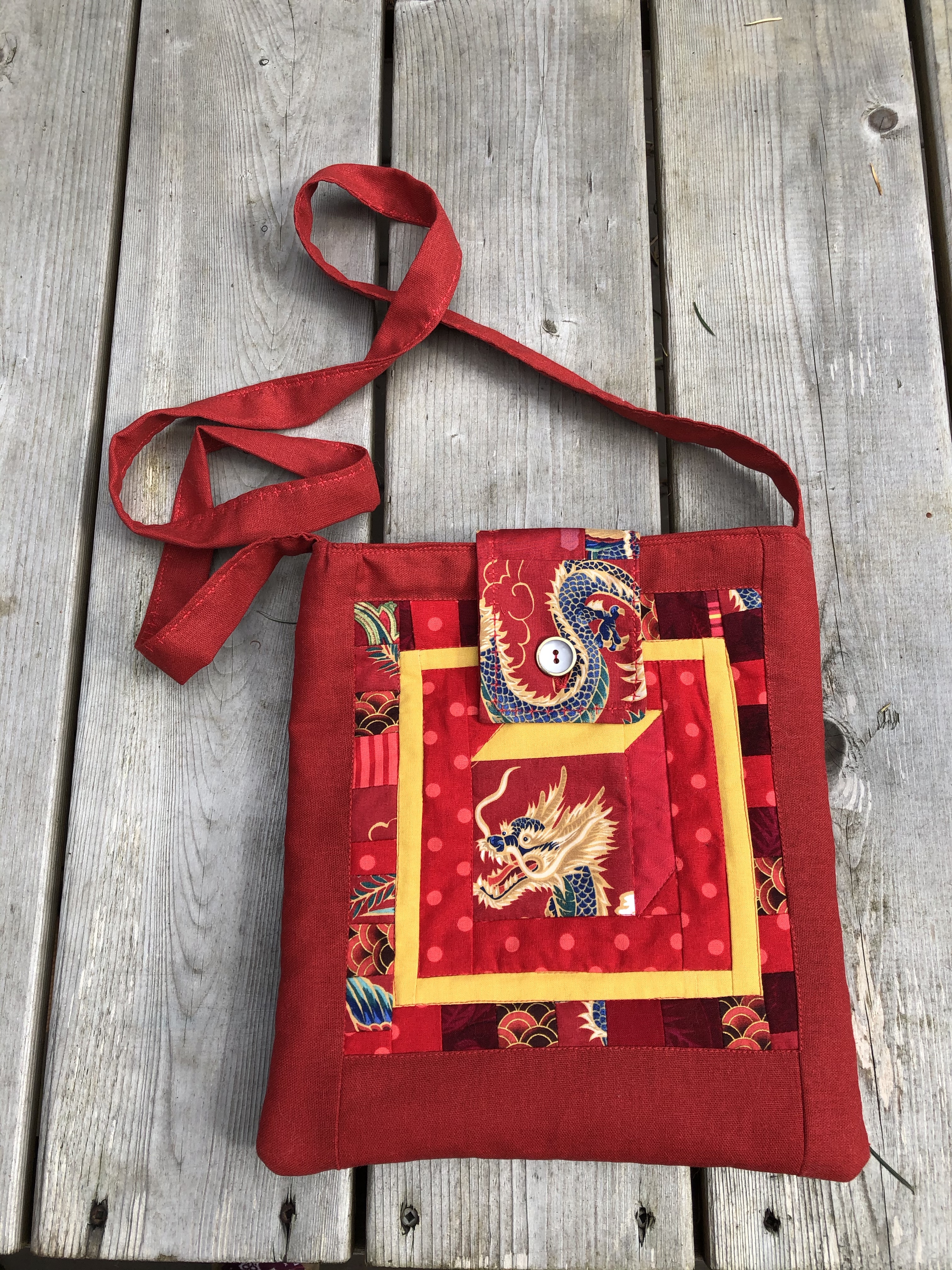
Although 2024 was my first year of so-called retirement, and thus I was given twenty additional hours each week, I wrote less, and I sewed less. (A few felt birds for family and other little felt creations, an apron, a crib quilt start, a fur-lined bag.) I did finish an editing certificate I started in 2020, which is a relief. And I made a lovely new friend and deepened existing friendships. I started a volunteer gig at a non-profit arts and crafts shop in August that has led to meeting many interesting people. Bonus: I get to surround myself with a messy profusion of materials that inspire me. 

This year, I listened to probably one hundred dharma talks on Dharma Seed, with a broad aspiration of becoming more intimate with life—accepting whatever’s happening in my heart, whatever’s happening in the world. Making friends with wild mind. Accepting the truth of the way things are.

I read so many books this year. A couple that stick with me are Rebecca Solnit’s memoir, Recollections of My Nonexistence and The Age of Loneliness, a book of essays about life during the sixth extinction by Laura Marris. 

Solnit writes a lot about being a woman. That’s what her title gestures toward—the peculiar “nonexistence” of being female in a patriarchy (remember mansplaining? She is behind that neologism[i]). She draws on John Berger’s 1972 Ways of Seeing, which I’ve known about for years and now am determined to read. She quotes words from him that jibe with my experience: “To be born a woman has been to be born, within an allotted and confined space, into the keeping of men. The social presence of women has developed as a result of their ingenuity in living under such tutelage with such a limited space. But this has been at the cost of a woman’s self being split into two.” 

Perhaps that sounds dramatic in the Global North in 2024, but that has been my experience. Perhaps it’s different for lesbians. Perhaps it is different for women of subsequent generations, but Solnit and I were born three years apart (1961/1958), so we grew up at roughly the same time. Berger goes on, 

“A woman must continually watch herself. … She has to survey everything she is and everything she does because how she appears to others, and ultimately how she appears to men, is of crucial importance for what is normally thought of as the success of her life. Her own sense of being in herself is supplanted by a sense of being appreciated as yourself by another.”

Solnit calls Berger brilliant and generous, to be able to imagine a woman’s experience, and I agree. What he writes here feels just as real as the carnations in front of me. Reading the passage and feeling its truth is freeing. No action needed, just awareness.

Similarly, truth pinged through me when I read Laura Marris writing about the age of loneliness. We become lonelier as we bear witness to the drastic reduction, or “great thinning,” of ordinary animals. Marris draws on the work of naturalist, Michael McCarthy, who writes of our baby boomer age group, “As we come to the end of our time, a different way of categorising us is beginning to manifest itself: we were the generation who, over the long course of our lives, saw the shadow fall across the face of the earth.” 

Reading this series of essays, elegies to Earth as the shadow descends and animals disappear, I was gripped by a grief so deep I sat for a time and just cried. Again, the truth is freeing. Let’s not deny that this is happening. It’s really happening. We can still enjoy the beauty that is here. 

In keeping with my mood of asceticism, I recently deleted my Facebook and Instagram accounts. Unlike the birds who used to sing outside my window, FB and IG will not be mourned. I feel light as I step through life with a new red pedometer safety-pinned to my leggings (the pedometer frees me from carrying a “smart” phone to count steps). Michael, Marvin, and I amble down to the beach at Thetis Cove to watch the sky change. Rippled water reflects a bank of pink clouds. 

Thank you for reading. In the coming year, may you experience moments of lightness in a shadowy world. 

Berger, John. 1972. Ways of Seeing. Penguin.
Marris, Laura. 2024. The Age of Loneliness: Essays. Greywolf Press.
McCarthy, Michael. 2015. The Moth Snowstorm: Nature and Joy. New York Review Books.
Solnit, Rebecca. 2020. Recollections of My Nonexistence. Viking.


[i] From Wikipedia: The term mansplaining was inspired by an essay, “Men Explain Things to Me: Facts Didn’t Get in Their Way”, written by author Rebecca Solnit and published on TomDispatch.com on 13 April 2008. In the essay, Solnit told an anecdote about a man at a party who said he had heard she had written some books. She began to talk about her most recent, on Eadweard Muybridge, whereupon the man cut her off and asked if she had “heard about the very important Muybridge book that came out this year”—not considering that it might be (as, in fact, it was) Solnit’s book. Solnit did not use the word mansplaining in the essay, but she described the phenomenon as “something every woman knows”.
Creativity is a fox: A year in review

I start the year with a glance back over 2023. Last year, creativity often eluded me. She was a timid fox, hiding in her hole. I tried to lure her out, but at the first sign of self-doubt, she’d scurry back down the tunnel. Making things—in cloth or paint, in the kitchen, with words—can feel pointless in the face of climate crisis, grief, war, and ennui. And yet, don’t you think we must continue to create as an antidote to all the destruction?

When fox stayed out long enough, she inspired me to bake cakes, sew things, paint mandalas, and write stories and poems. 

Baking

I love making cakes and preparing gifts for people. I fantasized once about starting a small business: I could make bespoke cakes and gifts to order (quilted bookmarks, small herb bouquets from my garden, stones from the beach that feel good in your hand). Nice idea, but maybe not a great business move.

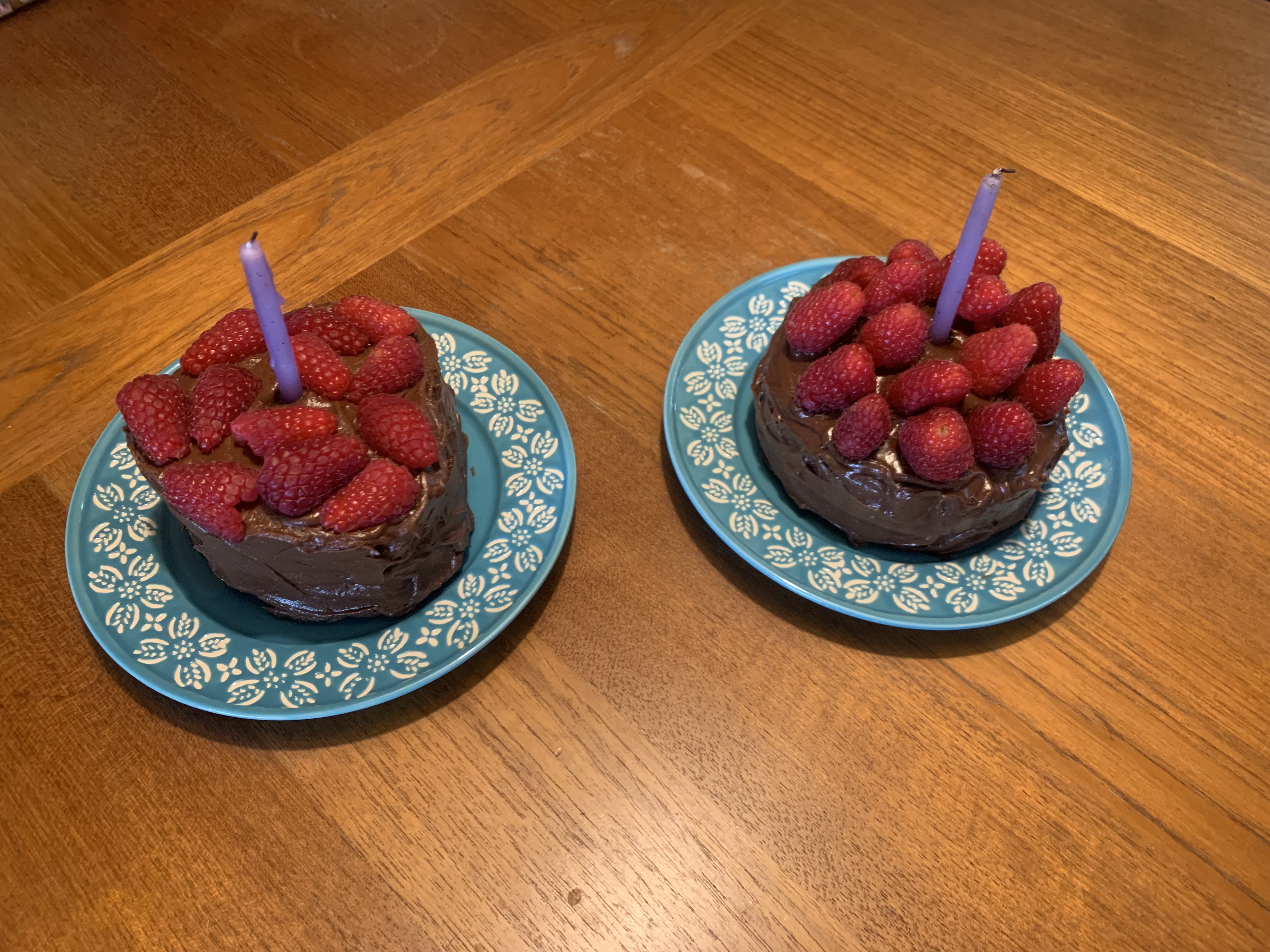
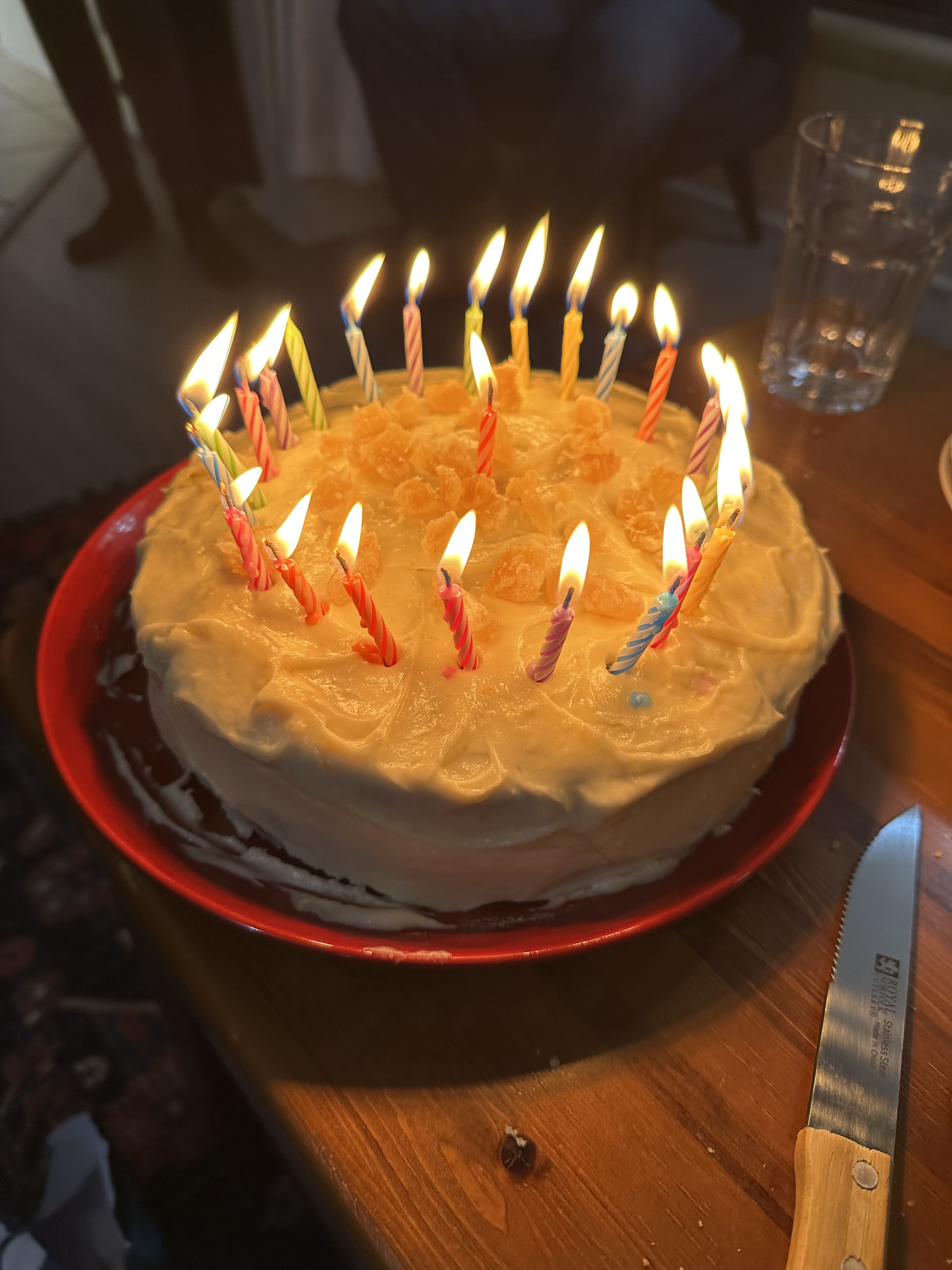
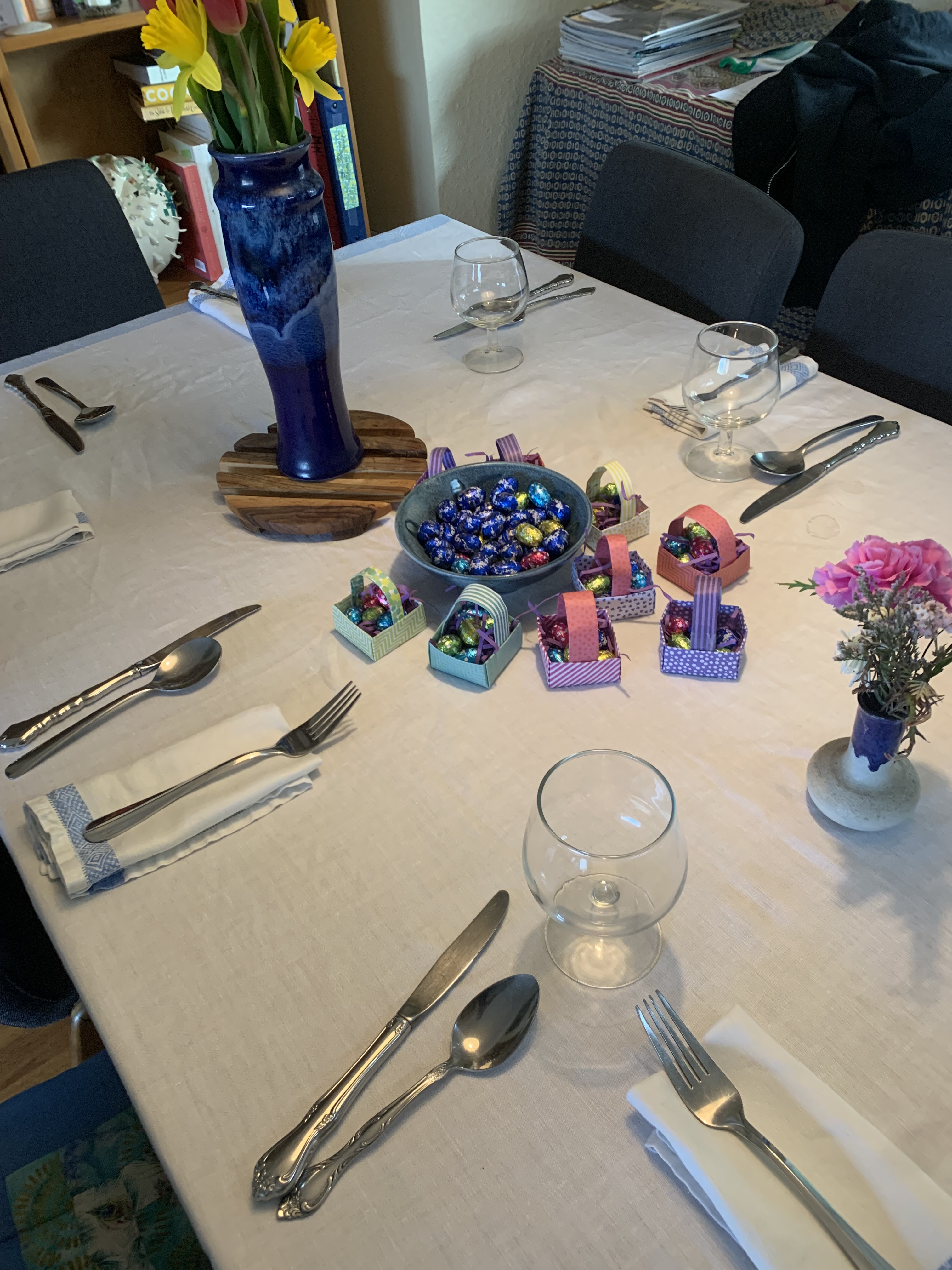
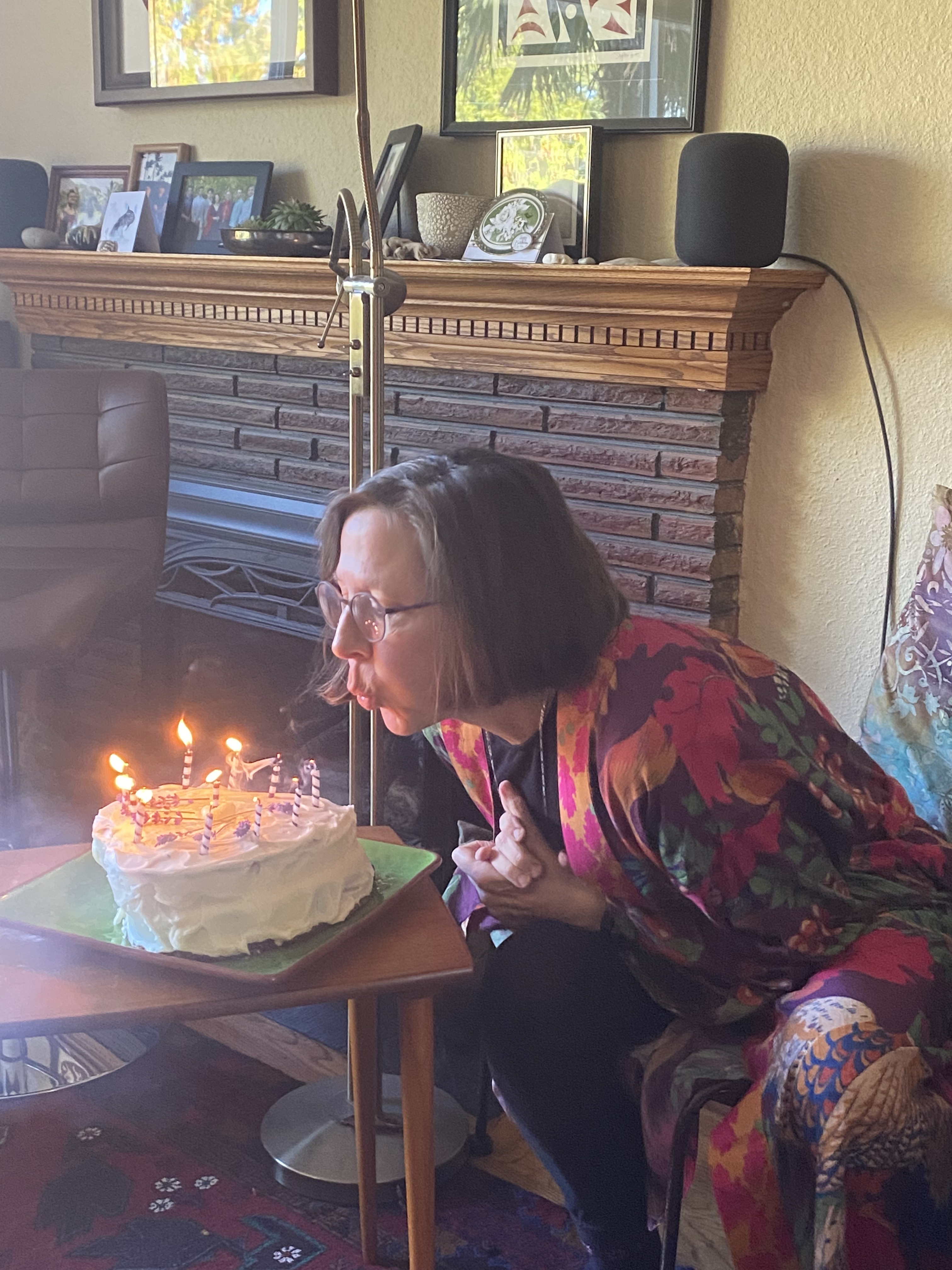
This year Michael got an upside-down blood orange cake for his February birthday, and we had fun sourcing the oranges. Found some good ones at the Market Garden on Catherine Street (where shoppers sometimes sit down to play the grand piano—such a cool store). I baked mini-chocolate cakes with strawberries later in the month for Barbara, and for Easter, an almond torte with whipped cream and more strawberries. Like my mother before me, I love to set a beautiful table, and Easter was no exception. The origami Easter baskets filled with foil-wrapped chocolate eggs provided a whimsical touch. (Entertain your inner child, I say.) For my own birthday party, a classic carrot cake baked in a heart-shaped pan frosted with cream cheese icing. For Andréa’s big five-oh: applesauce cake with three kinds of ginger. And for the final English conversation café at work: ginger cake with buttercream icing. What is it about a cake that speaks pure love?

Sewing

I didn’t make any new quilts, but I did sew a purple wall hanging, about 30 by 30 inches, that now hangs in our bedroom. I like to lie in bed and gaze at it. Four sentinel circles surround a larger one—all shot with gold thread (fragments cut from an old wraparound skirt from a yard sale). Those circles/mandalas ground me; cloth clocks tick noiselessly, watching over us as we sleep. 

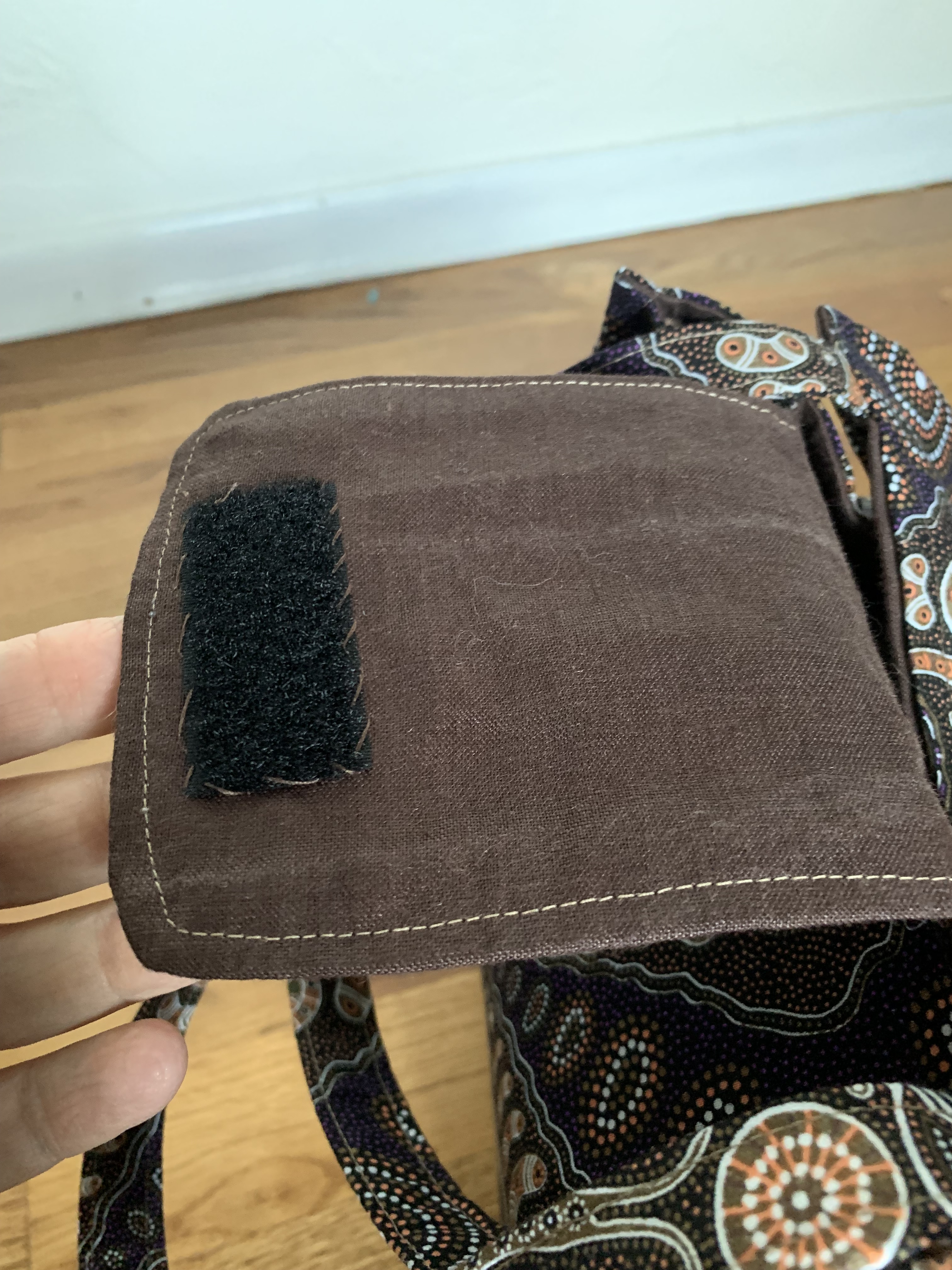
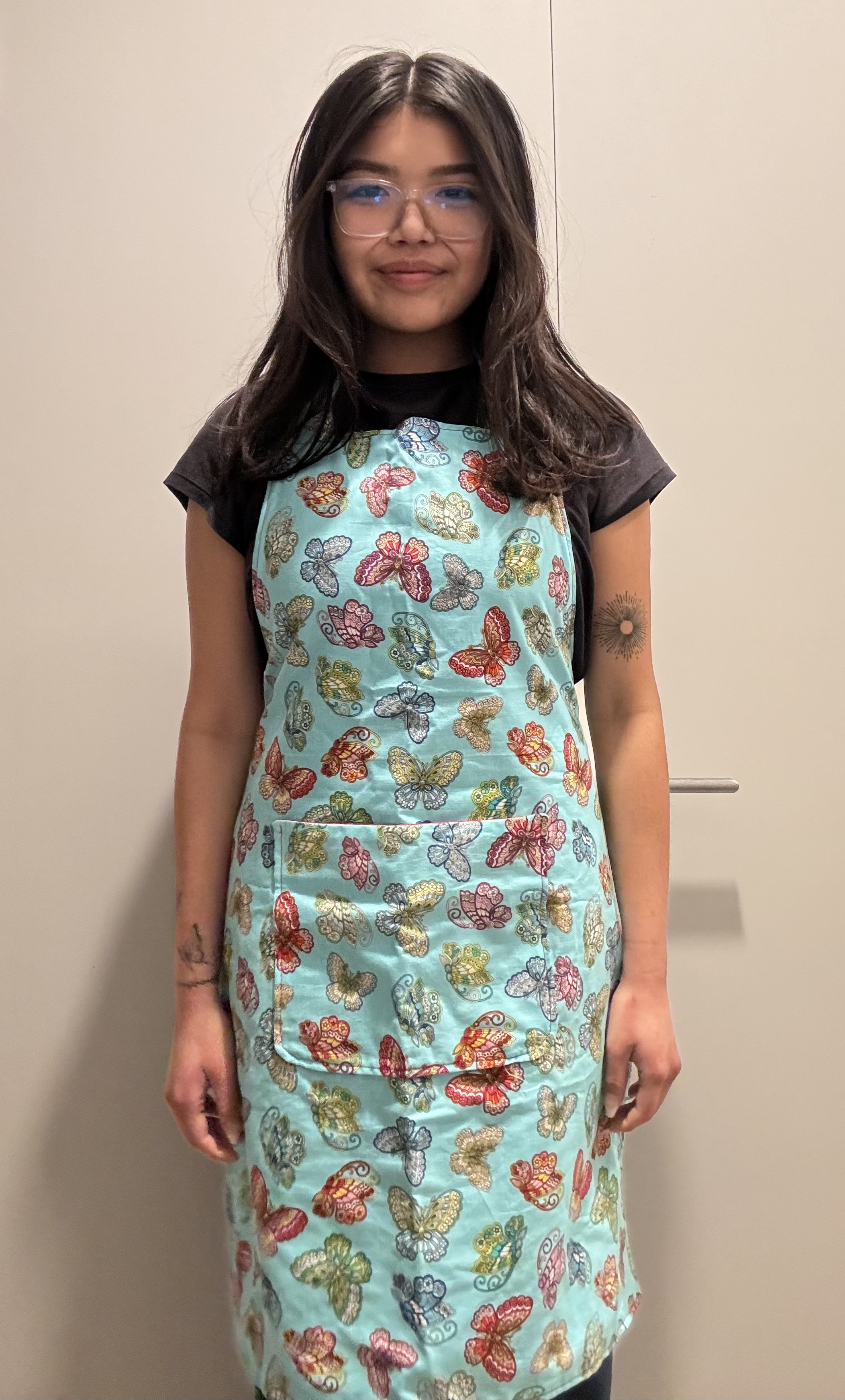
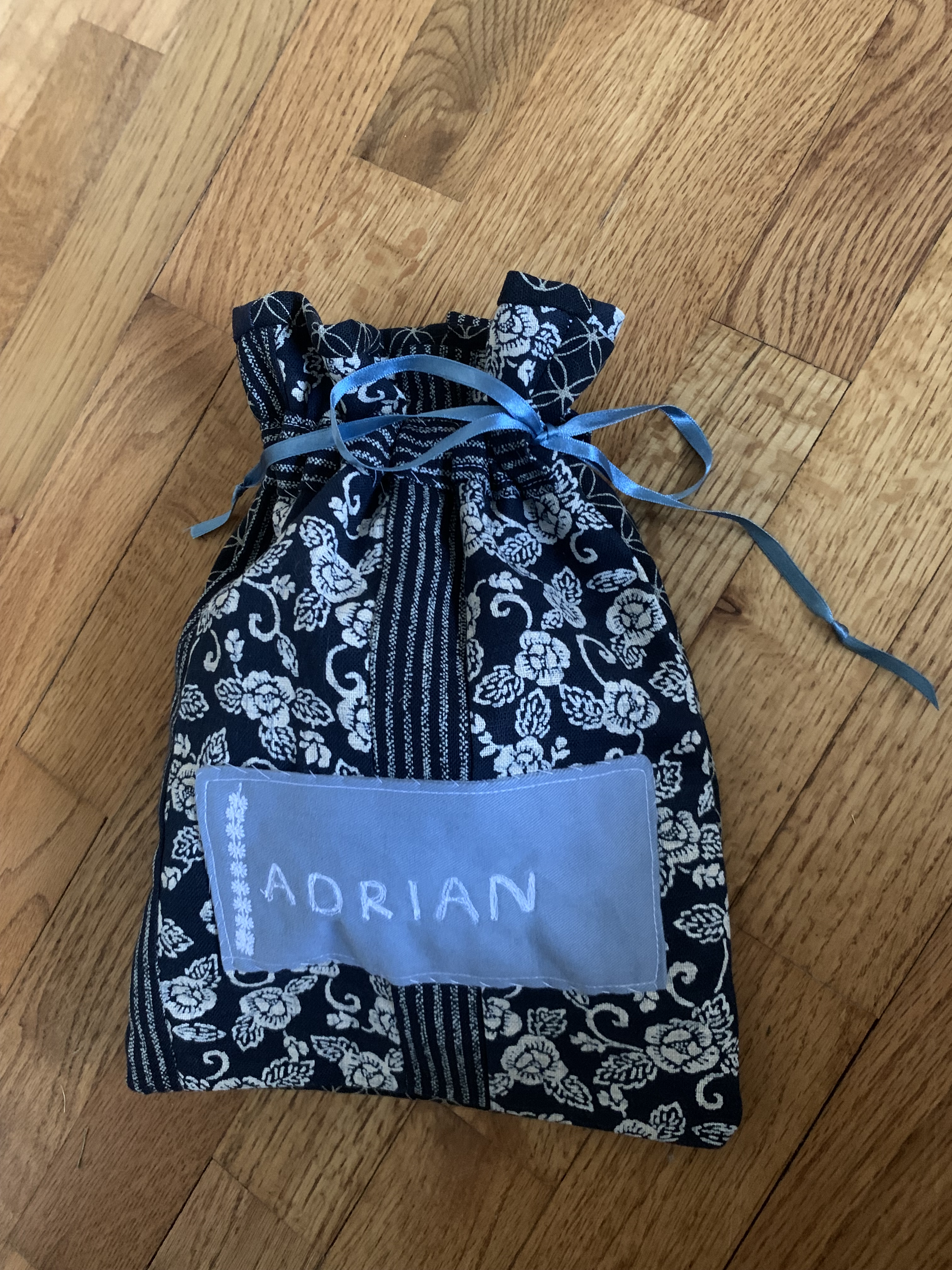
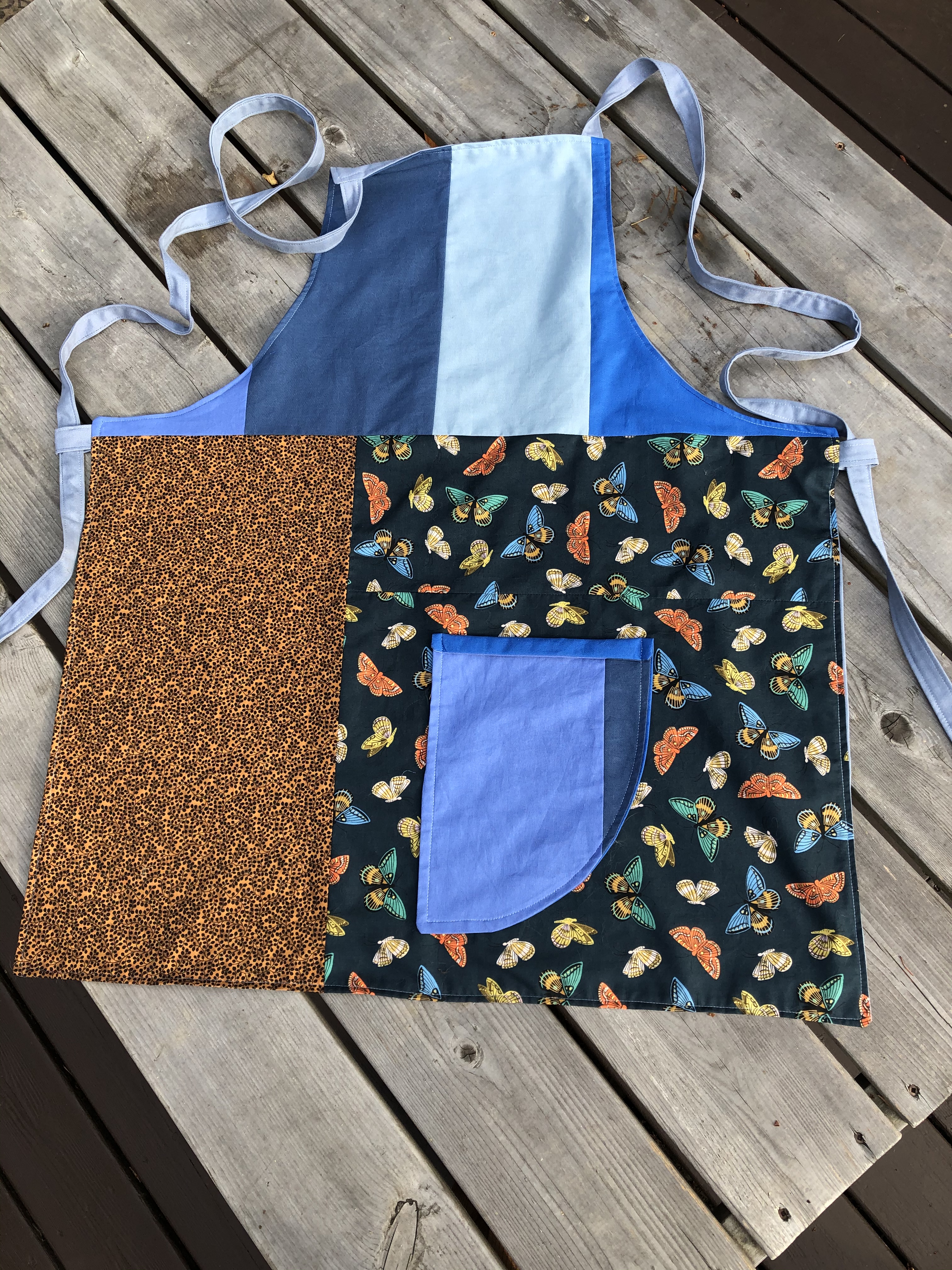
Smaller sewing projects attract me because results come together quickly. My sister Kathryn bought me a drapery panel of Indonesian fabric in browns, reds, and purples at a thrift store. A lot of fabric—40 by 83 inches—for only $4. I’ve enjoyed making some things from it: placemats and napkins mostly, and a sweet little fabric basket (I made a few of these for friends for Christmas, then filled them with chocolates and gifts). I felt most proud of the lunch bag I made for my boss, Nancy, because it tested my skill. I used fabric in a brown geometric pattern by an Australian Aboriginal designer. Then I lined the bag with sturdy brown linen from a too-big jacket I bought at a yard sale down the street. Nancy loves it. Adrian’s bag (filled with toys) for his second birthday involved some great scraps I bought from Smoking Lily on Government Street. Finally, I sewed a butterfly apron at Christmas for my niece. She is beautiful in any outfit, even an apron. 

For my 65th birthday party (the theme was poetry and potluck), I made fabric wrappers for second-hand poetry books I bought for guests. So fun to comb through my stash and find colours and patterns that sing together. Party favours were fun when you were a kid, and they are even more fun when you’re an adult. Again, entertain that inner child…

Making Mandalas

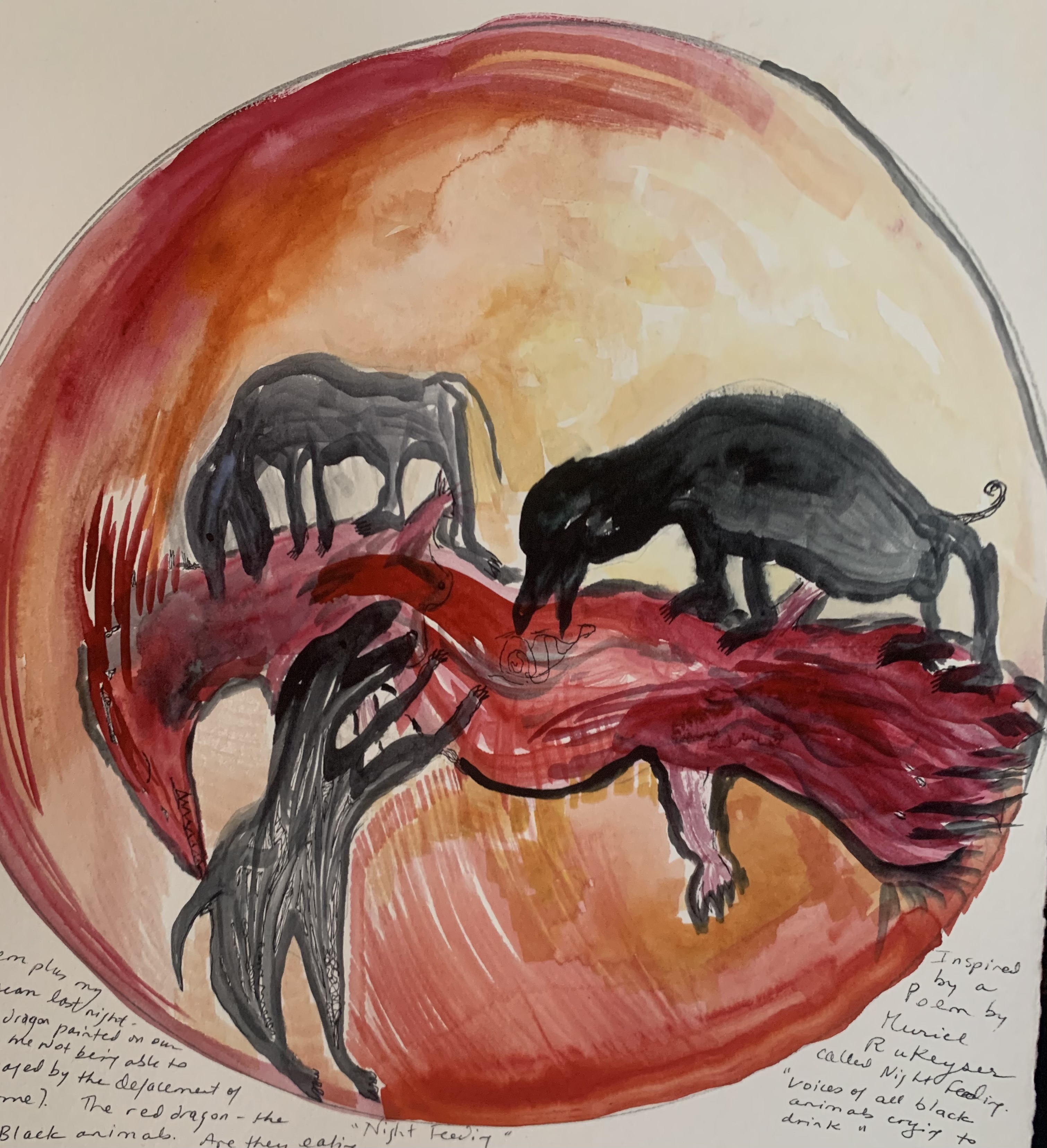
Michael and I had a Monday Mandala practice for a while, but it fizzled out sometime during the year. One exciting project: we delivered a multi-day mandala-making workshop in March and early April on Zoom. Our participants were mostly from New Mexico—all lovely, open-hearted women. It was a good experience. Michael was a guest presenter at two Creating Mandala monthly events. The CM team featured a new goddess each month, and Michael chose to talk about the High Priestess (Tarot) and Kali (Hindu goddess associated with death). I attended both of these events with pride and pleasure. Some mandalas last year were inspired by dreams—a rich transmutation. I dreamed I entered a room in my house and found that someone had painted on my white wall a red dragon being devoured by three beasts. Still musing on the meaning of that one. 

Writing

Here’s where the fox was most recalcitrant. I aborted so many poems, blogposts, and stories last year, I am surprised to find anything in my files. I posted on this blog only five times in 2023. However, I did complete a series of linked short stories (started in previous years): Nothing is Wasted: The Stan and Deedee Stories. I shared them with a few friends and family members. If you are interested in reading them and you’d like a digital copy, let me know (maddyruthwalker@gmail.com) and I will send you one. 

Some months, I had nothing new to share with my writing group. I’d scour the old folders for some scrap from the distant past to read. Or I’d just listen to others read their work. But that’s okay. I know that I’ll write again. When nothing seems to be happening, the fox is deep in her hole, pregnant with kits. How many will be born and when? Just have faith.

I wrote only a few poems in 2023, and one was for my birthday. Each guest was asked to bring a poem to share. It was extraordinary to see my friends and family members get up into the poetry seat and read poems they’d chosen, poems they’d written: one of the best gifts I’ve ever received. To close the offerings, I read my own poem– one that expresses the expansiveness I feel as we enter 2024. Happy New Year to you!

Expansion

I started slim 
and willowy.
Then, whoosh of years.

My waist - heavy as grief,
soft as dough -
expanded.

Grief. Have you met her?
Well then you know the
grace that she bestows.

Hard things—she
cracks them open, 
ignites a hotter flame, 
imbues a deeper shade of red. 

So, like my waist, 
my heart’s made wide by grief, 
a vast container for the love I feel 
for trees, and animals, the sky, 
the planet, for you, my friends,
for people everywhere, 
for life expanding.

Sewing/sowing history

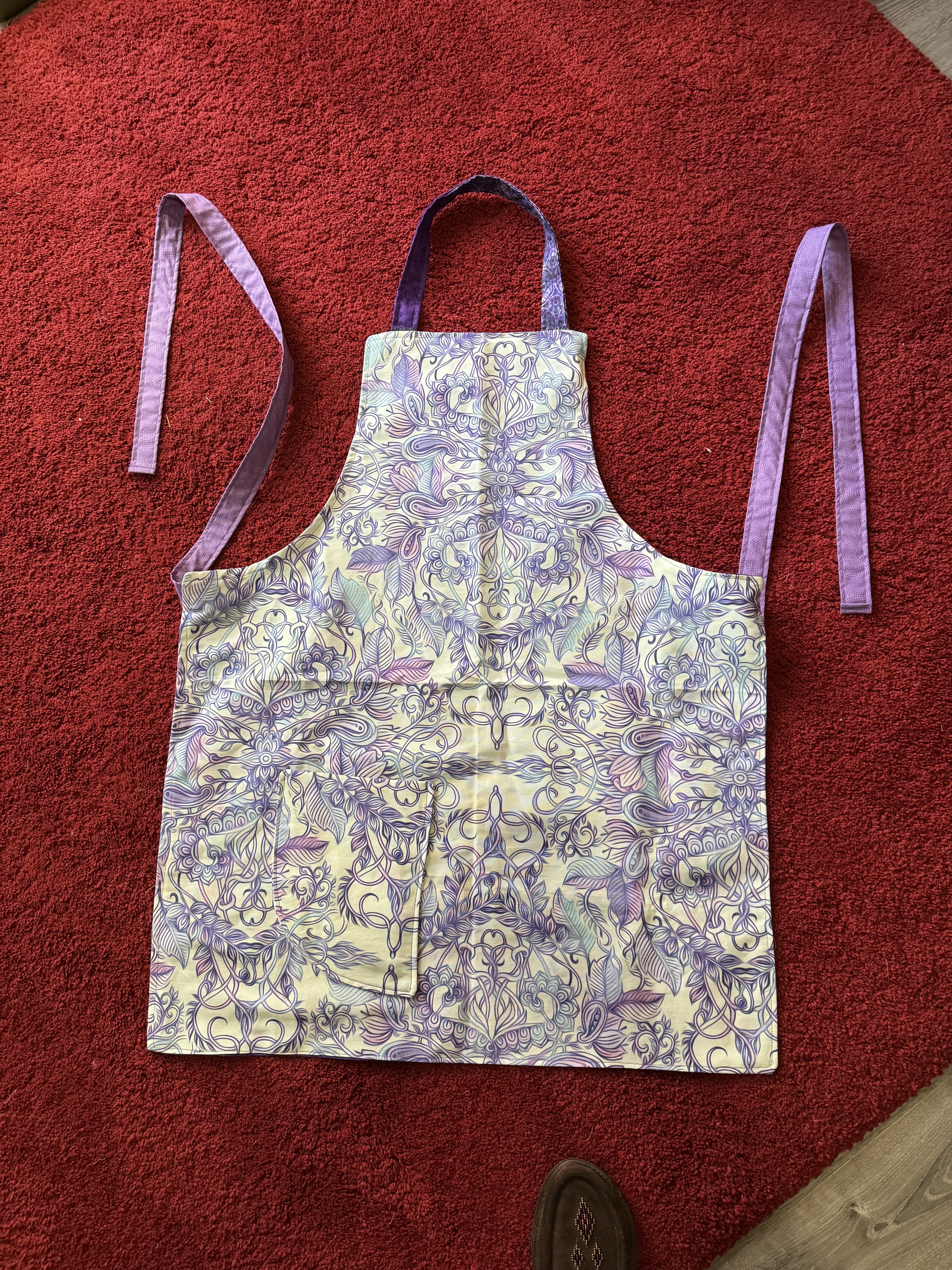
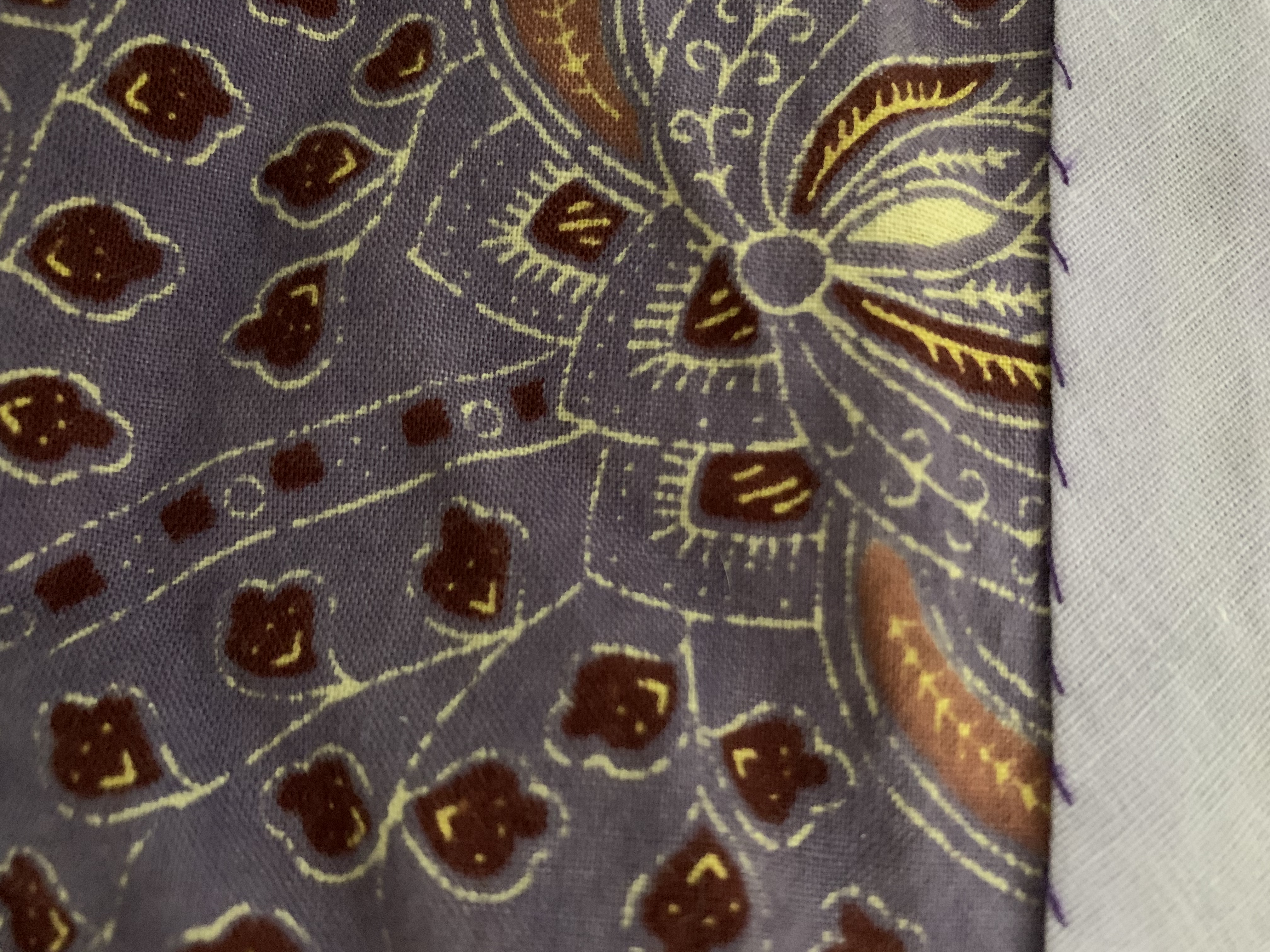
The lavender bias tape is sewn in small, even stitches along the inner edge of the richly patterned cloth. My grandmother once sat quietly, sewing this binding to finish the apron she was making for me. After wearing the apron for decades, I have been cutting it apart, incorporating squares of the purple, cream, and brown fabric into coasters for a friend, a shoulder bag for my niece, and now a quilt. These little squares and rectangles sew/sow history into new textiles. 

Grandma Marguerite Walker (nee Potter) was born in 1896 in Fort Scott, Kansas. Although I didn’t know her well, I have fond memories of her. She was gentle and genteel, soft-spoken, and poised.  When my parents when to Europe for several weeks when I was 8 or 9, she came to stay with us in Toronto. She taught me how to set a table during that visit because, apparently, my mother had never taught me the correct way to place napkin, fork, knife, and spoon. I once visited her in Los Gatos, California, where she lived for many years. One day, we wandered about, looking at the shops. “What a lovely colour your blouse is,” grandma said to a woman we approached on the street. That stranger lit up from the compliment, and I never forgot that simple, kind exchange. Another time we heard ambulance sirens in the distance, and my grandmother prayed aloud that nobody was hurt. This was something new for me. “Prayer” was not in my parents’ lexicon. And in her letters, grandma wrote “thot” for thought, not because she didn’t know how to spell—she was an excellent speller—but because she had her own shorthand. 

In my twenties, I underwent surgery to correct infertility. I was told after the surgery that I still had only a 15-20% chance of having children. Grandma Marguerite started sending me her copies of Unity magazine and told me her church congregation was praying for me. Ultimately, I gave birth to three healthy sons. I don’t know about cause–effect, but I was forever grateful to her for the energetic and spiritual work she undertook on my behalf. All of these warm memories float through me as I sew squares of Grandma’s apron into the mix of this new quilt, which I think I’ll call “windows to a purple world.” 

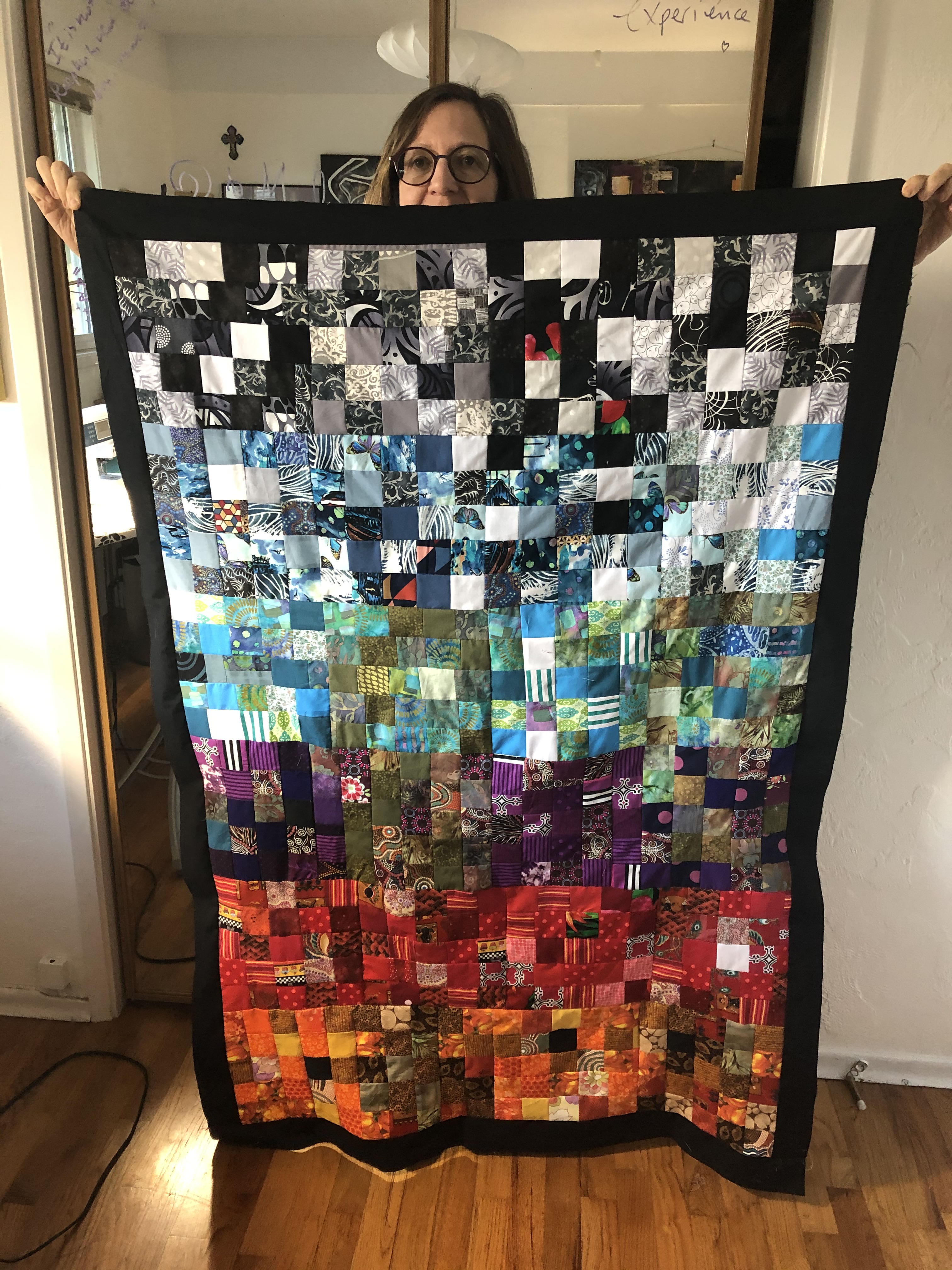
Windows to a purple world (quilt in progress)

This type of sewing I’m describing is upcycling, but with a difference. Take fabric that’s been in your family or is otherwise meaningful and make it into something new. If you do this, you incorporate stories into your sewing. A couple of years ago my friend Nancy gave me a large basket of textiles from her family—old linen tablecloths and napkins in pastel green, pink and salmon that her mother and grandmother had used over many years. I cut these precious pieces apart, mixed in other contemporary fabrics, and fashioned pillowcases. I gave Nancy the pillows for her birthday. She can remember her mother and grandmother and meals at the family table whenever she looks at them.  

I incorporated cloth from pink and green tablecloths and napkins from Nancy’s family into pillowcases.

Scattering scraps of one fabric over countless projects feels like I’m sowing seeds of connection far and wide. When Michael and drove to the Shakespeare Festival in Ashland, Oregon in the summer of 2017, we visited Sew Creative, a beautiful fabric store on the main drag. I fell in love with designs by Australian Aboriginal designers: swirly organic patterns that looked like amoebas and rhizomes done in purples, reds, browns, and oranges. And there was a binder there with each designer’s photograph and profile so I could learn about them–their processes and inspiration. I bought two one-yard pieces of fabric. During the last five years, I have cut and sewn those fabrics into countless things: purses, pouches, quilts, coasters. I love the dispersal of one thing into many. Cadmus sowed dragon’s teeth and up rose an army: the fierce Sparti (which means “sown”). I sow scraps of fabric and up rises. . .  delight! 

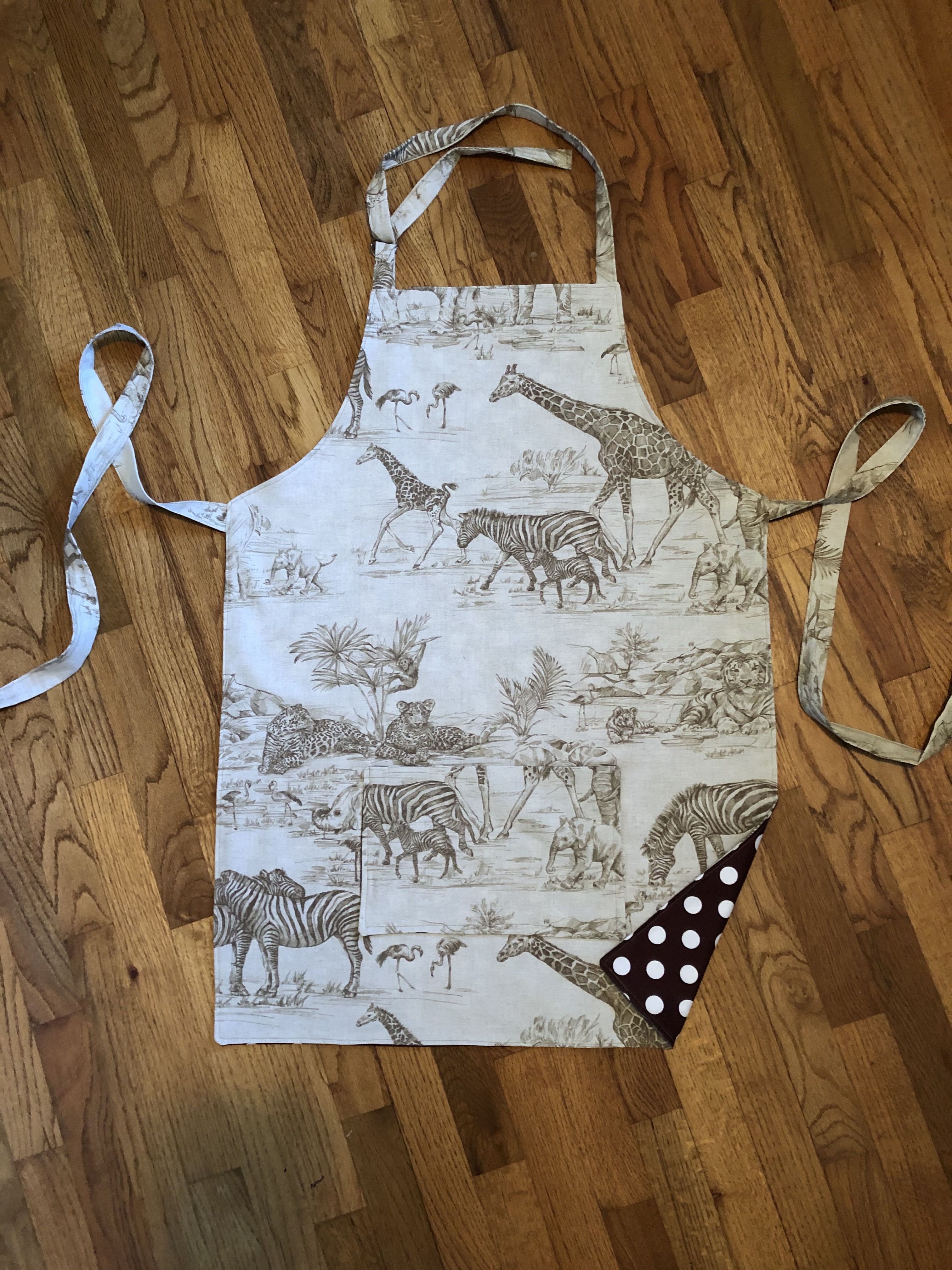
Scraps of the same fabric show up over and over again. The cloth Nat and Sam chose for their aprons (animals on the Serengeti; a bright turquoise broadcloth) show up in the bookmarks I recently made and distributed to friends and family. The blue tablecloth I bought at Value Village became the lining for my blue patchwork apron. It feels, at times, as if I—and not just the fabric—am being dispersed across time and space. It is too easy these days to disconnect and withdraw. I am trying to stay connected through writing and sewing, sewing and writing. Sowing myself far and wide through words and fabric.

Look back, look ahead

I know it was a horrible year, and yet it was somehow a good year for creativity. The work wanted to be made.

Writing

I finished the first draft of my first novel—as yet untitled. I have been living my own dictum. You only learn to write by writing, I tell the students I teach and tutor in academic writing. The more you write, the more you experiment, the more you learn how to write.

James Hillman said that “truth is revealed. It cannot ever be told. It has to appear inside the telling or through the telling.” Never have I found this more resonant than in writing fiction. I started out with a vague idea for a story, but it has only been inside the telling that truth has been revealed, an exciting and serendipitous—perhaps even magical—process.

I was privileged to have the first six months of the year off work and the second half working at home. This flexibility allowed me to establish a regular writing time in the mornings, so most days I wrote at least a paragraph and sometimes several pages. The novel is about 300 pages long. I will leave it to rest for a few weeks before I go back with an eye to editing. My small but loyal writing group helped me stay motivated, and I am grateful to them. I loved hearing other writers in the group read their work.

I published 18 blogposts in 2020. Long ago Michael helped me to be content with “3 plus me” (it’s written with a wineglass writer on my mirror). That just means if I like it and three other people like it (Michael is inevitably one of the three), then I am happy.

One of the posts this year was a beautiful guest blog by my sister.  And we collaborated on a second one. I love collaborating on blog posts and I welcome any of you to get in touch with  me if you want to write together.

Editing

This year I was accepted into Simon Fraser University’s Editing Certificate program and I have completed 3 of the 12 courses. I aim to finish in 2021, and intend to start my own freelance editing and writing coach business. I have done this kind of work as a side gig for years, but now I am ready to formalize my training and freelance in a serious way. Editing is a profoundly creative act. All of those decisions to be made about word choices and paragraphs, sytnax, architecture, punctuation. . . .

In my reading about editing, I came across Susan Bell’s, The artful edit, an interesting book about how to edit your own prose and hone your understanding of other people’s. I loved the way she takes the reader through the masterful editing of The Great Gatsby by Fitzgerald and his editor, Maxwell Perkins. She has provided me with so many ideas both in editing my own work and as I apply my skills to my clients’ writing.

Sewing

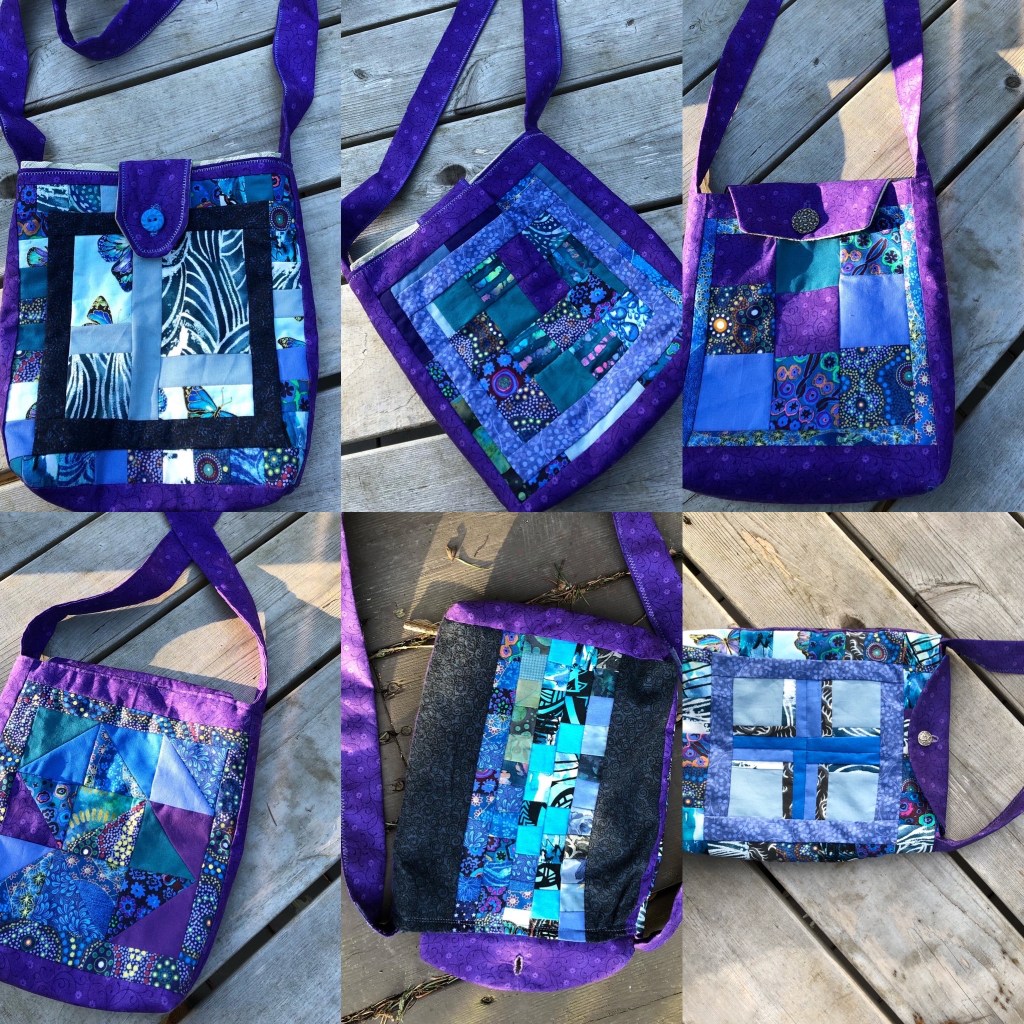
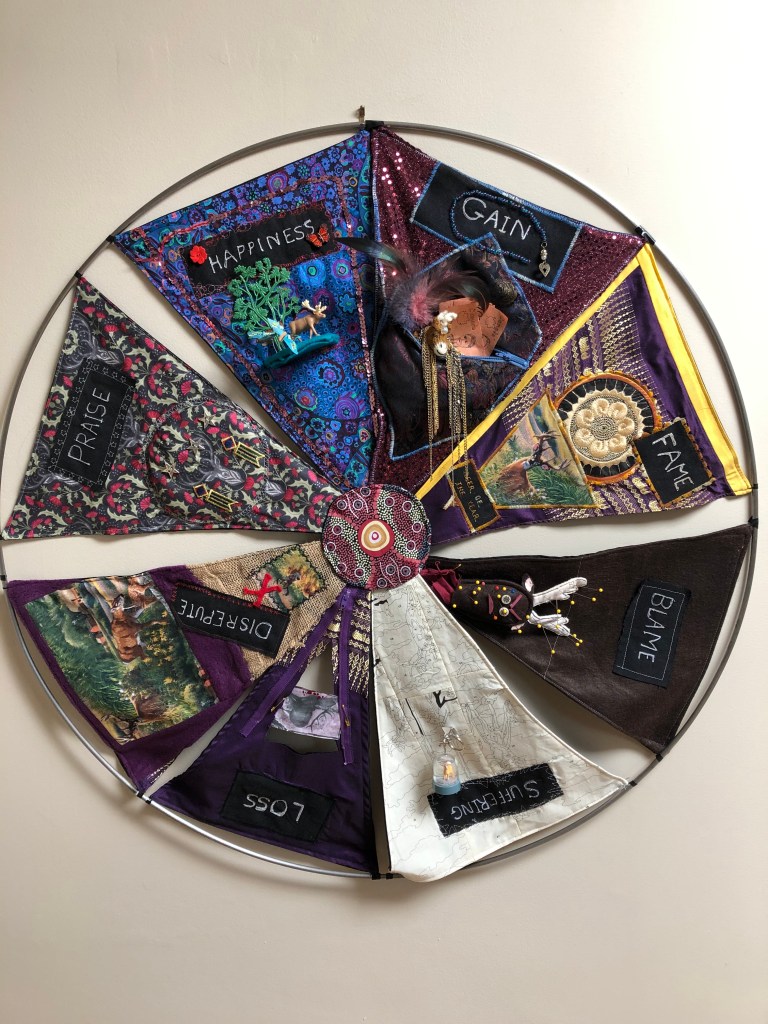
I sewed in fits and starts this year, but as I look back I realize I was productive, though it often didn’t feel that way. I finished the textile art piece Eight Worldy Winds early in the year. The piece now hangs on my office wall to remind me of the transitoriness of feelings, fortunes, and life itself. Then the pandemic shifted me into giving mode—I wanted to make small gifts for people. So I started with potholders I had promised to friends a long time ago, then I delved deep in my scrap supply to make one-of-a-kind bags for other friends. After that, I sewed masks. I have to admit, that was a duty more than a joy. Then I started making aprons for people I love. By the final apron, I felt I’d perfected the pattern. I almost forgot about the blue cape I made (my courage cape) out of an old wool blanket. So much fun!

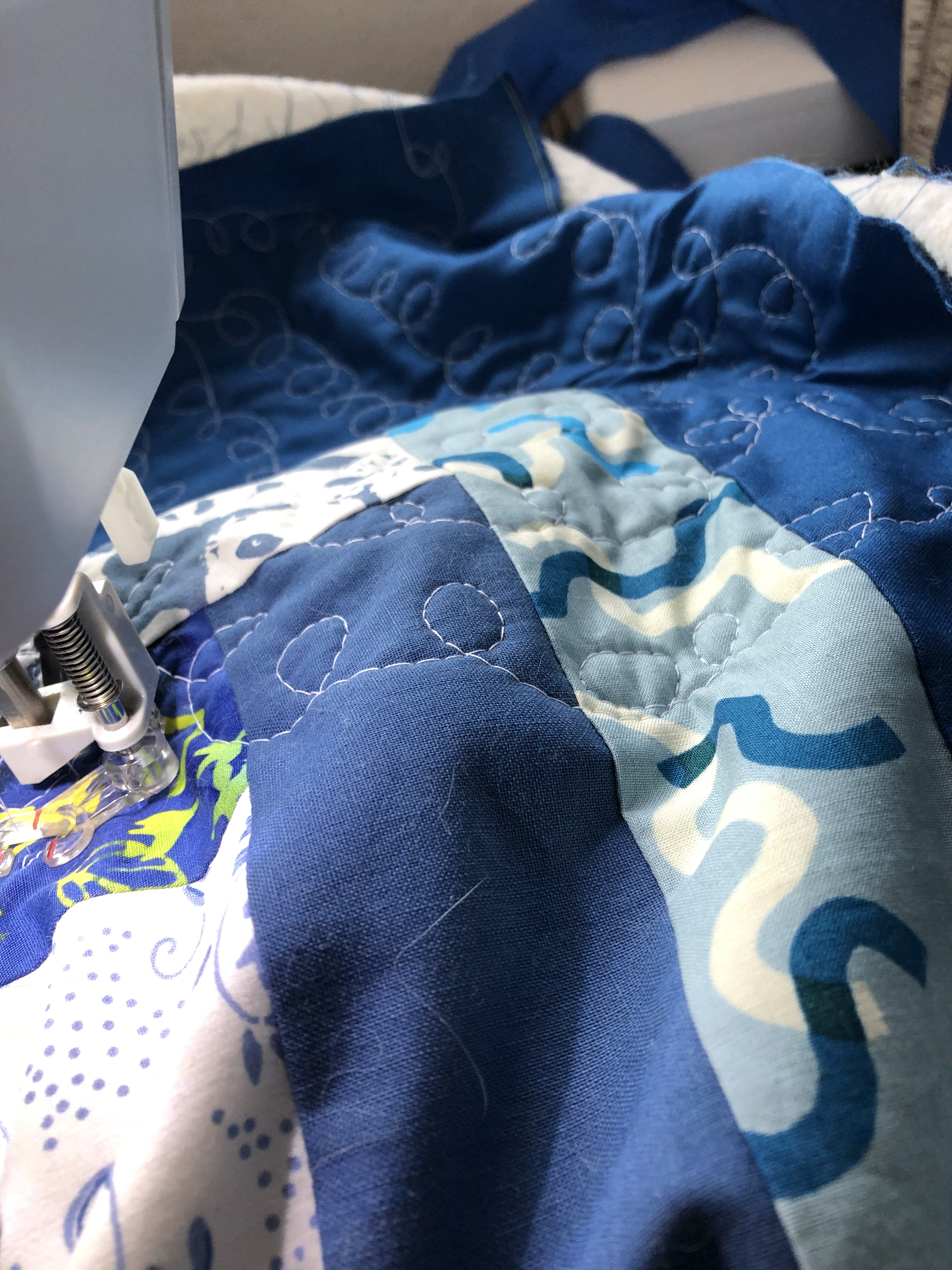
I went back to a bigger project with the Rhapsody in Blue quilt. It’s one of those weird quilts that actually look awful close up, with the mishmash of colours and patterns. But the total effect is pleasing. I started machine quilting of the top today, after pinning the whole quilt with safety pins. It’s the first time I’ve tried using curved safety pins to sandwich a quilt, and I like it. In the past, I’ve used the spray adhesive between layers, but I find it is not secure over time, and sometimes it takes me a while to finish a quilt top (now, especially, with a puppy).

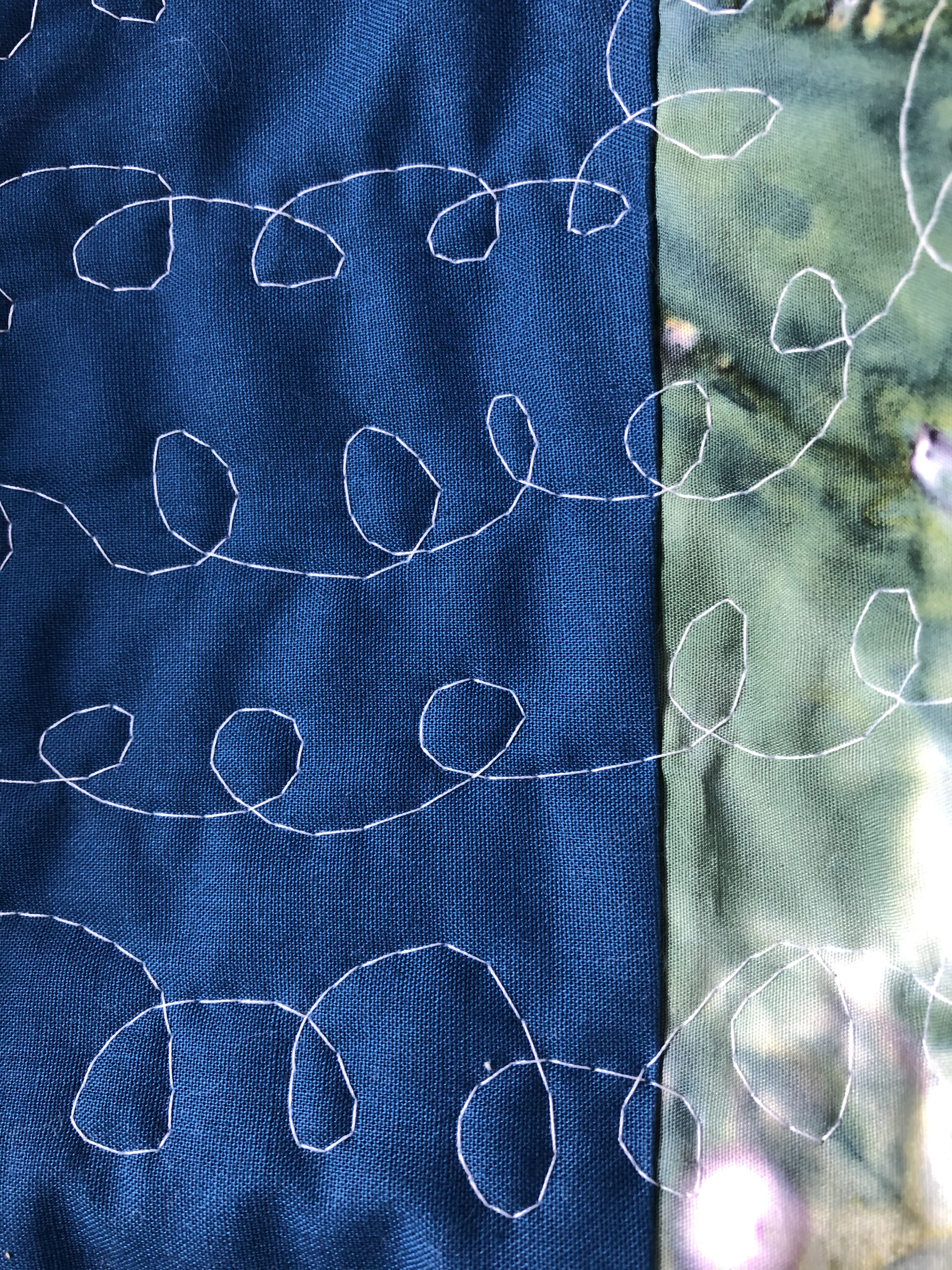
There is something incredibly liberating in free motion quilting. And it’s a physical act; my whole torso sways and moves as I push the material under the needle, forming loop de loops. 

Puppy raising

Raising a puppy is a creative act. Just as raising children calls for creativity every day, so does having a puppy in the house. I used to make up games and stories, craft activities, and innovative ways to distract and delight my children. Now I am doing the same kind of thing with Marvin.

Going forward

I put sewing and writing on hold during our first few weeks with Marvin because it was an immersive experience—all of my energy was need to do my paid job and engage with and train the puppy. Those few weeks taught me an important lesson. I felt drained and bereft without my creative outlets. It is not just a luxury to take time to write and sew. Creativity is my lifeblood; creativity gives me momentum to keep on going; creativity feeds me. Especially in this year of the pandemic, I have leaned heavily on creativity, and I am so grateful to have the time to pursue my creative acts.

This year I let go of some things—drawing and my aspiration to learn to play the ukulele to accompany my singing. I just can’t do everything. So I focused on writing and sewing. I’m not sure what I’ll focus on in 2021. Some contemplation is in order.

Remember, creativity is your birthright. It’s not granted to just some people—we are all born with innate creativity. As children it seems more accessible and we rarely question it, but then its force seems to fade for some people. I encourage you to spark your creativity if it’s dormant. Write a poem, cook something new, learn a song, write a song, draw a comic, sew something. Make a birthday card for a friend. You never know. . . . 

All my best to all of you. Thank you for reading. 


Threads connect us

I have been sitting in discomfort, searching for  how to begin. Fear of making a mistake keeps me from acting, from speaking. Perhaps some of you reading this feel the same way. Are you a privileged white person, trying to figure out how best to speak up, how to be part of the solution? Are you getting a crash course in systemic racism and wondering what to do with all the emotion and information? We can give money to Black Lives Matter causes if we’re financially able. But something more is being asked from us right now. 

White silence is complicit, white silence is oppression. If you are white and you have a social media following, you have a responsibility to use that influence to draw attention to Black voices. I don’t have much of a following (but huge gratitude to those who DO follow me) and I am certainly no influencer. Nonetheless, I want to use some of my space today to draw attention to two incredible Black women textile artists: Sarah Bond and Bisa Butler.

From Modern Quilt Guild’s website

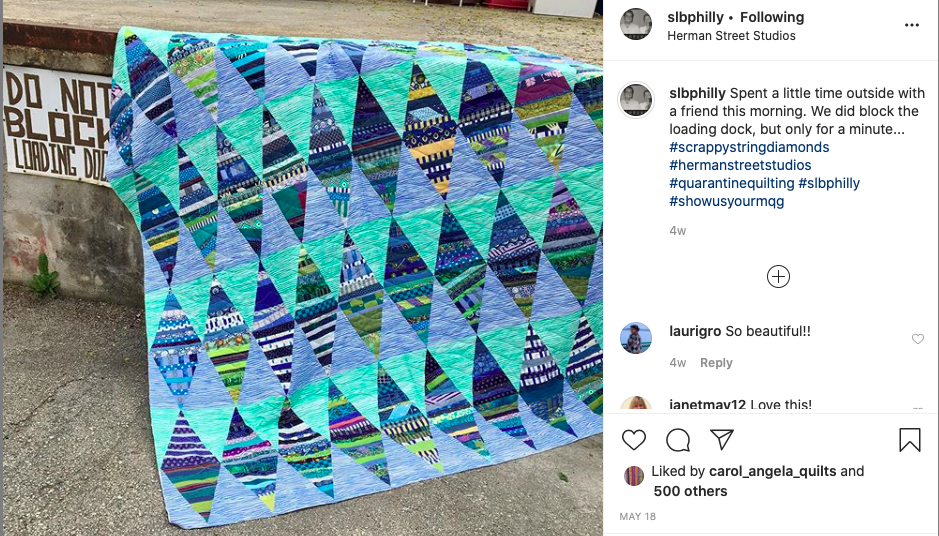
I’ve been following Philadelphian Sarah Bond on Instagram for a while, appreciating not only her beautiful quilts, but her frequent mention of herstory. A descendant of slaves, Bond is inspired by the quilts of her ForeMothers and by modern quilts, combining ideas from both into her bright geometric creations. I especially admire her scrappy diamonds.

Follow Sarah Bond on Instagram at @slbphilly Here is an image from her IG feed of one of those scrappy diamond quilts in delicious blues.

One of her recent projects is quilting together blocks created by young people at the Social Justice Sewing Academy (SJSA), an amazing organization that  “empowers youth to use textile art as a vehicle for personal transformation and community cohesion and become agents of social change.” Their hands-on workshops are held across the United States. Check them out.

Fibre artist Bisa Butler’s vibrant portraiture needs no introduction to people in the textile arts scene, but until recently, I was oblivious to her work. Her bright Kool-Aid colours and realistic fabric portraits are legendary. As an art student at Howard University, Butler was influenced by Romare Bearden’s collage and the AfriCOBRA collective (one of the inspirations for the Black Arts Movement). As a young mother, she learned how to quilt and developed, through these combined influences, her unique fibre art style. Her work celebrates African American identity, history, and culture through intense fibre portraits. Sometimes she uses pieces of clothing from her family history in her work. This short film, Quilting for the Culture, will introduce you to the woman, her work, and her aesthetic: 

on Facebook: https://www.facebook.com/bisa.butler

I’m in awe of the skill and talent of these two women. I aim to continue learning more about Black artists, especially Black women artists and Black textile artists. 

My creative space

As I prepare to return to work in two weeks, I’ve been cleaning up my creative space and reviewing the last six months of sewing. It’s been a productive time as the pandemic kept me close to home, close to my sewing machine. I find sewing brings joy and soothes grief—and I need that right now as our world is shaken by Covid-19, police brutality, and racism.

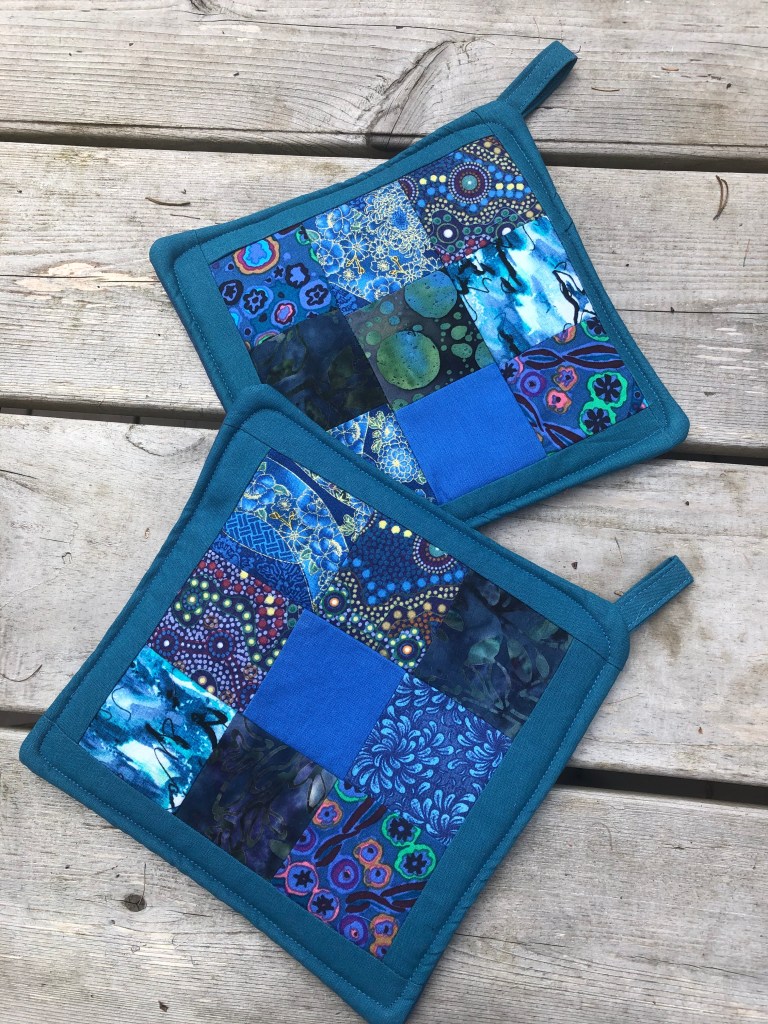
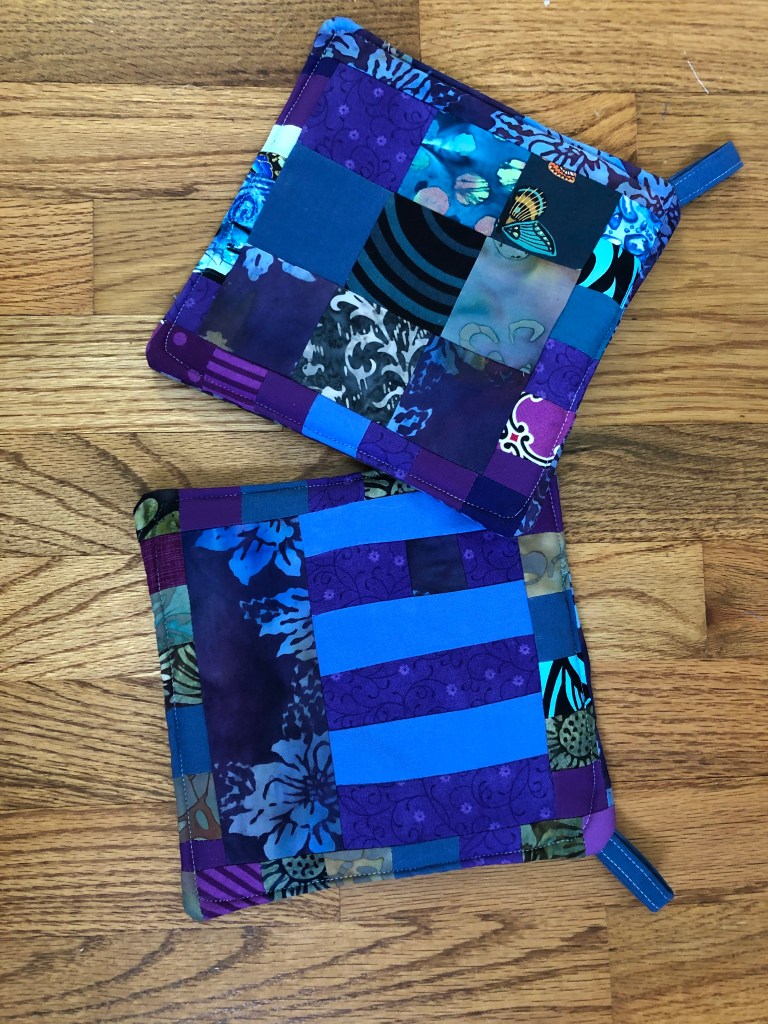
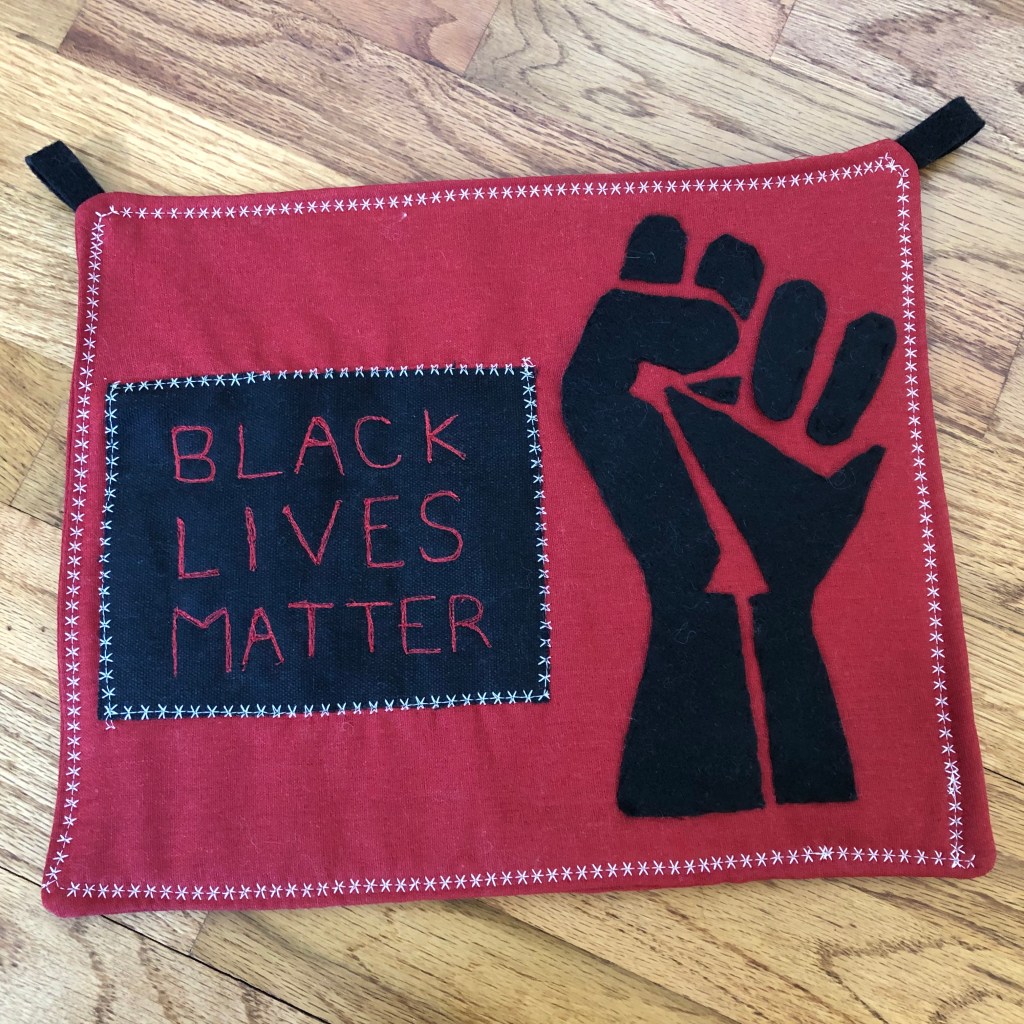
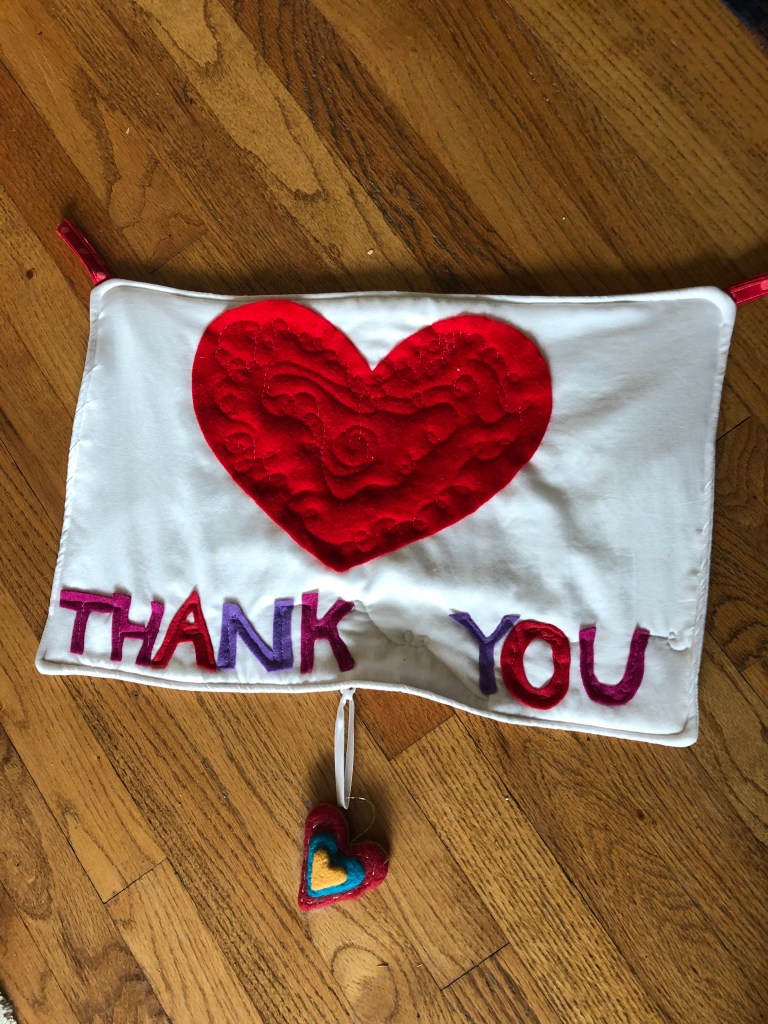
In January, I finished Four Seasons, a scrap quilt. After that, I sewed purses, potholders, and face masks galore and gave them all away. I also sewed my first garment, the “Courage Cape,” out of a $5 thrift store blanket. I made a couple of banners: “Thank You” to our health care workers, which hangs in our front window and “Black Lives Matter,” which hangs on our front door. 

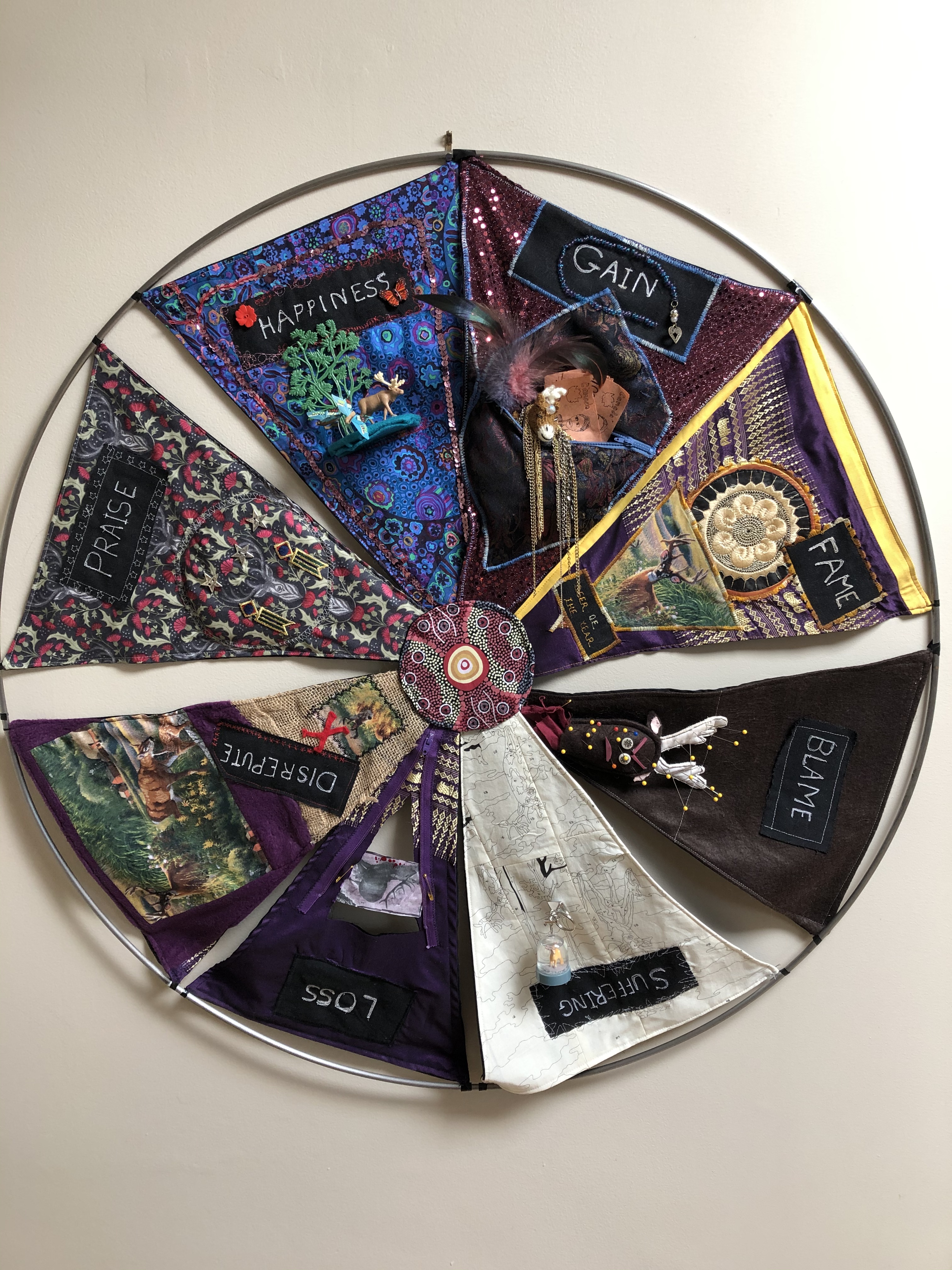
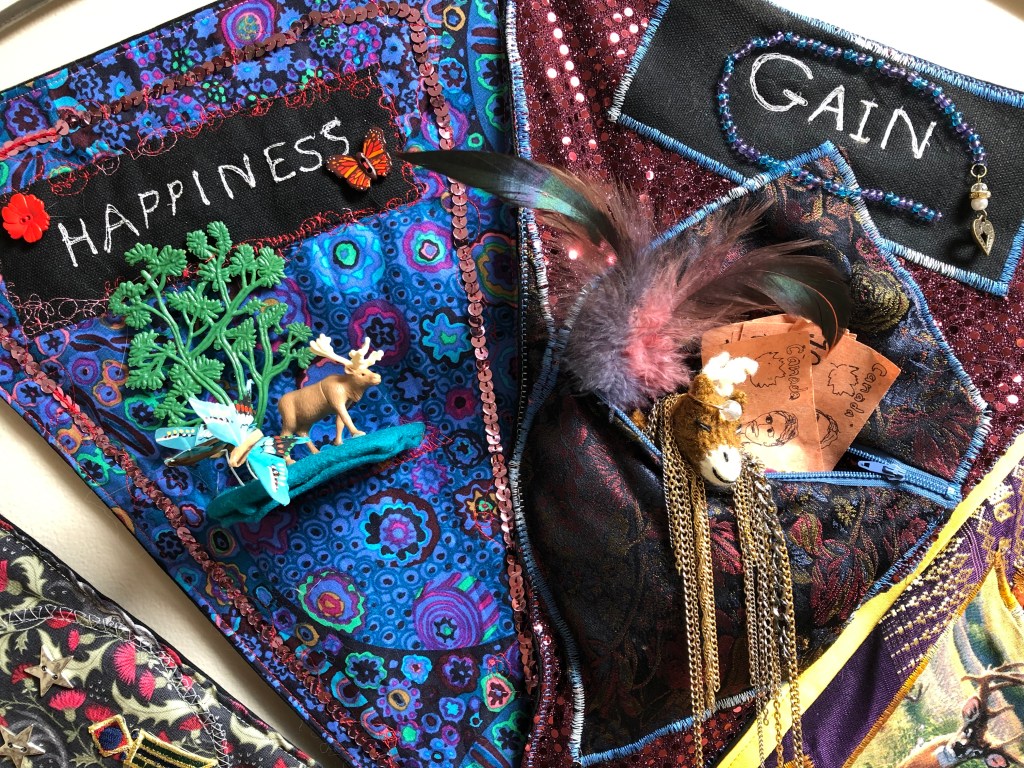
I finally completed Eight Worldly Winds, the first piece I’ve made that I dare to call “fibre art.” A series of eight triangular pennants arranged in a mandala feature a stag as protagonist and illustrate the eight worldly winds from Buddhist teachings. These consist of four opposing pairs of pleasures vs. discomforts: happiness/ suffering; praise/ blame; fame/ disrepute; and gain/ loss. Pema Chodron has a gift of making this teaching relevant to our lives:  

“We try to hold on to fleeting pleasures and avoid discomfort in a world where everything is always changing. Our attachment to them is very strong, very visceral at either extreme. But at some point it might hit us that there’s more to liberation than trying to avoid discomfort, more to lasting happiness than pursuing temporary pleasures, temporary relief.” 

Living Beautifully with Uncertainty and Change, 54-55

I am offering Four Seasons (approximately 38″ X 45″ quilt) and Eight Worldly Winds (35″ circular wall hanging) for a suggested donation of $250 each.  All money raised will be donated to Black Lives Matter Vancouver (and I’ll post the receipt for funds donated here on the blog). Free shipping (my donation) in North America. If you are interested, please send me an email: maddyruthwalker@gmail.com

Love, Madeline

Pause for poetry

Last week I finished my Four Seasons quilt and turned back to the project I had left half done: the eight worldly winds pennants. I had completed four (gain, loss, fame, and disrepute) and so started on Thursday to work on happiness: a small dime store deer standing on a woodsy platform amidst butterflies and a tree. And then at the happiest moment, sewing red curlicues around the happiness label, my machine stopped working. The bobbin started to jam. I cleaned and rethreaded the machine many times, patiently, methodically, but it kept jamming. Way overdue for a tune-up, I thought, so I packed it up and took it to Sawyer’s Sewing Centre. The chatty woman at the counter (who, we discovered during our lively exchange, lives right around the corner from me) said it would likely be two weeks before my machine was ready.

Without my sewing machine, what will I do? Sit around worrying about Covid 19 and the economic and climate crises?

Then, like a soaring bird, poetry ascended, landing in the space that sewing had occupied.

Yesterday I sat Sunday Morning Meditation at our Shambhala Centre for a while, then took off to walk around Fernwood. I headed down Belmont, straight for the Poetree to see what was new.  Some kind, creative person nailed a box to a tall tree right next to the sidewalk and posts poems there for passing people to enjoy.

IMG_0631I stood before the tree in the fragile March sun, reading e.e. cummings’s [love is more thicker than forget].  When I read e.e. cummings or Dylan Thomas, and sometimes T.S. Eliot, my mind tells me I don’t understand, and yet deep in my toes, my heart, my fingertips, my tongue, my soft palate, I get it. I sense the truth of it. I hear the rightness of it. cummings knew that love is certainly mad and moonly, yet at other times sane and sunly. Contradictory, puzzling, complex, maddening, glorious, fleeting, perseverant, inexplicable: love is all of that and more. The double negatives and oppositions in the poem read like wise nonsense spouted by a savant.

This morning, I was preparing a bag of tricks to visit a girl I play with sometimes. Today, I thought to myself, I will take supplies to make paper dolls and some books to read. I have saved a few books from my own childhood, and one of them is We like Bugs, a simple sweet primer wherein two children describe all of the bugs they encounter. Before slipping the old book into my bag, I flipped it open and found an inscription from my adopted grandmother, Phyllis Davidson, who had given me the book when I was five. The poem was a haiku involving a beetle and Michelle, our black female cat. Unearthing this treasure, so long hidden, made me feel happy, a little communion with my long-dead Grandma. Phyllis was a true cat-lover. After we moved to Toronto, she would send multi-page typed letters to us describing the antics of her many cats. Here, she seizes on Michelle’s alertness to sound and movement. Haven’t we all seen a cat’s attention glued forensically to an empty spot, as if ghost-watching? And then you realize a microscopic bug is passing there.

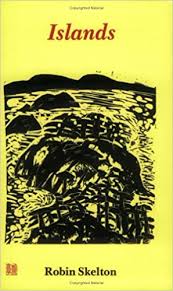
Grandma’s haiku reminded me of the hundreds of short poems Michael and I have written to each other over the years on our little kitchen whiteboard. Transitory as the clouds, the words are there today, gone tomorrow, arising imperfectly from our foggy minds as the coffee grinder buzzes in the early morning kitchen. It all started with Robin Skelton’s book, Islands, that we bought—I think—at a yard sale (Ekstasis Editions, 1993). The water-warped paperback lives in our kitchen drawer, handy for reference. The book’s subtitle is “poems in the traditional forms and metres of Japan,” and in his introduction, Skelton does a brilliant summary of many of those forms, including Sedoka, Dodoitsu, Choka, Mondo, and Somonka. Then in the body of the book, he richly demonstrates  his mastery of these forms, for example, this sharply humorous Dodoitsu (one stanza poem of 7-7-7-5 syllables) that describes a situation familiar to many of us over 60:

islandsIn Age

In age we find memory,
a sly old friend, removing
his coat, accepting a chair,
and lying, lying.

(p. 58)


IMG_0701Although most of our poems have disappeared under the quick daily rub of a tea towel, Michael snapped photos of a few of his over the years. He prefers the Choka, a form that Skelton describes as “a poem of any length” that “alternates a five syllable with a seven syllable line and concludes with an additional seven syllable line” (p. 10)­­. This one takes me back to the days when we both worked M-F, 9-5 and all week we ripened for the week-end and its leisurely joys.

Here’s to poetry of all kinds–I love the flawed, fresh jewels in the light; the old burnished friends; the wounded lines so raw and open; also those dense verses like green kernels, hard to crack. When I read a poem–sudden lift of my heart, dark sadness in my inner thighs, tingle in my ears. The way it makes me feel. The sweet heft of writing poetry, the tart cherry scour of sharp words, the high loft of vocabulary, precise yet untethered, vulnerable yet powerful. Poetry is for everybody. Write something now!


Open channel to the soul: A year of creative expression

“In the greatest confusion there is still an open channel to the soul. It may be difficult to find because by midlife it is overgrown, and some of the wildest thickets that surround it grow out of what we describe as our education. But the channel is always there, and it is our business to keep it open, to have access to the deepest part of ourselves…”

Saul Bellow, foreword to Allan Bloom, The Closing of the American Mind

As I look back over the year, I see that my ongoing mission has been to keep play and creativity alive in my everyday life. I like to think this everyday work/play as a way to keep the channel to my soul open, tender, and raw.  I do this mostly through writing and sewing.

Writing

This year I wrote quite a bit—I wrote everyday gratitudes, and sometimes I wrote “morning pages” (see Julia Cameron’s The Artist’s Way to know more about morning pages). I wrote blogposts, a short story, and a personal essay.  Every year I aspire to what I idealize as “a regular writing practice,” some idealistic daily routine where I put writing first, a priority in my life, and set writing goals. But so far, I haven’t achieved this. I wonder whether this year it’s time to lay the dream to rest and just write when I can for the sheer joy of it, to express myself, to explore my ideas.

After my mother died in February, I wrote an essay, “Holding Space for Death,” which I shared with my writing group and with Michael. In this personal essay, I try to articulate my complex response to my mother’s death. I describe how the Heart Sutra helped me make sense of the experience of grieving. I submitted the piece twice to literary journals. It was rejected twice. I continue to feel tension and yearning around the idea of publishing. In academic circles, publishing a piece in a respected journal or publishing a book is the be-all and end-all—it is the intended outcome of most writing.  It’s been hard for me to let go of that idea, as it was drummed into me throughout my graduate degrees.

Holding space

My illustration for “Holding Space for Death”

So in rejection of the idea that I should gain approval by being published in traditional venues, I continue to write this blog: 21 posts in 2019 including this one. I wrote poems and travelogues, mused on stuckness, and visited my little girl self. There were a few shared/ guest posts in there—one from my sister (thank you Judith), and Michael and I shared the blog during our summer road trip–such fun! I appreciate all of my reader comments this year—thank you so much for reading and being interested and responding to my ideas, poetry, and drawings.

Another way I’ve taken a detour around the publishing game is by printing a short story I wrote. I had a local company make copies and staple it as a small booklet with a few of my sketches as illustrations. My talented son provided the cover art.  I gave the little story to family and some friends as a Christmas gift. I gave the inexpensive gift of creative expression.

How To Love Things Into Being

Nat’s beautiful cover for my short story

Although I am pretty sure I completed my memoir in 2018, I got feedback from four readers in 2019: some very good feedback. Mostly, I learned that my analytical writing doesn’t mix well with storytelling, but that I can tell stories that hold interest. I don’t see any reason to pursue publication for the memoir; writing it was a wild and beautiful process.  But I do think there are some good chapters that may be reincarnated elsewhere. For example, the strong chapter on my Fez experience (living in Fez, Morocco for a month in the early 1980s) could be the beginning of a book of linked short stories.  Watch for it.

Sewing

I love to sew. It is only in sewing and writing that I achieve what Mihaly Csikszentmihalyi calls “flow,” losing sense of time and place as one becomes immersed in an activity.

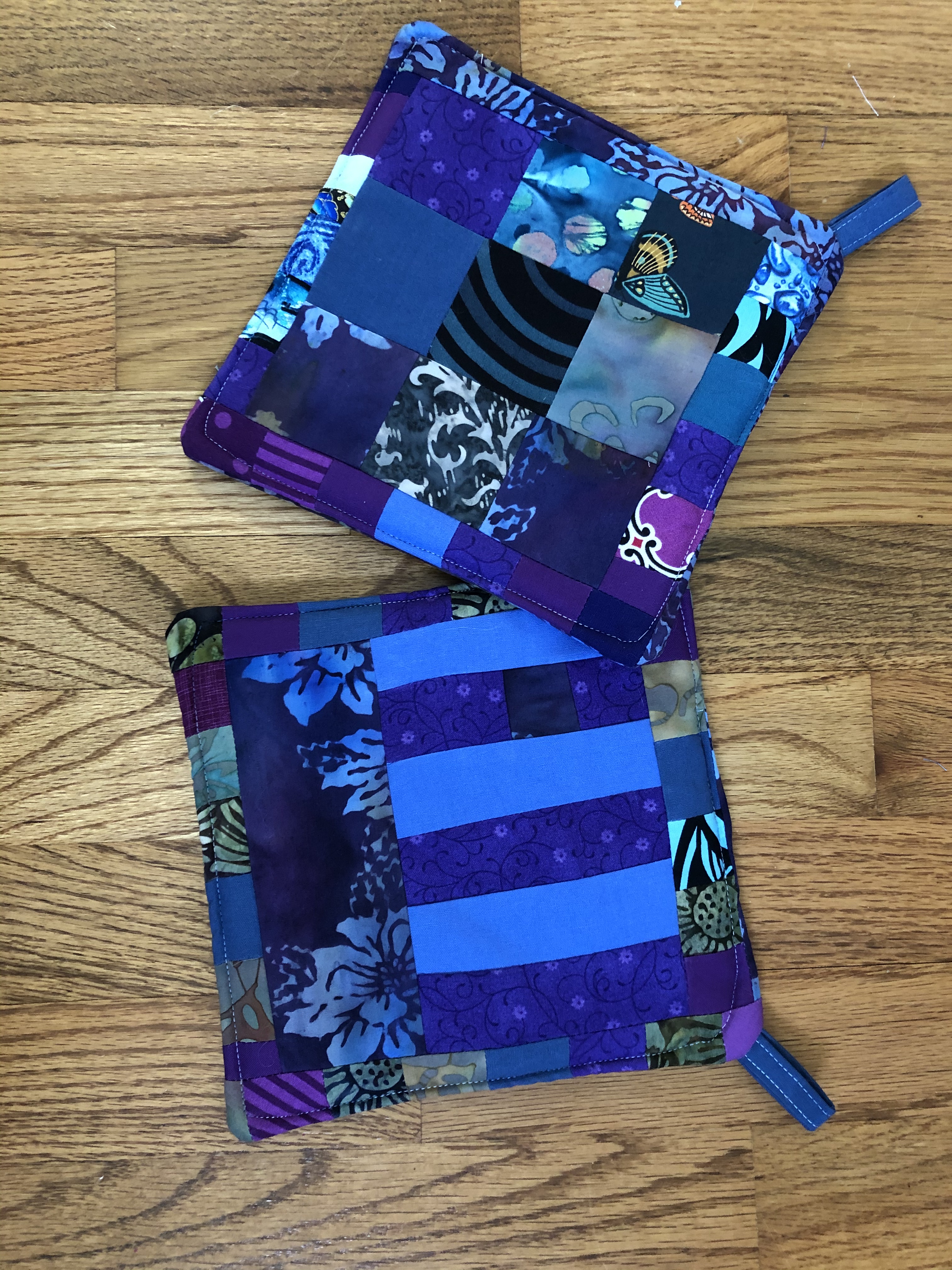
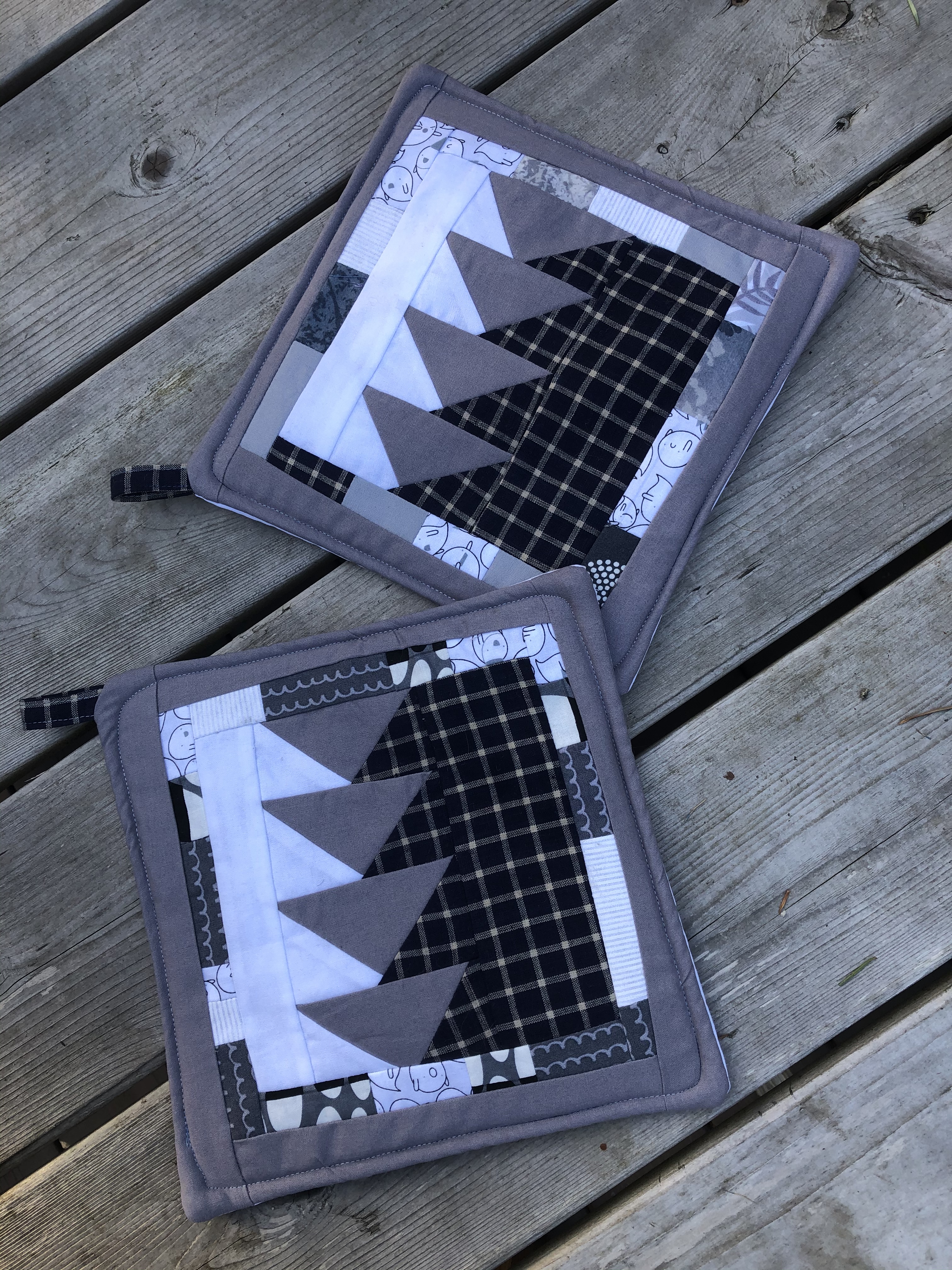
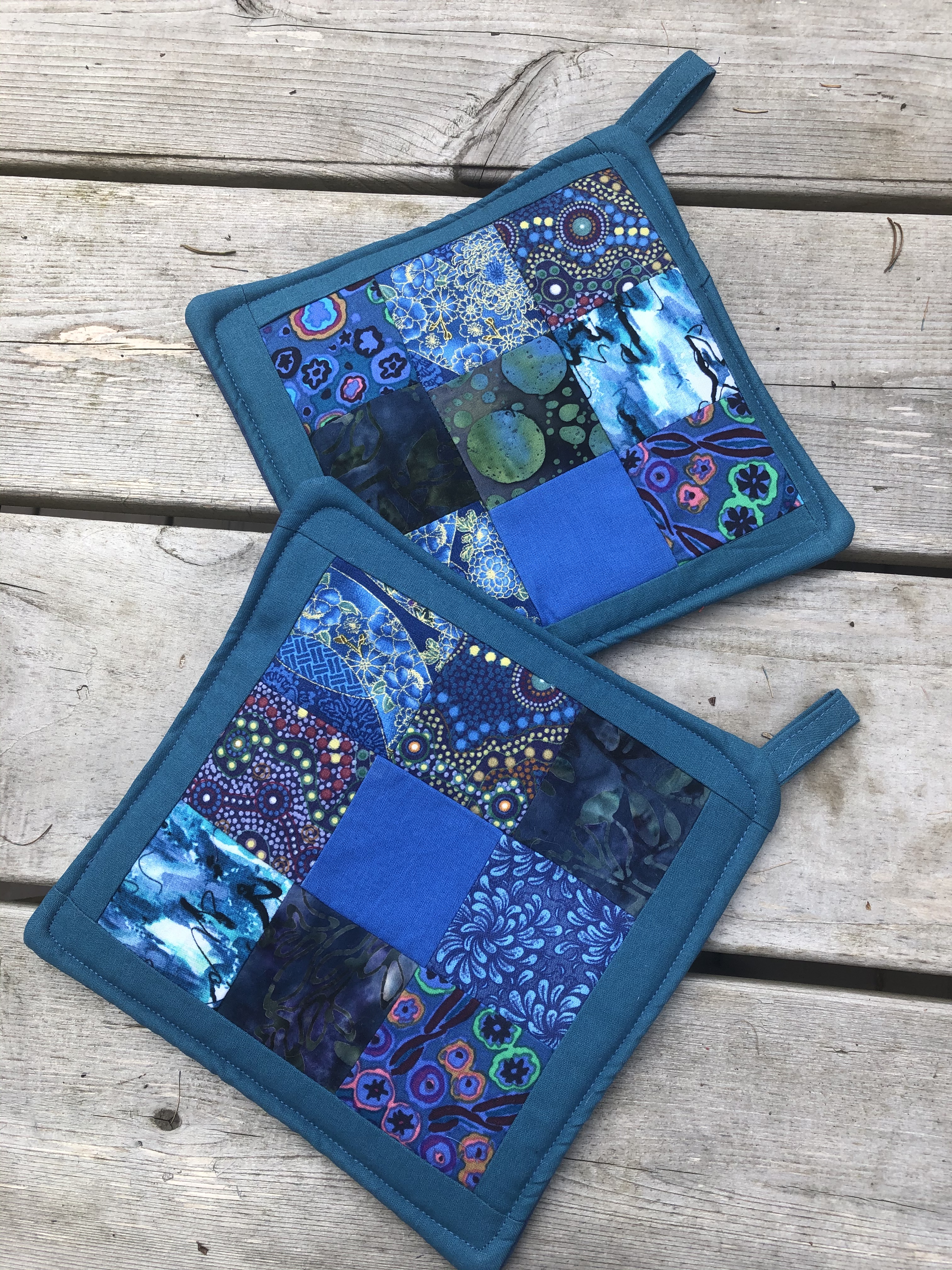
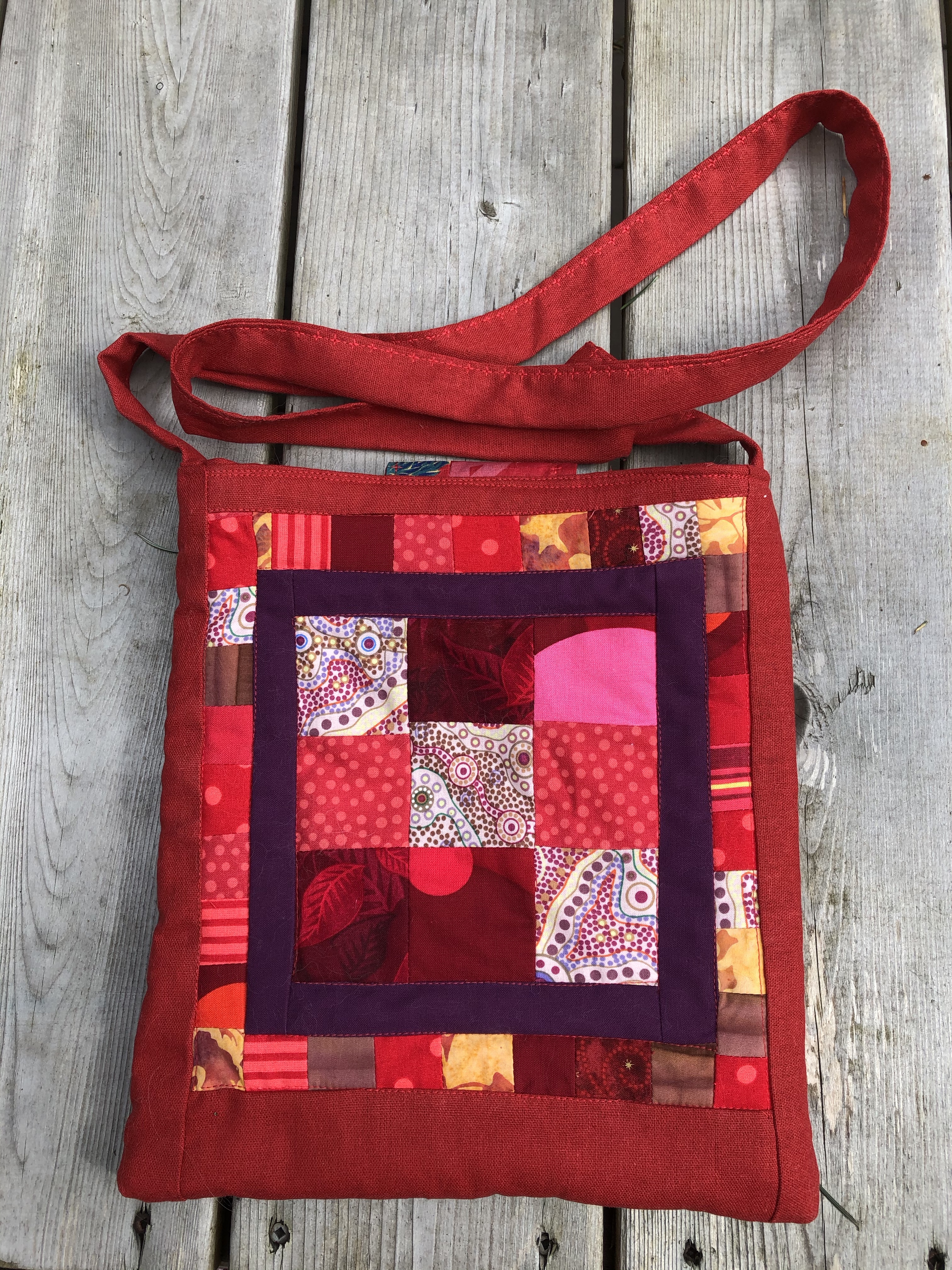
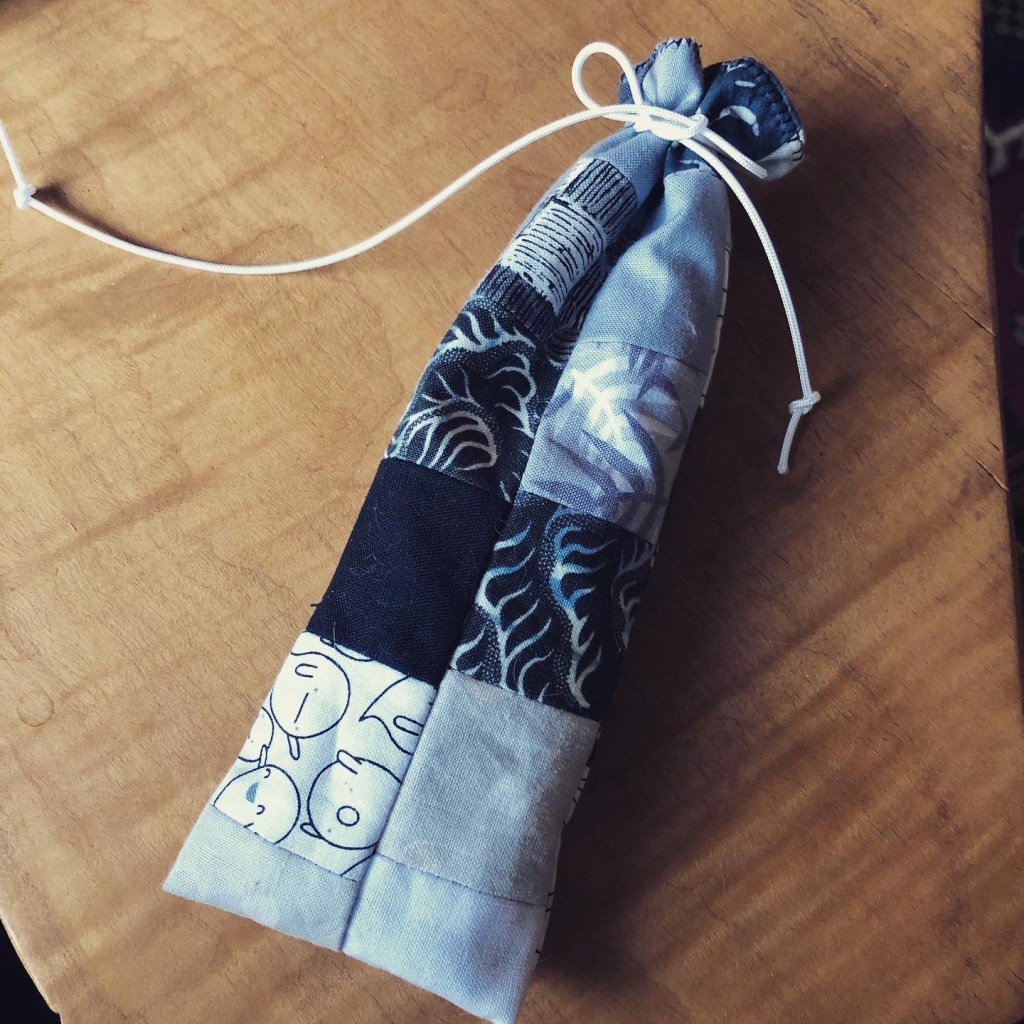
My sewing projects were various: pillow cases, napkins, mesh produce bags, a zippered laptop case and small zippered purses for coins, make-up, or iPod cords. Drawstring and buttoned purses for tarot cards. I created one cloth bag in rich reds and pinks as a container for a copy of The Velveteen Rabbit, a gift to Michael for his birthday this year (in this, one of his favourite books, we learn that the wonder of a lifetime of being loved transcends the telltale signs of ageing). A pair of little bags on long straps—one green/blue and one purple—went to an adorable pair of young sisters, daughters of a friend.

The biggest project was a quilt in memory of my stepson, who died in 2016. I used some of his shirts to create a pattern of triangles.  I worked on the quilt in fits and starts for 10 months, an emotional journey. I felt closer to Alex through the design and slow sewing of this piece.


Working with old family fabric became very special to me when I recently used some household linens that my dear friend had found when going through her parents’ house after their deaths.  When she gave them to me, I incorporated the delicate aged napkins into 2 pillow cases, one pink and one green. I see more of this kind of sewing in my future–using old cloth to fashion new objects.

This slideshow requires JavaScript.

And more

Although sewing and writing are my creative mainstays, I continued to draw and paint as well.  I make birthday and other cards for friends and family using watercolours, collage, and ink. I illustrated the blog (for example, far left, far right), the memoir (fire picture), and the Christmas present story (flying chair).

And then there is whiteboard “art”: Michael and I take turns making coffee in the morning, and as we wait for the coffee to steep in the French press, we draw images and write poems on the little whiteboard in the kitchen. That before-caffeine freestyle drawing produces some kooky stuff, sometimes based on the dreams either one of us has woken from.

IMG_3712

M & M Blend Coffee: A white board drawing

I bought a ukulele this year and Michael and I start beginner lessons next week at our local Silver Threads Centre. I aspire to learn enough chords and songs to accompany myself in singing some favourite Bonnie Raitt tunes. It was an old dream of mine to be a blues singer. . . .  And I almost forget. In 2020 I want to overcome the fear of a lifetime: Get up and DANCE in  public.

IMG_0231

According to Nina Wise, creativity is all about “having the courage to invent our lives—concoct lovemaking games, cook up a new recipe, paint a kitchen cabinet, build sculptures on the beach, and sing in the shower.”   She encourages us to by-pass the censoring voice that says “Stop!”  To cultivate the one that says “Yes! Go!”

For me, what has helped to achieve this creative freedom is to stop comparing myself to others so much, to stop worrying what others will think. My aim is not to become or be an artist. I am a maker. A creative. These are better nouns–less pressure.

I am never completely successful in banishing the people pleasing aspect of making–after all I really do care what people think. But external audience is not my first thought anymore. I am my first audience: I have to love what I make.

I express myself  because creative expression is my lifeblood. Seriously, being a maker keeps me alive. And I do it because the process and the product please me, the creating and the creation wake me up to life and to myself. And then I hope what I make pleases a few other people. That’s it. Creative expression is whispering to you. Creative expression is your birthright. Listen and say Yes! Say Go!

Recommended: Nina Wise, A Big New Free Happy Unusual Life: Self-expression and Spiritual Practice for Those who Have Time for Neither. Broadway Books 2002.


Hear my whispers

When I am frayed and strained and drizzle at the end
Please someone cut a square and put me in a quilt
That I might keep some child warm

And some old person with no one else to talk to
Will hear my whispers

And cuddle
near

excerpted from Nikki Giovanni’s “Quilts”

I wish I knew more about the dresses that were cut up and sewn into still-bright stars and pleated petals that make up the quilt on our bed. I can imagine young girls in the 1970s in their cotton frocks, blue and brown paisley, flowered yellow and orange peplum, pretty prints swinging from slender waists. Probably those dresses were home-made to begin with, with smocked bodices and full skirts. Or perhaps they were simple jumpers. I wish I knew. Once a dress had been handed down a few times from sister to cousin, and the littlest girl in the family outgrew it, the dress was cut into pieces for a quilt.

But it’s too late now to hear more stories because Frankie (Frances), the quilter, died last month at 90.  She was Michael’s sister-in-law, and when we visited her two months before her death, she gave us the quilt she sewed with her grandmother-in-law, Michael’s Grandma, whom everyone called Granny Dobie. Frankie described how Granny had travelled from her farm near Mission B.C. to Prince George with the unfinished quilt and a quilting frame that she set up in the living room. Granny then patiently instructed her granddaughter-in-law how to hand quilt so they could finish the quilt that would cover Frankie and Mac’s marriage bed.

When I lie under the quilt every night, I like to examine the stiches and think of the four hands that made them. In my mind, I see the two women—one young, one old—sitting together in companionable silence over the frame, stitching small, even dashes in white thread, tracking every seam, curved and straight, and securing the three layers of the quilt together.

We were so touched when Frankie wanted us to have the quilt—perhaps it was because she and I talked sewing when we visited, and she knew we’d both appreciate the work that went into it. When she gave us the quilt in September, she told us that Granny had used old dresses to sew all the stars and petals into blocks, placing yellows and oranges against their blue complements. I am no pink fan, so I wasn’t sure about the quilt at first, but now I treasure it. This old quilt will always remind me of vivacious, elegant Frankie.


Version 2For Frankie

Slender and strong as bamboo,
Frankie was fierce with reality.
She wore lipstick even on bad days,
or perhaps especially on bad days.
As she spoke in smart, tart
soprano, her long graceful hands wove the air.

Those hands
were hands that sewed and weaved,
that worked and loved,
a life time.

We have to be honest with ourselves

I usually have several things percolating. Right now it’s Inktober, so I’m doing a sketch every day inspired by the prompts, keeping my drawing loose and free and generative. Jake Parker started Inktober in 2009. He wanted to improve his inking skills so he set out to make 31 ink drawings during the 31 days of October, and the idea blossomed.  Here are drawings prompted by 1) cruel and 2) weak. All of them are on Instagram: @maddyruthwalker 


Next, there’s Loren’s butterfly quilt, and I feel a bit stalled, though I have booked a solitary quilting weekend in November to finish it. I had tried to “cut corners,” even when I know that is always a mistake. Trying to skimp on time, materials, money, or love. . . this strategy always backfires on me. I have all of these old batting scraps and thought, well rather than buying a new big whole piece, I will just sew them together loosely by hand and it will be fine. I hate to waste them, after all. I am frugal. And then I realized I didn’t have basting spray to put the layers together, so I figured, well I bet if I put a few pins in the quilt it will all stay together enough for me to quilt it. So I did that, always hopeful, but in the back of my mind remembering other times that I’d donned my rose-coloured spectacles and done  something not very sensible, yet still unreasonably hoping for the best.

Sure enough, after machine quilting about one-quarter of the quilt I noticed the puckering and unevenness: The lack of basting spray combined with cobbled-together-batting created shifting fabric and resulted in a lumpy mess.  Furious with myself, I decided to rip the whole thing out, buy the spray, buy the batting and stop trying to cheap out on stuff.  But when I ripped out the stitching, being mad instead of patient, I ripped too hard and tore holes into the quilt top. So then I had three little rips that I had to patch.

IMG_3332

Hiding my mistakes in plain sight

Deep breath, accept what just happened, I told myself. I created three little patches, not in matching cloth, but in contrasting cloth. Hiding my mistakes openly. The patches are obvious cues that something went wrong, but the mistake itself, the ugly rip, is covered. Hiding in plain sight. Whenever I quilt, I am reminded that things take time. What’s the rush?

My illustrated memoir, Sow’s Ear Purse is coming along (about 150 pages so far).  I am including the first five pages, below.  Sometimes I grab bits from other pieces I’ve written and incorporate them into the memoir. After all, I am making a sow’s ear purse, not a silk one. Please let me know what you think.

My storytelling flow class with Tom Hart at Sequential Artists Workshopis almost over; we are all scripting and putting together the final iteration of our stories.  Mine is about Niobe, a woman who grew up in Dogland and became King Ambrose’s seamstress, only to hear the distressing news that he is a sexual predator, so she plans an escape to Cat Island, a loving and benign kingdom. But some urgent news interrupts her flight.   Maybe I’ll post the full comic here once it’s finished. . . . Stay tuned.

I hope you are engaged in your own creative processes this month.

IMG_3276

We have to be honest with ourselves

“We have to be honest with ourselves. We have to see our gut, our real shit, our most undesirable parts. We have to see that. That is the foundation of warriorship and the basis for conquering fear.” Chogyam Trungpa Rinpoche,  Smile at Fear, p. 6

IMG_2626

I’m losing my memory, and with it, all of my memories.  I’m frightened that I won’t know my sons, my husband. That I’ll forget who I am and what I was. When I’ve lost that, I won’t be anybody. My thoughts, memories, and ideas will float away, like helium balloons, lighter than air, and what’s left will be a husk of me, the functioning yet deteriorating body, the spark of intellect extinguished. Arthritic hands will fumble over the TV remote, an ugly knitted afghan pulled over my plump aching knees.  I’ll ask my caregiver, “what’s for lunch?” only to be told, “you’ve just had lunch, dear. It’s time for your nap.” Well, you might think, that can happen to anybody.

The thing is, my brain is different from other people’s; it’s not just the inevitable memory loss associated with aging that terrifies me. The memory lapses ageing brings are now meeting the earlier damage my brain suffered from blackout drinking as a teenager. I imagine my mind right now as a slim sandbar with a black tide rising on either side. The lapping Lethe-like waves surround me and it’s only a matter of time until one touches the other, the foamy lip of old brain damage kissing the lacy dribble from age’s drooping mouth. Over the course of my life I have known that my hippocampus is different from other people’s.  There is something missing, some capacity for cementing details that others seem to have, the train into long-term memory is stuck at the station. I’ll read a novel, see a film and two weeks later it’s gone—as if erased. This was happening even in my thirties and forties. It’s a miracle I was able to remember enough of what I read and learned to complete a Ph.D. in my late forties. Now that I am turning sixty, it’s only grown worse. If I don’t write things down, they are lost.

In “Sketch of the Past,” Virginia Woolf describes with sensuous detail her first memories—the “red and purple flowers on a black ground” of her mother’s dress, and then lying half asleep in a nursery bed at St. Ives, the Woolf’s seaside house in Cornwall, hearing the waves breaking behind the yellow blind, “the blind draw its little acorn across the floor as the wind blew the blind out.  [My earliest memories are] of lying and hearing this splash and seeing this light, and feeling, it is almost impossible that I should be here; of feeling the purest ecstasy I can conceive.” (p. 65). Later in the sketch are captures of scenes and places wrought with photographic intimacy, a closeness that made me start to weep when I realized I have only a few dry kernels of remembrance rattling around my mind. Woolf was a little younger than I am when she wrote this essay. The precision of detail amazes me. What do I remember from early years? A veil obscures that time from consciousness. Any memories I have seem to be memories created from my cache of small square photographs with their warped, jagged edges: Serving my stuffed animals “tea” at Little Bear’s tea party, blowing enormous soap bubbles with my adopted Grandmother in Berkeley, feeding the llamas at the children’s zoo at Tilden park. My mind fools me into thinking that I remember those events, but I don’t—there’s only the faded capture on Kodak paper. No sensuous details arise; no feelings live on in my cells.  There’s just a dumb grey screen.

Yet there is a memory from age 11—my sisters sitting with me on the cold tile floor of the bathroom, both dabbing at my new kilt with warm wet cloths, quickly cleaning me up and putting me to bed so our mother wouldn’t know that we’d gotten drunk. Perhaps we started by pouring small amounts of wine from corked bottles in the kitchen. We might have sat around the kitchen table with coffee cups half full of too-sweet sherry. But my memory also keeps tugging at the old refrain, “come alive for a dollar five.” That was the joke we used to make later about the cheap rotgut wine “Old Niagara” that kept the rummies fueled. I remembered the old men slumped against the wall of the Silver Dollar tavern when I walked down Spadina Avenue, paper bags concealing identical green glass bottles lying beside each ragdoll body.

We got tipsy, the three of us, light-dark-redhead, but it was too much sweet stuff my first time drinking. We probably laughed, acted giddy and silly as sisters do. Felt the thrill of being bad. But before the sweet sickness came over my gut, I felt the first stirrings we alcoholics get—that deep gut-warmth. Liquid gold, ecstasy, painting my insides. That halo of euphoria that crosses us over into a land of freedom, power, luxury—the velvet couch of glory. Give it to me again and again!

So even though I scrambled up the stairs two at a time, my gut heaving, to retch in the toilet, partly missing and getting the sherry-smelling chunks of vomit on my new kilt, I was still shaken, seduced by that blood-warming pleasure. Even if I woke the next morning feeling black-wasted, sour-tongued, I still wanted to go back to that land soon, to loll on that velvet couch. Give it to me again and again!

There was no turning back. For the next fifteen years, I drank to get drunk. With my friends and family, I had to elaborately hide the machinations to get another drink, to keep going when everyone else had enough. I had to keep going until I was curled fetus-like, comatose, on the velvet couch. Not all the time, and I don’t think I drank steadily until I was around 16, but the hungry ghost had always been inside me. The ghost is inextinguishable.

Scientists have found that binge drinking in the teen years leads to irreversible brain damage. When researchers gave 10 doses of alcohol to adolescent rats over 16 days, mimicking binge drinking, they discovered that nerve cells in the hippocampus, the part of the brain that controls memory and learning, communicated abnormally and looked abnormal. According to the scientific report, “Branches coming off of nerve cells should look like short mushrooms. Instead, here they looked long and thin.”

In addition to damage to the hippocampus, heavy drinking leads to the loss of white matter in the brain. Like a shuttle bus, white matter quickly delivers messages to grey matter, so when you lose white matter the efficacy of your thinking is disrupted.  Alcohol also affects the prefrontal cortex and, thus, executive function. As drinking adolescents start to lose executive function, they find it more and more difficult to stop their self-damaging behavior, triggering a vicious circle.

It all started to make sense. I imagined long thin mushrooms branching off my botched nerve cells. As a typical teenager, the long-range planning or executive planning part of my brain was developing more slowly than other parts. The effects of alcohol abuse confounded this slow development by dissolving my white matter, prompting me—when I started to feel tipsy—to abandon thoughts of consequences and take many risks. Early in my life, my brain was irreversibly rewired. My memory just doesn’t work like other peoples.         

But I have my journals—erratic records of my life—that connect me to my past. Traces of my forgotten life live on in those notebooks that overflow a blue 60-litre Rubbermaid tub. Some date back to the mid-1970s when I first started to write.  Sometimes, this tub holding my past feels like a burden. Like Pandora’s box, it harbours snakes that might slither out and asphyxiate me. Ghosts might be unleashed, giving rise to nightmares, regret, self-recriminations. But could there be hidden treasures in there as well, I wonder? I contemplate the tub with ambivalence: The emancipatory urge to clear space battles with the fear of losing everything. Are the old journals a scourge holding me back from the future? Or do the journals anchor me to an identity, a reminder of who I am, the only record of Madeline as I slowly lose my mind?

As my 60thbirthday approached and my fear of losing my ability to remember grew, I decided I needed to make something out of those journals, but the thought of reading all of them was overwhelming.  How can I choose which ones to read? I wondered.

Always intrigued by chance, I wondered what it would be like if I pulled only 13 out of the pile of perhaps 50 or 60 journals and worked with just them. What if I eschew choosing the “best” or most interesting ones, the most dramatic ones, and rather, work with whatever I get? That would alleviate the huge responsibility of poring over all of them, and it would also force me to make something out of “slim pickings,” perhaps. I remember my mother telling me you can’t make a silk purse from a sow’s ear. True, you can’t make silk from pigskin, but you can make an even more bewitching purse from that sow’s ear than you could ever fashion from mere silk. Work with what you’ve got, with what you find, with what you pick out of the air, out of the dump, off street signs, from snatches of conversation.


IMG_3129

I am the sow


Four years of quilts

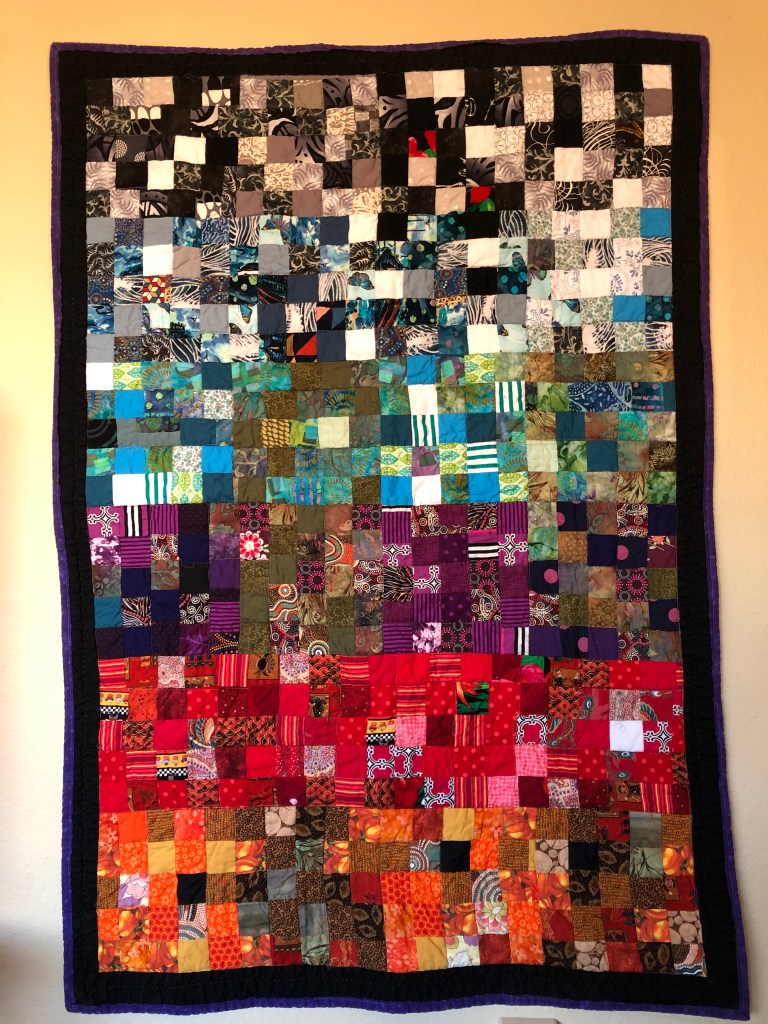
I started quilting in October 2013, learning from all those wonderful quilters who are kind enough to share their skill through YouTube videos and blog posts. I have made 16 quilts over these last four years, from the humble beginnings of a purple rag quilt (still on our bed) to the patchwork for my friend Olga this past summer.  I’ve made quilts for people I love, and this gives me the greatest pleasure–to plan each quilt thinking of that person, his colours, her design.  Quilting has brought frustration and joy, has made me more patient, has allowed me to learn through mistakes, to take risks, to be creative with colour and pattern.  I’ve found photos of 14 of the 16 quilts, shown here.  Happy Thanksgiving everybody.

“For it is in giving that we receive.” Saint Francis of Assisi