“When we run from our suffering we are actually running toward it.” Ajahn Chah
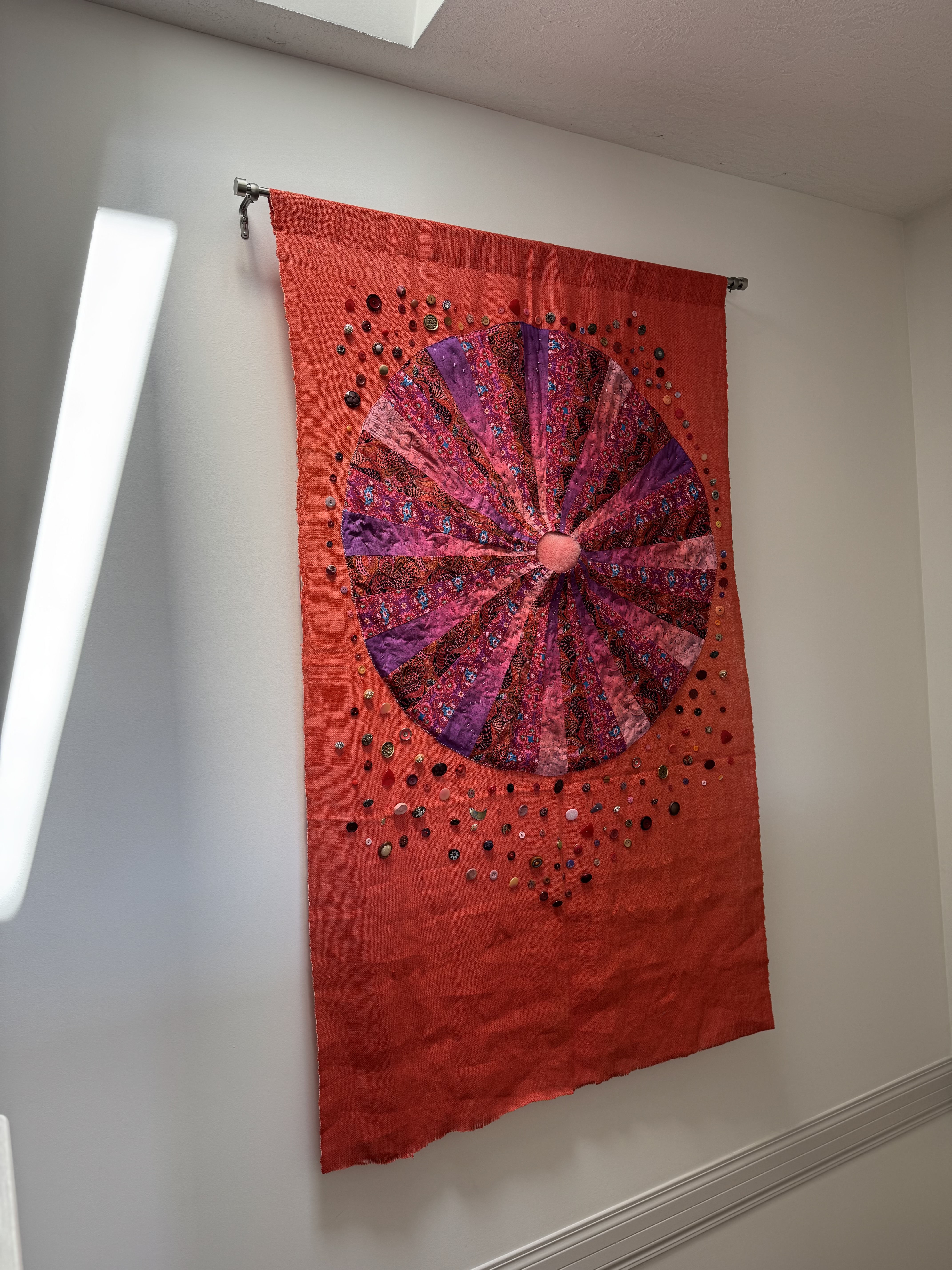
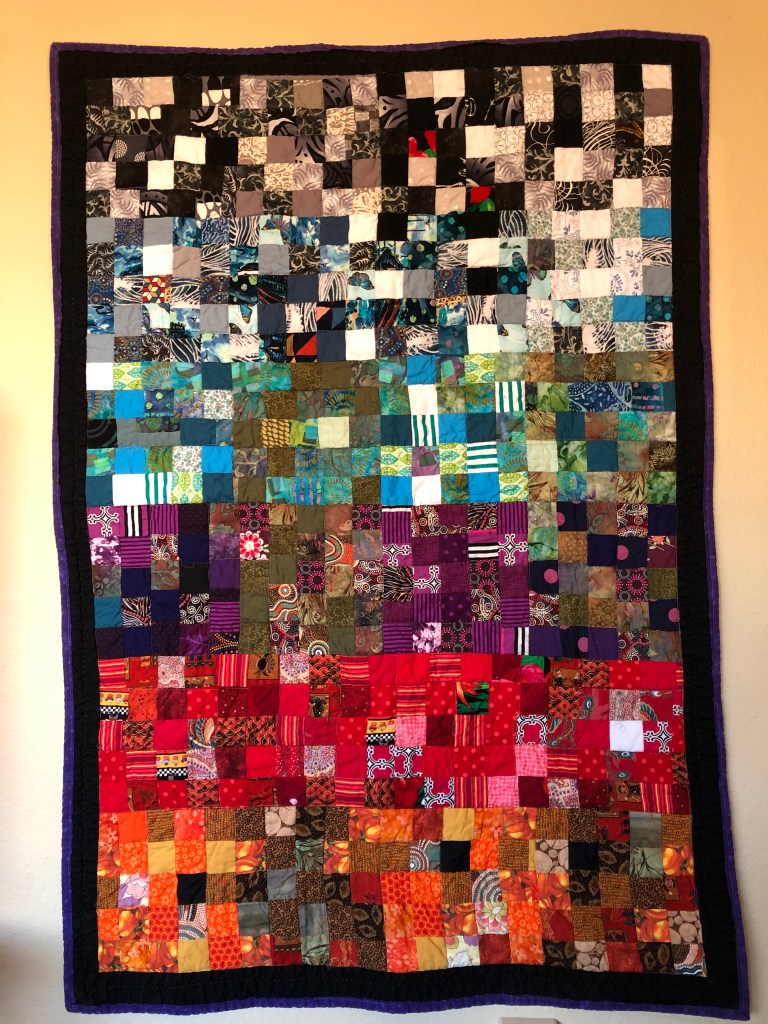
I’ve been basking in two messages from my unconscious this week. In one dream, a person wearing a bright tie-dyed shirt holds a hand lettered sign, “You are not alone.” In another dream, a young man, bearded, hugs me and whispers in my ear, “Thank you for your patience.” The messages are hackneyed, and yet they were delivered to me fresh, warm, colourful,by stately messengers. It doesn’t matter if they—the messages and the messengers—aren’t “real”; they are just as real as the people and events, the words, ideas, and things I encounter in my dream-like conscious life. And more to the point: They provide great comfort, having bathed me all week in an orange glow, a glow like that emanating from the 10,000 joys wall hanging, now installed in our stairwell.
The wall hanging seems to collect the sunlight falling in through the skylight and send back a peachy radiance. Several times now I’ve gone to flick the hall light off, thinking the switch is on when it shouldn’t be. No, the light is off, but 10,000 joys shed their own uncanny light.
When I made the piece, I kept telling myself, you don’t have to make its counterpart, 10,000 sorrows. It’s okay to just focus on joy right now. But of course, you cannot have 10,000 joys without 10,000 sorrows. I wish we taught this truth to children in kindergarten. You don’t experience joy without experiencing sorrow. And it’s okay. When you cling to joy and try to avoid sorrow, you just prolong it. I wish I’d gone to a Buddhist kindergarten, where these truths would be taught elegantly and logically, instead of being told by adults that “life isn’t fair,” which seems tawdry and cruel in comparison to the dharma.
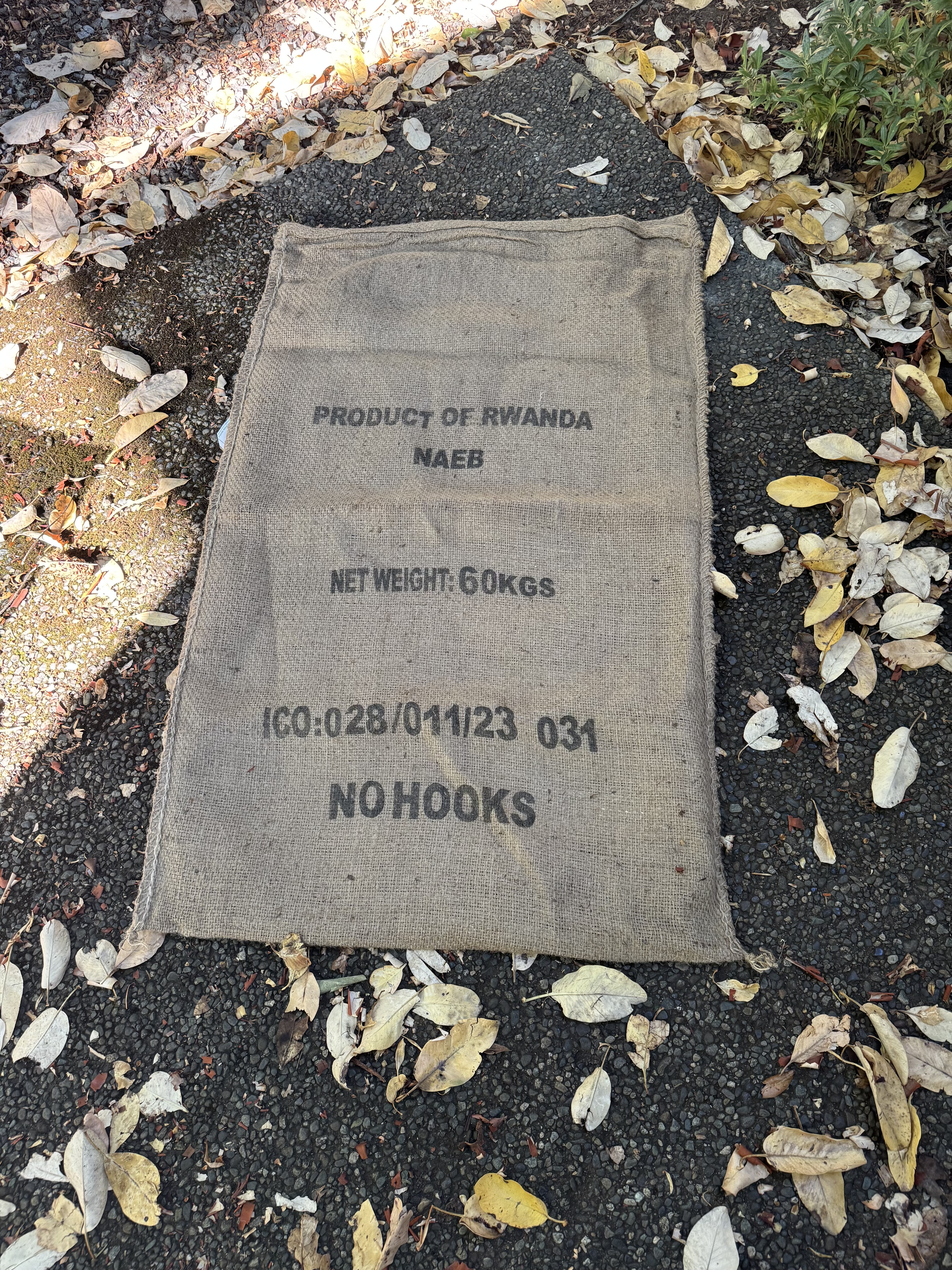
Inevitably, I am called upon to make joy’s counterpart. I had coffee with a friend yesterday at Esquimalt Roasting Company. As I waited at the counter for our lattés, I noticed a large burlap bag draped over a plastic bucket. I picked it up and showed it to the barista. Can I buy this? I asked. In my imagination, I was already picking its seams and spreading it out, a wide brown canvas for thousands of sorrows. It’s free! she responded. So now I have the backdrop for the wall hanging. I had originally thought it should be black, but brown is less dramatic than black, more subdued and complex, as sorrows often are, especially as we digest them.
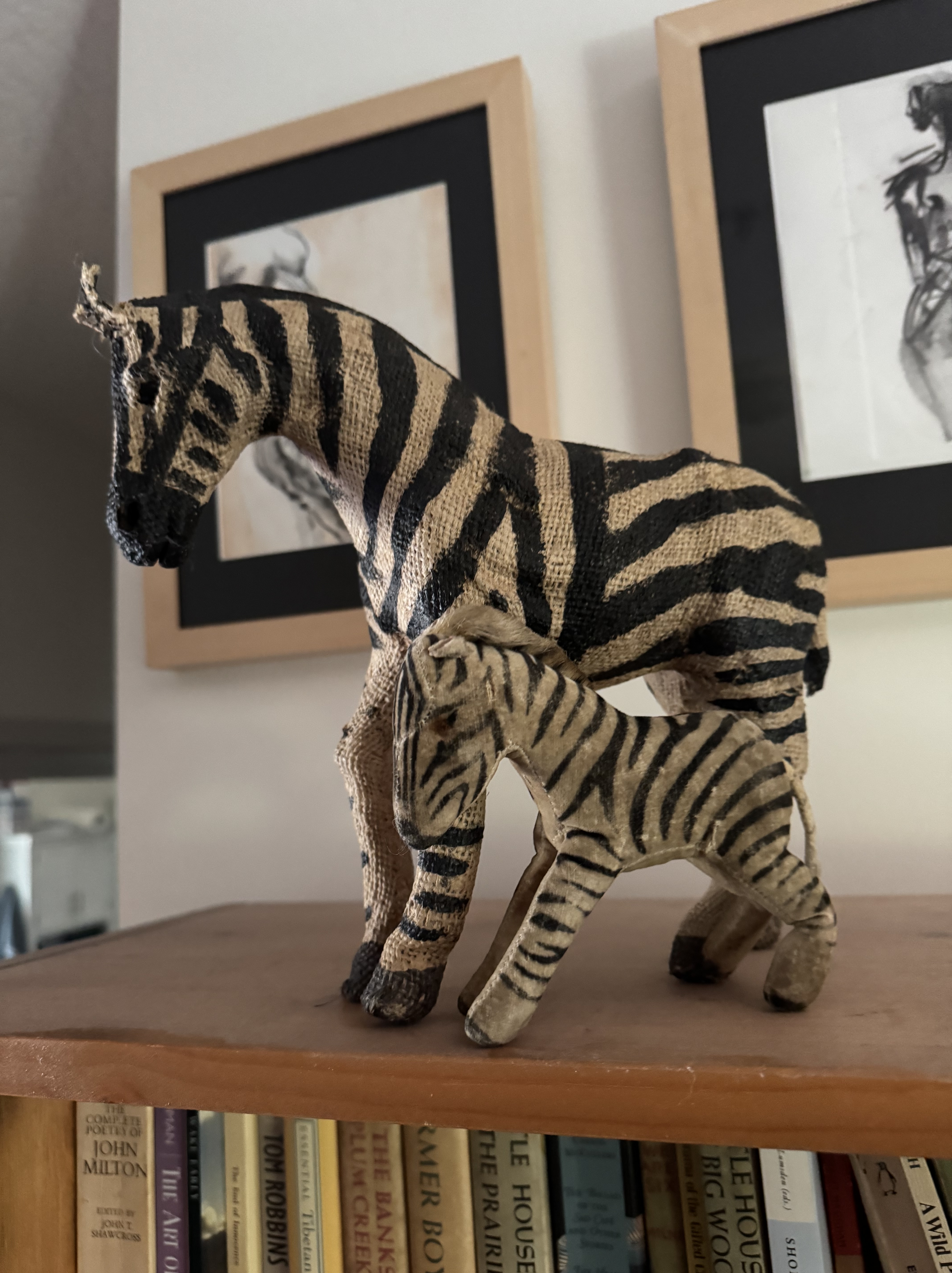
The burlap bag was pure serendipity. Another magical find was a zebra at the ReStore in Langford. Purchased for 70 cents ($1.00 but there was a 30% off sale). This zebra is majestic, dignified, kind, warm. She stands about 10 inches high. Her stripes are unrealistic, but otherwise she is a convincing animal. I dug out a stuffed toy zebra I’d kept from childhood in a box under the stairs. It’s remarkable this sixty-year old stuffed animal still stands! They now live together, mother and child, atop a bookshelf in our bedroom. I like to gaze at them from bed. Something about them feels calming, comforting. I loved my zebra striped one-piece bathing suit when I was eight years old. When I wore it, my reward was a zebra tan that was pure magic.
How to find comfort
Face fear, face grief, crunch on them like buttered toast, let them nourish you. Small striped body in the mirror, some kind of childhood magic. Let dreams bathe you in orange light. Sweet’s after tastes bitter, crying sparks a belly laugh. Joy and sorrow are so intertwined, you can’t tease them apart, please don’t waste time trying. Practice the butterfly hug: Hands cross collarbones, thumbs meet, fingers tap lightly, lightly. A comforting rhythm will come. It will come.
In mid-December, I bought a green glass jug in a second-hand store, half price. My aspiration was to make a beautiful winter bouquet for my friend, Lillian. I bought a bunch of silver dollar eucalyptus and two dozen white carnations. I envisioned white wintry bursts among the silvery green, but the more I trimmed and mixed the carnations with the stems of eucalyptus, the sillier and more incoherent it looked. I took basic Ikebana but still haven’t a clue how to make flowers and plants look good.
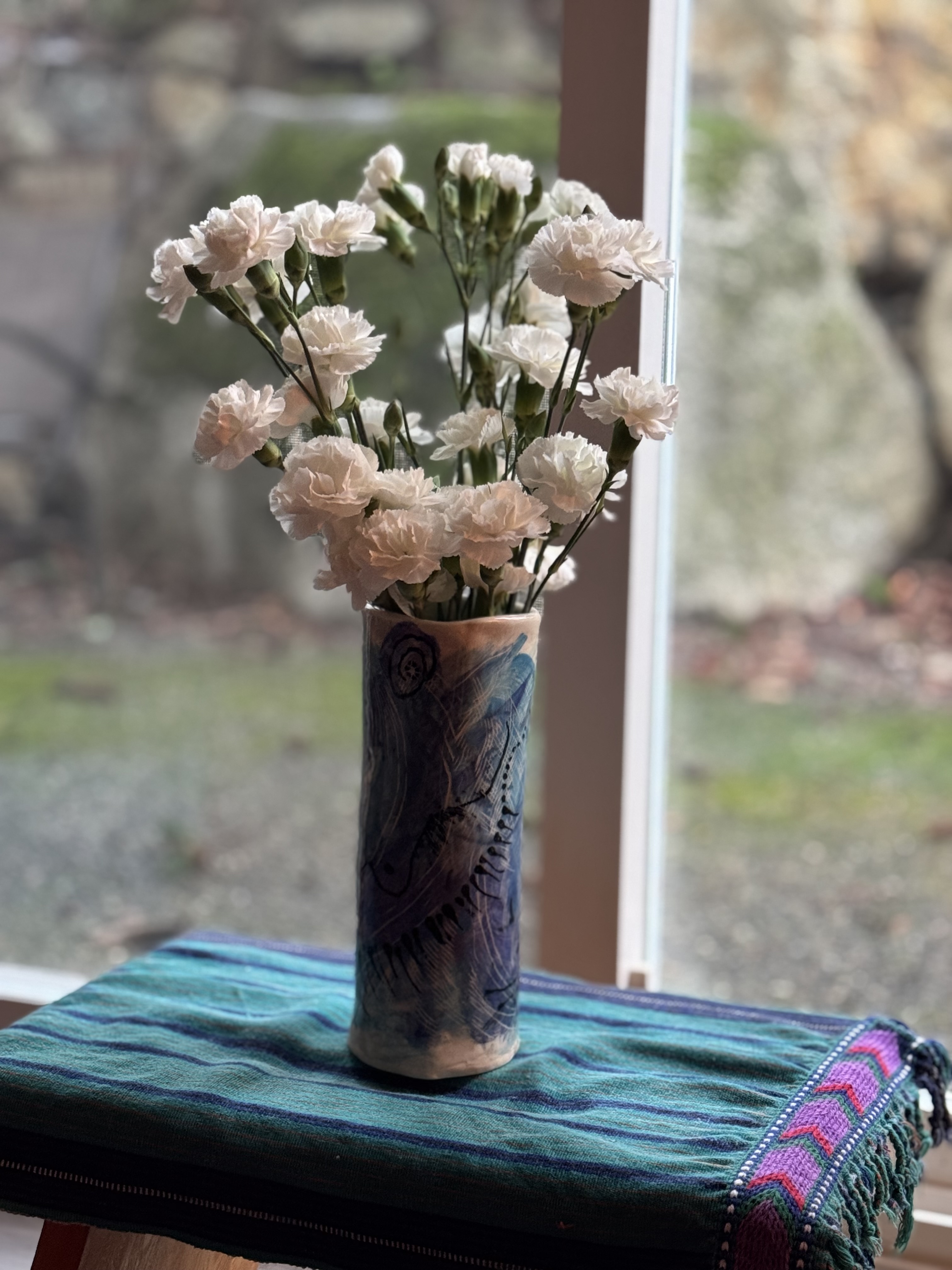
Finally, I used only the eucalyptus, splayed out in a free-fall arrangement. I attached a few small, red shiny balls to the stems, and the effect, I hope, was Christmassy and charming, if a bit messy. Lillian said she loved it. (But what could she say, really?) I was going to throw out the unused carnations, but it seemed such a waste, so I put them in a white and blue vase and placed it in my study on a low stool covered with a blue-green cloth.
I don’t like carnations, or I didn’t think that I did. I’ve seen too many sad, slender bunches wrapped in cellophane at the mini-mart next to the hospital. They make me think of last-minute purchases for the death bed, cheap flowers that outlive the person you visited. They seem so tight, orthodox, banal. Whorls of perfect, serrated petals, every bloom the same.
But they’ve grown on me. As I spend hours in their presence, they’ve become real. You could say I’ve become intimate with them. I sit here now, the last day of the year, gazing at their fresh ordinariness. The carnation is the sturdy, faithful flower that will see you through. Perhaps they are flower of the year: commonplace as canned milk. Carnations are one-foot-in-front-of-the-other flowers. Quotidian flowers. Bread-and-butter blooms. See you through the hardest times. Last for weeks. Nothing special.
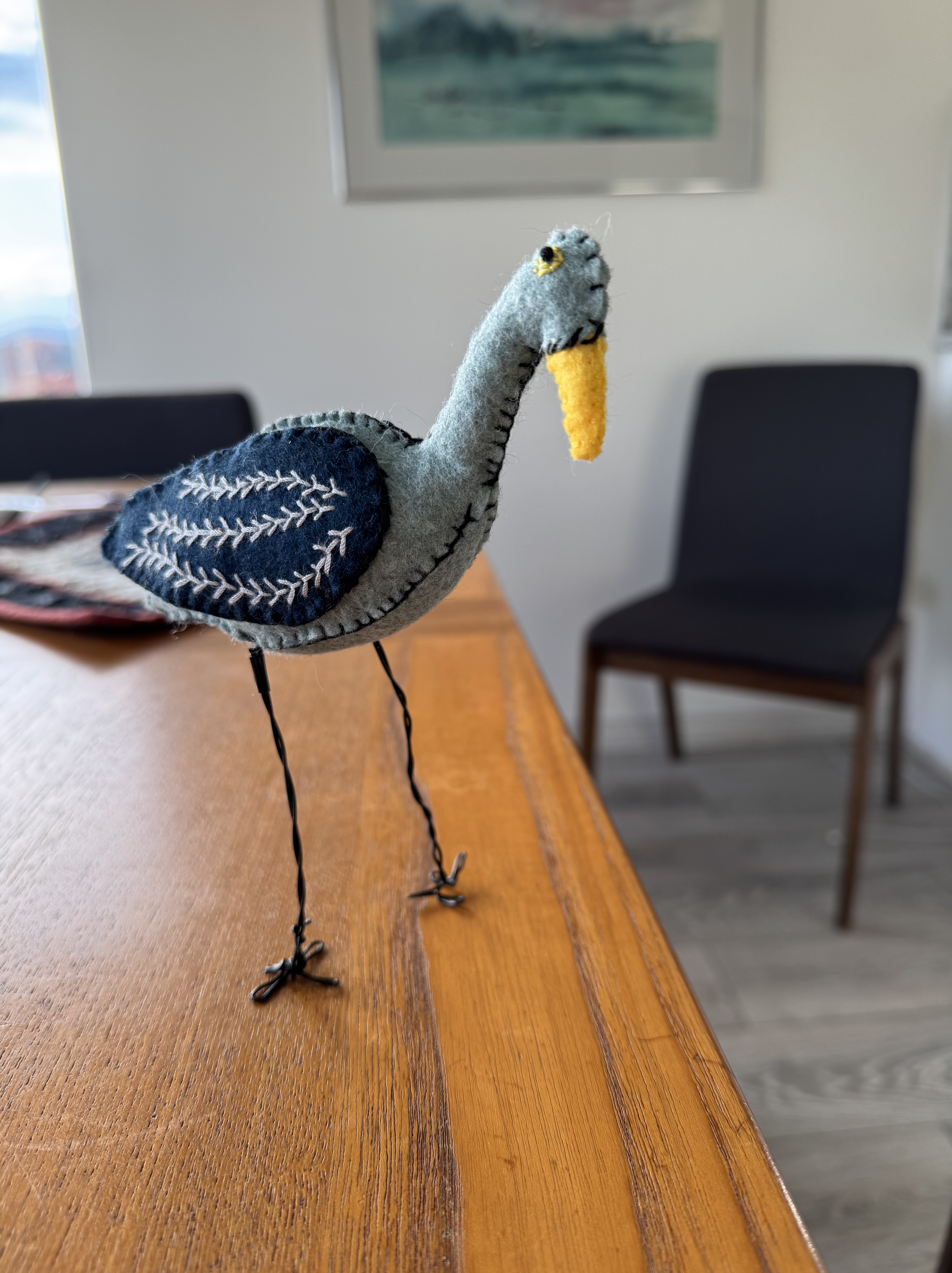
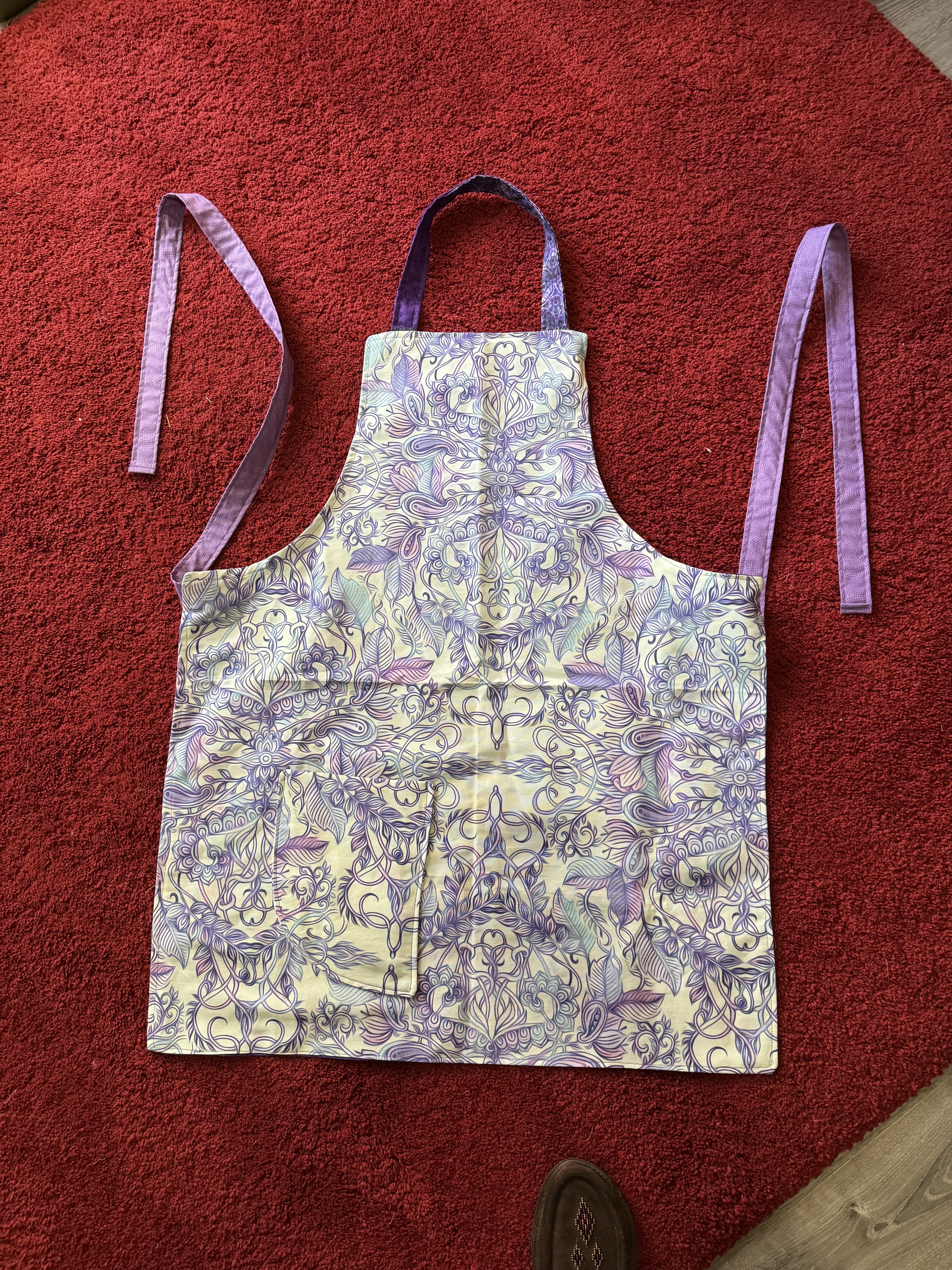
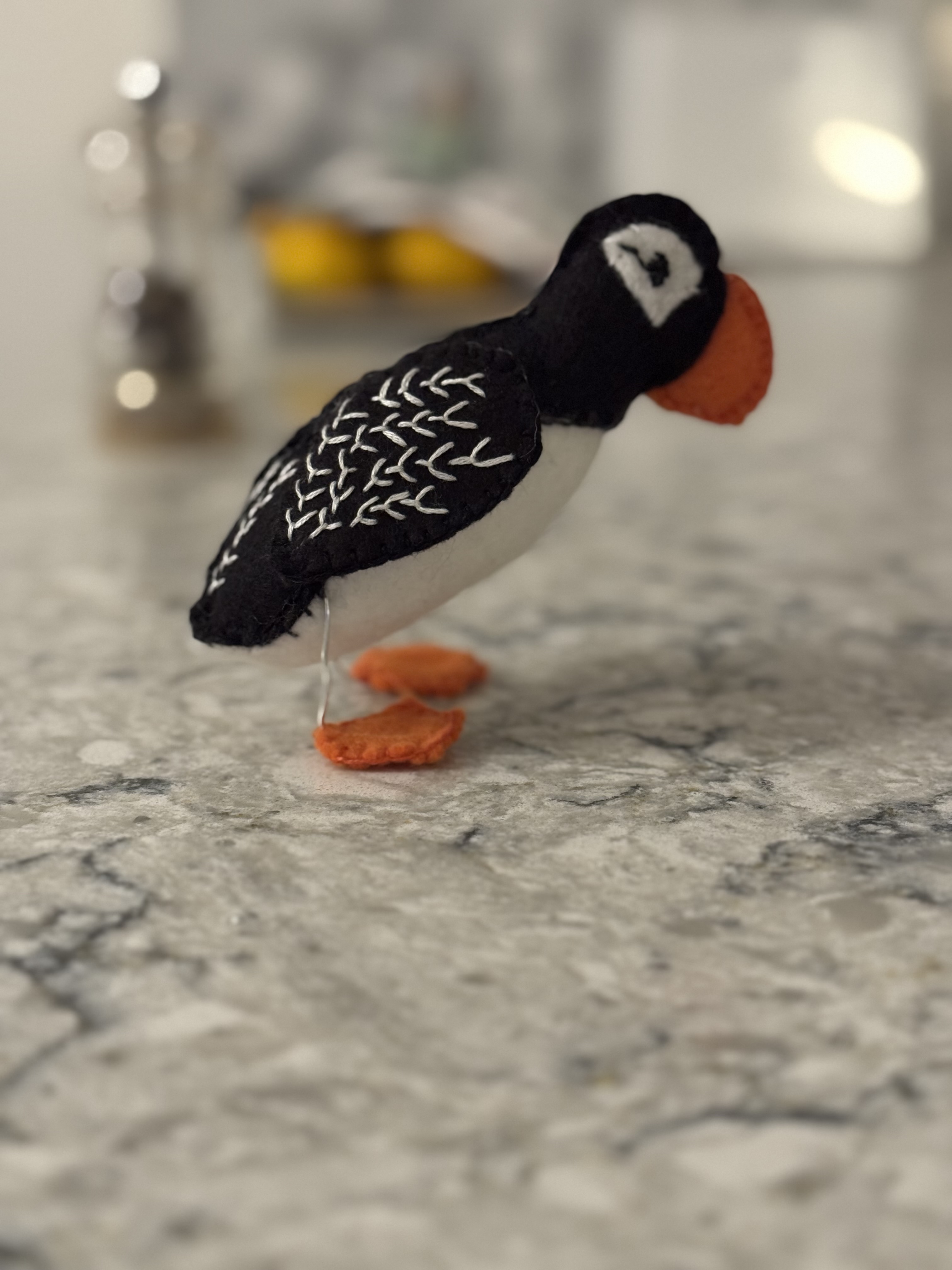
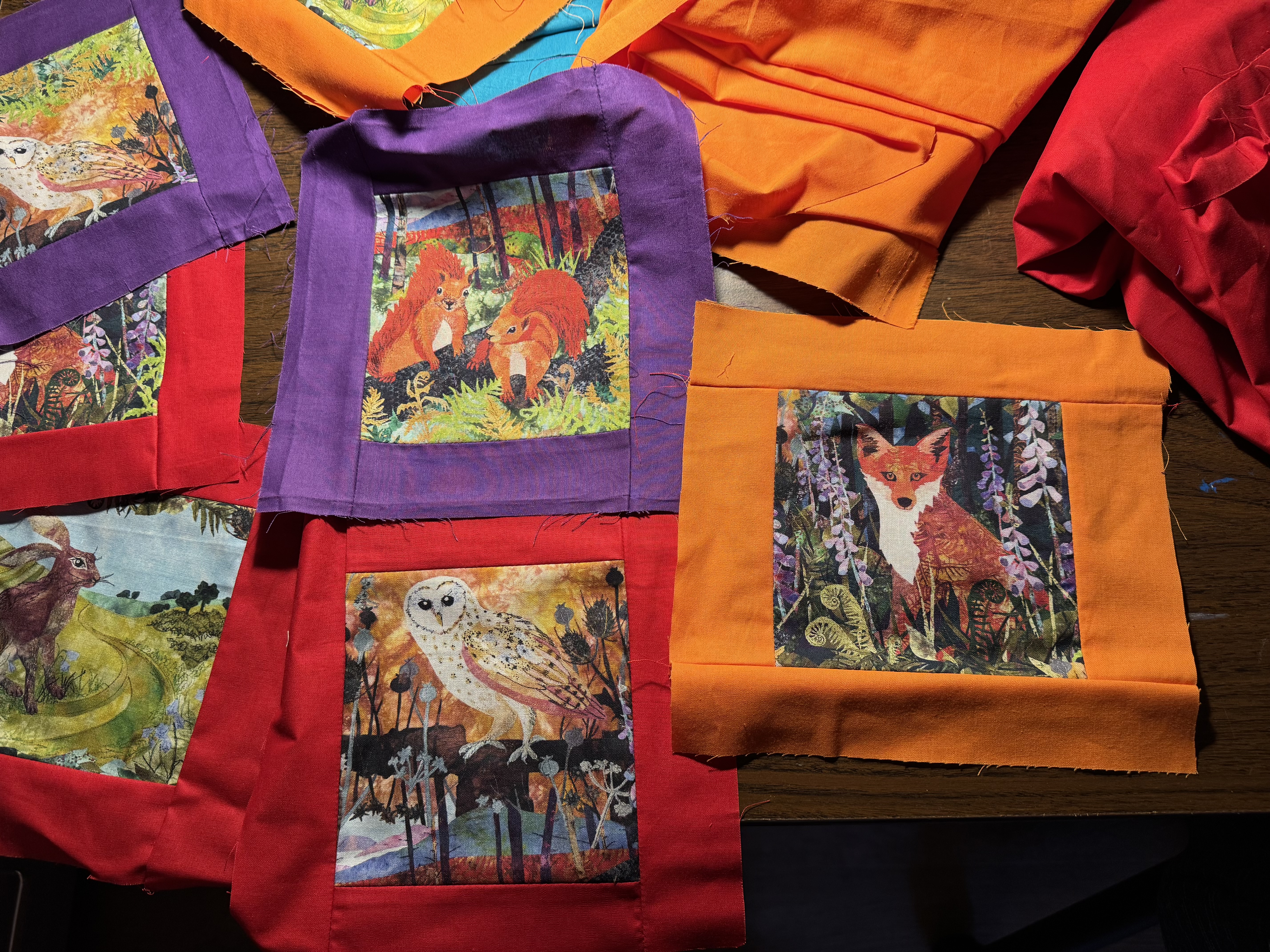
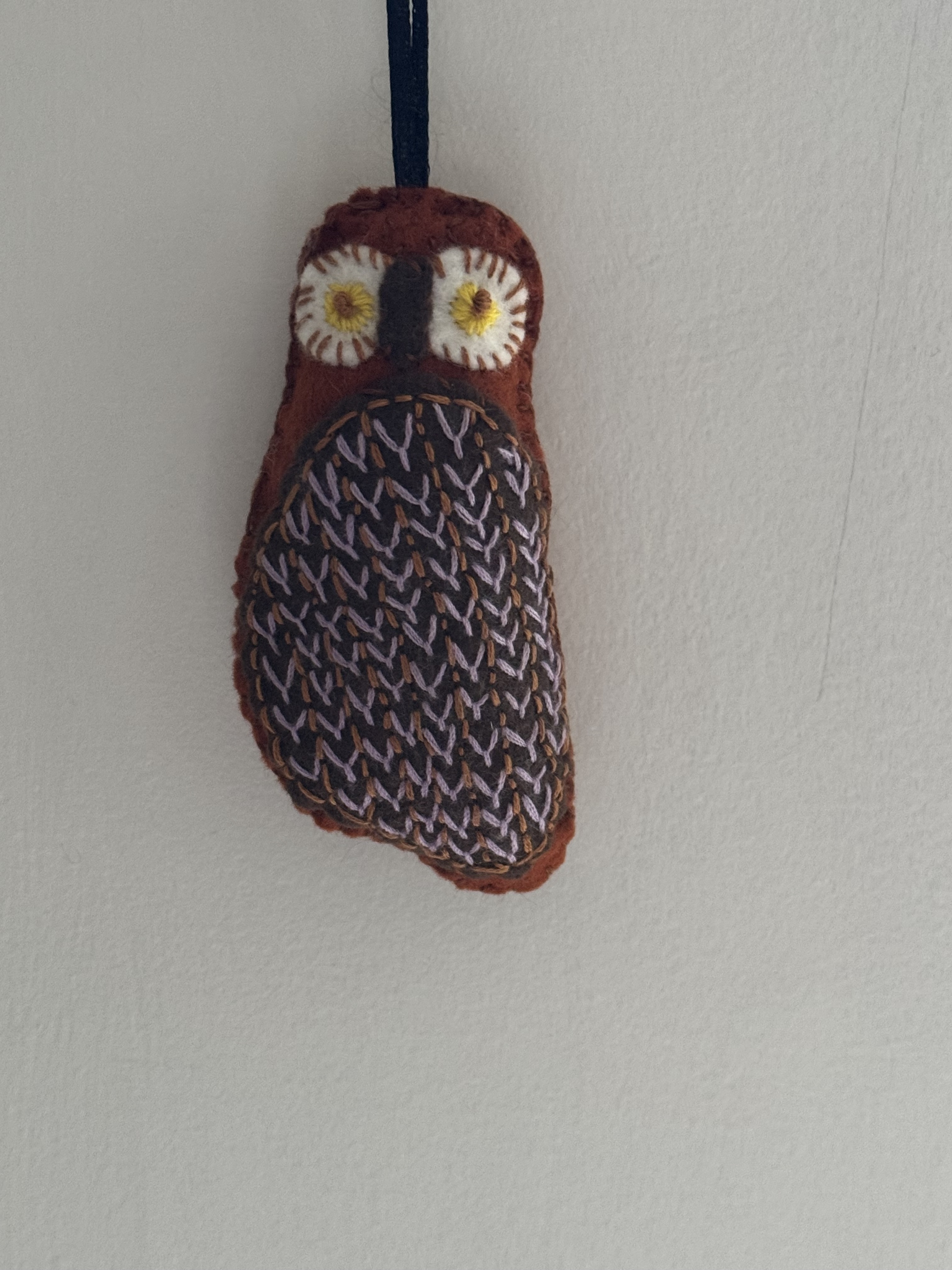
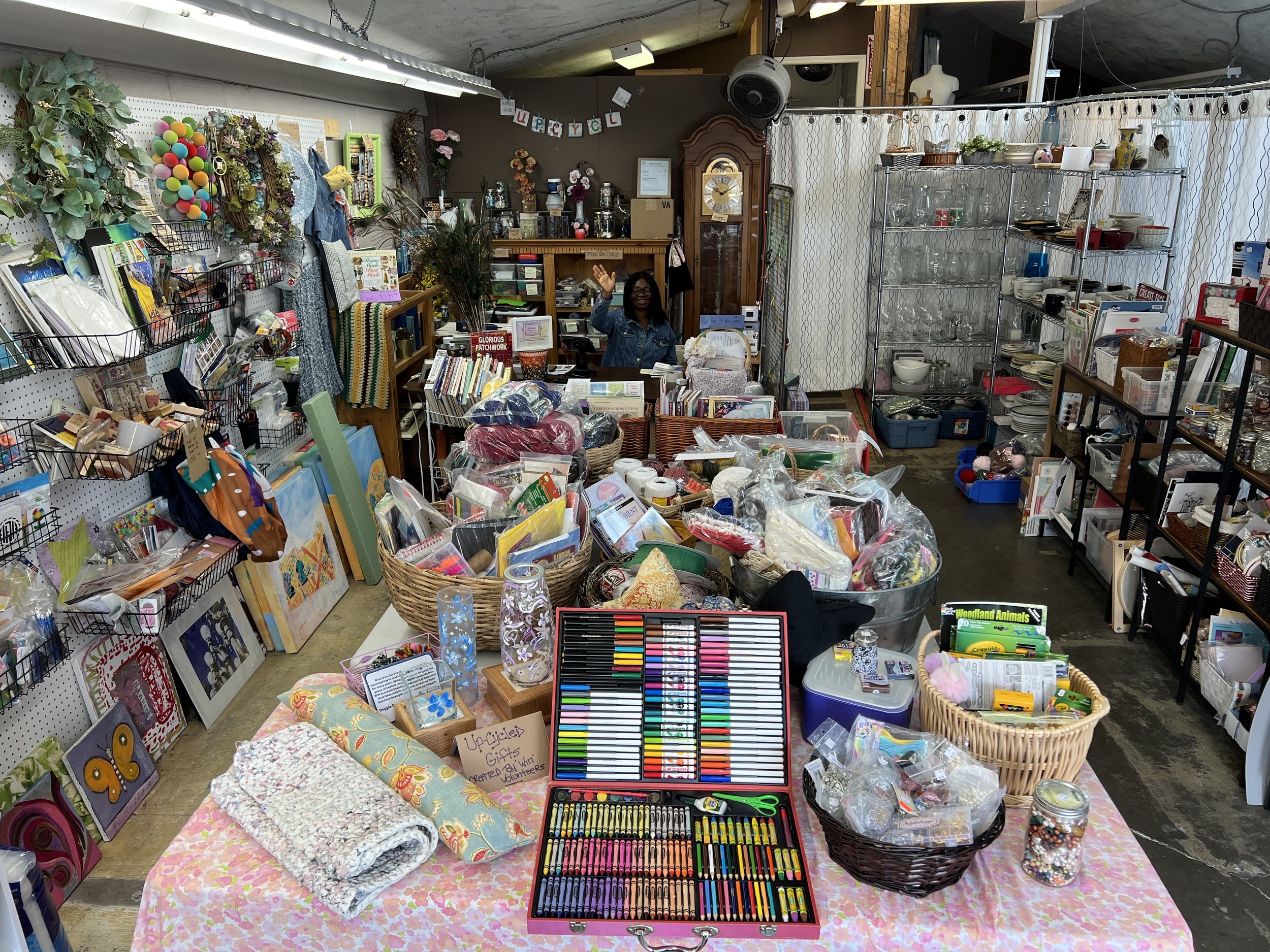
Although 2024 was my first year of so-called retirement, and thus I was given twenty additional hours each week, I wrote less, and I sewed less. (A few felt birds for family and other little felt creations, an apron, a crib quilt start, a fur-lined bag.) I did finish an editing certificate I started in 2020, which is a relief. And I made a lovely new friend and deepened existing friendships. I started a volunteer gig at a non-profit arts and crafts shop in August that has led to meeting many interesting people. Bonus: I get to surround myself with a messy profusion of materials that inspire me.
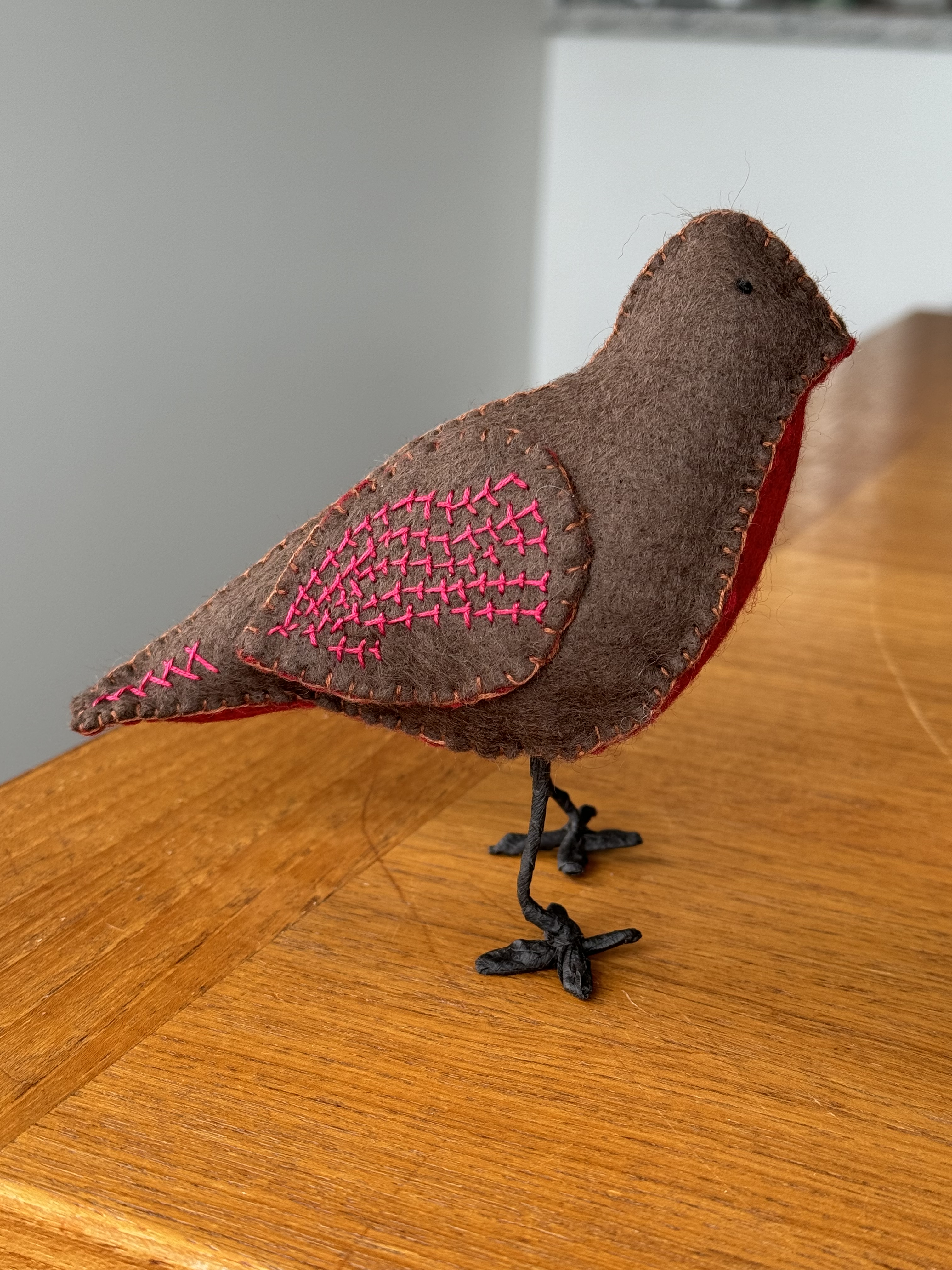
Kathryn’s robinAllison’s pigeonEvan’s heronNancy’s reversible purple apronNancy’s reversible purple apronSarah’s swanI made felt hearts for friends at Christmas.Nat’s puffinNat’s puffinI started a quilt for Lillian’s great grandson, FoxWilson the owl, a gift for Michael Magic bag lined with fake fur for Nat’s 30th birthdayWomen in Need’s Upcycle and Craft store on North Park Avenue. I work there on Thursday afternoons.
This year, I listened to probably one hundred dharma talks on Dharma Seed, with a broad aspiration of becoming more intimate with life—accepting whatever’s happening in my heart, whatever’s happening in the world. Making friends with wild mind. Accepting the truth of the way things are.
I read so many books this year. A couple that stick with me are Rebecca Solnit’s memoir, Recollections of My Nonexistence and The Age of Loneliness, a book of essays about life during the sixth extinction by Laura Marris.
Solnit writes a lot about being a woman. That’s what her title gestures toward—the peculiar “nonexistence” of being female in a patriarchy (remember mansplaining? She is behind that neologism[i]). She draws on John Berger’s 1972 Ways of Seeing, which I’ve known about for years and now am determined to read. She quotes words from him that jibe with my experience: “To be born a woman has been to be born, within an allotted and confined space, into the keeping of men. The social presence of women has developed as a result of their ingenuity in living under such tutelage with such a limited space. But this has been at the cost of a woman’s self being split into two.”
Perhaps that sounds dramatic in the Global North in 2024, but that has been my experience. Perhaps it’s different for lesbians. Perhaps it is different for women of subsequent generations, but Solnit and I were born three years apart (1961/1958), so we grew up at roughly the same time. Berger goes on,
“A woman must continually watch herself. … She has to survey everything she is and everything she does because how she appears to others, and ultimately how she appears to men, is of crucial importance for what is normally thought of as the success of her life. Her own sense of being in herself is supplanted by a sense of being appreciated as yourself by another.”
Solnit calls Berger brilliant and generous, to be able to imagine a woman’s experience, and I agree. What he writes here feels just as real as the carnations in front of me. Reading the passage and feeling its truth is freeing. No action needed, just awareness.
Similarly, truth pinged through me when I read Laura Marris writing about the age of loneliness. We become lonelier as we bear witness to the drastic reduction, or “great thinning,” of ordinary animals. Marris draws on the work of naturalist, Michael McCarthy, who writes of our baby boomer age group, “As we come to the end of our time, a different way of categorising us is beginning to manifest itself: we were the generation who, over the long course of our lives, saw the shadow fall across the face of the earth.”
Reading this series of essays, elegies to Earth as the shadow descends and animals disappear, I was gripped by a grief so deep I sat for a time and just cried. Again, the truth is freeing. Let’s not deny that this is happening. It’s really happening. We can still enjoy the beauty that is here.
In keeping with my mood of asceticism, I recently deleted my Facebook and Instagram accounts. Unlike the birds who used to sing outside my window, FB and IG will not be mourned. I feel light as I step through life with a new red pedometer safety-pinned to my leggings (the pedometer frees me from carrying a “smart” phone to count steps). Michael, Marvin, and I amble down to the beach at Thetis Cove to watch the sky change. Rippled water reflects a bank of pink clouds.
Thank you for reading. In the coming year, may you experience moments of lightness in a shadowy world.
Berger, John. 1972. Ways of Seeing. Penguin. Marris, Laura. 2024. The Age of Loneliness: Essays. Greywolf Press. McCarthy, Michael. 2015. The Moth Snowstorm: Nature and Joy. New York Review Books. Solnit, Rebecca. 2020. Recollections of My Nonexistence. Viking.
[i] From Wikipedia: The term mansplaining was inspired by an essay, “Men Explain Things to Me: Facts Didn’t Get in Their Way”, written by author Rebecca Solnit and published on TomDispatch.com on 13 April 2008. In the essay, Solnit told an anecdote about a man at a party who said he had heard she had written some books. She began to talk about her most recent, on Eadweard Muybridge, whereupon the man cut her off and asked if she had “heard about the very important Muybridge book that came out this year”—not considering that it might be (as, in fact, it was) Solnit’s book. Solnit did not use the word mansplaining in the essay, but she described the phenomenon as “something every woman knows”.
As I read the last line of Mary Oliver’s poem “Heavy”—”a love to which there is no reply”—it occurred to me that this describes my love for NYC. You can love NYC, but NYC doesn’t love you back. NYC doesn’t actually give a shit about you; the city is completely self-absorbed, and that’s just fine. It’s all part of the city’s mystique, its swirling, pigeon-flocked, neon-lit-glass-and-steel, rapid-fire, whirling-dervish, creative vibration.
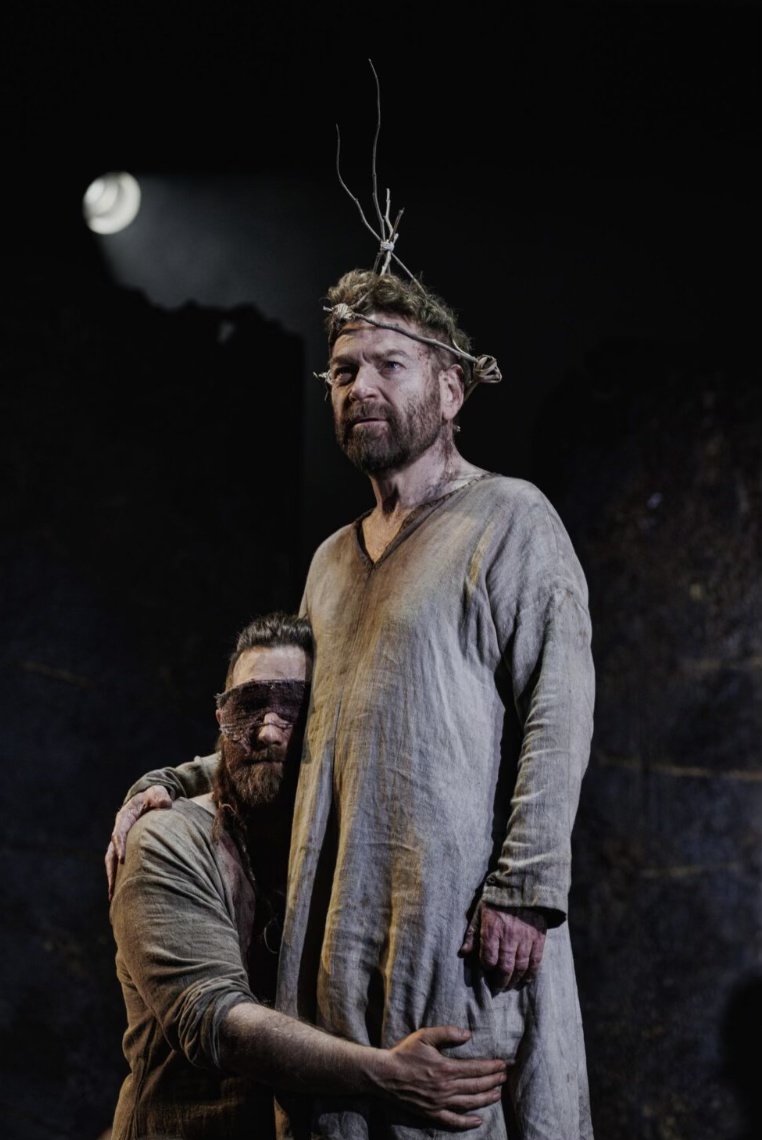
We stayed at a sweet hotel in the Flatiron district, saw wonderful exhibits at the Whitney and the Met, watched Kenneth Branagh as King Lear, went to a comedy show where five hilarious stand-up comedians made me laugh for ninety minutes. I loved all of it, every minute. But a few small vignettes stay with me and keep breaking the surface of my thoughts.
One dollar for an original print
In the Whitney Museum gift shop there’s a vending machine at one end where you can slide four quarters into the slots, push, and out pops an original print of some NYC iconic object or scene by Ana Inciardi. We put our quarters in, and now we own two tiny prints (2.5 inches by 3.5 inches): a black and white cookie and a NYC water tower. Inciardi is kind of genius, isn’t she? I don’t know if she profits from this—surely a print for a dollar is not netting her much money. But it is such a delightful thing to encounter: a vending machine dispensing original art. I want art vending machines to be installed everywhere, machines where you insert coins and receive poems, collages, small clay sculptures, watercolours, flash fiction, holograms, fabric art, tarot cards… Can you see it?
The women’s washroom at Barnes and Noble
To use the washroom at the Fifth Avenue location of Barnes and Noble, you must first purchase something. At the bottom of your receipt is the bathroom code. I bought The Temporary, a novel by Rachel Cusk, an author I have been wanting to read (the novel is wonderfully written, but very depressing). I then used the code to enter the women’s washroom, where there was a line up for the two working stalls (there always seems to be one stall with a scrawled “out of order” sign). A woman of colour (#1) exited one of the stalls, but the next person in line (white woman) looked in, then withdrew with a look of disgust on her face. Woman #1, was busy washing her hands. I said to woman #2, “what’s the problem? You’re not going in?” Woman #2, not making eye contact with me, said cooly, “they got stuff all over the seat.” I went into the stall and saw a fine spray of water droplets on the seat, likely created by the toilet’s back spray. Quickly removed with a wipe of toilet paper. The venomous way woman #2 said “they got stuff all over the seat” implied something terrible, perhaps excrement smeared everywhere. Her contemptuous reaction was so overblown and ridiculous—it felt symbolic of a rising wave of incivility and prejudice in (American) society. Ugh.
Four girls draw a statue
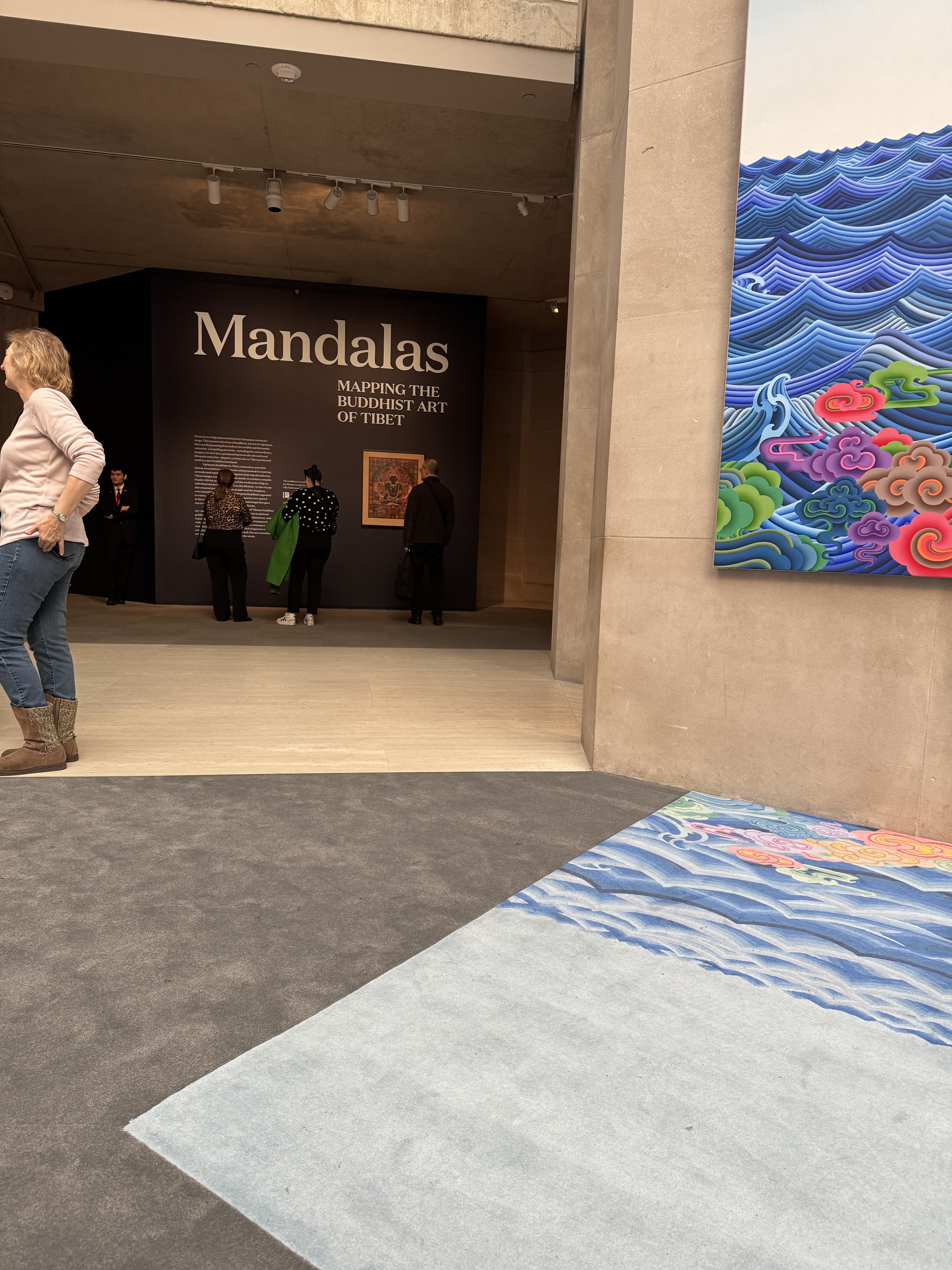
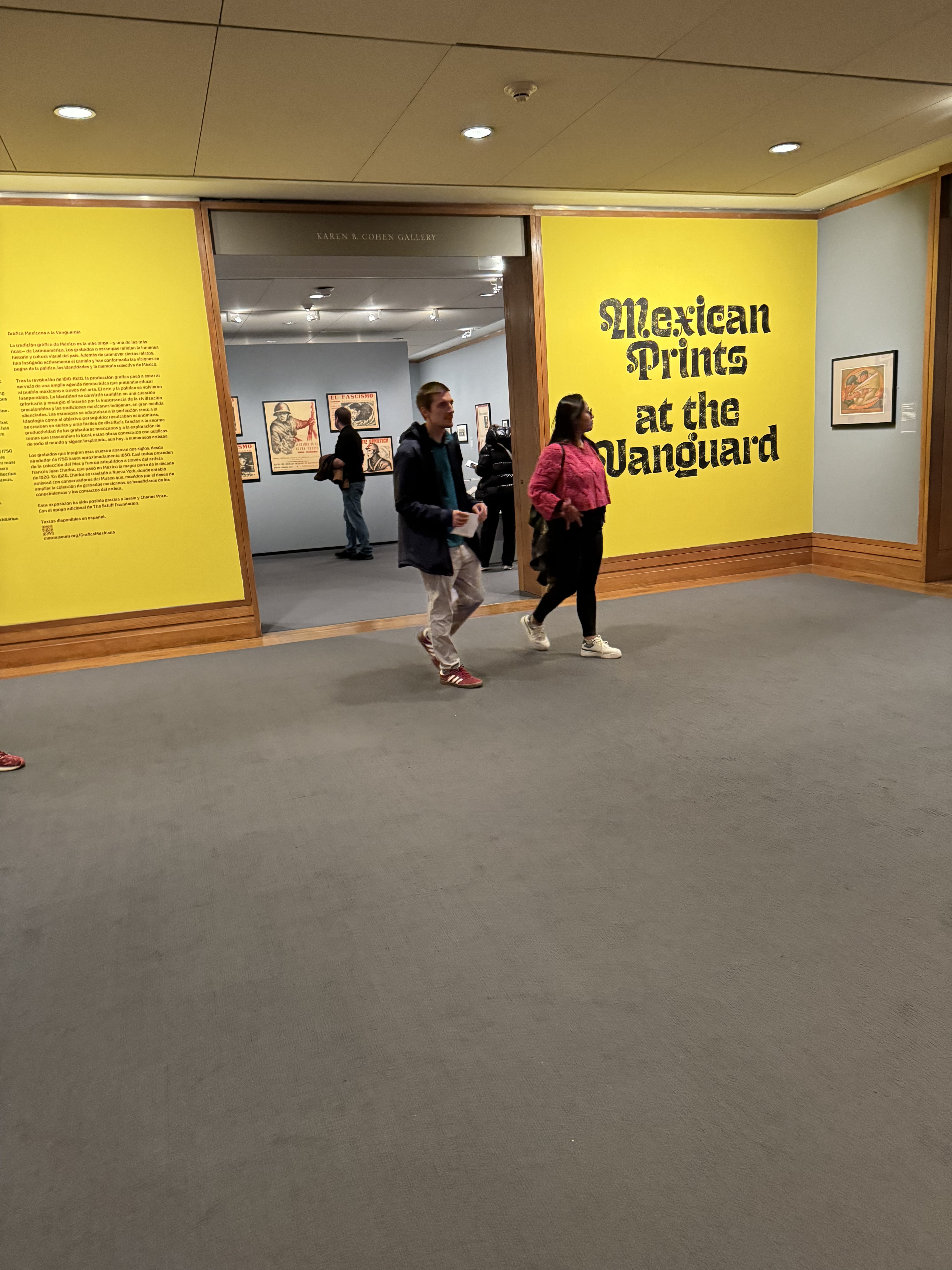
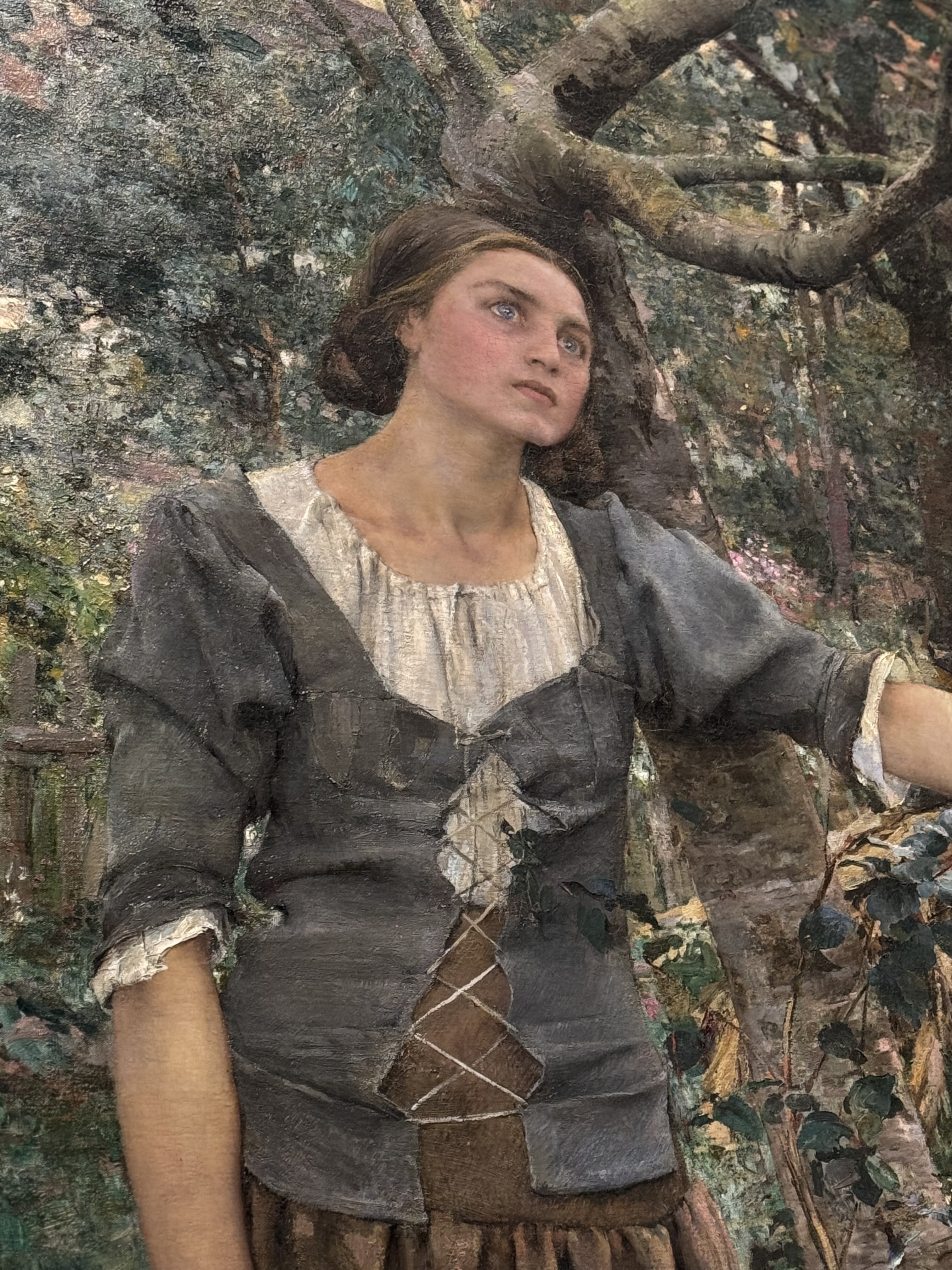
I loved the two exhibits we spent time with at the Metropolitan Museum of Art: Mandalas, Mapping the Buddhist Art of Tibet and Mexican Prints at the Vanguard. As we left the museum, passing through the Leon Levy and Shelby White court filled with ancient Greek and Roman statues, I saw four teen girls sitting on the marble floor in front of a bench, absorbed in drawing a statue of a nude man. This is what I will remember from the trip… their bowed heads, their silent engagement with the statue and with each other. A refreshing palate cleanser after bathroom woman #2’s remark. Oh, and the Joan of Arc by Jules Bastien-Lepage (1879): her face had me swooning.
Docent at the Met
We got a bit lost after the Mandala exhibit and asked a docent for help locate the gallery where the Mexican prints were on display. She led us rapidly through throngs of people, and I told her my mother had been a docent for years at the Art Gallery of Ontario (I had many moments of thinking of my mom in NYC—we visited the city together in my early twenties and saw, among other things, Zero Mostel in Fiddler on the Roof). The docent explained she had to do highlights tours for two years before they let her specialize in anything. I asked her what she specializes in now. Arms and armour, she answered. And I get to have another speciality, she said, but I am taking a break. Evidently, it’s exhausting to learn all there is to learn about the arms and armour in the Met’s extensive collection.
Pumpkin Pie at the Malibu Diner
Before the show at Gotham Comedy Club, West 23rd and 7thAvenue, we ate dinner at the Malibu Diner across the street. An old-fashioned American diner with a huge, laminated menu, plenty of booths with red vinyl benches, low chrome stools facing the long counter. All of the waiters spoke Spanish among themselves. When our waiter brought my twice-baked potato, I said Gracias Señor, and then he started to speak to me in Spanish, and I had to explain that I only know a few words. He laughed.
We paid for our meals and went to the club, but we were early. The woman said come back in half an hour; they were running late. Where to go? The cold wind bit our cheeks that night. So, we returned to the diner, where the waiters welcomed us like old friends. Come, come to the back, sit in this booth, where you won’t feel the wind that sneaks in whenever somebody opens the door. It’s warm back here. Our same waiter from before brought pumpkin pie with whipped cream. Sometimes eating dessert is the perfect way to pass time.
Shakespeare groupies
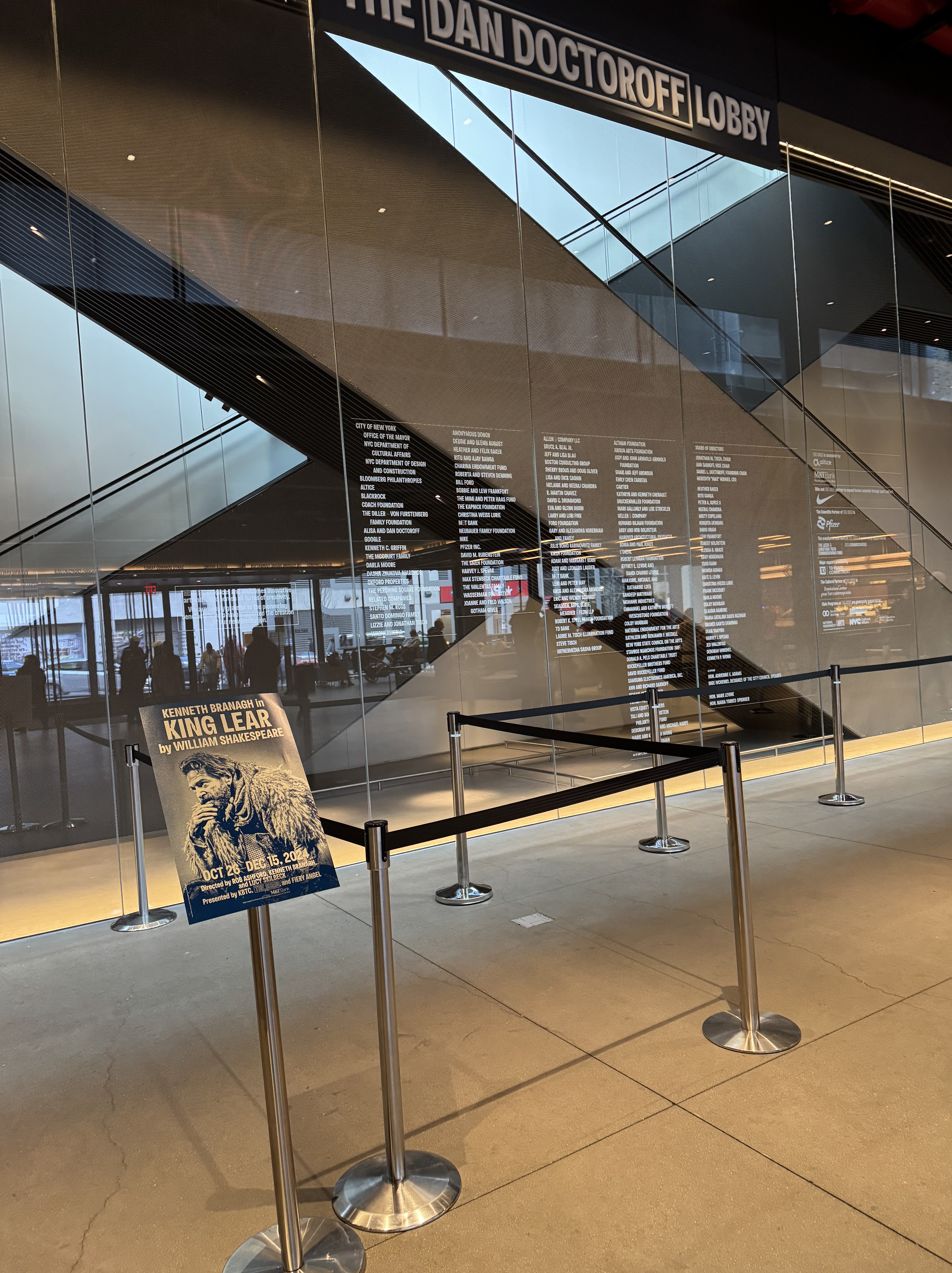
We took our excellent seats at the Griffin Theatre (at the Shed), where we had tickets to see King Lear. In front of us, two women about my age were taking off their coats and chatting. They started to engage us in conversation—where were we from? Did we go to a lot of Shakespeare plays? They had both lived in Atlanta and belonged to a Shakespeare reading group. When one of them moved to Baltimore, Maryland, they figured that was it—they wouldn’t see each other again. But then the Maryland woman saw an advertisement for King Lear with Kenneth Branagh and called her Atlanta friend. Why don’t I buy tickets? You can fly here. We’ll go together. So, Atlanta woman got a flight to Baltimore, and that morning they’d taken the train from Baltimore to Manhattan. We’re Shakespeare groupies, the blonde woman from Atlanta said. In April, we’re going to see Denzel Washington in Othello, said the Baltimore woman. Shakespeare groupies. I love it.
Window shopping
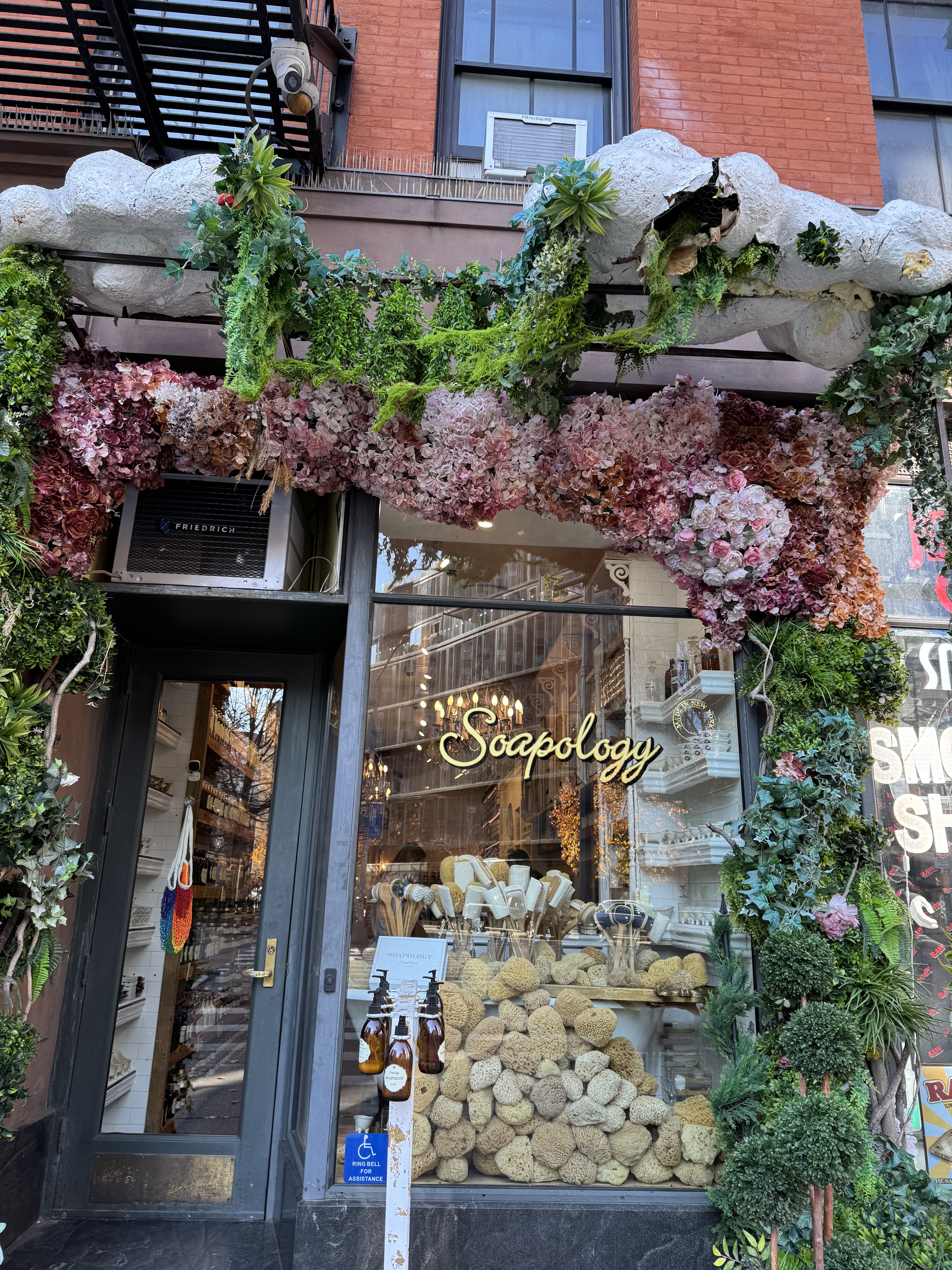
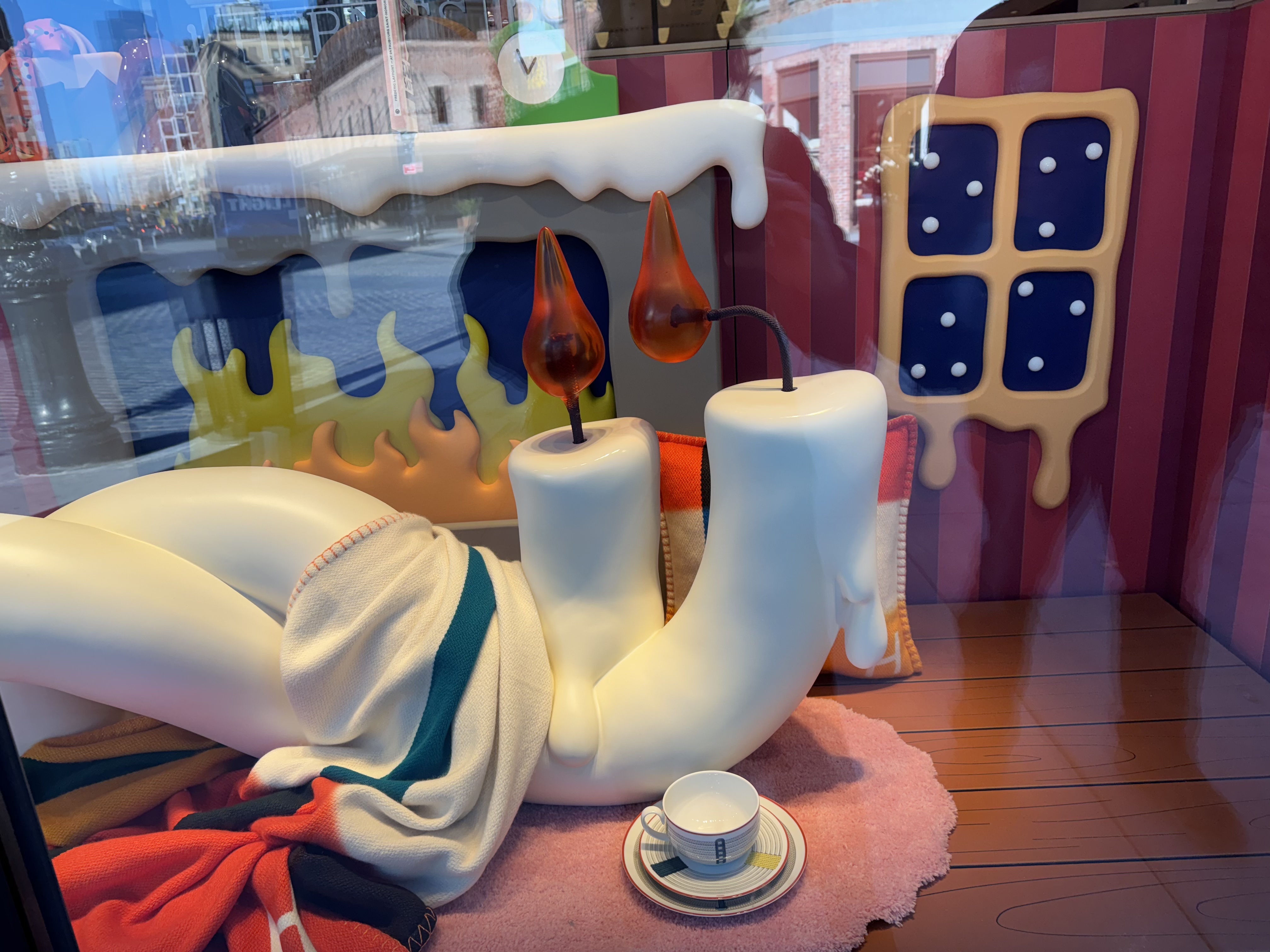
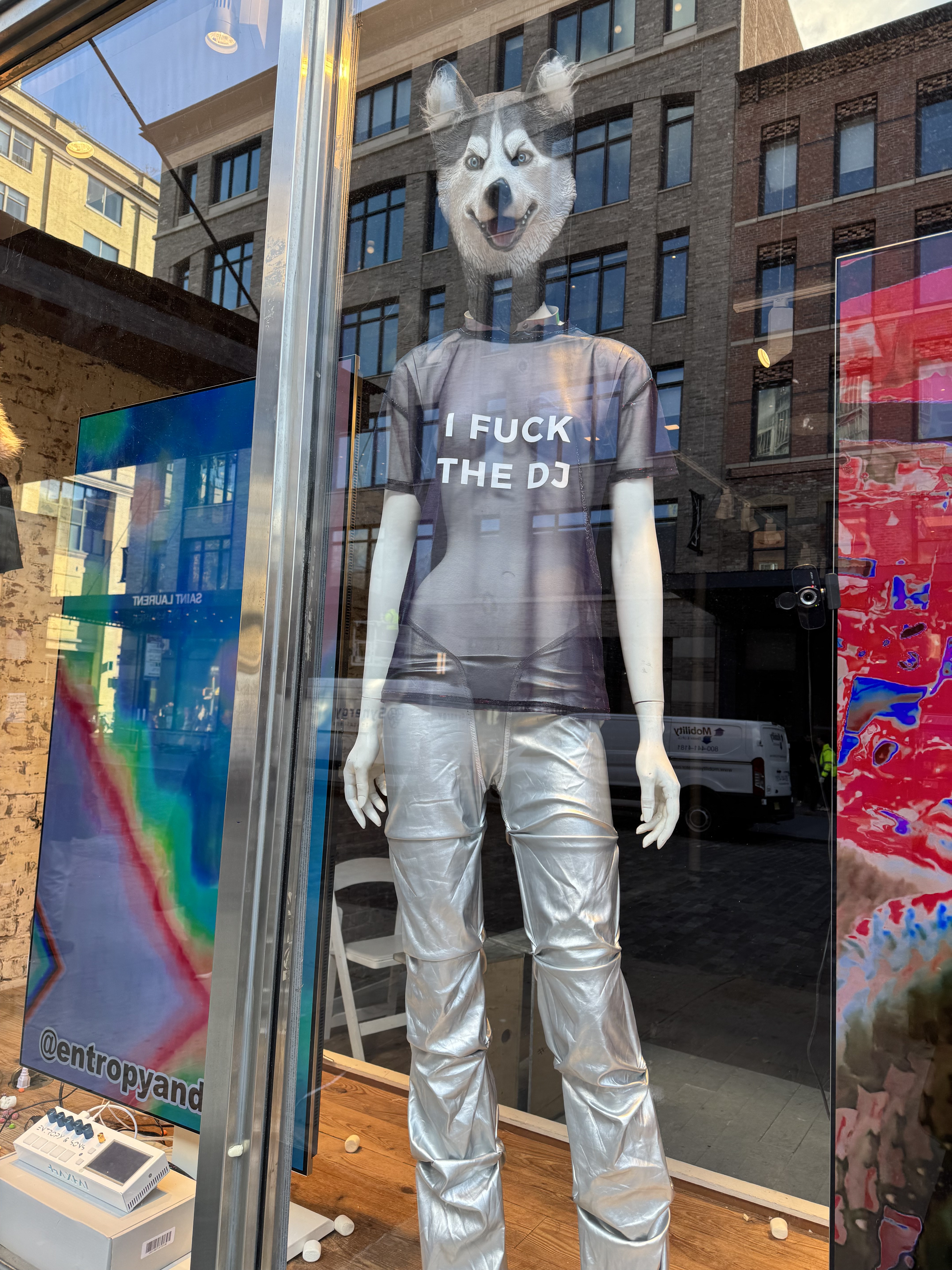
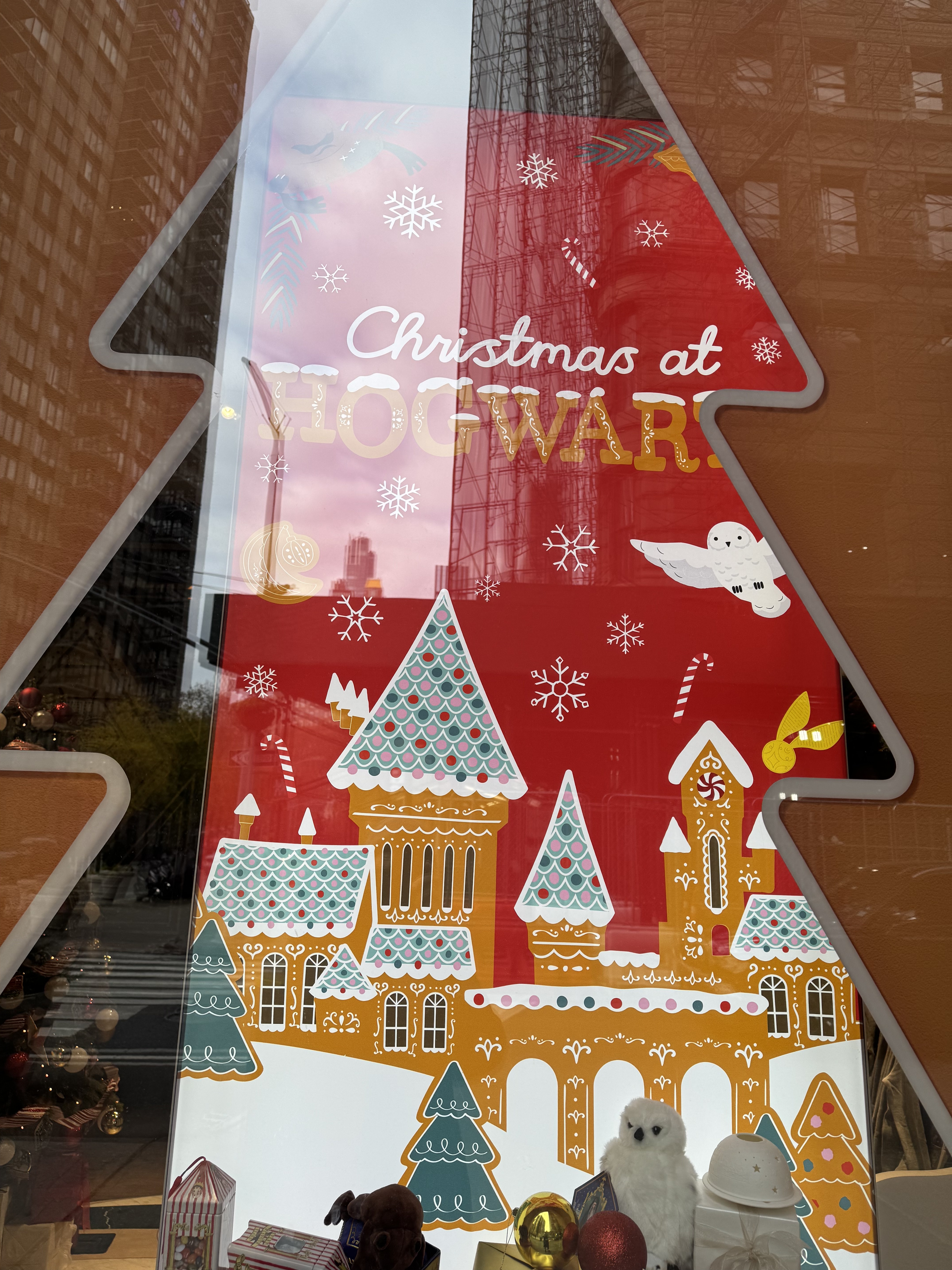
NYC is the best place to window shop. No need to buy a thing; just absorb the kaleidoscope of artifacts and moods rippling through glass. Mannequins wearing weird t-shirts, everything Harry Potter, bolts of cloth, soaps, sculpture, ceramics, sexy candles, life messages, and rainbow bagels.
Until next time…
We walked through Chelsea along a sidewalk that bordered a basketball court. Kids were shooting baskets on the first day of December, laughing, talking. A flock of grey pigeons passed overhead while the sun winked from behind a fringe of clouds. A bubble of pure joy passed through my body and into my head, exploding into a private smile. I love you, New York City; no reply necessary.
Last night in bed I was reading Dreyer’s English: An Utterly Correct Guide to Clarity and Style, an amusing book by Benjamin Dreyer, a Random House copy editor. I happen to be two weeks into my final six-week course for Simon Fraser University’s Editing Certificate, so my late night reading aligned with the language-focused mood I’m in. I was enjoying Dreyer’s humour when I read this sentence, which made me sit up in bed:
“You might—or might not—be surprised to learn that many copyeditorial man-hours have been expended over the decades as to the correct construction of the common vulgarity—and an enchantingly common vulgarity it is—used to describe an act of fellatio.” After the term “man-hours” was an endnote: “I know I’m supposed to prefer and use ‘person-hours’ or ‘work-hours.’ I can’t, so I don’t. Please forgive me.”
It wasn’t the discussion of whether or not to use a hyphen with blowjob (Dreyer’s preference is no hyphen) that bothered me. I’m no prude (I hope). It was the insistence on “man-hours” without even trying to find an alternative.
What about just writing “many hours have been expended by copy editors over the decades”? Such an easy way out of “man-hours,” a term that makes the labour of fifty percent of the world’s population disappear. I wonder if Dreyer is just paying lip service to the requirement of conscious editing, editing that does not harm or marginalize. Karen Yin created The Conscious Style Guide, such a useful resource. Countless other editors and writers have worked to use language carefully and critically as a force of good in the world. Dreyer has power, privilege, and pull, and he could use these forces for good by making some small adjustments.
So, there I was, lying in bed, irritated by “man-hours.” What about the millions of “man-hours” women spend breastfeeding? And that started me thinking of breastfeeding, women feeding their infants and toddlers with nourishment produced from their own bodies. Once I started to think of breastfeeding, scenes from two novels came into my mind, one from John Updike’s 1968 Couples and the other from John Steinbeck’s 1939 Grapes of Wrath. In both scenes, an adult man is sucking at the breast of a lactating woman. Updike’s scene is highly erotic (or at least, I found it so when I read it in my twenties), whereas in Steinbeck, the character Rose of Sharon is offering her breast to a starving man, an image I find disturbing. I’ve forgotten so much from the thousands of books I’ve read in my life. But those two scenes have stayed with me throughout the years.
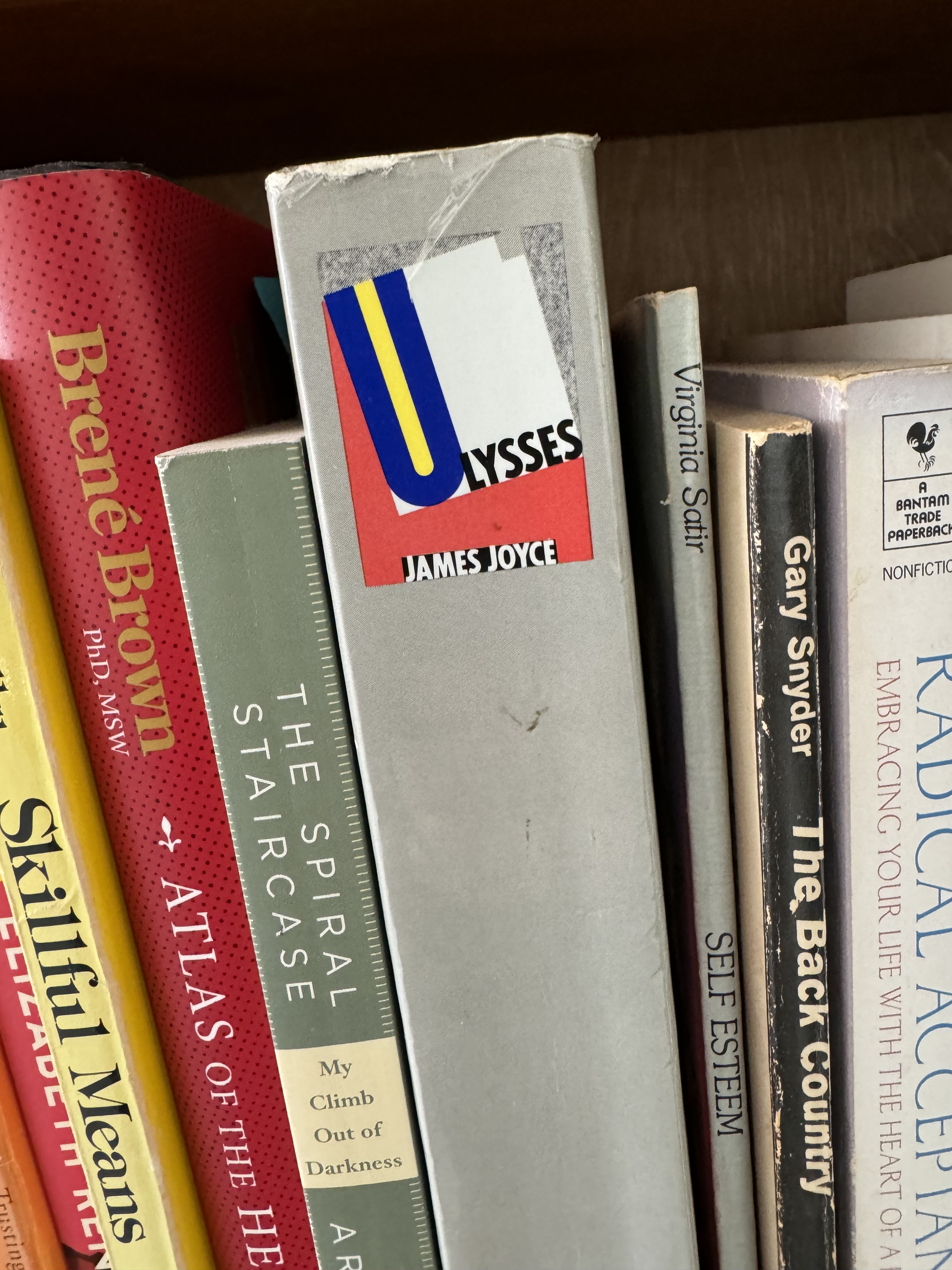
In our new house, we have a bookshelf at the top of the stairs, so every time I ascend to the main living space, a patchwork of book spines meets me like an old friend. The elongated blue U on the thick spine of James Joyce’s Ulysses always catches my eye. My mind likes to repeat itself, going back to well-trod memories, and so I return over and over—with nostalgia—to the summer in grad school when I studied that great modernist novel. It was an intense, six-week seminar course. A small, intimate group of students, mostly women, met for three hours, twice weekly. Each student had to present several times on chosen topics. I was working hard. Add to my hard work and yearning for an A, the presence of a provocative, flirtatious professor who created a highly charged atmosphere in the hot seminar room.
I was immersed in the complexity of Joyce’s schema for the novel, based on Homer’s Odyssey, and by turn delighted then confused by his fresh, arcane, mysterious writing. I could slide down rabbit holes every day, trying to parse meaning.
One day, I took the boys to the beach at Thetis Lake and brought the novel with me. We went in for a swim, and as we came up to our beach blanket where I had laid Joyce’s novel, my six-year old son, who was learning to read, said to me, “Why are you reading a book called Useless?” I laughed. I could see how his mind’s eye read useless; so many of the same letters as Ulysses. I reported this to my professor next class, and he couldn’t stop laughing. He thought what my son said was inadvertently profound, the title Useless pointing to the modernist idea of the inutility of art: art for art’s sake.
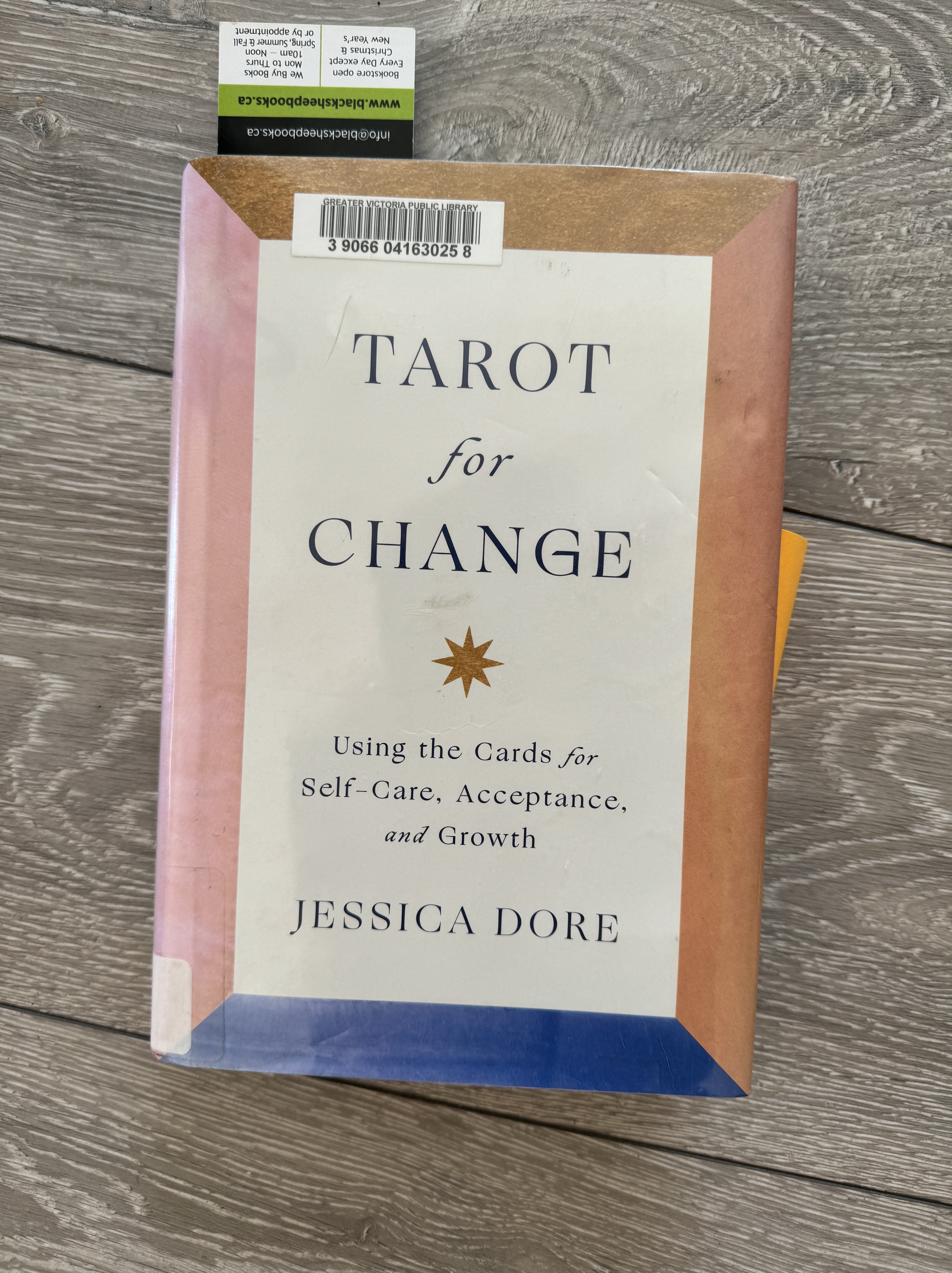
In the mornings, I’ve been trying to not grab my phone immediately, but instead, to read and write. I’m reading Jessica Dore’s Tarot for Change: Using the Cards for Self-Care, Acceptance, and Growth. I first discovered Dore when my husband, Michael, told me about her newsletter, Offerings, on Substack. I love the way she thinks about books and tarot and life, so I borrowed her book from the library, and it’s on the coffee table, ready to dip into whenever I sit down for a spell. It’s funny, the actual tarot card she is writing about (and she writes about all 78) doesn’t matter much—each page has some nugget of wisdom, wisdom from her life experience, and from theology, psychology, literature; wisdom drawn from C.G. Jung, D.W. Winnicott, and newer therapists like Marsha Linehan and Steven Hayes. I enjoy the nuggets.
Here’s an example of a Dore nugget—this is from her comments on the Empress:
“The Empress represents nature and is, in my experience, one of the most misunderstood arcana in the tarot. People love her but can’t put a finger on why. I think it’s that we long to be in our bodies but have forgotten how, and she shows us what it would feel like if we could. Many of us think of the wild as something ‘out there,’ and I think that’s sad for us. It shows how cut off we are from the fact that somewhere deep down and old we are still the wild, and the body—with all its cycles and rhythms and ebbs and flows and generation and degeneration—is proof.” (pp. 47–48)
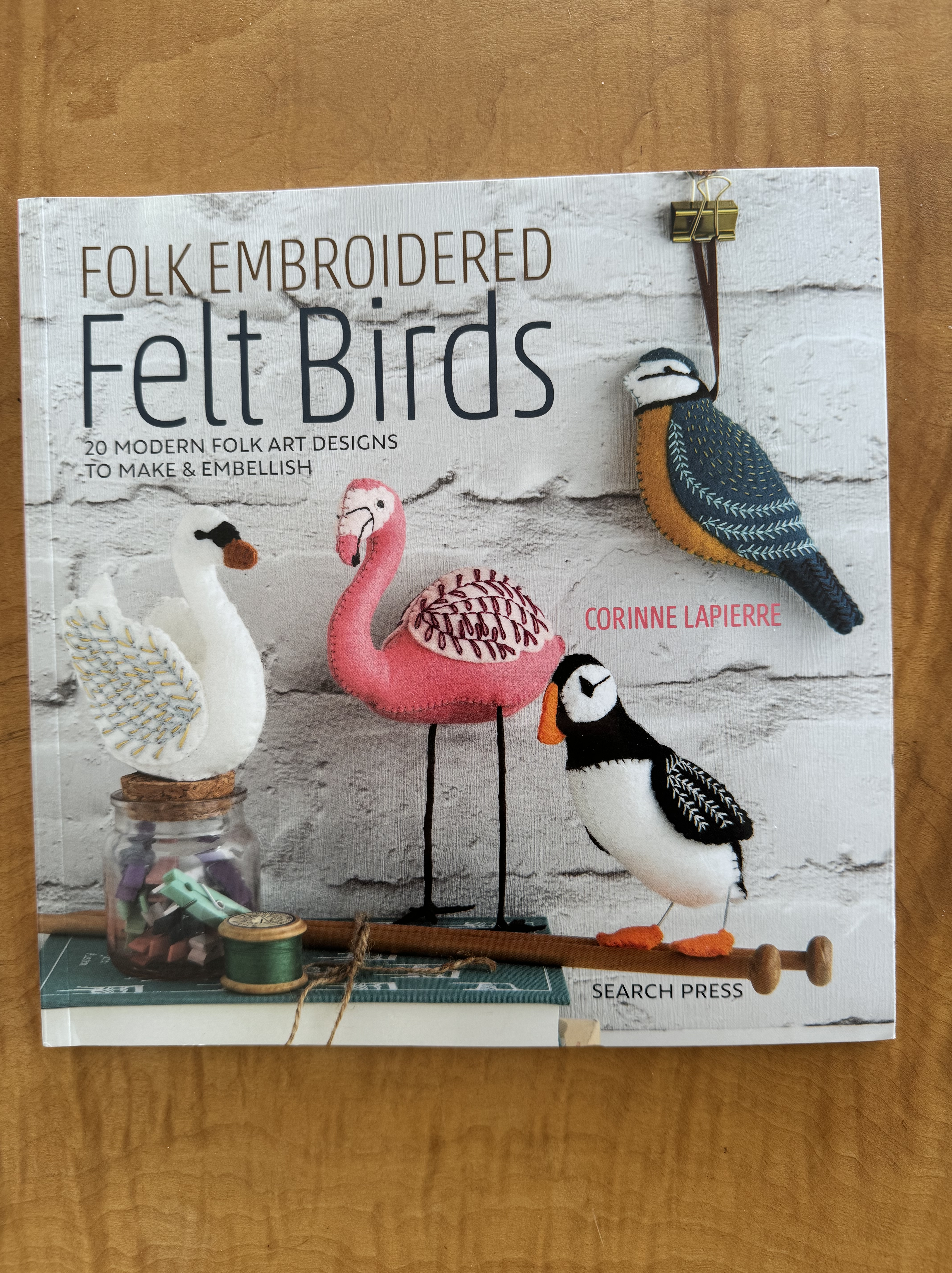
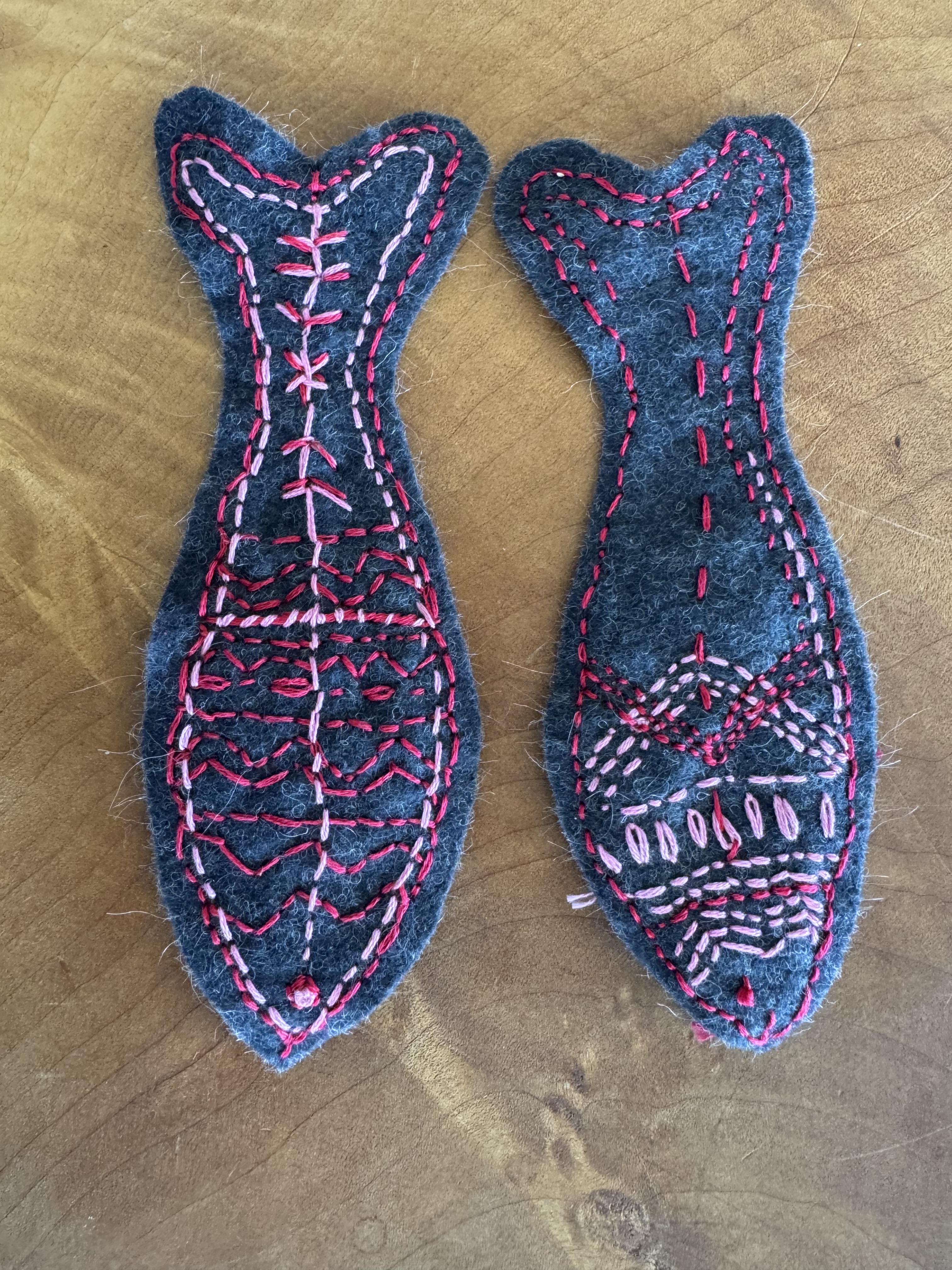
Folk Embroidered Felt Birds: 20 Modern Folk Art Designs to Make & Embellish by Corinne Lapierre. I took this book out of the library and promised myself I’d make two birds before it was due back. I like embroidering at the end of the day, after my mind has been busy with thinking, editing, word stuff. Nice to just sew coloured thread in pretty designs. I met my modest goal—I made a wonky robin and a not-bad pigeon. Then I got a notice the book was due and couldn’t be renewed, as somebody else wanted it. I made a heart for a friend’s birthday, then another heart with a favourite quotation on it, “still, flowing water” from Ajhan Chah, which is to remind me of the paradox that mind is both still and flowing. I don’t entirely understand his talk on this topic, but I still find it inspirational. Then I took out another book by Lapierre, Fabulous Felt, and I made some fish. But I realized what I really want to do is to make all of those twenty birds from her felt birds book, so eighteen more. And it seems that everybody wants the library book, so I ordered a copy and it arrived today. Lots of birds to come!
When I can’t sleep, I am glad to find my e-reader on the bedside table. In the middle of the night, I pick it up and read quietly, bathed in soft light, disturbing nobody. Last night, I found treasure after midnight: two books I’d bought in 2021 by Charlotte Joko Beck, my favourite Zen teacher.
I read for an hour or so, finding many paragraphs I’d highlighted. I savoured her wisdom again. How could I have forgotten you, Joko? I fell asleep calmed by her words. This, I hope, gives the flavour of her teachings:
When expectation fails—when we don’tget what we’re after—at that point, practice can begin. . . . Disappointment is our true friend, our unfailing guide; but of course nobody likes such a friend.
When we refuse to work with our disappointment, we break the Precepts: rather than experience the disappointment, we resort to anger, greed, gossip, criticism. Yet it’s the moment of being that disappointment which is fruitful; and, if we are not willing to do that, at least we should notice that we are not willing. The moment of disappointment in life is an incomparable gift that we receive many times a day if we’re alert. This gift is always present in anyone’s life, that moment when “It’s not the way I want it!”
Everyday Zen: Love and Work (1989)
The morning before, I’d quickly sketched on my whiteboard a comic of a little girl disappointed with life, as if it’s life’s fault somehow that we are disappointed. To admit that I’m disappointed feels difficult. Rather, I fake it—everything is fine. And I hate to see disappointment on the face of somebody I love. I want to fix it—to remove the disappointment, find an antidote. This reaction leads to all kinds of fuckery, as you can imagine.
What strange serendipity to find Joko’s words about disappointment. What if disappointment is a gift?
I cannot seem to write freely anymore. This change is so disappointing! I feel resistance to my own writing and powerless to give good advice to students about how to overcome writing paralysis. It’s been some months since I wrote freely. Everything I put down seems irrelevant or stupid. I’ve started many blogposts and abandoned them after a paragraph or two. After reading Joko, I said to myself, okay—I am here with my disappointment. Here it is, I feel it, and I’ll write through it, through the obstacle. The obstacle is the path. I pull up the abandoned blogpost from last week. Try again.
My first class as a new graduate student was on September 11, 2001. After watching the twin towers go down in smoldering ruins on our TV, I left the house, trembling, to attend a class in African American literature. My professor, a young, blond, white man around 10 years my junior, not only didn’t mention his own whiteness in relation to the topic of African American literature, but also didn’t mention the traumatic horror of 9/11 that hadjust happened that morning. It was as if we were in the mythic, impregnable ivory tower—only abstract ideas are permitted here. No planes can touch us. Real politics, real life, real hatred, real racism, poverty, oppression—stay outside the moat, outside the fly zone. When I think of his omission now, I realize how bizarre it was. He was the teacher; we followed his lead and stayed silent about what had just happened. History happened. I know now that it was fear that stopped him. He didn’t know how to handle the mess of us being angry, scared, facing the horror. So he never mentioned the planes, the smoke, the ash, the buildings collapsing in rubble.
Twenty-two years later, I’ve experienced three different roles at the university: student, faculty, and staff member. And this semester, I end my sojourn here. I can say that things have changed for the better. We have evolved.
We were blind to our privilege back then (well, we still are, it’s a work in progress). The prof who didn’t acknowledge the significance of his whiteness in relation to the topic of African America and Blackness is only one example. Students were considered brains walking around on legs—not full humans with mutable emotions. Not people with hearts, failing bodies, families, jobs, depression, ADHD, mental illness. We were confused, unhappy, imperfect, terrified to admit our vulnerabilities, worried we weren’t smart enough. I remember one professor (another young white male) saying to us, “When I was a student, I never asked for an extension. I was always able to meet the deadlines. If I could do it, so can you. No extensions will be given in this class.” He had no clue that some of us might be dealing with financial and emotional burdens, children who needed care, challenges to our executive functioning, depression, two or three jobs….
I went to a learning and teaching conference during the last week of August. The theme was Accessibility, Relationality and Belonging. The keynote speaker, Jackie Stewart (UBC), talked about how to advance equity in university classes and beyond, at the level of program, institution, and society. She talked about collecting data from the grandmother’s perspective, not from big brother’s top-down perspective. An approach of care—we want to see all students succeed—rather than from power. It was wonderful to attend sessions on why we should teach queer theory in first year, on how to coach your ADHD students in executive functioning. Another session on a new Indigenous-student-only academic writing course. I learned about the hidden curriculum: All of those things we assume students should “already know,” but don’t.
At the executive functioning workshop, the facilitator told us how to incorporate into our syllabi a request-for-extension form. Students can just complete a digital form and get the extension they need without embarrassment or anxiety. Inform them not just of due dates, but also suggested start dates for assignments. We always just thought, “they should figure it out themselves.” Really?
In the queer theory session, Michael Reed showed us a video that made us cry, made us realize this is why we need to—if not teach queer theory in our first year classes—at least include something in our syllabi to show we are allies. Maybe something as simple as, here’s the location of the closest gender-neutral bathroom. We see you, trans and non-binary students. You belong.
I walked back to my office in the library at the end of the conference, past the Digicasters with their welcoming and inclusive messages: “We have screen readers, ask us!” “We have a respite room if you need to take a nap!” Libraries have evolved. Somewhere along the way, we realized we are here to serve the students. And no, it’s not “hand holding.”
I feel content with all I’ve learned. It’s too late for me to incorporate these innovations into my teaching, but I’ve enjoyed witnessing the consciousness-raising taking place in higher education.
The pandemic really kickstarted this movement. We admitted we were tired, stressed, and scared—staff, instructors, and students all. We needed to infuse our teaching and learning with kindness, patience, care, and transparency. This is real life, not the ivory tower.
And I come back to Joko Beck, relieved that I’ve made it this far in my writing. Perhaps I just had to walk around the (writer’s) block in my path. Not an obstacle, just a detour. Joko Beck writes in Nothing Special (1993),
“As we watch the mind over the years, the hopes slowly wear out. And we’re left with what? It may seem gruesome, I know: we’re left with life as it is. … Turning our lives of drama to lives of no drama means turning a life where we’re constantly seeking, analyzing, hoping, and dreaming into one of experiencing life as it appears, right now. The key factor is awareness, just experiencing the pain as it is. Paradoxically, this is joy. There is no other joy on this earth except this.”
I find this so consoling—no other joy on this earth than life / pain as it is. Disappointment? Admit it, feel it. Writer’s block? Write around it, through it. Insomnia? Read Zen wisdom in the middle of the night.
The bus to work takes about 40 minutes—the perfect length of time to listen to a dharma talk on Dharmaseed. I’m happier with this pastime than I am browsing Facebook or Instagram. The dharma talks inspire me and make me feel better about being alive, while Facebook or IG can make me feel dispirited. Recently, I listened to a talk by a dharma teacher I enjoy—Shelley Graf. She read an excerpt from Sharon Salzberg’s 2002 book on faith. I liked the quotation, but even more, I was intrigued by Salzberg’s book title: Faith: Trusting Your Own Deepest Experience.
Trusting your own deepest experience brought to mind a revelation I had when I started to see a therapist four years ago. Doesn’t sound like much, but it was profound for me: I am entitled to claim my own experience. During that therapy session, I had been dithering about whether I felt a certain way, circling around the ugliness of something, making excuses, minimizing my hurt, my terror, my sadness—in short, underplaying what I felt. “Oh, it wasn’t really so bad.” Nancy sat up straight in her chair, looked at me with intensity, and said, “Madeline, you are entitled to claim your own experience!” I laughed, “really?” I didn’t know that. To think I got to this stage in life feeling I couldn’t be honest about how it really was, how it really is, to be me. I came home that day and on the mirror in my sewing room, I wrote, “I am entitled to claim my experience.” I refresh it with a wine glass marker when it fades because it’s a crucial daily reminder.
Back to Salzberg’s book—well, I bought it and read it quickly, underlining the bits that made me cry or wake up or feel a swelling in my chest. There were many passages that made me feel good—made me feel connected to something bigger, something transcendent, which is what faith is, isn’t it? I love the sense that “no matter what happens, we can place our faith in the deepest part of ourselves, our buddha nature” (p. 170).
With those good feelings still germinating inside of me, I entered the course Michael and I are teaching on Zoom this weekend: Creating and Interpreting Personal Mandalas.[1] This morning, we led our participants through stages one through three. In stage one we rest in the darkness, in the womb. Being, not doing. As I started my mandala, I lined the womb-circle with layers of brown watercolour. Soon, a purple hyacinth spear emerged from the lining of the womb.
As I painted, my mind travelled back, back, back. Thirty-five years ago, I had several weeks off work to heal from surgery. Waiting time, resting time, stage one time. Hours in bed spent daydreaming, not doing, just being. My first husband and I lived in Toronto in a rented house on Devonshire, and the spacious front bedroom had big bay windows with generous ledges. The laser surgery I’d undergone was supposed to give me a chance at having babies, something I hungered for. When my friend Hannah visited me, she brought a potted hyacinth, not yet blooming. I put the plant on the window ledge, and it was as if I could feel the ache of that blue-blushed spear yearning to open.
It was early spring in Toronto: cold days, deluges, and then suddenly, bright hot sun. One day the hyacinth burst forth in a matter of hours, spraying the room with sweetness. Whenever I smell hyacinths, I go back to that time of hunger and healing. My body craved to follow the flower in her blossoming. But I had to wait.
My grandmother Marguerite and I were writing to each other that year. She sent me copies of Unity Church’s magazine and told me that she and other members of her congregation in Los Gatos, California, were praying for me to heal and get pregnant. I thanked her and pretended to be onside with her faith. But in fact, I thought it was silly. How quaint, a circle of old ladies in a church basement, holding hands and thinking of me.
Grandma Marguerite Walker in the Philippines, 1923
Months and months elapsed with no result. I thought the surgery hadn’t worked; after all, the doctor had told me I had only a 15% chance of having children. The odds weren’t great. Feeling like we needed a big change in our lives, my husband and I sold our stuff, quit our jobs, bought a Volkswagen van, and drove south. Almost a year after my surgery, we sat in a Planned Parenthood office in Green Bay, Wisconsin to learn the good news. I was pregnant.
The hyacinth I painted this morning seemed to have come from the deep well of memory— light-filled room, white sheets rumpled on the bed, the bluish spear opening as I kneeled nearby in my nightgown. Spring magic! And I thought of Sharon Salzberg writing about a research project undertaken in Korea: Women trying to conceive were prayed for at a distance, and these women became pregnant at twice the rate of those who received no prayers. I underlined that passage. Beautiful evidence of our “profound interconnectedness” (p. 147).
I think often of my grandmother’s faith, and how she and her Unity friends may have had some small part in my blossoming into a mother. And now, I blossom into belief in the interconnectedness of life, belief in the butterfly effect doing its work not only in the material world, but in the emotional realm too. The mistake we make, writes Salzberg, is to expect a certain outcome from our actions. We get attached to results, which leads to expectation. “When our intention is to do good for others, and we nurture that intention, we can have faith that in some way, often unknown to us, it ripples out” (p. 144). As we go deeper into spring and the hyacinths begin to open, let our loving intentions and kind actions ripple out in ways we will never know.
I have been sitting in discomfort, searching for how to begin. Fear of making a mistake keeps me from acting, from speaking. Perhaps some of you reading this feel the same way. Are you a privileged white person, trying to figure out how best to speak up, how to be part of the solution? Are you getting a crash course in systemic racism and wondering what to do with all the emotion and information? We can give money to Black Lives Matter causes if we’re financially able. But something more is being asked from us right now.
White silence is complicit, white silence is oppression. If you are white and you have a social media following, you have a responsibility to use that influence to draw attention to Black voices. I don’t have much of a following (but huge gratitude to those who DO follow me) and I am certainly no influencer. Nonetheless, I want to use some of my space today to draw attention to two incredible Black women textile artists: Sarah Bond and Bisa Butler.
From Modern Quilt Guild’s website
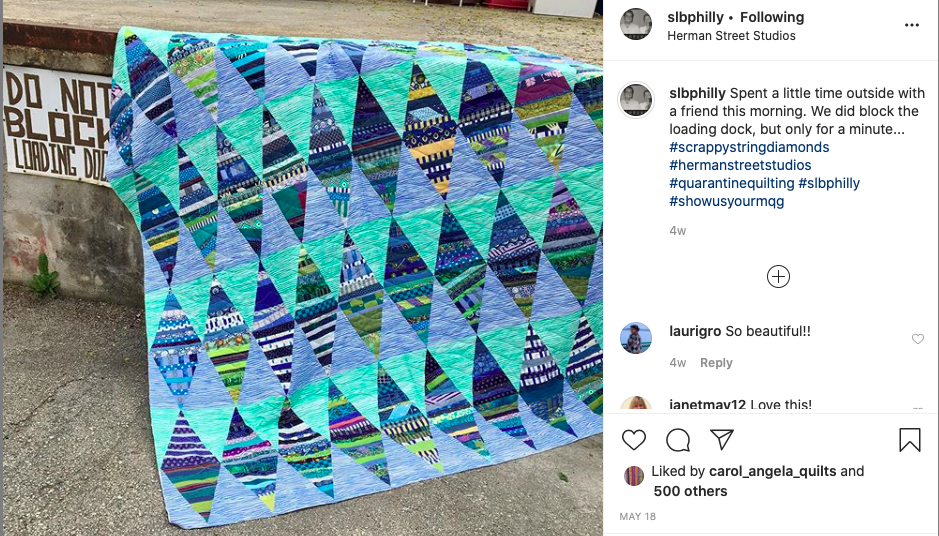
I’ve been following Philadelphian Sarah Bond on Instagram for a while, appreciating not only her beautiful quilts, but her frequent mention of herstory. A descendant of slaves, Bond is inspired by the quilts of her ForeMothers and by modern quilts, combining ideas from both into her bright geometric creations. I especially admire her scrappy diamonds.
Follow Sarah Bond on Instagram at @slbphilly Here is an image from her IG feed of one of those scrappy diamond quilts in delicious blues.
One of her recent projects is quilting together blocks created by young people at the Social Justice Sewing Academy (SJSA), an amazing organization that “empowers youth to use textile art as a vehicle for personal transformation and community cohesion and become agents of social change.” Their hands-on workshops are held across the United States. Check them out.
Fibre artist Bisa Butler’s vibrant portraiture needs no introduction to people in the textile arts scene, but until recently, I was oblivious to her work. Her bright Kool-Aid colours and realistic fabric portraits are legendary. As an art student at Howard University, Butler was influenced by Romare Bearden’s collage and the AfriCOBRA collective (one of the inspirations for the Black Arts Movement). As a young mother, she learned how to quilt and developed, through these combined influences, her unique fibre art style. Her work celebrates African American identity, history, and culture through intense fibre portraits. Sometimes she uses pieces of clothing from her family history in her work. This short film, Quilting for the Culture, will introduce you to the woman, her work, and her aesthetic:
I’m in awe of the skill and talent of these two women. I aim to continue learning more about Black artists, especially Black women artists and Black textile artists.
My creative space
As I prepare to return to work in two weeks, I’ve been cleaning up my creative space and reviewing the last six months of sewing. It’s been a productive time as the pandemic kept me close to home, close to my sewing machine. I find sewing brings joy and soothes grief—and I need that right now as our world is shaken by Covid-19, police brutality, and racism.
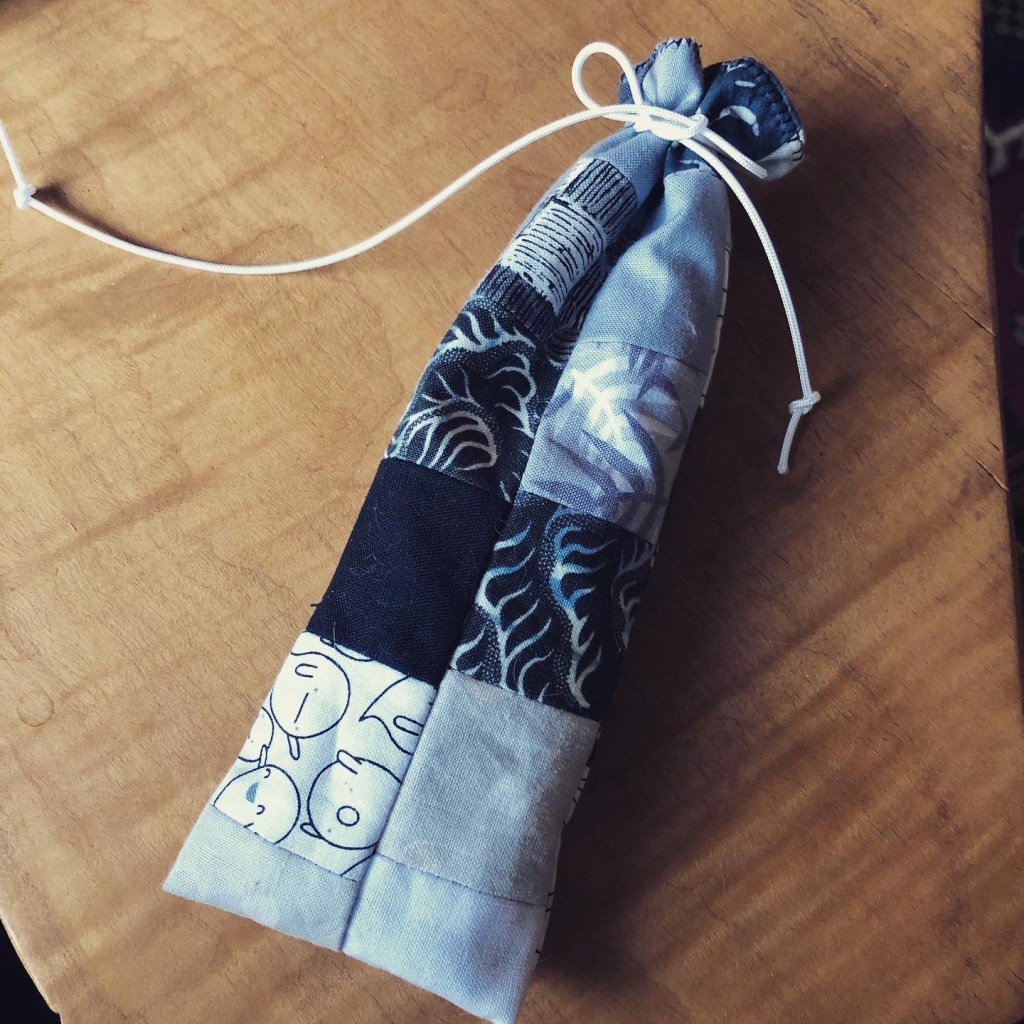
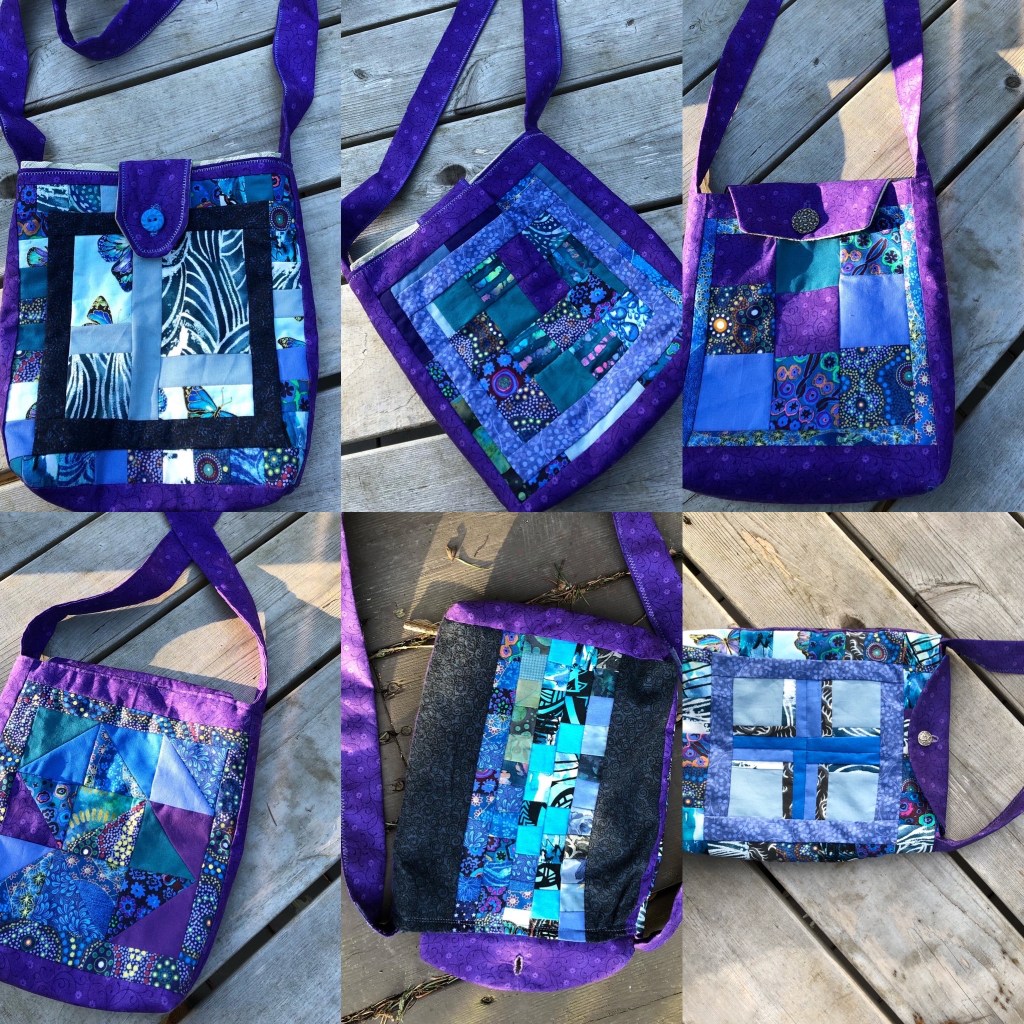
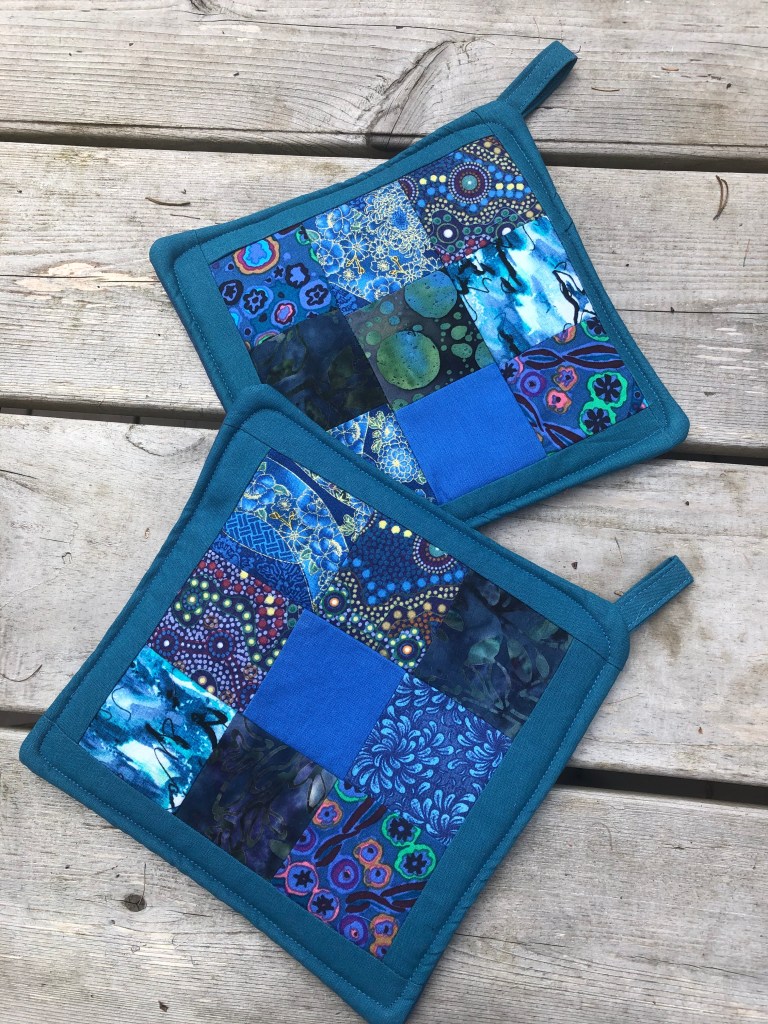
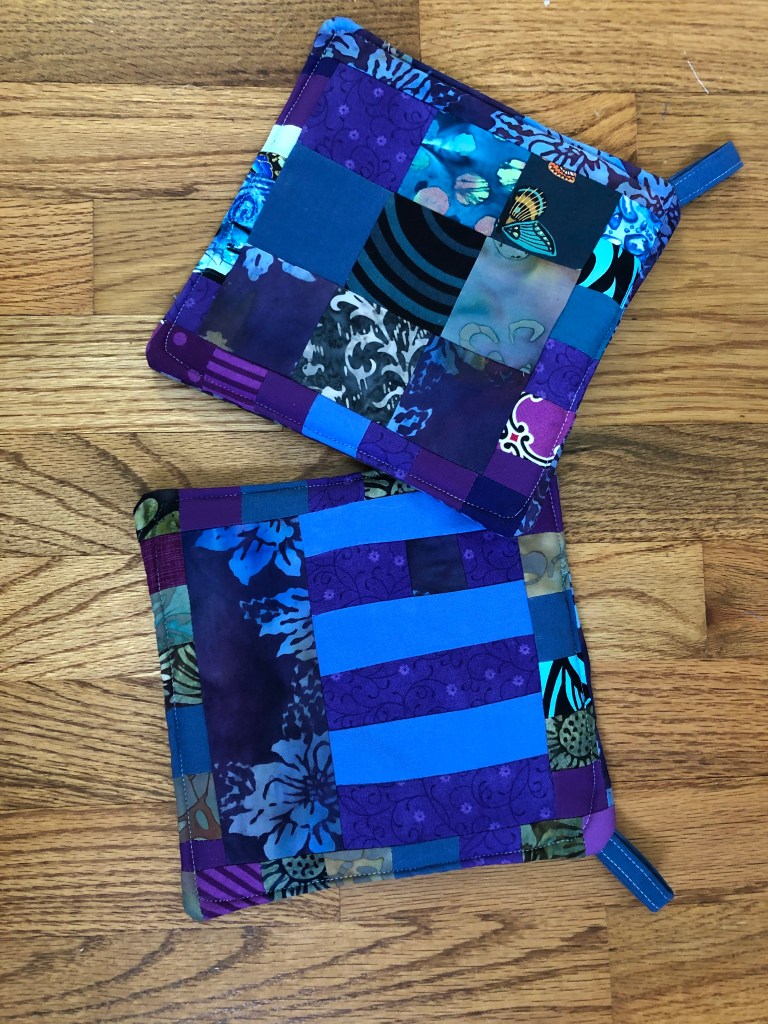
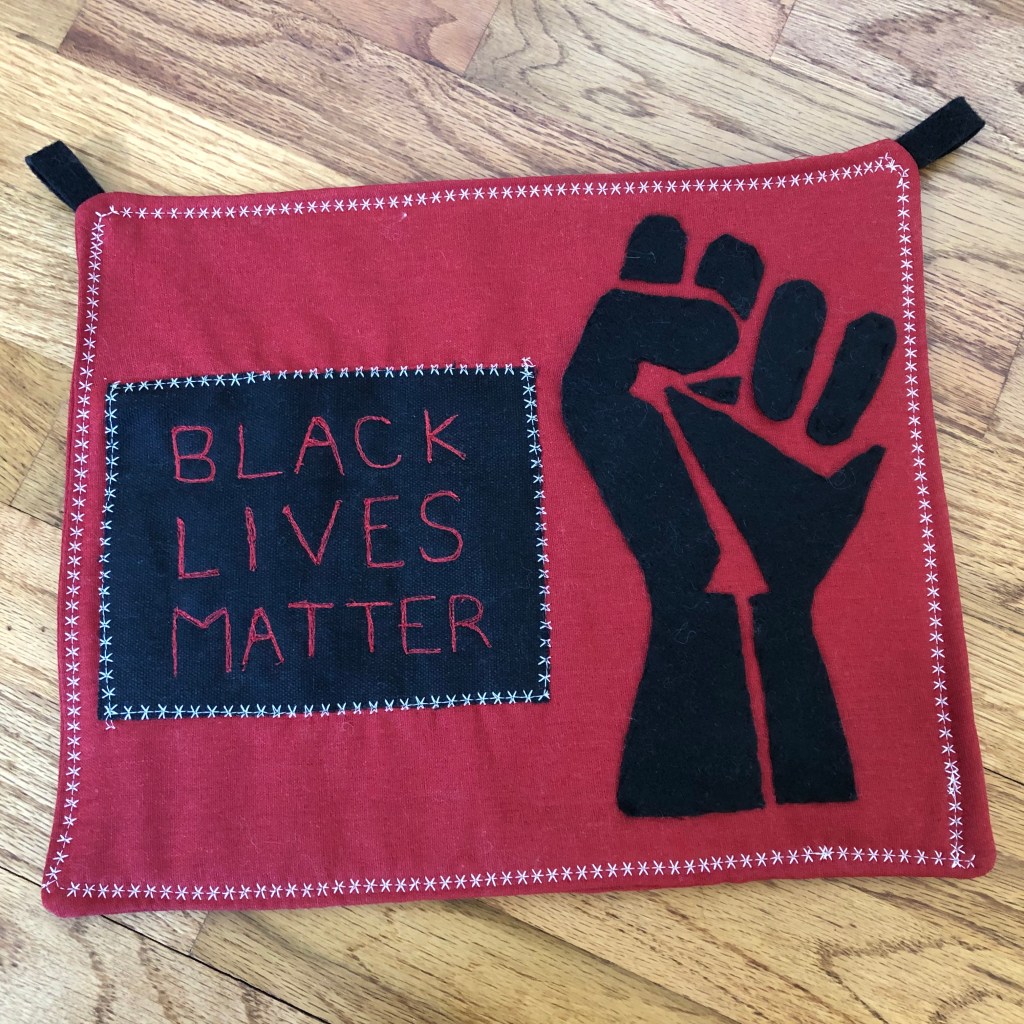
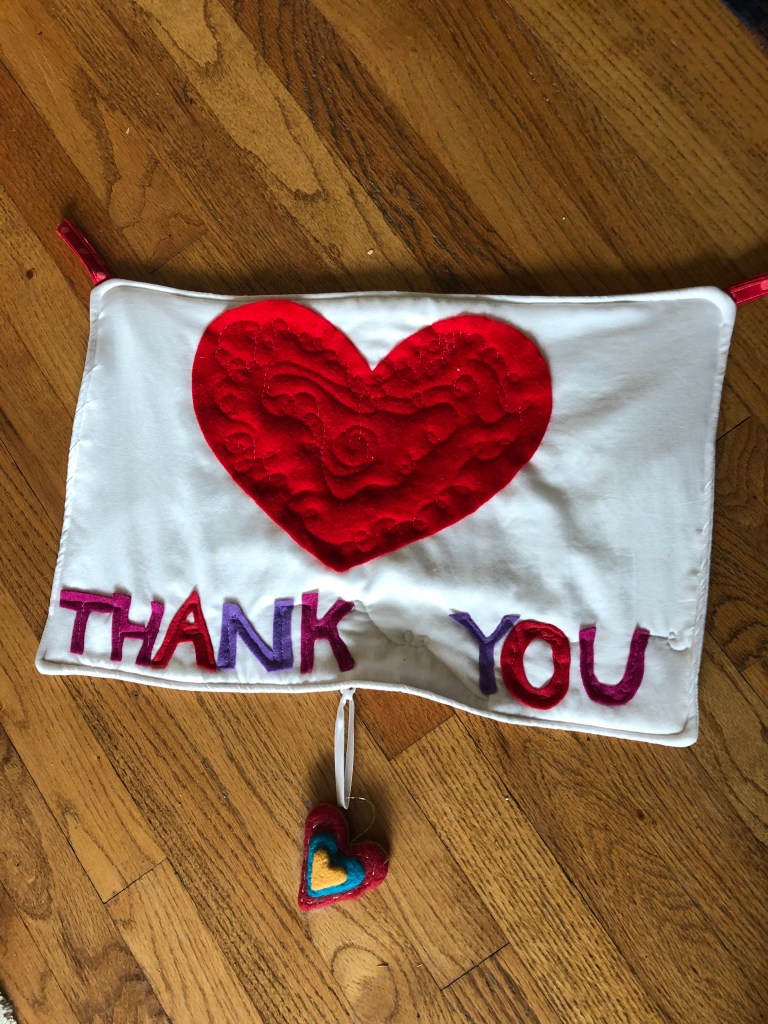
In January, I finished Four Seasons, a scrap quilt. After that, I sewed purses, potholders, and face masks galore and gave them all away. I also sewed my first garment, the “Courage Cape,” out of a $5 thrift store blanket. I made a couple of banners: “Thank You” to our health care workers, which hangs in our front window and “Black Lives Matter,” which hangs on our front door.
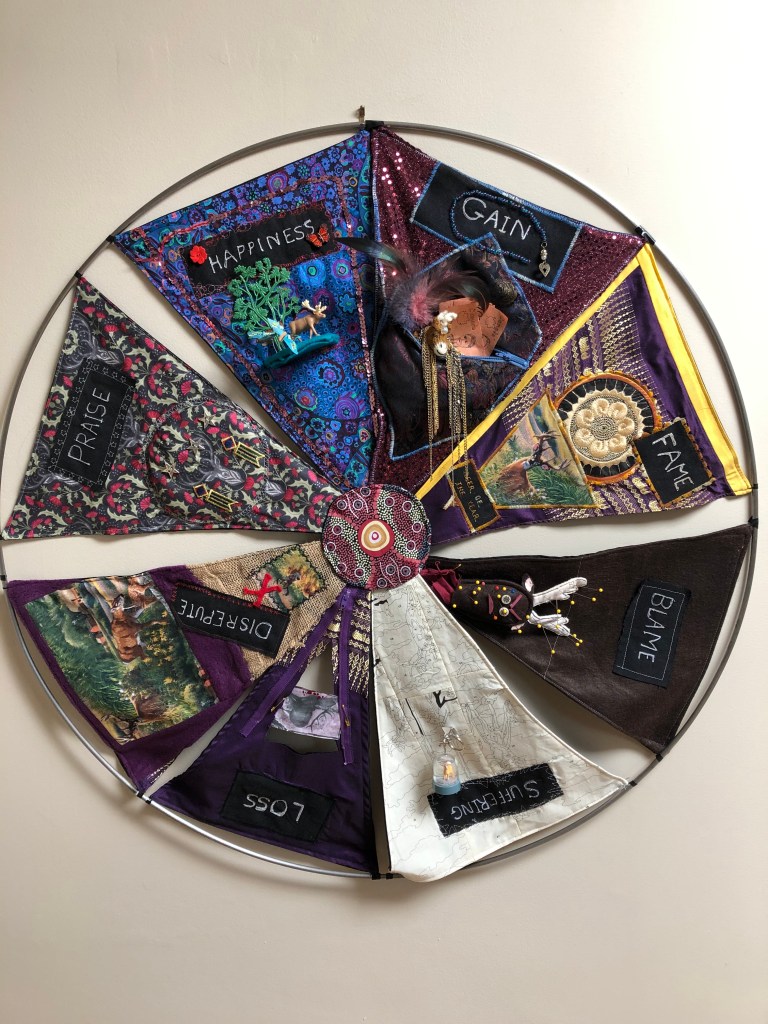
I finally completed Eight Worldly Winds, the first piece I’ve made that I dare to call “fibre art.” A series of eight triangular pennants arranged in a mandala feature a stag as protagonist and illustrate the eight worldly winds from Buddhist teachings. These consist of four opposing pairs of pleasures vs. discomforts: happiness/ suffering; praise/ blame; fame/ disrepute; and gain/ loss. Pema Chodron has a gift of making this teaching relevant to our lives:
“We try to hold on to fleeting pleasures and avoid discomfort in a world where everything is always changing. Our attachment to them is very strong, very visceral at either extreme. But at some point it might hit us that there’s more to liberation than trying to avoid discomfort, more to lasting happiness than pursuing temporary pleasures, temporary relief.”
Living Beautifully with Uncertainty and Change, 54-55
I am offering Four Seasons (approximately 38″ X 45″ quilt) and Eight Worldly Winds (35″ circular wall hanging) for a suggested donation of $250 each. All money raised will be donated to Black Lives Matter Vancouver (and I’ll post the receipt for funds donated here on the blog). Free shipping (my donation) in North America. If you are interested, please send me an email: maddyruthwalker@gmail.com
“Art is solving problems that cannot be formulated before they have been solved. The shaping of the question is part of the answer.” Piet Hein
Today during a visit to the Art Gallery of Victoria, I was captivated by Nicholas Vandergugten’s work “What Comes First,” a series of four monitors showing nine looping films of artists’ hands as they worked. The film focuses on process, not product, calling attention to the practice of creation—the incomplete, the unpolished, the fits and starts. We see artists’ hands doing and pausing and making. Hands turn the pages of an art bullet journal, hands etch and paint, hands turn over found objects: bones and feathers. Hands rest on the paint-flecked table as if considering their next move. Here, I document the process/progress of making eight pennants in a similar spirit.
In the last several days, I finished “loss,” then “fame.” Three pennants are complete. I enjoyed creating “fame.” The steps leading up to it included an hour wandering through Fabricland, searching for deer-themed fabric. To my surprise, there was a lot to choose from.
Yet soon discomfort seeped in. Not about the materials themselves, but about the concept. When I created the first pennant, “gain,” I arbitrarily used a tiny deer puppet that I had hanging around my studio. It was part of a set of knitted finger puppets I gave to a little girl, but somehow the deer got away from the set and I ended up with it. It seemed a perfect way to make the abstract concrete: to have someone or something experiencing gain. So my deer was soon cosseted by silks and feathers, zipped into a cocoon of wealth. A narrative emerged: Rainer the reindeer enjoys his gains, not realizing he’ll soon experience loss.
Unwittingly, I had committed myself to a story about a deer, a narrative that would need to continue through all of the eight worldly winds to maintain coherence. For loss, I represented the biggest loss—death—inside of an empty purse. Fame was fun and whimsical—deer of the year.
But a problem emerged. Animals do not experience the eight worldly winds in the same way humans do. Perhaps they feel pleasure and pain, but can they be famous amongst themselves? Or can a deer be disreputable according to other deer? What about praise and blame—do animals feel these? I doubt it. (Buddhist texts depict those in the animal realm as driven by impulse and instinct, and thus living a life of mostly suffering.)
In using an animal to represent how humans experience samsara, I unintentionally introduced irony. Now I had the problem of how to show Rainer experiencing the eight worldly winds without being too cute in my anthropomorphism (for example, replicating a Disney version of Rudolph the red-nosed reindeer). Could Rainer stand in for human experience and at the same time retain his essential deerness?
I seemed to be throwing the heaviness of human subjectivity over the antlers of a proud autonomous deer. Oh dear… there I go again. “Proud” is the inevitable human perspective—I cannot escape it. When I think of disrepute I conjure up Rudolph’s red nose. When I think of a famous deer, the mythical white stag comes to mind. As soon as I, human subject, try to imagine deer subjectivity, I colour deer as object.
I remembered a poem I wrote about meeting a stag.* Inevitably self-referential, the speaker soon slips from confrontation with an alien creature into being Susan in Narnia. The stag becomes C.S. Lewis’s literary creation. How to stay in a space that respects difference?
But then again, I am not sure it really matters. Ultimately, continuing to work on a series is to have faith that everything will hang together eventually and that there is some kind of value–if not in the product, then in the process. As I work on the next five pennants, I will continually reshape the question of how to show a deer stuck in samsara and probably wish I’d never started it.
The Stag
(for Elizabeth Bishop)
I faced a stag
in the darkening light,
felt his animal breath
warm, familiar
looked into his glassy
dispassionate eye
felt a whoosh of joy
to share the earth.
There was a moment of
recognition. How did
you raise forty points
on urban marigolds?
I wanted to ask, and wanted
him to answer, plunging us from
Oak Bay to Narnia.
I could be Susan,
Archeress,
Surefooted older sister,
gentle, strong,
doubtful at first, but
then devoted to Aslan.
Stag, turn white and take me there,
let me blow danger with my
magic horn before I get
beguiled by the material world.
But suddenly
mind flings back to body,
yours— pivot of bone branches,
smooth quivering hide,
and mine—sagging on two legs
in this sad outlandish standoff.
*This is a modified version of the original poem published in my book Birth of the Uncool
“We take what is transitory – money, fame, power, relationship – to be real and base our lives on achieving what cannot last – happiness, wealth, fame, and respect. When we base life on what can be taken from us, we give power over our lives to anyone who can take it away. We become dependent on others and on society for a sense of well-being.”
Ken McLeod, Wake Up to Your Life, 92
The first time I came across Buddhism’s concept of the eight worldly winds (also called worldly concerns or dharmas), I was startled by its simple truth. The eight worldly winds come in four opposing pairs: gain vs. loss; happiness vs. suffering; praise vs. blame; and good reputation vs. bad reputation.[1] Buddhism teaches that our endless oscillation between these coupled states keeps us tossing in the storm of samsara. I immediately recognized myself: I live my life hoping for and clinging to the “positive” states of gain, happiness, praise, and good reputation while fearing and avoiding their “negative” counterparts: loss, suffering, blame, and bad reputation. The eight worldly winds give us a bird’s eye view of human suffering—we are flags tossed helplessly by those winds, whipping from elation to despair, trying desperately to stay on the left side of the flagpole (gain/happiness/praise/good reputation). Trying to make those impermanent states last.
The antidote to the eight winds is not to rise above the weather like the bird that has the view, but rather to identify with the still center, the flagpole. Remain equanimous. Feel and accept sadness, pain, and loss—don’t rush it or try to flee from under its dark shadow. Sit there until the shadow passes. And when delight and happiness come, embrace those too, revel in them, but know they are impermanent. Gain feels good, but loss is inevitable, so why expect continuous gain? You may pride yourself on your good reputation, but you have no control over what people say about you. Good can turn to bad as quickly as the wind changes direction. Praise and approval feed you, but again, praise will evaporate and you’ll feel blamed and shamed for something soon. These teachings make visceral sense to me; I feel the truth of them in my bones. The pivot point of hope/fear drives our responses. When we live in hope for the “good” stuff and in fear for the “bad” stuff, we are caught blindly in samsara, and we do not experience life as it is.
I have come back to this teaching so often that I decided a few months ago to start a sewing project based on the eight worldly winds. By sewing the concept I might drive it even more deeply into my consciousness; by exploring what these states would look and feel like if they were fabric flags, I might find out more about myself while sharing this profound teaching with others.
I also decided I would document the project as it progresses, which feels risky to me. But another teaching (this one specifically from Shambhala—Chögyam Trungpa’s Sacred Path of the Warrior), is that is we really want to experience all the rawness and intensity of life, we must emerge from our cocoons, the thick ego-wrappings of habituated behaviour that keep us muffled and safe. To document a project-in-progress feels vulnerable—what if I fail? (loss/suffering). What if nobody is interested? (insignificance/bad reputation). What if people think it’s stupid? (blame/bad rep). And then there is the other concern—what if revealing artistic ideas before they are fully hatched drains them of their energy? (suffering/loss). Those questions don’t need answers. Let me simply begin.
In brief, I decided to sew eight pennants or vertical flags representing the eight winds. First, I thought I’d do four with front and back representing the pairs. That seemed to truly show their oppositional nature, but if I ever want to display the pennants, viewers would have to walk around them and may not be practical, depending on the exhibit space. I struggled a bit over the size of the pennants and the design. I did a mock-up of good reputation, but decided it was too small and I’d like the words to be consistently displayed horizontally across the top of each pennant. In my mind’s eye, I could see the eight finished pennants strung up on a clothesline with wooden clothes pegs, four pairs tossing in the breeze from an electric fan nearby.
Prototype
I had to choose the translations of the word pairs that worked for me—particularly happiness/pleasure and suffering/pain. Happiness and suffering seem more capacious than pleasure/pain, so I’ll go with those. And as for good reputation/ bad reputation, translators seem to prefer words like fame/disgrace or fame/insignificance, but while insignificance is ubiquitous, fame is not widely applicable. How many of us experience fame? Good and bad rep are states we all struggle with.
I made a lot of sketches and a plan. We’ll see how it goes. I am going to begin with gain because I have so many ideas about it. I’ll post along the way. Mostly my inner critic keeps poking me saying, but is this meaningful work? Does this matter? Well, it matters to me. So, I choose to ignore her.
Doodling and planning
If you are interested in knowing more about the eight worldly winds, I’ve provided links to three good sources: the first is a brief description of the concerns by Judy Lief; the second is a series of videos by Jetsunma Tenzin Palmo; and the third is a compilation of quotations on the worldly concerns by Pema Chodron (go to page 40-41):
[1] The source is verse 29 of Nagarjuna’s Letter to a Friend. There are various translations of the pairs from their original: a variation of happiness/suffering is pleasure/pain and variations on good reputation/ bad reputation are fame/insignificance, ill-repute, censure, or disgrace.































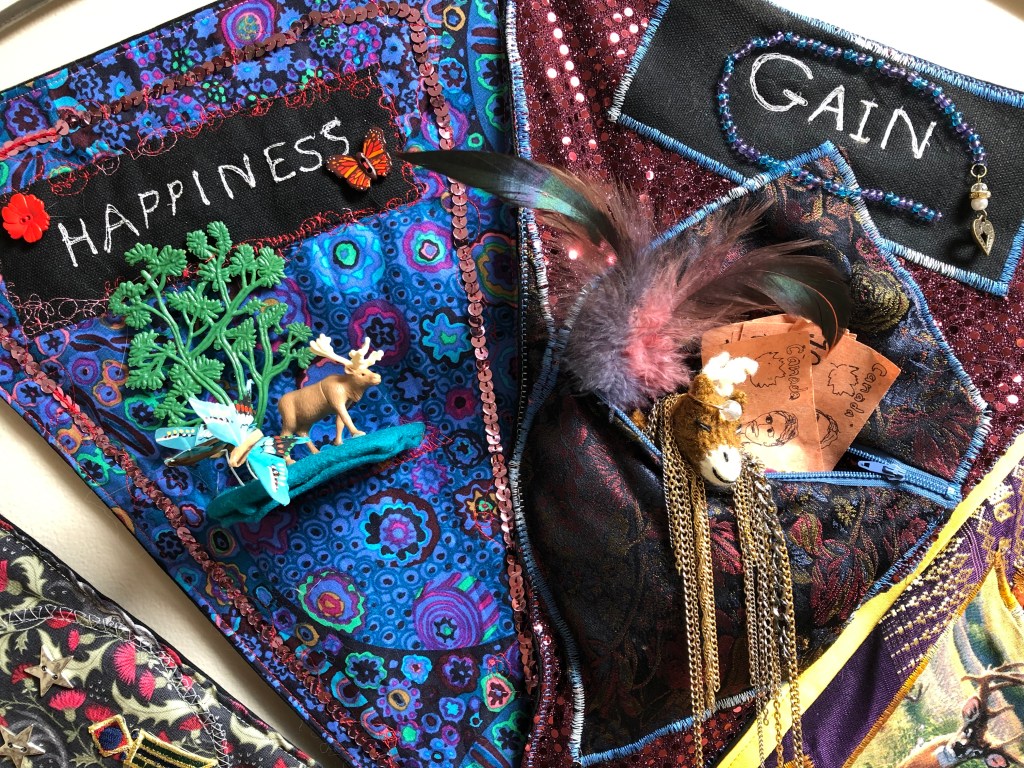


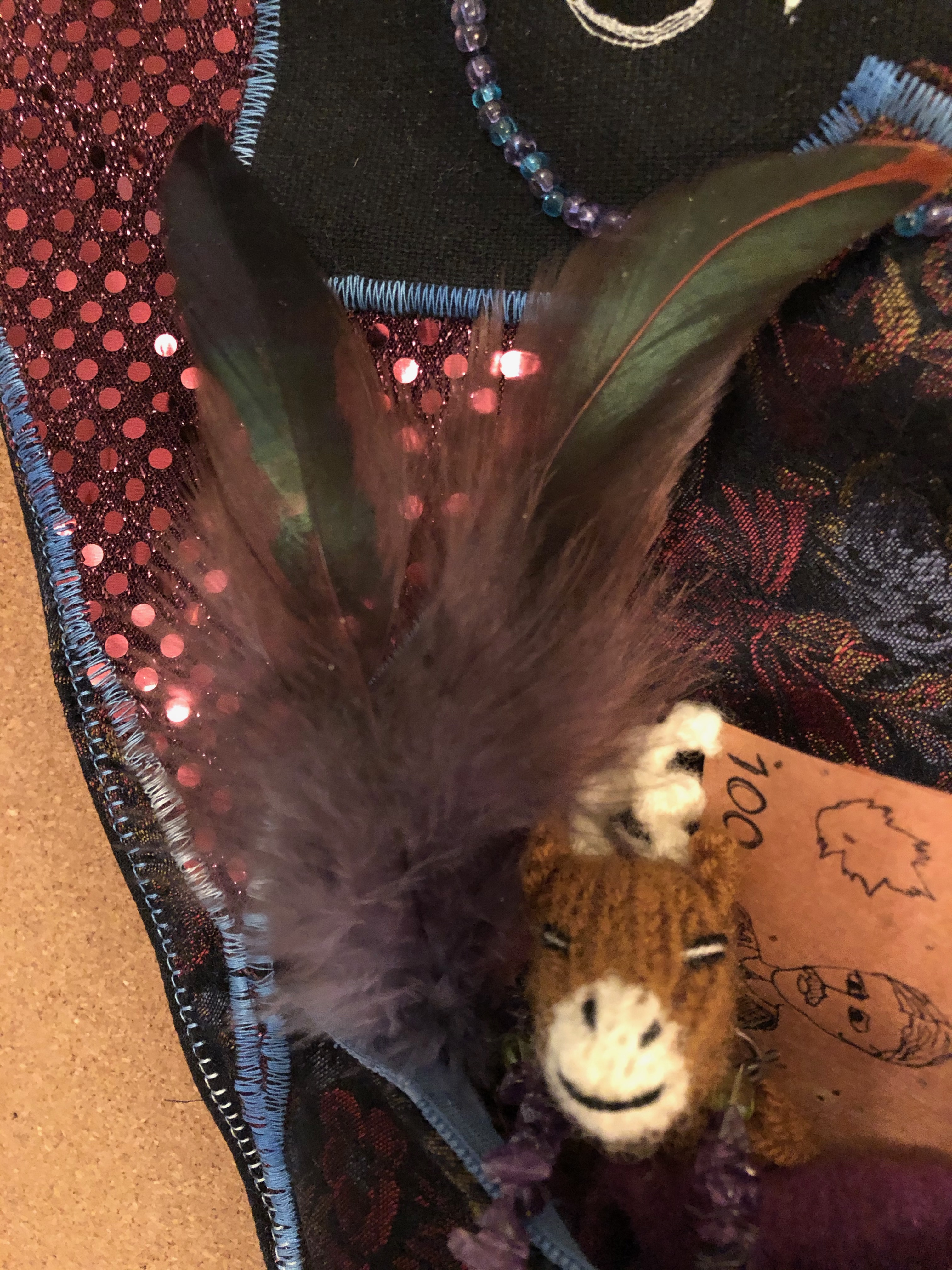 to a little girl, but somehow the deer got away from the set and I ended up with it. It seemed a perfect way to make the abstract concrete: to have someone or something experiencing gain. So my deer was soon cosseted by silks and feathers, zipped into a cocoon of wealth. A narrative emerged: Rainer the reindeer enjoys his gains, not realizing he’ll soon experience loss.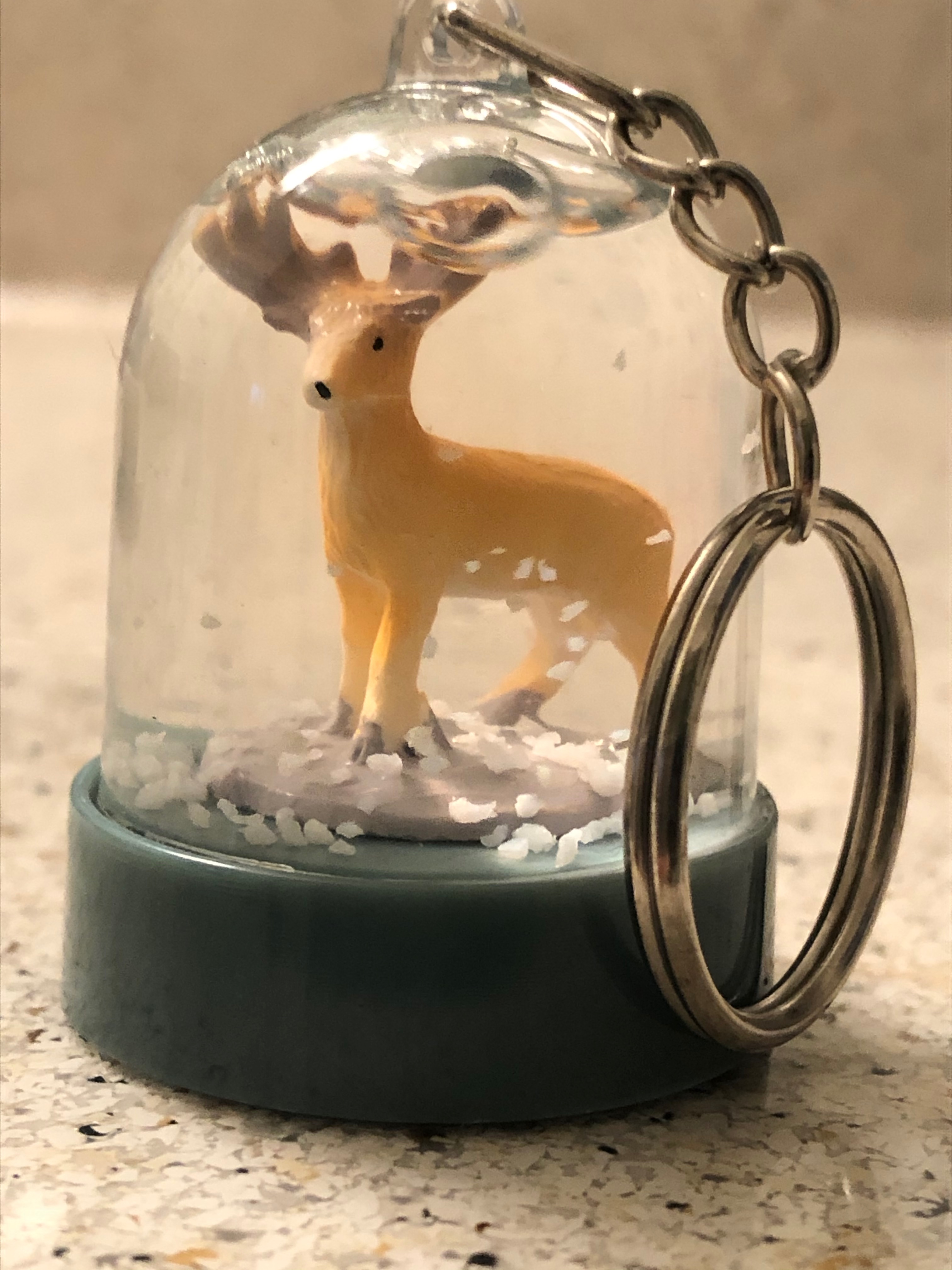


 Madeline Ruth Walker