

Madeline: “I’d like to go that big yard sale tomorrow,”
Two heartbeats occur.
Madeline: “But maybe you’d rather not. I guess we have something else planned?”
Michael: “Don’t walk it back! If you want to go the sale, you should go to the sale.”
Michael has noted that I have a habit of “walking it back.” I put forward an idea, a desire, a need. Then I rapidly withdraw it, sometimes not completely, but I often pull it back at least partially in a sentence laden with doubt. I offer qualifications for the original ask, or I might revise it entirely, deciding I don’t want it after all if it 1) inconveniences another person or persons or 2) makes me appear to take up too much space in the world (literally andmetaphorically).
I’m glad he brought this to my attention—I often don’t see my practices and habits; they are so embedded in my “personality,” I don’t recognize them for what they are. I believe the “walking back” behaviour is linked to a primal fear of claiming my place in the world, filling up space—taking up room physically, emotionally, spiritually, and psychologically.
Looking back over old journals as I write my memoir has been painful and illuminating. I started to think that perhaps “walking it back” is the trace of primal wounds that manifested in a different way in my teens and twenties. I saw my references in journals to bingeing and purging, and I could see my bulimia as the prototypical instance of “walking it back.” According to the New Oxford American dictionary, bulimia is an “emotional disorder involving distortion of body image and obsessive desire to lose weight, in which bouts of extreme overeating are followed by self-induced vomiting, purging and fasting.” One root of the word is from the Greek “ox hunger” (bous + limos).
That fits because there was a “black hole” inside me as big as the hunger of an ox, representing the need to be loved, accepted, to be seen, to be enough. To fill it I would secretly eat and eat. I remember secreting away a whole tin of homemade orange-flavoured cookies my grandmother sent one Christmas, hoping nobody would notice that most of them were gone when I replaced the tin in the morning. The taste of my stomach acid laced with orange kept coming back up my burning throat and into my mouth for weeks. The shame I felt every time I entered the bulimia triangle was debilitating, yet whenever I succumbed to this pattern, it felt inevitable, the only way to temporarily fill the unfillable hole.
Eating is a way of claiming something—Hey world, I am trying to fill up my cavernous need even though I know this won’t work for long, it never does. Almost immediately, I would feel terrible guilt and shame about claiming that space, the actual physical space of the fat person I might turn into. The fear of my fat body taking up space in the world, more space than was acceptable, sent me into the purging phase, trying to bring up as much food as I’d shoved down. That is a way of walking it back. . . I regret claiming space, I need to undo that expression of desire. Maybe if I bring it all back up we can pretend it never happened. Not only did the bingeing never happen, but I never had a need to be loved, there is no black hole. I am fine. Just fine. The performance of pretending I am okay, I am self-sufficient, I don’t need you: A hard role to play all day, every day.
Susan Bordo sees bulimia as a result of the double bind that modern society puts women in—we must perform as if we are always confident, self-sufficient, self-disciplined, and the price we pay is an inexorable letting go: “Many of us may find our lives vacillating between a daytime rigidly ruled by the “performance principle” while our nights and weekends capitulate to unconscious “letting go” . . . In this way the central contradiction of the system inscribes itself on our bodies, and bulimia emerges as a characteristic of modern personality construction” (477).
As I read Bordo and think about bulimia as a systemic problem, I wonder if thousands of other young women were doing what I was doing, are doing now what I was doing for over a decade. The secrecy of it makes me so sad. Perhaps I left traces of my disorder, a smell of puke in the bathroom, missing cake, chocolate bar wrappers. . . but mostly I think it was hidden from everybody who loved me. How sad I am now to think that I “performed” my life so much of the time.
Bingeing and purging are part of my distant past, but Michael’s urging me to not “walk it back” is a loving reminder that I still sometimes fear being a woman on the earth who has needs, desires, and preferences. A reminder that I can and should take up room in every way. I claim my right to be here. I speak my truth. Two of the ways I do that is by writing and drawing.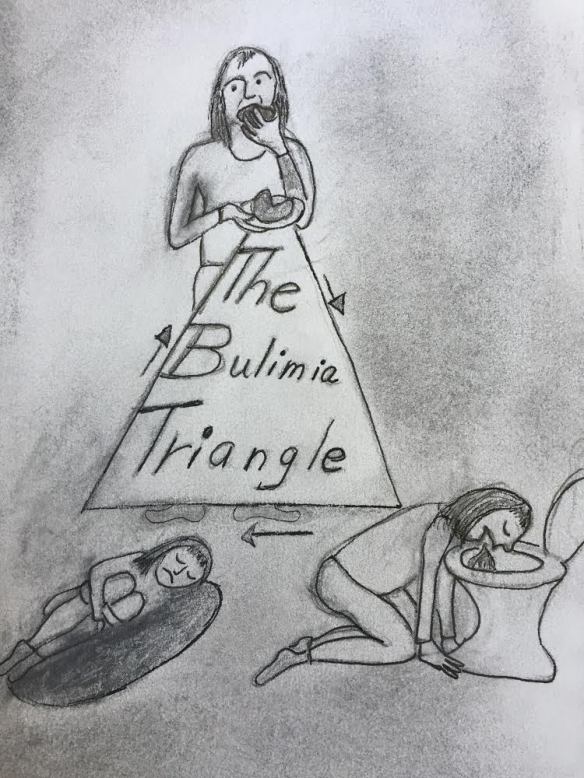
(Thank you, M.)
Reference
Bordo, Susan. 1995. “Reading the Slender Body.” In Nancy Tuana and Rosemarie Tong (eds.), Feminism and Philosophy: Essential Readings in Theory, Reinterpretation and Application. Boulder, CO: Westview Press. 467-88.
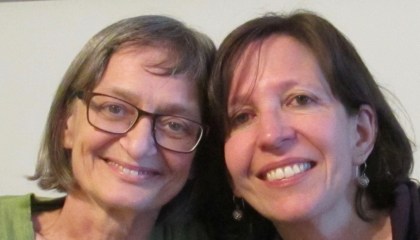 When Hanna came to visit, she brought candy. Not dark chocolate for the adults, but Twizzlers, sour worms, stuff kids devour. She sent birthday money and cards to my children. One summer she came to visit from Ontario and listened to my teenage son play clips from the music he was loving that season. She leaned in attentively when he described to her why he liked it. She was interested.
 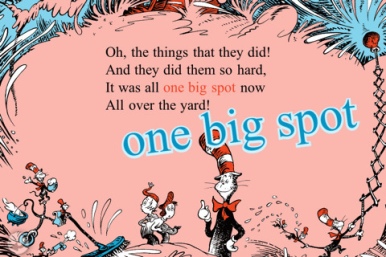 Like walking on pink snow, I thought, as my feet padded over a bed of petals under a cluster of Kwanzan Flowering Cherry trees. Here in Victoria, we get more pink snow than white; from February until May these blossoms drift in eddies from their fruit tree homes and fall gently to the ground. And then I remembered an old book from my childhood, The Cat in the Hat Comes Back. Sally and her brother were clearing snow outside when the Cat in the Hat ambled by. Even though they remembered the havoc he created in the first book (The Cat in the Hat), they unwisely let him in the house to get out of the cold, where he ate cake in the bathtub, leaving a pink ring. When he tried to clean the bathtub ring, he made things worse: he transferred the pink stain to the mother’s white dress, the father’s shoes, the rug, and the bed. The big Cat asked for help from little cats A, B, and C (who live under his tall hat), but they spread the stain further, onto the white snow outside. You may have read this book, which culminates in “Voom,” an amazing magical cleaning agent under the hat of microscopic cat Z that wiped the snow pure white. But only after all the other 25 alphabet cats plus their leader had transformed the snow into a bubblegum-pink blanket across the yard.


 Think (think, think)

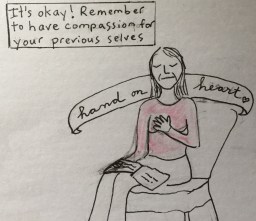 Sometimes I felt discouraged. But I just found something to motivate me and moved ahead. One step in front of the other. I like Julia Cameron’s The Artist’s Way where she’s collected so many encouraging quotations in the margins. Today I opened the book to Jackson Pollock’s “The painting has a life of its own. I try to let it come through.” I wrote it on a post-it note then crossed out “painting” and replaced it with “graphic memoir.” I remember all of the times I wanted to quit writing my dissertation. But I kept talking myself out of quitting and into writing. I love what Lisa Hanawelt says: “Don’t worry about how good it’ll be. Just make it and do your best.”
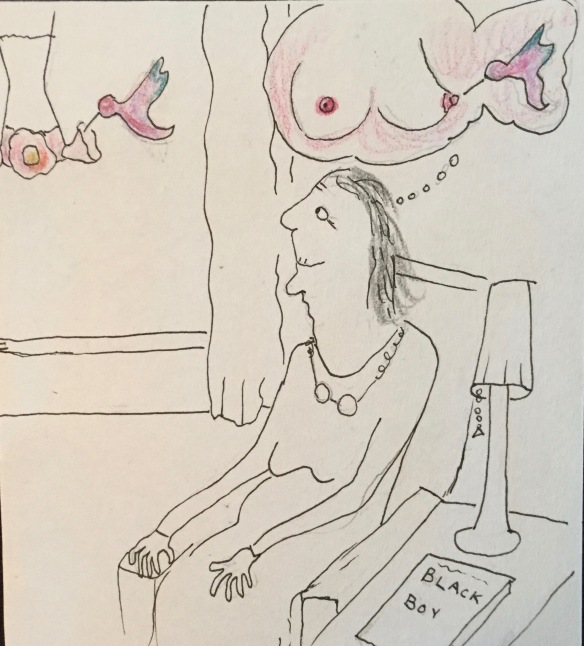
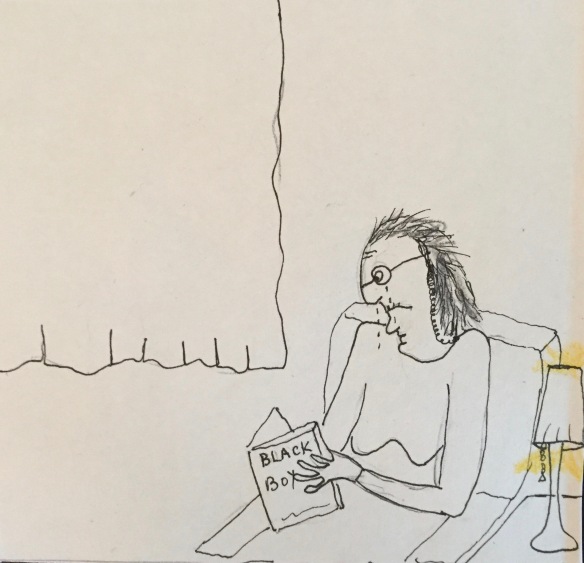
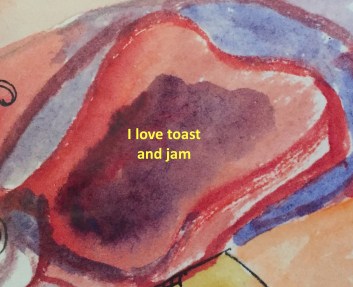 to toast and jam, my desert island food. This “toast,” however, was really more like big fat slices of hot bread. I like thin slices of well-done crunchy toast. Too bad. But the “jam” was delicious apple butter infused with cinnamon and cloves and nutmeg. The waiter behind the bar asked other diners solicitously how they liked their food, but he never asked me. He called me “ma’am.” It’s interesting how lone older women are treated differently from other people. We are mostly invisible. But funnily, I don’t really mind. There are powers in being invisible, as sorcerers know.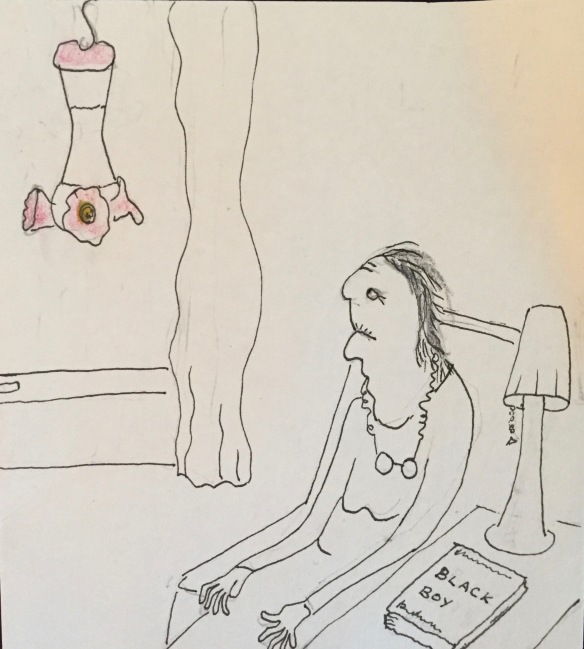

 Thanks for reading.





 Madeline Ruth Walker