The work wants to be made


I usually write about reading and writing, but today I want to expand and talk about other stuff as well—all the sources that have been sustaining me through this horrible summer. Summer of accidents, death, sadness, and grief.

Reading. I am reading Jonathan Lethem’s Motherless Brooklyn. I don’t remember meeting a more wonderful narrator—orphan-boy detective Lionel with Tourette’s syndrome.   His verbal and physical tics lift this detective story out of the ordinary. Lethem gives a master class in first person narration. I am less interested in the story than in the brill narration.

Writing. I finished my seventh story. My goal is still 10. I like this one, though I don’t know if any of them are any good. Sometimes ideas emerge from a deep well I didn’t know I had access too. Sometimes the process feels like automatic writing. . . “where is this coming from?” As Elizabeth Gilbert says in Big Magic, “The work wants to be made, and it wants to be made through you.” I am not even thinking as I write. The words just come out.

The latest, “Cones and Bottles” is about a woman Angela with a shitty childhood encountering a girl named Apeshit who is in the midst of her own shitty childhood. Angela confronts some of her demons around addiction and control. Ice cream cones and chocolate milk bottles figure in the story. Angela’s new neighbours invite her over for a barbecue.

At one point, as she carefully negotiated her sawdust hamburger, Angela ventured a question, “So is Ape short for April?”

“Ha, no, actually. That’s a good story,” answered Edie, licking mustard off her pudgy fingers. Angela noticed she had letters inexpertly tattooed on each finger of her left hand, just above the knuckles: P-A-R-T-Y. “Her real name is Mariah, you know, after the singer.” And then she interjected a phrase of a Carey song. “Touch my baw-dy, put me on the fl-o-o-o-o-r,” Edie crooned in a scratchy voice, pretending her hot dog was a mic. “But when she was little and we were trying to toilet train her, she used to shit on the floor, then start throwing it at us. I kid you not. Just like the apes going apeshit in the zoo. So we started calling her Apeshit, then Ape for short.”

Hen chimed in. “She still does it from time to time.”

“No kidding,” responded Angie, her flesh crawling from this description. She didn’t want to keep that image in her mind – the kid scooping soft turds from the floor and lobbing them at her parents. She imagined the damage done to the last apartment: smelly brown stains on carpets and walls.

* * *

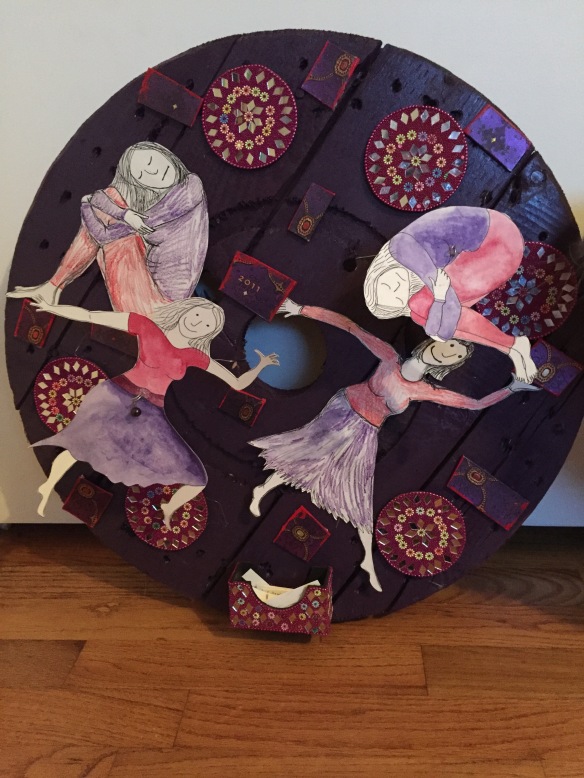
Art making. I found the wooden end of an electrical spool by the side of the road, around 22 inches in diameter. I brought it home and created “Shimmer” a mixed media piece with paper, glue, watercolour, acrylic, spraypaint, coloured pencil, straws, duct tape, wire, found objects. Shimmer has two women who spin for you (well four women, but only two can spin). One expands into dance, the other has contracted into solitude. Jewels sparkle here and there from found objects. There is a little glittery holder for my own version of angel cards at the bottom. This may not be finished.

Spin the girl, pick a card. Shimmer away/ Contract/ Expand/ Change/Everything changes all the time/ pick a card any card/ you never know what life holds for you.

Sewing: Working on “full moon rising quilt.” I love the batiks. I am learning to sew curves, sometimes tricky. This quilt is for a friend that I love.

Painting and writing, sewing and drawing, reading and thinking, dreaming and loving, crying and hugging. These all sustain me during the summer of pain.

P.S. would you like me to pick a card for you? Reply below. I’ll pick it and tell you what it says. IMG_1052


Learning the craft: first person first

I have been enjoying Bringing the Devil to His Knees: The Craft of Fiction and the Writing Life. The first essay is Richard Russo’s defence of omniscience, and he is very persuasive in showing writers the advantages of omniscience with examples from John Steinbeck and Jon Hassler (and others).

Okay, I am convinced. Problem is, it takes time, doesn’t it? To build to omniscience?

I have completed six stories now, and two out of six are third person. One of the third person narrations is close (we go into the thoughts of one of the characters), and the other, I suppose is “omniscient.” But that one felt very weird to write.  First person narration comes naturally, like a river flowing through me.  Third person omniscient feels distant from me, like I have stepped out of myself.  The disembodiment perhaps brings new powers over time.

I would like to write more in the third person, but I want to see if I can keep the energy of the first person and translate it into third person narration.  This feels like a process that cannot be rushed.

After my book of poems was published, I felt squeamish about it–that I was too confessional, too much of me was exposed.  And yet there is energy there, albeit awkward energy. There is soul. In writing fiction, I need to transmute that richness of my voice, my experience, into the more subtle delineations of the third person narrator.

I started a new full-time job on July 18 after four months “between jobs.” I realize the job takes a lot out of me, though I love it, and I am so grateful for employment that fits my skills and my interests.  I remain committed to my story writing, to learning the craft, to carving out some time each morning. I arranged a 9:30 start so I can fit in my writing time. IMG_0435The blog, however, will be more erratic.

In closing, I offer two paragraphs from my stories, one from a first person narration, the other from my most “omniscient” narrator:

I sat in the kitchen nook, feeling quite proprietorial by now. I liked this corner. It felt safe. The kitchen table was strewn with used coffee cups, a colouring book and crayons, a stack of library books in one corner. The other adults had things in hand—there was nothing to do. My son was taken care of. I liked the coffee made from beans from a local roastery. It was strong with real cream. I liked the big panel of windows behind me. I could turn my head and see the narrow yard with a rusty play gym and the compost pile, home to happy rats. I could see the sagging homemade cake perched atop the fridge, the goody bags lined up on the top shelf in the Ikea-styled kitchen. The sun had come out and I felt the warmth on my neck and a pleasant breeze from the open window beside me. The kids’ voices seemed as if they were coming from a distant country in another language. I liked the feel of the smooth cushion under my bare thighs.

Rinaldo unbuttoned the top two buttons of his madras shirt, lifted her small hand, and leaning over the bed, placed it on his bare chest, atop the layer of curly, sweaty hair. “Here, Mum, right here.” Ainslie’s thin arm was fully extended, the hand had disappeared into her son’s open shirt. His large hand covered hers, pinning it to his heart, the chest hair protruding from around the hand sandwich. He leaned over her, his other arm steadying his big leaning body so he wouldn’t fall into the bed. On this hot July day, he was wearing cargo shorts and his trunk-like thighs, also covered with thick dark hair, were pressed up against the wooden rail at the side of the bed. Ainslie opened her eyes, surprised but not alarmed by this new position she was in. Mother and son did not speak, but the room was not silent. The sound of Rinaldo’s heart seemed to fill the space, BA-doom, BA-doom, BA-doom. Ainslie felt the reverberations through her body.


Work mentioned

Baxter, Charles and Peter Turchi, Eds. Bringing the Devil to His Knees: The Craft of Fiction and the Writing Life. Ann Arbor: The University of Michigan Press, 2004.


When we were very young

I have been planning and musing over a short story idea, and one of the things I wish to implement is a wise narrating voice of a male ornithologist recalling his boyhood experiences. I thought of Rascal (1963), that beautifully written and illustrated memoir by Sterling North. The story covers one year (May 1918-May 1919) in the author’s life growing up in Wisconsin with his father and many pets, specifically his pet raccoon, Rascal. I was given the abridged version titled Little Rascal (probably for younger children), a red hardcover with a sketch of a raccoon embossed in black on the lower right corner of the book. There were more illustrations in that version than in the original Rascal: Gorgeous “scratchboard” illustrations by John Schoenherr that—although rendered only in black and white—glow with life and light.

I have kept some books from both my childhood and my children’s. But alas, not that book. I searched the shelves high and low. Although it was a favourite, I must have gotten rid of it during one of the many moving purges over the years. I took Rascal: A Memoir of a Better Era out of the curriculum library here at the University, and I’ve been enjoying reading the full version of the story.

North’s writing is spare and lovely. He explains the natural world simply, for the young reader, but without talking down to his junior audience. Indeed, the book captures the attention of readers of all ages. When the boy and his father realize Rascal, the pet raccoon, will need eventually to be caged because he’s developed a taste for sweet corn, Sterling’s father plans a trip in Northern Wisconsin, near Lake Superior for the three of them: father, son, and raccoon.

North describes this childhood idyll, two weeks of camping and fishing in the woods. One day, Sterling and Rascal make a discovery in their rambles along a river:

“Then, half a mile farther upstream, we came upon it suddenly—a little lake which was the very source, as round as a big drop of dew and as clear. Its shores were of clean sand and gravel, and it was cupped among low hills, forested with evergreens, with several white birches standing in sharp relief against this background of dark firs.

There were water lilies in the shallows, their floating pads large enough for little frogs to sit on, and blossoms the size of saucers, where green and scarlet dragonflies held court.” (93-4).

My experience of reading this book again is that I revert to the dreamy, safe space of my child self’s imagination. In these imaginary green spaces, I once felt that the world was whole and benign.

IMG_0949

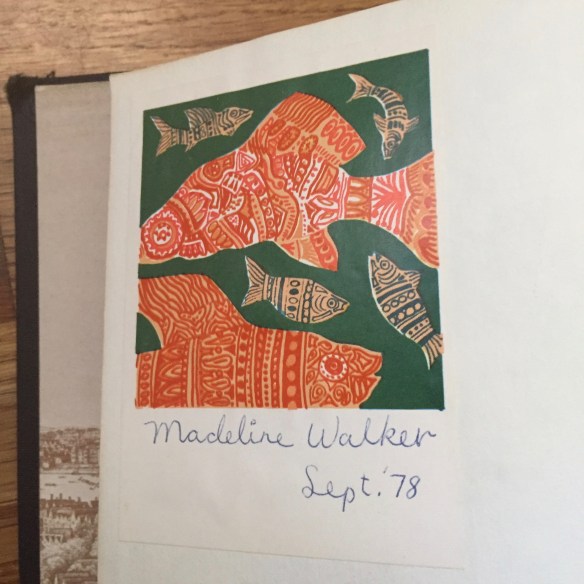
Bookmark by Madeline Walker

North does not adorn his descriptions with multisyllabic adjectives; he sticks to plain words like “little” and “big,” “low” and “sharp,” and colour words “green and scarlet.” He welcomed me into this warm world when I was very young, and I love returning there.

There is a lake just a twenty-minute car ride from where I live. Recently my friend and I took a dip there. The water lilies had just emerged, pure and white amidst lacquered pads. As we slid into the cool water, we could see an eagle take flight from an old log across the small lake. He thrust his big wings, scooped the air, and was lifted up, up. His white head sparkled against the blue sky. Dark conifers surrounded us, and the dragonflies were dancing, just as they did one hundred years ago for Sterling North.

Work cited

North, Sterling. Rascal: A Memoir of a Better Era. New York, NY: E.P. Dutton & Co., 1963.


Plants and Books for Sale

One Saturday in May I noticed a clearly lettered handmade sign taped onto a telephone pole near our house: “Plants and Books for Sale” followed by an address on a nearby street. My husband and I headed over; how could we resist? We approached a small white house screened by a cedar hedge. The driveway was lined with makeshift tables brimming with plants of various sizes and types. Printed sheets in clear plastic protectors provided information about each plant: latin name, care required, interesting facts.IMG_0937

Two deck chairs were set up at the head of the driveway. In one sat a woman, about 75 perhaps, with white hair and an anxious face. A teenaged boy sat next to her wearing a beige safari hat and glasses. He smiled at us and rose as we approached. “Interest…est…est…ed in buying some plants?” he stuttered. “Yes, in a bit” I answered. Looking at the woman I added, “But I am even more interested in the books.”

“Yes, well we have a house full of those, and they’re all for sale,” she announced, getting slowly out of the chair. “Follow me.” As we followed her into the dark hallway and throughout a warren of small rooms, I was impressed by the many bookshelves as well as boxes of books in the house. There must have been hundreds, even thousands of books. Books about philosophy, religion, mythology, art history. Shelf after shelf of novels, books of poems. Thick hard-covered books about countries of the world, about ships, and about plants. Politics, history, economics. This was an incredible collection, accumulated over a lifetime, evidence of an astute and curious reader.

“If you don’t mind me asking, why are you selling all of your books?” I ventured.

“They belong to my husband. He just had a stroke. They said he’ll never read again. And he won’t want them here when he gets back from the hospital. So they’ve all got to go.” She spoke in a rather brusque fashion, then turned on her heel and went back outside.

What a thing to happen! How unfair life is, to rob a man of one of his central pleasures!

My husband and I wandered through the rooms browsing, ending up on the front porch where several cardboard boxes set up on card tables overflowed with books. The boy was soon standing beside me. “Was your grandfather a professor?” I asked. “Yes, he was, before he retired,” the boy replied. We stood companionably together thumbing through books.

For one dollar each I bought Antonia Fraser’s Must You Go? My Life with Harold Pinter, Norman O. Brown’s Love’s Body, and Through the Flower: my struggle as a woman artist, by Judy Chicago. I tucked them away and forgot about them.

This week I discovered them atop a tall pile under my sewing table.

Fraser’s account of her long relationship with Pinter is comprised mostly of short, choppy journal entries. I read the first fifty pages and realized that the intricacies of their affair, the play reviews, the money problems, the vitriolic ex-wife, the children: none of these things interest me. I don’t really like Pinter’s plays, and I couldn’t get through Mary Queen of Scots. Sure, it’s a real-life romantic love story, and I am a sucker for those. But why on earth did I buy this book, when there were so many other better ones?

I reflected on this for a bit and then it came to me. It was the clippings. When I first handled this book at the sale, three slips of folded newsprint fell out: all from the Globe and Mail, all published in different months in 2010. One was a review of the memoir by Keith Garebian, the other two were reflections about Fraser’s book by Ian Brown and Elizabeth Renzetti. Two of the clippings focused on the uncontrollable force of love. As Brown wrote, “sometimes people’s hearts just overtake them.” Pinter and Fraser, each in their early forties, were both in long marriages with other people. With cyclone force, they fell in love with each other.

The clippings told me a story about this person I’d never met. As the folded slips fell out of the paperback, they brought an image of an old man sitting at the kitchen table in the sun with a mug of coffee, a pair of scissors, and the Globe and Mail. Carefully cutting out articles, folding them precisely, and tucking them into the book he’d recently enjoyed.

Perhaps he loved Pinter’s plays or Fraser’s historical biographies and was curious about the scandal they created in London in 1975.

Or perhaps he was moved by this grand love affair, where two people ignored social expectations and fell into the vortex of attraction and emotion. Perhaps this love story stirred some deep longing in his own heart. In any case, the clippings showed his interest in the book. And they also show his meticulous attention to detail, his wish to capture information and cross-reference it. I like to think the clippings give me a glimpse into his lively, complex mind before the fateful stroke. Or perhaps I’m just telling stories.

I also bought a large pot of Autumn Joy at the sale. The grandson, who shared with us his dream of becoming a botanist some day, told me I could look forward to reddish pink blooms in the fall.

Works mentioned

Brown, Norman O. Love’s Body. New York, NY: Vintage Books, 1966.

Chicago, Judy. Through the Flower: my struggle as a woman artist. Anchor Books, 1977.

Fraser, Antonia. Must You Go? My Life with Harold Pinter. Random House, 2010.


Random acts of reading: Little free libraries and green-coloured glasses

The inter-art subject was fun, but the constraint became too constraining (I was searching too hard to find perfect material). So this week I am moving to another subject—the gems acquired through random acts of reading.

I have always enjoyed wandering around libraries or my own library and picking a book at random (often with eyes closed), opening it wherever, and seeing what I get.* Perhaps this practice is a secular version of Bibliomancy, where a sacred book is balanced on its spine, allowed to fall open, and a passage selected with one’s eyes closed. My aim in this practice is not spiritual, but it is purposeful: I do these random acts of reading with the intention of finding some serendipitous truth or significance in the words I land on. As Swedish detective Kurt Wallender says in the marvelous PBS series “there are no coincidences.”

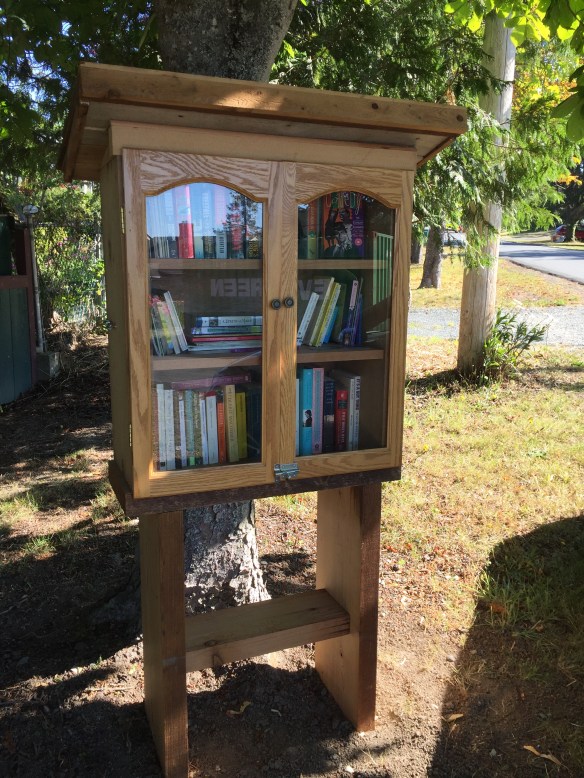
This week I enjoyed wandering around my neighbourhood, treasuring the last weeks of leisure (my new job begins July 18). We have at least three little free libraries in a five-block radius of our house.

I passed the newest and most elegant of the three mini libraries a few days ago and chose a couple of books. The following day, I dropped by the glass-doored cabinet and replenished the library’s supply with two books I have enjoyed and am ready to hand on: John Updike’s, The Beauty of the Lilies and Rachel Naomi Remen’s, Kitchen Table Wisdom.

One of the books I took was Anthony Trollope’s Early Short Stories. I enjoyed reading Trollope’s Barsetshire series in my twenties—they are highly addictive. But I didn’t know him as a story writer. As I am now writing stories, I thought I would explore his shorter fictions.

I opened the book randomly and started to read “La Mère Bauche.” I found the plot grim—a sixtyish stern mother (proprietress of a hotel) prevents her adult son from marrying his childhood sweetheart, and coerces the young woman (an orphan) to marry, instead, a fifty-year-old one-legged man. The young maid subsequently kills herself rather than submit to the man. The moral, I suppose, is that one shouldn’t meddle in the affairs of others: La Mère Bauche “never again laid down laws for the management of anyone” (90). Apparently Harper’s Magazine, who had commissioned the piece, hated it and never published it. I can see why.

As someone trying to learn the craft of fiction, I found more interesting than this nineteenth-century plot a physical detail of La Mère Bauche that carries symbolic weight. We are told in an early description of La Mère that “her eyebrows were large and bushy, but those alone would not have given her face that look of indomitable sternness which it possessed. Her eyebrows were serious in their effect, but not so serious as the pair of green spectacles which she always wore under them. It was thought by those who had analyzed the subject that the great secret of Madame Bauche’s power lay in her green spectacles” (66).

Madame’s green spectacles are referred to again at strategic moments. When the girl, Marie, beseeches her benefactress to consider her love for Madame’s son, “Madame Bauche’s spectacles remained unmoved; but not her heart” (72). Later, when angry with Marie, Madame is ready to carry out “all the threats conveyed by those terrible spectacles,” and an “angry fire glimmered through the green glasses” (p. 83).

At one point, those green spectacles take on a life of their own. When Marie closets herself in her room to weep after the wedding and refuses to leave, “twice did the green spectacles leave the room, covering eyes which also were not dry” (89). And Madame begins to wonder if she had perhaps done the wrong thing in insisting on this marriage.

Trollope uses the detail of the green spectacles judiciously. He doesn’t hammer away at the symbolism. Only much later did I wonder: If cheerful optimistic folks are said to see life through rose-coloured glasses, perhaps Madame’s green glasses illustrate her view of the world through the lens of jealousy and possessiveness. She must have her son all to herself and in clinging to him, she ruins four lives. If the glasses are the great secret of Madame’s power, they are also the secret of her tragic life. The glasses prevent her from following her compassionate heart.

This was a good story for me to learn about using character detail in a story. As David Lodge says, “all description in fiction is highly selective; its basic rhetorical technique is synecdoche, the part standing in for the whole” (68). Trollope’s careful use of green spectacles is a great example.

Trollope’s story had another message for me about the dangers of mothers clinging to their sons. I said good-bye to my youngest son on Wednesday. Two months shy of 22, he is off for an adventure, destination Halifax, with just a backpack and his dreams. For that good-bye, I put on my rose-coloured glasses and I am determined to keep them on.

*I was charmed to see that Ian Brown, in his memoir Sixty, enjoys the same practice of opening books, reading randomly, and finding treasure.

IMG_0915 (1)

Works Cited

Lodge, David. The Art of Fiction. London, England: Penguin Books, 1992.

Trollope, Anthony. 1859. “La Mère Bauche.” Early Short Stories. Oxford: Oxford University Press, 1994.


Inter-Art: Highbrow/ lowbrow reading

383228


I remember taking a required class on bibliography in grad school. That was fifteen years ago. Our prof, young and bold, had us dissect a book right down to its spine. That exercise felt sacrilegious—deface a book?

Another activity was to list all the books and other material we’d recently read that we didn’t mind people knowing about in one column, then write that other list—the texts we felt squirmy or embarrassed about—in a second column. I listed in column one all of the classics or books considered “literature” I had recently finished. And in column two: Maeve Binchy’s novels. I felt uncomfortable admitting that I loved curling up with her squishy sentimental fictions and a box of Kleenex. That was like admitting I enjoyed O Henry bars (Binchy) more than Green & Black’s organic dark chocolate (James Joyce). When I met my husband he was apologetic about listening to John Grisham audiobooks. My mother’s love for Rex Stout is something she hides in the basement while all of the history and art history books have pride of place in the living room. These prejudices are deep-seated: Are we worried about appearing dumb? Undiscerning?

Book snobbery is captured at a gut level in my favourite Margaret Drabble short story, “The Merry Widow.”

In tight third person, Drabble writes about her “merry widow” Elsa. Elsa’s husband Philip has recently died, and she feels liberated. She is looking forward to a holiday in Dorset at a cottage alone. The holiday was planned when Philip was still alive. She would have suffered through it, under his critical eye, but now the getaway has an enchanting aspect to it. It will be her first vacation without him after decades of unhappy marriage:

“She had been absolutely fed up to the back teeth with Philip, she said to herself, gritting those teeth tightly as she wrote to increase the standing order for oil delivery, as she rang the plumber to arrange to have a shower attachment fitted to the bathroom tap. Why on earth shouldn’t she have a shower attachment, at her age, with her pension and savings? Her jaw ached with retrospective anger. How mean he had become, how querulous, how determined to thwart every pleasure, to interfere with every friendship.” (p. 152)

For her trip, Elsa packs her bird book, her butterfly book, her flower book, her Pevsner, and her Margery Allingham omnibus. One of her greatest pleasures is to identify birds, butterflies, and flowers, a hobby that had irritated Philip no end. “It had seemed a harmless pleasure, until Philip attacked it. Harmless, innocent, and proper for the wife of a university lecturer. An interest in flowers and butterflies. What could be wrong with that? By some sleight of reasoning he had made it seem sinister, joyless, life-denying.” (p. 155). Drabble is so good at showing how a critical partner can grind his spouse down to a stub through continual undermining, sarcasm, and mockery. The belittled spouse loses all confidence and, ultimately, loses delight in life.

But back to my topic: categorizing some texts as “lowbrow.” Elsa loves the little Dorset holiday cottage and the “modest wilderness” around her. She enjoys her solitude, her wanderings and walks, a gin and tonic in the evenings. She reads and watches the long-tailed finches, relishing the luxury of answering to nobody, of doing exactly what she wants. She revels in her own company, realizing she had been crushed under Philip for a very long time.

“Philip, she reflected…would not have approved her choice of novel. She was reading a Margery Allingham omnibus, nostalgically, pointlessly. Philip had despised detective stories. He had mocked her pleasure in them. And indeed they were a bit silly, but that was the point of them. Yes, that was the point. After lunch, she took Margery Allingham into the paddock, with a rug and her sunhat, and lay under an apple tree.” (p. 161)

Throughout the story, Elsa reflects on how Philip would have judged her choices, and the reflection makes her relieved and happy that she is no longer under his surveillance. She doesn’t have to defend her reading preferences any longer—for example, “pointless” and pleasurable detective stories.

After Philip’s death, she cancelled his subscriptions to scholarly periodicals, which comprised his reading matter.

Now she could relax: eat what she wanted, take long hot showers, watch what she liked on TV, listen to Radio 2, identify flowers and birds, look at the local architecture, indulge in Margery Allingham’s entertaining stories. Philip’s snobbery and psychological abuse died along with him, and she feels suddenly extricated from under the shadow that greyed out her life. (Another shadow emerges in the story, but I won’t spoil it for you.)

That two-column exercise doesn’t work for me today: I can write only one eclectic list—the books I am reading. I don’t need to hide anything; I don’t need anybody’s approval. I hope the same goes for you.

cover-ADayintheLifeSmilingWoman

Drabble, M. (2012). The merry widow. In A day in the life of a smiling woman: Complete short stories (pp. 151-168). New York, NY: Houghton Mifflin Harcourt Publishing Co.

A poem cannot contain

A poem contains (has / holds) words, but a poem cannot contain (restrain / control) meaning.

In 1956 Dorothy Livesay wrote “On looking into Henry Moore.”

This week I wrestled with that poem and its subject.

I paused on the bridge over Colquitz Creek and watched a mallard fly awkwardly beneath my feet, squawking with urgency. I thought: I am like that duck. Flying with ungainly wings—so clumsy you could hardly call it flying. Toward what? For what purpose? Only to get to another part of the creek? Why? That is what trying to “get” poetry can feel like for me.

I have been struggling to find conclusions to writing that is meant to be open to many interpretations, work that must remain ambiguous, opaque. And of course this is part of its beauty. Thank you to Blank and Kay on close reading of poems. They remind us there is no final solution or mastery of a poem in close reading: only deeper understanding.

So I will meander a bit today as a way of acknowledging that blog posts are not polished academic papers; they are (or can be) exploratory essays. First, Livesay’s poem cannot contain Moore’s work any more than this post can contain any final interpretation. She wrote the poem in 1956, so I kept trying to figure out which piece or pieces of his sculpture had motivated the poem, kept thumbing through books showing a chronology of his massive oeuvre. What had she seen? And in what context? I don’t know—I only know my experience of Henry Moore’s work, not Livesay’s experience.

To grow up in Toronto in the 1960s is to remember when, in 1966, Moore’s The Archer (or Three-Way Piece Number Two) was unveiled in Nathan Phillips Square. This bold bronze sculpture was so revolutionary, so wonderfully different from anything I knew, a complement to the curved towers of our City Hall. The Archer seemed part machine, part human with smooth protuberances punching up and out into space.

Later that sculpture was the backdrop for my stepfather’s photographic portraits of my teenaged sisters: brown and red hair whipping cross their lean and tender faces. Then later, in 1974, the Henry Moore Sculpture Gallery opened at the AGO. I can remember walking around in the silent gallery, among the monumental stone figures, many of them recumbent, and feeling peace. This was hallowed space. Those figures felt human, kind, and wise.

Fast forward, way forward, to 2014 when the AGO made the brilliant pairing of Henry Moore with Francis Bacon for “Terror and Beauty.” We travelled to Toronto to see family and to see the show. I discovered Moore’s realistic drawings of the London underground during the blitz in WWII. People lined the tube like insects wrapped in chrysalis blankets, mouths agape as they slept off the trauma of the bombings. I also saw Moore’s late crucifixion drawing and felt again, something hallowed in the vulnerable curve of Jesus’s spare, feminine body against the cross.

Poems don’t always yield their nuts easily: If I can pry open the shell a little, get a crumb, that is enough for now. To strive too hard to get it, to get it all, is to be like the urgent flapping duck.

To open her poem, Livesay writes,*

Sun   stun me   sustain me
turn me to stone:
Stone   goad me  gall me
urge me to run.

When I have found
passivity in fire
and fire in stone
female and male
I’ll rise alone
self-extending and self-known.

Livesay’s title is “on looking into Henry Moore.” Perhaps she’s looking into the artist’s mind and attempting to capture his experience of working in stone. To feel, paradoxically, energy and movement in immovable, inert material. To feel your medium goading you, prodding you to make something, to run, to create. To find passivity in dynamic, always changing fire: again, paradoxical. Those extra spaces placed after Sun, stun me, stone, goad me: The pauses of incantation, as if making art is like making magic. Leaving space for us to walk around Moore’s massive sculptures.

“And fire in stone”: Michelangelo said (I paraphrase) every block of stone has a statue in it and it is up to the sculptor to discover it. So the passive fire burns slowly in the stone, willing its sculptor to fan the flames.

In the next line, Livesay writes “male and female” then “I’ll rise alone/ self-extending and self-known.” To acknowledge the potential for male and female within the stone, within ourselves, to be sufficient unto ourselves, to be fire and stone, to be passive and feel vital energy, to know oneself, to extend oneself, to complete oneself. To contain all things, yet never be contained.

On second thought, this is not Livesay trying to get into Moore, but isn’t it Livesay herself, spinning some of her common threads from The Self-Completing Tree? Just as the reclining figure was a subject Moore explored over and over, so self-completion, aloneness, the paradoxical self, were some ideas Livesay returned to throughout her writing life.

I know the poem will yield more nut crumbs as I continue to ponder. And I’ve started reading John Russell’s biography of Moore, as well. The duck has landed.

Sketch from Moore/Bacon show AGO 2014 by Madeline Walker

Sketch from Moore/Bacon show AGO 2014 by Madeline Walker

Sketch from Moore/Bacon Show AGO 2014 by Michael Carpenter

Sketch from Moore/Bacon Show AGO 2014 by Michael Carpenter

Livesay, D. (1986). On looking into Henry Moore. in The self-completing tree: Selected poems. pp. 27-28. Victoria, BC: Press Porcépic.

*Copyright law dictates I cannot quote the entire poem here, but you can read it here.


Inter Art: Scarcity and Abundance

I recently re-read Alice Munro’s story “Friend of My Youth,” about the sisters Flora and Ellie who are Cameronians, a “freak religion from Scotland” (p. 152). When Ellie is confined to her sick bed, Flora puts her sister to sleep by reading to her from old books of their faith, “all the stuff that was in their monstrous old religion” (p. 157). Sometimes those readings were leavened by stories about Scotland, about “urchins and comic grandmothers” (p. 157). The only title mentioned is Wee Macgregor, about a Glaswegian lad and his family narrated in Scots dialect by J.J. Ball. These mawkish tales were first published in the Glasgow Evening Times around the turn of the century then gathered in a small book. As I read about the few books Flora had on hand, I thought of my mother’s house and how an early impoverishment of books shapes minds and lives.

Then I turned to Richard Wright, an important twentieth-century African American writer, whose 1961 short story “The Man who was Almost a Man” contains another kind of paucity. The only intertext in this story is the Sears and Roebuck catalogue. Dave doesn’t have his own copy—he has to go to the local store and borrow the catalogue so he can pore over the pictures. It’s doubtful he can read. Getting a gun from the catalogue, thinks Dave, will make him a man. A persistent theme in Wright’s work is the black man’s struggle to be seen as fully human.

“Howdy, Dave! Whutcha want?”

“How yuh, Mistah Joe? Aw, Ah don wanna buy nothing. Ah jus wanted t see ef yuhd lemme look at tha catlog erwhile.”

“Sure! You wanna see it here?”

“Nawsuh. Ah wans t take it home wid me. Ah’ll bring it back termorrow when Ah come in from the fiels. ”

“You plannin on buying something?”

“Yessuh.”

“Your ma lettin you have your own money now?”

“Shucks. Mistah Joe, Ahm gittin t be a man like anybody else!”

Joe laughed and wiped his greasy white face with a red bandanna.

“Whut you plannin on buyin?”

Dave looked at the floor, scratched his head, scratched his thigh, and smiled. Then he looked up shyly.

“Ah’ll tell yuh, Mistah Joe, ef yuh promise yuh won’t tell.”

“I promise.”

“Waal, Ahma buy a gun.”

“A gun? Whut you want with a gun?”

“Ah wanna keep it.”

“You ain’t nothing but a boy. You don’t need a gun.”

“Aw, lemme have the catlog, Mistah Joe. Ah’Il bring it back.”

When Dave takes the catalogue home, his mother thinks it will provide toilet paper in the outhouse, but is quickly disabused of this notion. Dave pores over the pictures during dinner and is told to put the catalogue away. In John Steinbeck’s Grapes of Wrath farm labourers are suspicious of the written word because it may be used to manipulate and deceive. And here, similarly, Dave’s parents see the catalogue as dangerous—putting ideas into their son’s head. All those glittery objects they cannot afford.

Dave gets his gun and of course the results are catastrophic.

What is it like to grow up where there are no books in the house? Where you have to borrow a catalogue from the corner store? Or perhaps there is only one book: the Bible. This poverty is hard for me to imagine. I grew up surrounded by books and received books for every birthday and Christmas as I was growing up.

However, my mother grew up in a strict German Lutheran home with seven siblings and no books save the Bible. Born in North Dakota in 1929, my mother Virginia was so grateful when one of her much older sisters—my Auntie Fran—gave her the gift of her first book when she was 7 or 8, Shaun O’Day of Ireland (1929). She remembers this gift fondly because it unlocked the door to literacy and a lifelong hunger for books and reading. She mentioned the book to me again when I visited her last Easter, and she is 87—so this is an indelible memory. Curiously, the author of Shaun O’Day is Madeline Brandeis, with the same spelling of Madeline that I use. Although my mother says she named me Madeline because she “liked the name,” I wonder if it was this author’s name—author of a treasured book—that partially inspired the choice?

51FcoAh6NbL._SX362_BO1,204,203,200_

The words and pictures in books might give people ideas about having a better life. My mother started reading about Shaun, imagined how life was in Ireland, and soon she had her eye on a different life. She left her parents’ farm in Lodi, California to move to LA and then to Berkeley. She met my dad on the Berkeley campus where she studied Art History and he studied Sociology. Both of them surrounded themselves with books, just as my sisters and I do. From scarcity to abundance.

If you have any ideas for future blogs on inter art/ intertext please use the comment section or email me at maddyruthwalker@gmail.com Thank you for reading.

Work cited

Munro, A. (1990). A friend of my youth. In L. Chalykoff, N. Gordon, & P. Lumsden (Eds), The Broadview introduction to literature: Short fiction (pp. 150-167). Peterborough, ON: Broadview Press.

Note: I use APA here even though MLA is expected. I have used and taught APA for the last while (working in a School of Nursing), so I need to re-learn MLA now.

Inter-art and music

Today I am writing about Charles Baxter’s short story, “Gershwin’s Second Prelude,” a beautiful example of inter-art in the form of a short story wrapped around a piece of music. Baxter, like Ann Beattie from the last post, is an American writer born in 1947.

In this story, Kate, the protagonist, is in a tenuous relationship with Wiley. Wiley borrows money from Kate and can’t keep a job. He’s unpredictable and irritating. But he’s also a brilliant, charismatic guy—a great lover and a very funny man who keeps Kate amused with his clown antics. Kate is taking piano lessons from Mme. Gutowski, an ancient Polish pianist who lived in Paris in the 1920s and 1930s, and knew Ravel, Bartók, and Cocteau. The story runs like two trains on parallel tracks. We switch from Kate and Wiley to Kate and Mme. and then back to Wiley again. When Kate finds a needle in the bathroom cabinet, Wiley admits he likes doing heroin. Kate asks why he does it. “I like to feel like God,” Wiley said. “I like to have the sun explode and then spray over my face” (p. 9).

Meanwhile over on the piano train, Kate is failing miserably at Shubert and Mme. instructs her to cease: “’No more Schubert,’ she repeated irritably. ‘You play like an American. You speed up the tempo to make a climax. This is Schubert, not Las Vegas’” (p. 2). She orders her pupil to play Gershwin’s Second Prelude instead. “’Gershwin?’ Kate frowned. ‘That’s trash’” (p. 3). But Mme. disagrees. Gershwin, she argues “’requires wizard, but teaches tenderness from first bar to end. You Americans have such trouble learning tenderness, I don’t understand. Learn to relax into calm’” (p. 3). Mme. talks about dead musicians as if they were alive and accessible. She encourages Kate to get to know Gershwin, “a nice boy. You two will adore each other” (p. 3).

Here’s where you stop to listen to Gershwin’s second prelude. This is Michel Legrande’s 1994 recording of all three preludes; you can skip to number two from 1:25-3:56. 

After Wiley leaves her, Kate shows up to her piano lesson drunk, and Mme. tells her a story about her lover in Paris many years ago who succumbed to opium and the delusion that you can be happy all of the time. That lover ended up committing suicide by leaping from the top of a cathedral.

Mme. describes those artists who grab at joy and happiness: “’Joy is infected. Joy for too long is infection. Cannot last’” (p. 14). Rather, it’s what appears to be mundane that has value: “’Boredom has its own tenderness, its own mercy’” (p. 15).

I cannot reduce Baxter’s complex story to one takeaway, but perhaps Madame has it right—what may seem boring, the day-to-day sitting at the piano bench (or writing desk) and working at making a connection with the composer/reader, is the key. Grabbing at happiness and trying to make joy last will make you crazy and sick.

At the end of the story, Mme. extracts a promise from Kate that she won’t keep striving to be happy and insists on a toast with imaginary champagne: “’You will become a hero. You will learn to face losses of giant size’” (p. 15). And they raise their invisible glasses to celebrate loss, boredom, and hard work.

I listened to Gershwin’s piece a few times, trying to understand what its presence meant in the story. I felt the melancholy of the persistent refrain. The minor notes seem to undercut the jaunty rhythm, and five notes repeated throughout the prelude seem to illustrate the boredom tinged with tenderness that Mme. spoke of.

This story reminded me of Elizabeth Gilbert’s message about stubborn gladness. She writes that her “ultimate choice, then, is to always approach my work from a place of stubborn gladness” (p. 219). She just plugs away, trusting throughout losses and wins, ups and downs. Note she does not use the word happiness or the word joy; she uses gladness.

Stubborn gladness. Tender boredom.

 Works cited

Baxter, C. (1984). Gershwin’s second prelude. Harmony of the world. Columbia, MO: University of Missouri Press.

Gilbert, E. (2015). Big magic: Creative living beyond fear. New York, NY: Riverhead Books.


Inter-art

I am writing short stories. I am on number six, with a goal of ten. And sometimes I need a break, so I decided to start a weekly blog post about intertextuality, more broadly inter-art. Most of my stories so far refer to other books; for example in my long Fez story the young protagonist is in love with Catherine Barkley of Hemingway’s Farewell to Arms and in “Elephant Man Comes Out,” the protagonist is aroused (again) by Edmund White’s A Boy’s Own Story.  I am often captivated by poems, stories, and novels that refer to other poems, narratives, paintings, pieces of art, songs, movies, and symphonies because art is such an important part of my own life. Following the threads of influence and provenance is a mysterious process, revealing layer upon layer of literary and artistic sediment/sentiment. I am also reading Big Magic by Elizabeth Gilbert and feeling the rightness of just writing and not necessarily getting it right. Blogging is good practice. A way of priming the pump for the stories.

So each week (or more often, or less often), I will blog about inter-art. I will either discuss something I have come across in my writing, or I will open books randomly to find something (a favourite pastime of mine). I’d like to start, though, with one of my favourite short stories and the poem referred to and, in fact, quoted in its entirety, in that story.  Ann Beattie is an American novelist and short story writer (68 years old), and her “Yancey” is a story about an ageing woman and her ageing dog (whose name is Yancey). In the first person, this woman (a poet), describes an intriguing encounter with the IRS man who comes to make sure she does have a home office dedicated to writing that she has claimed in her tax return.  After he looks at the room and they exchange some playful dialogue, he says to her “If you were to recommend one book of poetry I should read, what would it be?” We don’t expect an IRS man–a numbers and rules man–to be interested in poetry. They discuss poems, the narrator probing his tastes, and finally she settles on James Wright’s “Lying in a Hammock at William Duffy’s Farm in Pine Island, Minnesota.” 

A deceptive poem, a lovely poem, a shocking poem. The bronze butterfly and cowbells, the sunlight, the chicken hawk, the horse droppings all mused upon as the speaker lies in a hammock on a friend’s farm.  Then the last line: “I have wasted my life.”  When the narrator recites the poem to the IRS guy, he is incredulous.  “Is that really a poem?” He asks. And “I’ve never heard anything like that. The last line comes out of nowhere.”  And the narrator, who is, remember, a poet, disagrees. She responds that the last line could have come first, but the writer sets us up, seduces us.  And they both end up agreeing that everybody feels like that–that they’ve wasted their life–at least some of the time.  Their brief encounter, the old poet reciting Wright’s startling poem as she sits on the stairs, her dog next to her, the IRS man listening patiently:  it is all so unusual and so unlikely. And yet it is the stuff that happens in our lives, those random coming togethers with strangers or near strangers. Those almost magical encounters.  The IRS guy leaves, saying he’ll get a book of Wright’s poetry and she responds “Any day’s good when you get someone to buy a book of poetry who wouldn’t ordinarily do it.”

Reading “Yancey” several times made me recognize how the meeting of two unlikely people can create the heart of a narrative. What do they exchange? How are they transformed by the exchange? I hope that I do some of that work in “Elephant Man” and even in “Family Life,” though in that story it’s an exchange between a son and his mother.  More next week.

Madeline