“In a time of destruction, create something.” Maxine Hong Kingston
I have been trying to write poems this year. If you love poetry, I recommend listening to The New Yorker poetry podcast. Poetry editor Kevin Young interviews poets who read a poem from the New Yorker archive plus one of their own poems. Also inspiring, if you are interested in haiku, is Natalie Goldberg’s book, Three Simple Lines. She writes about her pilgrimage to Japan, about haiku, about the first Japanese masters, Basho, Buson, Shiki.
I have started to write my own version of Haibun, a Japanese form that combines concise prose with a haiku. I loosely interpret this form, writing a daily observation in a few sentences plus a “sort of” haiku. No more 17 syllables, just three simple lines. Maybe these aren’t haibuns or haikus at all…. maybe they are just what they are.
I Womb
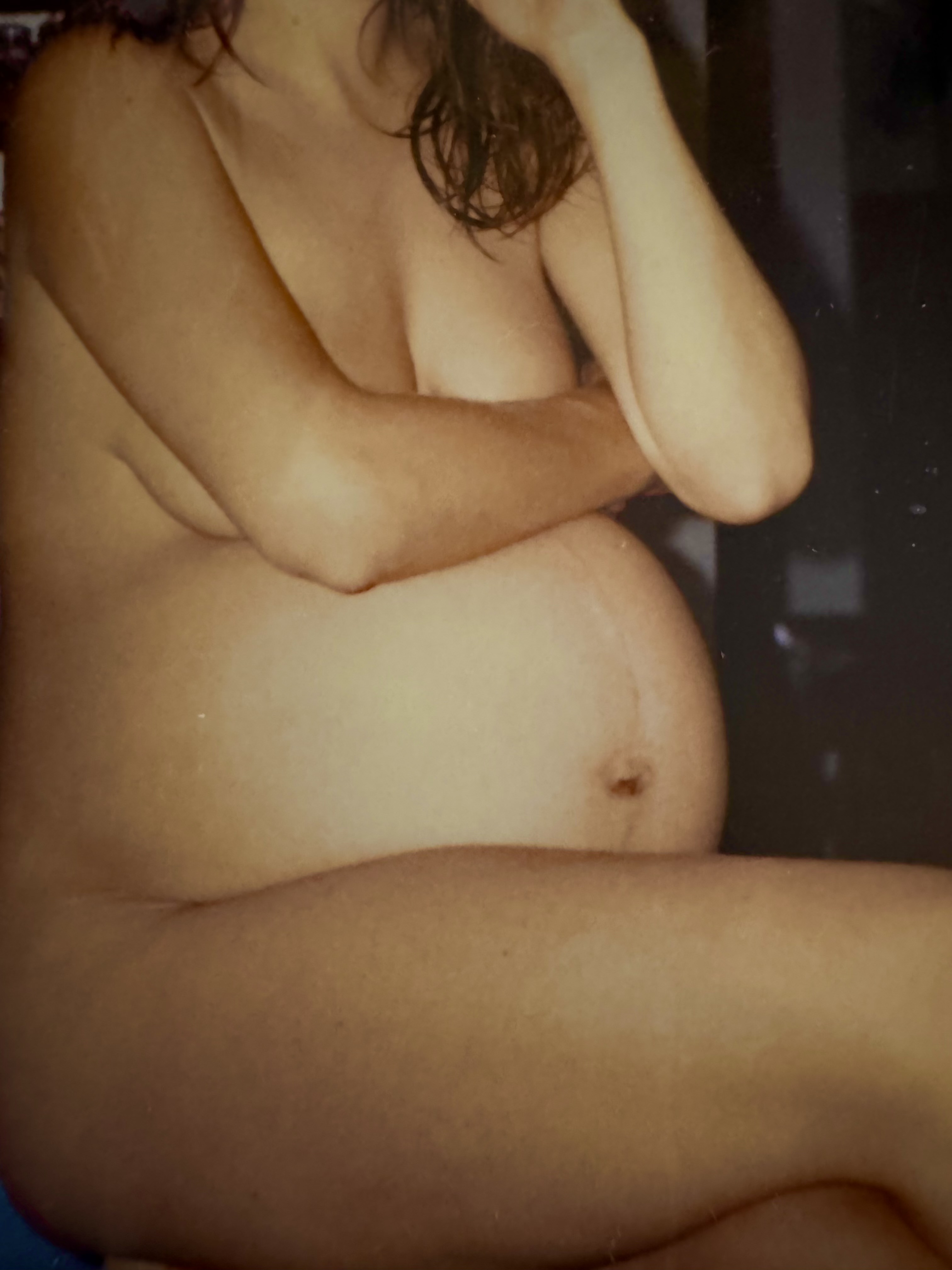
Morning crossword, four letter word, first site of eviction. “Womb,” I say aloud with certainty. But no, the answer is “Eden.”
Every human’s first home, the blood red womb
II Orange
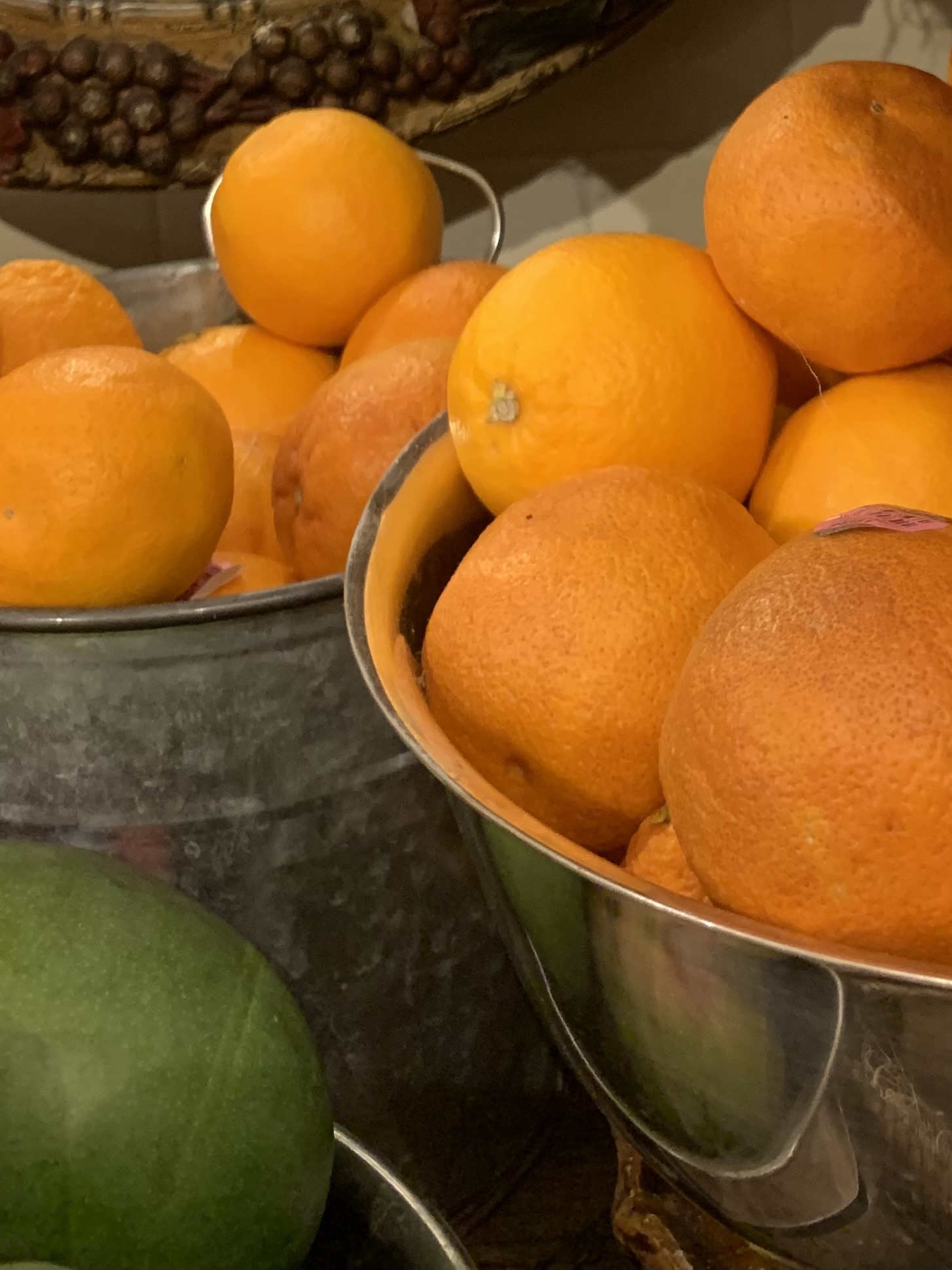
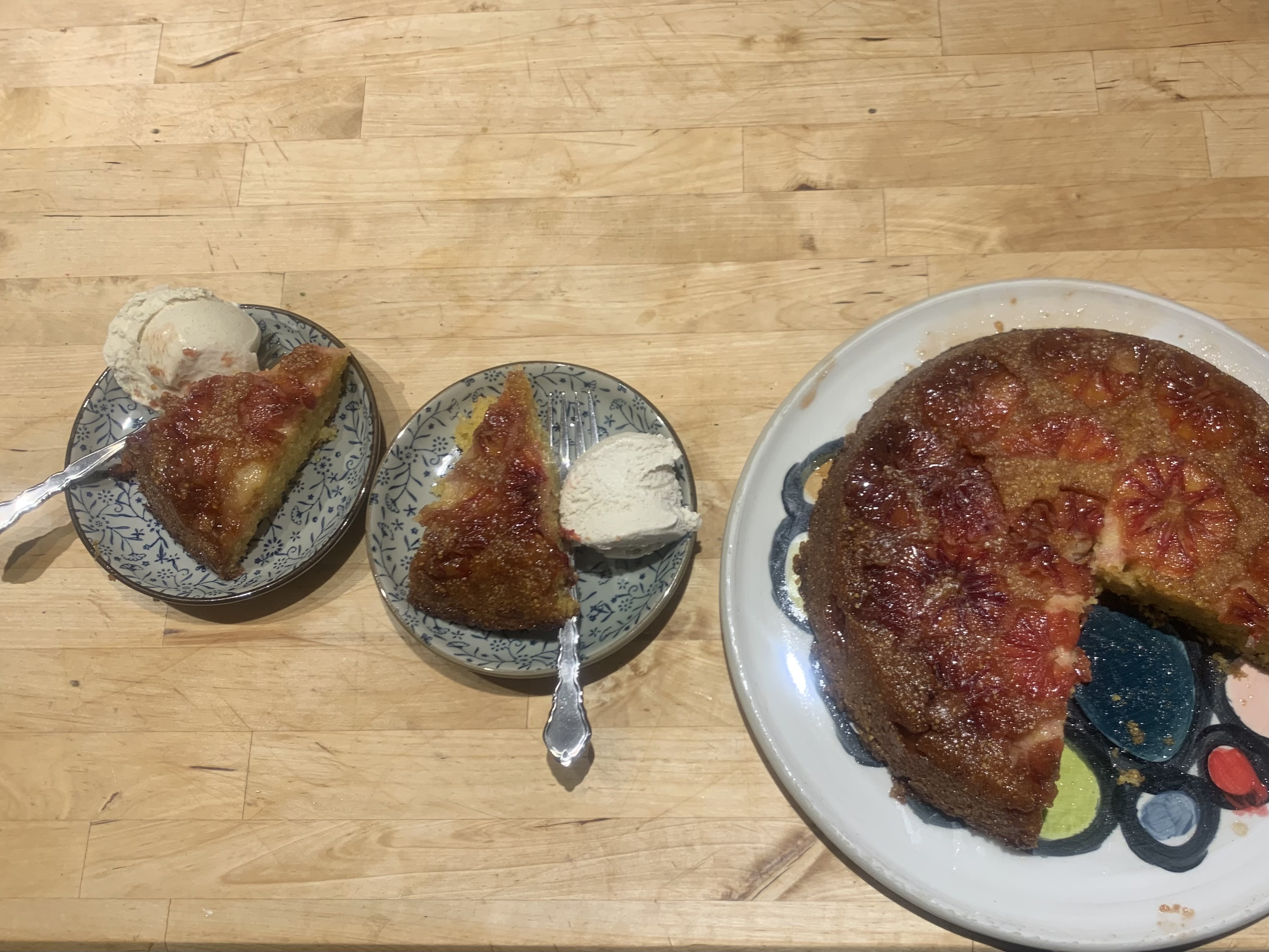
I go to the store to buy blood oranges for the cake and discover they have been rebranded raspberry oranges. the word “blood” is off-putting to consumers. I feel angry.
Remote, bloodless pale body of moon his face, forgotten
III Knife
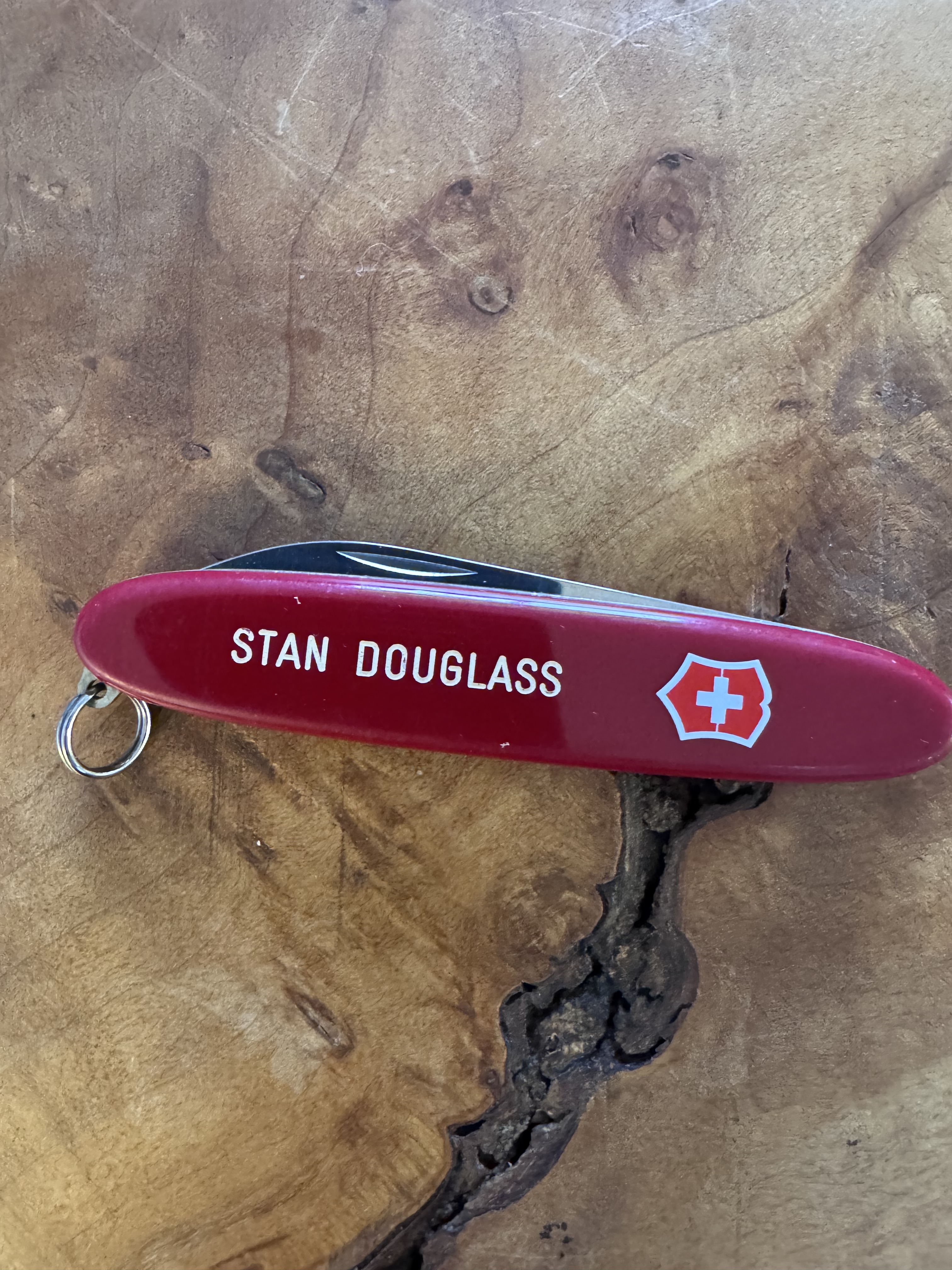
I go to an estate sale and buy a box of assorted junk for two dollars. At the bottom, I find a small Swiss army knife tucked into a black sleeve. The knife is marked with white letters: Stan Douglass. I look up Stan’s obituary.
When fifteen, only a lad, Stanley made a vow to serve the Lord
IV Ruth
My son and I walk along the street, heading to Value Village. He’s shouldering an old chair he took from a free pile, then regretted. I’m following. Suddenly a telephone pole is in front of me with
R U T H
painted in big red letters. Just a day ago, my friend and I compared middle names. Her middle name is Mazal meaning good luck. Mine is Ruth, I texted, and she texted back that “the biblical Ruth is a very special woman, and her name is synonymous with unwavering loyalty and kindness.”
Is it a sign? Four red letters tell my fortune
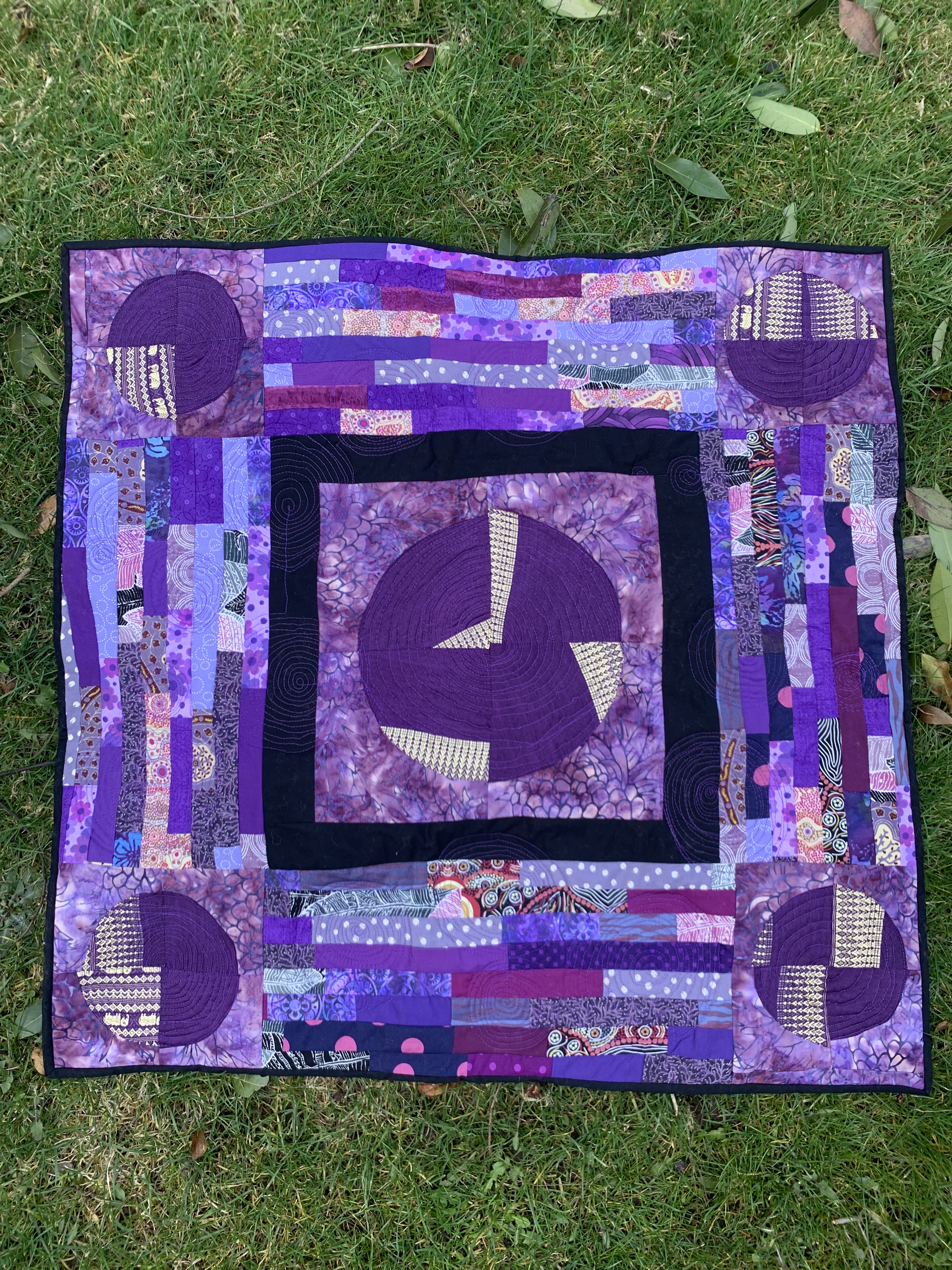
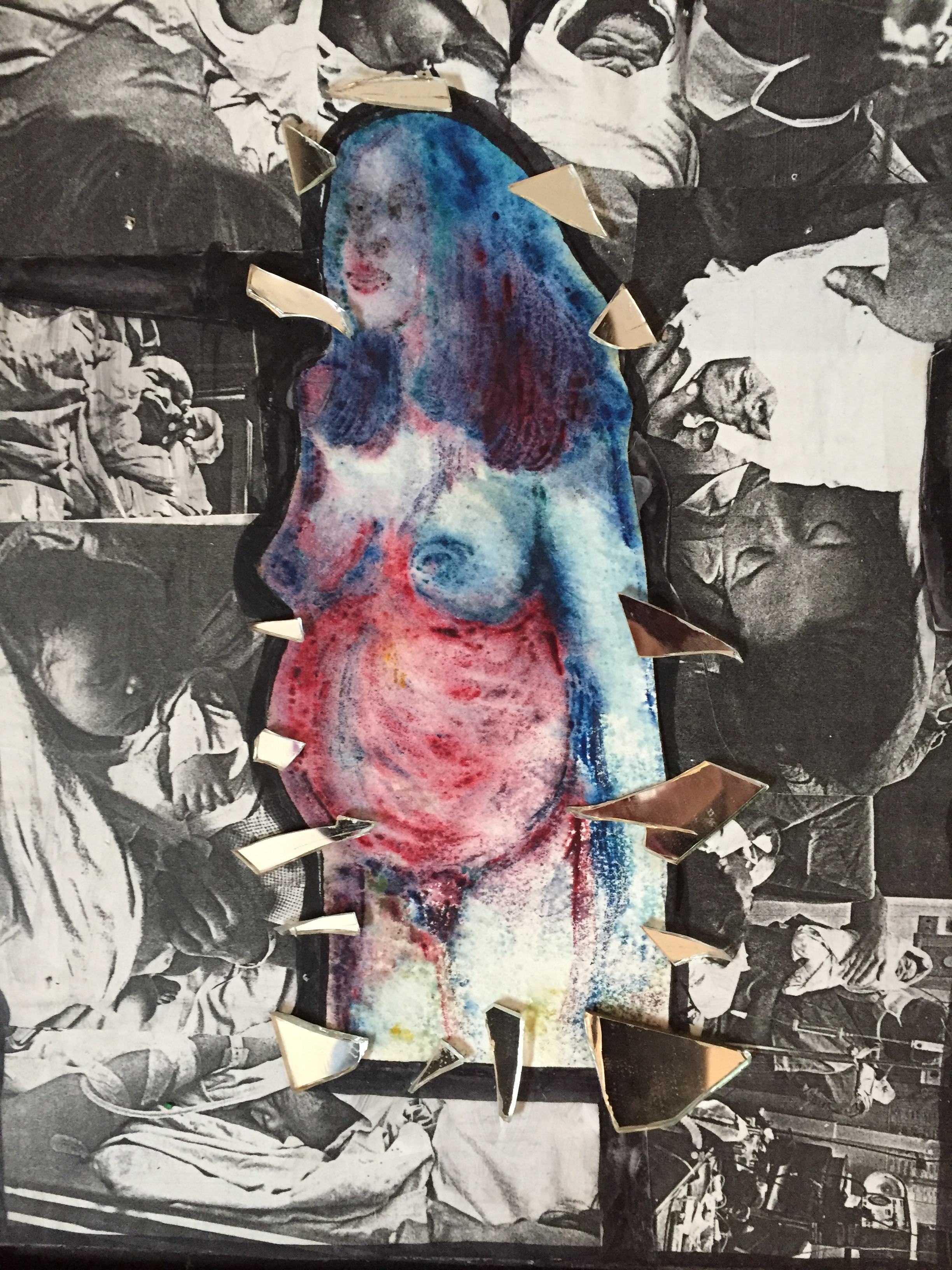
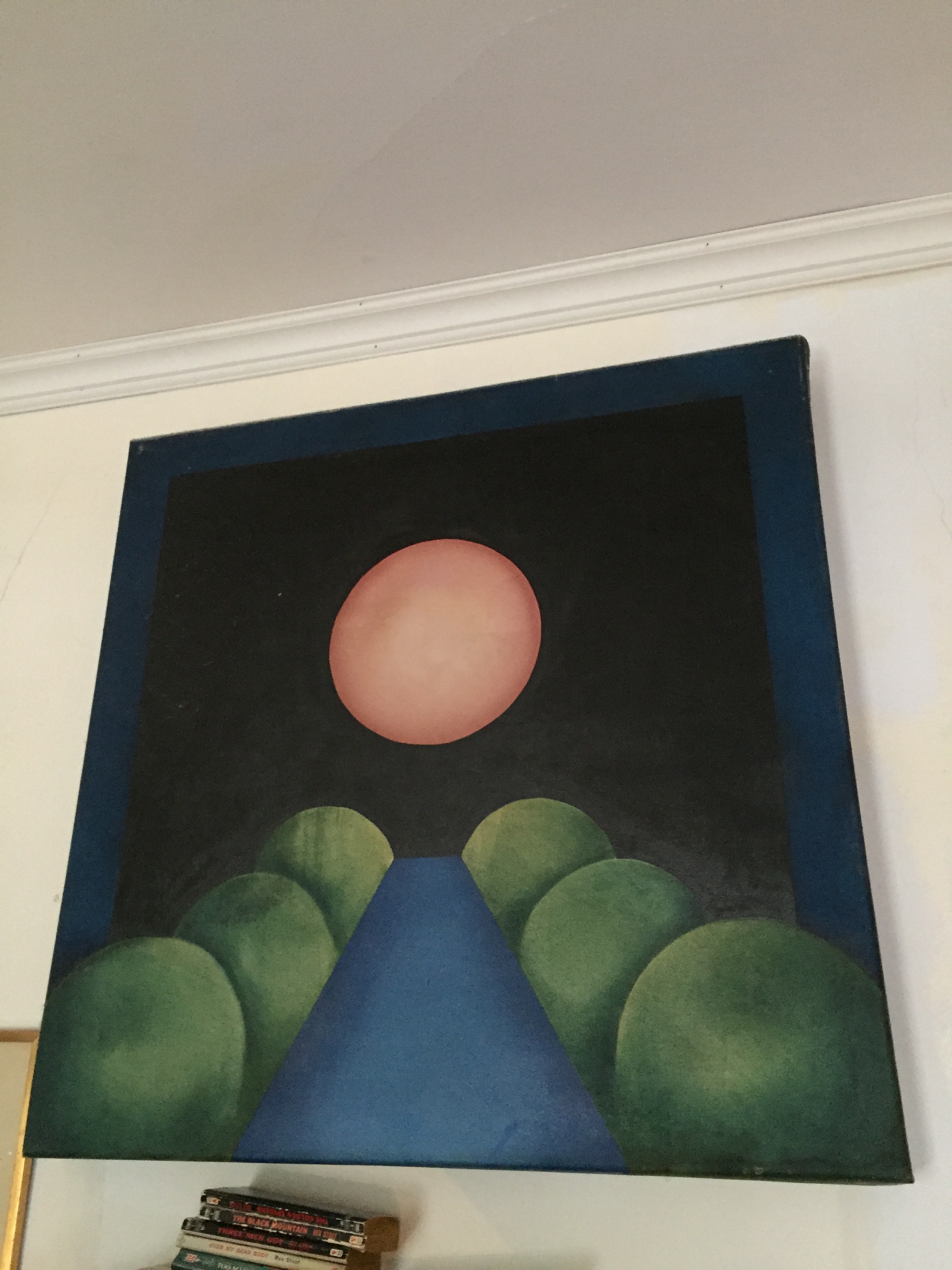
The moon painting is by Bob Sabatini. Other creations are mine.
My dad, 1927-2021, looking over his land soon after they bought the farm.
We walked slowly Thursday morning because overnight, recycling boxes and bags heaped with cans, bottles, cardboard, and newspaper had appeared at the curb. Blue splashes up and down the street that Marvin had to investigate, and so our walk slowed to a shuffle. He snuffled like a pig rooting for truffles, straining at the leash to lick the pizza box, to reach the Friskies can with a smidgen of catfood left on the rim. The night before, during his last walk of the day, he’d let out a volley of piercing barks at a pile of recycling across the street. Perhaps to his eyes, in the dark, the mound of stuff piled high above the blue box was a threatening mammal.
Early September’s morning chill, high scudding clouds above, and a Northern Flicker playing hide and seek in a hawthorn tree, his red head popping in and out of sight. The street is quiet—just the distant thunder of the McKenzie interchange as a blur of cars crosses into town. I am grateful to work at home, no need to commute. Instead, I love these 7 a.m. walks. Something in a recycling box caught my eye. Neatly folded on top of a pile of newspapers was a section of Saturday’s Globe and Mail, folded to the crossword puzzle. Every clue solved; every box filled with a neatly penciled block letter. Perfection. Did my puzzle-solving compatriot struggle over it as much as I had?
I felt connected to that person—their careful block letters different from my scribbled slanty ones, but we both finished the thing. Did they do it quickly, or did they stretch out the experience into Sunday or even farther down the week, relishing it? Did they approach the task methodically or fill in random clues? Did they ask for help or go it alone? Dictionary or no dictionary? Google or purely old school?
Marvin ate half of my pencil.
Think of all of us across the nation who turn to the crossword first thing on Saturday. Sharp number 2 pencil. Or maybe a mechanical one. Do some confident people use pens? Fresh white eraser by Mars. Or a pink Dixon, perhaps? We sit in armchairs, on couches, sprawled on deck chairs, scrunched on buses and subways, drinking lattes in coffee shops. All of us, together in the challenge.
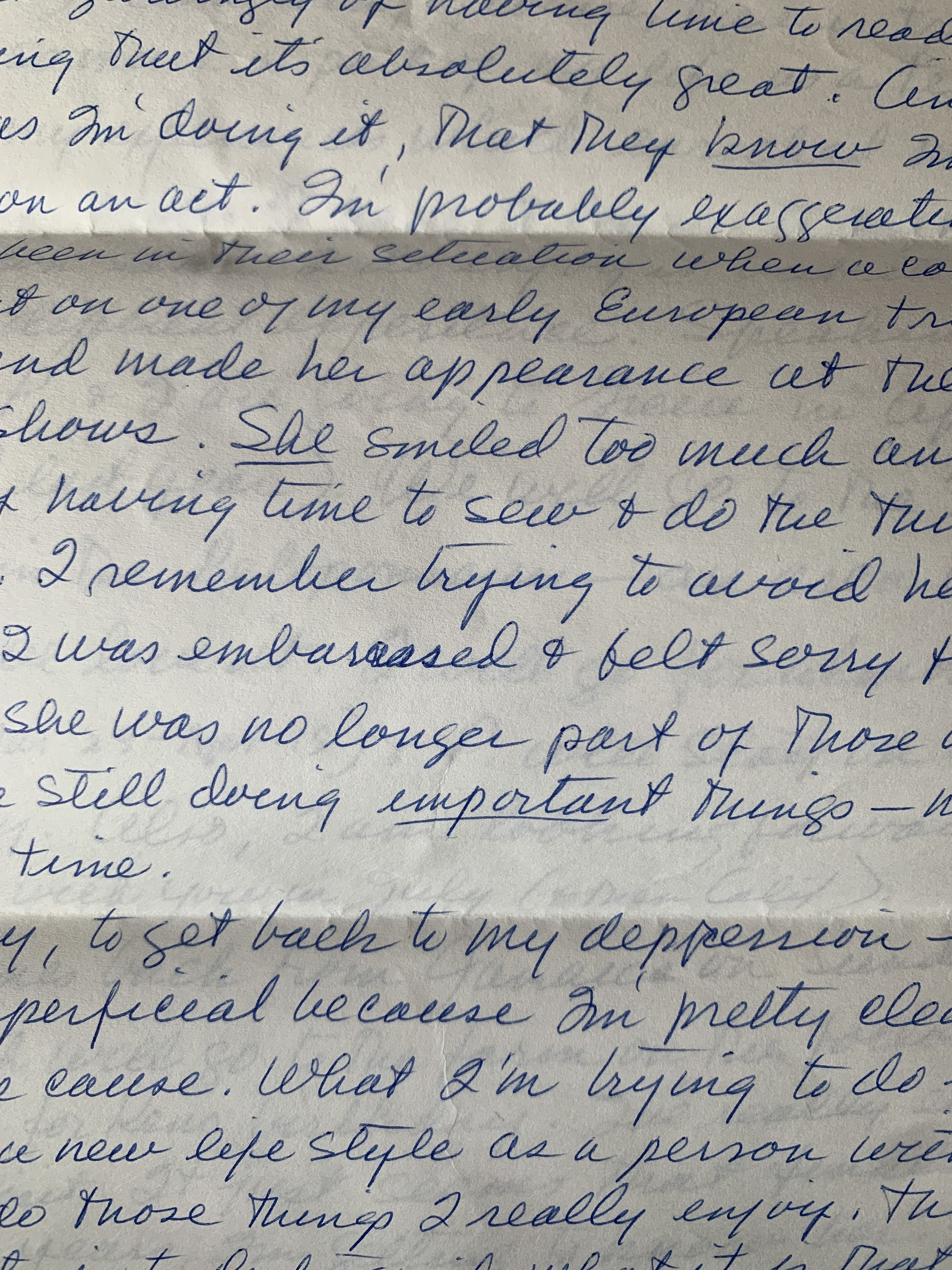
My mother did crosswords daily for the last 22 years of her life. They helped fill blocks of morning time after her mandatory retirement from her job as a lecturer in art history at Ryerson Polytechnic in Toronto. I found a letter from her dated February 1997. She had just received a package I’d sent intended to cheer her up:
“I didn’t realize my depression was so obvious. It isn’t a deep depression. It is simply that I no longer have an audience and no longer get paid for doing something I enjoy. The awful thing is that as soon as a person retires, he/she loses status. I notice it when I talk to people at Ryerson . . . They seem extra kind and sort of smile at me and ask me what I’m doing, etc. I smile back and try to talk glowingly of having time to read, etc. pretending that it’s absolutely great. And I know, as I’m doing it, that they know I’m putting on an act. . . So, I’m trying to develop a new lifestyle as a person with time to do those things I really enjoy. The difficulty is to distinguish what it is that I enjoy doing! Meanwhile, I do crossword puzzles, which is new for me and I’m getting pretty good at it (usually at breakfast), and it’s very nice to have the leisure not to have to rush.”
I started doing the Saturday crossword soon after my mother died in 2019. I thought they were too hard at first, and so I’d abandon them quickly. I have a healthy vocabulary, and I love language, but the crosswords seemed like something else. They’re filled with puns and tricks, and it seemed you had to be part of the in-crowd to get them: both hip to idiomatic English across the decades and savvy about current cultural trends. I’m just too literal, I thought, and what I know fills such a narrow groove. But then the challenge started to intrigue me. Now I look forward to the Saturday paper. After reading the headlines and the obituaries, I find the crossword, fold it into a nice rectangle, and begin.
All of this is a preface to say, I’ve had no will to write. Nothing seems worth writing about, these days. Life has a flat, fallow quality. Nothing’s important enough. Although there’s plenty of big bad news—pandemic, systemic racism, climate change—I don’t feel equipped to talk about any of it.
So, I push myself to finish this rather silly piece, a blog post about something as quotidian as the crossword puzzle. I stop and pause often to ask, “Why bother?” Why bother indeed. But it’s just that writing something, anything, seems as if it might be the antidote to the flat way I feel.
My thoughts return to my mother, sitting on the loveseat in her high-ceilinged living room, wrapped in a thick robe, blinds down, doing the crossword. Filling the hours. Her sleek black cat, Cicero, is curled up beside her. She is deep into it, puzzle dictionary next to her on the small rococo marble-topped table, Schubert’s Trout Quintet playing softly on the CD player. Missing the old nicotine rush, the sweet suck of smoke into her lungs, she holds the pencil like a cigarette for a moment. I miss her. In that old letter from ’97, she wrote,
“I’m probably exaggerating, but I have been in their situation [those Ryerson people who acted extra kind toward her] when a colleague retired and made her appearance at the annual fashion show. She smiled too much and talked of having time to sew and do the things she enjoyed. I remember trying to avoid her because I think I was embarrassed and felt sorry for her because she was no longer part of those of us who were still doing important things—not just passing time.”
Mama and me, back in the day.
Doing important things v. Just passing time. . . I flinch at my mother’s binary of “important” paid work and “just passing time.” But something in what she wrote resonates with me. I work part time as a self-employed editor, but lately, I often feel as if I’m just “passing time.”
Maybe this is just the flatness of grief. Flat-footed grief walks over me. After many losses, I am a fallow field—nothing growing here.
I have been reading memoirs about aging parents. . . Elizabeth Berg writes in hers, “I think as long as a parent is alive, it’s easier to feel young.” After my father died at the end of June, I’ve felt old, flat, fat, tired, sad. Nothing feels important. Especially not the weekly crossword. And yet, musing over the word problems gets my brain churning slowly, raking over clues like a pitchfork turning organic matter in the compost heap. I feel connected to crossword puzzlers across Canada. I imagine, for example, an old guy in Mahone Bay—let’s say he’s 82, goes by Ernest Nickerson and sits in the kitchen nook with morning coffee, chewing the end of the pencil as he tries to remember what a 10-sided shape is (79 across, 7 letters).
From our 2012 honeymoon in NYC
Remember geometry class in tenth grade? That’s where Ernest first noticed the girl who would be his wife, in geometry class at Mahone Bay School. As he digs deep for the name of a ten-sided shape, another thought is unearthed from that compost heap: Darlene’s thick red hair, held back with tortoiseshell barrettes. He couldn’t take his eyes off those red wings in front of him during class, couldn’t stop imagine pulling his fingers through that rough, dark crimson hair. He unclicks the delicate barrettes to let those wings loose to fly. If Darlene were alive now, Ernest thinks, she’d lean into my ear, her coarse grey hair tickling my nose, skinny shank up against mine, and whisper, “Decagon, Ernest. You knew that, honey.”
I write to get momentum, to feel connected to people, to create worlds. To feel connected to you, and Ernest, and Darlene. So, if you are a maker, a creative person, (we all are, each in our own way) remember: The work wants to be made, and it wants to be made by you. Even if it doesn’t seem important. Believe me, it’s important. It connects you to life. The fallow field regenerates.
Memoirs about aging and dying parents that I recommend:
Roz Chast, Can’t We Talk About Something More Pleasant?
Philip Roth, Patrimony: A True Story
Elizabeth Hay, All Things Consoled: A Daughter’s Memoir
Elizabeth Berg, I’ll Be Seeing You.
From a later trip to NYC, March 2019, after my mother died. Sugar skulls in a restaurant display.





 Madeline Ruth Walker