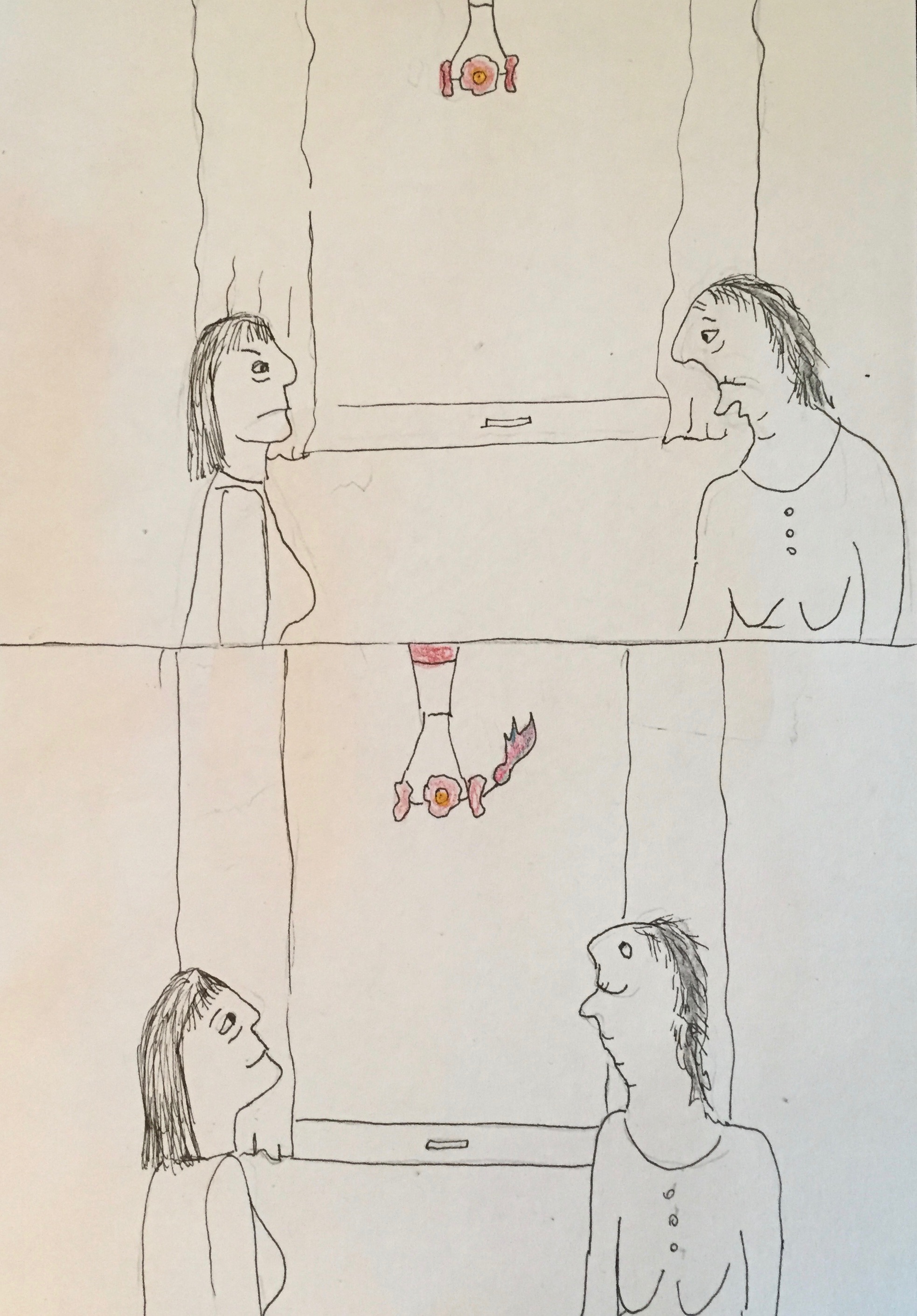
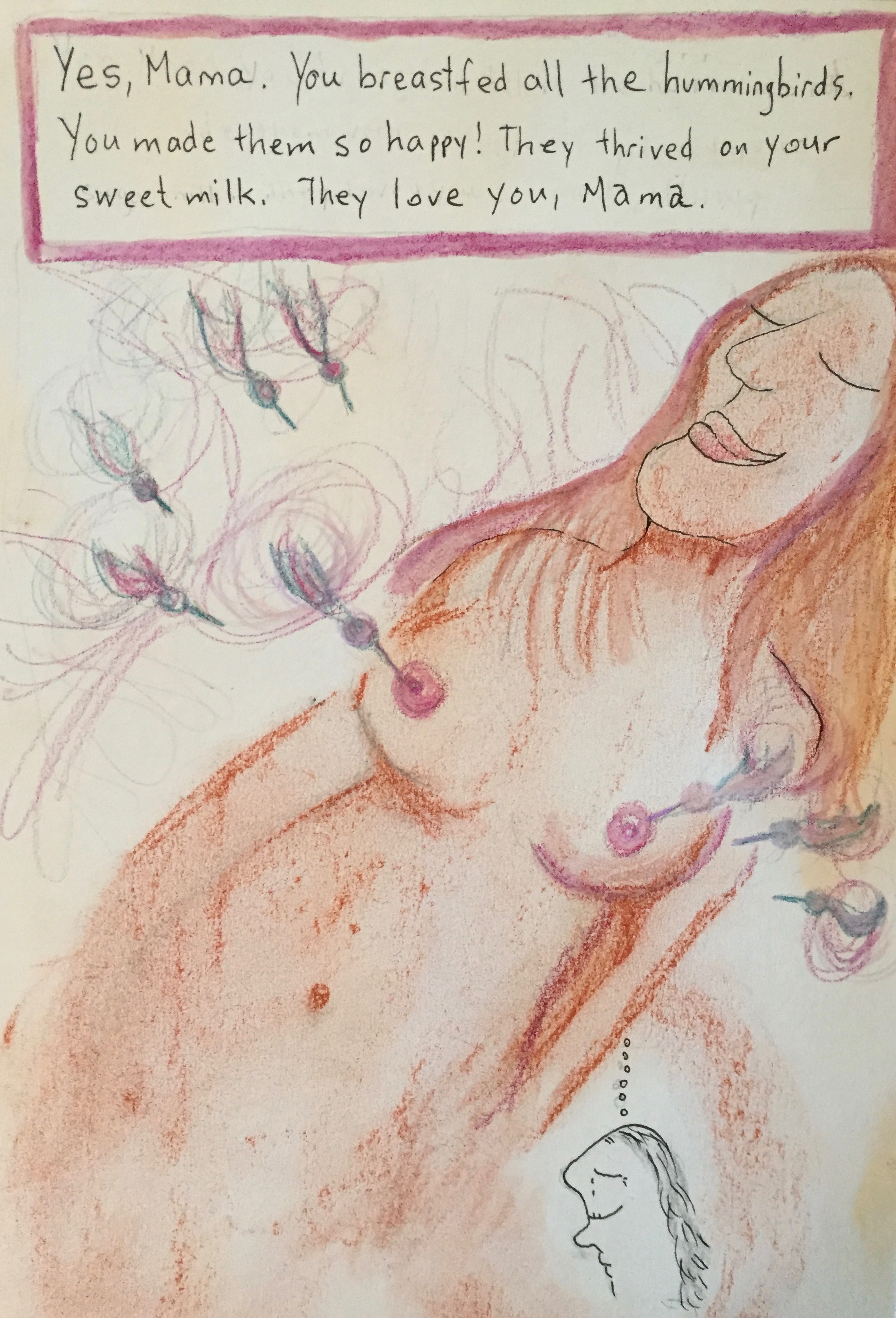
Commitment, connection, love, pleasure

I angle my chair so I can see the hummingbird at the feeder, only a couple of feet away. Coat of metallic green feathers, needle beak, vibrating wings—an Anna’s hummingbird, so close I could touch her. She trembles as she drinks long and hard at the sugar water I prepared. A ping of pleasure as I watch her become nourished, sated.

When we moved into this house, June 2024, I decided not to put up a hummingbird feeder. Too much work, too much anxiety. I remembered that icy winter a few years ago, when I fretted over the birds getting their food. Once you commit to a feeder, you need to keep it going through the cold months. Non-migratory hummingbirds depend on nectar in feeders for sustenance. So, that January, when the temps dropped below freezing and the liquid in the beaker froze into solid chunks, I cut the toes off a pair of old wool socks and pulled them, one over the other, to encase the container of sugar water, trying to keep it liquid. Several times a day, I removed the feeder from its hook, brought it inside, and melted the ice, so the birds had access to food that was precious, rare, and necessary. I felt guilty when I let the liquid freeze for too long. Worried for days, until the cold spell broke. 
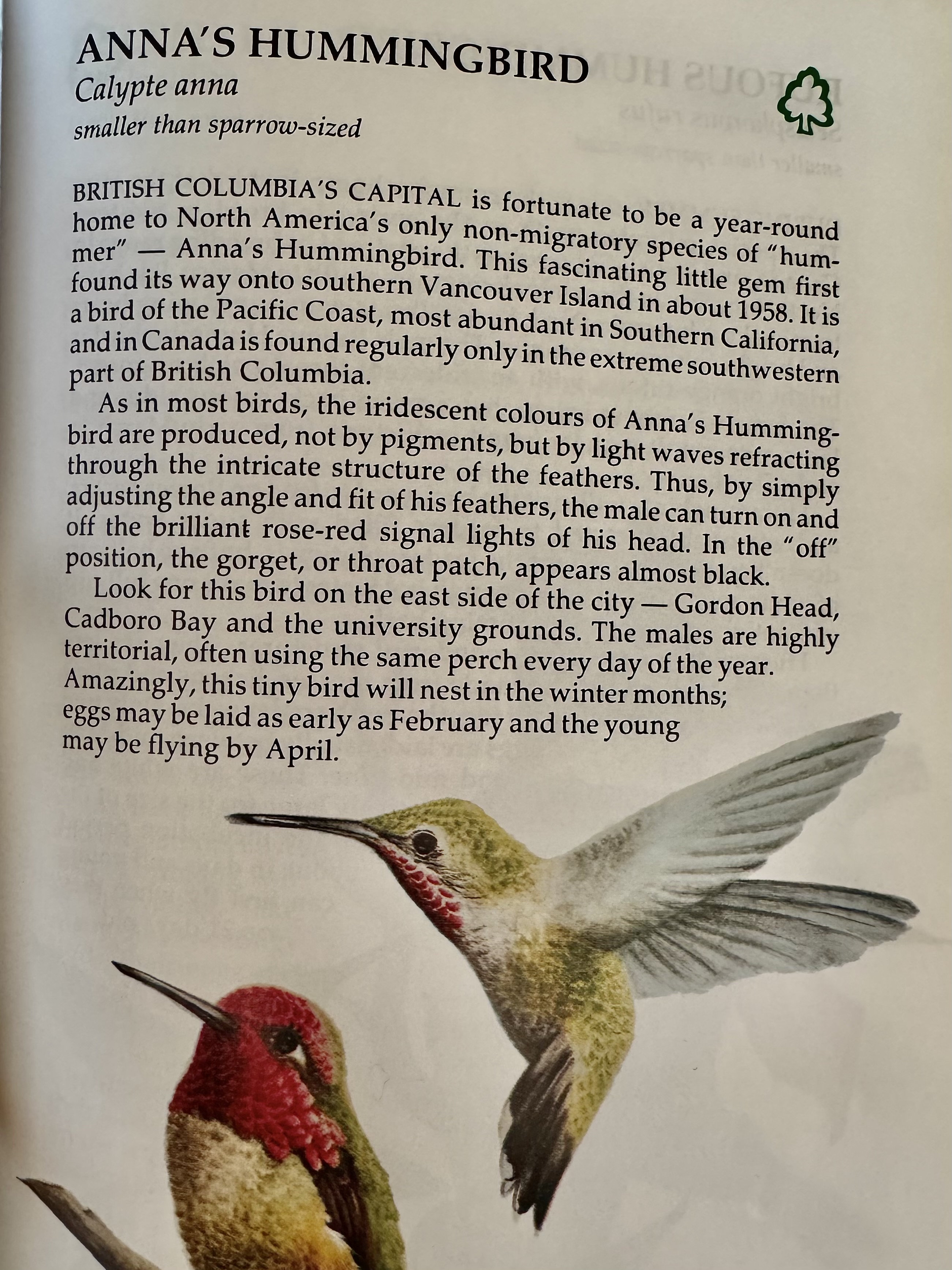
from Birds of Victoria, by Robin Bovey, Wayne Campbell, and Bryan Gates. Illustrated by Ewa Pluciennik

Save yourself the grief, I thought. Don’t put out a feeder again. Too much trouble. Yet, I didn’t get rid of the feeder with its four plastic red flowers. I must have known I would want it again someday. Yesterday, I dug it out from the back of a cupboard and made the nectar, 2 cups water, ½ cup white sugar. I was yearning for connection. I watched the first bird discover it hanging off the balcony rail, drawn by the gaudy red. As he fed hungrily, my body responded as if I were nursing a newborn again. Tiny being of my flesh, cradled close, skin on skin, painful tickle of let-down followed by a strong rush of milk, sustained by baby’s rhythmic sucking.

Photo by K.A. Walker

My body remembers well the flow of oxytocin, the pleasure, the sense of deep, silent connection with my sons. For eight years I breastfed three babies. Cellular memory.

Perhaps the sweet ping I feel when I watch a hummer drink its fill at the feeder can replace the rewards I look for on my smartphone. A few days ago, alarmed by how frequently I pick up the phone (for example, 21 pickups in 3 hours), I found a book I’d read in 2018 when it first came out. Catherine Price wrote How to Break Up With Your Phone (there’s a 2025 edition) because she saw how smartphones were grabbing our attention and changing our brains and our lives. I was concerned then, and I went through her 30 day “break up,” becoming by the end, more conscious and intentional when I used my phone. That worked…for a while. Fast forward to late 2025, and I’m back where I was but even worse. 

I know it’s worse because when I attempted a digital “sabbath”—turning off the phone for 24 hours—I woke in the middle of the night, anxiety flooding my body, terrified of being cut off from life, from everybody I know. A great black wall towered between me and the living world. Existential loneliness. I crept out to the kitchen and turned the phone back on. Even though there were no texts, only junk emails, a whoosh of relief. A conduit had been re-opened. The potential for connection. 

I know that my brain and body have been altered through smartphone use. Over the years, I notice decreased ability to read complex material for longer than a few minutes. I am highly distractible, grabbing my phone for no particular reason. Life feels fragmented. So, again, I plan to work slowly through Catherine Price’s 30 day break-up. I’ve quit other addictions: alcohol, cigarettes. I can do this.

Maybe when I feel the urge to grab my phone, I’ll head over to the feeder. Sit a while. Watch. Because observing hummingbirds at the feeder soothes me, reminds me of feeding my babies, sustaining them with my bountiful milk. The body’s sagacity. A promise to keep these little birds fed throughout the winter is part of the circle of commitment, connection, love, pleasure.  

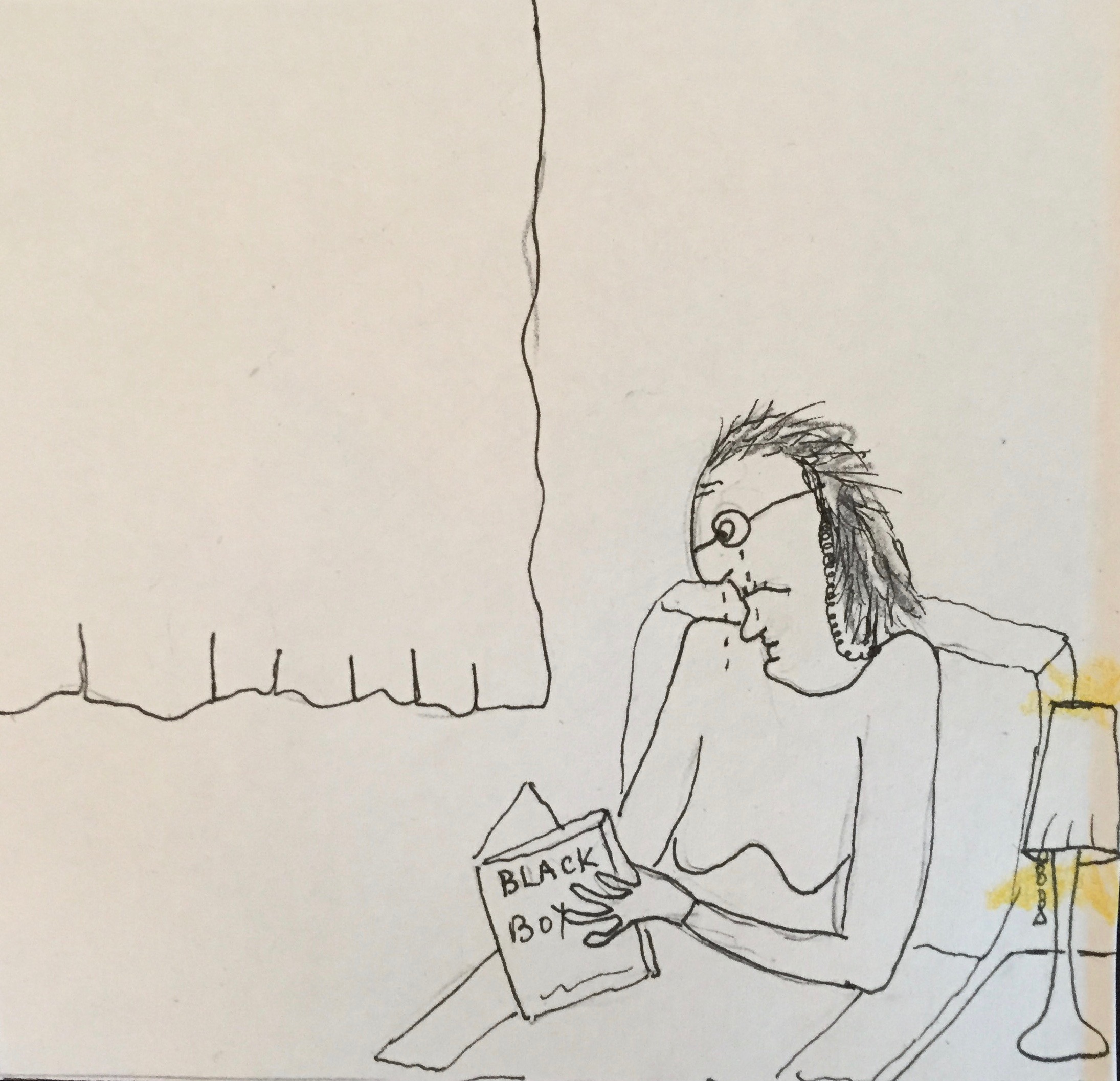
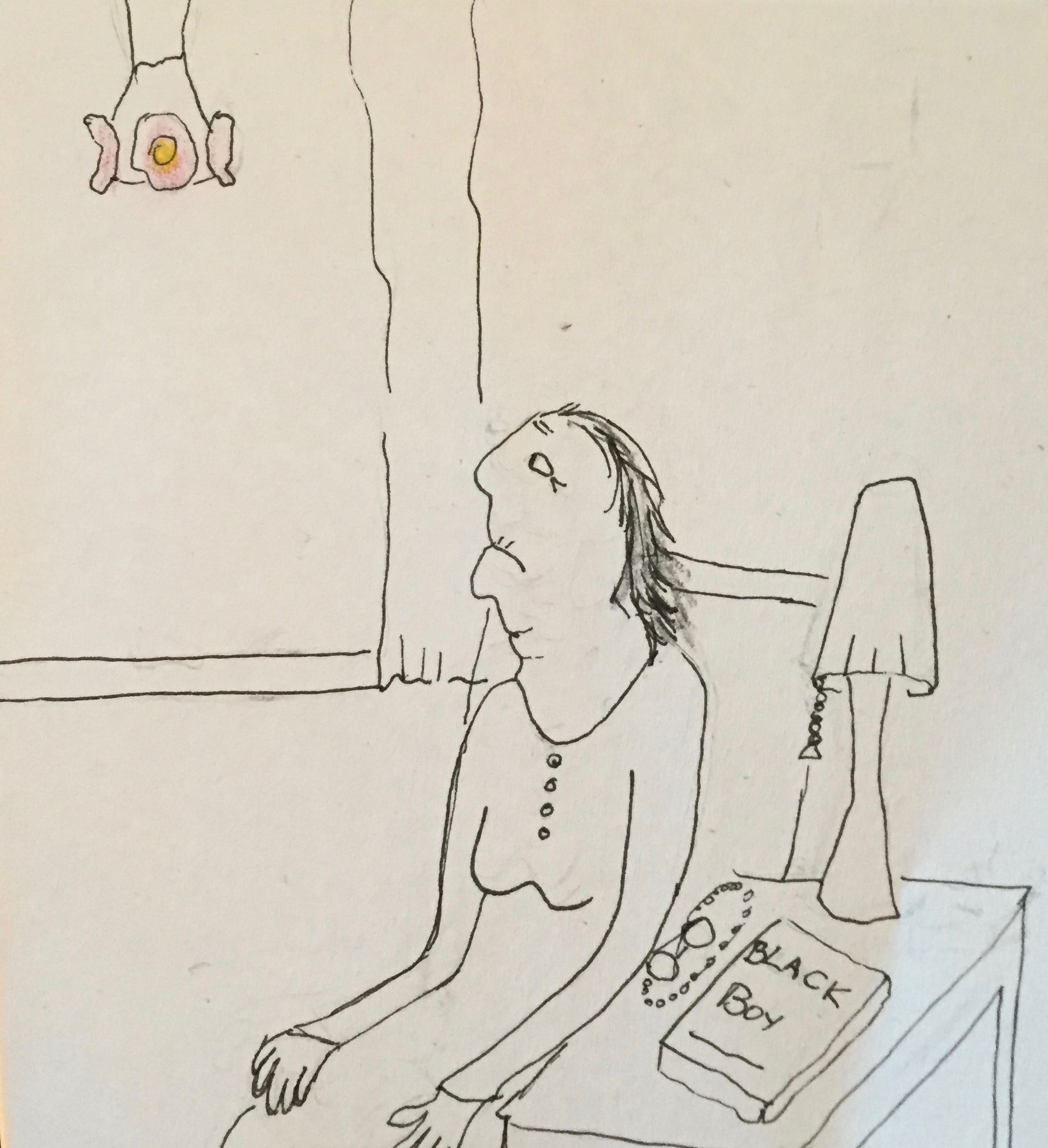
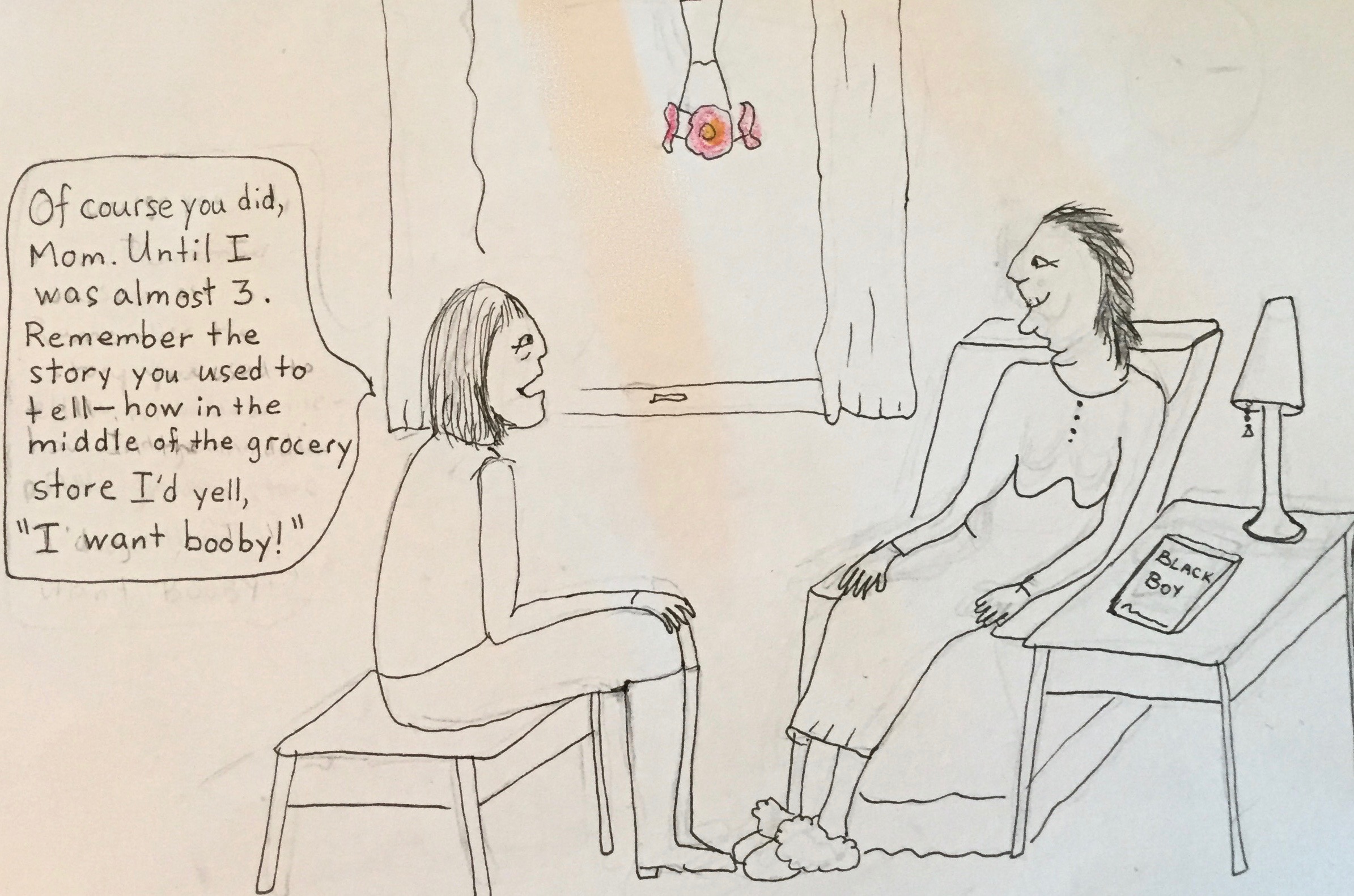
P.S. I made a weird comic about breastfeeding hummingbirds in 2017; clearly, I’ve been feeling this connection between hummers and nursing for a long time! I published it here: https://maddyruthwalker.com/2017/11/02/sweet-milk-for-the-hummingbirds/


Books

Last night in bed I was reading Dreyer’s English: An Utterly Correct Guide to Clarity and Style, an amusing book by Benjamin Dreyer, a Random House copy editor. I happen to be two weeks into my final six-week course for Simon Fraser University’s Editing Certificate, so my late night reading aligned with the language-focused mood I’m in. I was enjoying Dreyer’s humour when I read this sentence, which made me sit up in bed:

“You might—or might not—be surprised to learn that many copyeditorial man-hours have been expended over the decades as to the correct construction of the common vulgarity—and an enchantingly common vulgarity it is—used to describe an act of fellatio.”  After the term “man-hours” was an endnote: “I know I’m supposed to prefer and use ‘person-hours’ or ‘work-hours.’ I can’t, so I don’t. Please forgive me.”

It wasn’t the discussion of whether or not to use a hyphen with blowjob (Dreyer’s preference is no hyphen) that bothered me. I’m no prude (I hope). It was the insistence on “man-hours” without even trying to find an alternative. 

What about just writing “many hours have been expended by copy editors over the decades”? Such an easy way out of “man-hours,” a term that makes the labour of fifty percent of the world’s population disappear. I wonder if Dreyer is just paying lip service to the requirement of conscious editing, editing that does not harm or marginalize. Karen Yin created The Conscious Style Guide, such a useful resource. Countless other editors and writers have worked to use language carefully and critically as a force of good in the world. Dreyer has power, privilege, and pull, and he could use these forces for good by making some small adjustments. 

So, there I was, lying in bed, irritated by “man-hours.” What about the millions of “man-hours” women spend breastfeeding? And that started me thinking of breastfeeding, women feeding their infants and toddlers with nourishment produced from their own bodies. Once I started to think of breastfeeding, scenes from two novels came into my mind, one from John Updike’s 1968 Couples and the other from John Steinbeck’s 1939 Grapes of Wrath. In both scenes, an adult man is sucking at the breast of a lactating woman. Updike’s scene is highly erotic (or at least, I found it so when I read it in my twenties), whereas in Steinbeck, the character Rose of Sharon is offering her breast to a starving man, an image I find disturbing. I’ve forgotten so much from the thousands of books I’ve read in my life. But those two scenes have stayed with me throughout the years. 

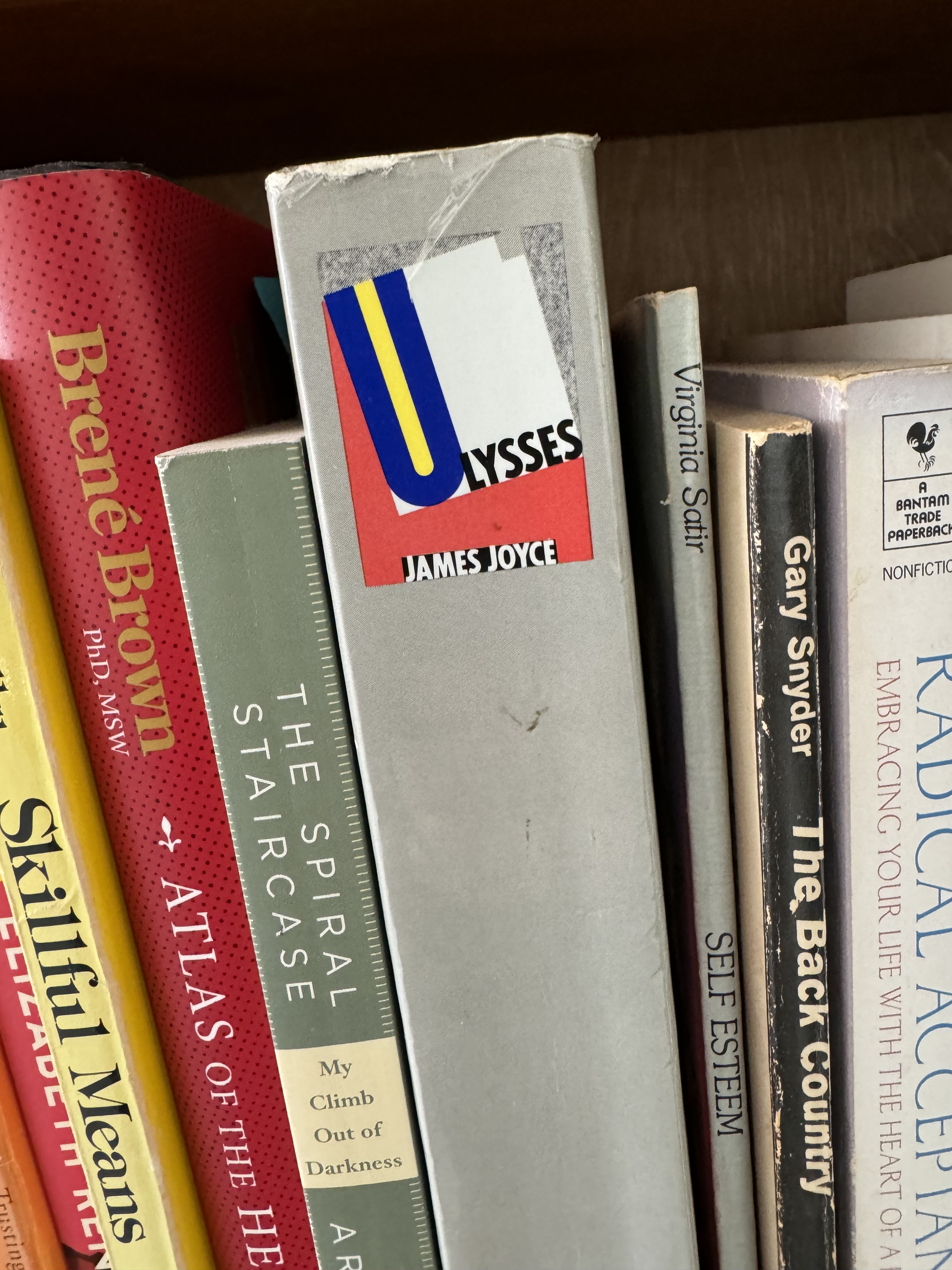
In our new house, we have a bookshelf at the top of the stairs, so every time I ascend to the main living space, a patchwork of book spines meets me like an old friend. The elongated blue U on the thick spine of James Joyce’s Ulysses always catches my eye. My mind likes to repeat itself, going back to well-trod memories, and so I return over and over—with nostalgia—to the summer in grad school when I studied that great modernist novel. It was an intense, six-week seminar course. A small, intimate group of students, mostly women, met for three hours, twice weekly. Each student had to present several times on chosen topics. I was working hard. Add to my hard work and yearning for an A, the presence of a provocative, flirtatious professor who created a highly charged atmosphere in the hot seminar room.

I was immersed in the complexity of Joyce’s schema for the novel, based on Homer’s Odyssey, and by turn delighted then confused by his fresh, arcane, mysterious writing. I could slide down rabbit holes every day, trying to parse meaning. 

One day, I took the boys to the beach at Thetis Lake and brought the novel with me. We went in for a swim, and as we came up to our beach blanket where I had laid Joyce’s novel, my six-year old son, who was learning to read, said to me, “Why are you reading a book called Useless?” I laughed. I could see how his mind’s eye read useless; so many of the same letters as Ulysses. I reported this to my professor next class, and he couldn’t stop laughing. He thought what my son said was inadvertently profound, the title Useless pointing to the modernist idea of the inutility of art: art for art’s sake. 

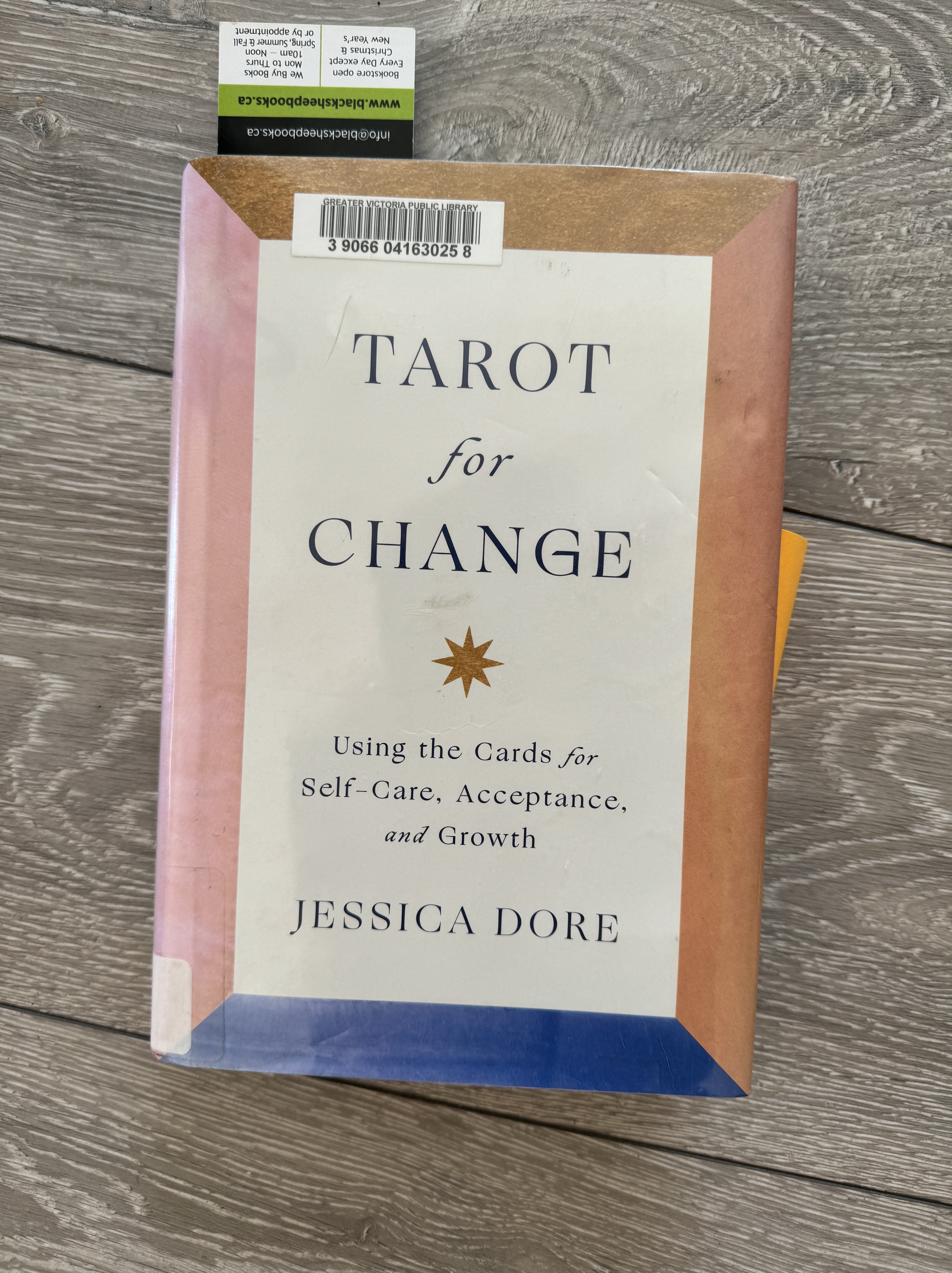
In the mornings, I’ve been trying to not grab my phone immediately, but instead, to read and write. I’m reading Jessica Dore’s Tarot for Change: Using the Cards for Self-Care, Acceptance, and Growth. I first discovered Dore when my husband, Michael, told me about her newsletter, Offerings, on Substack. I love the way she thinks about books and tarot and life, so I borrowed her book from the library, and it’s on the coffee table, ready to dip into whenever I sit down for a spell. It’s funny, the actual tarot card she is writing about (and she writes about all 78) doesn’t matter much—each page has some nugget of wisdom, wisdom from her life experience, and from theology, psychology, literature; wisdom drawn from C.G. Jung, D.W. Winnicott, and newer therapists like Marsha Linehan and Steven Hayes. I enjoy the nuggets. 

Here’s an example of a Dore nugget—this is from her comments on the Empress:

“The Empress represents nature and is, in my experience, one of the most misunderstood arcana in the tarot. People love her but can’t put a finger on why. I think it’s that we long to be in our bodies but have forgotten how, and she shows us what it would feel like if we could. Many of us think of the wild as something ‘out there,’ and I think that’s sad for us. It shows how cut off we are from the fact that somewhere deep down and old we are still the wild, and the body—with all its cycles and rhythms and ebbs and flows and generation and degeneration—is proof.” (pp. 47–48) 

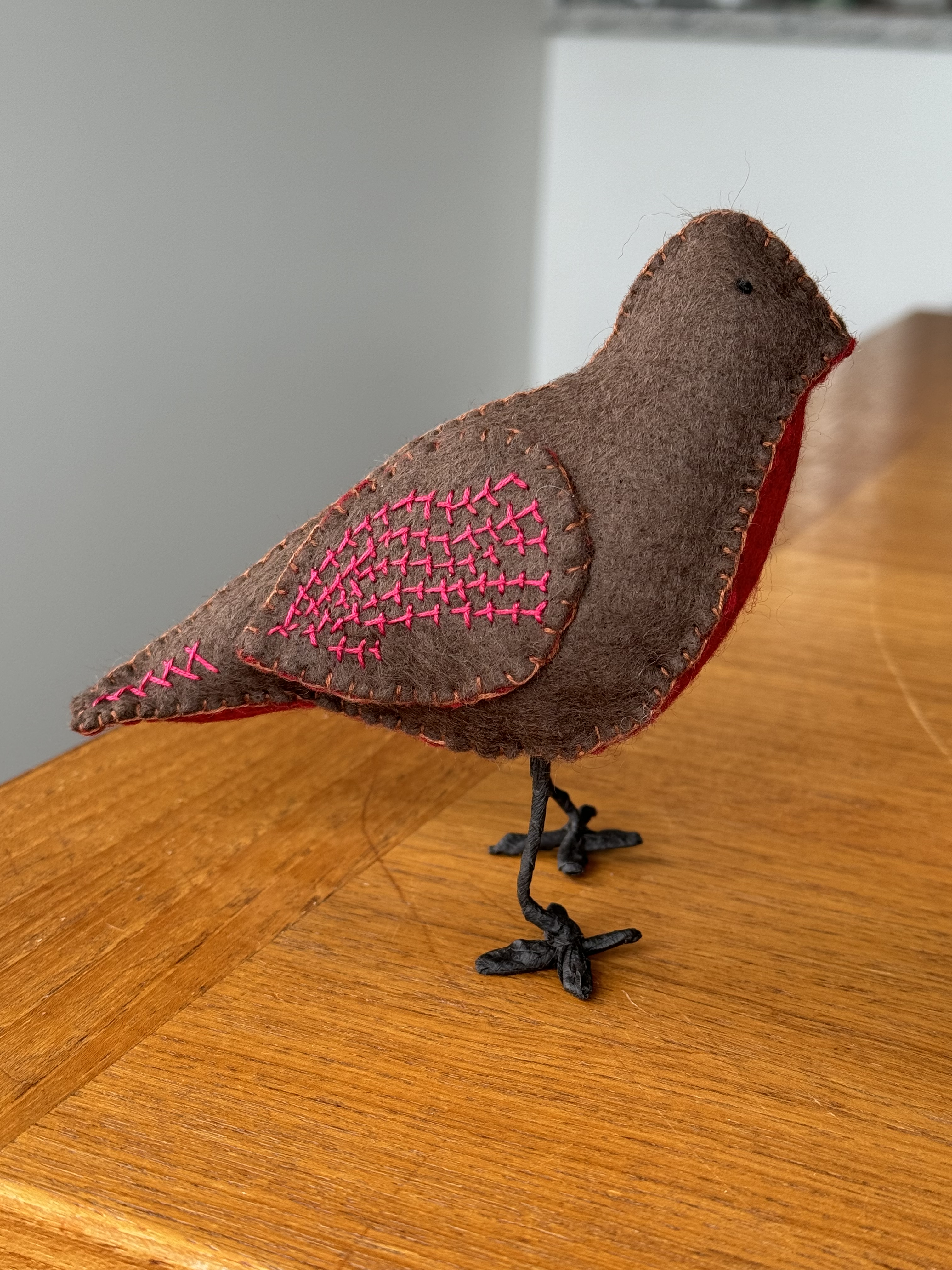
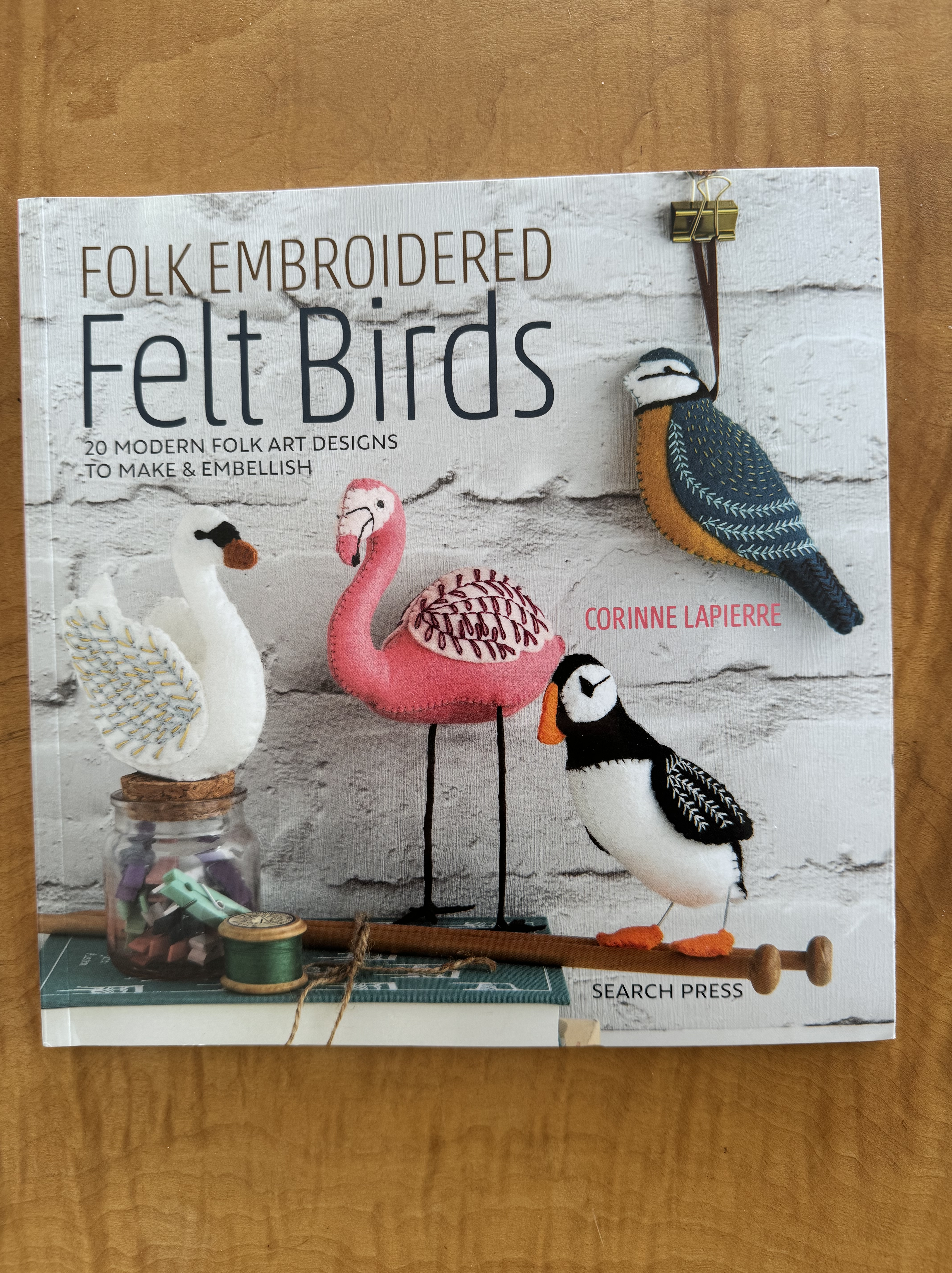
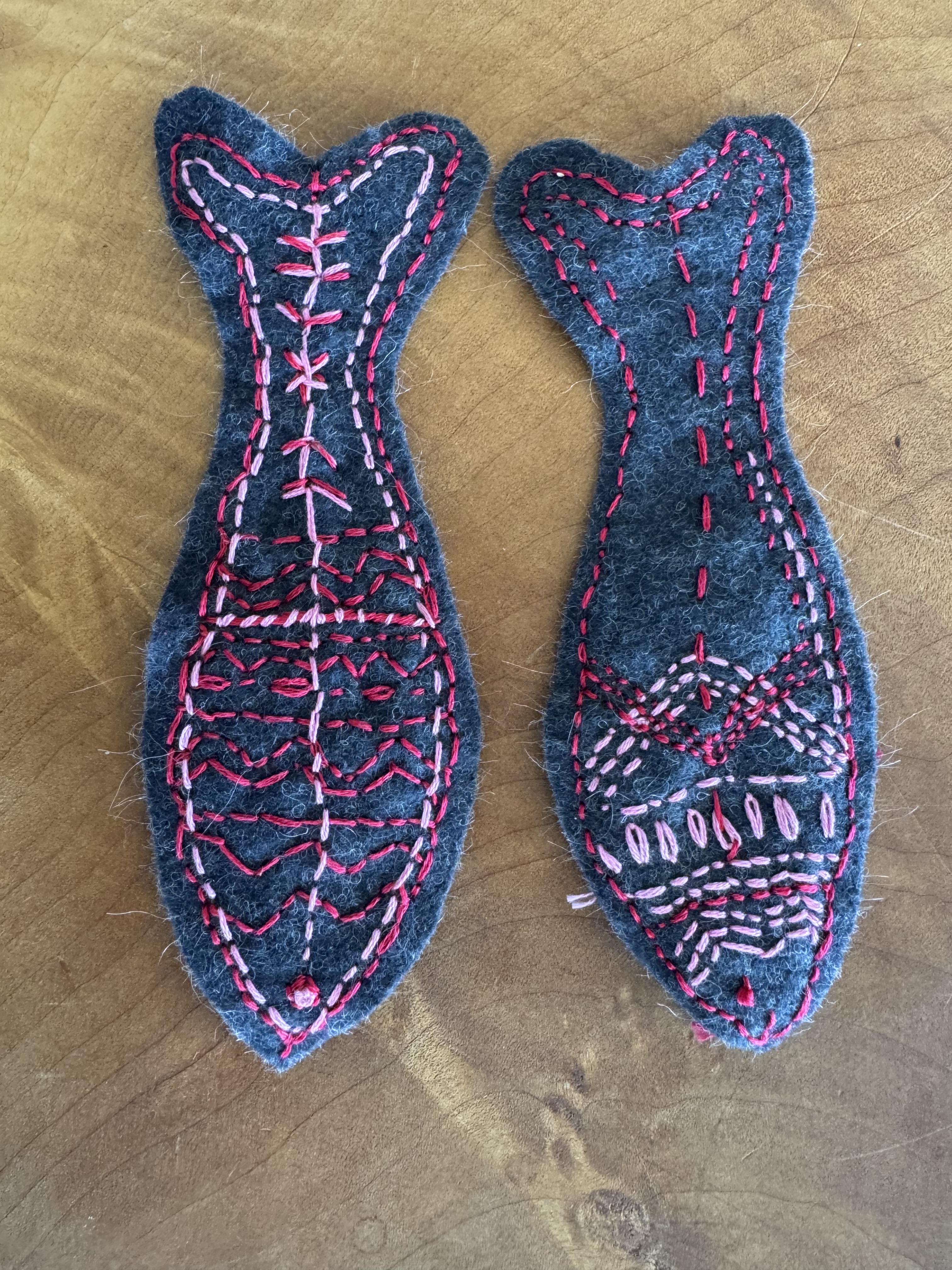
Folk Embroidered Felt Birds: 20 Modern Folk Art Designs to Make & Embellish by Corinne Lapierre. I took this book out of the library and promised myself I’d make two birds before it was due back. I like embroidering at the end of the day, after my mind has been busy with thinking, editing, word stuff. Nice to just sew coloured thread in pretty designs. I met my modest goal—I made a wonky robin and a not-bad pigeon. Then I got a notice the book was due and couldn’t be renewed, as somebody else wanted it. I made a heart for a friend’s birthday, then another heart with a favourite quotation on it, “still, flowing water” from Ajhan Chah, which is to remind me of the paradox that mind is both still and flowing. I don’t entirely understand his talk on this topic, but I still find it inspirational. Then I took out another book by Lapierre, Fabulous Felt, and I made some fish. But I realized what I really want to do is to make all of those twenty birds from her felt birds book, so eighteen more. And it seems that everybody wants the library book, so I ordered a copy and it arrived today. Lots of birds to come!

Sweet milk for the hummingbirds

I am not going to say anything about this latest comic except that I submitted it as the final assignment for our “Going in for the Snakes” course.  Anything I say will cloud your reception of the work, so I’ll just let it stand.

I start an intensive course in graphic memoir in mid-November.

IMG_2222IMG_2223IMG_2224IMG_2225IMG_2226IMG_2227IMG_2228IMG_2229IMG_2230IMG_2231IMG_2232IMG_2233IMG_2234Thanks for reading.