The bird-light bones of change

Last year I bought my first Tarot deck with the intention to learn about this ancient tool. My purpose was to use the cards to understand myself and my life better, rather than as a way to divine the future.  So when I drew the Death card reversed last week, I was not alarmed. I did not read the card as a warning that somebody would die soon. Somebody is always going to die.

Anthony Louis says that death reversed is about resisting necessary change (death upright is about transformation).  He writes, “you are clinging to an outmoded situation, relationship, or attitude that really should be discarded.” I had asked the question before I drew: what will help me most going forward to heal myself, my whole self? And the answer I get is that I am clinging to the past because I fear change. It is time to discard a mode of living. By clinging to it, I am hindering my growth. My sense is that the outmoded ways I resist changing are, one, depending on my “rational” way of making decisions and two, living impulsively. I picture these modes as living from the top part of my body, neck up, rather than centering in on the heart. I have been slowly transforming into a fully intuitive being who follows deep inner knowing: not impulse, but intuition. I can trust my inner process, my discernment, my inner guide.  That feels very right at the moment. And it doesn’t mean eschewing intellect or reason. Of course there is a place for those!  It just means that when I feel scattered, my thoughts whipping around my head, and confusion reigning, I need to settle back into my body, put my hand on my heart, and sit with what’s happening at the moment, asking myself, what do I need right now?  Answers do come, sometimes slowly, other times quickly. Deep knowing has its own timetable.  The knowledge that comes is sometimes mysterious, yet pretty much unassailable.

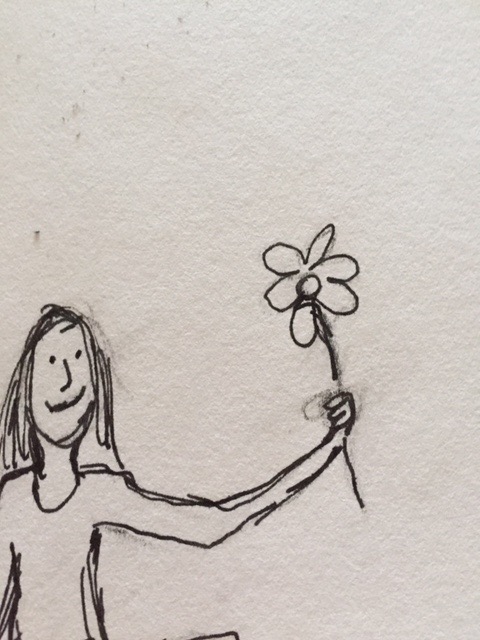
I had a recurring dream as a child that I was clawing my way through a dark underground tunnel. The physical feelings accompanying the dream were pain, suffocation, fear, and claustrophobia.  And then, after a long time, bloody-knuckled and exhausted, I saw light. I came out into the air, greeted by a daisy growing at the mouth of the tunnel. And the lightness I felt then was like the lightness you feel after setting down your pack at the top of the mountain. I can still recreate those sensations of the childhood dream, though I haven’t had it for decades. For a long time I thought it was about birth, then I thought perhaps it was about death. It’s probably about both, but it’s also about the journey from living in the head to living from the heart.

In my mandala, I painted that  underground journey.

img_1572

In my book of poems, I wrote about it in a poem called “Daisy”: “But finally I came up into the day and/ a big daisy—such a cartoonish flower—/was handed to me./ I sat on green grass at the mouth of the hole,/ crosslegged, light, my bones like a bird’s, holding a large/ white-petalled, yolk-centred flower that seems now like the repository of all happiness!”
img_1577

Reference

Louis, Anthony.  (2001). Tarot: Plain and simple.  St. Paul, MO: Llewellyn Publications.


Already dead

img_1247

The day Alex was killed
a beautiful Vietnamese woman,
her mouth concealed by a
paper mask, crouched at my feet
to paint blood on nails.

I felt ridiculous on the throne,
all this attention paid to
my calloused feet.
So I asked her, “what is the loveliest
place in your country?”

In the cheap notebook I keep in my purse,
I recorded her answer, Hoi An.
A few hours later, Alex was gone.

Three months ago to the day
a pedicure, a death.
Still there are curves of mock blood
on the halluces.

Every time I wake, a red wall
of fear rushes at me
I pray for our four surviving sons.

The youngest just laughs,
“Mom,” he says hugging me,
“Just live like I’m already dead.”


November 13, 2016 by Madeline Walker
Watercolour by Madeline Walker


Dilettante blues

dilettante |ˌdiləˈtäntdiləˈtäntē| noun (pl. dilettantanti |-ˈtäntē| or dilettantantes): a person who cultivates an area of interest, such as the arts, without real commitment or knowledge: [ as modifier ] : a dilettante approach to science.

I have long thought of myself as having a dilettante approach to intellectual and artistic projects. In our loving household, we put a slightly kinder label on it: “Dabblers unite” is one of our mottos. Yet on my more self-critical days, I wonder why I cannot commit to a path and get really good at one thing, whether it’s fiction, sewing, poetry, drawing, painting or making comics. I come into my room on weekend mornings, loving the light pooling on blond wood floors; the palm tree outside the window; my son’s, my husband’s, and my own paintings decorating white walls. The drawing table and swivel chair in front of the window beckon, “pick me! Draw comics today!” The sewing machine and cutting table are spread with a quilt I am in the middle of making, also calling out to me: “Play with us! Free motion quilting is so fun!” And my low wicker chair, lined with plump blue pillows, looks seductive, laptop not far away. “Write! write! you know you want to, you know you want to get better at this short story thing. . . . “ The tall cupboard might be open, with its treasure trove: glue gun, watercolours, scissors, charcoal, India ink, felt-tip pens and pencils in every hue. Whose birthday is next? Shall I make a card?

Yes, I want to create, but when I never commit to one path, I never get really good any one thing. Even when I committed five years of my life to getting a PhD, I don’t think I went really deep, and I didn’t continue my research in that area. I never got to really know my subject. I used to joke that I was getting a “PhD lite” because I would rather go horizontal, exploring many tangents, than go vertical, deep into the material. I’ve always read this way too: skimming and popping in and out of several different books, writing down the title of a new one, pursuing first this lead and then that one, rarely settling down for any length of time and achieving depth. Picking books off shelves, reading a line. This and that, this and that. I’ve celebrated my dilettantism too–deciding to write about film and gender and just doing it, making the plunge. It often feels liberating to follow my variegated passions.

And yet, deep down I know that if I put on blinders and really work at something, eschewing all the persuasive pulls at my attention, a jewel may be uncovered. So, my intuition tells me not to just accept my dilettantism. To choose one path and stick to it, to put aside the other things, simply breaks my heart. However, I sense that that is the way I need to go eventually. I won’t force it, but at some point, “big magic” (Elizabeth Gilbert) will  lead me to the vertical plunge. I can feel it coming.

For now, I will enjoy dabbling.  A little moon quilt, a little cartooning, a little short story writing.  A little of this, a little of that.


img_1100img_1101img_1102

Have a creative week.


A poem cannot contain

A poem contains (has / holds) words, but a poem cannot contain (restrain / control) meaning.

In 1956 Dorothy Livesay wrote “On looking into Henry Moore.”

This week I wrestled with that poem and its subject.

I paused on the bridge over Colquitz Creek and watched a mallard fly awkwardly beneath my feet, squawking with urgency. I thought: I am like that duck. Flying with ungainly wings—so clumsy you could hardly call it flying. Toward what? For what purpose? Only to get to another part of the creek? Why? That is what trying to “get” poetry can feel like for me.

I have been struggling to find conclusions to writing that is meant to be open to many interpretations, work that must remain ambiguous, opaque. And of course this is part of its beauty. Thank you to Blank and Kay on close reading of poems. They remind us there is no final solution or mastery of a poem in close reading: only deeper understanding.

So I will meander a bit today as a way of acknowledging that blog posts are not polished academic papers; they are (or can be) exploratory essays. First, Livesay’s poem cannot contain Moore’s work any more than this post can contain any final interpretation. She wrote the poem in 1956, so I kept trying to figure out which piece or pieces of his sculpture had motivated the poem, kept thumbing through books showing a chronology of his massive oeuvre. What had she seen? And in what context? I don’t know—I only know my experience of Henry Moore’s work, not Livesay’s experience.

To grow up in Toronto in the 1960s is to remember when, in 1966, Moore’s The Archer (or Three-Way Piece Number Two) was unveiled in Nathan Phillips Square. This bold bronze sculpture was so revolutionary, so wonderfully different from anything I knew, a complement to the curved towers of our City Hall. The Archer seemed part machine, part human with smooth protuberances punching up and out into space.

Later that sculpture was the backdrop for my stepfather’s photographic portraits of my teenaged sisters: brown and red hair whipping cross their lean and tender faces. Then later, in 1974, the Henry Moore Sculpture Gallery opened at the AGO. I can remember walking around in the silent gallery, among the monumental stone figures, many of them recumbent, and feeling peace. This was hallowed space. Those figures felt human, kind, and wise.

Fast forward, way forward, to 2014 when the AGO made the brilliant pairing of Henry Moore with Francis Bacon for “Terror and Beauty.” We travelled to Toronto to see family and to see the show. I discovered Moore’s realistic drawings of the London underground during the blitz in WWII. People lined the tube like insects wrapped in chrysalis blankets, mouths agape as they slept off the trauma of the bombings. I also saw Moore’s late crucifixion drawing and felt again, something hallowed in the vulnerable curve of Jesus’s spare, feminine body against the cross.

Poems don’t always yield their nuts easily: If I can pry open the shell a little, get a crumb, that is enough for now. To strive too hard to get it, to get it all, is to be like the urgent flapping duck.

To open her poem, Livesay writes,*

Sun   stun me   sustain me
turn me to stone:
Stone   goad me  gall me
urge me to run.

When I have found
passivity in fire
and fire in stone
female and male
I’ll rise alone
self-extending and self-known.

Livesay’s title is “on looking into Henry Moore.” Perhaps she’s looking into the artist’s mind and attempting to capture his experience of working in stone. To feel, paradoxically, energy and movement in immovable, inert material. To feel your medium goading you, prodding you to make something, to run, to create. To find passivity in dynamic, always changing fire: again, paradoxical. Those extra spaces placed after Sun, stun me, stone, goad me: The pauses of incantation, as if making art is like making magic. Leaving space for us to walk around Moore’s massive sculptures.

“And fire in stone”: Michelangelo said (I paraphrase) every block of stone has a statue in it and it is up to the sculptor to discover it. So the passive fire burns slowly in the stone, willing its sculptor to fan the flames.

In the next line, Livesay writes “male and female” then “I’ll rise alone/ self-extending and self-known.” To acknowledge the potential for male and female within the stone, within ourselves, to be sufficient unto ourselves, to be fire and stone, to be passive and feel vital energy, to know oneself, to extend oneself, to complete oneself. To contain all things, yet never be contained.

On second thought, this is not Livesay trying to get into Moore, but isn’t it Livesay herself, spinning some of her common threads from The Self-Completing Tree? Just as the reclining figure was a subject Moore explored over and over, so self-completion, aloneness, the paradoxical self, were some ideas Livesay returned to throughout her writing life.

I know the poem will yield more nut crumbs as I continue to ponder. And I’ve started reading John Russell’s biography of Moore, as well. The duck has landed.

Sketch from Moore/Bacon show AGO 2014 by Madeline Walker

Sketch from Moore/Bacon show AGO 2014 by Madeline Walker

Sketch from Moore/Bacon Show AGO 2014 by Michael Carpenter

Sketch from Moore/Bacon Show AGO 2014 by Michael Carpenter

Livesay, D. (1986). On looking into Henry Moore. in The self-completing tree: Selected poems. pp. 27-28. Victoria, BC: Press Porcépic.

*Copyright law dictates I cannot quote the entire poem here, but you can read it here.


Inter-art

I am writing short stories. I am on number six, with a goal of ten. And sometimes I need a break, so I decided to start a weekly blog post about intertextuality, more broadly inter-art. Most of my stories so far refer to other books; for example in my long Fez story the young protagonist is in love with Catherine Barkley of Hemingway’s Farewell to Arms and in “Elephant Man Comes Out,” the protagonist is aroused (again) by Edmund White’s A Boy’s Own Story.  I am often captivated by poems, stories, and novels that refer to other poems, narratives, paintings, pieces of art, songs, movies, and symphonies because art is such an important part of my own life. Following the threads of influence and provenance is a mysterious process, revealing layer upon layer of literary and artistic sediment/sentiment. I am also reading Big Magic by Elizabeth Gilbert and feeling the rightness of just writing and not necessarily getting it right. Blogging is good practice. A way of priming the pump for the stories.

So each week (or more often, or less often), I will blog about inter-art. I will either discuss something I have come across in my writing, or I will open books randomly to find something (a favourite pastime of mine). I’d like to start, though, with one of my favourite short stories and the poem referred to and, in fact, quoted in its entirety, in that story.  Ann Beattie is an American novelist and short story writer (68 years old), and her “Yancey” is a story about an ageing woman and her ageing dog (whose name is Yancey). In the first person, this woman (a poet), describes an intriguing encounter with the IRS man who comes to make sure she does have a home office dedicated to writing that she has claimed in her tax return.  After he looks at the room and they exchange some playful dialogue, he says to her “If you were to recommend one book of poetry I should read, what would it be?” We don’t expect an IRS man–a numbers and rules man–to be interested in poetry. They discuss poems, the narrator probing his tastes, and finally she settles on James Wright’s “Lying in a Hammock at William Duffy’s Farm in Pine Island, Minnesota.” 

A deceptive poem, a lovely poem, a shocking poem. The bronze butterfly and cowbells, the sunlight, the chicken hawk, the horse droppings all mused upon as the speaker lies in a hammock on a friend’s farm.  Then the last line: “I have wasted my life.”  When the narrator recites the poem to the IRS guy, he is incredulous.  “Is that really a poem?” He asks. And “I’ve never heard anything like that. The last line comes out of nowhere.”  And the narrator, who is, remember, a poet, disagrees. She responds that the last line could have come first, but the writer sets us up, seduces us.  And they both end up agreeing that everybody feels like that–that they’ve wasted their life–at least some of the time.  Their brief encounter, the old poet reciting Wright’s startling poem as she sits on the stairs, her dog next to her, the IRS man listening patiently:  it is all so unusual and so unlikely. And yet it is the stuff that happens in our lives, those random coming togethers with strangers or near strangers. Those almost magical encounters.  The IRS guy leaves, saying he’ll get a book of Wright’s poetry and she responds “Any day’s good when you get someone to buy a book of poetry who wouldn’t ordinarily do it.”

Reading “Yancey” several times made me recognize how the meeting of two unlikely people can create the heart of a narrative. What do they exchange? How are they transformed by the exchange? I hope that I do some of that work in “Elephant Man” and even in “Family Life,” though in that story it’s an exchange between a son and his mother.  More next week.

Madeline