
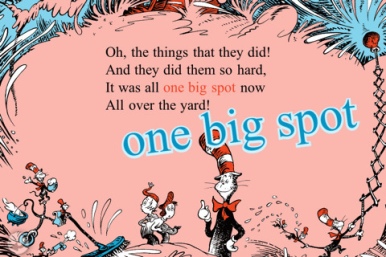
 Like walking on pink snow, I thought, as my feet padded over a bed of petals under a cluster of Kwanzan Flowering Cherry trees. Here in Victoria, we get more pink snow than white; from February until May these blossoms drift in eddies from their fruit tree homes and fall gently to the ground. And then I remembered an old book from my childhood, The Cat in the Hat Comes Back. Sally and her brother were clearing snow outside when the Cat in the Hat ambled by. Even though they remembered the havoc he created in the first book (The Cat in the Hat), they unwisely let him in the house to get out of the cold, where he ate cake in the bathtub, leaving a pink ring. When he tried to clean the bathtub ring, he made things worse: he transferred the pink stain to the mother’s white dress, the father’s shoes, the rug, and the bed. The big Cat asked for help from little cats A, B, and C (who live under his tall hat), but they spread the stain further, onto the white snow outside. You may have read this book, which culminates in “Voom,” an amazing magical cleaning agent under the hat of microscopic cat Z that wiped the snow pure white. But only after all the other 25 alphabet cats plus their leader had transformed the snow into a bubblegum-pink blanket across the yard.
I recalled the book and the image of pink snow not with pleasure, but with disquiet. I realized that when I read that picture book, published the year of my birth, I used to feel not delight but worry. That huge anarchist cat was threatening, not fun or jolly: he initiated chaos. His swirl of pink filth grew unbidden, and I had no control over it. How scary to watch the malevolent pink stain spread like bacteria over everything inside and outside. What a revelation to have bodily sensations—a clenched stomach and light fluttery heart—when I remembered the growing pink stain and my helplessness in the face of it. And then when the problem was solved—voila!—by Voom, again I had no control over that; it was simply something that happened out there in the world. It didn’t matter that order was restored as if the stain had never happened. What I remembered was feeling not relieved, but disturbed and powerless.
As children, we have no control over the big Cats out there—they do crazy stuff and all we can do is feel our fear and anxiety as we watch events unfold. I am reading a book, Call it Sleep (1934) by Henry Roth, that perfectly captures a child’s experience of being swung around like a leaf in a windstorm. As an immigrant Austrian Jew in the Lower East Side of New York City, David is manipulated by other children, criticized and beaten by his father, and abused and chastised by his rabbi, leaving him terrified and untrusting of the world. Only his mother Genya provides solace. Roth’s skill is in bringing us into David’s life so we feel the terror of events and his despairing existence. Once he wanders away from home and gets lost, ending up in the police station among Irish cops:
“He understood it now, understood it all, irrevocably, indelibly. Desolation had fused into a touchstone, a crystalline, bitter, burred reagent that would never be blunted, never dissolved. Trust nothing. Trust nothing. Trust nothing. Wherever you look, never believe. Whatever anything was or did or said, it pretended. Never believe. If you played hide’n’-go-seek, it wasn’t hide’n’-go-seek, it was something else, something sinister. If you played follow the leader, the world turned upside down and an evil face passed through it. Don’t play; never believe.”
Part 2
Recently I rediscovered How to be an Explorer of the World (2008) by Keri Smith on my bookshelf. Smith writes, “at any given moment, no matter where you are, there are hundreds of things around you that are interesting and worth documenting.” I decided to do experiment #33, arrangements, with pink snow. I was interested in pink snow as a thing. There was the idea of pink snow from a children’s book, then there were the pink petals under my feet.
The next day I took my cloth bag to work and gathered handfuls of petals from the ground. They were soft, buttery, and damp. The petals were attached to bits of brown detritus and mixed with long pine needles from a nearby coniferous trees, so I scooped them up all up together. Smith suggests explorers do lots of things with the materials they gather: stretch them out in a long chain, use them to cover a book, freeze them in ice. I did different things with my petals. I shaped them into a circle, a heart, and face. I placed some in a plastic zip-lock bag with purple ink and smooshed the mess onto paper. I placed a handful in a mason jar full of water and kept it for a couple of days. I suspended a round crystal over the mound of petals on my floor. I’m not sure why. . . I was just playing. I realize I have a strong belief in the goodness of play and creativity. And I have a need to play creatively. I used to think that play had to be for something; now I know it doesn’t have to be purposeful. Just play. Just believe.
Now to clean up all the old petals.


 Think (think, think)
 Madeline Ruth Walker