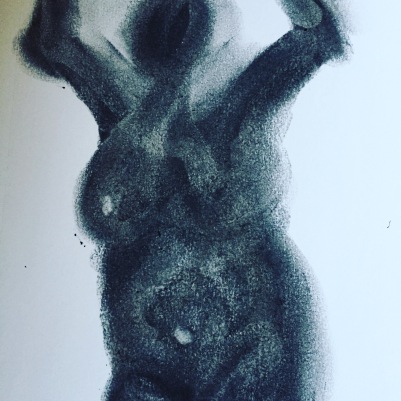
Let me hear your body talk

IMG_1884

A curse and a gift of ageing is a growing awareness of the ways I have been inauthentic in my life. Lately, I have become profoundly aware of the disconnection between my body and my mind.  I have ignored my body for so long, shut it up into submission, taken it for granted. These pronouncements presume a Cartesian dualism, an assumption that mind and body are separate, and though I realize they are not, that is how I have felt in my life—my body and mind feel separate.

Two years ago I started a graphic memoir, Let me hear your body talk. It was my attempt to illustrate the life of my body from infancy to the present day. After a dozen or so pages, I stopped and let the project languish. My reason was that I was too clumsy an artist to render my ideas. But another reason I stopped was that as I worked through my childhood and teenage years, drawing and writing, I felt acutely uncomfortable with how I had regularly ignored my body’s signals. From emotional eating to having sex with somebody who repulsed me, to neglecting pain, to resisting the gut’s intuition. I had abused my body through various compulsions: I was addicted early on to the approval of others, and later to food, cigarettes, and booze. Never having learned how to honour my body as precious, I considered it as merely an appendage to my brain/mind, which I believed was more valuable.

Although I can’t speak for others, my memory is that as a family, we weren’t grounded in our bodies. Moving the body, appreciating the body, enjoying the body, listening to the body: these were not on the agenda when I was a child.  Sports, exercise, or creative body expression were not encouraged or modelled by my parents. Sex was rarely discussed or mentioned, though it might have been alluded to. When I took up running in my late thirties, my mother commented, “You’re not overweight, so why? It can’t be good for you, jiggling around like that.” I suppose when I was very young, I lived shamelessly and happily in my skin, but I cannot remember. In our family, intellect was prized above all.

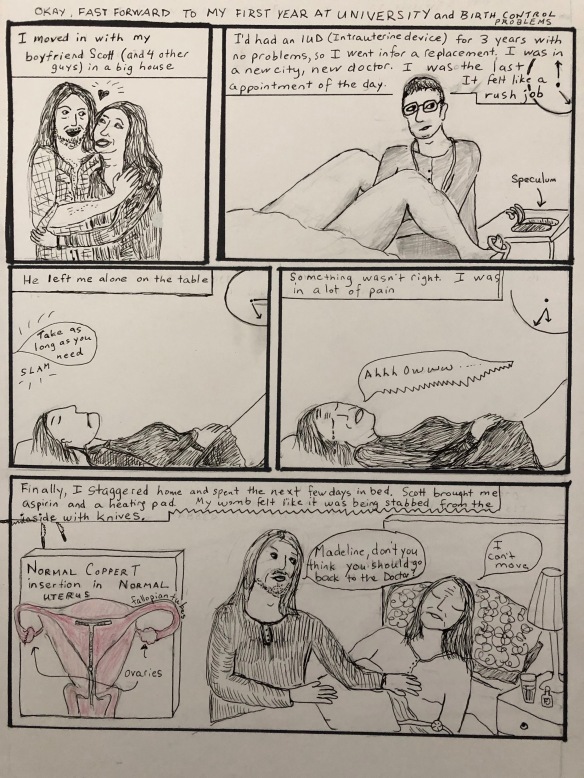
Of course, this is not to suggest my body has not been a source of bliss.  Sex can be rapturous. . . the ruminating mind dissolves as every nerve ending sparkles and shimmers. Being pregnant, giving birth, breastfeeding: all gave me tremendous pleasure/transcendent pain and left me with gratitude, love, and respect for my body and its capacity. But as the excerpt from my memoir shows, as a young woman I tuned out my body’s sensations and needs.  My people-pleasing antennae were turned way up; I wanted not to be a problem to others, so I suffered, often silently. I wanted to please the man I was with; my pleasure was secondary.
IMG_0054IMG_0052 4

These days, I meditate daily. Although my thoughts quiet for minutes at a time, I still haven’t felt fully connected to my body. Looking to change this, I bought Reggie Ray’s book, The Awakening Body on somatic meditation. Ray provides instructions on six somatic meditations. One resonated more than the others: yin breathing. “The place of yin is in the lower belly, approximately a couple of inches below the navel and in about the middle of the body. . . In Taoist meditation, this place in the lower belly is known as the lower dan t’ien” (p. 67).  Ray goes on to write that the lower dan t’ien’s role in the body “is the inner expression of the fundamental space of the cosmos, the original womb out of which all energy and life arise. It is the microcosmic expression of the same limitless reality we meet ‘outside’ in the earth at its infinite depth.” The concept of the “original womb” may sound inflated or unbelievable, and yet I immediately understood this concept because I had experienced the yin space before.

A few years ago, I had felt this space, an oval the size of a duck’s egg located about three inches below the navel, as a mysterious source of deep pleasure. At that time, I welcomed it, but I didn’t understand it. It would come to me late at night as I was drifting off to sleep, a pulsing sense of well-being in my whole body, but originating there at the body’s root—tingling pleasure that was not exactly sexual. A radiating pleasure-consciousness that felt rooted, centred, yet expansive. It’s hard to explain. As I said, it’s mysterious.

Lately, I have been doing yin breathing, breathing in and out through the lower dan t’ien and thereby, “roaming on the boundary between consciousness (the ego domain) and the unconscious (the deep Soma).  As a result, my body consciousness may be shifting. Recently, we  went to hear live jazz, the Amina Figarova Sextet, and I enjoyed music more than ever before. Instead of listening in my head, my whole body heard and felt. I enter the piano’s thrum, the saxophone’s sugarplum melodies, the drum’s silvery beats; I swallow the flute’s shivers and I become the tall brown bass, plucked.  My body is a repository for sound and I can’t help but move to the rhythms. I fill with jazz colours, jazz feelings. Body and mind are one. Feels so good.


Not getting there

What I wanted
was the walking, not the walking-to but
the not-getting-there, the every moment
starting out, the every moment
being lifted in an arc against the moment of arrival: the anticipation
is terrific, yet always nothing
happens when I’m there

From Cashion Bridge by Jan Zwicky

Last week I set myself a task—to write six “columns” over six weeks, each prompted by a line or lines from a poem I picked at random from a book of poems I picked at random from our bookshelves . . . .

It sounded so fun and inspirational at the time.

All week I struggled with you might call writer’s block, though the term seems inaccurate. It was more like writer’s doubt. I doubted everything I wrote and thought. First, I worried I might misrepresent the lines from Zwicky’s brilliant poem, even though I told myself the line I chose (“What I wanted/was the walking, not the walking-to but/ the not-getting-there”) was merely a diving board into other waters, my own waters.  Then I worried about the substance of what I was writing—it seemed superficial. An old question that regularly haunts me returned, “why does it even matter?”

I also had second thoughts about the idea of a column. What is a “column” anyway? How could I differentiate my regular personal essay blogposts from a series of columns? It turns out I couldn’t really find a distinction, so I wondered at my original purpose.  Perhaps I just wanted the discipline of writing a post a week for six weeks, and the poem prompts were a fun and beautiful way to provide a way to get going.  Well that just started to freak me out: How could I sustain this weekly posting? I am used to posting every once in a while, when the spirit moves me.

Michael’s meditation teacher has told him over and over again, “Don’t make a project out of it.” It can be anything—watching a TV series, taking up a cause, daily meditation, making art. Don’t make a project out of it.  And I was making a project out of the columns. I even called it “The Six Column Project.” When I make a project out something, it becomes difficult. It’s not fun anymore because it’s loaded with expectations and hidden pressures. Ultimately undoable.  As soon as I release the idea of a “project” and the timeline (why produce a post weekly when I am not actually a weekly columnist?), I am released into to the creative ether. I grow wings. So I will continue to write blogposts, probably not weekly, but when the spirit moves me. And I like the idea of using those lines from random poems as prompts—I may continue with that for awhile.

In the meantime, I squeezed out a couple of paragraphs this week inspired by Zwicky’s “not-getting-there.”

Walking meditation is all about not-getting-there. There is nowhere to get to.  When I was first taught this practice, our teacher told us to imagine the snow lion padding joyfully through the highland meadows.  He used his hand to show us the wavy motion of a soft heel/paw strike followed by the rest of the foot coming down on earth as if caressing the ground. We attend to our feet making contact with the floor as we circle the big bright shrine room, light tumbling through the tall windows. My foot slowly arches, each deliberate step on the wooden floors sending a flood of warm energy up my legs.  Measured paces around and around, like the snow lion treading lightly in the high mountain meadow, surrounded by wildflowers.

IMG_3473

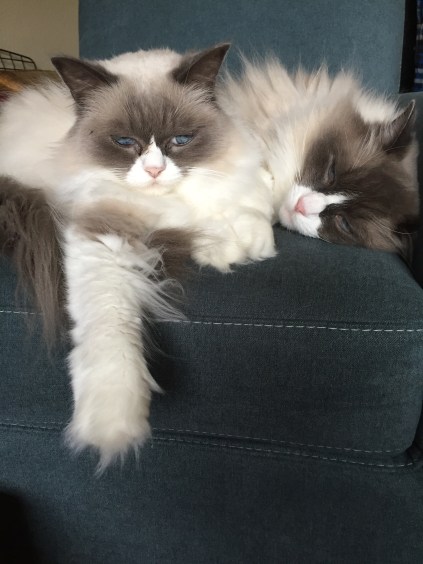
Joy and Andy

The snow lion image puts me in mind of our two cats, who wander aimlessly around our house.  Sometimes they have purpose—food bowl or litter box—but mostly it’s a long ramble through the rooms, not getting anywhere in particular, stopping here, sleeping there. Joy, the smaller one, will occasionally stop and extend one of her front legs in an arabesque. She is a feline ballerina.  

*  *  *

It occurs to me that I did quite well at writing a column about not getting there because this post has been all about how I didn’t get there (“there” being the column project). So in failure I have succeeded.

IMG_0039

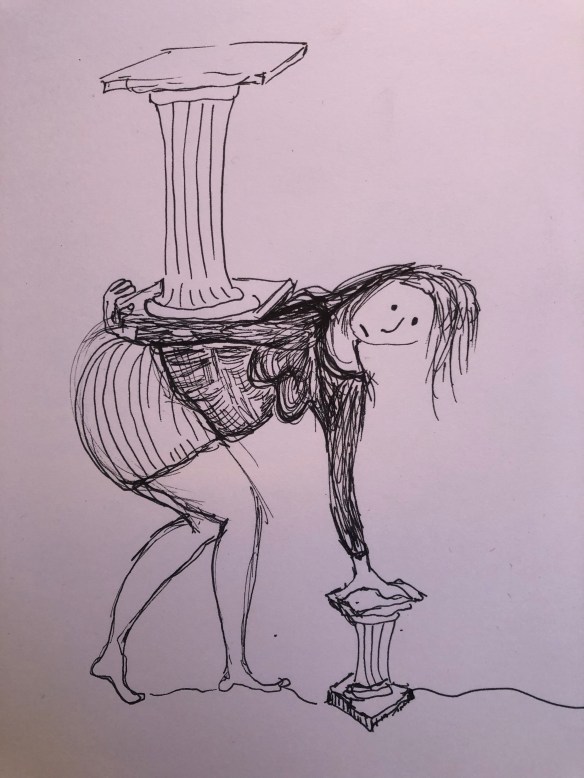
I wanted to master the column, but the column mastered me.

The six column project

By Madeline

As I get older I think of paths not taken. For example, in my twenties, I dreamed of writing a weekly column for a big paper. In the 1980s, I devoured film critic Liam Lacey’s articles in the Globe and Mail, loving his clever analysis and enormous vocabulary. Now I look forward to reading columns by Ian Brown and Elizabeth Renzetti in the same paper. To be a columnist means that not only do you write for eager readers, but also you are constrained—beautifully constrained because the deadline makes you work hard and generate ideas and heat up with fecund energy (at least this is my fantasy). None of the passive doodling that writing becomes when there is no real audience, no real deadline. Too much of that kind of writing and my creative spirit retreats and shrivels.

IMG_0033 2

My creative spirit when she goes into hiding…(image by Ugo Fontana)

So, I thought, why can’t I pretend I have my own column? You are reading this right now: Will you be my audience? I will set myself some constraints: six “columns” in six weeks. Then, lying in bed unable to sleep the other night, I wrestled with content. What will the columns be about? After mulling over this for some time and writing scraps of ideas on bits of paper in the pitch black so as not to wake Michael, I thought of poetry. I will take ten books of poetry off our shelves—no thinking, just the first ten I come across.  Shut my eyes and open each book and place a book mark in that page. Then I have a bit of choice; from each of those ten open pages, I will choose a lines or series of lines or a stanza (whatever makes sense).  Those lines then will become the pool I will choose from for the six columns. Those lines will be the titles that suggest ideas or themes for writing. I won’t necessarily write about the poem or poet or even poetry. . . the line or line will be a springboard for ideas, generating who knows what? That is the exciting part. Anything might come up!

Other constraints:  each column must be 500 to 750 words and accompanied by a sketch or image  created by me. My hope is that weekly deadlines will banish preciousness and perfectionism.

Playfulness comes in the midst of what feels like gruelling work: I am preparing to teach technical writing again in September. And I have taken on an editing contract. In the midst of preparing and planning, creativity bursts forth, a project is born. Something wants to be written, but it doesn’t know yet what it is.   Inspire me, poets.

Expect the first column in one week, based on these lines from Jan Zwicky’s “Cashion Bridge”:

janzwicky

Pamela gave me this precious book for my 60th birthday


“What I wanted
was the walking, not the walking-to but
the not-getting-there, the every moment
starting out, the every moment
being lifted in an arc against the moment of arrival: the anticipation
is terrific, yet always nothing
happens when I’m there”


P.S. Yesterday, when I heard that Toni Morrison had died, I felt both sadness and gratitude. Sadness that we have lost such a star and gratitude for her immeasurable contribution to American life and letters. She was a great artist, thinker, humanitarian, and activist. I had the privilege of teaching her novel Beloved more than once to undergraduate students (and it took me several reads to understand it—it is so rich). I can’t believe that at first I rejected it, saying “I don’t like ghost stories.” Whew–how ridiculously rigid I was! Thank goodness inspiring teachers helped open my mind.

I also chose to teach The Bluest Eye and Song of Solomon, both amazing in very different ways.  Paradise is another gem, and her literary theory book, Playing in the Dark: Whiteness and the Literary Imagination (1993) is insightful and startling, even today. Through her evocative, deeply-felt stories, I learned about endemic racism, the horror of slavery, and the African-American experience better than I ever could via history and non-fiction books.  Some lines from Beloved will always stay with me. At the end of the novel, Paul D. tries to explain to Sethe his feelings about her, so he recalls what Sixo said about the Thirty-Mile Woman: “She is a friend of my mind. She gather me, man. The pieces I am, she gather them and give them back to me in all the right order. It’s good, you know, when you got a woman who is a friend of your mind.” I just found out there is a documentary about Morrison titled “The Pieces I Am.” That line from Beloved, then, has clearly touched many hearts.  Good-bye beloved Toni Morrison (Chloe Wofford).

P.P.S. Thank you so much for all of your encouragement and comments on the travel blogposts that Michael and I wrote.  We loved hearing from you, and Michael enjoyed the experience so much, he is thinking of starting his own blog. I’ll let you know when he does. xoxox