Full Time, A Short Story

Last year, Benji was hit by a car. He was Alma’s last cat of the dozen that graced her long life. I heard the thud as I sat sewing at the bay window. When I looked up, Benji lay crumpled on the street and no car in sight. Some asshole hit him and drove off. I threw down my sewing and ran into the street, grabbing my shawl on the way. He was still alive, making a peculiar huffing noise, blood trickling from his jaw that looked all crooked. 

Oh no, this will destroy Alma. I scooped his light body up from the pavement and cradled him in the shawl. When I knocked at Alma’s door, it took a while for her to open it. Her eyesight wasn’t the best, so at first, I think she thought I was bringing her a loaf of my sourdough, wrapped in a kitchen towel. But soon she realized what was in my arms and began to cry.

Alma, we’ll can take him to Peter right away. Our healer Peter lives in a cottage just around the corner. Get in my sidecar, I told her, and I’ll hand Benji to you. Her crying had evolved into low keening. I dropped her purple cape over her shoulders, and she slipped on her sandals. I opened the door of the sidecar attached to my bike, and she slid into the seat, creakily, and held her arms open as if to take a baby. Benji was her baby—a cat she’d coddled and loved since he was a feral kitten, discovered in the old shed behind my cottage with three litter mates. We figured the mother had been killed by a car or racoon. The kittens were starving. We found homes for them, all but one. Alma had been without a cat for almost a year then, and when she saw little squirming Benji, she said she had to have him. Or he had to have her. 

She fed him with an eyedropper for weeks and carried him close to her warm, wrinkled breast in a sling she asked me to sew for her. I made the sling with indigo cloth I had left over after making Peter’s shirt. Alma was a sight to behold, walking slowly to the corner store with her shopping cart, the sling around her front, a tiny feline face peeping from the folds of blue cloth. 

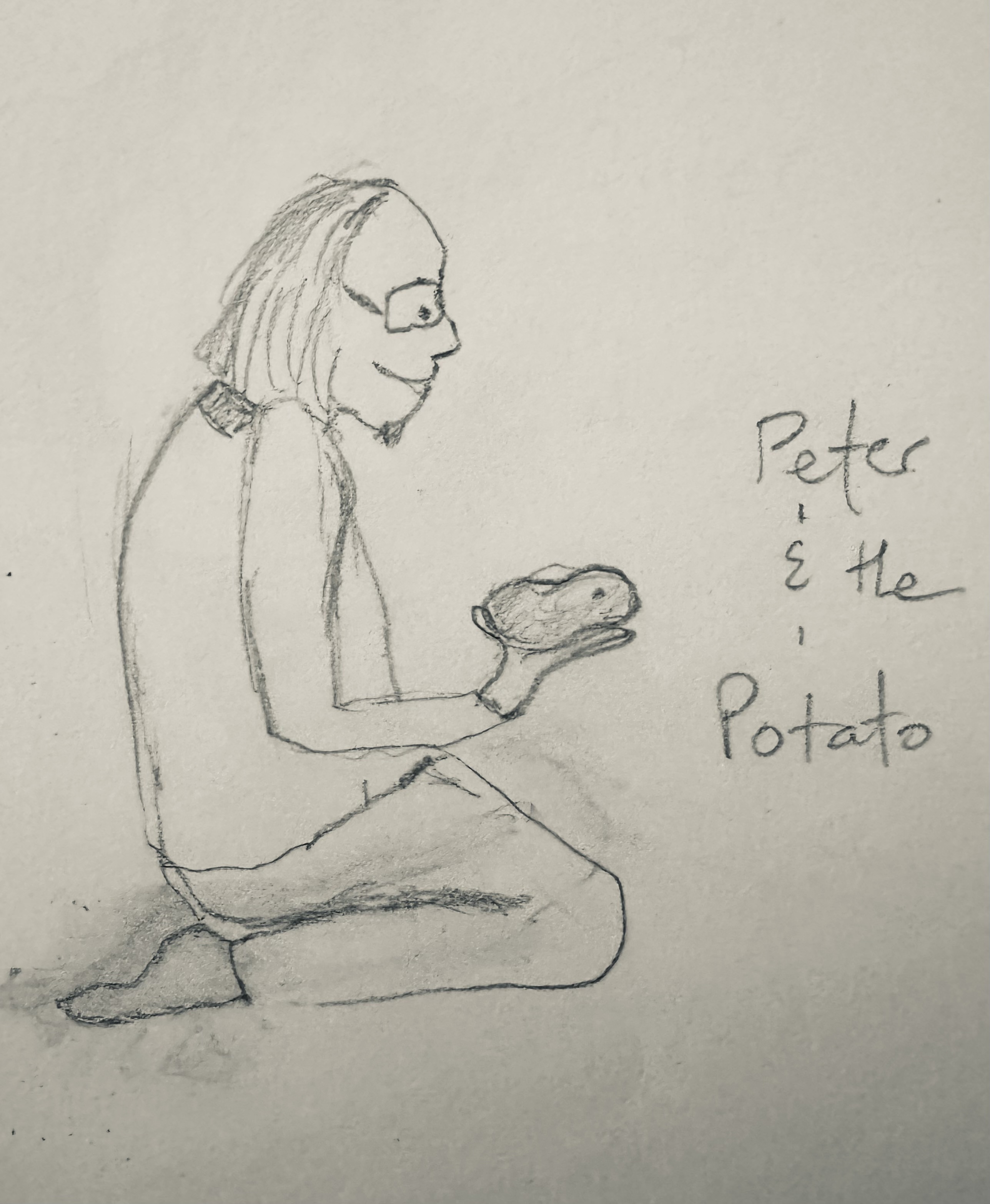
Oh Benji, Benji. Out of my peripheral vision, I could see Alma bent deep over his little body as I pumped the bike, swooshing down the road and around the corner. It took us only a minute to get to Peter’s. We knocked on the door, no answer, so I figured he was in the garden. We trod the narrow path beside the cottage. His back was to us as he sat on his haunches, examining a potato he had just dug from the soil. I looked fondly at the blue indigo cloth straining across the breadth of his back, a breadth of skin and warm muscle I had run my hands over just last night. My knees trembled with desire as I approached him with Benji now in my arms, Alma hobbling behind me. 

An hour later, we sat in Peter’s front room on low velvet couches, drinking jasmine tea. Alma was holding a lifeless Benji in her lap. Peter had determined the injuries too severe to save him, so he’d administered a lethal drug in a long needle while Alma stroked the fur, matted with blood. Now, Benji looked so peaceful, curled up in my red wool shawl, Alma’s hand under his little skull. 

Neither love nor money will persuade me to ever get another cat, Alma said, her voice soft and sad. She’d stretched her stick-thin legs out before her. Alma liked to wear sandals most of the year, except when it snowed, liked her feet to feel the air, and today I could see her thick greenish toenails and large bunions up close. She was terribly old.

Peter heaved a great sigh. Benji was a fine cat, he said. We had all loved Benji’s antics. He’d dance like Baryshnikov, trying to swat the clouds of gnats that floated above the garden beds in summer. His meow was a sweet question mark, meaow? And if you were lucky enough to hold him in your lap, you were blessed with a vibrational purr that set your thighs buzzing. A deep warmth and contentment emanated from his slight, stripey body. We all loved Benji. 

Peter sighed again, shaking his head at the loss. We came to Peter with our sick and injured pets and even, sometimes, with our own ailments. His stinging nettle tonic has reduced my hay fever. His black cohosh tea has helped women all over our neighbourhood with menopause. Peter is not just a skilled herbalist. His magic hands can make me come just by stroking my breasts.
Several weeks after Benji died, a sunny June Saturday, I was at a yard sale with Alma. On summer weekends, Alma and I did the yard sale circuit together on my bike. I pedaled, and she rode sidecar. She has a thing for small dishes, tiny saucers and bowls, sized for fairies. I like to collect children’s books. I don’t have children, and I never will have. I’m fifty this year, but nonetheless I’m charmed by simple stories and illustrations. I would rather read three or four children’s books to myself at bedtime than a novel filled with crime, sex, mystery, and drama. 

A book caught my eye, titled Part-time Dog. I opened the cover to the copyright page to check the publication year, 1965. I always do that first because I prefer old books. They provide the most comfort. I bought it, along with several others, two dollars for the lot. Alma found a gold rimmed bowl decorated with an image of two goldfish. Later, we had dinner at my place—a big salad and thick slices of my sourdough. After dinner I gave Alma a framed photograph of Benji dancing in the garden that I’d taken the year before. I’d caught him with both paws in the air, his golden eyes glittering with excitement. One small foot was off the ground as he leapt. The sun played over his orange and brown stripes, and the patch of white on his face made him look almost human. When Alma saw it, tears rolled down her wrinkly face. I moved next to her on the couch and put my arm around her. Not for the first time, Alma said that neither love nor money would persuade her to get another cat. Benji was the best and the last.  

That night after Alma left, Peter slipped in my back door, and we made love silently. Through the open window, we heard whoo-hoo from the owl in the tall pine. I felt us smile in unison. What if this life was an illusion? What if I were a character in a children’s story about a happy seamstress and her herbalist? After Peter left, I lay in my narrow bed with the stack of new-to-me children’s books on the bedside table. Part-time Dog was on top, so I started with that.  

Brownie is a small stray dog who shows up in the neighbourhood. He starts walking with the children to school, accompanies Mrs. Butterworth to the bank and watches Mrs. Tweedy rake the leaves in her yard. But he has no home, nowhere to go at night, so he sleeps under someone’s porch. Three women in the neighbourhood decide to adopt Brownie. It would be too much work for one of them to have him all the time. So, one gives him breakfast and keeps him in the morning, one has him in the afternoon and gives him his dinner, and another has Brownie every night, where he sleeps in his warm bed, safe and sound. I liked the book so much, I read it again, then fell asleep, dreaming of a little brown dog curled up at my feet. 

In September, Peter noticed a white cat in his garden, sleeping on a warm stone, and he scratched her chin and stroked her, gave her some salmon he was cooking for lunch, and then asked around the neighbourhood. Nobody knew anything about her. She was a short-haired female with one blue eye and one golden, and he named her Nia. Peter worried he’d be taking her from her family, but still, nobody claimed her. 

She claimed us, wandering back and forth from my cottage to Peter’s. When Peter gardened, she stayed close to his side, and when I sewed, she spread out on the table next to me, her purr matching the vibration of the sewing machine. And though Alma said she’d not have another cat for love nor money, there were many nights when Nia wandered into her cottage and curled up on her bed.

Christmas was simple and good. Alma, Peter, and Nia came to my cottage. We had a stew made with pumpkin from the garden and my sourdough bread. For dessert, Peter brought an apple cranberry pie he’d baked. We walked Alma home, then we went to Peter’s cottage because his bed is bigger than mine. I stayed all night.  When I got up, Nia was nowhere to be found. After we drank our coffee, Peter went and called for the cat, but she didn’t come running, her white tail twitching and her little bell tinkling, as she usually did. Frost painted the windows white, and a crust of ice capped the blue bowl of water we kept outside for her. We went to my cottage next, but Nia wasn’t there. At Alma’s, we knocked at the door. No answer, so Peter opened it gingerly, and we called through. Silence. We walked to the back, to Alma’s bedroom, where she lay peacefully, her long white hair flowing out around her across the dark pillowcase, eyes closed in her wrinkled brown face. We knew her life was over. Nia lay at Alma’s feet, purring deep and low. 

Later when we cleaned Alma’s cottage and found a copy of her last will and testament, we discovered she’d left the cottage to both of us. When Peter asked me to marry him in the spring, I said yes, you make me happy. But there’s one condition. Let’s keep things as they are. 

We sleep sometimes at my place, sometimes at Peter’s, and other times at Alma’s. We kept things the same. The blue sling that kept Benji close to Alma’s chest hangs on the hook near the door, the framed photograph of him on the living room wall. The tiny dishes, neatly arranged, are displayed the way Alma liked them, on open shelves in the kitchen. Nia wanders from one cottage to the other to the other. She knows that food, water, and love are everywhere.

Note: Part-time Dog is a book I read to my children by Jane Thayer, pictures by Seymour Fleishman

Throttle down

After my third accident, I decided throttles are my nemesis. First time was on my scooter, second and third times on my e-bike. Originally, my Marin Fairfax bike was not electric–just human powered. Last year, I had a Bafang motor installed to make commuting easier. But I didn’t expect to get a throttle with the install—it just “came with,” and I didn’t question it. After riding the bike for a while and experimenting with the throttle, I thought, this is too much and I don’t really need it. Five levels of assist are more than enough. Nonetheless, I started to depend on the throttle. It was like touching a magic wand to create delicious bursts of power that eased me into motion after a stop, pulled me up the steep hills, glided me along without pedalling.

On the day of the Pride Parade, I set out early for Douglas Street to capture a good spot to watch. Riding up and over the bridge, I slowed down to observe a great cloud of bright balloons approaching from the other side. After a few moments, I pressed my throttle to get a move on. What happened next was so fast and unexpected, I hardly know how to describe it. I hadn’t noticed that one of my handlebars had gotten tucked under a bridge railing. When I throttled, the bike jumped with a life of its own, and the seat swivelled, hitting me hard in the upper thigh. Suddenly, I was on the ground, the bike on top of me, with blood flowing from cuts on my hands. My thigh pulsed with pain. A couple stopped to help me up and righted my bike. Somehow, I got to the parade and watched for a while, but then realized I was in shock. Nothing an extra hot latté at Habit Coffee couldn’t cure. 

But seriously, the eggplant and banana bruise on my thigh was ugly and tender, and I limped for a few days. It took some time for the bruises to go away, the cuts to heal, and for my thinking to coalesce around throttles and what they mean. 

CHEK’s Tess van Straaten co-hosted the Pride Parade broadcast with local drag queen Gouda Gabor

In 2012, I bought a 50 cc scooter. So cute and fun! I loved it. But again, the throttle. I was on my way home from work in backed up traffic, daydreaming. Suddenly, I realized the car ahead of me had started moving a few moments before, and to catch up, I hit the throttle. But my wheel was turned, and the machine jumped. I was thrown to the ground, the scooter on top of me. I stopped traffic that day, ended up at the hospital, and received a sling and advice to keep my fractured arm quiet for several weeks. Shaken by the accident, I sold my scooter soon after that.

My beautiful scooter and me

Then there was the other e-bike incident when I throttled my bike on a gravel path. Big mistake. Again, I ended up flat out on the ground, bruised and shaky, with the bike on top of me. 

Throttle is a noun signifying the device controlling the flow of power to an engine. Also, it’s a verb: you throttle the throttle or (second meaning) you choke or strangle somebody. I started to think of how I might be using the throttle too much on my bike and in my life. I throttle to get the extra boost I think I need. Usually, I throttle without thinking, and then I run into trouble. But if I were to insert a pause, I might realize I don’t need the throttle. Throttling chokes my life. Increasingly, to throttle (act precipitously, riding a burst of power) leads me into discordant situations that I regret getting into. Doing the unnecessary thing, saying the wrong words.

Perhaps I’d be better off if my e-bike didn’t have a throttle at all. But still, I’d be throttling my life. I reflected on ways to stop doing this. Perhaps one of these will resonate with you: 

  • Don’t respond immediately to email or texts. Stop and think. What’s my responsibility here? Is what I am writing useful, timely, kind, necessary?
  • Don’t jump from one activity to another. You might like to pause for a moment and ask, “How do I feel now? What do I need?”
  • Stop manufacturing energy you don’t have. Don’t do that “one extra thing.” Just don’t.
  • Doing stuff is overrated. What about doing nothing? There is plummy goodness in sitting and observing life, engaging all senses.
  • And related to the last point, think about Rick Hanson’s “Taking in the Good” program in Hardwiring Happiness. (I recommend this book!) HEAL is an acronym for four steps: Have a positive experience. Enrich it by exploring all its crevices and beauties. Absorb it fully into your body and mind. Link it with negative experiences so when they arise, you rewire your negatives with positives.

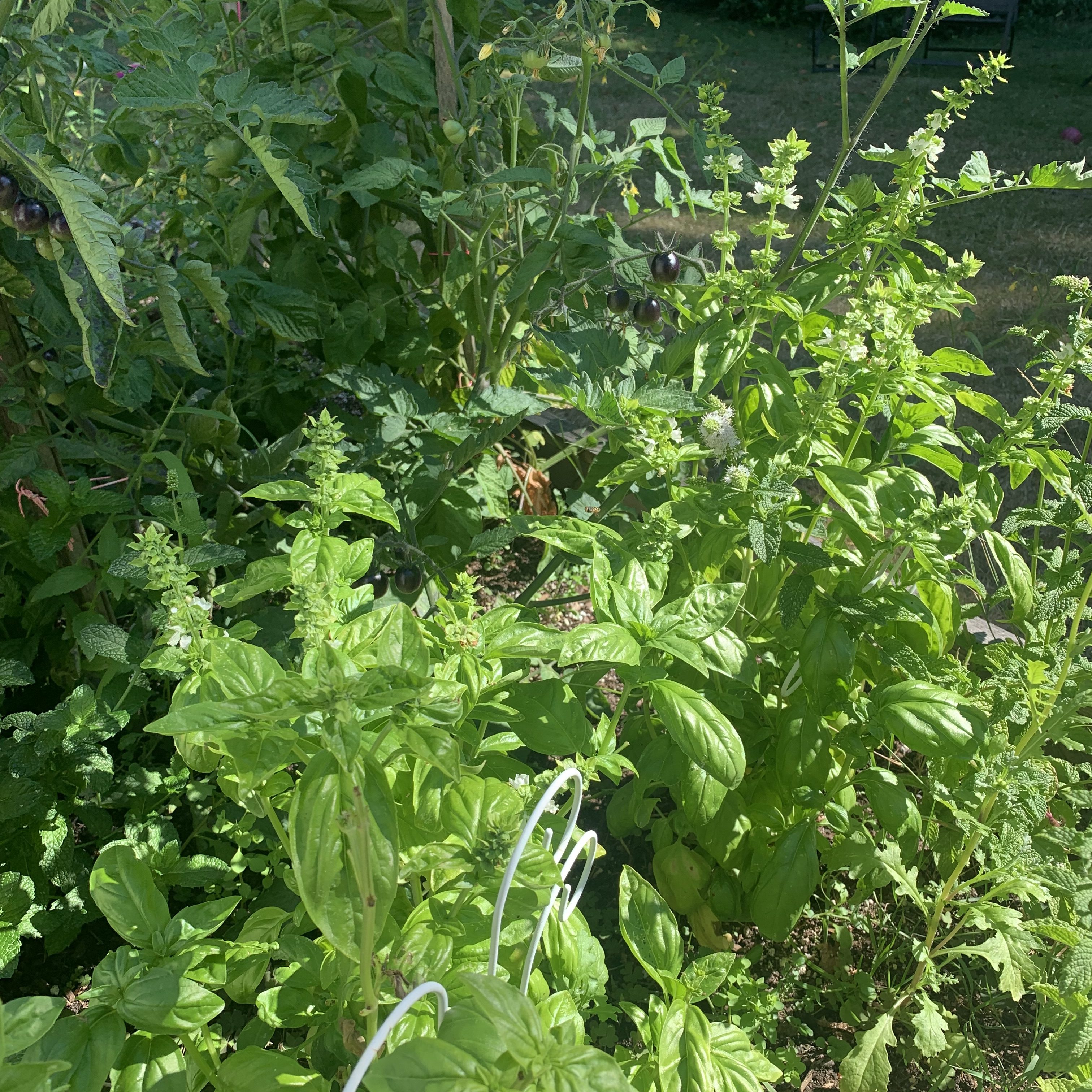
This afternoon, I sat in the sun reading a wonderful book I got out of the library, Country of the Blind: A Memoir at the End of Sight, by Andrew Leland. He writes with candour about his experience of slowly going blind from Retinitus Pigmentosa. I am learning so much about blindness and disability in general. Marvin, our dog, lay near me on the browning grass, contentedly chewing a stick. I sipped from a glass of sparkling water, a lemon sliver among the bubbles. Leland’s prose struck me as honest and evocative; I absorbed his words with delight, laughing occasionally at the stories he told about his two-week experience at the Colorado Center for the Blind. The sun felt restorative. Sounds of the neighbourhood on a summer weekday floated over the yard. The occasional yelp from a dog, somebody’s car radio—the cheesy song “In the Summertime” by Mungo Jerry coming in and out of aural focus—the guy who lives behind us directing somebody in a high, bossy voice about how to find something. “It’s in the back of the cupboard—you really have to search for it.” I could smell the mint and basil in the garden box at my elbow, filling my head with spicy green. My whole body flushed with well-being and pleasure. Throttle down.


Moving through fear

Lit from within is the sole secure way
to traverse dark matter. Some life forms —
certain mushrooms, snails, jellyfish, worms —
glow bioluminescent, and people as well; we
emit infrared light from our most lucent selves.
Our tragedy is we can’t see it.

From Robin Morgan’s “The Ghost Light”

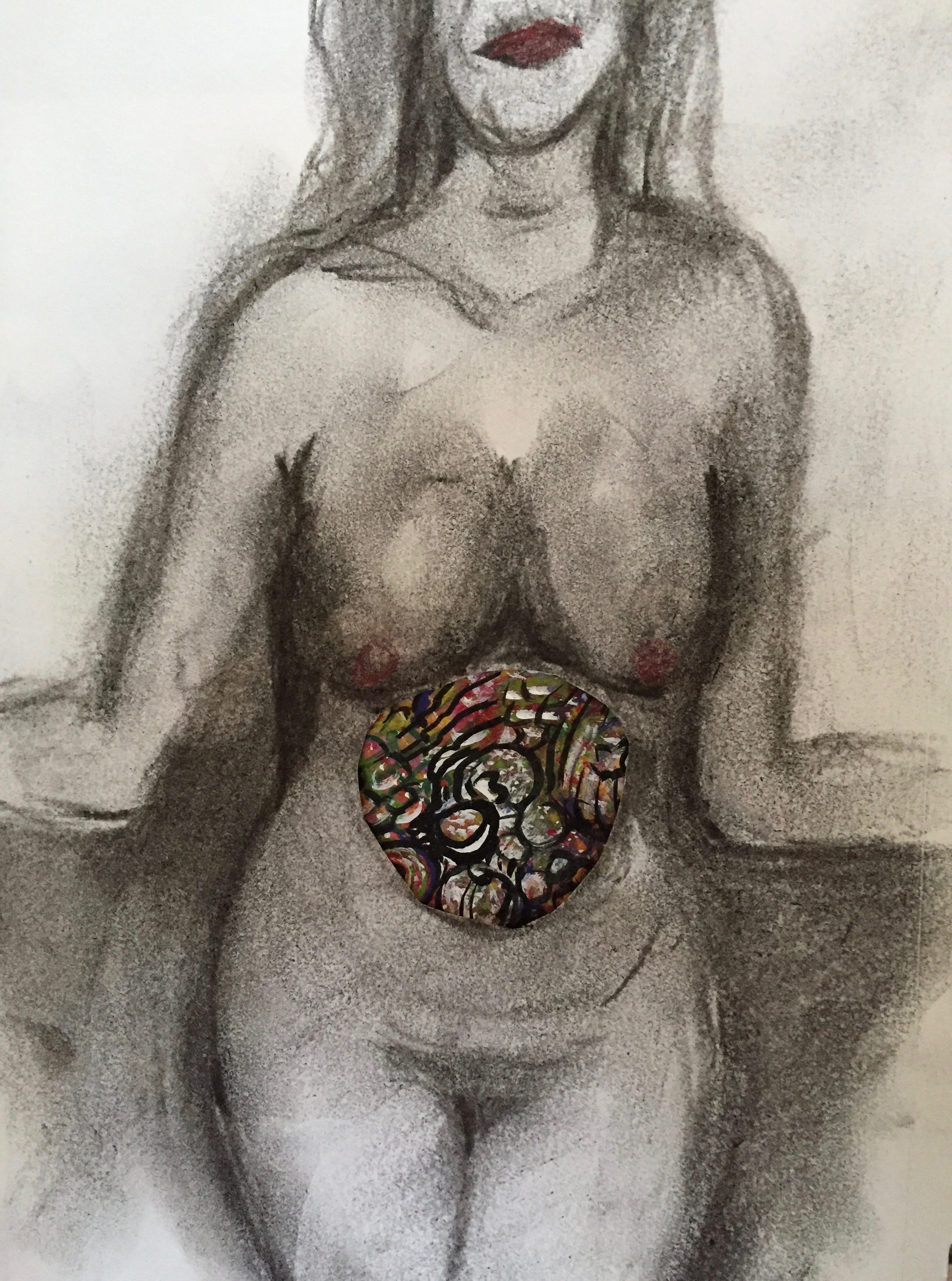
As I get older, I am scared to do new things. Sometimes fear sucks the life and juice out of my plans and ideas, drying them in my solar plexus where they rattle around for months, even years. I can feel one or two in there now.  Those husks are like the bone-and-fur pellets—all that remains of their prey—that owls disgorge in the night. But the good news is that when I walk through fear, my plans and ideas can be reconstituted.

For over a year, I contemplated the bike racks on Victoria’s BC Transit buses.  I’d watch a nimble cyclist enter the space in front of a bus, pull down the rack, and lift her bicycle up and into the metal grooves. Her quick hand motion somehow moved a slender, rubber-clad arm up and over the front wheel. There seemed to be some mysterious communication pass between the driver and the cyclist both when the cyclist secured the bike and again when she removed it at her destination. How could I ever hope to know what was going on there? And with such weak arms, how could I possibly lift my bike onto the rack, place the wheels precisely into the grooves? Hopeless.

But I wanted to. Dusk begins before 5 p.m. these days, and I don’t want to ride home in the dark. But the mornings—well the sunrises are spectacular on the commute to work, streets frost-rimed and crisp as my wheels spin down the pavement. Smoky red-violet light blooms in the sky, heralding the sun’s bright burst of glory.  And it’s good exercise, my 45 minute commute, exercise I need. Another selling point: The Galloping Goose and Lochside trails have few riders this time of year.  Wouldn’t it be nice to ride to work in the morning and at the end of the day, pop the bike onto the rack and relax on the bus ride home, watching colourful Christmas lights slide by?

Feeling scared, I procrastinated. I didn’t know how to do it, wasn’t part of the bike rack club, one of the initiated. The bus driver would get annoyed with me. Other riders would feel irritated by my clumsiness. What if I did it wrong and my bike flew off the bus and caused an accident? Oh and the rack would probably already be taken up by other bicycles. Then what?  The list of fears and reasons not to act went on and on, dehydrating my plan until it was just a dry pellet.

One day I’d had just enough of myself, of the dry fear pellet knocking around my middle. I watched the video on BC Transit’s website on how to use the bike racks, then walked my bike over to the bus stop after work. I was lucky that an acquaintance of mine happened to be in the line-up, a philosophy student I’d coached. So I told her about my fear, and she admitted to also feeling paralyzed at the thought of doing new things. I felt less alone.  We chatted and I forgot to be scared.

When the bus arrived, I stepped in front of it and pulled the bike rack down. Just as I had imagined, I found it hard to hold my bike up and away from my body, then navigate its wheels into the grooves. I faltered a couple of times, almost dropping it. A young woman waiting for another bus saw what was happening and came quickly to my side. She helped me manoeuvre the wheels into the spaces, then showed me how to pull the locking bar out and over the wheel, how to test that it was secure.  When I got on the bus, the driver instructed me to give him some notice before my stop. I felt relieved.

I chatted with my philosophy acquaintance about C.S. Lewis and the four loves, about religion and being brought up as atheists—an experience we shared, about Iris Murdoch, and about marking papers. Such a delightful opportunity to discuss ideas and feelings.  Occasionally, I’d look up and see my handlebars through the front window and feel a ping of pleasure. I did it!  When I got off the bus and removed the bike, I flipped the rack up, made eye contact with the driver and gave him a thumb’s up as I moved out of the way. He nodded at me.  I was initiated.

The second time was a little easier—again, someone came to my aid when I faltered. (Oh, the kindness of strangers!) Third time was smooth; I needed no assistance, felt confident. Fourth time, I felt like an old hand, like I’d been doing this forever, what was ever the problem?

Fifth time I had to take the bus both to and from work because my tire deflated 10 minutes into my ride. The tires on this new bike of mine have Presta valves, and I was used to Schrader. I hadn’t paid full attention when Michael showed me how to use the pump on my tires. So when I inflated the back tire because it was feeling soft, I forgot to screw the little nut clockwise on the valve, and the air slowly leaked out as I rode.  When I noticed I was riding on a flat, I said to myself, no problem—I’ll take the bus.

After the workday, I put my bike on the bus home, and the friendly driver commented, “nice bike.”  I agreed it was a great bicycle. Then I mentioned my problem that morning with the deflated tire.  I took a seat near the front and fell into a reverie. After a while, the driver pulled to a stop to let some passengers on, and a big truck swiped the bus, cracking the side mirror. The driver was shaken up, and he announced to us that he’d do his best to fix the mirror with a rubber band, but he wasn’t sure it would hold and we may have to get off and wait for the next bus.

The rubber band held for about seven stops, keeping the glass fragments in their frame.  But then the driver, a kind and patient guy in his fifties, stopped again and announced that the rubber band had snapped, and he’d have to find some kind of replacement. He was pretty upbeat about it—not defeated yet.

“What do you need?” I asked. “Maybe I have something in my purse.”  “Well as a matter of fact,” he smiled, “I’ve been eyeing that bungee cord you’ve got on your bike basket. That would be perfect.” “Oh, that’s a great solution. Take it—it’s yours!” He removed the cord that I keep strapped onto my bike’s wire basket and wrapped it around the mirror until the glass shards, like puzzle pieces, were secure again in their frame.  “Perfect,” he said as he came in from the cold and closed the doors. “We’re legal.”

As I got ready to get off the bus, he thanked me for the bungee cord.  “Hey, if you hadn’t had the problem with your tire deflating this morning, you wouldn’t be here now giving me the bungee cord. You saved the day!” I smiled at him and waved at the passengers. They waved back and a few called out their thanks.  My bungee cord had helped them avoid a long delay in their travels home.

These days, fear seems to loom large over small things, things like putting a bike on a bus rack. But when I go forward and just do those things I fear doing, in the

IMG_3463 2

“where fear lives/lit from within”

words of Robin Morgan, I feel lit from within. I come forward, out of my safe cocoon. I engage with people—kind strangers, grateful passengers, and a gentle bus driver.  I engage with life.

Note on the illustration:  Credit to Nathaniel Churchill (thanks, Nat). I used one of his paintings behind the cutout in my sketch.  It occurred to me that this piece illustrates not only fear-pellets in the solar plexus, but it can also be interpreted as the experience of feeling “lit from within.”  Life is full of paradoxes.